
India Sustainable Finance Market Size, Share, Trends and Forecast by Investment Type, Transaction Type, Industry Vertical, and Region, 2026-2034
India Sustainable Finance Market Size, Share, Trends & Forecast (2026-2034)
The India sustainable finance market grew from USD 653.8 Billion in 2025 to USD 748.2 Billion in 2026 and is projected to reach USD 2,420.6 Billion by 2034, growing at a CAGR of 14.44% during 2026-2034. Government policies and ESG regulations are positively influencing the market. Rising green bonds and loans, increased investor demand, and international funding are accelerating India's shift towards a low-carbon economy. Fixed Income dominates investment type at 46.8%, Green Bond leads transaction type at 58.4%, and West India commands the largest regional share at 32.5%.
Market Snapshot
|
Metric |
Value |
|
Base Year Market Size (2025) |
USD 653.8 Billion |
|
Market Size (2026) |
USD 748.2 Billion |
|
Forecast Market Size (2034) |
USD 2,420.6 Billion |
|
CAGR (2026-2034) |
14.44% |
|
Base Year |
2025 |
|
Historical Period |
2020-2025 |
|
Forecast Period |
2026-2034 |
|
Dominant Investment Type |
Fixed Income (46.8%, 2025) |
|
Dominant Transaction Type |
Green Bond (58.4%, 2025) |
|
Leading Region |
West India (32.5%, 2025) |
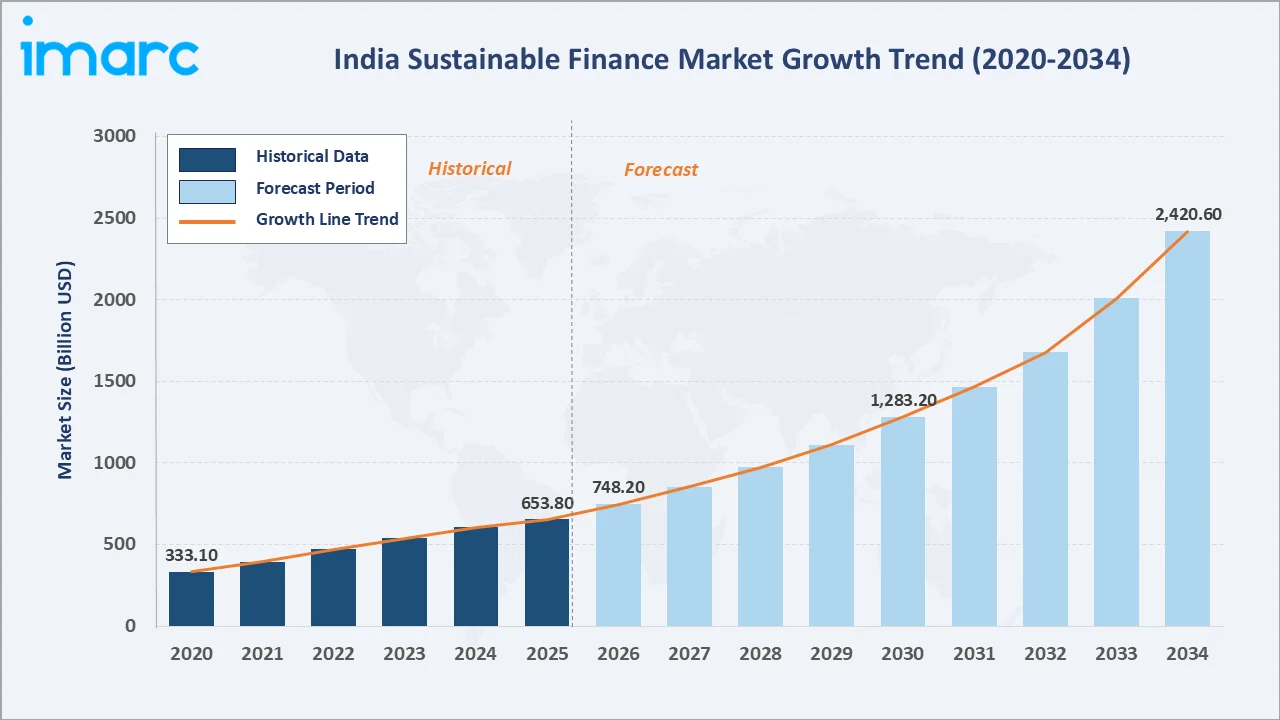
The India sustainable finance market grew from USD 333.1 Billion in 2020 to USD 653.8 Billion by 2025 and is estimated to reach USD 748.2 Billion in 2026. The market is projected to reach USD 1,283.2 Billion by 2030 and USD 2,420.6 Billion by 2034.
To get more information on this market, Request Sample
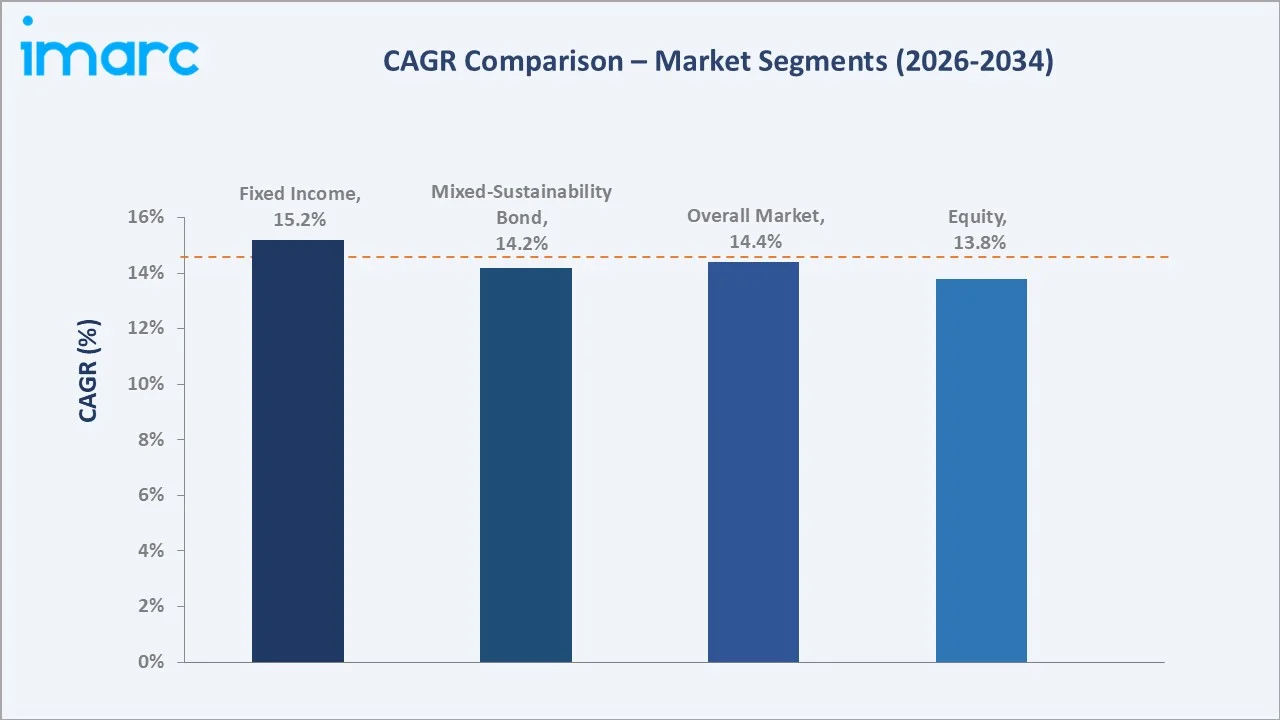
Fixed Income instruments grow at ~15.2% CAGR through expanding green bond issuances. Green Bond expands at ~16.1% CAGR as the fastest-growing transaction segment through climate-aligned project financing. Equity sustainable investments grow at ~13.8% CAGR through ESG-aligned fund growth.
Executive Summary
The India sustainable finance market is experiencing one of its fastest expansion phases, anchored by transformative government ESG policies, growing institutional investor commitment, and the structural shift toward climate-aligned financial products. Fixed Income leads at 46.8% through green bond issuances across public and private sectors. Green Bond leads transaction type at 58.4% as certification frameworks mature. West India holds 32.5% of market share, anchored by Mumbai's financial sector and ESG-focused corporate issuers.
Fixed Income leads at 46.8% through sovereign and corporate green bond issuances, growing at ~15.2% CAGR. Green Bond leads transaction type at 58.4% through certified use-of-proceeds instruments, growing at ~16.1% CAGR. West India commands 32.5% through Mumbai's financial sector concentration.
Key Market Insights
|
Insight |
Data |
|
Dominant Investment Type |
Fixed Income – 46.8% share (2025); growing at ~15.2% CAGR (2026-2034) |
|
Dominant Transaction Type |
Green Bond – 58.4% share (2025); growing at ~16.1% CAGR (2026-2034) |
|
Leading Region |
West India – 32.5% (2025) |
|
Key Market Opportunity |
India's green infrastructure gap and ESG transition requirements represent a large addressable market through green bonds, sustainability-linked loans, and blended finance instruments |
Key Analytical Observations Supporting the Above Data:
- Fixed Income at 46.8%: SEBI's BRSR mandate and India's sovereign green bond program have catalyzed fixed income ESG issuances, making it the dominant investment type. India's National Sustainable Finance Framework targets a significant expansion of green bond issuances, with fixed income's superior risk-adjusted yields making it the clear instrument choice for institutional ESG allocations.
- Green Bond at 58.4%: SEBI's green bond certification framework combined with Climate Bonds Initiative alignment has established green bonds as India's primary sustainable finance instrument. Green bond's certified use-of-proceeds structure, international investor familiarity, and developing secondary market liquidity make it the preferred transaction type for both government and corporate sustainable capital raising.
- West India at 32.5%: Mumbai's status as India's financial capital, Maharashtra's concentration of ESG-mandated institutional investors, and the density of corporate headquarters issuing ESG bonds collectively generate India's highest sustainable finance transaction volumes and market value leadership.
India Sustainable Finance Market Overview
The India sustainable finance market encompasses green bonds, social bonds, mixed-sustainability bonds, ESG-linked loans, and sustainability-linked financial instruments issued or invested by financial institutions, corporates, development finance institutions, and government entities across India's states and union territories. India's ESG bond issuances grew significantly in 2025, supported by SEBI's enhanced BRSR reporting mandates for the top 1,000 listed companies, RBI's ESG lending guidelines for banks, and the Government's sovereign green bond program, indicating substantial headroom for revenue growth through the forecast period.
Market Dynamics
To evaluate market opportunities, Request Sample
Market Drivers
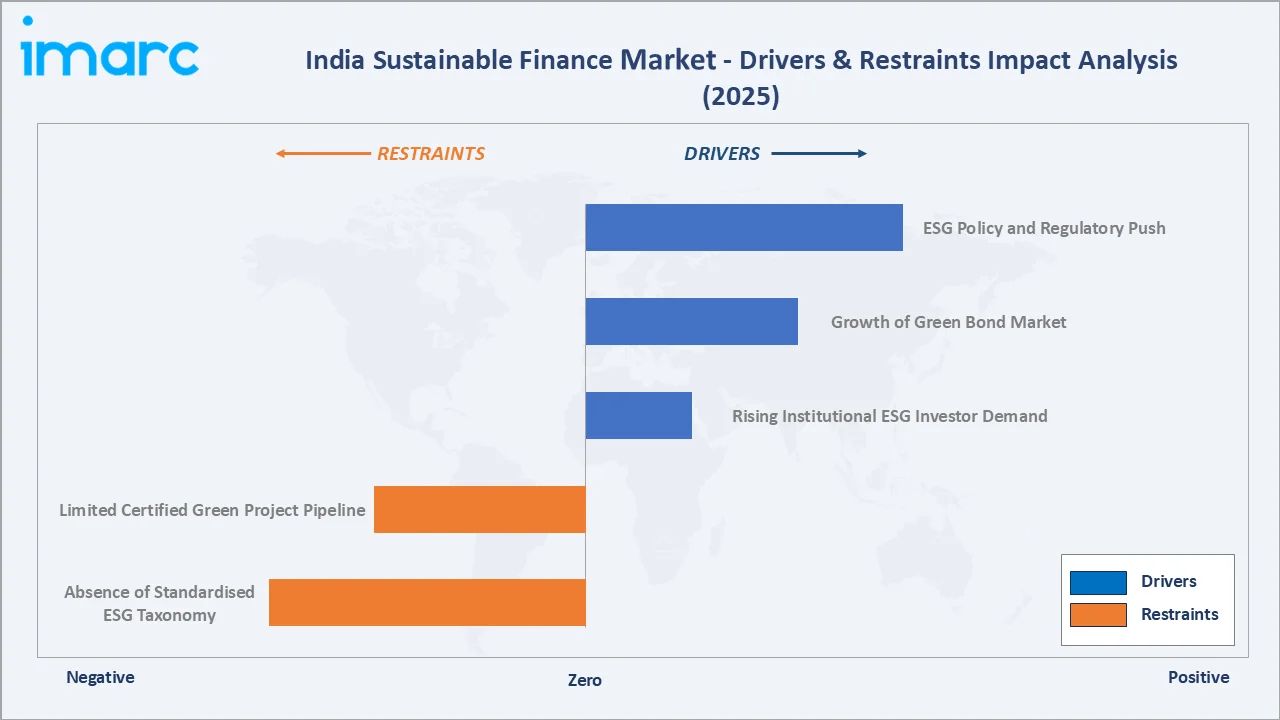
- ESG Policy and Regulatory Push: The Government's sovereign green bond program, SEBI's BRSR reporting mandate for listed companies, and RBI's ESG lending guidelines for banks are creating a structured regulatory environment that incentivizes sustainable finance adoption across banking, capital markets, and institutional investment channels. SEBI's ESG fund categorization requirements are standardizing ESG investment product structures, accelerating institutional allocation to sustainable finance instruments.
- Growth of Green Bond Market: India's green bond market is expanding through public and private sector issuances, supported by SEBI's green bond certification framework and growing international investor appetite for emerging market climate-aligned debt. Green bond issuances by Indian issuers exceeded USD 10 Billion in 2025, with renewable energy, clean transportation, and sustainable water management projects forming the primary use-of-proceeds categories.
- Rising Institutional ESG Investor Demand: Domestic mutual funds, insurance companies, and pension funds are increasingly incorporating ESG criteria into investment mandates, driven by SEBI's ESG fund categorization requirements and IRDA's ESG investment guidelines for insurers. Growing beneficiary demand for responsible investment products aligned with sustainability outcomes is creating structural demand for ESG-certified instruments.
- International Capital Inflows and DFI Support: Development finance institutions including the World Bank, ADB, IFC, and bilateral agencies are channeling international concessional and commercial capital into India's sustainable finance market through green bond subscriptions, blended finance facilities, and technical assistance programs that reduce financing costs for domestic ESG issuers.
Market Restraints
- Absence of Standardised ESG Taxonomy: India lacks a comprehensive national green taxonomy aligned with global standards such as the EU Taxonomy or Climate Bonds Initiative definitions, creating inconsistency in ESG labeling across instruments, issuers, and sectors. This taxonomy gap increases greenwashing risks and reduces the comparability of Indian ESG instruments to international peers, deterring quality-focused international investors.
- Limited Certified Green Project Pipeline: The pipeline of bankable, certified green projects meeting international ESG criteria remains limited relative to the available sustainable finance capital, creating deployment bottlenecks particularly in MSME lending, agriculture sustainability, blue economy finance, and biodiversity conservation.
- Greenwashing Risks and Disclosure Gaps: Concerns about greenwashing in ESG-labeled instruments, combined with inconsistent non-financial disclosure standards across issuers, reduce international investor confidence and create reputational risks for the broader India sustainable finance market.
Market Opportunities
- Renewable Energy Transition Financing: India's 500 GW renewable energy target by 2030 requires an estimated USD 250 Billion in investment across solar, wind, green hydrogen, battery storage, and EV infrastructure, creating a massive certified green project pipeline for green bonds, project finance, and sustainability-linked loans.
- Social Bond and Impact Investing Growth: Financial inclusion mandates and social infrastructure requirements across healthcare, education, affordable housing, and microfinance create a substantial pipeline for social bond issuances and impact investing vehicles, supported by growing development bank participation and rising institutional impact investor demand.
Market Challenges
- High ESG Compliance and Verification Costs: The complexity of ESG measurement, verification, and reporting requirements imposes significant compliance costs on issuers, particularly mid-sized corporates, limiting market participation to large-cap entities with established sustainability reporting capabilities and reducing mid-market ESG financing accessibility.
- Limited Retail Investor Participation: Domestic retail investor awareness of sustainable finance products remains limited, restricting demand to institutional investors and reducing the depth of the sustainable bond secondary market, affecting liquidity and pricing efficiency for ESG instruments.
Emerging Market Trends
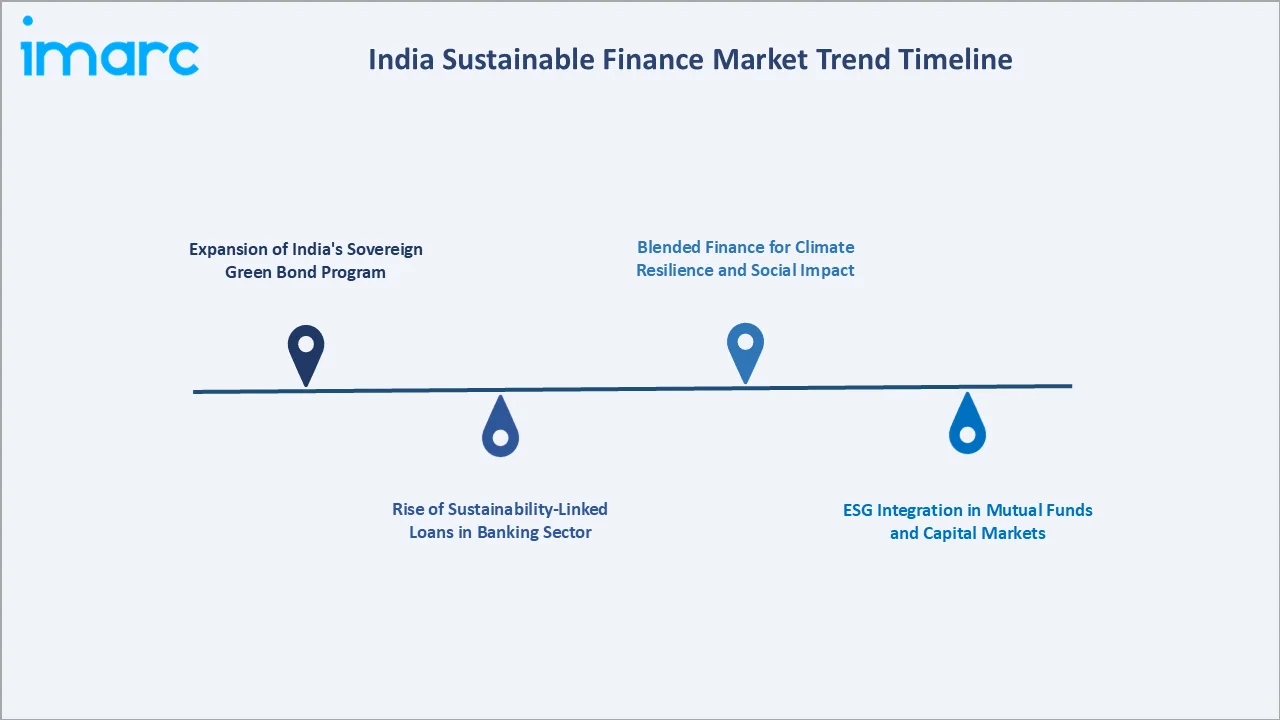
1. Expansion of India's Sovereign Green Bond Program
India's sovereign green bond program is evolving from a pilot initiative into a systematic annual issuance mechanism targeting climate-priority sectors. In 2026, the Government of India issued the third tranche of sovereign green bonds, with proceeds allocated to renewable energy infrastructure, green transportation, and sustainable water management projects. The sovereign green bond program is establishing a risk-free green yield benchmark that enables corporate issuers to price green bond offerings efficiently in both domestic and international capital markets, accelerating private sector ESG issuance.
2. Rise of Sustainability-Linked Loans in Banking Sector
Indian banks and NBFCs are increasingly offering sustainability-linked loans with interest rate step-up and step-down adjustments tied to ESG KPIs, moving beyond traditional green project finance into performance-linked ESG instruments. In 2026, Standard Chartered issued a social bond allocating 57% of funds to India for SME lending and social infrastructure financing, reflecting the growing integration of sustainability performance metrics into mainstream banking products and corporate treasury strategies.
3. ESG Integration in Mutual Funds and Capital Markets
SEBI's ESG fund categorization requirements and enhanced BRSR reporting mandates are driving systematic integration of ESG criteria into mutual fund portfolio construction, equity research, and institutional credit assessment frameworks. Domestic fund houses are launching dedicated ESG funds, thematic sustainable investment products, and impact-focused alternative investment funds targeting international capital seeking India ESG exposure.
4. Blended Finance for Climate Resilience and Social Impact
Blended finance structures combining sovereign guarantees, DFI concessional capital, and commercial private investment are emerging as a critical mechanism to finance India's climate adaptation, biodiversity conservation, social infrastructure, and rural sustainability projects, unlocking private sustainable finance for SDG-aligned projects across India's underserved markets.
Industry Value Chain Analysis
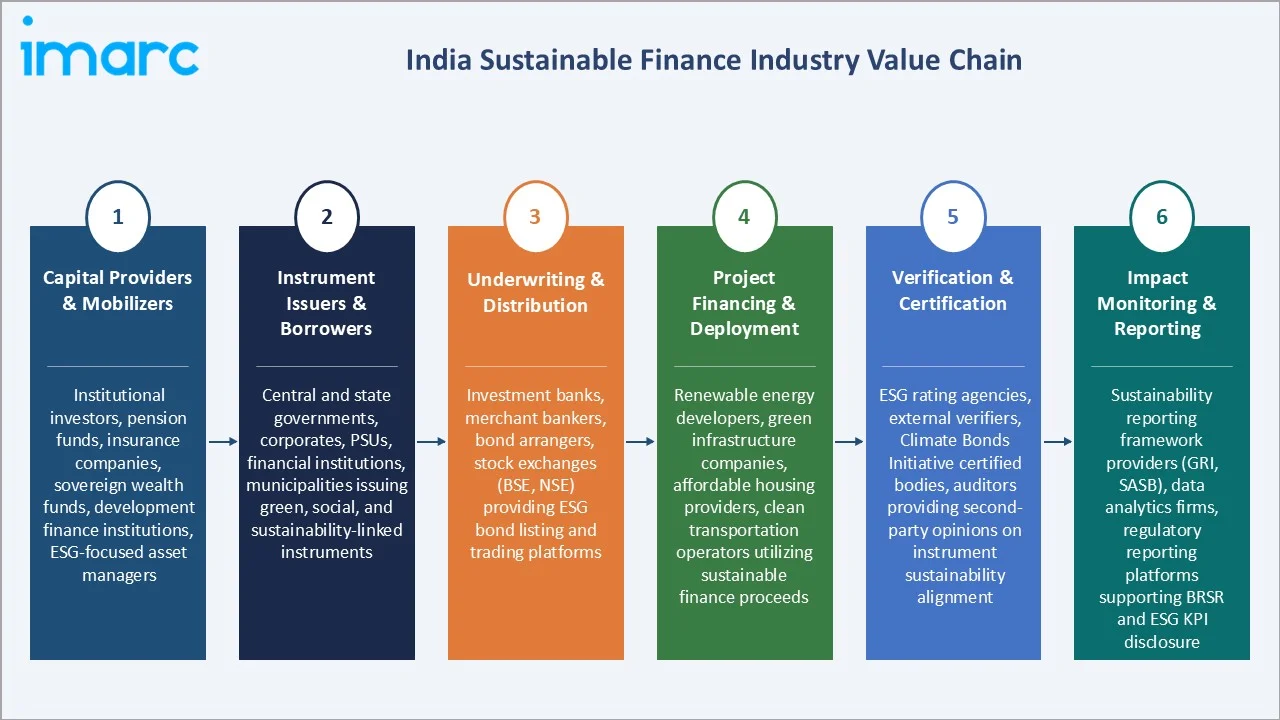
The India sustainable finance value chain integrates capital mobilization, instrument issuance, underwriting and distribution, project financing, impact monitoring and reporting, and measurement, creating an end-to-end ecosystem that channels ESG-aligned capital from institutional investors to certified sustainable end-use projects across India's economy.
|
Stage |
Key Players |
|
Capital Providers & Mobilizers |
Institutional investors, pension funds, insurance companies, sovereign wealth funds, development finance institutions, ESG-focused asset managers. |
|
Instrument Issuers & Borrowers |
Central and state governments, corporates, PSUs, financial institutions, municipalities issuing green, social, and sustainability-linked instruments. |
|
Underwriting & Distribution |
Investment banks, merchant bankers, bond arrangers, stock exchanges (BSE, NSE) providing ESG bond listing and trading platforms. |
|
Project Financing & Deployment |
Renewable energy developers, green infrastructure companies, affordable housing providers, clean transportation operators utilizing sustainable finance proceeds. |
|
Verification & Certification |
ESG rating agencies, external verifiers, Climate Bonds Initiative certified bodies, auditors providing second-party opinions on instrument sustainability alignment. |
|
Impact Monitoring & Reporting |
Sustainability reporting framework providers (GRI, SASB), data analytics firms, regulatory reporting platforms supporting BRSR and ESG KPI disclosure. |
The underwriting and distribution stage represents the primary value-addition and commercially differentiated layer, where financial institutions differentiate through ESG structuring expertise, investor placement capabilities, and green bond certification support. India's sustainable finance value chain is deepening through specialized ESG verification, rating, and data service providers emerging alongside mainstream financial institutions.
Technology Landscape in the India Sustainable Finance Industry
ESG Data Analytics and Reporting Technology
ESG data platforms and analytics tools are transforming how financial institutions assess, monitor, and report sustainability performance across investment portfolios and loan books. These technologies enable real-time ESG scoring, carbon footprint tracking, Scope 1-2-3 emissions measurement, and regulatory reporting automation that reduces BRSR and sustainability disclosure compliance costs. Growing adoption of AI-powered ESG data aggregation tools is improving the consistency and comparability of sustainability metrics across Indian corporate issuers.
Blockchain and Digital Instruments for Green Finance
Distributed ledger technology is being explored for green bond issuance, tracking, and impact verification, providing immutable use-of-proceeds records and real-time impact reporting that reduces greenwashing risks. Digital green bond platforms using blockchain infrastructure can reduce issuance costs by up to 30%, enhance transparency, and lower minimum issuance size thresholds, enabling smaller corporate and municipal issuers to access sustainable capital markets.
AI-Powered ESG Risk Assessment and Greenwashing Detection
Artificial intelligence and machine learning applications are enabling financial institutions to conduct automated ESG due diligence, identify greenwashing risks in sustainability disclosures through natural language processing, and assess physical and transition climate risk exposures in investment and loan portfolios. Regulators including SEBI are exploring AI-powered ESG disclosure monitoring tools to improve the consistency and accuracy of sustainable finance market oversight.
Market Segmentation Analysis
The report covers the following segments:
|
Segment Category |
Leading Segment |
Market Share |
Year |
|
Investment Type |
Fixed Income |
46.8% |
2025 |
|
Transaction Type |
Green Bond |
58.4% |
2025 |
|
Industry Vertical |
🔒 |
🔒 |
2025 |
|
Region |
West India |
32.5% |
2025 |

By Investment Type
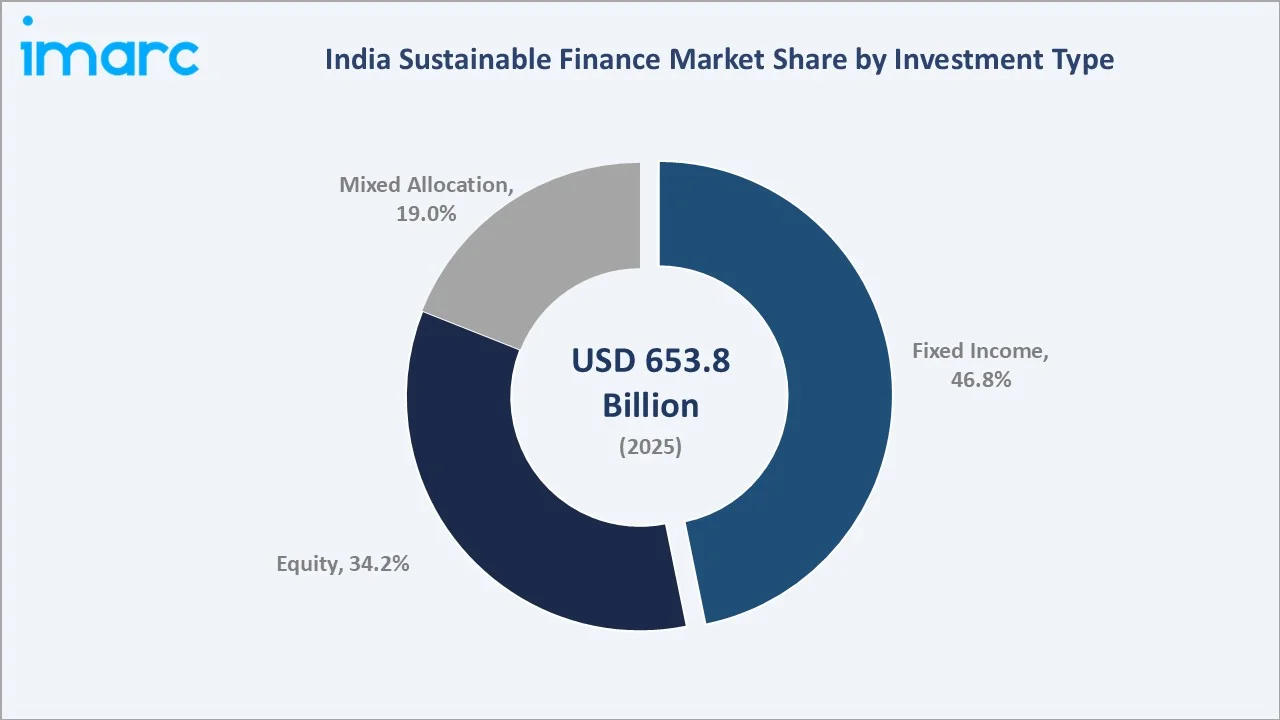
Fixed Income commands 46.8% (2025) and is projected to grow at ~15.2% CAGR, having established itself as the dominant ESG investment type, driven by government sovereign green bonds, corporate ESG-labeled debt, and green infrastructure bonds. Fixed income's predictable yield structure, sovereign credit enhancement, and SEBI certification framework have made it the preferred choice for insurance companies, pension funds, and long-duration institutional investors seeking sustainability-aligned fixed returns within their regulatory investment mandates.
To access detailed market analysis, Request Sample
Equity at 34.2% is growing through ESG-themed mutual funds, SEBI-categorized ESG equity funds, and impact-focused private equity in clean energy and climate technology sectors. Equity's ~13.8% CAGR is above the market average, reflecting rising domestic institutional ESG mandates and the surge in sustainability-focused AUM across Indian asset managers. Mixed Allocation at 19.0% encompasses balanced ESG funds and blended finance vehicles. Mixed Allocation's ~12.5% CAGR is driven by growing demand for diversified ESG portfolios across retail and institutional sustainable investors.
By Transaction Type
Green Bond dominates at 58.4% in 2025 and is projected to grow at ~16.1% CAGR, having established itself as India's primary sustainable finance instrument through government sovereign issuances, SEBI-certified corporate green bonds, and renewable energy project bonds. Green bond's certified use-of-proceeds structure, developing secondary market liquidity on BSE and NSE, and international investor familiarity with the Climate Bonds Initiative standard make it the preferred transaction type for India's largest ESG capital raisings in renewable energy, clean transportation, and sustainable water management.
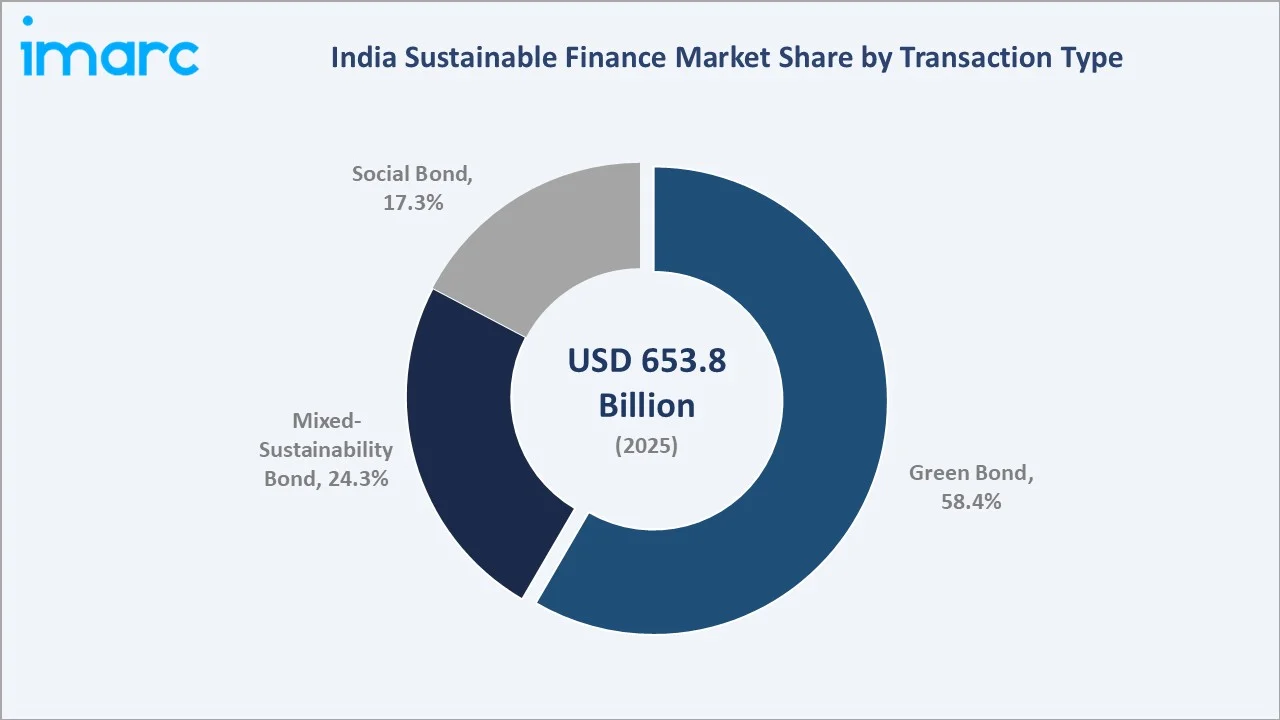
Mixed-Sustainability Bond at 24.3% includes instruments combining environmental and social objectives. Mixed-Sustainability Bond's ~14.2% CAGR reflects the growing corporate preference for instruments addressing both environmental and social priorities simultaneously. Social Bond at 17.3% encompasses instruments financing healthcare, education, affordable housing, and financial inclusion. Social Bond's ~12.8% CAGR is supported by development bank structuring support and growing impact-first institutional investor participation in India's social infrastructure sustainable financing programs.
Regional Market Insights
|
Region |
Share (2025) |
Key India Sustainable Finance Market Drivers & Characteristics |
|
West India |
32.5% |
Reflecting dense financial sector concentration, large corporate ESG bond issuers, and Mumbai's role as India's primary sustainable capital market hub. |
|
North India |
26.8% |
Reflecting government-driven green bond issuances from Delhi NCR, policy institutions, and growing ESG adoption among north Indian industrial corporates. |
|
South India |
24.1% |
Reflecting IT sector ESG integration, Bangalore and Chennai corporate bond issuances, and strong institutional investor base with sustainability mandates. |
West India's 32.5% share reflects the concentration of India's financial sector, stock exchanges (BSE, NSE), and corporate headquarters of major ESG bond issuers in Mumbai, combined with Maharashtra's industrial base driving corporate sustainability-linked borrowing and ESG equity fund management AUM concentration.
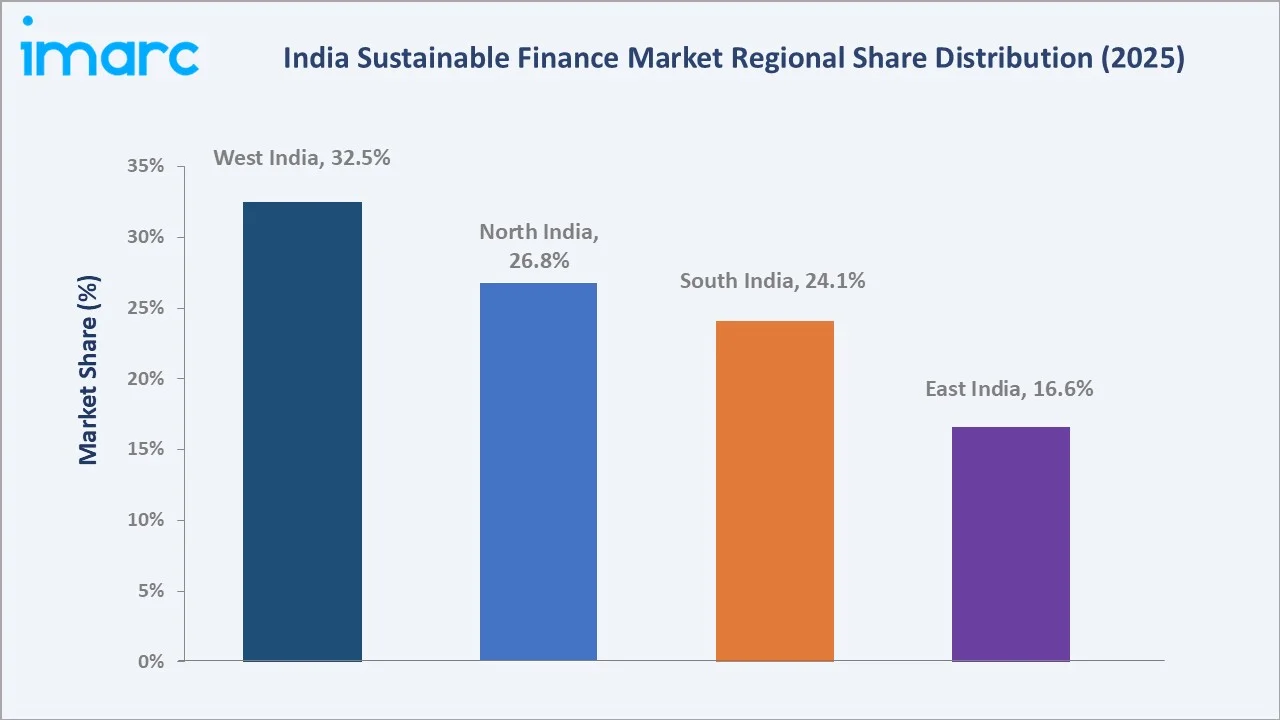
South India's 24.1% is driven by the IT workforce and technology companies integrating ESG into corporate finance strategies, with Bangalore and Chennai emerging as hubs for green building finance and corporate sustainability bonds. East India at 16.6% is the highest growth potential region, with renewable energy project finance in Jharkhand, Odisha, and West Bengal attracting DFI-supported sustainable capital.
Competitive Landscape
The India sustainable finance market is moderately concentrated, with public sector banks, private sector financial institutions, and development finance institutions competing on ESG product breadth, issuance track record, sustainability reporting capability, and international investor relationships. Market participants are increasingly investing in ESG frameworks, green bond structuring capabilities, and impact measurement to strengthen their sustainable finance market presence.
|
Company |
Key Brands |
Market Position |
Core Strength |
|
State Bank of India |
SBI Green Bonds, SBI ESG Fund |
Market Leader |
State Bank of India, through its leading sustainable finance practice, acts as the primary driver of India's green bond underwriting and ESG lending ecosystem through sovereign green bond issuances and implementation of RBI ESG guidelines. |
|
HDFC Bank Limited |
HDFC ESG Finance, Green Bonds |
Market Leader |
HDFC Bank Limited, through its flagship sustainable finance capabilities, is a major provider of green bond underwriting, ESG lending, and sustainability-linked loan services across India's corporate and institutional banking segments. |
|
ICICI Bank Limited |
ICICI Green Finance, ESG Loans |
Established Player |
ICICI Bank Limited plays a major role in India's sustainable finance sector through renewable energy financing, ESG fund distribution, and sustainable bond issuance capabilities for large corporate and institutional sustainability objectives. |
|
Axis Bank Limited |
Axis Sustainable Finance |
Established Player |
Axis Bank Limited delivers sustainable finance solutions through green bond underwriting, ESG-linked lending, and sustainability-linked financing for corporate clients pursuing environmental and social sustainability targets. |
Companies across the competitive landscape are investing in AI-powered ESG data analytics, green bond certification capabilities, and international investor relationship management to strengthen their sustainable finance market position. The competitive landscape is bifurcating between large public and private sector banks competing for large-cap ESG bond mandates and specialty sustainable finance institutions targeting specific climate sectors.
Key Company Profiles
State Bank of India
State Bank of India is a diversified public sector banking group with a significant presence in the country's sustainable finance ecosystem through its banking subsidiaries and capital market arms. In the sustainable finance market, the company offers green bond underwriting, ESG-linked infrastructure lending, and sustainability-linked banking products catering to corporate, government, and institutional clients. Its extensive nationwide network and government banking mandate support its leadership position in India's expanding sustainable finance landscape.
- Key Products: SBI Green Bonds, SBI ESG Fund, SBI Sustainability-Linked Loans.
- Recent Developments: In January 2023, SBI raised INR 10,000 crore through 15-year infrastructure bonds at 7.70% coupon to finance sustainable infrastructure projects, with bids exceeding INR 21,045 crore, reflecting strong institutional investor demand for SBI's ESG-aligned debt instruments.
- Strategic Focus: Expanding its sustainable finance footprint through continued investments in green bond underwriting capabilities, ESG-linked infrastructure lending programs, and renewable energy project financing. The company also emphasizes integrated ESG reporting and RBI sustainability guideline implementation to enhance its institutional ESG credibility.
HDFC Bank Limited
HDFC Bank Limited is a diversified private sector banking group with a strong and growing presence in the sustainable finance sector through its corporate banking and capital markets divisions. In the India sustainable finance market, its offerings span green bond underwriting, sustainability-linked loans, ESG advisory services, and responsible investment products for institutional and corporate clients. Its extensive digital banking infrastructure and broad corporate client base support its growing presence in India's evolving sustainable finance ecosystem.
- Key Products: HDFC ESG Finance, HDFC Green Bonds, HDFC Sustainability-Linked Loans.
- Recent Developments: In March 2026, HDFC Bank completed the underwriting of a US$ 750 million green bond issuance for a major renewable energy developer, marking its largest single green bond mandate in the clean energy sector and strengthening its position as a leading green capital market arranger.
- Strategic Focus: Expanding high-quality sustainable finance product offerings through green bond underwriting, sustainability-linked loan structuring, ESG credit assessment integration, and continued responsible banking framework development. Its strategy also emphasizes improving BRSR disclosure quality, widening ESG product coverage, and integrating sustainability criteria into mainstream credit decision-making.
ICICI Bank Limited
ICICI Bank Limited is a major private sector bank with substantial capabilities in the sustainable finance market through its corporate and investment banking divisions. In India's sustainable finance market, its capabilities span renewable energy project lending, green bond underwriting, ESG fund distribution, and sustainability-linked financing for large corporate and institutional clients. Its integrated financial services model enables comprehensive sustainable finance solutions for clients seeking ESG-aligned capital market access.
- Key Products: ICICI Green Finance, ICICI ESG Loans, ICICI Sustainable Bond Underwriting.
- Strategic Focus: Strengthening sustainable finance through renewable energy sector lending expansion, ESG-certified green bond underwriting mandate growth, sustainability-linked loan structuring for large corporates, and advancing digital ESG reporting and carbon accounting capabilities for institutional borrowers and investors.
Market Concentration Analysis
The India sustainable finance market is moderately concentrated through public sector bank dominance in sovereign green bond underwriting and large institutional ESG lending. The corporate green bond segment is witnessing increasing participation from private sector banks and international financial institutions with ESG structuring expertise. The social bond and impact investing segments represent the most significant structural disruption to market concentration as development finance institutions bring specialized structuring capabilities, potentially expanding into India's underserved social infrastructure ESG financing segment by 2030.
Investment & Growth Opportunities
Highest Growth Segments
Green Bond (~16.1% CAGR), Mixed-Sustainability Bond (~14.2% CAGR), Fixed Income sustainable instruments (~15.2% CAGR), renewable energy project green bonds (~18% CAGR estimated), and blended finance for climate resilience represent the highest-growth sustainable finance investment vectors in India through 2034.
Investment Themes
- Renewable Energy and Climate Infrastructure Finance: India's 500 GW renewable capacity target by 2030 creates a certified green project pipeline requiring debt capital through green bonds, project finance, and sustainability-linked loans across solar, wind, green hydrogen, battery storage, and EV charging infrastructure.
- Social Impact Bond and Inclusive Finance Market: India's SDG financing requirements across healthcare, education, affordable housing, and financial inclusion create substantial demand for social bonds and impact-investing vehicles, supported by growing development bank participation and institutional impact investor demand.
Future Market Outlook (2026-2034)
The India sustainable finance market is projected to grow from USD 653.8 Billion in 2025 to USD 748.2 Billion in 2026, reaching USD 2,420.6 Billion by 2034, exhibiting a CAGR of 14.44% during 2026-2034. The market is projected to reach an anchor value of USD 1,283.2 Billion by 2030, representing the mid-period milestone at which India's national ESG taxonomy achieves international alignment, green bond markets standardize across issuers and sectors, and institutional ESG adoption reaches critical mass across insurance, pension, and mutual fund segments.
Three structural forces define the India sustainable finance market trajectory through 2034. First, India's regulatory evolution from SEBI's BRSR mandate through RBI's ESG lending guidelines to a comprehensive national green taxonomy is positioning India for a decade of ESG market quality upgrades. Second, the renewable energy transition requirement of 500 GW capacity by 2030 is bringing sustainable finance from specialty market to essential infrastructure financing channel. Third, the convergence of ESG data analytics, AI-powered greenwashing detection, and blockchain-based impact verification is transforming sustainable finance from a documentation-intensive compliance exercise into a real-time performance-linked capital market.
Research Methodology
Primary Research
Primary research comprised in-depth interviews with sustainable finance executives, ESG fund managers, green bond arrangers, regulatory consultants, development finance institution officers, and corporate sustainability heads across India's leading financial institutions, corporates, and government agencies. These discussions validated market size estimates, instrument type demand dynamics, regional adoption patterns, and technology integration trajectories for the 2026-2034 forecast period.
Secondary Research
Secondary research encompassed SEBI green bond circulars and ESG fund categorization guidelines, RBI ESG lending publications, Climate Bonds Initiative India market reports, company annual sustainability reports, IMARC Group proprietary BFSI and sustainable finance databases, annual reports of key market participants, IOSCO and ICMA sustainable finance standards publications, and industry publications covering India's sustainable finance market developments through 2025.
Forecasting Models
correlations with GDP and regulatory adoption curves, sovereign green bond program issuance timelines, institutional ESG mandate expansion rates, international capital flow projections into emerging market ESG instruments, and regulatory framework development milestones. Both bottom-up instrument-level and top-down market revenue projection approaches were cross-validated for forecast consistency.
India Sustainable Finance Market Report Coverage:
| Report Features | Details |
|---|---|
| Base Year of the Analysis | 2025 |
| Historical Period | 2020-2025 |
| Forecast Period | 2026-2034 |
| Units | Billion USD |
| Scope of the Report |
Exploration of Historical Trends and Market Outlook, Industry Catalysts and Challenges, Segment-Wise Historical and Future Market Assessment:
|
| Investment Types Covered | Equity, Fixed Income, Mixed Allocation |
| Transaction Types Covered | Green Bond, Social Bond, Mixed-Sustainability Bond |
| Industry Verticals Covered | Utilities, Transport and Logistics, Chemicals, Food and Beverage, Government, Others |
| Regions Covered | North India, South India, East India, West India |
| Companies Covered | State Bank of India, HDFC Bank Limited, ICICI Bank Limited, Axis Bank Limited, etc. |
| Customization Scope | 10% Free Customization |
| Post-Sale Analyst Support | 10-12 Weeks |
| Delivery Format | PDF and Excel through Email (We can also provide the editable version of the report in PPT/Word format on special request) |
Key Benefits for Stakeholders:
- IMARC’s industry report offers a comprehensive quantitative analysis of various market segments, historical and current market trends, market forecasts, and dynamics of the India sustainable finance market from 2020-2034.
- The research report provides the latest information on the market drivers, challenges, and opportunities in the India sustainable finance market.
- Porter's five forces analysis assist stakeholders in assessing the impact of new entrants, competitive rivalry, supplier power, buyer power, and the threat of substitution. It helps stakeholders to analyze the level of competition within the India sustainable finance industry and its attractiveness.
- Competitive landscape allows stakeholders to understand their competitive environment and provides an insight into the current positions of key players in the market.
Frequently Asked Questions About the India Sustainable Finance Market Report
The India sustainable finance market reached USD 748.2 Billion in 2026, driven by sovereign green bond issuances, SEBI BRSR mandate adoption, ESG fund growth, and expanding corporate sustainability-linked financing. Rising international investor demand for ESG-aligned emerging market assets is further supporting market expansion.
The India sustainable finance market is projected to grow at a CAGR of 14.44% during 2026-2034, driven by renewable energy green bond expansion, ESG regulatory maturation, growing institutional ESG adoption, and increasing international capital inflows into India's certified sustainable finance instruments.
Fixed Income leads with a 46.8% share in 2025, growing at ~15.2% CAGR, through government sovereign green bonds, corporate ESG-labeled debt, and green infrastructure bonds, driven by predictable yield structures appealing to insurance companies, pension funds, and long-duration institutional investors.
Green Bond leads with a 58.4% share in 2025, growing at ~16.1% CAGR, through government sovereign issuances, SEBI-certified corporate green bonds, and renewable energy project bonds attracting international climate-aligned capital seeking certified instruments in India's growing sustainable finance market.
West India leads with a 32.5% share in 2025, anchored by Mumbai's financial sector, BSE and NSE green bond listing infrastructure, and Maharashtra's concentration of corporate ESG bond issuers, generating India's highest sustainable finance transaction volumes and market value per region.
Key players include State Bank of India, HDFC Bank Limited, ICICI Bank Limited and Axis Bank Limited, among others.
The market is projected to reach USD 2,420.6 Billion by 2034 at a CAGR of 14.44%, driven by renewable energy green bond expansion, social bond market growth, ESG integration in mainstream banking, international capital inflows, and India's net-zero transition financing requirements.
Need more help?
- Speak to our experienced analysts for insights on the current market scenarios.
- Include additional segments and countries to customize the report as per your requirement.
- Gain an unparalleled competitive advantage in your domain by understanding how to utilize the report and positively impacting your operations and revenue.
- For further assistance, please connect with our analysts.
 Request Customization
 Speak to an Analyst
 Request Brochure
 Inquire Before Buying
Benefits of Customization
- Personalize this research
- Triangulate with your data
- Get data as per your format and definition
- Gain a deeper dive into a specific application, geography, customer, or competitor
- Any level of personalization
Get in Touch With Us
UNITED STATES
Phone: +1-201-971-6302
INDIA
Phone: +91-120-433-0800
UNITED KINGDOM
Phone: +44-753-714-6104
Email: [email protected]
Client Testimonials




.webp)




.webp)













Related Reports

Choose your plan
*Please note that the prices mentioned below are starting prices for each bundle type. Kindly contact our team for further details.*
Single User License
- 1 User License, Access on 2 Devices
- PDF Report + Excel Dataset (Password Protected)
- Lifetime Access
- No Printing Rights
- 10% Free Report Customization
- 10–12 Weeks of Analyst Support
Five User License
- Access for 5 Users, 2 Devices per User
- PDF Report + Excel Dataset (Password Protected)
- Lifetime Access
- Dedicated Account Manager
- 12–14 Weeks of Analyst Support
- No Printing Rights
- 15% Free Report Customization
- 25% Discount on Your Next Purchase
Corporate User License
- Unlimited User Access (Within Your Organization)
- PDF Report + Excel Dataset
- Lifetime Access
- Dedicated Account Manager
- 14–20 Weeks of Analyst Support
- No Printing Rights
- 20% Free Report Customization
- 30% Discount on Your Next Purchase
Essential Insights
What's included:
3 reports
- Lifetime Access
- PDF Reports
- Excel Datasets
- 2 Weeks of Free Analyst Support
- 2 User Licenses
- Access on 2 Devices
- Printing Rights
- Complimentary PowerPoint (PPT) Version
- Complimentary License Upgrade
Professional Access
What's included:
5 reports
- Lifetime Access
- PDF Reports
- Excel Datasets
- 8 Weeks of Free Analyst Support
- 2 User Licenses
- Access on 2 Devices
- Printing Rights
- Complimentary PowerPoint (PPT) Version
- Complimentary License Upgrade
Business Advantage
What's included:
8 reports
- Lifetime Access
- PDF Reports
- Excel Datasets
- 14 Weeks of Free Analyst Support
- 2 User Licenses
- Access on 2 Devices
- Printing Rights
- Complimentary PowerPoint (PPT) Version
- Complimentary License Upgrade
Enterprise Intelligence
What's included:
10 reports
- Lifetime Access
- PDF Reports
- Excel Datasets
- 20 Weeks of Free Analyst Support
- 2 User Licenses
- Access on 2 Devices
- Printing Rights
- Complimentary PowerPoint (PPT) Version
- Complimentary License Upgrade