
India Yoga Mat Market Size, Share, Trends and Forecast by Material, Distribution Channel, End Use, and Region, 2026-2034
India Yoga Mat Market Size, Share, Trends & Forecast (2026-2034)
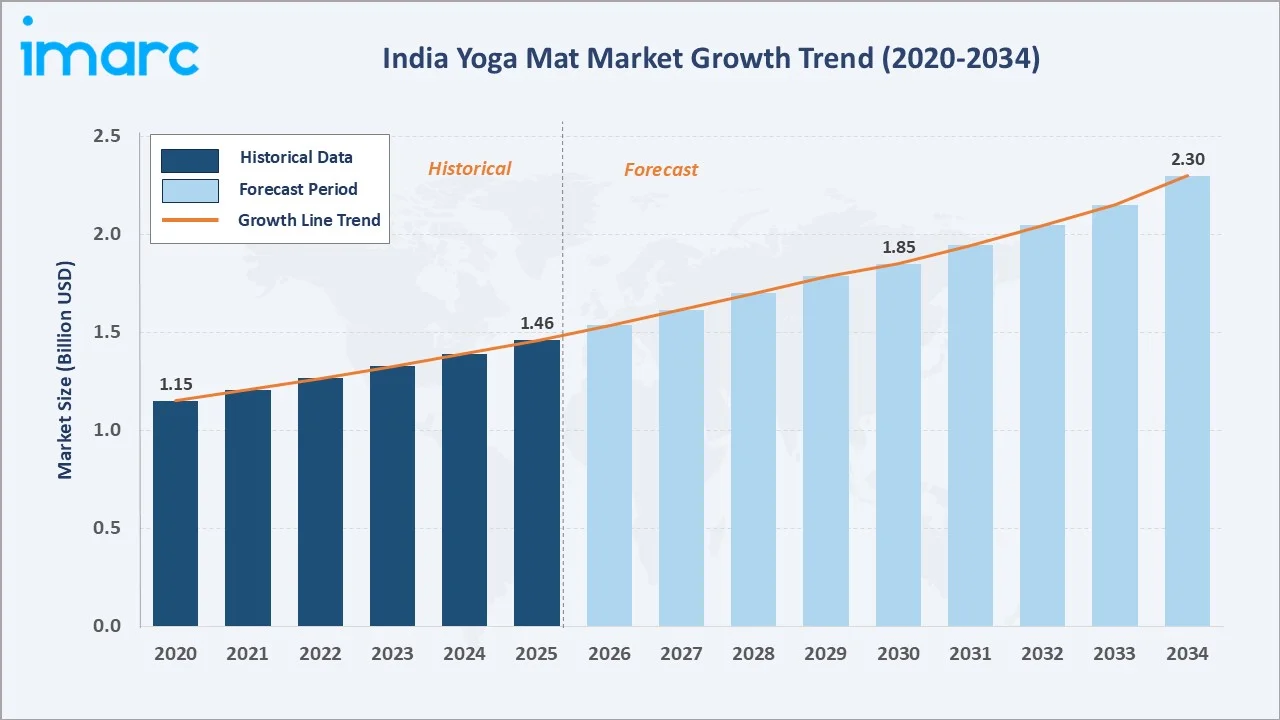
The India yoga mat market grew from USD 1.46 Billion in 2025 to USD 1.56 Billion in 2026 and is projected to reach USD 2.30 Billion by 2034, growing at a CAGR of 4.94% during 2026-2034. The market is driven by rising health and wellness consciousness, sustained government-backed yoga promotion, and expanding home fitness and studio culture across urban and semi-urban India. PVC dominates the material segment at 39.0%, reflecting affordability and wide manufacturing availability. Online stores lead distribution channels at 38.0%, supported by rapid e-commerce and quick-commerce penetration. North India commands 33.0% of the national market share. Expanding fitness-studio networks, rising disposable incomes, and growing preference for eco-friendly TPE and natural-fiber mats are further supporting India yoga mat market growth. TPE holds 26.0% of material share. Specialty stores account for 29.0% of distribution, while West India follows closely at 29.0% regional share.
Market Snapshot
|
Metric |
Value |
|
Base Year Market Size (2025) |
USD 1.46 Billion |
| Market Size (2026) | USD 1.56 Billion |
|
Forecast Market Size (2034) |
USD 2.30 Billion |
|
CAGR (2026-2034) |
4.94% |
|
Base Year |
2025 |
|
Historical Period |
2020-2025 |
|
Forecast Period |
2026-2034 |
|
Dominant Material |
PVC (39.0%, 2025) |
|
Dominant Distribution Channel |
Online Stores (38.0%, 2025) |
|
Leading Region |
North India (33.0%, 2025) |
India yoga mat market expanded from USD 1.15 Billion in 2020 to USD 1.46 Billion in 2025 and an estimated USD 1.56 Billion in 2026, anchored at USD 1.85 Billion in 2030, and forecast to reach USD 2.30 Billion by 2034. India’s yoga mat market is commercially distinctive, combining the world’s largest home-grown yoga-practicing population with a rapidly organizing branded mat industry that is steadily displacing unbranded and informal local suppliers.
To get more information on this market, Request Sample
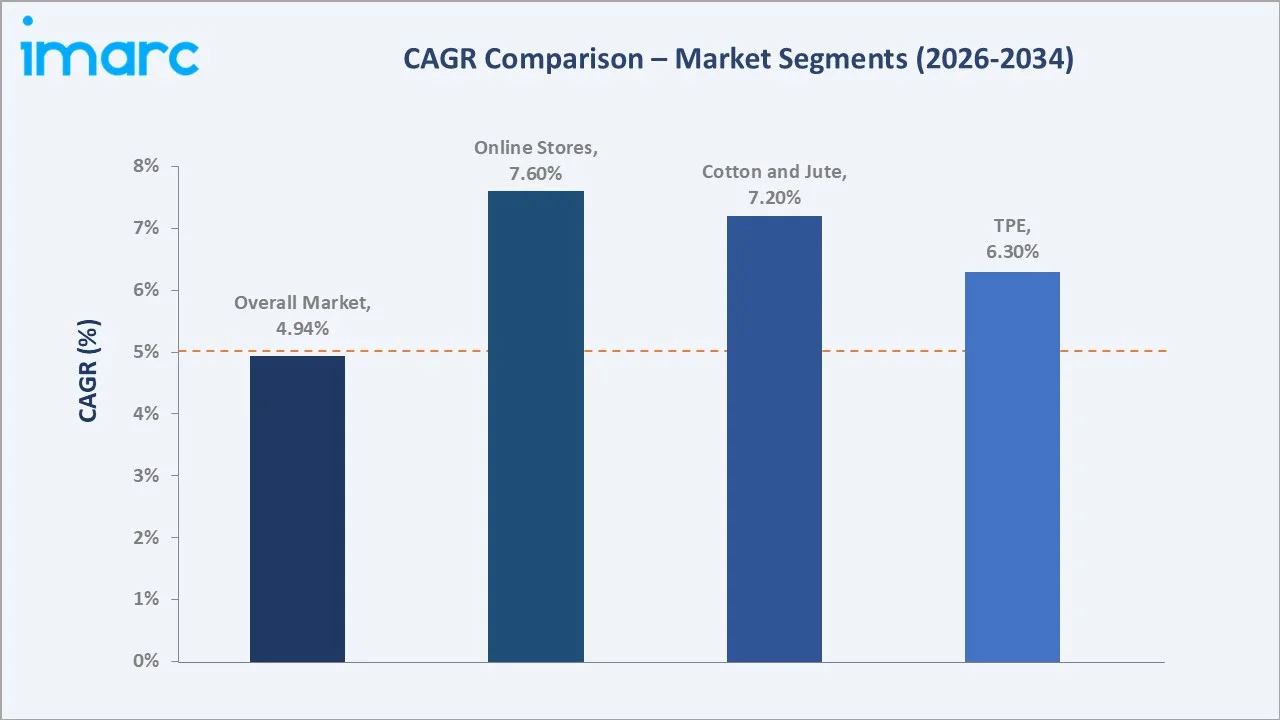
Cotton and jute mats grow fastest at ~7.2% CAGR through India’s sustainability-led consumer shift, natural-fiber craft promotion, and rising preference for biodegradable practice surfaces. Online stores expand at ~7.6% CAGR as quick-commerce platforms and direct-to-consumer brands widen fitness-accessory reach into Tier-2 and Tier-3 cities.
Executive Summary
India yoga mat market expanded from USD 1.46 Billion in 2025 to an estimated USD 1.56 Billion in 2026 reflects the commercial scale of the world’s largest and most culturally rooted yoga-practicing population, supported by the Ministry of AYUSH’s sustained promotion of yoga through the International Day of Yoga, which registered participation from more than 3 crore people in 2026. The market is projected to reach USD 2.30 Billion by 2034, delivering a 4.94% CAGR.
PVC at 39.0% leads through affordability and mass retail availability, while online stores at 38.0% reflect India’s rapid e-commerce adoption for fitness accessories. North India leads regionally at 33.0%, driven by Delhi-NCR’s dense fitness-studio network and elevated wellness spending. TPE and cotton-jute segments are gaining share as environmental awareness rises among urban consumers.
Looking ahead, the market outlook remains positive, supported by rising disposable incomes, expanding organized retail, and continued institutional promotion of yoga as a preventive healthcare practice, positioning India as both the largest consumption base and an emerging manufacturing and export hub for yoga accessories.
Key Market Insights
|
Insight |
Data |
|
Dominant Material |
PVC - 39.0% share (2025) |
|
Dominant Distribution Channel |
Online Stores - 38.0% share (2025) |
|
Leading Region |
North India - 33.0% share (2025) |
|
Market Opportunity |
Eco-friendly TPE and natural-fiber mat expansion; D2C and quick-commerce channel growth; premium alignment-mat segment; corporate wellness and studio bulk procurement |
Key Analytical Observations Supporting The Above Data:
- PVC at 39.0%: The PVC segment dominates due to its low manufacturing cost, durability, and wide availability across mass, budget, and mid-range retail channels. Its established supply base makes it the default choice for first-time buyers.
- Online Stores at 38.0%: E-commerce leads distribution through wide SKU assortment, competitive discounting, and fast delivery via platforms such as Amazon, Flipkart, and quick-commerce apps, which are increasingly stocking fitness accessories.
- North India at 33.0%: North India dominates regionally due to Delhi-NCR’s dense fitness-studio and gym network, higher urban disposable incomes, and strong organized retail and e-commerce penetration.
- TPE at 26.0%: The TPE segment is growing fastest among mainstream materials, reflecting rising demand for eco-friendly, lightweight, and better-grip alternatives to PVC among health-conscious urban consumers.
- Specialty Stores at 29.0%: Sustained by fitness-focused retail chains such as Decathlon, which offer a try-before-you-buy experience and curated fitness-accessory ranges.
- Government promotion: The Ministry of AYUSH’s International Day of Yoga (IDY) 2026, themed “Yoga for Healthy Ageing,” recorded participation from over 3 crore individuals across 780 districts via the Yoga Sangam portal, reinforcing sustained demand for practice accessories.
India Yoga Mat Market Overview
India yoga mat market encompasses the manufacturing, branding, and retail of mats used across yoga studios, gyms, wellness centers, and home practice. The market sits at the intersection of India’s deep cultural relationship with yoga and a rapidly organizing fitness-accessory retail industry.
Ecosystem participants include raw material suppliers of PVC, TPE, natural rubber, cotton, and jute; mat manufacturers; national and international brands; offline specialty and supermarket retail; e-commerce platforms; and end consumers spanning yoga studios, gyms, and households. Macroeconomic tailwinds include rising urban disposable incomes, an expanding health and wellness economy, and continued government promotion of yoga through the Ministry of AYUSH’s Yoga 365 and International Day of Yoga initiatives.
Market Dynamics
To evaluate market opportunities, Request Sample
Market Drivers
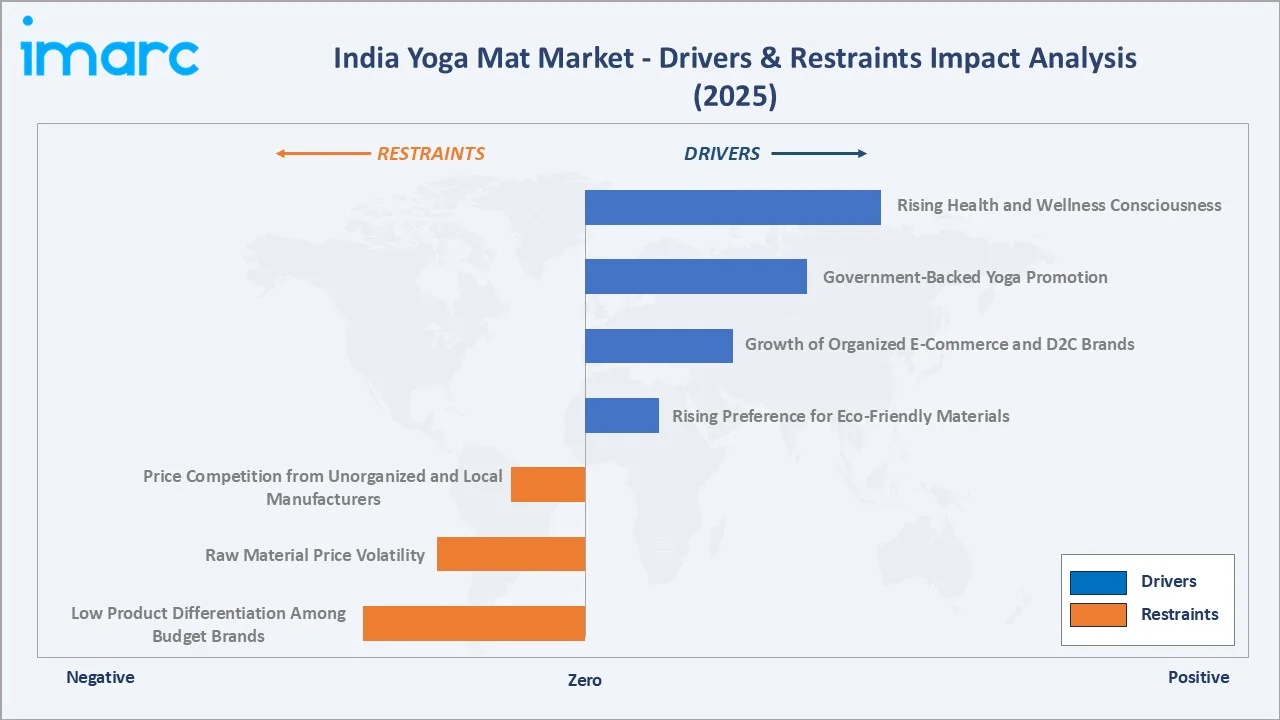
- Rising Health and Wellness Consciousness: Growing awareness of preventive healthcare and lifestyle-related illnesses is encouraging Indian consumers to adopt regular fitness routines, including yoga, which is directly increasing demand for mats across studios, gyms, and homes. Rising screen time and sedentary urban lifestyles are further reinforcing this shift toward structured physical activity.
- Government-Backed Yoga Promotion: The Ministry of AYUSH’s sustained institutional push, including the annual International Day of Yoga and Yoga 365 initiative, is embedding yoga into workplaces, schools, and communities. IDY 2026 alone drew participation from more than 3 crore people nationwide, sustaining structural mat demand.
- Growth of Organized E-Commerce and D2C Brands: Online platforms and direct-to-consumer brands are providing consumers with easy access to a wide range of yoga mats across price points and materials, expanding reach into Tier-2 and Tier-3 cities and enabling faster adoption of new designs and materials.
- Rising Preference for Eco-Friendly Materials: Growing environmental awareness among urban consumers is increasing demand for TPE, natural rubber, and cotton-jute mats over conventional PVC, encouraging brands to expand sustainable product lines.
Market Restraints
- Price Competition from Unorganized and Local Manufacturers: A large unorganized segment selling low-cost, unbranded mats through local retail and informal channels continues to pressure the pricing and margins of organized branded players.
- Raw Material Price Volatility: Fluctuations in the prices of PVC, TPE, and natural rubber, which are linked to crude-oil and commodity markets, create cost uncertainty for manufacturers and can compress margins across the value chain.
Market Opportunities
- Premiumization Through Alignment and Multi-Functional Mats: Rising consumer sophistication is creating demand for premium mats with alignment markers, thicker cushioning, and multi-functional designs, allowing brands to expand into higher-margin categories.
- Corporate Wellness and Studio Bulk Procurement: Growing corporate wellness programs and expanding studio and gym networks are creating bulk procurement opportunities for branded mat suppliers beyond individual retail sales.
Market Challenges
- Low Product Differentiation Among Budget Brands: The high concentration of similarly priced PVC and entry-level TPE mats makes it difficult for budget brands to differentiate on features alone, intensifying price-based competition.
- Counterfeit and Unbranded Product Penetration: The widespread availability of unbranded look-alike products, particularly through unorganized online marketplaces, challenges brand trust and consistent quality perception among first-time buyers.
Emerging Market Trends
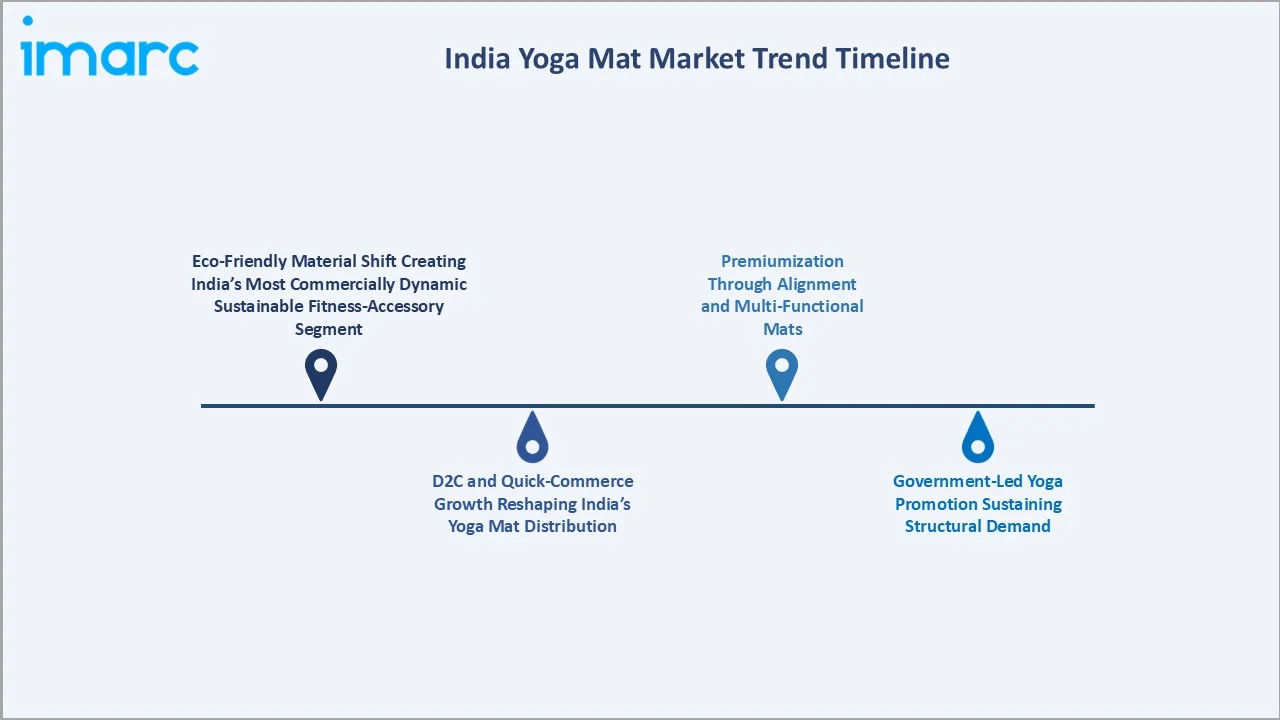
1. Eco-Friendly Material Shift Creating India’s Most Commercially Dynamic Sustainable Fitness-Accessory Segment
Rising environmental awareness is driving demand for TPE, natural rubber, and cotton-jute mats over conventional PVC. Brands are increasingly marketing biodegradability and recyclability as core differentiators, encouraging both established and new entrants to expand eco-friendly product lines.
2. D2C and Quick-Commerce Growth Reshaping India’s Yoga Mat Distribution
Direct-to-consumer brands and quick-commerce platforms are shortening delivery timelines and widening geographic reach, allowing fitness-accessory brands to access Tier-2 and Tier-3 city consumers who previously relied on limited local retail options.
3. Premiumization Through Alignment and Multi-Functional Mats
Rising consumer sophistication, particularly among urban studio practitioners, is fueling demand for premium mats with alignment guides, superior grip, and multi-functional designs suitable for yoga, Pilates, and general fitness use.
4. Government-Led Yoga Promotion Sustaining Structural Demand
The Ministry of AYUSH’s continued institutional campaigns, including Yoga Mahotsav and the annual International Day of Yoga, are embedding yoga into schools, workplaces, and community programs, creating a durable, non-discretionary demand base for practice accessories.
Industry Value Chain Analysis
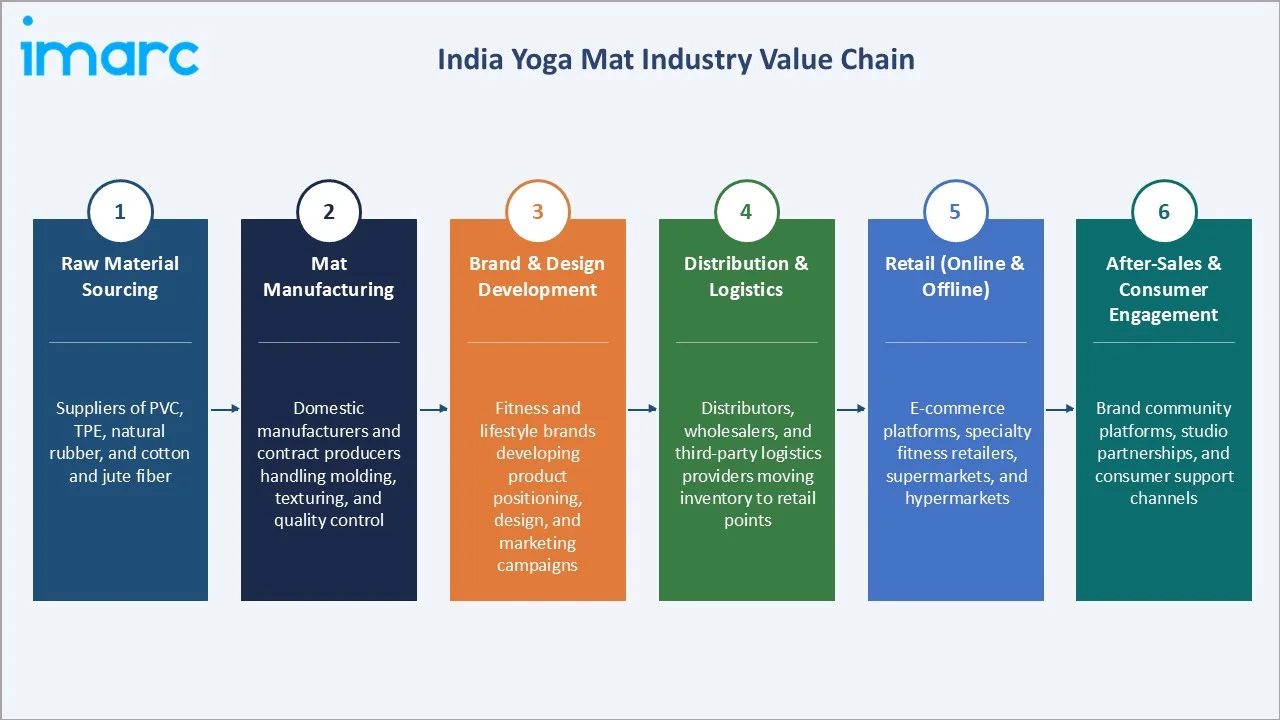
India yoga mat value chain spans raw material sourcing through to end consumption, with manufacturing increasingly concentrated among organized domestic producers supplying both branded and private-label retail channels.
|
Stage |
Key Participants |
|
Raw Material Sourcing |
Suppliers of PVC, TPE, natural rubber, and cotton and jute fiber |
|
Mat Manufacturing |
Domestic manufacturers and contract producers handling molding, texturing, and quality control |
|
Brand & Design Development |
Fitness and lifestyle brands developing product positioning, design, and marketing campaigns |
|
Distribution & Logistics |
Distributors, wholesalers, and third-party logistics providers moving inventory to retail points |
|
Retail (Online & Offline) |
E-commerce platforms, specialty fitness retailers, supermarkets, and hypermarkets |
|
After-Sales & Consumer Engagement |
Brand community platforms, studio partnerships, and consumer support channels |
The mat manufacturing stage is India’s most commercially consequential value-chain segment, where brands are increasingly investing in Make-in-India production capacity to reduce import dependence, particularly for eco-friendly jute and natural-rubber formats.
Technology Landscape in the India Yoga Mat Industry
Material Innovation and Eco-Friendly Formulations
Material science advances are enabling manufacturers to produce TPE and natural-rubber mats that combine the grip and durability of PVC with improved biodegradability. This innovation is helping brands meet rising consumer demand for sustainable practice accessories without compromising on performance.
Grip and Texture Engineering
Surface texturing technologies, including wavy and micro-ridge patterns, are improving anti-slip performance on tile and hardwood flooring common in Indian homes. These innovations are particularly valued by consumers practicing in humid or high-perspiration conditions.
Alignment and Smart Mat Technology
Premium mats increasingly feature printed alignment guides that assist posture correction, while early-stage smart mats with embedded sensors for pose tracking are gaining niche traction among studio and app-connected fitness consumers, signaling a gradual shift toward technology-enabled practice accessories.
Market Segmentation Analysis
The report covers the following segments:
|
Segment Category |
Leading Segment |
Market Share |
Year |
|
Material |
PVC |
39.0% |
2025 |
|
Distribution Channel |
Online Stores |
38.0% |
2025 |
|
End Use |
🔒 |
🔒 |
2025 |
|
Region |
North India |
33.0% |
2025 |

By Material
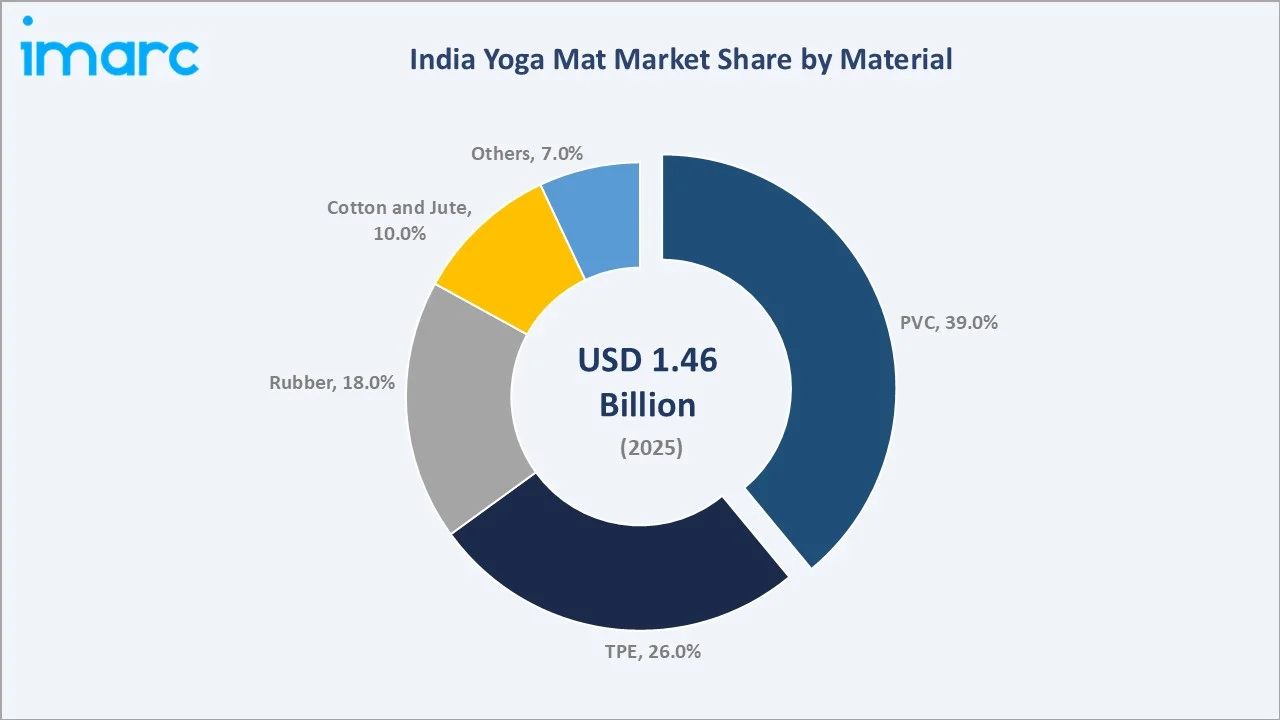
PVC leads at 39.0% (2025). The segment benefits from India’s most extensive manufacturing base, offering the lowest price points across mass, fashion, and institutional bulk-purchase occasions.
To access detailed market analysis, Request Sample
TPE at 26.0% grows fastest among mainstream materials at ~6.3% CAGR through rising eco-conscious consumer preference, while cotton and jute at 10.0% is the fastest-growing segment overall at ~7.2% CAGR, driven by India’s sustainability movement and natural-fiber craft promotion. Rubber and others account for 18.0% and 7.0% shares, respectively.
By Distribution Channel
Online stores lead at 38.0% (2025). The channel’s commercial dominance reflects India’s broader e-commerce expansion, wide product assortment, and consumer preference for doorstep delivery and price comparison.
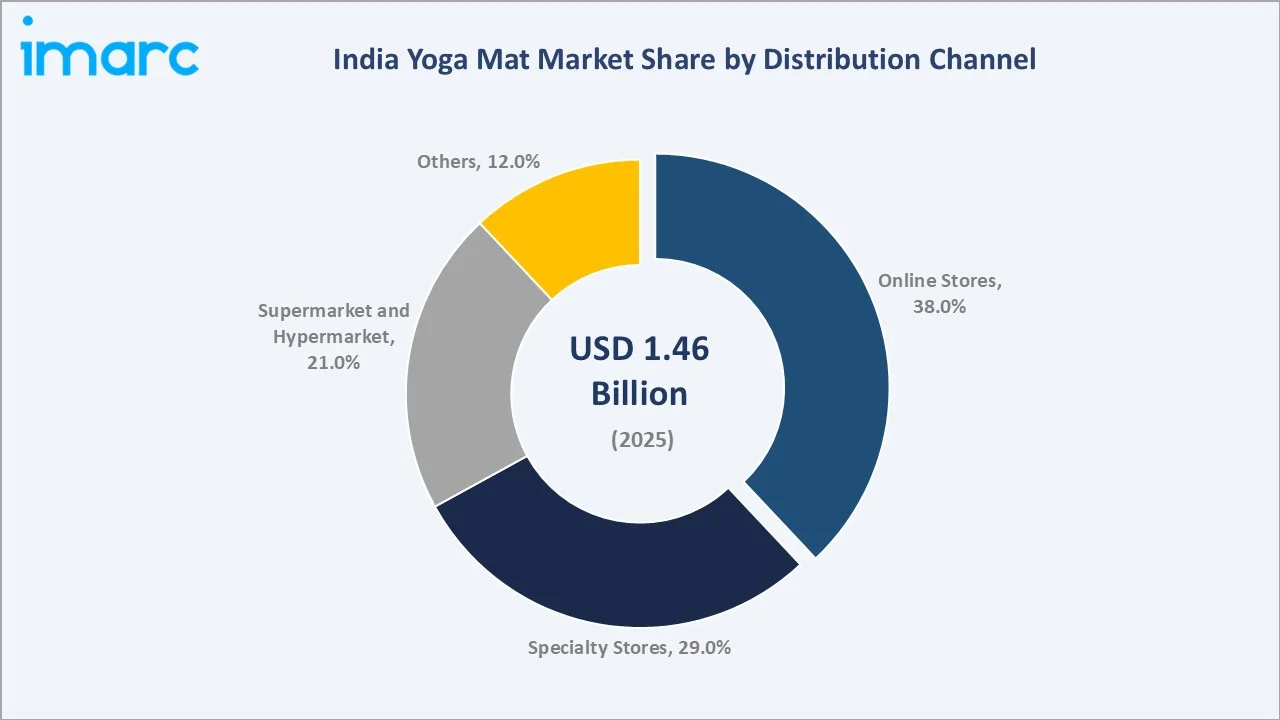
Specialty stores at 29.0% are growing through fitness-focused retail chains offering curated in-store experiences, while supermarket and hypermarket channels at 21.0% serve mass-market convenience-driven purchases. Others account for the remaining 12.0%.
Regional Market Insights
|
Region |
Share (2025) |
Key India Yoga Mat Market Drivers & Characteristics |
|
North India |
33.0% |
Driven by Delhi-NCR’s dense fitness-studio network, higher disposable incomes, and strong organized retail and e-commerce penetration. |
|
West India |
29.0% |
Supported by Mumbai and Pune’s affluent, fitness-oriented urban population and widespread adoption of premium and eco-friendly mats. |
|
South India |
24.0% |
Reflects Bengaluru, Hyderabad, and Chennai’s health-conscious, tech-savvy population, with strong corporate wellness and studio-driven consumption. |
|
East India |
14.0% |
Rising disposable incomes and increasing exposure to branded fitness accessories are gradually supporting growth in Kolkata and surrounding urban centers. |
North India’s 33.0% market leadership reflects Delhi-NCR’s concentration of yoga studios, wellness centers, and government institutional programming anchored in the national capital region. West India’s 29.0% reflects Mumbai’s premium fitness culture and Pune’s growing e-commerce adoption for wellness accessories.
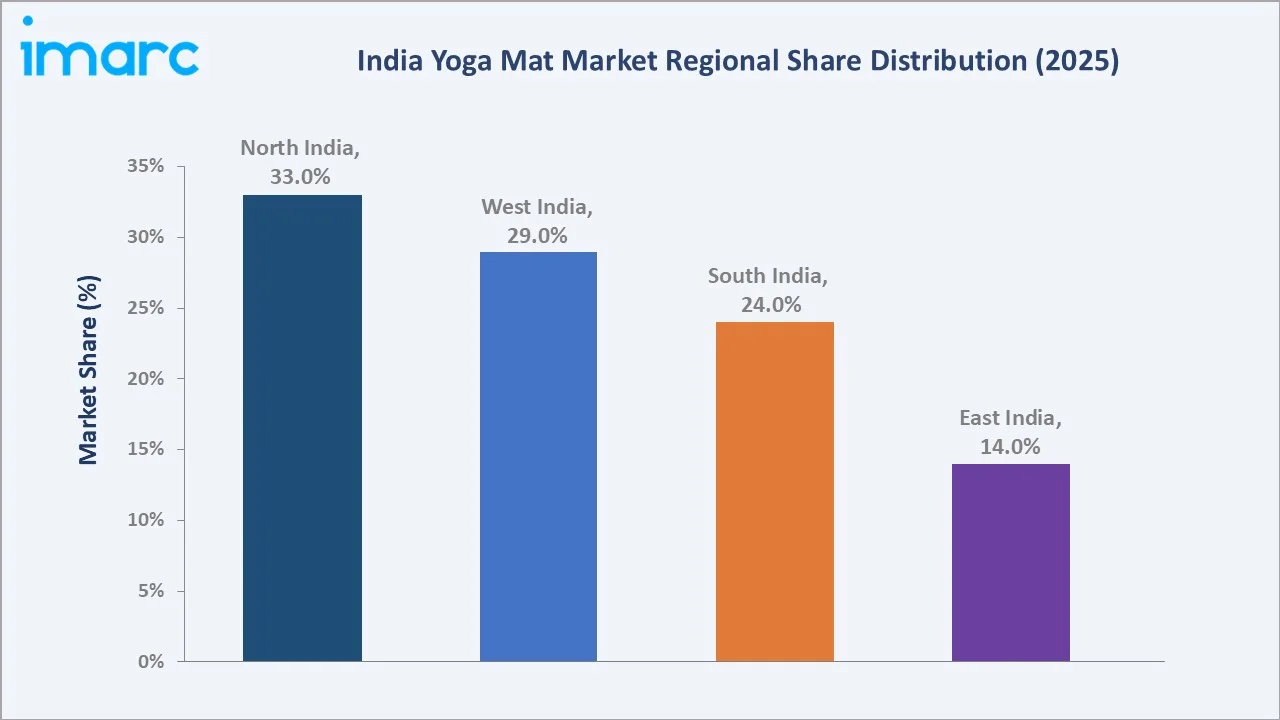
South India’s 24.0% reflects Bengaluru’s IT-sector wealth and wellness-oriented lifestyle culture, creating strong demand for premium and studio-grade mats. East India’s 14.0% is the most commercially underdeveloped region but is growing steadily as Kolkata’s organized retail expansion and rising urban wellness awareness create first-generation branded mat demand.
Competitive Landscape
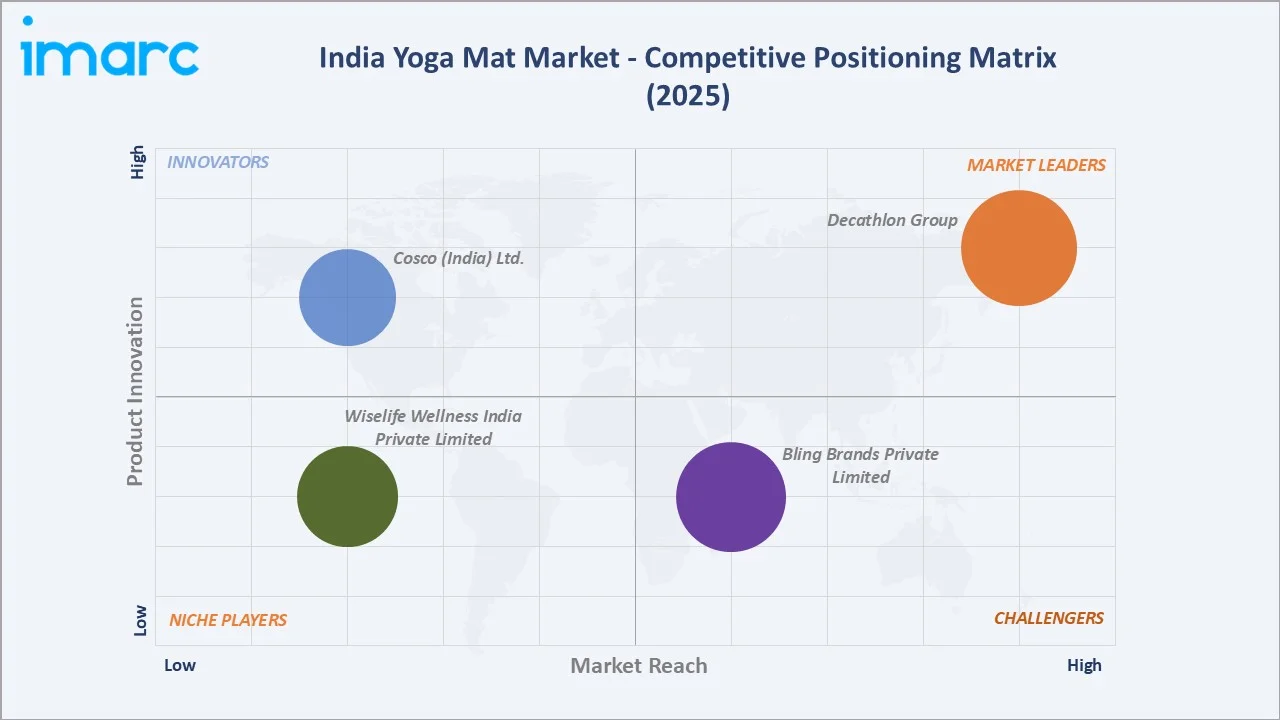
India yoga mat market competitive landscape is moderately fragmented, spanning organized sports and fitness brands, D2C-focused challengers, and a large unorganized base of local and private-label manufacturers. Competition is intensifying due to growing e-commerce penetration and rising consumer preference for eco-friendly materials.
|
Company |
Key Brands |
Market Position |
Core Strength |
|
Decathlon Group |
Domyos, Kimjaly |
Market Leader |
Decathlon combines vertically integrated Make-in-India manufacturing with an extensive omnichannel retail network, offering eco-designed jute and natural-rubber mats alongside affordable PVC and foam ranges. |
|
Bling Brands Private Limited |
Boldfit |
Strong Challenger |
Boldfit is one of India’s most-listed fitness-accessory brands on Amazon and Flipkart, known for its TPE ProGrip mats with wavy-grip underside technology and strong D2C e-commerce distribution. |
|
Cosco (India) Ltd. |
Cosco |
Innovator |
Cosco is a legacy Indian sporting-goods manufacturer with an established offline retail and institutional distribution network across sports and fitness categories. |
|
Wiselife Wellness India Private Limited |
WiseLife |
Niche Player |
WiseLife focuses on targeted body alignment guides, optimal joint cushioning, and sustainable product construction. |
The competitive landscape’s most significant dynamic is the continued formalization of India’s yoga mat market, as organized brands progressively capture share from unbranded local suppliers through wider e-commerce reach, quality certification, and eco-friendly product positioning.
Key Company Profiles
Decathlon Group
Decathlon Group, which owns Decathlon Sports India, is a leading sporting-goods retailer and manufacturer with a significant presence in the India yoga mat market through its Domyos and Kimjaly brands, offering both affordable foam mats and eco-designed jute and natural-rubber options.
- Key Brands: Domyos, Kimjaly, among others
- Strategic Focus: Expanding Make-in-India manufacturing capacity and eco-designed product ranges while sustaining its omnichannel retail leadership across store and online formats.
Bling Brands Private Limited
Bling Brands Private Limited, which owns Boldfit, is a fast-growing Indian D2C fitness-accessory brand with a strong presence in the yoga mat market through its TPE-based ProGrip range, widely distributed via Amazon and Flipkart.
- Key Brand: Boldfit
- Strategic Focus: Strengthening D2C e-commerce distribution and product durability to maintain leadership among India’s value-conscious online fitness-accessory buyers.
Market Concentration Analysis
India yoga mat market is moderately fragmented, with organized brands such as Decathlon, Boldfit, and Cosco collectively accounting for a meaningful but non-dominant share of total sales, while a large unorganized and private-label segment continues to serve price-sensitive consumers through local retail and unbranded online listings.
Market concentration is gradually increasing as organized e-commerce platforms favor brands with quality certification and consistent fulfillment, while unbranded competition remains structurally significant due to India’s large price-sensitive consumer base and low switching costs between budget mat options.
Investment & Growth Opportunities
Highest Growth Segments
Cotton and jute mats (~7.2% CAGR through sustainability-led demand), online stores (~7.6% CAGR through e-commerce and quick-commerce expansion), and TPE mats (~6.3% CAGR through eco-conscious consumer preference) represent India’s highest-growth yoga mat investment vectors through 2034.
Emerging Investment Opportunities
India’s natural-fiber and eco-friendly mat segment, though currently a smaller share of the overall market, represents its highest-growth investment opportunity, driven by rising environmental awareness, Khadi and natural-fiber craft promotion, and growing consumer willingness to pay a premium for biodegradable practice accessories.
Investment Themes
- D2C and quick-commerce brand-building in Tier-2 and Tier-3 cities: India’s smaller cities with rising disposable incomes and growing fitness awareness represent an underserved distribution opportunity above the more saturated metro e-commerce market.
- Eco-friendly and premium alignment-mat manufacturing capacity: Domestic manufacturing investment in TPE, natural rubber, and jute mat production supports both import substitution and rising sustainable-consumer demand, creating an investable long-term capacity opportunity.
Future Market Outlook (2026-2034)
India yoga mat market is projected to grow from USD 1.46 Billion in 2025 to USD 1.56 Billion in 2026 and is forecast to reach USD 2.30 Billion by 2034, delivering a 4.94% CAGR over the forecast period. The market’s anchor value of USD 1.85 Billion in 2030 reflects a steady structural expansion supported by sustained government promotion, rising organized retail penetration, and growing consumer preference for eco-friendly materials.
Three structural forces define India yoga mat market growth through 2034: continued government-led yoga promotion sustaining non-discretionary demand; e-commerce and quick-commerce maturation, creating geographic market democratization into smaller cities; and rising environmental consciousness, driving a structural shift toward TPE, natural rubber, and cotton-jute materials over conventional PVC.
Research Methodology
Primary Research
Primary research comprised structured interviews with India yoga mat industry stakeholders, including brand and retail category managers, e-commerce platform representatives, fitness-studio owners, and consumer survey data from yoga mat buyers across North, West, South, and East India.
Secondary Research
Secondary research encompassed India trade and industry association data, company websites and annual disclosures, Ministry of AYUSH publications, e-commerce platform listings, and India retail and wellness-industry market analysis. Over 40 secondary sources were reviewed.
Forecasting Models
Market revenue forecasts were developed using a consumption-based estimation model, combining India’s urban and semi-urban fitness-participant base by region with average mat purchase frequency and price-segment distribution to derive total market revenue by segment aggregation.
India Yoga Mat Market Report Coverage:
| Report Features | Details |
|---|---|
| Base Year of the Analysis | 2025 |
| Historical Period | 2020-2025 |
| Forecast Period | 2026-2034 |
| Units | Billion USD |
| Scope of the Report |
Exploration of Historical Trends and Market Outlook, Industry Catalysts and Challenges, Segment-Wise Historical and Future Market Assessment:
|
| Materials Covered | PVC, TPE, Rubber, Cotton and Jute, Others |
| Distribution Channels Covered | Supermarket and Hypermarket, Specialty Stores, Online Stores, Others |
| End Uses Covered | Yoga and Fitness Clubs, Household, Others |
| Regions Covered | North India, South India, East India, West India |
| Companies Covered | Decathlon Group, Bling Brands Private Limited, Cosco (India) Ltd., Wiselife Wellness India Private Limited, etc. |
| Customization Scope | 10% Free Customization |
| Post-Sale Analyst Support | 10-12 Weeks |
| Delivery Format | PDF and Excel through Email (We can also provide the editable version of the report in PPT/Word format on special request) |
Key Benefits for Stakeholders:
- IMARC’s industry report offers a comprehensive quantitative analysis of various market segments, historical and current market trends, market forecasts, and dynamics of the India yoga mat market from 2020-2034.
- The research report provides the latest information on the market drivers, challenges, and opportunities in the India yoga mat market.
- Porter's five forces analysis assist stakeholders in assessing the impact of new entrants, competitive rivalry, supplier power, buyer power, and the threat of substitution. It helps stakeholders to analyze the level of competition within the India yoga mat industry and its attractiveness.
- Competitive landscape allows stakeholders to understand their competitive environment and provides an insight into the current positions of key players in the market.
Frequently Asked Questions About the India Yoga Mat Market Report
India yoga mat market size is estimated at USD 1.56 Billion in 2026, driven by rising health and wellness consciousness, government-backed yoga promotion, and expanding e-commerce access to fitness accessories across urban and semi-urban India.
India yoga mat market grows at a 4.94% CAGR during 2026-2034, reaching USD 2.30 Billion by 2034, supported by rising disposable incomes, organized retail expansion, and growing eco-friendly material adoption.
PVC leads at 39.0% through its affordability, durability, and wide availability across mass, budget, and mid-range retail channels catering to India’s largely price-sensitive fitness-accessory buyer base.
Online stores lead at 38.0% through wide product assortment, competitive discounting, and fast delivery via major e-commerce and quick-commerce platforms across Indian cities.
North India leads at 33.0% through Delhi-NCR’s dense fitness-studio network, higher disposable incomes, and strong organized retail and e-commerce penetration.
Leading companies include Decathlon Group, Bling Brands Private Limited, Cosco (India) Ltd., and Wiselife Wellness India Private Limited, among others.
India yoga mat market is projected to reach approximately USD 1.85 Billion by 2030, supported by sustained government yoga promotion and rising organized e-commerce retail penetration.
Priority investment opportunities include eco-friendly and premium alignment-mat manufacturing capacity, and D2C and quick-commerce brand-building expansion into India’s Tier-2 and Tier-3 cities.
Cotton and Jute is the fastest-growing material at an estimated ~7.2% CAGR, driven by India’s sustainability movement and rising consumer preference for biodegradable practice surfaces.
The Ministry of AYUSH actively promotes yoga through the annual International Day of Yoga and the Yoga 365 initiative, sustaining structural demand for yoga mats and other practice accessories nationwide.
Need more help?
- Speak to our experienced analysts for insights on the current market scenarios.
- Include additional segments and countries to customize the report as per your requirement.
- Gain an unparalleled competitive advantage in your domain by understanding how to utilize the report and positively impacting your operations and revenue.
- For further assistance, please connect with our analysts.
 Request Customization
 Speak to an Analyst
 Request Brochure
 Inquire Before Buying
Benefits of Customization
- Personalize this research
- Triangulate with your data
- Get data as per your format and definition
- Gain a deeper dive into a specific application, geography, customer, or competitor
- Any level of personalization
Get in Touch With Us
UNITED STATES
Phone: +1-201-971-6302
INDIA
Phone: +91-120-433-0800
UNITED KINGDOM
Phone: +44-753-714-6104
Email: [email protected]
Client Testimonials




.webp)




.webp)













Related Reports

Choose your plan
*Please note that the prices mentioned below are starting prices for each bundle type. Kindly contact our team for further details.*
Single User License
- 1 User License, Access on 2 Devices
- PDF Report + Excel Dataset (Password Protected)
- Lifetime Access
- No Printing Rights
- 10% Free Report Customization
- 10–12 Weeks of Analyst Support
Five User License
- Access for 5 Users, 2 Devices per User
- PDF Report + Excel Dataset (Password Protected)
- Lifetime Access
- Dedicated Account Manager
- 12–14 Weeks of Analyst Support
- No Printing Rights
- 15% Free Report Customization
- 25% Discount on Your Next Purchase
Corporate User License
- Unlimited User Access (Within Your Organization)
- PDF Report + Excel Dataset
- Lifetime Access
- Dedicated Account Manager
- 14–20 Weeks of Analyst Support
- No Printing Rights
- 20% Free Report Customization
- 30% Discount on Your Next Purchase
Essential Insights
What's included:
3 reports
- Lifetime Access
- PDF Reports
- Excel Datasets
- 2 Weeks of Free Analyst Support
- 2 User Licenses
- Access on 2 Devices
- Printing Rights
- Complimentary PowerPoint (PPT) Version
- Complimentary License Upgrade
Professional Access
What's included:
5 reports
- Lifetime Access
- PDF Reports
- Excel Datasets
- 8 Weeks of Free Analyst Support
- 2 User Licenses
- Access on 2 Devices
- Printing Rights
- Complimentary PowerPoint (PPT) Version
- Complimentary License Upgrade
Business Advantage
What's included:
8 reports
- Lifetime Access
- PDF Reports
- Excel Datasets
- 14 Weeks of Free Analyst Support
- 2 User Licenses
- Access on 2 Devices
- Printing Rights
- Complimentary PowerPoint (PPT) Version
- Complimentary License Upgrade
Enterprise Intelligence
What's included:
10 reports
- Lifetime Access
- PDF Reports
- Excel Datasets
- 20 Weeks of Free Analyst Support
- 2 User Licenses
- Access on 2 Devices
- Printing Rights
- Complimentary PowerPoint (PPT) Version
- Complimentary License Upgrade