
Japan 3D Printing Plastics Market Size, Share, Trends and Forecast by Type, Form, Application, End User, and Region, 2026-2034
Japan 3D Printing Plastics Market Size, Share, Trends & Forecast (2026-2034)
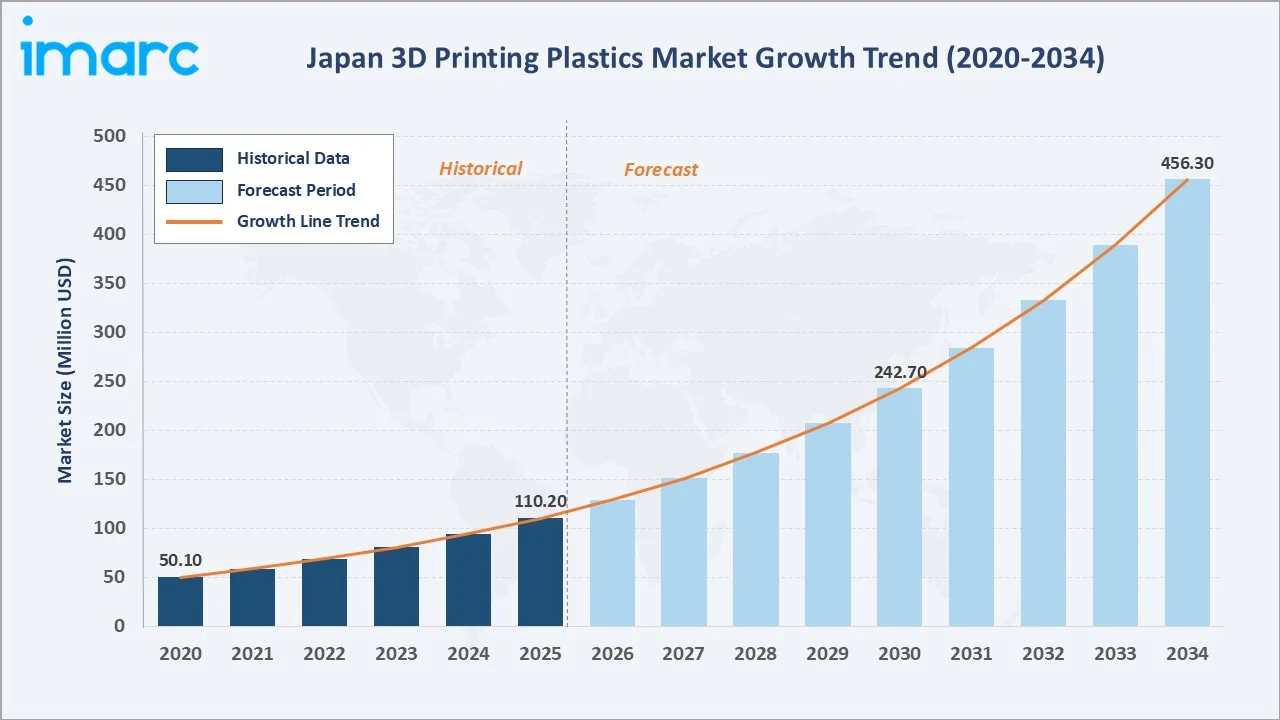
The Japan 3D printing plastics market grew from USD 110.2 Million in 2025 to USD 129.1 Million in 2026 and is projected to reach USD 456.3 Million by 2034, growing at a CAGR of 17.10% during 2026-2034. The market is driven by Japan’s advanced manufacturing ecosystem, deep penetration of Industry 4.0 technologies, and strong automotive and aerospace demand for precision-engineered components. Japan’s leading additive-manufacturing trade event, TCT Japan, draws more than 47,000 industry professionals annually, reflecting the breadth of manufacturers, designers, and engineers actively engaging with 3D printing technology. This strong industry engagement is driving the Japan 3D printing market by supporting demand across prototyping, tooling, and functional part production segments.
Filament dominates at 52.8%, manufacturing leads applications at 57.6%, and Kanto Region commands 37.2% of the national market share.
Market Snapshot
|
Metric |
Value |
|
Base Year Market Size (2025) |
USD 110.2 Million |
|
Market Size (2026) |
USD 129.1 Million |
|
Forecast Market Size (2034) |
USD 456.3 Million |
|
CAGR (2026-2034) |
17.10% |
|
Base Year |
2025 |
|
Historical Period |
2020-2025 |
|
Forecast Period |
2026-2034 |
|
Dominant Form |
Filament (52.8%, 2025) |
|
Dominant Application |
Manufacturing (57.6%, 2025) |
|
Leading Region |
Kanto Region (37.2%, 2025) |
The Japan 3D printing plastics market size increased from USD 50.1 Million in 2020 to USD 110.2 Million in 2025 and is estimated to reach USD 129.1 Million in 2026. The market is further expected to grow to USD 242.7 Million by 2030 and USD 456.3 Million by 2034. The Japan 3D printing market is commercially unique among global additive-manufacturing markets, combining one of Asia’s most advanced industrial automation bases, a rapidly expanding metal additive-manufacturing segment driven by automotive and aerospace precision-component demand, and a healthcare 3D printing segment growing at above-average rates through Japan’s rising adoption of patient-specific medical devices and prosthetics.
To get more information on this market, Request Sample
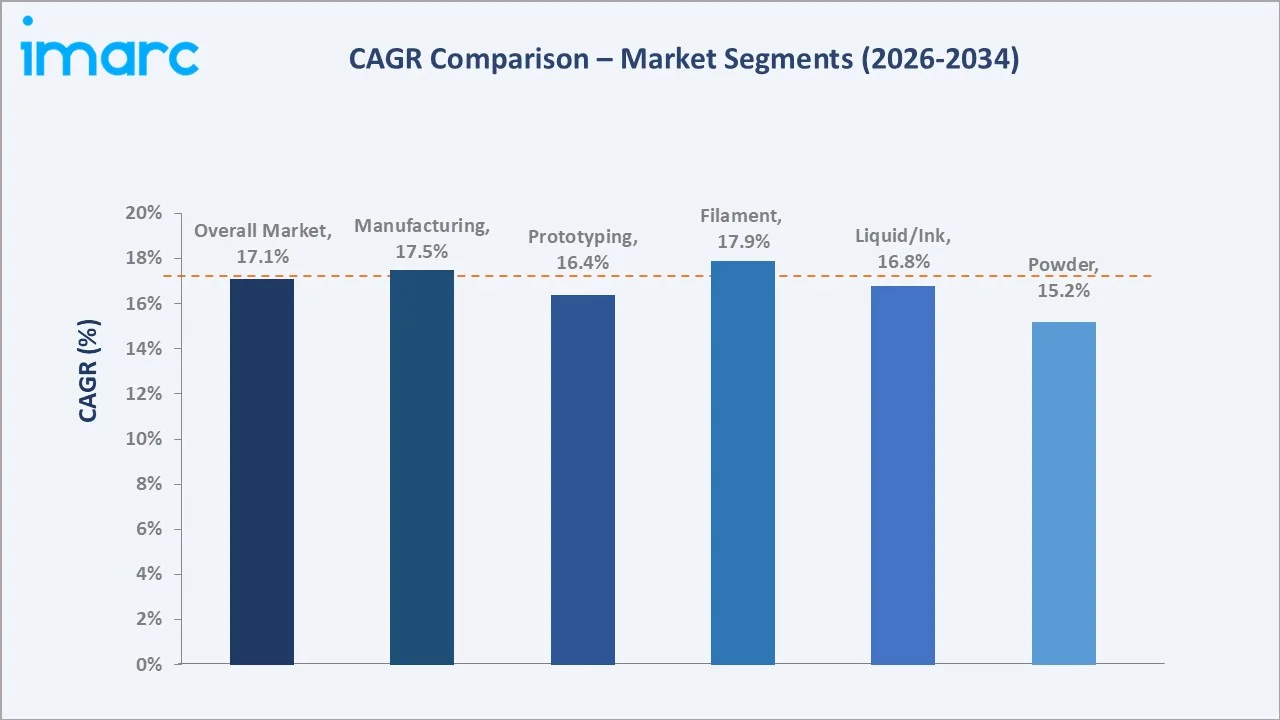
Manufacturing at 57.6% leads applications through Japan's precision prototyping demand from automotive OEMs, electronics manufacturers, and aerospace suppliers requiring complex, lightweight components. Filament segment grows fastest at ~17.9% CAGR through FDM technology proliferation.
Executive Summary
The Japan 3D printing plastics market expanded from USD 110.2 Million in 2025 to an estimated USD 129.1 Million in 2026, positioning it among Asia's fastest-growing additive manufacturing materials markets. Japan's world-class manufacturing base, supported by leading automotive, electronics, and aerospace industries, is driving strong adoption of 3D printing plastics. The country's robotics ecosystem and smart factory initiatives accelerate material innovation and process integration. The market is projected to reach USD 456.3 Million by 2034. Filament at 52.8% leads through FDM dominance. Manufacturing at 57.6% reflects industrial prototyping scale. Kanto Region leads regionally at 37.2%.
Key Market Insights
|
Insight |
Data |
|
Dominant Form |
Filament - 52.8% share (2025) |
|
Dominant Application |
Manufacturing - 57.6% market share (2025) |
|
Leading Region |
Kanto Region - 37.2% share (2025) |
|
Market Opportunity |
Healthcare 3D printing expansion, aerospace lightweighting, automotive customization, and sustainability-driven bioplastic innovation |
Key analytical observations supporting the above data:
- Filament at 52.8%: Filament dominates due to its compatibility with widely used FDM printers, cost efficiency, and versatility across engineering-grade and specialty polymer applications in Japan's manufacturing sector.
- Manufacturing at 57.6%: Manufacturing leads because Japan's OEM-heavy industrial base requires precision, repeatable 3D printing solutions for end-use parts, jigs, fixtures, and rapid tooling across automotive and electronics sectors.
- Kanto Region at 37.2%: Kanto dominates due to Tokyo's concentration of advanced manufacturers, electronics companies, robotics firms, and research institutions driving high-volume 3D printing plastics consumption.
Japan 3D Printing Plastics Market Overview
Japan 3D printing plastics market is positioned at the intersection of the country's advanced manufacturing heritage and its strategic commitment to Industry 4.0 transformation. The market combines mass-production manufacturing efficiency with small-batch customization capabilities that 3D printing uniquely enables.
Japan's 3D printing plastics ecosystem integrates polymer producers, additive manufacturing equipment suppliers, software developers, and a dense network of industrial end users. Key macroeconomic drivers include Japan's manufacturing competitiveness strategy, carbon neutrality goals, and aging workforce pressures accelerating automation adoption.
Market Dynamics
To evaluate market opportunities, Request Sample
Market Drivers
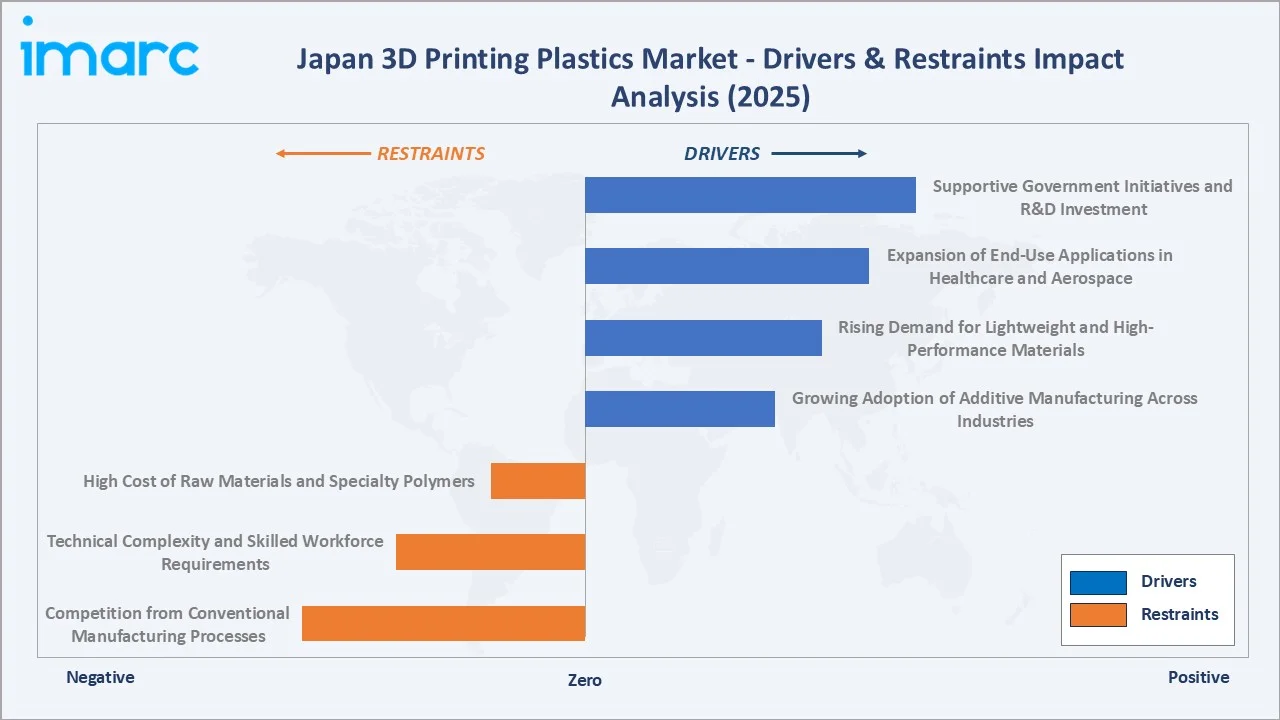
- Growing Adoption of Additive Manufacturing Across Industries: The increasing use of additive manufacturing across various industries is driving the demand for 3D printing plastics. Businesses are leveraging 3D printing for prototyping, tooling, and production of complex components, reducing lead times and material waste. This widespread adoption is significantly contributing to market growth.
- Rising Demand for Lightweight and High-Performance Materials: There is a growing need for lightweight yet strong materials in sectors such as automotive, aerospace, and consumer electronics. 3D printing plastics, including engineering-grade polymers and composites, meet these requirements by enabling the production of complex structures with superior mechanical properties at reduced weight.
- Expansion of End-Use Applications in Healthcare and Aerospace: The healthcare and aerospace sectors are increasingly adopting 3D printing plastics for producing customized implants, surgical guides, lightweight structural components, and interior parts. The ability to fabricate patient-specific or application-specific components with precision is driving demand for specialized polymer materials.
- Supportive Government Initiatives and R&D Investment: Governments across major economies are actively supporting additive manufacturing through R&D funding, tax incentives, and national manufacturing strategies. These initiatives encourage innovation in 3D printing plastics, accelerating the development of new materials and expanding the addressable market across industrial sectors.
Market Restraints
- High Cost of Raw Materials and Specialty Polymers: The elevated cost of engineering-grade 3D printing plastics, including PEEK, polyamide composites, and photopolymer resins, remains a significant barrier for small and mid-sized enterprises. Limited availability of domestic specialty polymer suppliers further restricts access and increases procurement costs, slowing broader market adoption.
- Technical Complexity and Skilled Workforce Requirements: Operating advanced 3D printing systems requires specialized knowledge in material science, process parameters, and post-processing techniques. The shortage of skilled professionals and the steep learning curve associated with engineering-grade plastics create barriers to adoption, particularly among smaller manufacturers.
- Competition from Conventional Manufacturing Processes: Established manufacturing methods such as injection molding and CNC machining offer cost advantages at high production volumes and are deeply embedded in existing industrial workflows. This creates resistance to transitioning toward 3D printing plastics, especially for standardized components where traditional processes remain economically favorable.
Market Opportunities
- Growing Demand for Sustainable and Bio-Based Materials: Rising environmental concerns and corporate sustainability goals are creating demand for bio-based and recyclable 3D printing plastics. The development of eco-friendly polymer formulations, including PLA composites and recycled PETG, presents significant growth opportunities as manufacturers seek to reduce their environmental footprint.
- Expansion of 3D Printing in Medical Device Manufacturing: The medical device industry presents significant opportunities for 3D printing plastics through the production of patient-specific implants, dental prosthetics, orthotics, and surgical planning models. Growing regulatory acceptance of additively manufactured medical components and increasing healthcare investments are supporting the adoption of high-performance biocompatible polymers.
Market Challenges
- Lack of Standardization and Quality Certification Frameworks: The absence of unified international standards for 3D printing plastic material performance, testing protocols, and quality benchmarks creates uncertainty for manufacturers and end users. This lack of standardization complicates qualification processes for regulated industries such as aerospace and healthcare, limiting broader industrial adoption.
- Supply Chain Vulnerabilities and Raw Material Price Volatility: The 3D printing plastics market is susceptible to supply chain disruptions due to its reliance on imported specialty polymer precursors and chemical feedstocks. Fluctuations in raw material prices, geopolitical uncertainties, and logistics challenges create procurement risks that can affect production planning and market stability for manufacturers.
Emerging Market Trends
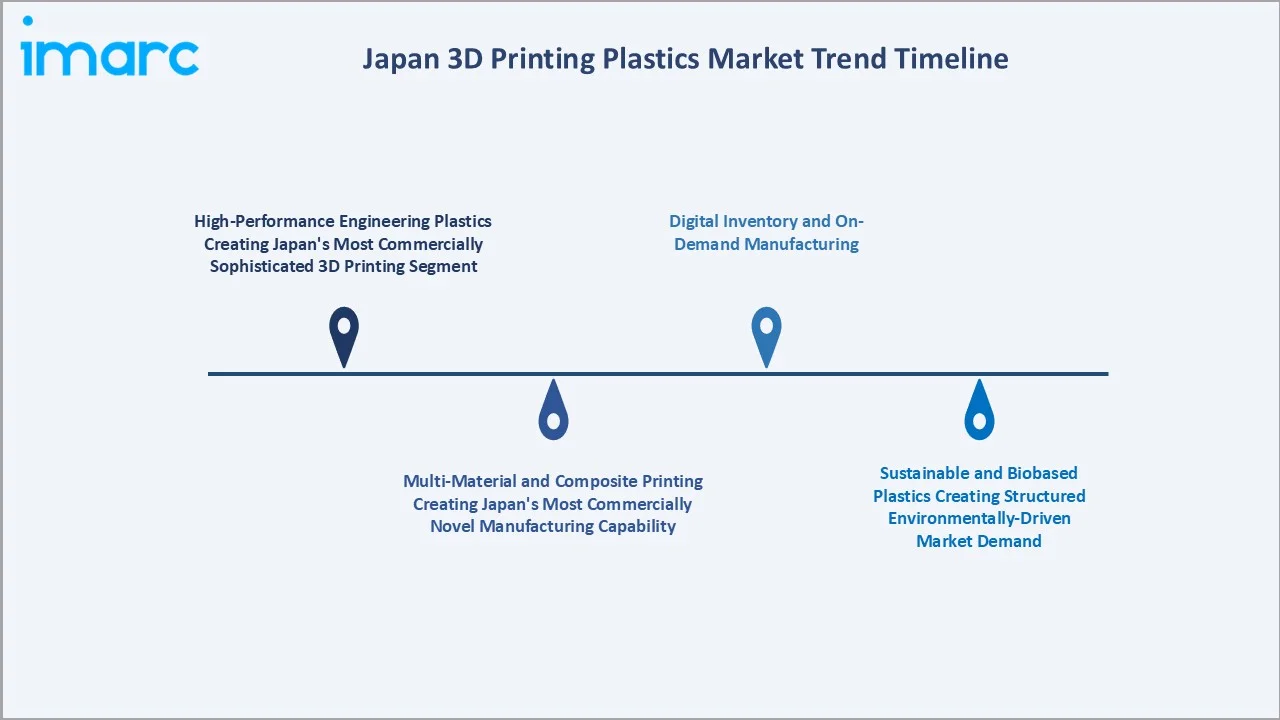
1. High-Performance Engineering Plastics Creating Japan's Most Commercially Sophisticated 3D Printing Segment
The adoption of high-performance engineering plastics in 3D printing is expanding as industries demand materials that can withstand extreme temperatures, mechanical stress, and chemical exposure. Polymers such as PEEK, polyamide composites, and reinforced resins are being used across demanding applications in aerospace, medical devices, and industrial tooling. As additive manufacturing matures, high-performance polymer materials are increasingly being qualified for end-use structural and functional applications. This shift from prototyping to production-grade usage is driving investment in material certification, process validation, and testing infrastructure, creating a more commercially viable pathway for engineering-grade 3D printing plastics.
2. Multi-Material and Composite Printing Creating Japan's Most Commercially Novel Manufacturing Capability
Multi-material and composite 3D printing technologies are enabling manufacturers to produce components that combine rigid structures with flexible elements, functional conductivity, or reinforced mechanical strength in a single print cycle. This capability reduces assembly complexity, shortens production lead times, and opens new design possibilities across automotive, electronics, and consumer product industries. The convergence of composite material science and additive manufacturing is accelerating the development of fiber-reinforced polymer components with properties that approach those of metal parts. These advanced composite materials are being adopted for lightweight structural applications, reducing component weight while maintaining the strength and durability required by demanding industrial environments.
3. Sustainable and Biobased Plastics Creating Structured Environmentally-Driven Market Demand
Growing environmental awareness and regulatory pressure are driving the development and adoption of sustainable 3D printing plastics, including bio-based polymers, recycled feedstocks, and compostable materials. Manufacturers and brands across multiple industries are actively seeking eco-friendly material alternatives that reduce carbon footprint without compromising performance requirements. Corporate sustainability commitments and evolving environmental regulations are creating structured institutional demand for certified sustainable 3D printing materials. The growing availability of bio-based and recycled polymer options, combined with improving material performance, is making sustainable choices increasingly viable for industrial prototyping and production applications.
4. Digital Inventory and On-Demand Manufacturing
Digital inventory and on-demand manufacturing strategies enabled by 3D printing are transforming how industries manage spare parts, tooling, and low-volume components. By replacing physical warehouses with digital design libraries and printing parts as needed, manufacturers can reduce inventory costs, minimize waste, and respond more rapidly to maintenance and customization requirements. The on-demand manufacturing model is gaining traction across industries with distributed operations and variable part replacement needs, including marine, energy, and heavy equipment sectors. The economic case for on-demand production is particularly strong for low-frequency replacement parts with high storage costs, where additive manufacturing provides flexibility and cost advantages over traditional inventory models.
Industry Value Chain Analysis
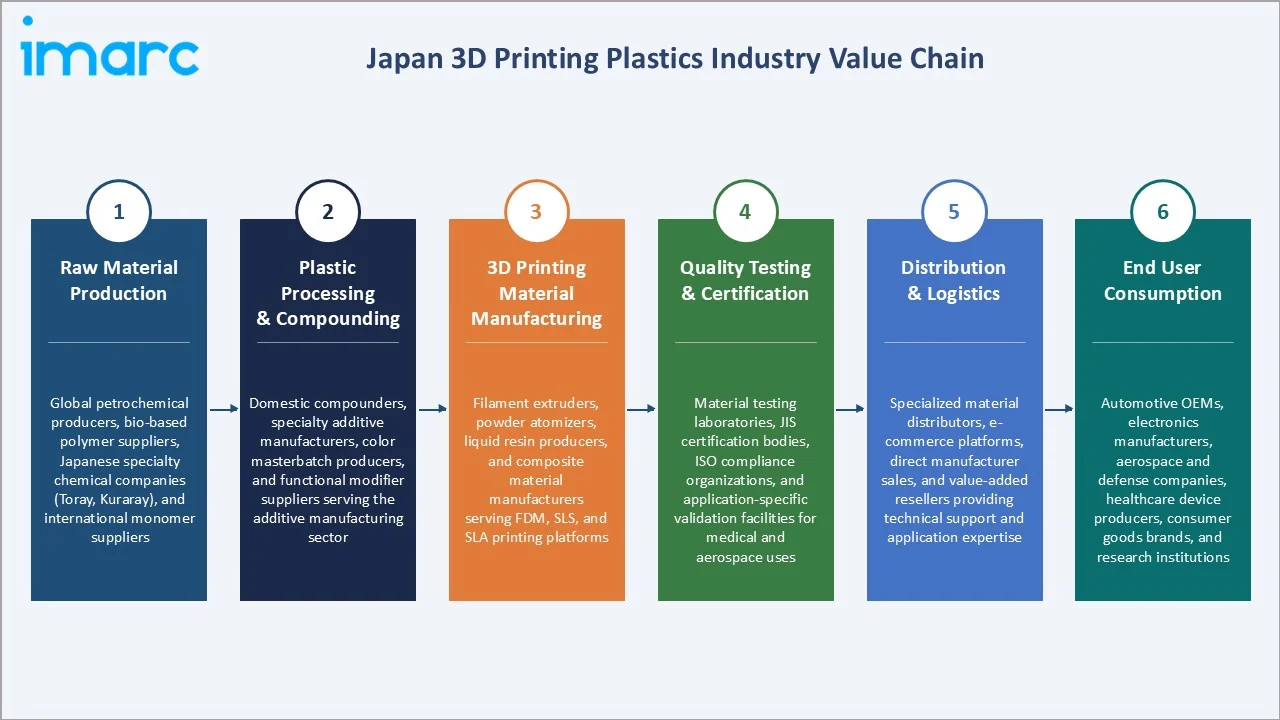
Japan 3D printing plastics value chain represents one of the most technologically sophisticated material supply chains in Asia's manufacturing ecosystem. The chain integrates global polymer producers, domestic specialty compounders, precision equipment manufacturers, and end-user industrial facilities.
The polymer formulation stage is Japan's most commercially consequential upstream process, where specialty additives, reinforcing agents, and functional modifiers are incorporated to meet stringent industrial performance specifications. Japanese chemical companies maintain competitive advantages in high-purity polymer synthesis.
|
Stage |
Key Participants |
|
Raw Material Production |
Global petrochemical producers, bio-based polymer suppliers, Japanese specialty chemical companies (Toray, Kuraray), and international monomer suppliers |
|
Plastic Processing & Compounding |
Domestic compounders, specialty additive manufacturers, color masterbatch producers, and functional modifier suppliers serving the additive manufacturing sector |
|
3D Printing Material Manufacturing |
Filament extruders, powder atomizers, liquid resin producers, and composite material manufacturers serving FDM, SLS, and SLA printing platforms |
|
Quality Testing & Certification |
Material testing laboratories, JIS certification bodies, ISO compliance organizations, and application-specific validation facilities for medical and aerospace uses |
|
Distribution & Logistics |
Specialized material distributors, e-commerce platforms, direct manufacturer sales, and value-added resellers providing technical support and application expertise |
|
End User Consumption |
Automotive OEMs, electronics manufacturers, aerospace and defense companies, healthcare device producers, consumer goods brands, and research institutions |
Technology Landscape in the Japan 3D Printing Plastics Industry
Fused Deposition Modeling (FDM) Material Technology
Fused Deposition Modeling technology uses thermoplastic filaments that are melted and deposited layer by layer to produce three-dimensional parts. It is the most widely adopted 3D printing technology due to its cost-effectiveness, material versatility, and compatibility with a broad range of engineering polymers including ABS, PLA, PETG, Nylon, and PC blends used in industrial and prototyping applications.
Advancements in FDM material science have expanded the range of printable thermoplastics to include high-temperature and reinforced composites. The development of continuous fiber-reinforced filaments incorporating carbon, glass, and Kevlar fibers has significantly improved the mechanical properties achievable through FDM, extending its applicability to structural and load-bearing components across manufacturing sectors.
Photopolymer Resin and SLA/DLP Technology
Stereolithography and Digital Light Processing technologies use photopolymer resins that are cured through ultraviolet light exposure to produce high-resolution components with smooth surface finishes. These technologies are widely used in dental, medical, and precision manufacturing applications where dimensional accuracy, fine feature resolution, and aesthetic quality are critical requirements.
The photopolymer resin segment is benefiting from the development of functional resins with improved mechanical, thermal, and biocompatible properties. Advances in resin chemistry have produced materials suitable for end-use applications in consumer electronics, healthcare devices, and engineering components, expanding the market beyond its traditional prototyping focus.
Selective Laser Sintering (SLS) Powder Materials
Selective Laser Sintering technology uses laser energy to fuse thermoplastic powder particles, enabling the production of complex, functional parts without support structures. SLS is valued for its ability to produce geometrically intricate components with isotropic mechanical properties, making it suitable for aerospace brackets, automotive ducts, and medical device housings requiring high structural performance.
The SLS material portfolio is expanding beyond traditional polyamide-12 to include high-performance specialty powders such as PEEK, polypropylene, and TPU elastomers. This broadening of available materials is enabling SLS technology to address a wider range of functional applications, including flexible components, chemically resistant parts, and high-temperature structural elements in regulated industries.
Market Segmentation Analysis
The report covers the following segments:
|
Segment Category |
Leading Segment |
Market Share |
Year |
|
Form |
Filament |
52.8% |
2025 |
|
Application |
Manufacturing |
57.6% |
2025 |
|
Type |
🔒 |
🔒 |
2025 |
|
End User |
🔒 |
🔒 |
2025 |
|
Region |
Kanto Region |
37.2% |
2025 |

By Form
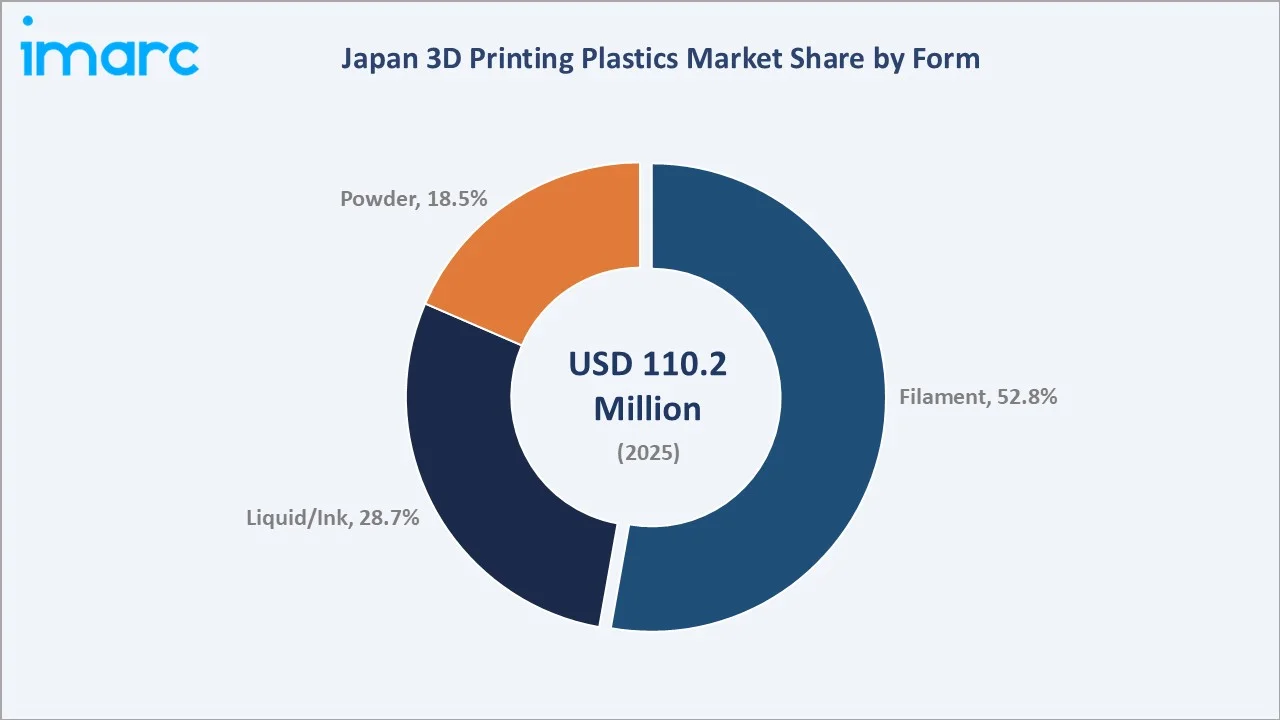
Filament leads at 52.8% (2025). The filament segment encompasses Japan's most commercially dominant 3D printing format, supporting the country's extensive FDM printer base across manufacturing, prototyping, and educational applications. Its versatility across engineering thermoplastics (ABS, PETG, Nylon, PEEK) and commodity polymers drives sustained market leadership through broad industry adoption.
To access detailed market analysis, Request Sample
Liquid/Ink at 28.7% grows fastest at ~16.8% CAGR through expanding SLA/DLP adoption in Japan's precision manufacturing and dental sectors, driven by demand for ultra-high-resolution components in electronics and medical device applications. Powder at 18.5% grows at ~15.2% CAGR through aerospace and automotive SLS functional part production requiring complex geometries and isotropic mechanical properties.
By Application
Manufacturing leads at 57.6% (2025). The manufacturing application segment encompasses Japan's industrial-scale 3D printing adoption for end-use parts, tooling, jigs, and fixtures across automotive, electronics, and aerospace sectors. Japan's OEM precision manufacturing culture and quality standards create sustained demand for production-grade 3D printing plastics with validated, repeatable performance characteristics.
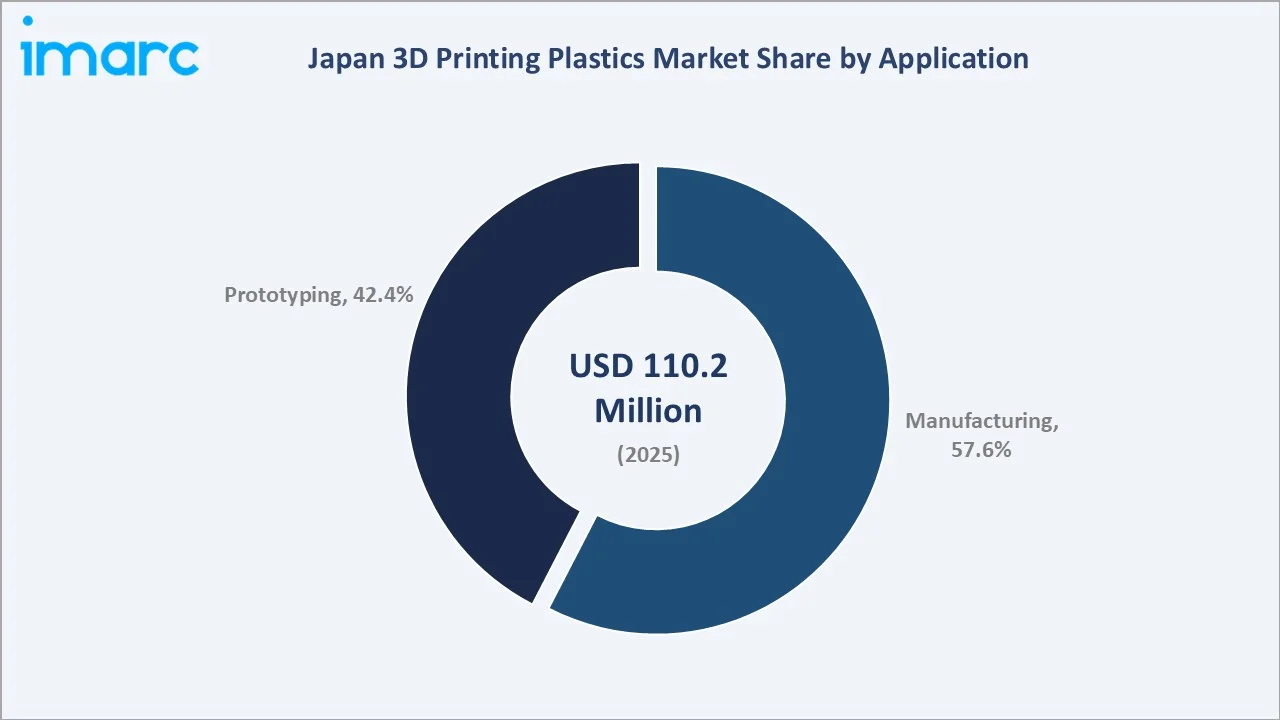
Prototyping at 42.4% grows at ~16.4% CAGR through Japan's design-intensive product development culture across consumer electronics, automotive, and medical device industries. Rapid physical validation requirements before production scale-up, combined with growing adoption of multi-material prototyping platforms, are driving demand for engineering-grade polymers that replicate final production material properties.
Regional Market Insights
|
Region |
Share (2025) |
Key Japan 3D Printing Plastics Market Drivers & Characteristics |
|
Kanto Region |
37.2% |
Driven by Tokyo's concentration of electronics, automotive R&D centers, and advanced manufacturing facilities with high 3D printing adoption rates |
|
Kansai/Kinki Region |
22.4% |
Osaka and Kyoto's precision manufacturing, medical device production, and chemical industry clusters support strong 3D printing plastics demand |
|
Central/Chubu Region |
15.6% |
Toyota City automotive manufacturing hub drives significant demand for prototyping and end-use plastic parts in vehicle component development |
|
Kyushu-Okinawa Region |
8.9% |
Semiconductor, automotive, and aerospace manufacturing in Fukuoka and Kumamoto create growing demand for specialized 3D printing materials |
|
Tohoku Region |
6.1% |
Reconstruction-driven manufacturing growth and electronics production expansion support increasing 3D printing plastics adoption |
|
Chugoku Region |
4.8% |
Shipbuilding, steel, and automotive parts manufacturing in Hiroshima and Okayama support localized demand for industrial-grade materials |
|
Hokkaido Region |
3.6% |
Food processing, agriculture technology, and medical research institutions drive emerging demand for specialized polymer applications |
|
Shikoku Region |
1.4% |
Small but growing market driven by chemical manufacturing and electronics production facilities across Tokushima and Ehime prefectures |
Kanto Region's 37.2% market leadership reflects Tokyo-Yokohama's unmatched concentration of technology companies, automotive suppliers, electronics OEMs, and research universities creating Japan's highest-density 3D printing plastics consumption cluster.
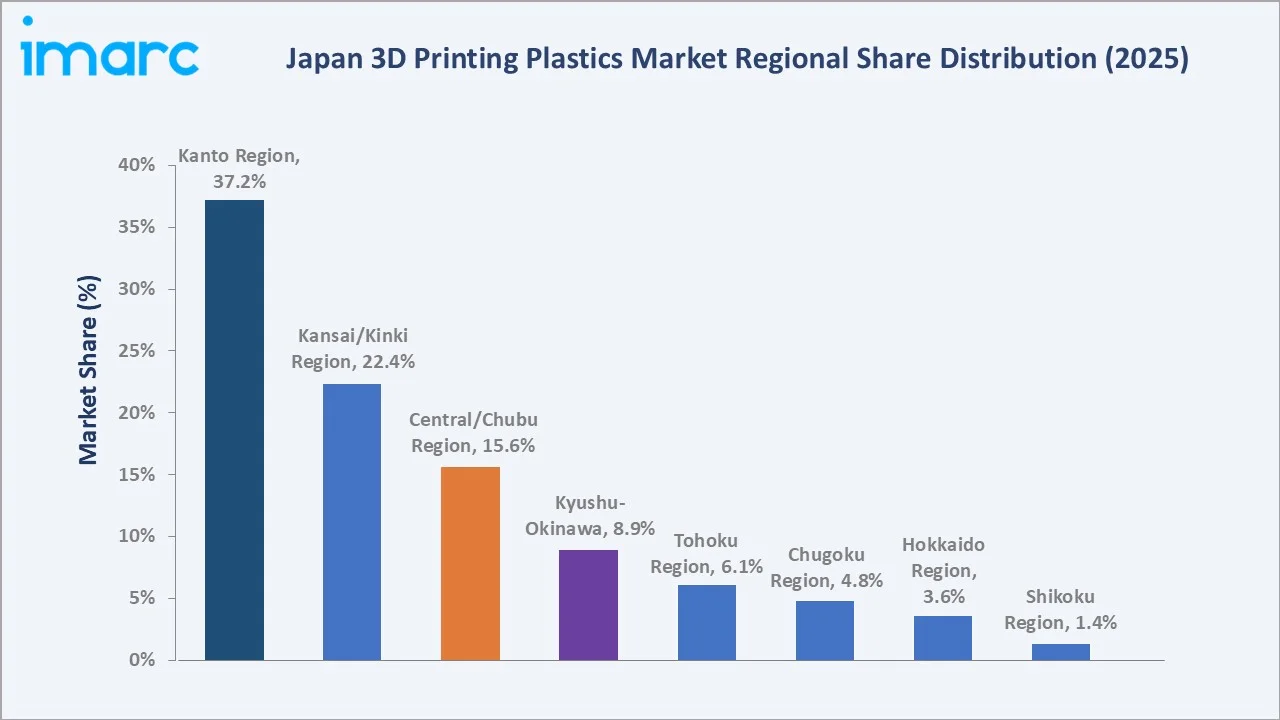
Kansai/Kinki Region's 22.4% reflects Osaka's precision machinery and chemical industry strength, Kyoto's advanced ceramics and electronics R&D ecosystem, and Kobe's medical device and biotechnology sectors driving specialty polymer demand.
Competitive Landscape
Japan 3D printing plastics market competitive landscape reflects the global nature of polymer supply combined with Japan-specific application demands. International material science leaders compete with domestic specialty chemical companies serving Japan's precision manufacturing requirements.
|
Company |
Key Products |
Market Position |
Core Strength |
| Stratasys Ltd. | FDM and PolyJet polymer materials | Market Leader | Stratasys leads through its integrated hardware-materials ecosystem, offering Japan's manufacturers validated material-printer combinations for industrial-grade production applications. |
| BASF SE | Ultrafuse filaments, Ultrasint powders | Strong Challenger | BASF's broad polymer chemistry expertise supports comprehensive 3D printing material portfolios serving Japan's automotive, electronics, and consumer goods sectors. |
| Evonik Industries AG | VESTOSINT polyamide powders, INFINAM specialty resins | Innovator | Evonik's specialty chemical expertise supports premium SLS powder and photopolymer resin development serving Japan's aerospace, medical, and high-end industrial markets. |
| 3D Systems Corporation | DuraForm polymers, VisiJet resins | Innovator | 3D Systems drives photopolymer innovation in Japan's dental, medical, and precision prototyping sectors through its integrated hardware-material-software solutions. |
The competitive landscape's most commercially significant dynamic is the materials performance differentiation strategy pursued by leading players, where superior thermal resistance, mechanical properties, and processing consistency command premium positioning among Japan's demanding industrial customers.
Key Company Profiles
Stratasys Ltd.
Stratasys Ltd. is a global leader in additive manufacturing solutions, with significant presence in Japan's 3D printing plastics market through its broad portfolio of FDM and PolyJet polymer materials. The company serves Japan's industrial manufacturing, healthcare, and aerospace sectors with validated material-printer ecosystems.
- Key Products: FDM thermoplastic filaments (ASA, ABS, PC, Nylon), PolyJet photopolymers, GrabCAD-validated engineering materials.
- Recent Developments: On September 9, 2026, Stratasys announced that Toyota and Rivian adopted its new F870 3D printer for factory-floor manufacturing applications. The F870 is designed for large-scale FDM production and supports engineering-grade thermoplastic materials, making the announcement relevant to the industrial polymer 3D-printing market.
- Strategic Focus: Expanding industrial material portfolio and software-material integration to serve Japan's precision manufacturing requirements with validated, traceable production-grade 3D printing solutions.
BASF SE
BASF SE is a global chemical leader with a rapidly expanding 3D printing plastics portfolio serving Japan's advanced manufacturing market. Its Ultrafuse, Ultrasint, and Ultracur3D product lines address FDM, SLS, and photopolymer applications respectively across industrial sectors.
- Key Products: Ultrafuse engineering filaments (PET, PP, TPU, PA6), Ultrasint polyamide and TPU powders, Ultracur3D photopolymer resins.
- Recent Developments: In October 2025, BASF and Suzuki jointly explored sustainable and high-performance material solutions for Suzuki’s next-generation MOQBA2 mobility vehicle. The materials proposed for various applications included thermoplastic polyurethane (TPU) and engineering plastics such as polyamide (PA). The solutions were showcased at the Japan Mobility Show 2025, highlighting BASF’s advanced polymer materials for next-generation mobility applications.
- Strategic Focus: Building comprehensive 3D printing plastics presence across all major print technologies and industrial verticals with application-optimized material development for Japanese manufacturing requirements.
Market Concentration Analysis
Japan 3D printing plastics market maintains a moderately concentrated structure, with international material science leaders holding dominant positions across technology segments while domestic specialty chemical players command niche positions in composite and functional material categories.
Market concentration is evolving through material portfolio expansion, with leading players diversifying across FDM, SLS, and photopolymer technologies. Japan's precision quality requirements create natural barriers favoring established players with proven material certifications for regulated applications in aerospace and healthcare.
Investment & Growth Opportunities
Highest Growth Segments
Filament (~17.9% CAGR through FDM technology proliferation and broad engineering polymer adoption), Liquid/Ink (~16.8% CAGR through expanding SLA/DLP adoption in precision manufacturing and dental sectors), and Manufacturing application (~17.5% CAGR through industrial-scale end-use part production growth) represent Japan's highest-growth 3D printing plastics segments.
Emerging Investment Opportunities
Japan's sustainable 3D printing plastics market, growing at 22-25% annually in bio-based and recycled material categories, represents Japan's highest-growth emerging segment driven by corporate ESG commitments and government carbon neutrality targets creating structured institutional demand.
Investment Themes
- High-performance engineering polymer material development for Japan's aerospace and automotive sectors, targeting PEEK, PEKK, and carbon fiber composite materials commanding 3-5x premium pricing above commodity plastics.
- Sustainable and bio-based 3D printing plastics platform investment for Japan's ESG-driven corporate market, capturing growth from Japan's 2050 carbon neutrality commitments and circular economy manufacturing initiatives.
Future Market Outlook (2026-2034)
The Japan 3D printing plastics market is projected to grow from USD 110.2 Million in 2025 to USD 129.1 Million in 2026, reaching USD 456.3 Million by 2034 at a CAGR of 17.10%. This represents Japan's most rapidly expanding advanced materials category.
Three structural forces define Japan's 3D printing plastics growth through 2034: Japan's Society 5.0 manufacturing transformation creating institutional demand for additive manufacturing integration, healthcare sector expansion driving specialty polymer adoption, and sustainability transition creating new bioplastic material categories.
Research Methodology
Primary Research
Primary research comprised structured interviews with Japan 3D printing plastics market stakeholders, including R&D Directors, Procurement Managers, Manufacturing Engineers, and Industry Analysts at leading automotive OEMs, electronics manufacturers, healthcare device companies, and aerospace suppliers across Japan's major industrial regions.
Secondary Research
Secondary research encompassed Japan Ministry of Economy Trade and Industry (METI) industrial reports, JIS standards documentation, company annual reports, Japan chemical industry association data, academic publications on additive manufacturing, and patent databases tracking polymer innovation trends.
Forecasting Models
Market revenue forecasts were developed using an industrial adoption curve model integrating Japan's manufacturing digitalization investment projections, technology cost reduction curves for 3D printing equipment, material performance improvement trajectories, and sector-specific application expansion timelines.
Japan 3D Printing Plastics Market Report Scope:
| Report Features | Details |
|---|---|
| Base Year of the Analysis | 2025 |
| Historical Period | 2020-2025 |
| Forecast Period | 2026-2034 |
| Units | Million USD |
| Scope of the Report |
Exploration of Historical Trends and Market Outlook, Industry Catalysts and Challenges, Segment-Wise Historical and Future Market Assessment:
|
| Types Covered | Photopolymers, ABS and ASA, Polyamide/Nylon, Polylactic Acid (PLA), Others |
| Forms Covered | Filament, Liquid/Ink, Powder |
| Applications Covered | Manufacturing, Prototyping |
| End Users Covered | Automotive, Healthcare, Aerospace and Defense, Consumer Goods |
| Regions Covered | Kanto Region, Kansai/Kinki Region, Central/ Chubu Region, Kyushu-Okinawa Region, Tohoku Region, Chugoku Region, Hokkaido Region, Shikoku Region |
| Companies Covered | Stratasys Ltd., BASF SE, Evonik Industries AG, 3D Systems Corporation, etc. |
| Customization Scope | 10% Free Customization |
| Post-Sale Analyst Support | 10-12 Weeks |
| Delivery Format | PDF and Excel through Email (We can also provide the editable version of the report in PPT/Word format on special request) |
Key Benefits for Stakeholders:
- IMARC’s report offers a comprehensive quantitative analysis of various market segments, historical and current market trends, market forecasts, and dynamics of the Japan 3D printing plastics market from 2020-2034.
- The research study provides the latest information on the market drivers, challenges, and opportunities in the Japan 3D printing plastics market.
- Porter's Five Forces analysis assists stakeholders in assessing the impact of new entrants, competitive rivalry, supplier power, buyer power, and the threat of substitution. It helps stakeholders to analyze the level of competition within the Japan 3D printing plastics industry and its attractiveness.
- Competitive landscape allows stakeholders to understand their competitive environment and provides an insight into the current positions of key players in the market.
Frequently Asked Questions About the Japan 3D Printing Plastics Market Report
Japan 3D printing plastics market size is estimated at USD 129.1 Million in 2026, driven by manufacturing sector 3D printing adoption, healthcare application expansion, and government support for additive manufacturing integration in Japan's industrial base.
Japan 3D printing plastics market grows at 17.10% CAGR during 2026-2034, reaching USD 456.3 Million by 2034. Growth is sustained by Japan's advanced manufacturing transformation, aerospace and automotive lightweighting demand, and healthcare customization needs.
Filament leads at 52.8% through Japan's extensive FDM printer base in manufacturing and prototyping applications. Filament's versatility across engineering thermoplastics and its compatibility with Japan's precision production requirements supports sustained market leadership.
Manufacturing leads at 57.6% through Japan's OEM industrial base requiring 3D printing for end-use parts, tooling, fixtures, and production support applications. Japan's precision manufacturing culture drives demand for production-grade plastic materials.
Kanto Region leads at 37.2% through Tokyo-Yokohama's unmatched concentration of technology manufacturers, electronics OEMs, automotive R&D centers, and research institutions driving Japan's highest-density 3D printing plastics consumption.
Leading companies include Stratasys Ltd., BASF SE, Evonik Industries AG, and 3D Systems Corporation, among others.
Japan 3D printing plastics market is projected to reach approximately USD 242.7 Million by 2030, with the manufacturing and healthcare segments growing as Japan's industrial 3D printing adoption accelerates and medical device customization expands.
Three priority investment opportunities: high-performance engineering polymer development for aerospace and automotive sectors, sustainable and bio-based 3D printing plastics for ESG-driven corporate demand, and healthcare specialty polymer materials for Japan's aging population-driven medical device growth.
Need more help?
- Speak to our experienced analysts for insights on the current market scenarios.
- Include additional segments and countries to customize the report as per your requirement.
- Gain an unparalleled competitive advantage in your domain by understanding how to utilize the report and positively impacting your operations and revenue.
- For further assistance, please connect with our analysts.
 Request Customization
 Speak to an Analyst
 Request Brochure
 Inquire Before Buying
Benefits of Customization
- Personalize this research
- Triangulate with your data
- Get data as per your format and definition
- Gain a deeper dive into a specific application, geography, customer, or competitor
- Any level of personalization
Get in Touch With Us
UNITED STATES
Phone: +1-201-971-6302
INDIA
Phone: +91-120-433-0800
UNITED KINGDOM
Phone: +44-753-714-6104
Email: [email protected]
Client Testimonials




.webp)




.webp)













Related Reports

Choose your plan
*Please note that the prices mentioned below are starting prices for each bundle type. Kindly contact our team for further details.*
Single User License
- 1 User License, Access on 2 Devices
- PDF Report + Excel Dataset (Password Protected)
- Lifetime Access
- No Printing Rights
- 10% Free Report Customization
- 10–12 Weeks of Analyst Support
Five User License
- Access for 5 Users, 2 Devices per User
- PDF Report + Excel Dataset (Password Protected)
- Lifetime Access
- Dedicated Account Manager
- 12–14 Weeks of Analyst Support
- No Printing Rights
- 15% Free Report Customization
- 25% Discount on Your Next Purchase
Corporate User License
- Unlimited User Access (Within Your Organization)
- PDF Report + Excel Dataset
- Lifetime Access
- Dedicated Account Manager
- 14–20 Weeks of Analyst Support
- No Printing Rights
- 20% Free Report Customization
- 30% Discount on Your Next Purchase
Essential Insights
What's included:
3 reports
- Lifetime Access
- PDF Reports
- Excel Datasets
- 2 Weeks of Free Analyst Support
- 2 User Licenses
- Access on 2 Devices
- Printing Rights
- Complimentary PowerPoint (PPT) Version
- Complimentary License Upgrade
Professional Access
What's included:
5 reports
- Lifetime Access
- PDF Reports
- Excel Datasets
- 8 Weeks of Free Analyst Support
- 2 User Licenses
- Access on 2 Devices
- Printing Rights
- Complimentary PowerPoint (PPT) Version
- Complimentary License Upgrade
Business Advantage
What's included:
8 reports
- Lifetime Access
- PDF Reports
- Excel Datasets
- 14 Weeks of Free Analyst Support
- 2 User Licenses
- Access on 2 Devices
- Printing Rights
- Complimentary PowerPoint (PPT) Version
- Complimentary License Upgrade
Enterprise Intelligence
What's included:
10 reports
- Lifetime Access
- PDF Reports
- Excel Datasets
- 20 Weeks of Free Analyst Support
- 2 User Licenses
- Access on 2 Devices
- Printing Rights
- Complimentary PowerPoint (PPT) Version
- Complimentary License Upgrade