
Japan Battery Materials Market Size, Share, Trends and Forecast by Type, Battery Type, Application, and Region, 2026-2034
Japan Battery Materials Market Size, Share, Trends & Forecast (2026-2034)
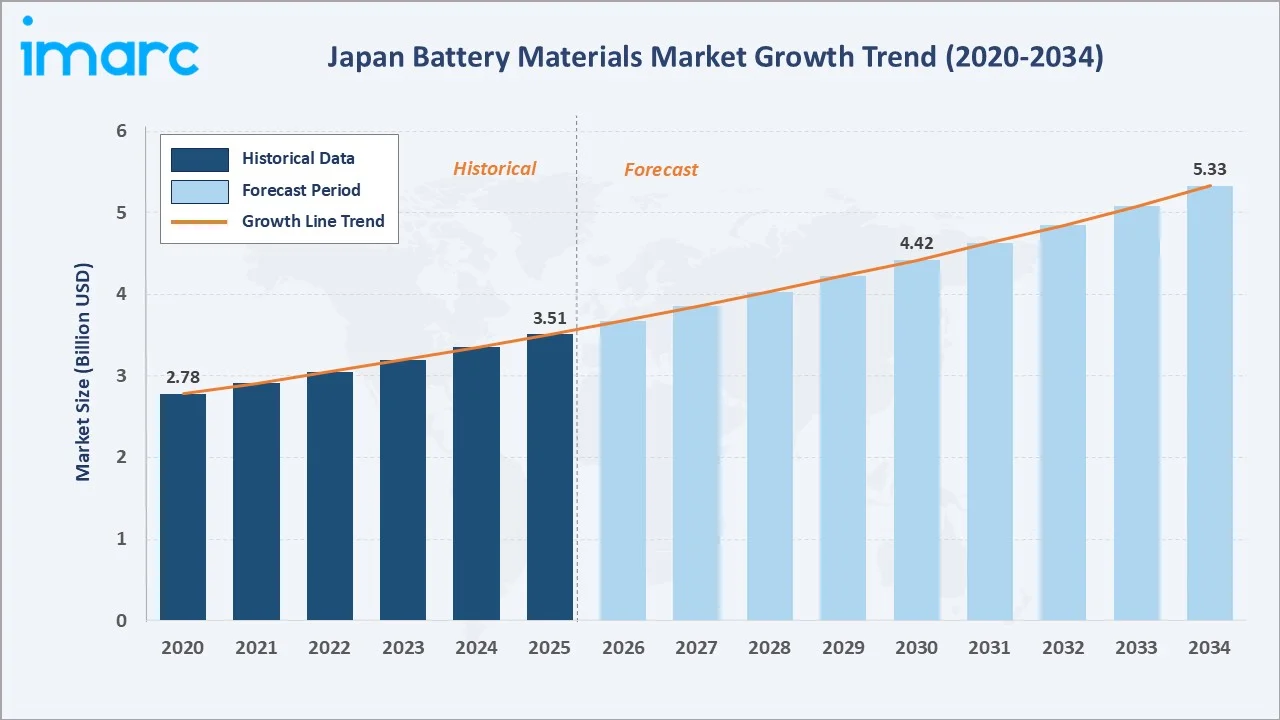
The Japan battery materials market grew from USD 3.51 Billion in 2025 to USD 3.67 Billion in 2026 and is projected to reach USD 5.33 Billion by 2034, growing at a CAGR of 4.75% during 2026-2034. Japan's advanced materials ecosystem, deep electrochemical research capabilities, and strategically positioned supply chains make it a critical global hub for battery material innovation and production. Lithium-ion battery materials dominate at 76.4% of the 2025 market, the automobile industry leads at 44.7% by application, and the Kanto region accounts for 34.6% of national market share.
Market Snapshot
|
Metric |
Value |
|
Base Year Market Size (2025) |
USD 3.51 Billion |
|
Market Size (2026) |
USD 3.67 Billion |
|
Forecast Market Size (2034) |
USD 5.33 Billion |
|
CAGR (2026-2034) |
4.75% |
|
Base Year |
2025 |
|
Historical Period |
2020-2025 |
|
Forecast Period |
2026-2034 |
|
Dominant Battery Type |
Lithium Ion (76.4%, 2025) |
|
Leading Application |
Automobile Industry (44.7%, 2025) |
|
Leading Region |
Kanto Region (34.6%, 2025) |
The Japan battery materials market grew from USD 2.78 Billion in 2020 to USD 3.51 Billion by 2025 and is estimated to reach USD 3.67 Billion in 2026. The market is projected to reach USD 4.42 Billion by 2030 and USD 5.33 Billion by 2034.
To get more information on this market, Request Sample
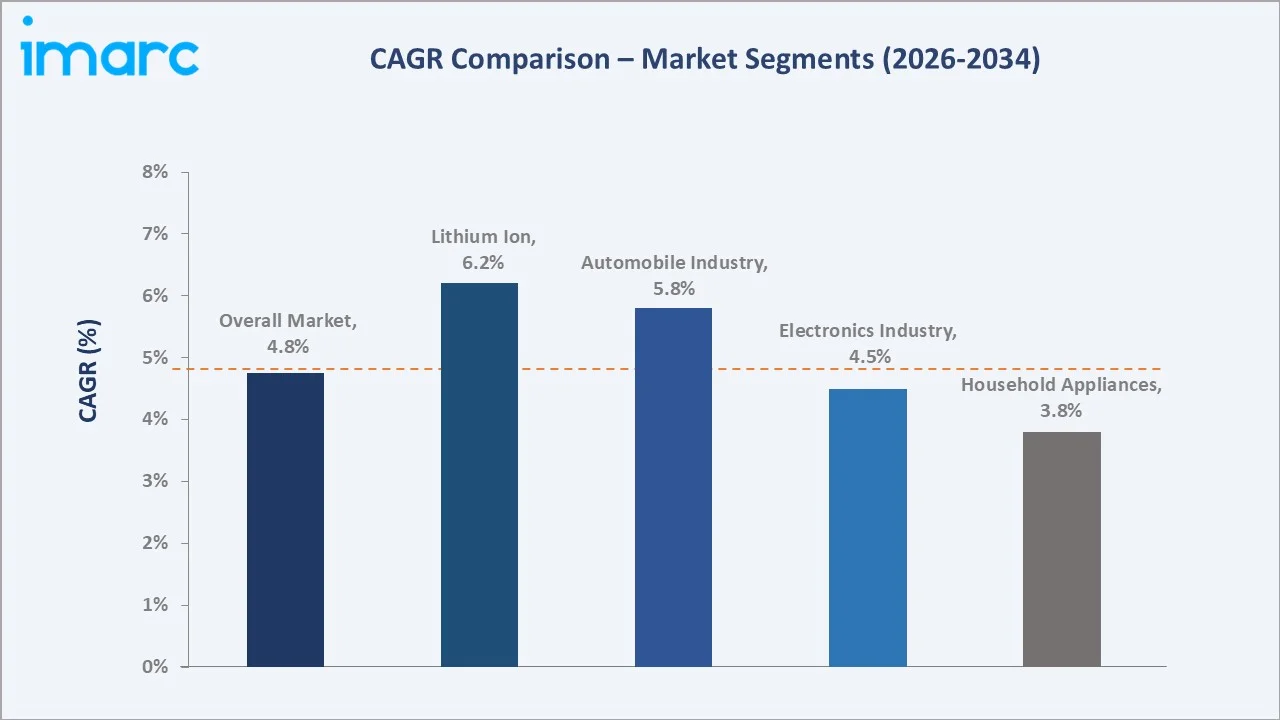
Lithium-ion is growing fastest at a CAGR of 6.2% through continued EV adoption and energy storage expansion. The automobile industry is growing at a 5.8% CAGR, driven by Japan's electric vehicle transition. The electronics industry is growing at a 4.5% CAGR, supported by sustained demand for advanced consumer devices and wearables.
Executive Summary
The Japan battery materials market represents one of the most technologically advanced and strategically critical segments of the global battery supply chain. Japan's materials science heritage, precision manufacturing capabilities, and extensive industry-academia partnerships have positioned the country as a global leader in battery material innovation spanning cathode active materials, separator films, electrolytes, and anode materials.
Lithium-ion materials command 76.4% of the 2025 market, driven by the accelerating transition to electric vehicles and expanding grid-scale energy storage deployment. The automobile application segment leads at 44.7% of market share, with electronics at 29.6% and household appliances at 15.3%. The Kanto region holds the largest geographic share at 34.6%, anchored by major battery manufacturers and automotive OEM procurement activity concentrated in the greater Tokyo metropolitan area.
Key Market Insights
|
Insight |
Data |
|
Dominant Battery Type |
Lithium Ion - 76.4% share (2025) |
|
Leading Application |
Automobile Industry - 44.7% share (2025) |
|
Leading Region |
Kanto Region - 34.6% (2025) |
|
Key Market Opportunity |
Rapid expansion of lithium-ion battery demand for electric vehicles, grid-scale energy storage systems, and portable electronics, supported by Japan's advanced materials ecosystem and growing domestic EV adoption policies. |
Key Analytical Observations Supporting the Above Data:
- Lithium Ion at 76.4%: The dominance of lithium-ion battery materials reflects Japan's early investment in lithium-ion technology and the sustained demand acceleration from electric vehicles, portable consumer electronics, and stationary energy storage systems requiring high energy density and long cycle life performance.
- Automobile Industry at 44.7%: Japan's automotive industry's transition toward hybrid and electric powertrains is the primary demand driver for advanced battery materials, with Toyota, Honda, and Nissan collectively sourcing significant volumes of cathode, anode, separator, and electrolyte materials from domestic suppliers.
- Kanto Region at 34.6%: The Kanto region's leadership reflects the concentration of battery technology companies, automotive procurement centers, and electronics manufacturers in the Tokyo area, supported by proximity to major research institutions advancing next-generation battery material development.
Japan Battery Materials Market Overview
The Japan battery materials market encompasses the full spectrum of functional materials used in electrochemical energy storage devices, including cathode active materials, anode materials, electrolytes, separator membranes, binders, conductive additives, and current collectors. Japan's position as a global technology leader in battery chemistry is underpinned by decades of electrochemical research, precision chemical manufacturing, and deep integration with the automotive and consumer electronics industries that collectively define global battery performance standards.
Market Dynamics
To evaluate market opportunities, Request Sample
Market Drivers
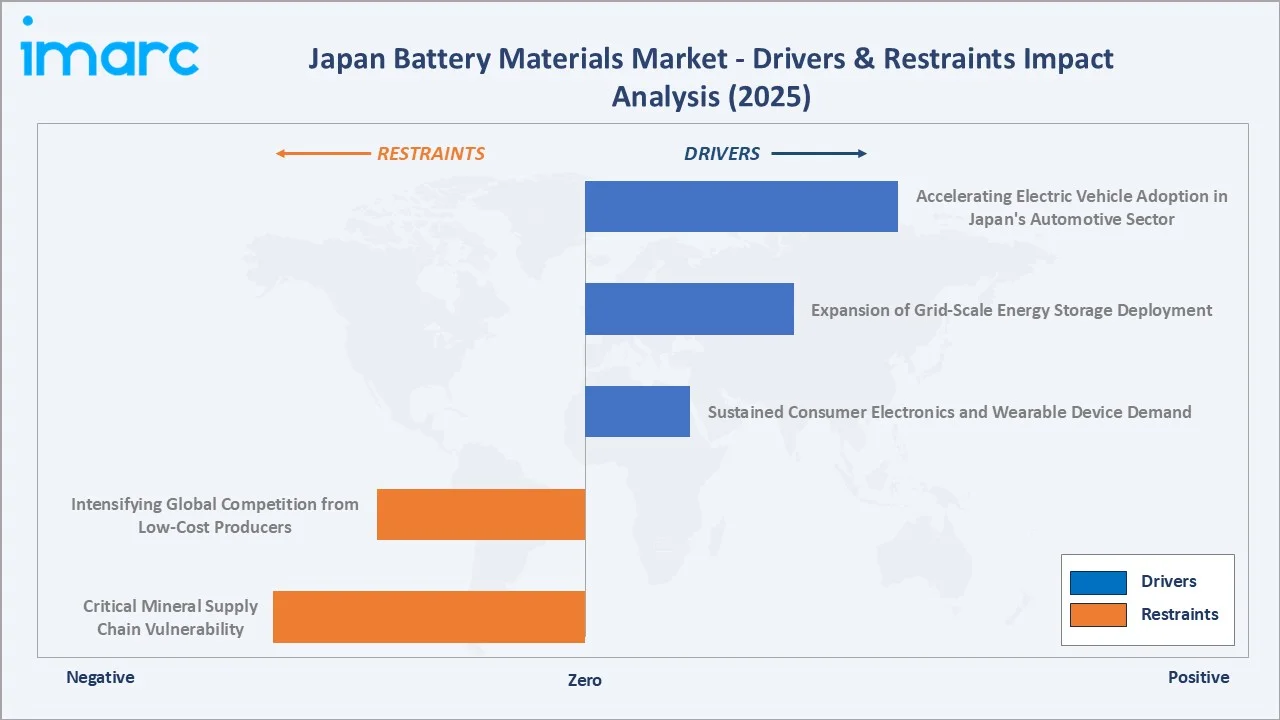
- Accelerating Electric Vehicle Adoption in Japan's Automotive Sector: Japan's major automotive manufacturers are accelerating their electrification strategies, committing to substantial EV and hybrid model launches. Battery electric vehicle (BEV) sales in Japan reached approximately 61,000 units in 2025, marking a 1.67% increase from around 60,000 units in 2024. This transition is directly driving demand for cathode active materials, high-purity electrolytes, and advanced anode materials at scale, with Japan's domestic material producers positioned as preferred suppliers to local OEM supply chains.
- Expansion of Grid-Scale Energy Storage Deployment: According to the Institute for Energy Economics and Financial Analysis (IEEFA), Japan’s grid-scale energy storage capacity stood at approximately 620 MW at the end of 2025. Japan's national energy security strategy and renewable energy integration goals are driving procurement of large-format lithium-ion battery systems for grid stabilization and peak shaving applications.
- Sustained Consumer Electronics and Wearable Device Demand: Japan's competitive consumer electronics and precision device manufacturing base maintains consistent high-quality demand for battery materials optimized for compact form factors, high energy density, and extended cycle life. The proliferation of wearables, IoT devices, and portable medical equipment sustain incremental material volume growth independent of EV demand cycles.
Market Restraints
- Critical Mineral Supply Chain Vulnerability: Japan's battery materials industry depends on imported critical minerals including lithium, cobalt, and nickel from geographically concentrated supply sources, creating inherent supply chain resilience challenges that can disrupt production planning and compress material availability during periods of supply disruption.
- Intensifying Global Competition from Low-Cost Producers: Competing battery material manufacturers in China and South Korea operate at significantly larger production scales with lower labor and energy cost structures, creating pricing pressure on Japanese producers in commodity material categories where performance differentiation is limited.
Market Opportunities
- Solid-State Battery Material Development: Japan is one of the major leaders in solid-state battery research, with major automotive manufacturers and material companies advancing toward commercialization of all-solid-state batteries offering superior safety and energy density compared to conventional lithium-ion technology. Japan's established expertise in solid electrolyte synthesis and thin-film ceramic processing positions domestic material producers to capture leadership in this next-generation technology transition.
- Battery Recycling and Secondary Material Recovery: Japan's growing installed base of lithium-ion batteries across EVs and consumer electronics is creating a substantial secondary material recovery opportunity. Closed-loop recycling of cathode metals and other high-value battery materials can reduce import dependence and provide cost-competitive recovered materials meeting quality specifications for re-use in new battery production.
Market Challenges
- Technology Transition Risk from Next-Generation Battery Chemistries: The ongoing development of alternative battery chemistries including sodium-ion, lithium-sulfur, and solid-state technologies creates material substitution risk for producers invested in current lithium-ion material platforms, requiring continuous research and development investment to maintain technology relevance through chemistry transitions.
- Rising Energy and Operating Cost Pressures: Energy-intensive manufacturing processes for battery-grade active materials face sustained cost pressures from energy price volatility, while environmental compliance requirements for chemical processing add operating cost complexity for material producers scaling domestic production capacity to meet growing demand.
Emerging Market Trends
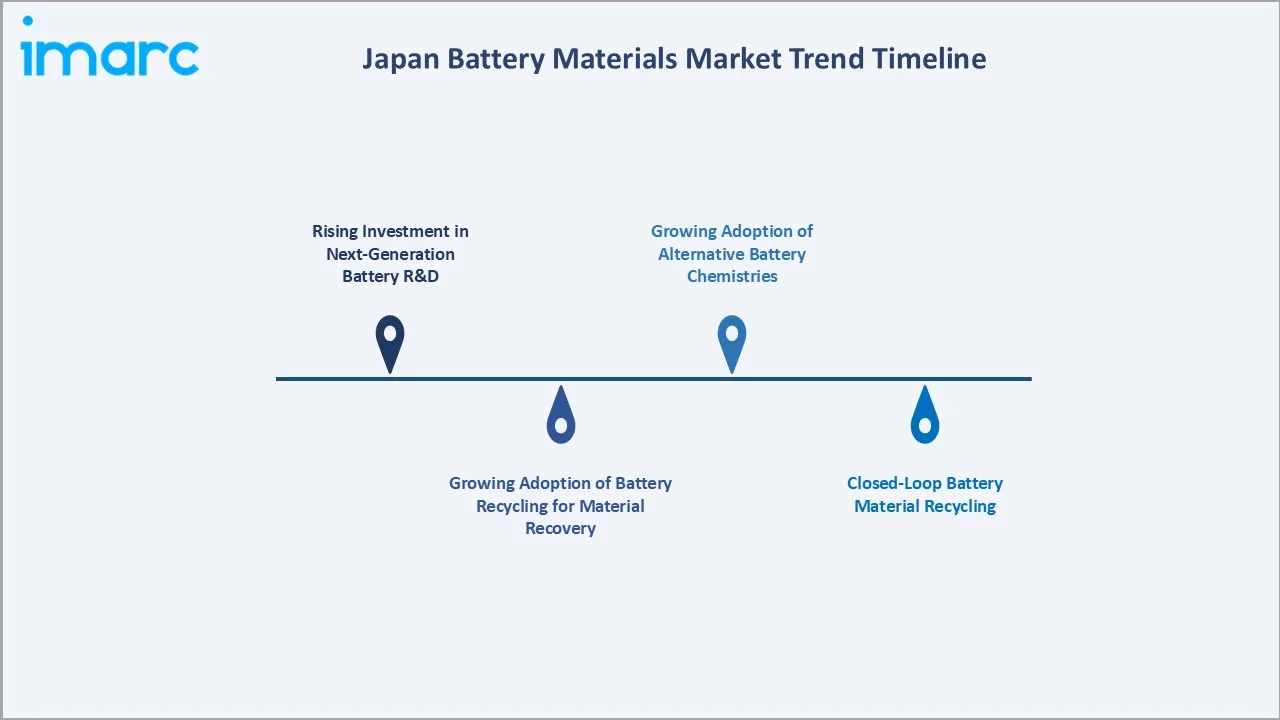
1. Rising Investment in Next-Generation Battery R&D
Japan’s battery materials market is witnessing growing investment in advanced battery research and material development to support next-generation technologies. In September 2026, Panasonic Energy launched Energy Innovation Square in Osaka, a lithium-ion battery R&D facility focused on material development, cell design, and prototyping to accelerate next-generation battery development and mass production for automotive and data center applications.
2. Growing Adoption of Battery Recycling for Material Recovery
In September 2026, Sumitomo Metal Mining opened Japan’s first electric vehicle battery recycling plant, aimed at recovering rare metals, reducing their outflow, and supporting a stable domestic supply of essential battery materials. The launch highlights the growing emphasis on recovering rare metals and strengthening domestic battery material supply chains.
3. Growing Adoption of Alternative Battery Chemistries
Japan’s battery materials market is witnessing increasing interest in non-lithium battery technologies to diversify energy storage solutions and strengthen domestic supply chains. In May 2026, SoftBank Corporation launched a Japan-based battery manufacturing business focused on zinc-bromine battery cells and containerized BESS, targeting GWh-scale production by FY2028 through an end-to-end vertically integrated approach.
4. Closed-Loop Battery Material Recycling
Hydrometallurgical and direct recycling processes for recovering cathode metals and other battery materials from end-of-life cells are advancing toward commercial scale in Japan. Partnerships between battery manufacturers, material producers, and recycling specialists are establishing circular economy frameworks that recover high-purity materials suitable for re-use in battery production.
Industry Value Chain Analysis
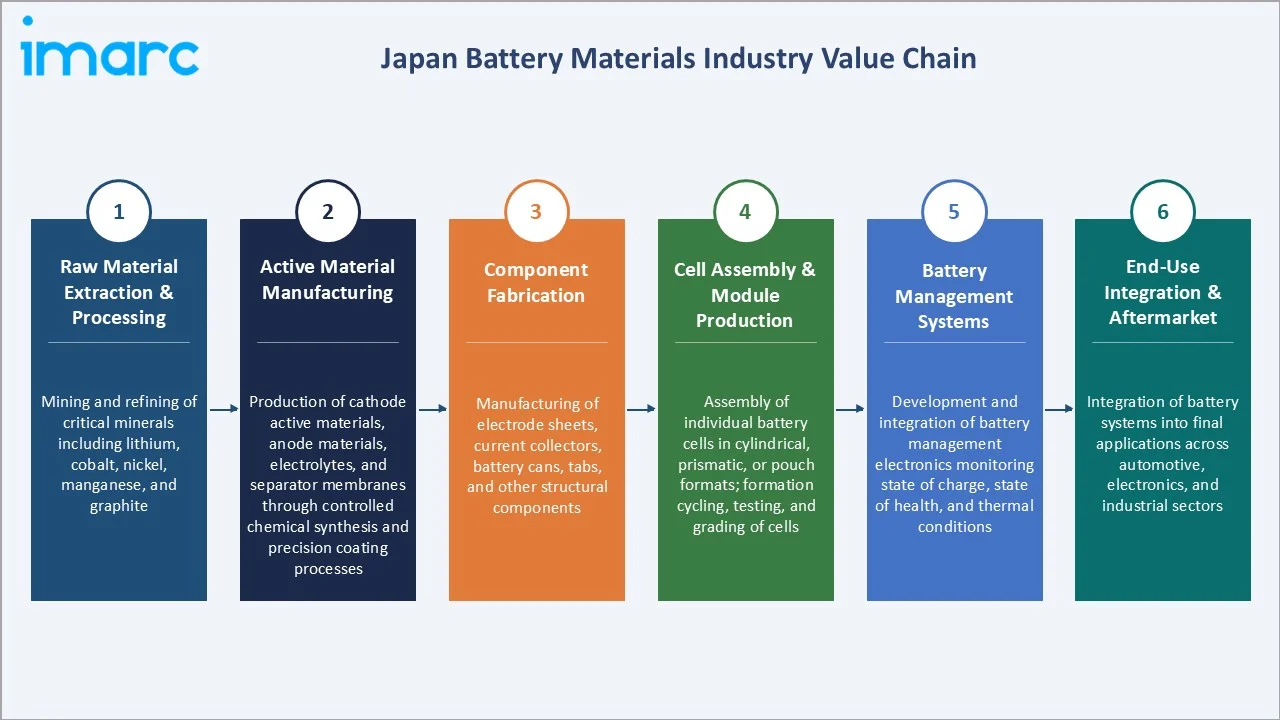
The Japan battery materials market value chain encompasses six integrated stages from raw material extraction through end-use integration and aftermarket services, with each stage representing distinct competency requirements and value-addition opportunities for market participants.
|
Stage |
Key Activities |
|
Raw Material Extraction & Processing |
Mining and refining of critical minerals including lithium, cobalt, nickel, manganese, and graphite. |
|
Active Material Manufacturing |
Production of cathode active materials, anode materials, electrolytes, and separator membranes through controlled chemical synthesis and precision coating processes. |
|
Component Fabrication |
Manufacturing of electrode sheets, current collectors, battery cans, tabs, and other structural components. |
|
Cell Assembly & Module Production |
Assembly of individual battery cells in cylindrical, prismatic, or pouch formats; formation cycling, testing, and grading of cells. |
|
Battery Management Systems |
Development and integration of battery management electronics monitoring state of charge, state of health, and thermal conditions. |
|
End-Use Integration & Aftermarket |
Integration of battery systems into final applications across automotive, electronics, and industrial sectors. |
Active material manufacturing represents the highest-value and most technically differentiated stage within Japan's battery materials supply chain, where precision synthesis chemistry, particle engineering, and surface modification capabilities determine electrochemical performance outcomes. Japanese producers have historically maintained competitive leadership in this stage through sustained research and process development investment.
Technology Landscape in the Japan Battery Materials Industry
Advanced Cathode Material Engineering
Precision dopant incorporation, gradient concentration structures, and nano-scale surface coatings are enabling Japanese cathode material producers to achieve differentiated performance in nickel-rich and manganese-rich cathode chemistries. Computational materials discovery is accelerating development cycles for novel cathode compositions.
Next-Generation Separator Technologies
Ceramic-coated and multilayer separator membranes developed by Japanese material producers offer enhanced thermal stability and reduced shrinkage during thermal events, improving battery safety for EV applications. Ultra-thin separators enabling higher energy density while maintaining mechanical integrity represent a key technology differentiation area for domestic producers.
Electrolyte Innovation and Functional Additives
High-concentration electrolytes, localized high-concentration electrolytes, and novel lithium salt formulations are being developed to extend battery operating temperature ranges and cycle life beyond current lithium-ion limitations. Japanese specialty chemical companies are leading development of electrolyte additive packages that suppress degradation mechanisms at electrode interfaces.
Market Segmentation Analysis
The report covers the following segments:
|
Segment Category |
Leading Segment |
Market Share |
Year |
|
Type |
🔒 |
🔒 |
2025 |
|
Battery Type |
Lithium Ion |
76.4% |
2025 |
|
Application |
Automobile Industry |
44.7% |
2025 |
|
Region |
Kanto Region |
34.6% |
2025 |

By Battery Type
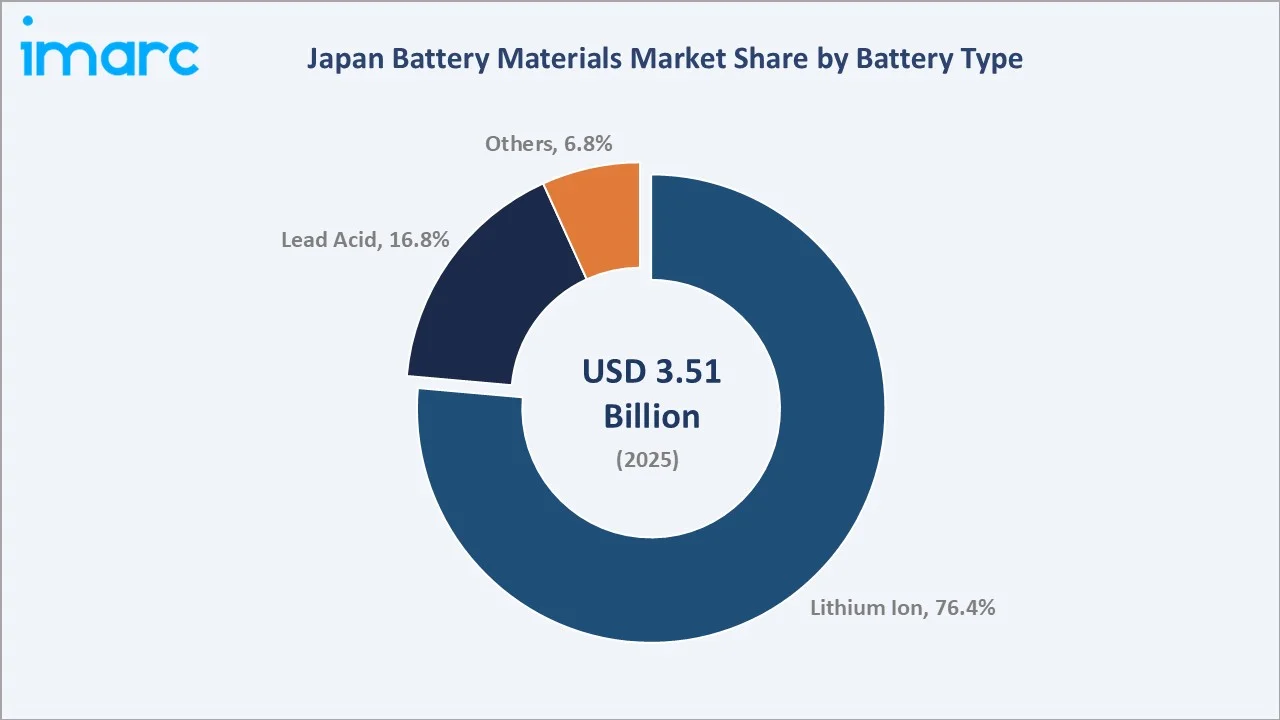
Lithium-ion battery materials command 76.4% of the 2025 Japan battery materials market, driven by the widespread adoption of lithium-ion technology across electric vehicles, consumer electronics, and stationary energy storage applications.
To access detailed market analysis, Request Sample
Lead-acid battery materials account for 16.8% of the 2025 market, sustained by entrenched demand in automotive starter batteries, uninterruptible power supply systems, and industrial forklift applications where lead-acid technology remains cost-competitive. Others at 6.8% include nickel-metal hydride, lithium polymer, and emerging solid-state battery material segments growing from early-stage technology development investments.
By Application
Automobile industry materials lead at 44.7% of the 2025 market, reflecting the central role of Japan's automotive industry as the primary driver of advanced battery material procurement.
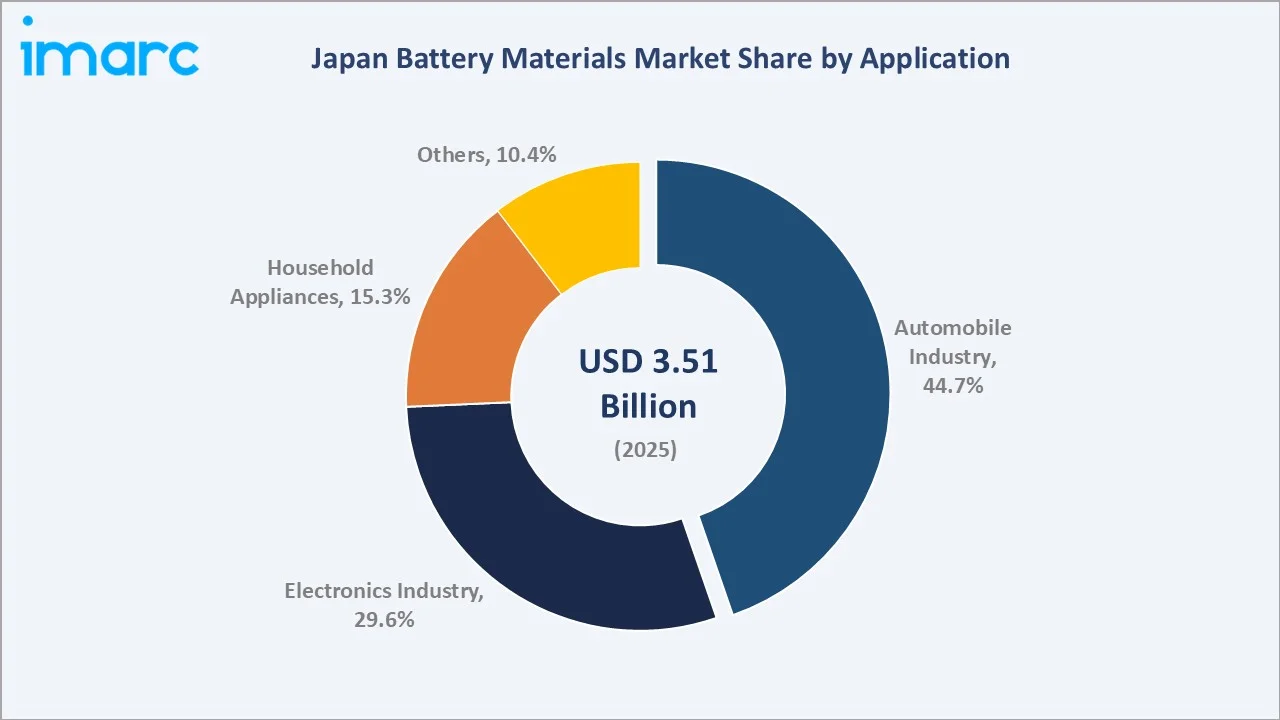
The electronics industry represents 29.6% of the 2025 market, driven by Japan's competitive consumer electronics, precision instruments, and industrial electronics manufacturing base, maintaining consistent demand for compact, high-energy-density battery materials. Household appliances at 15.3% include cordless tools, robotic vacuum cleaners, and portable appliances transitioning to lithium-ion technology platforms. Others at 10.4% encompass marine, aerospace, medical device, and grid-scale energy storage applications.
Regional Market Insights
|
Region |
Share (2025) |
Key Characteristics |
|
Kanto Region |
34.6% |
The dominant region driven by concentration of major battery manufacturers, technology companies, and automotive OEM headquarters, generating the highest demand for advanced battery materials across all application segments. |
|
Central/Chubu Region |
18.7% |
A critical automotive manufacturing hub and its extensive supplier ecosystem, sustaining strong demand for lithium-ion battery materials used in hybrid and electric vehicle powertrain systems. |
|
Kansai/Kinki Region |
17.8% |
Home to leading battery material producers and electronics manufacturers, with strong industrial demand from consumer electronics and energy storage segments. |
|
Kyushu-Okinawa Region |
8.9% |
Growing semiconductor and electronics manufacturing presence, with expanding EV-related battery supply chain activity attracting new investment from battery material producers targeting automotive customers. |
|
Tohoku Region |
7.1% |
Industrial manufacturing base with established chemical and material processing capabilities, contributing to electrode material and electrolyte production serving domestic battery assemblers. |
|
Chugoku Region |
5.8% |
Chemical industry concentration supports production of battery-grade specialty chemicals and separator materials; moderate but stable demand from regional electronics and industrial battery applications. |
|
Hokkaido Region |
4.2% |
Emerging as a potential location for battery recycling and critical mineral processing facilities, with natural resource advantages and renewable energy availability supporting sustainable battery material production. |
|
Shikoku Region |
2.9% |
Smaller regional market with specialty chemical and material producers serving niche battery material segments; growth driven by renewable energy storage deployment and regional industrial electrification. |
The Kanto region's 34.6% share reflects the concentration of Japan's most significant battery material producers, automotive procurement headquarters, and electronics manufacturers in the Tokyo metropolitan corridor. Central/Chubu region, at 18.7%, is powered by automotive manufacturing concentration, which anchors a dense ecosystem of battery material suppliers. Kansai/Kinki region, at 17.8%, hosts battery operations and related material suppliers in the industrial zone.
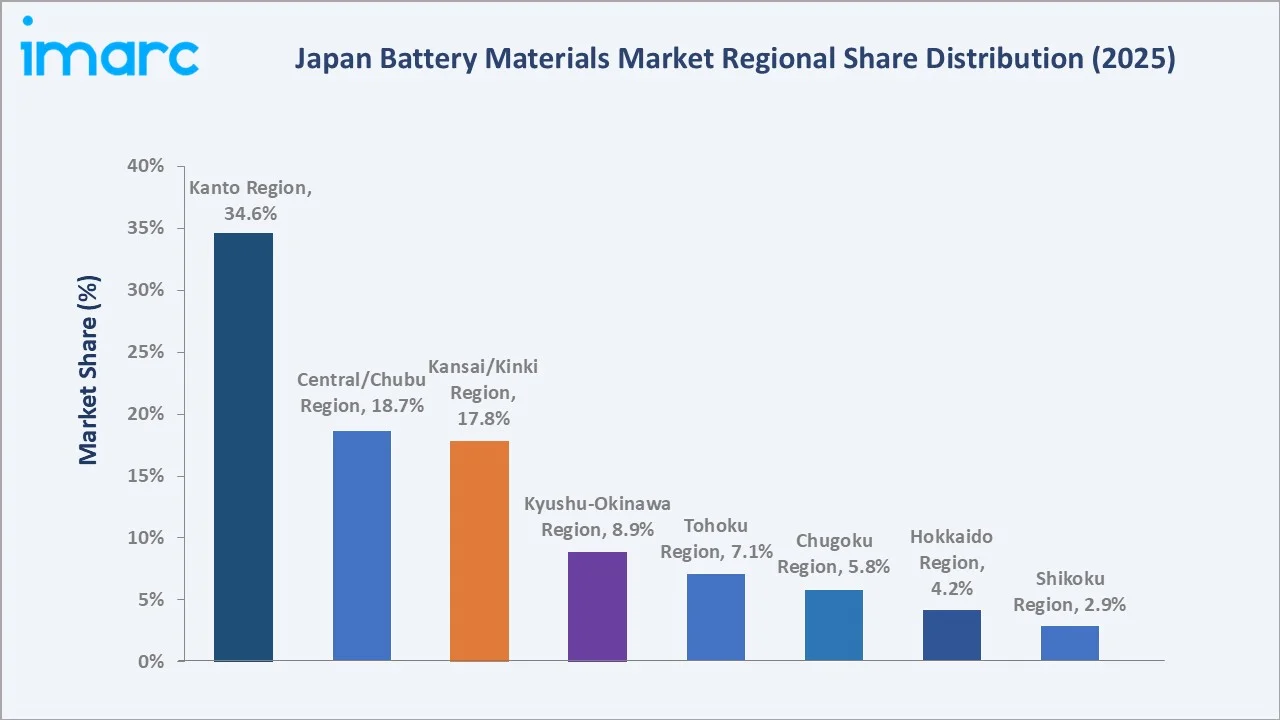
Kyushu-Okinawa region accounted for 8.9%, reflecting growing semiconductor, electronics, and EV battery supply-chain activity, while the Tohoku region contributed 7.1% through chemical and material processing capabilities. Chugoku region at 5.8%, the Hokkaido region at 4.2%, and the Shikoku region at 2.9% represented smaller markets, with opportunities linked to specialty chemicals, recycling, critical minerals, renewable energy storage, and industrial electrification.
Competitive Landscape
The Japan battery materials market features a mix of diversified specialty chemical groups, dedicated battery material producers, and integrated materials companies with multi-segment product portfolios. Leading domestic producers maintain competitive advantages through proprietary synthesis technologies, deep application engineering knowledge, and long-standing supply agreements with major battery cell manufacturers and automotive OEMs.
|
Company |
Key Offerings |
Market Position |
Core Strength |
| Sumitomo Metal Mining Co., Ltd. | Lithium nickel manganese cobalt oxide (NMC), Lithium Nickel-Cobalt-Aluminum Oxide (NCA), Nickel Hydroxide | Market Leader | Sumitomo Metal Mining Co., Ltd. is a foundational pillar of Japan's electric vehicle (EV) and clean-energy supply chain, acting as a major producer of battery-grade metals and high-nickel cathode active materials. |
| Asahi Kasei Corporation | Celgard, HIPORE, High Ionic Conductive Electrolyte for Lithium-ion Batteries (LIB), SunForce, LASTAN for EV battery | Established Player | Asahi Kasei Corporation plays a foundational and pioneering role in the development and supply of critical materials for lithium-ion batteries (LIBs). |
| TORAY INDUSTRIES, INC. | A675 GS1, A900 F1, A510T 35 M, CM2001 L, A670 T05 | Established Player | Toray Industries, Inc. plays a major role in the Japanese battery materials industry by developing advanced polymer membranes, resin components, and film current collectors. |
| UBE Corporation | Polyimide Binder for Li-ion Battery, Separator, Electrolyte | Innovator | UBE Corporation plays a major role in the Japanese lithium-ion battery (LiB) materials supply chain, focusing on high-performance chemical components. |
| Shin-Etsu Chemical Co., Ltd. | Anode material for lithium ion batteries | Challenger | Shin-Etsu Chemical Co., Ltd. plays a critical role in Japan's battery industry through advanced materials. |
Competitive dynamics are evolving through intensifying investment in solid-state battery material platforms, battery recycling technology development, and supply chain partnerships targeting critical mineral security. International competitors are expanding Japan market presence, while domestic producers strengthen supply relationships to support Japanese automotive OEM operations outside Japan.
Key Company Profiles
Sumitomo Metal Mining Co., Ltd.
Sumitomo Metal Mining Co., Ltd. is a Japanese non-ferrous metals company engaged in mineral resources, smelting and refining, and advanced materials. The company develops and produces battery materials, including cathode materials for electric and hybrid vehicle batteries. Its battery materials portfolio includes NCA, NMC, and nickel hydroxide, supported by extensive expertise in metal processing and refining. The company also focuses on battery recycling and resource recovery to support a sustainable and stable materials supply chain.
- Key Offerings: Lithium nickel manganese cobalt oxide (NMC), Lithium Nickel-Cobalt-Aluminum Oxide (NCA), Nickel Hydroxide.
- Strategic Focus: Strengthening its battery materials business through advanced cathode material technologies, resource efficiency, and recycling initiatives. The company also emphasizes expanding sustainable material supply chains to support the growing demand for electric vehicles and energy storage systems.
Asahi Kasei Corporation
Asahi Kasei Corporation is a diversified Japanese chemical company engaged in the production of advanced materials, chemicals, and functional products. The company has a strong presence in the battery materials industry, particularly through its HIPORE microporous polyolefin separators for lithium-ion batteries. Its battery-related technologies support applications across electric vehicles, consumer electronics, and energy storage systems. The company continues to strengthen its advanced materials portfolio through technological development and global manufacturing capabilities.
- Key Offerings: Celgard, HIPORE, High Ionic Conductive Electrolyte for Lithium-ion Batteries (LIB), SunForce, LASTAN for EV battery.
- Strategic Focus: Focuses on advancing battery separator technologies and high-performance materials to support the evolving lithium-ion battery industry. The company emphasizes technological innovation, capacity expansion, and sustainable solutions for electric vehicles and energy storage applications.
Future Market Outlook (2026-2034)
The Japan battery materials market grew from USD 3.51 Billion in 2025 to USD 3.67 Billion in 2026 and is projected to reach USD 5.33 Billion by 2034, exhibiting a CAGR of 4.75% during 2026-2034. The market is projected to reach USD 4.42 Billion by 2030, when solid-state battery material commercialization is expected to begin contributing meaningful revenue alongside continued lithium-ion material demand growth driven by EV adoption acceleration.
Three structural forces will define Japan's battery materials market through 2034. First, the automotive electrification transition will be the dominant demand driver, with Japan's leading automakers advancing EV programs that require significant increases in cathode, anode, separator, and electrolyte material procurement. Second, technology transitions from conventional lithium-ion toward solid-state and next-generation chemistries will create material substitution opportunities favoring Japanese producers with advanced materials development capabilities. Third, supply chain resilience imperatives will drive investment in domestic critical mineral processing and recycled material recovery, expanding Japan's battery materials value chain while reducing dependence on imported precursors.
Research Methodology
Primary Research
Primary research included structured interviews with battery material production executives, automotive procurement specialists, battery cell manufacturers, and energy storage system integrators across Japan. Technical consultations with academic researchers at leading Japanese universities advancing battery material science informed technology trend analysis and forecast assumptions.
Secondary Research
Secondary research incorporated Japanese battery industry association statistics, company annual reports and investor presentations, patent filing databases tracking material innovation activity, government ministry energy and industry policy documents, and international battery market research reports covering material supply chain dynamics.
Forecasting Models
Market forecasting integrates Japan EV adoption trajectory projections, battery chemistry transition scenarios, critical mineral supply chain forecasts, government energy policy implementation timelines, competitive pricing dynamics from Asian battery material markets, and technology disruption probability assessments for solid-state and alternative battery chemistries.
Japan Battery Materials Market Report Coverage:
| Report Features | Details |
|---|---|
| Base Year of the Analysis | 2025 |
| Historical Period | 2020-2025 |
| Forecast Period | 2026-2034 |
| Units | Billion USD |
| Scope of the Report |
Exploration of Historical Trends and Market Outlook, Industry Catalysts and Challenges, Segment-Wise Historical and Future Market Assessment:
|
| Types Covered | Cathode, Anode, Electrolyte, Separator, Others |
| Battery Types Covered | Lithium Ion, Lead Acid, Others |
| Applications Covered | Automobile Industry, Household Appliances, Electronics Industry, Others |
| Regions Covered | Kanto Region, Kansai/Kinki Region, Central/ Chubu Region, Kyushu-Okinawa Region, Tohoku Region, Chugoku Region, Hokkaido Region, Shikoku Region |
| Companies Covered | Sumitomo Metal Mining Co., Ltd., Asahi Kasei Corporation, TORAY INDUSTRIES, INC., UBE Corporation, Shin-Etsu Chemical Co., Ltd., etc. |
| Customization Scope | 10% Free Customization |
| Post-Sale Analyst Support | 10-12 Weeks |
| Delivery Format | PDF and Excel through Email (We can also provide the editable version of the report in PPT/Word format on special request) |
Key Benefits for Stakeholders:
- IMARC’s industry report offers a comprehensive quantitative analysis of various market segments, historical and current market trends, market forecasts, and dynamics of the Japan battery materials market from 2020-2034.
- The research report provides the latest information on the market drivers, challenges, and opportunities in the Japan battery materials market.
- Porter's five forces analysis assist stakeholders in assessing the impact of new entrants, competitive rivalry, supplier power, buyer power, and the threat of substitution. It helps stakeholders to analyze the level of competition within the Japan battery materials industry and its attractiveness.
- Competitive landscape allows stakeholders to understand their competitive environment and provides an insight into the current positions of key players in the market.
Frequently Asked Questions About the Japan Battery Materials Market Report
The Japan battery materials market reached USD 3.67 Billion in 2026, driven by accelerating EV adoption, expanding energy storage deployment, and sustained consumer electronics demand for advanced lithium-ion battery materials.
The market is projected to grow at a CAGR of 4.75% during 2026-2034, driven by automotive electrification, grid-scale energy storage expansion, solid-state battery material commercialization, and battery recycling ecosystem development.
The market is projected to reach USD 4.42 Billion by 2030, when solid-state battery material production is expected to begin commercial scale-up alongside continued lithium-ion material demand growth from EV manufacturing acceleration.
Lithium-ion leads with a 76.4% market share in 2025, driven by its dominant position across electric vehicles, consumer electronics, and energy storage applications requiring high energy density and long operational life.
The automobile industry leads with a 44.7% share in 2025, driven by Japan's major automotive manufacturers advancing hybrid and electric vehicle programs requiring large volumes of advanced battery materials from domestic supply chains.
The Kanto region leads with 34.6% of the 2025 market, anchored by the concentration of major battery material producers, automotive OEM procurement headquarters, and electronics manufacturers in the greater Tokyo metropolitan area.
Key players include Sumitomo Metal Mining Co., Ltd., Asahi Kasei Corporation, TORAY INDUSTRIES, INC., UBE Corporation, and Shin-Etsu Chemical Co., Ltd., among others.
The market is projected to reach USD 5.33 Billion by 2034, driven by full-scale EV market maturation, solid-state battery material commercialization, grid-scale energy storage expansion, and the emergence of a domestic battery recycling and secondary material economy.
Need more help?
- Speak to our experienced analysts for insights on the current market scenarios.
- Include additional segments and countries to customize the report as per your requirement.
- Gain an unparalleled competitive advantage in your domain by understanding how to utilize the report and positively impacting your operations and revenue.
- For further assistance, please connect with our analysts.
 Request Customization
 Speak to an Analyst
 Request Brochure
 Inquire Before Buying
Benefits of Customization
- Personalize this research
- Triangulate with your data
- Get data as per your format and definition
- Gain a deeper dive into a specific application, geography, customer, or competitor
- Any level of personalization
Get in Touch With Us
UNITED STATES
Phone: +1-201-971-6302
INDIA
Phone: +91-120-433-0800
UNITED KINGDOM
Phone: +44-753-714-6104
Email: [email protected]
Client Testimonials

.webp)

.webp)


Related Reports
Choose your plan
*Please note that the prices mentioned below are starting prices for each bundle type. Kindly contact our team for further details.*
Single User License
- 1 User License, Access on 2 Devices
- PDF Report + Excel Dataset (Password Protected)
- Lifetime Access
- No Printing Rights
- 10% Free Report Customization
- 10–12 Weeks of Analyst Support
Five User License
- Access for 5 Users, 2 Devices per User
- PDF Report + Excel Dataset (Password Protected)
- Lifetime Access
- Dedicated Account Manager
- 12–14 Weeks of Analyst Support
- No Printing Rights
- 15% Free Report Customization
- 25% Discount on Your Next Purchase
Corporate User License
- Unlimited User Access (Within Your Organization)
- PDF Report + Excel Dataset
- Lifetime Access
- Dedicated Account Manager
- 14–20 Weeks of Analyst Support
- No Printing Rights
- 20% Free Report Customization
- 30% Discount on Your Next Purchase
Essential Insights
What's included:
3 reports
- Lifetime Access
- PDF Reports
- Excel Datasets
- 2 Weeks of Free Analyst Support
- 2 User Licenses
- Access on 2 Devices
- Printing Rights
- Complimentary PowerPoint (PPT) Version
- Complimentary License Upgrade
Professional Access
What's included:
5 reports
- Lifetime Access
- PDF Reports
- Excel Datasets
- 8 Weeks of Free Analyst Support
- 2 User Licenses
- Access on 2 Devices
- Printing Rights
- Complimentary PowerPoint (PPT) Version
- Complimentary License Upgrade
Business Advantage
What's included:
8 reports
- Lifetime Access
- PDF Reports
- Excel Datasets
- 14 Weeks of Free Analyst Support
- 2 User Licenses
- Access on 2 Devices
- Printing Rights
- Complimentary PowerPoint (PPT) Version
- Complimentary License Upgrade
Enterprise Intelligence
What's included:
10 reports
- Lifetime Access
- PDF Reports
- Excel Datasets
- 20 Weeks of Free Analyst Support
- 2 User Licenses
- Access on 2 Devices
- Printing Rights
- Complimentary PowerPoint (PPT) Version
- Complimentary License Upgrade