
Japan Factory Automation & Industrial Controls Market Size, Share, Trends and Forecast by Type, End Use Industry, and Region, 2026-2034
Japan Factory Automation & Industrial Controls Market Size, Share, Trends & Forecast (2026-2034)
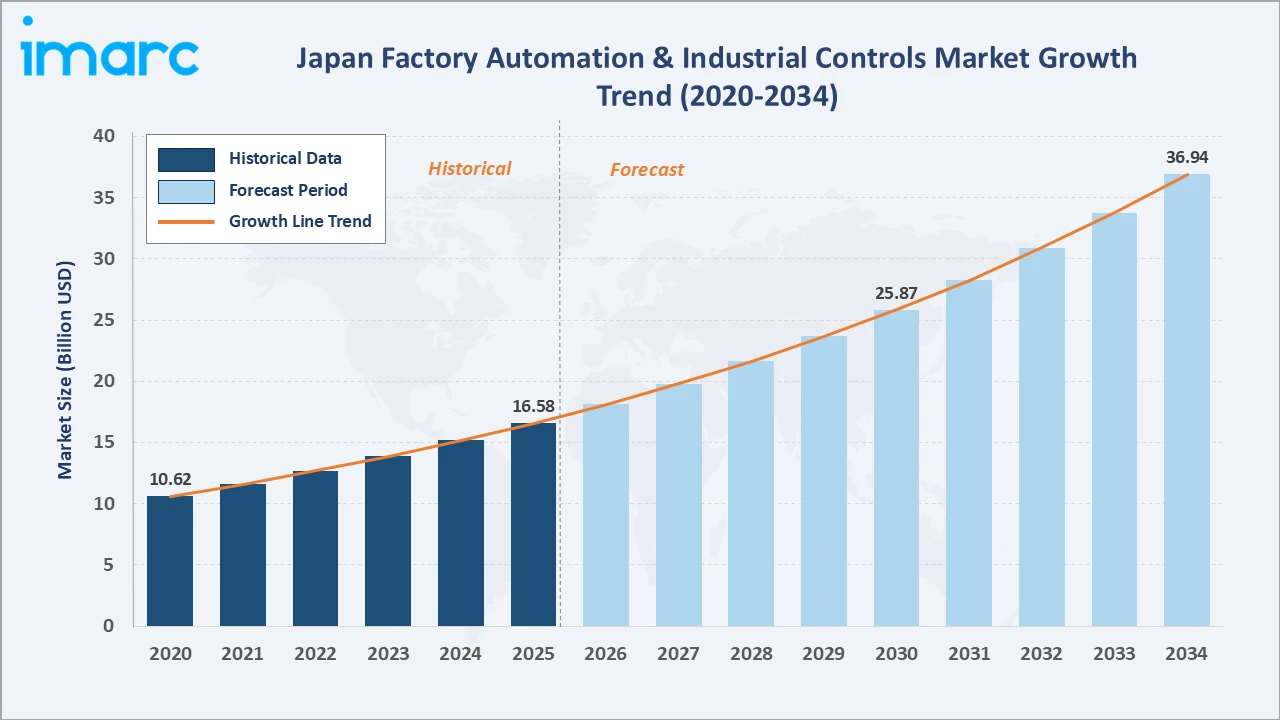
The Japan factory automation and industrial controls market grew from USD 16.58 Billion in 2025 to USD 18.12 Billion in 2026 and is projected to reach USD 36.94 Billion by 2034, growing at a CAGR of 9.31% during 2026-2034. The market is driven by rising industrial automation adoption across manufacturing sectors, chronic labour shortages stemming from Japan’s rapidly aging population, and strong government support through Society 5.0 and Connected Industries smart manufacturing initiatives.
Expanding IIoT platform adoption, digital twin technology deployment, and growing demand for AI-integrated predictive maintenance solutions are further supporting market growth. Industrial Control Systems dominates at 55.0%. Automotive & Transportation leads end use industry at 35.0%. Kanto Region commands 32.0% of the national market share.
Market Snapshot
| Metric | Value |
|---|---|
| Base Year Market Size (2025) | USD 16.58 Billion |
| Market Size (2026) | USD 18.12 Billion |
| Forecast Market Size (2034) | USD 36.94 Billion |
| CAGR (2026-2034) | 9.31% |
| Base Year | 2025 |
| Historical Period | 2020-2025 |
| Forecast Period | 2026-2034 |
| Dominant Type | Industrial Control Systems – 55.0% |
| Dominant End Use Industry | Automotive & Transportation – 35.0% |
| Leading Region | Kanto Region – 32.0% |
The Japan factory automation and industrial controls market size increased from USD 10.62 Billion in 2020 to USD 16.58 Billion in 2025 and is estimated to reach USD 18.12 Billion in 2026. The forecast period (2026–2034) projects continued strong growth driven by industrial digitalisation, robotics adoption, and smart factory investments. Rising labour costs and an aging workforce are compelling manufacturers to accelerate automation investment across all industrial verticals. Supportive government policies and rapid IIoT integration are further reinforcing long-term market expansion through the forecast period.
To get more information on this market, Request Sample
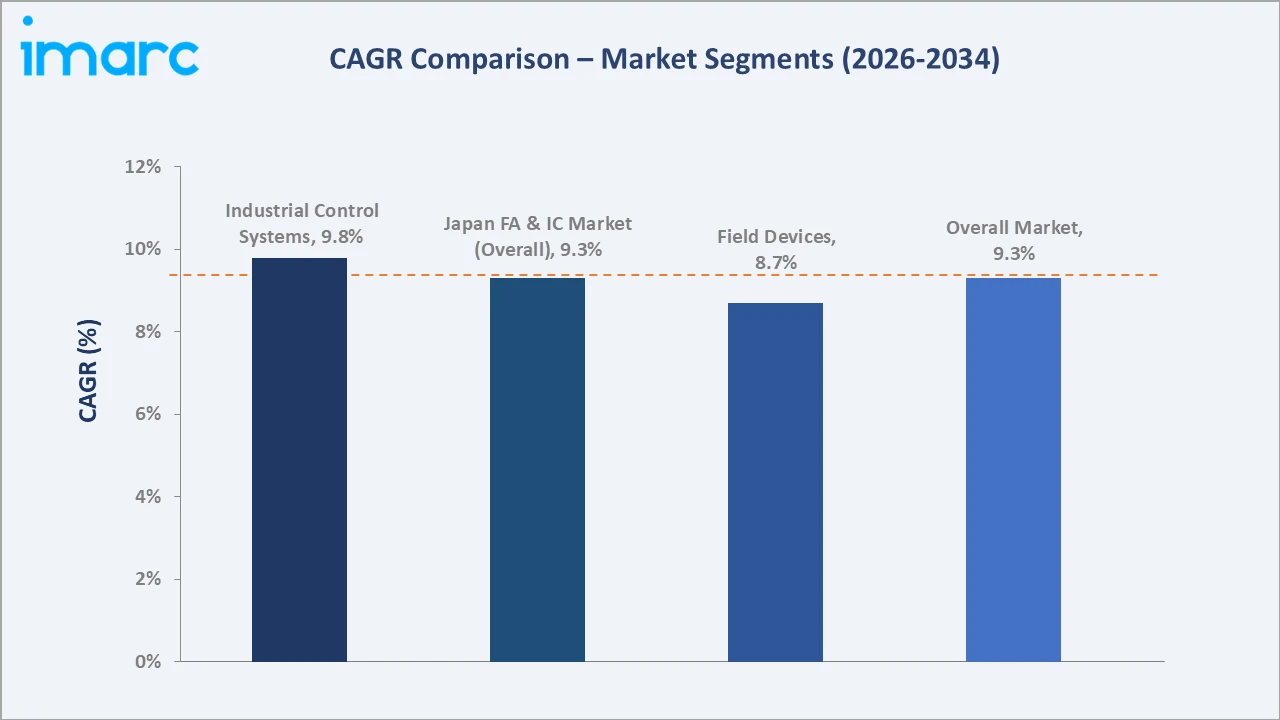
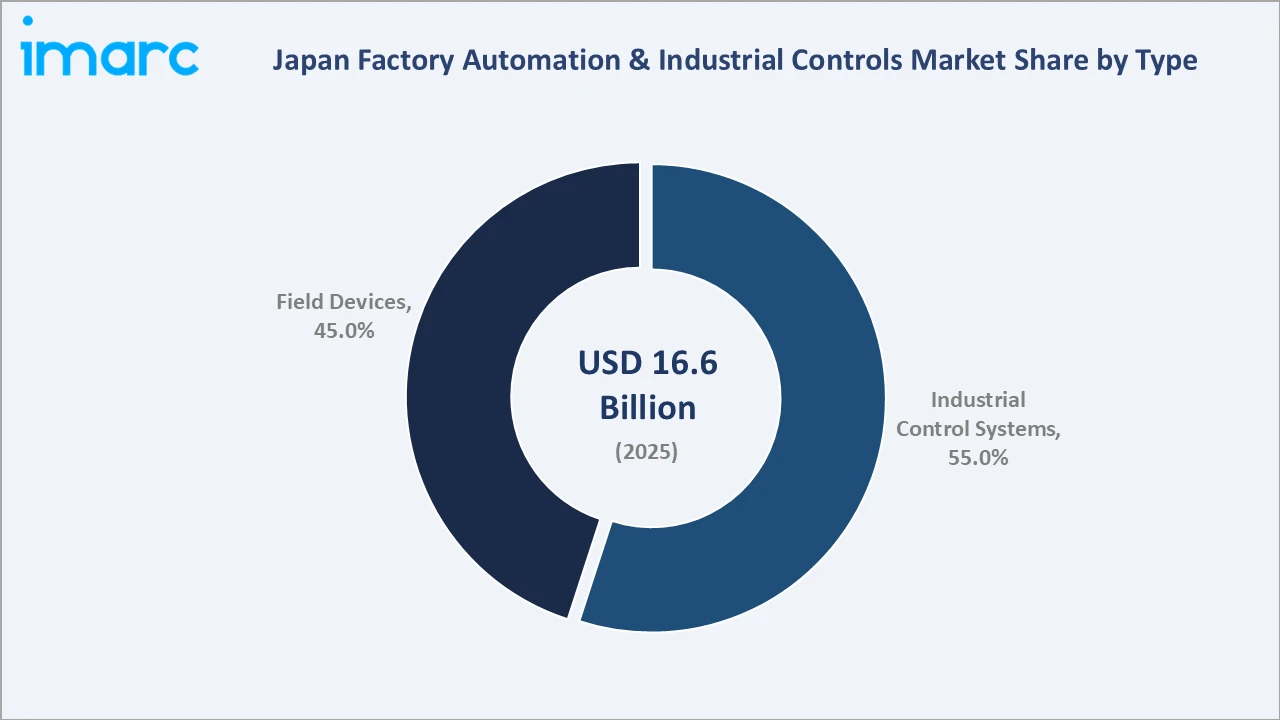
Industrial Control Systems are projected to grow at a higher CAGR (~9.80%) through widespread PLC, SCADA, and DCS adoption across oil & gas, power, and automotive sectors. Field Devices follow at ~8.70% CAGR, driven by sensor integration and machine vision expansion.
Executive Summary
The Japan factory automation and industrial controls market expanded from USD 16.58 Billion in 2025 to an estimated USD 18.12 Billion in 2026, positioning it among the world’s most advanced and largest national factory automation markets by value. The market’s scale is underpinned by Japan’s globally dominant industrial robotics manufacturing base, the structural imperative of labour substitution driven by demographic ageing, and decades of precision manufacturing expertise embedded across the country’s industrial base. These structural demand drivers are supporting the expansion of the industrial control systems segment at a rate that outpaces Japan’s overall manufacturing sector output growth. Japan’s factory automation and industrial controls market is commercially distinguished from other major Asian automation markets by its extraordinary concentration of globally leading domestic OEMs, including four of the world’s five largest industrial robot manufacturers. The market is projected to reach USD 36.94 Billion by 2034. Industrial Control Systems at 55.0% leads through widespread PLC, DCS, and SCADA deployments across Japan’s process and discrete manufacturing industries. Automotive & Transportation at 35.0% reflects Japan’s globally significant automotive OEM concentration and high robotic assembly density. Kanto Region leads regionally at 32.0%.
Key Market Insights
| Insight | Data |
|---|---|
| Dominant Type | Industrial Control Systems – 55.0% share (2025) |
| Dominant End Use Industry | Automotive & Transportation – 35.0% market share (2025) |
| Leading Region | Kanto Region – 32.0% share (2025) |
| Market Opportunity | AI-powered predictive maintenance and IIoT platform integration |
Key Analytical Observations Supporting the Above Data:
- Industrial Control Systems at 55.0%: Dominates through large-scale PLC, DCS, and SCADA deployments across Japan's automotive and heavy industry, supported by Industry 4.0 digital transformation initiatives.
- Automotive & Transportation at 35.0%: Highest end-use share driven by Japan's globally competitive auto OEM base, extensive robotic assembly lines, and EV platform investments at major vehicle manufacturers.
- Kanto Region at 32.0%: Leads due to concentration of industrial manufacturing headquarters, R&D facilities, and large electronics and automotive clusters in the Greater Tokyo area.
Japan Factory Automation & Industrial Controls Market Overview
Japan's factory automation and industrial controls market holds a unique global position, combining decades of manufacturing excellence with strong government policy support for smart industry transformation. The market integrates domestic hardware leadership, advanced software control systems, and global supply chain connectivity, valued at USD 18.12 Billion in 2026.
The ecosystem spans component manufacturers, system integrators, technology providers, distributors, and end-use industries. Japan's aging workforce projected to decline 20% by 2035 represents the most commercially compelling structural driver, compelling manufacturers to automate or face labour-driven capacity constraints across all industrial segments.
Market Dynamics
To evaluate market opportunities, Request Sample
Market Drivers
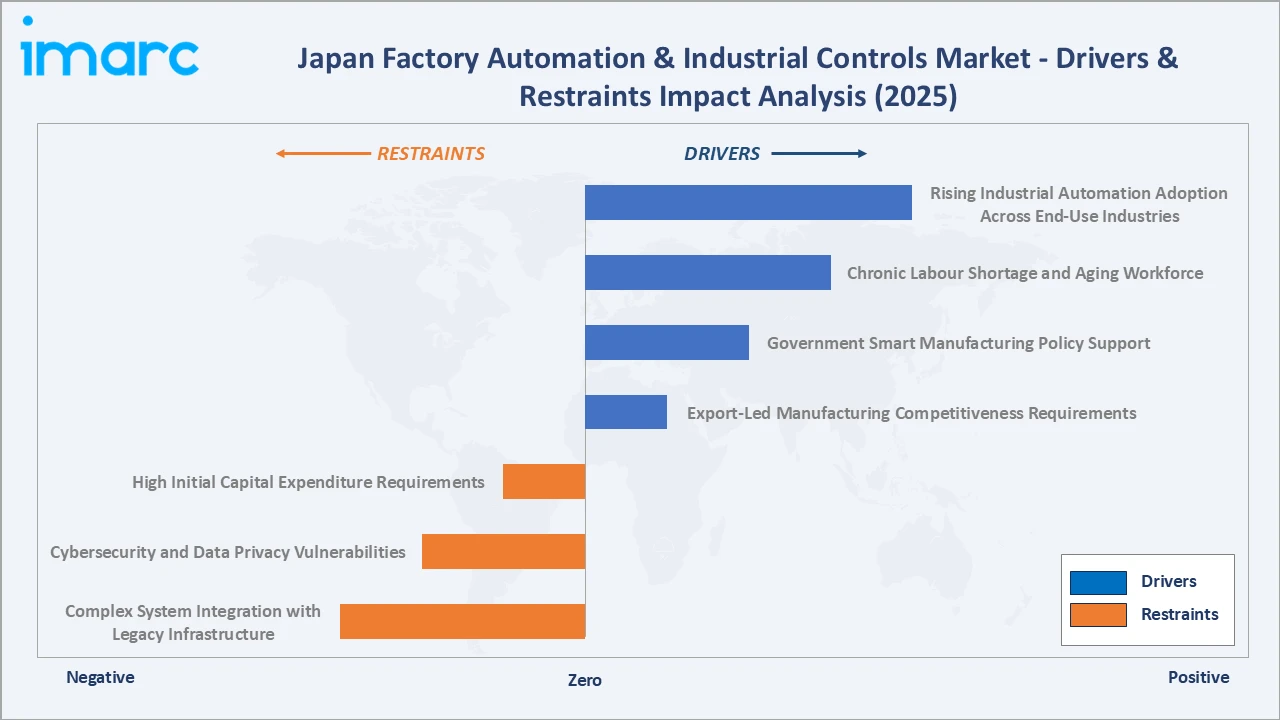
- Rising Industrial Automation Adoption Across End-Use Industries: Manufacturing enterprises across diverse industrial sectors are increasingly deploying automation solutions to improve operational efficiency, reduce production costs, and enhance product quality consistency. The shift from manual to automated production processes is accelerating across automotive, food and beverage, chemical, and electronics industries as organisations seek to optimise throughput and minimise human error. Investment in factory automation equipment, including programmable logic controllers, industrial robots, and smart sensing systems, is growing steadily as manufacturers recognise the long-term productivity gains achievable through systematic automation deployment across all production stages.
- Chronic Labour Shortage and Aging Workforce: Persistent labour shortages and an aging industrial workforce are creating powerful structural demand for automation solutions that can substitute for human labour in manufacturing environments. As demographic shifts reduce the availability of working-age population, manufacturers face increasing difficulty maintaining production capacity through traditional labour-intensive approaches. Automation technologies including industrial robots, collaborative robots, and automated guided vehicles are increasingly positioned as viable long-term solutions to labour supply constraints, delivering measurable returns through reduced wage costs, improved consistency, and extended operational hours across manufacturing enterprises of all scales.
- Government Smart Manufacturing Policy Support: Government policy initiatives supporting smart manufacturing, industrial digitalisation, and technology-driven productivity enhancement are creating favourable conditions for factory automation market expansion. Public sector investment in manufacturing technology development, combined with subsidy programmes, tax incentives, and preferential financing for automation equipment procurement, is reducing adoption barriers for small and medium-sized manufacturers. Regulatory frameworks encouraging energy efficiency and workplace safety compliance are additionally creating compliance-driven automation demand, accelerating procurement decision timelines and expanding the addressable market for solution providers.
- Export-Led Manufacturing Competitiveness Requirements: Manufacturers competing in global export markets require continuous productivity and quality improvements to sustain competitiveness against lower-cost production alternatives in emerging economies. Automation investment enables export-oriented manufacturers to compete on product quality, production precision, and delivery reliability rather than labour cost advantage alone. Advanced automation systems deliver measurable quality improvements including reduced defect rates, tighter dimensional tolerances, and enhanced process consistency that support premium positioning in international markets, creating consistent long-term demand among manufacturers serving global customers with exacting supply chain quality standards.
Market Restraints
- High Initial Capital Expenditure Requirements: The significant upfront capital investment required to deploy comprehensive factory automation systems represents a substantial financial barrier, particularly for small and medium-sized manufacturing enterprises operating with constrained investment budgets. Full-scale automation implementations encompassing programmable controllers, industrial robots, sensing systems, and integration software frequently require multi-year capital planning cycles and extended payback periods that challenge traditional financial approval processes. The total cost of ownership, including installation, commissioning, training, and ongoing maintenance, further increases the commitment required and can slow adoption rates among cost-sensitive manufacturers.
- Cybersecurity and Data Privacy Vulnerabilities: Increasing connectivity between industrial control systems, enterprise networks, and cloud platforms through IIoT integration introduces significant cybersecurity vulnerabilities that complicate automation procurement decisions for industrial operators. Industrial control systems were historically isolated from external networks, but modern smart factory architectures require connectivity that exposes operational technology environments to cyber threats previously confined to information technology systems. The consequences of industrial cybersecurity incidents, including production disruption, safety hazards, and intellectual property loss, are particularly severe, requiring specialised expertise and ongoing investment that adds to overall costs.
- Complex System Integration with Legacy Infrastructure: Integrating modern automation platforms with existing legacy manufacturing equipment presents significant technical complexity, operational risk, and cost that can deter manufacturers from undertaking automation investments. Legacy production equipment, often representing substantial prior capital investment, may operate on proprietary protocols, outdated communication standards, or architectures incompatible with contemporary automation platforms without extensive customisation. System integration projects frequently encounter unexpected compatibility challenges that extend implementation timelines, increase project costs beyond initial estimates, and temporarily disrupt operations, increasing total cost of ownership.
Market Opportunities
- AI-Powered Predictive Maintenance Platform Deployment: AI-driven predictive maintenance platforms represent a significant commercial opportunity as manufacturers seek to minimise costly unplanned equipment downtime and optimise maintenance scheduling efficiency. Machine learning algorithms applied to sensor data streams from industrial equipment can identify performance anomalies and predict failure events with sufficient advance notice to schedule maintenance interventions before production disruption occurs. The economic value of predictive maintenance, including reduced emergency repair costs, lower spare parts inventory requirements, and extended equipment service life, creates compelling return-on-investment cases that support automation procurement decisions.
- IIoT-Enabled Smart Factory Infrastructure Build-Out: Expansion of IIoT-connected smart factory infrastructure creates substantial growth opportunities for field device manufacturers, control system vendors, software platform providers, and system integrators across industrial markets. Smart factory deployments connect physical production assets to digital management systems through sensor networks, edge computing infrastructure, and cloud analytics platforms, generating operational data that enables real-time performance optimisation and evidence-based decision-making. The comprehensive scope of smart factory transformation creates large, multi-year project opportunities as growing manufacturer recognition of competitive advantages accelerates adoption across sectors.
- Collaborative Robot Market Expansion in SME Manufacturing: Rising adoption of collaborative robots among small and medium manufacturing enterprises represents a significant market expansion opportunity beyond traditional large-enterprise automation purchasers. Collaborative robots, characterised by intuitive programming interfaces, compact footprints, built-in safety systems enabling human co-working, and lower price points relative to traditional industrial robots, are making automation economically accessible to manufacturers previously unable to justify conventional robot deployments. Declining price points and flexible redeployment capability across multiple production tasks are expanding the commercially viable addressable market to a substantially larger manufacturing base.
Market Challenges
- Rapid Technological Obsolescence in Industrial Control Systems: Frequent technology upgrades in PLC, SCADA, and HMI platforms create obsolescence risk for recently installed systems, challenging manufacturers to balance system longevity with technology advancement adoption. Automation solution providers are releasing new platform generations at an accelerating pace, driven by AI integration, cloud connectivity, and cybersecurity enhancements, which compress effective system lifecycles and increase pressure on manufacturers to reinvest in control infrastructure upgrades ahead of planned replacement schedules. Managing technology transition costs while maintaining operational continuity remains a persistent challenge for industrial automation decision-makers across all sectors.
- Skills Gap in Industrial Automation Engineering: A widening shortage of skilled engineers capable of designing, deploying, and maintaining advanced automation systems constrains the pace of market expansion across manufacturing segments. The convergence of operational technology and information technology in modern factory automation requires engineers proficient in both industrial control systems and software development, a combination that is scarce in the current engineering talent pool. Educational institutions are expanding automation engineering curricula, but the pace of graduate supply is insufficient to meet the accelerating demand generated by industrial digitalisation programmes across manufacturing enterprises and system integration firms.
Emerging Market Trends
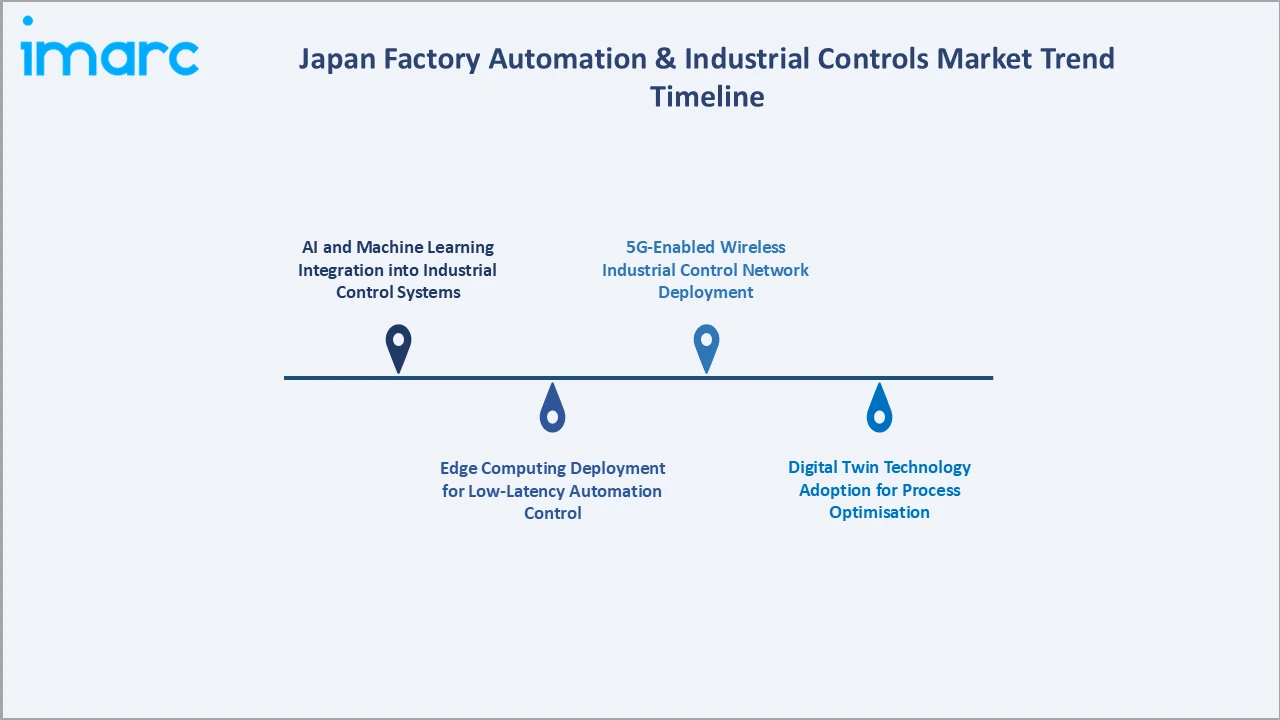
1. AI and Machine Learning Integration into Industrial Control Systems
AI and machine learning integration into industrial control systems is transforming factory automation from rule-based process execution to adaptive, self-optimising manufacturing environments capable of responding dynamically to production variations. Machine learning algorithms embedded in programmable logic controllers and supervisory control systems analyse real-time process data to continuously refine control parameters, improving output quality, energy efficiency, and equipment utilisation beyond levels achievable through conventional programming. AI-powered vision inspection systems are replacing sampling-based quality control with automated defect detection at production line speeds, delivering measurable quality improvements across electronics, pharmaceutical, and precision components manufacturing.
2. Edge Computing Deployment for Low-Latency Automation Control
Edge computing deployment in factory automation environments enables local processing of operational data with millisecond-level response times essential for high-speed manufacturing control and safety-critical applications. Unlike cloud-dependent architectures requiring data transmission to remote servers, edge computing processes sensor and control data at the factory floor level, eliminating latency that would otherwise compromise time-sensitive automation control decisions. Edge infrastructure also reduces dependence on network connectivity, improving system resilience in environments where communication interruptions could cause production disruption or safety incidents, supporting deployment of advanced automation applications including real-time inspection and autonomous mobile robot coordination across manufacturing facilities.
3. Digital Twin Technology Adoption for Process Optimisation
Digital twin technology enables manufacturers to create virtual replicas of physical production assets, processes, and factory layouts that can be simulated, tested, and optimised prior to or independently of physical implementation. Factory-wide digital twin deployments allow engineering teams to evaluate automation system configurations, identify process bottlenecks, test control logic modifications, and validate safety procedures in a risk-free virtual environment that eliminates production disruption. The predictive capability of digital twin platforms, combining real-time sensor data with simulation models, supports continuous process improvement by identifying optimisation opportunities invisible through conventional production monitoring approaches, with adoption accelerating as implementation costs decrease and demonstrated outcomes strengthen investment cases.
4. 5G-Enabled Wireless Industrial Control Network Deployment
Fifth-generation wireless network deployment in industrial facilities is enabling new categories of factory automation applications previously constrained by the latency and reliability limitations of earlier wireless technologies. Private 5G networks provide the ultra-low latency, high bandwidth, and deterministic communication characteristics required for wireless industrial control connectivity, autonomous mobile robot coordination, and real-time machine vision data transmission across factory floor environments. The elimination of fixed network cabling through wireless connectivity reduces facility modification costs, simplifies production line reconfiguration, and enables flexible manufacturing layouts adaptable rapidly to changing production requirements, with industrial adoption expected to accelerate as private network deployment costs decline and ROI documentation expands.
Industry Value Chain Analysis
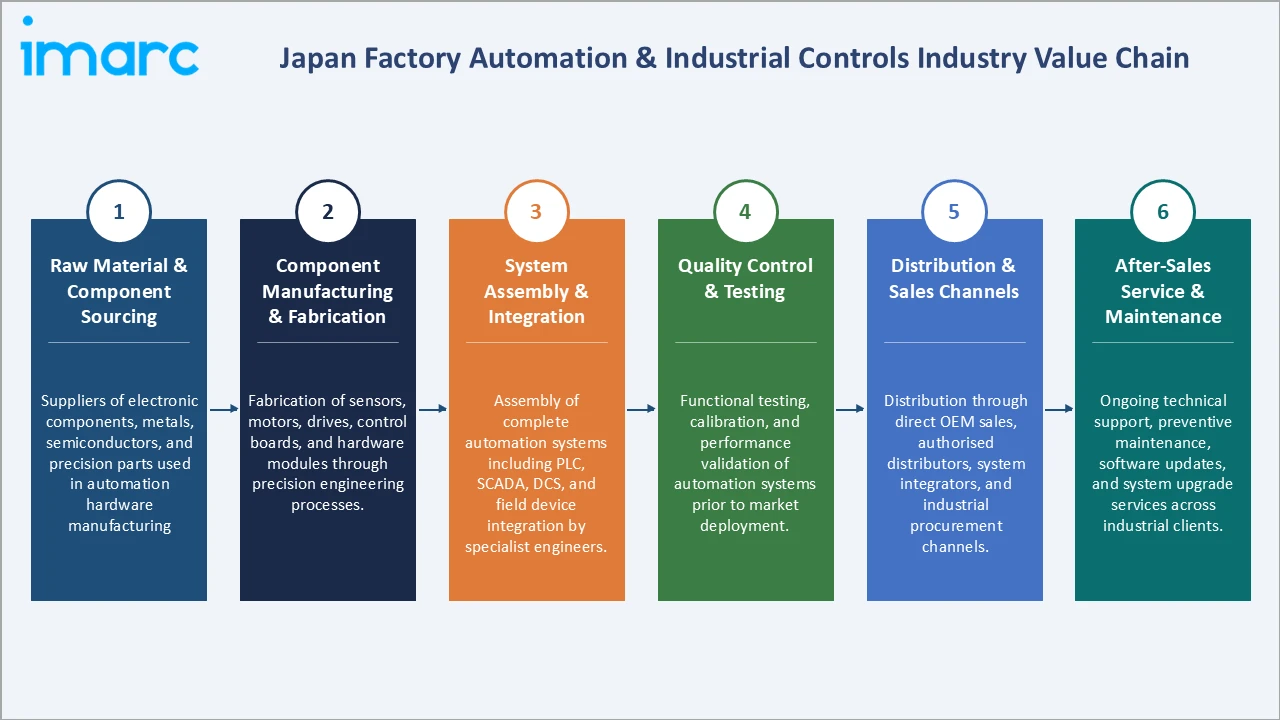
Japan's factory automation and industrial controls value chain spans six sequential stages, from raw material sourcing through to after-sales service. System assembly and integration represents the highest value-added stage due to engineering complexity and customisation requirements across diverse end-use industrial environments.
| Stage | Key Participants & Activities |
|---|---|
| Raw Material & Component Sourcing | Suppliers of electronic components, metals, semiconductors, and precision parts used in automation hardware manufacturing. |
| Component Manufacturing & Fabrication | Fabrication of sensors, motors, drives, control boards, and hardware modules through precision engineering processes. |
| System Assembly & Integration | Assembly of complete automation systems including PLC, SCADA, DCS, and field device integration by specialist engineers. |
| Quality Control & Testing | Functional testing, calibration, and performance validation of automation systems prior to market deployment. |
| Distribution & Sales Channels | Distribution through direct OEM sales, authorised distributors, system integrators, and industrial procurement channels. |
| After-Sales Service & Maintenance | Ongoing technical support, preventive maintenance, software updates, and system upgrade services across industrial clients. |
System assembly and integration is the value chain's most commercially consequential stage. Custom integration of PLC, SCADA, DCS, robotics, and field devices requires specialised engineering expertise, creating high barriers to entry and premium pricing power for qualified system integrators.
Technology Landscape in the Japan Factory Automation & Industrial Controls Industry
Programmable Logic Controllers (PLC) and Distributed Control Systems (DCS)
Programmable logic controllers and distributed control systems constitute the foundational control infrastructure of modern industrial manufacturing, providing reliable, deterministic automation of discrete and continuous production processes across virtually all industrial sectors. Contemporary PLC platforms have evolved significantly beyond their original relay-replacement function to incorporate advanced motion control, high-speed communication networking, and integrated software development environments supporting complex multi-axis manufacturing automation. Distributed control systems, widely deployed in process industries including chemical, oil and gas, and power generation, provide plant-wide control integration with advanced alarming, historian, and process control capabilities, with next-generation platforms incorporating cloud connectivity and AI-assisted programming tools that reduce engineering complexity and enable remote system management.
Industrial Robotics and Collaborative Robot Technology
Industrial robotics technology has expanded significantly in capability, application scope, and commercial accessibility, transforming from a technology limited to high-volume automotive assembly to a broadly deployed automation tool across diverse manufacturing industries and applications. Six-axis articulated robots, SCARA robots, delta robots, and Cartesian systems each serve distinct application requirements spanning welding, material handling, assembly, painting, palletising, and quality inspection across automotive, electronics, food processing, and pharmaceutical manufacturing. Collaborative robots represent the technology segment's most commercially dynamic development, incorporating force-sensing and safety monitoring systems that allow direct human co-working, with declining price points and improving programming interfaces broadening adoption across smaller manufacturers previously unable to economically justify robot investment.
IIoT Platforms and Edge Intelligence
Industrial Internet of Things platforms provide the connectivity, data management, and analytics infrastructure enabling manufacturers to extract operational intelligence from distributed production assets and translate it into actionable process improvements. IIoT architectures integrate field device sensor data, machine control system parameters, and production execution system outputs into unified data environments that support real-time performance monitoring, advanced analytics, and evidence-based operational decision-making. Edge computing components within IIoT architectures perform local data processing at the equipment level, filtering and analysing sensor streams to deliver time-sensitive control responses and reduce data transmission volumes, with platform adoption accelerating as demonstrated value from connected manufacturing deployments justifies the infrastructure investment required for comprehensive factory-wide implementation.
Machine Vision and Advanced Sensor Technology
Machine vision systems and advanced sensing technologies are fundamental enablers of quality-driven manufacturing automation, providing the measurement and inspection capabilities required to maintain product quality standards at modern production line speeds. Vision systems incorporating high-resolution cameras, specialised illumination, and AI-powered image analysis software can detect surface defects, dimensional deviations, and assembly errors with sub-millimetre precision at rates far exceeding manual inspection capability. Advanced sensor technologies including laser displacement sensors, 3D measurement systems, thermal imaging, and spectroscopic analysers provide manufacturers with comprehensive real-time measurement data supporting process optimisation and quality assurance, with continuing advances in miniaturisation and AI-assisted analysis expanding the range of addressable inspection applications across manufacturing industries.
Market Segmentation Analysis
The report covers the following segments:
| Segment Category | Leading Segment | Market Share | Year |
|---|---|---|---|
| Type | Industrial Control Systems | 55.0% | 2025 |
| End Use Industry | Automotive & Transportation | 35.0% | 2025 |
| Region | Kanto Region | 32.0% | 2025 |

By Type
Industrial Control Systems lead at 55.0% (2025). This segment encompasses PLC, DCS, SCADA, MES, HMI, and PLM systems deployed across Japan's heavy and process industries. Large-scale capital investments in automotive assembly automation and chemical plant digitalisation are primary demand drivers, generating approximately USD 9.12 Billion in 2025.
To access detailed market analysis, Request Sample
Field Devices at 45.0% grow at ~8.70% CAGR through expanding industrial robotics deployments, advanced sensor integration, and proliferation of machine vision systems. Japan's global robotics leadership home to four of the world's top five robot manufacturers directly supports sustained double-digit growth in field device demand through 2034.
By End Use Industry
Automotive & Transportation leads at 35.0% (2025). Japan's globally significant automotive OEM base represents the largest single automation consumption segment. EV platform transitions are generating incremental automation investments in battery manufacturing, motor assembly, and powertrain testing, generating approximately USD 5.80 Billion in 2025.
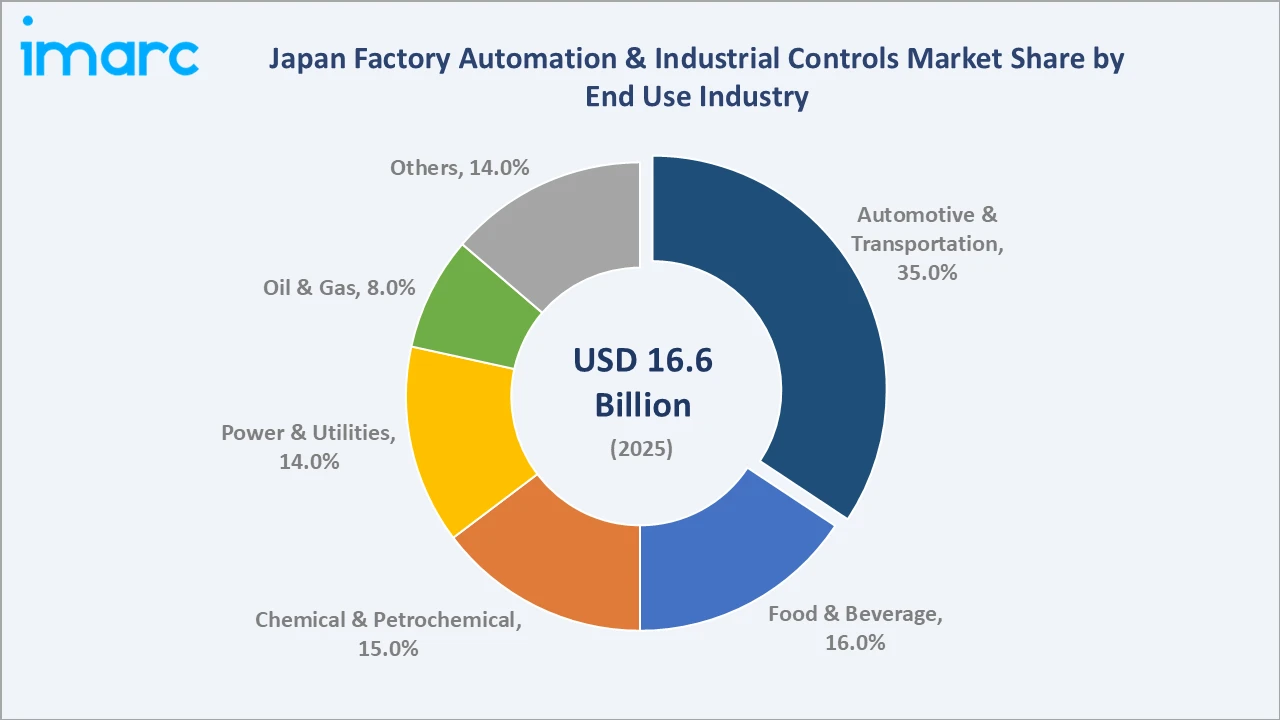
Food & Beverage at 16.0% ranks second, driven by food safety regulations and automated packaging demand. Chemical & Petrochemical at 15.0% and Power & Utilities at 14.0% represent established markets with stable replacement-cycle demand. Oil & Gas at 8.0% reflects niche but high-value offshore and refinery control system investments.
Regional Market Insights
| Region | Share (2025) | Key Japan FA & IC Market Drivers & Characteristics |
|---|---|---|
| Kanto Region | 32.0% | Highest concentration of industrial manufacturing, electronics, and automotive HQs; strong demand for advanced control systems and robotics. |
| Central/Chubu Region | 22.0% | Home to major automotive assembly clusters with extensive automation infrastructure; Japan's most automation-intensive industrial region. |
| Kansai/Kinki Region | 20.0% | Strong chemical, pharmaceutical, and electronics manufacturing base drives consistent demand for precision control systems and field instrumentation. |
| Kyushu-Okinawa Region | 8.0% | Growing semiconductor and electronics manufacturing creates incremental industrial automation demand; government-backed industrial park development active. |
| Chugoku Region | 6.0% | Steel, shipbuilding, and heavy manufacturing drive traditional control system demand with gradual smart factory technology upgrades ongoing. |
| Tohoku Region | 5.0% | Post-earthquake industrial reconstruction and new manufacturing facility investments have established a growing industrial automation procurement base. |
| Shikoku Region | 4.0% | Chemical and food processing industries represent primary automation demand drivers with increasing investment in automated production line upgrades. |
| Hokkaido Region | 3.0% | Food processing, agricultural machinery, and energy sector automation represent primary demand drivers with emerging cold-chain logistics automation growth. |
The Kanto Region's 32.0% market leadership reflects Greater Tokyo's industrial density, with the highest concentration of factory automation equipment procurement, system integration firms, and industrial technology R&D centres. Major electronics and automotive OEM headquarters drive recurring capital automation investments.
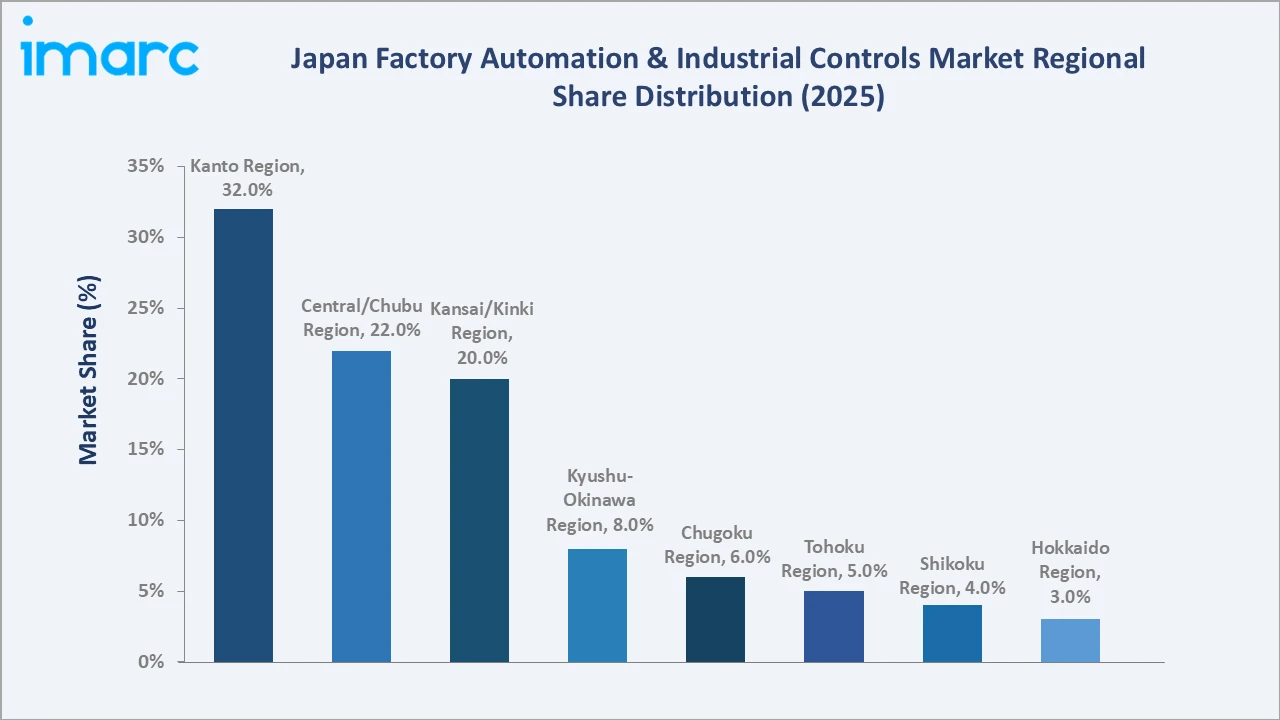
The Central/Chubu Region's 22.0% share reflects the Nagoya metropolitan area's status as Japan's automotive manufacturing heartland. Kansai/Kinki at 20.0% benefits from Osaka's chemical and pharmaceutical automation requirements. Kyushu-Okinawa at 8.0% is an emerging growth region supported by semiconductor plant investments.
Competitive Landscape
Japan's factory automation and industrial controls competitive landscape is defined by globally dominant domestic manufacturers alongside international technology leaders. The market's competitive intensity is high, with leading players competing on technology innovation, system integration capability, and after-sales service network depth.
| Company | Key Offerings | Market Position | Core Strength |
|---|---|---|---|
| FANUC Corporation | CNC systems, industrial robots, FA equipment | Market Leader | FANUC Corporation is the world's largest manufacturer of CNC and factory automation systems, renowned for precision and reliability. |
| Mitsubishi Electric Corporation | PLCs, inverters, HMI, servo systems | Market Leader | Mitsubishi Electric Corporation holds a leading position in integrated FA systems, combining hardware and software solutions. |
| Keyence Corporation | Sensors, vision systems, laser markers | Innovator | Keyence Corporation leads in sensor and machine vision technology with a high-margin direct sales model. |
| Omron Corporation | PLCs, motion controllers, collaborative robots, sensing components | Strong Challenger | Omron Corporation leads in AI-embedded sensing and control technology with strong presence in electronics manufacturing automation. |
| Yokogawa Electric Corporation | DCS, field instruments | Strong Challenger | Yokogawa Electric Corporation is Japan's leader in process control and industrial automation for oil, gas, and chemicals. |
The competitive landscape's most strategically significant dynamic is the coexistence of vertically integrated Japanese automation conglomerates with specialised niche technology providers. This creates a highly layered competitive structure where system-level integrators compete alongside component specialists across different segments of the automation value chain.
Key Company Profiles
FANUC Corporation
FANUC Corporation is a globally recognised leader in CNC systems, factory automation equipment, and industrial robotics, headquartered in Oshino, Yamanashi, Japan. The company serves manufacturing clients across automotive, aerospace, electronics, and general industry verticals with precision-engineered automation solutions renowned for reliability and longevity.
- Key Offerings: CNC systems, FANUC robots (including ROBOSHOT and CRX collaborative robots), ROBOCUT wire-EDM, ROBODRILL machining centres, FA equipment, servo amplifiers, and laser cutting systems.
- Recent Developments: In December 2025, FANUC introduced open-platform robotics capabilities supporting Physical AI applications, including an open-source ROS 2 driver and standard Python support. These developments enable manufacturers to integrate FANUC robots, including the CRX collaborative series, with advanced AI technologies, supporting more flexible automation and application development.
- Strategic Focus: Maintaining technology leadership in CNC and industrial robot precision while expanding collaborative robot capabilities and AI-driven automation solutions to address Japan's growing SME manufacturing automation demand.
Mitsubishi Electric Corporation
Mitsubishi Electric Corporation is one of Japan's most diversified electrical equipment manufacturers, with a significant factory automation division encompassing PLCs, inverters, servo systems, and industrial robots. The company serves clients across automotive, food processing, semiconductor, and infrastructure sectors with integrated automation solutions.
- Key Offerings: MELSEC PLCs, FR-series inverters, MELSERVO servo systems, MELFA industrial robots, GOT HMI, and the e-F@ctory smart manufacturing platform.
- Recent Developments: In 2025, Mitsubishi Electric launched upgraded MELSEC iQ-R series PLCs with enhanced cybersecurity features and expanded IIoT connectivity, addressing growing demand for secure industrial network integration.
- Strategic Focus: Delivering integrated smart factory solutions through the e-F@ctory platform, combining manufacturing IT and OT systems to optimise production efficiency and data-driven decision-making across industrial clients.
Keyence Corporation
Keyence Corporation is a Japanese technology company recognised as a global innovation leader in industrial sensors, machine vision systems, laser markers, and measurement instrumentation. The company operates a high-margin direct sales model and serves manufacturing clients across electronics, automotive, pharmaceutical, and food & beverage industries.
- Key Offerings: Photoelectric sensors, vision systems, laser displacement sensors, barcode readers, laser markers, digital microscopes, and precision measurement instruments.
- Strategic Focus: Sustaining industry-leading profitability through proprietary sensing technology innovation, a consultative direct sales model, and rapid new product development cycles addressing emerging manufacturing quality control requirements.
Market Concentration Analysis
Japan's factory automation and industrial controls market exhibits a moderately concentrated structure at the upper tier, with a small number of large integrated players capturing a significant portion of overall market revenue. The broader market remains fragmented across hundreds of specialised component and sub-system suppliers serving diverse industrial end markets.
Market concentration is gradually increasing as leading automation providers invest in platform-based ecosystem strategies that tie customers into proprietary control architectures. This platform lock-in dynamic, combined with the complexity of multi-vendor system integration, is creating durable competitive advantages for established market leaders.
Investment & Growth Opportunities
Highest Growth Segments
Industrial Control Systems (~9.80% CAGR) represent the highest-growth segment through 2034, driven by digital factory transformation across automotive and process industries. Field Devices (~8.70% CAGR) follow closely, supported by robotics and machine vision expansion. The overall market CAGR of 9.31% reflects Japan's structural automation demand trajectory.
Emerging Investment Opportunities
AI-integrated predictive maintenance platforms represent Japan's most commercially attractive emerging automation investment, with demonstrated ROI of 20–30% reduction in unplanned downtime. Digital twin deployment for factory simulation and IIoT infrastructure build-out represent the two additional high-priority investment categories through 2030.
Investment Themes
- Industrial Control Systems platform modernisation across Japan's Chemical & Petrochemical sector, creating above-average growth through system upgrade cycles and IIoT integration projects.
- Collaborative robot (cobot) deployment for SME manufacturing automation, addressing Japan's most structurally underserved segment as labour costs and demographic pressures intensify.
Future Market Outlook (2026-2034)
The Japan factory automation and industrial controls market is projected to grow from USD 16.58 Billion in 2025 to USD 18.12 Billion in 2026, reaching USD 25.87 Billion by 2030 and USD 36.94 Billion by 2034. The 9.31% CAGR reflects accelerating technology adoption driven by government policy, demographic necessity, and export competitiveness requirements.
Three structural forces define Japan's factory automation market outlook through 2034 acceleration of AI and IIoT platform integration into industrial control infrastructure, the demographic-driven imperative to replace declining labour with autonomous systems, and Japan's strategic investment in Society 5.0 smart manufacturing as a national priority.
Research Methodology
Primary Research
Primary research comprised structured interviews with Japan factory automation industry stakeholders, including Plant Automation Directors, Control System Engineers, Procurement Managers, and System Integrators. Industry experts from automotive, chemical, food & beverage, and electronics sectors provided qualitative insights on adoption trends and investment criteria.
Secondary Research
Secondary research encompassed Japan Ministry of Economy, Trade and Industry manufacturing data, Japan Robot Association annual reports, company annual reports, trade publications, and patent filing data. Import-export data from Japan Customs and industrial association reports supplemented primary research findings.
Forecasting Models
Market revenue forecasts were developed using an industrial capital expenditure model incorporating Japan's manufacturing output growth, automation penetration rate trajectory by sector, historical factory automation investment data, and government policy stimulus estimates. Bottom-up segment models were validated against top-down macroeconomic forecasts.
Japan Factory Automation & Industrial Controls Market Report Scope:
| Report Features | Details |
|---|---|
| Base Year of the Analysis | 2025 |
| Historical Period | 2020-2025 |
| Forecast Period | 2026-2034 |
| Units | Billion USD |
| Scope of the Report |
Exploration of Historical Trends and Market Outlook, Industry Catalysts and Challenges, Segment-Wise Historical and Future Market Assessment:
|
| Types Covered |
|
| End Use Industries Covered | Oil and Gas, Chemical and Petrochemical, Power and Utilities, Food and Beverage, Automotive and Transportation, Others |
| Regions Covered | Kanto Region, Kansai/Kinki Region, Central/ Chubu Region, Kyushu-Okinawa Region, Tohoku Region, Chugoku Region, Hokkaido Region, Shikoku Region |
| Companies Covered | FANUC Corporation, Mitsubishi Electric Corporation, Keyence Corporation, Omron Corporation, Yokogawa Electric Corporation, etc. |
| Customization Scope | 10% Free Customization |
| Post-Sale Analyst Support | 10-12 Weeks |
| Delivery Format | PDF and Excel through Email (We can also provide the editable version of the report in PPT/Word format on special request) |
Key Benefits for Stakeholders:
- IMARC’s report offers a comprehensive quantitative analysis of various market segments, historical and current market trends, market forecasts, and dynamics of the Japan factory automation & industrial controls market from 2020-2034.
- The research study provides the latest information on the market drivers, challenges, and opportunities in the Japan factory automation & industrial controls market.
- Porter's Five Forces analysis assists stakeholders in assessing the impact of new entrants, competitive rivalry, supplier power, buyer power, and the threat of substitution. It helps stakeholders to analyze the level of competition within the Japan factory automation & industrial controls industry and its attractiveness.
- Competitive landscape allows stakeholders to understand their competitive environment and provides an insight into the current positions of key players in the market.
Frequently Asked Questions About the Japan Factory Automation & Industrial Controls Market Report
Japan factory automation and industrial controls market size is estimated at USD 18.12 Billion in 2026, driven by rising automation adoption, labour shortages, and smart manufacturing investments.
Japan factory automation and industrial controls market grows at 9.31% CAGR during 2026-2034, reaching USD 36.94 Billion by 2034, sustained by IIoT, AI, and robotics adoption.
Industrial Control Systems lead at 55.0% through widespread PLC, DCS, and SCADA deployments across automotive, chemical, and power generation end markets.
Automotive & Transportation leads at 35.0% through Japan's competitive OEM base, extensive robotic assembly lines, and new EV platform automation investments.
Kanto Region leads at 32.0% through Greater Tokyo's industrial density, automation OEM concentration, and highest procurement volume of advanced control systems.
Leading companies include FANUC Corporation, Mitsubishi Electric Corporation, Keyence Corporation, Omron Corporation, and Yokogawa Electric Corporation, among others.
Japan factory automation and industrial controls market is projected to reach approximately USD 25.87 Billion by 2030, with both Industrial Control Systems and Field Devices registering strong growth.
Three priority investment opportunities: AI-powered predictive maintenance platforms, IIoT smart factory infrastructure build-out, and collaborative robot deployment in SME manufacturing segments.
Key drivers include chronic labour shortages, government Society 5.0 manufacturing policy, export competitiveness requirements, and rising industrial automation adoption across end-use sectors.
Japan factory automation and industrial controls market grew from USD 10.62 Billion in 2020 to USD 16.58 Billion in 2025, representing steady compound growth through the historical period.
Need more help?
- Speak to our experienced analysts for insights on the current market scenarios.
- Include additional segments and countries to customize the report as per your requirement.
- Gain an unparalleled competitive advantage in your domain by understanding how to utilize the report and positively impacting your operations and revenue.
- For further assistance, please connect with our analysts.
 Request Customization
 Speak to an Analyst
 Request Brochure
 Inquire Before Buying
Benefits of Customization
- Personalize this research
- Triangulate with your data
- Get data as per your format and definition
- Gain a deeper dive into a specific application, geography, customer, or competitor
- Any level of personalization
Get in Touch With Us
UNITED STATES
Phone: +1-201-971-6302
INDIA
Phone: +91-120-433-0800
UNITED KINGDOM
Phone: +44-753-714-6104
Email: [email protected]
Client Testimonials























Related Reports

Choose your plan
*Please note that the prices mentioned below are starting prices for each bundle type. Kindly contact our team for further details.*
Single User License
- 1 User License, Access on 2 Devices
- PDF Report + Excel Dataset (Password Protected)
- Lifetime Access
- No Printing Rights
- 10% Free Report Customization
- 10–12 Weeks of Analyst Support
Five User License
- Access for 5 Users, 2 Devices per User
- PDF Report + Excel Dataset (Password Protected)
- Lifetime Access
- Dedicated Account Manager
- 12–14 Weeks of Analyst Support
- No Printing Rights
- 15% Free Report Customization
- 25% Discount on Your Next Purchase
Corporate User License
- Unlimited User Access (Within Your Organization)
- PDF Report + Excel Dataset
- Lifetime Access
- Dedicated Account Manager
- 14–20 Weeks of Analyst Support
- No Printing Rights
- 20% Free Report Customization
- 30% Discount on Your Next Purchase
Essential Insights
What's included:
3 reports
- Lifetime Access
- PDF Reports
- Excel Datasets
- 2 Weeks of Free Analyst Support
- 2 User Licenses
- Access on 2 Devices
- Printing Rights
- Complimentary PowerPoint (PPT) Version
- Complimentary License Upgrade
Professional Access
What's included:
5 reports
- Lifetime Access
- PDF Reports
- Excel Datasets
- 8 Weeks of Free Analyst Support
- 2 User Licenses
- Access on 2 Devices
- Printing Rights
- Complimentary PowerPoint (PPT) Version
- Complimentary License Upgrade
Business Advantage
What's included:
8 reports
- Lifetime Access
- PDF Reports
- Excel Datasets
- 14 Weeks of Free Analyst Support
- 2 User Licenses
- Access on 2 Devices
- Printing Rights
- Complimentary PowerPoint (PPT) Version
- Complimentary License Upgrade
Enterprise Intelligence
What's included:
10 reports
- Lifetime Access
- PDF Reports
- Excel Datasets
- 20 Weeks of Free Analyst Support
- 2 User Licenses
- Access on 2 Devices
- Printing Rights
- Complimentary PowerPoint (PPT) Version
- Complimentary License Upgrade