
Japan Hybrid Electric Vehicle Market Size, Share, Trends and Forecast by Propulsion Type, Configuration Type, Vehicle Type, Power Source, and Region, 2026-2034
Japan Hybrid Electric Vehicle Market Size, Share, Trends & Forecast (2026-2034)
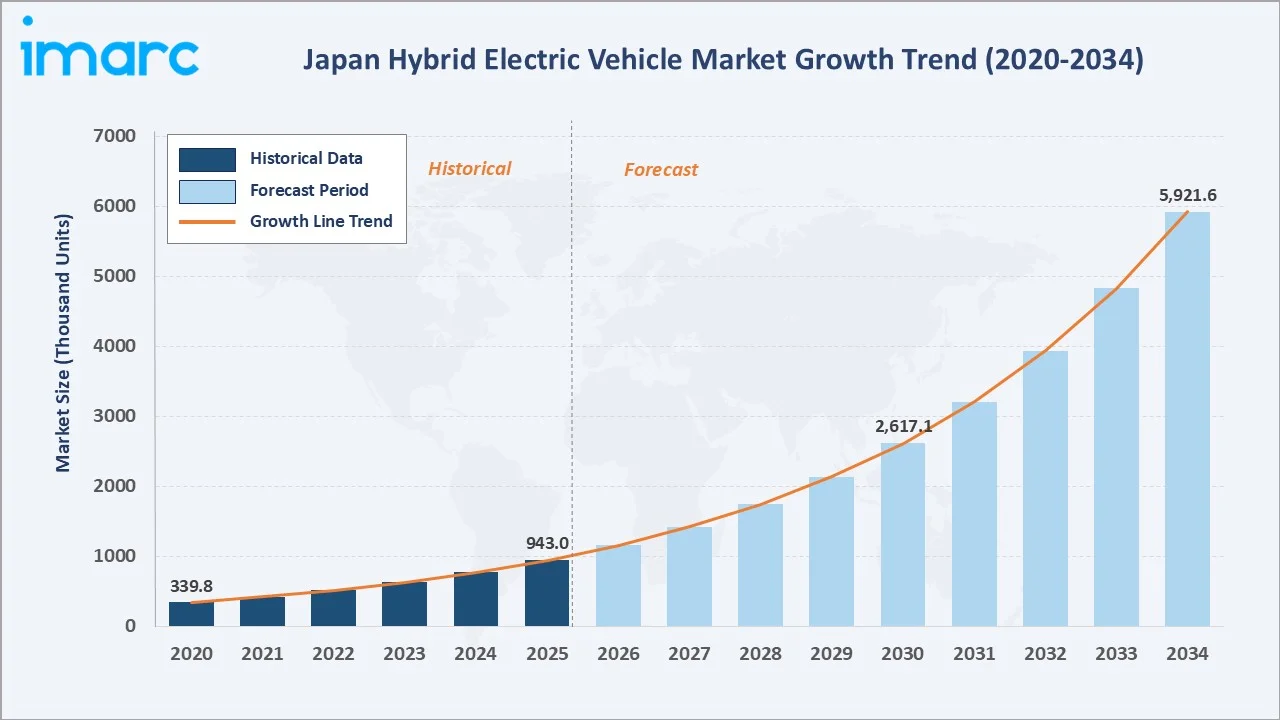
The Japan hybrid electric vehicle market reached 943.0 Thousand Units in 2025 and is projected to reach 5,921.6 Thousand Units by 2034, expanding at a CAGR of 22.65% during 2026-2034. Rising consumer demand for fuel-efficient mobility, government carbon-neutrality mandates, and rapid advancements in battery and powertrain technology are driving adoption across passenger and commercial vehicle segments.
Market Snapshot
|
Metric |
Value |
|
Market Size (2025) |
943.0 Thousand Units |
|
Forecast Market Size (2034) |
5,921.6 Thousand Units |
|
CAGR (2026-2034) |
22.65% |
|
Base Year |
2025 |
|
Historical Period |
2020-2025 |
|
Forecast Period |
2026-2034 |
Kanto Region leads Japan's hybrid electric vehicle landscape, holding a 40.9% share in 2025, anchored by Tokyo's dense passenger vehicle market. Full hybrids command the largest propulsion share at 54.8%, while combination HEV architecture retains the leading configuration position at 48.6%, reflecting sustained demand for Toyota's power-split hybrid systems.
To get more information on this market, Request Sample
Japan's hybrid electric vehicle market is underpinned by three structural forces: tightening emission regulations under the government's 2050 carbon-neutrality roadmap, rising battery cost competitiveness, and consumer preference for proven hybrid reliability over fully electric alternatives. Each force independently reinforces hybrid adoption across urban and rural driving conditions, sustaining a high CAGR through 2034 despite intensifying competition from battery electric vehicles.
Executive Summary
The Japan hybrid electric vehicle market is undergoing sustained expansion, driven by the convergence of stringent emission regulations, government decarbonization targets, and rapid battery technology improvements. The market was valued at 943.0 Thousand Units in 2025 and is forecast to reach 5,921.6 Thousand Units by 2034, growing at a CAGR of 22.65%.
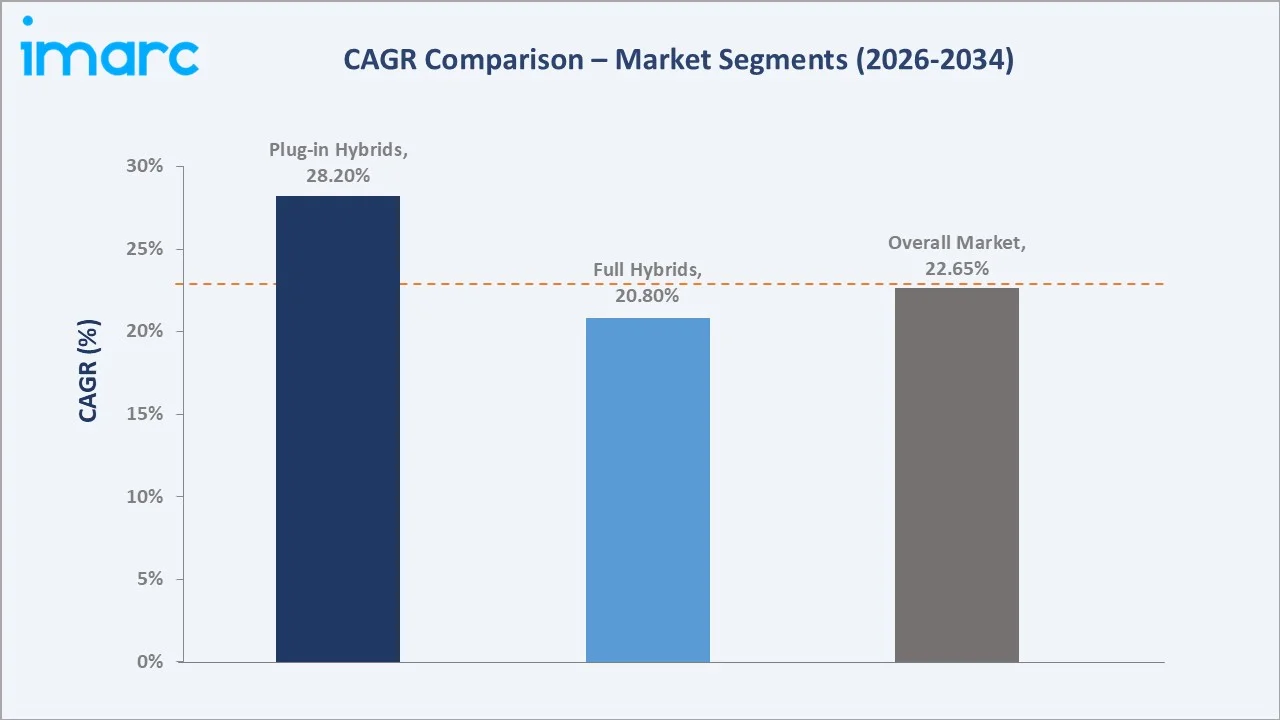
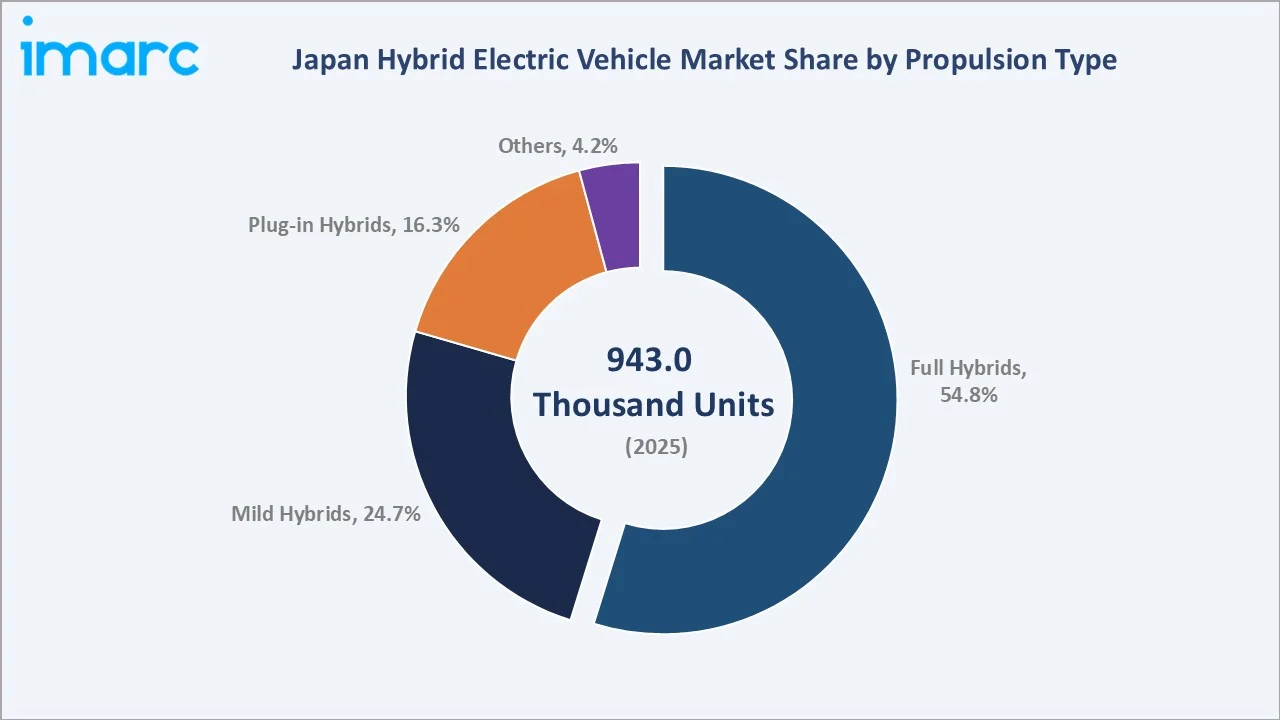
Full hybrids dominate the propulsion segment with a 54.8% share in 2025, reflecting decades of Toyota and Honda engineering refinement. Mild hybrids follow at 24.7%, offering cost-effective electrification for entry-level models, while Plug-in hybrids at 16.3% are expanding fastest as charging infrastructure matures.
Combination HEV architecture leads the configuration segment at 48.6%, though Series HEV systems, led by Nissan's e-POWER technology, are gaining share rapidly across compact and minivan segments. Kanto Region leads regionally at 40.9%, anchored by Tokyo's dense vehicle registration base and extensive dealership networks. Kansai/Kinki follows at 18.8%, driven by Osaka's manufacturing ecosystem.
Key Market Insights
|
Insight |
Data |
|
Largest Propulsion Type |
Full Hybrids – 54.8% share (2025) |
|
Fastest Growing Propulsion Type |
Plug-in Hybrids – ~28.2% CAGR (2026-2034) |
|
Largest Configuration Type |
Combination HEV – 48.6% share (2025) |
|
Fastest Growing Configuration Type |
Series HEV – ~25.4% CAGR (2026-2034) |
|
Leading Region |
Kanto Region – 40.9% share (2025) |
|
Top Companies |
Toyota Motor Corporation, Honda Motor Co., Ltd., Nissan Motor Co., Ltd., Suzuki Motor Corporation, Mazda Motor Corporation |
Key Analytical Observations Supporting The Above Data:
- Full Hybrids account for 54.8% of Japan's hybrid electric vehicle market in 2025. This dominance reflects Toyota's Toyota Hybrid System (THS II) legacy and Honda's e:HEV platform, both of which deliver fuel economy gains without requiring external charging, making them the preferred choice for mainstream passenger car buyers nationwide.
- Plug-in Hybrids are expected to grow fastest at an estimated 28.2% CAGR as automakers expand battery range and charging networks. Toyota's Alphard and Vellfire PHEV models, launched in January 2025 with approximately 73 kilometers of WLTC electric range, exemplify this shift toward extended-range electrified minivans for Japanese families.
- Combination HEV architecture leads at 48.6% share (2025), combining series and parallel power delivery for optimal efficiency across urban and highway driving. This configuration underpins Toyota's dominant hybrid lineup, spanning the Prius, Corolla, and Yaris, and remains the technical benchmark for competing manufacturers.
- Series HEV systems, led by Nissan's e-POWER technology, are projected to expand fastest among configuration types as the company extends e-POWER to the all-new Kicks in Japan in June 2026, offering electric-motor-only propulsion with a gasoline engine acting solely as a generator.
- Kanto Region's 40.9% share (2025) reflects Tokyo's status as Japan's largest vehicle registration hub, supported by dense dealership networks, corporate fleet demand, and metropolitan emission-reduction ordinances that favor hybrid and plug-in hybrid vehicle adoption over conventional gasoline models.
Japan Hybrid Electric Vehicle Market Overview
Hybrid electric vehicles combine an internal combustion engine with one or more electric motors to improve fuel efficiency and reduce tailpipe emissions, without requiring external charging infrastructure except in plug-in variants. Japan's hybrid ecosystem spans passenger cars, commercial vehicles, and two-wheelers, supported by domestic automakers' decades-long investment in hybrid drivetrain research. The market serves urban commuters, rural households, corporate fleets, and ride-hailing operators seeking a balance between fuel economy, reliability, and lower total cost of ownership compared with fully electric alternatives.
Macroeconomic drivers include Japan's carbon-neutrality target for 2050, interim greenhouse gas reduction goals of 46% by 2030, and government tax incentives that lower the effective purchase cost of hybrid and plug-in hybrid vehicles. Rising fuel prices and an ageing population favoring low-maintenance vehicles further support hybrid adoption. Automakers are simultaneously investing in solid-state battery research and AI-driven energy management systems to extend electric-only range, positioning hybrids as a durable bridge technology between conventional and fully battery-electric mobility.
Market Dynamics
To evaluate market opportunities, Request Sample
Market Drivers
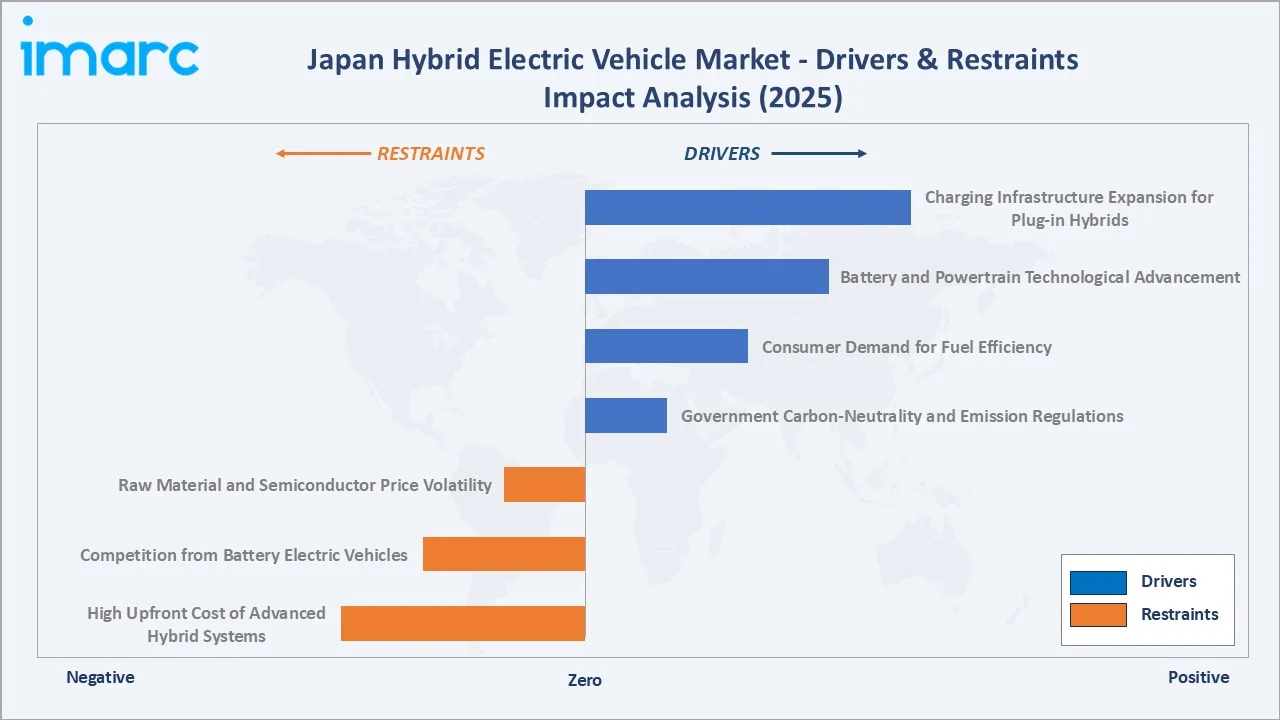
- Government Carbon-Neutrality and Emission Regulations: Japan's 2050 carbon-neutrality target, supported by interim goals of 46% emission reduction by 2030, is compelling automakers to accelerate hybrid and plug-in hybrid vehicle rollouts across all vehicle classes.
- Consumer Demand for Fuel Efficiency: Rising fuel costs and government tax incentives are steering Japanese consumers toward hybrid vehicles, which typically deliver 20-30% better fuel economy than comparable gasoline-only models, without the range anxiety associated with battery electric vehicles.
- Battery and Powertrain Technological Advancement: Continuous improvements in lithium-ion battery density, regenerative braking, and AI-driven energy management, exemplified by Honda's December 2024 e:HEV system delivering over 10% fuel efficiency gains, are strengthening hybrid vehicle value propositions.
- Charging Infrastructure Expansion for Plug-in Hybrids: Growing deployment of fast-charging stations in Japan's urban centers is easing range constraints for plug-in hybrid buyers, supporting Toyota's expansion of PHEV variants including the Alphard and Vellfire launched in January 2025.
Market Restraints
- High Upfront Cost of Advanced Hybrid Systems: Plug-in hybrid and next-generation full hybrid platforms carry a price premium over conventional gasoline vehicles, limiting adoption among budget-conscious buyers in Japan's price-sensitive kei-car and compact vehicle segments.
- Competition from Battery Electric Vehicles: Government incentives for battery electric vehicles and expanding public charging networks are gradually diverting long-term demand away from hybrid platforms, particularly in dense urban markets such as Tokyo and Osaka.
- Raw Material and Semiconductor Price Volatility: Fluctuating prices for lithium, rare-earth magnets, and automotive-grade semiconductors used in hybrid powertrains continue to pressure manufacturer margins and complicate long-term production planning.
Market Opportunities
- Solid-State Battery Integration: Japanese automakers' accelerating investment in solid-state battery research presents an opportunity to extend plug-in hybrid electric range while reducing charging time, strengthening competitiveness against fully electric alternatives.
- Fleet and Logistics Electrification: Growing adoption of hybrid commercial vehicles by logistics operators, including Fujitsu Limited and Sustainable Shared Transport Inc.'s integrated transportation and delivery system for shippers and logistics service providers launched in January 2025, is creating new demand from fleet operators pursuing sustainable supply chains.
- Export Market Expansion: Japan's hybrid technology leadership positions domestic automakers to capture growing export demand from Southeast Asia and Europe, where hybrid vehicles are increasingly favored as a transitional technology ahead of full electrification.
Market Challenges
- Intensifying Global EV Competition: Chinese and Korean automakers' rapid battery electric vehicle cost reductions are pressuring Japanese manufacturers to justify hybrid platforms' long-term relevance within an accelerating global electrification timeline.
- Balancing R&D Investment Across Powertrains: Automakers must allocate research budgets across hybrid, plug-in hybrid, and battery electric platforms simultaneously, creating strategic trade-offs that can slow the pace of hybrid-specific innovation.
Emerging Market Trends
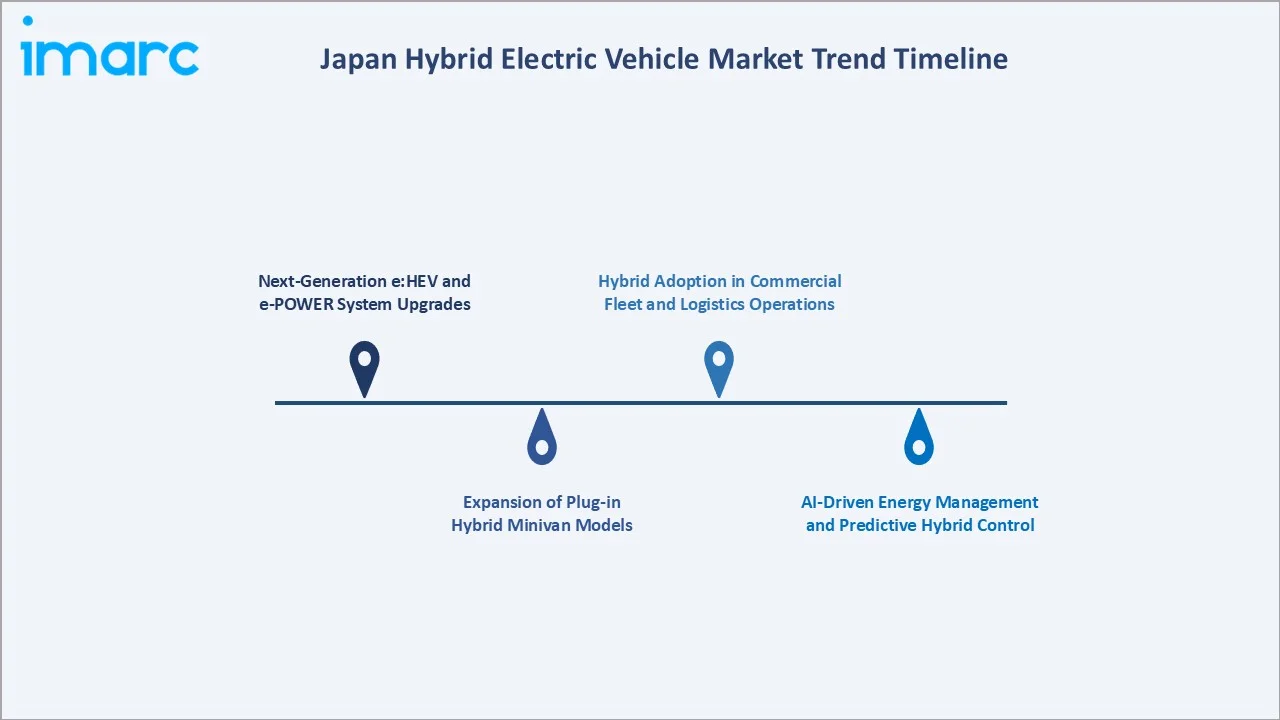
1. Next-Generation e:HEV and e-POWER System Upgrades
In December 2024, Honda launched its next-generation e:HEV hybrid system featuring 1.5-litre and 2.0-litre direct-injection Atkinson-cycle engines, delivering over a 10% fuel efficiency improvement. Nissan simultaneously expanded e-POWER to the all-new Kicks in June 2026, reinforcing series-hybrid adoption.
2. Expansion of Plug-in Hybrid Minivan Models
Toyota introduced the Alphard and Vellfire PHEV in January 2025, offering approximately 73 kilometers of WLTC electric range, marking Japan's first PHEV minivans in this class and signaling broader plug-in hybrid penetration into family vehicle segments.
3. AI-Driven Energy Management and Predictive Hybrid Control
Automakers are integrating AI-driven energy management systems that predict driving conditions and optimize power-split between combustion and electric motors in real time, improving fuel economy and extending component life across full and plug-in hybrid platforms.
4. Hybrid Adoption in Commercial Fleet and Logistics Operations
Fujitsu Limited and Sustainable Shared Transport Inc., a Yamato Holdings subsidiary, launched a cooperative delivery platform in January 2025, encouraging logistics operators to standardize hybrid and electrified vehicle fleets for sustainable, cost-efficient last-mile delivery networks.
Industry Value Chain Analysis
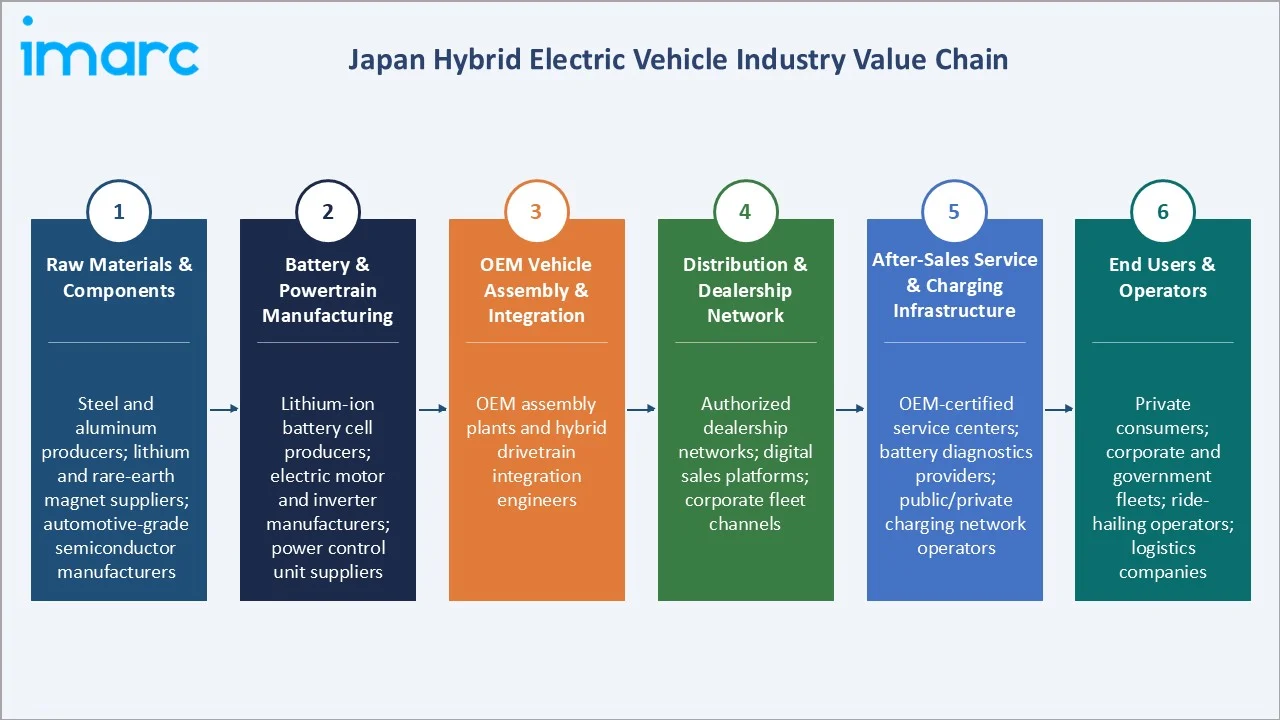
Japan's hybrid electric vehicle value chain spans raw material and semiconductor supply through end-user ownership, with each stage occupied by specialized manufacturers, integrators, and service providers whose performance directly influences vehicle reliability, fuel efficiency, and total cost of ownership.
|
Stage |
Key Players / Examples |
|
Raw Materials & Components |
Steel and aluminum producers, lithium and rare-earth magnet suppliers, and automotive-grade semiconductor manufacturers |
|
Battery & Powertrain Manufacturing |
Lithium-ion battery cell producers, electric motor and inverter manufacturers, and power control unit suppliers |
|
OEM Vehicle Assembly & Integration |
OEM assembly plants and hybrid drivetrain integration engineers |
|
Distribution & Dealership Network |
Authorized dealership networks, digital sales platforms, and corporate fleet channels |
|
After-Sales Service & Charging Infrastructure |
OEM-certified service centers, battery diagnostics providers, and public/private charging network operators |
|
End Users & Operators |
Private consumers, corporate and government fleets, ride-hailing operators, and logistics companies |
Technology Landscape in the Japan Hybrid Electric Vehicle Industry
Series HEV Technology
Series hybrid systems, led by Nissan's e-POWER platform, use the combustion engine solely as a generator, with an electric motor delivering all propulsion. This configuration, expanded to the all-new Kicks in June 2026, offers EV-like driving smoothness without requiring external charging, appealing to buyers seeking electrified performance with gasoline vehicle convenience.
Parallel HEV Technology
Parallel hybrid systems allow both the combustion engine and electric motor to drive the wheels directly, either independently or together, offering strong highway efficiency. Mazda and Suzuki deploy parallel and mild-hybrid variants of this architecture across compact and kei-car segments to balance cost and fuel economy.
Combination (Power-Split) HEV Technology
Combination HEV systems, epitomized by Toyota's Hybrid System (THS II) and Honda's e:HEV, blend series and parallel operation through a power-split device, optimizing efficiency across driving conditions. This architecture commands 48.6% of Japan's configuration segment in 2025 and remains the technical benchmark for fuel-efficient, reliable hybrid propulsion.
Next-Generation Battery and AI Energy Management
Japanese automakers are accelerating solid-state battery research to improve energy density and reduce charging time for plug-in hybrid variants. Parallel investment in AI-driven predictive energy management systems is enabling real-time power-split optimization, improving fuel economy across full, mild, and plug-in hybrid platforms through 2034.
Market Segmentation Analysis
The report covers the following segments:
|
Segment Category |
Leading Segment |
Market Share |
Year |
|
Propulsion Type |
Full Hybrids |
54.8% |
2025 |
|
Configuration Type |
Combination HEV |
48.6% |
2025 |
|
Vehicle Type |
🔒 |
🔒 |
2025 |
|
Power Source |
🔒 |
🔒 |
2025 |
|
Region |
Kanto Region |
40.9% |
2025 |

By Propulsion Type
Full hybrids dominate with a 54.8% share in 2025. The segment encompasses self-charging hybrid systems, including Toyota's THS II and Honda's e:HEV, that combine a combustion engine with electric motors without requiring external charging. The segment's dominance reflects decades of engineering refinement and strong consumer trust in proven hybrid reliability across Japan's passenger vehicle fleet.
To access detailed market analysis, Request Sample
Mild hybrids account for 24.7% of the market, offering 48-volt electrification in the entry-level and kei-car segments at lower cost premiums. Plug-in hybrids, at 16.3%, are expected to grow fastest as Toyota expands its Alphard and Vellfire PHEV lineup, while others, including two-wheeler and specialty hybrid systems, account for the remaining 4.2%, serving niche commercial and micro-mobility applications.
By Configuration Type
Combination HEV commands a 48.6% share in 2025, as it integrates series and parallel power delivery through a power-split device, enabling seamless transitions between electric and combustion propulsion. Toyota's dominant hybrid lineup, spanning the Prius, Corolla, and Yaris, relies on this architecture, reinforcing its position as Japan's benchmark hybrid configuration.
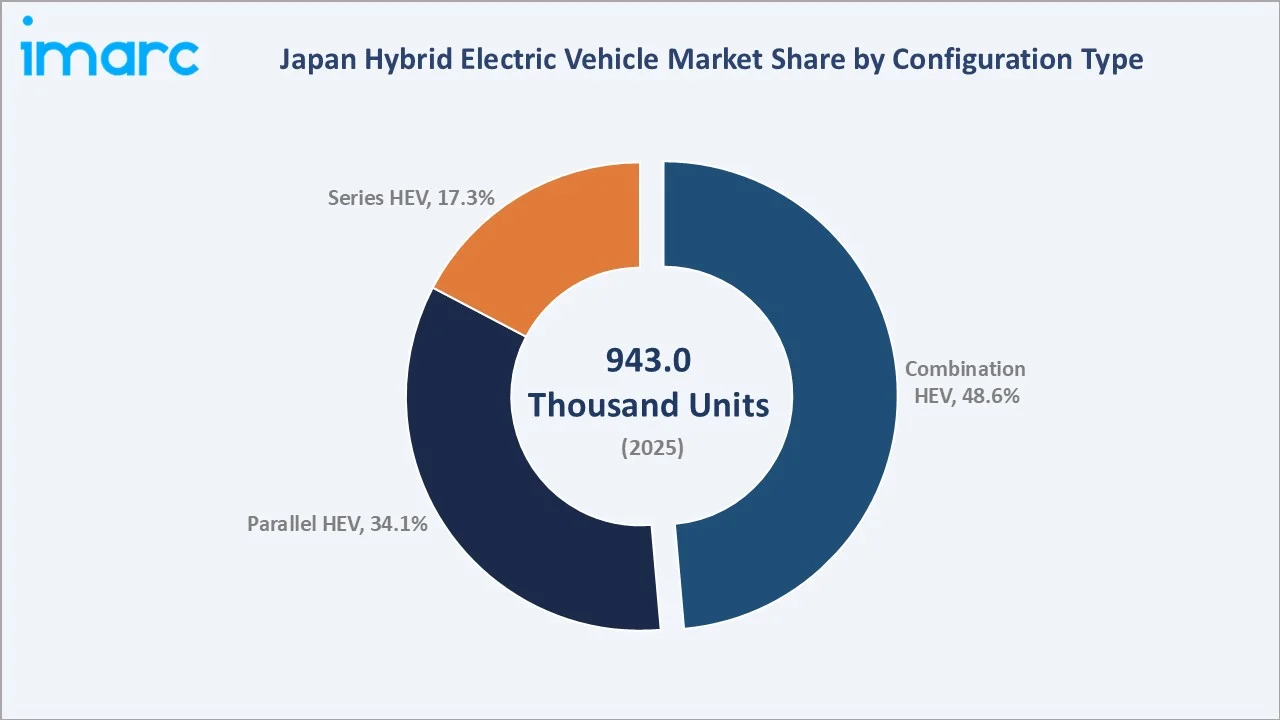
Parallel HEV follows at 34.1%, favored for its mechanical simplicity and cost efficiency across compact vehicle segments. Series HEV, led by Nissan's e-POWER technology, holds 17.3% and is projected to grow fastest as the company extends the platform to additional model lines, offering electric-motor-only propulsion with combustion-engine-based generation.
Regional Market Insights
Kanto Region's market leadership (40.9%, 2025) reflects Tokyo's status as Japan's largest vehicle registration hub. The region's dense dealership networks, corporate fleet concentration, and metropolitan emission-reduction ordinances combine to sustain its dominant position through 2034.
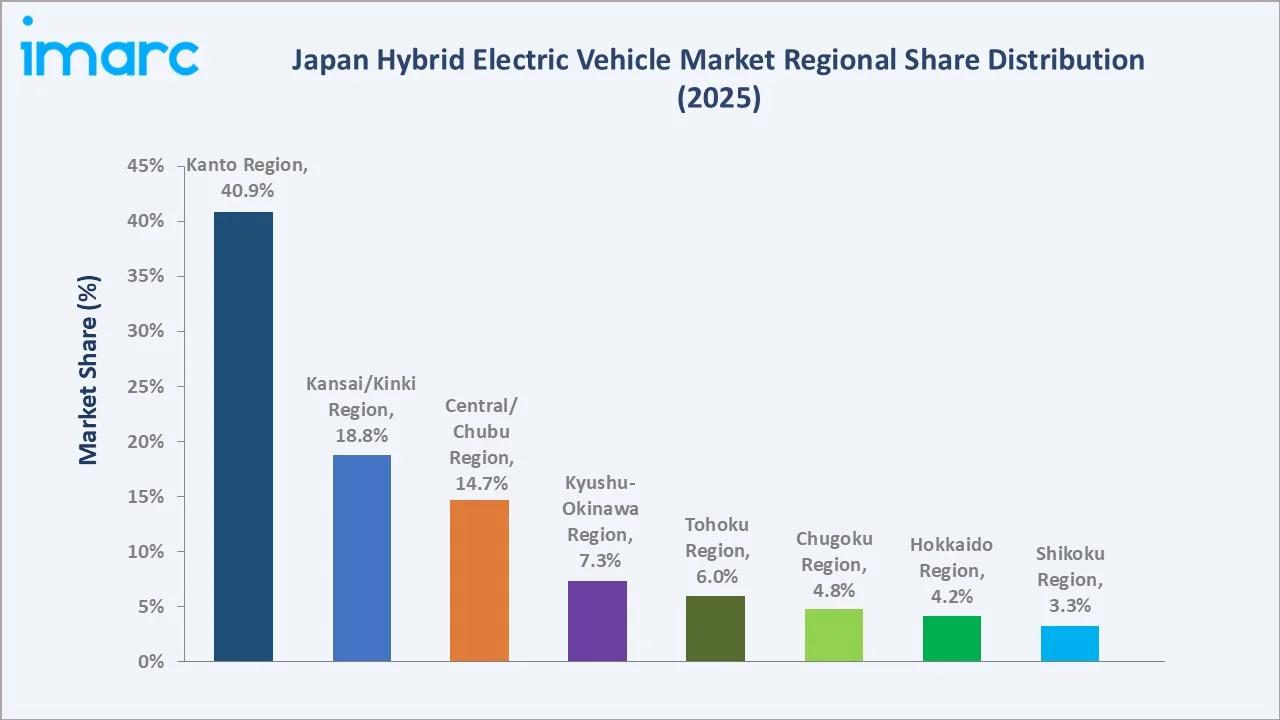
Kansai/Kinki at 18.8% represents Japan's second-largest hybrid vehicle market. Osaka's automotive manufacturing ecosystem and expanding plug-in hybrid charging infrastructure are catalyzing accelerated adoption, positioning the region as a key growth corridor alongside Kanto through the forecast period.
|
Region |
Share (2025) |
Key Growth Drivers |
|
Kanto Region |
40.9% |
Largest vehicle registration base, dense dealership networks, corporate fleet demand, and metropolitan low-emission ordinances |
|
Kansai/Kinki Region |
18.8% |
Osaka's automotive manufacturing ecosystem, strong urban commuter demand, and expanding plug-in hybrid charging infrastructure |
|
Central/Chubu Region |
14.7% |
Toyota's Aichi Prefecture manufacturing base, high household vehicle ownership, and strong industrial fleet penetration |
|
Kyushu-Okinawa Region |
7.3% |
Growing automotive component manufacturing, rising rural hybrid adoption, and expanding dealership presence |
|
Tohoku Region |
6.0% |
Cold-climate hybrid reliability demand and government rural mobility incentive programs |
|
Chugoku Region |
4.8% |
Mazda's Hiroshima manufacturing presence and regional fleet electrification initiatives |
|
Hokkaido Region |
4.2% |
Cold-weather driving conditions favoring hybrid reliability over battery electric range limitations |
|
Shikoku Region |
3.3% |
Smaller vehicle parc with gradual hybrid replacement of ageing gasoline fleets |
Competitive Landscape
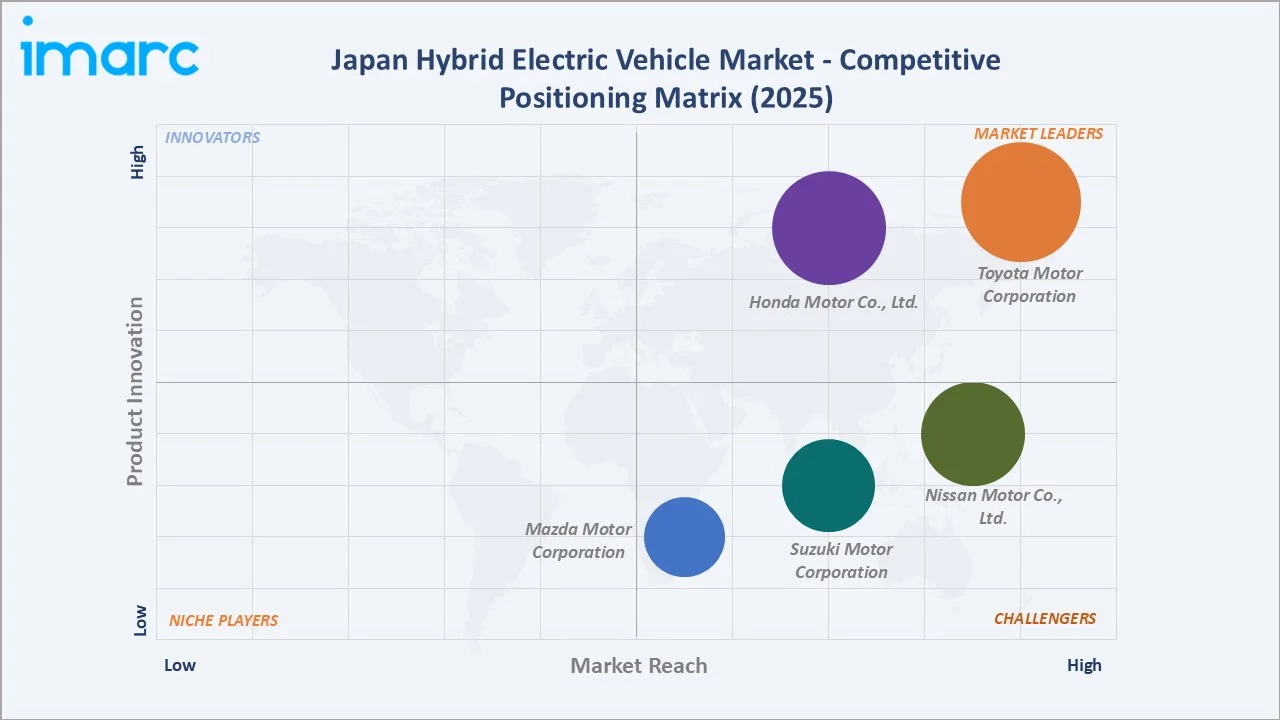
Japan's hybrid electric vehicle market exhibits high concentration, with the top domestic automakers collectively holding a dominant share of market revenue in 2025, reflecting decades of hybrid technology leadership.
|
Company Name |
Brands/Solutions/ Products |
Market Position |
Core Strength |
|
Toyota Motor Corporation |
RAV4 Plug-in Hybrid, Alphard and Vellfire Plug-in Hybrid, Corolla Hybrid, Prius, among others |
Market Leader |
One of the broadest hybrid lineup; power-split architecture leadership; expanding PHEV portfolio |
|
Honda Motor Co., Ltd. |
Honda e:HEV, Honda Sensing |
Market Leader |
Next-generation e:HEV efficiency gains; strong global hybrid export volumes |
|
Nissan Motor Co., Ltd. |
Kicks, Serena, Note, DAYZ, Juke, and X-Trail |
Strong Challenger |
Series-hybrid innovation; rapid e-POWER model line expansion |
|
Suzuki Motor Corporation |
Suzuki ALLGRIP Hybrid, Smart Hybrid |
Strong Challenger |
Mild-hybrid leadership in kei-car and compact segments |
|
Mazda Motor Corporation |
e-Skyactiv Hybrid |
Challenger |
Parallel-hybrid efficiency engineering; Hiroshima manufacturing base |
Toyota Motor Corporation and Honda Motor Co., Ltd. dominate through comprehensive product portfolios spanning full, mild, and plug-in hybrid platforms, supported by extensive domestic and export dealership networks. Nissan Motor Co., Ltd., Suzuki Motor Corporation, and Mazda Motor Corporation compete through configuration-specific specialization, targeting distinct consumer segments across series-hybrid, mild-hybrid, and parallel-hybrid technology positioning.
Key Company Profiles
Toyota Motor Corporation
Toyota Motor Corporation is Japan's largest automaker and global leader in hybrid vehicle technology. Its Toyota Hybrid System (THS II) underpins the Prius, Corolla, and Yaris hybrid lineup, alongside expanding Lexus Hybrid Drive applications.
- Product Portfolio: RAV4 Plug-in Hybrid, Alphard and Vellfire PHEV models, Corolla Hybrid, Prius, among other combination HEV powertrains across passenger and commercial segments.
- Recent Developments: In February 2026, Toyota Motor Corporation announced that the new RAV4 plug-in hybrid electric vehicle will launch in Japan, featuring Z and performance-focused GR SPORT variants. The model offers up to approximately 150 km of electric-only range, 242 kW of system output, fast-charging support, and an external power supply for outdoor use and emergencies.
- Strategic Focus: Expanding plug-in hybrid range across minivan and SUV segments; strengthening Combination HEV efficiency; scaling solid-state battery research for next-generation platforms.
Honda Motor Co., Ltd.
Honda Motor Co., Ltd. is a global leader in hybrid powertrain engineering, recognized for its e:HEV two-motor hybrid system deployed across the product portfolio.
- Product Portfolio: e:HEV two-motor hybrid systems, 1.5-litre and 2.0-litre direct-injection Atkinson-cycle engines, and Honda Sensing driver-assist integration into Fit, Civic, and CR-V hybrid models.
- Recent Developments: In October 2025, Honda unveiled next-generation technologies for electrified vehicles, including a lighter hybrid platform, an advanced large-vehicle hybrid system, and technologies for the Super-ONE compact EV. The new hybrid platform, planned for models from 2027, is 90 kg lighter and targets improved driving performance, fuel efficiency, parts commonality, and lower production costs.
- Strategic Focus: Scaling next-generation e:HEV efficiency; expanding global hybrid export volumes; integrating AI-driven energy management across future platforms.
Market Concentration Analysis
Japan's hybrid electric vehicle market exhibits high concentration, with Toyota Motor Corporation and Honda Motor Co., Ltd. alone accounting for a dominant share of total hybrid vehicle sales in 2025, reflecting decades of accumulated engineering expertise, extensive dealership networks, and strong brand trust among domestic consumers seeking proven hybrid reliability over emerging alternatives.
Consolidation pressure is emerging as automakers balance R&D investment across hybrid, plug-in hybrid, and battery electric platforms. Nissan's expansion of e-POWER across additional model lines and Suzuki's mild-hybrid focus in kei-car segments reflect strategic specialization rather than direct competition with Toyota and Honda's broad-based hybrid portfolios.
Investment & Growth Opportunities
Fastest Growing Segments
Plug-in Hybrids (~28.2% CAGR) and Series HEV configurations (~25.4% CAGR) represent the highest-growth investment vectors through 2034, driven by expanding charging infrastructure and Nissan's e-POWER platform extension. Together, these subcategories address a rapidly expanding addressable market within Japan's hybrid electric vehicle ecosystem.
Emerging Market Expansion
Kyushu-Okinawa and Tohoku regions collectively represent an incremental growth opportunity beyond Kanto and Kansai/Kinki by 2034, as automotive component manufacturing expands and rural mobility incentive programs accelerate hybrid replacement of ageing gasoline vehicle fleets in Japan's secondary markets.
Venture and Institutional Investment Trends
- Automaker R&D commitments toward solid-state battery development are creating supply chain opportunities for battery material and component manufacturers serving Japan's hybrid and plug-in hybrid platforms.
- Government tax incentive programs supporting hybrid vehicle purchases are sustaining consumer demand, indirectly channeling institutional investment toward dealership network expansion and after-sales service infrastructure.
- Logistics sector electrification, exemplified by Fujitsu Limited and Sustainable Shared Transport Inc.'s cooperative delivery platform, is opening fleet-scale procurement opportunities for hybrid commercial vehicle manufacturers.
Future Market Outlook (2026-2034)
Japan's hybrid electric vehicle market is positioned for sustained, high-growth expansion through 2034. From a base of 943.0 Thousand Units in 2025, the market is projected to reach 5,921.6 Thousand Units by 2034, representing substantial incremental unit growth at a CAGR of 22.65%. This growth is structurally supported by Japan's carbon-neutrality roadmap and continued automaker investment in next-generation hybrid platforms.
The technology mix will continue evolving through 2034, with plug-in hybrids and series HEV configurations gaining share as charging infrastructure matures and Nissan expands e-POWER adoption. This shift creates replacement demand opportunities for incumbent automakers and market entry opportunities for component suppliers specializing in next-generation battery and power-electronics technology.
Research Methodology
Primary Research
Primary research comprised structured interviews with industry participants across 2024-2025, including automotive OEM executives, powertrain engineers, dealership network operators, and government transportation policy analysts across Japan. Expert input validated market sizing, propulsion technology adoption rates, and regional deployment trends.
Secondary Research
Secondary research encompassed automaker annual reports, Japan Automobile Manufacturers Association (JAMA) registration data, government emission policy documentation, and industry publications covering hybrid powertrain technology, battery supply chains, and regional vehicle registration trends.
Forecasting Models
Market size estimations were derived using top-down and bottom-up forecasting, incorporating vehicle registration data, propulsion technology mix transitions, and automaker production disclosures. A base-case CAGR of 22.65% reflects consensus estimates validated against announced hybrid platform launches and government electrification policy timelines.
Japan Hybrid Electric Vehicle Market Report Coverage:
| Report Features | Details |
|---|---|
| Base Year of the Analysis | 2025 |
| Historical Period | 2020-2025 |
| Forecast Period | 2026-2034 |
| Units | Thousand Units |
| Scope of the Report |
Exploration of Historical Trends and Market Outlook, Industry Catalysts and Challenges, Segment-Wise Historical and Future Market Assessment:
|
| Propulsion Types Covered | Full Hybrids, Mild Hybrids, Plug-In Hybrids, Others |
| Configuration Types Covered | Series HEV, Parallel HEV, Combination HEV |
| Vehicle Types Covered | Passenger Cars, Commercial Vehicles, Two-Wheelers, Others |
| Power Sources Covered | Stored Electricity, On Board Electric Generator |
| Regions Covered | Kanto Region, Kansai/Kinki Region, Central/Chubu Region, Kyushu-Okinawa Region, Tohoku Region, Chugoku Region, Hokkaido Region, Shikoku Region |
| Companies Covered | Toyota Motor Corporation, Honda Motor Co. Ltd., Nissan Motor Co. Ltd., Suzuki Motor Corporation, Mazda Motor Corporation, etc. |
| Customization Scope | 10% Free Customization |
| Post-Sale Analyst Support | 10-12 Weeks |
| Delivery Format | PDF and Excel through Email (We can also provide the editable version of the report in PPT/Word format on special request) |
Key Benefits for Stakeholders:
- IMARC’s industry report offers a comprehensive quantitative analysis of various market segments, historical and current market trends, market forecasts, and dynamics of the Japan hybrid electric vehicle market from 2020-2034.
- The research report provides the latest information on the market drivers, challenges, and opportunities in the Japan hybrid electric vehicle market.
- Porter's five forces analysis assist stakeholders in assessing the impact of new entrants, competitive rivalry, supplier power, buyer power, and the threat of substitution. It helps stakeholders to analyze the level of competition within the Japan hybrid electric vehicle industry and its attractiveness.
- Competitive landscape allows stakeholders to understand their competitive environment and provides an insight into the current positions of key players in the market.
Frequently Asked Questions About the Japan Hybrid Electric Vehicle Market Report
The Japan hybrid electric vehicle market reached 943.0 Thousand Units in 2025 and is projected to reach 5,921.6 Thousand Units by 2034.
The market is expected to grow at a CAGR of 22.65% during 2026-2034, driven by emission regulations, fuel efficiency demand, and battery technology advancement.
Kanto Region leads with a 40.9% share in 2025, anchored by Tokyo's dense vehicle registration base and extensive dealership networks.
Full hybrids dominate with a 54.8% share in 2025, led by Toyota's THS II and Honda's e:HEV self-charging hybrid systems.
Combination HEV holds the largest share at 48.6%, reflecting strong demand for Toyota's power-split hybrid architecture across passenger vehicles.
Some of the key players include Toyota Motor Corporation, Honda Motor Co., Ltd., Nissan Motor Co., Ltd., Suzuki Motor Corporation, and Mazda Motor Corporation.
Plug-in hybrids are growing fastest at an estimated 28.2% CAGR as automakers expand electric range and charging infrastructure matures nationwide.
Key challenges include intensifying battery electric vehicle competition, R&D investment trade-offs across powertrains, and raw material price volatility.
Plug-in hybrid battery technology, series-hybrid platform expansion, fleet electrification, and solid-state battery research represent the highest-growth investment opportunities.
AI-driven energy management systems are optimizing power-split between combustion and electric motors in real time, improving fuel economy across hybrid platforms.
Need more help?
- Speak to our experienced analysts for insights on the current market scenarios.
- Include additional segments and countries to customize the report as per your requirement.
- Gain an unparalleled competitive advantage in your domain by understanding how to utilize the report and positively impacting your operations and revenue.
- For further assistance, please connect with our analysts.
 Request Customization
 Speak to an Analyst
 Request Brochure
 Inquire Before Buying
Benefits of Customization
- Personalize this research
- Triangulate with your data
- Get data as per your format and definition
- Gain a deeper dive into a specific application, geography, customer, or competitor
- Any level of personalization
Get in Touch With Us
UNITED STATES
Phone: +1-201-971-6302
INDIA
Phone: +91-120-433-0800
UNITED KINGDOM
Phone: +44-753-714-6104
Email: [email protected]
Client Testimonials




.webp)




.webp)













Related Reports

Choose your plan
*Please note that the prices mentioned below are starting prices for each bundle type. Kindly contact our team for further details.*
Single User License
- 1 User License, Access on 2 Devices
- PDF Report + Excel Dataset (Password Protected)
- Lifetime Access
- No Printing Rights
- 10% Free Report Customization
- 10–12 Weeks of Analyst Support
Five User License
- Access for 5 Users, 2 Devices per User
- PDF Report + Excel Dataset (Password Protected)
- Lifetime Access
- Dedicated Account Manager
- 12–14 Weeks of Analyst Support
- No Printing Rights
- 15% Free Report Customization
- 25% Discount on Your Next Purchase
Corporate User License
- Unlimited User Access (Within Your Organization)
- PDF Report + Excel Dataset
- Lifetime Access
- Dedicated Account Manager
- 14–20 Weeks of Analyst Support
- No Printing Rights
- 20% Free Report Customization
- 30% Discount on Your Next Purchase
Essential Insights
What's included:
3 reports
- Lifetime Access
- PDF Reports
- Excel Datasets
- 2 Weeks of Free Analyst Support
- 2 User Licenses
- Access on 2 Devices
- Printing Rights
- Complimentary PowerPoint (PPT) Version
- Complimentary License Upgrade
Professional Access
What's included:
5 reports
- Lifetime Access
- PDF Reports
- Excel Datasets
- 8 Weeks of Free Analyst Support
- 2 User Licenses
- Access on 2 Devices
- Printing Rights
- Complimentary PowerPoint (PPT) Version
- Complimentary License Upgrade
Business Advantage
What's included:
8 reports
- Lifetime Access
- PDF Reports
- Excel Datasets
- 14 Weeks of Free Analyst Support
- 2 User Licenses
- Access on 2 Devices
- Printing Rights
- Complimentary PowerPoint (PPT) Version
- Complimentary License Upgrade
Enterprise Intelligence
What's included:
10 reports
- Lifetime Access
- PDF Reports
- Excel Datasets
- 20 Weeks of Free Analyst Support
- 2 User Licenses
- Access on 2 Devices
- Printing Rights
- Complimentary PowerPoint (PPT) Version
- Complimentary License Upgrade