
Meat Processing Equipment Market Size, Share, Trends and Forecast by Type, Meat Type, Application, and Region, 2026-2034
Meat Processing Equipment Market Size, Share, Trends & Forecast (2026-2034)
The global meat processing equipment market reached USD 18.3 Billion in 2025 and is projected to reach USD 29.8 Billion by 2034, growing at a CAGR of 5.43% during 2026-2034. The market is driven by rising global meat consumption, growing automation adoption in processing facilities, and stringent food safety regulations driving equipment modernization. India’s total meat production reached 10.50 million tonnes in 2024–25, representing a 2.46% increase compared with 2023–24. This steady growth is driving the market by increasing demand for efficient cutting, deboning, grinding, mixing, packaging, and automated processing systems to handle higher production volumes while maintaining hygiene and quality standards. Cutting equipment leads the type at 24.6%. Processed pork leads meat type at 46.8%. North America leads regionally at 35.7%.
Market Snapshot
|
Metric |
Value |
|
Market Size (2025) |
USD 18.3 Billion |
|
Forecast Market Size (2034) |
USD 29.8 Billion |
|
CAGR (2026-2034) |
5.43% |
|
Base Year |
2025 |
|
Historical Period |
2020-2025 |
|
Forecast Period |
2026-2034 |
|
Dominant Type |
Cutting Equipment (24.6%, 2025) |
|
Dominant Meat Type |
Processed Pork (46.8%, 2025) |
|
Leading Region |
North America (35.7%, 2025) |
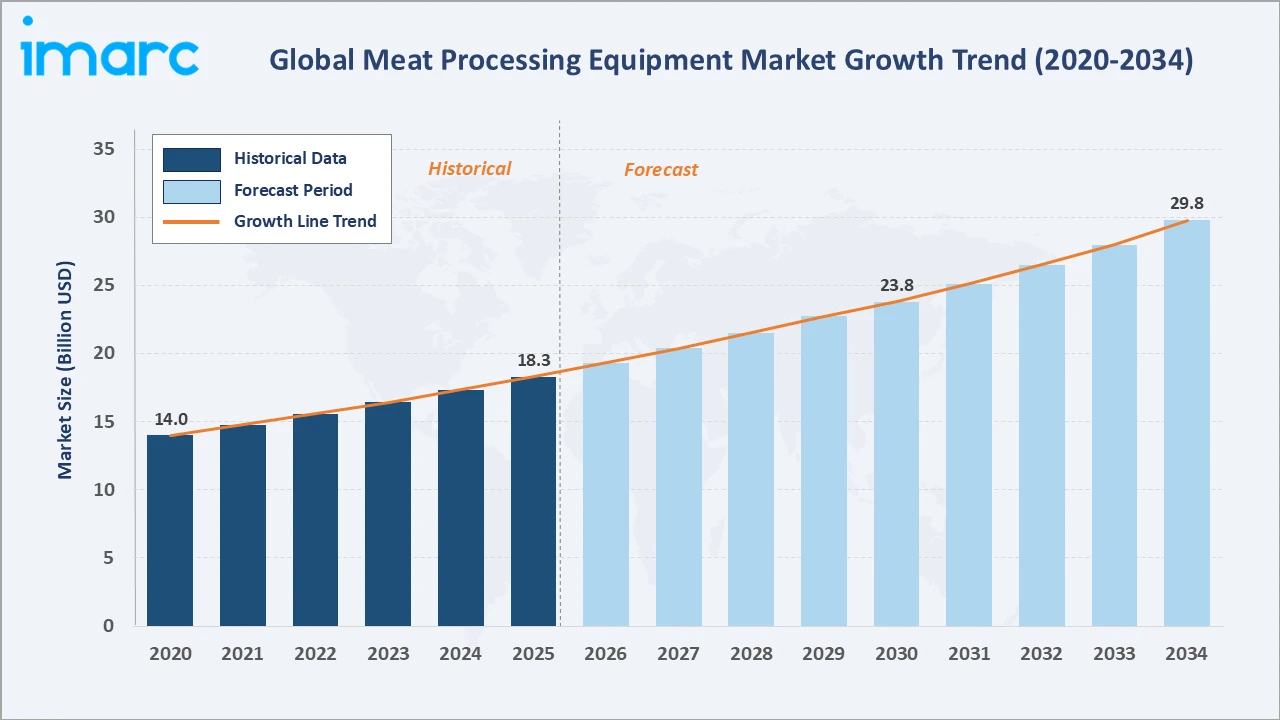
The global meat processing equipment market has demonstrated steady growth, increasing from USD 14.0 Billion in 2020 to USD 18.3 Billion in 2025, reflecting sustained investment in processing infrastructure modernization across major meat-producing nations. The market is projected to reach USD 23.8 Billion by 2030 and further grow to USD 29.8 Billion by 2034, supported by growing automation investments, expanding processed meat export trade, and rising consumer demand for value-added meat products.
To get more information on this market, Request Sample
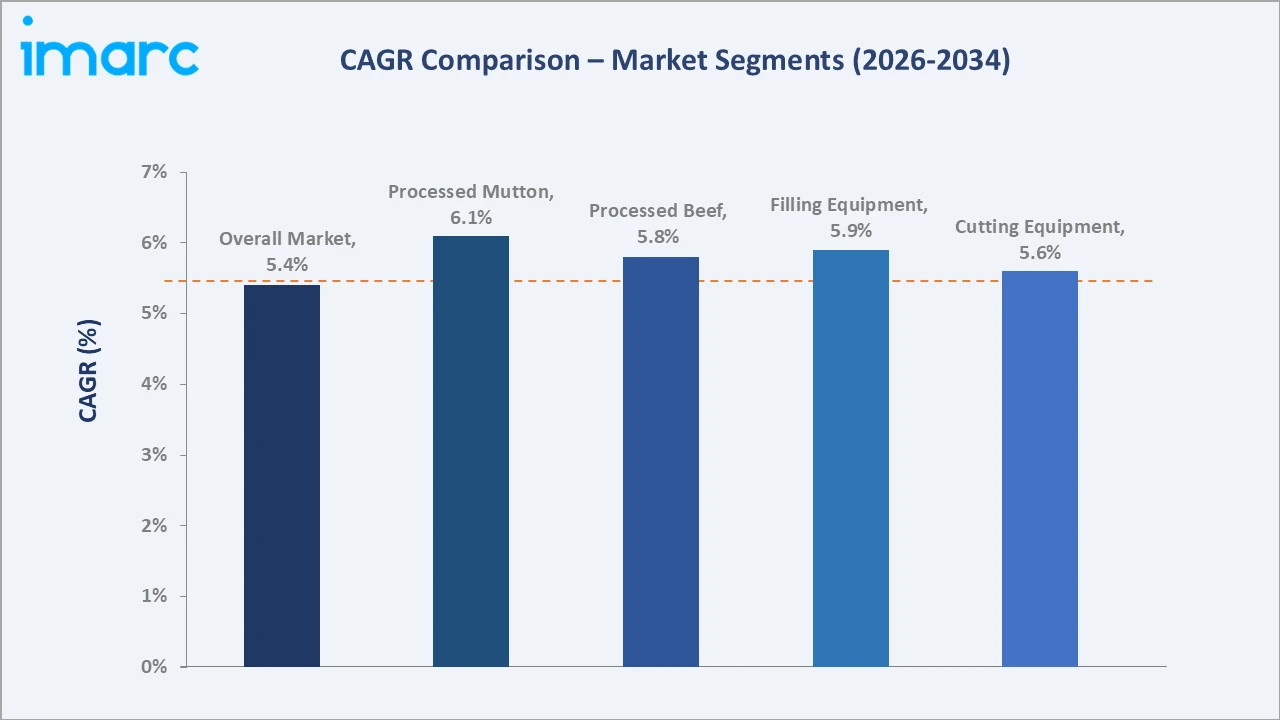
Processed mutton leads the segment CAGR at ~6.1% through expanding halal and premium mutton processing demand. Filling equipment grows at ~5.9% CAGR through rising sausage and charcuterie production automation. Processed beef grows at ~5.8% CAGR through premium beef processing facility investment.
Executive Summary
The global meat processing equipment market is experiencing steady growth, supported by rising global protein consumption, increasing per-capita meat demand in developing economies, and growing investment in processing facility automation. Expanding organized meat processing sectors in Asia-Pacific, Latin America, and the Middle East are creating significant new demand for modern equipment lines covering cutting, grinding, filling, blending, and tenderizing operations.
Cutting equipment at 24.6% leads through universal application across all meat processing operations. Processed pork at 46.8% leads meat type through the dominant global pork processing infrastructure. North America leads regionally at 35.7% through its large-scale, highly automated meat processing industry.
Key Market Insights
|
Insight |
Data |
|
Dominant Type |
Cutting Equipment – 24.6% share (2025) |
|
Leading Meat Type |
Processed Pork – 46.8% market share (2025) |
|
Leading Region |
North America – 35.7% share (2025) |
|
Market Opportunity |
Robotics and automation integration; halal meat processing equipment; energy-efficient processing lines; Asia-Pacific plant expansion; AI vision quality inspection systems |
Key Analytical Observations Supporting the Above Data:
- Cutting Equipment at 24.6%: Cutting equipment dominates as it is the foundational processing step applied universally across all meat types, pork, beef, mutton, and poultry, in every meat processing facility, from primary carcass breakdown through precision portioning for retail and food service.
- Processed Pork at 46.8%: Processed pork dominates meat type due to the global dominance of pork as the most consumed meat protein, with China alone accounting for a major share of global pork consumption. The extensive pork processing infrastructure in Europe, North America, and China requires the broadest and most diverse range of processing equipment, driving the highest equipment investment volumes of any meat category.
- North America at 35.7%: North America leads due to its highly industrialized meat processing sector, with the US operating some of the world's largest beef, pork, and poultry processing facilities.
Meat Processing Equipment Market Overview
The global meat processing equipment market encompasses machinery and equipment used in the conversion of livestock carcasses into consumer-ready meat products. It includes cutting, grinding, filling, blending, tenderizing, dicing, smoking, and massaging equipment used across beef, pork, mutton, and poultry processing operations. The market serves primary processing, secondary processing, and value-added processing operations. It covers fresh processed meat, precooked meat, raw cooked meat, cured meat, dry meat, and fermented sausage production applications. Growing consumer demand for convenience meats, processed protein products, and halal-certified processed meats is expanding the scope of processing equipment requirements globally.
Market Dynamics
To evaluate market opportunities, Request Sample
Market Drivers
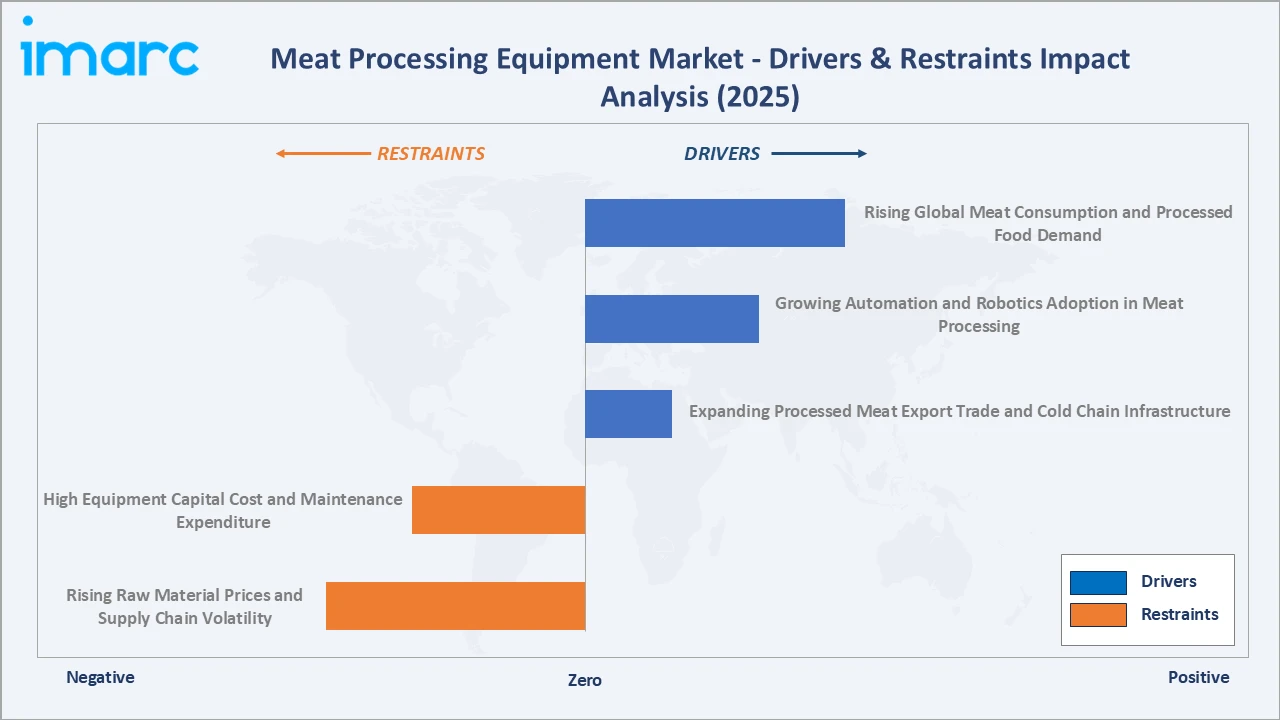
- Rising Global Meat Consumption and Processed Food Demand: Global per capita meat consumption is projected to increase by nearly 30 kg per person by 2035. At the same time, global meat consumption is expected to rise to approximately 412 million tonnes by 2035. The shift from fresh to processed, convenience, and ready-to-eat meat products is increasing processing equipment intensity per unit of meat produced, as value-added processing requires significantly more equipment steps than fresh meat preparation.
- Growing Automation and Robotics Adoption in Meat Processing: Labor shortages, rising minimum wages, and stringent hygiene standards are accelerating the adoption of robotic and automated processing systems across meat processing facilities globally. Automated deboning lines, AI-vision-guided portioning machines, and robotic trimming systems are reducing labor dependency in leading processing facilities while improving yield accuracy and consistent product quality across high-throughput operations.
- Expanding Processed Meat Export Trade and Cold Chain Infrastructure: Global processed meat trade is expanding as developing nations invest in meat processing infrastructure to capture export value-add. Brazil's beef processing exports, EU charcuterie trade, and Australia's processed mutton exports are creating demand for equipment investment in major export-oriented processing facilities. Government programs supporting cold chain infrastructure development in Africa and Southeast Asia are further enabling processed meat market expansion.
Market Restraints
- High Equipment Capital Cost and Maintenance Expenditure: Automated meat processing equipment lines require significant capital investments. High upfront costs and ongoing maintenance expenditures create barriers for mid-scale and artisanal processors, limiting market penetration beyond large industrial processing operations in price-sensitive emerging market segments.
- Rising Raw Material Prices and Supply Chain Volatility: Stainless steel prices, the primary material for food-grade meat processing equipment, experienced significant volatility, increasing equipment manufacturing costs for leading equipment producers. Supply chain disruptions affecting precision components, specialist bearings, and electronic control systems created lead time extensions that affected delivery schedules for new equipment installations across all major markets.
Market Opportunities
- Energy-Efficient and Sustainable Processing Technology: Energy costs represent 15-20% of meat processing operational expenses, creating strong economic incentives for energy-efficient equipment investment. Heat recovery systems for smoking and cooking equipment, variable-frequency drive motors for grinding and cutting lines, and water recycling systems for cleaning operations are delivering ROI-justified equipment upgrade cycles among sustainability-focused large processors.
- Expansion of Meat Processing Capacity: In May 2026, the U.S. Department of Agriculture (USDA) Rural Development announced USD 60 million in grant funding under Phase 4 of the Meat and Poultry Processing Expansion Program (MPPEP IV). The funding is intended to expand domestic meat processing capacity and strengthen the resilience and competitiveness of the U.S. beef industry. This is expected to stimulate demand for automated cutting, deboning, grinding, packaging, and other advanced meat processing machinery, particularly among small and mid-sized processors.
Market Challenges
- Skilled Labor Shortage for Equipment Operation and Maintenance: The increasing technical complexity of automated meat processing equipment, incorporating servo drives, vision systems, PLC controllers, and CIP automation, requires skilled maintenance technicians that are in short supply in many processing markets. Equipment downtime caused by technical failures in high-throughput automated lines can cost processors heavily in lost production, creating significant operational risk when maintenance expertise is unavailable.
- Regulatory Divergence Across Global Markets: Meat processing equipment manufacturers face complex regulatory compliance requirements that vary significantly across target markets. Designing equipment to meet multiple regulatory frameworks simultaneously adds engineering complexity and cost, particularly for manufacturers seeking to serve diverse global customer bases with standardized product lines.
Emerging Market Trends
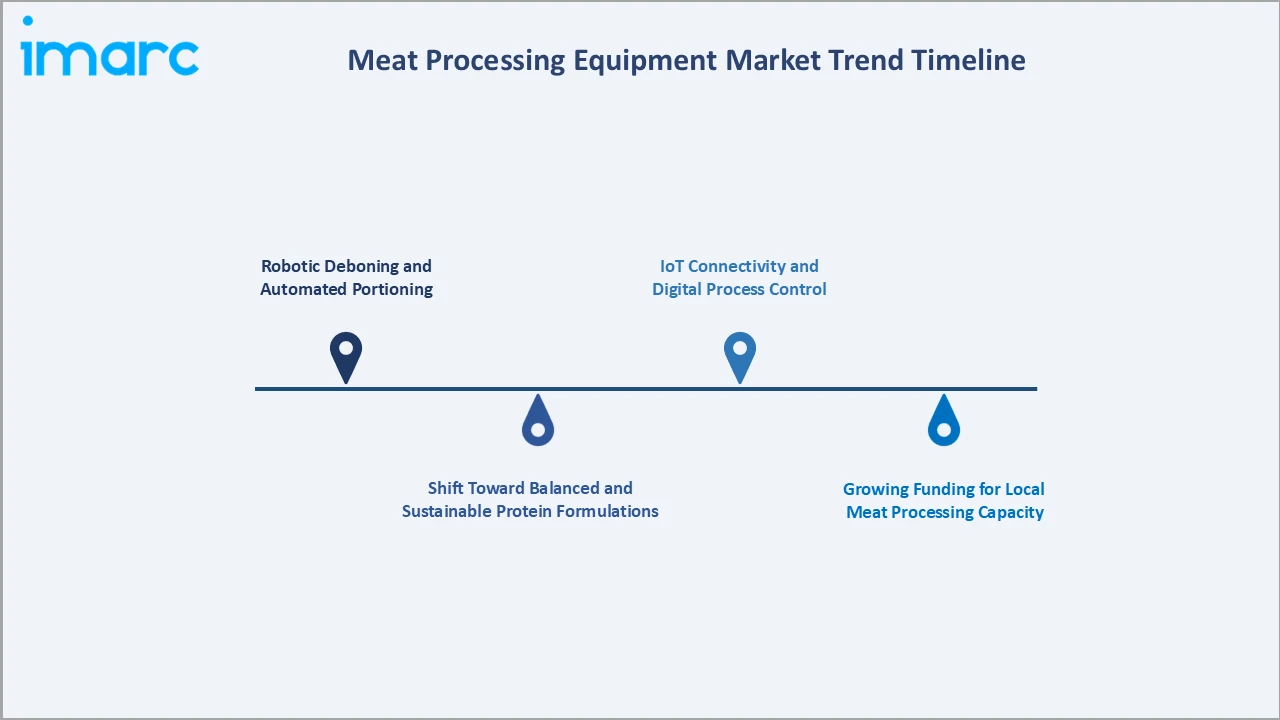
1. Robotic Deboning and Automated Portioning
Robotic deboning systems, which use AI-guided robotic arms to separate meat from bone with precision matching or exceeding skilled human butchers, are transitioning from premium installations to mainstream adoption in large processing facilities. Automated water jet portioning systems deliver portion weight accuracy, significantly reducing giveaway costs in retail-ready packaging operations.
2. Shift Toward Balanced and Sustainable Protein Formulations
Food manufacturers are increasingly adopting texturized and blended protein solutions that combine nutritional performance with lower environmental impact. In March 2026, Novameat introduced its “Balanced Protein” framework, a high-performance texturized protein solution aimed at helping manufacturers manage market volatility while addressing growing demand for lower-carbon, nutrient-rich protein products. This trend is encouraging innovation in flexible protein formulations that can also help reduce exposure to raw material price volatility.
3. IoT Connectivity and Digital Process Control
Internet of Things sensors integrated into meat processing equipment are enabling real-time monitoring of critical process parameters including temperature, pressure, cutting force, and cleaning chemical concentrations. Digital process control platforms connecting cutting, grinding, filling, and smoking equipment into unified process management systems are reducing waste, improving energy efficiency, and enabling predictive maintenance programs that minimize unplanned downtime in high-throughput processing operations.
4. Growing Funding for Local Meat Processing Capacity
In April 2026, the New Mexico Department of Agriculture (NMDA) made approximately USD 3 million in state grant funding available to local meat processing businesses through the New Mexico Local Meat Processing Grant. Funded through a one-time 2026 legislative appropriation, the program supports New Mexico-based slaughter, processing, and value-added production facilities, including federally inspected, state-inspected, and custom-exempt operations. This trend is expected to accelerate investment in modern meat processing equipment, automation, and facility upgrades across local supply chains.
Industry Value Chain Analysis
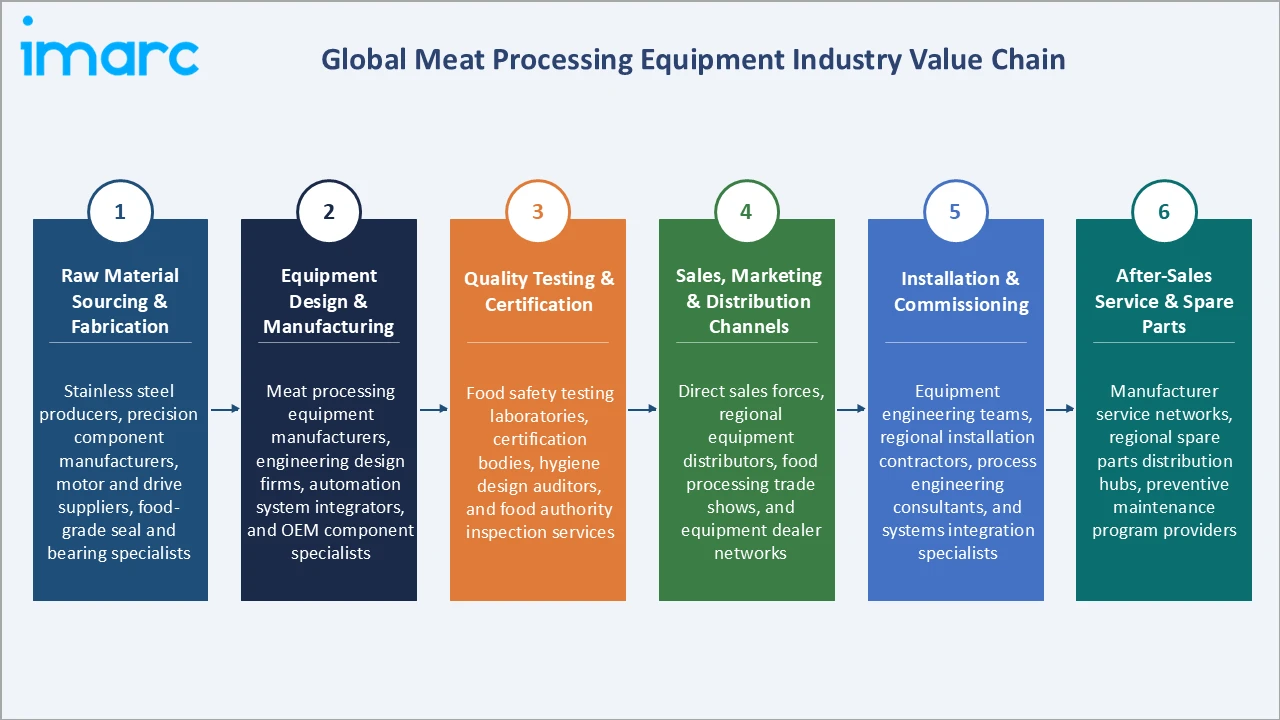
The meat processing equipment value chain integrates raw material sourcing and fabrication, equipment design and manufacturing, quality testing and regulatory certification, sales and distribution, installation and commissioning, and after-sales service and spare parts supply.
|
Stage |
Key Participants |
|
Raw Material Sourcing & Fabrication |
Stainless steel producers, precision component manufacturers, motor and drive suppliers, food-grade seal and bearing specialists. |
|
Equipment Design & Manufacturing |
Meat processing equipment manufacturers, engineering design firms, automation system integrators, and OEM component specialists. |
|
Quality Testing & Certification |
Food safety testing laboratories, certification bodies, hygiene design auditors, and food authority inspection services. |
|
Sales, Marketing & Distribution Channels |
Direct sales forces, regional equipment distributors, food processing trade shows, and equipment dealer networks. |
|
Installation & Commissioning |
Equipment engineering teams, regional installation contractors, process engineering consultants, and systems integration specialists. |
|
After-Sales Service & Spare Parts |
Manufacturer service networks, regional spare parts distribution hubs, preventive maintenance program providers. |
Equipment design and manufacturing represent the most value-added stage in the meat processing equipment value chain, as it directly determines processing throughput, yield performance, hygiene compliance, energy efficiency, and long-term reliability. This phase integrates materials engineering, food safety design, automation system development, and regulatory compliance architecture, making it the most technically intensive and differentiating segment across the value chain.
Technology Landscape in the Meat Processing Equipment Industry
Cutting and Portioning Equipment Technology
Modern cutting equipment integrates multi-blade band saws, water jet portioning systems, and robotic cutting arms guided by AI vision systems. Computer-controlled deboning systems use 3D imaging to map skeletal structure in real time, guiding cutting trajectories for maximum yield recovery. Leading equipment features automatic blade tensioning, servo-controlled cut depth adjustment, and integrated X-ray foreign body detection in unified processing modules.
Grinding and Filling Equipment Technology
Industrial grinding equipment has evolved from simple auger-driven designs to high-performance systems incorporating twin-screw technology, temperature-controlled grinding chambers, and integrated coarse/fine grinding in single-pass configurations. Automated linking and twisting systems integrated with filling machines enable complete sausage production automation from meat emulsion to retail-ready linked product without manual intervention.
Smoking and Curing Equipment Technology
Modern smoking and curing equipment incorporates precise smoke generation control, forced convection airflow management, and computerized time-temperature programs enabling consistent product quality across batch and continuous production formats. Electrostatic smoke deposition systems reduce smoking time compared to conventional smoke chambers while delivering superior smoke penetration depth and product surface appearance. Continuous smoking tunnels integrated with automated loading and unloading systems are enabling high-throughput cured meat production with minimal labor input in leading European charcuterie operations.
Market Segmentation Analysis
The report covers the following segments:
|
Segment Category |
Leading Segment |
Market Share |
Year |
|
Type |
Cutting Equipment |
24.6% |
2025 |
|
Meat Type |
Processed Pork |
46.8% |
2025 |
|
Application |
Fresh Processed Meat |
🔒 |
2025 |
|
Region |
North America |
35.7% |
2025 |

By Type
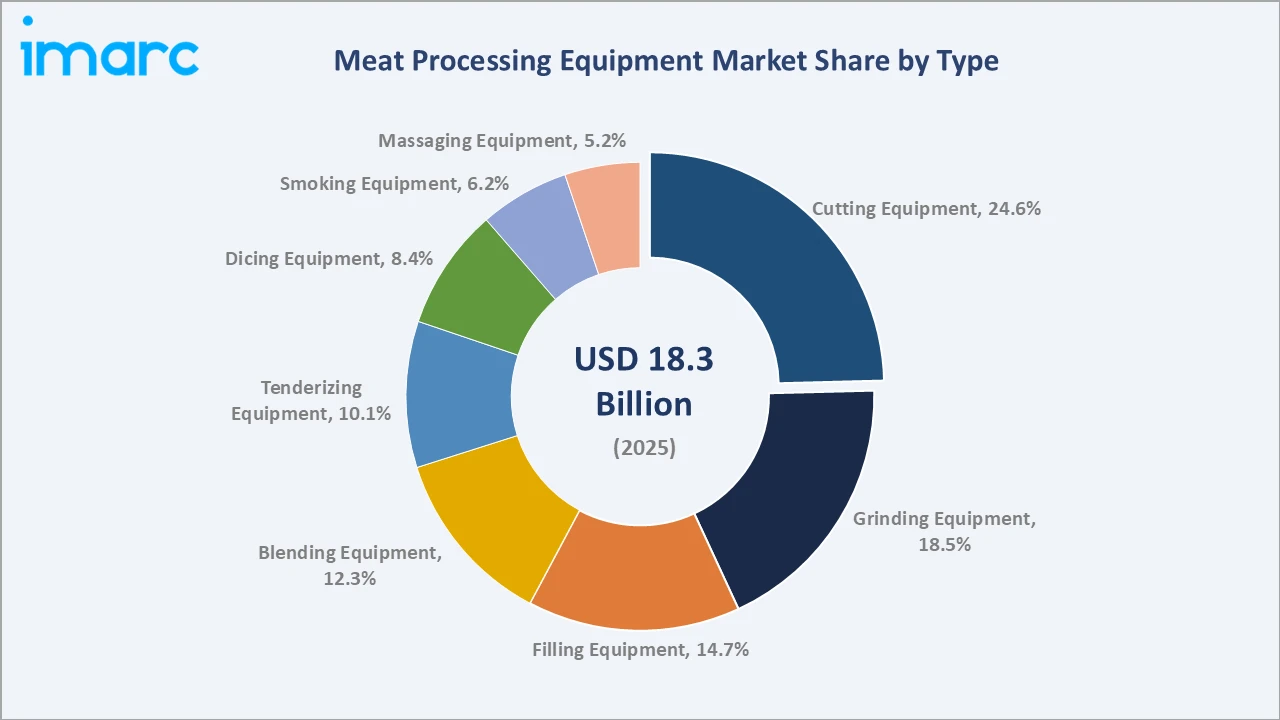
Cutting equipment leads at 24.6% (2025), reflecting its universal application as the primary processing step across all meat types and production scales. High-throughput automated cutting and portioning systems command significant per-unit capital values, making this the highest-revenue equipment category despite being a single processing function.
To evaluate market opportunities, Request Sample
Grinding equipment holds 18.5% (2025), driven by extensive use in hamburger patty, sausage meat, and processed meat product manufacturing. Filling equipment accounts for 14.7% (2025), growing through rising sausage and formed product demand. Blending equipment represents 12.3% (2025). Tenderizing equipment at 10.1%, dicing equipment at 8.4%, smoking equipment at 6.2%, and massaging equipment at 5.2% complete the market segmentation.
By Meat Type
Processed pork dominates at 46.8% (2025), reflecting pork's position as the world's most consumed meat and the extensive processing equipment installed base across China, the EU, and North America. Pork processing requires the most diverse range of equipment, from primary cutting through sausage filling, curing, and smoking, driving the highest per-tonne equipment investment intensity of any meat category.
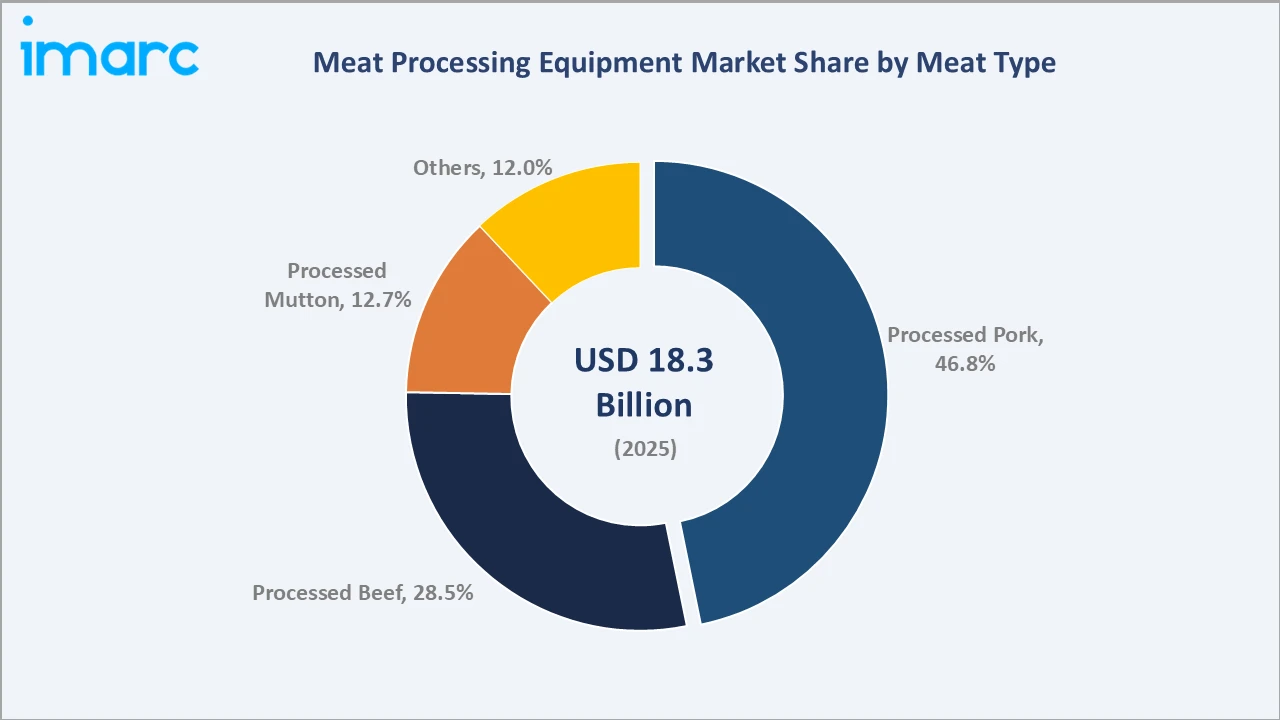
Processed beef accounts for 28.5% (2025), driven by the large beef processing infrastructure in North America, Brazil, Australia, and Argentina. Processed mutton holds 12.7% (2025), growing through expanding halal processing demand in the Middle East, South Asia, and Australia. Others represent 12.0% (2025), encompassing poultry, game, and specialty meat processing equipment segments.
Regional Market Insights
|
Region |
Share (2025) |
Key Meat Processing Equipment Market Drivers & Characteristics |
|
North America |
35.7% |
Largest market driven by highly industrialized, large-scale beef and pork processing operations, continuous automation investment by major processors. |
|
Europe |
28.6% |
Mature market with high equipment quality standards, strong pork and charcuterie processing tradition driving diverse equipment demand. |
|
Asia-Pacific |
24.8% |
Fastest-growing region driven by China's massive pork processing infrastructure investment and India's expanding organized meat sector. |
|
Latin America |
6.3% |
Growing market anchored by Brazil's world-leading beef processing export sector; expanding processed meat consumption in Mexico and Argentina. |
|
Middle East and Africa |
4.6% |
Emerging market with strong halal meat processing equipment demand. |
North America's 35.7% dominance reflects the region's unparalleled concentration of large-scale, capital-intensive beef and pork processing operations. Europe's 28.6% reflects both a large installed equipment base requiring continuous modernization and a strong equipment manufacturing export sector, with Germany, Italy, and the Netherlands home to leading global equipment suppliers.
Asia-Pacific's 24.8% is growing at the fastest regional CAGR, driven by China's ongoing investment in large-scale pork processing infrastructure, India's expanding organized meat sector, and Southeast Asia's rising processed meat consumption. Latin America at 6.3% and the Middle East and Africa at 4.6% represent high-potential growth markets, with Brazil's beef export ambitions and Middle Eastern halal processing investment creating foundations for sustained equipment demand through the forecast period.
Competitive Landscape
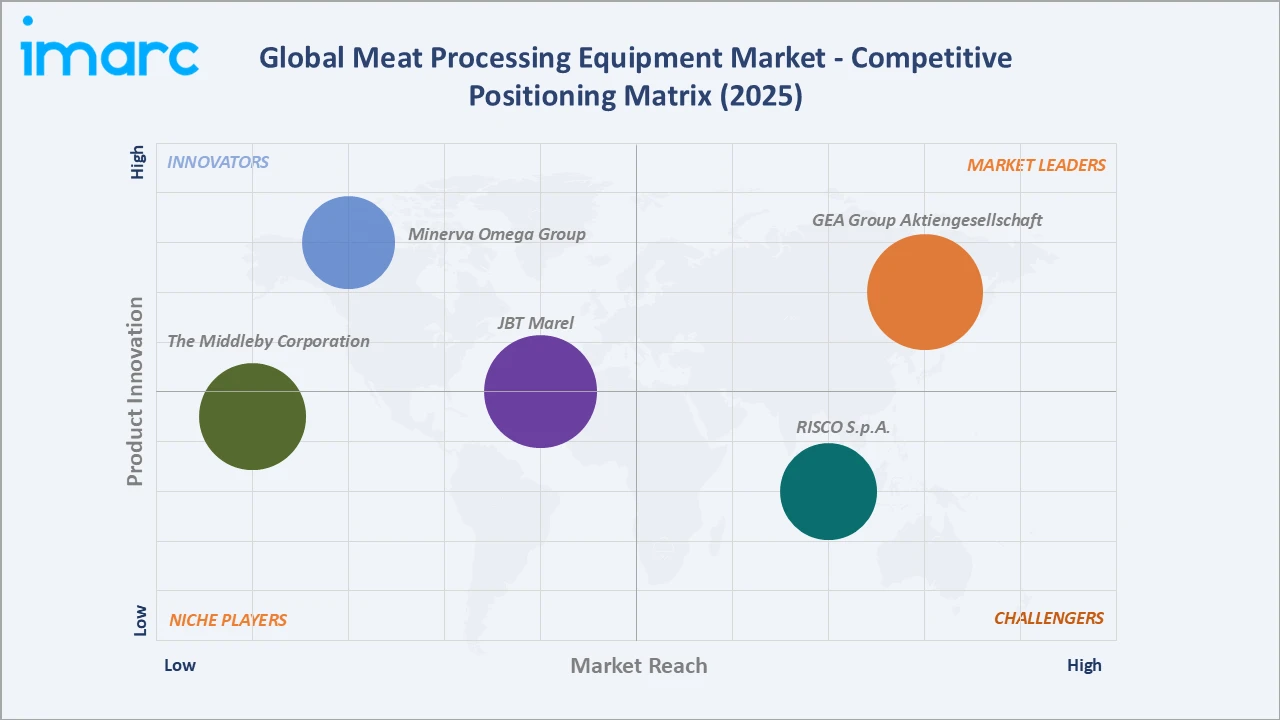
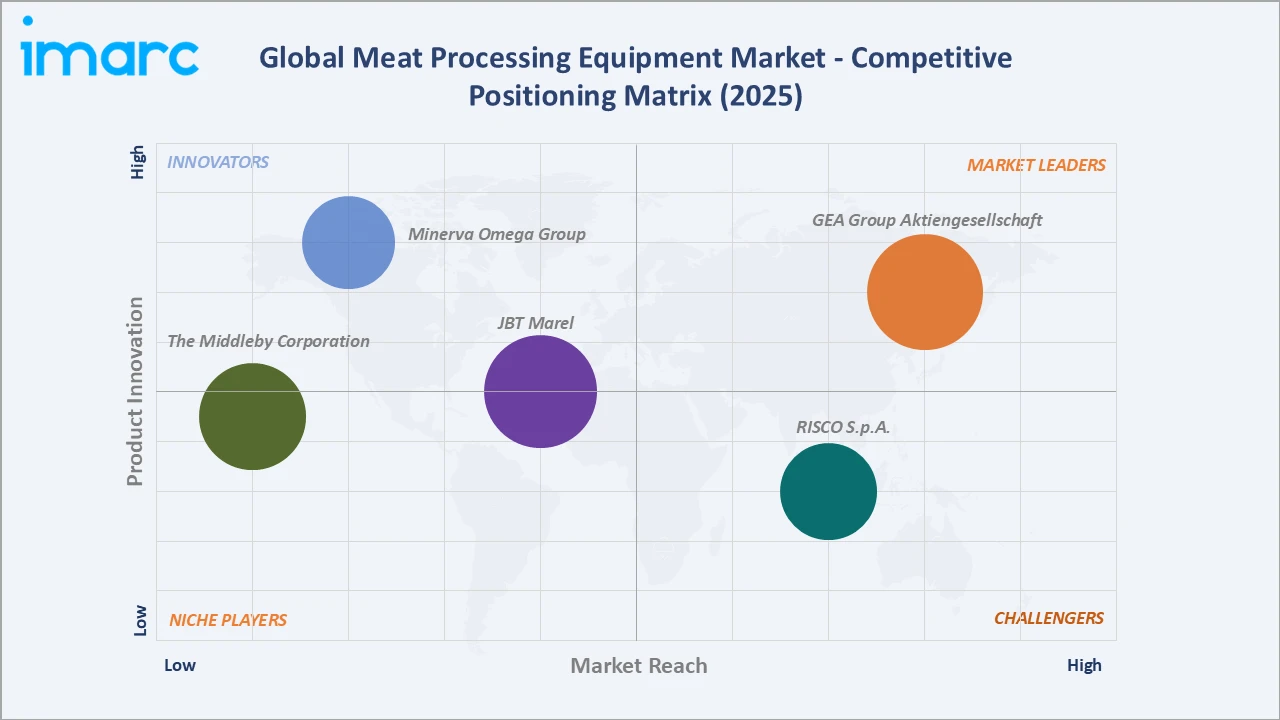
The global meat processing equipment market is moderately concentrated, with a mix of multinational integrated processing solutions providers and specialized equipment manufacturers serving distinct processing stages and meat categories. Market participants compete on processing throughput capacity, hygiene design standards, automation integration capability, after-sales service network breadth, and total cost of ownership.
|
Company |
Key Products |
Market Position |
Core Strength |
|
GEA Group Aktiengesellschaft |
GEA CookStar, GEA CookStar First, GEA CookStar Turbo, GEA FlowCook, GEA SuperHeatSmoke & HotSmoke |
Market Leader |
GEA Group Aktiengesellschaft provides comprehensive, automated solutions covering every step of the production line. |
|
JBT Marel |
M-Line Pre-Cutter and Belly Opener (MPB), M-Line Bung Remover (MBR), M-Line Leaf Lard Remover (MLR), M-Line Neck Cutter (MNC), Gorilla cattle dehiders |
Established Player |
JBT Marel (formed by the acquisition of Marel by John Bean Technologies) is a global leader in providing end-to-end automated systems for the meat industry. |
|
The Middleby Corporation |
Armor Inox, Alkar, Cozzini, Danfotech, Maurer-Atmos |
Established Player |
The Middleby Corporation plays a major role in the meat processing industry by supplying automated, end-to-end equipment. |
|
RISCO S.p.A. |
RS 918, RS 920, RS 920 Flex |
Challenger |
RISCO S.p.A. is a leading global manufacturer of advanced machinery and automated systems for the meat processing industry. |
|
Minerva Omega Group |
Meat mincers, Bone saws, Portioning machines, Meat mixers, Sausage fillers |
Innovator |
The Minerva Omega Group designs and builds heavy-duty equipment for the meat, fish, and food processing industries. |
Companies are also investing in robotic system integration, IoT connectivity, digital service platforms, and hygienic design upgrades to differentiate in a market increasingly driven by total cost of ownership, processing uptime, and food safety compliance. The market is expected to see further consolidation through acquisitions as leading integrated equipment providers seek to extend portfolio breadth across all processing stages and meat categories.
Key Company Profiles
GEA Group Aktiengesellschaft
GEA Group Aktiengesellschaft is one of the largest food processing equipment manufacturers, offering a comprehensive portfolio of meat processing solutions spanning primary cutting, grinding, filling, smoking, thermal processing, and packaging. GEA's meat processing equipment division serves major beef, pork, poultry, and processed meat manufacturers globally, with particular strength in large-scale industrial processing line integration.
- Key Products: GEA CookStar, GEA CookStar First, GEA CookStar Turbo, GEA FlowCook, GEA SuperHeatSmoke & HotSmoke.
- Strategic Focus: Digital transformation through GEA's digital services platform for predictive maintenance and process optimization, sustainability-driven product development for energy-efficient processing equipment, robotic and AI vision integration into core processing equipment lines.
JBT Marel
JBT Marel is a provider of advanced food processing technology and equipment serving the poultry, meat, fish, prepared foods, and other food sectors. The company offers integrated solutions spanning primary processing, portioning, inspection, weighing, packaging, automation, and digital production management. Its portfolio is focused on improving food safety, yield, productivity, and operational efficiency across processing plants worldwide.
- Key Products: M-Line Pre-Cutter and Belly Opener (MPB), M-Line Bung Remover (MBR), M-Line Leaf Lard Remover (MLR), M-Line Neck Cutter (MNC), Gorilla cattle dehiders.
- Strategic Focus: Software-driven differentiation with Innova production management creating recurring revenue, robotic and AI adoption acceleration across portioning, trimming, and deboning, smart factory integration enabling complete process visibility, expanding presence in Asia-Pacific and Latin America greenfield plant markets.
Market Concentration Analysis
The global meat processing equipment market is moderately fragmented. Specialized manufacturers compete effectively in specific processing stage niches where specialist expertise commands premium positioning over integrated line providers. Fragmentation persists across processing stage specializations, geographic markets, and processing scales, from large industrial to artisanal operations, creating a competitive landscape where technical expertise, service network proximity, hygiene design credentials, and total cost of ownership determine equipment selection. The market is expected to see continued consolidation through acquisitions as leading integrated providers seek comprehensive portfolio coverage across all meat processing stages and increasing automation integration capability.
Investment & Growth Opportunities
Highest Growth Segments
Processed mutton equipment (~6.1% CAGR through halal market expansion), filling equipment (~5.9% CAGR through sausage and formed product automation), processed beef equipment (~5.8% CAGR through North American and Brazilian facility investment), Asia-Pacific greenfield plant equipment installation, and robotic and AI vision integration represent the highest-growth investment vectors in the meat processing equipment market through 2034.
Investment Themes
- Robotic and AI vision integration: Equipment incorporating robotic trimming, AI-guided portioning, and computer vision quality inspection commands price premiums over conventional automated lines and delivers significantly stronger customer ROI through yield improvement and labor cost reduction. Investment in robotic processing capabilities creates defensible differentiation from commodity equipment manufacturers competing primarily on price.
- Asia-Pacific service and support network development: As Asia-Pacific becomes the fastest-growing equipment market, manufacturers establishing regional spare parts hubs, trained service technician networks, and local application engineering capabilities are creating competitive advantages that translate into customer loyalty and recurring after-sales revenue across the region's rapidly expanding processing plant base.
Future Market Outlook (2026-2034)
The global meat processing equipment market is projected to grow from USD 18.3 Billion in 2025 to USD 29.8 Billion by 2034, delivering a 5.43% CAGR over the forecast period through rising global protein consumption, accelerating processing automation investment, expanding processed meat export trade, and growing halal meat processing market development across the Middle East and Asia-Pacific. The market's anchor value of USD 23.8 Billion in 2030 represents the meat processing equipment market at smart factory integration inflection and robotic automation mainstream adoption across large-scale processing operations globally.
Three structural forces are expected to define the growth of the global meat processing equipment market through 2034. First, rising global meat consumption will sustain consistent demand for processing capacity expansion and equipment modernization across all major meat categories, particularly pork and beef in emerging market contexts. Second, the accelerating adoption of robotic processing systems, AI vision quality inspection, IoT-connected processing line management, and digital twin process optimization will transform meat processing from labor-intensive to highly automated operations. Third, the formalization and expansion of organized meat processing sectors across developing economies will create large greenfield equipment installation opportunities in Latin America, Southeast Asia, the Middle East, and Africa, expanding the total addressable market for meat processing equipment beyond its current concentration in mature processing economies.
Research Methodology
Primary Research
Primary research comprised in-depth interviews with senior executives from meat processing equipment manufacturers, large-scale meat processing operations, food safety regulatory specialists, automation system integrators, and food industry consultants across major global markets. Discussions validated market size estimates, assessed automation adoption trends, evaluated competitive dynamics, and provided insights into regulatory developments, technology investment priorities, and long-term equipment demand growth across the global meat processing equipment market.
Secondary Research
Secondary research encompassed company financial reports, meat production statistics, regulatory publications, technical standards, processed meat trade association reports, food processing industry equipment databases, and credible food industry analyst publications. These sources supported market trend analysis, competitive positioning assessment, regional production data, and equipment demand analysis across global meat processing markets.
Forecasting Models
Forecasting models were developed using historical equipment market revenue data, meat production volume growth rates, processing automation penetration trajectories, regional meat consumption forecasts, and macroeconomic indicators. Both top-down and bottom-up approaches were applied and validated through primary expert consultations. Regulatory modernization timelines, halal market expansion dynamics, Asia-Pacific greenfield investment programs, and robotic automation adoption trajectories were incorporated to generate reliable forecasts through 2034.
Report Coverage:
| Report Features | Details |
|---|---|
| Base Year of the Analysis | 2025 |
| Historical Period | 2020-2025 |
| Forecast Period | 2026-2034 |
| Units | Billion USD |
| Scope of the Report |
Exploration of Historical Trends and Market Outlook, Industry Catalysts and Challenges, Segment-Wise Historical and Future Market Assessment:
|
| Types Covered | Cutting Equipment, Blending Equipment, Filling Equipment, Tenderizing Equipment, Dicing Equipment, Grinding Equipment, Smoking Equipment, Massaging Equipment |
| Meat Types Covered | Processed Pork, Processed Beef, Processed Mutton, Others |
| Applications Covered | Fresh Processed Meat, Precooked Meat, Raw Cooked Meat, Cured Meat, Dry Meat, Raw Fermented Sausages, Others |
| Regions Covered | Asia Pacific, Europe, North America, Latin America, Middle East and Africa |
| Countries Covered | United States, Canada, Germany, France, United Kingdom, Italy, Spain, Russia, China, Japan, India, South Korea, Australia, Indonesia, Brazil, Mexico |
| Companies Covered | GEA Group Aktiengesellschaft, JBT Marel, The Middleby Corporation, RISCO S.p.A., Minerva Omega Group, etc. |
| Customization Scope | 10% Free Customization |
| Post-Sale Analyst Support | 10-12 Weeks |
| Delivery Format | PDF and Excel through Email (We can also provide the editable version of the report in PPT/Word format on special request) |
Frequently Asked Questions About the Meat Processing Equipment Market Report
The global meat processing equipment market reached USD 18.3 Billion in 2025, driven by rising global meat consumption, growing processing automation investment, and stringent food safety regulations driving equipment upgrade cycles. Expanding processed meat export trade and increasing consumer demand for value-added meat products are further supporting near-term market growth.
The global meat processing equipment market grows at a 5.43% CAGR during 2026-2034, reaching USD 29.8 Billion by 2034. The CAGR reflects steady protein consumption growth, accelerating automation adoption, expanding Asia-Pacific processing capacity investment, and growing halal meat processing equipment demand across the Middle East and Southeast Asia.
Cutting equipment leads at 24.6% (2025), driven by its universal application as the foundational processing step across all meat types and production scales. High-value automated portioning and deboning systems within this category command significant capital values, making it the highest-revenue equipment segment in the global market.
Processed pork dominates at 46.8% (2025), reflecting pork's position as the most consumed meat protein and the extensive processing infrastructure in China, the EU, and North America, requiring diverse cutting, grinding, filling, curing, and smoking equipment investments to serve a wide range of processed pork product categories.
North America leads at 35.7% (2025), supported by the region's highly industrialized, large-scale beef and pork processing operations, continuous automation investment by major processors, and stringent compliance requirements driving equipment upgrade cycles across the region's processing facilities.
Leading companies include GEA Group Aktiengesellschaft, JBT Marel, The Middleby Corporation, RISCO S.p.A., and Minerva Omega Group, among others.
The market is projected to reach approximately USD 23.8 Billion by 2030, driven by expanding Asia-Pacific processing plant investment, growing automation adoption across North American and European processing operations, and increasing halal processing equipment demand across Middle Eastern and Southeast Asian markets.
Priority investment opportunities include robotic and AI vision integrated processing systems for yield optimization and labor reduction, halal-certified dedicated processing equipment for the expanding global halal meat market, energy-efficient processing technology meeting sustainability commitments of major processor customers, and Asia-Pacific service and support network development to capture the region's rapidly growing equipment installation base.
Need more help?
- Speak to our experienced analysts for insights on the current market scenarios.
- Include additional segments and countries to customize the report as per your requirement.
- Gain an unparalleled competitive advantage in your domain by understanding how to utilize the report and positively impacting your operations and revenue.
- For further assistance, please connect with our analysts.
 Request Customization
 Speak to an Analyst
 Request Brochure
 Inquire Before Buying
Benefits of Customization
- Personalize this research
- Triangulate with your data
- Get data as per your format and definition
- Gain a deeper dive into a specific application, geography, customer, or competitor
- Any level of personalization
Get in Touch With Us
UNITED STATES
Phone: +1-201-971-6302
INDIA
Phone: +91-120-433-0800
UNITED KINGDOM
Phone: +44-753-714-6104
Email: [email protected]
Client Testimonials




.webp)




.webp)













Related Reports

Choose your plan
*Please note that the prices mentioned below are starting prices for each bundle type. Kindly contact our team for further details.*
Single User License
- 1 User License, Access on 2 Devices
- PDF Report + Excel Dataset (Password Protected)
- Lifetime Access
- No Printing Rights
- 10% Free Report Customization
- 10–12 Weeks of Analyst Support
Five User License
- Access for 5 Users, 2 Devices per User
- PDF Report + Excel Dataset (Password Protected)
- Lifetime Access
- Dedicated Account Manager
- 12–14 Weeks of Analyst Support
- No Printing Rights
- 15% Free Report Customization
- 25% Discount on Your Next Purchase
Corporate User License
- Unlimited User Access (Within Your Organization)
- PDF Report + Excel Dataset
- Lifetime Access
- Dedicated Account Manager
- 14–20 Weeks of Analyst Support
- No Printing Rights
- 20% Free Report Customization
- 30% Discount on Your Next Purchase
Essential Insights
What's included:
3 reports
- Lifetime Access
- PDF Reports
- Excel Datasets
- 2 Weeks of Free Analyst Support
- 2 User Licenses
- Access on 2 Devices
- Printing Rights
- Complimentary PowerPoint (PPT) Version
- Complimentary License Upgrade
Professional Access
What's included:
5 reports
- Lifetime Access
- PDF Reports
- Excel Datasets
- 8 Weeks of Free Analyst Support
- 2 User Licenses
- Access on 2 Devices
- Printing Rights
- Complimentary PowerPoint (PPT) Version
- Complimentary License Upgrade
Business Advantage
What's included:
8 reports
- Lifetime Access
- PDF Reports
- Excel Datasets
- 14 Weeks of Free Analyst Support
- 2 User Licenses
- Access on 2 Devices
- Printing Rights
- Complimentary PowerPoint (PPT) Version
- Complimentary License Upgrade
Enterprise Intelligence
What's included:
10 reports
- Lifetime Access
- PDF Reports
- Excel Datasets
- 20 Weeks of Free Analyst Support
- 2 User Licenses
- Access on 2 Devices
- Printing Rights
- Complimentary PowerPoint (PPT) Version
- Complimentary License Upgrade