
Mexico Application Security Market Size, Share, Trends and Forecast by Component, Type, Testing Type, Deployment Mode, Organization Size, Industry Vertical, and Region, 2026-2034
Mexico Application Security Market Size, Share, Trends & Forecast (2026-2034)
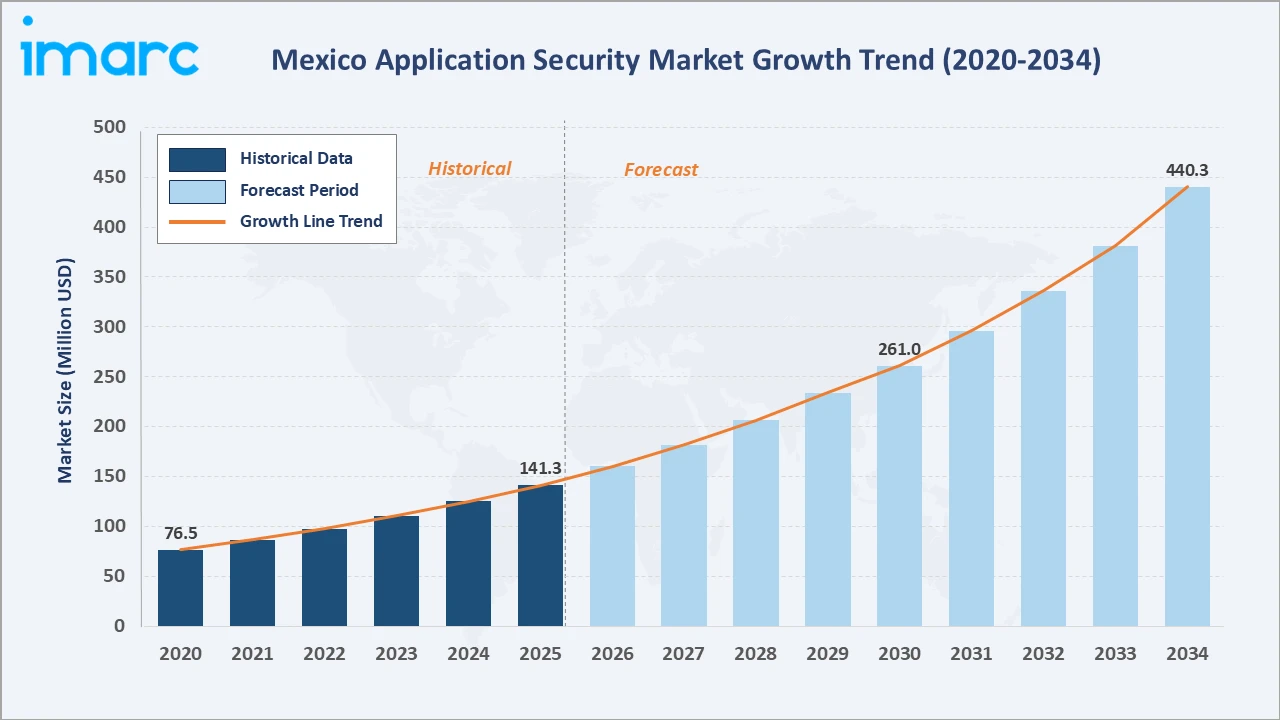
The Mexico application security market reached USD 141.3 Million in 2025 and is projected to reach USD 440.3 Million by 2034, exhibiting a robust CAGR of 13.06% during 2026-2034. Mexico ranks fifth worldwide in cyberattack volume, experiencing an average of approximately 5.3 million cyberattacks each day. This high threat exposure is driving the Mexico application security market as organizations increase investments in vulnerability management, application testing, runtime protection, and secure software development to safeguard digital assets and sensitive data. Solution leads at 72.8%, web application security dominates at 68.4%, and Central Mexico commands the largest regional share at 47.3%.
Market Snapshot
|
Metric |
Value |
|
Market Size (2025) |
USD 141.3 Million |
|
Forecast Market Size (2034) |
USD 440.3 Million |
|
CAGR (2026-2034) |
13.06% |
|
Base Year |
2025 |
|
Historical Period |
2020-2025 |
|
Forecast Period |
2026-2034 |
|
Dominant Component |
Solution – 72.8% (2025) |
|
Dominant Type |
Web Application Security – 68.4% (2025) |
|
Leading Region |
Central Mexico – 47.3% (2025) |
The Mexico application security market grew from USD 76.5 Million in 2020 to USD 141.3 Million in 2025, driven by the COVID-19 pandemic’s forced digital acceleration across banking, government, healthcare, and manufacturing sectors, the exponential growth of Mexico’s fintech ecosystem, and the regulatory push requiring financial institutions to implement application-layer controls. The market is projected to reach USD 261.0 Million by 2030 and USD 440.3 Million by 2034.
To get more information on this market, Request Sample
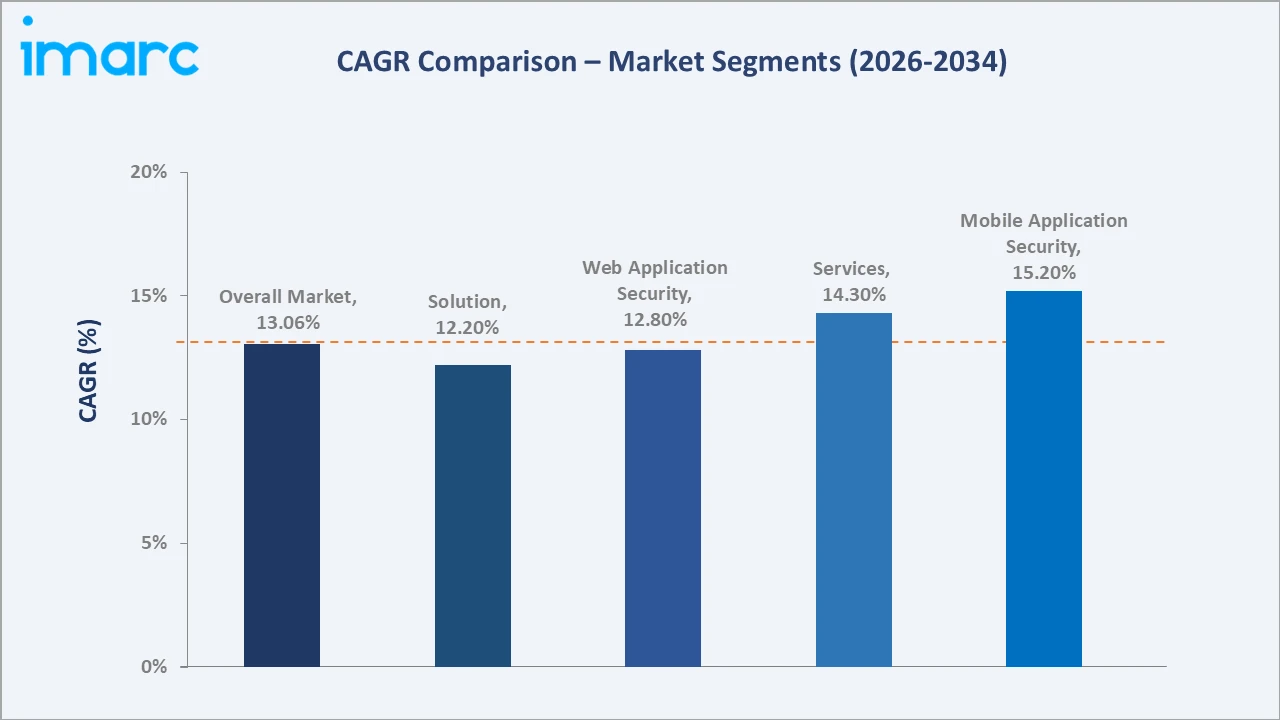
Mobile application security grows fastest at ~15.20% CAGR through Mexico’s smartphone penetration surge and mobile banking adoption. Services grow at ~14.30% CAGR through managed security services and consulting demand. Web application security grows at ~12.80% CAGR as enterprises protect cloud-hosted web applications. Solution grows at ~12.20% CAGR through WAF, RASP, and SAST/DAST platform adoption.
Executive Summary
Mexico application security market represents Latin America’s most strategically significant cybersecurity investment opportunity, where the country’s dual identity as a major nearshoring destination receiving high foreign direct investment and as one of the hemisphere’s most targeted cyberattack geographies creates a compulsory security investment dynamic that elevates application security from discretionary IT spending to operational necessity.
Solution’s 72.8% dominance reflects the market’s maturity progression toward platform-based security deployments. Web application security’s 68.4% leadership reflects Mexico’s digital commerce acceleration, where the country’s e-commerce market growth is creating a massive web application attack surface across retail, banking, and government portals that require enterprise-grade inspection and bot management solutions. Central Mexico’s 47.3% regional dominance reflects Mexico City’s concentration of financial institutions, government agencies, and technology company headquarters that collectively represent the market’s highest-density enterprise application security demand.
Key Market Insights
|
Insight |
Data |
|
Dominant Component |
Solution – 72.8% share (2025) |
|
Dominant Type |
Web Application Security – 68.4% share (2025) |
|
Leading Region |
Central Mexico – 47.3% share (2025) |
|
Market Opportunity |
DevSecOps managed services for nearshoring tech companies; CNBV-compliant application security for community banks; mobile application security for Mexico’s digital banking platforms; API security for real-time payment system integrations |
Key Analytical Observations:
- Solution at 72.8% (2025): The Solution segment’s commanding market share reflects Mexico’s enterprise application security market’s structural shift from fragmented point-tool acquisition toward integrated platform deployments that reduce operational complexity, licensing cost, and security team burden through consolidated visibility and management.
- Web Application Security at 68.4% (2025): Web application security dominates due to the rapid expansion of online banking, e-commerce, cloud services, and enterprise web platforms. Rising cyberattacks targeting web applications are driving organizations to prioritize vulnerability testing, threat detection, and continuous application protection.
- Central Mexico at 47.3% (2025): Central Mexico leads due to the strong concentration of financial institutions, technology companies, government agencies, and large enterprises in Mexico City and surrounding states. High digital adoption, cloud migration, and cybersecurity spending further support regional demand.
Mexico Application Security Market Overview
The Mexico application security market encompasses solutions and services designed to protect software applications from cyber threats, vulnerabilities, and unauthorized access. It includes web application security, mobile application security, API security, application testing, runtime protection, and vulnerability management. The market serves sectors such as banking, retail, healthcare, government, telecommunications, and technology as organizations strengthen secure software development and digital risk management. Macroeconomic factors include economic digitalization, rising IT and cloud expenditure, expanding e-commerce, and growing adoption of digital financial services.
Market Dynamics
To evaluate market opportunities, Request Sample
Market Drivers
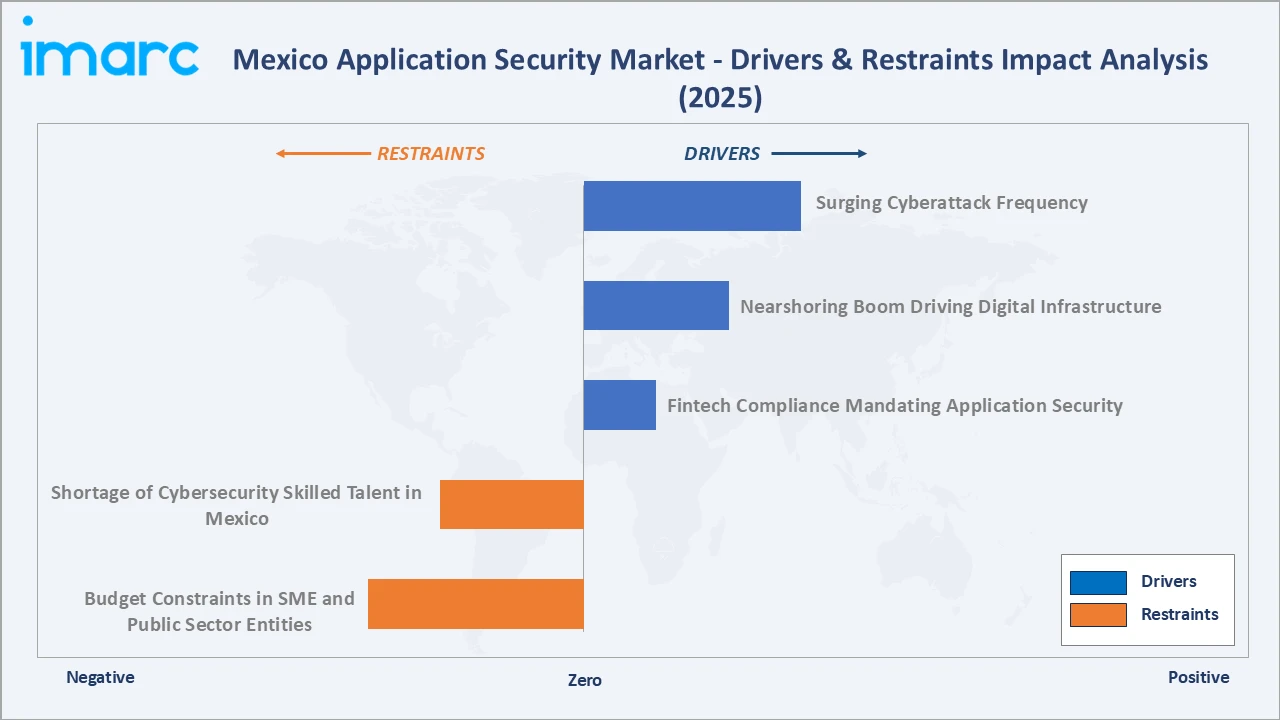
- Surging Cyberattack Frequency: Mexico’s threat landscape has escalated dramatically, with the country experiencing an average of 5.3 million cyberattacks per day. The rising frequency and sophistication of cyberattacks in Mexico are prompting enterprises to strengthen protection across web, mobile, and cloud-based applications. Organizations are increasing spending on vulnerability assessment, application testing, threat detection, and runtime security to reduce breach risks. This heightened threat environment is accelerating demand across the Mexico application security market.
- Nearshoring Boom Driving Digital Infrastructure: Mexico’s emergence as the premier nearshoring destination for US technology companies has created a structural application security demand driver independent of Mexico’s domestic threat environment. US technology companies and financial institutions establishing Mexico-based development centers impose contractual application security requirements that their Mexico-based engineering teams and software development partners must satisfy as a condition of engagement. Mexico’s nearshoring software development sector represents a captive application security market where US client security requirements drive Mexican vendor adoption of application security platforms that domestic market demand alone would not create at an equivalent pace.
- Fintech Compliance Mandating Application Security: Stricter compliance requirements across Mexico’s fintech and financial services sector are pushing companies to strengthen application security throughout the software lifecycle. Institutions must protect customer data, secure digital transactions, and reduce vulnerabilities across mobile apps, APIs, and cloud platforms. This regulatory pressure is increasing investment in application testing, access controls, encryption, and continuous security monitoring.
Market Restraints
- Shortage of Cybersecurity Skilled Talent in Mexico: Mexico faces a significant cybersecurity talent shortage, requiring approximately 83,000 cybersecurity specialists while having only around 6,000 professionals available to meet current market needs. The limited availability of professionals skilled in application security, cloud security, secure coding, and threat analysis can slow deployment of advanced security programs. Talent shortages also increase hiring and training costs for enterprises and security providers. This capability gap can delay vulnerability remediation and restrict the broader adoption of application security solutions.
- Budget Constraints in SME and Public Sector Entities: Limited cybersecurity budgets among SMEs and some public sector organizations can delay investment in advanced application security tools and specialized services. High implementation, licensing, and skilled personnel costs may lead these entities to prioritize basic security measures instead. This can slow broader adoption of application security solutions across the Mexico application security market.
Market Opportunities
- DevSecOps Managed Services for Nearshoring Technology Companies: Mexico’s growing position as a nearshoring hub creates opportunities for managed DevSecOps providers to support technology companies developing applications for domestic and international clients. Integrating automated security testing, vulnerability management, and continuous monitoring into development pipelines can help firms strengthen software security while addressing cybersecurity talent shortages. This creates recurring demand for specialized application security services.
- API Security for Mexico’s SPEI Payment Ecosystem: SPEI, Mexico’s real-time payment system operated by Banco de México, processes more than 3 million transactions daily and is used by roughly 6 in 10 Mexicans. In 2023, the platform handled over 3.8 billion transactions, with the total transaction value reaching approximately US$25.7 billion. The expanding use of APIs across Mexico’s SPEI payment ecosystem creates opportunities for specialized security solutions that protect real-time financial transactions and sensitive customer data. Banks and fintech companies require stronger API authentication, vulnerability testing, threat detection, and fraud prevention capabilities.
Market Challenges
- Legacy Application Security Vulnerabilities: Many organizations continue to operate legacy applications that were not designed according to modern security standards. Integrating advanced security tools into older systems can be technically complex and expensive. Unpatched vulnerabilities and outdated software can therefore increase exposure to cyber threats.
- Complex Multi-Cloud and Hybrid IT Environments: Growing adoption of cloud and hybrid infrastructure is expanding the application attack surface for Mexican enterprises. Organizations must secure applications, APIs, workloads, and data distributed across multiple environments. Maintaining consistent security policies and visibility across these systems remains a significant challenge.
Emerging Market Trends
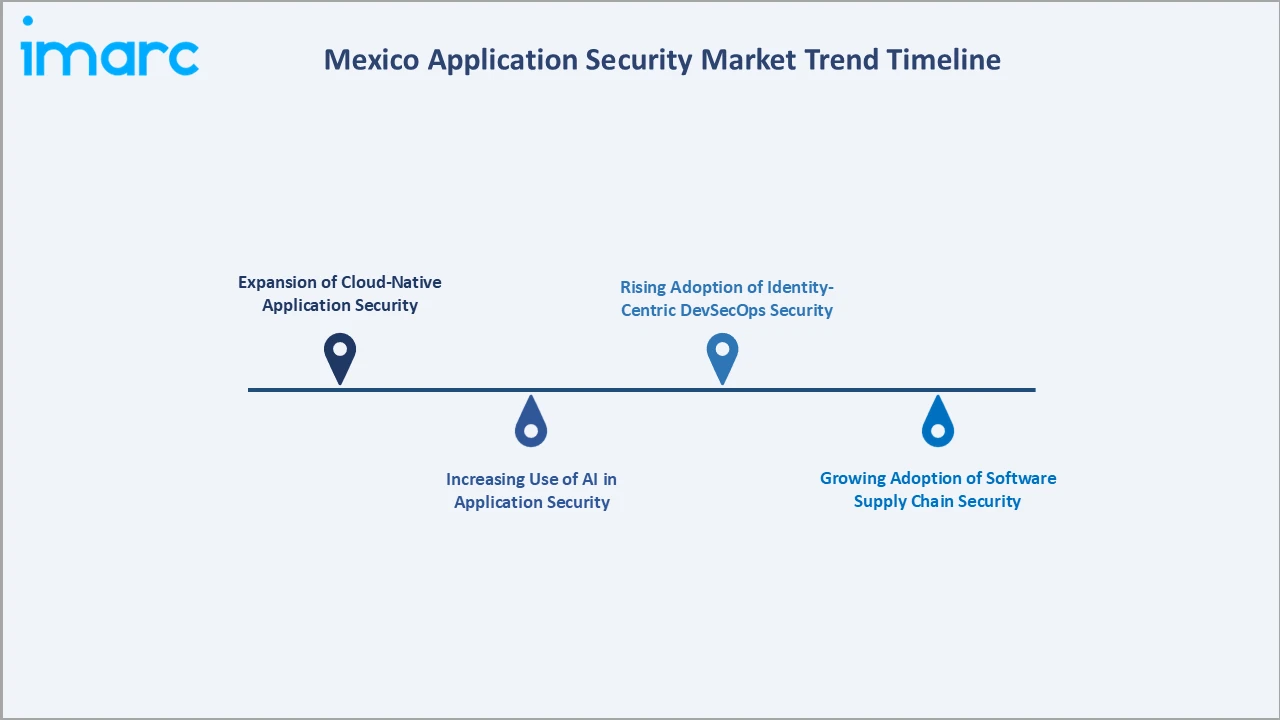
1. Expansion of Cloud-Native Application Security
Increasing enterprise migration toward public, private, and hybrid cloud environments is changing application security requirements. Organizations are adopting security solutions designed for containers, microservices, serverless applications, and cloud workloads. Continuous monitoring is becoming important as applications are frequently updated and distributed across multiple environments. Cloud-native security also supports centralized visibility across development and production systems. This trend is creating opportunities for integrated cloud application protection platforms.
2. Increasing Use of AI in Application Security
Artificial intelligence and machine learning are increasingly being incorporated into application security tools to improve vulnerability identification and threat detection. AI-based systems can help analyze large volumes of application activity and prioritize security risks based on severity. Automation can also reduce pressure on cybersecurity teams facing skilled talent shortages. AI-assisted code analysis supports faster identification of insecure coding practices. This trend is improving the scalability and efficiency of application security operations.
3. Rising Adoption of Identity-Centric DevSecOps Security
In April 2026, BlueFlag Security partnered with T-Systems México to integrate its identity-centric software development lifecycle security capabilities into T-Systems Mexico’s cybersecurity services portfolio. The collaboration is designed to strengthen enterprise DevSecOps security by addressing identity-related risks throughout the development lifecycle, extending protection beyond conventional tools such as SAST, DAST, and SCA. The partnership highlights a shift toward securing developer identities and access across the software development lifecycle. Enterprises are increasingly moving beyond traditional SAST, DAST, and SCA tools to address identity-driven risks within modern DevSecOps environments.
4. Growing Adoption of Software Supply Chain Security
Enterprises are placing greater emphasis on securing third-party libraries, open-source components, and software dependencies used in application development. Software composition analysis and dependency monitoring help organizations identify vulnerable components before applications are deployed. Greater use of open-source software is increasing the importance of maintaining visibility into software inventories. Organizations are also strengthening controls around development pipelines and application updates. This is making software supply chain security an emerging component of broader application security strategies.
Industry Value Chain Analysis
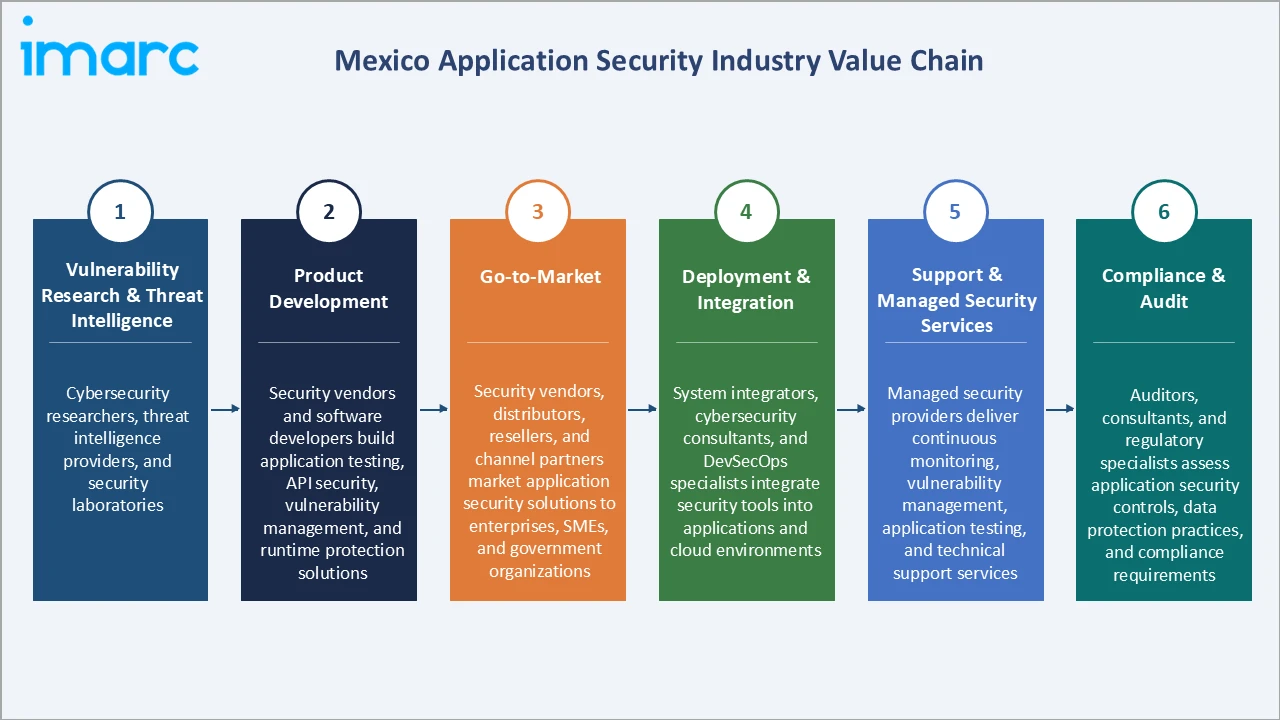
Mexico application security value chain integrates threat intelligence research, product development, go-to-market execution, deployment and integration, ongoing managed support, and compliance validation into a specialized security delivery process that serves enterprise and government clients across Mexico’s four principal commercial regions.
|
Stage |
Key Participants |
|
Vulnerability Research & Threat Intelligence |
Cybersecurity researchers, threat intelligence providers, and security laboratories. |
|
Product Development |
Security vendors and software developers build application testing, API security, vulnerability management, and runtime protection solutions. |
|
Go-to-Market |
Security vendors, distributors, resellers, and channel partners market application security solutions to enterprises, SMEs, and government organizations. |
|
Deployment & Integration |
System integrators, cybersecurity consultants, and DevSecOps specialists integrate security tools into applications and cloud environments. |
|
Support & Managed Security Services |
Managed security providers deliver continuous monitoring, vulnerability management, application testing, and technical support services. |
|
Compliance & Audit |
Auditors, consultants, and regulatory specialists assess application security controls, data protection practices, and compliance requirements. |
Product development is the most value-added stage, as it involves creating advanced application security solutions such as SAST, DAST, API security, runtime protection, and vulnerability management platforms. Strong R&D, proprietary technologies, and continuous innovation directly determine security effectiveness, scalability, and product differentiation.
Technology Landscape in the Mexico Application Security Industry
Static Application Security Testing (SAST)
SAST technology analyzes application source code, bytecode, or binaries to identify security vulnerabilities before deployment. It enables developers to detect insecure coding practices early in the software development lifecycle. Integration with DevOps pipelines supports automated and continuous code scanning. The technology can reduce remediation costs by identifying weaknesses before applications reach production. Growing DevSecOps adoption is supporting its use across Mexican enterprises.
Dynamic Application Security Testing (DAST)
DAST evaluates running web applications by simulating external attacks and identifying exploitable vulnerabilities. It helps organizations detect authentication weaknesses, configuration issues, injection vulnerabilities, and other runtime security risks. Automated DAST platforms can be incorporated into continuous testing processes. The technology is particularly relevant for customer-facing web applications. Rising cyber threats are strengthening demand for continuous dynamic testing.
Software Composition Analysis (SCA)
SCA technology identifies and evaluates open-source libraries and third-party components incorporated into software applications. It detects known vulnerabilities, outdated dependencies, and licensing risks across software supply chains. Automated scanning can be integrated into development pipelines to identify vulnerable components before deployment. Growing reliance on open-source software is increasing the importance of dependency visibility. SCA is becoming an important component of modern application security programs.
Market Segmentation Analysis
The report covers the following segments:
|
Segment Category |
Leading Segment |
Market Share |
Year |
|
Component |
Solution |
72.8% |
2025 |
|
Type |
Web Application Security |
68.4% |
2025 |
|
Testing Type |
🔒 |
🔒 |
2025 |
|
Deployment Mode |
🔒 |
🔒 |
2025 |
|
Organization Size |
🔒 |
🔒 |
2025 |
|
Industry Vertical |
🔒 |
🔒 |
2025 |
|
Region |
Central Mexico |
47.3% |
2025 |

By Component
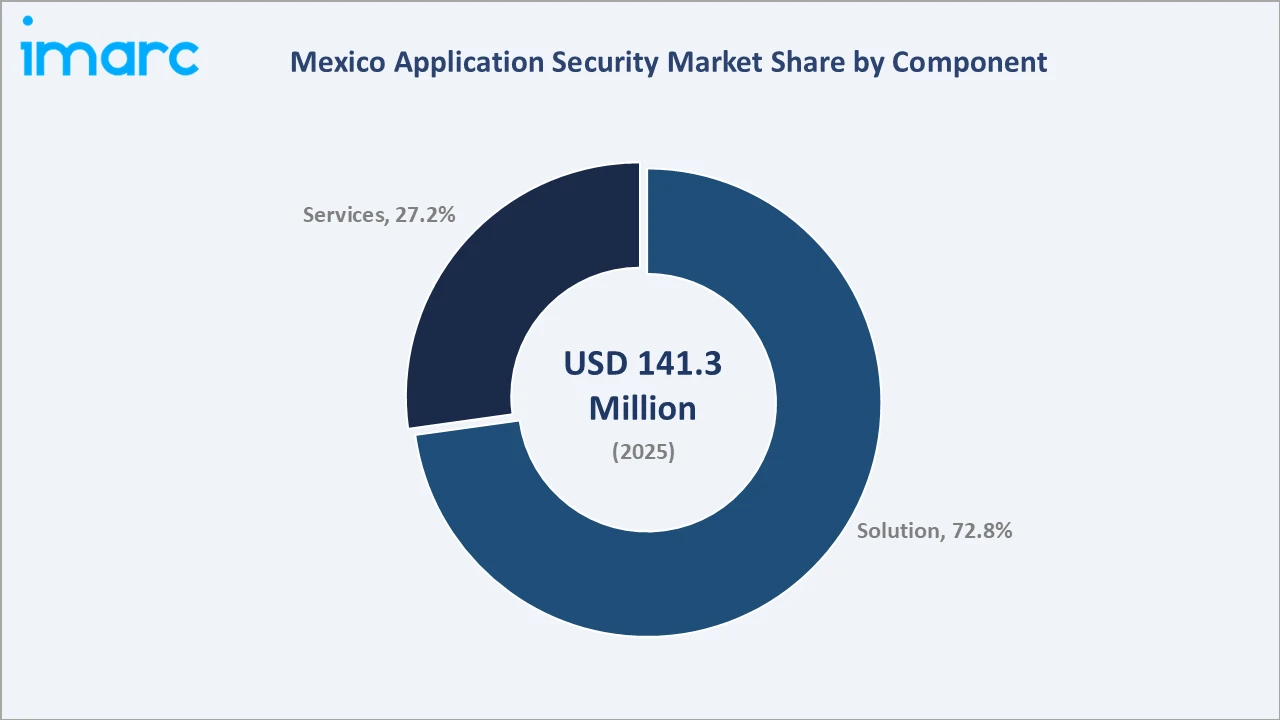
Solution leads at 72.8% (2025) through WAF, SAST/DAST, RASP, and API security platform deployments across Mexico’s financial, government, and manufacturing sectors, driven by compliance mandates and protection requirements.
To access detailed market analysis, Request Sample
Services at 27.2%, growing at ~14.30% CAGR, through managed application security services, DevSecOps consulting, and penetration testing outsourcing driven by Mexico’s cybersecurity talent shortage.
By Type
Web application security leads at 68.4% (2025) through WAF, API security, and DAST deployments protecting Mexico’s financial portals, government digital services, and e-commerce platforms.
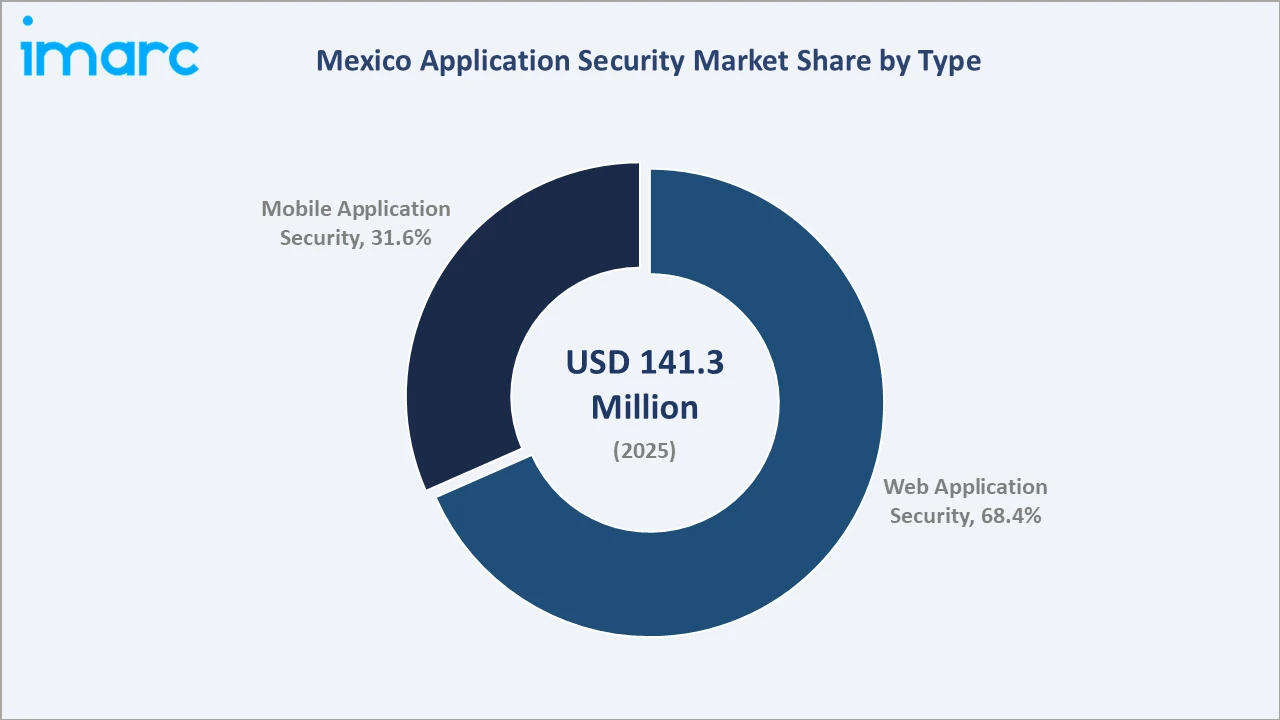
Mobile application security at 31.6% is growing fastest at ~15.20% CAGR through CNBV mobile banking security mandates and Mexico’s surging mobile financial services adoption.
Regional Market Insights
|
Region |
Share (2025) |
Key Application Security Market Drivers & Characteristics |
|
Central Mexico |
47.3% |
Leads due to the concentration of financial institutions, government agencies, technology companies, and large enterprises, particularly around Mexico City. |
|
Northern Mexico |
31.8% |
Supported by nearshoring, manufacturing digitalization, cross-border business activity, and increasing adoption of cloud and enterprise applications. |
|
Southern Mexico |
13.6% |
Growth is driven by expanding digital services, government modernization, and increasing cybersecurity awareness among businesses and public organizations. |
|
Others |
7.3% |
Supported by gradual cloud adoption, SME digitalization, improving connectivity, and growing demand for managed application security services. |
Central Mexico leads at 47.3% in 2025, supported by strong enterprise, financial services, government, and technology activity. Northern Mexico accounts for 31.8%, driven by nearshoring, manufacturing digitalization, and cross-border business operations.
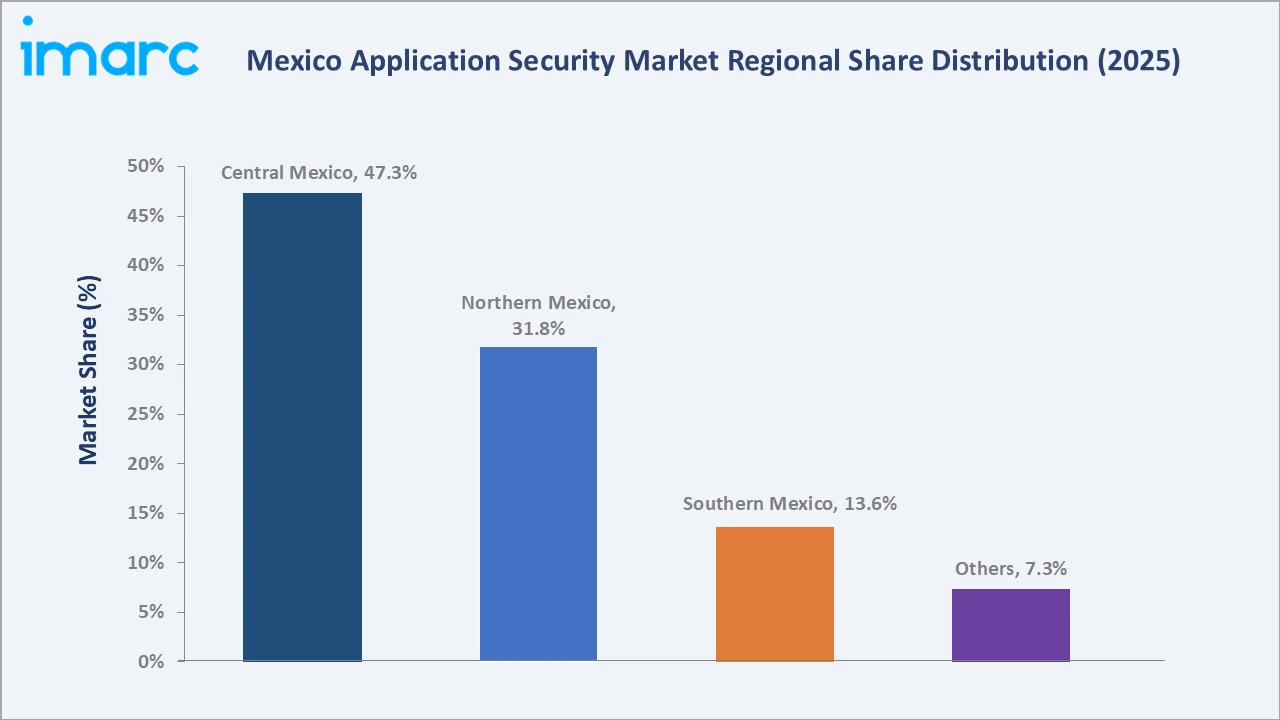
Southern Mexico holds 13.6%, supported by expanding digital services and gradual cybersecurity modernization. Other regions represent 7.3%, with demand emerging through SME digitalization, cloud adoption, and managed security services.
Competitive Landscape
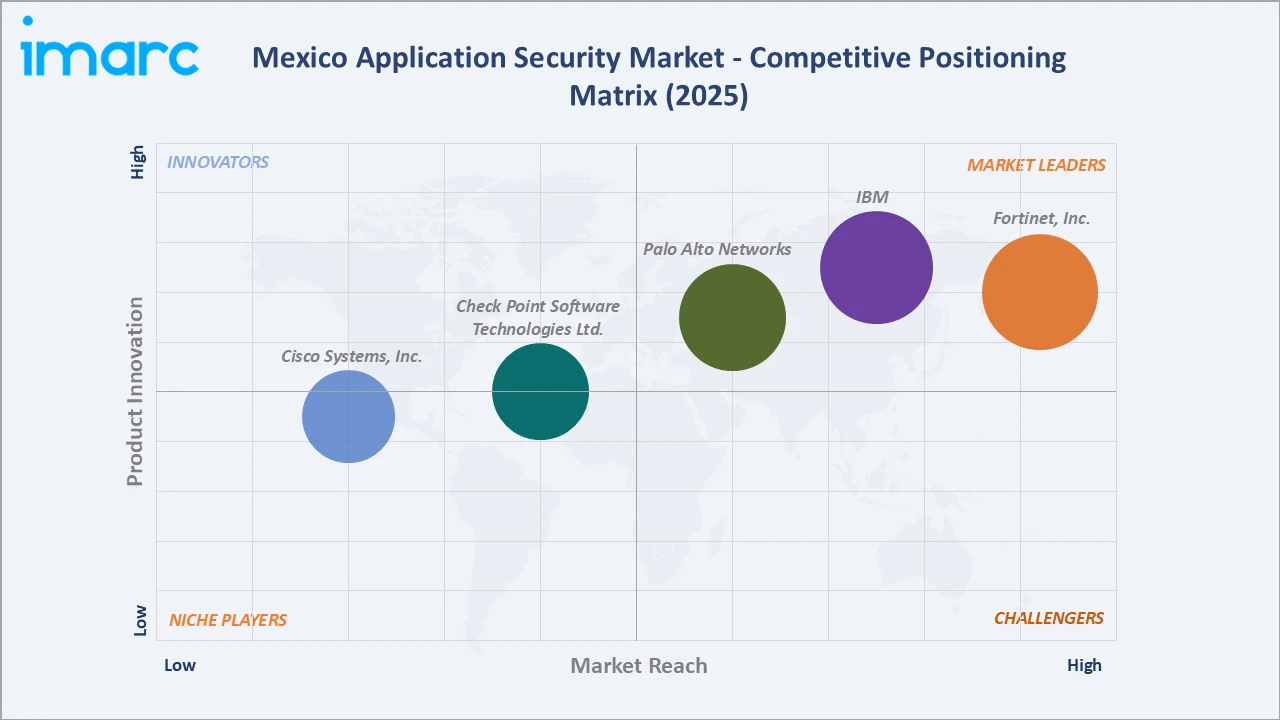
The Mexico application security market is moderately concentrated, with global cybersecurity vendors competing alongside regional managed security providers and specialized application security firms. Competition is increasingly driven by integrated security platforms, API and cloud-native protection, DevSecOps capabilities, AI-based threat detection, and managed security services.
|
Company |
Key Offerings |
Market Position |
Core Strength |
|
Fortinet, Inc. |
Fortinet Security Fabric, FortiGuard Web Application Security Service |
Market Leader |
Fortinet, Inc. plays a major role in Mexico’s application security landscape by helping enterprises and government organizations defend software, web apps, and APIs. |
|
IBM |
IBM's AI-powered Digital AppSec Champion (DASC) and Security Harness |
Market Leader |
IBM plays a major role in Mexico's application security by providing AI-powered vulnerability testing, security consulting, and threat intelligence. |
|
Palo Alto Networks |
Prisma Cloud |
Market Leader |
Palo Alto Networks provides comprehensive application security to businesses in Mexico by securing cloud environments, identifying applications, and preventing attacks. |
|
Check Point Software Technologies Ltd. |
Cloud Security |
Established Player |
Check Point Software Technologies Ltd. protects businesses in Mexico from cyber threats using advanced application security solutions. |
|
Cisco Systems, Inc. |
Cisco Cloud Application Security |
Established Player |
Cisco Systems, Inc. plays a major role in Mexico's application security by providing cloud-native security platforms. |
Mexico application security competitive landscape is evolving toward platform consolidation, where enterprises are rationalizing from disparate point tools toward integrated platforms, benefiting vendors whose unified application security platforms offer superior ROI through operational simplification relative to multi-vendor alternatives.
Key Company Profiles
Fortinet, Inc.
Fortinet, Inc. is a cybersecurity company that provides integrated security solutions for enterprises, government organizations, service providers, and other institutions. The company’s portfolio spans network security, cloud security, endpoint protection, application security, secure access, and threat intelligence. In the Mexico application security market, Fortinet supports organizations with web application protection, API security, vulnerability management, and cloud-based security capabilities. Its broad technology ecosystem and enterprise-focused offerings help address evolving cyber risks across digital applications and infrastructure.
- Key Offerings: Fortinet Security Fabric, FortiGuard Web Application Security Service.
- Strategic Focus: Focuses on expanding integrated web application and API security, combining WAF, API protection, bot management, DDoS mitigation, and threat analytics through platforms. Its emphasis on AI- and machine-learning-driven threat detection supports protection against zero-day attacks and increasingly sophisticated application threats.
Palo Alto Networks
Palo Alto Networks is a cybersecurity company providing security solutions for enterprises, government organizations, and cloud-based environments. Its portfolio includes network security, cloud security, endpoint protection, application security, threat intelligence, and security operations technologies. In the Mexico application security market, the company supports organizations with web application protection, API security, cloud workload security, and DevSecOps capabilities. Its integrated platform approach helps enterprises secure applications across development, deployment, and runtime environments.
- Key Offerings: Prisma Cloud.
- Strategic Focus: Strengthening AI-driven and prevention-first security, using unified code, cloud, and runtime context to identify and prioritize application risks. These capabilities position Palo Alto Networks to address growing cloud adoption, application modernization, and sophisticated cyber threats among Mexican enterprises.
Market Concentration Analysis
The Mexico application security market is moderately concentrated, with global cybersecurity vendors maintaining strong positions alongside regional managed security providers and specialized firms. Leading players benefit from broad security portfolios, established enterprise relationships, strong channel networks, and advanced cloud capabilities. Competition is increasingly centered on integrated application security platforms, API protection, DevSecOps, cloud-native security, and AI-driven threat detection. Regional providers remain competitive by offering localized consulting, managed security, and cost-effective solutions. High technological requirements and the need for specialized cybersecurity expertise create moderate barriers to new entrants. Overall, continued cloud adoption and demand for managed services are expected to gradually broaden the competitive landscape.
Investment & Growth Opportunities
Highest Growth Segments
Mobile application security (~15.20% CAGR) and services (~14.30% CAGR) represent Mexico’s application security market’s highest-growth investment opportunities through 2034, driven by mobile banking security mandates and Mexico’s structural cybersecurity talent shortage, compelling services outsourcing, respectively.
Investment Themes
- DevSecOps Managed Service Platform for Nearshoring Market: Investment in managed DevSecOps platforms can support nearshoring technology companies in Mexico by integrating automated security testing, vulnerability management, and continuous monitoring into software development workflows. This model can help enterprises address cybersecurity talent shortages while maintaining secure and scalable application development.
- Regulatory Compliant Mobile Application Security Testing Service: Investment in specialized mobile application security testing services can help fintech and financial institutions meet Mexico’s requirements for vulnerability scanning, penetration testing, authentication, and data protection. Regulatory requirements for technology infrastructure create recurring opportunities for compliance-focused application testing and security assessment providers.
Future Market Outlook (2026-2034)
The Mexico application security market is projected to grow from USD 141.3 Million in 2025 to USD 440.3 Million by 2034, delivering a robust 13.06% CAGR that positions Mexico as Latin America’s fastest-growing application security market by absolute value increment and one of the region’s highest-growth cybersecurity segments by percentage expansion. The midpoint anchor of USD 261.0 Million in 2030 confirms structural market momentum that is independent of any single policy event or technology trend.
First, Mexico’s regulatory landscape is entering its most consequential evolution for application security adoption, where three concurrent regulatory developments will collectively mandate application security investment across Mexico’s entire financial sector, significantly expand compliance obligations for digital service providers, and establish criminal liability for Board-level executives at organizations that suffer preventable data breaches through application vulnerability exploitation. Second, Mexico’s nearshoring acceleration is creating application security demand at a pace that outstrips regulatory compliance-driven demand in both growth rate and total market value contribution. Third, Mexico’s AI-driven application security adoption will accelerate through the forecast period as three AI application security capabilities reach commercial maturity that are specifically relevant to Mexico’s market constraints: automated WAF tuning, AI-powered application vulnerability prioritization, and generative AI-powered secure code suggestions.
Research Methodology
Primary Research
Primary research comprised in-depth interviews with IT security directors, application security product specialists, cybersecurity channel partner executives, DevSecOps engineers, the cybersecurity committee on Mexico workforce and market development, and data protection representatives on enforcement priorities.
Secondary Research
Secondary research encompassed a review of government publications, cybersecurity regulations, industry reports, company disclosures, trade associations, and credible technology databases. The research also covered cyberattack trends, application security adoption, cloud and DevSecOps developments, regulatory requirements, regional demand, and competitive activity across Mexico.
Forecasting Models
Forecasting models developed using historical Mexico application security market revenue data (2020-2025), Mexico cybersecurity regulatory timeline impact analysis, nearshoring FDI trajectory projection, application security spending as percentage of IT security budget trajectory, AI application security technology adoption curve modeling, mobile application security demand growth aligned to Mexico’s digital banking user base expansion projections, and competitive pricing evolution impact on solution segment volume demand through the forecast period.
Mexico Application Security Market Report Coverage:
| Report Features | Details |
|---|---|
| Base Year of the Analysis | 2025 |
| Historical Period | 2020-2025 |
| Forecast Period | 2026-2034 |
| Units | Million USD |
| Scope of the Report |
Exploration of Historical Trends and Market Outlook, Industry Catalysts and Challenges, Segment-Wise Historical and Future Market Assessment:
|
| Components Covered | Solution, Services |
| Types Covered | Web Application Security, Mobile Application Security |
| Testing Types Covered | Static Application Security Testing (SAST), Dynamic Application Security Testing (DAST), Interactive Application Security Testing (IAST), Runtime Application Self-Protection (RASP) |
| Deployment Modes Covered | On-premises, Cloud-based |
| Organization Sizes Covered | Large Enterprises, Small and Medium-sized Enterprises |
| Industry Verticals Covered | BFSI, Healthcare, IT and Telecom, Manufacturing, Government and Public Sector, Retail and E-Commerce, Others |
| Regions Covered | Northern Mexico, Central Mexico, Southern Mexico, Others |
| Companies Covered | Fortinet, Inc., IBM, Palo Alto Networks, Check Point Software Technologies Ltd., Cisco Systems, Inc., etc. |
| Customization Scope | 10% Free Customization |
| Post-Sale Analyst Support | 10-12 Weeks |
| Delivery Format | PDF and Excel through Email (We can also provide the editable version of the report in PPT/Word format on special request) |
Key Benefits for Stakeholders:
- IMARC’s industry report offers a comprehensive quantitative analysis of various market segments, historical and current market trends, market forecasts, and dynamics of the Mexico application security market from 2020-2034.
- The research report provides the latest information on the market drivers, challenges, and opportunities in the Mexico application security market.
- Porter's five forces analysis assist stakeholders in assessing the impact of new entrants, competitive rivalry, supplier power, buyer power, and the threat of substitution. It helps stakeholders to analyze the level of competition within the Mexico application security industry and its attractiveness.
- Competitive landscape allows stakeholders to understand their competitive environment and provides an insight into the current positions of key players in the market.
Frequently Asked Questions About the Mexico Application Security Market Report
Mexico application security market reached USD 141.3 Million in 2025, driven by rising cyberattack frequency, rapid digitalization, and growing adoption of cloud-based applications across enterprises. Increasing fintech activity, API usage, DevSecOps adoption, and regulatory emphasis on data protection are further supporting demand for advanced application security solutions.
The market grows at 13.06% CAGR, reaching USD 440.3 Million by 2034, driven by escalating cyber threats, expanding cloud adoption, and increasing digital application usage. Growing investments in DevSecOps, API security, AI-driven protection, and managed security services are expected to further accelerate market growth
Solution leads at 72.8% (2025) through enterprise WAF, SAST/DAST, RASP, and API security platform deployments mandated by regulations and US nearshoring client security requirements.
Web application security leads at 68.4% (2025) through WAF protecting SPEI payment portal integrations, government digital services, and e-commerce platforms against OWASP Top 10 threats.
Central Mexico leads at 47.3% through Mexico City’s financial sector headquarters concentration, federal government agencies, and Mexico’s largest enterprise headquarters driving application security procurement.
Leading companies include Fortinet, Inc., IBM, Palo Alto Networks, Check Point Software Technologies Ltd., and Cisco Systems, Inc., among others
The market is projected to reach USD 261.0 Million by 2030, driven by rising cyberattack exposure, rapid cloud adoption, and expanding use of web, mobile, and API-based applications. Increasing DevSecOps integration, regulatory compliance needs, and demand for managed security services are further supporting market growth.
Top investment opportunities include API and mobile application security for fintech and digital payments, managed DevSecOps services, cloud-native application protection, AI-driven vulnerability management, and software supply-chain security.
Need more help?
- Speak to our experienced analysts for insights on the current market scenarios.
- Include additional segments and countries to customize the report as per your requirement.
- Gain an unparalleled competitive advantage in your domain by understanding how to utilize the report and positively impacting your operations and revenue.
- For further assistance, please connect with our analysts.
 Request Customization
 Speak to an Analyst
 Request Brochure
 Inquire Before Buying
Benefits of Customization
- Personalize this research
- Triangulate with your data
- Get data as per your format and definition
- Gain a deeper dive into a specific application, geography, customer, or competitor
- Any level of personalization
Get in Touch With Us
UNITED STATES
Phone: +1-201-971-6302
INDIA
Phone: +91-120-433-0800
UNITED KINGDOM
Phone: +44-753-714-6104
Email: [email protected]
Client Testimonials




.webp)




.webp)













Related Reports

Choose your plan
*Please note that the prices mentioned below are starting prices for each bundle type. Kindly contact our team for further details.*
Single User License
- 1 User License, Access on 2 Devices
- PDF Report + Excel Dataset (Password Protected)
- Lifetime Access
- No Printing Rights
- 10% Free Report Customization
- 10–12 Weeks of Analyst Support
Five User License
- Access for 5 Users, 2 Devices per User
- PDF Report + Excel Dataset (Password Protected)
- Lifetime Access
- Dedicated Account Manager
- 12–14 Weeks of Analyst Support
- No Printing Rights
- 15% Free Report Customization
- 25% Discount on Your Next Purchase
Corporate User License
- Unlimited User Access (Within Your Organization)
- PDF Report + Excel Dataset
- Lifetime Access
- Dedicated Account Manager
- 14–20 Weeks of Analyst Support
- No Printing Rights
- 20% Free Report Customization
- 30% Discount on Your Next Purchase
Essential Insights
What's included:
3 reports
- Lifetime Access
- PDF Reports
- Excel Datasets
- 2 Weeks of Free Analyst Support
- 2 User Licenses
- Access on 2 Devices
- Printing Rights
- Complimentary PowerPoint (PPT) Version
- Complimentary License Upgrade
Professional Access
What's included:
5 reports
- Lifetime Access
- PDF Reports
- Excel Datasets
- 8 Weeks of Free Analyst Support
- 2 User Licenses
- Access on 2 Devices
- Printing Rights
- Complimentary PowerPoint (PPT) Version
- Complimentary License Upgrade
Business Advantage
What's included:
8 reports
- Lifetime Access
- PDF Reports
- Excel Datasets
- 14 Weeks of Free Analyst Support
- 2 User Licenses
- Access on 2 Devices
- Printing Rights
- Complimentary PowerPoint (PPT) Version
- Complimentary License Upgrade
Enterprise Intelligence
What's included:
10 reports
- Lifetime Access
- PDF Reports
- Excel Datasets
- 20 Weeks of Free Analyst Support
- 2 User Licenses
- Access on 2 Devices
- Printing Rights
- Complimentary PowerPoint (PPT) Version
- Complimentary License Upgrade