
Mexico Pizza Market Size, Share, Trends and Forecast by Type, Crust Type, Distribution Channel, and Region, 2026-2034
Mexico Pizza Market Size, Share, Trends & Forecast (2026-2034)
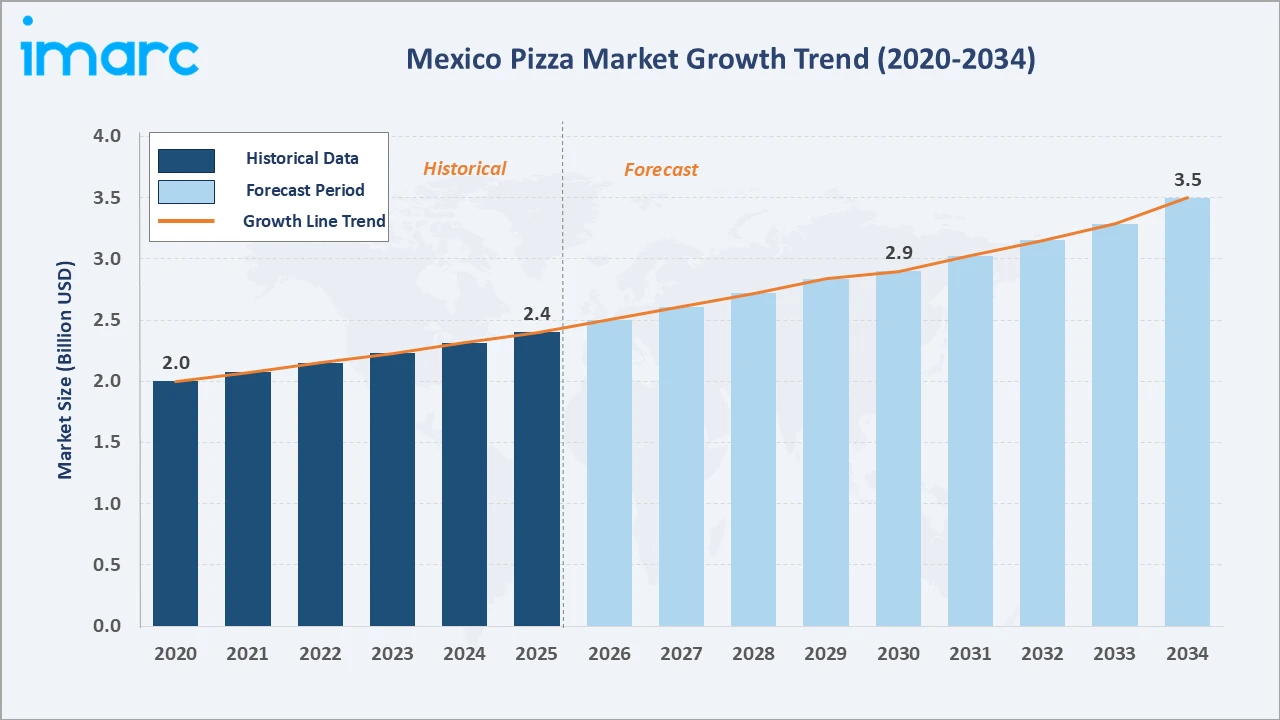
The Mexico pizza market size increased from USD 2.4 Billion in 2025 to USD 2.5 Billion in 2026 and is projected to reach USD 3.5 Billion by 2034, exhibiting a CAGR of 3.94% during 2026-2034. Growth is driven by expanding quick-service restaurant (QSR) store networks, rising food-delivery app penetration, and increasing urban demand for convenient, ready-to-eat meals. Mexico's food-preparation and beverage-service sector accounts for roughly 12.2% of the country's registered business units and supports more than two million jobs, according to INEGI and CANIRAC. Government agricultural market information sources estimate the country consumes between 120 million and 140 million pizzas annually. Non-vegetarian pizza leads the type segment at 67.9%. Thin crust leads the crust-type segment at 46.8%. Central Mexico leads regionally at 45.9%.
Market Snapshot
|
Metric |
Value |
|
Base Year Market Size (2025) |
USD 2.4 Billion |
| Market Size (2026) | USD 2.5 Billion |
|
Forecast Market Size (2034) |
USD 3.5 Billion |
|
CAGR (2026-2034) |
3.94% |
|
Base Year |
2025 |
|
Historical Period |
2020-2025 |
|
Forecast Period |
2026-2034 |
|
Dominant Type |
Non-vegetarian Pizza (67.9%, 2025) |
|
Dominant Crust Type |
Thin Crust (46.8%, 2025) |
|
Leading Region |
Central Mexico (45.9%, 2025) |
The Mexico pizza market grew from USD 2.0 Billion in 2020 to USD 2.4 Billion in 2025 and an estimated USD 2.5 Billion in 2026, reflecting a steady recovery in dine-in traffic, rapid growth of delivery aggregators such as Rappi, Uber Eats, and DiDi Food, and continued store expansion by leading QSR chains. The market is expected to reach USD 2.9 Billion by 2030, supported by new store openings during 2026 FIFA World Cup and rising digital-ordering penetration. By 2034, the market is forecast to reach USD 3.5 Billion, driven by premiumization, menu innovation, and expansion into smaller Mexican cities. Overall, the market reflects steady, delivery-led growth across the forecast period.
To get more information on this market, Request Sample
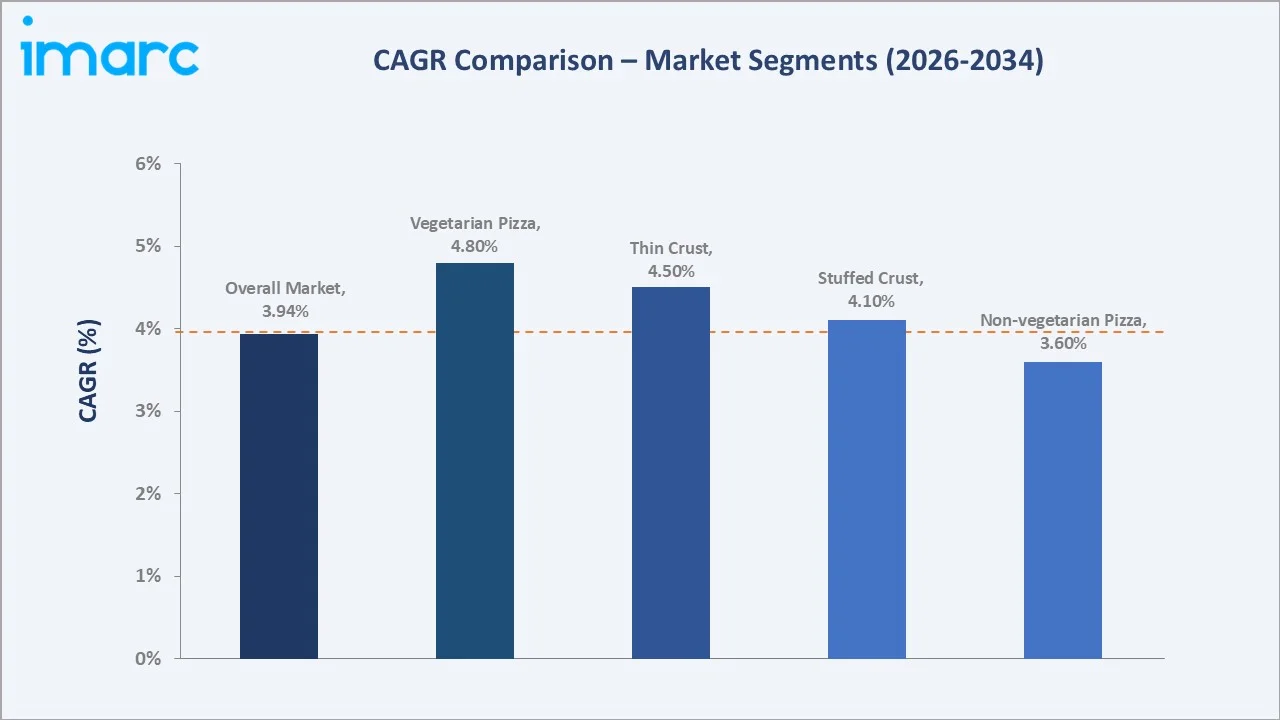
Vegetarian pizza grows fastest at an estimated ~4.8% CAGR, supported by rising health consciousness and plant-forward menu additions. Thin crust grows at an estimated ~4.5% CAGR as chains position it as a lighter, premium option, while stuffed crust grows at an estimated ~4.1% CAGR through limited-time promotional launches.
Executive Summary
The Mexico pizza market is expanding steadily, supported by the country's large, youthful population and growing preference for convenient, on-demand meals. Rising smartphone penetration and food-delivery app adoption are reshaping how consumers order pizza, with digital and delivery channels accounting for a growing share of chain sales. Leading international brands continue to expand their store networks alongside strong homegrown players, while consumers increasingly favor value-driven combo offerings and limited-time menu innovations.
Non-vegetarian pizza continues to lead the type segment at 67.9% share in 2025, reflecting Mexico's strong preference for meat-topped and regionally inspired flavors. Thin crust leads the crust-type segment at 46.8%, favored for its faster preparation and lighter eating experience. Central Mexico leads regionally at 45.9% share, supported by high urban density, strong QSR penetration, and established delivery infrastructure across Mexico City and its metropolitan area.
Looking ahead, the market outlook remains positive, supported by the 2026 FIFA World Cup, continued store expansion into secondary cities, and rising investment in digital ordering and loyalty platforms by leading pizza chains.
Key Market Insights
|
Insight |
Data |
|
Dominant Type |
Non-vegetarian Pizza - 67.9% share (2025) |
|
Dominant Crust Type |
Thin Crust - 46.8% share (2025) |
|
Leading Region |
Central Mexico - 45.9% share (2025) |
|
Market Opportunities |
World Cup 2026 tourism demand; digital loyalty platform expansion; secondary-city store growth; plant-based menu innovation; airport and travel-hub locations; premium crust positioning |
Key Analytical Observations Supporting the Above Data:
- Non-vegetarian Pizza at 67.9%: Dominates due to strong Mexican consumer preference for meat-forward toppings such as pepperoni, ham, chorizo, and regional proteins like al pastor and cochinita, popularized by domestic chains including Benedetti's Pizza. Combo-meal promotions from leading QSR chains reinforce this preference across dine-in and delivery channels.
- Thin Crust at 46.8%: Leads due to faster preparation times, lower price points, and consumer perception of thin crust as a lighter option suited to frequent, on-the-go consumption. Chains increasingly market thin crust as a flagship value proposition in combo bundles.
- Central Mexico at 45.9%: Dominates regionally due to Mexico City's dense urban population, high store concentration, and mature last-mile delivery infrastructure supported by platforms such as Rappi and Uber Eats.
- Store network expansion: Domino's Pizza, operated by Alsea, and Little Caesars, present since 2006 and operating across all 32 Mexican states, continue to add new units, while Pizza Hut, operated by Food Delivery Brands, opened numerous stores ahead of the 2026 FIFA World Cup.
- Government-recognized consumption base: Mexico's agricultural market information services estimate consumers eat between 120 million and 140 million pizzas annually, underscoring the scale of demand for pizza-related dairy, wheat, and processed-meat inputs.
Mexico Pizza Market Overview
The Mexico pizza market encompasses dine-in, takeaway, and delivery-based pizza sold through international QSR chains, domestic chains, and independent pizzerias. It includes non-vegetarian and vegetarian pizza types across thin, thick, and stuffed crust formats, served through company-owned and franchised store networks. Growth is shaped by urbanization, rising delivery-app penetration, an expanding middle class, and Mexico's position as co-host of the 2026 FIFA World Cup, which lifted foodservice demand nationwide.
Market Dynamics
To evaluate market opportunities, Request Sample
Market Drivers
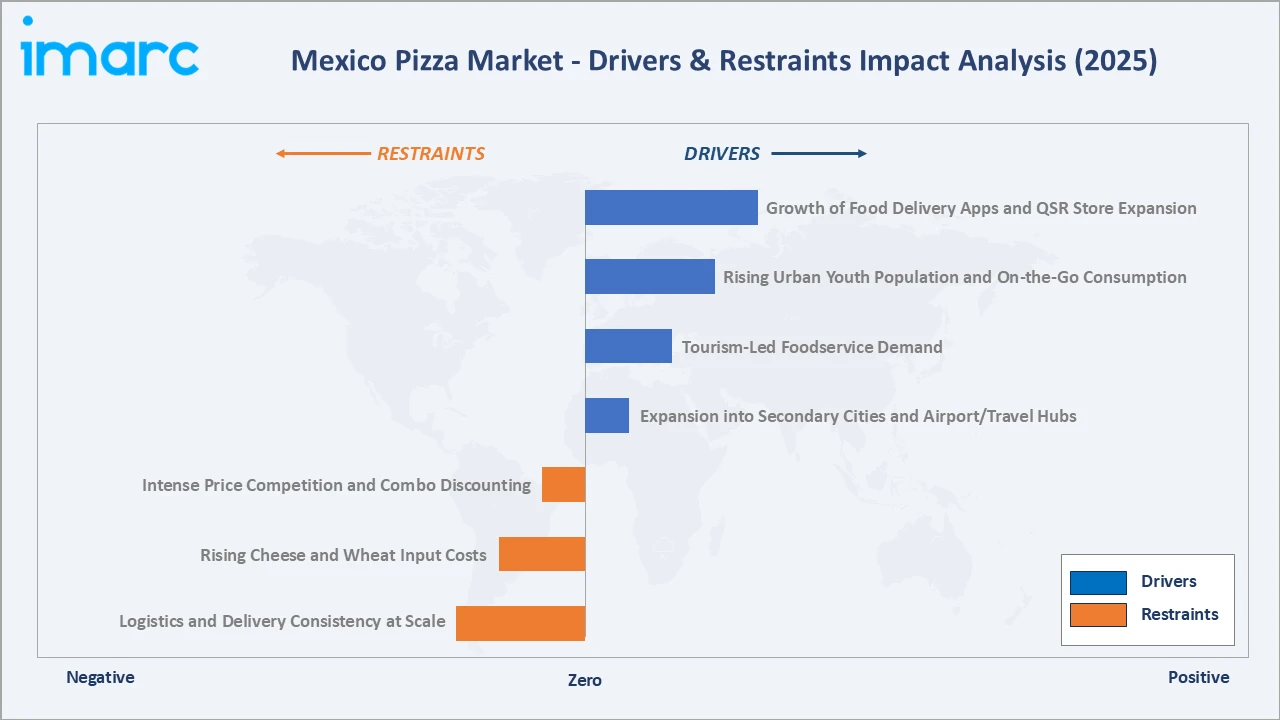
- Growth of Food Delivery Apps and QSR Store Expansion: Mexico's food-preparation and beverage-service sector recorded a gross domestic product of roughly MXN 838.5 billion in the third quarter of 2025, according to INEGI, underscoring the scale of foodservice spending nationally. Leading pizza chains continue to expand store counts, with Domino's Pizza, operated by Alsea. Combined with third-party platforms such as Rappi, Uber Eats, and DiDi Food, this expansion is widening pizza's reach into new neighborhoods and secondary cities.
- Rising Urban Youth Population and On-the-Go Consumption: Mexico's large urban population and high share of working-age consumers support frequent, convenience-driven meal occasions. INEGI data shows households allocate a growing share of food spending to restaurant and prepared-food purchases, supporting demand for value-priced, quickly prepared meals such as pizza across dine-in, takeaway, and delivery formats.
- Tourism-Led Foodservice Demand: Mexico's role as co-host of the 2026 FIFA World Cup prompted leading pizza chains to expand store networks, including new airport locations, ahead of an expected surge in domestic and international visitor traffic.
Market Restraints
- Intense Price Competition and Combo Discounting: Mexico's pizza market is highly price-competitive, with leading chains such as Little Caesars built around a hot-and-ready, value-priced model. Persistent discounting and combo promotions can compress margins for both international chains and smaller independent pizzerias competing for the same delivery-app customer base.
- Rising Cheese and Wheat Input Costs: Pizza production depends heavily on dairy and wheat-based inputs. Fluctuations in domestic dairy and flour prices can raise costs for chains and independent pizzerias, pressuring margins, particularly for smaller operators without the scale purchasing power of large franchise networks.
Market Opportunities
- Expansion into Secondary Cities and Airport/Travel Hubs: Leading chains are targeting expansion beyond major metropolitan areas. Little Caesars expanded into cities such as Pachuca, Hidalgo, while Pizza Hut opened new locations at Mexico City's international airport terminals ahead of the 2026 World Cup, reflecting an opportunity to capture new consumer segments across secondary markets and high-traffic travel corridors.
- Growth of Digital Loyalty and App-Based Ordering: Alsea reported rising digital and loyalty-program sales contribution for its Domino's Pizza operations in Mexico, creating opportunities for chains to deepen customer engagement, personalize offers, and increase order frequency through mobile apps and subscription-style loyalty programs.
Market Challenges
- Logistics and Delivery Consistency at Scale: Maintaining consistent delivery times and food quality across large, geographically dispersed franchise networks remains challenging, particularly as chains expand into secondary cities with less-developed last-mile delivery infrastructure.
- Franchise Supplier Payment and Operational Consistency: Pizza Hut Mexico's operator publicly acknowledged working to regularize payments to suppliers as part of its recovery and expansion strategy, highlighting the operational and working-capital challenges that can accompany rapid multi-brand franchise expansion.
Emerging Market Trends
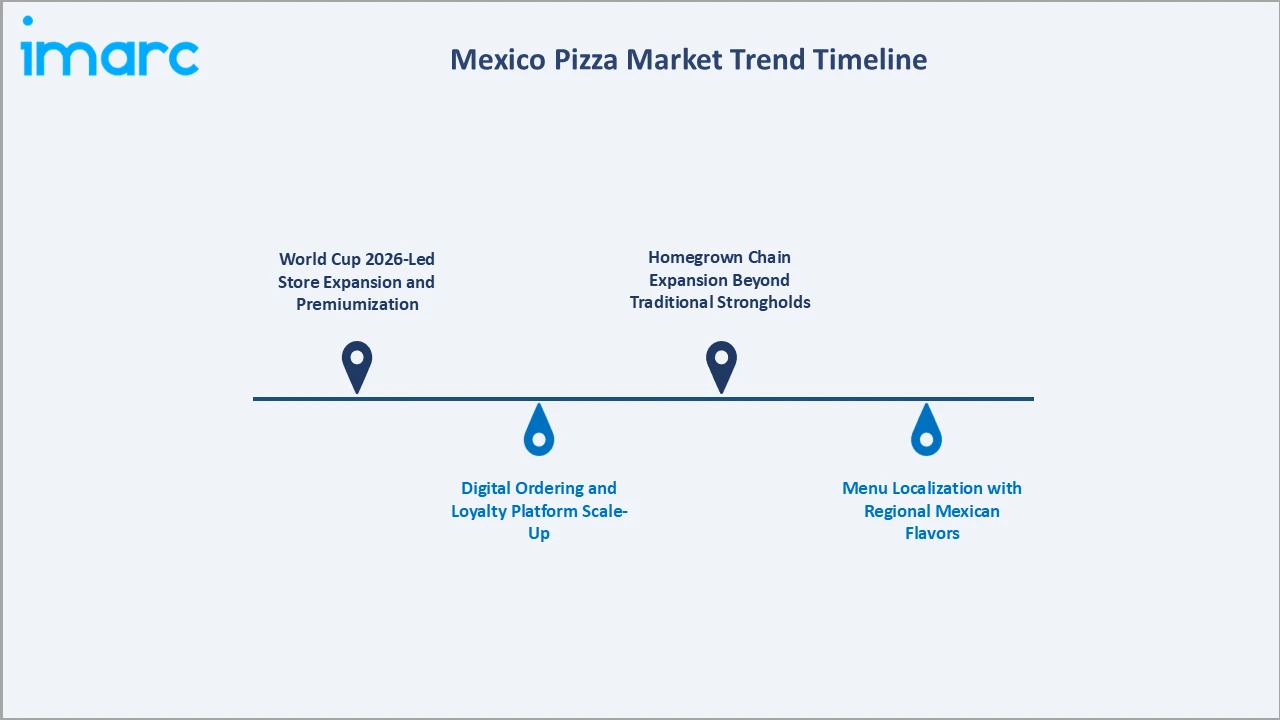
1. World Cup 2026-Led Store Expansion and Premiumization
Mexico's co-hosting of the 2026 FIFA World Cup prompted leading chains to expand store networks and introduce premium, limited-time menu items. Pizza Hut Mexico opened new airport locations and projects double-digit revenue growth during the tournament window, while other chains are expected to intensify marketing and store investment around the event.
2. Digital Ordering and Loyalty Platform Scale-Up
Pizza chains are investing in mobile app ordering, loyalty points, and personalized promotions to build repeat usage. Alsea highlighted digital and loyalty sales as a growing share of its Mexico QSR business, reflecting a broader shift toward app-first ordering across the pizza category.
3. Homegrown Chain Expansion Beyond Traditional Strongholds
Benedetti's Pizza, Mexico's largest domestically owned pizza chain, founded in Colima in 1983, continues to expand its franchise network into new cities including Mexico City, Guadalajara, and Monterrey, competing directly with international chains through combo pricing and regionally inspired toppings.
4. Menu Localization with Regional Mexican Flavors
Chains are increasingly localizing menus with toppings such as al pastor, chorizo, jalapeño, and cochinita pibil to differentiate from standardized international offerings and appeal to regional taste preferences across Mexico's diverse states.
Industry Value Chain Analysis
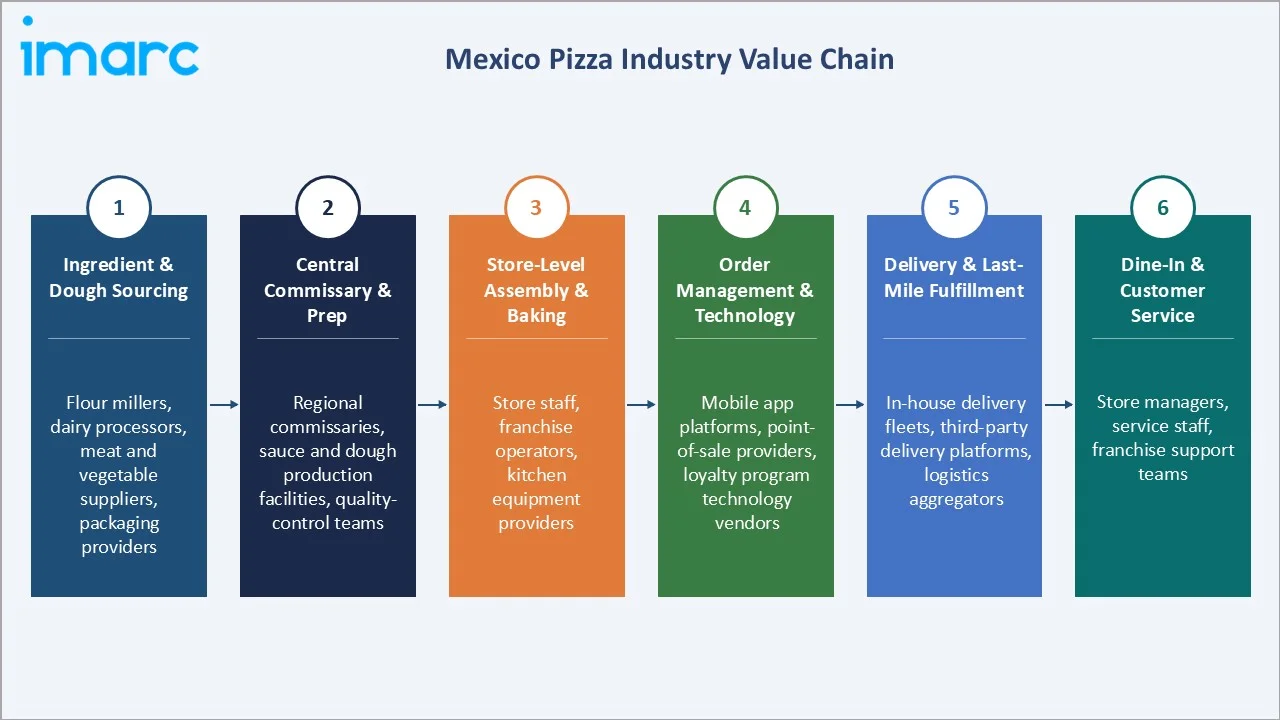
Mexico's pizza value chain integrates ingredient and dough sourcing, central commissary preparation, store-level assembly and baking, order management, and last-mile delivery or dine-in service. Large chains such as Domino's Pizza rely on centralized supply-chain operations, including Alsea's in-house distribution unit, to standardize ingredient quality and control costs across hundreds of stores nationwide.
|
Stage |
Key Participants |
|
Ingredient & Dough Sourcing |
Flour millers, dairy processors, meat and vegetable suppliers, packaging providers |
|
Central Commissary & Prep |
Regional commissaries, sauce and dough production facilities, quality-control teams |
|
Store-Level Assembly & Baking |
Store staff, franchise operators, kitchen equipment providers |
|
Order Management & Technology |
Mobile app platforms, point-of-sale providers, loyalty program technology vendors |
|
Delivery & Last-Mile Fulfillment |
In-house delivery fleets, third-party delivery platforms, logistics aggregators |
|
Dine-In & Customer Service |
Store managers, service staff, franchise support teams |
Store-level assembly and baking represents a key value-creation stage in the Mexico pizza value chain, as consistent product quality, speed of service, and menu execution directly shape customer satisfaction and repeat visits. Chains that standardize recipes and invest in efficient kitchen workflows, such as Little Caesars' hot-and-ready model, are able to differentiate on speed and price, while other operators compete on menu variety and topping customization.
Technology Landscape in the Mexico Pizza Industry
Mobile Ordering and Delivery Platform Integration
Pizza chains increasingly integrate directly with third-party delivery platforms such as Rappi, Uber Eats, and DiDi Food, alongside proprietary mobile apps. This dual-channel approach helps chains reach delivery-first customers while retaining direct relationships and loyalty data through owned digital channels, supporting more targeted promotions and repeat ordering.
Point-of-Sale and Kitchen Automation
Store-level technology, including digital point-of-sale systems and kitchen display screens, helps chains manage high order volumes during peak periods such as major sporting events. These systems support faster order processing, more accurate inventory tracking, and improved coordination between front-of-house and kitchen teams across large franchise networks.
Loyalty and Customer Data Platforms
Leading operators are expanding loyalty programs that track customer preferences and purchase frequency, enabling personalized offers and targeted win-back campaigns. Alsea cited rising loyalty-linked sales contribution across its Mexico QSR portfolio, reflecting the growing role of customer data in driving repeat pizza purchases.
Market Segmentation Analysis
The report covers the following segments:
|
Segment Category |
Leading Segment |
Market Share |
Year |
|
Type |
Non-vegetarian Pizza |
67.9% |
2025 |
|
Crust Type |
Thin Crust |
46.8% |
2025 |
|
Distribution Channel |
🔒 |
🔒 |
2025 |
|
Region |
Central Mexico |
45.9% |
2025 |

By Type
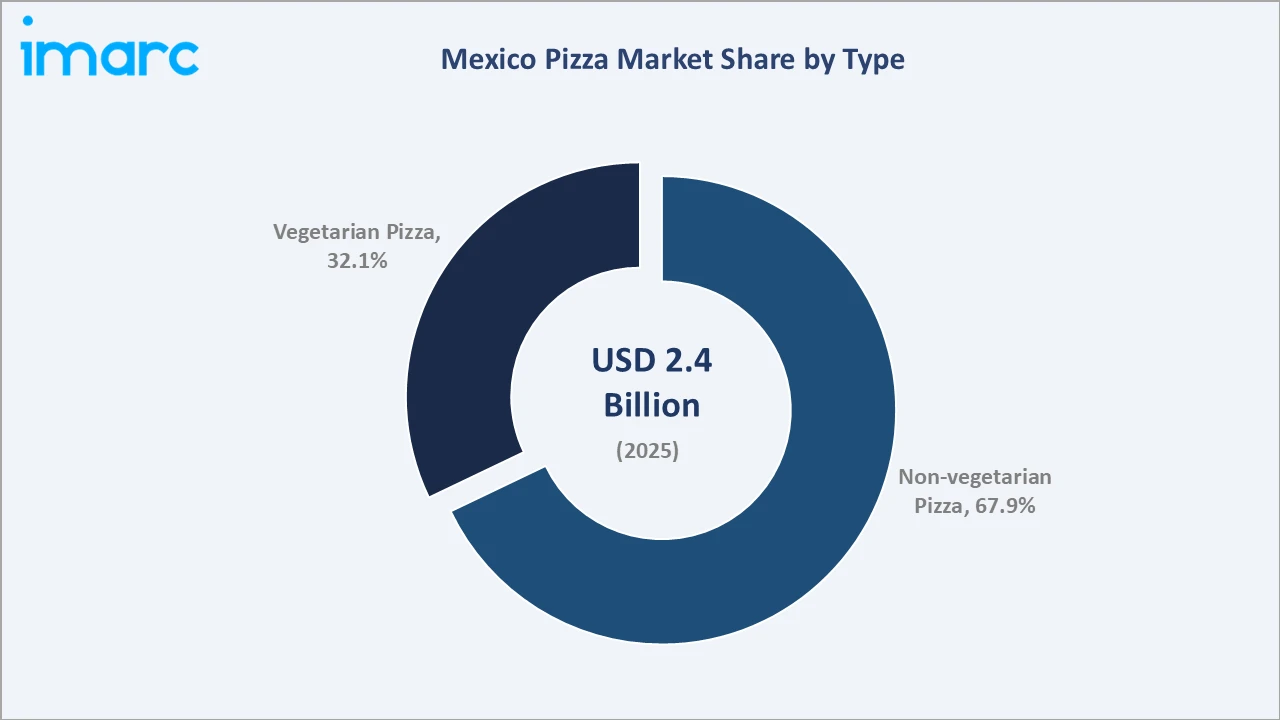
Non-vegetarian pizza leads the type segment at 67.9% (2025), driven by strong consumer preference for pepperoni, ham, chorizo, and regionally inspired meat toppings such as al pastor and cochinita pibil, widely featured across leading chain menus.
To access detailed market analysis, Request Sample
Vegetarian pizza, at 32.1% share, is growing as chains add plant-forward toppings such as mushroom, corn, and roasted vegetables to combo menus, supported by rising health-conscious consumption among younger, urban consumers.
By Crust Type
Thin crust leads the crust-type segment at 46.8% (2025), favored for faster preparation, lower cost, and its positioning as a lighter option across combo promotions from leading chains.
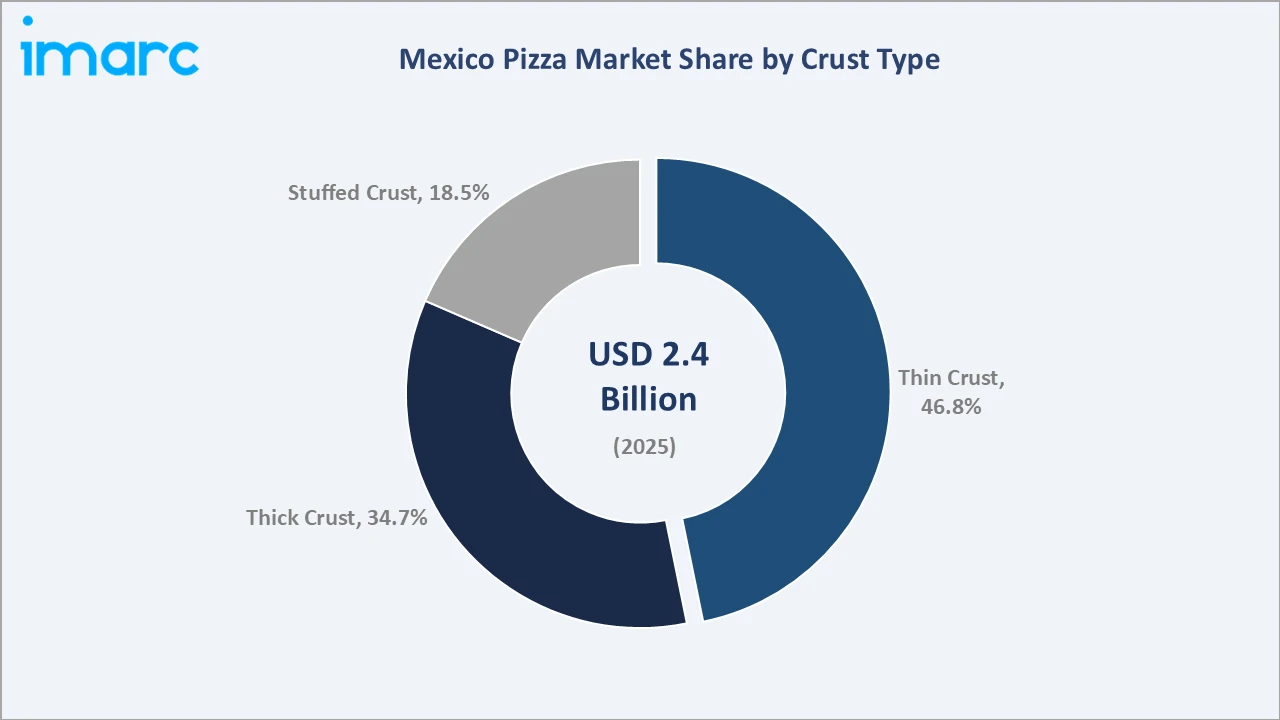
Thick crust follows at 34.7% share, popular in traditional dine-in and family-sharing occasions, while stuffed crust, at 18.5% share, continues to grow through limited-time promotional launches and premium menu positioning by major chains.
Regional Market Insights
|
Region |
Share (2025) |
Key Mexico Pizza Market Drivers & Characteristics |
|
Central Mexico |
45.9% |
Reflects Mexico City's dense urban population, extensive QSR store networks, and mature delivery-platform infrastructure supporting high order frequency. |
|
Northern Mexico |
31.6% |
Reflects strong cross-border consumer influence, established franchise networks, and growing suburban store expansion. |
|
Southern Mexico |
14.3% |
Reflects developing foodservice infrastructure, rising tourism-linked demand in coastal and cultural destinations, and expanding delivery-platform coverage. |
|
Others |
8.2% |
Includes remaining states supported through franchise expansion into secondary cities and growing delivery-platform coverage beyond major metropolitan areas. |
Central Mexico's 45.9% share is supported by Mexico City's dense population, high concentration of QSR stores, and mature last-mile delivery infrastructure operated by platforms such as Rappi and Uber Eats. Northern Mexico follows at 31.6%, reflecting the region's role as Little Caesars' original 2006 market-entry point and continued franchise growth near the US border.
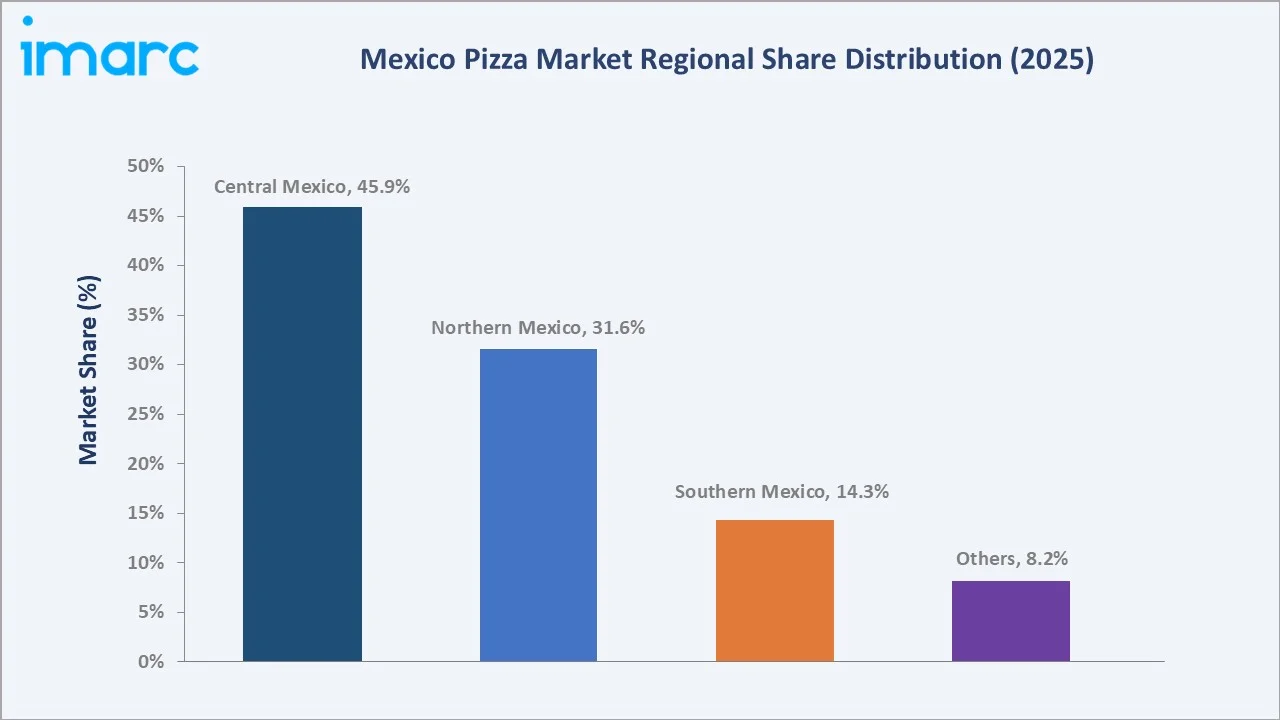
Southern Mexico, at 14.3% share, reflects developing but growing foodservice infrastructure and rising tourism-linked demand, while other regions, at 8.2% share, continue to expand through franchise growth into secondary cities and smaller markets across the country.
Competitive Landscape
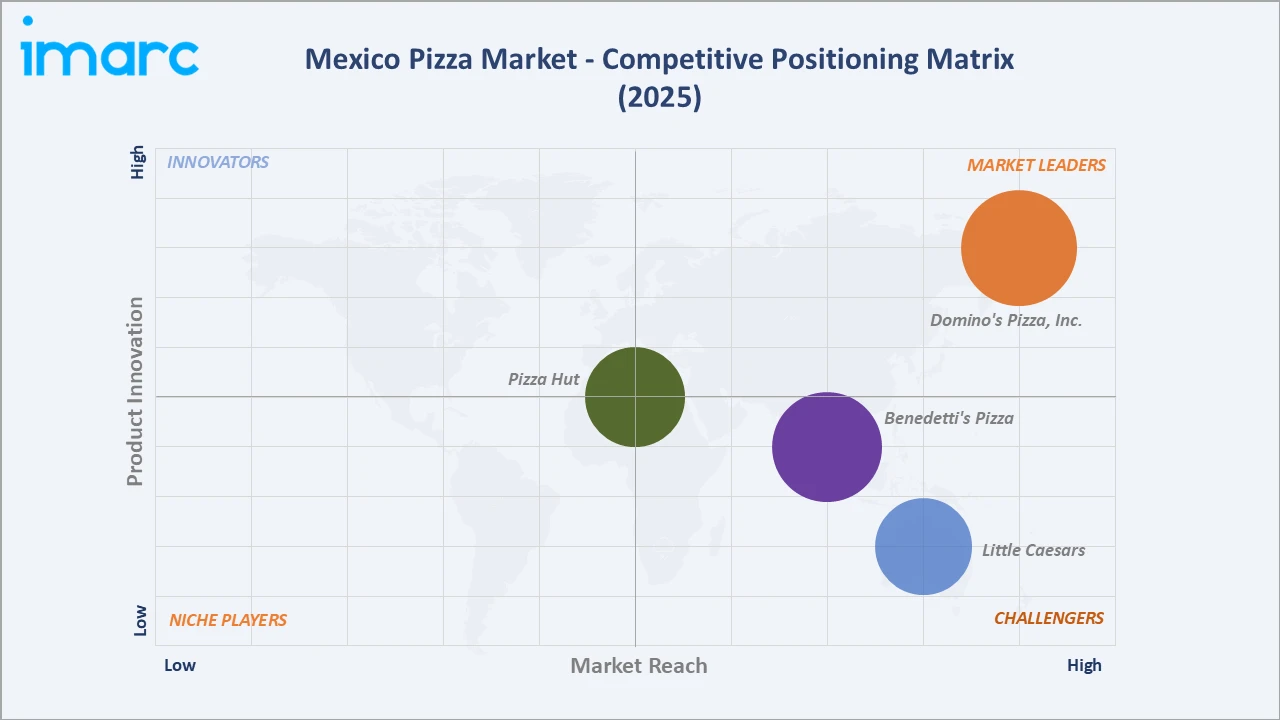
The Mexico pizza market is moderately concentrated, led by international QSR franchises operating alongside a strong domestic challenger. Competition is shaped by store count, delivery speed, price positioning, and menu localization. Domino's Pizza and Little Caesars, present in Mexico since 2006, together account for a large share of chain-affiliated store count, while Pizza Hut and Benedetti's Pizza compete through renewed store formats and homegrown menu positioning, respectively.
|
Company |
Key Regional Offerings |
Market Position |
Core Strength |
|
Domino's Pizza, Inc. |
Mexican-inspired specialty pizzas, chorizo jalapeno cheesy bread, seasoned potato wedges |
Market Leader |
Domino's Pizza is operated in Mexico by Alsea, S.A.B. de C.V., which reports it as the #1 QSR pizza brand worldwide by its own measures. Alsea operates several hundred Domino's stores nationally, supported by its in-house supply-chain and distribution network. |
|
Little Caesars |
Hot-N-Ready Pizzas, Pepperoni Pizza, Cu4tro/Creamy Cu4tro, Crazy Bread |
Strong Challenger |
Little Caesars entered Mexico in 2006 and now operates across all 32 states with an estimated 700-800 units, making Mexico its largest market outside the United States, according to company statements. |
|
Pizza Hut |
Pan Pizza, Orilla de Queso (Stuffed Cheese Crust), regional specialty toppings |
Established Player |
Pizza Hut is operated in Mexico by Spain-based Food Delivery Brands, running more than 300 stores nationally and expanding during the 2026 FIFA World Cup. |
|
Benedetti's Pizza |
Mega Pizzas, Pizza 4 Estaciones, Súper Pizza & Pizza Grande, Papachas |
Market Leader |
Benedetti's Pizza is Mexico's largest domestically owned pizza chain, founded in Colima in 1983, operating more than 100 franchised units across multiple Mexican states. |
Competition continues to intensify around digital ordering, loyalty programs, and store-format innovation, with chains investing in smaller express-format stores, airport locations, and app-based promotions to capture delivery-first consumers during 2026 FIFA World Cup.
Key Company Profiles
Domino's Pizza, Inc.
Domino's Pizza is operated across Mexico by Alsea, S.A.B. de C.V., a Mexico City-based multinational restaurant operator. Alsea describes Domino's as the number one QSR pizza brand worldwide by its internal measures and operates several hundred Domino's stores across Mexico.
- Key Regional Offerings: Mexican-inspired specialty pizzas, chorizo jalapeno cheesy bread, seasoned potato wedges, and others.
- Strategic Focus: Expanding digital and loyalty-driven sales, supported by Alsea's shared supply-chain and distribution infrastructure across its restaurant portfolio.
Little Caesars
Little Caesars entered the Mexican market in 2006 with its first store in Ciudad Juárez and has since expanded to all 32 Mexican states. Company executives have described Mexico as Little Caesars' fastest-growing and largest market outside the United States, built around its signature Hot-N-Ready value model.
- Key Regional Offerings: Hot-N-Ready Pizzas, Pepperoni Pizza, Cu4tro/Creamy Cu4tro, Crazy Bread, and others.
- Strategic Focus: Continued franchise-led expansion into new cities, including recent growth in Pachuca, Hidalgo, alongside its core value-and-speed positioning.
Pizza Hut
Pizza Hut is operated in Mexico by Spain-based Food Delivery Brands, running more than 300 stores nationwide as of 2025-2026. The company has been modernizing store formats and regularizing supplier payments as part of a broader recovery and growth strategy.
- Key Regional Offerings: Pan Pizza, Orilla de Queso (Stuffed Cheese Crust), regional specialty toppings, and others.
- Strategic Focus: Store modernization and expansion during the 2026 FIFA World Cup, including new airport locations at Mexico City's international airport.
Benedetti's Pizza
Benedetti's Pizza is Mexico's largest domestically owned pizza chain, founded in Colima in 1983 and headquartered in Mexico City. The company operates more than 100 franchised units across multiple Mexican states, with roughly half of its franchisees operating more than one location.
- Key Regional Offerings: Mega Pizzas, Pizza 4 Estaciones, Súper Pizza & Pizza Grande, Papachas, and others.
- Strategic Focus: Continued franchise expansion into major metropolitan markets including Mexico City, Guadalajara, and Monterrey.
Market Concentration Analysis
The Mexico pizza market shows moderate concentration, with a small number of large international and domestic chains accounting for a substantial share of branded, chain-affiliated store count, alongside a long tail of independent, unbranded pizzerias serving local neighborhoods. Domino's Pizza and Little Caesars together operate well over a thousand stores nationally, while Pizza Hut and Benedetti's Pizza maintain established, growing networks. Independent pizzerias remain highly fragmented, competing primarily on price and delivery speed within local markets. Consolidation pressure is limited by Mexico's large geographic footprint and continued opportunity for franchise-led expansion into underserved secondary cities and states.
Investment & Growth Opportunities
Highest Growth Segments
Vegetarian pizza (~4.8% estimated CAGR), thin crust (~4.5% estimated CAGR), and store formats targeting airports, travel hubs, and secondary cities represent the Mexico pizza market's highest-growth investment vectors through 2034.
Investment Themes
- Travel-Hub Expansion: Leading chains invested in new airport and travel-corridor locations ahead of the 2026 FIFA World Cup, which Mexico is co-hosting with the United States and Canada.
- Digital Loyalty and App-Based Ordering Infrastructure: Investment in mobile ordering, loyalty programs, and delivery-platform integration is creating opportunities for chains to increase order frequency and customer retention. Alsea highlighted rising digital and loyalty-linked sales contribution across its Mexico QSR business, reflecting continued opportunity for technology-driven growth in the category.
Future Market Outlook (2026-2034)
The Mexico pizza market is projected to grow from USD 2.4 Billion in 2025 to USD 2.5 Billion in 2026, reaching USD 3.5 Billion by 2034, delivering a 3.94% CAGR over the forecast period, supported by continued QSR store expansion, rising digital and delivery-platform penetration, and tourism-linked demand. The market's anchor value of USD 2.9 Billion in 2030 reflects continued post-World Cup store expansion and steadier, delivery-led consumption growth.
Three structural forces are expected to define market growth through 2034. First, continued expansion of leading pizza chains into secondary cities and underserved states will widen the market's geographic footprint. Second, deepening integration between chains and delivery platforms will support order-frequency growth among urban, digitally engaged consumers. Third, ongoing menu localization with regional Mexican flavors and health-conscious, plant-forward options will help chains differentiate and capture a broader range of consumer occasions.
Research Methodology
Primary Research
Primary research comprised review and analysis of statements from pizza chain operators, franchise directors, and foodservice industry participants in Mexico. Publicly disclosed operating metrics, store-count updates, and executive statements from companies including Alsea, Little Caesars, Food Delivery Brands, and Benedetti's Pizza were reviewed to validate store-network trends, expansion plans, and competitive positioning.
Secondary Research
Secondary research drew on government and company sources, including INEGI and CANIRAC publications on Mexico's food-preparation and beverage-service sector, Alsea's quarterly investor reports and corporate presentations, and public statements from Little Caesars, Food Delivery Brands, and Benedetti's Pizza. Government agricultural market information sources were also reviewed for national pizza consumption estimates.
Forecasting Models
Forecasting models combined historical market performance from 2020 to 2025 with expected store-network growth, delivery-platform penetration trends, and tourism-linked demand associated with the 2026 FIFA World Cup. Segment- and region-level estimates were validated through triangulation of company-disclosed store counts, government sector statistics, and observed category growth patterns to support long-term projections through 2034.
Mexico Pizza Market Report Coverage:
| Report Features | Details |
|---|---|
| Base Year of the Analysis | 2025 |
| Historical Period | 2020-2025 |
| Forecast Period | 2026-2034 |
| Units | Billion USD |
| Scope of the Report |
Exploration of Historical Trends and Market Outlook, Industry Catalysts and Challenges, Segment-Wise Historical and Future Market Assessment:
|
| Types Covered | Non-vegetarian Pizza, Vegetarian Pizza |
| Crust Types Covered | Thick Crust, Thin Crust, Stuffed Crust |
| Distribution Channels Covered | Quick Service Restaurants (QSR), Full-Service Restaurants (FSR), Others |
| Regions Covered | Northern Mexico, Central Mexico, Southern Mexico, Others |
| Companies Covered | Domino's Pizza Inc., Little Caesars, Pizza Hut, Benedetti's Pizza, etc. |
| Customization Scope | 10% Free Customization |
| Post-Sale Analyst Support | 10-12 Weeks |
| Delivery Format | PDF and Excel through Email (We can also provide the editable version of the report in PPT/Word format on special request) |
Key Benefits for Stakeholders:
- IMARC’s industry report offers a comprehensive quantitative analysis of various market segments, historical and current market trends, market forecasts, and dynamics of the Mexico pizza market from 2020-2034.
- The research report provides the latest information on the market drivers, challenges, and opportunities in the Mexico pizza market.
- Porter's five forces analysis assist stakeholders in assessing the impact of new entrants, competitive rivalry, supplier power, buyer power, and the threat of substitution. It helps stakeholders to analyze the level of competition within the Mexico pizza industry and its attractiveness.
- Competitive landscape allows stakeholders to understand their competitive environment and provides an insight into the current positions of key players in the market.
Frequently Asked Questions About the Mexico Pizza Market Report
The Mexico pizza market size increased from USD 2.4 Billion in 2025 and USD 2.5 Billion in 2026, supported by expanding QSR store networks, rising food-delivery app penetration, and strong consumer demand for convenient, value-priced meals across dine-in, takeaway, and delivery channels nationwide.
The Mexico pizza market is projected to grow at a CAGR of 3.94% during 2026-2034, reaching USD 3.5 Billion by 2034, supported by continued store expansion and World Cup-linked tourism demand.
Non-vegetarian pizza leads at 67.9% share, reflecting strong consumer preference for meat-based toppings, including regionally inspired options such as al pastor and cochinita pibil, widely featured across leading chain menus.
Thin crust leads at 46.8% share, favored for faster preparation, lower price points, and its positioning as a lighter option within combo promotions offered by major pizza chains.
Central Mexico leads at 45.9% share, supported by Mexico City's dense urban population, extensive QSR store networks, and mature last-mile delivery infrastructure across the metropolitan area.
Leading chains include Domino's Pizza, Inc., Little Caesars, Pizza Hut, and Benedetti's Pizza, among others.
The market is projected to reach approximately USD 2.9 Billion by 2030, supported by continued store expansion, rising delivery-platform penetration, and tourism-linked demand from the 2026 FIFA World Cup.
Key opportunities include World Cup 2026-linked travel-hub store expansion, digital loyalty and app-based ordering infrastructure, and continued franchise growth into secondary Mexican cities and underserved states.
Need more help?
- Speak to our experienced analysts for insights on the current market scenarios.
- Include additional segments and countries to customize the report as per your requirement.
- Gain an unparalleled competitive advantage in your domain by understanding how to utilize the report and positively impacting your operations and revenue.
- For further assistance, please connect with our analysts.
 Request Customization
 Speak to an Analyst
 Request Brochure
 Inquire Before Buying
Benefits of Customization
- Personalize this research
- Triangulate with your data
- Get data as per your format and definition
- Gain a deeper dive into a specific application, geography, customer, or competitor
- Any level of personalization
Get in Touch With Us
UNITED STATES
Phone: +1-201-971-6302
INDIA
Phone: +91-120-433-0800
UNITED KINGDOM
Phone: +44-753-714-6104
Email: [email protected]
Client Testimonials




.webp)




.webp)













Related Reports

Choose your plan
*Please note that the prices mentioned below are starting prices for each bundle type. Kindly contact our team for further details.*
Single User License
- 1 User License, Access on 2 Devices
- PDF Report + Excel Dataset (Password Protected)
- Lifetime Access
- No Printing Rights
- 10% Free Report Customization
- 10–12 Weeks of Analyst Support
Five User License
- Access for 5 Users, 2 Devices per User
- PDF Report + Excel Dataset (Password Protected)
- Lifetime Access
- Dedicated Account Manager
- 12–14 Weeks of Analyst Support
- No Printing Rights
- 15% Free Report Customization
- 25% Discount on Your Next Purchase
Corporate User License
- Unlimited User Access (Within Your Organization)
- PDF Report + Excel Dataset
- Lifetime Access
- Dedicated Account Manager
- 14–20 Weeks of Analyst Support
- No Printing Rights
- 20% Free Report Customization
- 30% Discount on Your Next Purchase
Essential Insights
What's included:
3 reports
- Lifetime Access
- PDF Reports
- Excel Datasets
- 2 Weeks of Free Analyst Support
- 2 User Licenses
- Access on 2 Devices
- Printing Rights
- Complimentary PowerPoint (PPT) Version
- Complimentary License Upgrade
Professional Access
What's included:
5 reports
- Lifetime Access
- PDF Reports
- Excel Datasets
- 8 Weeks of Free Analyst Support
- 2 User Licenses
- Access on 2 Devices
- Printing Rights
- Complimentary PowerPoint (PPT) Version
- Complimentary License Upgrade
Business Advantage
What's included:
8 reports
- Lifetime Access
- PDF Reports
- Excel Datasets
- 14 Weeks of Free Analyst Support
- 2 User Licenses
- Access on 2 Devices
- Printing Rights
- Complimentary PowerPoint (PPT) Version
- Complimentary License Upgrade
Enterprise Intelligence
What's included:
10 reports
- Lifetime Access
- PDF Reports
- Excel Datasets
- 20 Weeks of Free Analyst Support
- 2 User Licenses
- Access on 2 Devices
- Printing Rights
- Complimentary PowerPoint (PPT) Version
- Complimentary License Upgrade