
Mobile Satellite Services Market Size, Share, Trends and Forecast by Service Type, Application Type, Industry Vertical, and Region, 2026-2034
Mobile Satellite Services Market Size, Share, Trends & Forecast (2026-2034)
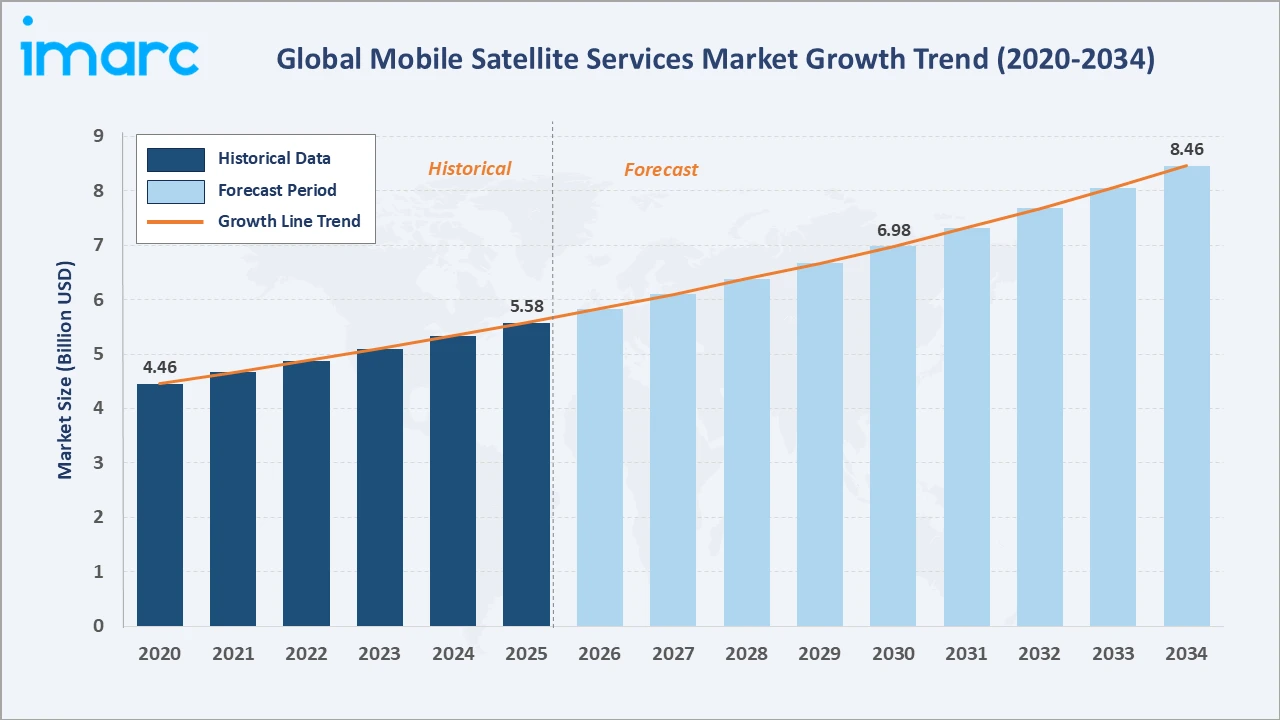
The global mobile satellite services market reached USD 5.58 Billion in 2025 and is projected to reach USD 8.46 Billion by 2034, growing at a CAGR of 4.58% during 2026-2034. Growth is propelled by rising demand for enhanced data and multimedia access, expanding 5G convergence with satellite networks, and increasing reliance on mobile satellite services (MSS) across defense, maritime, and remote industrial operations.
Data Service leads the service type segment at 47.8% due to escalating enterprise and IoT connectivity needs, while land application type dominates at 49.5% led by remote monitoring and emergency communication use cases. North America commands 36.4% of the global market share, supported by advanced satellite infrastructure and strong defense and maritime end-use adoption.
Market Snapshot
|
Metric |
Value |
|
Market Size (2025) |
USD 5.58 Billion |
|
Forecast Market Size (2034) |
USD 8.46 Billion |
|
CAGR (2026-2034) |
4.58% |
|
Base Year |
2025 |
|
Historical Period |
2020-2025 |
|
Forecast Period |
2026-2034 |
|
Dominant Service Type |
Data Service (47.8%, 2025) |
|
Dominant Application Type |
Land (49.5%, 2025) |
|
Leading Region |
North America (36.4%, 2025) |
The market expanded steadily from USD 4.46 Billion in 2020 to USD 5.58 Billion in 2025, anchored at USD 6.98 Billion in 2030, and forecast to reach USD 8.46 Billion by 2034. Growth remained resilient through recurring satellite capacity constraints and elevated launch costs, supported by accelerating LEO constellation deployment and rising demand for connectivity beyond terrestrial network coverage.
To get more information on this market, Request Sample
Data Service grows fastest at an estimated ~5.1% CAGR as enterprise IoT, fleet tracking, and broadband connectivity applications multiply data traffic volumes. Maritime applications expand at ~5.6% CAGR, the fastest among application types, as shipping fleets adopt satellite connectivity for safety compliance and crew welfare.
-12-(1).webp)
Executive Summary
The global mobile satellite services market reached USD 5.58 Billion in 2025, reflecting sustained demand for connectivity solutions that operate independently of terrestrial infrastructure. MSS enables voice, data, and video communication for mobile and fixed terminals across land, maritime, and air environments, making it indispensable for defense, disaster response, and remote industrial operations. The market is projected to reach USD 8.46 Billion by 2034.
Data Service at 47.8% dominates the service type segment through rising enterprise connectivity, IoT device proliferation, and broadband data demand from remote sites. Land applications at 49.5% lead through widespread use in transportation, remote monitoring, and public safety communication. North America at 36.4% leads globally through advanced satellite ground infrastructure, strong defense procurement, and early 5G-satellite integration.
Key Market Insights
|
Insight |
Data |
|
Dominant Service Type |
Data Service - 47.8% share (2025) |
|
Dominant Application Type |
Land - 49.5% market share (2025) |
|
Leading Region |
North America - 36.4% market share (2025) |
|
Market Opportunity |
LEO constellation expansion; direct-to-device connectivity; 5G-satellite convergence; maritime safety compliance mandates |
Key Analytical Observations Supporting the Above Data:
- Data Service at 47.8%: Data Service dominates as enterprises, IoT networks, and government agencies increasingly rely on satellite broadband for remote connectivity, supported by falling terminal costs and expanding LEO capacity.
- Land at 49.5%: Land application type leads through transportation fleet tracking, utility monitoring, and public safety communication, particularly in regions with limited terrestrial coverage.
- North America at 36.4%: North America leads through advanced satellite infrastructure, strong defense and homeland security spending, and early adoption of next-generation MSS technologies.
Mobile Satellite Services Market Overview
The global mobile satellite services market encompasses radio communication services that deliver voice, data, and internet connectivity to mobile and fixed terminals, ships, aircraft, buildings, and land vehicles independent of local terrestrial infrastructure. MSS provides wide-area earth coverage and is critical for disaster relief telecommunications, positioning it as an essential connectivity layer beyond conventional cellular networks.
The ecosystem integrates satellite operators, ground infrastructure providers, terminal and equipment manufacturers, service resellers, and regulatory bodies overseeing spectrum allocation. Macroeconomic factors include rising defense budgets, expanding maritime trade, growing remote workforce connectivity needs, and continued investment in low-earth orbit satellite constellations.
Rising digitalization across remote and underserved geographies, coupled with growing awareness of disaster-resilient communication infrastructure, is expanding the addressable base for MSS providers beyond traditional defense and maritime customers. Enterprises across agriculture, forestry, mining, and logistics are increasingly integrating satellite connectivity into their operational technology stacks to enable real-time asset tracking, remote monitoring, and automated reporting, further diversifying the market's end-use composition.
Market Dynamics
To evaluate market opportunities, Request Sample
Market Drivers
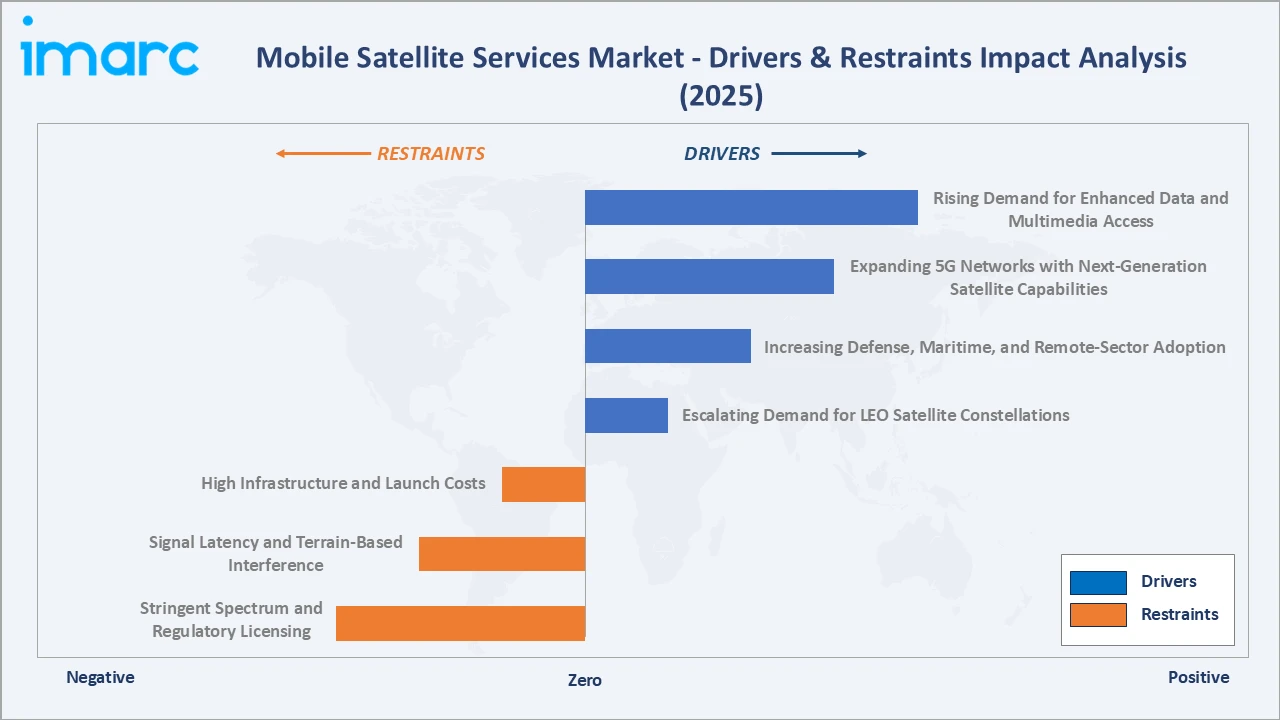
- Rising Demand for Enhanced Data and Multimedia Access: Growing high-speed internet penetration and improving wireless access have introduced new capabilities such as enhanced data and multimedia access, directly driving MSS adoption across enterprise and consumer segments requiring connectivity beyond terrestrial coverage. As remote workforces, IoT sensor networks, and content-rich applications proliferate, subscribers increasingly demand higher-throughput satellite links, prompting operators to expand bandwidth capacity and roll out new data-centric service tiers. This structural shift in usage patterns is reinforcing sustained investment across the MSS value chain.
- Expanding 5G Networks with Next-Generation Satellite Capabilities: The advent of 5G mobile networks integrated with next-generation satellite capabilities is catalyzing demand for MSS worldwide, enabling seamless handoff between terrestrial and satellite connectivity for uninterrupted service. Telecom operators are increasingly partnering with satellite providers to extend 5G coverage into rural and maritime zones, creating hybrid network architectures that reduce coverage gaps and unlock new enterprise and consumer use cases.
- Increasing Defense, Maritime, and Remote-Sector Adoption: Military and defense personnel operating on land, sea, and air in remote areas rely on MSS for network accessibility, while forestry, mining, and oil and gas companies use MSS for voice communication, remote connectivity, and automated equipment monitoring. Rising geopolitical tensions and expanding offshore exploration activity are further accelerating procurement of ruggedized, mission-critical satellite terminals across these sectors.
- Escalating Demand for LEO Satellite Constellations: The rising deployment of low-earth orbit (LEO) satellites is strengthening market growth by reducing latency and expanding coverage, making MSS increasingly viable for time-sensitive applications. Falling launch costs and reusable rocket technology are enabling operators to deploy denser constellations at lower capital outlay, accelerating the commercial rollout of low-latency broadband and real-time tracking services.
Market Restraints
- High Infrastructure and Launch Costs: Satellite manufacturing, launch, and ground infrastructure development require substantial capital expenditure, limiting entry for smaller players and constraining pricing flexibility for service providers. These elevated upfront costs also extend payback periods for new constellations, discouraging aggressive capacity expansion in price-sensitive emerging markets.
- Signal Latency and Terrain-Based Interference: Geostationary MSS links can experience latency and signal degradation in dense urban or heavily forested terrain, affecting service reliability for certain end-use applications. Such performance constraints can deter latency-sensitive enterprise customers from fully migrating critical workloads to satellite-based connectivity, favoring hybrid network deployments instead.
- Stringent Spectrum and Regulatory Licensing: Complex, region-specific spectrum allocation and licensing requirements increase compliance costs and delay market entry for satellite operators expanding into new geographies. Fragmented regulatory frameworks across countries also complicate cross-border service continuity, requiring operators to maintain dedicated legal and compliance teams in each target market.
Market Opportunities
- Direct-to-Device (D2D) Connectivity: Emerging D2D satellite technology enabling standard smartphones to connect directly to satellites creates a substantial new consumer MSS opportunity. As chipset manufacturers embed satellite connectivity modules into mainstream devices, operators gain access to a vastly larger addressable subscriber base beyond dedicated terminal owners.
- AI-Enabled Network Optimization: Artificial intelligence-driven satellite network management can improve capacity allocation and service reliability, opening opportunities for value-added MSS offerings. Predictive analytics also allow operators to proactively reroute traffic during congestion or weather disruption, strengthening service-level commitments to premium enterprise customers.
Market Challenges
- Orbital Congestion and Spectrum Interference Risk: Rapid growth in LEO satellite deployments is increasing orbital congestion and the risk of signal interference between competing constellations. Operators must invest in advanced collision-avoidance systems and coordinate spectrum usage with regulators, adding operational complexity and cost to network expansion plans.
- Terminal Affordability in Price-Sensitive Markets: High satellite terminal and subscription costs continue to restrict adoption among small enterprises and individual users in price-sensitive emerging economies. Bridging this affordability gap requires sustained investment in terminal miniaturization and manufacturing scale, which smaller regional operators may struggle to fund independently.
Emerging Market Trends
1. LEO Satellite Constellation Expansion
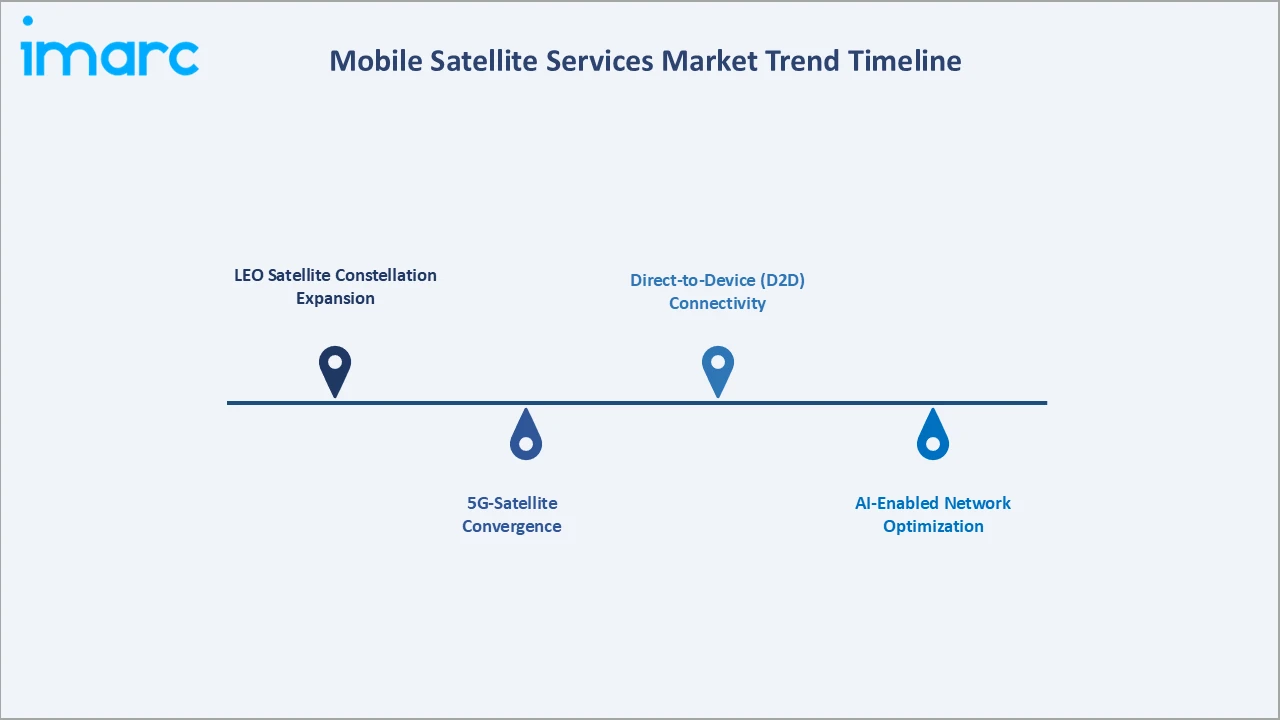
Rapid deployment of low-earth orbit satellite constellations is reducing latency and expanding global coverage, enabling MSS providers to deliver higher-throughput data and voice services to previously underserved regions. This trend is reshaping competitive dynamics as new entrants leverage LEO capacity to challenge established geostationary operators on price and performance.
2. 5G-Satellite Convergence
Integration of satellite links with 5G core networks is enabling seamless connectivity handoff, supporting continuous service for mobile users transitioning between terrestrial and non-terrestrial networks. Standards bodies are actively defining interoperability frameworks to accelerate commercial adoption of converged network architectures.
3. Direct-to-Device (D2D) Connectivity
Satellite operators are partnering with mobile network operators to enable direct-to-device connectivity on standard smartphones, expanding the addressable consumer base for emergency messaging and basic connectivity. Several flagship smartphone launches have already incorporated satellite messaging as a standard safety feature, accelerating mainstream awareness.
4. AI-Enabled Network Optimization
Operators are deploying AI-driven traffic management and predictive maintenance systems to optimize satellite capacity utilization and improve service reliability across fluctuating demand patterns. These systems also enable dynamic pricing and capacity trading between operators, improving overall network efficiency.
Industry Value Chain Analysis
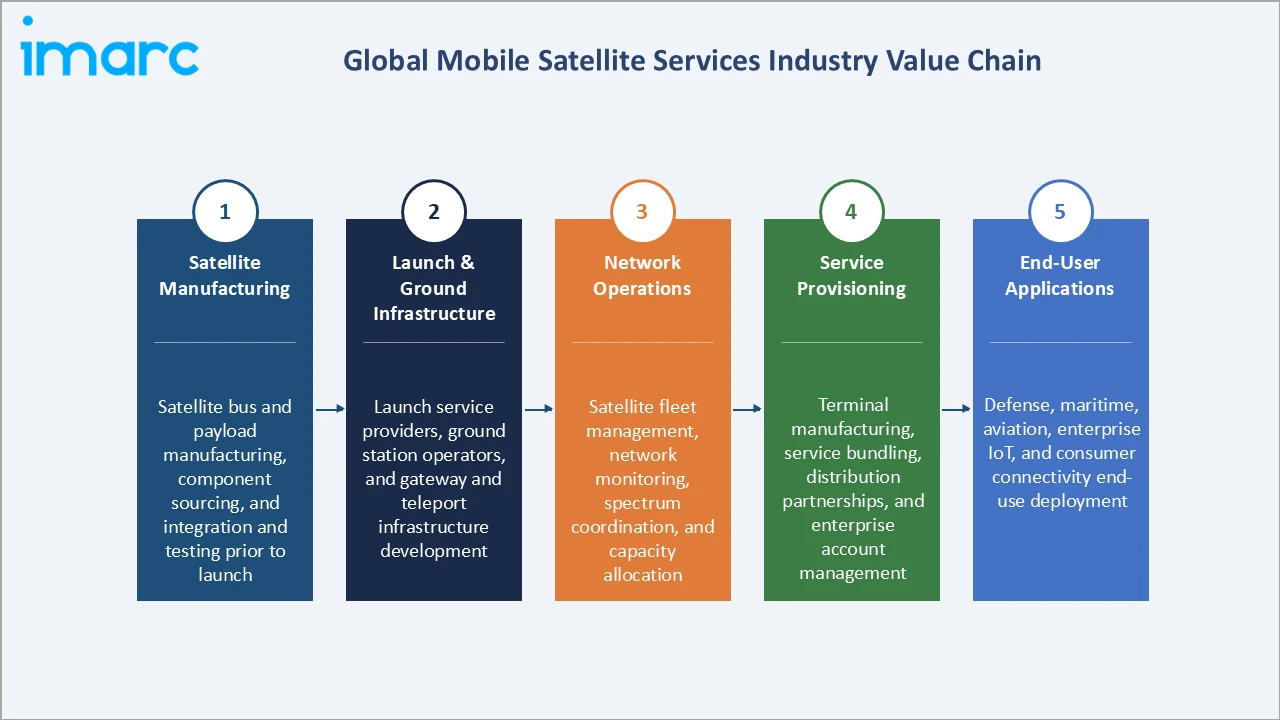
The MSS value chain integrates satellite manufacturing, launch and ground infrastructure deployment, network operations, service provisioning, and end-user application delivery. The value chain has progressively consolidated around vertically integrated satellite operators offering end-to-end connectivity solutions, reducing dependence on third-party ground segment providers and improving service-level control.
|
Stage |
Key Participants |
|
Satellite Manufacturing |
Satellite bus and payload manufacturing, component sourcing, and integration and testing prior to launch |
|
Launch & Ground Infrastructure |
Launch service providers, ground station operators, and gateway and teleport infrastructure development |
|
Network Operations |
Satellite fleet management, network monitoring, spectrum coordination, and capacity allocation |
|
Service Provisioning |
Terminal manufacturing, service bundling, distribution partnerships, and enterprise account management |
|
End-User Applications |
Defense, maritime, aviation, enterprise IoT, and consumer connectivity end-use deployment |
Technology Landscape in the Mobile Satellite Services Industry
Geostationary (GEO) Satellite Technology
Geostationary satellite technology offers wide, fixed-area coverage and stable connectivity, making it well-suited for broadcast, maritime, and enterprise applications requiring consistent bandwidth over a defined region. Its established infrastructure base continues to underpin a significant share of current MSS revenue.
Low-Earth Orbit (LEO) Satellite Technology
LEO satellite technology delivers significantly lower latency and higher throughput than traditional geostationary systems, supporting real-time applications such as video conferencing and time-sensitive IoT data transmission. Its rapid commercial scale-up is reshaping competitive dynamics across the MSS industry.
Direct-to-Device Satellite Technology
Direct-to-device satellite technology enables standard smartphones to connect to satellite networks without specialized terminals, using enhanced onboard processing and expanded spectrum partnerships. This technology is expected to substantially broaden the consumer MSS addressable market over the forecast period.
AI-Enabled Network Management Technology
Artificial intelligence and machine learning are increasingly embedded within satellite network operations to optimize bandwidth allocation, predict maintenance requirements, and dynamically reroute traffic during congestion or adverse weather events. This technology layer is enhancing overall service reliability while reducing operational costs for satellite operators managing increasingly complex multi-orbit networks.
Market Segmentation Analysis
The report covers the following segments:
|
Segment Category |
Leading Segment |
Market Share |
Year |
|
Service Type |
Data Service |
47.8% |
2025 |
|
Application Type |
Land |
49.5% |
2025 |
|
Industry Vertical |
Aerospace and Defense |
🔒 |
2025 |
|
Region |
North America |
36.4% |
2025 |

By Service Type
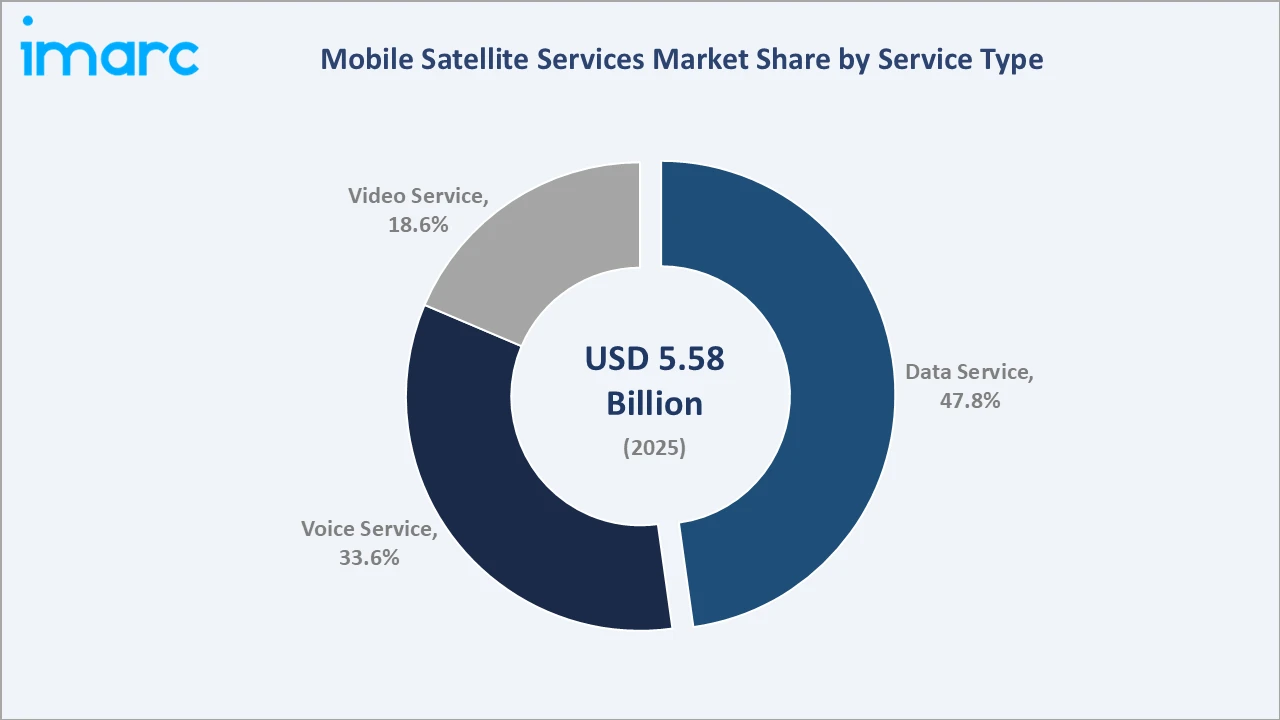
Data Service leads at 47.8% in 2025, driven by rising enterprise connectivity, IoT device proliferation, and remote broadband access requirements across defense, maritime, and industrial end-users.
To access detailed market analysis, Request Sample
Voice Service at 33.6% remains critical for emergency communication and remote workforce coordination, while Video Service at 18.6% is the fastest-growing category as surveillance and broadcast applications expand across defense and media end-use sectors.
By Application Type
Land application type lead at 49.5% through widespread use in transportation, utility monitoring, and public safety communication in regions with limited terrestrial network coverage.
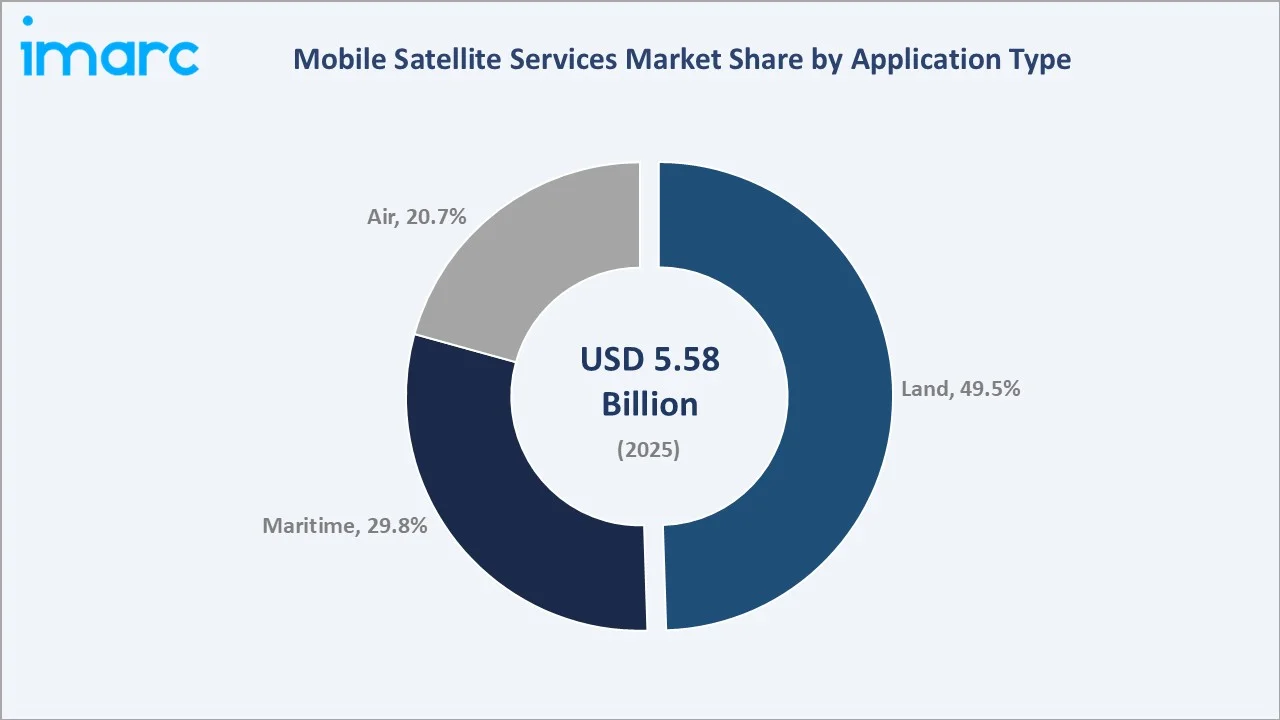
Maritime applications at 29.8% reflect growing shipping fleet connectivity mandates for safety compliance and crew welfare, while Air applications at 20.7% are supported by expanding in-flight connectivity and aviation safety communication requirements.
Regional Market Insights
Regional MSS adoption patterns closely track each geography's defense spending priorities, maritime trade exposure, and terrestrial network coverage gaps, resulting in materially different growth drivers across regions despite a broadly consistent global technology roadmap.
|
Region |
Share (2025) |
Key MSS Market Drivers & Characteristics |
|
North America |
36.4% |
Driven by advanced satellite ground infrastructure, strong defense and homeland security spending, and early adoption of 5G-satellite convergence |
|
Asia-Pacific |
28.7% |
Supported by expanding maritime trade, rising defense modernization, and growing rural connectivity initiatives across China, Japan, and India |
|
Europe |
20.1% |
Driven by stringent maritime safety regulations, cross-border defense cooperation, and investments in satellite communication infrastructure |
|
Latin America |
8.2% |
Growing through expanding oil and gas remote operations and increasing disaster-response telecommunications needs |
|
Middle East and Africa |
6.6% |
Emerging with rising oil and gas sector adoption, defense modernization, and infrastructure development initiatives |
North America, at 36.4%, leads through its advanced satellite ground infrastructure base, robust defense procurement, and early commercial rollout of direct-to-device connectivity services. Asia-Pacific, at 28.7%, reflects the region's expanding maritime trade volumes and rising rural connectivity investments.
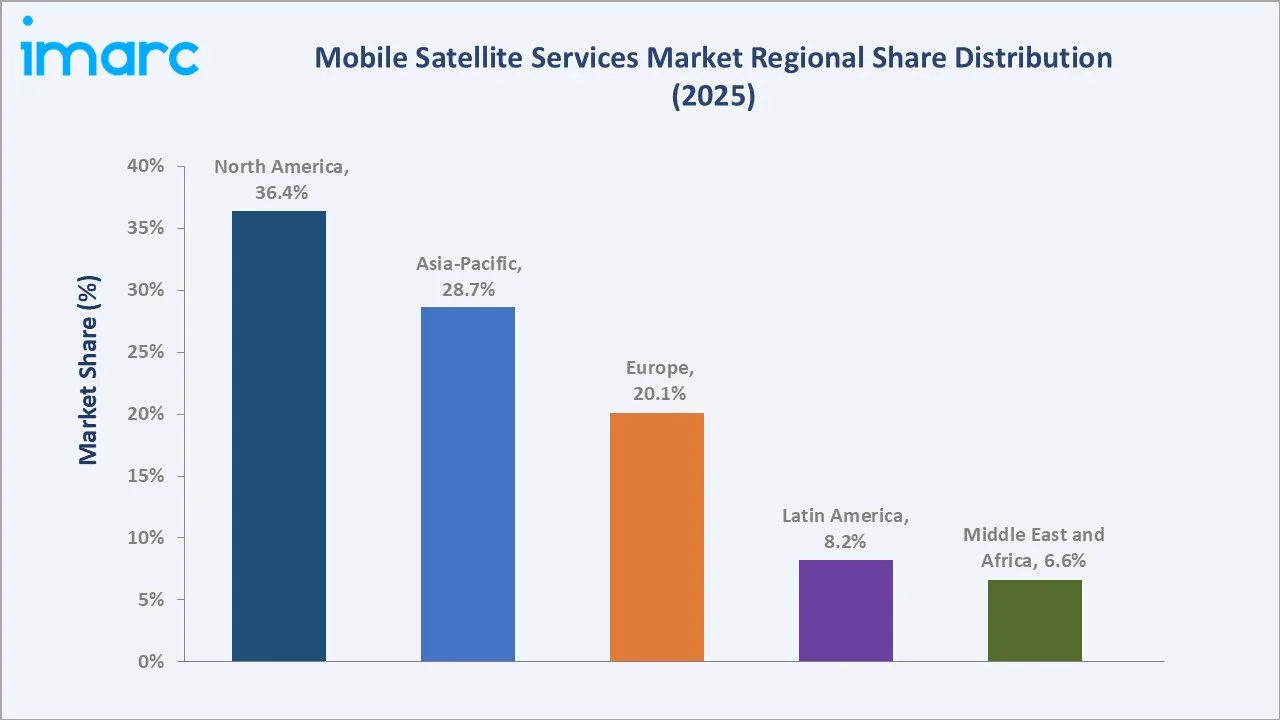
Europe, at 20.1%, is supported by stringent maritime safety mandates and cross-border defense cooperation. Latin America, at 8.2%, and Middle East and Africa, at 6.6%, represent emerging but steadily growing MSS markets driven primarily by remote oil and gas operations and disaster-response telecommunications needs.
Competitive Landscape
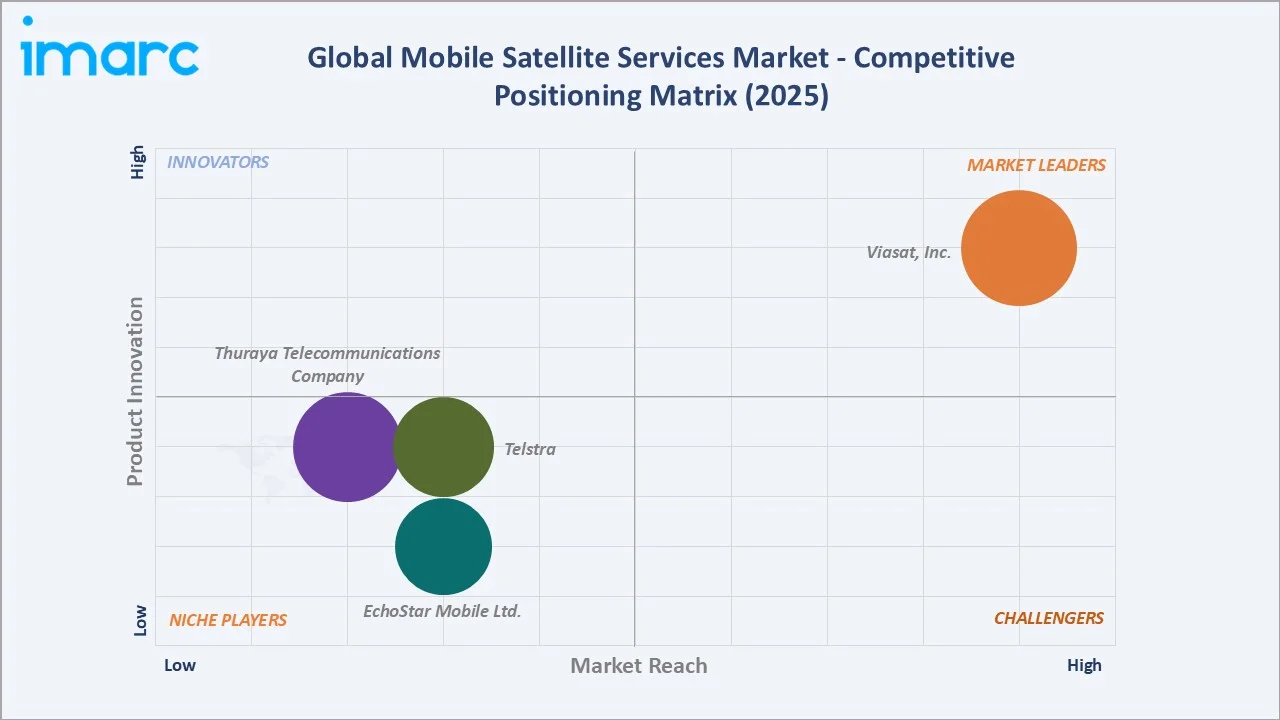
The global mobile satellite services market competitive landscape is moderately consolidated, comprising established satellite network operators, regional telecommunications providers, and specialized niche connectivity providers. Competitive differentiation increasingly hinges on constellation scale, latency performance, and the breadth of direct-to-device partnership agreements secured with mobile network operators and device manufacturers.
|
Company Name |
Key Products |
Market Position |
Core Strength |
|
Viasat, Inc. |
Fleet Xpress, NexusWave |
Market Leader |
Viasat specializes in maritime, aviation, and enterprise satellite communication with a strong geostationary network. |
|
EchoStar Mobile Ltd. |
EchoStar Mobile SYNERGY, EchoStar Mobile MOMENTUM, EchoStar Mobile CONTINUITY, EchoStar Mobile ADVANTAGE |
Niche Player |
EchoStar Mobile focuses on IoT and M2M satellite connectivity across European coverage areas. |
|
Telstra |
Mobile Satellite |
Niche Player |
Telstra offers regional satellite connectivity integrated with its broader telecommunications network in Australia. |
|
Thuraya Telecommunications Company |
Thuraya XT-LITE, Thuraya IP+ |
Niche Player |
Thuraya provides regional MSS coverage across the Middle East, Africa, Asia, and Europe with cost-effective terminals. |
Key players include Viasat, Inc., EchoStar Mobile Ltd., Telstra, Thuraya Telecommunications Company, and others.
Key Company Profiles
Viasat, Inc.
Viasat, Inc. is a US-based global communications company that, through its Inmarsat Maritime subsidiary, holds a leading position in the mobile satellite services market with a strong geostationary and multi-orbit network serving maritime, aviation, and government customers.
- Key Products: Fleet Xpress, NexusWave, Global Xpress (GX).
- Strategic Focus: Expanding multi-orbit connectivity by combining its GEO ViaSat-3 network with LEO partnerships, while deepening its maritime and government service portfolio through Inmarsat Maritime. The company is also investing in higher-throughput Ka-band satellite capacity and hybrid network architectures to improve bandwidth and resilience. Strengthening defense, aviation, and enterprise contracts remains central to Viasat's long-term revenue strategy.
EchoStar Mobile Ltd.
EchoStar Mobile Ltd. is an Ireland-based satellite communications company operating a pan-European S-band network with a strong presence in the mobile satellite services market through its IoT, M2M, and direct-to-device connectivity solutions.
- Key Products: EM SYNERGY, EM MOMENTUM, EM CONTINUITY, EM ADVANTAGE.
- Recent Developments: In October 2024, EchoStar Mobile entered into a three-year strategic partnership with Connected to expand reliable satellite-based connectivity for users in remote and off-grid locations across Europe. Under the agreement, EchoStar Mobile will provide its EM2050 satellite communication modules, enabling Connected to integrate direct-to-device satellite capabilities into its Connected One solution. The collaboration aims to deliver dependable communication, location tracking, and emergency assistance services in areas with limited or no terrestrial network coverage, while reducing reliance on extensive ground infrastructure.
- Strategic Focus: Scaling its pan-European LoRa-enabled massive IoT network and broadening direct-to-device partnerships to reach mainstream consumer devices. The company is also advancing its 3GPP-NTN compliant direct-to-cell service and next-generation LEO satellite deployment to expand wideband coverage. Strengthening its position in humanitarian, agritech, and utility IoT connectivity remains central to EchoStar Mobile's growth strategy.
Market Concentration Analysis
The mobile satellite services market is moderately concentrated, with the top four key players collectively accounting for a substantial share of global MSS revenue. Regional and niche providers such as EchoStar Mobile, Telstra, and Thuraya Telecommunications Company compete through localized coverage and specialized vertical offerings. Market concentration is expected to moderate over the forecast period as new LEO entrants and direct-to-device partnerships create additional competitive segments.
Consolidation pressure is also emerging from vertically integrated technology companies entering the satellite connectivity space through direct-to-device partnerships with mobile network operators. This trend is gradually blurring the boundary between traditional MSS providers and terrestrial telecom operators, creating new hybrid competitive tiers that combine established satellite infrastructure with consumer-scale distribution networks.
Investment & Growth Opportunities
Highest Growth Segments
Video Service (~6.0% CAGR), Maritime applications (~5.6% CAGR), and Data Service (~5.1% CAGR) represent the highest-growth investment vectors through 2034, driven by rising enterprise, defense, and maritime connectivity demand.
Emerging Investment Opportunities
Direct-to-device connectivity represents the MSS market's highest-potential emerging opportunity, as partnerships between satellite operators and mobile network operators unlock a substantially larger consumer addressable base beyond traditional dedicated satellite terminal users. Enterprise IoT connectivity for logistics, agriculture, and asset-tracking applications also represents a fast-scaling investment avenue, supported by falling terminal costs and rising demand for real-time visibility across distributed operations.
Investment Themes
- LEO constellation capacity expansion as a structural competitive advantage through 2034: Operators achieving early scale in LEO deployment are positioned to capture disproportionate share of new enterprise and defense contracts as latency-sensitive applications continue to grow.
- Direct-to-device chipset partnerships enabling mass-market consumer MSS adoption: Investment in chipset-level integration with smartphone manufacturers creates a durable distribution advantage as satellite connectivity becomes a standard device feature.
Future Market Outlook (2026-2034)
The global mobile satellite services market is projected to grow from USD 5.58 Billion in 2025 to USD 8.46 Billion by 2034, delivering a 4.58% CAGR over the forecast period. The market's anchor value of USD 6.98 Billion in 2030 reflects the MSS industry's transition toward LEO-dominant network architectures and expanding direct-to-device commercial adoption.
LEO constellation expansion, 5G-satellite convergence, and direct-to-device connectivity are expected to reshape the competitive landscape, while data service and maritime applications sustain above-market growth through the forecast horizon. Continued investment in AI-enabled network optimization and hybrid GEO-LEO architectures will further strengthen service reliability and support broader enterprise adoption across the industry.
Three structural forces define MSS market growth through 2034 with strong confidence. Rising global reliance on connectivity beyond terrestrial coverage continues to expand the addressable base across defense, maritime, and remote industrial sectors. The proliferation of direct-to-device partnerships is set to multiply the consumer subscriber base well beyond dedicated satellite terminal ownership. Finally, converging 5G and satellite architectures are creating a structurally larger enterprise connectivity market than either technology could address independently, sustaining premium pricing for integrated hybrid network solutions.
Research Methodology
Primary Research
Primary research comprised structured interviews with industry stakeholders, including satellite network engineers, defense procurement officers, and maritime connectivity specialists.
Secondary Research
Secondary research encompassed company annual reports, satellite industry association data, spectrum regulatory filings, and defense procurement disclosures.
Forecasting Models
Market revenue forecasts were developed using a bottom-up model incorporating service type adoption rates, application-level demand, and regional infrastructure investment trends.
Report Scope:
| Report Features | Details |
|---|---|
| Base Year of the Analysis | 2025 |
| Historical Period | 2020-2025 |
| Forecast Period | 2026-2034 |
| Units | Billion USD |
| Scope of the Report | Exploration of Historical Trends and Market Outlook, Industry Catalysts and Challenges, Segment-Wise Historical and Future Market Assessment:
|
| Service Types Coverage | Voice Service, Data Service, Video Service |
| Application Types Coverage | Land, Air, Maritime |
| Industry Verticals Coverage | BFSI, Aerospace and Defense, Healthcare, Public Sector, IT and Telecom, Retail, Others |
| Regions Covered | Asia Pacific, Europe, North America, Latin America, Middle East and Africa |
| Countries Covered | United States, Canada, Germany, France, United Kingdom, Italy, Spain, Russia, China, Japan, India, South Korea, Australia, Indonesia, Brazil, Mexico |
| Companies Covered | Viasat Inc., EchoStar Mobile Ltd., Telstra, Thuraya Telecommunications Company, etc. |
| Customization Scope | 10% Free Customization |
| Post-Sale Analyst Support | 10-12 Weeks |
| Delivery Format | PDF and Excel through Email (We can also provide the editable version of the report in PPT/Word format on special request) |
Frequently Asked Questions About the Mobile Satellite Services Market Report
The global MSS market reached USD 5.58 Billion in 2025, driven by the Data Service segment dominant at 47.8%, Land application type leading at 49.5%, rising 5G-satellite convergence, and North America commanding 36.4% market share through advanced satellite infrastructure and strong defense adoption.
The MSS market grows at 4.58% CAGR during 2026-2034, reaching USD 8.46 Billion by 2034. This growth reflects rising enterprise and IoT connectivity demand, LEO constellation expansion, direct-to-device partnerships, and increasing defense and maritime adoption.
Data Service leads at 47.8%, capturing the mainstream enterprise and IoT broadband connectivity specification. This segment grows at ~5.1% CAGR through rising remote connectivity and multimedia access demand.
Land leads at 49.5% through the highest transportation, utility monitoring, and public safety communication demand. Maritime grows fastest at ~5.6% CAGR through expanding shipping fleet connectivity mandates.
North America leads at 36.4% through advanced satellite ground infrastructure, strong defense procurement, and early direct-to-device connectivity rollout.
Leading companies include Viasat, Inc., EchoStar Mobile Ltd., Telstra, Thuraya Telecommunications Company, and others.
The MSS market is projected to reach approximately USD 6.98 Billion by 2030, with LEO constellation deployment and 5G-satellite convergence becoming standard specifications for enterprise and consumer platforms.
Three priority investment opportunities: LEO constellation capacity expansion, direct-to-device chipset partnerships for mass-market adoption, and AI-enabled network optimization for enterprise service reliability.
Need more help?
- Speak to our experienced analysts for insights on the current market scenarios.
- Include additional segments and countries to customize the report as per your requirement.
- Gain an unparalleled competitive advantage in your domain by understanding how to utilize the report and positively impacting your operations and revenue.
- For further assistance, please connect with our analysts.
 Request Customization
 Speak to an Analyst
 Request Brochure
 Inquire Before Buying
Benefits of Customization
- Personalize this research
- Triangulate with your data
- Get data as per your format and definition
- Gain a deeper dive into a specific application, geography, customer, or competitor
- Any level of personalization
Get in Touch With Us
UNITED STATES
Phone: +1-201-971-6302
INDIA
Phone: +91-120-433-0800
UNITED KINGDOM
Phone: +44-753-714-6104
Email: [email protected]
Client Testimonials




.webp)




.webp)













Related Reports

Choose your plan
*Please note that the prices mentioned below are starting prices for each bundle type. Kindly contact our team for further details.*
Single User License
- 1 User License, Access on 2 Devices
- PDF Report + Excel Dataset (Password Protected)
- Lifetime Access
- No Printing Rights
- 10% Free Report Customization
- 10–12 Weeks of Analyst Support
Five User License
- Access for 5 Users, 2 Devices per User
- PDF Report + Excel Dataset (Password Protected)
- Lifetime Access
- Dedicated Account Manager
- 12–14 Weeks of Analyst Support
- No Printing Rights
- 15% Free Report Customization
- 25% Discount on Your Next Purchase
Corporate User License
- Unlimited User Access (Within Your Organization)
- PDF Report + Excel Dataset
- Lifetime Access
- Dedicated Account Manager
- 14–20 Weeks of Analyst Support
- No Printing Rights
- 20% Free Report Customization
- 30% Discount on Your Next Purchase
Essential Insights
What's included:
3 reports
- Lifetime Access
- PDF Reports
- Excel Datasets
- 2 Weeks of Free Analyst Support
- 2 User Licenses
- Access on 2 Devices
- Printing Rights
- Complimentary PowerPoint (PPT) Version
- Complimentary License Upgrade
Professional Access
What's included:
5 reports
- Lifetime Access
- PDF Reports
- Excel Datasets
- 8 Weeks of Free Analyst Support
- 2 User Licenses
- Access on 2 Devices
- Printing Rights
- Complimentary PowerPoint (PPT) Version
- Complimentary License Upgrade
Business Advantage
What's included:
8 reports
- Lifetime Access
- PDF Reports
- Excel Datasets
- 14 Weeks of Free Analyst Support
- 2 User Licenses
- Access on 2 Devices
- Printing Rights
- Complimentary PowerPoint (PPT) Version
- Complimentary License Upgrade
Enterprise Intelligence
What's included:
10 reports
- Lifetime Access
- PDF Reports
- Excel Datasets
- 20 Weeks of Free Analyst Support
- 2 User Licenses
- Access on 2 Devices
- Printing Rights
- Complimentary PowerPoint (PPT) Version
- Complimentary License Upgrade