
Saudi Arabia Particle Board Market Size, Share, Trends and Forecast by Application, Sector, and Region, 2026-2034
Saudi Arabia Particle Board Market Size, Share, Trends & Forecast (2026-2034)
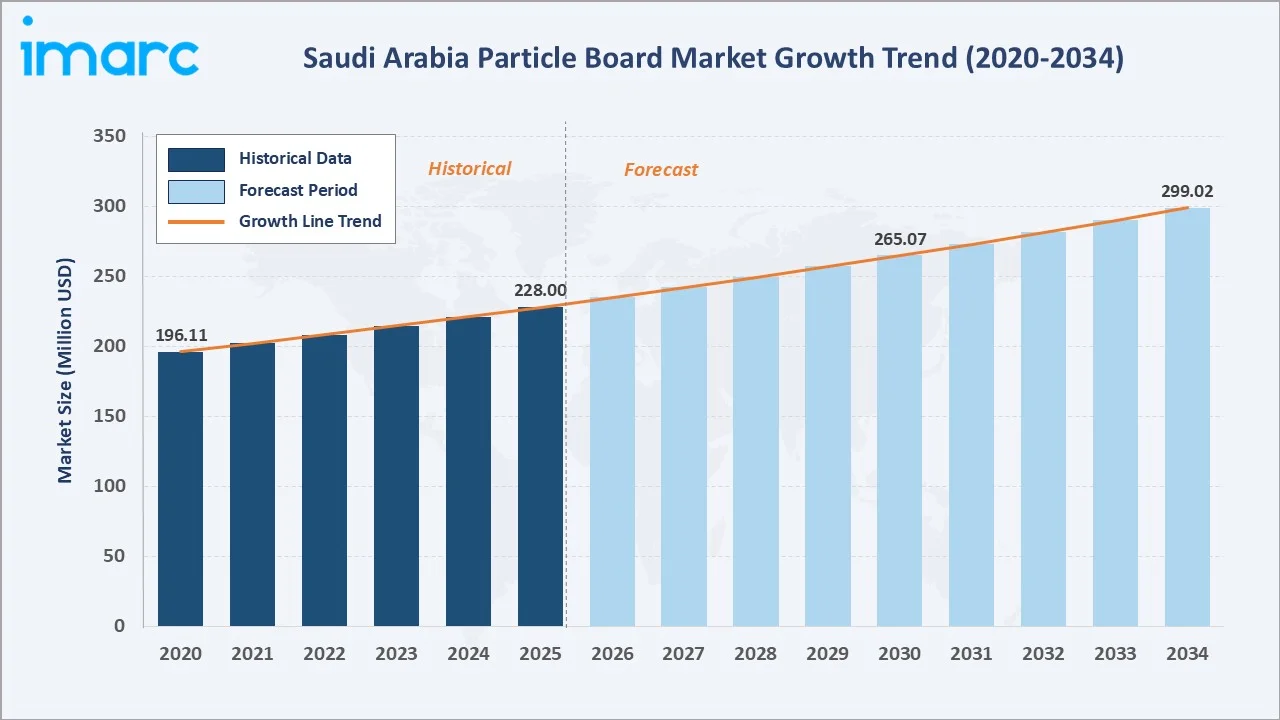
The Saudi Arabia particle board market reached USD 228.00 Million in 2025 and is projected to reach USD 299.02 Million by 2034, growing at a CAGR of 3.06% during 2026-2034. Growth is underpinned by Vision 2030-linked housing and infrastructure programs, expanding furniture manufacturing, and rising demand for cost-effective engineered wood panels.
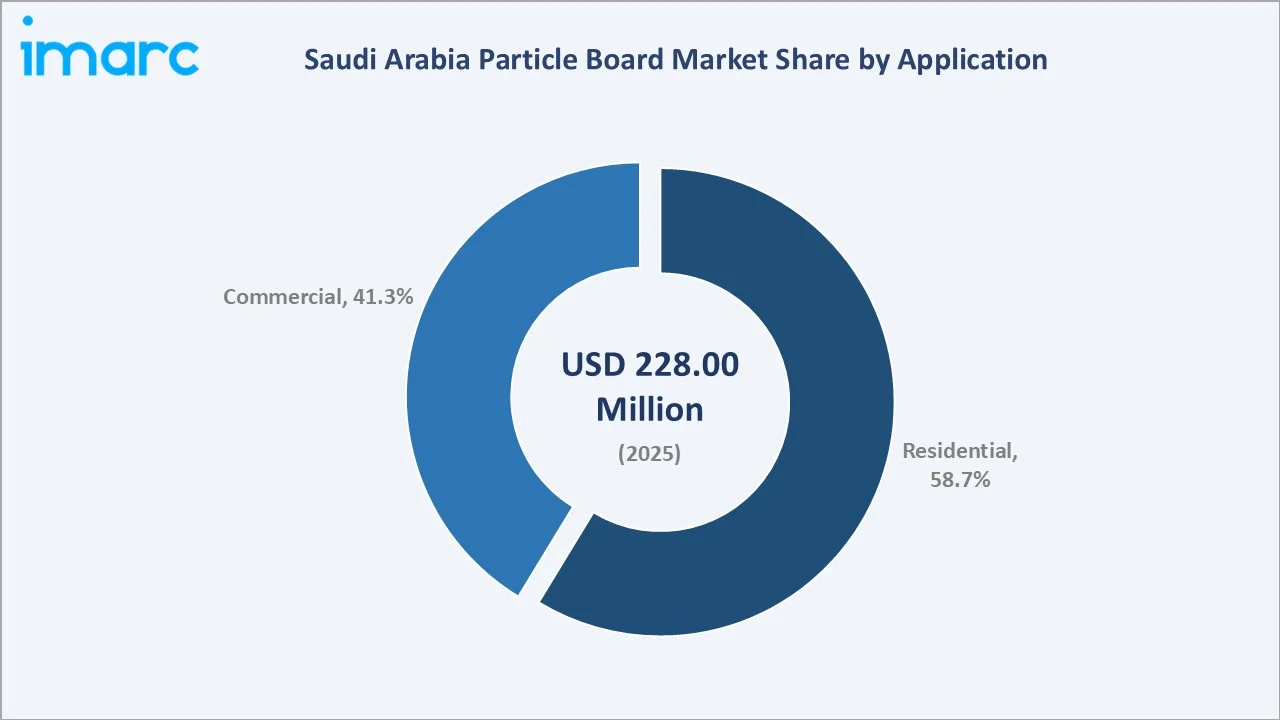
Residential applications lead at 58.7% and new construction accounts for 69.4% of demand, while the Northern and Central Region commands 41.4% of the national market.
Market Snapshot
|
Metric |
Value |
|
Market Size (2025) |
USD 228.00 Million |
|
Forecast Market Size (2034) |
USD 299.02 Million |
|
CAGR (2026-2034) |
3.06% |
|
Base Year |
2025 |
|
Historical Period |
2020-2025 |
|
Forecast Period |
2026-2034 |
|
Dominant Application |
Residential (58.7%, 2025) |
|
Dominant Sector |
New Construction (69.4%, 2025) |
|
Leading Region |
Northern and Central Region (41.4%, 2025) |
The market expanded from an estimated USD 196.11 Million in 2020 to USD 228.00 Million in 2025, supported by recovering construction activity and a growing domestic furniture base. It is anchored at an estimated USD 265.07 Million in 2030 and forecast to reach USD 299.02 Million by 2034, as new-build housing and government-backed urban development projects sustain long-term panel demand at a consistent annual growth rate across the historical and forecast periods.
To get more information on this market, Request Sample
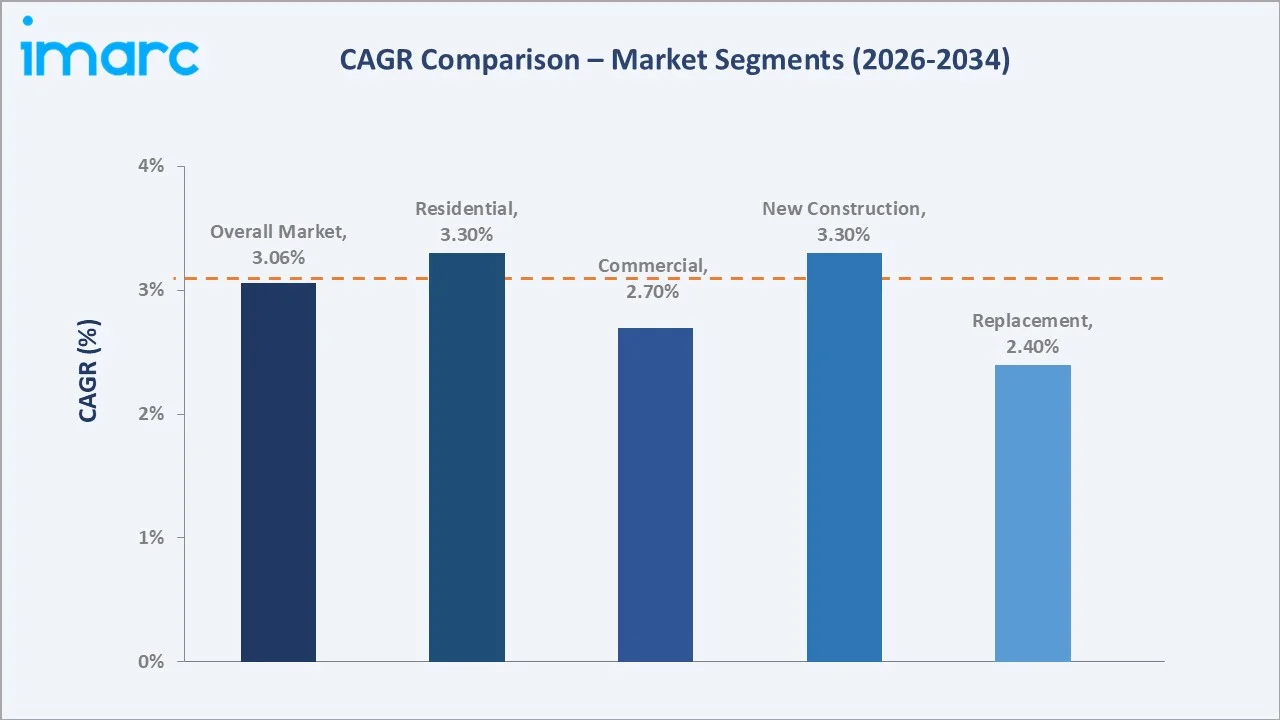
Residential applications grow fastest at an estimated ~3.3% CAGR as Vision 2030 housing delivery multiplies cabinetry and modular furniture demand per household. The new construction sector grows at an estimated ~3.3% CAGR as the Kingdom's active residential and commercial development pipeline continues to outpace the replacement and renovation segment.
Executive Summary
The Saudi Arabia particle board market reached USD 228.00 Million in 2025, reflecting steady demand from the Kingdom's construction and furniture manufacturing sectors. Particle board's affordability, lightweight structure, and adaptability to laminates and veneers make it a preferred substrate for cabinetry, wall panelling, and modular furniture across residential and commercial developments.
The market is projected to reach USD 299.02 Million by 2034. Residential applications at 58.7% lead through Vision 2030 housing expansion, while new construction at 69.4% dominates the sector split as the Kingdom continues large-scale urban and infrastructure development. The Northern and Central Region leads regionally at 41.4%, anchored by Riyadh's construction and furniture manufacturing concentration.
Key Market Insights
|
Insight |
Data |
|
Dominant Application |
Residential - 58.7% market share (2025) |
|
Dominant Sector |
New Construction - 69.4% market share (2025) |
|
Leading Region |
Northern and Central Region - 41.4% market share (2025) |
|
Market Opportunity |
Low-formaldehyde board lines; local raw-material sourcing; PIF-backed panel manufacturing |
Key Analytical Observations Supporting The Above Data:
- Residential at 58.7%: Rapid household formation and Vision 2030 housing programs such as Sakani are driving cabinetry, wardrobe, and modular furniture demand, keeping particle board consumption concentrated in residential fit-outs.
- New Construction at 69.4%: Large-scale residential, commercial, and giga-project developments across the Kingdom generate sustained demand for particle board used in built-in furniture, partitions, and interior fixtures.
- Northern and Central Region at 41.4%: Riyadh's dense construction pipeline, furniture manufacturing clusters, and population concentration anchor the region's leading share of national particle board demand.
Saudi Arabia Particle Board Market Overview
The Saudi Arabia particle board market encompasses the manufacture, import, and distribution of engineered wood panels produced from wood chips, sawmill shavings, and synthetic resin, used across residential and commercial construction and furniture manufacturing. As a leading substrate for kitchen cabinets, wardrobes, doors, and shelving, particle board benefits from its cost efficiency relative to solid wood and medium-density fibreboard alternatives.
The ecosystem integrates raw material suppliers, particle board manufacturers, building material distributors and retailers, furniture manufacturers, interior fit-out contractors, and regulatory bodies setting emission and building-material standards. Macroeconomic factors include Vision 2030 diversification spending, population growth, urbanization, and construction sector expansion. Domestic panel production remains limited relative to national demand, leaving the market reliant on imports from Europe and Asia alongside a growing base of local converters and laminators that add finishing capacity closer to end-use customers.
Market Dynamics
To evaluate market opportunities, Request Sample
Market Drivers
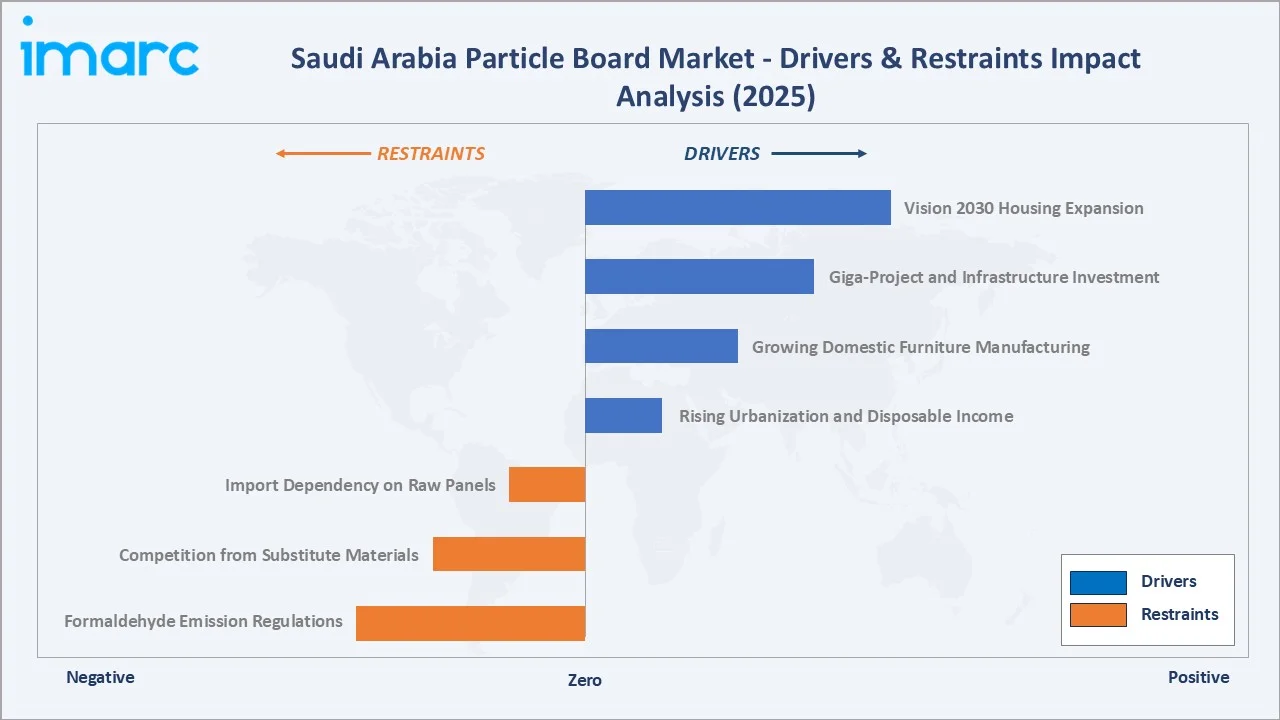
- Vision 2030 Housing Expansion: Government-backed housing initiatives, including the Sakani program, are accelerating residential construction nationwide, directly lifting demand for particle board in cabinetry, wardrobes, and interior fixtures across new housing units. The program aims to raise home ownership rates among Saudi nationals, translating into a steady pipeline of new residential units requiring furniture and built-in storage solutions. As homebuilders scale delivery to meet these targets, particle board's cost efficiency relative to solid wood makes it the default substrate for volume-driven cabinetry and wardrobe production. This sustained residential pipeline is expected to anchor particle board demand through the forecast period.
- Growing Domestic Furniture Manufacturing: Expansion of local furniture production, supported by import-substitution incentives, is increasing particle board consumption as manufacturers scale output of cost-competitive cabinetry and modular furniture for retail and contract markets. Saudi industrial policy increasingly favors domestic value addition, encouraging furniture producers to localize lamination, edge-banding, and finishing operations rather than import completed panels. This shift is expanding the addressable market for both domestically manufactured and imported raw particle board as local converters scale capacity. Growing e-commerce furniture retail is further widening distribution reach for these manufacturers, reinforcing panel demand.
- Giga-Project and Infrastructure Investment: Large-scale developments such as NEOM, Qiddiya, and the Red Sea Project are generating substantial demand for interior fit-out materials, including particle board used in commercial and hospitality interiors. These projects require large volumes of cabinetry, wall panelling, and furniture for hotels, residential communities, and mixed-use developments, creating sizeable procurement opportunities for panel suppliers. Contractors delivering these projects increasingly favor suppliers able to guarantee consistent quality and volume, benefiting both established local manufacturers and international producers with regional distribution. The multi-year execution timelines of these giga-projects provide long-term demand visibility for the industry.
- Rising Urbanization and Disposable Income: Continued urban migration and higher household spending power are increasing renovation activity and furniture replacement cycles, supporting steady particle board demand across residential and commercial segments. As more Saudi households relocate to urban centers, demand for compact, space-efficient furniture solutions is rising, favoring modular particle board-based designs. Higher disposable incomes are also enabling more frequent furniture upgrades and interior renovations, extending particle board consumption beyond new construction into the replacement segment. This trend is expected to gradually diversify demand drivers beyond new-build activity alone.
Market Restraints
- Import Dependency on Raw Panels: Limited domestic wood-panel manufacturing capacity leaves the market reliant on imports from Europe and Asia, exposing pricing and supply timelines to international freight costs and currency fluctuations. Extended shipping lead times from key exporting countries can create inventory planning challenges for local distributors and furniture manufacturers. Global freight rate volatility and periodic port congestion further compound cost unpredictability for importers. This reliance also leaves domestic converters vulnerable to supply disruptions during periods of international trade or logistics disruption.
- Competition from Substitute Materials: Medium-density fibreboard, plywood, and metal-based furniture components offer higher durability and moisture resistance, limiting particle board's penetration in premium and high-moisture applications. Premium residential and commercial developments increasingly specify MDF or plywood for higher-visibility applications, constraining particle board's share in higher-value segments. Metal and engineered composite furniture components are also gaining traction in commercial and hospitality projects seeking greater durability. This substitution pressure is expected to persist as consumer preference for premium finishes grows alongside rising disposable incomes.
- Formaldehyde Emission Regulations: Tightening indoor air quality and emission standards are raising compliance costs for manufacturers and importers, requiring investment in low-emission resin formulations. Meeting evolving E1 and E0 emission thresholds requires upgraded resin formulations and testing protocols, adding cost pressure particularly for smaller domestic converters. Importers must also ensure certification compliance across sourcing regions, complicating supplier qualification processes. As regulatory scrutiny increases, manufacturers unable to adapt quickly may face reduced market access in commercial and green-building certified projects.
Market Opportunities
- Low-Formaldehyde and Moisture-Resistant Board Manufacturing: Local production of low-formaldehyde and moisture-resistant particle board presents a significant opportunity as regulatory standards tighten. Manufacturers that invest early in compliant resin systems can differentiate themselves in commercial and green-building certified projects. This positioning also reduces exposure to potential future import restrictions tied to emission standards. Early movers in this segment stand to capture share from importers slower to adapt their product lines.
- Domestic Manufacturing Capacity Expansion: Investment in domestic panel manufacturing capacity, supported by Vision 2030 industrial diversification goals, could reduce import reliance and improve regional supply resilience for furniture and construction customers. Local production would shorten lead times and reduce exposure to international freight volatility, strengthening supply reliability for contractors on time-sensitive giga-projects. Government incentives supporting industrial localization further improve the investment case for new manufacturing capacity. This creates opportunities for both new entrants and existing players to expand production footprints within the Kingdom.
Market Challenges
- Distribution Channel Fragmentation: Fragmented distribution channels and price competition from lower-cost Asian imports continue to pressure margins for domestic converters. The presence of numerous small and mid-sized trading houses makes coordinated pricing and quality standards difficult to maintain across the market. This fragmentation also complicates efforts by larger manufacturers to build consistent brand recognition among end-use customers. Consolidation among distributors could gradually ease this challenge but is likely to occur slowly given the market's competitive structure.
- Balancing Cost Competitiveness and Regulatory Compliance: Manufacturers must balance cost competitiveness with rising compliance costs tied to emission standards and evolving building-material regulations. Smaller domestic producers may struggle to absorb the capital costs of upgrading to compliant resin systems while remaining price-competitive against imports. This tension could slow the pace of regulatory adoption unless supported by financing incentives or phased compliance timelines. Balancing these priorities will be critical to sustaining healthy margins across the value chain.
Emerging Market Trends
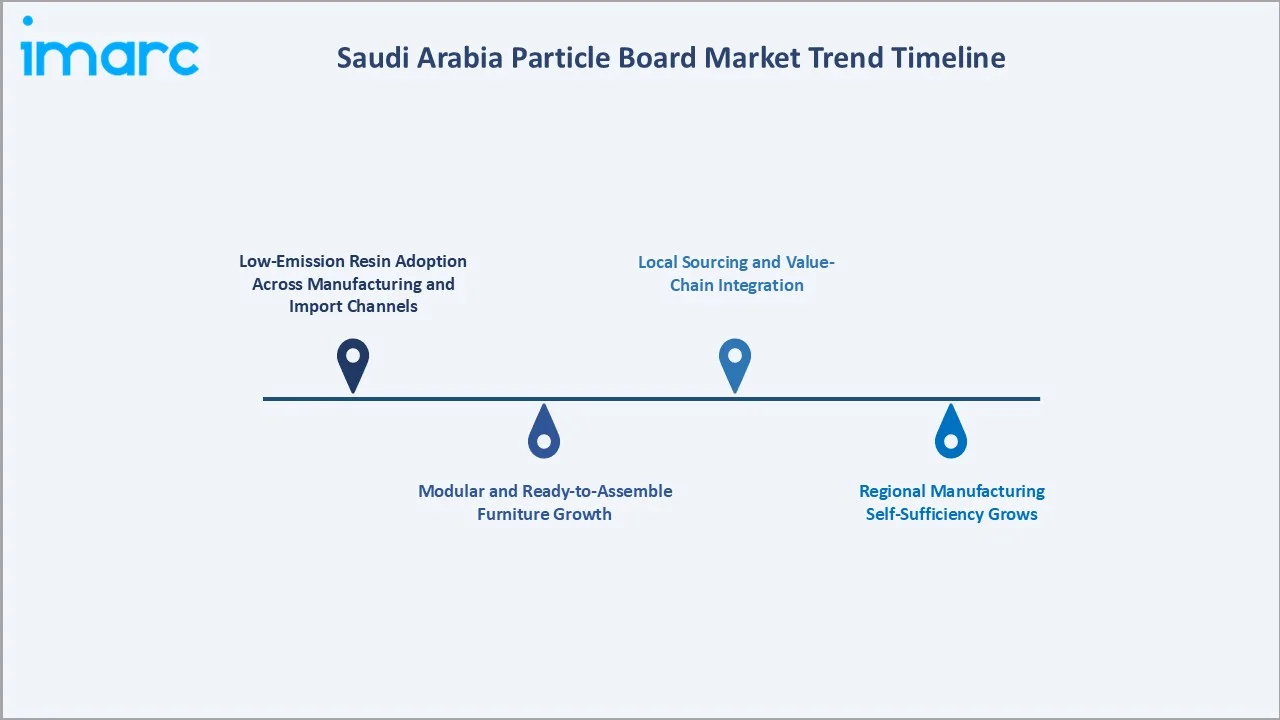
1. Low-Emission Resin Adoption Across Manufacturing and Import Channels
Manufacturers and importers are shifting toward low-formaldehyde and E1-grade resin systems to align with tightening indoor air quality regulations and growing green-building certification requirements across commercial projects.
2. Modular and Ready-to-Assemble Furniture Growth
Rising demand for space-efficient, ready-to-assemble furniture in apartments and compact housing units is increasing particle board consumption in flat-pack cabinetry and modular storage systems.
3. Local Sourcing and Value-Chain Integration
Furniture manufacturers are increasingly integrating laminating and edge-banding operations domestically, reducing reliance on imported finished panels and strengthening local value addition.
4. Regional Manufacturing Self-Sufficiency Grows
Domestic panel manufacturing capacity is gradually expanding as Vision 2030 industrial diversification incentives and import-substitution policies encourage local production of particle board and related wood panels. As local converters scale lamination, edge-banding, and finishing operations, and as new domestic manufacturing investment materializes, the market is expected to incrementally reduce its historical dependence on imports from Europe and Asia, improving regional supply resilience for furniture and construction customers by the end of the forecast period.
Industry Value Chain Analysis
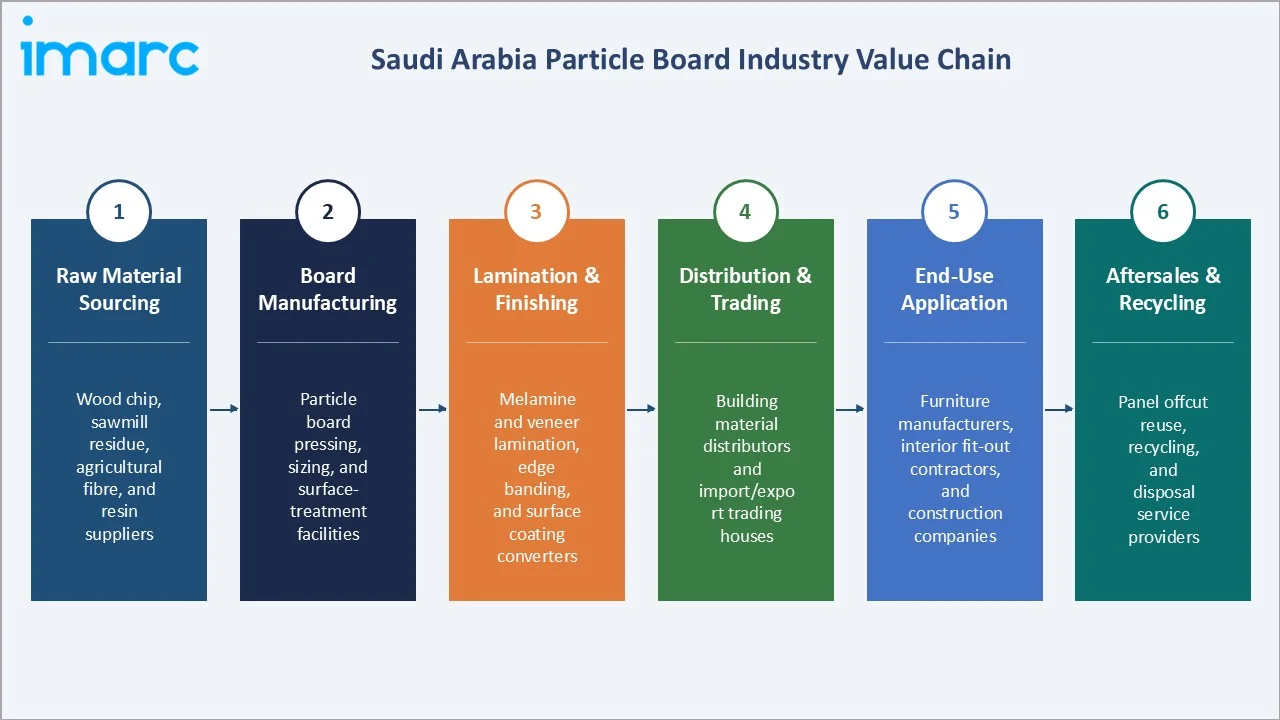
The Saudi Arabia particle board value chain begins with raw material sourcing, including wood chips, sawmill residues, and agricultural fibres, sourced both domestically and through imports. Board manufacturing and lamination follow, conducted by a mix of local converters and imported finished panels from European and Asian producers.
|
Stage |
Key Participants |
|
Raw Material Sourcing |
Wood chip, sawmill residue, agricultural fibre, and resin suppliers |
|
Board Manufacturing |
Particle board pressing, sizing, and surface-treatment facilities |
|
Lamination & Finishing |
Melamine and veneer lamination, edge banding, and surface coating converters |
|
Distribution & Trading |
Building material distributors and import/export trading houses |
|
End-Use Application |
Furniture manufacturers, interior fit-out contractors, and construction companies |
|
Aftersales & Recycling |
Panel offcut reuse, recycling, and disposal service providers |
Distribution occurs through building material retailers, furniture manufacturers, and contract suppliers serving residential and commercial construction projects. End-use consumption spans furniture manufacturing, interior fit-out contractors, and direct retail, with demand ultimately shaped by construction activity and household furniture replacement cycles across the Kingdom's four regions.
Technology Landscape in the Saudi Arabia Particle Board Industry
Single-Layer and Three-Layer Particle Board Technology
Three-layer particle board technology, combining fine-particle outer layers with a coarser core, offers improved surface finish and screw-holding strength, making it the preferred format for laminated furniture panels. Single-layer board remains cost-competitive for structural and less visible applications, supporting continued dual-format demand across the market.
Low-Formaldehyde (E1/E0) Resin Technology
Low-formaldehyde resin systems reduce indoor air emissions and support compliance with tightening building-material regulations. Their adoption is accelerating among manufacturers and importers targeting green-building certified commercial projects, as developers increasingly specify low-emission materials for hospitality and premium residential interiors.
Moisture-Resistant (MR) Particle Board Technology
Moisture-resistant particle board, treated with wax and resin additives, is gaining adoption in kitchen and bathroom cabinetry applications where humidity exposure is higher, supporting product differentiation among premium furniture manufacturers seeking to compete with MDF and plywood alternatives in wet-area applications.
Market Segmentation Analysis
The report covers the following segments:
|
Segment Category |
Leading Segment |
Market Share |
Year |
|
Application |
Residential |
58.7% |
2025 |
|
Sector |
New Construction |
69.4% |
2025 |
|
Region |
Northern and Central Region |
41.4% |
2025 |

By Application
To access detailed market analysis, Request Sample
Residential applications account for 58.7% of the market in 2025, driven by housing expansion under Vision 2030 and rising demand for kitchen cabinetry, wardrobes, and modular furniture. Commercial applications hold the remaining 41.3%, supported by office, retail, and hospitality fit-out activity.
By Sector
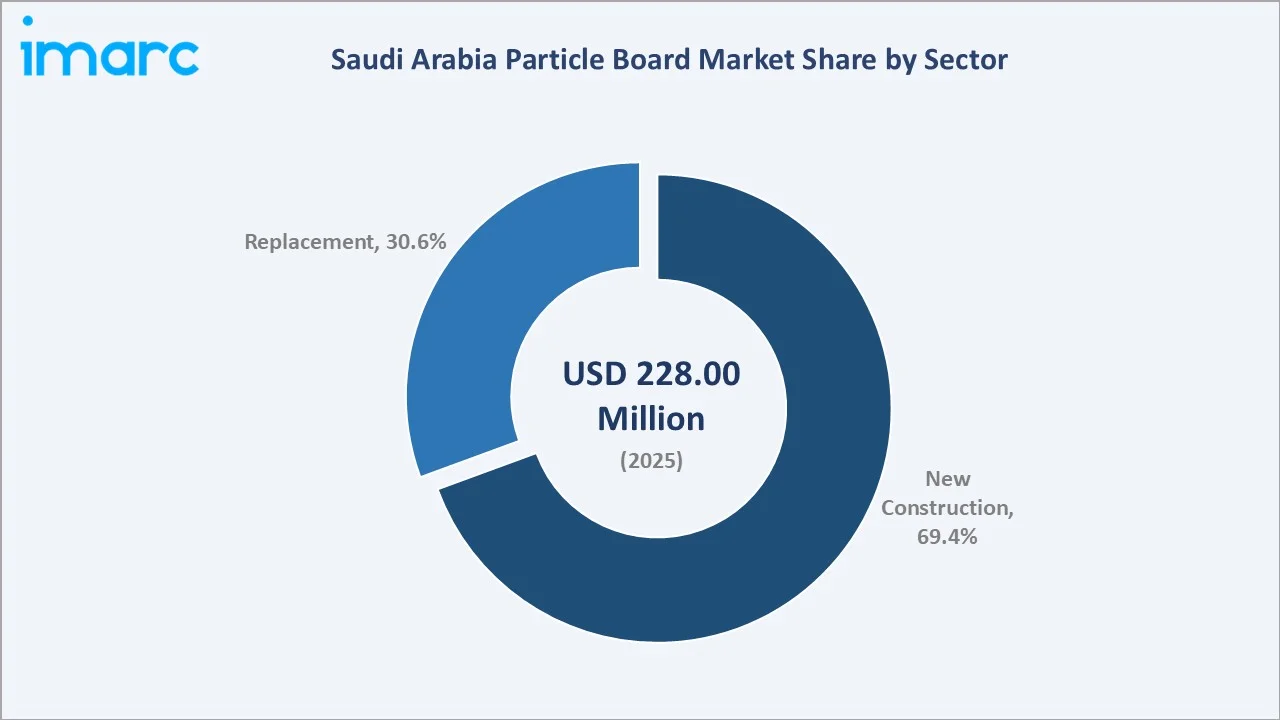
New construction represents 69.4% of demand in 2025, reflecting the Kingdom's active residential and commercial development pipeline. The replacement sector accounts for 30.6%, driven by renovation activity and furniture upgrade cycles in existing residential and commercial properties.
Regional Market Insights
|
Region |
Share |
Key Particle Board Market Drivers & Characteristics |
|
Northern and Central Region |
41.4% |
Driven by Riyadh's concentrated construction activity, population base, furniture manufacturing clusters, and Vision 2030 giga-project proximity |
|
Western Region |
27.3% |
Supported by Jeddah and Makkah's construction, hospitality development, and port-linked import trading activity |
|
Eastern Region |
19.8% |
Driven by industrial and residential growth linked to Dammam, the Eastern Province's economic activity, and manufacturing investment |
|
Southern Region |
11.5% |
Reflects a smaller construction base and population density relative to other regions, with gradual infrastructure development |
The Northern and Central Region leads the market with a 41.4% share in 2025, anchored by Riyadh's concentrated construction activity, population base, and furniture manufacturing clusters. The Western Region follows at 27.3%, supported by Jeddah and Makkah's construction and hospitality development.
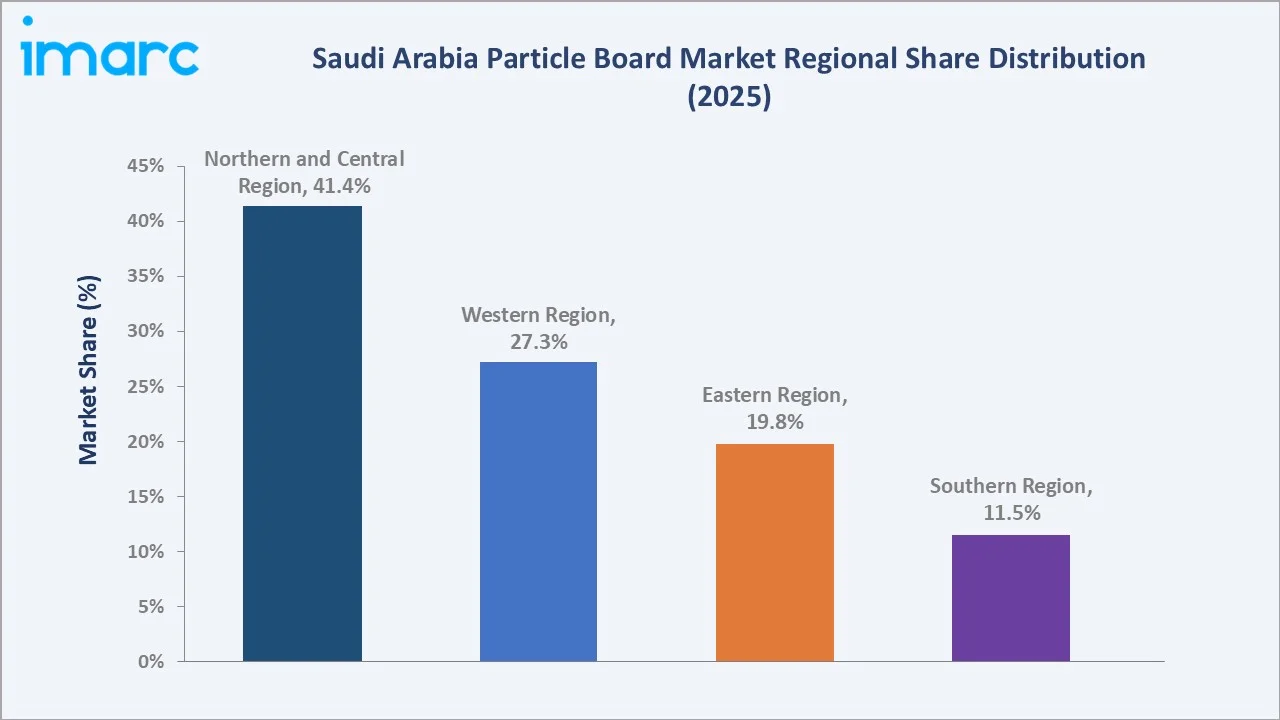
The Eastern Region holds 19.8%, driven by industrial and residential growth linked to Dammam and the Eastern Province's economic activity, while the Southern Region accounts for 11.5%, reflecting its smaller construction base and population density relative to other regions.
Competitive Landscape
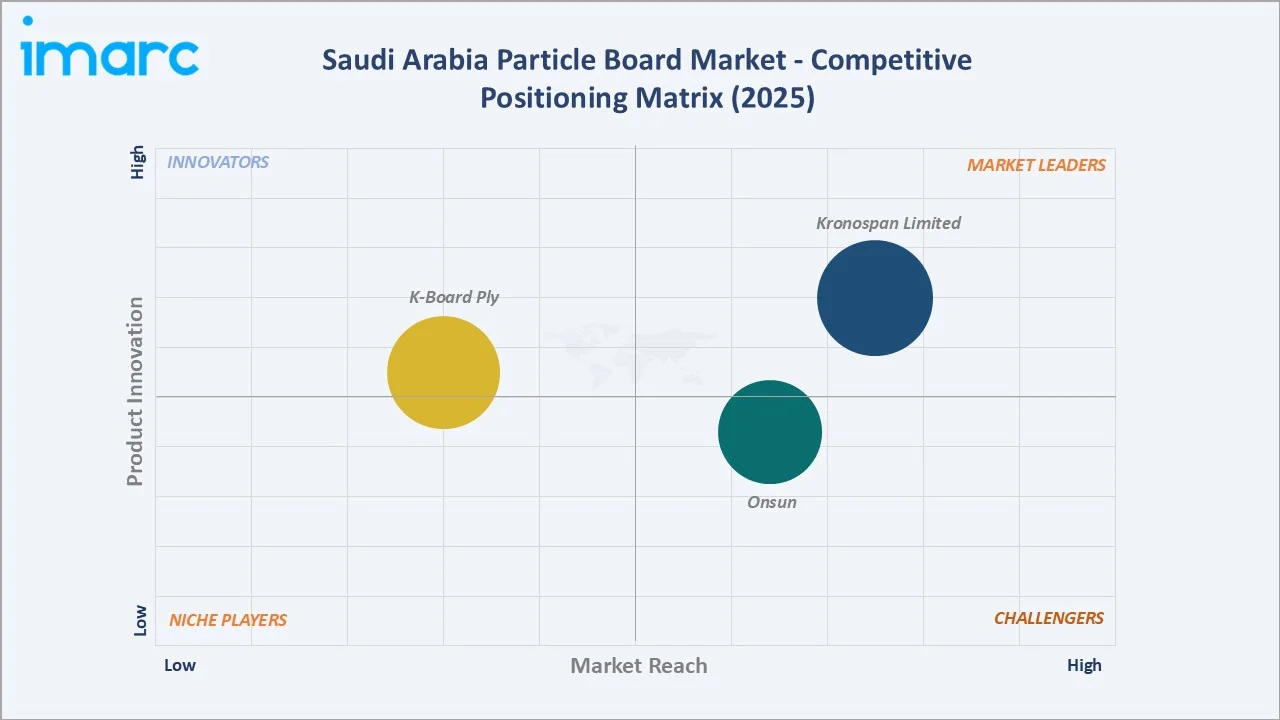
The Saudi Arabia particle board market competitive landscape is moderately fragmented, combining diversified domestic industrial groups, regional trading companies, and international panel producers supplying through import channels. Competition centers on pricing, product finish quality, and delivery reliability to furniture manufacturers and construction contractors.
|
Company Name |
Key Products |
Market Position |
Core Strength |
|
Kronospan Limited |
Particleboard P2, Particleboard P3, Particleboard P5, Fire Retardant Particleboard |
Market Leader |
Global manufacturing scale and consistent product quality |
|
K-Board Ply |
Particle Board |
Established Player |
Diversified wood-panel product range with established export distribution network |
|
Onsun |
Particle Board |
Strong Challenger |
Large-scale manufacturing capacity with integrated lamination and customization services |
Key players include Kronospan Limited, K-Board Ply, Onsun, and others.
Key Company Profiles
Kronospan Limited
Kronospan Limited is a global wood-based panel manufacturer founded in 1897, with an extensive international production network spanning Europe and North America, supplying particle board, MDF, OSB, and laminate flooring to markets worldwide, including Saudi Arabia through import and distribution channels.
- Key Products: Particleboard P2, Particleboard P3, Particleboard P5, Fire Retardant Particleboard
- Strategic Focus: Kronospan is prioritizing vertical integration across raw material sourcing and panel manufacturing, alongside continued international capacity expansion. The company's ongoing investment in production efficiency and supply chain security supports consistent delivery to import-dependent markets such as Saudi Arabia.
K-Board Ply
K-Board Ply produces a diversified range of wood-substitute panels, including plywood, MDF, laminates, veneers, particle board, and PVC & WPC.
- Key Products: Particle board
- Strategic Focus: K-Board Ply is focused on broadening its wood-substitute product portfolio and strengthening export distribution partnerships in Gulf markets, positioning its diversified panel range to serve furniture and construction demand beyond its core South Indian base.
Market Concentration Analysis
The Saudi Arabia particle board market is moderately fragmented, combining diversified domestic industrial groups, regional trading companies, and international producers supplying through imports. Local players compete primarily on distribution reach and pricing, while international manufacturers differentiate through product consistency and emission-compliant panel grades. Consolidation is expected to progress gradually as import-substitution incentives favor manufacturers with scaled domestic processing capacity over smaller, purely import-dependent distributors.
Investment & Growth Opportunities
Highest Growth Segments
Residential applications and new construction remain the highest-growth demand pools, supported by sustained Vision 2030 housing delivery and urban development activity through 2034.
Emerging Investment Opportunities
- Domestic low-formaldehyde particle board manufacturing capacity, positioned to serve green-building certified commercial and hospitality projects
- Local lamination and edge-banding value addition, reducing dependency on imported finished panels for furniture producers
- Furniture manufacturing partnerships aligned with import-substitution incentives under Vision 2030 industrial diversification goals
Investment Themes
Investors are prioritizing regulatory-compliant, low-emission panel production and integrated furniture manufacturing capacity that reduces import dependency while serving the Kingdom's expanding residential construction pipeline. Partnerships that combine international technology expertise with local distribution and manufacturing scale are increasingly viewed as the most durable route to capturing long-term demand growth.
Future Market Outlook (2026-2034)
The Saudi Arabia particle board market is expected to grow steadily through 2034, reaching USD 299.02 Million at a 3.06% CAGR. Continued Vision 2030 housing delivery, giga-project interior fit-out demand, and expanding domestic furniture manufacturing capacity are expected to sustain long-term panel consumption, while regulatory tightening gradually shifts supply toward low-emission product lines. Over the forecast period, the balance between local manufacturing and imports is likely to shift incrementally toward domestic production as import-substitution incentives and compliance requirements favor manufacturers with regional processing capacity.
Research Methodology
Primary Research
Insights were validated through interviews with particle board manufacturers, furniture producers, and building material distributors operating across Saudi Arabia's four regions, supplemented by consultations with interior fit-out contractors serving residential and commercial construction projects.
Secondary Research
Data was compiled from government construction and housing program disclosures, trade statistics, and industry association publications covering the Kingdom's wood panel and furniture sectors, alongside company disclosures from leading domestic and international manufacturers.
Forecasting Models
Market forecasts apply top-down and bottom-up estimation, cross-validated against historical construction activity and regional demand trends to derive the 2026-2034 outlook, with sensitivity checks applied against Vision 2030 housing delivery targets and giga-project execution timelines.
Saudi Arabia Particle Board Market Report Coverage:
| Report Features | Details |
|---|---|
| Base Year of the Analysis | 2025 |
| Historical Period | 2020-2025 |
| Forecast Period | 2026-2034 |
| Units | Million USD |
| Scope of the Report |
Exploration of Historical Trends and Market Outlook, Industry Catalysts and Challenges, Segment-Wise Historical and Future Market Assessment:
|
| Applications Covered | Residential, Commercial |
| Sectors Covered | New Construction, Replacement |
| Regions Covered | Northern and Central Region, Western Region, Eastern Region, Southern Region |
| Companies Covered | Kronospan Limited, K-Board Ply, Onsun, etc. |
| Customization Scope | 10% Free Customization |
| Post-Sale Analyst Support | 10-12 Weeks |
| Delivery Format | PDF and Excel through Email (We can also provide the editable version of the report in PPT/Word format on special request) |
Key Benefits for Stakeholders:
- IMARC’s industry report offers a comprehensive quantitative analysis of various market segments, historical and current market trends, market forecasts, and dynamics of the Saudi Arabia particle board market from 2020-2034.
- The research report provides the latest information on the market drivers, challenges, and opportunities in the Saudi Arabia particle board market.
- Porter's five forces analysis assist stakeholders in assessing the impact of new entrants, competitive rivalry, supplier power, buyer power, and the threat of substitution. It helps stakeholders to analyze the level of competition within the Saudi Arabia particle board industry and its attractiveness.
- Competitive landscape allows stakeholders to understand their competitive environment and provides an insight into the current positions of key players in the market.
Frequently Asked Questions About the Saudi Arabia Particle Board Market Report
The Saudi Arabia particle board market reached USD 228.00 Million in 2025, driven by residential applications dominant at 58.7%, new construction leading the sector split at 69.4%, and the Northern and Central Region commanding 41.4% of national demand through Riyadh's construction and furniture manufacturing concentration.
The market is projected to grow at a CAGR of 3.06% during 2026-2034, reaching USD 299.02 Million by 2034. This growth reflects sustained Vision 2030 housing delivery, giga-project interior fit-out demand, and expanding domestic furniture manufacturing capacity across the forecast period.
Residential applications lead at 58.7% in 2025, supported by Vision 2030 housing programs such as Sakani that are driving cabinetry, wardrobe, and modular furniture demand across new housing units.
New construction dominates at 69.4% in 2025, reflecting the Kingdom's active residential, commercial, and giga-project development pipeline, while the replacement sector accounts for the remaining 30.6% of demand.
The Northern and Central Region leads at 41.4% through Riyadh's concentrated construction activity, population base, and furniture manufacturing clusters, followed by the Western Region at 27.3%, the Eastern Region at 19.8%, and the Southern Region at 11.5%.
Key players include Kronospan Limited, K-Board Ply, Onsun, and others.
The market is projected to reach approximately USD 265.07 Million by 2030, with continued Vision 2030 housing delivery, low-formaldehyde resin adoption, and expanding local lamination capacity shaping mid-forecast demand.
Priority investment opportunities include domestic low-formaldehyde particle board manufacturing capacity, local lamination and edge-banding value addition, and furniture manufacturing partnerships aligned with Vision 2030 import-substitution incentives.
Need more help?
- Speak to our experienced analysts for insights on the current market scenarios.
- Include additional segments and countries to customize the report as per your requirement.
- Gain an unparalleled competitive advantage in your domain by understanding how to utilize the report and positively impacting your operations and revenue.
- For further assistance, please connect with our analysts.
 Request Customization
 Speak to an Analyst
 Request Brochure
 Inquire Before Buying
Benefits of Customization
- Personalize this research
- Triangulate with your data
- Get data as per your format and definition
- Gain a deeper dive into a specific application, geography, customer, or competitor
- Any level of personalization
Get in Touch With Us
UNITED STATES
Phone: +1-201-971-6302
INDIA
Phone: +91-120-433-0800
UNITED KINGDOM
Phone: +44-753-714-6104
Email: [email protected]
Client Testimonials




.webp)




.webp)













Related Reports

Choose your plan
*Please note that the prices mentioned below are starting prices for each bundle type. Kindly contact our team for further details.*
Single User License
- 1 User License, Access on 2 Devices
- PDF Report + Excel Dataset (Password Protected)
- Lifetime Access
- No Printing Rights
- 10% Free Report Customization
- 10–12 Weeks of Analyst Support
Five User License
- Access for 5 Users, 2 Devices per User
- PDF Report + Excel Dataset (Password Protected)
- Lifetime Access
- Dedicated Account Manager
- 12–14 Weeks of Analyst Support
- No Printing Rights
- 15% Free Report Customization
- 25% Discount on Your Next Purchase
Corporate User License
- Unlimited User Access (Within Your Organization)
- PDF Report + Excel Dataset
- Lifetime Access
- Dedicated Account Manager
- 14–20 Weeks of Analyst Support
- No Printing Rights
- 20% Free Report Customization
- 30% Discount on Your Next Purchase
Essential Insights
What's included:
3 reports
- Lifetime Access
- PDF Reports
- Excel Datasets
- 2 Weeks of Free Analyst Support
- 2 User Licenses
- Access on 2 Devices
- Printing Rights
- Complimentary PowerPoint (PPT) Version
- Complimentary License Upgrade
Professional Access
What's included:
5 reports
- Lifetime Access
- PDF Reports
- Excel Datasets
- 8 Weeks of Free Analyst Support
- 2 User Licenses
- Access on 2 Devices
- Printing Rights
- Complimentary PowerPoint (PPT) Version
- Complimentary License Upgrade
Business Advantage
What's included:
8 reports
- Lifetime Access
- PDF Reports
- Excel Datasets
- 14 Weeks of Free Analyst Support
- 2 User Licenses
- Access on 2 Devices
- Printing Rights
- Complimentary PowerPoint (PPT) Version
- Complimentary License Upgrade
Enterprise Intelligence
What's included:
10 reports
- Lifetime Access
- PDF Reports
- Excel Datasets
- 20 Weeks of Free Analyst Support
- 2 User Licenses
- Access on 2 Devices
- Printing Rights
- Complimentary PowerPoint (PPT) Version
- Complimentary License Upgrade