
Robo Advisory Market Size, Share, Trends and Forecast by Business Model, Service Type, Provider, End User, and Region, 2026-2034
Robo Advisory Market Size, Share, Trends & Forecast (2026-2034)
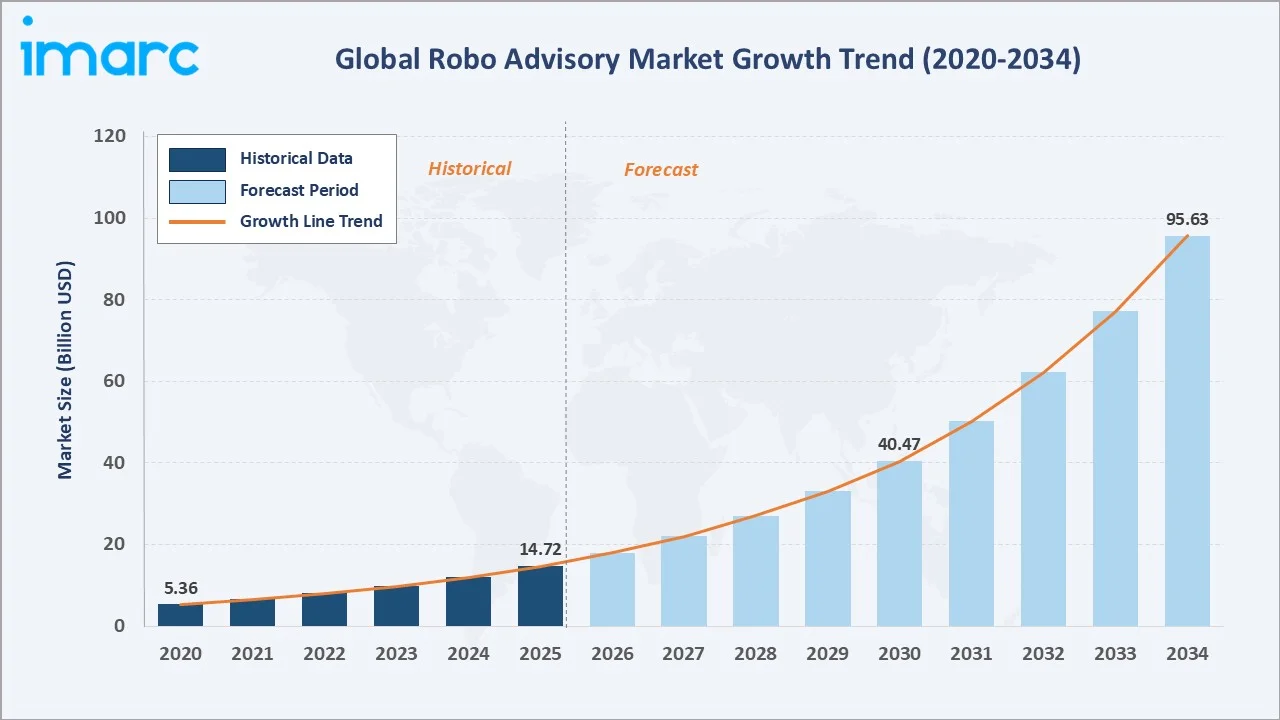
The global robo advisory market reached USD 14.72 Billion in 2025 and is projected to reach USD 95.63 Billion by 2034, growing at a CAGR of 22.42% during 2026-2034. The market is driven by rising demand for accessible, low-cost financial solutions, ongoing technological advancements, digital transformation, and expanding financial literacy worldwide. Increasing smartphone penetration and growing investor comfort with automated, algorithm-driven portfolio management are further accelerating adoption of robo-advisory platforms across both retail and high-net-worth investor segments globally.
Market Snapshot
|
Metric |
Value |
|
Market Size (2025) |
USD 14.72 Billion |
|
Forecast Market Size (2034) |
USD 95.63 Billion |
|
CAGR (2026-2034) |
22.42% |
|
Base Year |
2025 |
|
Historical Period |
2020-2025 |
|
Forecast Period |
2026-2034 |
|
Dominant Business Model |
Hybrid Robo Advisors (57.2%, 2025) |
|
Dominant Service Type |
Comprehensive Wealth Advisory (58.4%, 2025) |
|
Leading Region |
North America (39.2%, 2025) |
The market expanded steadily from USD 5.36 Billion in 2020 to USD 14.72 Billion in 2025, nearly tripling in five years, and is anchored at USD 40.47 Billion by 2030 before reaching USD 95.63 Billion by 2034. This sustained trajectory reflects consistent double-digit annual growth as automated wealth-management adoption accelerates across developed and emerging economies alike, supported by falling technology costs and improving investor confidence in digital advisory platforms.
To get more information on this market, Request Sample
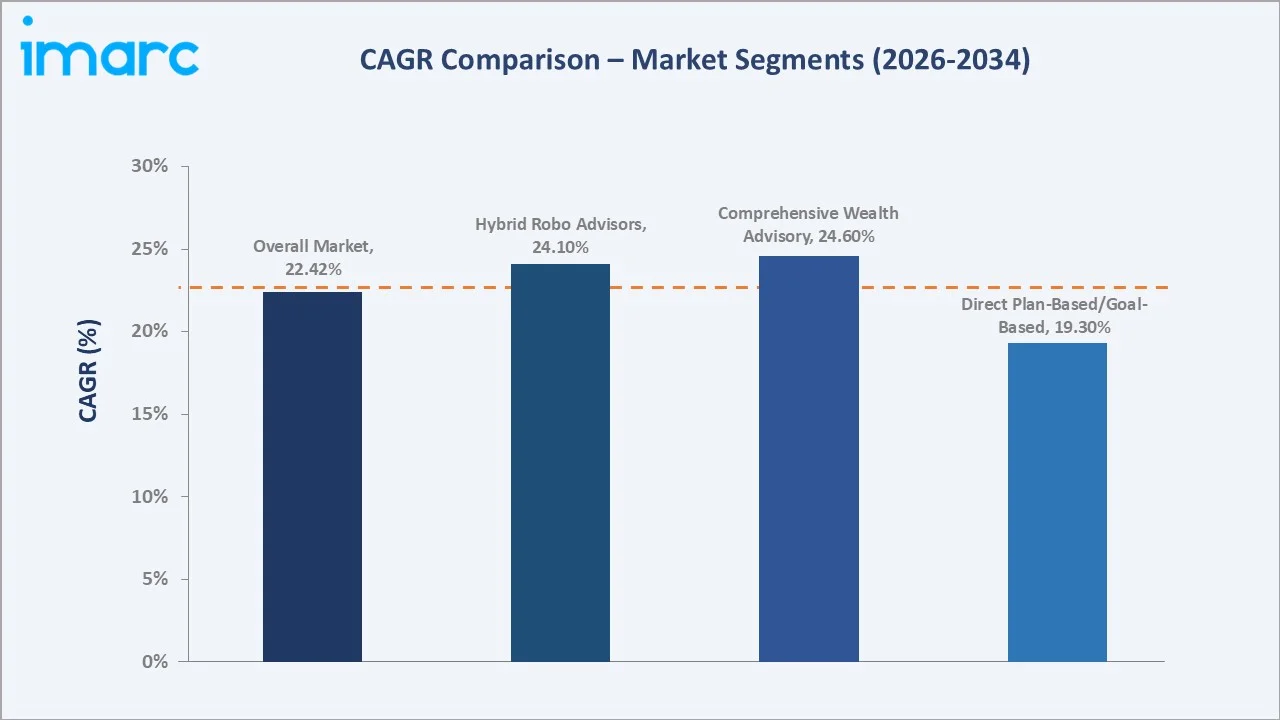
Hybrid robo advisors grow fastest at approximately 24.1% CAGR as investors increasingly seek automated portfolio management combined with on-demand human guidance for complex decisions. Comprehensive wealth advisory expands at approximately 24.6% CAGR, outpacing direct plan-based/goal-based services at approximately 19.3%, reflecting rising demand from investors with diversified and multi-generational financial planning needs.
Executive Summary
The global robo advisory market reached USD 14.72 Billion in 2025, representing one of the financial technology industry's highest-growth digital service categories, driven by the fundamental shift toward automated, algorithm-based wealth management. The robo-advisory platform has become a defining channel for delivering accessible, low-cost investment guidance that was previously available primarily through traditional human advisors. The market is projected to reach USD 95.63 Billion by 2034.
Hybrid robo advisors, at 57.2% share, dominate by combining automated efficiency with human oversight for complex financial situations. Comprehensive wealth advisory, at 58.4% share, leads through integrated planning across retirement, tax, and estate needs. North America, at 39.2%, leads globally through advanced fintech infrastructure, high digital adoption, and strong investor trust in automated platforms.
Key Market Insights
|
Insight |
Data |
|
Dominant Business Model |
Hybrid Robo Advisors - 57.2% share (2025) |
|
Dominant Service Type |
Comprehensive Wealth Advisory - 58.4% market share (2025) |
|
Leading Region |
North America - 39.2% market share (2025) |
|
Market Opportunity |
AI-driven personalization; goal-based automation; HNI-focused hybrid advisory; emerging-market digital wealth platforms |
Key Analytical Observations Supporting the Above Data:
- Hybrid Robo Advisors at 57.2%: The hybrid model dominates as investors with complex financial needs value combining low-cost automated portfolio management with human advisory guidance, particularly during volatile market conditions and major life-stage financial decisions such as retirement or inheritance planning.
- Comprehensive Wealth Advisory at 58.4%: This segment leads as growing investor wealth requires integrated planning across retirement, tax optimization, and estate management, extending well beyond simple goal-based investment allocation into holistic financial strategy.
- North America at 39.2%: North America dominates due to high smartphone and internet penetration, strong fintech infrastructure, and established investor trust in digital financial platforms across the United States and Canada, supported by favorable regulatory clarity.
Robo Advisory Market Overview
The global robo advisory market encompasses digital platforms that deliver algorithm-driven, automated financial planning and investment management services with minimal human intervention, spanning pure robo-advisory tools and hybrid platforms that blend automation with human advisory support across retail and institutional channels worldwide.
The ecosystem integrates technology and AI/ML providers, custodian and brokerage partners, asset and ETF manufacturers, payment and KYC onboarding providers, and regulatory bodies overseeing digital advisory conduct. Rising financial literacy, expanding smartphone penetration, and growing demand for low-cost, accessible wealth management continue to reshape the industry's macroeconomic and competitive backdrop.
As the industry matures, competitive differentiation is shifting from basic automated allocation toward integrated financial planning, tax optimization, and personalized advisory experiences, with providers increasingly investing in proprietary technology and expanded human-advisory capacity to serve higher-value client relationships.
Market Dynamics
To evaluate market opportunities, Request Sample
Market Drivers
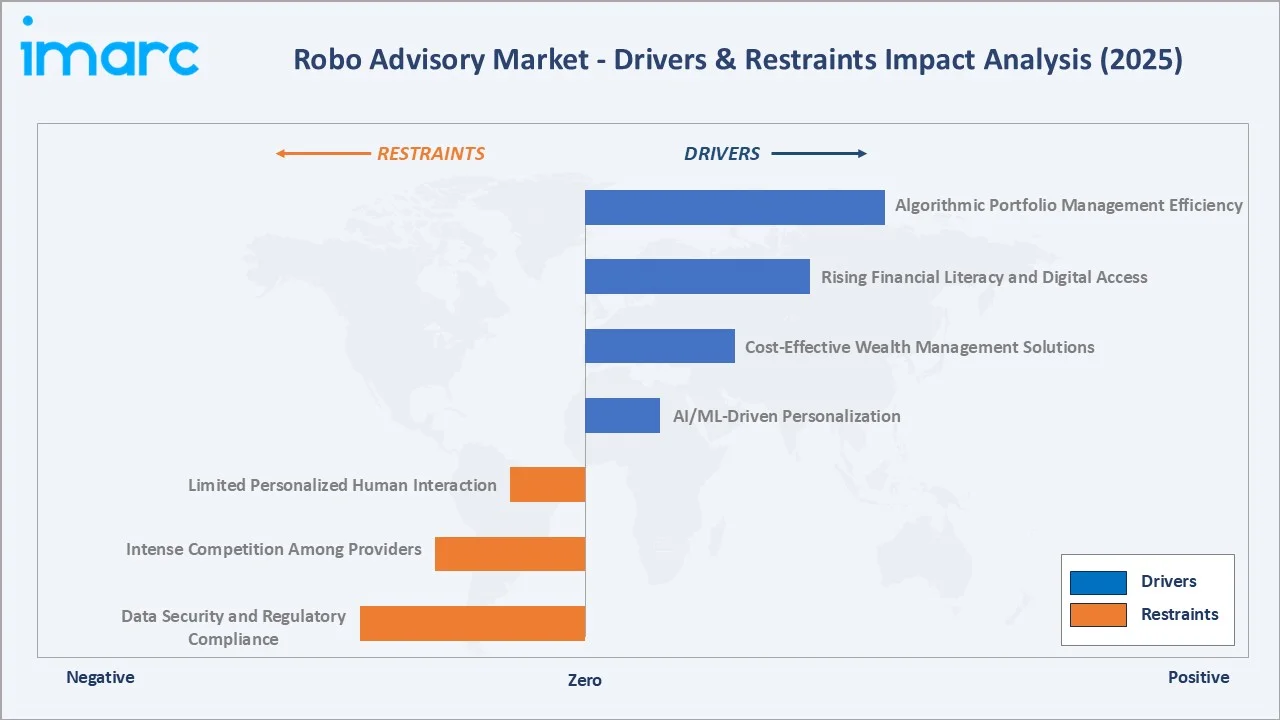
- Algorithmic Portfolio Management Efficiency: Advanced algorithms enable rapid, data-driven portfolio construction and continuous rebalancing, reducing operational costs and human error. This efficiency attracts cost-sensitive investors and supports scalable, real-time wealth management, driving broad adoption of robo-advisory platforms across retail and institutional investor segments worldwide.
- Rising Financial Literacy and Digital Access: Expanding financial literacy programs and growing internet access are enabling more individuals to engage confidently with automated investing tools. Increasing awareness of low minimum-investment thresholds is broadening participation in digital wealth management among first-time and underserved investors.
- Cost-Effective Wealth Management Solutions: Robo advisors charge significantly lower fees than traditional human advisors, making professional-grade portfolio management accessible to a broader investor base and driving increased adoption among younger, cost-conscious consumers seeking transparent, predictable pricing structures.
- AI/ML-Driven Personalization: Artificial intelligence and machine learning enable highly personalized investment strategies based on individual risk tolerance, goals, and time horizons, enhancing client engagement and strengthening long-term retention across robo-advisory platforms globally, including within hybrid advisory channels.
Market Restraints
- Limited Personalized Human Interaction: The absence of dedicated human advisors can deter investors with complex financial situations who value personalized guidance, particularly during periods of heightened market volatility or significant life events requiring nuanced, empathetic advice.
- Intense Competition Among Providers: A crowded competitive landscape featuring numerous fintech, bank, and traditional wealth-manager entrants is compressing fee margins and raising customer-acquisition costs across the robo-advisory industry, pressuring smaller providers' long-term profitability and viability.
- Data Security and Regulatory Compliance: Handling sensitive financial and personal data subjects robo-advisory platforms to strict data-protection and regulatory requirements across multiple jurisdictions, raising compliance costs and operational complexity for market participants of all sizes and maturity levels.
Market Opportunities
- Expansion Among Digitally Native Investors: Growing millennial and Gen Z preference for digital-first, convenient financial solutions offer robo-advisors a large and expanding addressable market of cost-sensitive, technology-comfortable investors entering capital markets for the first time in their lives.
- Hybrid Advisory Expansion for HNIs: Rising demand among high-net-worth individuals for cost-efficient yet personalized wealth management creates opportunities for hybrid platforms combining automated portfolio management with dedicated human advisory support and specialized estate and tax planning.
Market Challenges
- Client Trust and Engagement Barriers: Building sustained investor trust in fully automated advice remains challenging, particularly during market downturns, requiring robo-advisors to invest continuously in transparent communication, investor education, and proactive, timely client engagement strategies.
- Scaling Personalization at Low Cost: Balancing sophisticated, individualized advisory capabilities against the low-fee model that underpins robo-advisory economics presents an ongoing operational and technological challenge for providers seeking sustainable profitability at meaningful scale.
Emerging Market Trends
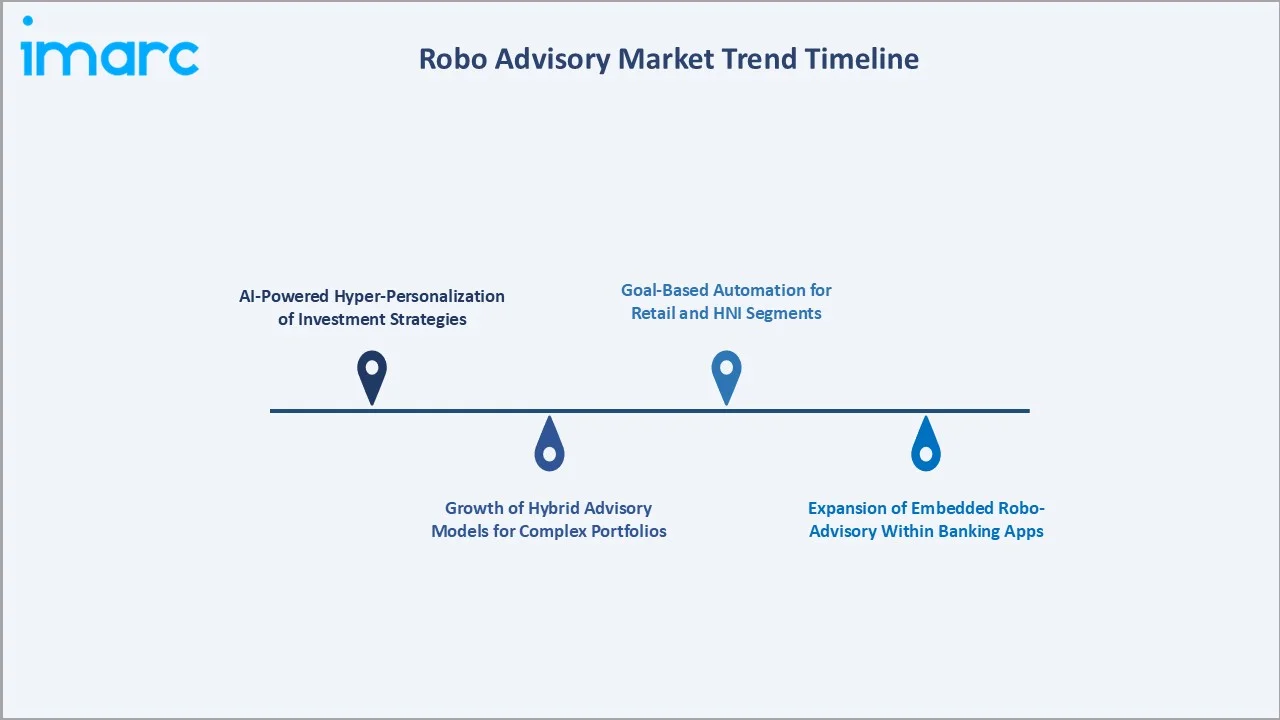
1. AI-Powered Hyper-Personalization of Investment Strategies
Robo-advisory platforms are increasingly deploying advanced AI and machine learning to tailor portfolios to individual goals, risk tolerance, and personal values, including tax-loss harvesting and ESG-aligned allocation strategies for increasingly sophisticated investor segments seeking differentiated outcomes.
2. Growth of Hybrid Advisory Models for Complex Portfolios
Providers are expanding hybrid offerings that pair automated portfolio management with on-demand human advisors, addressing investor demand for personalized guidance during major financial decisions, market volatility, and complex multi-account planning scenarios requiring specialized expertise.
3. Goal-Based Automation for Retail and HNI Segments
Platforms are integrating comprehensive goal-based planning tools covering retirement, education, and legacy planning, enabling both retail investors and high-net-worth individuals to automate multi-goal financial strategies within a single unified digital platform and dashboard.
4. Expansion of Embedded Robo-Advisory Within Banking Apps
Banks and neobanks are embedding robo-advisory functionality directly within existing digital banking applications, allowing customers to access automated investing without switching platforms, thereby broadening distribution reach and lowering customer-acquisition costs across the industry.
Industry Value Chain Analysis
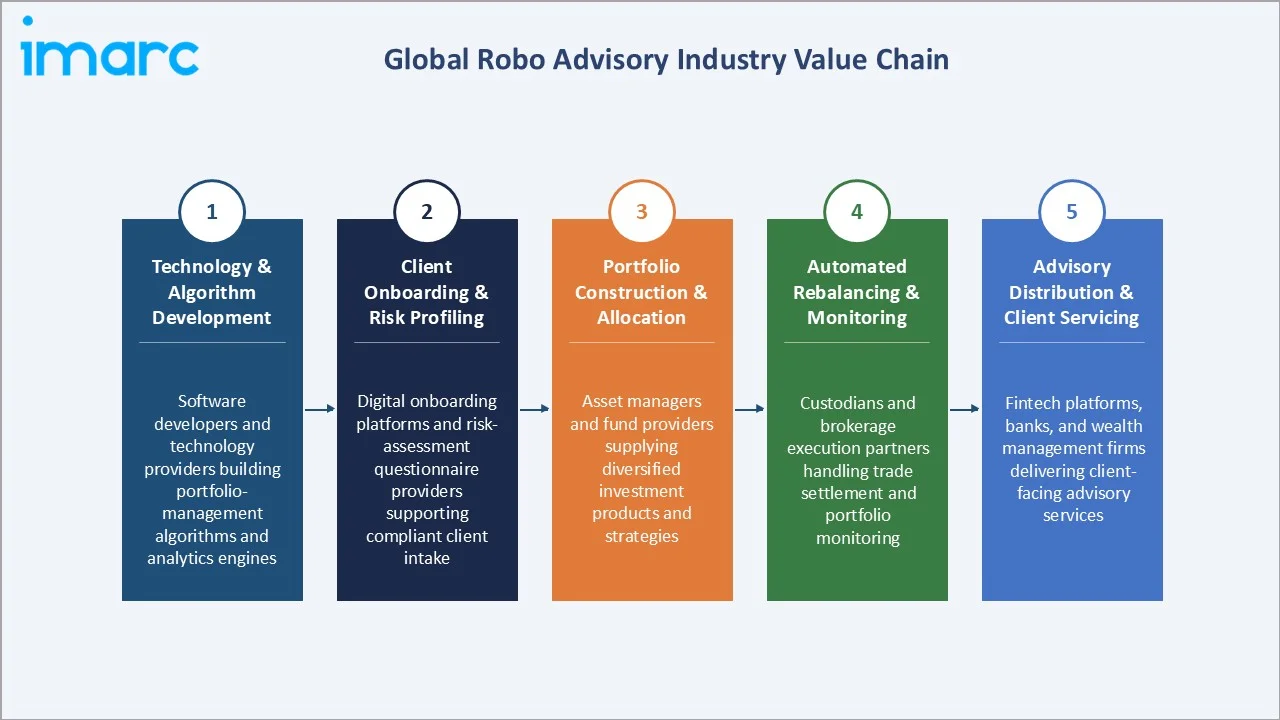
The robo advisory value chain integrates technology and algorithm development, client onboarding and risk profiling, portfolio construction, automated rebalancing, and advisory distribution, with technology providers and asset managers forming the chain's most commercially critical tiers. Efficient coordination across these stages directly determines client experience quality and overall platform competitiveness.
|
Stage |
Key Participants |
|
Technology & Algorithm Development |
Software developers and technology providers building portfolio-management algorithms and analytics engines |
|
Client Onboarding & Risk Profiling |
Digital onboarding platforms and risk-assessment questionnaire providers supporting compliant client intake |
|
Portfolio Construction & Allocation |
Asset managers and fund providers supplying diversified investment products and strategies |
|
Automated Rebalancing & Monitoring |
Custodians and brokerage execution partners handling trade settlement and portfolio monitoring |
|
Advisory Distribution & Client Servicing |
Fintech platforms, banks, and wealth management firms delivering client-facing advisory services |
The technology and algorithm development stage represents the value chain's most differentiating tier, as platform performance and personalization capability directly influence client acquisition and retention. Advisory distribution channels are broadening as banks and traditional wealth managers increasingly integrate robo-advisory capabilities alongside existing service offerings, reducing reliance on standalone fintech distribution and expanding overall market reach.
Technology Landscape in the Robo Advisory Industry
AI and Machine Learning-Based Algorithmic Engines
AI and machine learning engines analyze investor risk profiles and market data to construct and continuously rebalance portfolios, forming the core technology layer that differentiates modern robo-advisory platforms from legacy, manually managed investment tools and traditional advisory models.
Mobile-First and API-Integrated Advisory Platforms
Mobile applications and open API integrations enable seamless onboarding, real-time portfolio tracking, and connectivity with banking and payment systems, improving overall user experience and broadening robo-advisory platform accessibility for investors across diverse demographic segments.
Cybersecurity and Data Encryption Technology
Robust encryption, multi-factor authentication, and continuous monitoring protect sensitive financial data, supporting regulatory compliance and investor trust as robo-advisory platforms scale operations across multiple jurisdictions and expanding customer bases worldwide.
Cloud-Based Scalable Infrastructure
Cloud computing enables robo-advisory providers to scale computational capacity for real-time portfolio analytics and rebalancing while managing infrastructure costs efficiently, supporting rapid customer growth without proportional increases in fixed technology investment.
Market Segmentation Analysis
The report covers the following segments:
|
Segment Category |
Leading Segment |
Market Share |
Year |
|
Business Model |
Hybrid Robo Advisors |
57.2% |
2025 |
|
Service Type |
Comprehensive Wealth Advisory |
58.4% |
2025 |
|
Provider |
Fintech Robo Advisors |
🔒 |
2025 |
|
End User |
High Net Worth Individuals (HNIs) |
🔒 |
2025 |
|
Region |
North America |
39.2% |
2025 |

By Business Model
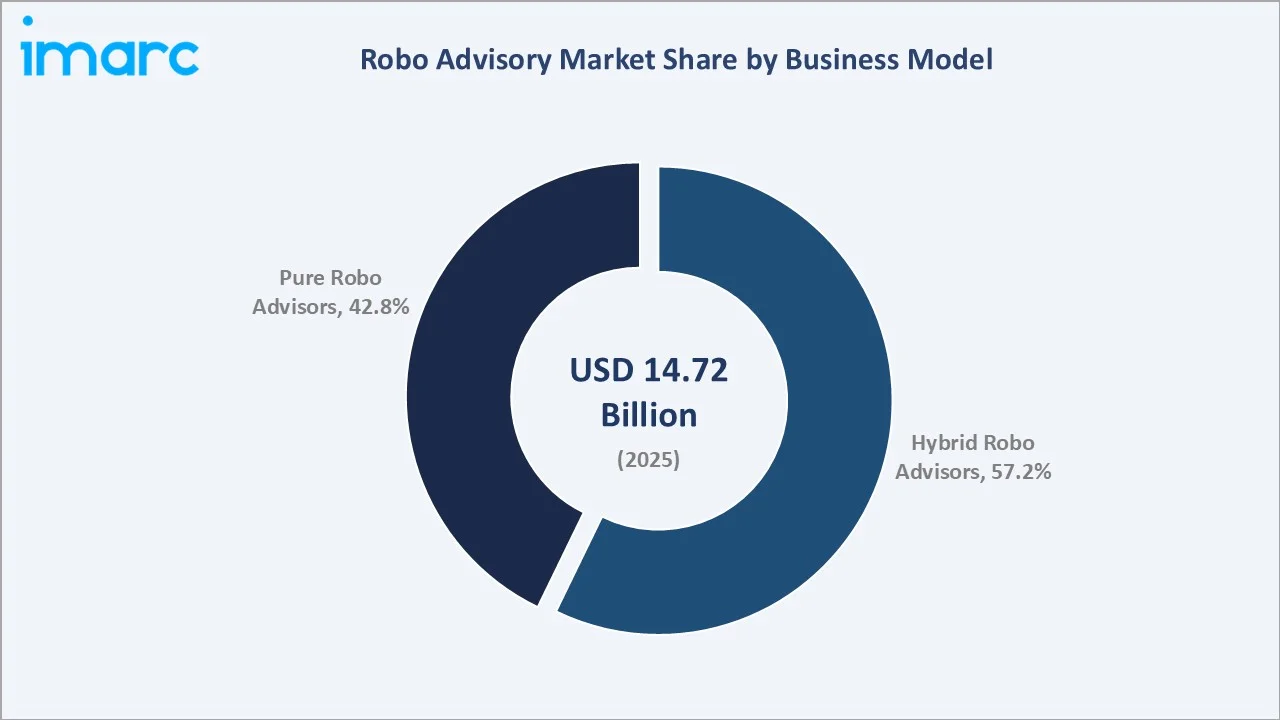
Hybrid robo advisors lead at 57.2% in 2025, reflecting investor preference for combining automated, low-cost portfolio management with human advisory support for complex financial decisions and higher-value client relationships requiring nuanced guidance.
To access detailed market analysis, Request Sample
Pure robo advisors, at 42.8%, remain attractive to cost-sensitive, digitally native investors seeking fully automated, low-fee portfolio management without dedicated human advisory involvement, particularly among younger retail investors entering capital markets for the first time. This segment continues to benefit from ongoing improvements in algorithmic sophistication and expanding fund-selection breadth.
By Service Type
Comprehensive wealth advisory leads at 58.4% in 2025, as investors with diversified income streams, business ownership, and multi-generational planning needs increasingly demand integrated advisory solutions extending beyond simple goal-based investing into holistic financial strategy.
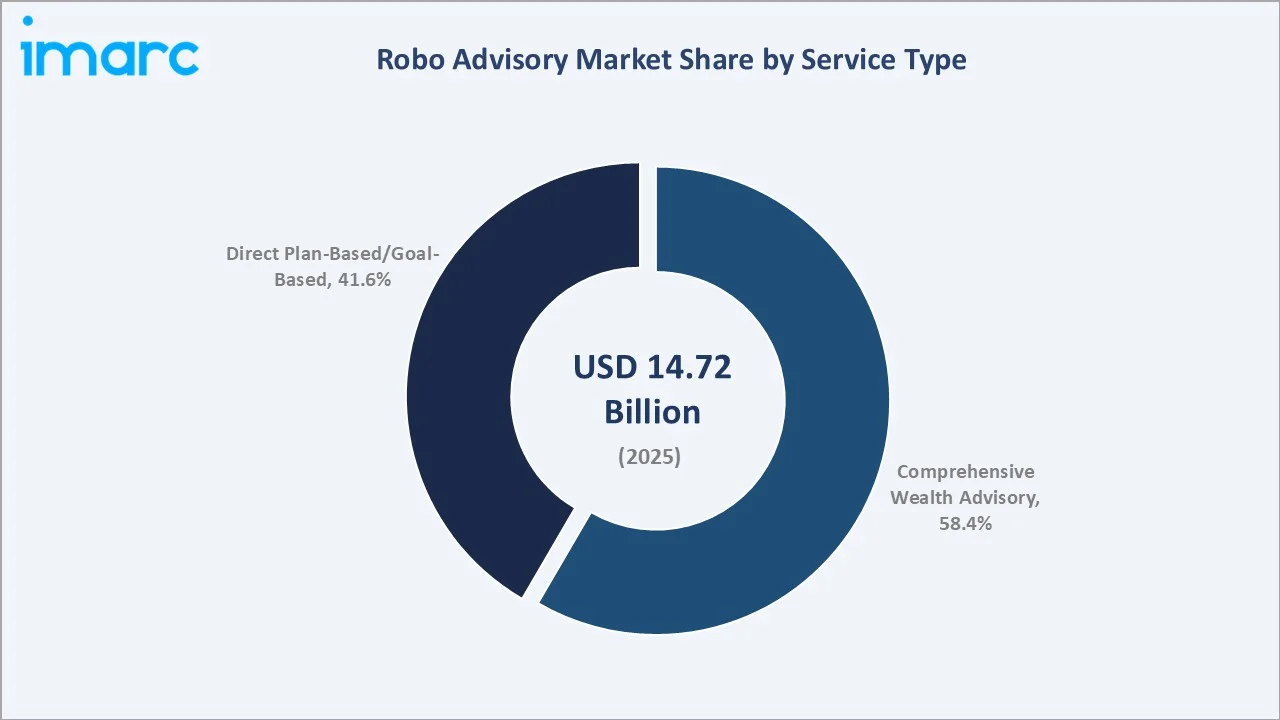
Direct plan-based/goal-based services, at 41.6%, remain popular among retail investors pursuing specific objectives such as retirement or education savings through simple, automated, low-cost investment plans requiring minimal ongoing engagement. Providers continue to enhance these offerings with improved goal-tracking dashboards and automated contribution features.
Regional Market Insights
|
Region |
Share (2025) |
Key Robo Advisory Market Drivers & Characteristics |
|
North America |
39.2% |
Advanced digital infrastructure, strong investor trust, mature capital markets, and widespread fintech adoption support market leadership |
|
Europe |
27.1% |
Supportive regulatory frameworks, rising demand for sustainable investing, and expanding technology-enabled advisory adoption |
|
Asia-Pacific |
24.8% |
Expanding middle-class wealth, rising smartphone penetration, and growing fintech investment activity across major economies |
|
Latin America |
5.2% |
Improving financial inclusion, rising smartphone usage, and increasing adoption of digital banking and investment services |
|
Middle East and Africa |
3.7% |
Emerging fintech ecosystems, expanding digital infrastructure, and rising interest in accessible wealth management tools |
North America, at 39.2%, leads through advanced fintech infrastructure and high consumer trust in digital financial services, supported by mature capital markets, favorable regulatory clarity, and well-established investor familiarity with automated platforms. Europe, at 27.1%, benefits from supportive regulation and rising demand for sustainable, ESG-aligned digital investing solutions.
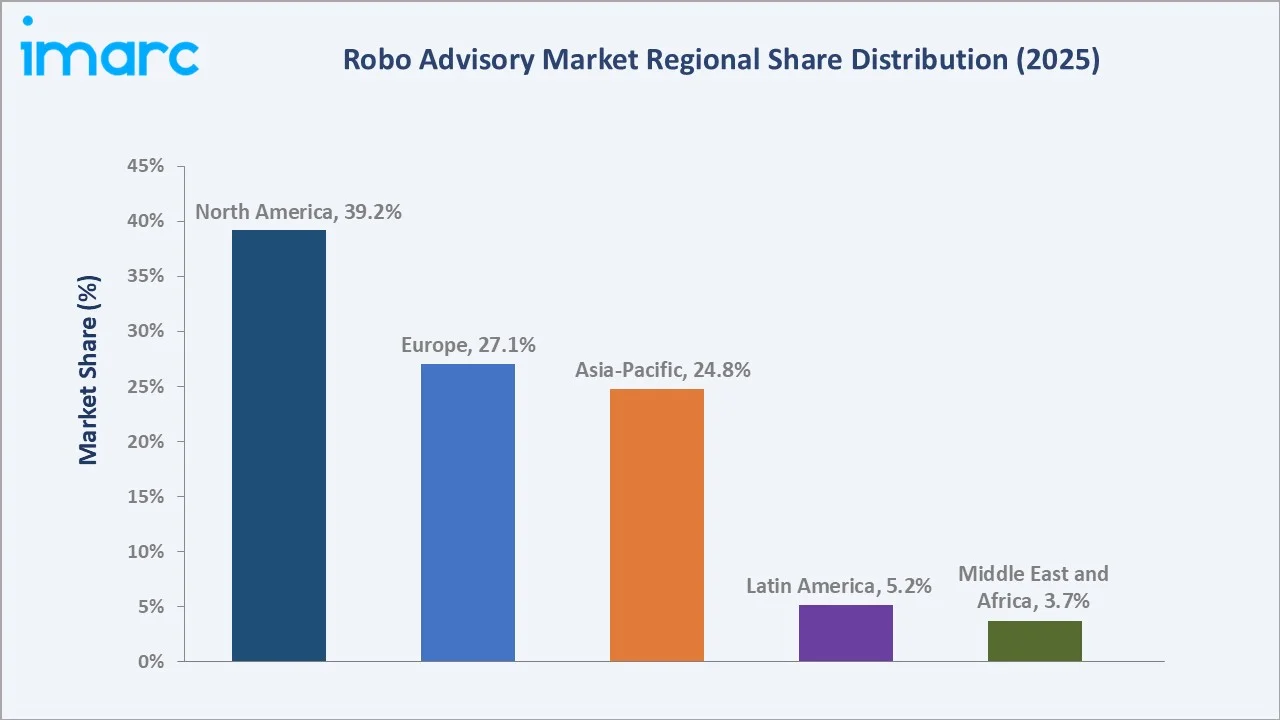
Asia-Pacific, at 24.8%, reflects rapid smartphone-driven fintech adoption and expanding middle-class wealth across the region's major economies. Latin America, at 5.2%, and the Middle East and Africa, at 3.7%, represent early-stage but steadily expanding digital wealth-management markets with strong long-term growth potential.
Competitive Landscape
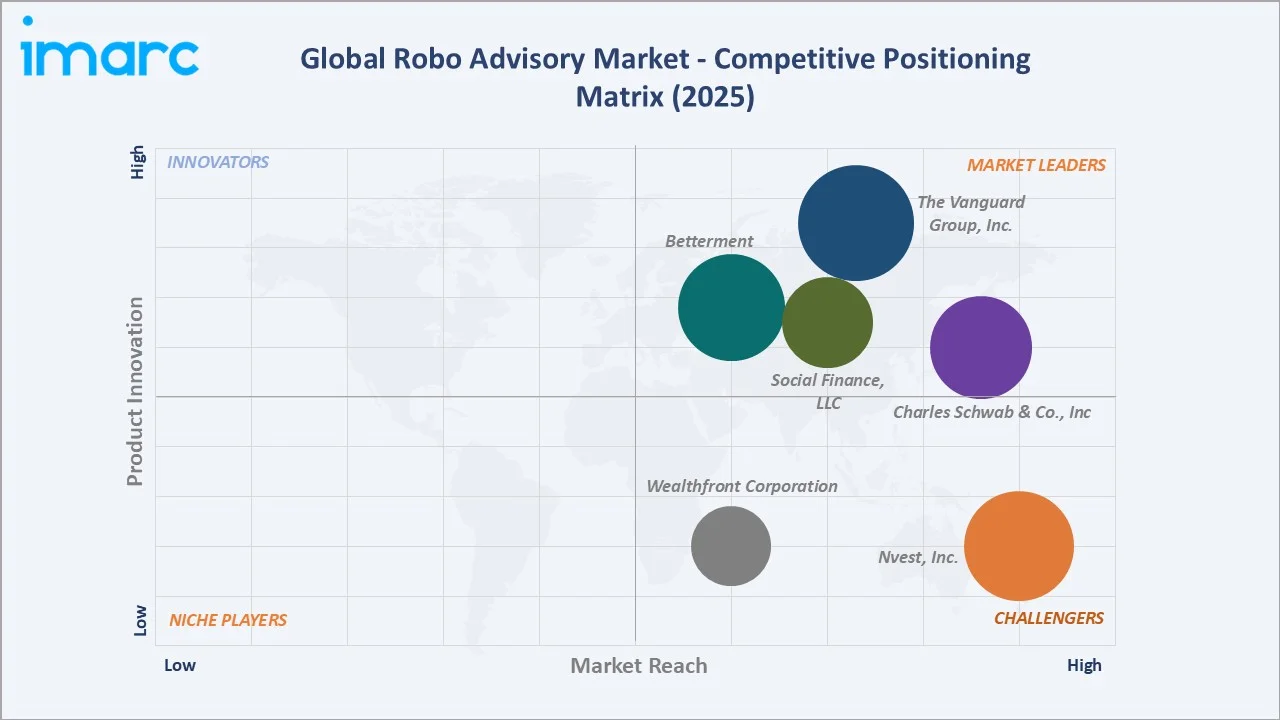
The global robo advisory market is moderately fragmented, comprising established pure-play robo-advisory pioneers, diversified fintech and brokerage platforms, and traditional wealth managers expanding into automated digital advisory services to defend and grow their client bases. Providers are differentiating through personalization technology, fee structures, and breadth of integrated financial services offered to clients.
|
Company Name |
Key Products |
Market Position |
Core Strength |
|
Betterment |
Automated Investing, Cash Reserve, Retirement Planning, Betterment Advisor Solutions |
Market Leader |
Pioneer in pure-play robo-advisory with strong goal-based planning tools |
|
Nvest, Inc. |
Automated Portfolio Management |
Strong Challenger |
Technology licensing model partnering with banks and brokerages |
|
Social Finance, LLC |
SoFi Automated Investing |
Market Leader |
Integrated fintech ecosystem combining banking, lending, and investing |
|
Charles Schwab & Co., Inc |
Schwab Intelligent Portfolios |
Market Leader |
Extensive brokerage infrastructure and zero-advisory-fee robo platform |
|
The Vanguard Group, Inc. |
Vanguard Digital Advisor, Personal Advisor |
Market Leader |
Low-cost fund ecosystem and large-scale assets under management |
|
Wealthfront Corporation |
Automated Investing |
Strong Challenger |
Advanced tax-loss harvesting and comprehensive digital planning tools |
Key players include Betterment, Nvest, Inc., Social Finance, LLC, Charles Schwab & Co., Inc, The Vanguard Group, Inc., Wealthfront Corporation, and others.
Key Company Profiles
Betterment
Betterment is a US-based pure-play robo-advisory pioneer offering automated investing, cash management, and retirement planning tools built on goal-based portfolio algorithms for retail investors and advisor-channel clients across the United States. The company remains one of the industry's most recognized independent digital wealth-management brands.
- Key Products: Automated Investing, Cash Reserve, Retirement Planning.
- Recent Developments: In February 2025, Betterment acquired the automated investing business of Ellevest, expanding its digital wealth management platform and customer base. As part of the agreement, Ellevest's automated investing accounts and assets under management will transition to Betterment, while Ellevest will retain its financial planning, wealth management, technology, employees, and core operations.
- Strategic Focus: Expanding goal-based automated investing and retirement planning tools while broadening advisor-channel partnerships and institutional distribution relationships across the United States.
Charles Schwab & Co., Inc
Charles Schwab & Co., Inc is a US-based financial services firm offering Schwab Intelligent Portfolios, a zero-advisory-fee robo-advisory platform backed by extensive brokerage infrastructure, scale, and decades of investor trust across generations of American investors.
- Key Products: Schwab Intelligent Portfolios.
- Strategic Focus: Strengthening its zero-fee automated advisory platform while expanding hybrid advisory access for higher-balance clients seeking additional personalized guidance.
Market Concentration Analysis
The robo advisory market is moderately fragmented, with the key players collectively holding a significant share of global assets under automated management. Traditional wealth managers and regional fintech entrants continue to gain share as digital adoption broadens across retail and high-net-worth investor segments, gradually diversifying the competitive landscape over the forecast period as new entrants target underserved regional and demographic niches.
Consolidation activity, including technology licensing partnerships and acquisitions of smaller robo-advisory platforms by established financial institutions, is expected to continue as incumbents seek to accelerate digital capability build-out rather than developing proprietary algorithms independently, further reshaping competitive dynamics through the forecast period. This trend is expected to gradually raise entry barriers for new, smaller technology-only providers.
Investment & Growth Opportunities
Highest Growth Segments
Hybrid robo advisory, at approximately 24.1% CAGR, comprehensive wealth advisory, at approximately 24.6% CAGR, AI-driven personalization tools, and HNI-focused hybrid platforms represent the highest-growth investment vectors through 2034, supported by rising global digital wealth adoption and expanding fintech infrastructure across both mature and emerging markets.
Emerging Investment Opportunities
Goal-based automation for HNI segments represents a high per-client-value opportunity, as comprehensive wealth advisory generates substantially higher revenue per account than direct plan-based offerings, supported by rising global high-net-worth wealth accumulation and demand for integrated planning. Embedded finance partnerships with banks and neobanks further extend distribution reach into previously underserved customer segments.
Investment Themes
- AI Personalization Infrastructure Investment: Providers investing in proprietary AI/ML personalization engines can achieve differentiated client engagement and retention, creating a durable competitive advantage over standardized, template-based robo-advisory platforms lacking sophisticated customization capabilities.
- Hybrid Advisory Channel Expansion: Expanding hybrid advisory capacity to serve HNI and complex retail segments captures higher-margin comprehensive wealth advisory revenue while retaining the underlying cost efficiency and scalability of core platform automation.
Future Market Outlook (2026-2034)
The global robo advisory market is projected to grow from USD 14.72 Billion in 2025 to USD 95.63 Billion by 2034, delivering a 22.42% CAGR over the forecast period. The market's anchor value of USD 40.47 Billion by 2030 reflects an industry at its most transformative digital-adoption inflection point, as automated wealth management moves further into the financial services mainstream across both developed and emerging economies.
Hybrid advisory models, AI-driven personalization, and comprehensive wealth advisory will increasingly define the competitive landscape, as digitally native investors and high-net-worth individuals alike demand automated, integrated, and cost-efficient wealth management solutions through 2034 and beyond, reshaping how financial advice is delivered globally across retail and institutional channels alike.
Research Methodology
Primary Research
Primary research comprised structured interviews with industry stakeholders, including robo-advisory platform executives, fintech product leads, wealth management specialists, and institutional investment technology experts across major regional markets, supplemented by discussions with regulatory and compliance advisors.
Secondary Research
Secondary research encompassed company annual reports, fintech industry publications, regulatory filings, financial technology association data, and published market forecasts covering the global robo advisory industry and its adjacent digital wealth-management ecosystem, cross-verified across multiple independent sources.
Forecasting Models
Market revenue forecasts were developed using a bottom-up model incorporating assets under automated management by business model and service type, average revenue per account, and regional digital-adoption growth rates across historical and forecast periods, validated against top-down industry benchmarks.
Robo Advisory Market Report Scope:
| Report Features | Details |
|---|---|
| Base Year of the Analysis | 2025 |
| Historical Period | 2020-2025 |
| Forecast Period | 2026-2034 |
| Units | Billion USD |
| Scope of the Report |
Exploration of Historical Trends and Market Outlook, Industry Catalysts and Challenges, Segment-Wise Historical and Future Market Assessment:
|
| Business Models Covered | Pure Robo Advisors, Hybrid Robo Advisors |
| Service Types Covered | Direct Plan-Based/Goal-Based, Comprehensive Wealth Advisory |
| Providers Covered | Fintech Robo Advisors, Banks, Traditional Wealth Managers, Others |
| End Users Covered | Retail Investor, High Net Worth Individuals (HNIs) |
| Regions Covered | Asia Pacific, Europe, North America, Latin America, Middle East and Africa |
| Countries Covered | United States, Canada, Germany, France, United Kingdom, Italy, Spain, Russia, China, Japan, India, South Korea, Australia, Indonesia, Brazil, Mexico |
| Companies Covered | Betterment, Nvest, Inc., Social Finance, LLC, Charles Schwab & Co., Inc, The Vanguard Group, Inc., Wealthfront Corporation, etc. |
| Customization Scope | 10% Free Customization |
| Post-Sale Analyst Support | 10-12 Weeks |
| Delivery Format | PDF and Excel through Email (We can also provide the editable version of the report in PPT/Word format on special request) |
Key Benefits for Stakeholders:
- IMARC's report offers a comprehensive quantitative analysis of various market segments, historical and current market trends, market forecasts, and dynamics of the robo advisory market from 2020-2034.
- The research study provides the latest information on the market drivers, challenges, and opportunities in the global robo advisory market.
- The study maps the leading, as well as the fastest-growing, regional markets. It further enables stakeholders to identify the key country-level markets within each region.
- Porter's five forces analysis assists stakeholders in assessing the impact of new entrants, competitive rivalry, supplier power, buyer power, and the threat of substitution. It helps stakeholders to analyze the level of competition within the robo advisory industry and its attractiveness.
- The competitive landscape allows stakeholders to understand their competitive environment and provides insight into the current positions of key players in the market.
Frequently Asked Questions About the Robo Advisory Market Report
The global robo advisory market reached USD 14.72 Billion in 2025, driven by hybrid robo advisors dominant at 57.2%, comprehensive wealth advisory leading at 58.4%, and North America commanding 39.2% market share through advanced fintech infrastructure and high digital adoption.
The robo advisory market grows at a 22.42% CAGR during 2026-2034, reaching USD 95.63 Billion by 2034, driven by AI-based personalization, hybrid advisory expansion, rising digital financial literacy, and broader fintech distribution across investor segments.
Hybrid robo advisors lead at 57.2%, combining automated portfolio management with human advisory guidance for complex financial planning needs, and grow at approximately 24.1% CAGR through 2034 across major regional markets.
Comprehensive wealth advisory leads at 58.4%, driven by investors requiring integrated planning across retirement, tax optimization, and estate management, growing at approximately 24.6% CAGR through 2034 worldwide as investor wealth accumulates.
North America leads at 39.2%, supported by mature fintech infrastructure, high digital adoption, and strong investor trust in automated wealth-management platforms across the United States and Canada, with Europe following closely.
Leading companies include Betterment, Nvest, Inc., Social Finance, LLC, Charles Schwab & Co., Inc, The Vanguard Group, Inc., Wealthfront Corporation, and others.
The robo advisory market is projected to reach approximately USD 40.47 Billion by 2030, with hybrid advisory and AI-driven personalization becoming standard features across mainstream digital wealth-management platforms worldwide during this period.
Priority opportunities include AI personalization infrastructure investment, hybrid advisory channel expansion for HNI segments, and goal-based automation platforms serving comprehensive wealth advisory clients across both developed and emerging markets globally.
Need more help?
- Speak to our experienced analysts for insights on the current market scenarios.
- Include additional segments and countries to customize the report as per your requirement.
- Gain an unparalleled competitive advantage in your domain by understanding how to utilize the report and positively impacting your operations and revenue.
- For further assistance, please connect with our analysts.
 Request Customization
 Speak to an Analyst
 Request Brochure
 Inquire Before Buying
Benefits of Customization
- Personalize this research
- Triangulate with your data
- Get data as per your format and definition
- Gain a deeper dive into a specific application, geography, customer, or competitor
- Any level of personalization
Get in Touch With Us
UNITED STATES
Phone: +1-201-971-6302
INDIA
Phone: +91-120-433-0800
UNITED KINGDOM
Phone: +44-753-714-6104
Email: [email protected]
Client Testimonials




.webp)




.webp)













Related Reports

Choose your plan
*Please note that the prices mentioned below are starting prices for each bundle type. Kindly contact our team for further details.*
Single User License
- 1 User License, Access on 2 Devices
- PDF Report + Excel Dataset (Password Protected)
- Lifetime Access
- No Printing Rights
- 10% Free Report Customization
- 10–12 Weeks of Analyst Support
Five User License
- Access for 5 Users, 2 Devices per User
- PDF Report + Excel Dataset (Password Protected)
- Lifetime Access
- Dedicated Account Manager
- 12–14 Weeks of Analyst Support
- No Printing Rights
- 15% Free Report Customization
- 25% Discount on Your Next Purchase
Corporate User License
- Unlimited User Access (Within Your Organization)
- PDF Report + Excel Dataset
- Lifetime Access
- Dedicated Account Manager
- 14–20 Weeks of Analyst Support
- No Printing Rights
- 20% Free Report Customization
- 30% Discount on Your Next Purchase
Essential Insights
What's included:
3 reports
- Lifetime Access
- PDF Reports
- Excel Datasets
- 2 Weeks of Free Analyst Support
- 2 User Licenses
- Access on 2 Devices
- Printing Rights
- Complimentary PowerPoint (PPT) Version
- Complimentary License Upgrade
Professional Access
What's included:
5 reports
- Lifetime Access
- PDF Reports
- Excel Datasets
- 8 Weeks of Free Analyst Support
- 2 User Licenses
- Access on 2 Devices
- Printing Rights
- Complimentary PowerPoint (PPT) Version
- Complimentary License Upgrade
Business Advantage
What's included:
8 reports
- Lifetime Access
- PDF Reports
- Excel Datasets
- 14 Weeks of Free Analyst Support
- 2 User Licenses
- Access on 2 Devices
- Printing Rights
- Complimentary PowerPoint (PPT) Version
- Complimentary License Upgrade
Enterprise Intelligence
What's included:
10 reports
- Lifetime Access
- PDF Reports
- Excel Datasets
- 20 Weeks of Free Analyst Support
- 2 User Licenses
- Access on 2 Devices
- Printing Rights
- Complimentary PowerPoint (PPT) Version
- Complimentary License Upgrade