
Rubidium Market Size, Share, Trends and Forecast by Production Process, Grade, Application Sector, and Region, 2026-2034
Rubidium Market Size and Share:
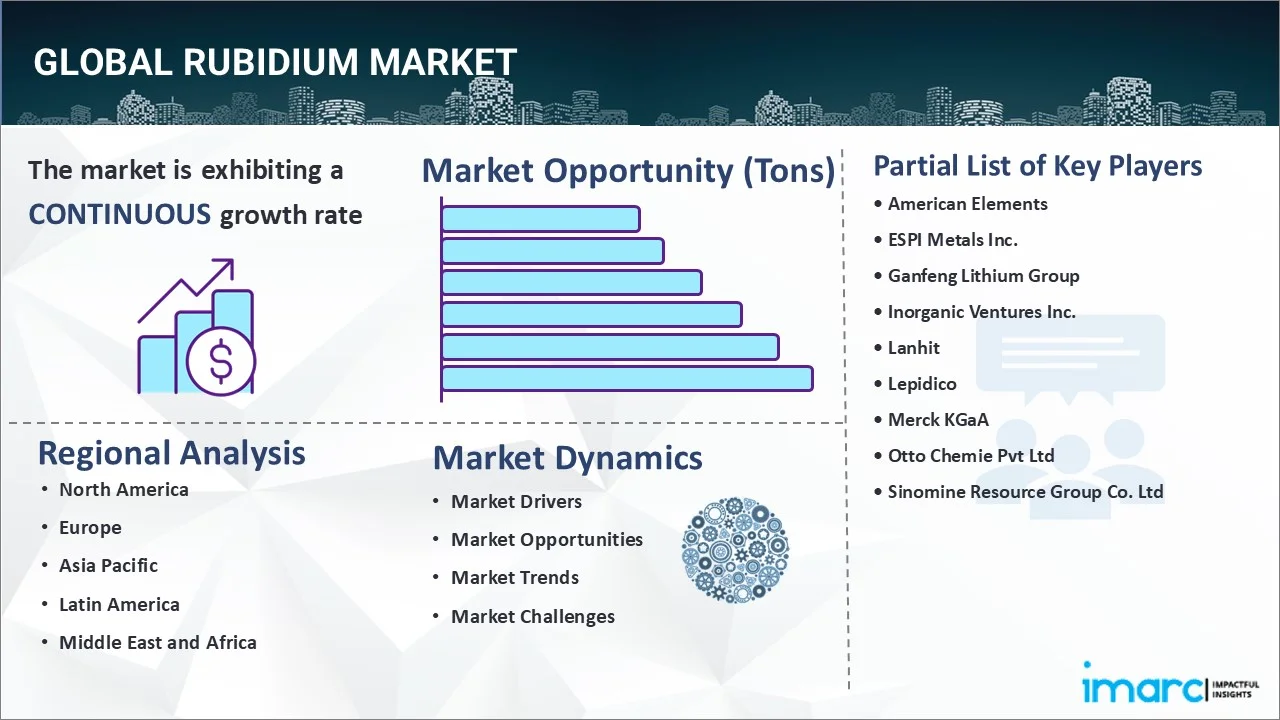
The global rubidium market size reached 3.10 Kilo Tons in 2025 and is projected to reach 4.06 Kilo Tons by 2034, growing at a compound annual growth rate of 3.02% from 2026-2034. North America currently dominates the market, holding a market share of 35% in 2025. The region benefits from substantial investments in scientific research and development (R&D), a well-established electronics sector driving the adoption of rubidium-based atomic clocks, and increasing demand for precision timekeeping technologies in telecommunications and satellite navigation, all expanding the rubidium market share.
The increasing use of rubidium in scientific research, particularly in atomic clocks, is one of the factors that is expected to have a positive impact on the rubidium market in the near future. The use of rubidium in atomic clocks provides precise time accuracy, making it an essential component in satellite navigation systems, telecommunications, and scientific research. The increasing use of rubidium in biomedical research, particularly in positron emission tomography using the isotope rubidium-82, in cardiac perfusion imaging, is also having a positive impact on the rubidium market growth in the near future. Moreover, the increasing production of specialty glasses used in fiber optic telecommunications systems and night vision systems is expected to generate significant growth opportunities for the rubidium market in the near future. Furthermore, the growing trend of quantum computing research, in which rubidium is used as qubits, is expected to have a positive impact on the rubidium market in the near future.
The United States has also emerged as a vital region for the overall rubidium industry due to a variety of factors. Firstly, the country has a well-established defense and aerospace industry that uses a large quantity of rubidium for building atomic clocks for GPS navigation systems. Secondly, the rapid deployment of 5G technology infrastructure is also contributing to the overall demand for rubidium. For example, a large quantity of rubidium is required for building accurate atomic clocks for 5G network infrastructure deployment sites. Additionally, the rising importance of quantum computing technology, which is backed by both government and private sector funding, is also contributing to the overall demand for high-quality rubidium compounds. For example, in February 2025, the Department of Energy announced a proposal to allocate $2.5 billion for funding quantum technology from 2026 to 2030 as part of the Quantum Leadership Act. Furthermore, the rising importance of rubidium-82 for cardiac PET scans is also adding to the overall demand for rubidium.
To get more information on this market Request Sample
Rubidium Market Trends:
Rising Quantum Computing Applications
The expanding role of rubidium in quantum computing research is significantly contributing to the market demand. Neutral rubidium atoms, held and manipulated using precisely focused laser beams called optical tweezers, serve as qubits in quantum processors that offer inherent stability and scalable architecture. Researchers worldwide are leveraging the unique properties of rubidium to develop more powerful and efficient quantum systems suitable for applications in drug discovery, materials science, cryptography, and optimization problems. The increasing recognition of neutral-atom platforms as a viable path to fault-tolerant quantum computing is spurring investments from both government agencies and private technology firms. For instance, in August 2025, a research team at the University of Science and Technology of China arranged more than 2,000 rubidium atoms into precise two-dimensional and three-dimensional arrays, marking a tenfold increase over the largest previous atom arrays. These developments are propelling the demand for rubidium across academic and commercial quantum research laboratories.
Growing Demand for Atomic Clocks
The rising need for precise timekeeping solutions in telecommunications, satellite navigation, and defense applications is driving the demand for rubidium-based atomic clocks, which represents a key rubidium market forecast indicator. Rubidium atomic clocks deliver high-frequency stability, compact form factors, and low power consumption, making them ideal for integration into portable devices and embedded systems. The global rollout of 5G networks is a primary catalyst, as these networks require nanosecond-level time synchronization for features such as massive MIMO and network slicing. Additionally, the growing deployment of global navigation satellite systems, including GPS, Galileo, and BeiDou, relies on rubidium clocks for accurate positioning. For instance, in January 2025, a research team from Academy for Precision Measurement Science and Technology (APM) developed a new rubidium atomic clock that set an international record for stability, expanding the leading advantage in rubidium clock technology. The expanding telecommunications and defense infrastructure continues to drive rubidium demand.
Expanding Biomedical Imaging Applications
The increasing adoption of rubidium-82 in cardiac positron emission tomography scans is supporting the rubidium market outlook. Rubidium-82 is a generator-produced radiotracer with a 75-second half-life that enables rapid, non-invasive myocardial perfusion imaging with minimal radiation exposure to patients. As the prevalence of cardiovascular diseases continues to rise globally, the demand for accurate and efficient diagnostic tools has intensified, positioning rubidium-82 PET as a preferred modality in nuclear cardiology. Healthcare facilities are increasingly installing rubidium generators to provide on-demand cardiac imaging without requiring an on-site cyclotron. For instance, in 2025, Frequency Electronics projected initial fiscal year 2026 revenue of $1M to $2M from its compact rubidium-based TURbO atomic clock aimed at defense drones and missile guidance systems. Moreover, the rising awareness about early disease detection and personalized medicine approaches that allow tailored treatments based on individual diagnostic results is creating additional demand for rubidium isotopes.
Rubidium Industry Segmentation:
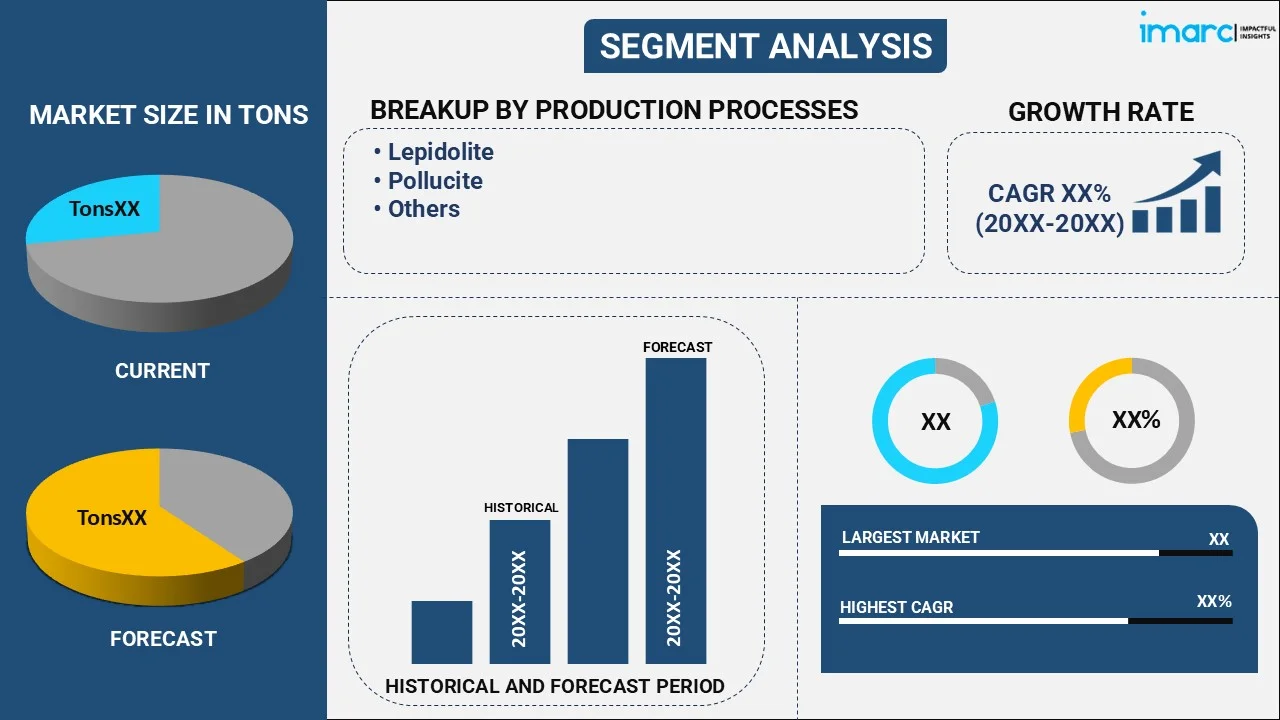
IMARC Group provides an analysis of the key trends in each segment of the global rubidium market, along with forecast at the global, regional, and country levels from 2026-2034. The market has been categorized based on production process, grade, and application sector.
Analysis by Production Process:
To get detailed segment analysis of this market Request Sample
- Lepidolite
- Pollucite
- Others
Lepidolite holds 44% of the market share. Lepidolite is a lithium-bearing mica mineral that contains trace amounts of rubidium within its crystal lattice, and it serves as the primary source for rubidium extraction globally. The production process typically begins with mining the mineral from ore deposits, followed by beneficiation to concentrate the valuable components. Subsequently, advanced extraction techniques such as acid leaching, chlorination roasting, or alkaline pressure leaching are employed to isolate rubidium from the concentrate. The extracted rubidium is then refined to achieve the required purity for various industrial applications. The dominance of this segment is attributed to the abundant availability of lepidolite and its cost-effective extraction methods compared to other rubidium-bearing minerals. For instance, a 2025 study published in the journal Minerals demonstrated that optimized sulfuric acid leaching of lepidolite slag could achieve rubidium extraction rates of 86.26%, enhancing the economic viability of rubidium recovery from this source.
Analysis by Grade:
- Technical Grade Metal
- High-purity Grade
Technical grade metal leads the market with a share of 52%. Technical grade rubidium metal is produced through refining processes that achieve purity levels suitable for a broad range of industrial applications without requiring the ultra-high purity demanded by specialized scientific instruments. This grade of rubidium is extensively used in the production of specialty glasses for fiber-optic telecommunications networks, night-vision devices, and electrical-signal generators. Its wider applicability across diverse industrial sectors and relatively lower production costs compared to high-purity grade rubidium drive its dominant position. The growing demand for rubidium carbonate in glass manufacturing, where it reduces electrical conductivity and improves stability and durability, is further strengthening this segment.

Analysis by Application Sector:
- Biomedical Research
- Electronics
- Specialty Glass
- Pyrotechnics
- Others
Electronics dominates the market, with a share of 36%. The electronics segment encompasses a wide range of applications for rubidium, including atomic clocks, frequency standards, magnetometers, and semiconductor manufacturing through ion implantation processes. Rubidium-based atomic clocks are essential components in telecommunications base stations, satellite navigation receivers, and defense communication systems where precise timing synchronization is critical. The rising demand for smaller and more efficient electronic devices is bolstering the consumption of rubidium in this segment. Additionally, the expanding deployment of 5G infrastructure worldwide requires nanosecond-level timing accuracy that rubidium oscillators reliably provide. For instance, in 2025, Microchip Technology launched its second-generation low-noise chip-scale atomic clock, model SA65-LN, designed to operate in wider temperature ranges for demanding portable and battery-powered electronic applications. The continued advancement in electronics and semiconductor technologies is sustaining the segment's leadership.
Regional Analysis:
.webp)
To get more information on the regional analysis of this market Request Sample
- North America
- United States
- Canada
- Asia Pacific
- China
- Japan
- India
- South Korea
- Australia
- Indonesia
- Others
- Europe
- Germany
- France
- United Kingdom
- Italy
- Spain
- Russia
- Others
- Latin America
- Brazil
- Mexico
- Others
- Middle East and Africa
North America, accounting for 35% of the share, enjoys the leading position in the market. The region benefits from an established ecosystem of technological innovation, substantial government and private sector investment in research and development, and a robust demand for rubidium-based technologies across defense, aerospace, and telecommunications sectors. The significant presence of leading atomic clock manufacturers and advanced research institutions further supports the region's dominance. The rapid deployment of 5G networks and the expanding quantum computing landscape are additional catalysts driving rubidium consumption. For instance, in December 2025, a research team at Lomonosov Moscow State University tested a 72-qubit quantum computing prototype using neutral rubidium atoms, reflecting the growing global focus on rubidium-based quantum technologies that also stimulates demand from North American research collaborators. Moreover, the rising utilization of rubidium-82 in cardiac imaging at healthcare facilities strengthens the regional market position.
Key Regional Takeaways:
United States Rubidium Market Analysis
The United States represents the largest contributor to the North American rubidium market, driven by its leadership in aerospace, defense, and advanced technology sectors. The country's substantial defense budget supports the continuous procurement and integration of rubidium-based atomic clocks into military GPS systems, secure satellite communications, and electronic warfare platforms. The telecommunications sector is another significant demand driver, as the rapid expansion of 5G network infrastructure requires highly precise timing synchronization provided by rubidium oscillators. Additionally, the growing quantum computing ecosystem in the United States is accelerating rubidium demand, with major research institutions and startup companies employing neutral rubidium atoms in next-generation quantum processors. For instance, in 2025, a Harvard-led research collaboration demonstrated a system with scalable error-corrected quantum computation using rubidium atom arrays, creating the scientific foundation for practical large-scale quantum computing. Moreover, government initiatives aimed at securing domestic critical mineral supplies are reinforcing the rubidium value chain.
Europe Rubidium Market Analysis
Europe represents a significant market for rubidium, driven by the region's strong emphasis on technological advancement, scientific research, and precision manufacturing. The presence of major chemical and specialty materials companies, including key rubidium compound suppliers, supports a well-established supply chain. European nations are investing heavily in quantum technology programs, with several countries establishing dedicated quantum research centers that rely on rubidium for neutral-atom quantum computing experiments. The defense and aerospace sectors across the region maintain steady demand for rubidium atomic clocks used in navigation and communication systems. Additionally, the telecommunications industry is driving rubidium consumption through the deployment of advanced network infrastructure. For instance, in July 2025, a leading manufacturer released the NAC2 nano atomic clock, a compact rubidium oscillator drawing under 250 milliwatts and designed for portable applications in environments lacking satellite navigation signals. The growing demand for specialty glass in fiber-optic networks and industrial optics further supports the European rubidium market trends.
Asia-Pacific Rubidium Market Analysis
The Asia-Pacific region is emerging as a rapidly growing market for rubidium, driven by substantial investments in quantum technology, telecommunications infrastructure, and space exploration programs. China leads the regional market with significant government-backed initiatives in atomic clock development, satellite navigation systems, and quantum computing research. Japan's advanced electronics and aerospace industries sustain steady demand for rubidium-based precision instruments. For instance, in December 2024, Everest Metals Corporation in Western Australia successfully produced its first rubidium product from the Mt Edon Critical Mineral Project, intended for high-technology applications including communications, aerospace, and defense. India and South Korea are also contributing to regional demand through expanding semiconductor manufacturing and 5G network deployment programs.
Latin America Rubidium Market Analysis
Latin America represents a developing market for rubidium, with growing demand primarily driven by the expansion of telecommunications infrastructure and increasing industrialization across the region. Brazil and Mexico are the leading consumers, driven by their advancing telecommunications networks that require precision timing solutions. For instance, in February 2025, Ganfeng Lithium commenced lithium production at its Mariana project in Argentina, which supports the broader alkali metal supply chain including rubidium extraction from co-located mineral deposits. The region's telecommunications modernization initiatives are gradually increasing the adoption of rubidium-based technologies.
Middle East and Africa Rubidium Market Analysis
The Middle East and Africa region represents a nascent but growing market for rubidium, supported by increasing investments in telecommunications and defense infrastructure. Gulf Cooperation Council countries are expanding their satellite navigation and communication systems, creating demand for rubidium atomic clocks. For instance, in 2025, International Lithium Corp acquired an option for the Karibib project in Namibia, described as holding the largest declared rubidium resource in Africa, potentially enhancing regional rubidium supply availability. The gradual modernization of telecommunications networks across the region is expected to support steady demand growth.
Competitive Landscape:
The competitive landscape of the rubidium market is characterized by a mix of established chemical manufacturers and specialized mineral extraction companies that are actively pursuing capacity expansions, technological innovation, and strategic partnerships. Key players are investing in improving extraction and purification techniques to enhance the yield and purity of rubidium compounds, addressing the growing demand from high-technology applications. Several companies are diversifying their operations to include rubidium as a co-product of lithium and cesium extraction, leveraging existing mining infrastructure to improve cost efficiency. The market also witnesses collaborations between industry participants and research institutions to develop novel applications in quantum computing, energy storage, and biomedical imaging. Challenges include the geographically concentrated supply base and the dependence on co-production with lithium, which creates supply volatility linked to lithium market dynamics.
The report provides a comprehensive analysis of the competitive landscape in the rubidium market with detailed profiles of all major companies, including:
- American Elements
- ESPI Metals Inc.
- Ganfeng Lithium Group
- Inorganic Ventures Inc.
- Lanhit
- Lepidico
- Merck KGaA
- Otto Chemie Pvt Ltd
- Sinomine Resource Group Co. Ltd
Latest News and Developments:
- October 2025: Safran Electronics & Defense unveiled MIRA, its next-generation Miniature Rubidium Atomic clock establishing a new benchmark in precise timing technology for defense, aerospace, telecom, and industrial sectors. MIRA is designed to endure harsh conditions, functioning dependably from – 40°C to +80°C and tolerating 50g shock, 7.7 gRMS vibration, and high-altitude flight – while maintaining atomic lock stability. Its standard interfaces and adaptable management capabilities allow for smooth integration, facilitating quick updates for both new and existing platforms.
Rubidium Market Report Scope:
| Report Features | Details |
|---|---|
| Base Year of the Analysis | 2025 |
| Historical Period | 2020-2025 |
| Forecast Period | 2026-2034 |
| Units | Kilo Tons, Million USD |
| Scope of the Report | Exploration of Historical and Forecast Trends, Industry Catalysts and Challenges, Segment-Wise Historical and Predictive Market Assessment:
|
| Production Processes Covered | Lepidolite, Pollucite, Others |
| Grades Covered | Technical Grade Metal, High-purity Grade |
| Application Sectors Covered | Biomedical Research, Electronics, Specialty Glass, Pyrotechnics, Others |
| Regions Covered | Asia Pacific, Europe, North America, Latin America, Middle East and Africa |
| Countries Covered | United States, Canada, Germany, France, United Kingdom, Italy, Spain, Russia, China, Japan, India, South Korea, Australia, Indonesia, Brazil, Mexico |
| Companies Covered | American Elements, ESPI Metals Inc., Ganfeng Lithium Group, Inorganic Ventures Inc., Lanhit, Lepidico, Merck KGaA, Otto Chemie Pvt Ltd, Sinomine Resource Group Co. Ltd. etc. |
| Customization Scope | 10% Free Customization |
| Post-Sale Analyst Support | 10-12 Weeks |
| Delivery Format | PDF and Excel through Email (We can also provide the editable version of the report in PPT/Word format on special request) |
Key Benefits for Stakeholders:
- IMARC’s report offers a comprehensive quantitative analysis of various market segments, historical and current market trends, market forecasts, and dynamics of the rubidium market from 2020-2034.
- The research study provides the latest information on the market drivers, challenges, and opportunities in the global rubidium market.
- The study maps the leading, as well as the fastest-growing, regional markets. It further enables stakeholders to identify the key country-level markets within each region.
- Porter's Five Forces analysis assists stakeholders in assessing the impact of new entrants, competitive rivalry, supplier power, buyer power, and the threat of substitution. It helps stakeholders to analyze the level of competition within the rubidium industry and its attractiveness.
- Competitive landscape allows stakeholders to understand their competitive environment and provides an insight into the current positions of key players in the market.
Frequently Asked Questions About the Rubidium Market Report
The rubidium market reached at 3.10 Kilo Tons in 2025.
The rubidium market is projected to exhibit a CAGR of 3.02% during 2026-2034, reaching a volume of 4.06 Kilo Tons by 2034.
The rubidium market is primarily driven by the growing utilization of rubidium in scientific research and atomic clocks, increasing demand for energy storage technologies driven by renewable energy adoption, expanding biomedical applications in cardiac PET imaging, rising deployment of 5G telecommunications infrastructure requiring precise timing solutions, and the surging interest in quantum computing research that leverages rubidium atoms.
North America currently dominates the rubidium market, accounting for a share of 35%. The region benefits from substantial investments in research and development, a well-established defense and aerospace sector that relies on rubidium-based atomic clocks, and expanding quantum computing and 5G telecommunications infrastructure.
Some of the major players in the rubidium market include American Elements, ESPI Metals Inc., Ganfeng Lithium Group, Inorganic Ventures Inc., Lanhit, Lepidico, Merck KGaA, Otto Chemie Pvt Ltd, Sinomine Resource Group Co. Ltd. etc.
Need more help?
- Speak to our experienced analysts for insights on the current market scenarios.
- Include additional segments and countries to customize the report as per your requirement.
- Gain an unparalleled competitive advantage in your domain by understanding how to utilize the report and positively impacting your operations and revenue.
- For further assistance, please connect with our analysts.
 Request Customization
 Speak to an Analyst
 Request Brochure
 Inquire Before Buying
Benefits of Customization
- Personalize this research
- Triangulate with your data
- Get data as per your format and definition
- Gain a deeper dive into a specific application, geography, customer, or competitor
- Any level of personalization
Get in Touch With Us
UNITED STATES
Phone: +1-201-971-6302
INDIA
Phone: +91-120-433-0800
UNITED KINGDOM
Phone: +44-753-714-6104
Email: [email protected]
Client Testimonials




.webp)




.webp)













Related Reports

Choose your plan
*Please note that the prices mentioned below are starting prices for each bundle type. Kindly contact our team for further details.*
Single User License
- 1 User License, Access on 2 Devices
- PDF Report + Excel Dataset (Password Protected)
- Lifetime Access
- No Printing Rights
- 10% Free Report Customization
- 10–12 Weeks of Analyst Support
Five User License
- Access for 5 Users, 2 Devices per User
- PDF Report + Excel Dataset (Password Protected)
- Lifetime Access
- Dedicated Account Manager
- 12–14 Weeks of Analyst Support
- No Printing Rights
- 15% Free Report Customization
- 25% Discount on Your Next Purchase
Corporate User License
- Unlimited User Access (Within Your Organization)
- PDF Report + Excel Dataset
- Lifetime Access
- Dedicated Account Manager
- 14–20 Weeks of Analyst Support
- No Printing Rights
- 20% Free Report Customization
- 30% Discount on Your Next Purchase
Essential Insights
What's included:
3 reports
- Lifetime Access
- PDF Reports
- Excel Datasets
- 2 Weeks of Free Analyst Support
- 2 User Licenses
- Access on 2 Devices
- Printing Rights
- Complimentary PowerPoint (PPT) Version
- Complimentary License Upgrade
Professional Access
What's included:
5 reports
- Lifetime Access
- PDF Reports
- Excel Datasets
- 8 Weeks of Free Analyst Support
- 2 User Licenses
- Access on 2 Devices
- Printing Rights
- Complimentary PowerPoint (PPT) Version
- Complimentary License Upgrade
Business Advantage
What's included:
8 reports
- Lifetime Access
- PDF Reports
- Excel Datasets
- 14 Weeks of Free Analyst Support
- 2 User Licenses
- Access on 2 Devices
- Printing Rights
- Complimentary PowerPoint (PPT) Version
- Complimentary License Upgrade
Enterprise Intelligence
What's included:
10 reports
- Lifetime Access
- PDF Reports
- Excel Datasets
- 20 Weeks of Free Analyst Support
- 2 User Licenses
- Access on 2 Devices
- Printing Rights
- Complimentary PowerPoint (PPT) Version
- Complimentary License Upgrade