
Saudi Arabia Auto Parts Aftermarket Size, Share, Trends and Forecast by Type, Application, and Region, 2026-2034
Saudi Arabia Auto Parts Aftermarket Summary:
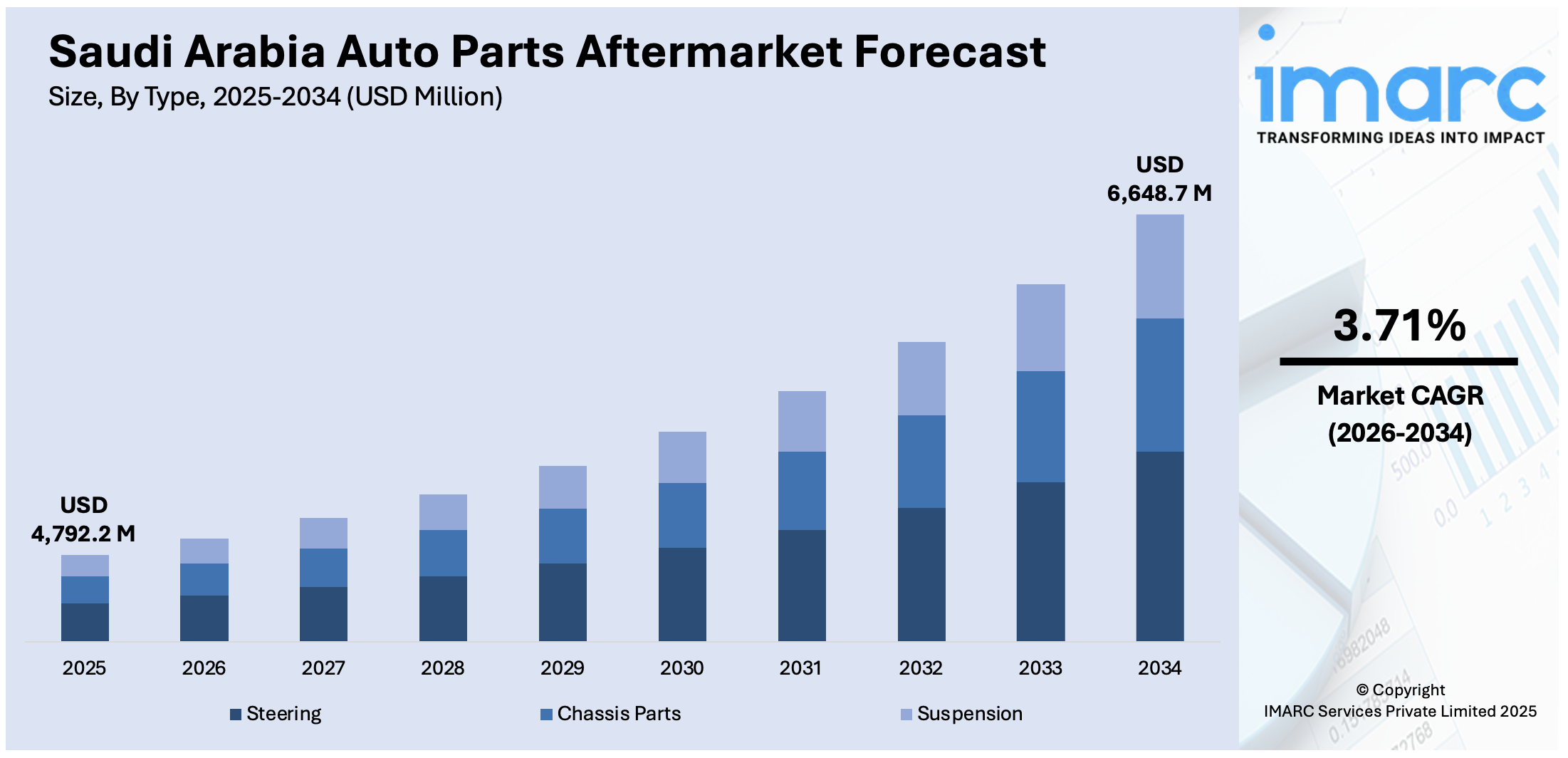
The Saudi Arabia auto parts aftermarket size was valued at USD 4,792.2 Million in 2025 and is projected to reach USD 6,648.7 Million by 2034, growing at a compound annual growth rate of 3.71% from 2026-2034.
The Saudi Arabia auto parts aftermarket is experiencing robust expansion, underpinned by a rapidly growing vehicle fleet, rising consumer preference for vehicle maintenance over premature replacement, and expanding retail and digital distribution networks. The Kingdom's ongoing economic diversification initiatives are fostering a more competitive aftermarket landscape, with increasing participation from both regional and international spare parts suppliers, distributors, and service providers.
Key Takeaways and Insights:
- By Type: Chassis parts dominate the market with a share of 36% in 2025, driven by the high frequency of undercarriage component replacements necessitated by extreme desert heat, rough terrain conditions, and mandatory periodic vehicle inspections across the Kingdom.
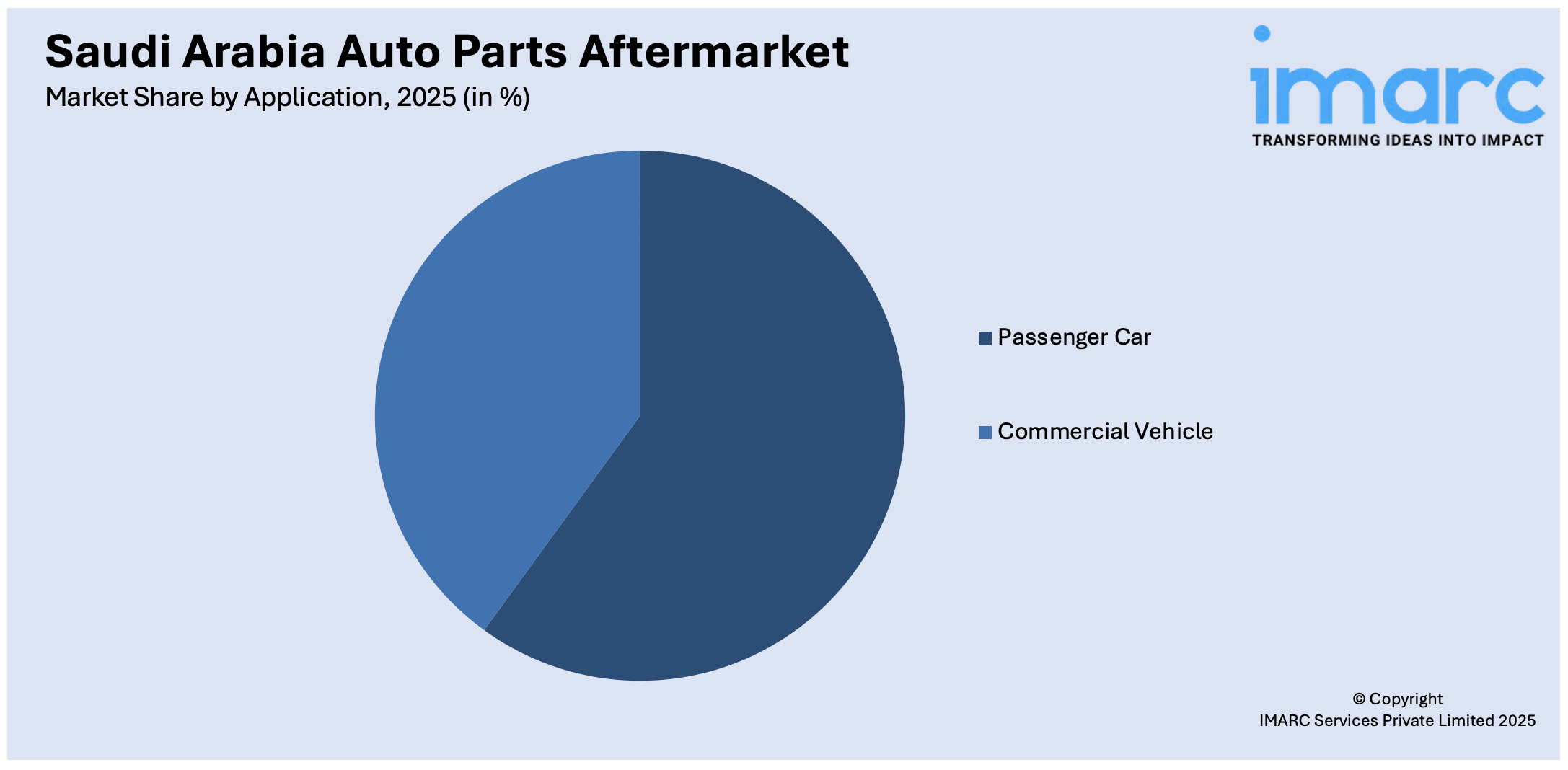
- By Application: Passenger car leads the market with a share of 63% in 2025. This dominance is driven by the Kingdom's substantial passenger vehicle fleet, rising multi-car household ownership, and increasing female motorist participation following driving license reforms.
- By Region: Northern and Central Region represents the largest region with 30% share in 2025, fueled by the concentration of economic activity, population density, and vehicle registrations in Riyadh, which serves as the commercial and administrative hub of the Kingdom.
- Key Players: Key players drive the Saudi Arabia auto parts aftermarket by expanding product portfolios, enhancing supply chain efficiency, investing in digital distribution platforms, and strengthening partnerships with regional workshops and service centers to ensure comprehensive aftermarket coverage across diverse vehicle segments.
To get more information on this market Request Sample
The Saudi Arabia auto parts aftermarket is witnessing a transformative phase, driven by the Kingdom's ambitious Vision 2030 economic diversification agenda, rising vehicle ownership levels, and an expanding network of retail and digital distribution channels. The aftermarket ecosystem is becoming increasingly sophisticated, with growing investments in e-commerce platforms, intelligent warehousing solutions, and localized spare parts centers that enhance accessibility and reduce delivery lead times across the country. The mandatory Motor Vehicle Periodic Inspection (MVPI) system, which requires private vehicles to undergo annual technical checks after their third year of registration, creates a consistent and predictable demand cycle for safety-critical replacement components, including chassis parts, braking systems, and suspension assemblies. The convergence of fleet growth, regulatory enforcement, and digital retail innovation is collectively establishing the Kingdom as one of the most dynamic aftermarket hubs in the Middle East.
Saudi Arabia Auto Parts Aftermarket Trends:
Digital Transformation and E-Commerce Integration in Parts Distribution
The Saudi auto parts aftermarket is undergoing significant digital transformation, with e-commerce platforms and business-to-business digital channels reshaping how spare parts are sourced and distributed. Online retail platforms are providing real-time parts availability, compatibility verification, and doorstep delivery services, reducing dependence on traditional brick-and-mortar outlets. In July 2025, Partfinder UAE announced its expansion into Saudi Arabia, leveraging its digital platform to make spare part sourcing faster, more transparent, and accessible for workshops and individual consumers across the Kingdom.
Growing Emphasis on Sustainability and Circular Economy Practices
Sustainability is emerging as a transformative trend in the Saudi aftermarket, driven by the Kingdom's broader environmental goals under the Saudi Green Initiative. Workshops and fleet operators are gradually adopting component recycling practices to comply with evolving sustainability requirements and reduce operational costs. Local firms are collaborating with international technology providers to establish eco-friendly dismantling and parts recovery facilities, while manufacturers are investing in greener production processes and environmentally responsible disposal practices for end-of-life automotive components.
Rising Adoption of Telematics and Predictive Maintenance Technologies
Fleet operators and automotive service providers in Saudi Arabia are increasingly adopting telematics, artificial intelligence-driven diagnostics, and predictive maintenance solutions to optimize vehicle performance and reduce unplanned downtime. These technologies enable real-time monitoring of vehicle health, allowing proactive identification of component wear before failure occurs. In 2024, Zain KSA deployed a fully Saudi-developed fleet management solution integrating GPS tracking, driver behavior analytics, and predictive maintenance alerts for commercial fleet operators across the Kingdom.
How Vision 2030 is Transforming the Saudi Arabia Auto Parts Aftermarket:
Saudi Arabia's Vision 2030 is reshaping the auto-parts aftermarket by driving vehicle fleet expansion, urbanization, and transport infrastructure modernization across the Kingdom. Mega-projects such as NEOM, Riyadh Metro, and the Jeddah–Riyadh highway network are increasing commercial and passenger vehicle usage, fueling sustained demand for replacement parts and maintenance services. Regulatory reforms, including stricter vehicle safety inspection standards (Fahas), localization mandates under the National Industrial Development and Logistics Program (NIDLP), and incentives for aftermarket manufacturing, are attracting global suppliers and boosting domestic production capacity. Rising average vehicle age, growing female driver participation since the 2018 driving reform, and the expanding e-commerce distribution of auto components are further accelerating aftermarket growth across the Kingdom.
Market Outlook 2026-2034:
The Saudi Arabia auto parts aftermarket is poised for sustained growth through the forecast period, supported by an expanding vehicle population, robust infrastructure development under Vision 2030, and increasing localization of automotive manufacturing capabilities. The proliferation of mega-projects including NEOM, the Red Sea development, and Qiddiya is expected to substantially increase commercial vehicle fleet utilization, subsequently accelerating aftermarket component demand. Continued expansion of digital distribution channels and regulatory enforcement of vehicle safety standards will further reinforce market momentum. The market generated a revenue of USD 4,792.2 Million in 2025 and is projected to reach a revenue of USD 6,648.7 Million by 2034, growing at a compound annual growth rate of 3.71% from 2026-2034.
Saudi Arabia Auto Parts Aftermarket Report Segmentation:
|
Segment Category |
Leading Segment |
Market Share |
|
Type |
Chassis Parts |
36% |
|
Application |
Passenger Car |
63% |
|
Region |
Northern and Central Region |
30% |
Type Insights:
- Steering
- Chassis Parts
- Suspension
Chassis parts dominate with a market share of 36% of the total Saudi Arabia auto parts aftermarket in 2025.
Chassis parts encompass a broad range of structural and functional components, including frames, axles, wheel assemblies, and exhaust systems, which are subject to significant wear in Saudi Arabia's demanding driving conditions characterized by extreme heat, abrasive sand, and extended highway travel. The Kingdom's mandatory Motor Vehicle Periodic Inspection (MVPI) system conducts thorough undercarriage assessments, ensuring steady replacement demand for chassis-related parts. Additionally, the growing vehicle fleet size, increasing urbanization, and expanding road infrastructure across the Kingdom are further amplifying the need for durable and high-quality chassis components. The combination of harsh climatic conditions, high vehicle mileage, and stringent regulatory compliance requirements positions this segment as the dominant revenue contributor within the market.
The growing commercial vehicle fleet, driven by mega-project construction activities and logistics sector expansion, further amplifies demand for heavy-duty chassis components, including reinforced frames, suspension mounts, and driveline assemblies. Independent workshops and authorized service centers across the Kingdom maintain substantial chassis parts inventories to ensure rapid turnaround times, while the emergence of digital platforms has improved accessibility and price transparency for these high-demand components across urban and semi-urban markets.
Application Insights:
Access the comprehensive market breakdown Request Sample
- Passenger Car
- Commercial Vehicle
Passenger car leads with a share of 63% of the total Saudi Arabia auto parts aftermarket in 2025.
The passenger car segment commands the largest share of the Saudi auto parts aftermarket, reflecting the Kingdom's substantial and rapidly growing passenger vehicle fleet. The rising number of registered vehicles across the country, with passenger cars accounting for a significant majority of the total vehicle fleet, continues to drive sustained aftermarket demand. The cultural preference for private vehicle ownership, expansion of multi-car households, and increasing female driver participation following the landmark driving license reform continue to sustain robust replacement parts demand across categories including brakes, filters, batteries, and lighting components. Furthermore, expanding urbanization, longer daily commuting distances, and the growing adoption of ride-hailing services are accelerating vehicle usage rates, further reinforcing the dominance of this segment within the overall market.
The rising average age of the passenger vehicle fleet further reinforces aftermarket activity, as older vehicles require more frequent maintenance and component replacements compared to newer models. Consumers are increasingly opting for vehicle refurbishment over new purchases amid evolving economic conditions, driving sustained demand for high-quality replacement parts. The expansion of organized retail networks, authorized service centers, and e-commerce platforms has improved the accessibility and affordability of passenger car aftermarket components throughout the Kingdom.
Regional Insights:
- Northern and Central Region
- Western Region
- Eastern Region
- Southern Region
Northern and Central Region represents the leading region with a 30% share of the total Saudi Arabia auto parts aftermarket in 2025.
The Northern and Central Region, around which the capital city of Riyadh is centered, represents the main commercial, business, and population center of the Kingdom, thereby creating the greatest demand for the aftermarket. The Riyadh metropolitan area has a substantial and increasingly large population base and represents a large proportion of the country’s total vehicle population, thereby creating a large demand for spare parts and maintenance services. The presence of headquarters for large automotive distributors, as well as the Riyadh Industrial City, ensures that spare parts are readily available and competitively priced in the region. Moreover, the mega-infrastructure projects being undertaken in the capital are further increasing vehicle use and thereby fueling the aftermarket in this large regional market.
The dominance of the region’s aftermarket is further reinforced by the presence of massive commercial vehicle fleets operating on behalf of government institutions, businesses, and industries. The continued evolution of the King Salman Automotive Cluster within King Abdullah Economic City is creating a manufacturing and supply chain hub that will improve the availability of local parts and minimize importation. The growing e-commerce logistics and ride-sharing market in Riyadh is further fueling the demand for both passenger and commercial vehicle aftermarket parts.
Market Dynamics:
Growth Drivers:
Why is the Saudi Arabia Auto Parts Aftermarket Growing?
Rising Vehicle Ownership and Expanding Fleet Population
Saudi Arabia's vehicle fleet is experiencing sustained expansion, driven by rising household incomes, increasing urbanization, and growing female labor force participation. The Kingdom is the largest automotive market in the Middle East and North Africa region, with a large number of new vehicles registered each year. This continuous influx of new vehicles creates a cascading demand cycle for aftermarket parts, as each vehicle eventually requires routine maintenance and component replacements. The cultural reliance on private transportation, combined with limited mature public transit alternatives in most cities, ensures that vehicle ownership rates remain elevated across all demographic segments. The expansion of multi-car households and the growing presence of ride-hailing and car-leasing platforms further amplify fleet utilization rates, accelerating the wear and replacement cycles for critical automotive components including brakes, filters, batteries, and chassis parts.
Vision 2030 Localization Initiatives and Domestic Manufacturing Expansion
The Kingdom's Vision 2030 agenda is fundamentally reshaping the automotive ecosystem through aggressive industrial localization policies, domestic manufacturing investments, and strategic partnerships with global automakers. The National Industrial Strategy has set a clear objective of attracting multiple original equipment manufacturers capable of producing over 300,000 vehicles annually within a centralized automotive cluster. The establishment of the King Salman Automotive Cluster at King Abdullah Economic City represents a landmark transformation in the Kingdom's automotive manufacturing capabilities. These localization efforts are creating a robust tier-one and tier-two supplier network that enhances the domestic availability of aftermarket components while reducing reliance on imports. The government's target of achieving 50% local content in domestic vehicle sales by the end of the decade is directly stimulating investments in local parts manufacturing, warehousing infrastructure, and supply chain optimization across the aftermarket sector.
Mandatory Vehicle Inspection Regime Driving Consistent Replacement Demand
The Motor Vehicle Periodic Inspection (MVPI) system, managed under the General Directorate of Traffic, mandates comprehensive technical inspections for all vehicles operating on Saudi roads. Private vehicles must undergo annual inspections after their third year of registration, while commercial and public transport vehicles face more frequent inspection cycles. These inspections encompass thorough assessments of steering systems, suspension components, braking mechanisms, lighting, tire condition, and exhaust emissions, creating a structured and predictable demand pattern for safety-critical replacement parts. Vehicles that fail to meet the required standards must undergo repairs and component replacements before re-inspection, ensuring a steady flow of aftermarket purchases. The nationwide network of inspection stations, combined with real-time defect reporting through digital portals, enables parts distributors to anticipate demand patterns and optimize inventory management, further strengthening the aftermarket supply chain.
Market Restraints:
What Challenges the Saudi Arabia Auto Parts Aftermarket is Facing?
Heavy Dependence on Imported Components and Supply Chain Vulnerabilities
Despite the government's push for industrial diversification and local content development, the automotive components sector remains largely reliant on foreign suppliers, particularly from China, Japan, South Korea, the United States, and Germany. This dependence exposes the aftermarket to international supply chain disruptions, fluctuating foreign exchange rates, increased transportation costs, and geopolitical uncertainties that can affect the availability and pricing of critical replacement components.
Proliferation of Counterfeit and Substandard Auto Parts
The presence of counterfeit and low-quality aftermarket components poses a significant challenge to market integrity and consumer safety. Substandard parts that fail to meet required quality specifications can lead to premature failures, safety hazards, and increased warranty claims, undermining consumer confidence in aftermarket products and creating reputational risks for legitimate distributors and retailers operating across the Kingdom.
Intense Competition from Unorganized Aftermarket Segment
The unorganized aftermarket segment, comprising independent workshops, small-scale traders, and informal distribution channels, continues to exert competitive pressure on organized players through lower pricing and accessible service delivery. These unregulated operators often lack standardized quality control measures and traceability systems, creating an uneven competitive landscape that challenges the growth and profitability of established aftermarket companies.
Competitive Landscape:
The Saudi Arabian auto parts aftermarket is marked by a competitive environment where the presence of global car conglomerates, local distributors, and a large unorganized sector co-exists. Players in the market are also increasingly distinguishing themselves through investments in online distribution networks, smart warehousing solutions, and additional service center networks. Collaborations between global spare parts suppliers and local distributors are also improving the efficiency of the supply chain and increasing the availability of products in the Kingdom. The focus on quality certification, traceability, and after-sales service quality is slowly shifting market share in favor of the organized sector, and online marketplaces are further introducing new dynamics in the market by allowing consumers direct access to a broader range of auto parts products.
Recent Developments:
- In May 2025, SOUEAST officially launched its Saudi Arabia subsidiary and inaugurated a 10,000-square-meter spare parts center in Jeddah, the largest in the Middle East, in partnership with Starlinks. The facility features an intelligent warehouse system enabling 24-hour standard parts delivery and 48-hour emergency response across the Kingdom.
Saudi Arabia Auto Parts Aftermarket Report Coverage:
| Report Features | Details |
|---|---|
| Base Year of the Analysis | 2025 |
| Historical Period | 2020-2025 |
| Forecast Period | 2026-2034 |
| Units | Million USD |
| Scope of the Report |
Exploration of Historical Trends and Market Outlook, Industry Catalysts and Challenges, Segment-Wise Historical and Future Market Assessment:
|
| Types Covered | Steering, Chassis Parts, Suspension |
| Applications Covered | Passenger Car, Commercial Vehicle |
| Regions Covered | Northern and Central Region, Western Region, Eastern Region, Southern Region |
| Customization Scope | 10% Free Customization |
| Post-Sale Analyst Support | 10-12 Weeks |
| Delivery Format | PDF and Excel through Email (We can also provide the editable version of the report in PPT/Word format on special request) |
Frequently Asked Questions About the Saudi Arabia Auto Parts Aftermarket Report
The Saudi Arabia auto parts aftermarket size was valued at USD 4,792.2 Million in 2025.
The Saudi Arabia auto parts aftermarket is expected to grow at a compound annual growth rate of 3.71% from 2026-2034 to reach USD 6,648.7 Million by 2034.
Chassis parts dominated the market with a share of 36%, driven by the high frequency of undercarriage component replacements necessitated by extreme climatic conditions and mandatory vehicle inspection requirements across the Kingdom.
Key factors driving the Saudi Arabia auto parts aftermarket include rising vehicle ownership rates, expanding fleet populations, Vision 2030 localization initiatives promoting domestic manufacturing, and the mandatory MVPI vehicle inspection regime sustaining consistent replacement demand.
Major challenges include heavy dependence on imported components exposing the market to supply chain vulnerabilities, the proliferation of counterfeit and substandard auto parts undermining consumer confidence, and intense competition from the unorganized aftermarket segment.
Need more help?
- Speak to our experienced analysts for insights on the current market scenarios.
- Include additional segments and countries to customize the report as per your requirement.
- Gain an unparalleled competitive advantage in your domain by understanding how to utilize the report and positively impacting your operations and revenue.
- For further assistance, please connect with our analysts.
 Request Customization
 Speak to an Analyst
 Request Brochure
 Inquire Before Buying
Benefits of Customization
- Personalize this research
- Triangulate with your data
- Get data as per your format and definition
- Gain a deeper dive into a specific application, geography, customer, or competitor
- Any level of personalization
Get in Touch With Us
UNITED STATES
Phone: +1-201-971-6302
INDIA
Phone: +91-120-433-0800
UNITED KINGDOM
Phone: +44-753-714-6104
Email: [email protected]
Client Testimonials




.webp)




.webp)













Related Reports

Choose your plan
*Please note that the prices mentioned below are starting prices for each bundle type. Kindly contact our team for further details.*
Single User License
- 1 User License, Access on 2 Devices
- PDF Report + Excel Dataset (Password Protected)
- Lifetime Access
- No Printing Rights
- 10% Free Report Customization
- 10–12 Weeks of Analyst Support
Five User License
- Access for 5 Users, 2 Devices per User
- PDF Report + Excel Dataset (Password Protected)
- Lifetime Access
- Dedicated Account Manager
- 12–14 Weeks of Analyst Support
- No Printing Rights
- 15% Free Report Customization
- 25% Discount on Your Next Purchase
Corporate User License
- Unlimited User Access (Within Your Organization)
- PDF Report + Excel Dataset
- Lifetime Access
- Dedicated Account Manager
- 14–20 Weeks of Analyst Support
- No Printing Rights
- 20% Free Report Customization
- 30% Discount on Your Next Purchase
Essential Insights
What's included:
3 reports
- Lifetime Access
- PDF Reports
- Excel Datasets
- 2 Weeks of Free Analyst Support
- 2 User Licenses
- Access on 2 Devices
- Printing Rights
- Complimentary PowerPoint (PPT) Version
- Complimentary License Upgrade
Professional Access
What's included:
5 reports
- Lifetime Access
- PDF Reports
- Excel Datasets
- 8 Weeks of Free Analyst Support
- 2 User Licenses
- Access on 2 Devices
- Printing Rights
- Complimentary PowerPoint (PPT) Version
- Complimentary License Upgrade
Business Advantage
What's included:
8 reports
- Lifetime Access
- PDF Reports
- Excel Datasets
- 14 Weeks of Free Analyst Support
- 2 User Licenses
- Access on 2 Devices
- Printing Rights
- Complimentary PowerPoint (PPT) Version
- Complimentary License Upgrade
Enterprise Intelligence
What's included:
10 reports
- Lifetime Access
- PDF Reports
- Excel Datasets
- 20 Weeks of Free Analyst Support
- 2 User Licenses
- Access on 2 Devices
- Printing Rights
- Complimentary PowerPoint (PPT) Version
- Complimentary License Upgrade