
Saudi Arabia Autonomous Vehicle Market Report by Component (Hardware, Software and Services), Level of Automation (Level 3, Level 4, Level 5), Application (Transportation and Logistics, Military and Defense), and Region 2026-2034
Market Overview:
Saudi Arabia autonomous vehicle market size reached USD 1,234.5 Million in 2025. Looking forward, IMARC Group expects the market to reach USD 6,827.1 Million by 2034, exhibiting a growth rate (CAGR) of 20.93% during 2026-2034. The rising focus of government bodies to alleviate traffic congestion by optimizing routes and facilitating more efficient traffic flow is primarily driving the market growth.
|
Report Attribute
|
Key Statistics
|
|---|---|
|
Base Year
|
2025 |
|
Forecast Years
|
2026-2034
|
|
Historical Years
|
2020-2025
|
| Market Size in 2025 | USD 1,234.5 Million |
| Market Forecast in 2034 | USD 6,827.1 Million |
| Market Growth Rate (2026-2034) | 20.93% |
Access the full market insights report Request Sample
An autonomous vehicle (AV), also referred to as a driverless vehicle, has the capability to function independently without human intervention. Its operation relies on a combination of sensors, cameras, and an advanced driver assistance system (ADAS) to perceive its surroundings and make navigation decisions. The primary objective of autonomous vehicle technology is to enhance road safety by avoiding collisions and mitigating the risk of accidents. Additionally, it contributes to the reduction of traffic congestion and promotes smoother traffic flow through communication with other vehicles and route optimization. Furthermore, autonomous vehicles play a crucial role in minimizing the environmental impact of transportation, leading to decreased travel times and lower fuel consumption.
Saudi Arabia Autonomous Vehicle Market Trends:
Expansion of Smart City Projects and Connected Infrastructure
The progress of smart city projects in Saudi Arabia is driving autonomous vehicle adoption by enabling connected, data-driven mobility. These initiatives highlight enhanced connectivity, digital frameworks, and eco-friendly mobility options, encouraging an environment suitable for smart transportation systems. Fitted with Internet of Things (IoT) devices, sensors, and real-time data networks, intelligent infrastructure facilitates smooth vehicle-to-infrastructure (V2I) communication, improving road safety, traffic management, and operational effectiveness. The implementation of advanced 5G networks enhances autonomous systems through rapid data transfer, accurate navigation, and seamless communication among vehicles and control systems. Strategies for urban planning increasingly incorporate smart mobility corridors and zones for autonomous testing, facilitating the integration of automated vehicles with city infrastructure. Recent industry data by the IMARC Group indicated that the connected vehicles market in Saudi Arabia achieved USD 762.12 Million in 2024, demonstrating the growing integration of technology and transportation. With the Kingdom integrating automation into its urban systems, these interconnected ecosystems are increasingly vital for ensuring dependable, sustainable, and future-oriented autonomous mobility in urban regions.
Increasing Collaboration Between Automotive and Technology Sectors
Established vehicle manufacturers are collaborating with artificial intelligence (AI) companies, cloud service providers, and digital infrastructure businesses to develop unified solutions that merge mechanical accuracy with computational smartness. These collaborations are speeding up the creation of scalable, connected, and adaptable autonomous driving systems that can address various mobility needs. Collaboration across different industries enhances knowledge sharing, collective innovation, and the co-creation of software-defined vehicles that feature real-time data analysis, predictive maintenance, and autonomous navigation functionalities. Furthermore, joint initiatives are facilitating interoperability among different systems, guaranteeing smooth communication across networks and devices. These partnerships are essential for synchronizing hardware abilities with AI-based decision-making structures, leading to safer and more effective autonomous systems. With Saudi Arabia progressing its vision for a high-tech mobility ecosystem, the fusion of automotive engineering and digital innovation is creating a robust foundation for market growth, technological superiority, and global competitiveness.
Government Support and Strategic Policy Frameworks
The governing body is actively encouraging smart mobility solutions in line with its national transformation agenda, creating a supportive environment for the testing, certification, and implementation of autonomous technologies. Regulatory structures promoting innovation, adherence to safety standards, and data management are drawing both local and international investors to engage in autonomous mobility initiatives. Specialized initiatives for research cooperation, joint ventures, and skill development are encouraging the incorporation of cutting-edge automotive technologies into the Kingdom’s transport system. Setting standards for cybersecurity, connectivity, and operational safety guarantees that autonomous systems meet international benchmarks while accommodating local needs. Additionally, focused investments in digital infrastructure, intelligent roadways, and integrated mobility networks are speeding up preparedness for widespread adoption. Through the establishment of a transparent regulatory framework and a forward-looking strategic vision, Saudi Arabia aims to become a vital center for next-generation transportation, fostering trust, innovation, and sustainable market development.
Saudi Arabia Autonomous Vehicle Market Growth Drivers:
Development of 5G Networks and High-Speed Connectivity
Rapid, low-delay communication is essential for smart mobility, facilitating instant data transfer among vehicles, infrastructure, and control hubs. With 5G integration, autonomous systems attain enhanced situational awareness, swift decision-making, and accurate navigation, all crucial for maintaining safety and operational efficiency. Improved connectivity further enables sophisticated features, such as vehicle-to-everything (V2X) communication, predictive maintenance, and effortless over-the-air software updates. In 2025, Zain KSA introduced its 5G Standalone (SA) network using the 600 MHz low-band spectrum in Riyadh and Jeddah, enhancing network reliability and enabling functionalities like network slicing, VoNR, and RedCap devices. This milestone aligns with the focus of Vision 2030 on enhancing national coverage and digital preparedness. Saudi Arabia is building a strong base for smart transportation, cooperative driving, and connected ecosystems by integrating 5G technology with autonomous mobility, showcasing the Kingdom’s leadership in innovative future development.
Rising Awareness and Acceptance of Autonomous Technology
The growing number of awareness campaigns, trial programs, and educational efforts are assisting people in understanding the safety, convenience, and environmental advantages of autonomous vehicles. Showcasing actual performance in the real world, along with clear discussions on safety measures and data security, is decreasing doubt and building trust. People are increasingly open to automated systems that improve comfort and lessen driving fatigue, especially as familiarity with advanced driver-assistance technologies grows. The younger, digitally proficient demographic is particularly disposed to embrace cutting-edge transportation options that align with contemporary digital living. As awareness increases, so does the openness to participate in autonomous ride-hailing services and intelligent transport applications. This cultural transition toward technology-based mobility is changing views on automotive innovation, facilitating easier acceptance and incorporation of autonomous vehicles in both private and shared transport sectors across the Kingdom.
Emergence of Autonomous Mobility Initiatives
The launch of autonomous mobility projects creates regulated settings for experimenting with cutting-edge technologies, enhancing safety measures, and evaluating actual performance under various traffic and weather scenarios. Through promoting cooperation among government agencies, research organizations, and private sector innovators, these initiatives assist in creating regulatory benchmarks and technical standards vital for large-scale implementation. They also act as venues for public awareness, enabling citizens to witness the advantages of automation directly, thus increasing trust and acceptance. In 2025, Saudi Arabia launched the pilot phase of its first self-driving taxi program in Riyadh, marking a significant step in the Kingdom's Vision 2030. The pilot, running for 12 months, includes autonomous taxis at seven key locations across the city, with safety officers on board. The initiative aims to lay the groundwork for a nationwide rollout and smarter urban mobility. By means of these initial implementations, Saudi Arabia is establishing the operational groundwork, technological knowledge, and policy structure necessary for the broad acceptance of self-driving transportation, strengthening its dedication to intelligent mobility and sustainable urban development.
.webp)
Saudi Arabia Autonomous Vehicle Market Segmentation:
IMARC Group provides an analysis of the key trends in each segment of the market, along with forecasts at the country level for 2026-2034. Our report has categorized the market based on component, level of automation, and application.
Component Insights:
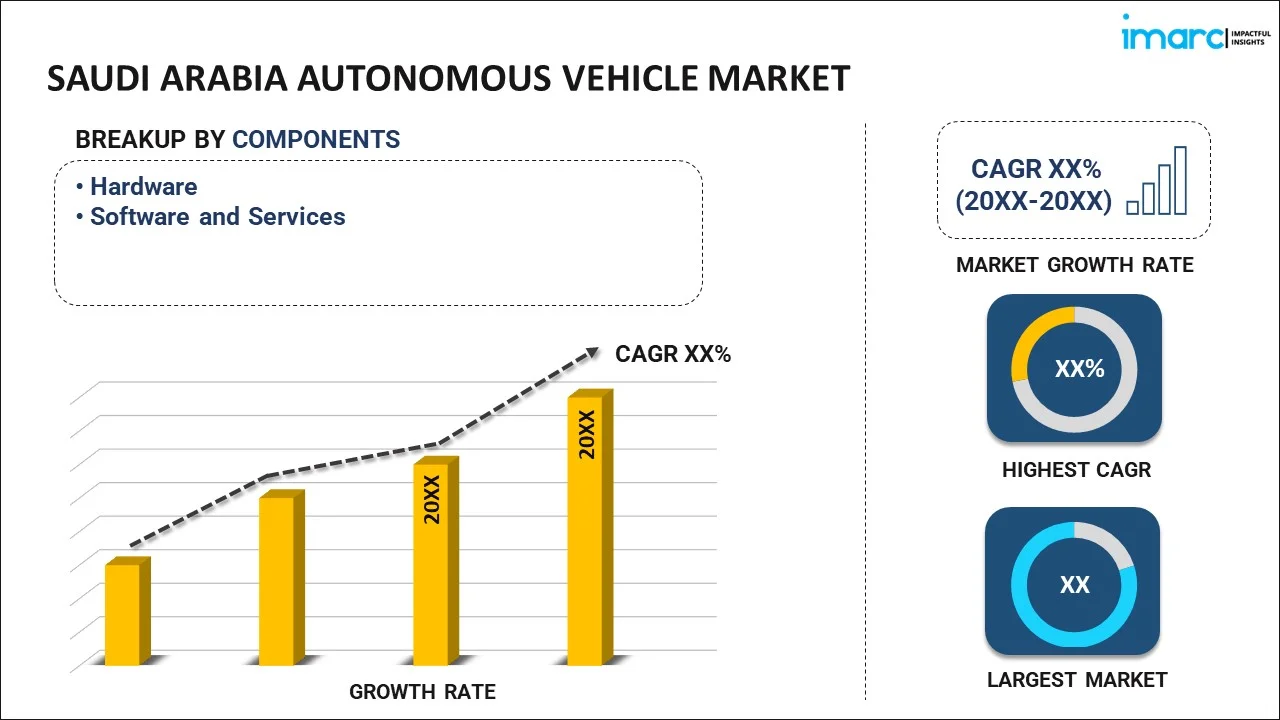
To get detailed segment analysis of this market Request Sample
- Hardware
- Software and Services
The report has provided a detailed breakup and analysis of the market based on the component. This includes hardware and software and services.
Level of Automation Insights:
- Level 3
- Level 4
- Level 5
A detailed breakup and analysis of the market based on the level of automation have also been provided in the report. This includes level 3, level 4, and level 5.
Application Insights:
- Transportation and Logistics
- Military and Defense
The report has provided a detailed breakup and analysis of the market based on the application. This includes transportation and logistics and military and defense.
Regional Insights:
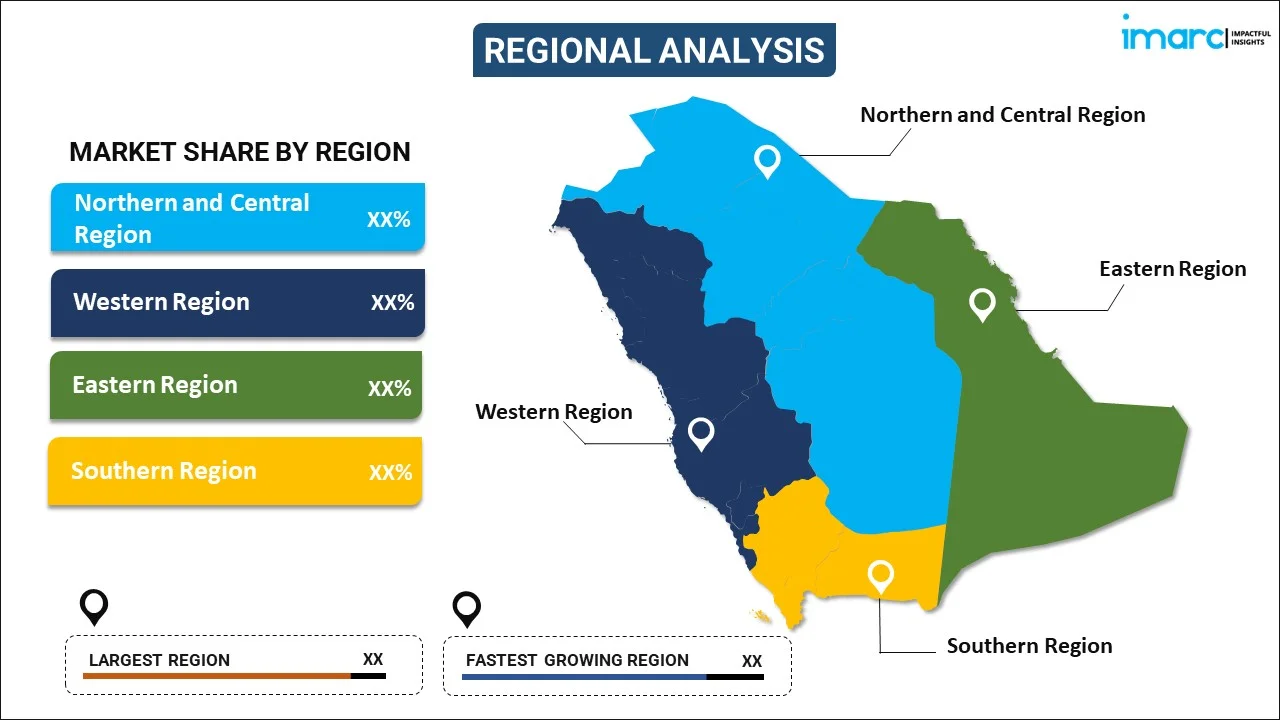
To get detailed regional analysis of this market Request Sample
- Northern and Central Region
- Western Region
- Eastern Region
- Southern Region
The report has also provided a comprehensive analysis of all the major regional markets, which include Northern and Central Region, Western Region, Eastern Region, and Southern Region.
Competitive Landscape:
The market research report has also provided a comprehensive analysis of the competitive landscape in the market. Competitive analysis such as market structure, key player positioning, top winning strategies, competitive dashboard, and company evaluation quadrant has been covered in the report. Also, detailed profiles of all major companies have been provided.
Saudi Arabia Autonomous Vehicle Market News:
- July 2025: Saudi Arabia launched a trial for autonomous vehicles in Riyadh, marking a key step towards developing a smart, sustainable transport system. The trial will operate at King Khalid International Airport and major city locations, with safety officers onboard during the tests. This initiative supports Vision 2030's goal of enhancing mobility through AI-powered technology and public-private partnerships.
- July 2025: WeRide received Saudi Arabia's first Robotaxi autonomous driving permit, allowing the company to operate autonomous vehicles in Riyadh. The pilot project, in collaboration with Uber and AiDriver, will cover key areas like King Khalid International Airport. A full-scale Robotaxi service is planned for launch by the end of 2025.
- May 2025: Saudi Arabia's Transport General Authority (TGA) and Uber signed a strategic partnership to launch autonomous vehicles in the Kingdom. The initiative aligns with Saudi Vision 2030, aiming to transform the transport sector through smart mobility. The first autonomous vehicle rides via Uber will begin before the end of 2025, initially with onboard drivers for safety.
Saudi Arabia Autonomous Vehicle Market Report Coverage:
| Report Features | Details |
|---|---|
| Base Year of the Analysis | 2025 |
| Historical Period | 2020-2025 |
| Forecast Period | 2026-2034 |
| Units | Million USD |
| Scope of the Report | Exploration of Historical and Forecast Trends, Industry Catalysts and Challenges, Segment-Wise Historical and Predictive Market Assessment:
|
| Components Covered | Hardware, Software and Services |
| Levels of Automation Covered | Level 3, Level 4, Level 5 |
| Applications Covered | Transportation and Logistics, Military and Defense |
| Regions Covered | Northern and Central Region, Western Region, Eastern Region, Southern Region |
| Customization Scope | 10% Free Customization |
| Post-Sale Analyst Support | 10-12 Weeks |
| Delivery Format | PDF and Excel through Email (We can also provide the editable version of the report in PPT/Word format on special request) |
Key Benefits for Stakeholders:
- IMARC’s industry report offers a comprehensive quantitative analysis of various market segments, historical and current market trends, market forecasts, and dynamics of the Saudi Arabia autonomous vehicle market from 2020-2034.
- The research report provides the latest information on the market drivers, challenges, and opportunities in the Saudi Arabia autonomous vehicle market.
- Porter's five forces analysis assist stakeholders in assessing the impact of new entrants, competitive rivalry, supplier power, buyer power, and the threat of substitution. It helps stakeholders to analyze the level of competition within the Saudi Arabia autonomous vehicle industry and its attractiveness.
- Competitive landscape allows stakeholders to understand their competitive environment and provides an insight into the current positions of key players in the market.
Frequently Asked Questions About the Saudi Arabia Autonomous Vehicle Market Report
The autonomous vehicle market in Saudi Arabia was valued at USD 1,234.5 Million in 2025.
The Saudi Arabia autonomous vehicle market is projected to exhibit a CAGR of 20.93% during 2026-2034, reaching a value of USD 6,827.1 Million by 2034.
The Saudi Arabia autonomous vehicle market is growing due to advancements in AI, supportive government policies promoting smart mobility, and rising investments in connected infrastructure. Increasing focus on road safety, energy efficiency, and sustainable transportation is encouraging adoption, while ongoing research, testing, and collaborations with international technology firms are enhancing innovation and market readiness.
Need more help?
- Speak to our experienced analysts for insights on the current market scenarios.
- Include additional segments and countries to customize the report as per your requirement.
- Gain an unparalleled competitive advantage in your domain by understanding how to utilize the report and positively impacting your operations and revenue.
- For further assistance, please connect with our analysts.
 Request Customization
 Speak to an Analyst
 Request Brochure
 Inquire Before Buying
Benefits of Customization
- Personalize this research
- Triangulate with your data
- Get data as per your format and definition
- Gain a deeper dive into a specific application, geography, customer, or competitor
- Any level of personalization
Get in Touch With Us
UNITED STATES
Phone: +1-201-971-6302
INDIA
Phone: +91-120-433-0800
UNITED KINGDOM
Phone: +44-753-714-6104
Email: [email protected]
Client Testimonials




.webp)




.webp)













Related Reports

Choose your plan
*Please note that the prices mentioned below are starting prices for each bundle type. Kindly contact our team for further details.*
Single User License
- 1 User License, Access on 2 Devices
- PDF Report + Excel Dataset (Password Protected)
- Lifetime Access
- No Printing Rights
- 10% Free Report Customization
- 10–12 Weeks of Analyst Support
Five User License
- Access for 5 Users, 2 Devices per User
- PDF Report + Excel Dataset (Password Protected)
- Lifetime Access
- Dedicated Account Manager
- 12–14 Weeks of Analyst Support
- No Printing Rights
- 15% Free Report Customization
- 25% Discount on Your Next Purchase
Corporate User License
- Unlimited User Access (Within Your Organization)
- PDF Report + Excel Dataset
- Lifetime Access
- Dedicated Account Manager
- 14–20 Weeks of Analyst Support
- No Printing Rights
- 20% Free Report Customization
- 30% Discount on Your Next Purchase
Essential Insights
What's included:
3 reports
- Lifetime Access
- PDF Reports
- Excel Datasets
- 2 Weeks of Free Analyst Support
- 2 User Licenses
- Access on 2 Devices
- Printing Rights
- Complimentary PowerPoint (PPT) Version
- Complimentary License Upgrade
Professional Access
What's included:
5 reports
- Lifetime Access
- PDF Reports
- Excel Datasets
- 8 Weeks of Free Analyst Support
- 2 User Licenses
- Access on 2 Devices
- Printing Rights
- Complimentary PowerPoint (PPT) Version
- Complimentary License Upgrade
Business Advantage
What's included:
8 reports
- Lifetime Access
- PDF Reports
- Excel Datasets
- 14 Weeks of Free Analyst Support
- 2 User Licenses
- Access on 2 Devices
- Printing Rights
- Complimentary PowerPoint (PPT) Version
- Complimentary License Upgrade
Enterprise Intelligence
What's included:
10 reports
- Lifetime Access
- PDF Reports
- Excel Datasets
- 20 Weeks of Free Analyst Support
- 2 User Licenses
- Access on 2 Devices
- Printing Rights
- Complimentary PowerPoint (PPT) Version
- Complimentary License Upgrade