
Saudi Arabia Bedsheet Market Size, Share, Trends and Forecast by Type, Application, Sales Channel, and Region, 2026-2034
Saudi Arabia Bedsheet Market Size, Share, Trends & Forecast (2026-2034)
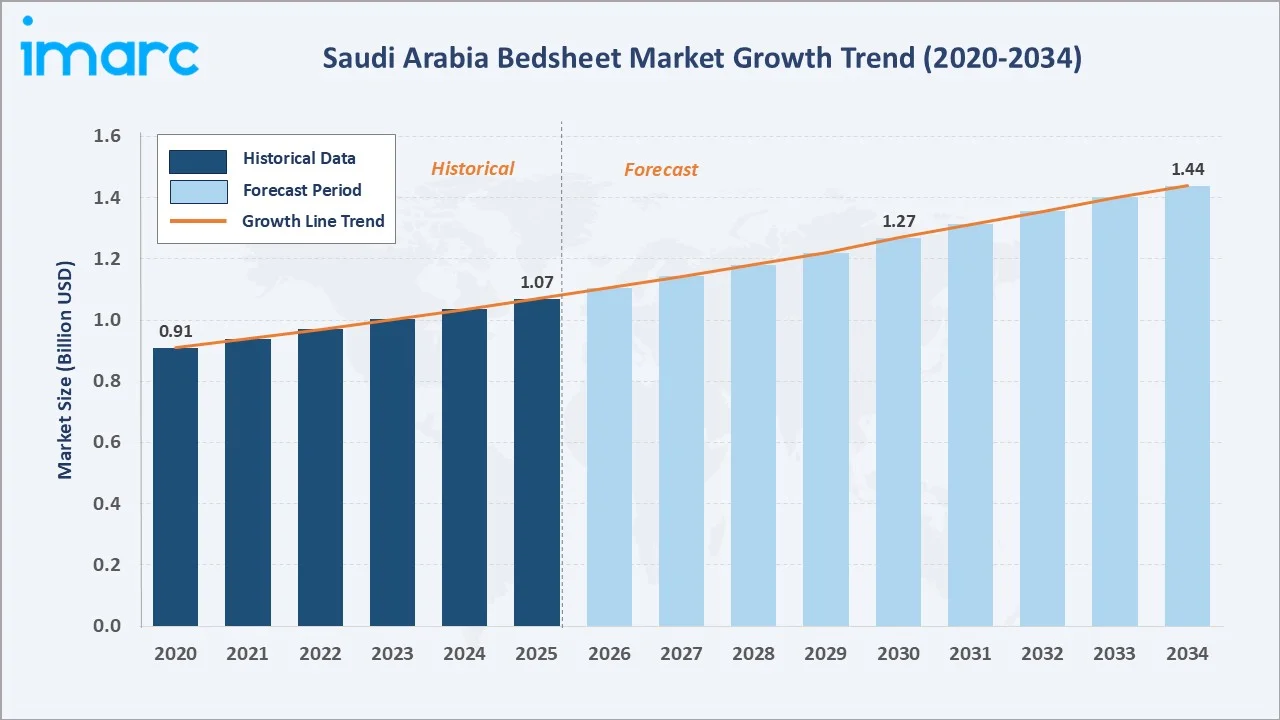
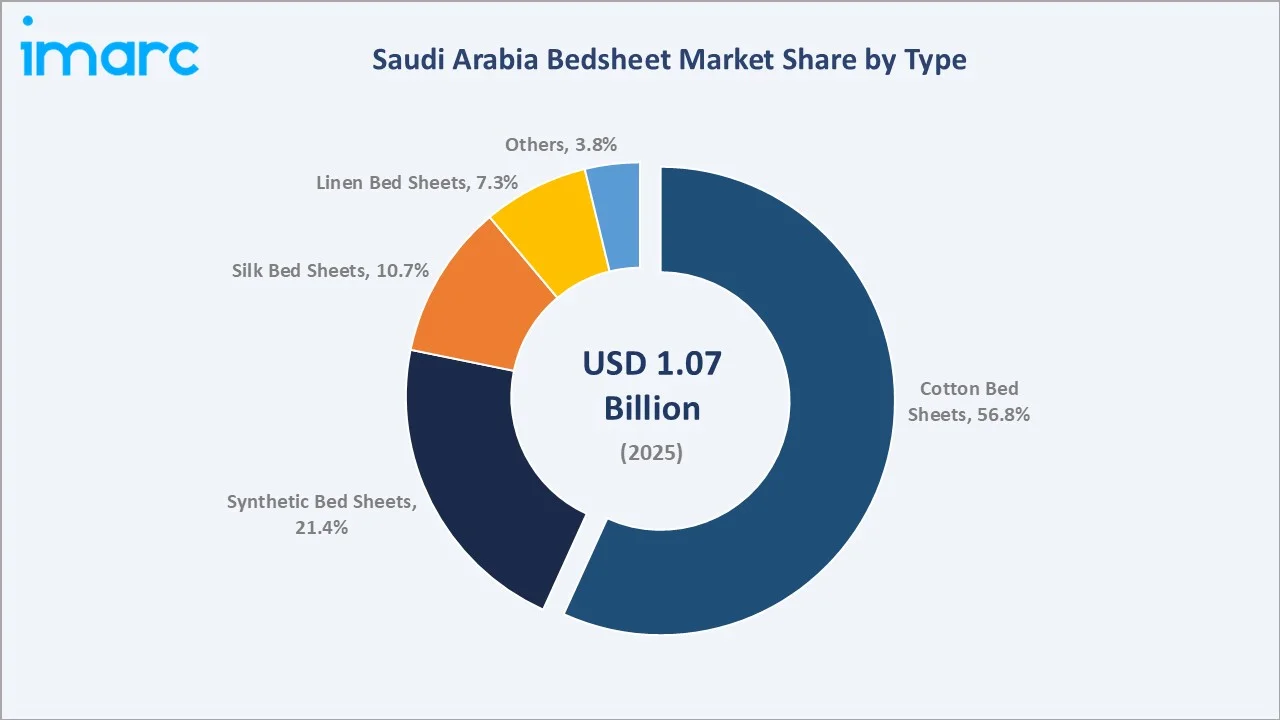
The Saudi Arabia bedsheet market reached USD 1.07 Billion in 2025 and is projected to reach USD 1.44 Billion by 2034, expanding at a CAGR of 3.33% during 2026-2034. Growth rests on a fast-growing resident population, a rising homeownership rate under the Housing Program, and an expanding hospitality sector tied to religious tourism. Residential use dominates demand at 82.6% of 2025 revenue, while commercial buyers, largely hotels and serviced apartments, hold 17.4% and are growing fastest. Cotton bed sheets lead by type at 56.8% share on comfort and climate suitability. The Western Region leads geographically at 36.8%, aided by Hajj and Umrah-linked hospitality demand across Jeddah, Makkah and Madinah.
Market Snapshot
|
Metric |
Value |
|
Market Size (2025) |
USD 1.07 Billion |
|
Forecast Market Size (2034) |
USD 1.44 Billion |
|
CAGR (2026-2034) |
3.33% |
|
Base Year |
2025 |
|
Historical Period |
2020-2025 |
|
Forecast Period |
2026-2034 |
|
Largest Application |
Residential (82.6%, 2025) |
|
Largest Type |
Cotton Bed Sheets (56.8%, 2025) |
|
Dominant Region |
Western Region (36.8%, 2025) |
The market expanded from USD 0.91 Billion in 2020 to USD 1.07 Billion in 2025. It is anchored at USD 1.27 Billion in 2030 and forecast to reach USD 1.44 Billion by 2034. Growth is steady and consumption-led rather than speculative. Volume demand tracks household formation and hotel room supply, while value is lifted by a gradual mix shift toward premium cotton, silk and linen sets that carry higher average selling prices.
To get more information on this market, Request Sample
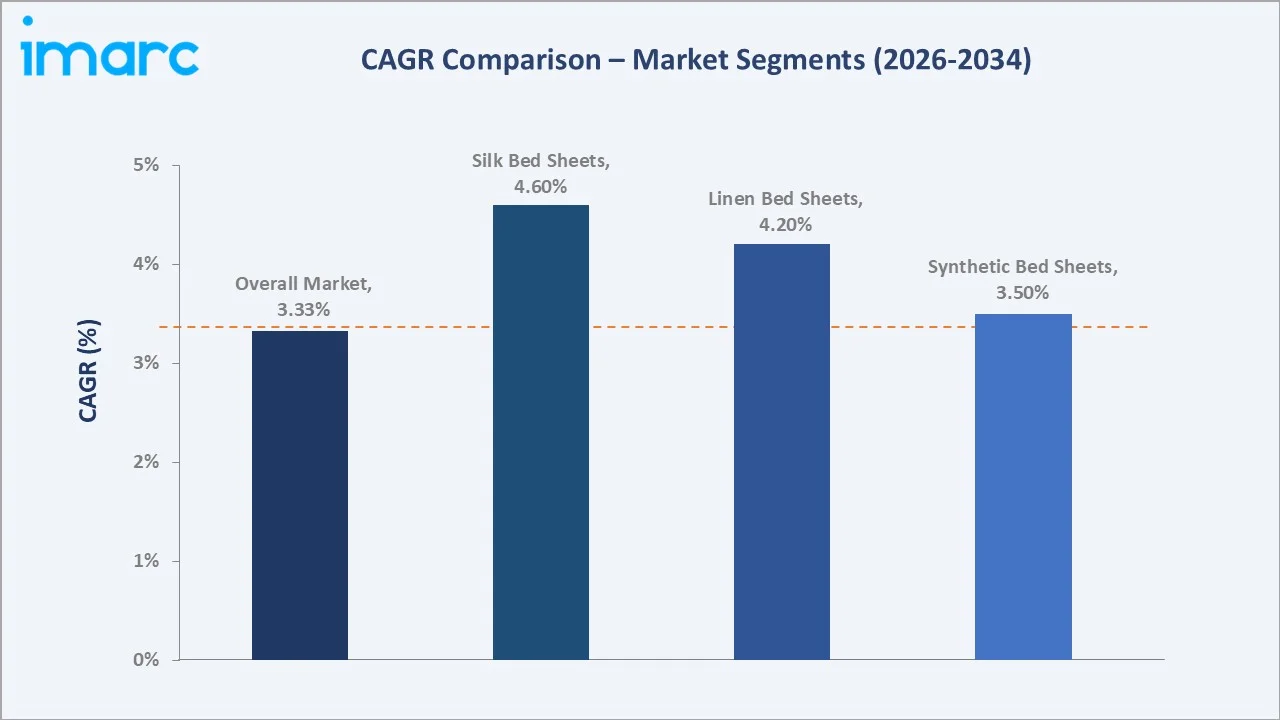
Silk bed sheets grow fastest among product types at roughly 4.60% CAGR (2026-2034), reflecting rising demand for premium and gifting-oriented bedding among affluent urban households. Linen follows at about 4.20% CAGR on sustainability appeal, while Cotton, the volume leader, advances at a steadier 3.00% CAGR, consistent with its role as the everyday staple of the Saudi Arabia bedsheet market.
Executive Summary
The Saudi Arabia bedsheet market reached USD 1.07 Billion in 2025. Growth is anchored in demographic scale: GASTAT put the Kingdom's population at 35.3 million in 2024, expanding at 4.7% annually, with 74.7% of residents in the working-age bracket that drives independent household formation. The Housing Program lifted homeownership among Saudi families to 65.4% by end-2024, up from a 47% base in 2016 and moving toward a 70% target by 2030, which steadily expands the base of furnished homes requiring bedding replacement and upgrades.
Cotton bed sheets command 56.8% of 2025 revenue, valued by Saudi households for breathability in the Kingdom's hot climate. Residential use represents 82.6% of the market, while Commercial buyers, chiefly hotels and serviced apartments, hold 17.4% and are expanding fastest at roughly 4.50% CAGR. GASTAT recorded 5,900 licensed tourism hospitality facilities by Q4 2025, a 34.2% increase over Q4 2024, directly widening bulk-linen procurement. The market is projected to reach USD 1.44 Billion by 2034 at a 3.33% CAGR, with the Western Region, home to Jeddah, Makkah and Madinah, retaining the largest share on the strength of pilgrimage-linked accommodation demand.
Looking ahead, premiumisation, sustainability positioning and e-commerce penetration will shape competitive outcomes. Local manufacturing, led by producers such as SATEX, is gaining visibility through organic-cotton product lines, while international retail groups continue to expand physical and digital footprints across the Kingdom's major cities.
Key Market Insights
|
Insight |
Data |
|
Largest Type |
Cotton Bed Sheets - 56.8% value share (2025) |
|
Dominant Application |
Residential - 82.6% share (2025) |
|
Fastest Growing Application |
Commercial - ~4.50% CAGR (2026-2034) |
|
Dominant Region |
Western Region - 36.8% share (2025) |
|
Market Opportunity |
Sustainable cotton and hospitality-grade contract supply |
Key Analytical Observations Supporting the Above Data:
- Cotton leads at 56.8% share (2025) on climate suitability and comfort: Cotton fibres offer breathability suited to the Kingdom's arid, high-temperature conditions, keeping the category the default choice across supermarkets, specialty stores and online retail alike.
- Synthetic holds 21.4% as the value-tier volume format: Polyester and blended sheets remain the go-to choice for price-sensitive households and budget hospitality operators, offering durability at a lower price point than natural fibres.
- Residential dominance reflects a fast-expanding home base: GASTAT recorded a 65.4% homeownership rate among Saudi families by end-2024, and the Sakani platform helped more than 93,000 families move into new homes that year, sustaining bulk bedding demand.
- Commercial demand is the growth engine at ~4.50% CAGR: GASTAT's tourism establishment count reached 5,900 facilities by Q4 2025 including 2,847 hotels, and Vision 2030 targets 150 million annual visitors by 2030, both of which lift institutional linen procurement.
- Western Region is dominant with 36.8% share (2025): The region concentrates Jeddah's population and retail density alongside Makkah and Madinah's religious-tourism hospitality base, giving it the Kingdom's largest combined residential and commercial demand pool.
- Regulatory compliance shapes market entry: All bedding products require SASO Type 1a conformity certification through the SABER platform before customs clearance, alongside Arabic-language labelling, which favours established importers and local manufacturers with compliance depth.
Saudi Arabia Bedsheet Market Overview
The Saudi Arabia bedsheet market covers cotton, silk, synthetic, linen and blended bedding sold through supermarkets and hypermarkets, specialty home-textile stores and online platforms. Supply combines local manufacturing with imported fabric and finished goods sourced from Asian and European textile hubs. End use spans residential households, hotels, serviced apartments and other hospitality operators seeking bulk, durable linen programs.
Products are governed by SASO's Technical Regulation of Textile Products, which mandates Type 1a conformity certification through the SABER platform and Arabic-language labelling ahead of market placement. Macroeconomic tailwinds include Vision 2030 economic diversification, a resident population GASTAT estimated at 35.3 Million in 2024, and a homeownership rate that reached 65.4% by end-2024 on the way to a 70% target by 2030.
Market Dynamics
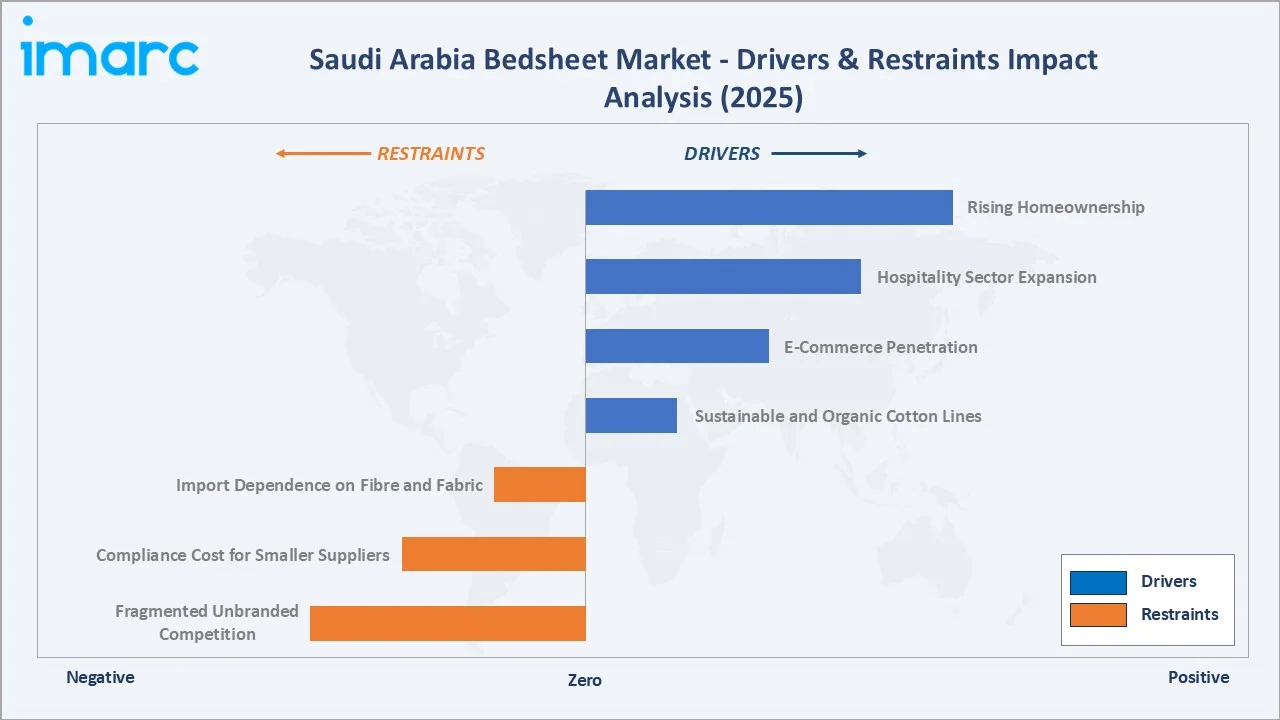
Growth in the Saudi Arabia bedsheet industry is shaped by population expansion and a maturing hospitality sector, offset by import dependence and intensifying price competition from unbranded suppliers.
To evaluate market opportunities, Request Sample
Market Drivers
- Population and Household Growth: GASTAT recorded a 4.7% annual population growth rate to 35.3 Million in 2024, with 74.7% of residents aged 15-64, sustaining a large and expanding base of bedding-consuming households.
- Rising Homeownership: The Housing Program's Sakani platform helped homeownership climb to 65.4% by end-2024 from a 47% base in 2016, with over 93,000 Saudi families moving into new homes that year alone.
- Hospitality Sector Expansion: GASTAT logged 5,900 licensed tourism hospitality facilities by Q4 2025, up 34.2% year-on-year, directly lifting institutional demand for durable, contract-grade bed linen.
- E-Commerce Penetration: The Communications, Space and Technology Commission reported 99% internet penetration in 2024, and 63.7% of internet users purchased goods online in 2023, widening digital access to home-textile assortments.
Market Restraints
- Import Dependence on Fibre and Fabric: Reliance on imported cotton yarn and finished fabric exposes distributors to freight and currency risk, adding cost volatility that is difficult to pass through in a price-sensitive retail segment.
- Compliance Cost for Smaller Suppliers: SASO Type 1a certification through the SABER platform adds documentation and testing cost per shipment, a burden that weighs disproportionately on smaller importers and private-label sellers.
Market Opportunities
- Sustainable and Organic Cotton Lines: Local manufacturer SATEX launched the Kingdom's first fully sustainable bedsheet line in March 2025 using organic cotton sourced from the Al-Ahsa region, aligned with Vision 2030 circular-economy goals.
- Hospitality-Grade Contract Supply: Specialist linen suppliers can capture recurring institutional revenue as licensed hotel and serviced-apartment inventory continues to expand across the Kingdom's major cities.
Market Challenges
- Fragmented Unbranded Competition: Bulk imports of unbranded sheets sold through independent trade compress margins for branded distributors, particularly in value-tier supermarket and hypermarket channels.
- Seasonal Demand Concentration: Hospitality-linked bedding demand concentrates around Hajj and Umrah seasons, creating inventory planning complexity for suppliers serving the Western Region.
Emerging Market Trends
Five trends define the Saudi Arabia bedsheet market outlook through 2034: premiumisation, digital retail, sustainability, hospitality-grade specification and smart textile integration.
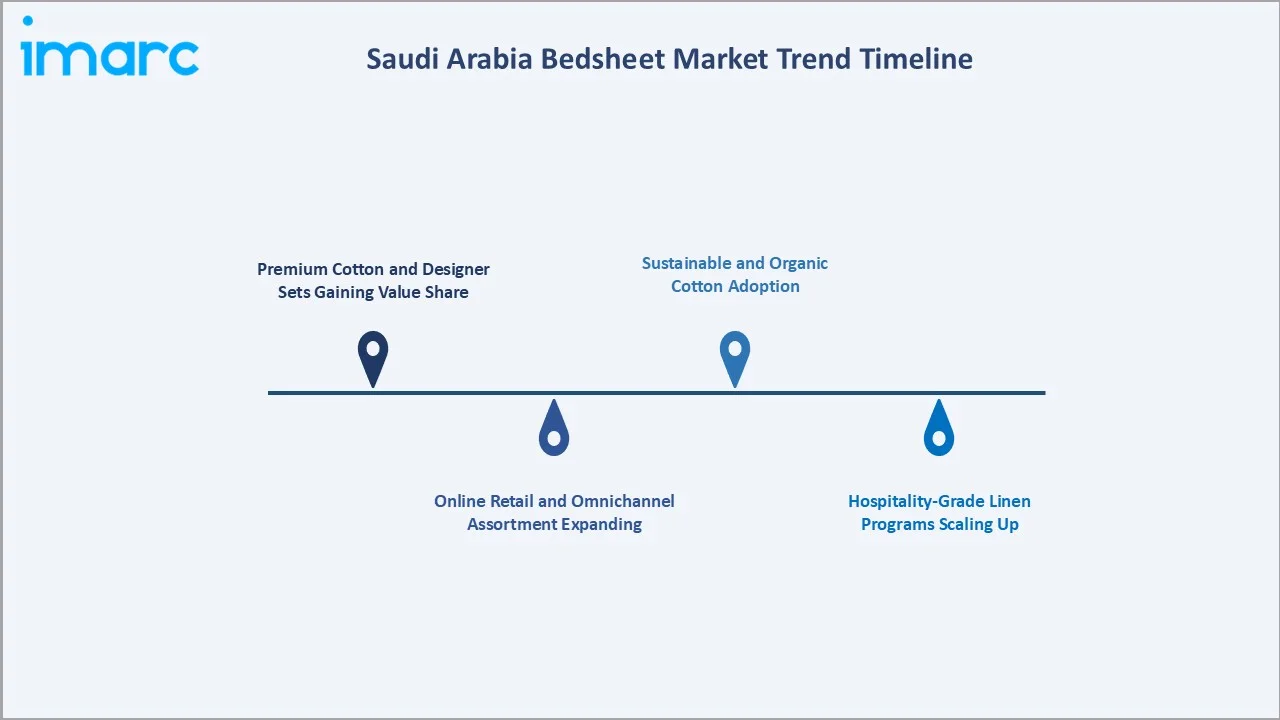
1. Premium Cotton and Designer Sets Gaining Value Share
Cotton and silk sheets carry rising average selling prices as buyers treat bedding as a home-decor statement. Engraved packaging, matching pillow sets and branded designer collaborations sustain premium positioning across specialty retail.
2. Online Retail and Omnichannel Assortment Expanding
CST data shows 99% internet penetration in 2024, with 63.7% of internet users having purchased online in 2023. E-commerce still represents only about 18% of total retail sales, leaving significant headroom for bedding categories to migrate online.
3. Sustainable and Organic Cotton Adoption
SATEX's March 2025 launch of an organic-cotton line sourced from Al-Ahsa, tied to a Vision 2030 circular-economy target of cutting textile waste by 40%, signals a broader shift toward traceable, eco-labelled bedding across the Kingdom.
4. Hospitality-Grade Linen Programs Scaling Up
With 2,847 licensed hotels and 3,090 serviced apartments recorded by GASTAT in Q4 2025, hotel groups increasingly standardise on contract-grade, high-thread-count sheets, creating a distinct B2B specification tier separate from retail assortments.
5. Smart and Performance Fabric Integration
Moisture-wicking, antimicrobial and temperature-regulating finishes are moving from niche hospitality use into mainstream household ranges, supported by growing consumer awareness of hygiene and comfort performance.
Industry Value Chain Analysis
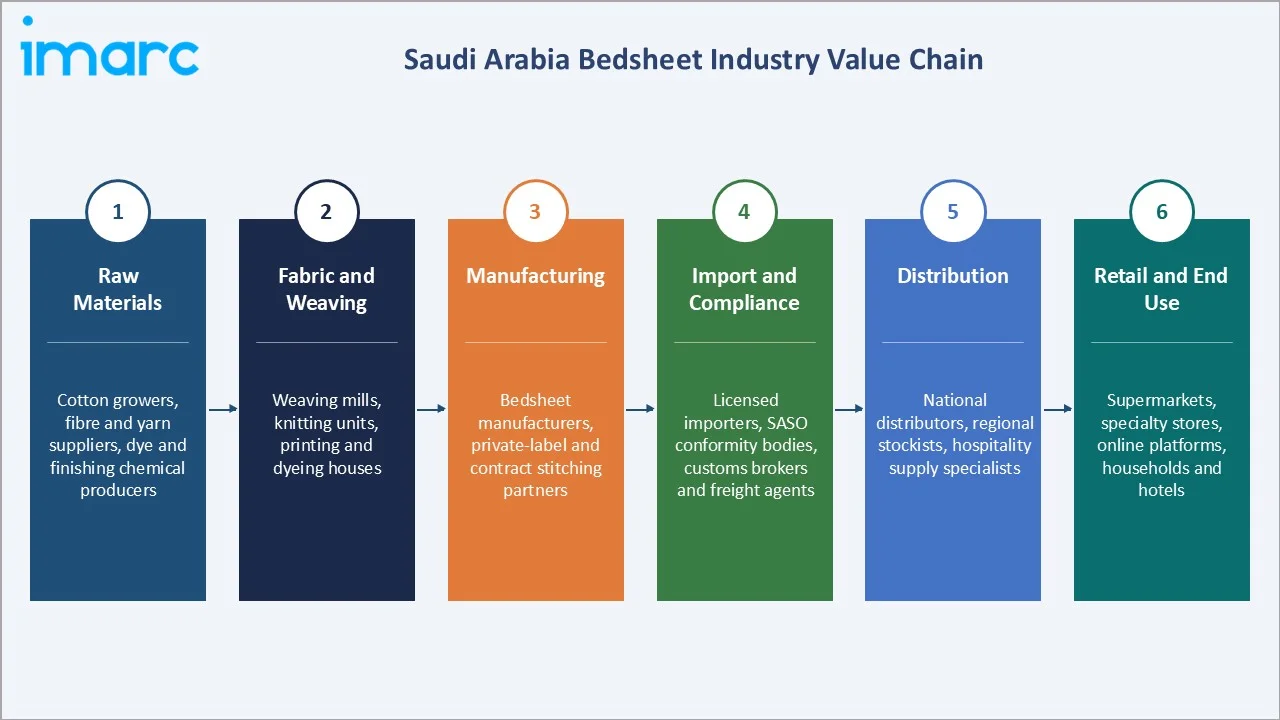
The Saudi Arabia bedsheet value chain runs from cotton and fibre sourcing, through weaving, dyeing and stitching, into import compliance and multi-tier distribution, ending in a retail base spanning supermarkets, specialty stores, online platforms and hospitality contracts.
|
Stage |
Key Participants |
|
Raw Materials |
Cotton growers, fibre and yarn suppliers, dye and finishing chemical producers |
|
Fabric and Weaving |
Weaving mills, knitting units, printing and dyeing houses |
|
Manufacturing |
Bedsheet manufacturers, private-label and contract stitching partners |
|
Import and Compliance |
Licensed importers, SASO conformity bodies, customs brokers and freight agents |
|
Distribution |
National distributors, regional stockists, hospitality supply specialists |
|
Retail and End Use |
Supermarkets, specialty stores, online platforms, households and hotels |
Margin concentrates at the manufacturing and retail stages. Local producers absorb raw-material and compliance risk, while retailers capture mark-up at the point of sale. Direct hospitality contracts are beginning to shorten this chain for bulk institutional buyers.
Technology Landscape in the Saudi Arabia Bedsheet Industry
Fibre and Weave Innovation
Long-staple cotton weaves and blended synthetic-cotton constructions continue to improve durability and colourfastness, supporting the premiumisation trend visible across specialty and online channels.
Sustainable Materials Innovation
Organic and traceable cotton sourcing, exemplified by SATEX's Al-Ahsa-origin product line, is emerging as a differentiator aligned with Vision 2030 circular-economy targets for textile waste reduction.
Performance Finishing Technologies
Antimicrobial treatments and moisture-wicking finishes, already standard in premium hospitality bedding, are increasingly featured in mainstream household ranges marketed on hygiene and comfort claims.
Digital Commerce Enablement
High mobile penetration and expanding logistics infrastructure are enabling online retailers to offer wider colour and thread-count assortments than physical shelf space typically allows.
Market Segmentation Analysis
The report covers the following segments:
|
Segment Category |
Leading Segment |
Market Share |
Year |
|
Type |
Cotton Bed Sheets |
56.8% |
2025 |
|
Application |
Residential |
82.6% |
2025 |
|
Sales Channel |
🔒 |
🔒 |
2025 |
|
Region |
Western Region |
36.8% |
2025 |

By Type
Cotton bed sheets dominate at 56.8% market share in 2025 and grow at about 3.00% CAGR through 2034. Cotton's breathability and easy-care properties keep it the default choice across the Kingdom's hot climate, from budget supermarket ranges to premium specialty collections.
To access detailed market analysis, Request Sample
Synthetic sheets hold 21.4% and grow at roughly 3.50% CAGR as the value-tier volume format. Silk, at 10.7% share, is the fastest-growing category at about 4.60% CAGR, driven by gifting and premium positioning. Linen holds 7.3% on sustainability appeal, advancing near 4.20% CAGR, while Others, including bamboo and blended fabrics, account for 3.8%.
By Application
Residential use leads with 82.6% share in 2025. Rising homeownership and household formation, both tracked through the Housing Program's Sakani platform, sustain steady replacement demand at roughly 3.10% CAGR.
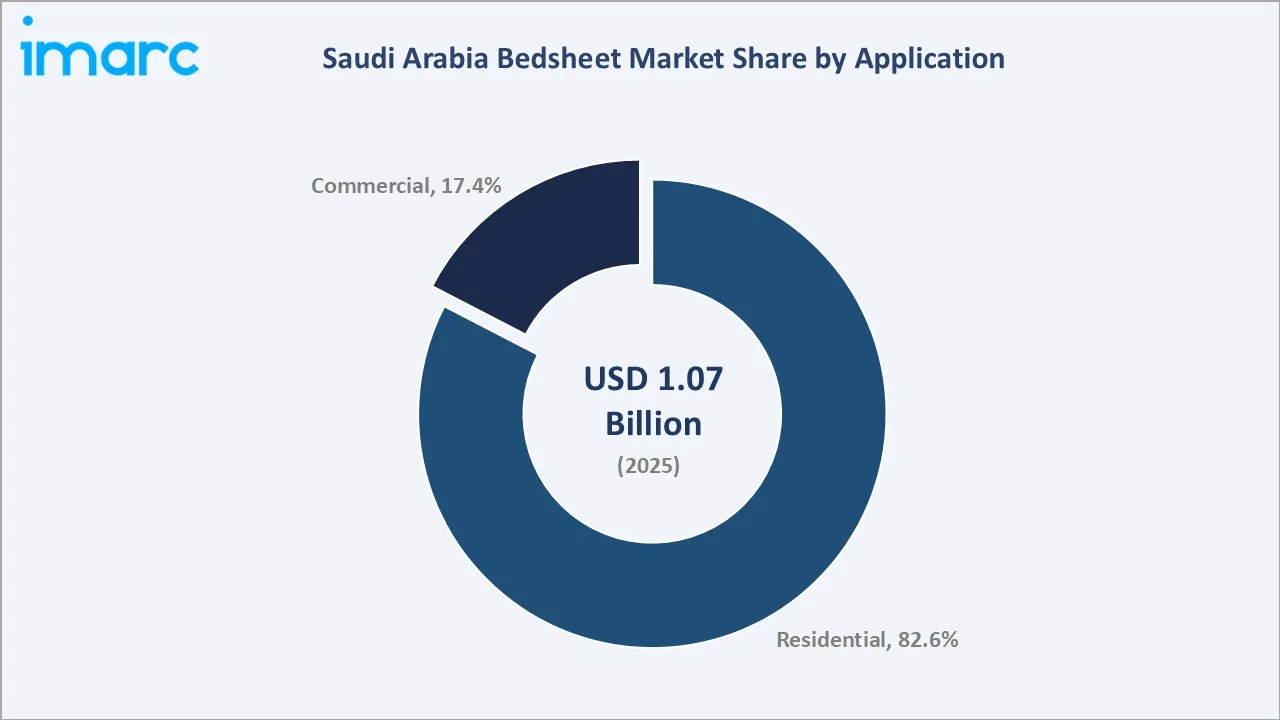
Commercial demand, at 17.4% share, is the fastest-growing application at approximately 4.50% CAGR. GASTAT's Q4 2025 count of 5,900 licensed hospitality facilities underscores the scale of institutional bulk-linen procurement supporting this segment.
Regional Market Insights
|
Region |
Share (2025) |
Key Growth Drivers & Characteristics |
|
Western Region |
36.8% |
Pilgrimage and tourism traffic through Jeddah, Makkah and Madinah; heavy hospitality footprint; major port gateway supporting import distribution; strong specialty and duty-free retail presence |
|
Central and Northern Region |
31.6% |
Largest population and retail concentration centred on Riyadh; dense modern trade and specialty home-textile retail; strong corporate and household gifting demand |
|
Eastern Region |
19.7% |
Industrial and energy-sector workforce with high expatriate concentration; organised retail clusters around the Dammam metropolitan area; steady supermarket and hypermarket purchasing |
|
Southern Region |
11.9% |
Smaller and more dispersed consumer base; traditional trade and independent grocery dominate; improving connectivity supporting gradual retail modernisation |
The Western Region's 36.8% share reflects Jeddah's position as a major port and retail gateway, reinforced by hospitality demand from Hajj and Umrah pilgrims. The Central and Northern Region follows at 31.6%, anchored by Riyadh's population density and modern retail concentration.
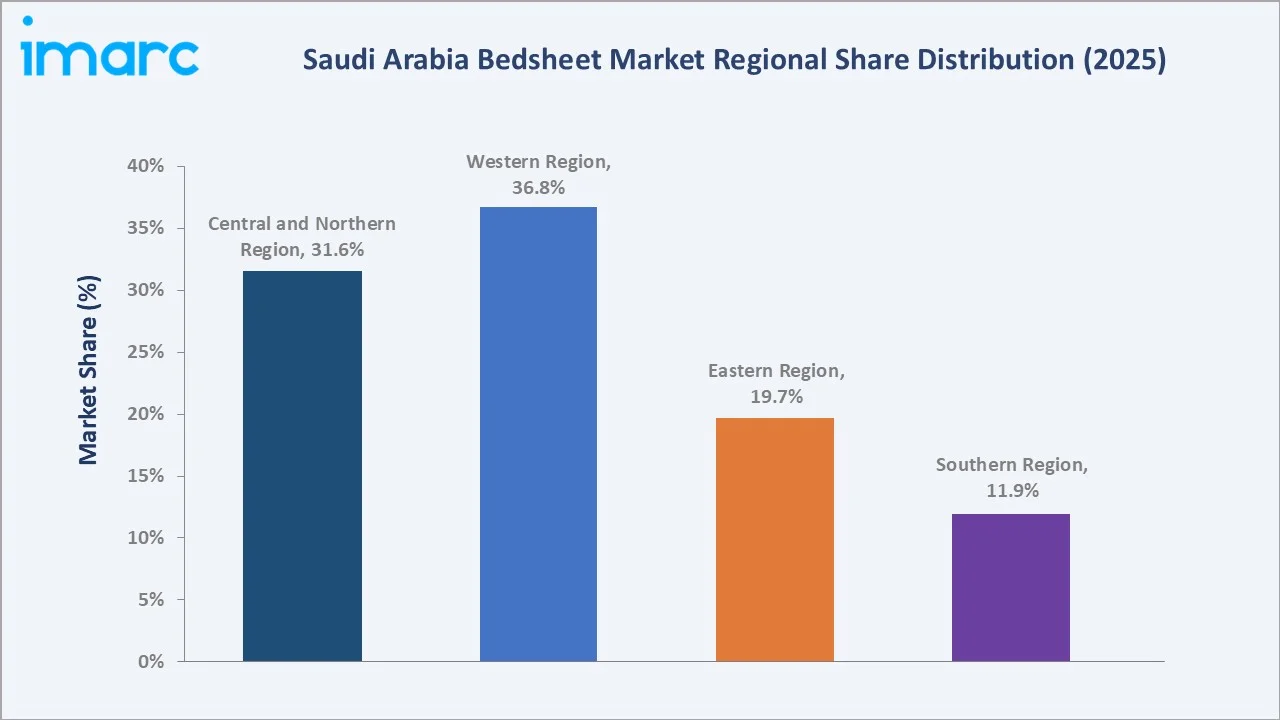
The Eastern Region holds 19.7%, supported by its industrial workforce and organised retail base around Dammam, while the Southern Region accounts for 11.9% on a smaller, more traditional retail structure that is gradually modernising.
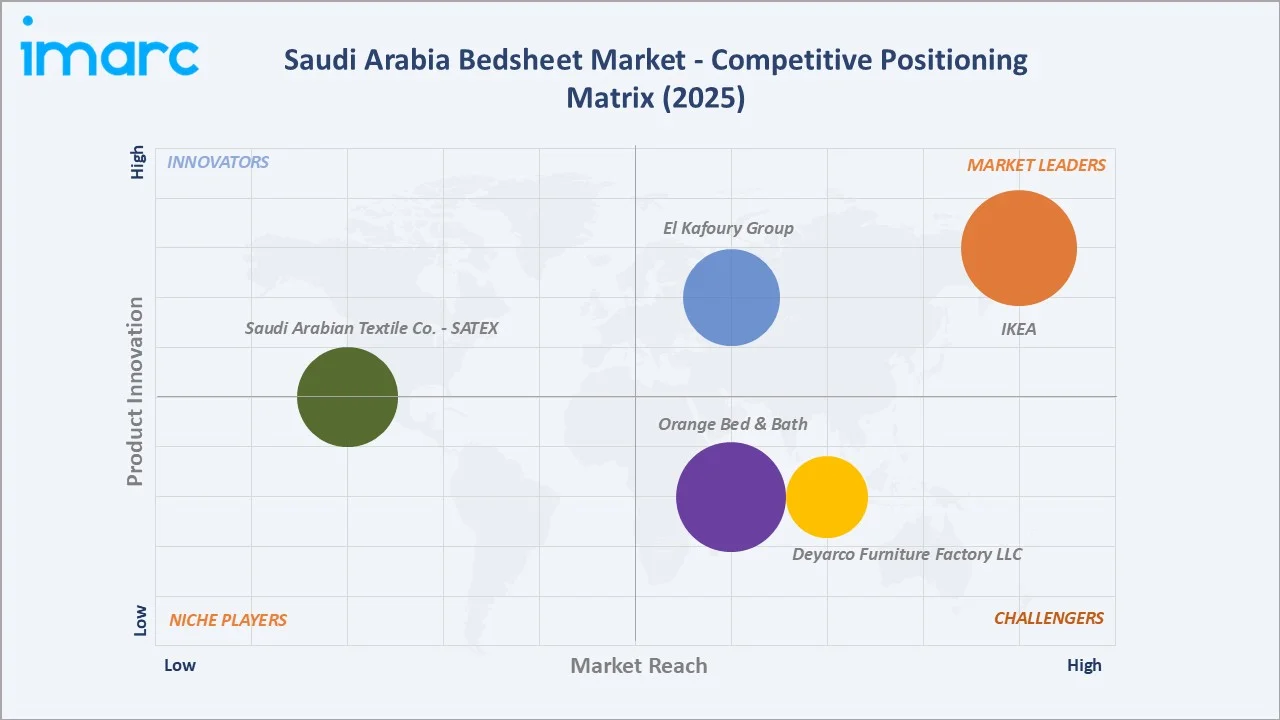
Competitive Landscape
The Saudi Arabia bedsheet market is moderately consolidated among large retail groups and international franchise operators, with a fragmented base of local manufacturers and unbranded importers competing on price.
|
Company Name |
Brand / Product Line |
Market Position |
Core Strength |
|
IKEA |
DVALA, ULLVIDE, NATTJASMIN |
Market Leader |
Operational via Ghassan Ahmed Al Sulaiman Furniture Trading Company (part of the Al Sulaiman Group), exclusive Saudi franchise of a global home-furnishings brand with large-format stores in major cities |
|
El Kafoury Group |
Customized flat and fitted sheets |
Market Leader |
Specialized manufacturing and customized furnishing solutions for the hospitality and corporate sectors |
|
Deyarco Furniture Factory LLC |
Hotel Linen Klub |
Strong Challenger |
Specialist B2B manufacturer supplying contract-grade linen to regional hotel chains and serviced apartments |
|
Orange Bed & Bath |
3-piece 100% cotton fitted sheet sets, microfiber comforter & bedsheet sets, single & double cotton sheet packs |
Strong Challenger |
Authentic designs, innovative aesthetic perceptions, and strong commitment to material quality |
|
Saudi Arabian Textile Co. - SATEX |
Breathable cotton bed sheets, customizable hotel bed linen sets, and sustainable organic cotton lines |
Emerging |
Local manufacturing base and first-to-market organic-cotton bedsheet line launched in March 2025 |
Positioning splits along distribution reach and brand specialisation. IKEA and other retailers combine broad physical and digital distribution with recognised design language, Deyarco defends the hospitality-contract niche, and SATEX together with regional manufacturers such as Orange Bed & Bath compete on local production and price.
Key Company Profiles
IKEA
IKEA in Saudi Arabia is managed locally by Ghassan Ahmed Al Sulaiman Furniture Co. (part of the Al Sulaiman Group) under an exclusive franchise arrangement, offering a broad home-textile assortment including bedsheets, duvet covers and pillowcases within a globally standardised retail format.
- Product Portfolio: Cotton, linen and blended bedsheet sets sold under IKEA's home-textile range, alongside coordinated bedroom accessories.
- Strategic Focus: Affordable design-led bedding supported by large-format showrooms and an integrated online ordering platform across major Saudi cities.
Deyarco Furniture Factory LLC (Hotel Linen Klub)
Deyarco Furniture Factory LLC manufactures under the Hotel Linen Klub brand, specialising in contract-grade bed linen for hotels, resorts and serviced apartments across the Gulf region, positioning it as a specialist B2B supplier to the Kingdom's expanding hospitality sector.
- Product Portfolio: Hotel Linen Klub brand’s 100% pure cotton sateen and solid-dyed or striped bedding sets
- Strategic Focus: Deepening contract relationships with hotel groups as GASTAT-recorded hospitality facility counts continue to expand.
Market Concentration Analysis
The Saudi Arabia bedsheet market shows moderate concentration at the organised retail tier and pronounced fragmentation below it. International franchise operators and large regional retail groups account for a meaningful share of branded volume, while no single company approaches a dominant share of the total market.
Fragmentation is heaviest in the value cotton and synthetic tiers, which together hold more than three-quarters of 2025 material share. Independent wholesalers import unbranded bulk units that reach traditional trade at prices below branded equivalents, keeping competitive intensity high across supermarket and hypermarket channels.
Consolidation is more visible at the distribution and hospitality-contract layer than in manufacturing. Large retail groups are broadening private-label assortments to improve buying leverage, while specialist B2B linen suppliers are securing longer-term hotel contracts as the Kingdom's licensed hospitality base expands.
Investment & Growth Opportunities
Fastest Growing Segments
Commercial application (~4.50% CAGR), silk bed sheets (~4.60% CAGR) and linen (~4.20% CAGR) represent the highest-growth vectors through 2034. Commercial demand combines the strongest institutional growth with recurring replacement cycles tied to hotel operations.
Emerging Market Opportunities
Hospitality-linked bulk supply offers underexploited demand. With Vision 2030 targeting 150 million annual visitors, Western Region hotel and serviced-apartment procurement presents a concentrated, recurring-revenue opportunity for contract-grade linen suppliers.
Investment Themes
- Digital-first premium distribution: Building direct and marketplace storefronts for premium cotton and silk ranges captures rising online penetration while protecting brand price integrity.
- Local sustainable manufacturing: Domestic organic-cotton capacity, following SATEX's example, reduces import exposure while aligning with Vision 2030 circular-economy targets.
- Hospitality contract consolidation: Specialist linen suppliers that scale contract-grade production can secure multi-year hotel agreements as licensed hospitality supply continues to expand.
Future Market Outlook (2026-2034)
The Saudi Arabia bedsheet market is projected to grow from USD 1.07 Billion in 2025 to USD 1.44 Billion by 2034 at a 3.33% CAGR, passing USD 1.27 Billion in 2030. Growth will be broad-based across residential replacement demand and commercial hospitality procurement rather than concentrated in a single channel.
Three forces anchor the trajectory. First, sustained population growth and rising homeownership under the Housing Program expand the addressable residential base. Second, hospitality-sector expansion, backed by Vision 2030's 150 million visitor target, sustains commercial-grade demand. Third, digital retail continues to widen assortment access, with e-commerce still representing only around 18% of total Saudi retail sales and considerable room to grow.
Research Methodology
Primary Research
Primary research comprised structured discussions with industry stakeholders, including bedsheet manufacturers and importers, specialty and supermarket category buyers in Riyadh, Jeddah and Dammam, hospitality procurement managers, online marketplace sellers, and SASO conformity assessment specialists.
Secondary Research
Secondary research drew on GASTAT publications covering population estimates and tourism establishment statistics, the Housing Program's Sakani platform data, CST e-commerce statistics, SASO technical regulation and SABER conformity requirements, and company disclosures from SATEX and other market participants.
Forecasting Models
Value forecasts were built bottom-up from household formation estimates, homeownership trends, hospitality facility growth and average selling price by material tier, then cross-checked against channel-level retail growth and reconciled to a top-down market total, yielding a blended 3.33% CAGR for 2026-2034.
Saudi Arabia Bedsheet Market Report Coverage:
| Report Features | Details |
|---|---|
| Base Year of the Analysis | 2025 |
| Historical Period | 2020-2025 |
| Forecast Period | 2026-2034 |
| Units | Billion USD |
| Scope of the Report |
Exploration of Historical Trends and Market Outlook, Industry Catalysts and Challenges, Segment-Wise Historical and Future Market Assessment:
|
| Types Covered | Cotton Bed Sheets, Silk Bed Sheets, Synthetic Bed Sheets, Linen Bed Sheets, Others |
| Applications Covered | Residential, Commercial |
| Sales Channels Covered | Supermarket and Hypermarket, Specialty Store, Online |
| Regions Covered | Northern and Central Region, Western Region, Eastern Region, Southern Region |
| Companies Covered | IKEA, El Kafoury Group, Deyarco Furniture Factory LLC, Orange Bed & Bath, Saudi Arabian Textile Co. - SATEX, etc. |
| Customization Scope | 10% Free Customization |
| Post-Sale Analyst Support | 10-12 Weeks |
| Delivery Format | PDF and Excel through Email (We can also provide the editable version of the report in PPT/Word format on special request) |
Key Benefits for Stakeholders:
- IMARC’s industry report offers a comprehensive quantitative analysis of various market segments, historical and current market trends, market forecasts, and dynamics of the Saudi Arabia bedsheet market from 2020-2034.
- The research report provides the latest information on the market drivers, challenges, and opportunities in the Saudi Arabia bedsheet market.
- Porter's five forces analysis assist stakeholders in assessing the impact of new entrants, competitive rivalry, supplier power, buyer power, and the threat of substitution. It helps stakeholders to analyze the level of competition within the Saudi Arabia bedsheet industry and its attractiveness.
- Competitive landscape allows stakeholders to understand their competitive environment and provides an insight into the current positions of key players in the market.
Frequently Asked Questions About the Saudi Arabia Bedsheet Market Report
The Saudi Arabia bedsheet market reached USD 1.07 Billion in 2025, supported by population growth to 35.3 million and a rising 65.4% homeownership rate among Saudi families.
The market is projected to grow at a 3.33% CAGR during 2026-2034, reaching USD 1.44 Billion by 2034, driven by residential demand and hospitality-sector expansion.
Cotton bed sheets lead with 56.8% share in 2025, favoured for their breathability and comfort suited to the Kingdom's hot climate across most retail channels.
Residential use holds the largest share at 82.6% in 2025, reflecting steady household formation and rising homeownership rates tracked by GASTAT.
Commercial application grows fastest at roughly 4.50% CAGR through 2034, supported by 5,900 licensed hospitality facilities recorded by GASTAT in Q4 2025.
The Western Region leads with 36.8% share in 2025, anchored by Jeddah's retail density and pilgrimage-linked hospitality demand in Makkah and Madinah.
Leading companies include IKEA, El Kafoury Group, Deyarco Furniture Factory LLC, Orange Bed & Bath, and Saudi Arabian Textile Co. - SATEX, among others.
GASTAT recorded 4.7% annual population growth to 35.3 million in 2024, directly expanding the household base that drives recurring residential bedding demand.
Bedsheets fall under SASO's Technical Regulation of Textile Products, requiring Type 1a conformity certification through the SABER platform and Arabic-language labelling before customs clearance.
The market is projected to reach approximately USD 1.27 Billion by 2030, supported by continued homeownership growth and hospitality-sector expansion.
Need more help?
- Speak to our experienced analysts for insights on the current market scenarios.
- Include additional segments and countries to customize the report as per your requirement.
- Gain an unparalleled competitive advantage in your domain by understanding how to utilize the report and positively impacting your operations and revenue.
- For further assistance, please connect with our analysts.
 Request Customization
 Speak to an Analyst
 Request Brochure
 Inquire Before Buying
Benefits of Customization
- Personalize this research
- Triangulate with your data
- Get data as per your format and definition
- Gain a deeper dive into a specific application, geography, customer, or competitor
- Any level of personalization
Get in Touch With Us
UNITED STATES
Phone: +1-201-971-6302
INDIA
Phone: +91-120-433-0800
UNITED KINGDOM
Phone: +44-753-714-6104
Email: [email protected]
Client Testimonials




.webp)




.webp)













Related Reports

Choose your plan
*Please note that the prices mentioned below are starting prices for each bundle type. Kindly contact our team for further details.*
Single User License
- 1 User License, Access on 2 Devices
- PDF Report + Excel Dataset (Password Protected)
- Lifetime Access
- No Printing Rights
- 10% Free Report Customization
- 10–12 Weeks of Analyst Support
Five User License
- Access for 5 Users, 2 Devices per User
- PDF Report + Excel Dataset (Password Protected)
- Lifetime Access
- Dedicated Account Manager
- 12–14 Weeks of Analyst Support
- No Printing Rights
- 15% Free Report Customization
- 25% Discount on Your Next Purchase
Corporate User License
- Unlimited User Access (Within Your Organization)
- PDF Report + Excel Dataset
- Lifetime Access
- Dedicated Account Manager
- 14–20 Weeks of Analyst Support
- No Printing Rights
- 20% Free Report Customization
- 30% Discount on Your Next Purchase
Essential Insights
What's included:
3 reports
- Lifetime Access
- PDF Reports
- Excel Datasets
- 2 Weeks of Free Analyst Support
- 2 User Licenses
- Access on 2 Devices
- Printing Rights
- Complimentary PowerPoint (PPT) Version
- Complimentary License Upgrade
Professional Access
What's included:
5 reports
- Lifetime Access
- PDF Reports
- Excel Datasets
- 8 Weeks of Free Analyst Support
- 2 User Licenses
- Access on 2 Devices
- Printing Rights
- Complimentary PowerPoint (PPT) Version
- Complimentary License Upgrade
Business Advantage
What's included:
8 reports
- Lifetime Access
- PDF Reports
- Excel Datasets
- 14 Weeks of Free Analyst Support
- 2 User Licenses
- Access on 2 Devices
- Printing Rights
- Complimentary PowerPoint (PPT) Version
- Complimentary License Upgrade
Enterprise Intelligence
What's included:
10 reports
- Lifetime Access
- PDF Reports
- Excel Datasets
- 20 Weeks of Free Analyst Support
- 2 User Licenses
- Access on 2 Devices
- Printing Rights
- Complimentary PowerPoint (PPT) Version
- Complimentary License Upgrade