
Saudi Arabia Biopharmaceutical Packaging Market Size, Share, Trends and Forecast by Material, Packaging Type, Application, and Region, 2026-2034
Saudi Arabia Biopharmaceutical Packaging Market Summary:
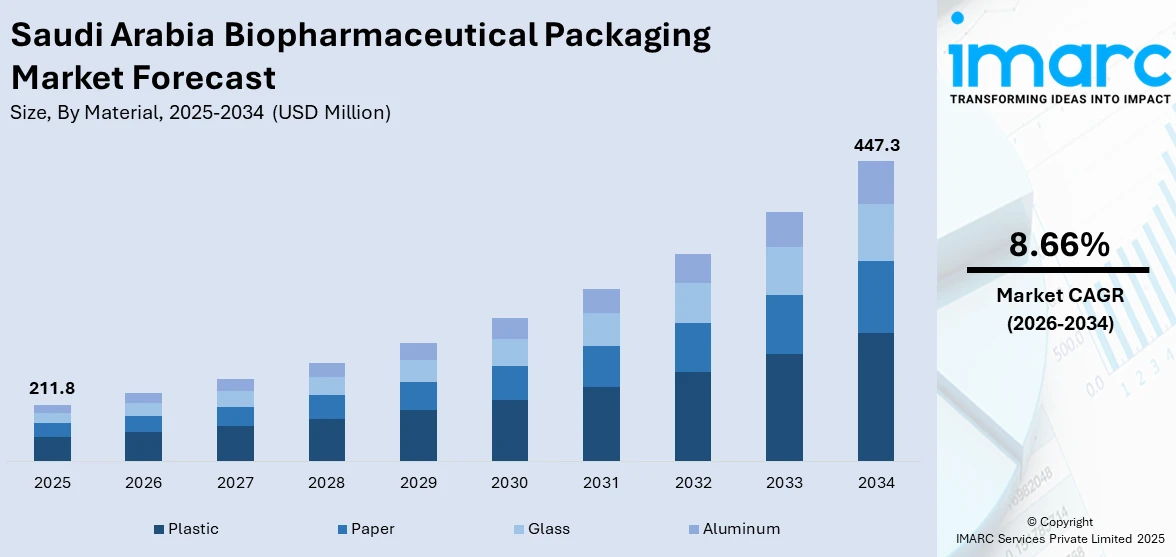
The Saudi Arabia biopharmaceutical packaging market size was valued at USD 211.8 Million in 2025 and is projected to reach USD 447.3 Million by 2034, growing at a compound annual growth rate of 8.66% from 2026-2034.
The Saudi Arabia biopharmaceutical packaging market is experiencing robust expansion, driven by the Kingdom's strategic healthcare transformation initiatives under Vision 2030. Increasing investments in local biopharmaceutical manufacturing, rising demand for vaccines and biologics, and the establishment of world-class production facilities are reshaping the packaging landscape. Growing emphasis on cold chain packaging solutions, regulatory compliance requirements, and the localization of pharmaceutical production are accelerating market development, positioning Saudi Arabia as a regional hub for biopharmaceutical packaging innovation and self-sufficiency.
Key Takeaways and Insights:
- By Material: Plastic dominates the market with a share of 45% in 2025, owing to its lightweight characteristics, excellent chemical resistance, and cost-effectiveness. Rising adoption of advanced polymer formulations enhances product stability and protection.
- By Packaging Type: Vials lead the market with a share of 32% in 2025. This dominance is driven by their critical role in maintaining sterility and efficacy of injectable biologics, vaccines, and sensitive biopharmaceutical formulations.
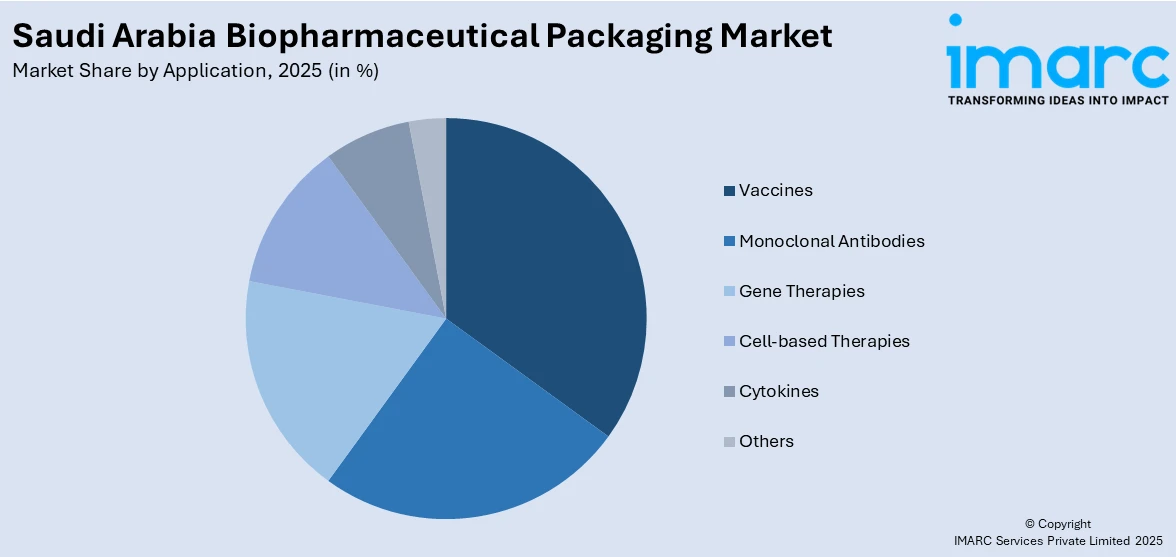
- By Application: Vaccines represent the largest segment with a market share of 35% in 2025, demonstrating the country's intensified emphasis on immunization programs, pandemic preparedness, and domestic vaccine manufacturing capabilities.
- By Region: Northern and Central Region comprises the largest region with 28% share in 2025, driven by concentration of pharmaceutical manufacturing facilities in Riyadh, major healthcare infrastructure investments, and strategic industrial clusters.
- Key Players: Key players drive the Saudi Arabia biopharmaceutical packaging market by expanding manufacturing capabilities, investing in cold chain technologies, and forming strategic partnerships with global pharmaceutical companies. Their focus on sustainable packaging solutions, regulatory compliance, and innovation ensures consistent product availability across diverse biopharmaceutical applications.
To get more information on this market Request Sample
The Saudi Arabia biopharmaceutical packaging market is witnessing transformative growth, as the Kingdom accelerates its journey towards pharmaceutical self-sufficiency and healthcare independence. Government investments in the vaccine and biomedical drug sectors are creating substantial demand for specialized packaging solutions that ensure product integrity and patient safety. The establishment of state-of-the-art biomanufacturing facilities demonstrates the Kingdom's commitment to localizing pharmaceutical production. Strategic partnerships between global healthcare leaders and domestic manufacturers are facilitating technology transfer and knowledge sharing, elevating packaging standards across the industry. The growing prevalence of chronic diseases, with diabetes affecting 23.1% of the adult population in 2024, necessitates reliable supply chains supported by advanced packaging infrastructure. Rising investments in cold chain logistics, smart packaging technologies, and sustainable materials are positioning Saudi Arabia as an emerging center for biopharmaceutical innovation in the Middle East region.
Saudi Arabia Biopharmaceutical Packaging Market Trends:
Expansion of Local Biomanufacturing Infrastructure
Saudi Arabia is witnessing unprecedented investments in local biopharmaceutical manufacturing facilities aligned with Vision 2030 healthcare objectives. The Kingdom's National Biotechnology Strategy focuses on developing end-to-end vaccine manufacturing capabilities and establishing advanced biomanufacturing platforms for biologics and biosimilars. In February 2025, Sanofi inaugurated its insulin pen manufacturing facility in collaboration with Sudair Pharma Company and NUPCO, demonstrating the growing demand for sophisticated packaging solutions that support domestic production capabilities.
Adoption of Advanced Cold Chain Packaging Solutions
The increasing production of temperature-sensitive biologics and vaccines is driving adoption of sophisticated cold chain packaging technologies across the Kingdom. Manufacturers are implementing Internet of Things (IoT)-enabled temperature monitoring systems, phase change materials, and vacuum-insulated containers to maintain product integrity during storage and distribution. These advancements are particularly critical for protecting sensitive formulations in Saudi Arabia's challenging climate conditions, ensuring therapeutic efficacy from manufacturing facilities to healthcare providers.
Growing Focus on Sustainable Packaging Materials
Environmental consciousness is reshaping packaging strategies, as manufacturers increasingly prioritize sustainable materials and recyclable solutions. The Saudi Green Initiative encourages adoption of eco-friendly packaging alternatives that reduce carbon footprint while maintaining pharmaceutical-grade quality standards. Industry players are investing in biodegradable polymers and recyclable packaging systems that align with global sustainability goals and regulatory expectations, creating opportunities for innovation in environmentally responsible biopharmaceutical packaging. These efforts not only enhance brand reputation but also strengthen compliance with emerging local and international environmental regulations.
How Vision 2030 is Transforming the Saudi Arabia Biopharmaceutical Packaging Market:
Vision 2030 is transforming the Saudi Arabia biopharmaceutical packaging market by strengthening local pharmaceutical manufacturing, healthcare infrastructure, and supply chain resilience. Government initiatives focused on localization and self-sufficiency are encouraging investments in domestic drug production, driving demand for high-quality primary and secondary packaging solutions that ensure product safety and regulatory compliance. Expansion of biopharmaceutical research and development (R&D), vaccine manufacturing, and biologics production is increasing the need for advanced packaging formats, such as prefilled syringes, vials, and sterile containers. Vision 2030’s emphasis on healthcare digitalization and quality standards is also pushing adoption of traceable, tamper-evident, and serialization-ready packaging systems.
Market Outlook 2026-2034:
The Saudi Arabia biopharmaceutical packaging market outlook remains highly favorable, as the Kingdom continues to implement transformative healthcare initiatives and expanding local manufacturing capabilities. Growing investments in biomanufacturing infrastructure, coupled with strategic technology transfer partnerships, are creating sustained demand for advanced packaging solutions. The market generated a revenue of USD 211.8 Million in 2025 and is projected to reach a revenue of USD 447.3 Million by 2034, growing at a compound annual growth rate of 8.66% from 2026-2034. Rising prevalence of chronic diseases, expanding immunization programs, and the establishment of vaccine production facilities are accelerating market expansion. The government's focus on achieving pharmaceutical self-sufficiency and reducing import dependency will continue to drive innovations in packaging technologies throughout the forecast period.
Saudi Arabia Biopharmaceutical Packaging Market Report Segmentation:
|
Segment Category |
Leading Segment |
Market Share |
|
Material |
Plastic |
45% |
|
Packaging Type |
Vials |
32% |
|
Application |
Vaccines |
35% |
|
Region |
Northern and Central Region |
28% |
Material Insights:
- Plastic
- Paper
- Glass
- Aluminum
Plastic dominates with a market share of 45% of the total Saudi Arabia biopharmaceutical packaging market in 2025.
Plastic maintains market leadership in the Saudi Arabia biopharmaceutical packaging market, owing to its exceptional versatility, cost-effectiveness, and compatibility with diverse pharmaceutical formulations. Advanced polymer technologies, including cyclic olefin copolymers and high-density polyethylene, offer superior chemical resistance and barrier properties essential for protecting sensitive biologics. The material’s flexibility enables customized packaging designs for vials, bottles, and prefilled delivery systems. Additionally, plastics support high-volume, automated manufacturing processes critical for scalable pharmaceutical production.
The growing preference for lightweight and shatterproof packaging solutions continues to drive plastic adoption across biopharmaceutical applications. Manufacturers increasingly utilize advanced plastic formulations that meet stringent regulatory requirements while reducing transportation costs and environmental impact. Innovations in recyclable and bio-based plastics are creating sustainable alternatives that align with the Kingdom's environmental commitments without compromising product protection or shelf life requirements for temperature-sensitive biopharmaceutical products throughout the distribution network.
Packaging Type Insights:
- Vials
- Bottles
- Ampoules
- Syringes
- Cartridges
Vials lead with a share of 32% of the total Saudi Arabia biopharmaceutical packaging market in 2025.
Vials represent the preferred packaging type for injectable biologics, vaccines, and parenteral formulations due to their superior chemical inertness and ability to maintain product sterility throughout the drug lifecycle. Type I borosilicate glass vials remain the gold standard for sensitive biologics requiring maximum protection against environmental contamination. Growing adoption of multi-dose vial configurations supports cost-effective vaccine distribution programs, particularly for immunization initiatives targeting the Kingdom's substantial population requiring protection against infectious diseases and seasonal illnesses.
The expansion of vaccine manufacturing capabilities in Saudi Arabia is significantly driving vial demand as new production facilities require substantial packaging infrastructure. In October 2025, CSL Seqirus and Vaccine Industrial Company entered into a Memorandum of Understanding (MoU) with the Saudi Arabian Ministry of Health to boost the biotechnology industry by obtaining advanced cell-based seasonal and pandemic influenza vaccines while localizing production in Saudi Arabia. Ready-to-use vial systems and advanced sterilization technologies are enhancing manufacturing efficiency while ensuring compliance with international pharmaceutical standards.
Application Insights:
Access the comprehensive market breakdown Request Sample
- Vaccines
- Monoclonal Antibodies
- Gene Therapies
- Cell-based Therapies
- Cytokines
- Others
Vaccines exhibit a clear dominance with a 35% share of the total Saudi Arabia biopharmaceutical packaging market in 2025.
Vaccines are the fastest-growing application segment, driven by Saudi Arabia's commitment to achieving immunization self-sufficiency and pandemic preparedness. In July 2023, Lifera, Sanofi, and Arabio signed an MoU to manufacture seven vaccines included in the mandatory immunization schedule, demonstrating substantial investment in local vaccine production capabilities. This strategic initiative aimed to strengthen national health security while reducing dependency on imported vaccines for protecting the Kingdom's population against preventable diseases.
The specialized packaging requirements for vaccine distribution are accelerating adoption of temperature-controlled solutions and tamper-evident containers across the country. Cold chain packaging innovations enable safe transportation of sensitive vaccine formulations across Saudi Arabia's extensive geography and challenging climate conditions. The growing investments in biomanufacturing facilities and technology transfer agreements with global pharmaceutical leaders ensure sustained demand for vaccine-specific packaging solutions that maintain item potency from production through administration to patients.
Regional Insights:
- Northern and Central Region
- Western Region
- Eastern Region
- Southern Region
Northern and Central Region represents the leading region with a 28% share of the total Saudi Arabia biopharmaceutical packaging market in 2025.
Northern and Central Region maintains market leadership, owing to the concentration of pharmaceutical manufacturing facilities, healthcare infrastructure, and industrial clusters in the Riyadh metropolitan area. In April 2025, Prince Faisal bin Bandar bin Abdulaziz, the Governor of Riyadh, launched 28 health initiatives throughout the Riyadh region, encompassing the public, private, and nonprofit sectors, valued at over SAR 7 Billion and providing a total of more than 3,000 beds. Sudair Industrial City hosts major biopharmaceutical production facilities. The region benefits from strategic proximity to government healthcare institutions, regulatory authorities, and logistics networks that facilitate efficient distribution of biopharmaceutical products across the Kingdom.
Continuous investments in healthcare infrastructure and the establishment of specialized industrial zones are strengthening the region's position as Saudi Arabia's biopharmaceutical hub. The concentration of skilled workforce, research institutions, and cold chain logistics capabilities provides competitive advantages for biopharmaceutical packaging manufacturers serving the domestic market and regional export opportunities. Increasing public–private collaboration is also supporting technology transfer and packaging innovation. Additionally, rising demand for localized pharmaceutical production is reinforcing long-term investment momentum in the region.
Market Dynamics:
Growth Drivers:
Why is the Saudi Arabia Biopharmaceutical Packaging Market Growing?
Government Investments in Healthcare Infrastructure and Pharmaceutical Localization
Saudi Arabia's Vision 2030 framework positions healthcare transformation as a strategic national priority, driving unprecedented investments in biopharmaceutical manufacturing and packaging infrastructure. Under Vision 2030, the government has committed more than USD 65 Billion in private sector healthcare investments to develop world-class medical facilities and pharmaceutical production capabilities. This comprehensive approach encompasses technology transfer agreements, workforce development programs, and regulatory modernization initiatives that strengthen domestic manufacturing competitiveness. Expanded biologics and vaccine manufacturing capacity is increasing demand for advanced, sterile, and compliant packaging solutions. Vision 2030 also encourages public–private partnerships (PPPs) and foreign direct investment (FDI), enabling access to global best practices and packaging technologies. As healthcare demand rises and regulatory standards align with international benchmarks, biopharmaceutical packaging is emerging as a critical enabler of Saudi Arabia’s evolving life sciences ecosystem and long-term healthcare sustainability.
Rising Prevalence of Chronic Diseases and Increasing Healthcare Demand
The growing burden of chronic diseases in Saudi Arabia is significantly driving demand for biopharmaceutical products and their specialized packaging solutions. In Saudi Arabia, the anticipated new cancer cases are projected to rise to 60,429 by 2040. This epidemiological profile necessitates reliable packaging infrastructure that ensures product stability and accessibility throughout distribution networks. Expanding immunization programs target the Kingdom's growing population with comprehensive vaccination schedules requiring temperature-controlled packaging systems. The aging demographic profile and increasing incidence of lifestyle-related conditions further amplify demand for biologics, biosimilars, and specialty pharmaceuticals that require advanced containment and protection throughout their shelf life. These trends are encouraging manufacturers to adopt high-quality, compliant packaging that supports long-term storage and safe administration. As treatment complexity increases, demand for innovative, patient-centric biopharmaceutical packaging solutions continues to strengthen across Saudi Arabia.
Expansion of Local Biomanufacturing and Technology Transfer Partnerships
Strategic partnerships between global pharmaceutical leaders and Saudi manufacturing companies are transforming the Kingdom's biopharmaceutical landscape and driving the market expansion. Technology transfer initiatives create direct demand for sophisticated packaging solutions, including prefilled syringes, cartridges, and specialized containers that meet stringent quality requirements. Multiple vaccine production projects involving international partners are establishing end-to-end manufacturing capabilities that require comprehensive packaging infrastructure from primary containment through secondary packaging and cold chain distribution systems. These collaborations are also helping local companies build technical know-how and operational experience across the full biopharmaceutical value chain. As global partners bring established quality systems and packaging standards, Saudi manufacturers are upgrading facilities to match international benchmarks. This shift is improving product reliability, speeding up regulatory approvals, and enabling locally produced medicines to reach both domestic and regional markets more efficiently, supporting long-term growth of the Saudi Arabia biopharmaceutical packaging ecosystem.
Market Restraints:
What Challenges the Saudi Arabia Biopharmaceutical Packaging Market is Facing?
High Dependency on Imported Raw Materials and Components
The Saudi Arabia biopharmaceutical packaging sector faces challenges from significant reliance on imported raw materials, specialty polymers, and glass containers. Limited domestic production of pharmaceutical-grade packaging materials creates supply chain vulnerabilities and cost fluctuations that affect manufacturing competitiveness. The dependency on international suppliers for critical inputs, including borosilicate glass, medical-grade plastics, and aluminum foil, exposes manufacturers to geopolitical risks and logistics disruptions that may impact product availability and pricing stability.
Stringent Regulatory Compliance Requirements
Increasingly rigorous regulatory standards enforced by the Saudi Food and Drug Authority create compliance challenges for packaging manufacturers. New requirements mandating serialization, track-and-trace capabilities, and tamper-evident features increase production costs and operational complexity. Smaller manufacturers may struggle to implement advanced quality management systems and obtain necessary certifications, potentially limiting market participation and innovation capacity while larger players invest substantially in compliance infrastructure.
Skilled Workforce Shortage in Specialized Packaging Technologies
The limited availability of skilled professionals with expertise in biopharmaceutical packaging technologies presents workforce challenges. Specialized knowledge in aseptic processing, cold chain management, and regulatory compliance remains scarce, requiring companies to invest significantly in training programs and international recruitment. This talent gap may constrain expansion capabilities and technology adoption rates as the industry scales to meet growing demand for sophisticated packaging solutions.
Competitive Landscape:
The Saudi Arabia biopharmaceutical packaging market exhibits a competitive landscape, characterized by both international players and emerging domestic manufacturers. Global packaging companies are establishing local production facilities and forming strategic partnerships with Saudi pharmaceutical manufacturers to capture market opportunities. Competition intensifies around cold chain capabilities, regulatory compliance expertise, and innovation in sustainable packaging solutions. Domestic players are strengthening positions through capacity expansions, technology investments, and specialized service offerings tailored to local market requirements. Strategic collaborations between packaging manufacturers and biopharmaceutical producers are driving value chain integration, while mergers and acquisitions consolidate market positions and expand geographic coverage throughout the Kingdom.
Saudi Arabia Biopharmaceutical Packaging Market Report Coverage:
| Report Features | Details |
|---|---|
| Base Year of the Analysis | 2025 |
| Historical Period | 2020-2025 |
| Forecast Period | 2026-2034 |
| Units | Million USD |
| Scope of the Report |
Exploration of Historical Trends and Market Outlook, Industry Catalysts and Challenges, Segment-Wise Historical and Future Market Assessment:
|
| Materials Covered | Plastic, Paper, Glass, Aluminium |
| Packaging Types Covered | Vials, Bottles, Ampoules, Syringes, Cartridges |
| Applications Covered | Vaccines, Monoclonal Antibodies, Gene Therapies, Cell-based Therapies, Cytokines, Others |
| Regions Covered | Northern and Central Region, Western Region, Eastern Region, Southern Region |
| Customization Scope | 10% Free Customization |
| Post-Sale Analyst Support | 10-12 Weeks |
| Delivery Format | PDF and Excel through Email (We can also provide the editable version of the report in PPT/Word format on special request) |
Frequently Asked Questions About the Saudi Arabia Biopharmaceutical Packaging Market Report
The Saudi Arabia biopharmaceutical packaging market size was valued at USD 211.8 Million in 2025.
The Saudi Arabia biopharmaceutical packaging market is expected to grow at a compound annual growth rate of 8.66% from 2026-2034 to reach USD 447.3 Million by 2034.
Plastic dominated the market with a share of 45%, driven by its versatility, cost-effectiveness, advanced barrier properties, and compatibility with diverse biopharmaceutical formulations requiring lightweight and shatterproof packaging solutions.
Key factors driving the Saudi Arabia biopharmaceutical packaging market include government investments in healthcare infrastructure, rising chronic disease prevalence, expansion of local biomanufacturing, technology transfer partnerships, and Vision 2030 pharmaceutical localization initiatives.
Major challenges include high dependency on imported raw materials, stringent regulatory compliance requirements, skilled workforce shortages, supply chain vulnerabilities, and substantial capital investments required for specialized cold chain and aseptic packaging infrastructure.
Need more help?
- Speak to our experienced analysts for insights on the current market scenarios.
- Include additional segments and countries to customize the report as per your requirement.
- Gain an unparalleled competitive advantage in your domain by understanding how to utilize the report and positively impacting your operations and revenue.
- For further assistance, please connect with our analysts.
 Request Customization
 Speak to an Analyst
 Request Brochure
 Inquire Before Buying
Benefits of Customization
- Personalize this research
- Triangulate with your data
- Get data as per your format and definition
- Gain a deeper dive into a specific application, geography, customer, or competitor
- Any level of personalization
Get in Touch With Us
UNITED STATES
Phone: +1-201-971-6302
INDIA
Phone: +91-120-433-0800
UNITED KINGDOM
Phone: +44-753-714-6104
Email: [email protected]
Client Testimonials




.webp)




.webp)













Related Reports

Choose your plan
*Please note that the prices mentioned below are starting prices for each bundle type. Kindly contact our team for further details.*
Single User License
- 1 User License, Access on 2 Devices
- PDF Report + Excel Dataset (Password Protected)
- Lifetime Access
- No Printing Rights
- 10% Free Report Customization
- 10–12 Weeks of Analyst Support
Five User License
- Access for 5 Users, 2 Devices per User
- PDF Report + Excel Dataset (Password Protected)
- Lifetime Access
- Dedicated Account Manager
- 12–14 Weeks of Analyst Support
- No Printing Rights
- 15% Free Report Customization
- 25% Discount on Your Next Purchase
Corporate User License
- Unlimited User Access (Within Your Organization)
- PDF Report + Excel Dataset
- Lifetime Access
- Dedicated Account Manager
- 14–20 Weeks of Analyst Support
- No Printing Rights
- 20% Free Report Customization
- 30% Discount on Your Next Purchase
Essential Insights
What's included:
3 reports
- Lifetime Access
- PDF Reports
- Excel Datasets
- 2 Weeks of Free Analyst Support
- 2 User Licenses
- Access on 2 Devices
- Printing Rights
- Complimentary PowerPoint (PPT) Version
- Complimentary License Upgrade
Professional Access
What's included:
5 reports
- Lifetime Access
- PDF Reports
- Excel Datasets
- 8 Weeks of Free Analyst Support
- 2 User Licenses
- Access on 2 Devices
- Printing Rights
- Complimentary PowerPoint (PPT) Version
- Complimentary License Upgrade
Business Advantage
What's included:
8 reports
- Lifetime Access
- PDF Reports
- Excel Datasets
- 14 Weeks of Free Analyst Support
- 2 User Licenses
- Access on 2 Devices
- Printing Rights
- Complimentary PowerPoint (PPT) Version
- Complimentary License Upgrade
Enterprise Intelligence
What's included:
10 reports
- Lifetime Access
- PDF Reports
- Excel Datasets
- 20 Weeks of Free Analyst Support
- 2 User Licenses
- Access on 2 Devices
- Printing Rights
- Complimentary PowerPoint (PPT) Version
- Complimentary License Upgrade