
Saudi Arabia BOPP Films Market Size, Share, Trends and Forecast by Type, Thickness, Production Process, Application, and Region, 2026-2034
Saudi Arabia BOPP Films Market Size, Share, Trends & Forecast (2026-2034)
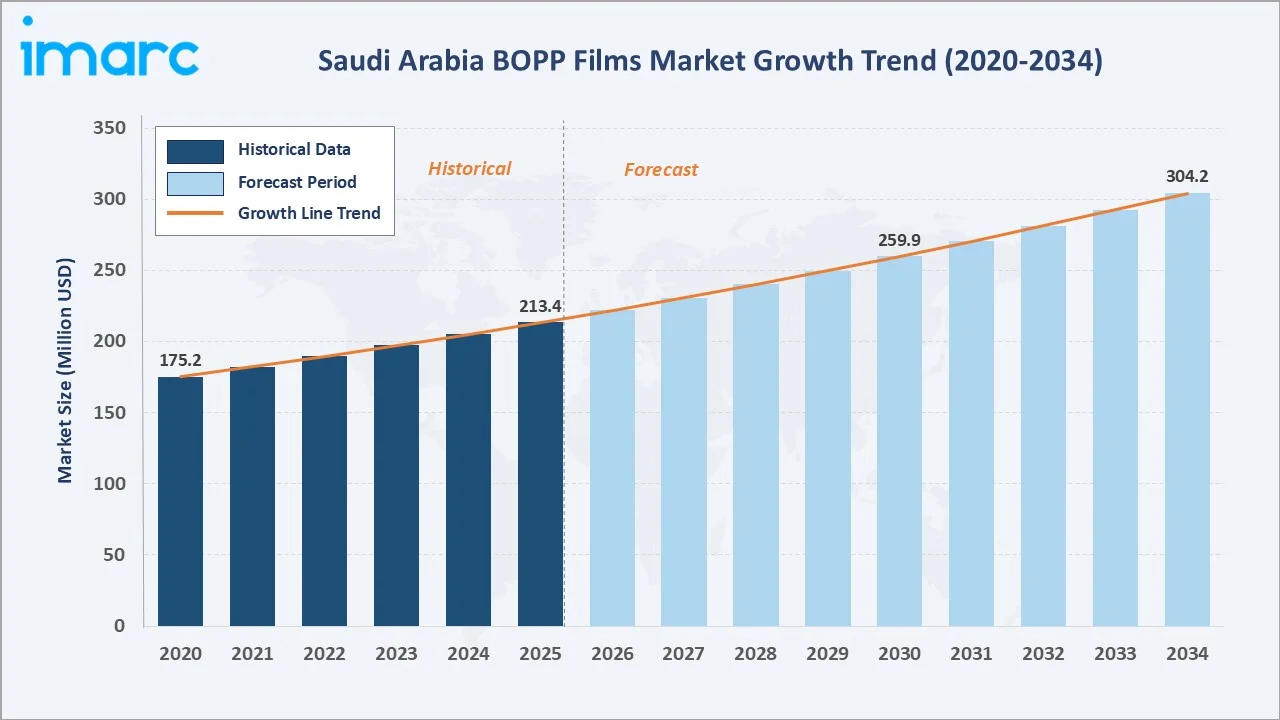
The Saudi Arabia BOPP films market grew from USD 213.4 Million in 2025 to USD 222.0 Million in 2026 and is projected to reach USD 304.2 Million by 2034, growing at a CAGR of 4.02% during 2026-2034. The market is driven by rising demand for flexible packaging across Saudi Arabia food, beverage, personal care, and pharmaceutical industries, supported by Vision 2030 downstream industrialization and competitive polypropylene resin supply from domestic petrochemical producers. Tenter process leads at 86.4% by production process, food dominates at 34.8% by application, and the Northern and Central region commands the largest regional share at 43.6% in 2025.
Market Snapshot
|
Metric |
Value |
|
Base Year Market Size (2025) |
USD 213.4 Million |
|
Market Size (2026) |
USD 222.0 Million |
|
Forecast Market Size (2034) |
USD 304.2 Million |
|
CAGR (2026-2034) |
4.02% |
|
Base Year |
2025 |
|
Historical Period |
2020-2025 |
|
Forecast Period |
2026-2034 |
|
Dominant Production Process |
Tenter (86.4%, 2025) |
|
Dominant Application |
Food (34.8%, 2025) |
|
Leading Region |
Northern and Central Region (43.6%, 2025) |
The Saudi Arabia BOPP films market grew from USD 175.2 Million in 2020 to USD 213.4 Million in 2025, and further to USD 222.0 Million in 2026, reflecting steady demand from the expanding food and beverage industry, modern retail growth, and broader flexible packaging adoption across consumer goods categories. The market is projected to reach USD 259.9 Million by 2030 before reaching USD 304.2 Million by 2034.
To get more information on this market, Request Sample
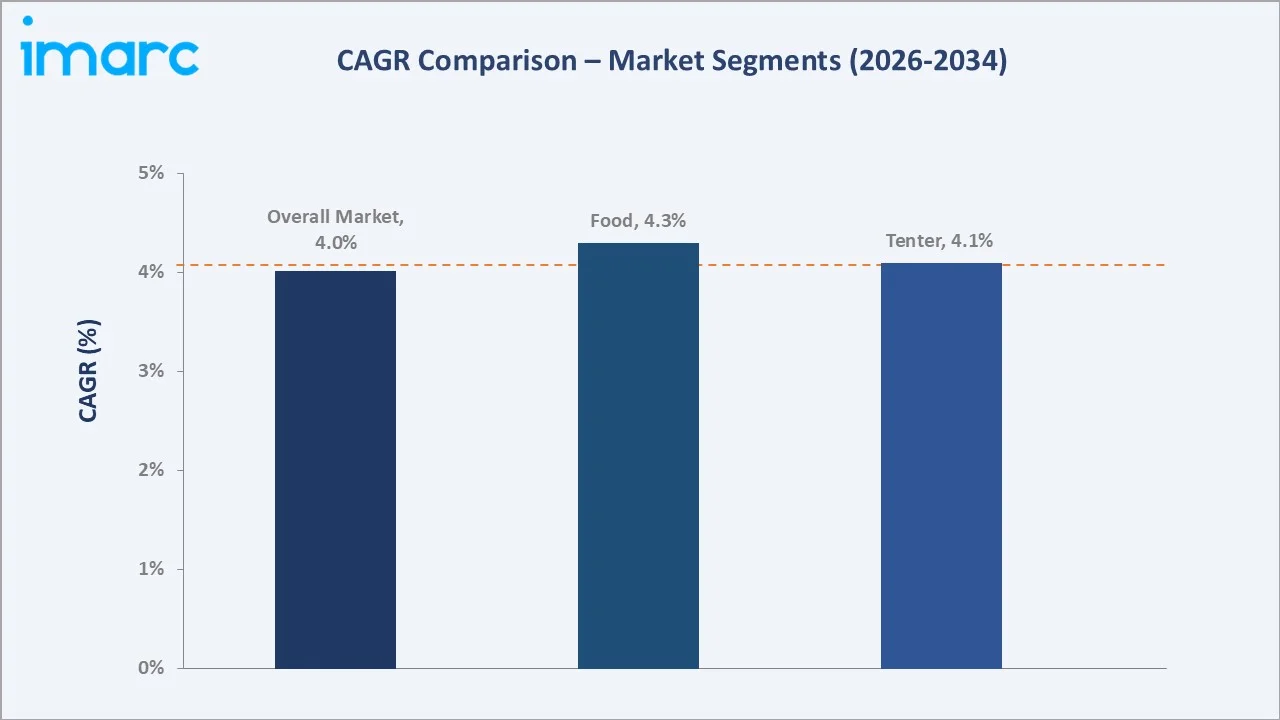
Tenter process is growing at a 4.1% CAGR, maintaining dominance as the industry-standard manufacturing method delivering superior film uniformity, wider width capability, and higher throughput suited to Saudi Arabia large-scale production operations. Food application at 4.3% CAGR reflects the sustained expansion of Saudi Arabia food industry, which is the primary and fastest-growing end-use segment for BOPP packaging films.
Executive Summary
The Saudi Arabia BOPP films market is experiencing steady structural growth, underpinned by the sustained expansion of Saudi Arabia food and beverage industry, the rise of modern retail formats requiring consistent high-performance flexible packaging, Vision 2030 downstream industrialization agenda supporting domestic polypropylene processing investment, and the strategic capacity investments of Saudi-based BOPP film manufacturers.
Tenter process at 86.4% dominates production, reflecting the overwhelming commercial preference for the sequential biaxial stretching process that delivers film uniformity, width flexibility, and production economics suited to large-scale flexible packaging applications. The food sector leads at 34.8%, followed by beverage at 18.9% and personal care at 14.7%, collectively reflecting the primacy of fast-moving consumer goods packaging as the primary demand driver for Saudi Arabia BOPP film consumption. The Northern and Central region leads regionally at 43.6%, reflecting Riyadh's concentration of food manufacturing, modern retail distribution centers, and packaging converter operations.
Key Market Insights
|
Insight |
Data |
|
Dominant Production Process |
Tenter - 86.4% share (2025) |
|
Dominant Application |
Food - 34.8% share (2025) |
|
Leading Region |
Northern and Central Region - 43.6% (2025) |
|
Key Market Opportunity |
Rising demand for flexible packaging, growth in food and beverage packaging, increasing e-commerce activity, expansion of pharmaceutical and personal care packaging, demand for lightweight and recyclable packaging materials, and technological advancements in film production. |
Key Analytical Observations Supporting the Above Data:
- Tenter at 86.4%: Tenter process dominates because the sequential biaxial stretching method delivers consistent, defect-free film across the wide-width formats required for high-volume food, beverage, and personal care packaging applications. Tenter lines produce superior optical clarity, surface uniformity, and thickness control that converter customers require for printing, metallizing, and lamination.
- Food at 34.8%: Food packaging leads because Saudi Arabia food industry is the single largest consumer of flexible packaging in the kingdom, generating demand for BOPP films across snack packaging, dry food pouches, confectionery overwraps, fresh produce bags, and label stock.
- Northern and Central Region at 43.6%: Riyadh commands the largest BOPP film consumption share because it hosts Saudi Arabia largest concentration of food and beverage manufacturing facilities, modern retail distribution centers, fast-moving consumer goods company headquarters, and packaging converter operations that collectively represent the highest concentration of BOPP film demand in the kingdom.
Saudi Arabia BOPP Films Market Overview
The Saudi Arabia BOPP films market encompasses the manufacture, import, distribution, and conversion of biaxially oriented polypropylene films across all commercial thickness ranges and film type categories, including clear BOPP, metallized BOPP, matte BOPP, heat-sealable BOPP, and specialty coated BOPP films. These films serve as the primary flexible packaging substrate for food, beverage, personal care, pharmaceutical, electrical and electronics, tobacco, and other consumer goods applications through conversion processes including flexographic and gravure printing, lamination, metallizing, and adhesive coating.
Market Dynamics
To evaluate market opportunities, Request Sample
Market Drivers
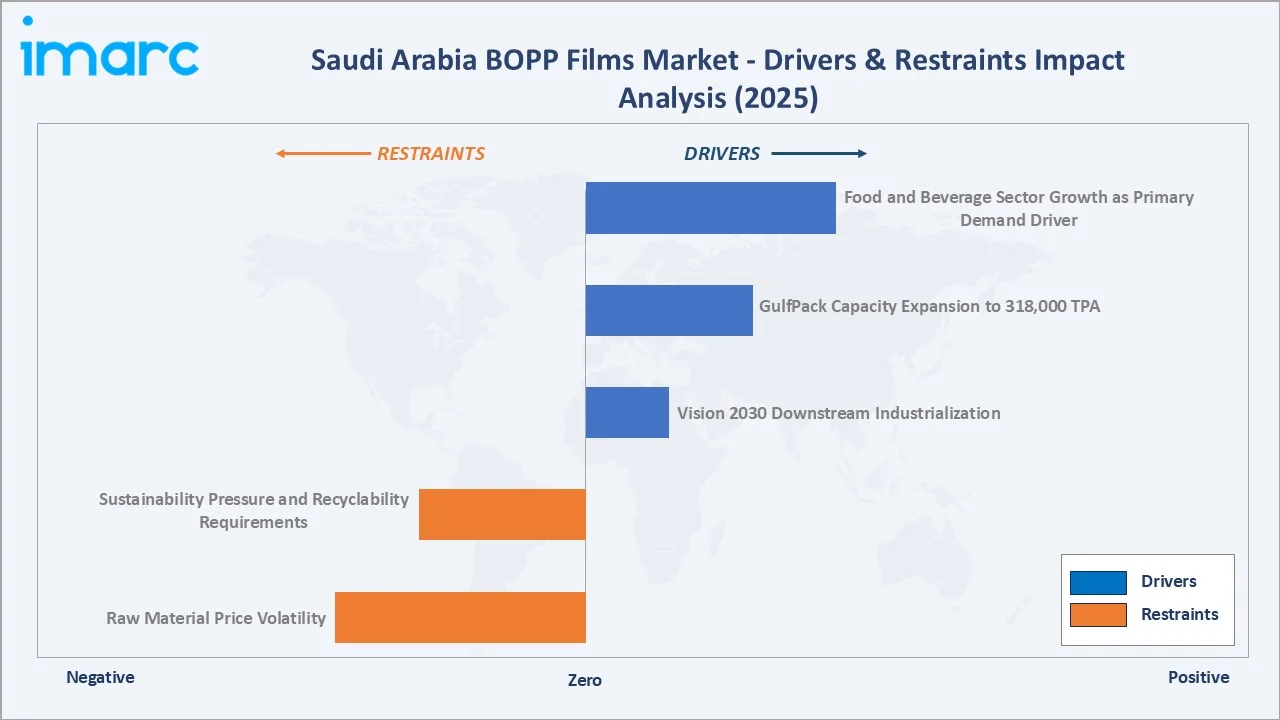
- Food and Beverage Sector Growth as Primary Demand Driver: Saudi Arabia food and beverage industry is the single largest consumer of flexible packaging, including BOPP films, generating sustained demand from snack food, confectionery, bakery, dry food, beverage label, and condiment packaging. Saudi Arabia’s urbanization and growing modern retail penetration are increasing demand for shelf-ready packaged food products that require high-clarity, print-receptive BOPP packaging for consumer appeal and product differentiation.
- GulfPack Capacity Expansion to 318,000 TPA: In March 2025, GulfPack signed contracts for expanding its BOPP film production capacity by installing two new 10.4-meter-wide production lines at a new facility. The expansion is expected to increase capacity from 183,000 TPA to approximately 318,000 TPA, with operations planned to begin in 2026 and 2027, creating a strategic platform for both export market revenue growth and premium product tier development.
- Vision 2030 Downstream Industrialization: Vision 2030 National Industrial Development program supports downstream polymer processing investment that directly benefits BOPP film manufacturing as a high-value polypropylene application. Saudi Arabia domestic petrochemical production from integrated producers provides competitively priced PP resin feedstock that gives Saudi BOPP film manufacturers a structural cost advantage, supporting both domestic market competitiveness and global export economics.
Market Restraints
- Raw Material Price Volatility: BOPP film manufacturing economics are directly linked to polypropylene resin pricing, which fluctuates with crude oil prices, global propylene supply-demand dynamics, and petrochemical industry capacity cycles. While Saudi Arabia benefits from domestic PP resin production, BOPP film manufacturers importing raw materials or competing with imported films face exposure to global PP commodity price movements that compress margins when PP prices increase faster than BOPP film selling prices can be adjusted.
- Sustainability Pressure and Recyclability Requirements: Growing environmental awareness and potential regulatory requirements aligned with the Saudi Arabia Green Initiative are creating pressure on BOPP film manufacturers to develop recyclable mono-material structures, reduce film thickness, and increase use of recycled PP content, each of which requires R&D investment and product reformulation.
Market Opportunities
- Metallized BOPP Film for Premium Consumer Goods: Saudi Arabia growing premium FMCG market, driven by rising disposable income, a growing middle class, and Vision 2030 quality of life programs, is creating demand for metallized BOPP films that provide high-barrier, mirror-surface packaging for premium food, personal care, and confectionery products. Metallized BOPP commands significant price premiums over clear BOPP and offers superior barrier performance that extends product shelf life for export-oriented Saudi food manufacturers.
- Export Market Expansion to GCC and Global Markets: Saudi Arabia’s strategic location provides BOPP film manufacturers with access to growing packaging markets across the GCC and other international regions. Expanding exports can help manufacturers diversify their customer base and increase production utilization. Moreover, established logistics infrastructure and proximity to regional markets can support cost-efficient distribution and strengthen Saudi Arabia’s position as an export hub.
Market Challenges
- Dependence on Packaging Industry Demand: BOPP films are closely linked to demand from food and beverage, consumer goods, pharmaceutical, and other packaging applications. Any slowdown in packaging production or changes in customer requirements can affect film demand. Manufacturers may need to diversify their application base to reduce exposure to individual end-use sectors.
- Competition from Alternative Packaging Materials: BOPP films compete with materials such as polyethylene films, PET films, paper, and other flexible packaging substrates. Changes in material preferences based on cost, functionality, and sustainability can influence demand. This creates a need for manufacturers to continuously improve film performance and application suitability.
Emerging Market Trends
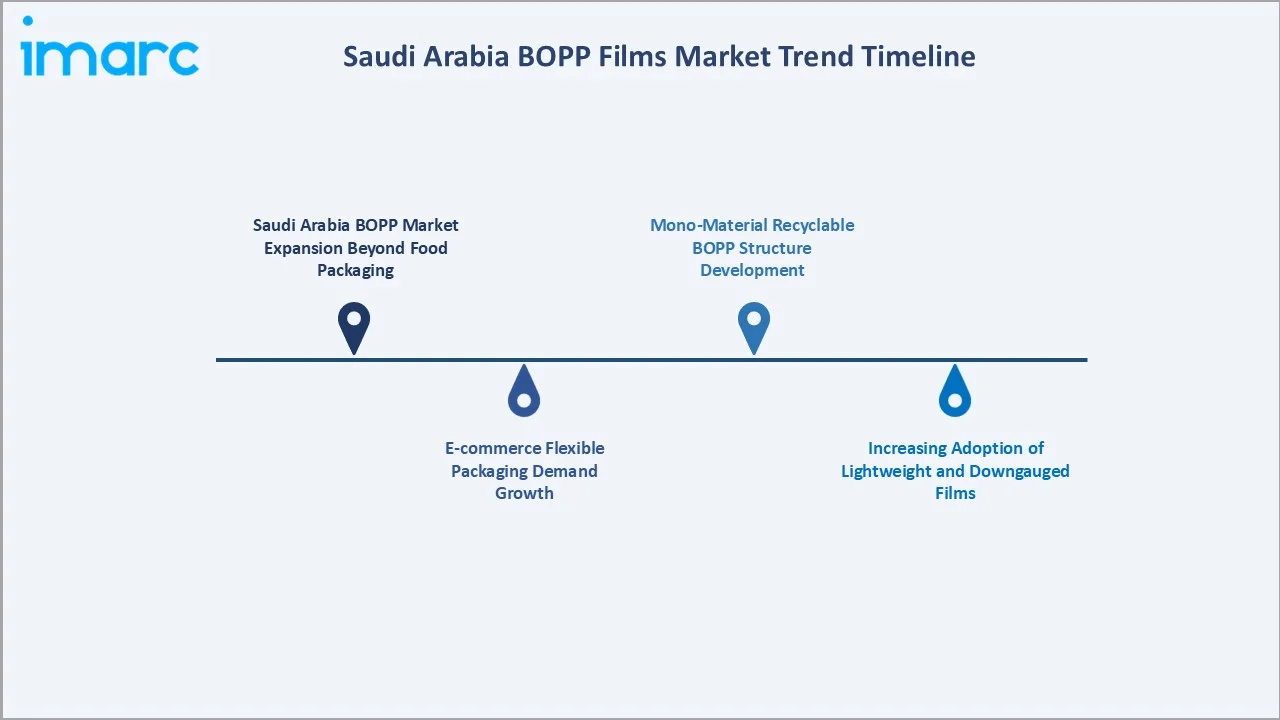
1. Saudi Arabia BOPP Market Expansion Beyond Food Packaging
The Saudi Arabia BOPP films market is moving beyond food packaging into applications including labeling, overwraps, stationery, and textile packaging as converting capabilities expand and brand owners recognize the versatility, cost competitiveness, and printability of BOPP across a wider range of packaging and commercial applications. Label stock BOPP is a growing category as modern retail expansion and e-commerce growth increase demand for high-quality printed labeling. Overwrap BOPP for confectionery, gifts, and stationery is growing alongside Vision 2030 quality of life and tourism programs that are expanding Saudi Arabia retail and hospitality sectors.
2. E-commerce Flexible Packaging Demand Growth
Saudi Arabia e-commerce market growth is creating new demand for BOPP-based flexible packaging solutions, including protective pouches, printed mailers, and tamper-evident wrap applications. E-commerce packaging requires high-clarity, print-receptive, and durable flexible films that BOPP provides at competitive cost, and the growth of direct-to-consumer food and FMCG delivery platforms is expanding BOPP consumption in categories that were previously distributed primarily through rigid packaging formats.
3. Mono-Material Recyclable BOPP Structure Development
The global flexible packaging industry transition toward recyclable mono-material structures, driven by extended producer responsibility regulations and brand owner sustainability commitments, is creating demand for all-BOPP laminate structures that can replace multi-material laminations combining BOPP with BOPET, PE, and aluminum that are technically difficult to recycle. Saudi Arabia BOPP film manufacturers that develop certified recyclable mono-material structures will capture premium pricing and preferred supplier status from sustainability-committed FMCG brand owners.
4. Increasing Adoption of Lightweight and Downgauged Films
Packaging producers are focusing on reducing material usage while maintaining required strength and performance. Downgauged BOPP films can help lower packaging weight, material consumption, and transportation requirements. This trend aligns with both cost-efficiency and sustainability objectives. As a result, manufacturers are investing in advanced film technologies that enable thinner yet durable products.
Industry Value Chain Analysis
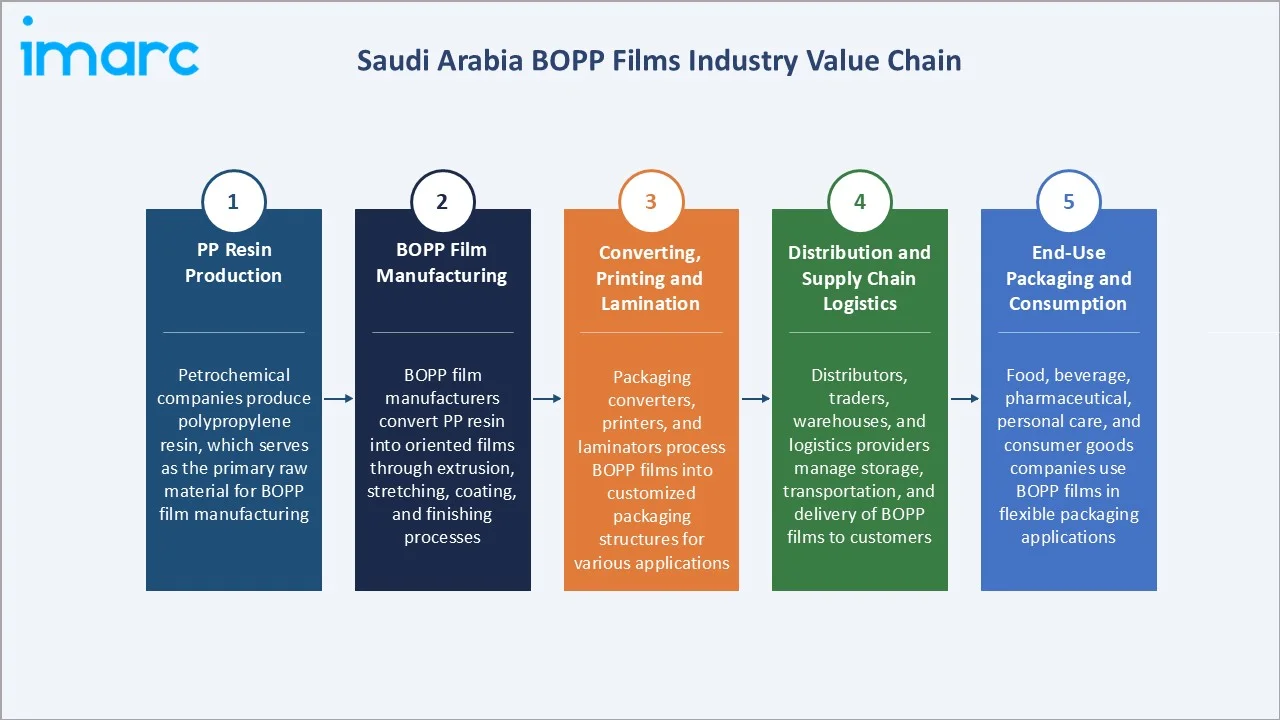
The Saudi Arabia BOPP films value chain spans five integrated stages from polypropylene resin production through end-use packaging consumption. The BOPP film manufacturing stage captures the highest value addition in the chain, transforming commodity polypropylene resin through capital-intensive biaxial orientation into precision-specification flexible film substrates that command significant value-add premiums over raw resin cost.
|
Stage |
Key Participants |
|
PP Resin Production |
Petrochemical companies produce polypropylene resin, which serves as the primary raw material for BOPP film manufacturing. |
|
BOPP Film Manufacturing |
BOPP film manufacturers convert PP resin into oriented films through extrusion, stretching, coating, and finishing processes. |
|
Converting, Printing and Lamination |
Packaging converters, printers, and laminators process BOPP films into customized packaging structures for various applications. |
|
Distribution and Supply Chain Logistics |
Distributors, traders, warehouses, and logistics providers manage storage, transportation, and delivery of BOPP films to customers. |
|
End-Use Packaging and Consumption |
Food, beverage, pharmaceutical, personal care, and consumer goods companies use BOPP films in flexible packaging applications. |
The BOPP film manufacturing stage is the highest value-added stage in the value chain. BOPP film manufacturers that combine competitive PP resin feedstock access, state-of-the-art wide tenter lines, in-line metallizing capability, and surface treatment technologies capture the largest margin differential in the chain, transforming commodity polypropylene into precision-performance flexible packaging substrates with differentiated technical properties that sustain commercial pricing power above commodity film trading.
Technology Landscape in the Saudi Arabia BOPP Films Industry
Wide-Width Tenter Biaxial Orientation Technology
The installation of 10.4-meter-wide tenter BOPP production lines by GulfPack in 2025 represents the adoption of the widest commercially available BOPP production technology, enabling per-unit production cost reduction through economies of scale, greater slit width flexibility for converter customers, and superior film uniformity across the entire web width. Wide-width tenter technology from suppliers enables Saudi Arabia BOPP manufacturers to produce premium films at competitive global cost structures, supporting GulfPack export competitiveness.
Metallizing and In-Line Surface Treatment
Vacuum metallizing technology, applying ultra-thin aluminum coatings to BOPP film in vacuum chamber systems, transforms standard clear BOPP into high-barrier, premium-appearance metallized BOPP with significantly enhanced moisture vapor and oxygen barrier properties. In-line corona treatment and coating application technologies enable surface modification during film production that improves ink adhesion, adhesive bondability, and specialized functional coatings. Saudi Arabia BOPP manufacturers with in-house metallizing capability capture higher-value product tiers serving premium food, personal care, and confectionery packaging that command price premiums over standard clear BOPP.
Digital Printing Integration and Smart Packaging
The integration of digital variable printing with BOPP film packaging is enabling short-run, personalized, and versioned packaging that supports e-commerce fulfillment, promotional campaigns, and SKU proliferation strategies for Saudi Arabia FMCG brand owners. Smart packaging technologies, including QR codes, near-field communication tags, and authentication features printed or integrated on BOPP film packaging, are growing as brand owners seek to engage consumers digitally and protect against counterfeiting in pharmaceutical and premium food categories.
Market Segmentation Analysis
The report covers the following segments:
|
Segment Category |
Leading Segment |
Market Share |
Year |
|
Type |
🔒 |
🔒 |
2025 |
|
Thickness |
🔒 |
🔒 |
2025 |
|
Production Process |
Tenter |
86.4% |
2025 |
|
Application |
Food |
34.8% |
2025 |
|
Region |
Northern and Central Region |
43.6% |
2025 |

By Production Process
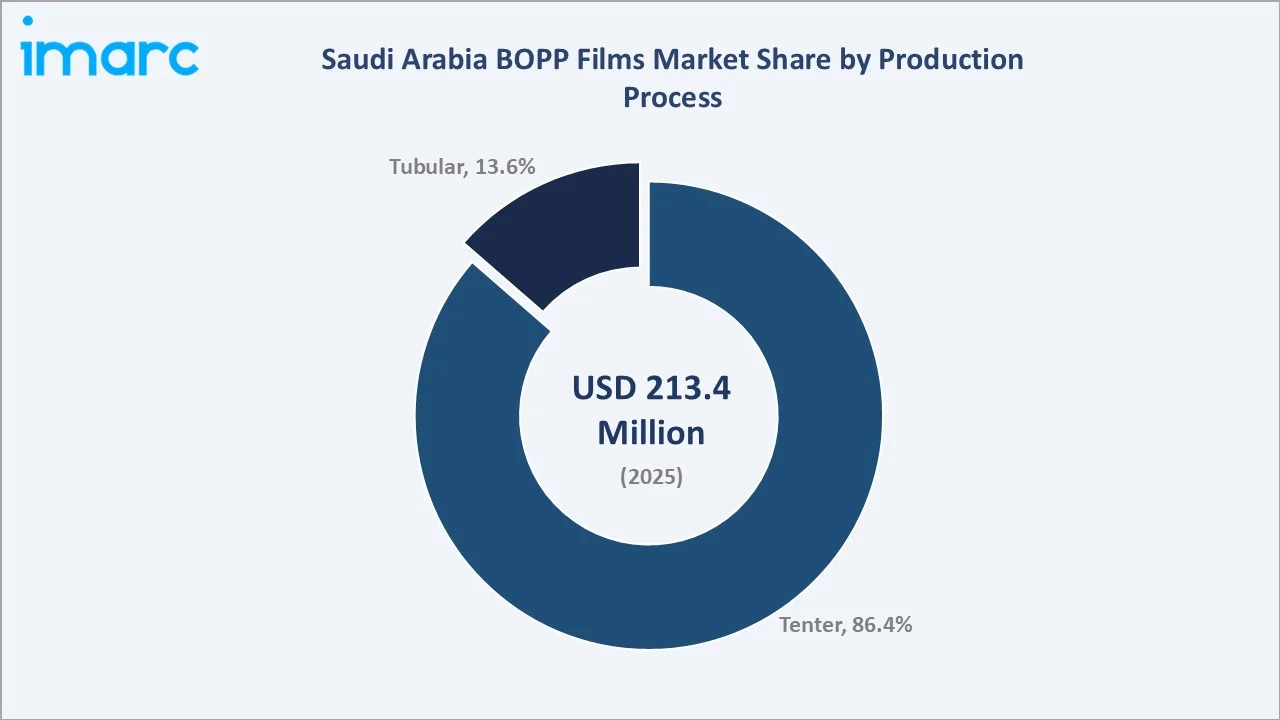
Tenter process leads at 86.4% in 2025, reflecting the overwhelming commercial dominance of the sequential biaxial stretching process that stretches polypropylene film first in the machine direction, then in the transverse direction through a tenter oven, delivering superior film uniformity, consistent thickness profile, and wider commercial width capability compared to tubular process alternatives.
To access detailed market analysis, Request Sample
Tubular process at 13.6% serves specific applications where the tubular bubble process characteristics are either technically preferred or economically justified for smaller-scale specialty film production. Tubular BOPP is particularly used for certain overwrap and agricultural film applications where specific film properties align with tubular process capability.
By Application
Food leads at 34.8% in 2025, reflecting the primacy of Saudi Arabia food manufacturing sector as the most important demand driver for BOPP flexible packaging. BOPP films serve snack food, confectionery, dry goods, bakery, rice and grain, fresh produce, and dairy packaging applications where clear, printable, moisture-resistant film is required.
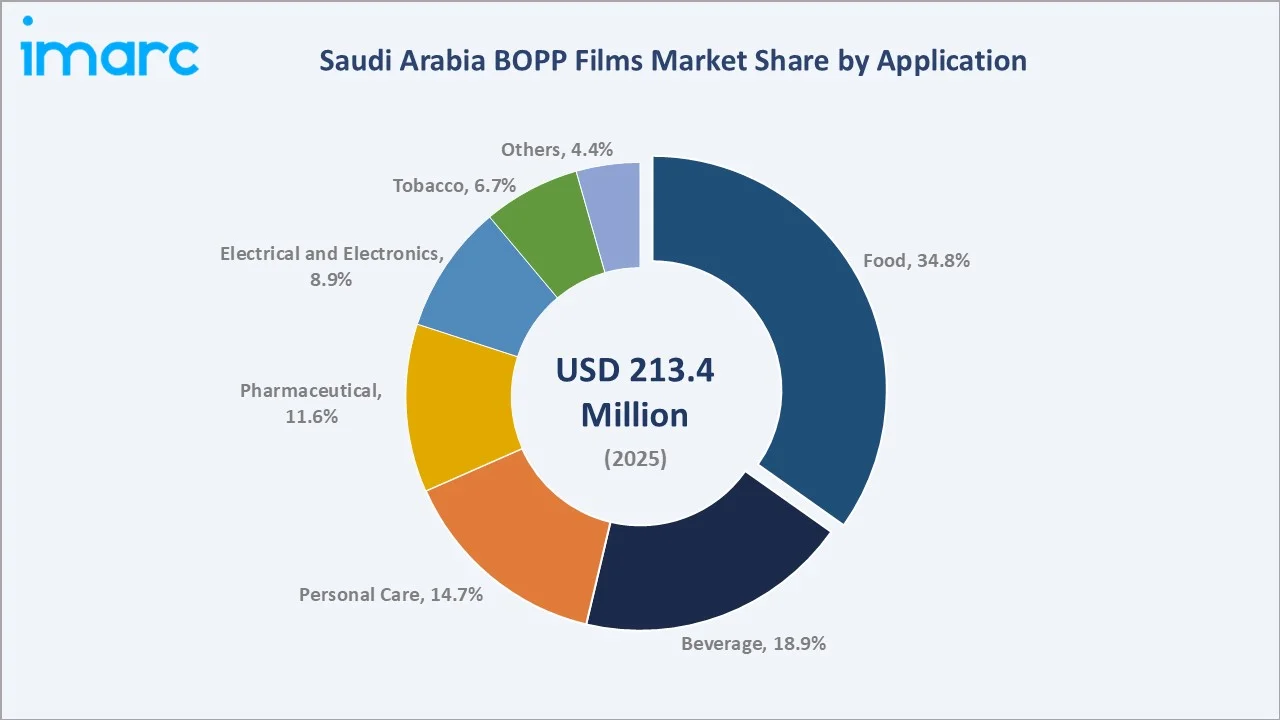
Beverage at 18.9% serves primarily label applications for bottled water, carbonated soft drinks, fruit juices, and dairy beverages that require printable, moisture-resistant label stock. Personal care at 14.7% covers shampoo, conditioner, cosmetics, and toiletries packaging where BOPP provides clarity and printability. Pharmaceutical at 11.6% uses BOPP for tablet blister overwrap, medicine pack labels, and outer packaging. Electrical and electronics at 8.9% uses BOPP for capacitor films and packaging wraps, tobacco at 6.7% uses BOPP as cigarette pack overwrap replacing cellophane, and others at 4.4% includes stationery, textile, and industrial applications.
Regional Market Insights
|
Region |
Share (2025) |
Key Saudi Arabia BOPP Films Market Drivers & Characteristics |
|
Northern and Central Region |
43.6% |
High concentration of population, manufacturing activities, and packaging industries supports demand for BOPP films across food, beverage, and consumer goods applications. |
|
Western Region |
28.4% |
Strong retail, food processing, hospitality, and commercial activities contribute to increasing consumption of flexible packaging materials. |
|
Eastern Region |
19.2% |
Industrial development, petrochemical activities, and established manufacturing infrastructure support BOPP film demand from packaging and related industries. |
|
Southern Region |
8.8% |
Growing industrialization, retail development, and food-processing activities are gradually supporting the adoption of flexible packaging solutions. |
In 2025, the Northern and Central region accounted for the largest share of the Saudi Arabia BOPP films market at 43.6%, supported by its concentration of population, manufacturing activities, and packaging industries. The Western region represented 28.4%, driven by retail, food processing, hospitality, and commercial activities.
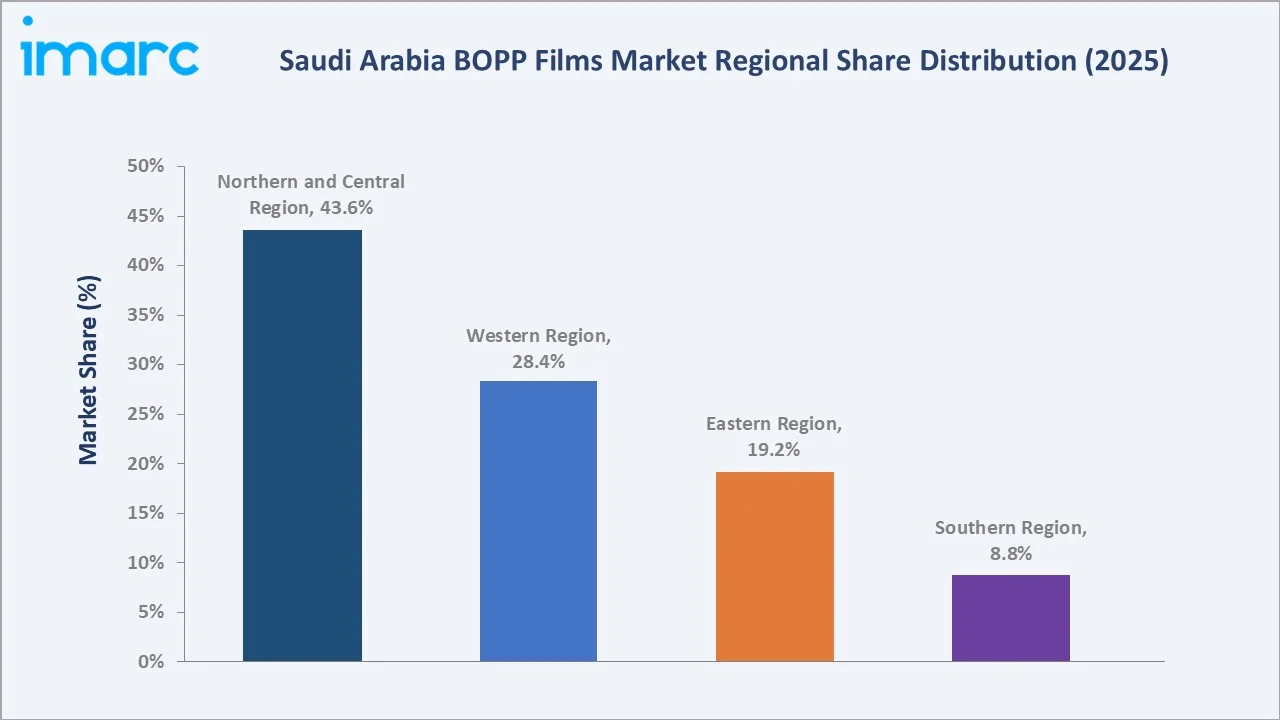
The Eastern region held a 19.2% share, supported by industrial development, petrochemical activities, and established manufacturing infrastructure. Meanwhile, the Southern region accounted for 8.8%, with demand gradually increasing alongside industrialization and retail development.
Competitive Landscape
The Saudi Arabia BOPP films market competition is driven by film technical performance, thickness specification consistency, surface treatment quality for printing and lamination, delivery reliability, and pricing competitiveness against both domestic and imported supply.
| Company | Key Offerings | Market Position | Core Strength |
|---|---|---|---|
| GulfPack | BOPP Label Films, BOPP Packaging Films, BOPP Industrial Films, Sustainable Solutions | Market Leader | GulfPack acts as a leading pioneer and major manufacturer of biaxially oriented polypropylene (BOPP) and cast polypropylene (CPP) films in Saudi Arabia |
| B.C. Jindal Group | BICOR Transparent BOPP films, OPPALYTE White BOPP films, METALLYTE Metallized BOPP films | Established Player | The B.C. Jindal Group participates in the Saudi Arabia BOPP films sector primarily as a major external supplier and competitive market player exporting high-performance flexible packaging and specialized capacitor films. |
| Cosmo First Limited | BOPP Flexible Packaging Films, BOPP Industrial Films, BOPP Lamination Films | Established Player | Cosmo First Limited operates as a premier international vendor, exporting high-performance BOPP films to Saudi Arabia and the broader GCC region. |
| TORAY INDUSTRIES, INC. | Torayfan BOPP Films | Innovator | Toray exerts its influence through technology supply, importing its highly specialized TORAYFAN portfolio, and advancing the regional shift toward a circular economy. |
| UFlex Limited | High Coefficient of Friction (COF) BOPP Films, Bio & Oxo Degradable BOPP Films, Anti-fog BOPP Films | Challenger | UFlex Limited plays a key role as a major exporter, packaging supplier, and innovator in Saudi Arabia’s expanding Biaxially Oriented Polypropylene (BOPP) films market. |
The competitive landscape is evolving with GulfPack capacity expansion to 318,000 TPA, positioning Saudi Arabia as a major global BOPP film exporter. International competitors supply the Saudi Arabia import market through established distributor networks, competing primarily on price, specialty product availability, and technical application support for Saudi converters.
Key Company Profiles
GulfPack
GulfPack is a Saudi-based manufacturer specializing in BOPP, CPP, and metallized films for flexible packaging applications. The company serves customers across food, beverage, consumer goods, and other packaging sectors. Its operations focus on producing films with different functional and performance characteristics to meet varied packaging requirements. GulfPack continues to strengthen its manufacturing capabilities and product portfolio in line with evolving market demand.
- Key Offerings: BOPP Label Films, BOPP Packaging Films, BOPP Industrial Films, Sustainable Solutions.
- Strategic Focus: Expanding BOPP film production capabilities while enhancing operational efficiency and product offerings. The company emphasizes capacity expansion, product diversification, and technological improvements to address growing demand from domestic, GCC, and international packaging markets.
Cosmo First Limited
Cosmo First Limited is a diversified materials and packaging company with operations spanning flexible packaging films, including BOPP films. The company serves customers across various industries by providing films designed for packaging, labeling, and other applications. Its product portfolio includes specialty and value-added film solutions catering to different performance requirements. In the Saudi Arabia BOPP films market, the company contributes through its manufacturing capabilities, product offerings, and international market presence.
- Key Offerings: BOPP Flexible Packaging Films, BOPP Industrial Films, BOPP Lamination Films.
- Strategic Focus: Expanding its specialty and value-added film portfolio while strengthening manufacturing capabilities and operational efficiency. In the Saudi Arabia BOPP films market, its strategy emphasizes product innovation, sustainable packaging solutions, and serving diverse regional and international customer requirements.
Market Concentration Analysis
The Saudi Arabia BOPP films market is moderately concentrated, with GulfPack as the clearly dominant domestic producer and leading local market participant, alongside a fragmented import market served by numerous international BOPP film manufacturers competing through Saudi Arabia agents and distributors. GulfPack capacity expansion from 183,000 to 318,000 TPA will further increase Saudi Arabia domestic production concentration as GulfPack gains market share at the expense of import supply for comparable standard film grades.
The import-serving competitive tier is fragmented with no single import supplier commanding dominant market position, creating competitive pricing discipline that benefits Saudi converter customers. Market concentration is expected to increase modestly through 2034 as GulfPack capacity expansion takes GulfPack domestic production share significantly higher, while international suppliers continue competing for specialty and premium film grades that GulfPack standard product range does not fully address. This creates a sustainable competitive ecosystem where GulfPack dominates commodity film supply and international specialists compete for premium specialty film applications.
Investment & Growth Opportunities
Highest Growth Segments
Food packaging BOPP represents the highest near-term volume growth segment, directly linked to Saudi Arabia food industry growth and expanding at above-overall-BOPP-market rates as packaged food adoption increases. Export market BOPP through GulfPack expanded capacity represents the highest revenue growth absolute dollar opportunity as 318,000 TPA production serves global converter demand.
Investment Themes
- Metallizing Capacity Expansion: Investment in vacuum metallizing lines alongside BOPP film production increases value-add per ton through metallized BOPP premium pricing, serving growing demand from Saudi Arabia premium food, confectionery, and personal care packaging applications that require barrier and aesthetic properties of metallized film.
- Recyclable Mono-Material BOPP Development: Investment in R&D and converting capability for all-BOPP recyclable laminate structures that replace multi-material BOPP-BOPET-PE laminates positions Saudi Arabia BOPP manufacturers for premium sustainable packaging demand from multinational FMCG brand owners with 2025-2030 recyclability commitments.
- Digital Printing and Short-Run Converting: Investment in digital printing-compatible BOPP specialty films and short-run converting capability serves Saudi Arabia growing e-commerce and promotional FMCG packaging demand that requires versioned, personalized, and short-run flexible packaging that offset gravure printing cannot economically produce.
Future Market Outlook (2026-2034)
The Saudi Arabia BOPP films market stood at USD 213.4 Million in 2025 and is projected to grow from USD 222.0 Million in 2026 to USD 304.2 Million by 2034, exhibiting a CAGR of 4.02% during the forecast period. The market is expected to reach an intermediate milestone of approximately USD 259.9 Million by 2030, as GulfPack new production lines reach full operational ramp-up, the Saudi Arabia food and beverage industry continues expanding above the Vision 2030 growth trajectory, and e-commerce flexible packaging demand progressively expands BOPP consumption into new end-use categories beyond traditional food and beverage packaging.
Three structural forces will define Saudi Arabia BOPP films market through 2034. First, Saudi Arabia food and beverage industry expansion will sustain the food application dominance at 34.8% while progressively expanding total BOPP demand volume as both packaged food production scales and food packaging BOPP content per unit increases through premiumization and format transition from rigid to flexible packaging. Second, GulfPack capacity expansion is creating a quantum step-change in Saudi Arabia BOPP industry revenue that moves beyond domestic consumption constraints to capture global flexible packaging market growth. Third, sustainability transformation in flexible packaging will progressively create a premium sustainable BOPP product tier in Saudi Arabia that commands above-commodity pricing and serves the growing requirement from multinational FMCG brand owners for certified recyclable and bio-based flexible packaging substrates through 2034.
Research Methodology
Primary Research
Primary research comprised structured consultations with BOPP film procurement managers at Saudi Arabia food and beverage manufacturers, flexible packaging converter operations, GulfPack and other Saudi film producer commercial teams, BOPP film distributor networks, and packaging industry association representatives. These discussions validated market sizing, assessed capacity expansion impact on domestic and export supply economics, identified application demand trends across food, beverage, and personal care sectors, and provided competitive intelligence on pricing, specification requirements, and converter purchasing patterns across Saudi Arabia regions.
Secondary Research
Secondary research drew on IMARC Group market data, Packaging Gateway GulfPack capacity expansion coverage, KSA flexible packaging market analysis, Saudi Arabia plastic packaging films market reports, global BOPP films market company rankings, Saudi petrochemical complex PP resin production reports, and Vision 2030 National Industrial Development Program documentation.
Forecasting Models
Market forecasts incorporated Saudi Arabia food and beverage industry growth trajectory, GulfPack capacity expansion timeline and domestic versus export revenue contribution modeling, flexible packaging market share gain from rigid packaging substitution analysis, e-commerce packaging demand growth projections, per-capita BOPP consumption convergence modeling toward GCC peer market levels, polypropylene resin feedstock cost scenario analysis, and macroeconomic indicators including Saudi Arabia non-oil GDP growth and FMCG sector expansion through 2034.
Saudi Arabia BOPP Films Market Report Coverage:
| Report Features | Details |
|---|---|
| Base Year of the Analysis | 2025 |
| Historical Period | 2020-2025 |
| Forecast Period | 2026-2034 |
| Units | Million USD |
| Scope of the Report |
Exploration of Historical Trends and Market Outlook, Industry Catalysts and Challenges, Segment-Wise Historical and Future Market Assessment:
|
| Types Covered | Wraps, Bags and Pouches, Tapes, Labels, Others |
| Thicknesses Covered | Below 15 Microns, 15-30 Microns, 30-45 Microns, More Than 45 Microns |
| Production Processes Covered | Tenter, Tubular |
| Applications Covered | Food, Beverage, Tobacco, Personal Care, Pharmaceutical, Electrical and Electronics, Others |
| Regions Covered | Northern and Central Region, Western Region, Eastern Region, Southern Region |
| Companies Covered | GulfPack, B.C. Jindal Group, Cosmo First Limited, TORAY INDUSTRIES, INC., UFlex Limited, etc. |
| Customization Scope | 10% Free Customization |
| Post-Sale Analyst Support | 10-12 Weeks |
| Delivery Format | PDF and Excel through Email (We can also provide the editable version of the report in PPT/Word format on special request) |
Key Benefits for Stakeholders:
- IMARC’s industry report offers a comprehensive quantitative analysis of various market segments, historical and current market trends, market forecasts, and dynamics of the Saudi Arabia BOPP films market from 2020-2034.
- The research report provides the latest information on the market drivers, challenges, and opportunities in the Saudi Arabia BOPP films market.
- Porter's five forces analysis assist stakeholders in assessing the impact of new entrants, competitive rivalry, supplier power, buyer power, and the threat of substitution. It helps stakeholders to analyze the level of competition within the Saudi Arabia BOPP films industry and its attractiveness.
- Competitive landscape allows stakeholders to understand their competitive environment and provides an insight into the current positions of key players in the market.
Frequently Asked Questions About the Saudi Arabia BOPP Films Market Report
The Saudi Arabia BOPP films market reached USD 222.0 Million in 2026, driven by food and beverage packaging demand, GulfPack capacity expansion, Vision 2030 food manufacturing growth, and continued import substitution as domestic BOPP production capacity expands.
The market is projected to grow at a CAGR of 4.02% during 2026-2034, supported by Saudi Arabia food industry expansion, GulfPack 318,000 TPA capacity creating export revenue growth, e-commerce packaging demand, and Vision 2030 downstream industrialization supporting domestic BOPP film investment.
The market is projected to reach approximately USD 259.9 Million by 2030, driven by GulfPack new tenter lines reaching full operational capacity, Saudi Arabia food and beverage manufacturing expansion, flexible packaging displacement of rigid formats, and the emerging premium sustainable BOPP product tier.
Tenter process leads with an 86.4% share in 2025, reflecting the overwhelming commercial dominance of the sequential biaxial stretching method that delivers superior film uniformity, width flexibility, and production economics for large-scale packaging applications.
Food leads with a 34.8% share in 2025, driven by the Saudi Arabia food industry generating demand for BOPP across snack, confectionery, dry food, bakery, and grain packaging, where BOPP provides optimal clarity, moisture resistance, and printability properties.
The Northern and Central region leads with a 43.6% share in 2025, reflecting Riyadh's concentration of food manufacturing, modern retail distribution, FMCG headquarters, and packaging converter operations that collectively represent Saudi Arabia highest-volume BOPP film demand center.
Key players include GulfPack, B.C. Jindal Group, Cosmo First Limited, TORAY INDUSTRIES, INC., and UFlex Limited, among others.
The market is projected to reach USD 304.2 Million by 2034, driven by GulfPack 318,000 TPA export platform creating above-domestic-demand revenue, sustainable recyclable mono-material BOPP premium tier development, food and beverage packaging demand expansion, e-commerce flexible packaging growth, and BOPP application diversification beyond food into labeling, personal care, and industrial categories.
Need more help?
- Speak to our experienced analysts for insights on the current market scenarios.
- Include additional segments and countries to customize the report as per your requirement.
- Gain an unparalleled competitive advantage in your domain by understanding how to utilize the report and positively impacting your operations and revenue.
- For further assistance, please connect with our analysts.
 Request Customization
 Speak to an Analyst
 Request Brochure
 Inquire Before Buying
Benefits of Customization
- Personalize this research
- Triangulate with your data
- Get data as per your format and definition
- Gain a deeper dive into a specific application, geography, customer, or competitor
- Any level of personalization
Get in Touch With Us
UNITED STATES
Phone: +1-201-971-6302
INDIA
Phone: +91-120-433-0800
UNITED KINGDOM
Phone: +44-753-714-6104
Email: [email protected]
Client Testimonials


.webp)

.webp)




Related Reports

Choose your plan
*Please note that the prices mentioned below are starting prices for each bundle type. Kindly contact our team for further details.*
Single User License
- 1 User License, Access on 2 Devices
- PDF Report + Excel Dataset (Password Protected)
- Lifetime Access
- No Printing Rights
- 10% Free Report Customization
- 10–12 Weeks of Analyst Support
Five User License
- Access for 5 Users, 2 Devices per User
- PDF Report + Excel Dataset (Password Protected)
- Lifetime Access
- Dedicated Account Manager
- 12–14 Weeks of Analyst Support
- No Printing Rights
- 15% Free Report Customization
- 25% Discount on Your Next Purchase
Corporate User License
- Unlimited User Access (Within Your Organization)
- PDF Report + Excel Dataset
- Lifetime Access
- Dedicated Account Manager
- 14–20 Weeks of Analyst Support
- No Printing Rights
- 20% Free Report Customization
- 30% Discount on Your Next Purchase
Essential Insights
What's included:
3 reports
- Lifetime Access
- PDF Reports
- Excel Datasets
- 2 Weeks of Free Analyst Support
- 2 User Licenses
- Access on 2 Devices
- Printing Rights
- Complimentary PowerPoint (PPT) Version
- Complimentary License Upgrade
Professional Access
What's included:
5 reports
- Lifetime Access
- PDF Reports
- Excel Datasets
- 8 Weeks of Free Analyst Support
- 2 User Licenses
- Access on 2 Devices
- Printing Rights
- Complimentary PowerPoint (PPT) Version
- Complimentary License Upgrade
Business Advantage
What's included:
8 reports
- Lifetime Access
- PDF Reports
- Excel Datasets
- 14 Weeks of Free Analyst Support
- 2 User Licenses
- Access on 2 Devices
- Printing Rights
- Complimentary PowerPoint (PPT) Version
- Complimentary License Upgrade
Enterprise Intelligence
What's included:
10 reports
- Lifetime Access
- PDF Reports
- Excel Datasets
- 20 Weeks of Free Analyst Support
- 2 User Licenses
- Access on 2 Devices
- Printing Rights
- Complimentary PowerPoint (PPT) Version
- Complimentary License Upgrade