
Saudi Arabia Buy Now Pay Later Services Market Size, Share, Trends and Forecast by Channel, Enterprise Size, End Use, and Region, 2026-2034
Saudi Arabia Buy Now Pay Later Services Market Size, Share, Trends & Forecast (2026-2034)
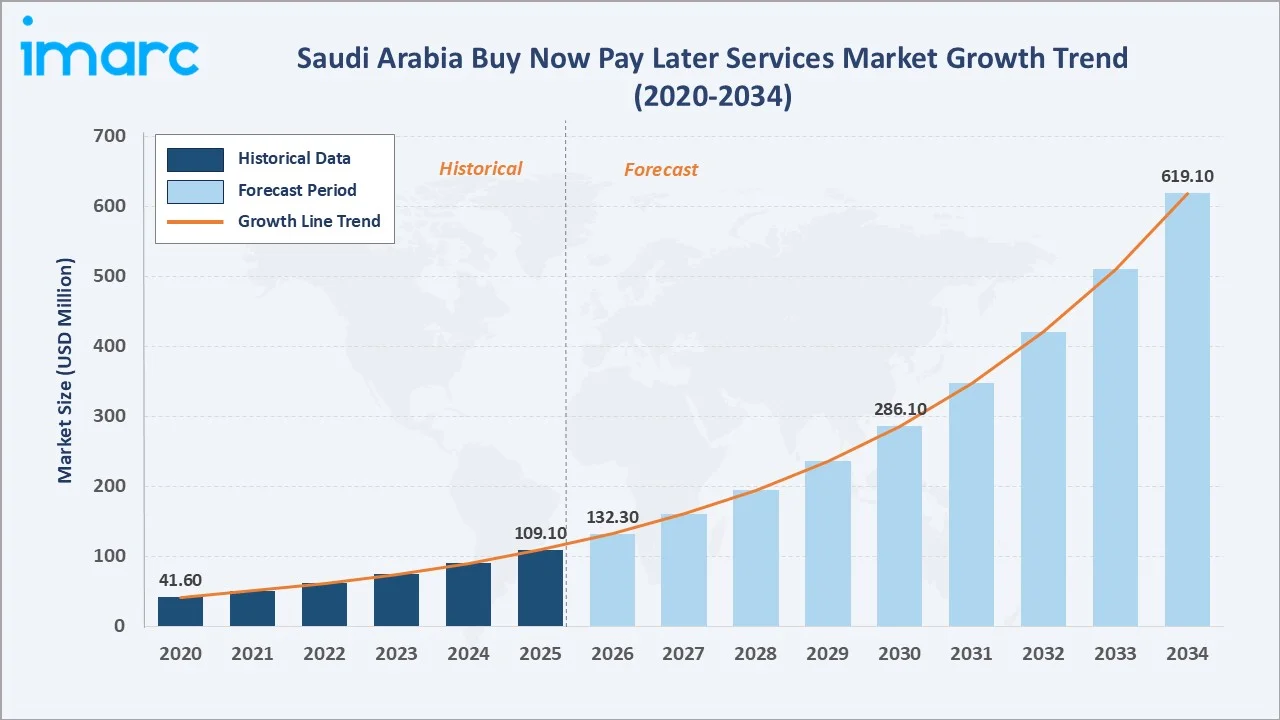
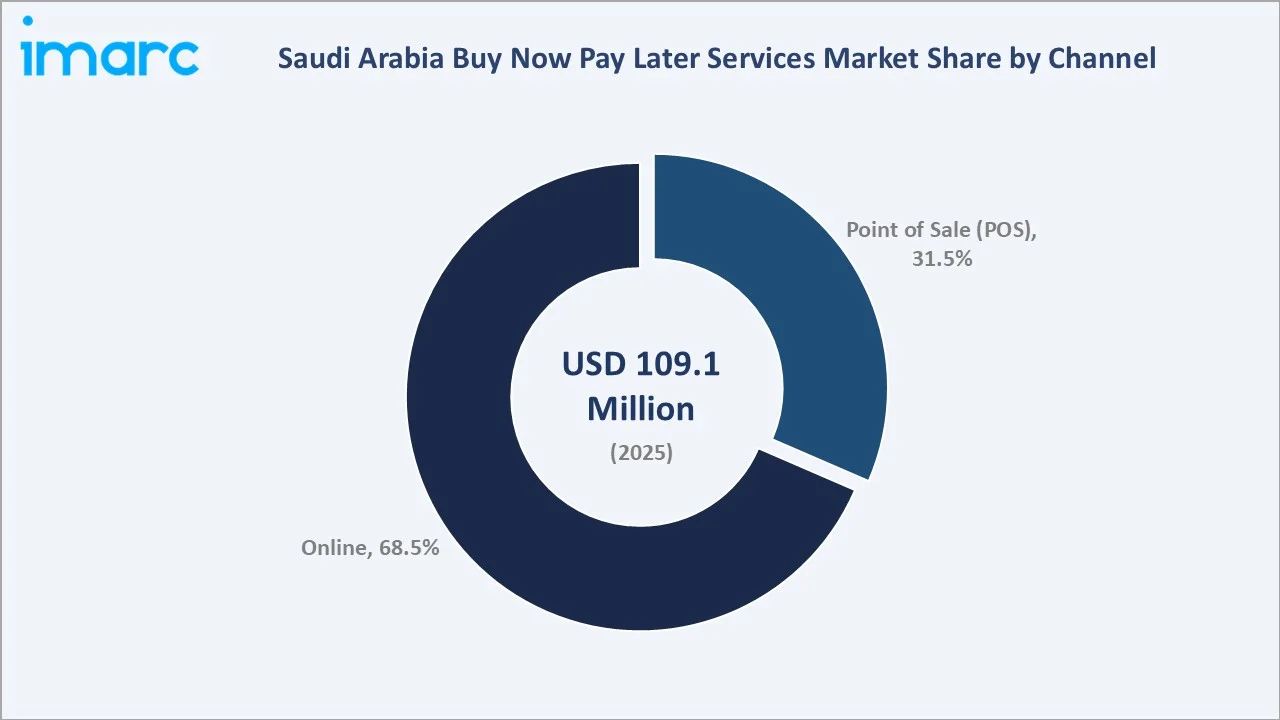
The Saudi Arabia buy now pay later services market grew from USD 109.1 Million in 2025 to USD 132.3 Million in 2026 and is projected to reach USD 619.1 Million by 2034, growing at a CAGR of 21.28% during 2026-2034. The market is driven by youthful demographics seeking interest-free credit alternatives, accelerating e-commerce adoption supported by Vision 2030 digital economy initiatives, growing Shariah-compliant fintech innovation, and expanding merchant adoption across retail, travel, and healthcare. In 2025, Saudi fintech Tamara secured a USD 2.4 billion Shariah-compliant financing deal from Goldman Sachs, Citi, and Apollo. Online channels dominate with a 68.5% share, large enterprises lead with 63.8%, and the Northern and Central Region holds the largest regional share at 46.2%.
Market Snapshot
|
Metric |
Value |
|
Base Year Market Size (2025) |
USD 109.1 Million |
|
Market Size (2026) |
USD 132.3 Million |
|
Forecast Market Size (2034) |
USD 619.1 Million |
|
CAGR (2026-2034) |
21.28% |
|
Base Year |
2025 |
|
Historical Period |
2020-2025 |
|
Forecast Period |
2026-2034 |
|
Dominant Channel |
Online (68.5%, 2025) |
|
Dominant Enterprise Size |
Large Enterprises (63.8%, 2025) |
|
Leading Region |
Northern and Central Region (46.2%, 2025) |
The Saudi Arabia buy now pay later services market size increased from USD 41.6 Million in 2020 to USD 109.1 Million in 2025 and is estimated to reach USD 132.3 Million in 2026, representing consistent expansion across digital payment channels, enterprise segments, and regional markets. The market is projected to reach USD 286.1 Million by 2030 and USD 619.1 Million by 2034.
To get more information on this market, Request Sample
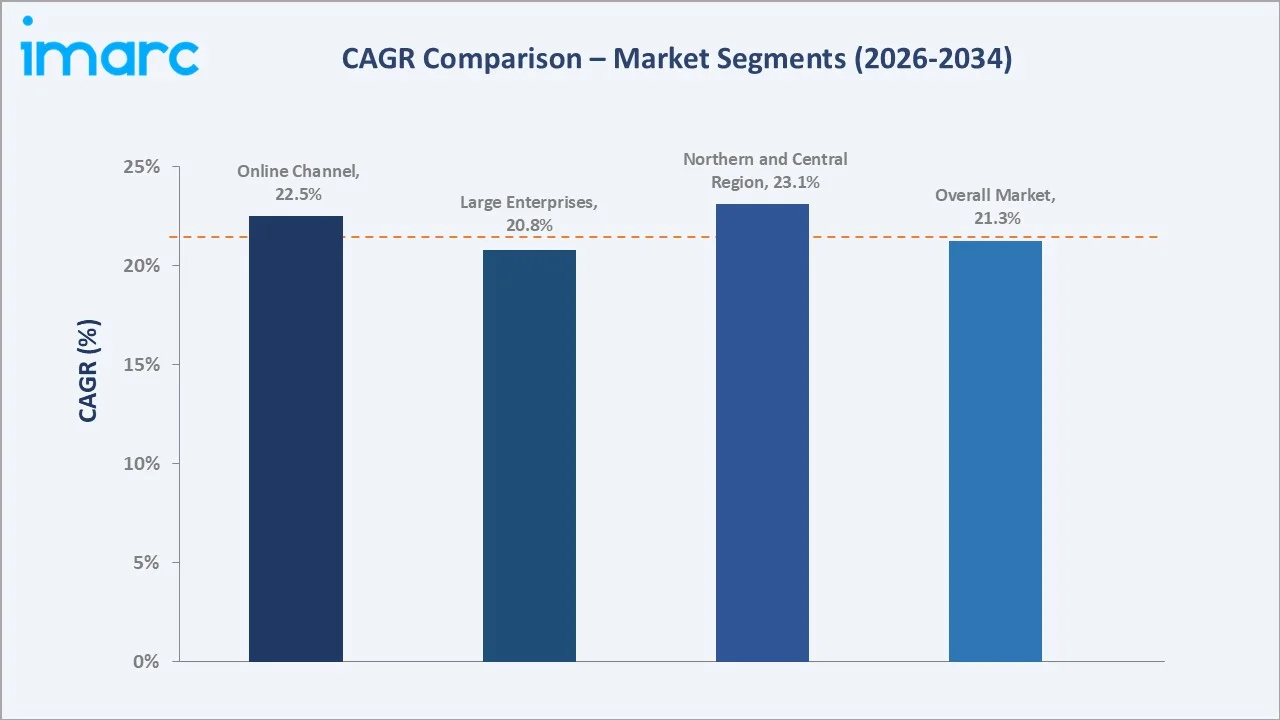
The Northern and Central Region grows at ~23.1% CAGR through Vision 2030-driven fintech adoption. Online channels grow at ~22.5% CAGR through e-commerce acceleration. Large enterprises grow at ~20.8% CAGR through digital payment platform investments.
Executive Summary
The Saudi Arabia buy now pay later services market is one of the fastest-growing financial technology segments in the GCC region, driven by a youthful population, high smartphone penetration exceeding 95%, and Vision 2030's emphasis on a cashless digital economy. The market's structural growth is compelling: BNPL solutions enable consumers to split purchases into manageable interest-free installments, directly addressing demand from religiously observant populations seeking Shariah-compliant credit alternatives. The market grew at a CAGR of 21.28% during 2026-2034, reaching USD 619.1 Million by 2034 from USD 109.1 Million in 2025.
Online channels command 68.5% through e-commerce platform dominance and are growing at ~22.5% CAGR. Large enterprises lead at 63.8% through established merchant network integration, growing at ~20.8% CAGR. Northern and Central Region holds 46.2% through Riyadh commercial hub concentration, growing at ~23.1% CAGR.
Key Market Insights
|
Insight |
Data |
|
Dominant Channel |
Online – 68.5% share (2025); growing at ~22.5% CAGR (2026-2034) |
|
Dominant Enterprise Size |
Large Enterprises – 63.8% share (2025); growing at ~20.8% CAGR (2026-2034) |
|
Leading Region |
Northern and Central Region – 46.2% (2025); growing at ~23.1% CAGR (2026-2034) |
|
Key Market Opportunities |
Shariah-compliant BNPL expansion, SME merchant onboarding, cross-border GCC payment integration, and embedded finance within super apps. |
Key Analytical Observations Supporting the Above Data:
- Online Channel at 68.5%: E-commerce acceleration driven by Vision 2030 digital economy targets and high smartphone penetration positions online BNPL as the primary acquisition channel, growing at ~22.5% CAGR through 2034. Seamless checkout API integration with major platforms sustains dominance.
- Large Enterprises at 63.8%: Major retail chains, airlines, and electronics brands adopted BNPL earlier, with established POS infrastructure enabling smooth integration. This segment grows at ~20.8% CAGR, leveraging high transaction volumes and brand recognition.
- Northern and Central Region at 46.2%: Riyadh concentrates the Kingdom's highest consumer spending and tech-savvy demographics, growing at ~23.1% CAGR, creating the densest merchant and consumer BNPL ecosystem in Saudi Arabia.
Saudi Arabia Buy Now Pay Later Services Market Overview
The Saudi Arabia buy now pay later services market encompasses digital payment solutions enabling consumers to defer or split purchases into installments, typically interest-free when repaid within agreed periods. The market serves diverse end-use sectors spanning fashion and apparel, consumer electronics, travel and hospitality, healthcare, education, and home furnishings. BNPL providers generate revenue primarily through merchant discount fees, with the overall market growing at a CAGR of 21.28% from USD 109.1 Million (2025) to USD 619.1 Million (2034).
Market Dynamics
To evaluate market opportunities, Request Sample
Market Drivers
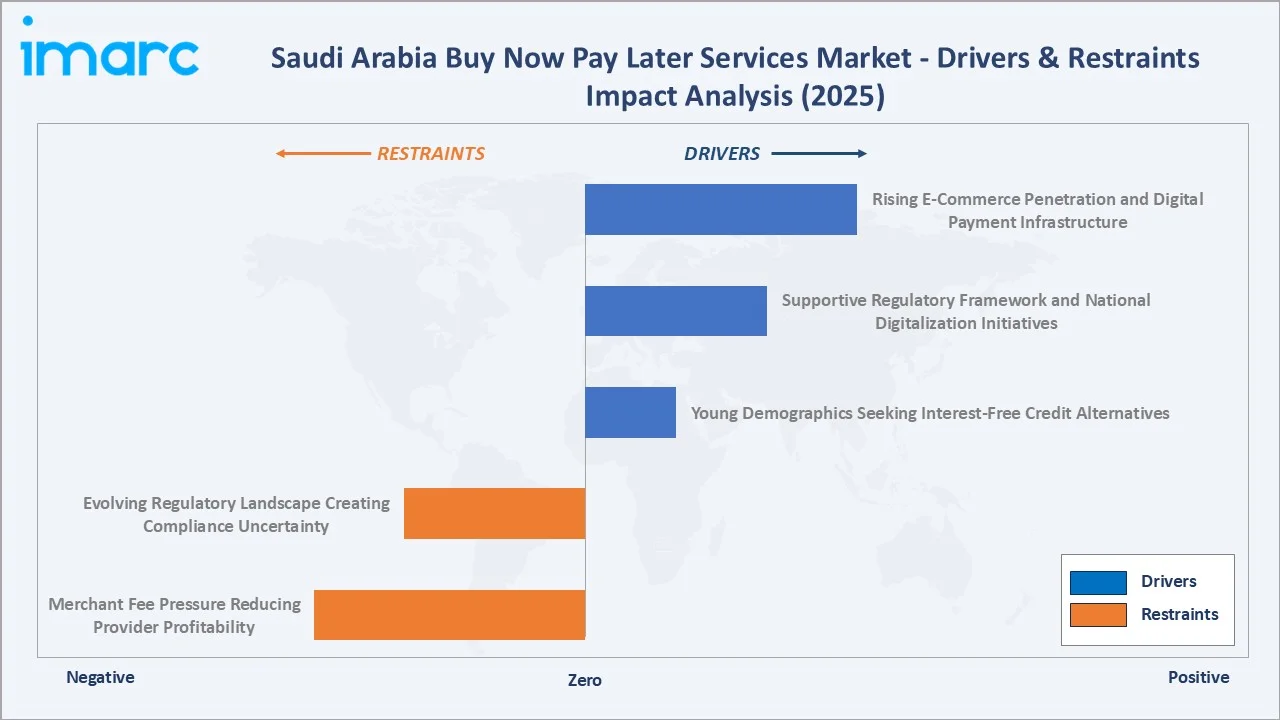
- Rising E-Commerce Penetration and Digital Payment Infrastructure: The rapid expansion of e-commerce and digital payment channels across the Kingdom has created a conducive environment for buy now pay later adoption. Growing consumer comfort with online transactions, high smartphone penetration, and evolving digital retail ecosystems support BNPL integration at checkout across fashion, electronics, and lifestyle categories, driving merchant acquisition and consumer uptake across the market.
- Supportive Regulatory Framework and National Digitalization Initiatives: Government-led initiatives promoting financial inclusion, cashless payments, and fintech sector development have provided strong institutional backing for the buy now pay later segment. A progressive central bank regulatory framework, including sandbox programs and streamlined licensing pathways, enables providers to scale responsibly while maintaining standards that protect consumers and sustain long-term confidence in the sector.
- Young Demographics Seeking Interest-Free Credit Alternatives: A predominantly young national population actively seeks transparent, interest-free credit alternatives aligned with Islamic finance principles. This demographic preference for deferred payment models that avoid conventional interest structures creates sustained structural demand for buy now pay later solutions that traditional banking products have historically been unable to address, underpinning the high forecast growth rate across the outlook period.
- Growing Merchant Adoption Across Diverse Retail Categories: Merchants across a widening range of sectors recognize buy now pay later as a practical tool for improving checkout conversion, increasing average basket sizes, and enhancing customer loyalty. Simplified integration processes, revenue-sharing commercial models, and dedicated provider support have accelerated adoption among both large enterprise retailers and small and medium businesses, expanding the reach of installment payment options throughout the Kingdom.
Market Restraints
- Evolving Regulatory Landscape Creating Compliance Uncertainty: The buy now pay later sector operates in a regulatory environment that continues to develop as authorities seek to balance fintech innovation with adequate consumer protection. Ongoing changes to consumer lending frameworks, data privacy obligations, and fintech licensing conditions create compliance costs and operational uncertainty that can constrain provider flexibility and limit the pace of market expansion for participants of varying scale.
- Merchant Fee Pressure Reducing Provider Profitability: As buy now pay later adoption matures and competition intensifies among providers, merchants gain negotiating leverage to seek lower discount rates. This structural fee compression creates pressure on providers to balance the ongoing costs of growth investment, credit risk management, and platform development against the need to operate commercially viable business models over the medium to long term.
- Credit Risk and Portfolio Quality Management Challenges: Extending credit to consumers with limited formal credit histories through alternative data assessment introduces elevated portfolio risk. Economic headwinds, simultaneous consumer obligations across multiple buy now pay later platforms, and limited cross-platform credit visibility can contribute to deteriorating portfolio quality and require increased provisioning, constraining provider profitability and capacity for sustained growth.
Market Opportunities
- Shariah-Compliant Product Innovation Expanding the Addressable Market: Developing buy now pay later products structured in accordance with Islamic finance principles represents a significant market opportunity. Eliminating conventional interest charges and replacing them with transparent, Shariah-certified merchant fee models unlocks consumer segments that have historically avoided conventional credit products, meaningfully expanding the total addressable consumer population and supporting long-term market growth.
- Cross-Sector BNPL Expansion into High-Value Service Categories: Buy now pay later adoption is broadening beyond core retail into travel and hospitality, healthcare services, professional education, and entertainment, where high transaction values and the desire for payment flexibility create compelling consumer propositions. These categories generate above-average per-transaction fee revenue for providers while diversifying the market beyond its traditional retail base and strengthening long-term resilience.
Market Challenges
- Consumer Over-Indebtedness Risk Across Multiple Platforms: As the number of buy now pay later providers grows, consumers may accumulate concurrent installment obligations across several platforms without full visibility from conventional credit bureaus. Without coordinated credit limit mechanisms or comprehensive bureau integration, systemic over-indebtedness risk could prompt regulatory intervention that modifies existing frictionless approval processes and affects overall market growth dynamics.
- Competition from Embedded Finance and Super App Ecosystems: Established digital platforms and telecommunications providers are increasingly embedding buy now pay later functionality within broader financial service offerings. These incumbents leverage extensive existing user bases, deep transaction data, and trusted consumer relationships to deliver integrated payment solutions at scale, creating significant competitive pressure that standalone buy now pay later providers must address through differentiation and strategic partnership approaches.
Emerging Market Trends
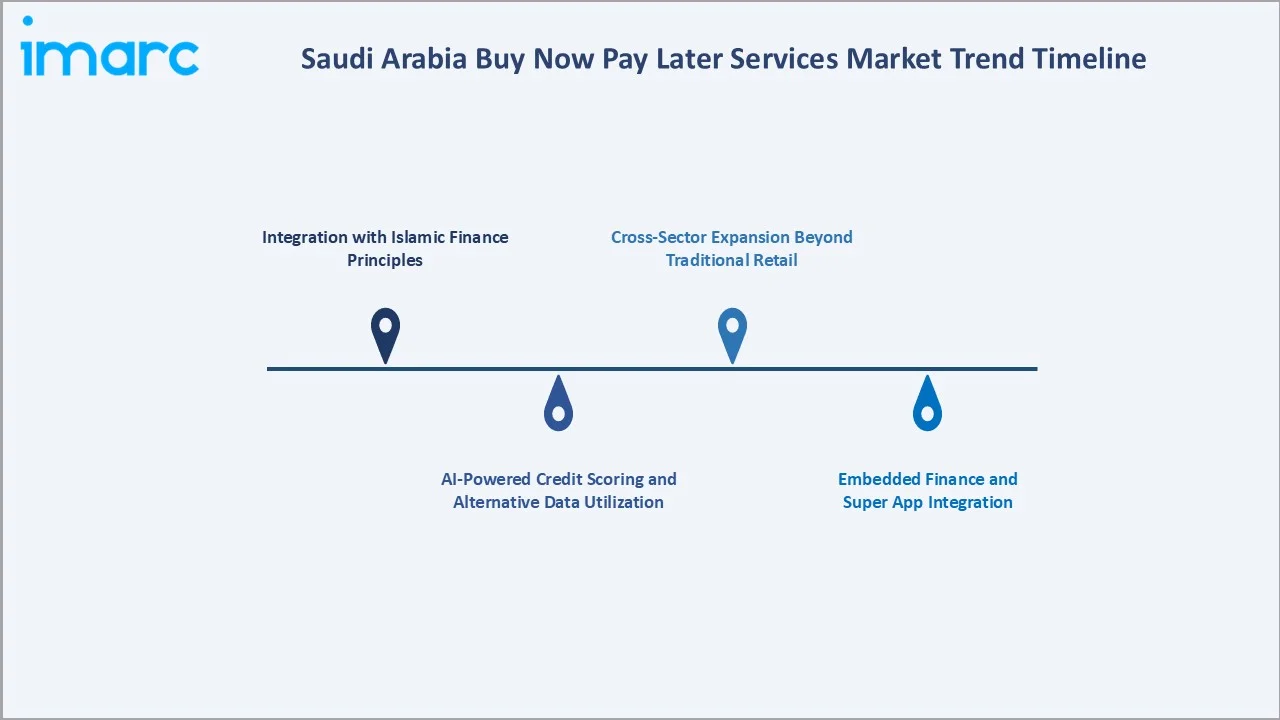
1. Integration with Islamic Finance Principles
The alignment of buy now pay later product structures with Islamic finance principles represents a defining trend shaping the Saudi market. Providers are developing Shariah-compliant installment frameworks that eliminate conventional interest charges and replace them with transparent merchant discount fee models reviewed and certified by independent advisory bodies. This structural adaptation unlocks consumer segments that have historically been reluctant to engage with credit products, supporting broader market participation and accelerating adoption among religiously observant demographics who seek ethical financial alternatives that align with their values.
2. AI-Powered Credit Scoring and Alternative Data Utilization
Buy now pay later providers are deploying advanced machine learning models that evaluate consumer creditworthiness using non-traditional data signals, including behavioral patterns, transaction histories, and device-level indicators. These models enable rapid approval decisions at the point of purchase while maintaining portfolio quality through dynamic risk assessment that adapts to evolving consumer behavior. The ability to extend responsible credit access to underserved consumers who lack conventional credit bureau records broadens the addressable market and supports the high growth trajectory projected across the forecast period.
3. Cross-Sector Expansion Beyond Traditional Retail
Buy now pay later solutions are penetrating sectors beyond their original retail origins, including travel and tourism, healthcare services, professional education, and subscription-based categories where high purchase values and the desire for payment flexibility create strong consumer propositions. Merchants across these verticals benefit from measurable improvements in checkout conversion and average transaction values when installment options are offered. This diversification strengthens the structural resilience of the market by reducing reliance on any single sector and expanding the breadth of everyday consumer use cases served.
4. Embedded Finance and Super App Integration
Leading digital platforms are integrating buy now pay later capabilities within broader financial service ecosystems, combining installment payments with wallet services, loyalty programs, and other consumer financial products. This embedded finance approach allows BNPL to function as a seamless component of everyday digital consumer experiences rather than a standalone checkout option. Providers that secure deep integration within high-traffic digital platforms gain significant distribution advantages and access to established consumer relationships that support adoption at lower per-user acquisition costs.
Industry Value Chain Analysis
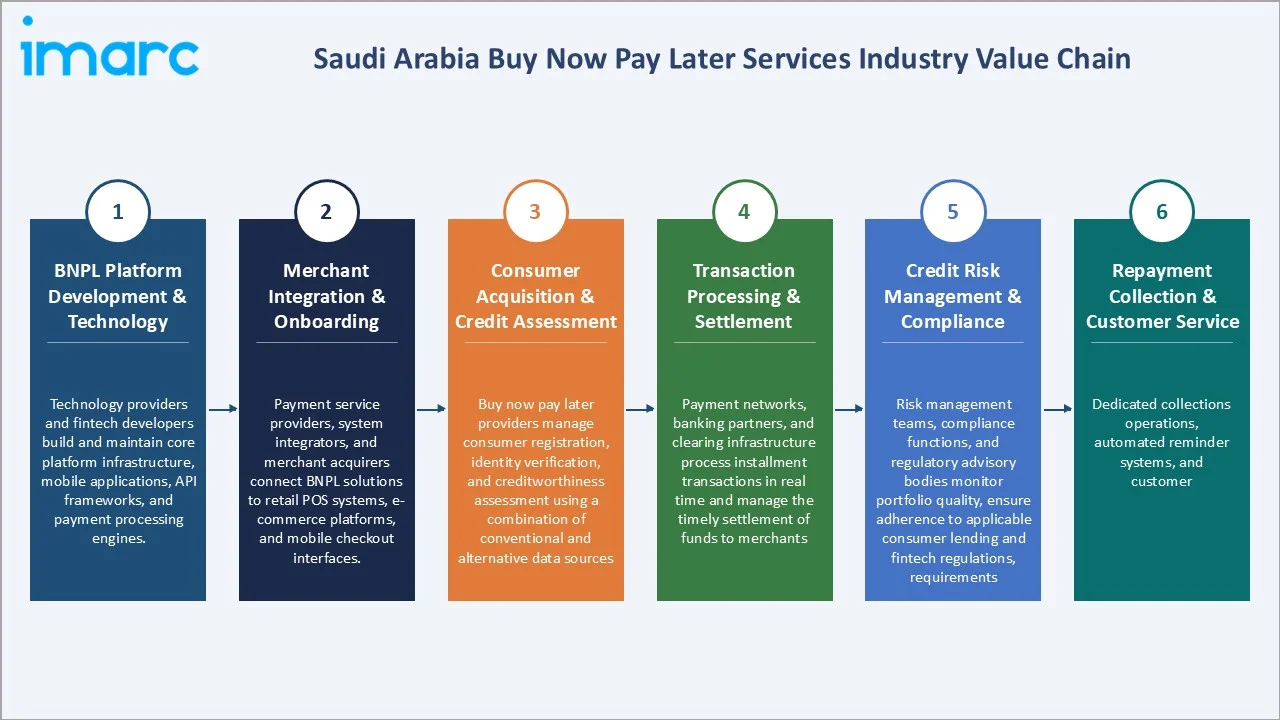
The Saudi Arabia buy now pay later services market industry value chain encompasses the full range of activities from platform development and merchant integration through consumer onboarding, transaction processing, risk management, and repayment collection. Each stage involves distinct participants whose coordination determines the efficiency, reach, and quality of installment payment delivery to consumers and merchants across the Kingdom.
|
Stage |
Key Participants |
|
BNPL Platform Development & Technology |
Technology providers and fintech developers build and maintain core platform infrastructure, mobile applications, API frameworks, and payment processing engines.
|
|
Merchant Integration & Onboarding |
Payment service providers, system integrators, and merchant acquirers connect BNPL solutions to retail POS systems, e-commerce platforms, and mobile checkout interfaces |
|
Consumer Acquisition & Credit Assessment |
Buy now pay later providers manage consumer registration, identity verification, and creditworthiness assessment using a combination of conventional and alternative data sources |
|
Transaction Processing & Settlement |
Payment networks, banking partners, and clearing infrastructure process installment transactions in real time and manage the timely settlement of funds to merchants. |
|
Credit Risk Management & Compliance |
Risk management teams, compliance functions, and regulatory advisory bodies monitor portfolio quality, ensure adherence to applicable consumer lending and fintech regulations |
|
Repayment Collection & Customer Service |
Dedicated collections operations, automated reminder systems, and customer |
The consumer acquisition and credit assessment stage represents the most strategically differentiated point in the buy now pay later value chain. The speed and accuracy of credit decisions at the moment of purchase directly determine approval rates, consumer experience quality, and merchant satisfaction, making this stage the primary arena of competitive differentiation among participants in the market.
Technology Landscape in the Saudi Arabia BNPL Industry
AI and Machine Learning Credit Decisioning
Artificial intelligence and machine learning technologies form the backbone of modern buy now pay later credit assessment, enabling providers to evaluate consumer risk profiles using a broad range of behavioral and transactional data signals beyond those captured by conventional credit bureaus. These models support near-instantaneous approval decisions at the point of purchase, improving the consumer experience while allowing providers to calibrate risk thresholds dynamically in response to portfolio performance. The ability to serve consumers with limited formal credit histories through responsible data-driven assessment is central to the market expansion and high growth rate projected across the outlook period.
API-First Platform Architecture and Merchant Integration
Modern buy now pay later platforms are built on flexible, API-first architectures that enable rapid and low-friction integration with merchant systems across diverse retail environments. Standardized integration toolkits, pre-built connectors for widely used commerce platforms, and accessible developer documentation reduce the technical complexity and cost of merchant onboarding, accelerating network expansion. This approach also enables real-time data exchange, dynamic checkout configuration, and merchant-facing analytics that help retailers optimize payment flexibility offerings for their specific consumer audiences.
Digital Identity Verification and Fraud Prevention
Robust digital identity verification and fraud detection capabilities are essential to maintaining the integrity of buy now pay later platforms operating at scale. Multi-layered verification processes, biometric authentication, and real-time transaction monitoring work in combination to confirm consumer identity accurately and detect potentially fraudulent activity before credit is extended. Ongoing investment in these technologies protects consumers and providers from financial and reputational harm, and their continued advancement is critical to sustaining broad confidence in buy now pay later as a reliable and secure payment channel.
Market Segmentation Analysis
The report covers the following segments:
|
Segment Category |
Leading Segment |
Market Share |
Year |
|
Channel |
Online |
68.5% |
2025 |
|
Enterprise Size |
Large Enterprises |
63.8% |
2025 |
|
End Use |
🔒 |
🔒 |
2025 |
|
Region |
Northern and Central Region |
46.2% |
2025 |

By Channel
Online channels lead at 68.5% (2025) and are projected to grow at a CAGR of ~22.5% during 2026-2034, driven by Saudi Arabia's rapidly expanding e-commerce ecosystem and smartphone penetration exceeding 95%. Seamless checkout API integrations with major platforms reduce abandonment and increase average order values across fashion, electronics, and travel categories.
To access detailed market analysis, Request Sample
Point of Sale (POS) at 31.5% serves growing physical retail integration in malls, specialty stores, and service businesses. QR code-based BNPL activation and NFC terminal integration enable seamless in-store installment options. Large retail chains and hospitality businesses are investing in POS BNPL infrastructure to capture high-value in-store transaction conversion, with this segment expected to grow as omnichannel strategies mature.
By Enterprise Size
Large enterprises lead at 63.8% (2025) and are projected to grow at a CAGR of ~20.8% during 2026-2034, driven by established technology infrastructure enabling BNPL integration, high transaction volumes, and brand recognition building consumer trust at checkout. Major retailers, airlines, hotel chains, and electronics brands were early BNPL adopters establishing operational templates.
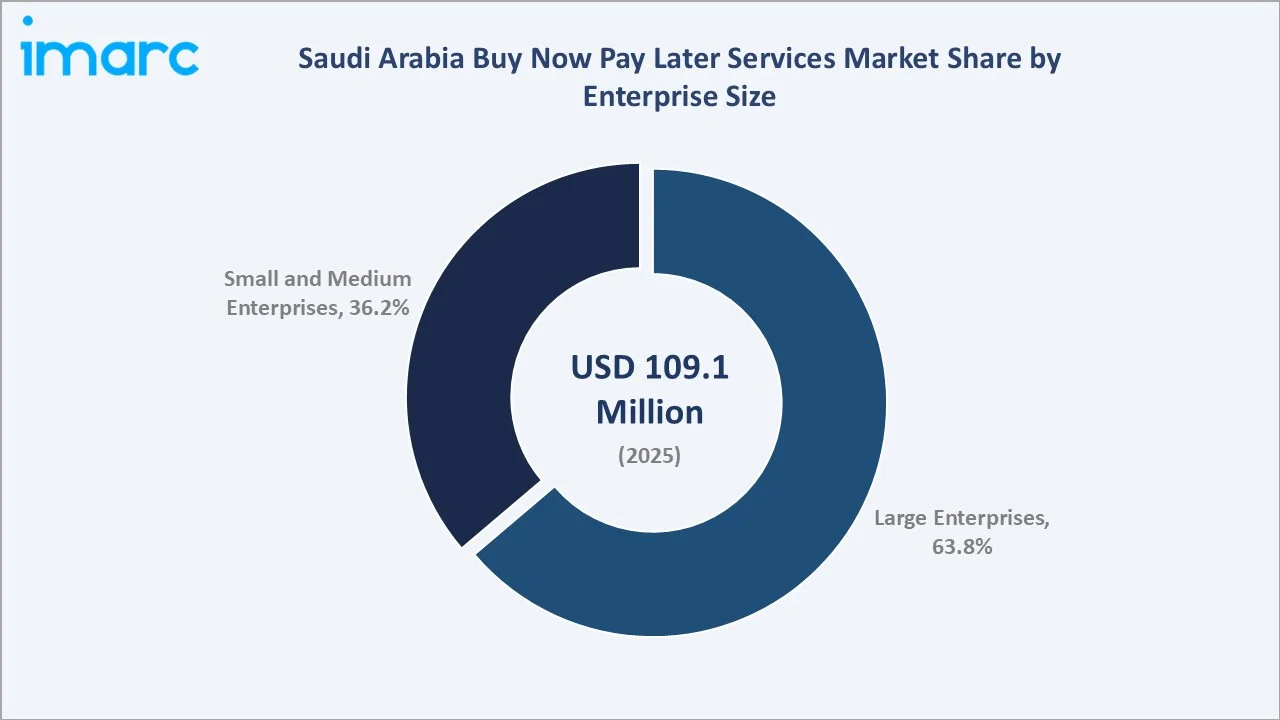
Small and medium enterprises at 36.2% are accelerating adoption, with this segment expected to grow at an above-market CAGR as Vision 2030 SME development programs expand the merchant base. Fashion boutiques, wellness centers, and specialty retailers report measurable checkout conversion improvements and growing consumer demand for payment flexibility in SME purchase categories.
Regional Market Insights
|
Region |
Share (2025) |
Key Saudi Arabia Buy Now Pay Later Services Market Drivers & Characteristics |
|
Northern and Central Region |
46.2% |
Reflecting Riyadh's status as Saudi Arabia's commercial capital, concentrating the highest consumer spending, tech-savvy millennial population, and largest density of modern retail, hospitality, and healthcare businesses, growing at ~23.1% CAGR through 2034. |
|
Western Region |
27.6% |
Reflecting Jeddah's role as the Kingdom's commercial gateway and Hajj/Umrah destination, with a cosmopolitan consumer base, strong fashion and lifestyle retail culture, and significant tourism-driven hospitality sector creating diverse BNPL use cases. |
|
Eastern Region |
16.8% |
Reflecting high per-capita income driven by petroleum sector employment, creating an affluent consumer base with strong purchasing power for high-value BNPL transactions in electronics, furniture, and automotive accessories in Dammam and Al-Khobar. |
|
Southern Region |
9.4% |
Reflecting the emerging BNPL market as digital payment infrastructure extends to secondary cities, with Vision 2030 tourism development in the Asir highlands creating new merchant categories and consumer adoption opportunities. |
The Northern and Central Region's 46.2% market leadership reflects Riyadh's concentration of consumer spending power and SAMA regulatory proximity, growing at ~23.1% CAGR. The Western Region's 27.6% leverages Jeddah's cosmopolitan retail culture and Hajj/Umrah tourism flows.
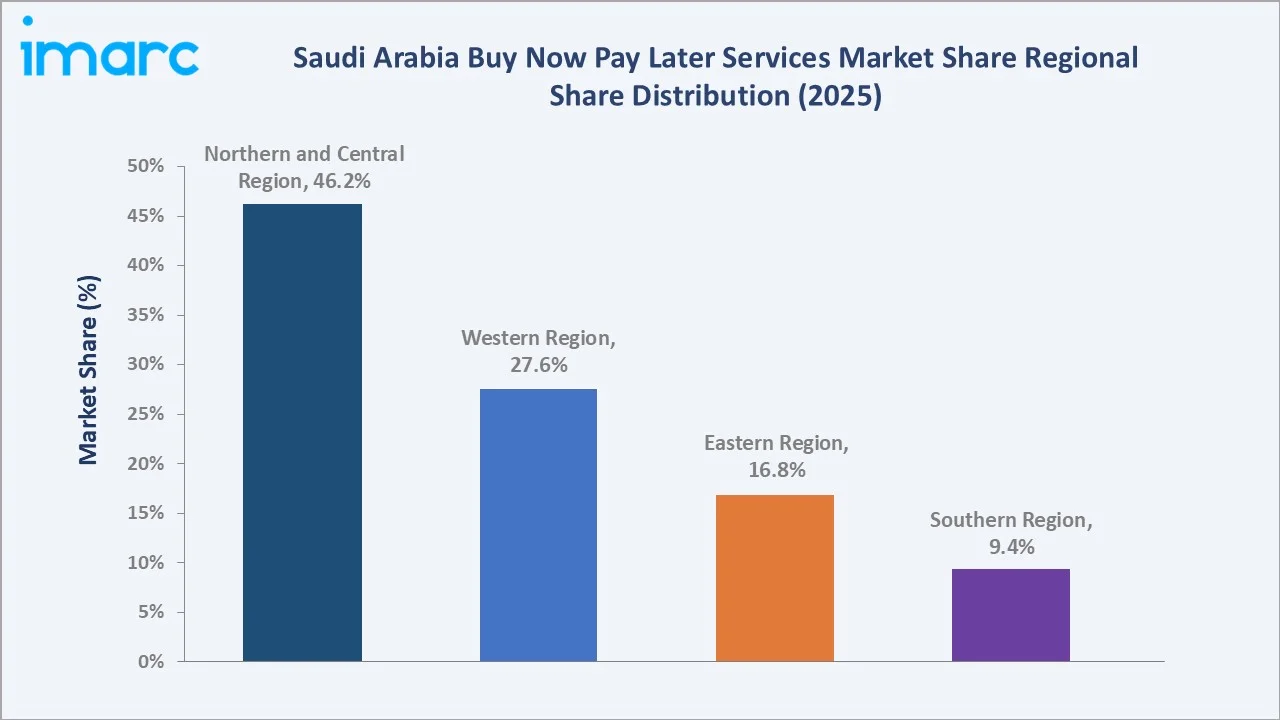
The Eastern Region's 16.8% reflects high per-capita incomes and growing e-commerce penetration. The Southern Region's 9.4% represents the emerging frontier market where Vision 2030 tourism development and digital infrastructure expansion are creating new BNPL merchant categories and consumer adoption opportunities.
Competitive Landscape
The Saudi Arabia buy now pay later services market exhibits dynamic competitive intensity with fintech innovators competing alongside traditional financial institutions. Competition centers on merchant acquisition, consumer approval rates, Shariah compliance certification, and technology integration capabilities. The market grew at 21.28% CAGR, attracting domestic operators and international platforms bringing proven GCC business models.
|
Company |
Key Products |
Market Position |
Core Strength |
|
Tamara |
Tamara Pay, Shop Now Pay Later |
Market Leader |
Tamara is Saudi Arabia's leading BNPL platform with Shariah-compliant installment solutions and the largest merchant network in the Kingdom. |
|
Tabby |
Split in 4, Pay Later, Tabby Card |
Market Leader |
Tabby provides flexible installment solutions across GCC with strong integration in fashion, electronics, and lifestyle categories. |
|
HyperPay |
BNPL Gateway, Payment Links |
Challenger |
HyperPay provides multi-channel BNPL payment gateway solutions integrated across physical and digital merchant touchpoints. |
|
PayTabs |
BNPL Integration, E-Invoicing |
Challenger |
PayTabs delivers BNPL-enabled payment processing with comprehensive merchant management and fraud protection capabilities. |
Companies across the competitive landscape are investing in AI-powered credit scoring, Shariah compliance engineering, merchant network expansion, and super app integration. The Saudi BNPL market is expected to see continued consolidation as regulatory clarity enables larger funding rounds and strategic bank partnerships.
Key Company Profiles
Tamara
Tamara is Saudi Arabia's leading buy now pay later platform, founded in Riyadh with operations spanning the GCC. The company operates Shariah-compliant installment payment products enabling consumers to split purchases across fashion, electronics, travel, and healthcare categories. Tamara's proprietary credit scoring algorithms leverage alternative data sources for rapid approvals while maintaining default rates below industry averages, supporting the market's 21.28% CAGR through 2034.
- Key Products: Tamara Pay, Shop Now Pay Later installments, Tamara Credit Line.
- Strategic Focus: Expanding cross-border BNPL capabilities across the GCC, deepening merchant network integration in healthcare and travel, and developing Shariah-compliant credit products through rigorous Shariah advisory board engagement.
Tabby
Tabby is a leading GCC-focused buy now pay later provider with significant Saudi Arabia market presence. The company offers split payment solutions, deferred payment products, and a co-branded Tabby Card providing flexible credit access. Tabby's technology platform supports seamless integration with major e-commerce platforms and physical retail POS systems across fashion, electronics, beauty, and home furnishings, growing in line with the Saudi BNPL market's 21.28% CAGR.
- Key Products: Split in 4 installments, Pay Later deferred payment, Tabby Card.
- Strategic Focus: Growing Tabby Card user base to build recurring consumer relationships, expanding merchant partnerships in travel and lifestyle categories, and leveraging data analytics to improve credit model performance for underserved consumer segments.
Market Concentration Analysis
The Saudi Arabia buy now pay later services market exhibits moderate-to-high concentration, with Tamara and Tabby collectively commanding significant market share through first-mover advantages, largest merchant networks, and superior brand recognition. Market concentration is expected to increase through 2034 as regulatory compliance requirements, capital intensity, and Shariah certification create barriers that benefit funded leaders. The overall market CAGR of 21.28% reflects both platform consolidation and new category penetration.
Investment & Growth Opportunities
Highest Growth Segments
Online BNPL channel (~22.5% CAGR), Northern and Central Region expansion (~23.1% CAGR), healthcare and travel BNPL vertical integration, SME merchant acquisition in secondary cities, and cross-border GCC BNPL infrastructure represent the highest-growth investment vectors in the Saudi Arabia BNPL market through 2034, outpacing the overall market CAGR of 21.28%.
Investment Themes
- Shariah-Compliant Product Innovation: Developing Islamic finance-aligned BNPL products targeting the underserved religiously observant consumer segment represents a structural opportunity. Providers engineering Shariah-compliant structures through merchant discount fee models access a consumer base seeking ethical financial alternatives, with this segment growing faster than the overall 21.28% CAGR.
- SME Merchant Network Expansion: Saudi Arabia's growing SME ecosystem, supported by Vision 2030 programs, creates a large, underserved merchant segment. Providers offering simplified onboarding, lower integration costs, and targeted marketing support can capture first-mover advantages in fashion boutiques, wellness centers, and specialty retailers across secondary Saudi cities.
Future Market Outlook (2026-2034)
The Saudi Arabia buy now pay later services market is projected to grow from USD 109.1 Million in 2025 to USD 132.3 Million in 2026, reaching USD 619.1 Million by 2034, exhibiting a CAGR of 21.28% during 2026-2034. The market is projected to reach an anchor milestone of USD 286.1 Million by 2030, representing the period at which regulatory frameworks fully mature, merchant networks achieve comprehensive category coverage, and embedded finance integration within super apps transforms BNPL into a standard payment option.
Three structural forces define the Saudi BNPL market trajectory through 2034. First, the demographic dividend from Saudi Arabia's young population creates compounding consumer demand. Second, Vision 2030's digital economy transformation sustains regulatory support and fintech investment flows. Third, cross-border GCC BNPL expansion creates a regional ecosystem where Saudi providers leverage domestic success to capture growth in Kuwait, Bahrain, Oman, and the UAE.
Research Methodology
Primary Research
Primary research comprised in-depth interviews with BNPL provider executives, Saudi retail merchants, fintech investors, SAMA regulatory specialists, Shariah advisory board members, and consumer finance industry association representatives. These discussions validated market size estimates, assessed segment demand dynamics, evaluated competitive positioning, and provided insights into regulatory developments and future market evolution.
Secondary Research
Secondary research encompassed SAMA annual fintech reports, Fintech Saudi sector publications, Saudi Central Bank payment system statistics, major company investor presentations, e-commerce market reports, Vision 2030 implementation progress reports, and industry publications covering GCC digital payment market developments and BNPL regulatory frameworks.
Forecasting Models
Forecasting models incorporated historical BNPL market revenue trends, Saudi e-commerce growth projections, demographic penetration curves for under-35 consumer segments, regulatory compliance timeline impact analysis, GCC regional expansion potential, and macroeconomic indicators including consumer spending growth and digital economy GDP contribution targets under Vision 2030.
Saudi Arabia Buy Now Pay Later Services Market Report Coverage:
| Report Features | Details |
|---|---|
| Base Year of the Analysis | 2025 |
| Historical Period | 2020-2025 |
| Forecast Period | 2026-2034 |
| Units | Million USD |
| Scope of the Report |
Exploration of Historical and Forecast Trends, Industry Catalysts and Challenges, Segment-Wise Historical and Predictive Market Assessment:
|
| Channels Covered | Online, Point of Sale (POS) |
| Enterprise Sizes Covered | Large Enterprises, Small and Medium Enterprises |
| End Uses Covered | Consumer Electronics, Fashion and Garment, Healthcare, Leisure and Entertainment, Retail, Others |
| Regions Covered | Northern and Central Region, Western Region, Eastern Region, Southern Region |
| Companies Covered | Tamara, Tabby, HyperPay, PayTabs, etc. |
| Customization Scope | 10% Free Customization |
| Post-Sale Analyst Support | 10-12 Weeks |
| Delivery Format | PDF and Excel through Email (We can also provide the editable version of the report in PPT/Word format on special request) |
Key Benefits for Stakeholders:
- IMARC’s industry report offers a comprehensive quantitative analysis of various market segments, historical and current market trends, market forecasts, and dynamics of the Saudi Arabia buy now pay later services market from 2020-2034.
- The research report provides the latest information on the market drivers, challenges, and opportunities in the Saudi Arabia buy now pay later services market.
- Porter's five forces analysis assist stakeholders in assessing the impact of new entrants, competitive rivalry, supplier power, buyer power, and the threat of substitution. It helps stakeholders to analyze the level of competition within the Saudi Arabia buy now pay later services industry and its attractiveness.
- Competitive landscape allows stakeholders to understand their competitive environment and provides an insight into the current positions of key players in the market.
Frequently Asked Questions About the Saudi Arabia Buy Now Pay Later Services Market Report
The Saudi Arabia buy now pay later services market reached USD 109.1 Million in 2025 and grew to USD 132.3 Million in 2026, driven by rising e-commerce adoption, young demographics seeking interest-free credit alternatives, Vision 2030 fintech support, and Shariah-compliant product innovation.
The Saudi Arabia buy now pay later services market is projected to grow at a CAGR of 21.28% during 2026-2034, sustained by digital payment infrastructure maturation, expanding merchant network coverage, regulatory clarity under SAMA, growing consumer familiarity with installment models, and cross-border GCC market expansion.
The Saudi Arabia buy now pay later services market is estimated to reach USD 132.3 Million in 2026, representing the first year of the forecast period, reflecting continued momentum from online channel growth, large enterprise adoption, and Northern and Central Region BNPL ecosystem expansion at a 21.28% CAGR.
Online channels lead with 68.5% share (2025), growing at ~22.5% CAGR through 2034. High smartphone penetration, seamless API-based checkout integration, and strong mobile shopping behavior among young demographics sustain online channel dominance above the overall 21.28% market CAGR.
Large enterprises lead with 63.8% share (2025), growing at ~20.8% CAGR. Established technology infrastructure, high transaction volumes, and brand recognition building consumer trust sustain large enterprise dominance. Major retail chains, airlines, and electronics brands were early BNPL adopters.
The Northern and Central Region leads with 46.2% share (2025), growing at ~23.1% CAGR, driven by Riyadh's concentration of consumer spending power, technology-savvy demographics, modern retail infrastructure, and government initiative concentration.
Key players include Tamara, Tabby, HyperPay and PayTabs, among others. The market is led by domestic fintech innovators with Shariah-compliant product expertise alongside international platforms bringing proven GCC business models adapted for the Saudi regulatory environment.
The market is projected to reach USD 619.1 Million by 2034 at a CAGR of 21.28%, driven by comprehensive digital economy transformation, mature Shariah-compliant product ecosystems, embedded finance integration within financial super apps, and GCC regional platform consolidation creating large-scale BNPL infrastructure.
Need more help?
- Speak to our experienced analysts for insights on the current market scenarios.
- Include additional segments and countries to customize the report as per your requirement.
- Gain an unparalleled competitive advantage in your domain by understanding how to utilize the report and positively impacting your operations and revenue.
- For further assistance, please connect with our analysts.
 Request Customization
 Speak to an Analyst
 Request Brochure
 Inquire Before Buying
Benefits of Customization
- Personalize this research
- Triangulate with your data
- Get data as per your format and definition
- Gain a deeper dive into a specific application, geography, customer, or competitor
- Any level of personalization
Get in Touch With Us
UNITED STATES
Phone: +1-201-971-6302
INDIA
Phone: +91-120-433-0800
UNITED KINGDOM
Phone: +44-753-714-6104
Email: [email protected]
Client Testimonials




.webp)




.webp)













Related Reports

Choose your plan
*Please note that the prices mentioned below are starting prices for each bundle type. Kindly contact our team for further details.*
Single User License
- 1 User License, Access on 2 Devices
- PDF Report + Excel Dataset (Password Protected)
- Lifetime Access
- No Printing Rights
- 10% Free Report Customization
- 10–12 Weeks of Analyst Support
Five User License
- Access for 5 Users, 2 Devices per User
- PDF Report + Excel Dataset (Password Protected)
- Lifetime Access
- Dedicated Account Manager
- 12–14 Weeks of Analyst Support
- No Printing Rights
- 15% Free Report Customization
- 25% Discount on Your Next Purchase
Corporate User License
- Unlimited User Access (Within Your Organization)
- PDF Report + Excel Dataset
- Lifetime Access
- Dedicated Account Manager
- 14–20 Weeks of Analyst Support
- No Printing Rights
- 20% Free Report Customization
- 30% Discount on Your Next Purchase
Essential Insights
What's included:
3 reports
- Lifetime Access
- PDF Reports
- Excel Datasets
- 2 Weeks of Free Analyst Support
- 2 User Licenses
- Access on 2 Devices
- Printing Rights
- Complimentary PowerPoint (PPT) Version
- Complimentary License Upgrade
Professional Access
What's included:
5 reports
- Lifetime Access
- PDF Reports
- Excel Datasets
- 8 Weeks of Free Analyst Support
- 2 User Licenses
- Access on 2 Devices
- Printing Rights
- Complimentary PowerPoint (PPT) Version
- Complimentary License Upgrade
Business Advantage
What's included:
8 reports
- Lifetime Access
- PDF Reports
- Excel Datasets
- 14 Weeks of Free Analyst Support
- 2 User Licenses
- Access on 2 Devices
- Printing Rights
- Complimentary PowerPoint (PPT) Version
- Complimentary License Upgrade
Enterprise Intelligence
What's included:
10 reports
- Lifetime Access
- PDF Reports
- Excel Datasets
- 20 Weeks of Free Analyst Support
- 2 User Licenses
- Access on 2 Devices
- Printing Rights
- Complimentary PowerPoint (PPT) Version
- Complimentary License Upgrade