
Saudi Arabia Car Rental and Leasing Market Size, Share, Trends and Forecast by Type, Vehicle Type, Vehicle Body Style Type, Booking Type, and Region, 2026-2034
Saudi Arabia Car Rental and Leasing Market Size, Share, Trends & Forecast (2026-2034)
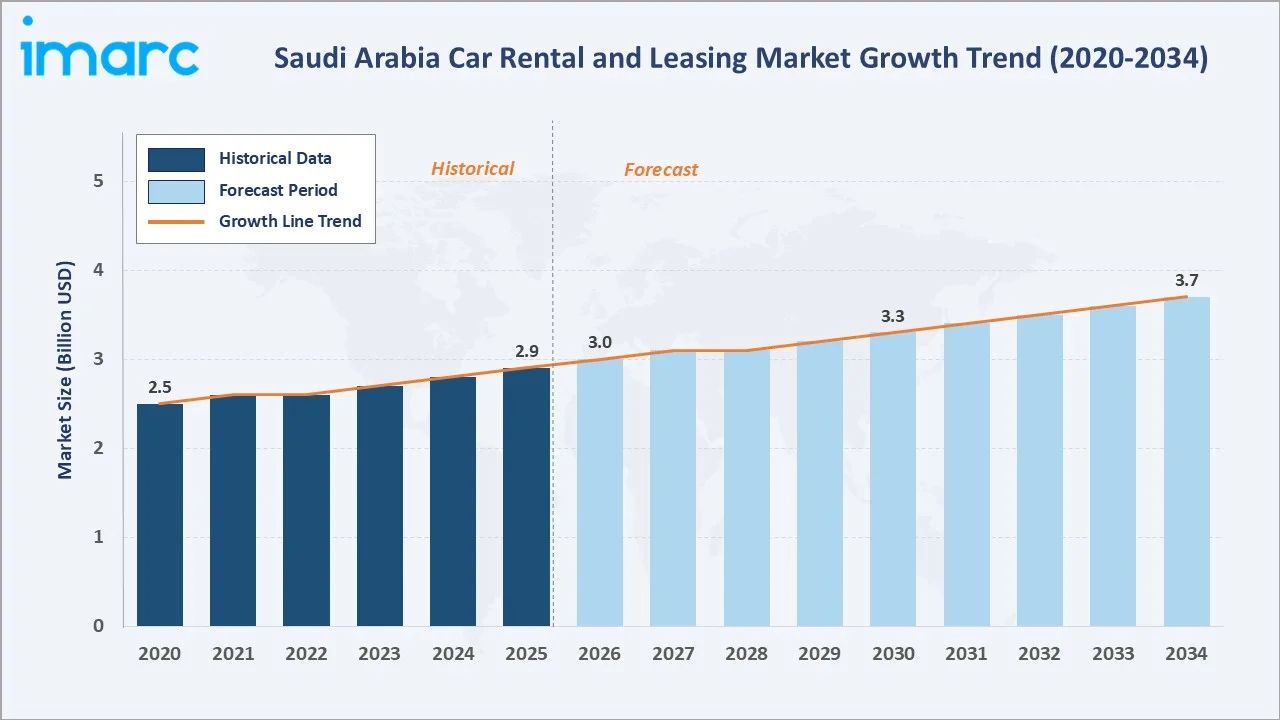
The Saudi Arabia car rental and leasing market grew from USD 2.9 Billion in 2025 to USD 3.0 Billion in 2026 and is projected to reach USD 3.7 Billion by 2034, growing at a CAGR of 2.76% during 2026-2034. The market expansion is attributed to increasing tourism, business travel, and demand for convenient and flexible mobility solutions across the country.
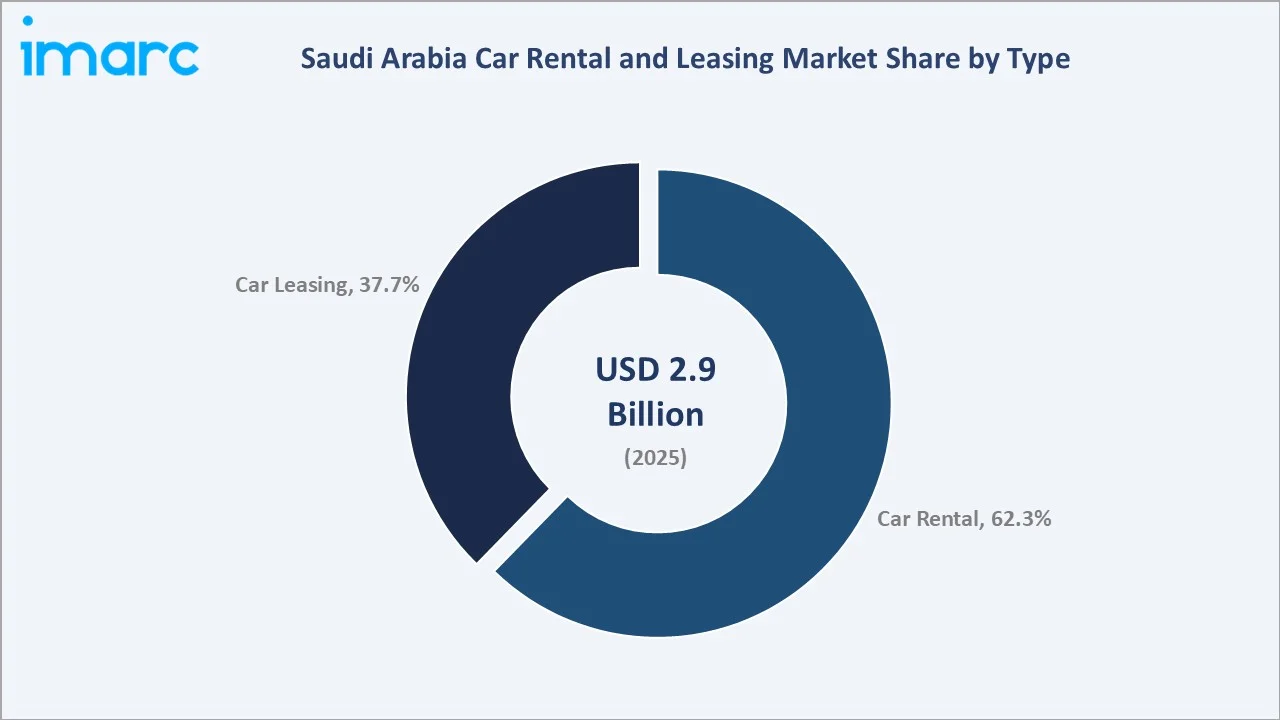
Car rental leads the type segment at 62.3%, economy/budget commands 55.2% of the vehicle type segment, and Northern and Central Region accounts for 45.3% of regional market share.
Market Snapshot
|
Metric |
Value |
|
Base Year Market Size (2025) |
USD 2.9 Billion |
|
Market Size (2026) |
USD 3.0 Billion |
|
Forecast Market Size (2034) |
USD 3.7 Billion |
|
CAGR (2026-2034) |
2.76% |
|
Base Year |
2025 |
|
Historical Period |
2020-2025 |
|
Forecast Period |
2026-2034 |
|
Largest Region |
Northern and Central Region (45.3%, 2025) |
|
Second Largest Region |
Western Region (27.8%, 2025) |
|
Leading Type |
Car Rental (62.3%, 2025) |
|
Leading Vehicle Type |
Economy/Budget (55.2%, 2025) |
The Saudi Arabia car rental and leasing market size increased from USD 2.5 Billion in 2020 to USD 2.9 Billion in 2025 and is estimated to reach USD 3.0 Billion in 2026. The market is further expected to grow to USD 3.3 Billion by 2030 and USD 3.7 Billion by 2034. The market expansion is supported by accelerating giga-project developments, rising inbound tourism under Vision 2030, and surging digital booking adoption across the Kingdom.
To get more information on this market, Request Sample
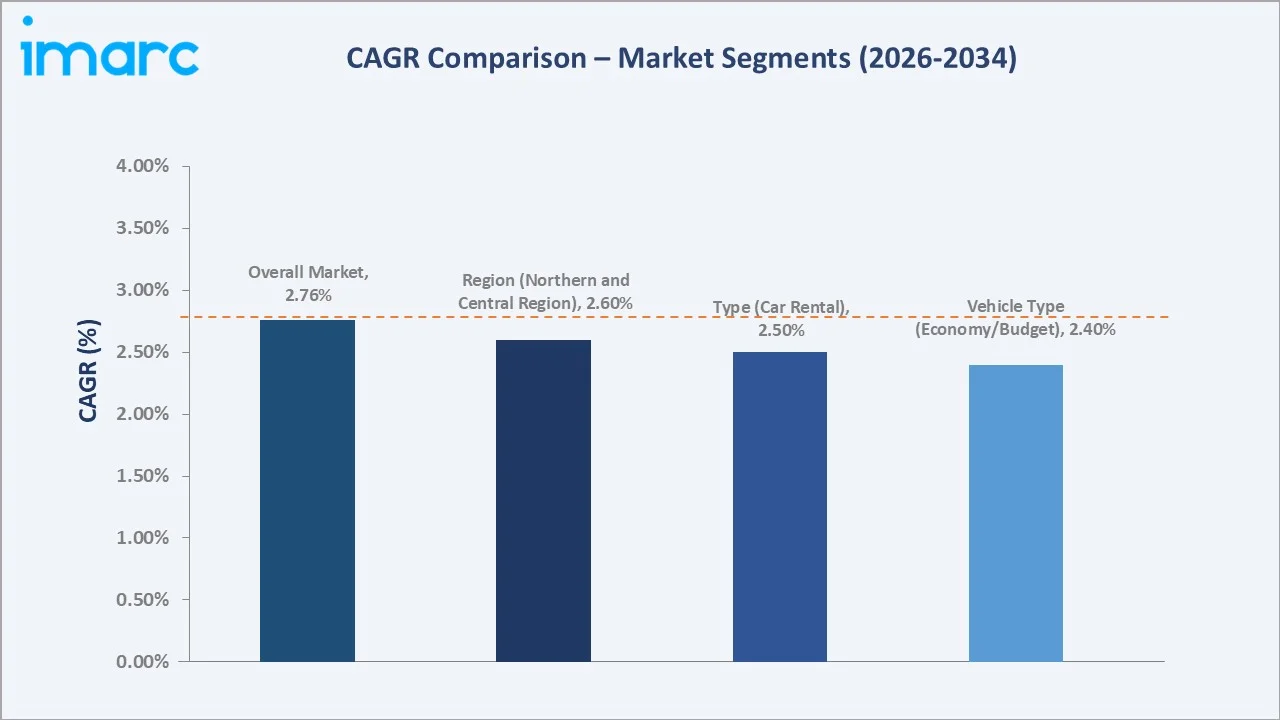
CAGR trajectories across type and vehicle type sub-segments show car leasing and premium/luxury expanding faster than the overall 2.76% market CAGR, driven by rising corporate fleet leasing demand, growing adoption among high-income residents, and expanding hospitality and tourism infrastructure across the Kingdom.
Executive Summary
The Saudi Arabia car rental and leasing market expanded from USD 2.9 Billion in 2025 to an estimated USD 3.0 Billion in 2026, reflecting steady growth driven by rising tourism, business travel, and demand for flexible mobility solutions. The industry has evolved from traditional counter-based rental services to technology-enabled fleet management, subscription-based mobility, and corporate leasing solutions.
Car rental leads the type segment at 62.3% in 2025, driven by short-term demand from tourists, business travelers, and individuals requiring temporary mobility solutions. Economy/budget commands 55.2% of the vehicle type segment in 2025, supported by price-sensitive leisure travelers and entry-level mobility needs. Northern and Central Region holds 45.3% of regional share, reflecting the Kingdom's large urban population base and high concentration of airport and business travel demand.
Key Market Insights
|
Insight |
Data |
|
Leading Type |
Car Rental — 62.3% share (2025) |
|
Second Largest Type |
Car Leasing — 37.7% share (2025) |
|
Leading Vehicle Type |
Economy/Budget — 55.2% share (2025) |
|
Second Largest Vehicle Type |
Premium/Luxury — 44.8% share (2025) |
|
Leading Region |
Northern and Central Region — 45.3% share (2025) |
|
Second Largest Region |
Western Region — 27.8% share (2025) |
|
Top Companies |
Seera Group Holding, Theeb Rent A Car, United International Transportation Co., Arabian Hala Company, Alturki Holding |
Key Analytical Observations Expanding On the Data Above:
- Car rental dominance at 62.3% is supported by high-frequency short-term demand from international tourists, pilgrims visiting Makkah and Madinah, and business travelers transiting through Riyadh, Jeddah, and Dammam airports, with rental providers capturing consistent occupancy throughout the year.
- Car leasing share at 37.7% is expanding as multinational corporations, government agencies, and private sector enterprises increasingly adopt fleet leasing arrangements to manage total cost of ownership and reduce vehicle maintenance burden.
- Economy/budget leadership at 55.2% reflects strong demand from price-conscious travelers and expatriate residents, with international rental brands and local operators deploying high volumes of mid-range vehicles to serve this segment.
- Premium/luxury at 44.8% remains substantial, supported by Saudi Arabia's affluent resident population, high corporate travel standards, and demand from international business visitors and tourists seeking premium mobility experiences.
- Northern and Central Region at 45.3% reflects Riyadh's status as the Kingdom's political, economic, and commercial capital, anchored by a dense concentration of government agencies, multinationals, and major infrastructure projects driving sustained fleet demand.
Saudi Arabia Car Rental and Leasing Market Overview
Car rental and leasing refers to the provision of vehicles to individuals and businesses for temporary or long-term use in exchange for periodic payments. Services range from daily and weekly rental arrangements for travelers and temporary users to multi-year fleet leasing contracts for businesses seeking managed mobility solutions without the capital outlay of vehicle ownership.
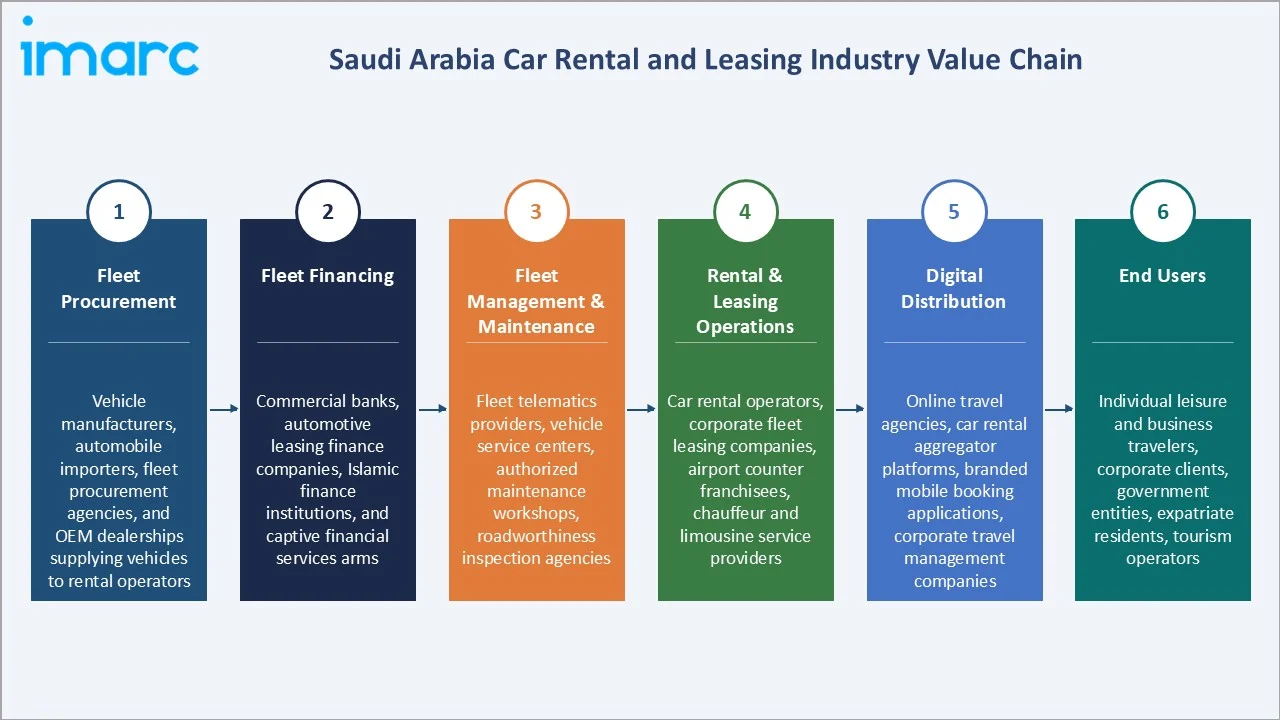
The Saudi Arabian ecosystem integrates vehicle importers and manufacturers, fleet financing institutions, rental and leasing operators, digital booking platforms, maintenance service providers, and end user segments spanning individual travelers, corporate clients, government bodies, and tourism operators. Together, these participants enable a broad and scalable vehicle mobility market across the Kingdom's major cities, airports, and emerging economic corridors.
Market Dynamics
To evaluate market opportunities, Request Sample
Market Drivers
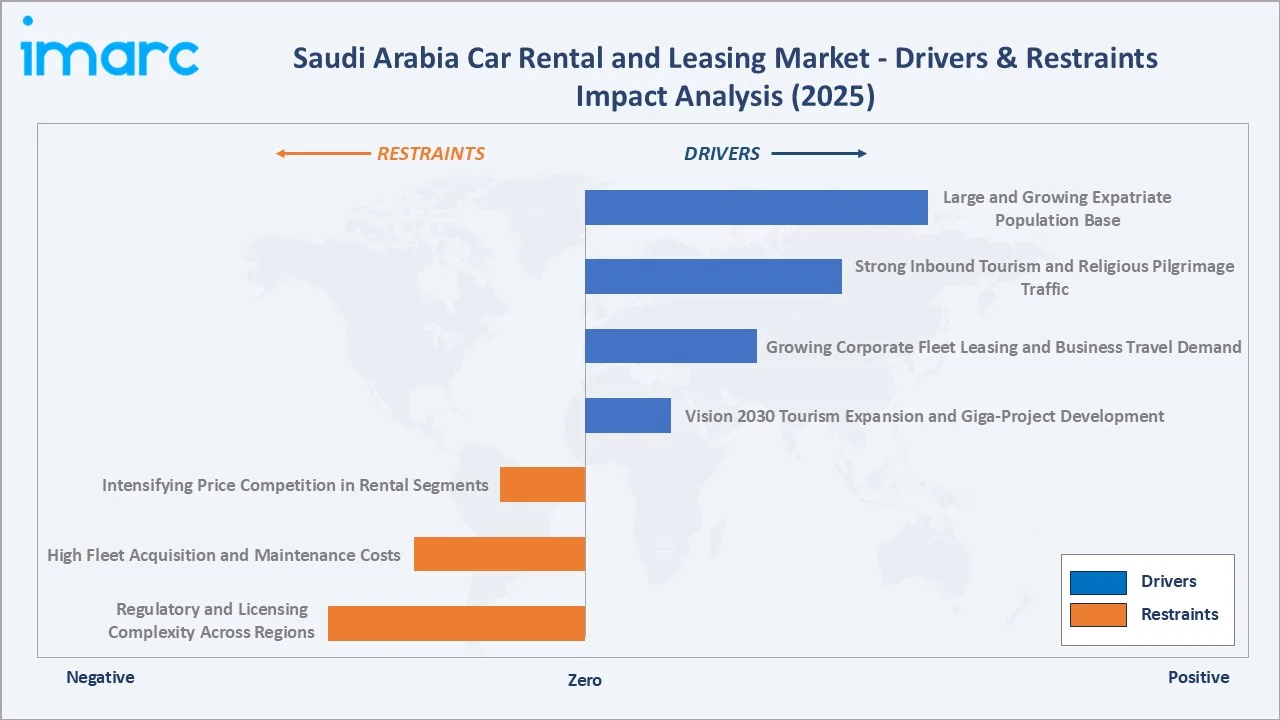
- Vision 2030 Tourism Expansion and Giga-Project Development: Saudi Arabia's Vision 2030 agenda has identified tourism and entertainment as strategic economic pillars, with substantial investment in airports, hospitality infrastructure, and giga-projects such as NEOM, Red Sea Project, and Diriyah, all of which are generating consistent demand for vehicle rental and fleet leasing services across multiple regions.
- Growing Corporate Fleet Leasing and Business Travel Demand: Rising corporate activity, growing numbers of multinational company headquarters in Riyadh and Jeddah, and expanding small and medium enterprise activity across the Kingdom are fueling sustained demand for short-term rental and long-term fleet leasing services from business travelers and corporate clients.
- Strong Inbound Tourism and Religious Pilgrimage Traffic: International tourist arrivals and religious pilgrimage visitors represent a consistent and growing source of rental demand. As reported by the Ministry of Tourism, Saudi Arabia attracted 116 Million tourists in 2024, with rental operators benefiting from consistent booking volumes across peak travel and pilgrimage seasons.
- Large and Growing Expatriate Population Base: A growing expatriate population in Saudi Arabia, which numbered approximately 13.4 Million as of 2025, is sustaining consistent demand for car rental and leasing services, as many expatriate residents prefer renting or leasing over vehicle ownership due to mobility flexibility and cost considerations.
Market Restraints
- Regulatory and Licensing Complexity Across Regions: The car rental and leasing sector in Saudi Arabia operates within a framework of vehicle import regulations, fleet age requirements, and rental operator licensing standards that vary across municipalities, creating compliance complexity for operators seeking to standardize operations across multiple regions.
- High Fleet Acquisition and Maintenance Costs: Fleet procurement, insurance, and maintenance represent significant capital requirements that can limit fleet expansion capacity for smaller operators and new market entrants, particularly during periods of rising vehicle import costs or fuel price volatility.
- Intensifying Price Competition in Rental Segments: Rising participation from domestic and international rental operators has intensified price competition, particularly in the economy/budget segment, constraining average revenue per vehicle and limiting margin expansion for operators dependent on volume-based pricing models.
Market Opportunities
- Digital Platform and Mobile Booking Expansion: Smartphone penetration and growing consumer comfort with digital mobility platforms in Saudi Arabia are creating significant opportunities for rental operators to capture bookings through mobile apps, aggregator platforms, and loyalty-based digital services.
- Expansion into Emerging Tourism and Economic Zones: Emerging tourism destinations, such as AlUla, Diriyah, Yanbu, and giga-project zones, represent new geographic markets with limited existing rental infrastructure, offering growth opportunities for operators willing to deploy fleet in developing corridors ahead of demand maturation.
Market Challenges
- Fleet Electrification and EV Infrastructure Investment: As Saudi Arabia accelerates fleet electrification in line with environmental goals under Vision 2030, rental and leasing operators face the challenge of investing in EV-ready infrastructure including charging facilities, driver training, and technician capabilities without clear near-term demand certainty.
- Workforce Availability and Retention in a Competitive Labor Market: Retaining skilled drivers, fleet managers, and customer service personnel across a competitive hospitality and mobility labor market in Saudi Arabia presents ongoing operational challenges, particularly for operators scaling rapidly to meet peak tourism and event-driven demand.
Emerging Market Trends
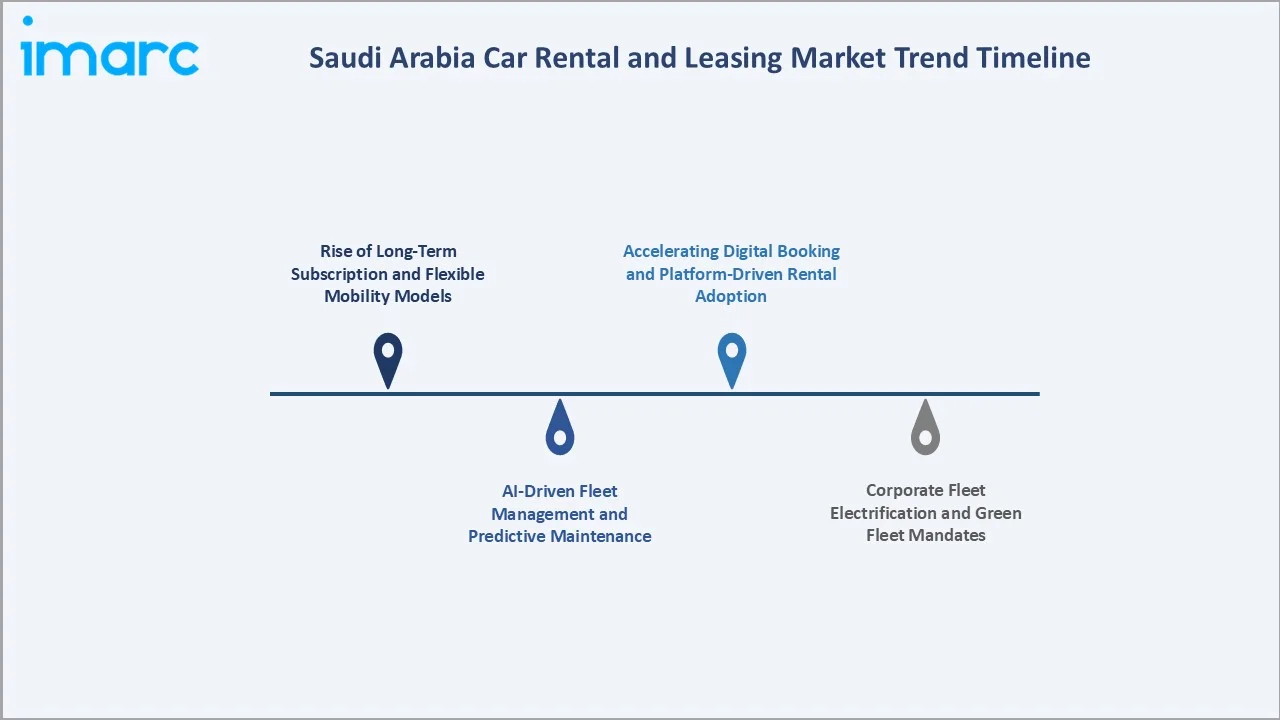
1. Rise of Long-Term Subscription and Flexible Mobility Models
Car rental and leasing operators in Saudi Arabia are increasingly launching subscription-based mobility services that offer flexible monthly vehicle access without long-term ownership commitments. These models are particularly attractive to young urban residents, expatriates, and new arrivals seeking vehicle access without the financial burden of vehicle purchase, with operators bundling insurance, maintenance, and roadside assistance into single monthly payments.
2. Accelerating Digital Booking and Platform-Driven Rental Adoption
Digital transformation is reshaping customer acquisition in the market, with operators investing in mobile booking applications, API integrations with travel platforms, and loyalty programs to improve fleet utilization and customer retention. Platform aggregators are enabling price comparison and instant booking across multiple operators, increasing market transparency and price sensitivity across customer segments.
3. Corporate Fleet Electrification and Green Fleet Mandates
Saudi Vision 2030 sustainability targets are beginning to influence fleet procurement decisions, with government entities and large corporations exploring EV adoption for managed fleet programs. Rental operators with early-mover positioning in EV fleet deployment are expected to secure competitive advantages in corporate and government leasing contracts as green fleet requirements mature.
4. AI-Driven Fleet Management and Predictive Maintenance
Technology-enabled fleet management platforms using AI and telematics are being adopted by leading operators to optimize vehicle utilization, predict maintenance needs, reduce downtime, and improve fuel efficiency across large and geographically distributed fleets. These capabilities are creating a meaningful operational differentiation between digitally advanced operators and traditional fleet managers.
Industry Value Chain Analysis
The Saudi Arabia car rental and leasing value chain spans six stages, from vehicle procurement and fleet financing through end-user engagement and lifecycle management. Rental and leasing operations and digital distribution channels capture the highest direct value-add, while fleet management and maintenance capabilities increasingly determine sustainable competitive position within this cost-intensive and operationally complex category.
|
Stage |
Key Players / Examples |
|
Fleet Procurement |
Vehicle manufacturers, automobile importers, fleet procurement agencies, and OEM dealerships supplying passenger and commercial vehicles to rental operators |
|
Fleet Financing |
Commercial banks, automotive leasing finance companies, Islamic finance institutions, and captive financial services arms of vehicle manufacturers |
|
Fleet Management & Maintenance |
Fleet telematics providers, vehicle service centers, authorized maintenance workshops, roadworthiness inspection agencies, and third-party fleet management firms |
|
Rental & Leasing Operations |
Car rental operators, corporate fleet leasing companies, airport counter franchisees, chauffeur and limousine service providers, and short-term mobility platforms |
|
Digital Distribution |
Online travel agencies, car rental aggregator platforms, branded mobile booking applications, corporate travel management companies, and hospitality booking systems |
|
End Users |
Individual leisure and business travelers, corporate clients, government and public sector entities, expatriate residents, and tourism and hospitality operators |
Operators that own or control multiple value chain stages, particularly those integrating fleet procurement, maintenance capabilities, and digital booking infrastructure, are better positioned to improve fleet utilization and deliver cost-efficient services compared to those reliant on third-party providers.
Technology Landscape in the Saudi Arabia Car Rental and Leasing Industry
Digital Booking Platforms and Mobile Applications
Car rental and leasing operators are investing in proprietary mobile applications and third-party platform integrations to capture bookings, manage reservations, and improve fleet utilization. Digital-first booking capabilities reduce customer acquisition costs, enable dynamic pricing, and support loyalty programs that drive repeat engagement from corporate and leisure customer segments.
Fleet Telematics and Real-Time Monitoring
Telematics systems enabling GPS tracking, driver behavior monitoring, real-time vehicle diagnostics, and geofencing are increasingly deployed across large fleet operations in Saudi Arabia. These technologies improve vehicle utilization, reduce unauthorized use, support predictive maintenance scheduling, and provide operators with data-driven insights for fleet optimization.
AI and Predictive Analytics
Leading fleet operators are adopting AI tools for demand forecasting, dynamic pricing, and predictive maintenance, enabling more accurate fleet deployment across high-demand locations and seasons. AI-driven maintenance alerts reduce unexpected vehicle downtime and extend fleet asset life, directly improving profitability in capital-intensive fleet operations.
EV Integration and Charging Infrastructure
Pilot EV fleet programs are underway among select operators in Saudi Arabia, aligned with national sustainability goals under Vision 2030. Charging infrastructure investment, driver training, and range management represent key technology requirements as operators prepare for gradual electrification of passenger and light commercial vehicle fleets.
Market Segmentation Analysis
The report covers the following segments:
|
Segment Category |
Leading Segment |
Market Share |
Year |
|
Type |
Car Rental |
62.3% |
2025 |
|
Vehicle Type |
Economy/Budget |
55.2% |
2025 |
|
Vehicle Body Style Type |
Sedan |
35.2% |
2025 |
|
Booking Type |
Online |
52.4% |
2025 |
|
Region |
Northern and Central Region |
45.3% |
2025 |

By Type
Car rental commands a 62.3% majority share, driven by high-frequency short-term demand from international and domestic tourists, business travelers, and temporary visitors requiring flexible vehicle access across the Kingdom's major cities and airports.
To access detailed market analysis, Request Sample
Car leasing at 37.7% is expanding steadily as corporate clients, government entities, and long-term expatriate residents increasingly prefer multi-year leasing arrangements that bundle vehicle access, maintenance, insurance, and fleet management into predictable monthly payments.
By Vehicle Type
Economy/budget leads with 55.2% share, reflecting the dominance of price-conscious leisure travelers, pilgrims, and budget-oriented business visitors across the Kingdom's large and diverse rental demand base. The segment is characterized by high fleet turnover, competitive pricing, and strong utilization from inbound tourism markets that prioritize cost efficiency over vehicle premium.
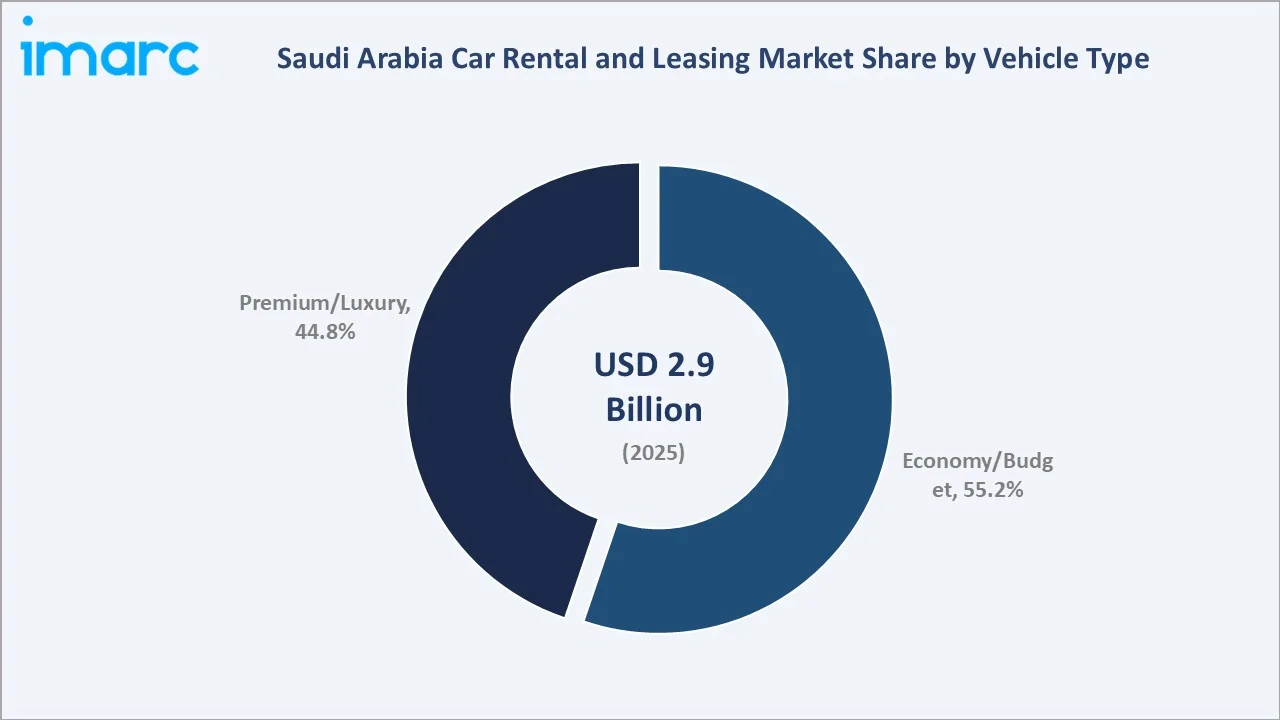
Premium/luxury at 44.8% remains a significant and structurally important segment in the Saudi Arabia market, supported by the Kingdom's large high-income resident base, demanding corporate travel standards, and consistent demand from high-net-worth international visitors.
Regional Market Insights
|
Region |
Share (2025) |
Key Growth Drivers |
|
Northern and Central Region |
45.3% |
Large population base anchored by Riyadh, high corporate activity, government fleet demand, and concentration of multinational companies and business travelers |
|
Western Region |
27.8% |
Strong tourism inflows driven by religious pilgrimage, expanding airport capacity at Jeddah, and growing leisure travel and hospitality demand |
|
Eastern Region |
17.2% |
Significant industrial and energy sector presence, corporate fleet leasing demand from oil and gas companies, and expanding logistics activity |
|
Southern Region |
9.7% |
Emerging regional travel, growing domestic tourism, and increasing infrastructure development supporting gradual market expansion |
Northern and Central Region at 45.3% leads the regional landscape, anchored by Riyadh's position as Saudi Arabia's political capital and economic hub. The region benefits from a dense concentration of government ministries, corporate headquarters, international airports, and major infrastructure projects that sustain high vehicle fleet demand across rental and leasing segments.
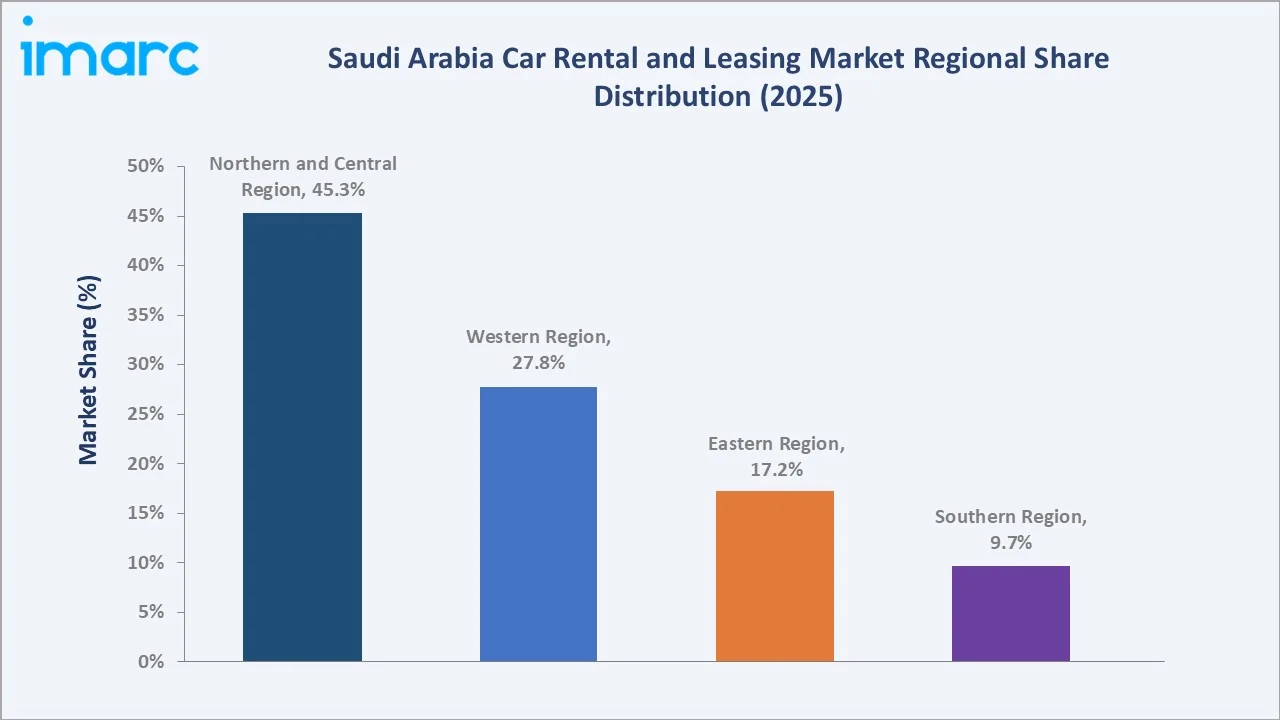
Southern Region, while currently the smallest contributor at 9.7%, is expanding as infrastructure investment in Asir and Jizan provinces develops tourism capacity and improves regional connectivity, gradually increasing demand for vehicle rental services in leisure and domestic travel segments.
Competitive Landscape
The Saudi Arabia car rental and leasing market is moderately concentrated, with well-established domestic operators and international franchise holders leading fleet size and geographic coverage while regional and emerging players compete on service flexibility, pricing, and niche customer segments. Fleet scale, digital booking capability, and airport location access form the key competitive differentiators across the industry.
|
Company Name |
Brand / Key Product |
Position |
Strategic Focus |
|
Seera Group Holding |
Lumi |
Leader |
Expanding technology-enabled fleet leasing and rental services through digital platform investment and corporate account growth |
|
Theeb Rent A Car |
Theeb |
Leader |
Broadening fleet capacity and geographic coverage across Saudi Arabia's key business and tourism corridors |
|
United International Transportation Co. |
Budget |
Leader |
Strengthening airport and city-center presence through continued fleet investment and service expansion |
|
Arabian Hala Company |
Avis |
Challenger |
Growing premium rental and corporate leasing clientele through service quality and fleet modernization |
|
Alturki Holding |
Samara Rent a Car, Sixt |
Challenger |
Expanding premium vehicle offerings and targeting business travelers and high-value corporate segments |
Key players include Seera Group Holding, Theeb Rent A Car, United International Transportation Co., Arabian Hala Company, and Alturki Holding, among others.
Key Company Profiles
Seera Group Holding
Seera Group Holding is a leading Saudi integrated travel and mobility services group. It operates across travel, tourism, and mobility services, catering to both individual customers and business clients in Saudi Arabia and the wider region.
- Product Portfolio: Fleet leasing solutions for corporate and government clients, short-term individual rental services, motorcycle and bus rental, used car sales, and technology-enabled fleet management platforms.
- Recent Developments: The company has continued to invest in expanding its service network and fleet capabilities, strengthening its operational footprint across key Saudi cities and airports.
- Strategic Focus: Driving growth through investment in digital mobility infrastructure and expanding long-term fleet leasing partnerships with corporate and government clients across Saudi Arabia.
Theeb Rent A Car
Theeb Rent A Car is one of Saudi Arabia's largest publicly listed domestic car rental companies, operating a wide network of branches across major cities and airports with a diversified fleet serving individual, corporate, and government customers.
- Product Portfolio: Short-term car rental, long-term fleet leasing, corporate fleet solutions, chauffeur-driven services, and one-way rental arrangements across all major Saudi regions.
- Recent Developments: The company has continued to grow its branch network and fleet capacity, maintaining consistent service delivery across its core rental and leasing customer segments.
- Strategic Focus: Scaling branch presence and fleet size to serve rising mobility demand across Saudi Arabia's key commercial centers, airports, and emerging tourism destinations.
United International Transportation Co.
United International Transportation Co. is a publicly listed Saudi company, providing vehicle rental and leasing services at airport locations and city-center branches across the Kingdom.
- Product Portfolio: Economy, mid-range, and SUV vehicle rental services targeting business and leisure travelers, long-term fleet leasing, and used vehicle sales.
- Recent Developments: The company has continued to expand its fleet capacity and strengthen its airport-linked rental presence, sustaining operational growth across its core Saudi markets.
- Strategic Focus: Building on its established airport and urban rental footprint by investing in fleet renewal and widening its branch coverage across key Saudi cities and transit hubs.
Market Concentration Analysis
The Saudi Arabia car rental and leasing market exhibits moderate concentration, with the top operators holding a meaningful collective share of fleet assets and booking volumes, particularly at key airports and major city locations where brand presence and fleet availability create durable competitive advantages.
Barriers to entry include high fleet procurement capital requirements, the need for regulatory licensing across multiple municipalities, and the operational complexity of managing geographically distributed fleet assets with consistent service standards. These factors favor established operators with strong brand recognition, existing fleet financing relationships, and mature maintenance networks.
Consolidation is gradually increasing as larger operators and international franchise holders acquire regional fleet assets and domestic operator licenses to broaden geographic coverage. Strategic partnerships between rental operators, hospitality groups, and airlines are further shaping competitive positioning across the market, particularly for operators seeking preferred supplier status with corporate travel programs.
Investment & Growth Opportunities
Fastest-Growing Segments
Car leasing is expanding faster than car rental within the type segmentation, driven by rising corporate fleet demand and growing adoption among long-term expatriate residents. Within the vehicle type segment, premium/luxury is growing above the overall market CAGR, supported by Vision 2030's focus on luxury tourism and the expanding Saudi events economy generating demand for high-value vehicle access.
Emerging Markets
Southern Region is expanding as infrastructure investment in domestic tourism destinations and improved regional transport connectivity drives new demand. Giga-project zones including NEOM and Red Sea Project represent significant untapped opportunity for operators willing to establish early-mover fleet presence ahead of demand maturation.
Venture & Investment Trends
Capital investment is concentrated in digital fleet management platforms, mobile booking infrastructure, and EV-ready fleet programs. Saudi tourism infrastructure investment, particularly in airport expansion and new hospitality developments across emerging destinations, is also attracting international rental brands and creating franchising and partnership opportunities for domestic operators seeking brand affiliation and operational best practices.
Future Market Outlook (2026-2034)
The Saudi Arabia car rental and leasing market is projected to grow from USD 2.9 Billion in 2025 to USD 3.0 Billion in 2026, reaching USD 3.7 Billion by 2034, registering a CAGR of 2.76% during 2026-2034.
Four forces will shape the market through 2034: continued expansion of Vision 2030 tourism and entertainment infrastructure; growing corporate and government fleet leasing adoption; accelerating digitalization of booking and fleet management; and gradual fleet electrification in alignment with Saudi sustainability goals.
By 2034, the Saudi Arabia car rental and leasing market is expected to be defined by technology-enabled fleet operations. Continued government investment in transport infrastructure and tourism positioning will further accelerate the evolution of the mobility services ecosystem across the Kingdom.
Research Methodology
Primary Research
Primary research included structured interviews with fleet operators, corporate procurement managers, tourism and hospitality executives, and regulatory specialists, validating market sizing, segment mix, and regional demand patterns across the Saudi Arabia car rental and leasing industry.
Secondary Research
Secondary sources included Saudi Tourism Authority publications, Saudi Central Bank financial sector data, General Authority of Statistics reports, Saudi Vision 2030 program documentation, and annual reports, press releases, and investor presentations from listed fleet operators, automotive importers, and transportation companies.
Forecasting Models
Market forecasts used top-down and bottom-up models combining fleet size data, vehicle utilization rates, rental day volumes, leasing contract trends, and macroeconomic variables including tourism arrival forecasts, expatriate population growth, and corporate activity indicators. Scenario analysis addressed Vision 2030 program delivery pace, oil price impacts on government spending, and technology adoption rates across the fleet industry.
Saudi Arabia Car Rental and Leasing Market Report Coverage:
| Report Features | Details |
|---|---|
| Base Year of the Analysis | 2025 |
| Historical Period | 2020-2025 |
| Forecast Period | 2026-2034 |
| Units | Billion USD |
| Scope of the Report |
Exploration of Historical and Forecast Trends, Industry Catalysts and Challenges, Segment-Wise Historical and Predictive Market Assessment:
|
| Types Covered | Car Rental, Car Leasing |
| Vehicle Types Covered | Economy/Budget, Premium/Luxury |
| Vehicle Body Style Types Covered | Hatchback, Sedan, Multi-Utility Vehicle and Sports, Utility Vehicle |
| Booking Types Covered | Online, Offline |
| Regions Covered | Northern and Central Region, Western Region, Eastern Region, Southern Region |
| Companies Covered | Seera Group Holding, Theeb Rent A Car, United International Transportation Co., Arabian Hala Company, Alturki Holding, etc. |
| Customization Scope | 10% Free Customization |
| Post-Sale Analyst Support | 10-12 Weeks |
| Delivery Format | PDF and Excel through Email (We can also provide the editable version of the report in PPT/Word format on special request) |
Key Benefits for Stakeholders:
- IMARC’s industry report offers a comprehensive quantitative analysis of various market segments, historical and current market trends, market forecasts, and dynamics of the Saudi Arabia car rental and leasing market from 2020-2034.
- The research report provides the latest information on the market drivers, challenges, and opportunities in the Saudi Arabia car rental and leasing market.
- Porter's five forces analysis assist stakeholders in assessing the impact of new entrants, competitive rivalry, supplier power, buyer power, and the threat of substitution. It helps stakeholders to analyze the level of competition within the Saudi Arabia car rental and leasing industry and its attractiveness.
- Competitive landscape allows stakeholders to understand their competitive environment and provides an insight into the current positions of key players in the market.
Frequently Asked Questions About the Saudi Arabia Car Rental and Leasing Market Report
The Saudi Arabia car rental and leasing market is estimated at USD 3.0 Billion in 2026, reflecting steady demand for flexible and convenient mobility solutions across the country.
The market is projected to grow at a CAGR of 2.76% from 2026-2034, reaching USD 3.7 Billion, supported by tourism infrastructure development and expanding fleet leasing adoption.
Car rental is the largest type segment, commanding 62.3% share in 2025, driven by high-frequency demand from international and domestic tourists, business travelers, and temporary visitors across major Saudi cities and airports.
Economy/budget is the leading vehicle type, accounting for 55.2% of market share in 2025, supported by strong price-sensitive demand from leisure travelers, pilgrims, and value-oriented business visitors across the Kingdom.
Northern and Central Region leads with 45.3% share in 2025, anchored by Riyadh's position as the Kingdom's corporate hub and primary economic center.
Leading players include Seera Group Holding, Theeb Rent A Car, United International Transportation Co., Arabian Hala Company, and Alturki Holding, among others.
Vision 2030 is driving major investments in tourism infrastructure, giga-projects, and entertainment sectors, all of which are generating consistent fleet demand from workers, visitors, and corporate clients.
Key opportunities include expansion in emerging tourism zones, digital platform investment, EV fleet programs, and long-term leasing contracts linked to giga-project workforce mobility requirements.
Digital booking platforms, mobile apps, and AI-driven fleet management tools are improving vehicle utilization, enabling dynamic pricing, and shifting customer acquisition toward online and mobile channels.
Need more help?
- Speak to our experienced analysts for insights on the current market scenarios.
- Include additional segments and countries to customize the report as per your requirement.
- Gain an unparalleled competitive advantage in your domain by understanding how to utilize the report and positively impacting your operations and revenue.
- For further assistance, please connect with our analysts.
 Request Customization
 Speak to an Analyst
 Request Brochure
 Inquire Before Buying
Benefits of Customization
- Personalize this research
- Triangulate with your data
- Get data as per your format and definition
- Gain a deeper dive into a specific application, geography, customer, or competitor
- Any level of personalization
Get in Touch With Us
UNITED STATES
Phone: +1-201-971-6302
INDIA
Phone: +91-120-433-0800
UNITED KINGDOM
Phone: +44-753-714-6104
Email: [email protected]
Client Testimonials




.webp)




.webp)













Related Reports

Choose your plan
*Please note that the prices mentioned below are starting prices for each bundle type. Kindly contact our team for further details.*
Single User License
- 1 User License, Access on 2 Devices
- PDF Report + Excel Dataset (Password Protected)
- Lifetime Access
- No Printing Rights
- 10% Free Report Customization
- 10–12 Weeks of Analyst Support
Five User License
- Access for 5 Users, 2 Devices per User
- PDF Report + Excel Dataset (Password Protected)
- Lifetime Access
- Dedicated Account Manager
- 12–14 Weeks of Analyst Support
- No Printing Rights
- 15% Free Report Customization
- 25% Discount on Your Next Purchase
Corporate User License
- Unlimited User Access (Within Your Organization)
- PDF Report + Excel Dataset
- Lifetime Access
- Dedicated Account Manager
- 14–20 Weeks of Analyst Support
- No Printing Rights
- 20% Free Report Customization
- 30% Discount on Your Next Purchase
Essential Insights
What's included:
3 reports
- Lifetime Access
- PDF Reports
- Excel Datasets
- 2 Weeks of Free Analyst Support
- 2 User Licenses
- Access on 2 Devices
- Printing Rights
- Complimentary PowerPoint (PPT) Version
- Complimentary License Upgrade
Professional Access
What's included:
5 reports
- Lifetime Access
- PDF Reports
- Excel Datasets
- 8 Weeks of Free Analyst Support
- 2 User Licenses
- Access on 2 Devices
- Printing Rights
- Complimentary PowerPoint (PPT) Version
- Complimentary License Upgrade
Business Advantage
What's included:
8 reports
- Lifetime Access
- PDF Reports
- Excel Datasets
- 14 Weeks of Free Analyst Support
- 2 User Licenses
- Access on 2 Devices
- Printing Rights
- Complimentary PowerPoint (PPT) Version
- Complimentary License Upgrade
Enterprise Intelligence
What's included:
10 reports
- Lifetime Access
- PDF Reports
- Excel Datasets
- 20 Weeks of Free Analyst Support
- 2 User Licenses
- Access on 2 Devices
- Printing Rights
- Complimentary PowerPoint (PPT) Version
- Complimentary License Upgrade