
Saudi Arabia Cement Board Market Size, Share, Trends and Forecast by Product Type, Application, End Use Industry, and Region, 2026-2034
Saudi Arabia Cement Board Market Size, Share, Trends & Forecast (2026-2034)
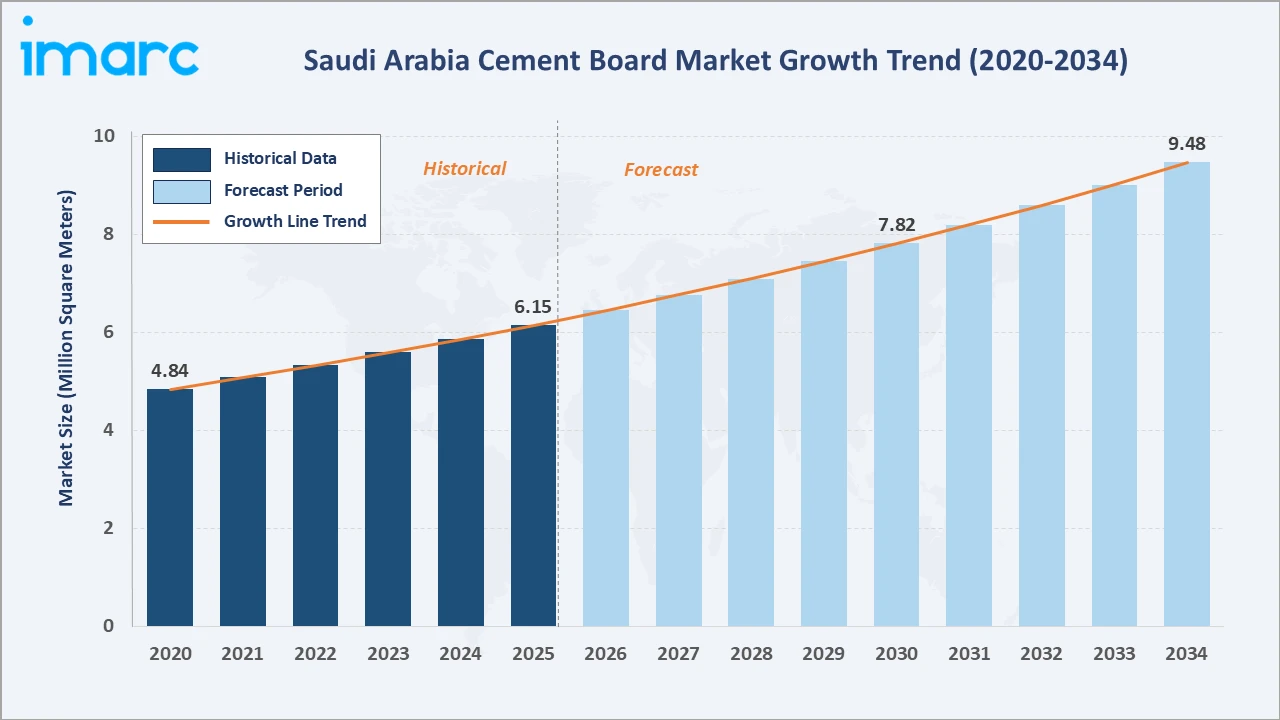
The Saudi Arabia cement board market reached 6.15 Million Square Meters in 2025 and is projected to reach 9.48 Million Square Meters by 2034, exhibiting a CAGR of 4.92% during 2026-2034. Saudi Arabia is advancing an extensive pipeline of giga-projects across coastal, urban, and desert locations as part of Vision 2030, reflecting its ambition to become a major global investment and development hub. More than one million homes are planned by 2030, with Riyadh expected to account for approximately 32.5% of the Kingdom’s new housing supply. This large-scale residential and infrastructure development is driving demand for cement boards in wall partitions, ceilings, façades, flooring substrates, and fire- and moisture-resistant construction applications. Fiber cement board (FCB) leads product type at 51.4%, commercial leads end use at 44.3%, and the Northern and Central region accounts for the largest regional share at 41.5%.
Market Snapshot
|
Metric |
Value |
|
Market Size (2025) |
6.15 Million Square Meters |
|
Forecast Market Size (2034) |
9.48 Million Square Meters |
|
CAGR (2026-2034) |
4.92% |
|
Base Year |
2025 |
|
Historical Period |
2020-2025 |
|
Forecast Period |
2026-2034 |
|
Dominant Product Type |
Fiber Cement Board (FCB) – 51.4%, 2025 |
|
Dominant End Use Industry |
Commercial – 44.3%, 2025 |
|
Leading Region |
Northern and Central Region – 41.5%, 2025 |
The Saudi Arabia cement board market grew from 4.84 Million Square Meters in 2020 to 6.15 Million Square Meters in 2025, driven by the progressive rollout of the Saudi Building Code's fire-resistance and moisture-resistance requirements for non-asbestos building boards, the explosion of Vision 2030 giga-project construction activity demanding high-performance cladding and partition materials, and Saudi Arabia's market dependency on imports benefiting from increased port capacity and logistics infrastructure investment. The market is projected to reach 7.82 Million Square Meters by 2030 and 9.48 Million Square Meters by 2034.
To get more information on this market, Request Sample
Fiber Cement Board (FCB) grows at ~5.45% CAGR through NEOM and Red Sea exterior cladding specifications, green building credit for non-toxic materials, and non-asbestos boards in petrochemical facility construction. Commercial end use grows at ~5.30% CAGR through the extraordinary scale of Vision 2030's hotel, entertainment, and retail construction pipeline. Northern and Central region grows at ~5.10% CAGR through Riyadh's Master Plan 2030 mega-infrastructure investment. Residential end use grows at ~5.10% CAGR through the National Housing Program's target and growing adoption of FCB in affordable housing wet areas and external cladding.
.webp)
Executive Summary
The Saudi Arabia cement board market occupies a structurally important position within the Kingdom's building materials ecosystem, as the only building board category that simultaneously satisfies Saudi Building Code (SBC) requirements for fire resistance, moisture resistance, structural integrity, and non-asbestos composition that mandatory non-combustible construction mandates require for commercial buildings and for bathroom, kitchen, and wet area applications across all building types. Saudi Arabia's market is distinguished by its complete import dependency, creating a supply chain vulnerability that Vision 2030's industrial development agenda is specifically targeting through incentives for local building materials manufacturing. Market volume reached 6.15 Million Square Meters in 2025, forecast at 9.48 Million Square Meters by 2034.
Fiber cement board leads at 51.4% (2025) through its unmatched combination of fire resistance, moisture impermeability, dimensional stability under extreme thermal cycling, and surface finish quality that meets the architectural specification requirements of NEOM, Red Sea, and Qiddiya entertainment district project designers. Commercial end use leads at 44.3% through the hotel and hospitality construction pipeline, retail and mixed-use development, and corporate office construction. The Northern and Central region leads at 41.5% through Riyadh's concentration of the Kingdom's largest building projects, most active construction market, and highest density of certified subcontractors.
Key Market Insights
|
Insight |
Data |
|
Dominant Product Type |
Fiber Cement Board (FCB) – 51.4% share (2025) |
|
Dominant End Use Industry |
Commercial – 44.3% share (2025) |
|
Leading Region |
Northern and Central Region – 41.5% share (2025) |
|
Market Opportunity |
Local FCB manufacturing investment; NEOM/Red Sea cladding supply partnerships; high-density fire-rated FCB for Saudi Aramco facilities; acoustic WWCB for education and healthcare |
Key Analytical Observations:
- Fiber Cement Board (FCB) at 51.4% (2025): FCB's market dominance in Saudi Arabia reflects the unique convergence of regulatory mandates and extreme climate performance requirements that no competing board category can simultaneously satisfy. Saudi Arabia's mandatory non-asbestos building material requirement eliminated legacy asbestos cement boards from the Saudi market, creating structural demand for non-asbestos FCB as the technically and commercially proven substitute.
- Commercial End Use at 44.3%: Commercial cement board consumption encompasses hotel and resort construction, entertainment venue construction, retail and mixed-use development, and corporate headquarters. The combination of Vision 2030's tourism target of 150 million visitors by 2030 and the associated hospitality construction pipeline sustains commercial segment dominance at 44.3% through the forecast period, as every new hotel and resort specification requires non-combustible, moisture-resistant FCB for bathroom pod units, kitchen cladding, and exterior facade systems.
- Northern and Central Region at 41.5% (2025): The Northern and Central region dominates due to intensive construction activity in Riyadh and surrounding urban centers. Large-scale housing, commercial, infrastructure, and Vision 2030 projects continue to generate substantial demand for durable, fire-resistant, and lightweight cement boards.
Saudi Arabia Cement Board Market Overview
The Saudi Arabia cement board market encompasses four distinct cement-matrix building board product types, such as fiber cement board (FCB), cement bonded particle board (CBPB), wood wool cement board (WWCB), and wood strand cement board (WSCB), each manufactured through a process of combining Portland cement with specific organic reinforcement materials and curing under pressure and temperature to produce flat building sheets with specific structural, acoustic, fire resistance, and moisture resistance properties. Saudi Arabia's cement board market is mostly import-dependent, supplied through distributors concentrated in Riyadh, Jeddah, and Dammam/Khobar. Macroeconomic factors include strong economic growth, rising government spending under Vision 2030, increasing urbanization, and expanding residential and commercial construction.
Market Dynamics
To evaluate market opportunities, Request Sample
Market Drivers
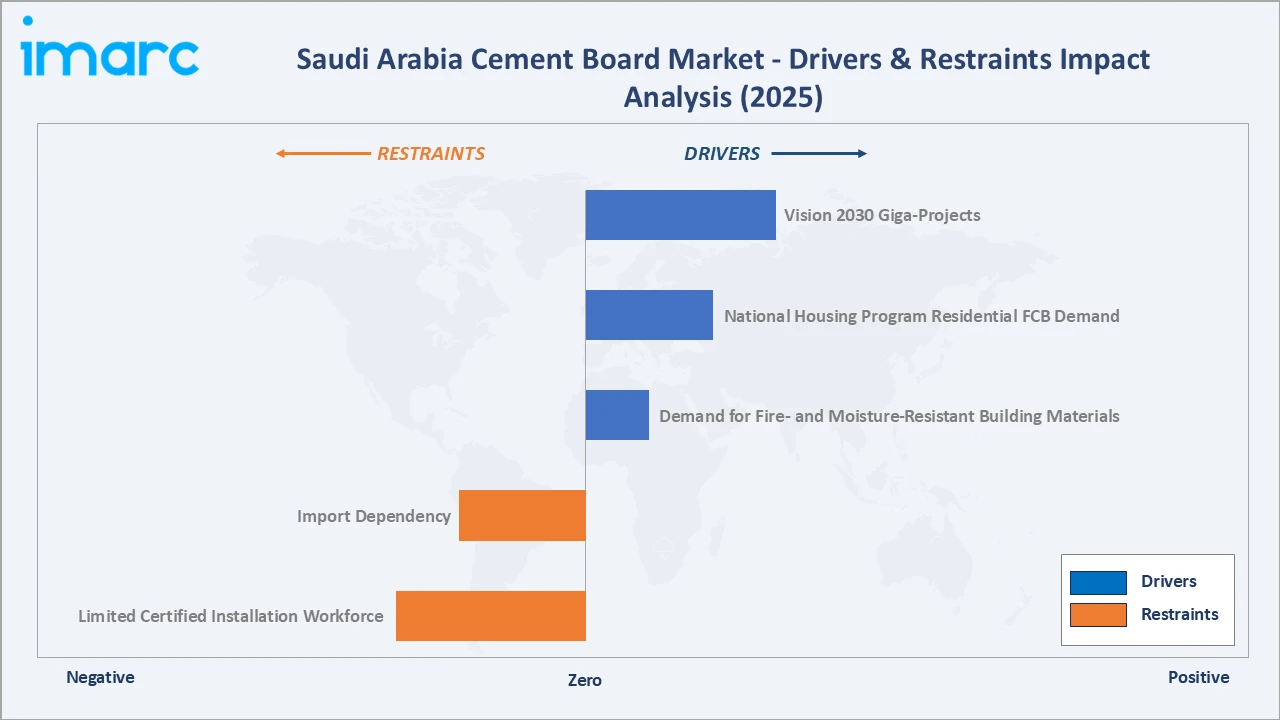
- Vision 2030 Giga-Projects: Saudi Arabia’s Vision 2030 giga-project portfolio represents more than US$1 trillion in announced investments, making it one of the largest construction programs. Key developments include NEOM (US$500 billion), New Murabba (US$50 billion) featuring the 400-meter Mukaab, Red Sea Global with a target of 50 hotels by 2030, and Qiddiya and Diriyah Gate, collectively represent the largest simultaneous construction program, with each development requiring fiber cement board at scale for exterior façade cladding, external wall sheathing, wet area bathroom pods, and internal fire-rated partitions.
- National Housing Program Residential FCB Demand: Saudi Arabia's National Housing Program under Vision 2030 targeting delivery of 1 million housing units to Saudi families by 2030, creates sustained residential cement board demand from the mandatory specification of FCB in bathroom wet areas, kitchen splashback cladding, and external cladding for housing developments seeking cost-effective, maintenance-free exterior finish systems.
- Demand for Fire- and Moisture-Resistant Building Materials: Rising demand for fire- and moisture-resistant building materials is supporting the adoption of cement boards across residential, commercial, and industrial projects in Saudi Arabia. Cement boards provide improved durability, dimensional stability, and resistance to mold, humidity, and fire compared with conventional gypsum or wood-based panels. Their suitability for kitchens, bathrooms, façades, ceilings, and exterior walls strengthens their use in the Kingdom’s hot and demanding climate. Stricter building safety standards and the expansion of high-rise, hospitality, and infrastructure projects are further accelerating market growth.
Market Restraints
- Import Dependency: Saudi Arabia's cement board market is import-dependent, creating a supply chain vulnerability and cost structure that domestic alternative materials with local manufacturing do not face. Import cost components include ocean freight to Saudi ports; import duty; port handling and inland transport to project sites; and the extended lead time that requires project contractors to carry substantial inventory at financing cost.
- Limited Certified Installation Workforce: FCB's full technical performance can only be achieved with correct installation technique, including proper fastener selection, board-to-board gap spacing for thermal expansion, waterproof membrane integration at board joints and penetrations, and factory-recommended joint compound application, which requires trained and certified installers. Saudi Arabia's FCB installation workforce is primarily composed of expatriate labor from South Asian countries with variable FCB installation experience, and very limited availability of manufacturer-certified FCB installation contractors who have completed the brand-specific training programs that operate for their respective FCB systems.
Market Opportunities
- Smart City and Mixed-Use Urban Development Projects: Saudi Arabia’s expanding smart city and mixed-use developments are creating significant opportunities for cement board suppliers. These projects require lightweight, durable, fire-resistant, and moisture-resistant materials for façades, partitions, ceilings, and service areas. Large developments such as integrated residential, commercial, hospitality, and entertainment districts can support sustained demand for high-performance cement boards.
- Increasing Renovation and Building Retrofit Activities: Growing renovation of aging residential, commercial, hospitality, and public buildings is opening new demand for cement boards. Their ease of installation, durability, and suitability for replacing damaged gypsum, wood, or conventional wall systems make them attractive for retrofit projects. Rising emphasis on fire safety, moisture protection, and energy-efficient building upgrades is further strengthening this opportunity.
Market Challenges
- Gypsum Board Competition in Internal Partitions: Conventional gypsum drywall benefits from high cost and lead time advantages versus imported cement board for internal partition applications where moisture resistance and fire performance requirements are less stringent than bathroom pods and external facades. The significantly lower installed cost of gypsum board partitions limits FCB penetration to applications where its superior performance properties justify the premium, which is the case for wet areas, external facades, and fire-rated assemblies but not for general internal office and apartment partitions where gypsum board is the technically adequate and commercially preferred choice.
- Saudi Green Building Standard Technical Knowledge Gaps: Many Saudi project teams lack the technical knowledge to specify cement board products correctly within regulatory rating system credit calculations, particularly regarding FCB's contribution to indoor air quality credits, materials and resources credits, and energy efficiency credits. This knowledge gap results in missed specification opportunities where FCB could contribute to certification credits but is not recognized or specified by project teams unfamiliar with FCB's sustainability credentials.
Emerging Market Trends
1. Rising Adoption of Prefabricated and Modular Construction
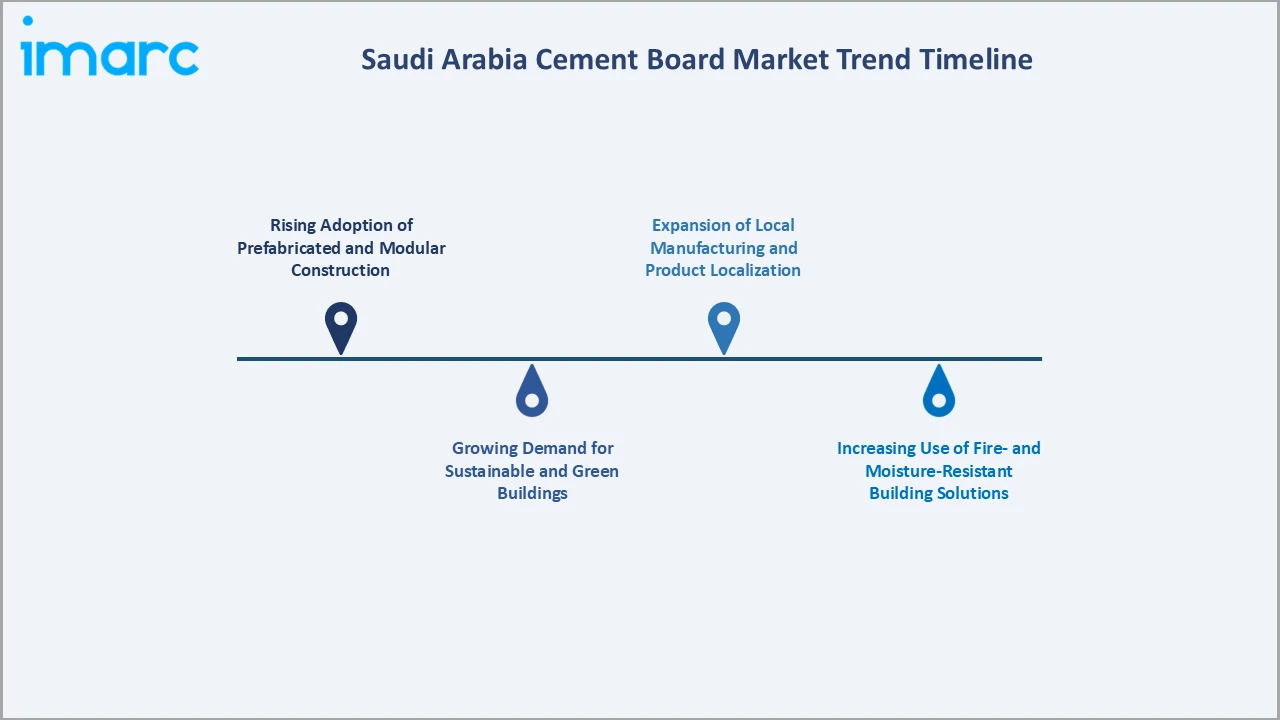
The growing use of prefabricated and modular building techniques is increasing demand for lightweight, durable cement boards that enable faster installation and reduced construction timelines. These systems are widely adopted in residential, commercial, and industrial projects under Vision 2030. Cement boards also minimize on-site labor requirements while improving construction efficiency and quality.
2. Growing Demand for Sustainable and Green Buildings
Saudi Arabia recorded the region’s highest sustainability score at 76.31 points and certified over 1.03 million square meters of sustainable building space. The achievement reflects measurable efficiency improvements across 6,662 projects completed since 2010. Developers are increasingly adopting environmentally friendly construction materials to meet sustainability goals and green building standards. Cement boards support energy-efficient construction due to their durability, long service life, and compatibility with insulated wall systems. Their use is expanding across residential, commercial, and public infrastructure projects seeking improved environmental performance.
3. Increasing Use of Fire- and Moisture-Resistant Building Solutions
Demand for high-performance construction materials with enhanced fire and moisture resistance is rising across Saudi Arabia. Cement boards are increasingly replacing conventional gypsum and wood-based panels in kitchens, bathrooms, façades, ceilings, and external cladding applications. Stricter building regulations and safety requirements continue to support this trend.
4. Expansion of Local Manufacturing and Product Localization
Manufacturers are expanding local production capacity to reduce import dependence and support Saudi Arabia's industrial localization objectives. Domestic manufacturing enables shorter lead times, improved supply chain resilience, and customized products suited to local climatic conditions. It also strengthens the competitiveness of regional suppliers.
Industry Value Chain Analysis
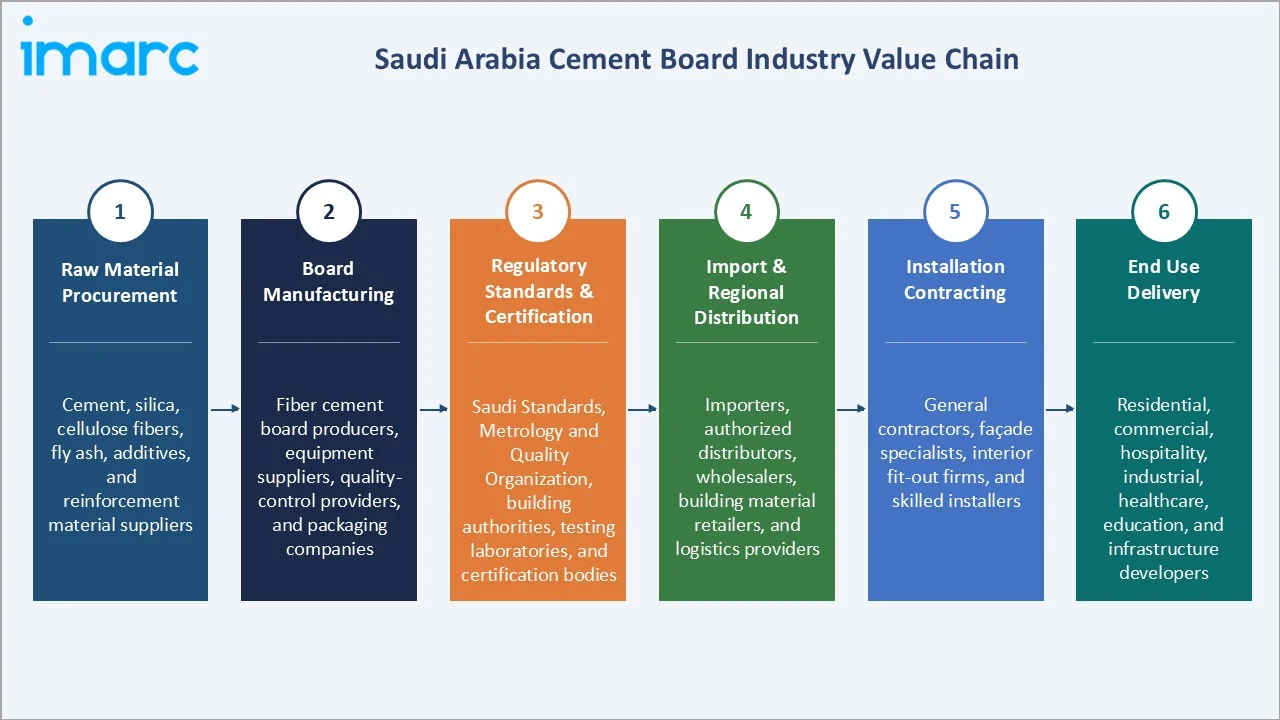
The Saudi Arabia cement board value chain integrates raw material procurement, board manufacturing, regulatory standards & certification, import & regional distribution, installation contracting, and end use delivery.
|
Stage |
Key Participants |
|
Raw Material Procurement |
Cement, silica, cellulose fibers, fly ash, additives, and reinforcement material suppliers. |
|
Board Manufacturing |
Fiber cement board producers, equipment suppliers, quality-control providers, and packaging companies. |
|
Regulatory Standards & Certification |
Saudi Standards, Metrology and Quality Organization, building authorities, testing laboratories, and certification bodies. |
|
Import & Regional Distribution |
Importers, authorized distributors, wholesalers, building material retailers, and logistics providers. |
|
Installation Contracting |
General contractors, façade specialists, interior fit-out firms, and skilled installers. |
|
End Use Delivery |
Residential, commercial, hospitality, industrial, healthcare, education, and infrastructure developers. |
Board manufacturing is the highest value-added stage in the Saudi Arabia cement board value chain, as it involves the formulation, pressing, curing, finishing, and quality testing of fiber cement boards. Product performance, including strength, fire resistance, moisture resistance, and dimensional stability, is largely determined during this stage. Manufacturers also differentiate their products through advanced production technologies, product innovation, and compliance with Saudi and international building standards.
Technology Landscape in the Saudi Arabia Cement Board Industry
Hatschek Continuous Manufacturing Technology
The Hatschek process is the most widely used manufacturing technology for fiber cement boards, enabling continuous production with consistent thickness and surface quality. It combines cement, cellulose fibers, silica, and additives into thin layers that are compressed into durable boards. The technology supports high-volume production while minimizing material waste and improving manufacturing efficiency.
Autoclave Curing Technology
Autoclave curing uses high-pressure steam to accelerate cement hydration and strengthen the board structure. This process improves dimensional stability, moisture resistance, fire performance, and mechanical strength. It also shortens production cycles while ensuring consistent product quality for demanding construction applications.
Fiber Reinforcement Technology
Manufacturers use cellulose fibers and synthetic reinforcing fibers to improve board flexibility, crack resistance, and structural integrity. Advanced fiber formulations enhance durability without compromising weight. This technology enables cement boards to withstand harsh climatic conditions and heavy construction use.
Market Segmentation Analysis
The report covers the following segments:
|
Segment Category |
Leading Segment |
Market Share |
Year |
|
Product Type |
Fiber Cement Board (FCB) |
51.4% |
2025 |
|
Application |
🔒 |
🔒 |
2025 |
|
End Use Industry |
Commercial |
44.3% |
2025 |
|
Region |
Northern and Central Region |
41.5% |
2025 |

By Product Type
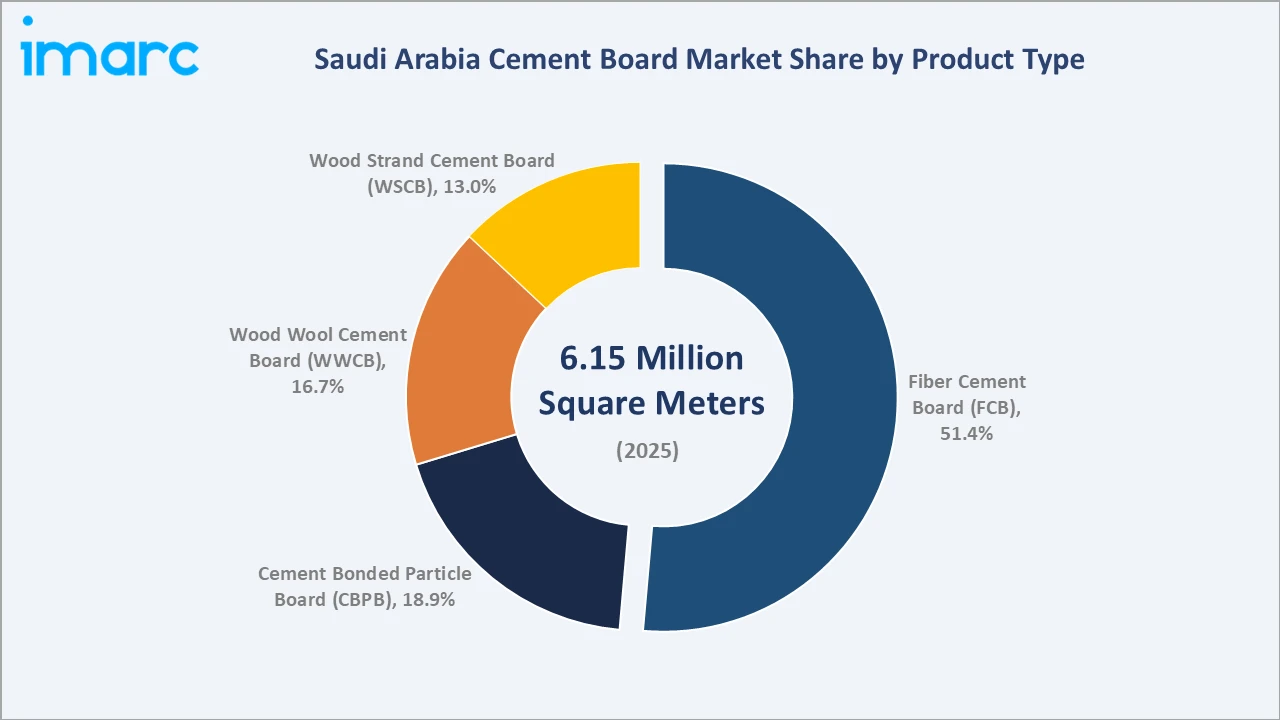
Fiber cement board (FCB) leads at 51.4% (2025) through its unmatched fire resistance, moisture impermeability, and dimensional stability under Saudi Arabia's extreme climate conditions. Cement bonded particle board (CBPB) at 18.9% serves industrial flooring, mezzanine decking, and heavy-load platforms in the Eastern Province's petrochemical and industrial construction sector.
To access detailed market analysis, Request Sample
Wood wool cement board (WWCB) at 16.7% addresses acoustic ceiling and wall applications in Vision 2030's education and healthcare construction pipeline. Wood strand cement board (WSCB) at 13.0% serves structural sheathing in LGSF modular housing construction and specialized acoustic applications in NEOM's prefabricated building systems.
By End Use Industry
Commercial end use leads at 44.3% (2025) through the extraordinary scale of Vision 2030's hospitality, entertainment, and retail construction pipeline.
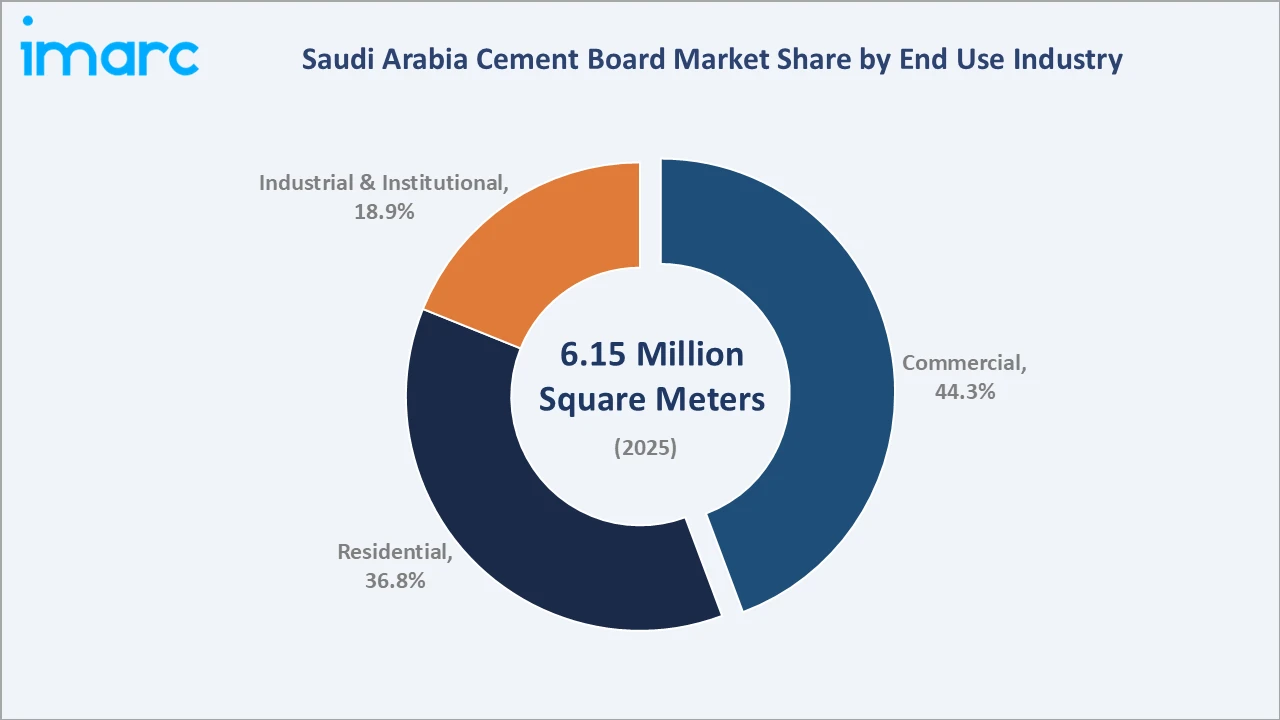
Residential at 36.8% is driven by the National Housing Program's target and growing FCB adoption in bathroom wet areas, kitchen cladding, and exterior sheathing for modular housing systems. Industrial and institutional at 18.9% encompasses Saudi Aramco and industrial facility construction, government ministry building construction, and healthcare and education institutional construction.
Regional Market Insights
|
Region |
Share (2025) |
Key Saudi Arabia Cement Board Market Drivers & Characteristics |
|
Northern and Central Region |
41.5% |
Dominates the market due to extensive residential, commercial, and infrastructure construction in Riyadh and surrounding cities. Vision 2030 giga-projects and strong government investment continue to drive cement board demand. |
|
Western Region |
27.1% |
Demand is supported by large tourism, hospitality, mixed-use developments, and religious infrastructure projects in Jeddah, Makkah, and Madinah. Increasing coastal urban development further boosts market growth. |
|
Eastern Region |
19.8% |
Industrial expansion, oil and gas facilities, logistics hubs, and commercial developments support steady demand for durable and moisture-resistant cement boards. Ongoing industrial diversification also contributes to market growth. |
|
Southern Region |
11.6% |
Market growth is driven by expanding residential construction, public infrastructure projects, and improving regional connectivity. Government investments in urban development continue to create new opportunities for cement board applications. |
Northern and Central regions' 41.5% market dominance is supported by extensive construction activity in Riyadh and surrounding urban centers. Large housing programs, commercial developments, and Vision 2030 projects continue to generate strong demand. Western region's 27.1% share represents the second-largest market, driven by tourism, hospitality, religious infrastructure, and mixed-use developments in Jeddah, Makkah, and Madinah.
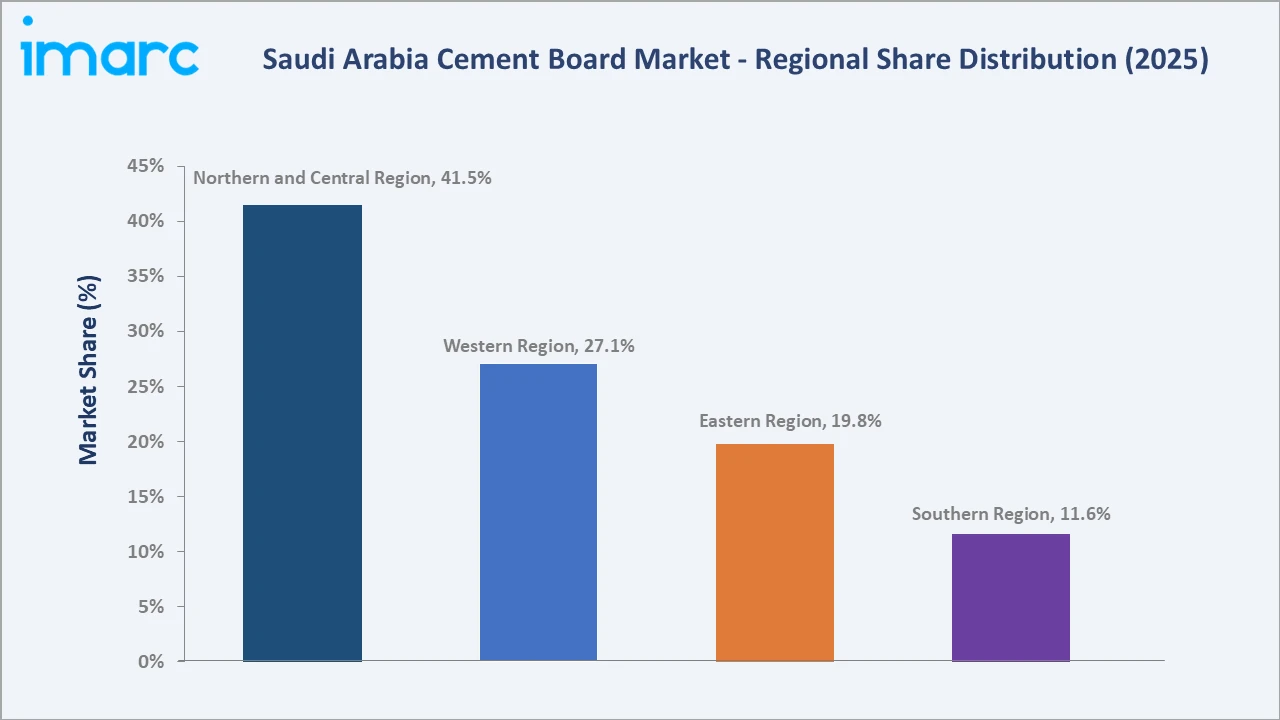
Eastern region's 19.8% share benefits from industrial expansion, logistics facilities, and oil and gas-related construction. Demand in this region is particularly strong for durable and moisture-resistant boards. Southern region, at 11.6% with ~5.20% CAGR, remains comparatively smaller but is expanding through residential construction and public infrastructure investment.
Competitive Landscape
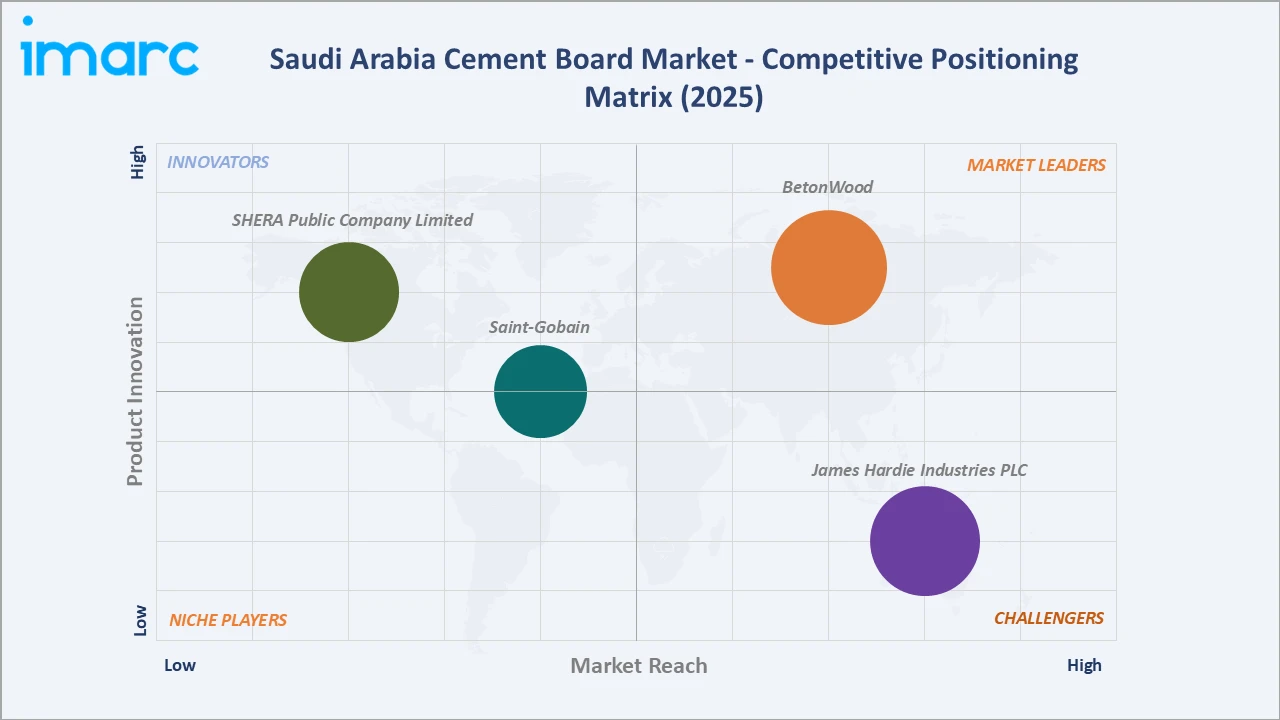
The Saudi Arabia cement board market is moderately competitive, with a mix of domestic manufacturers and international building material companies competing through product quality, manufacturing capabilities, and distribution networks. Companies are focusing on expanding local production, developing high-performance fire- and moisture-resistant boards, and strengthening relationships with contractors and developers. Innovation in sustainable products and compliance with evolving building standards are becoming key competitive differentiators. Strategic partnerships, capacity expansion, and participation in Vision 2030 projects continue to shape the competitive landscape.
|
Company |
Key Products |
Market Position |
Core Strength |
|
James Hardie Industries PLC |
Hardie Backer Cement Board |
Challenger |
In Saudi Arabia, James Hardie Industries PLC drives the fiber cement board market through advanced formulation technologies. |
|
SHERA Public Company Limited |
SHERA Floor Board |
Innovator |
SHERA Public Company Limited supplies high-quality, eco-friendly fiber-cement boards to Saudi Arabia's booming construction sector. |
|
Saint-Gobain |
AQUAROC FC BOARD |
Established Player |
Saint-Gobain plays a vital role in Saudi Arabia's cement and fibre cement board industry through its local manufacturing and supply of cementitious building materials through Gyproc. |
|
BetonWood |
BetonWood N, BetonWood Sanded, BetonWood Tongue/Groove, BetonWood Tongue/Groove Sanded, BetonFloor |
Market Leader |
BetonWood plays a vital role in the Saudi Arabian construction sector as a leading international supplier of high-density cement bonded particle boards. |
Competitive dynamics are increasingly defined by Vision 2030 giga-project specification influence. Achieving approved status requires certification, climate performance test data, and local technical service capability, barriers that favor established FCB brands over emerging suppliers.
Key Company Profiles
James Hardie Industries PLC
James Hardie Industries PLC is a recognized manufacturer of fiber cement building products and a technology leader in the cement board industry. The company develops high-performance fiber cement solutions for interior and exterior applications, including wall cladding, façades, flooring underlayments, and ceilings. Although its direct manufacturing presence in Saudi Arabia is limited, its products and technologies are supplied to the Kingdom through regional distribution networks and construction material partners.
- Key Products: Hardie Backer Cement Board.
- Strategic Focus: Expanding the adoption of high-performance fiber cement building solutions that offer superior fire resistance, moisture protection, durability, and low maintenance. The company emphasizes continuous product innovation, advanced manufacturing technologies, and sustainable building materials to meet evolving construction requirements.
BetonWood
BetonWood specialises in cement-bonded particle boards and sustainable building systems for residential, commercial, and industrial construction. The company offers high-density cement boards, thermal insulation systems, radiant flooring solutions, and acoustic building materials designed for fire resistance, moisture protection, and structural durability. Its cement-bonded particle boards are manufactured using Portland cement and wood fibers, supporting dry construction and energy-efficient building applications. While BetonWood does not have a direct manufacturing presence in Saudi Arabia, its products are available through international distribution channels and are well positioned to benefit from the Kingdom's growing demand for sustainable, high-performance construction materials driven by Vision 2030 and large-scale infrastructure development.
- Key Products: BetonWood N, BetonWood Sanded, BetonWood Tongue/Groove, BetonWood Tongue/Groove Sanded, BetonFloor.
- Strategic Focus: Promoting sustainable cement-bonded building materials that combine structural strength, fire resistance, moisture protection, and thermal performance for modern construction. The company emphasizes environmentally responsible manufacturing, energy-efficient building systems, and innovative dry construction solutions for residential, commercial, and industrial applications.
Market Concentration Analysis
The Saudi Arabia cement board market is moderately concentrated, with competition led by a mix of global manufacturers and regional building material suppliers. Established companies compete alongside local distributors through product quality, technical expertise, and project-based supply capabilities. Market participants are increasingly investing in sustainable and high-performance cement board solutions to align with evolving building regulations and Vision 2030 initiatives. Strong relationships with contractors, developers, and distribution partners remain critical competitive advantages, while innovation, local market presence, and reliable after-sales support continue to influence market positioning.
Investment & Growth Opportunities
Highest Growth Segments
FCB product type (~5.45% CAGR), commercial end use (~5.30% CAGR), Southern region (~5.20% CAGR driven by NEOM construction ramp-up), residential end use (~5.10% CAGR), and Northern and Central region (~5.10% CAGR through giga-project concentration) represent Saudi Arabia's highest-growth cement board investment vectors through 2034.
Investment Themes
- Domestic FCB Manufacturing: Investing in local fiber cement board manufacturing can reduce import dependence, shorten delivery times, and improve product customization for Saudi climatic and regulatory requirements. The opportunity is strengthened by localization incentives, expanding construction activity, and growing demand for fire-, moisture-, and heat-resistant building materials.
- NEOM and Giga-Project Long-Term Supply Agreement: Long-term supply contracts with NEOM and other giga-project developers can provide manufacturers with stable demand, predictable revenues, and strong market visibility. Suppliers offering certified, sustainable, and high-performance cement boards are well positioned to secure bulk orders for façades, modular buildings, interior partitions, and infrastructure facilities.
Future Market Outlook (2026-2034)
The Saudi Arabia cement board market is projected to grow from 6.15 Million Square Meters in 2025 to 9.48 Million Square Meters by 2034, delivering a 4.92% CAGR that reflects the structural alignment between Saudi Arabia's extraordinary building construction investment, its progressively tightening fire-safety and environmental building regulation, and the established technical superiority of cement board over conventional building panels in Saudi Arabia's extreme climate and regulatory environment. The anchor value of 7.82 Million Square Meters in 2030 is driven by three structural forces that compound through the forecast period.
First, Vision 2030's giga-project construction pipeline collectively represents the largest sustained demand source for high-specification FCB in the GCC construction market, sustaining above-market volume growth for the premium FCB segment that these projects specify. Second, the National Housing Program's target through 2030 embeds FCB as the standard exterior sheathing panel for LGSF modular housing systems assembled in Saudi industrial zone factories. Third, Saudi Arabia's import-dependent supply structure creates a structural market opening for the first investor to establish domestic FCB manufacturing.
Research Methodology
Primary Research
Primary research comprised in-depth interviews with product certification officers, technical committee representatives, Vision 2030 giga-project and facade engineering consultants, Riyadh and Jeddah cement board importers and distributors, National Housing Company modular construction program managers, facility construction procurement managers, building standards engineers, and major international FCB manufacturer Saudi Arabia country representatives. Discussions validated market volume estimates, segment dynamics, competitive positioning, regional demand patterns, and key project specification timelines.
Secondary Research
Secondary research encompassed fire and material standards documentation, product certification database for non-asbestos building board products, modular construction program documentation, NEOM material specification framework public documentation, and company annual reports.
Forecasting Models
Forecasting models were developed using historical Saudi Arabia cement board market volume data, Vision 2030 giga-project construction area and FCB intensity modeling, National Housing Program modular construction FCB sheathing requirement calculation, Saudi Building Code progressive tightening scenario analysis, product certification pipeline, regional market growth differential analysis across four regions, and domestic FCB manufacturing investment scenario modeling. Both top-down and bottom-up approaches were validated through primary research.
Saudi Arabia Cement Board Market Report Coverage:
| Report Features | Details |
|---|---|
| Base Year of the Analysis | 2025 |
| Historical Period | 2020-2025 |
| Forecast Period | 2026-2034 |
| Units | Million Square Meters |
| Scope of the Report |
Exploration of Historical Trends and Market Outlook, Industry Catalysts and Challenges, Segment-Wise Historical and Future Market Assessment:
|
| Product Types Covered | Fiber Cement Board (FCB), Wood Wool Cement Board (WWCB), Wood Strand Cement Board (WSCB), Cement Bonded Particle Board (CBPB) |
| Applications Covered | Flooring, Exterior and Partition Walls, Roofing, Columns and Beams, Facades, Weatherboard, and Cladding, Acoustic and Thermal Insulation, Others |
| End-User Industries Covered | Residential, Commercial, Industrial and Institutional |
| Regions Covered | Northern and Central Region, Western Region, Eastern Region, Southern Region |
| Companies Covered | James Hardie Industries PLC, SHERA Public Company Limited, Saint-Gobain, BetonWood, etc. |
| Customization Scope | 10% Free Customization |
| Post-Sale Analyst Support | 10-12 Weeks |
| Delivery Format | PDF and Excel through Email (We can also provide the editable version of the report in PPT/Word format on special request) |
Key Benefits for Stakeholders:
- IMARC’s industry report offers a comprehensive quantitative analysis of various market segments, historical and current market trends, market forecasts, and dynamics of the Saudi Arabia cement board market from 2020-2034.
- The research report provides the latest information on the market drivers, challenges, and opportunities in the Saudi Arabia cement board market.
- Porter's five forces analysis assist stakeholders in assessing the impact of new entrants, competitive rivalry, supplier power, buyer power, and the threat of substitution. It helps stakeholders to analyze the level of competition within the Saudi Arabia cement board industry and its attractiveness.
- Competitive landscape allows stakeholders to understand their competitive environment and provides an insight into the current positions of key players in the market.
Frequently Asked Questions About the Saudi Arabia Cement Board Market Report
The market reached 6.15 Million Square Meters in 2025, driven by Vision 2030 giga-projects specifying FCB for exterior cladding, Saudi Building Code fire-rated non-combustible material mandates, and National Housing Program 1 million affordable unit delivery requiring FCB for wet areas and LGSF modular sheathing.
The market grows at 4.92% CAGR during 2026-2034, reaching 9.48 Million Square Meters by 2034. Growth will be supported by expanding construction activity, giga-project development, and rising demand for durable building materials.
Fiber cement board (FCB) leads at 51.4% (2025) through non-asbestos compliance, Saudi Building Code non-combustible mandate, extreme climate dimensional stability, and giga-project premium specification.
Commercial leads at 44.3% (2025) through Vision 2030 hospitality, entertainment venue construction, and retail development.
Northern and Central region leads at 41.5% (2025) through Riyadh's concentration of Vision 2030 projects, NEOM supply logistics coordination, and National Housing Company modular residential programs.
Leading companies include James Hardie Industries PLC, SHERA Public Company Limited, Saint-Gobain, and BetonWood, among others.
The market is projected to reach approximately 7.82 Million Square Meters by 2030, driven by NEOM THE LINE residential and hospitality building envelope FCB specification peak phase, National Housing Program modular construction FCB sheathing demand scaling toward 1 million units target, Red Sea resort portfolio construction second phase expansion, and potential domestic FCB manufacturing investments.
Top investment opportunities: domestic FCB manufacturing facility under Vision 2030, NEOM long-term FCB cladding supply agreement, Red Sea resort WWCB acoustic specification, and FCB certified installation contractor network.
Need more help?
- Speak to our experienced analysts for insights on the current market scenarios.
- Include additional segments and countries to customize the report as per your requirement.
- Gain an unparalleled competitive advantage in your domain by understanding how to utilize the report and positively impacting your operations and revenue.
- For further assistance, please connect with our analysts.
 Request Customization
 Speak to an Analyst
 Request Brochure
 Inquire Before Buying
Benefits of Customization
- Personalize this research
- Triangulate with your data
- Get data as per your format and definition
- Gain a deeper dive into a specific application, geography, customer, or competitor
- Any level of personalization
Get in Touch With Us
UNITED STATES
Phone: +1-201-971-6302
INDIA
Phone: +91-120-433-0800
UNITED KINGDOM
Phone: +44-753-714-6104
Email: [email protected]
Client Testimonials




.webp)




.webp)













Related Reports

Choose your plan
*Please note that the prices mentioned below are starting prices for each bundle type. Kindly contact our team for further details.*
Single User License
- 1 User License, Access on 2 Devices
- PDF Report + Excel Dataset (Password Protected)
- Lifetime Access
- No Printing Rights
- 10% Free Report Customization
- 10–12 Weeks of Analyst Support
Five User License
- Access for 5 Users, 2 Devices per User
- PDF Report + Excel Dataset (Password Protected)
- Lifetime Access
- Dedicated Account Manager
- 12–14 Weeks of Analyst Support
- No Printing Rights
- 15% Free Report Customization
- 25% Discount on Your Next Purchase
Corporate User License
- Unlimited User Access (Within Your Organization)
- PDF Report + Excel Dataset
- Lifetime Access
- Dedicated Account Manager
- 14–20 Weeks of Analyst Support
- No Printing Rights
- 20% Free Report Customization
- 30% Discount on Your Next Purchase
Essential Insights
What's included:
3 reports
- Lifetime Access
- PDF Reports
- Excel Datasets
- 2 Weeks of Free Analyst Support
- 2 User Licenses
- Access on 2 Devices
- Printing Rights
- Complimentary PowerPoint (PPT) Version
- Complimentary License Upgrade
Professional Access
What's included:
5 reports
- Lifetime Access
- PDF Reports
- Excel Datasets
- 8 Weeks of Free Analyst Support
- 2 User Licenses
- Access on 2 Devices
- Printing Rights
- Complimentary PowerPoint (PPT) Version
- Complimentary License Upgrade
Business Advantage
What's included:
8 reports
- Lifetime Access
- PDF Reports
- Excel Datasets
- 14 Weeks of Free Analyst Support
- 2 User Licenses
- Access on 2 Devices
- Printing Rights
- Complimentary PowerPoint (PPT) Version
- Complimentary License Upgrade
Enterprise Intelligence
What's included:
10 reports
- Lifetime Access
- PDF Reports
- Excel Datasets
- 20 Weeks of Free Analyst Support
- 2 User Licenses
- Access on 2 Devices
- Printing Rights
- Complimentary PowerPoint (PPT) Version
- Complimentary License Upgrade