
Saudi Arabia Chatbot Market Size, Share, Trends and Forecast by Type, Product, Application, Organization Size, Vertical, and Region, 2026-2034
Saudi Arabia Chatbot Market Size, Share, Trends & Forecast (2026-2034)
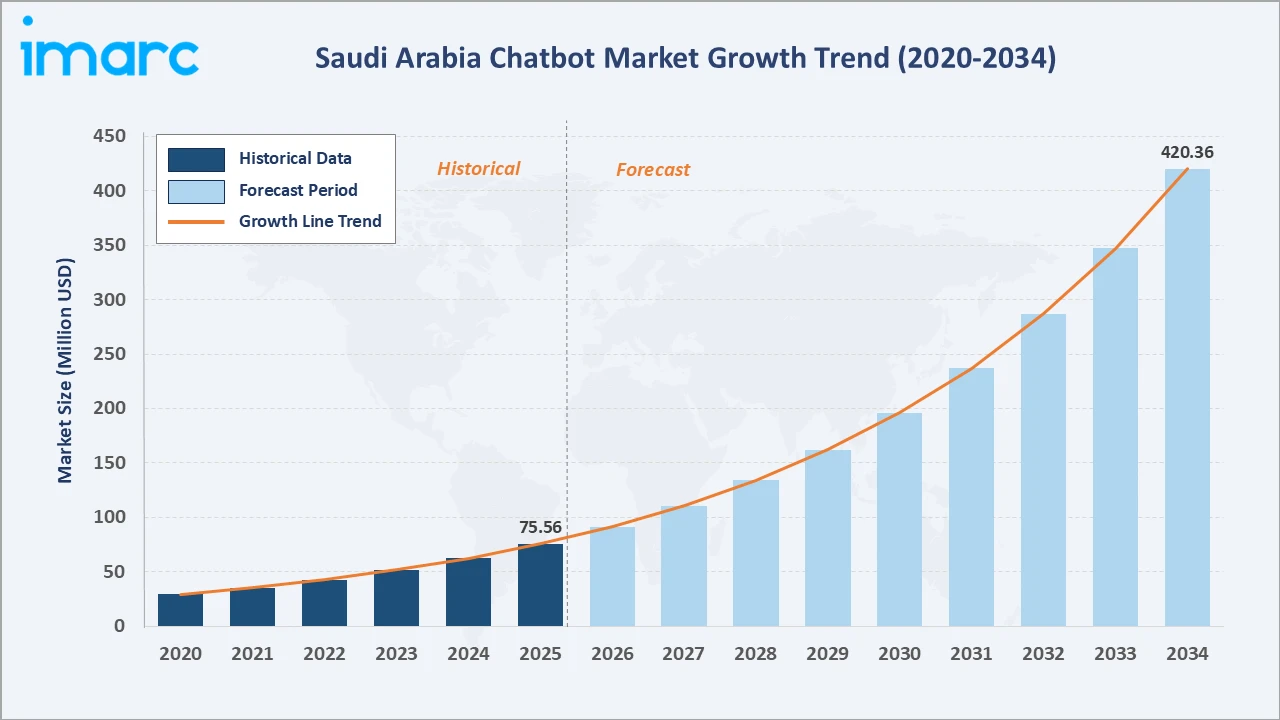
The Saudi Arabia chatbot market grew from USD 75.56 Million in 2025 to USD 91.43 Million in 2026 and is projected to reach USD 420.36 Million by 2034, exhibiting a CAGR of 21.01% during 2026-2034. Accelerating digital transformation under Vision 2030, rapid 5G infrastructure expansion, and growing enterprise demand for AI-powered customer engagement tools are the primary forces shaping market growth.
Web-based leads the type segment at 45.0%, artificial intelligence dominates the product segment at 55.0%, and Northern and Central Region commands 42.0% of regional share.
Market Snapshot
| Metric | Value |
|---|---|
| Base Year Market Size (2025) | USD 75.56 Million |
| Market Size (2026) | USD 91.43 Million |
| Forecast Market Size (2034) | USD 420.36 Million |
| CAGR (2026-2034) | 21.01% |
| Base Year | 2025 |
| Historical Period | 2020-2025 |
| Forecast Period | 2026-2034 |
| Largest Region | Northern and Central Region (42.0%, 2025) |
| Second Largest Region | Western Region (28.0%, 2025) |
| Leading Type | Web-based (45.0%, 2025) |
| Leading Product | Artificial Intelligence (55.0%, 2025) |
The Saudi Arabia chatbot market size increased from USD 29.12 Million in 2020 to USD 75.56 Million in 2025 and is estimated to reach USD 91.43 Million in 2026. The market is further expected to grow to USD 196.05 Million by 2030 and USD 420.36 Million by 2034. The market is commercially dynamic, underpinned by Saudi Arabia's accelerating digital infrastructure, a rapidly expanding AI adoption curve, and growing enterprise investment in conversational AI platforms across the financial services, retail, and government sectors.
To get more information on this market, Request Sample
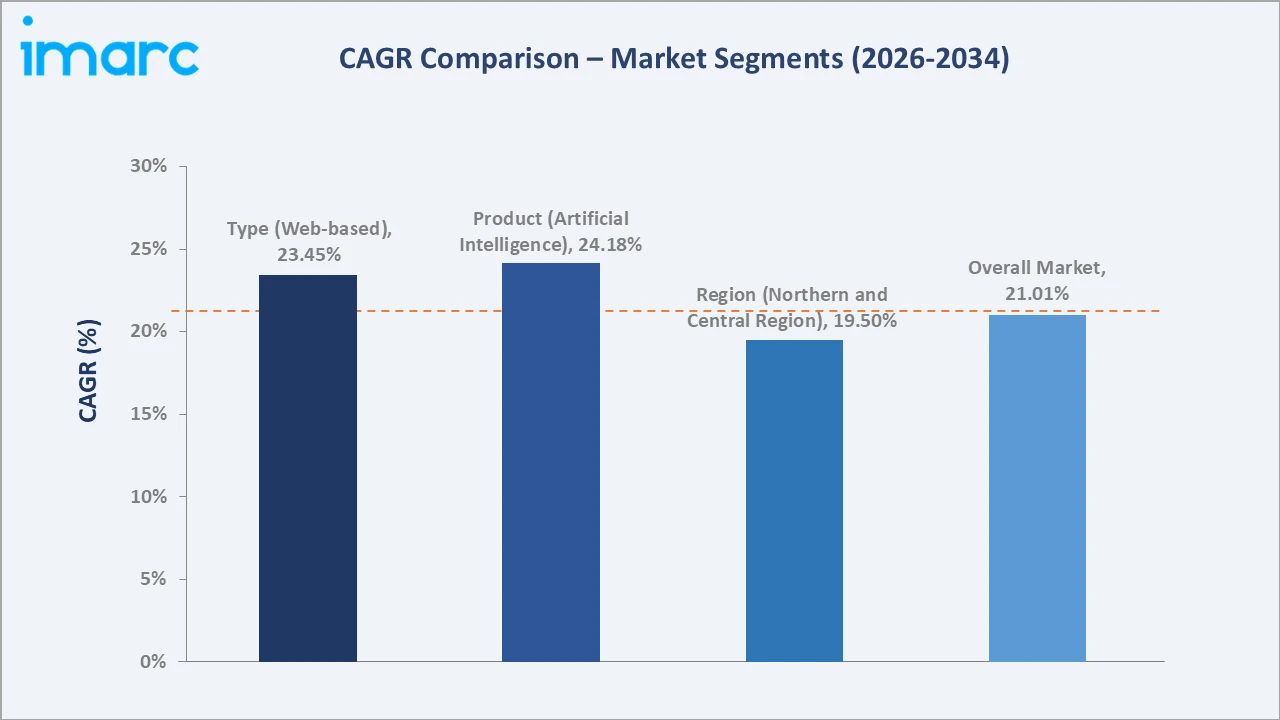
CAGR trajectories across type, product, and regional sub-segments show artificial intelligence and Southern Region expanding faster than the overall 21.01% market CAGR, driven by rising adoption of AI-powered conversational solutions, increasing business automation requirements, and growing digital transformation initiatives across regional industries.
Executive Summary
The Saudi Arabia chatbot market expanded from USD 75.56 Million in 2025 to an estimated USD 91.43 Million in 2026, driven by accelerating digital transformation under Vision 2030, rising enterprise adoption of AI-powered customer engagement tools, and expanding 5G infrastructure. Growing e-commerce penetration and increasing smartphone usage further support market growth across the Kingdom.
Web-based commands 45.0% type share in 2025, reflecting widespread enterprise adoption across customer service, banking, and e-commerce platforms. Artificial intelligence leads the product segment at 55.0%, driven by NLP advancements and machine learning (ML) integration enabling context-aware interactions. Northern and Central Region leads with 42.0% regional share, anchored by Riyadh's concentration of financial institutions and technology firms.
Key Market Insights
| Insight | Data |
|---|---|
| Leading Type | Web-based – 45.0% share (2025) |
| Second Largest Type | Messenger-based/Third party – 30.0% share (2025) |
| Leading Product | Artificial Intelligence – 55.0% share (2025) |
| Second Largest Product | Marketing – 25.0% share (2025) |
| Leading Region | Northern and Central Region – 42.0% share (2025) |
| Second Largest Region | Western Region – 28.0% share (2025) |
| Top Companies | Alphabet Inc., Microsoft Corporation, IBM, Amazon.com, Inc. |
Key Analytical Observations Expanding On the Data Above:
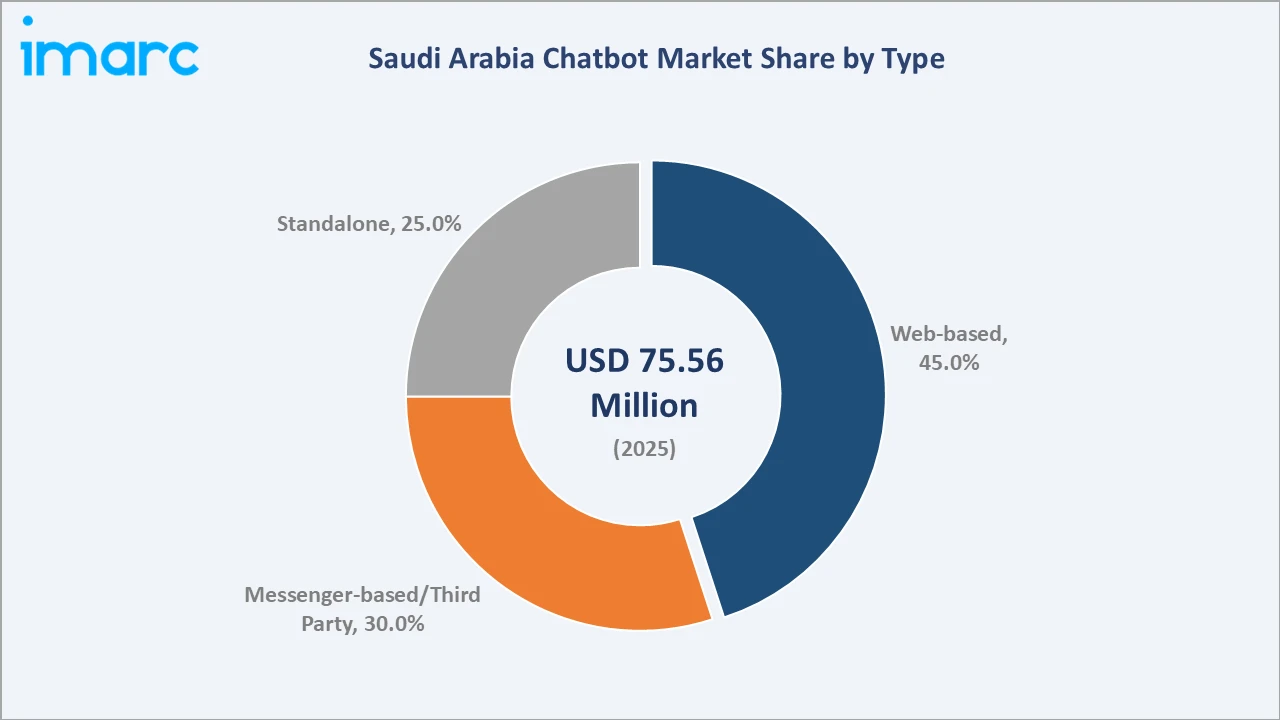
- Web-based dominance at 45.0% reflects its cross-device accessibility, ease of integration with enterprise customer service platforms, and high adoption across banking, retail, and government portals in Saudi Arabia.
- Messenger-based/third party share at 30.0% is supported by growing use of messaging applications for customer interaction and the cost-effective deployment of third-party chatbot integrations across social media platforms.
- Artificial intelligence leadership at 55.0% is driven by its ability to deliver intelligent, context-aware responses, reducing operational costs and improving customer satisfaction in high-volume interaction environments.
- Marketing at 25.0% captures demand from enterprises deploying chatbots for lead generation, personalized promotions, and automated customer acquisition workflows.
- Northern and Central Region at 42.0% leads market share due to Riyadh's density of financial services companies, government digital service portals, and large enterprise technology deployments.
Saudi Arabia Chatbot Market Overview
A chatbot is an AI-driven software application that simulates human conversation through text or voice interfaces. Spanning rule-based to advanced generative AI systems, chatbots are deployed across web portals, messaging applications, and voice platforms. Applications range from customer service automation and e-commerce support to healthcare triage, banking assistance, and government digital services.
The Saudi Arabia chatbot market ecosystem integrates technology providers, AI and NLP developers, cloud platform operators, system integrators, and enterprise end-users. Macroeconomic tailwinds including Vision 2030 digital transformation programs, rising 5G penetration, and growing investment in smart city and e-government infrastructure are accelerating enterprise chatbot deployments across the Kingdom.
Market Dynamics
To evaluate market opportunities, Request Sample
Market Drivers
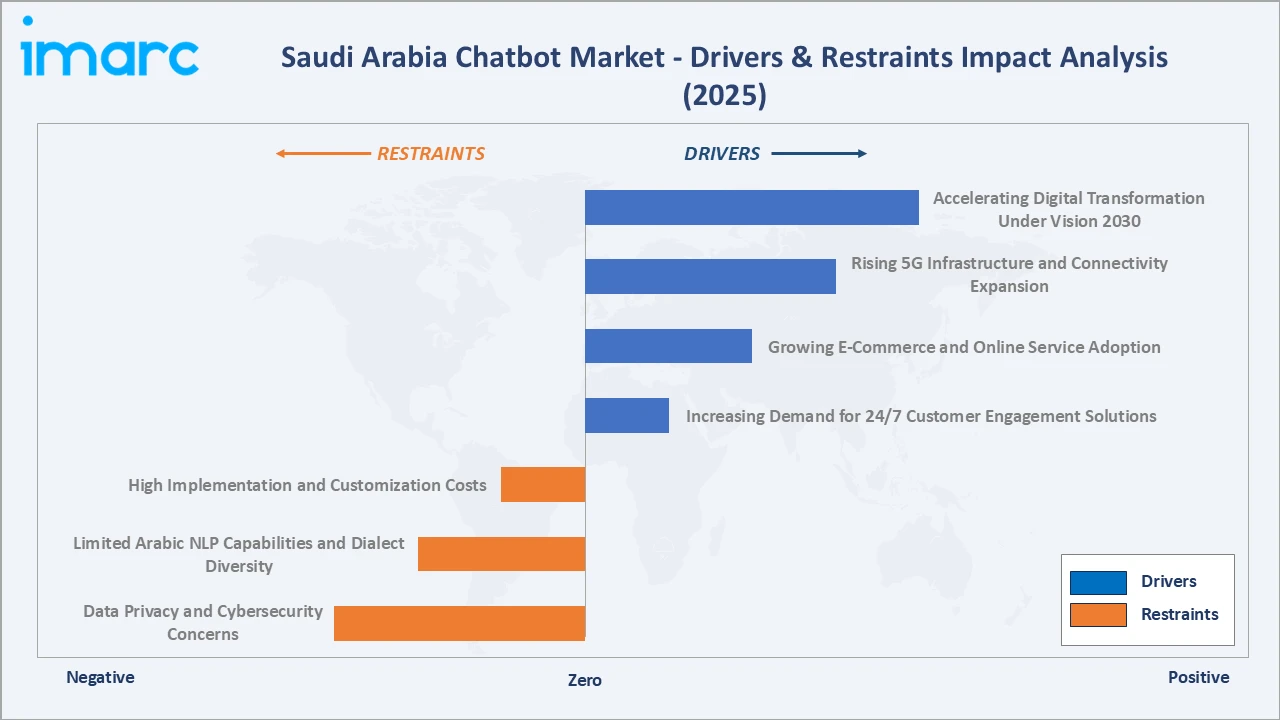
- Accelerating Digital Transformation Under Vision 2030: Saudi Arabia's Vision 2030 program is driving widespread enterprise digitization across financial services, retail, healthcare, and government sectors, directly increasing demand for AI-powered customer engagement platforms and automated service delivery solutions. Saudi Arabia ranked 22nd globally in the IMD World Digital Competitiveness Index in 2025, reflecting steady advances in digital infrastructure and enterprise technology adoption.
- Rising 5G Infrastructure and Connectivity Expansion: As per IMARC Group, the Saudi Arabia 5G infrastructure market size reached USD 199.5 Million in 2025. Rapid 5G rollout across Saudi Arabia is improving network capacity and reducing latency for real-time conversational AI applications, enabling more responsive chatbot interactions across mobile and IoT-connected customer touchpoints.
- Growing E-Commerce and Online Service Adoption: Rising e-commerce penetration and expanding digital service platforms are increasing demand for automated customer support, order management, and personalized shopping assistance capabilities that chatbots are well-positioned to deliver.
- Increasing Demand for 24/7 Customer Engagement Solutions: Enterprises across banking, telecommunications, and retail are deploying chatbots to provide round-the-clock customer service, reducing operational costs while improving response times and customer satisfaction metrics.
Market Restraints
- High Implementation and Customization Costs: Deploying enterprise-grade chatbot platforms requires significant investment in AI model training, integration with legacy systems, and ongoing maintenance, creating barriers for small and mid-sized enterprises with limited technology budgets.
- Limited Arabic NLP Capabilities and Dialect Diversity: The Arabic language presents unique NLP challenges due to its complex morphology, wide dialect variations across Saudi regions, and code-switching behavior, limiting the accuracy and adoption of chatbot solutions in Arabic-language customer interactions.
- Data Privacy and Cybersecurity Concerns: Growing regulatory scrutiny around personal data handling, combined with increasing cybersecurity incidents targeting AI-connected systems, is causing enterprises to adopt more cautious chatbot deployment strategies and invest in compliance-validated implementations.
Market Opportunities
- Government Digital Services Chatbot Deployment: Saudi Arabia's National Digital Transformation Unit and Vision 2030 e-government programs represent a large addressable opportunity for chatbot vendors offering Arabic-language, compliant platforms for citizen service automation across ministries and public agencies.
- Healthcare and Financial Services AI Assistant Adoption: Rising demand for patient triage, appointment scheduling, and banking service automation in Saudi Arabia's healthcare and financial services sectors creates significant growth potential for AI assistant platforms with sector-specific regulatory compliance capabilities.
Market Challenges
- Integration Complexity with Legacy Systems: Many Saudi enterprises operate heterogeneous IT environments spanning legacy ERP, CRM, and contact center platforms, creating significant technical complexity and cost in integrating modern chatbot solutions with existing operational infrastructure.
- User Trust and Adoption Barriers in Conversational AI: Building user trust in chatbot-mediated interactions remains a challenge, particularly for sensitive use cases in banking, healthcare, and government services, where users often prefer human agent escalation over automated resolution.
Emerging Market Trends
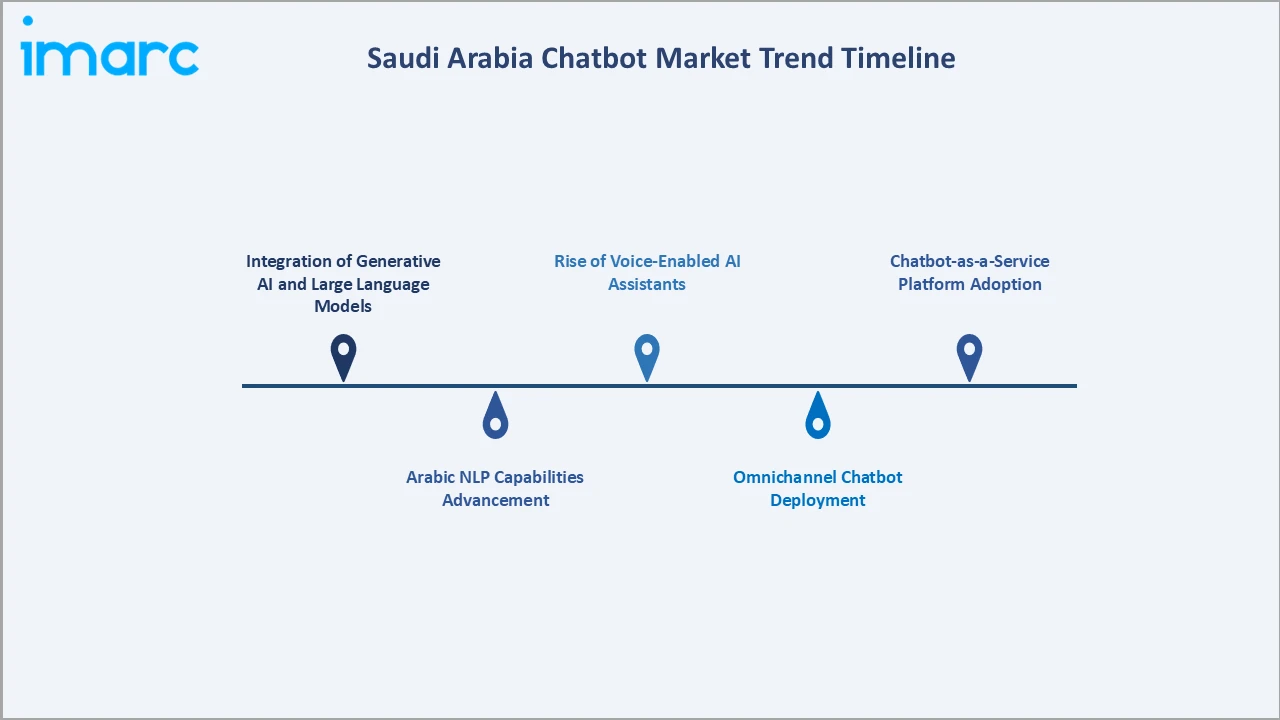
1. Integration of Generative AI and Large Language Models
Saudi enterprises are increasingly integrating large language models and generative AI capabilities into chatbot platforms, enabling more natural, context-aware conversations beyond pre-scripted responses. This shift is expanding chatbot applicability across complex customer service, advisory, and transactional use cases.
2. Arabic NLP Capabilities Advancement
Significant investment in Arabic NLP is improving the accuracy and fluency of AI-powered chatbots for Saudi and Gulf Arabic dialects. This trend is broadening chatbot adoption beyond English-language enterprise environments.
3. Omnichannel Chatbot Deployment
Enterprises are transitioning from single-channel chatbot deployments to omnichannel strategies spanning web portals, mobile apps, messaging platforms, and voice interfaces. Unified conversation management across channels is improving customer experience consistency and reducing operational complexity for large-scale deployments.
4. Rise of Voice-Enabled AI Assistants
Voice-activated chatbot interfaces are gaining adoption in Saudi Arabia, particularly in smart home, automotive, and customer service contexts. Advances in Arabic speech recognition and text-to-speech synthesis are enabling more accurate and natural voice interactions across consumer and enterprise applications.
5. Chatbot-as-a-Service Platform Adoption
Cloud-based chatbot-as-a-service platforms are lowering deployment barriers for small and mid-sized Saudi enterprises, enabling rapid implementation without significant upfront AI infrastructure investment. SaaS-model chatbot solutions are expanding market penetration beyond large enterprise segments.
Industry Value Chain Analysis
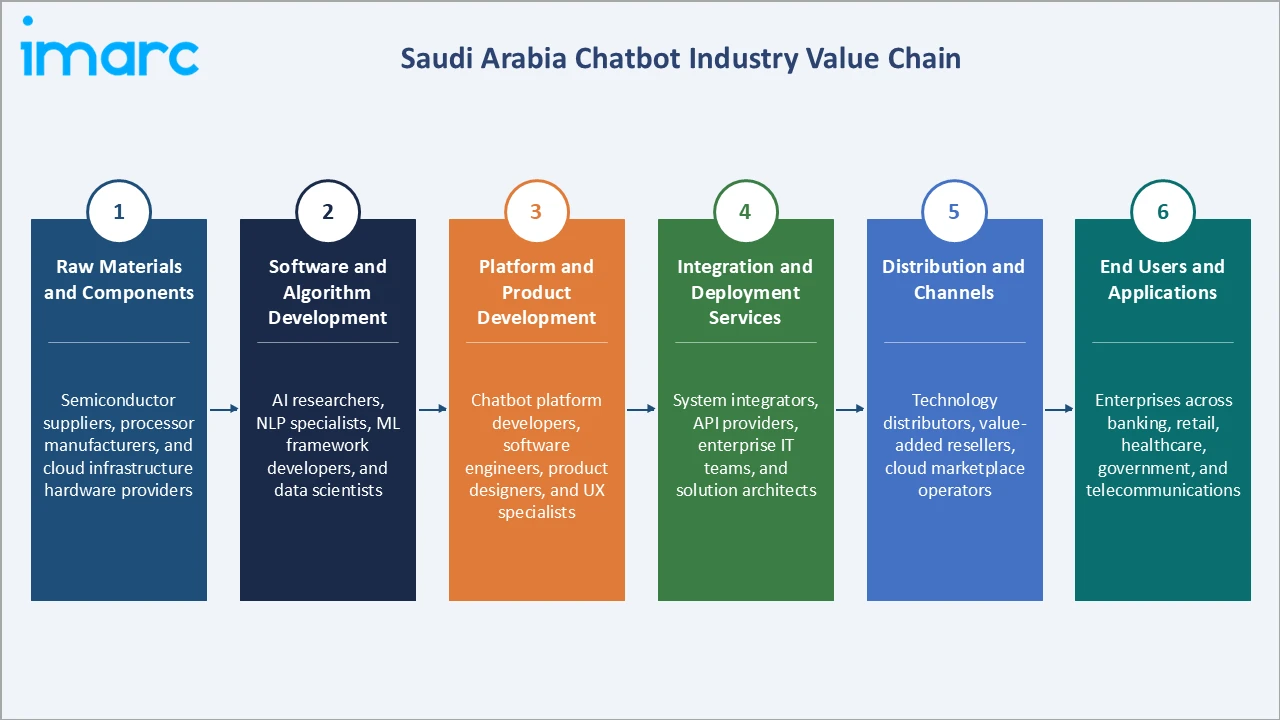
The Saudi Arabia chatbot market value chain spans six stages, from raw material and component supply through software development, platform build, integration, distribution, and final enterprise and consumer deployment. Platform and product development, integration services, and AI algorithm optimization stages capture the highest value-add.
| Stage | Key Players / Examples |
|---|---|
| Raw Materials and Components | Semiconductor suppliers, processor manufacturers, and cloud infrastructure hardware providers enabling AI computation and server capacity for chatbot platforms |
| Software and Algorithm Development | AI researchers, NLP specialists, ML framework developers, and data scientists building conversational AI models and training datasets |
| Platform and Product Development | Chatbot platform developers, software engineers, product designers, and UX specialists building deployable chatbot solutions and conversational interfaces |
| Integration and Deployment Services | System integrators, API providers, enterprise IT teams, and solution architects connecting chatbot platforms with CRM, ERP, and contact center systems |
| Distribution and Channels | Technology distributors, value-added resellers, cloud marketplace operators, and digital platform providers delivering chatbot solutions to enterprise customers |
| End Users and Applications | Enterprises across banking, retail, healthcare, government, and telecommunications deploying chatbots for customer service, sales automation, and internal productivity |
Vertically integrated vendors controlling platform development, integration, and managed service delivery are positioned to capture greater margin than point-solution providers dependent on third-party channel partners for enterprise deployment.
Technology Landscape in the Saudi Arabia Chatbot Industry
NLP and ML
NLP and ML form the foundational technology layer of the Saudi Arabia chatbot market. Intent recognition, entity extraction, and sentiment analysis capabilities are improving chatbot accuracy across Arabic and English customer interactions.
Large Language Models and Generative AI
Enterprise adoption of large language model-based platforms is accelerating, enabling more nuanced, context-aware chatbot responses across complex query types. Generative AI integration is expanding chatbot applicability beyond FAQ automation to advisory and transactional use cases.
Omnichannel Integration and API Frameworks
Modern chatbot platforms are built on open API architectures enabling integration with CRM, ERP, and contact center systems. Omnichannel frameworks allow unified conversation management across web, mobile, voice, and messaging interfaces, improving customer experience consistency.
Cloud Infrastructure and SaaS Deployment
Cloud-based deployment models are lowering entry barriers and enabling scalable, pay-per-use chatbot infrastructure. SaaS platforms from major cloud providers are expanding market access for mid-market Saudi enterprises seeking rapid deployment without large upfront investment.
Market Segmentation Analysis
The report covers the following segments:
| Segment Category | Leading Segment | Market Share | Year |
|---|---|---|---|
| Type | Web-based | 45.0% | 2025 |
| Product | Artificial Intelligence | 55.0% | 2025 |
| Application | 🔒 | 🔒 | 2025 |
| Organization Size | 🔒 | 🔒 | 2025 |
| Vertical | 🔒 | 🔒 | 2025 |
| Region | Northern and Central Region | 42.0% | 2025 |

By Type
Web-based commands a 45.0% majority share in 2025, driven by their ease of integration, cost-effectiveness, and widespread accessibility across business websites and digital platforms.
To access detailed market analysis, Request Sample
Messenger-based/third party at 30.0% is the second-largest type segment, supported by growing adoption of messaging platform integrations for customer service and sales automation.
By Product
Artificial intelligence represents 55.0% of the product segment in 2025, directly reflecting the dominant enterprise preference for AI-powered conversational tools capable of intelligent intent recognition and context-aware response generation.
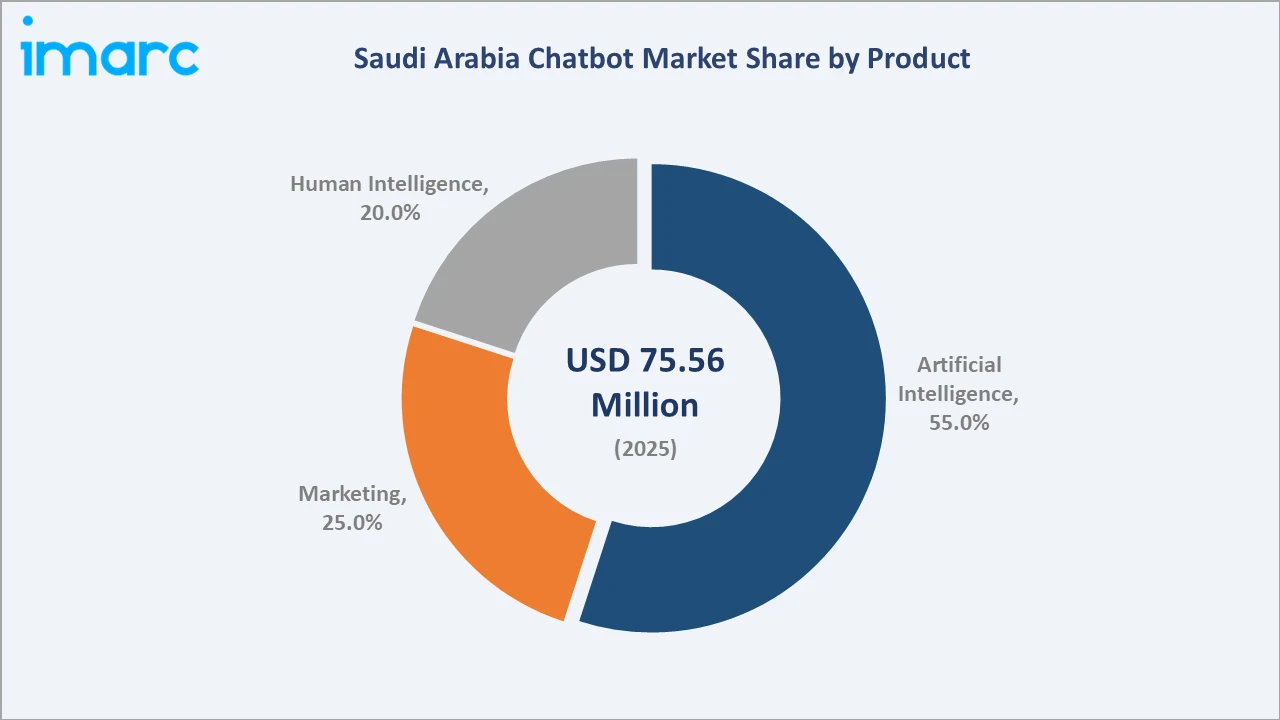
Marketing at 25.0% is the second-largest product segment, driven by enterprise demand for automated lead generation and personalized customer acquisition tools.
Regional Market Insights
| Region | Share (2025) | Key Growth Drivers |
|---|---|---|
| Northern and Central Region | 42.0% | Large concentration of financial services companies, government entities, technology enterprises, and telecommunications providers in Riyadh; high enterprise chatbot adoption and advanced digital infrastructure |
| Western Region | 28.0% | Expanding e-commerce and tourism sector activity in Jeddah, growing retail and hospitality enterprise adoption, and increasing smart city and digital service investment |
| Eastern Region | 20.0% | Oil and gas sector digital transformation, industrial enterprise automation investment, and growing technology and logistics sector chatbot adoption in Dammam and Dhahran |
| Southern Region | 10.0% | Emerging enterprise technology adoption, growing government digital service deployment, and expanding SME sector investment in customer engagement automation |
Northern and Central Region at 42.0% in 2025 leads the regional landscape, anchored by Riyadh's dense concentration of large enterprises, financial institutions, and government digital service programs, all driving high-volume chatbot deployments.
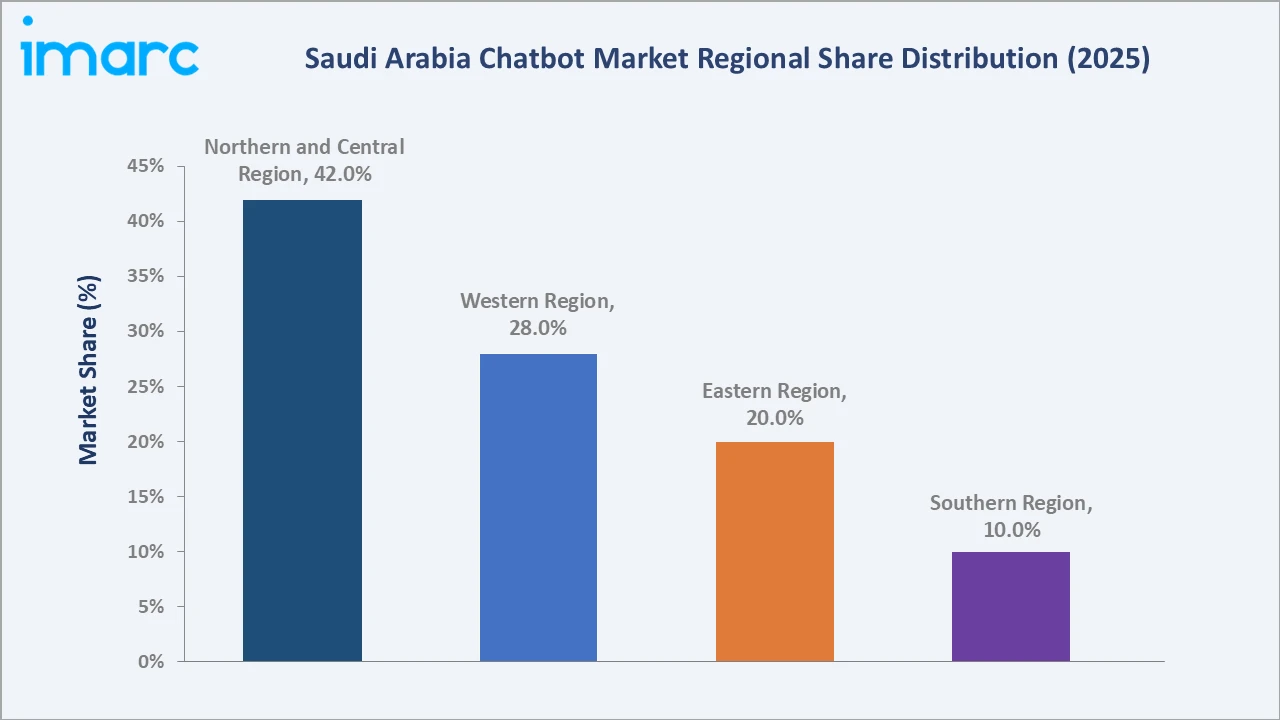
Western Region at 28.0% is supported by growing digital transformation initiatives, increasing adoption of AI-powered customer service solutions, and the concentration of commercial establishments across Jeddah and surrounding areas.
Competitive Landscape
The Saudi Arabia chatbot market is competitive, with a mix of global technology conglomerates, specialized AI platform companies, and regional technology providers competing on NLP accuracy, Arabic language support, cloud scalability, and enterprise integration depth. Scale, certified AI capabilities, and proximity to Saudi enterprise decision-makers form the key competitive differentiators.
| Company Name | Brand / Key Product | Position | Strategic Focus |
|---|---|---|---|
| Alphabet Inc. | Conversational Agents | Leader | Expanding AI-powered conversational capabilities through cloud NLP services and generative AI platform integration |
| Microsoft Corporation | Microsoft Copilot Studio | Leader | Building enterprise chatbot infrastructure through Azure AI services and Copilot Studio platform |
| IBM | IBM watsonx Assistant | Leader | Advancing enterprise AI assistant deployment through watsonx AI platform and industry-specific NLP capabilities |
| Amazon.com, Inc. | Amazon Lex | Challenger | Growing conversational AI capabilities across AWS cloud services and enterprise chatbot deployments |
Key players include Alphabet Inc., Microsoft Corporation, IBM, and Amazon.com, Inc., among others.
Key Company Profiles
Alphabet Inc.
Alphabet Inc. is a United States-based technology conglomerate headquartered in Mountain View, California. Through its Google Cloud division, the company provides AI-powered conversational platforms including Conversational Agents, serving enterprise clients across several countries.
- Product Portfolio: Conversational Agents, Vertex AI Conversation, Google Cloud Contact Center AI, and CCAI Insights for enterprise conversational automation and analytics.
- Recent Developments: The company continues to enhance its conversational AI capabilities through generative AI integration, platform upgrades, and the expansion of enterprise-focused chatbot solutions across industries.
- Strategic Focus: Scaling generative AI-powered conversational capabilities through Google Cloud platform investments and expanding enterprise AI assistant deployments across financial services, retail, and government verticals.
Microsoft Corporation
Microsoft Corporation is a United States-based technology company headquartered in Redmond, Washington. Through its Azure AI and Copilot Studio platforms, it provides enterprise-grade chatbot and conversational AI solutions serving large global enterprises and government organizations.
- Product Portfolio: Azure Bot Service, Microsoft Copilot Studio, Azure Cognitive Services for Language, and Dynamics 365 Customer Service with integrated AI chatbot capabilities.
- Recent Developments: The company continues to expand Copilot Studio capabilities, integrating Azure OpenAI Service functionalities and strengthening Arabic language support across its conversational AI product portfolio.
- Strategic Focus: Building enterprise conversational AI infrastructure through Azure platform investment and deepening integration between Copilot Studio and Microsoft 365 productivity suite.
IBM
IBM is a United States-based technology and consulting company headquartered in Armonk, New York. IBM watsonx Assistant is a flagship enterprise AI chatbot platform offering NLP-powered conversational automation across regulated industries.
- Product Portfolio: IBM watsonx Assistant, IBM Watson Discovery, and AI-powered customer service automation solutions for banking, healthcare, and government verticals.
- Recent Developments: The company continues to enhance its watsonx Assistant platform through generative AI integration, improved conversational capabilities, and expanded enterprise automation solutions across regulated industries.
- Strategic Focus: Deepening IBM watsonx Assistant enterprise capabilities through generative AI integration and growing deployment across regulated industry verticals including banking, insurance, and public sector.
Market Concentration Analysis
The Saudi Arabia chatbot market is moderately fragmented, with the top tier of global technology companies and platform providers accounting for a significant but not dominant share of enterprise deployments.
Barriers to entry include the capital requirements for AI model development and training infrastructure, the need for Arabic language NLP expertise, enterprise security and compliance certifications, and the technical depth required for integration with complex enterprise IT environments. These factors favor established technology companies with existing enterprise relationships and cloud platform scale over new entrants.
Consolidation is at an early stage, with large platform vendors investing in generative AI integration and Arabic language capabilities ahead of anticipated market growth. Strategic partnerships between global AI platform companies and Saudi regional technology providers are emerging as a key structure for reaching government and enterprise customers with locally compliant chatbot solutions.
Investment & Growth Opportunities
Fastest-Growing Segments
Artificial intelligence is the fastest-growing product sub-segment, driven by improving Arabic NLP model accuracy, falling generative AI deployment costs, and growing enterprise ROI evidence from early adopters across banking, government, and e-commerce verticals.
Emerging Markets
Southern Region represents the fastest-growing region, supported by expanding digital infrastructure, increasing technology adoption among businesses, and growing demand for AI-powered customer engagement solutions across emerging commercial and service sectors.
Venture & Investment Trends
Investment activity is concentrated in generative AI-powered chatbot platforms and Arabic NLP model development targeting the enterprise and government segments. Capital is also flowing into cloud-based SaaS chatbot solutions designed for regional expansion, particularly products with Arabic dialect support and offline-capable deployment suited to Southern and Eastern Region enterprise environments.
Future Market Outlook (2026-2034)
The Saudi Arabia chatbot market is projected to grow from USD 75.56 Million in 2025 to USD 91.43 Million in 2026, reaching USD 420.36 Million by 2034, registering a CAGR of 21.01% during 2026-2034.
Four forces will shape the market through 2034 continued Vision 2030 digital transformation investment driving enterprise AI adoption; advancing Arabic NLP and generative AI capabilities expanding chatbot applicability across Arabic-language use cases; growing SaaS platform accessibility lowering deployment barriers for SME segments; and expanding government digital service programs creating large-scale public sector chatbot demand.
By 2034, the Saudi Arabia chatbot market is expected to be characterized by a mix of AI-native platform vendors, telecom-backed regional providers, and industry-specialized chatbot solution companies. Continued enterprise digital transformation investment and expanding e-government service deployment will sustain strong market growth through the forecast period.
Research Methodology
Primary Research
Primary research included structured discussions with enterprise technology decision-makers, chatbot platform vendors, system integrators, and AI specialists in Saudi Arabia, validating market sizing, segment mix, and regional demand patterns across the chatbot market ecosystem.
Secondary Research
Secondary sources included publications from the Saudi Communications, Space and Technology Commission (CST), National Digital Transformation Unit data, Vision 2030 program reports, and public disclosures from listed technology companies and chatbot platform providers operating in Saudi Arabia.
Forecasting Models
Market forecasts used top-down and bottom-up models combining enterprise technology adoption rate projections, AI platform deployment growth estimates, and sector-specific digitization investment trends. Scenario analysis addressed Vision 2030 implementation pace, Arabic NLP technology advancement rates, and enterprise chatbot ROI evidence.
Saudi Arabia Chatbot Market Report Coverage:
| Report Features | Details |
|---|---|
| Base Year of the Analysis | 2025 |
| Historical Period | 2020-2025 |
| Forecast Period | 2026-2034 |
| Units | Million USD |
| Scope of the Report |
Exploration of Historical Trends and Market Outlook, Industry Catalysts and Challenges, Segment-Wise Historical and Future Market Assessment:
|
| Types Covered | Standalone, Web-based, Messenger-based/Third Party |
| Products Covered | Artificial Intelligence, Marketing, Human Intelligence |
| Applications Covered | Bots for Service, Bots for Social Media, Bots for Payments/Order Processing, Bots for Marketing, Others |
| Organization Sizes Covered | Small Enterprises, Medium Enterprises, Large Enterprises |
| Verticals Covered | Healthcare, Retail, Banking, Financial Services, and Insurance, Media and Entertainment, Travel and Tourism, E-commerce, Others |
| Regions Covered | Northern and Central Region, Western Region, Eastern Region, Southern Region |
| Companies Covered | Alphabet Inc., Microsoft Corporation, IBM, Amazon.com, Inc., etc. |
| Customization Scope | 10% Free Customization |
| Post-Sale Analyst Support | 10-12 Weeks |
| Delivery Format | PDF and Excel through Email (We can also provide the editable version of the report in PPT/Word format on special request) |
Key Benefits for Stakeholders:
- IMARC’s industry report offers a comprehensive quantitative analysis of various market segments, historical and current market trends, market forecasts, and dynamics of the Saudi Arabia chatbot market from 2020-2034.
- The research report provides the latest information on the market drivers, challenges, and opportunities in the Saudi Arabia chatbot market.
- Porter's five forces analysis assist stakeholders in assessing the impact of new entrants, competitive rivalry, supplier power, buyer power, and the threat of substitution. It helps stakeholders to analyze the level of competition within the Saudi Arabia chatbot industry and its attractiveness.
- Competitive landscape allows stakeholders to understand their competitive environment and provides an insight into the current positions of key players in the market.
Frequently Asked Questions About the Saudi Arabia Chatbot Market Report
The Saudi Arabia chatbot market size is estimated at USD 91.43 Million in 2026, driven by Vision 2030 digital transformation, rising enterprise AI adoption, and expanding 5G infrastructure across the Kingdom.
The Saudi Arabia chatbot market is projected to grow at a CAGR of 21.01% during 2026-2034, reaching USD 420.36 Million, supported by AI investment and Vision 2030 digitization programs.
Web-based dominates at 45.0% type share in 2025, driven by cross-device accessibility, ease of enterprise integration, and broad adoption across banking, retail, and government service portals.
Artificial intelligence leads at 55.0% product share in 2025, driven by growing NLP adoption, ML advancements, and rising enterprise demand for intelligent, context-aware customer interaction solutions.
Northern and Central Region leads with 42.0% share in 2025, anchored by Riyadh's concentration of financial institutions, government entities, and technology enterprises deploying chatbot solutions.
Southern Region is the fastest-growing region, fueled by expanding digital infrastructure, rising adoption of AI-powered chatbot solutions, and increasing business automation.
Key players include Alphabet Inc., Microsoft Corporation, IBM, and Amazon.com, Inc., among others.
Key drivers include Vision 2030 digital transformation, rising 5G infrastructure, growing e-commerce adoption, increasing AI investment, and expanding enterprise demand for 24/7 customer engagement solutions.
Need more help?
- Speak to our experienced analysts for insights on the current market scenarios.
- Include additional segments and countries to customize the report as per your requirement.
- Gain an unparalleled competitive advantage in your domain by understanding how to utilize the report and positively impacting your operations and revenue.
- For further assistance, please connect with our analysts.
 Request Customization
 Speak to an Analyst
 Request Brochure
 Inquire Before Buying
Benefits of Customization
- Personalize this research
- Triangulate with your data
- Get data as per your format and definition
- Gain a deeper dive into a specific application, geography, customer, or competitor
- Any level of personalization
Get in Touch With Us
UNITED STATES
Phone: +1-201-971-6302
INDIA
Phone: +91-120-433-0800
UNITED KINGDOM
Phone: +44-753-714-6104
Email: [email protected]
Client Testimonials























Related Reports

Choose your plan
*Please note that the prices mentioned below are starting prices for each bundle type. Kindly contact our team for further details.*
Single User License
- 1 User License, Access on 2 Devices
- PDF Report + Excel Dataset (Password Protected)
- Lifetime Access
- No Printing Rights
- 10% Free Report Customization
- 10–12 Weeks of Analyst Support
Five User License
- Access for 5 Users, 2 Devices per User
- PDF Report + Excel Dataset (Password Protected)
- Lifetime Access
- Dedicated Account Manager
- 12–14 Weeks of Analyst Support
- No Printing Rights
- 15% Free Report Customization
- 25% Discount on Your Next Purchase
Corporate User License
- Unlimited User Access (Within Your Organization)
- PDF Report + Excel Dataset
- Lifetime Access
- Dedicated Account Manager
- 14–20 Weeks of Analyst Support
- No Printing Rights
- 20% Free Report Customization
- 30% Discount on Your Next Purchase
Essential Insights
What's included:
3 reports
- Lifetime Access
- PDF Reports
- Excel Datasets
- 2 Weeks of Free Analyst Support
- 2 User Licenses
- Access on 2 Devices
- Printing Rights
- Complimentary PowerPoint (PPT) Version
- Complimentary License Upgrade
Professional Access
What's included:
5 reports
- Lifetime Access
- PDF Reports
- Excel Datasets
- 8 Weeks of Free Analyst Support
- 2 User Licenses
- Access on 2 Devices
- Printing Rights
- Complimentary PowerPoint (PPT) Version
- Complimentary License Upgrade
Business Advantage
What's included:
8 reports
- Lifetime Access
- PDF Reports
- Excel Datasets
- 14 Weeks of Free Analyst Support
- 2 User Licenses
- Access on 2 Devices
- Printing Rights
- Complimentary PowerPoint (PPT) Version
- Complimentary License Upgrade
Enterprise Intelligence
What's included:
10 reports
- Lifetime Access
- PDF Reports
- Excel Datasets
- 20 Weeks of Free Analyst Support
- 2 User Licenses
- Access on 2 Devices
- Printing Rights
- Complimentary PowerPoint (PPT) Version
- Complimentary License Upgrade