
Saudi Arabia Chocolate Market Size, Share, Trends and Forecast by Product Type, Product Form, Application, Pricing, Distribution, and Region, 2026-2034
Saudi Arabia Chocolate Market Size, Share, Trends & Forecast (2026-2034)
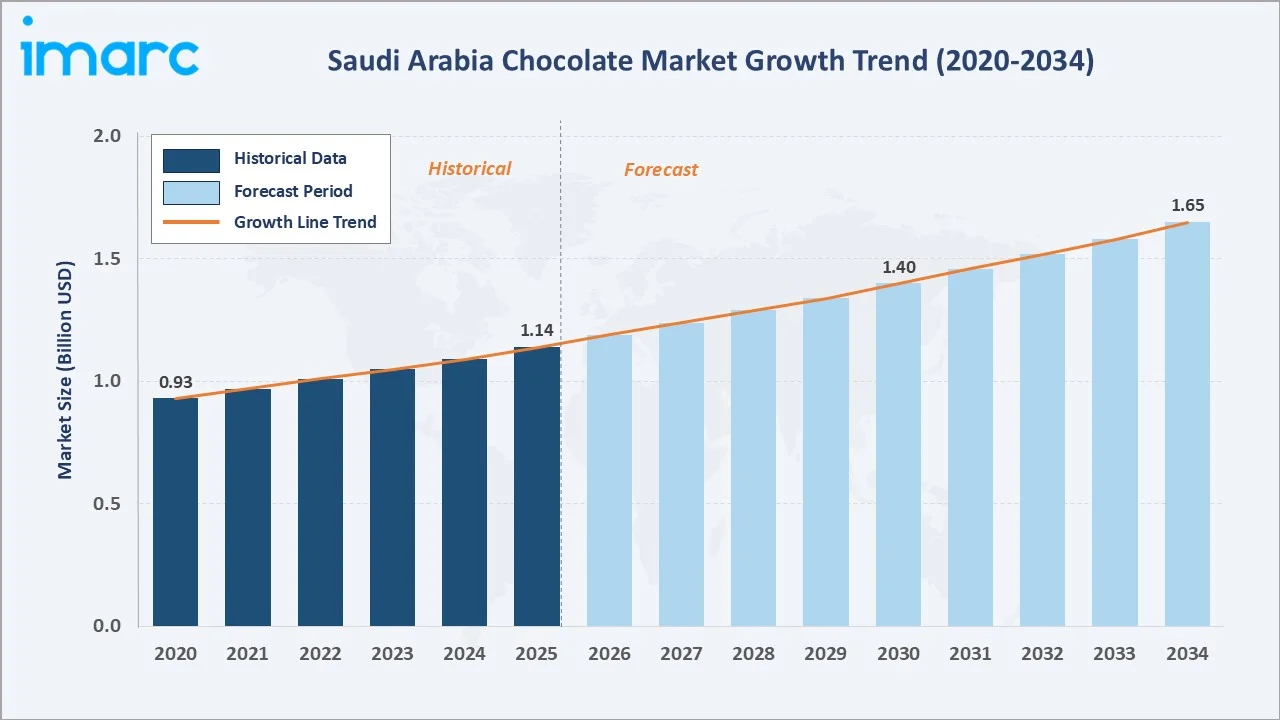
The Saudi Arabia chocolate market was valued at USD 1.14 Billion in 2025 and is projected to reach USD 1.65 Billion by 2034, exhibiting a CAGR of 4.18% during 2026-2034. The market is primarily driven by a growing young population with rising disposable income, a deeply embedded gifting culture, and expanding modern retail infrastructure.
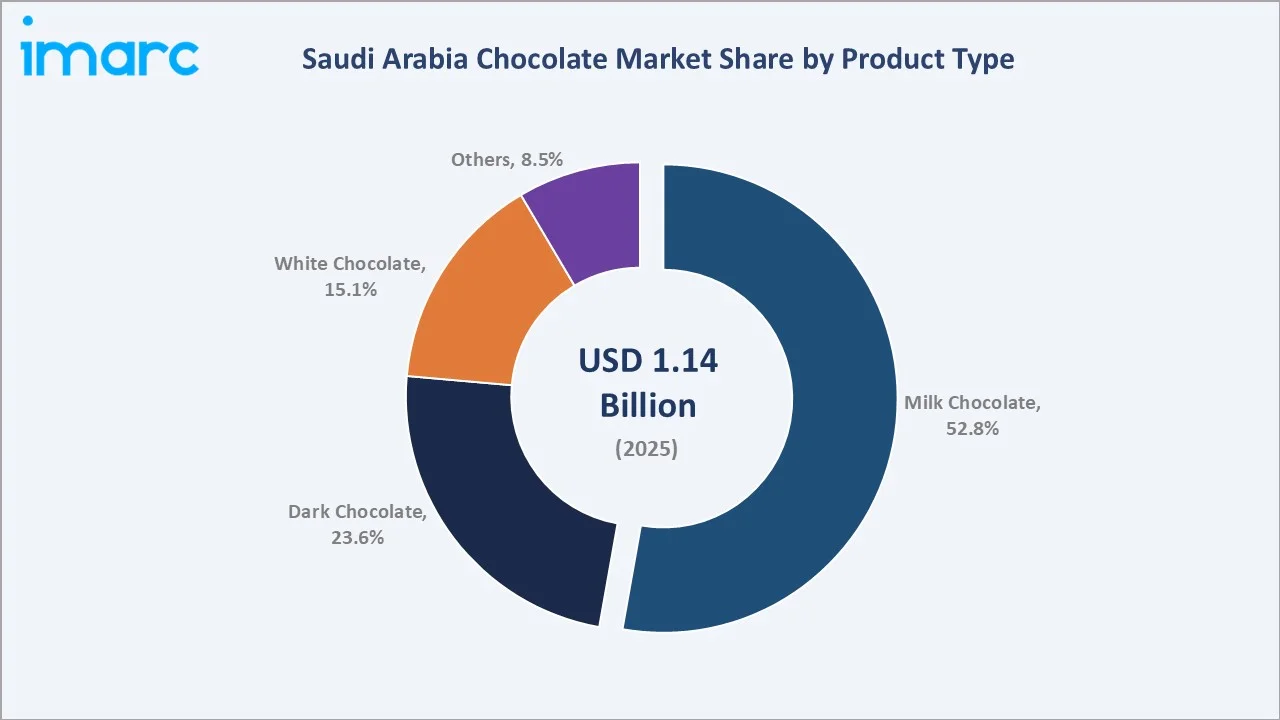
Based on product type, milk chocolate accounts for 52.8% of the market, molded dominates product form at 57.4%, and Northern and Central Region leads regional share at 39.4%.
Market Snapshot
| Metric | Value |
|
Market Size (2025) |
USD 1.14 Billion |
|
Forecast Market Size (2034) |
USD 1.65 Billion |
|
CAGR (2026-2034) |
4.18% |
|
Base Year |
2025 |
|
Historical Period |
2020-2025 |
|
Forecast Period |
2026-2034 |
|
Largest Region |
Northern and Central Region (39.4%, 2025) |
|
Second Largest Region |
Western Region (29.1%, 2025) |
|
Leading Product Type |
Milk Chocolate (52.8%, 2025) |
|
Leading Product Form |
Molded (57.4%, 2025) |
The Saudi Arabia chocolate market expanded from USD 0.93 Billion in 2020 to USD 1.14 Billion in 2025, supported by consistent growth in organized retail penetration and expanding e-commerce channels for confectionery. Anchored at USD 1.40 Billion in 2030, the forecast to USD 1.65 Billion by 2034 is driven by intensifying premiumization trends, growing health-conscious dark chocolate adoption, and a maturing gifting and occasions-based chocolate culture across urban centers.
To get more information on this market, Request Sample
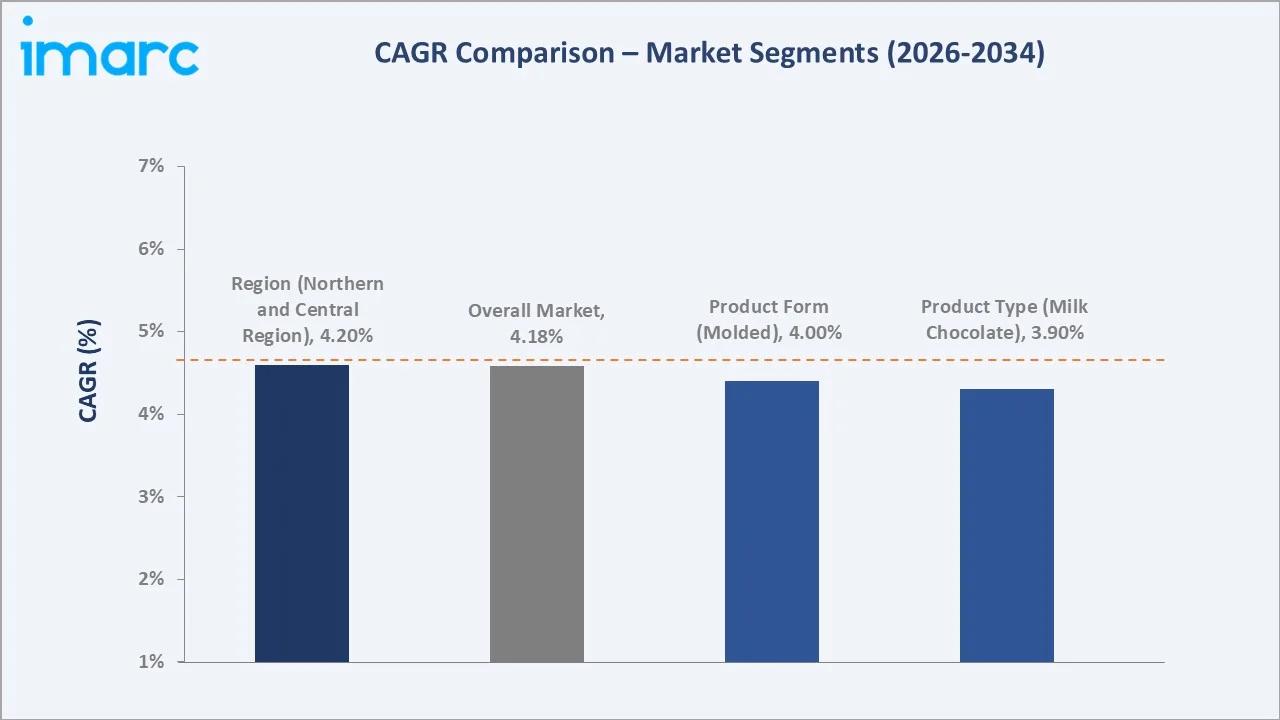
CAGR trajectories across product type and product form sub-segments, together with regional patterns, show dark chocolate and countlines expanding faster than the overall 4.18% market CAGR, driven by rising health awareness, growing adoption of on-the-go snacking, and expanding premium gifting occasions across urban Saudi consumers.
Executive Summary
The Saudi Arabia chocolate market is on a consistent growth trajectory, rising from USD 0.93 Billion in 2020 to USD 1.65 Billion by 2034. The industry has evolved from predominantly mass-market milk chocolate consumption to a diversified market encompassing premium gifting formats, artisan dark chocolate, and functional confectionery. Rising urban incomes, a young demographic base, and the cultural significance of chocolate in gifting and hospitality are sustaining broad-based demand across both premium and value segments.
On the basis of product type, milk chocolate commands 52.8% market share, driven by its broad consumer acceptance, appealing taste profile, and suitability for regular consumption across different age groups. Molded leads product form at 57.4%, supported by its convenient format, product variety, and widespread availability across retail channels. Northern and Central Region accounts for 39.4% of overall market share, fueled by a larger consumer base, established retail networks, and strong demand for chocolate products in major urban areas.
Key Market Insights
|
Insight |
Data |
|
Largest Product Type |
Milk Chocolate - 52.8% share (2025) |
|
Second Largest Product Type |
Dark Chocolate - 23.6% share (2025) |
|
Leading Product Form |
Molded - 57.4% share (2025) |
|
Second Largest Product Form |
Countlines - 28.6% share (2025) |
|
Leading Region |
Northern and Central Region - 39.4% share (2025) |
|
Second Largest Region |
Western Region - 29.1% share (2025) |
|
Top Companies |
Mars, Incorporated, Mondelēz International, Nestlé S.A., Ferrero Group, Patchi |
Key Analytical Observations Expanding On the Data Above:
- Milk chocolate dominance at 52.8% reflects strong consumer preference for sweet, approachable confectionery profiles among Saudi consumers across all age groups, particularly in everyday consumption and mass-gifting occasions.
- Dark chocolate share at 23.6% is steadily rising, supported by increasing health awareness among urban consumers who associate higher cacao content with reduced sugar levels and potential wellness benefits.
- Molded at 57.4% is propelled by the dominance of tabletted and boxed chocolate gifting across festive seasons, including Eid, Ramadan, and National Day celebrations.
- Countlines share at 28.6% is driven by strong demand for convenient, single-serve chocolate products across everyday consumption occasions.
- Northern and Central Region at 39.4% is anchored by Riyadh's position as the country's leading consumer market and high income concentration.
Saudi Arabia Chocolate Market Overview
The Saudi Arabia chocolate market encompasses the production, importation, distribution, and retail sale of chocolate-based confectionery products, including milk chocolate, dark chocolate, white chocolate, and compound formulations. Chocolate in Saudi Arabia is consumed across everyday indulgence, premium gifting, hospitality, food service, and seasonal occasions.
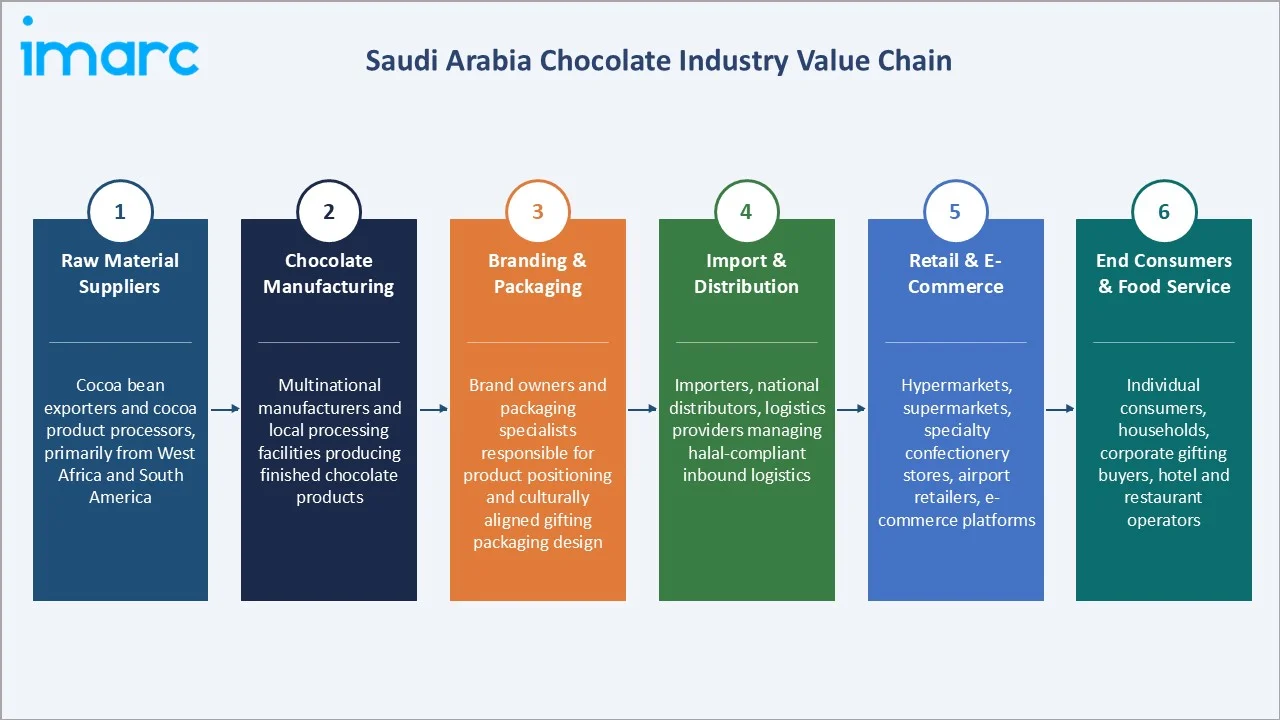
The ecosystem spans imported cocoa and cocoa product suppliers, multinational and local chocolate manufacturers, importers and distributors, modern trade retailers, specialty confectionery stores, hotel and food service operators, and a rapidly expanding e-commerce channel. Macroeconomic factors shaping the market include sustained growth in household disposable income, a rapidly expanding young population, rising female workforce participation, and ongoing infrastructure investment under Vision 2030.
Market Dynamics
To evaluate market opportunities, Request Sample
Market Drivers
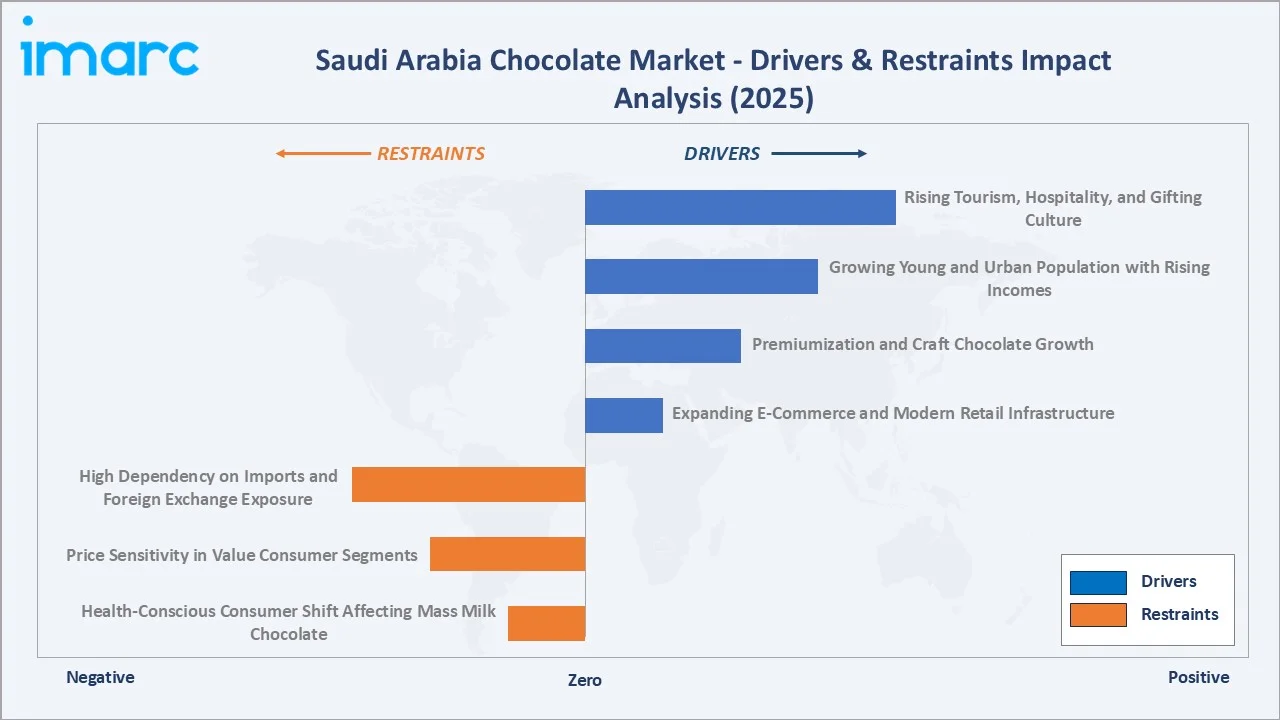
- Rising Tourism, Hospitality, and Gifting Culture: Saudi Arabia's tourism and entertainment expansion under Vision 2030 has directly stimulated premium chocolate demand across airports, hotels, and event venues. Chocolate occupies a central place in Saudi gifting culture, with demand peaking during Eid, Ramadan, and National Day periods, sustaining high-volume seasonal sales for both multinational and specialist brands. Tourism in Saudi Arabia hit 123 Million tourists in 2025, consisting of 29.3 Million visitors from abroad and 93.3 Million local travelers.
- Growing Young and Urban Population with Rising Incomes: A growing young and urban consumer base, coupled with improving disposable incomes, is increasing spending on confectionery and indulgent products. Younger consumers are also contributing to demand for convenient, premium, and variety-oriented chocolate products.
- Premiumization and Craft Chocolate Growth: Consumer preferences are shifting toward premium imported brands, artisan gifting boxes, and regionally influenced flavor profiles. International and specialty chocolate brands are expanding their retail presence in Saudi Arabia, targeting premium grocery, specialty confectionery, and online retail channels.
- Expanding E-Commerce and Modern Retail Infrastructure: The rapid growth of e-commerce platforms and the continued expansion of hypermarkets, supermarkets, and specialty confectionery outlets are improving product accessibility and enabling online chocolate gifting, further broadening the addressable consumer base across urban and semi-urban regions. As per IMARC Group, the Saudi Arabia e-commerce market size reached USD 251.3 Billion in 2025.
Market Restraints
- High Dependency on Imports and Foreign Exchange Exposure: The Saudi Arabia chocolate market is heavily reliant on imported finished products and raw materials, including cocoa beans and cocoa derivatives primarily sourced from West Africa and South America. Import dependency exposes market participants to foreign exchange volatility and international commodity price fluctuations.
- Price Sensitivity in Value Consumer Segments: While premium chocolate adoption is growing, a significant portion of the consumer base remains price-sensitive. Persistent inflation in food and confectionery categories has led some consumers to trade down from branded premium offerings to private-label or value-tier alternatives, constraining revenue growth in mid-market segments.
- Health-Conscious Consumer Shift Affecting Mass Milk Chocolate: Growing consumer awareness of sugar intake, obesity risks, and dietary health is prompting some Saudi consumers to reduce high-sugar confectionery consumption. This trend constrains volume growth in the traditional mass-market milk chocolate category, though it simultaneously benefits dark chocolate and reduced-sugar formulation segments.
Market Opportunities
- Sugar-Free, Functional, and Fortified Chocolate Growth: Rising health awareness is creating significant opportunity in sugar-free, low-sugar, and protein-enriched chocolate segments. Brands that develop halal-certified, health-positioned chocolate formats are well placed to capture a premium-priced, health-aware segment of Saudi consumers.
- Seasonal and Occasion-Based Gifting Expansion: Saudi Arabia's growing calendar of national celebrations, business gifting culture, and expanding tourism sector create sustained demand for premium, customized, and gift-packaged chocolate. Brands offering personalized and premium gift formats aligned with Saudi cultural occasions are positioned for strong growth.
- E-Commerce and Digital Gifting Platform Development: The expansion of online retail and digital gifting applications opens new distribution channels for premium and artisan chocolate brands, enabling direct-to-consumer reach beyond traditional retail and widening access across underserved regional markets.
Market Challenges
- Halal Certification and Regulatory Compliance Complexity: All chocolate products sold in Saudi Arabia must comply with halal certification requirements, Saudi Food and Drug Authority standards, and detailed product labeling regulations. Meeting these requirements adds cost and complexity for international brands seeking market entry.
- Intense Competition from Established Multinational Brands: Global confectionery majors with strong Saudi distribution networks, established brand equity, and large marketing budgets pose significant competitive barriers for emerging and local brands seeking to capture meaningful market share.
Emerging Market Trends
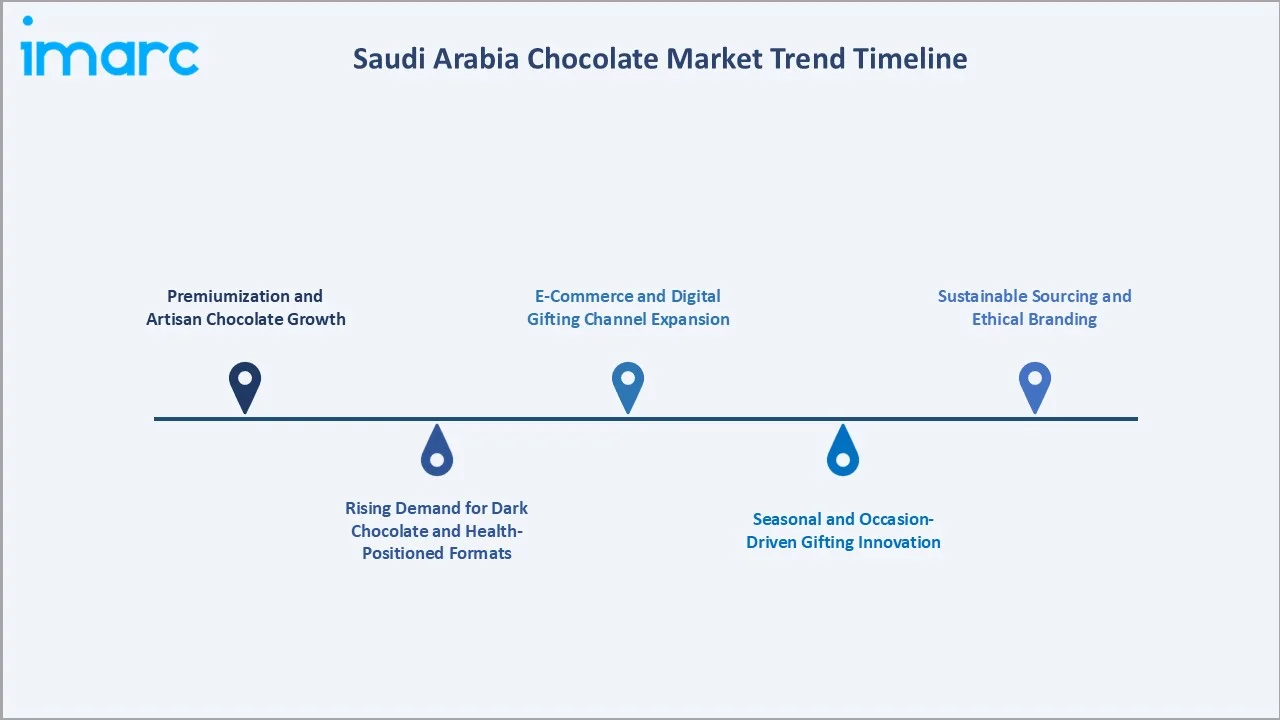
1. Premiumization and Artisan Chocolate Growth
Consumer appetite for high-quality, imported, and artisan chocolate is expanding rapidly in Saudi Arabia, driven by rising incomes, heightened brand awareness, and growing aspirational consumption among urban consumers. International premium brands from Belgium, Switzerland, and France are expanding retail presence, while local artisan chocolatiers are gaining traction by offering culturally relevant flavors and premium gifting formats.
2. Rising Demand for Dark Chocolate and Health-Positioned Formats
Growing consumer awareness about the potential benefits of high-cacao chocolate is accelerating dark chocolate adoption among health-aware Saudi consumers. Sugar-free, organic, and antioxidant-positioned chocolate products are gaining shelf space across premium retail outlets.
3. Seasonal and Occasion-Driven Gifting Innovation
Chocolate gifting tied to Eid Al-Fitr, Eid Al-Adha, Ramadan, Saudi National Day, and corporate gifting seasons remains a fundamental demand driver. Brands are increasingly developing limited-edition packaging, regionally inspired flavors, and personalized gifting solutions tailored to Saudi cultural occasions, driving repeat premium purchases and brand loyalty.
4. E-Commerce and Digital Gifting Channel Expansion
The rapid growth of e-commerce platforms in Saudi Arabia is transforming chocolate distribution, enabling online gifting, subscription-based confectionery services, and direct-to-consumer premium chocolate delivery. Brands with strong e-commerce capabilities are capturing younger, tech-savvy Saudi consumers who prefer digital-first shopping and gifting experiences.
5. Sustainable Sourcing and Ethical Branding
Saudi consumers, particularly in premium market segments, are showing increasing awareness of sustainable cocoa sourcing and ethical supply chain practices. Brands communicating certified sustainable sourcing, fair trade credentials, and environmental commitments are building competitive differentiation in the growing premium and gifting chocolate segment.
Industry Value Chain Analysis
The Saudi Arabia chocolate market value chain spans six stages, from raw material sourcing through end consumer engagement. Manufacturing, branding, and modern retail distribution capture the highest value-add, while import logistics and halal certification compliance increasingly shape competitive position for both international and domestic participants in this import-heavy market.
|
Stage |
Key Players / Examples |
|
Raw Material Suppliers |
Cocoa bean exporters and cocoa product processors, primarily based in West Africa and South America, supplying cocoa mass, butter, and powder to chocolate manufacturers |
|
Chocolate Manufacturing |
Multinational manufacturers and local processing facilities producing finished chocolate products for the Saudi Arabia market, including contract manufacturers for private-label formats |
|
Branding & Packaging |
Brand owners and packaging specialists responsible for product positioning, halal certification, Arabic-language labeling, and culturally aligned gifting packaging design |
|
Import & Distribution |
Importers, national distributors, and logistics providers managing halal-compliant product inbound logistics, warehousing, and distribution across Saudi regional markets |
|
Retail & E-Commerce |
Hypermarkets, supermarkets, specialty confectionery stores, airport retailers, hotel boutiques, and e-commerce platforms serving end consumers across urban and semi-urban centers |
|
End Consumers & Food Service |
Individual consumers, households, corporate gifting buyers, hotel and restaurant operators, and event caterers across Saudi Arabia's diverse consumer segments |
Vertically integrated multinational brands with proprietary manufacturing, established distribution networks, and strong retail relationships are positioned to capture greater value than importers operating solely on distribution margins. Local specialty chocolatiers with direct-to-consumer gifting channels are increasingly capturing premium value at the retail end of the chain.
Technology Landscape in the Saudi Arabia Chocolate Industry
Advanced Manufacturing and Precision Tempering Technology
Modern chocolate manufacturers are deploying precision tempering, enrobing, and molding automation technologies that improve product consistency, reduce waste, and enable faster production of complex chocolate formats. These technologies support the production of premium filled chocolates, truffles, and customized gifting products aligned with growing Saudi consumer demand for high-quality confectionery.
Cold Chain and Logistics Innovation
Saudi Arabia's hot climate presents significant cold chain management challenges for chocolate distribution. Manufacturers and distributors are investing in advanced temperature-controlled logistics infrastructure, specialized packaging with heat-resistant coatings, and real-time cold chain monitoring systems to maintain product quality across the supply chain.
E-Commerce Technology and Digital Gifting Platforms
The expansion of e-commerce in Saudi Arabia is driving adoption of digital gifting platforms, subscription confectionery services, and AI-powered product recommendation engines. Brands are leveraging data analytics and social commerce integrations to target occasion-based gifting moments and improve digital conversion rates across Saudi online retail channels.
Sustainable Packaging and Clean Label Innovation
Growing consumer focus on sustainability and product transparency is driving investment in biodegradable packaging, recyclable gifting materials, and clean-label formulation technologies. Brands reformulating products to reduce artificial additives and incorporate natural sweeteners are better positioned to align with evolving Saudi regulatory requirements and consumer health preferences.
Market Segmentation Analysis
The report covers the following segments:
|
Segment Category |
Leading Segment |
Market Share |
Year |
|
Product Type |
Milk Chocolate |
52.8% |
2025 |
|
Product Form |
Molded |
57.4% |
2025 |
|
Application |
🔒 |
🔒 |
2025 |
|
Pricing |
🔒 |
🔒 |
2025 |
|
Distribution |
🔒 |
🔒 |
2025 |
|
Region |
Northern and Central Region |
39.4% |
2025 |

By Product Type
Milk chocolate commands a 52.8% majority share in 2025, driven by strong consumer familiarity, broad appeal across all age groups, and its central role in everyday snacking and gifting occasions in Saudi Arabia. The segment benefits from established brand loyalty among mass-market consumers and wide distribution across hypermarkets and convenience retail.
To access detailed market analysis, Request Sample
Dark chocolate holds 23.6% market share in 2025 and represents the fastest-growing sub-segment within the product type category, supported by rising consumer health awareness and surging demand for premium, high-cacao formulations.
By Product Form
Molded leads the product form segment at 57.4% in 2025, reflecting the dominance of boxed, tabletted, and gift-packaged formats aligned with Saudi Arabia's strong gifting culture during Eid, Ramadan, and National Day celebrations. The format benefits from premium packaging opportunities and higher per-unit retail values.
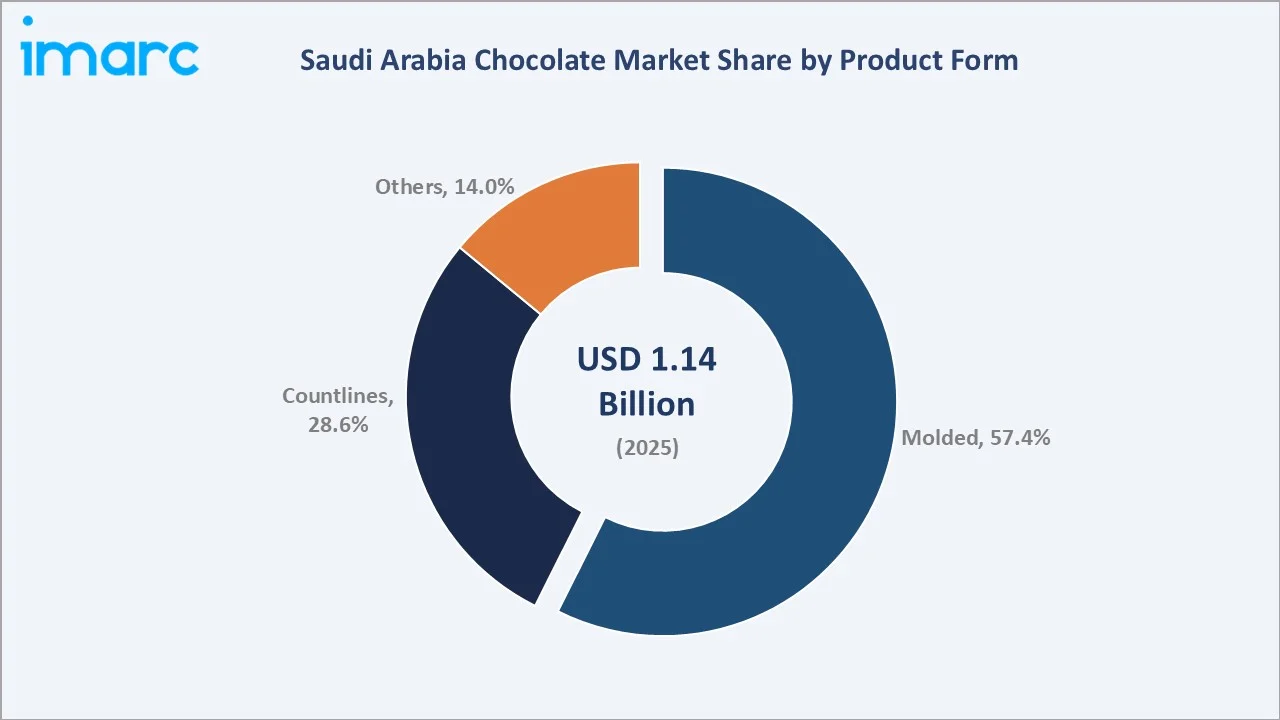
Countlines at 28.6% represent a strong and growing segment, driven by rising on-the-go snacking consumption and expanding modern convenience retail.
Regional Market Insights
|
Region |
Share (2025) |
Key Growth Drivers |
|
Northern and Central Region |
39.4% |
High income concentration in Riyadh, dense hypermarket and specialty retail infrastructure, strong corporate gifting demand, and elevated tourism footfall |
|
Western Region |
29.1% |
Significant religious tourism in Makkah and Madinah, growing urban population in Jeddah, expanding modern retail, and strong demand for premium gifting and travel retail chocolate |
|
Eastern Region |
19.8% |
High-income industrial workforce, strong corporate gifting culture tied to the oil and petrochemical sector, and growing modern retail infrastructure in Dammam and Al Khobar |
|
Southern Region |
11.7% |
Expanding retail penetration, growing urbanization, and rising household incomes, though market development remains at an earlier stage than northern and western regions |
Northern and Central Region at 39.4% in 2025 leads the regional landscape, anchored by high population concentration, major commercial centers, and expanding retail and hospitality infrastructure.
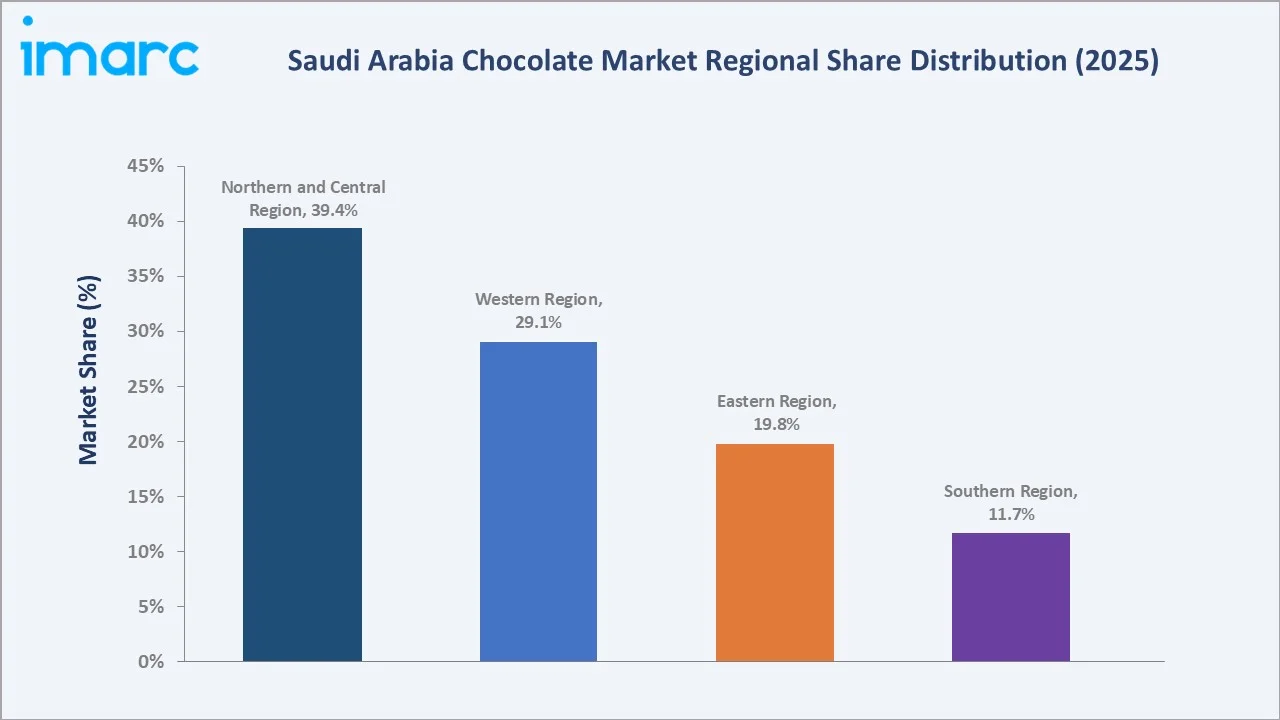
Southern Region, while currently the smallest regional contributor at 11.7%, is expanding steadily as modern retail infrastructure develops and urban incomes grow in cities such as Abha and Jazan, representing a long-term opportunity for both mass-market and premium chocolate brands expanding their Saudi geographic footprint.
Competitive Landscape
The Saudi Arabia chocolate market is moderately concentrated, with global confectionery majors leading on brand recognition and distribution scale while specialist gifting brands and regional chocolatiers compete on premium positioning, cultural relevance, and gifting expertise. Brand equity, halal certification, distribution network depth, and premium gifting capability form the primary competitive differentiators across the market.
|
Company Name |
Brand / Key Product |
Position |
Strategic Focus |
|
Mars, Incorporated |
Galaxy, Snickers, Twix |
Leader |
Expanding premium gifting range and strengthening modern trade distribution across Saudi urban centers |
|
Mondelēz International |
Cadbury, Toblerone, Milka |
Leader |
Growing premium segment presence and expanding e-commerce gifting capabilities in the Saudi Arabia market |
|
Nestlé S.A. |
KitKat, Quality Street |
Leader |
Deepening seasonal gifting portfolio and expanding halal-certified premium product range for Saudi consumers |
|
Ferrero Group |
Ferrero Rocher, Kinder |
Challenger |
Strengthening premium gifting positioning and expanding retail presence in specialty confectionery outlets across Saudi Arabia |
|
Patchi |
Patchi Les Signatures |
Challenger |
Expanding artisan gifting range and deepening Saudi gifting occasion positioning across its retail boutique network |
Key players include Mars, Incorporated, Mondelēz International, Nestlé S.A., Ferrero Group, and Patchi, among others.
Key Company Profiles
Mars, Incorporated
Mars, Incorporated is a global confectionery and food company headquartered in McLean, Virginia, United States, with a leading presence in the Saudi Arabia chocolate market through its Galaxy, Snickers, and Twix product lines.
- Product Portfolio: Broad chocolate portfolio spanning everyday snacking bars, gifting formats, and seasonal collections across milk chocolate, dark chocolate, and coated confectionery segments.
- Recent Developments: The firm is continuing to invest in product innovation and seasonal gifting formats across key Gulf markets, with ongoing focus on expanding modern trade and digital retail channels.
- Strategic Focus: Strengthening premium gifting positioning and deepening modern trade and e-commerce distribution reach across Saudi Arabia.
Mondelēz International
Mondelēz International is a global snacking company headquartered in Chicago, Illinois, United States, with a significant presence in the Saudi Arabia chocolate market through Cadbury, Toblerone, and Milka.
- Product Portfolio: Diverse chocolate range covering everyday snacking, premium gifting, and seasonal formats, targeting mass-market and premium consumer segments across Saudi retail channels.
- Recent Developments: The firm is advancing its digital commerce capabilities and expanding distribution partnerships across modern trade channels in Saudi Arabia.
- Strategic Focus: Expanding premium segment participation and building e-commerce gifting capabilities across the Saudi Arabia market.
Nestlé S.A.
Nestlé S.A. is a global food and beverage company headquartered in Vevey, Switzerland, with a well-established presence in the Saudi Arabia chocolate market through KitKat and Quality Street.
- Product Portfolio: KitKat and Quality Street chocolate range spanning snacking bars, boxed gifting assortments, and seasonal collections, with broad representation across modern trade and premium retail channels in Saudi Arabia.
- Recent Developments: The company is pursuing sustainable packaging initiatives and expanding its halal-certified product range across Saudi Arabia.
- Strategic Focus: Broadening seasonal gifting options while increasing the availability of premium chocolate products across organized retail channels in Saudi Arabia.
Market Concentration Analysis
The Saudi Arabia chocolate market is moderately concentrated, with the top four multinational brands, Mars, Incorporated, Mondelēz International, Nestlé S.A., and Ferrero Group, collectively accounting for a significant share of organized retail sales, reflecting their established distribution networks, brand recognition, and marketing scale in the Saudi Arabia market.
Barriers to entry in the Saudi Arabia chocolate market include the requirement for halal certification and compliance with Saudi Food and Drug Authority standards, the high cost of establishing distribution relationships with major modern trade retailers, and the marketing investment required to build brand recognition against established multinational incumbents. These factors favor established brands with existing Saudi Arabia market presence and regulatory compliance infrastructure.
Consolidation trends in the global confectionery industry are gradually reshaping the Saudi Arabia market landscape, as major multinationals expand their premium portfolio through acquisitions of artisan and specialty chocolate brands. Local and regional specialty chocolatiers continue to carve out premium niches by delivering culturally relevant products and superior gifting experiences that global brands are less equipped to match in the near term.
Investment & Growth Opportunities
Fastest-Growing Segments
Dark chocolate is expanding fastest among product type segments, driven by rising health awareness and growing premiumization among Saudi urban consumers. Countlines are similarly growing quickly within the product form segment, benefiting from rising on-the-go snacking consumption and the expansion of convenience retail channels.
Emerging Markets
Southern Region is the fastest-growing region within the Saudi Arabia chocolate market, expanding as modern retail infrastructure develops and disposable incomes rise in cities such as Abha, Jizan, and Najran. Within the Western Region, continued tourism development and the growth of premium retail in Jeddah present significant opportunity for premium gifting and artisan chocolate brands.
Venture & Investment Trends
Investment activity in the Saudi Arabia chocolate market is concentrated in premium gifting brand development, e-commerce and digital gifting platform expansion, and locally inspired artisan chocolate production. Saudi-based food investment funds and venture capital are increasingly supporting local artisan food brands, including chocolate, as part of the broader Vision 2030 focus on developing domestic food manufacturing capacity and supporting the growth of Saudi brands across consumer categories.
Future Market Outlook (2026-2034)
The Saudi Arabia chocolate market is forecast to expand from USD 1.14 Billion in 2025 to USD 1.65 Billion by 2034 at a CAGR of 4.18%, adding approximately USD 0.51 Billion in incremental market value over the forecast period.
Four forces will shape the market through 2034: continued premiumization and growing consumer appetite for dark, artisan, and functional chocolate formats; expansion of e-commerce and digital gifting platforms enabling brands to reach consumers across all regions of Saudi Arabia; growing participation by local artisan chocolatiers developing culturally relevant Saudi products; and sustained demand from Vision 2030-driven tourism and entertainment expansion that will continue to drive gifting and hospitality chocolate consumption.
By 2034, the Saudi Arabia chocolate market is expected to be characterized by a more diversified product mix, with dark chocolate and premium gifting formats accounting for a growing share of overall market value. Brands that successfully combine halal-certified formulations, cultural alignment, digital distribution capability, and sustainability credentials will be best positioned to lead in Saudi Arabia's evolving chocolate market through the end of the forecast period.
Research Methodology
Primary Research
Primary research included structured interviews with chocolate manufacturers, importers, distributors, modern trade retail buyers, specialty confectionery operators, and halal certification specialists, validating market sizing, segment mix, pricing dynamics, and regional demand patterns across Saudi Arabia.
Secondary Research
Secondary sources included Saudi Food and Drug Authority publications, General Authority for Statistics of Saudi Arabia data, Saudi Vision 2030 economic reports, industry association reports from Gulf confectionery trade bodies, and annual reports, press releases, and investor presentations from publicly listed global chocolate manufacturers and distributors.
Forecasting Models
Market forecasts used top-down and bottom-up models combining historical retail sales data, per-capita consumption trends, demographic growth projections, tourism and hospitality sector expansion data, and macroeconomic variables including disposable income and retail infrastructure development. Scenario analysis addressed commodity price volatility, regulatory developments, and shifts in consumer health preferences.
Saudi Arabia Chocolate Market Report Coverage:
| Report Features | Details |
|---|---|
| Base Year of the Analysis | 2025 |
| Historical Period | 2020-2025 |
| Forecast Period | 2026-2034 |
| Units | Billion USD |
| Scope of the Report | Exploration of Historical Trends and Market Outlook, Industry Catalysts and Challenges, Segment-Wise Historical and Future Market Assessment:
|
| Product Types Covered | White Chocolate, Milk Chocolate, Dark Chocolate, Others |
| Product Forms Covered | Molded, Countlines, Others |
| Applications Covered |
|
| Pricings Covered | Everyday Chocolate, Premium Chocolate, Seasonal Chocolate |
| Distributions Covered | Direct Sales (B2B), Supermarkets and Hypermarkets, Convenience Stores, Online Stores, Others |
| Regions Covered | Northern and Central Region, Western Region, Eastern Region, Southern Region |
| Companies Covered | Mars, Incorporated, Mondelēz International, Nestlé S.A., Ferrero Group, Patchi, etc. |
| Customization Scope | 10% Free Customization |
| Post-Sale Analyst Support | 10-12 Weeks |
| Delivery Format | PDF and Excel through Email (We can also provide the editable version of the report in PPT/Word format on special request) |
Key Benefits for Stakeholders:
- IMARC’s industry report offers a comprehensive quantitative analysis of various market segments, historical and current market trends, market forecasts, and dynamics of the Saudi Arabia chocolate market from 2020-2034.
- The research report provides the latest information on the market drivers, challenges, and opportunities in the Saudi Arabia chocolate market.
- Porter's five forces analysis assist stakeholders in assessing the impact of new entrants, competitive rivalry, supplier power, buyer power, and the threat of substitution. It helps stakeholders to analyze the level of competition within the Saudi Arabia chocolate industry and its attractiveness.
- Competitive landscape allows stakeholders to understand their competitive environment and provides an insight into the current positions of key players in the market.
Frequently Asked Questions About the Saudi Arabia Chocolate Market Report
The Saudi Arabia chocolate market was valued at USD 1.14 Billion in 2025, driven by rising consumer incomes, a strong gifting culture, Vision 2030-driven tourism expansion, and growing demand for premium and imported chocolate brands.
The market is projected to grow at a CAGR of 4.18% from 2026-2034, reaching USD 1.65 Billion, supported by continued premiumization, dark chocolate adoption, and expanding e-commerce gifting channels.
Milk chocolate is the largest product type segment at 52.8% in 2025, driven by broad consumer familiarity, mass-market appeal across all age groups, and its central role in everyday snacking and gifting occasions in Saudi Arabia.
Molded is the largest product form segment at 57.4% in 2025, driven by the dominance of boxed and gift-packaged chocolate formats that align with Saudi Arabia's strong gifting culture across Eid, Ramadan, and National Day celebrations.
Northern and Central Region commands 39.4% share in 2025, led by Riyadh and Jeddah as major commercial hubs, high consumer spending, and strong retail and hospitality activity.
Leading players include Mars, Incorporated, Mondelēz International, Nestlé S.A., Ferrero Group, and Patchi, among others.
Key growth drivers include Vision 2030-driven tourism expansion, rising consumer incomes, a young demographic profile, deeply embedded gifting culture, and expanding modern retail infrastructure.
Rising incomes and growing aspirational consumption are driving demand for imported premium brands, artisan gifting boxes, and high-cacao dark chocolate, shifting market value toward higher-margin product segments and specialist gifting channels.
Key challenges include high import dependency and commodity price exposure, regulatory compliance requirements including halal certification, health-conscious consumer trends constraining mass milk chocolate growth, and intense competition from established multinational brands.
Need more help?
- Speak to our experienced analysts for insights on the current market scenarios.
- Include additional segments and countries to customize the report as per your requirement.
- Gain an unparalleled competitive advantage in your domain by understanding how to utilize the report and positively impacting your operations and revenue.
- For further assistance, please connect with our analysts.
 Request Customization
 Speak to an Analyst
 Request Brochure
 Inquire Before Buying
Benefits of Customization
- Personalize this research
- Triangulate with your data
- Get data as per your format and definition
- Gain a deeper dive into a specific application, geography, customer, or competitor
- Any level of personalization
Get in Touch With Us
UNITED STATES
Phone: +1-201-971-6302
INDIA
Phone: +91-120-433-0800
UNITED KINGDOM
Phone: +44-753-714-6104
Email: [email protected]
Client Testimonials




.webp)




.webp)













Related Reports

Choose your plan
*Please note that the prices mentioned below are starting prices for each bundle type. Kindly contact our team for further details.*
Single User License
- 1 User License, Access on 2 Devices
- PDF Report + Excel Dataset (Password Protected)
- Lifetime Access
- No Printing Rights
- 10% Free Report Customization
- 10–12 Weeks of Analyst Support
Five User License
- Access for 5 Users, 2 Devices per User
- PDF Report + Excel Dataset (Password Protected)
- Lifetime Access
- Dedicated Account Manager
- 12–14 Weeks of Analyst Support
- No Printing Rights
- 15% Free Report Customization
- 25% Discount on Your Next Purchase
Corporate User License
- Unlimited User Access (Within Your Organization)
- PDF Report + Excel Dataset
- Lifetime Access
- Dedicated Account Manager
- 14–20 Weeks of Analyst Support
- No Printing Rights
- 20% Free Report Customization
- 30% Discount on Your Next Purchase
Essential Insights
What's included:
3 reports
- Lifetime Access
- PDF Reports
- Excel Datasets
- 2 Weeks of Free Analyst Support
- 2 User Licenses
- Access on 2 Devices
- Printing Rights
- Complimentary PowerPoint (PPT) Version
- Complimentary License Upgrade
Professional Access
What's included:
5 reports
- Lifetime Access
- PDF Reports
- Excel Datasets
- 8 Weeks of Free Analyst Support
- 2 User Licenses
- Access on 2 Devices
- Printing Rights
- Complimentary PowerPoint (PPT) Version
- Complimentary License Upgrade
Business Advantage
What's included:
8 reports
- Lifetime Access
- PDF Reports
- Excel Datasets
- 14 Weeks of Free Analyst Support
- 2 User Licenses
- Access on 2 Devices
- Printing Rights
- Complimentary PowerPoint (PPT) Version
- Complimentary License Upgrade
Enterprise Intelligence
What's included:
10 reports
- Lifetime Access
- PDF Reports
- Excel Datasets
- 20 Weeks of Free Analyst Support
- 2 User Licenses
- Access on 2 Devices
- Printing Rights
- Complimentary PowerPoint (PPT) Version
- Complimentary License Upgrade