
Saudi Arabia Cigarette Lighter Market Size, Share, Trends and Forecast by Product Type, Material Type, Distribution Channel, and Region, 2026-2034
Saudi Arabia Cigarette Lighter Market Size, Share, Trends & Forecast (2026-2034)
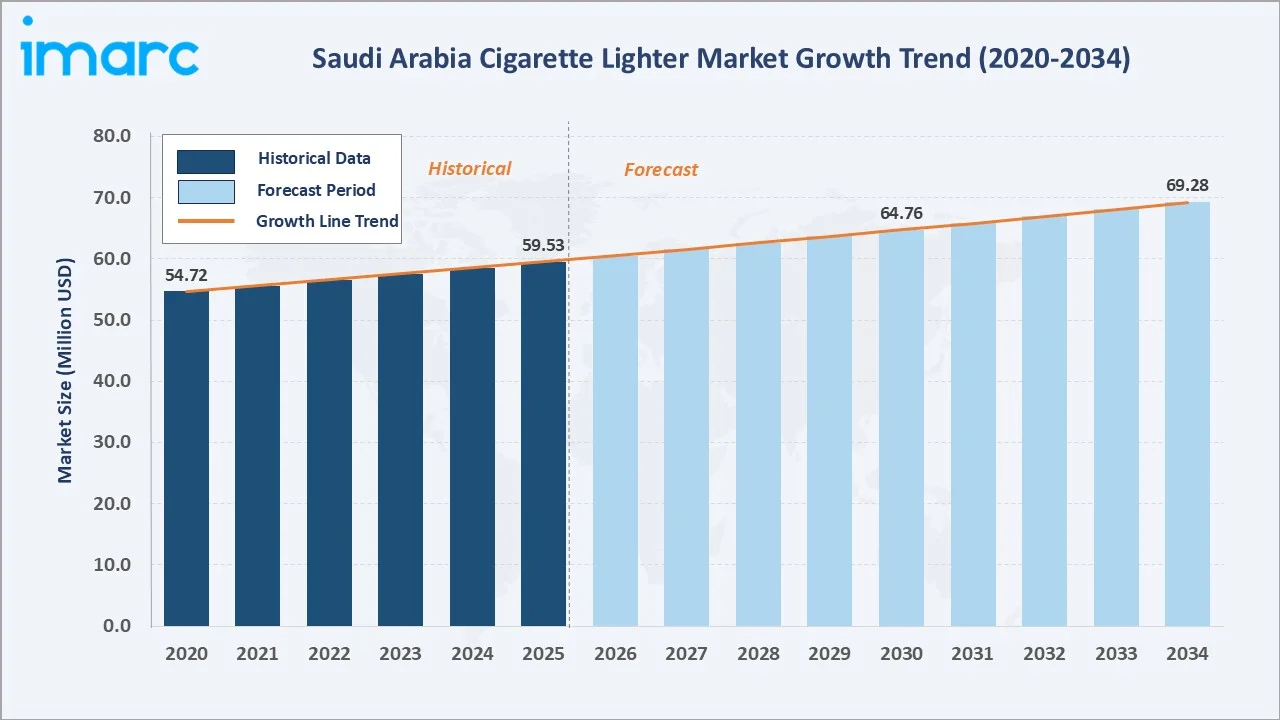
The Saudi Arabia cigarette lighter market reached USD 59.53 Million in 2025 and is projected to reach USD 69.28 Million by 2034, growing at a CAGR of 1.70% during 2026-2034. Demand rests on a stable adult tobacco base. GASTAT reported that 12.4% of the population aged 15 and above smoked in 2024. A resident population of 35.3 Million in 2024 and heavy pilgrim inflows keep everyday ignition demand firm. Metal lighters dominate at 56.4% material share. Tobacco shops hold 38.5% of distribution. The Northern and Central Region leads regionally at 46.8%.
Market Snapshot
|
Metric |
Value |
|
Market Size (2025) |
USD 59.53 Million |
|
Forecast Market Size (2034) |
USD 69.28 Million |
|
CAGR (2026-2034) |
1.70% |
|
Base Year |
2025 |
|
Historical Period |
2020-2025 |
|
Forecast Period |
2026-2034 |
|
Largest Material Type |
Metal (56.4%, 2025) |
|
Largest Distribution Channel |
Tobacco Shops (38.5%, 2025) |
|
Dominant Region |
Northern and Central Region (46.8%, 2025) |
The market expanded from USD 54.72 Million in 2020 to USD 59.53 Million in 2025. It is anchored at USD 64.76 Million in 2030 and forecast to reach USD 69.28 Million by 2034. Growth is steady rather than rapid. Volume demand tracks a slowly narrowing smoker base, while value is lifted by a mix shift toward metal, refillable and gift-oriented designs that carry higher unit prices.
To get more information on this market, Request Sample
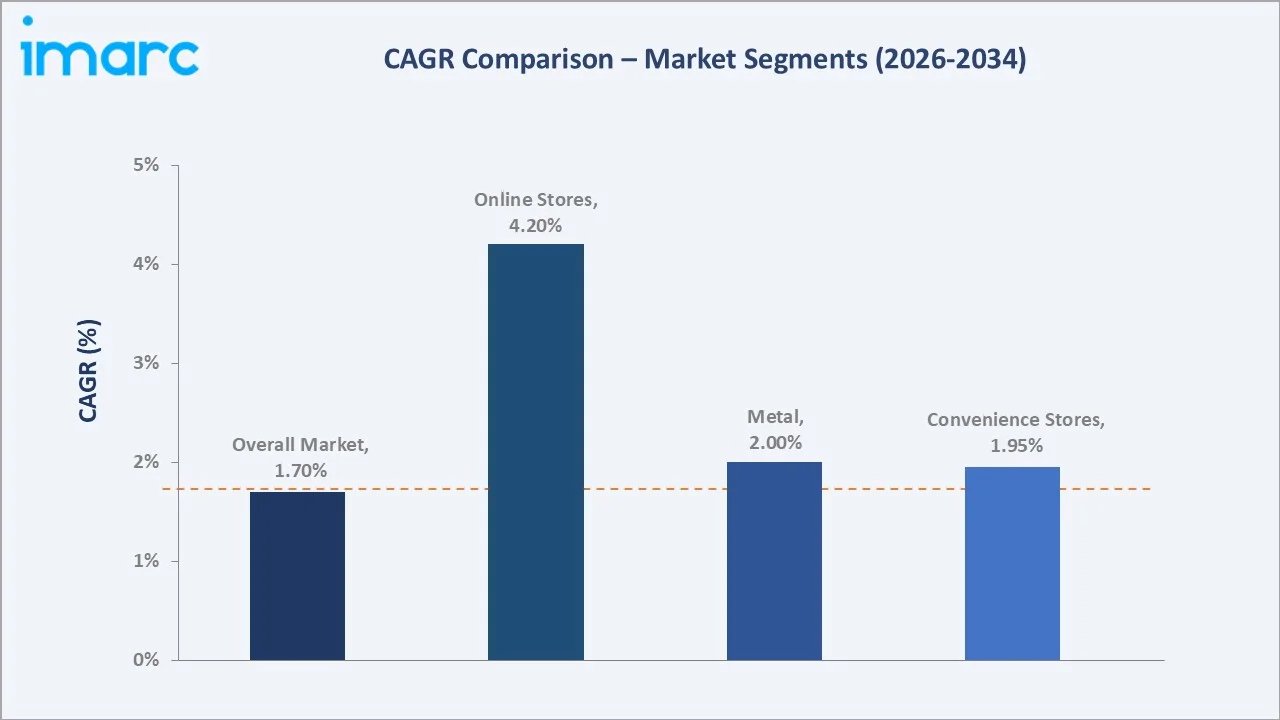
Online stores grow fastest at roughly 4.20% CAGR (2026-2034), supported by a widening base of licensed e-commerce merchants. Monsha'at recorded 40,953 e-commerce commercial records issued by the end of Q4 2024. Metal lighters advance at about 2.00% CAGR against 1.25% for plastic, reflecting the steady premiumisation of the Saudi Arabia cigarette lighter market.
Executive Summary
The Saudi Arabia cigarette lighter market reached USD 59.53 Million in 2025. The market is mature and replacement-driven. Its base is a large adult consumer pool: GASTAT put smoking prevalence among those aged 15 and above at 12.4% in 2024 across a population of 35.3 million. Lighters are low-ticket, high-frequency purchases, which makes demand resilient to economic cycles. The market is projected to reach USD 69.28 Million by 2034 at a 1.70% CAGR, with value growth outpacing unit growth.
Metal lighters command 56.4% of the 2025 market. Saudi buyers associate metal casings with durability, refillability and gifting value, and these units carry materially higher price points than disposables. Tobacco shops retain 38.5% of distribution, anchored by impulse purchasing alongside cigarettes and shisha supplies. The Northern and Central Region dominates at 46.8%, reflecting Riyadh's population density and retail concentration, while the Western Region benefits from pilgrimage and tourism traffic through Jeddah, Makkah and Madinah.
Key Market Insights
|
Insight |
Data |
|
Largest Material Type |
Metal - 56.4% value share (2025) |
|
Dominant Distribution Channel |
Tobacco Shops - 38.5% share (2025) |
|
Fastest Growing Channel |
Online Stores - ~4.20% CAGR (2026-2034) |
|
Dominant Region |
Northern and Central Region - 46.8% share (2025) |
|
Market Opportunity |
Refillable and premium designer formats lifting realisation per unit |
Key Analytical Observations Supporting The Above Data:
- Metal leads at 56.4% share (2025) on durability and gifting demand: Refillable metal lighters are treated as lasting accessories rather than consumables. Zippo, for example, has produced more than 600 Million windproof lighters, each carrying its lifetime guarantee, a proposition that supports premium pricing in the Kingdom.
- Plastic holds 35.2% as the everyday volume format: Disposable flint units remain the default impulse purchase at kiosks and convenience counters. They dominate unit volumes but contribute a smaller share of value because of low average selling prices.
- Tobacco shops at 38.5% reflect adjacency to core purchase occasions: Lighters sell alongside cigarettes, shisha coal and accessories. Specialist staff, wide brand assortment and habitual footfall keep this the anchor channel across Saudi cities.
- Online stores at 10.2% are the growth engine: Monsha'at data shows 40,953 e-commerce commercial records by Q4 2024, with Riyadh (16,834) and Makkah (10,314) leading. Wider assortment and designer editions are shifting premium purchases online.
- Northern and Central Region is dominant with 46.8% share (2025): The region concentrates Riyadh's population, retail density and corporate gifting demand, and it holds the largest count of registered e-commerce merchants in the Kingdom.
- Regulatory compliance shapes market entry: All regulated consumer products require a Product Certificate of Conformity and a Shipment Certificate of Conformity through SASO's SABER platform before customs clearance, which favours established importers with compliance depth.
Saudi Arabia Cigarette Lighter Market Overview
The Saudi Arabia cigarette lighter market covers disposable flint lighters, electronic and piezoelectric units, refillable metal lighters and utility formats sold across the Kingdom. The market is almost entirely import-driven, with supply sourced from global manufacturers in Europe, Japan and China through licensed Saudi importers and regional distributors. End use spans adult smokers, household cooking and candles, outdoor and camping activity, and hospitality operators.
Products are governed by the Saudi Standards, Metrology and Quality Organization (SASO), which requires conformity certification through the SABER platform ahead of customs clearance. Macroeconomic influences include Vision 2030 diversification, rising household incomes and a resident population that GASTAT estimated at 35.3 Million in 2024, of which 74.7% were of working age. Fiscal policy also matters: ZATCA applies excise tax to tobacco products, which shapes the affordability of the companion purchase.
Market Dynamics
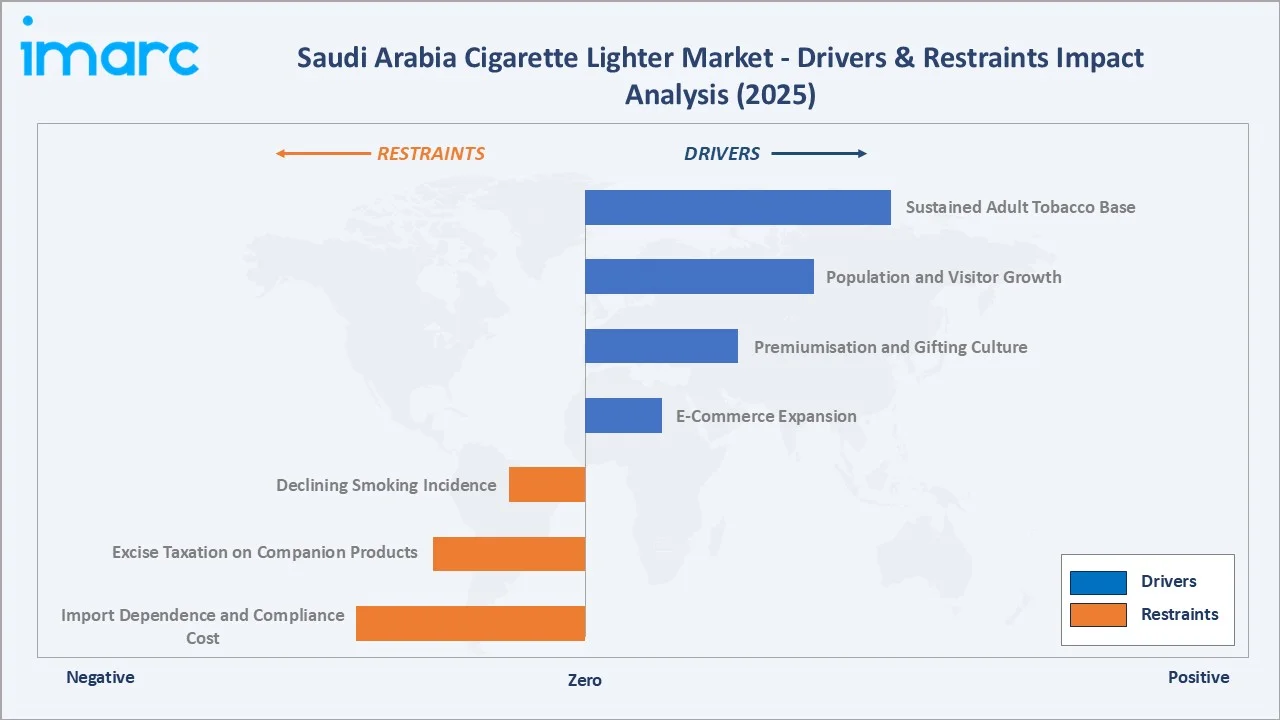
Growth in the Saudi Arabia cigarette lighter industry is shaped by a steady consumer base and a widening premium tier, offset by health policy pressure and intense price competition from low-cost imports.
To evaluate market opportunities, Request Sample
Market Drivers
- Sustained Adult Tobacco Base: GASTAT's Health Determinants Statistics Publication reported that 12.4% of adults aged 15 and above smoked in 2024. Applied to a population of 35.3 Million, this supports a large, habitual replacement cycle for pocket lighters.
- Population and Visitor Growth: GASTAT recorded 4.7% annual population growth to 35.3 Million in 2024. Hajj 2026 drew 1,707,301 pilgrims and Umrah performers reached 15,222,497 in Q1 2025 alone, lifting transient retail demand in the Western Region.
- Premiumisation and Gifting Culture: Metal and designer lighters hold 56.4% material share in 2025. Engraved and limited-edition units are used as corporate and personal gifts, raising average realisation well above disposable price points.
- E-Commerce Expansion: Monsha'at reported 40,953 e-commerce commercial records issued by the end of Q4 2024. Online stores hold 10.2% channel share in 2025 and grow at roughly 4.20% CAGR, the fastest of any channel through 2034.
Market Restraints
- Declining Smoking Incidence: Public health campaigns, cessation clinics and smoke-free rules in public venues continue to erode the core user base. This caps unit volume growth and holds the overall market CAGR at 1.70% rather than a steeper trajectory.
- Excise Taxation on Companion Products: ZATCA applies excise tax to tobacco products under the Excise Tax Law. Higher tobacco prices reduce purchase frequency among price-sensitive consumers, which indirectly suppresses lighter replacement rates.
- Import Dependence and Compliance Cost: Near-total reliance on imports exposes distributors to freight, currency and lead-time risk. SABER conformity certification adds documentation cost per product and per shipment, which weighs most on smaller importers.
Market Opportunities
- Refillable and Eco-Conscious Formats: Refillable designs reduce waste per ignition and align with sustainability messaging. Clipper, produced by Flamagas since 1959, built its position on refillability, and this proposition is gaining traction with younger Saudi buyers.
- Premium Retail and Duty-Free Expansion: Airport, hotel and high-street specialty retail in Jeddah and Riyadh offers a natural home for luxury and collectible lighters, capturing spend from a growing inbound visitor base.
Market Challenges
- Low-Cost Unbranded Imports: Bulk disposable units imported at minimal cost compress margins for branded distributors and complicate shelf-price positioning, particularly in the convenience and independent grocery channels.
- Substitution by Alternative Ignition: USB-rechargeable arc lighters, matches and built-in ignition on cooking appliances progressively displace classic flame units in household applications, narrowing non-tobacco demand.
Emerging Market Trends
Four trends define the Saudi Arabia cigarette lighter market outlook through 2034: premiumisation, digital retail, sustainability and ignition technology.
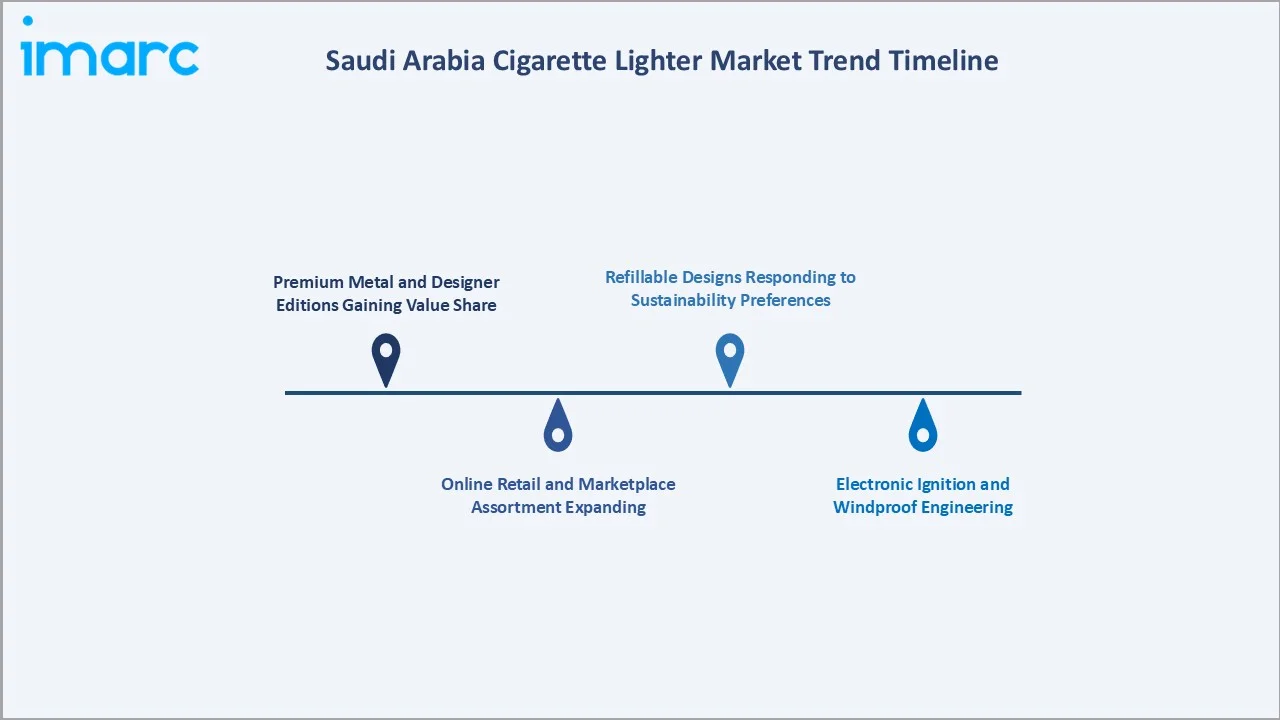
1. Premium Metal and Designer Editions Gaining Value Share
Metal lighters hold 56.4% of the 2025 market and grow at about 2.00% CAGR, faster than plastic at 1.25%. Buyers increasingly treat lighters as personal accessories. Engraving, limited runs and brand collaborations sustain price premiums over disposable formats.
2. Online Retail and Marketplace Assortment Expanding
Online stores hold 10.2% share in 2025 and grow fastest at roughly 4.20% CAGR. Monsha'at recorded 40,953 e-commerce commercial records by Q4 2024. Marketplaces give consumers access to imported designs, refill gas and accessories that local shelves rarely carry.
3. Refillable Designs Responding to Sustainability Preferences
Refillable units cut per-use waste and lower long-run cost of ownership. A Cricket lighter, made by Swedish Match Lighters, is designed to light up to approx. 2,000 times over its life cycle. Durable formats support sustainability positioning without sacrificing reliability.
4. Electronic Ignition and Windproof Engineering
Piezoelectric and electronic ignition remove the flint wheel and improve consistency in dusty, windy conditions common across the Kingdom. Windproof and turbo-jet flames are moving from specialist outdoor use into mainstream pocket ranges through 2034.
Industry Value Chain Analysis
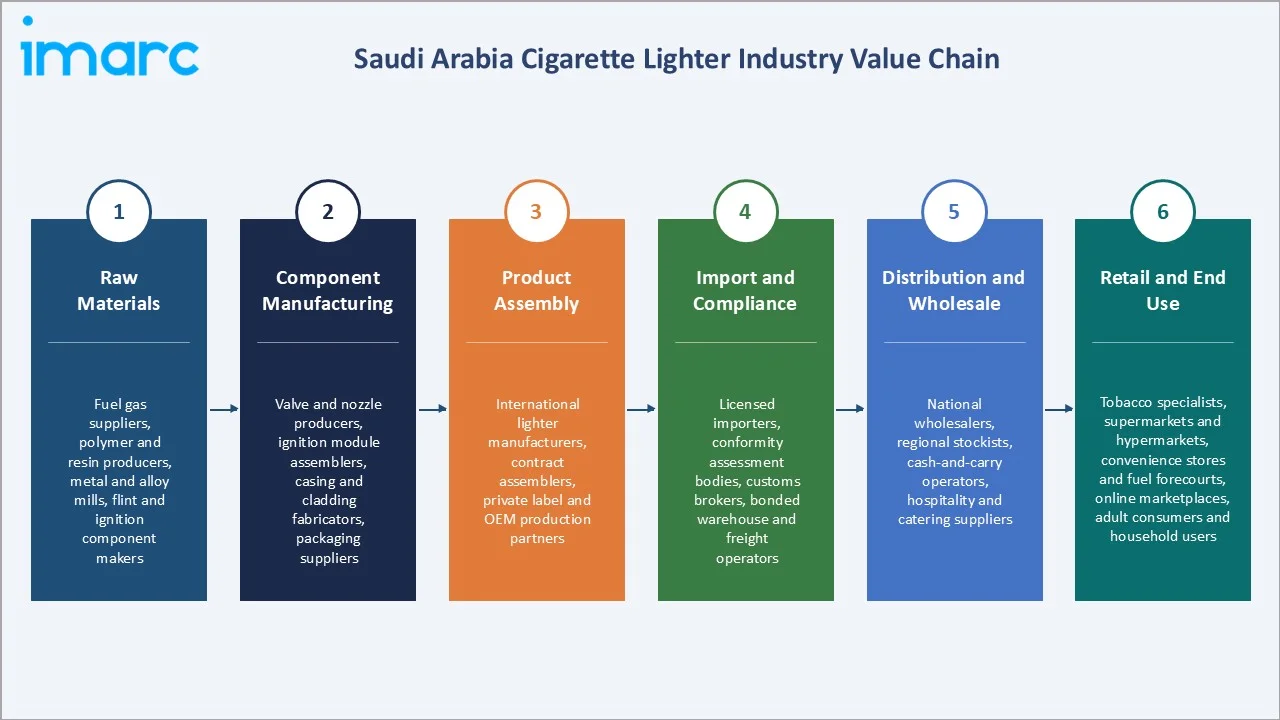
The Saudi Arabia cigarette lighter value chain runs from imported fuel, polymer and metal inputs, through overseas assembly and conformity certification, into multi-tier Saudi distribution and a retail base spanning tobacco shops, grocery formats and online platforms.
|
Stage |
Key Participants |
|
Raw Materials |
Fuel gas suppliers, polymer and resin producers, metal and alloy mills, flint and ignition component makers |
|
Component Manufacturing |
Valve and nozzle producers, ignition module assemblers, casing and cladding fabricators, packaging suppliers |
|
Product Assembly |
International lighter manufacturers, contract assemblers, private label and OEM production partners |
|
Import and Compliance |
Licensed importers, conformity assessment bodies, customs brokers, bonded warehouse and freight operators |
|
Distribution and Wholesale |
National wholesalers, regional stockists, cash-and-carry operators, hospitality and catering suppliers |
|
Retail and End Use |
Tobacco specialists, supermarkets and hypermarkets, convenience stores and fuel forecourts, online marketplaces, adult consumers and household users |
Margin is concentrated at the importer and retail stages. Importers absorb compliance, freight and inventory risk, while retailers capture impulse-driven mark-up at the point of sale. Direct-to-consumer online listings are beginning to shorten this chain for premium and collectible units.
Technology Landscape in the Saudi Arabia Cigarette Lighter Industry
Flint Ignition and Disposable Engineering
Flint-and-wheel ignition remains the workhorse technology behind the plastic segment, which holds 35.2% material share in 2025. Modern disposables use impact-resistant polymer bodies, calibrated flame height and controlled gas pressure. Manufacturing economics favour high-volume moulding, which is why this format anchors the value tier.
Piezoelectric and Electronic Ignition
Piezoelectric systems generate a spark through mechanical compression of a crystal, removing flint wear entirely. Electronic units deliver more consistent first-strike performance and longer service life. These technologies underpin the electronic lighter category and increasingly feature in mid-tier pocket ranges sold across Saudi retail.
Refillable Systems and Child-Resistance Design
Refillable architectures pair a butane reservoir with a refill valve and adjustable flame control, extending product life across thousands of ignitions. Child-resistance mechanisms and defined flame-height limits are standard engineering requirements for lighters placed on regulated markets, and conformity is verified before Saudi customs clearance.
Market Segmentation Analysis
The report covers the following segments:
|
Segment Category |
Leading Segment |
Market Share |
Year |
|
Product Type |
🔒 |
🔒 |
2025 |
|
Material Type |
Metal |
56.4% |
2025 |
|
Distribution Channel |
Tobacco Shops |
38.5% |
2025 |
|
Region |
Northern and Central Region |
46.8% |
2025 |

By Material Type
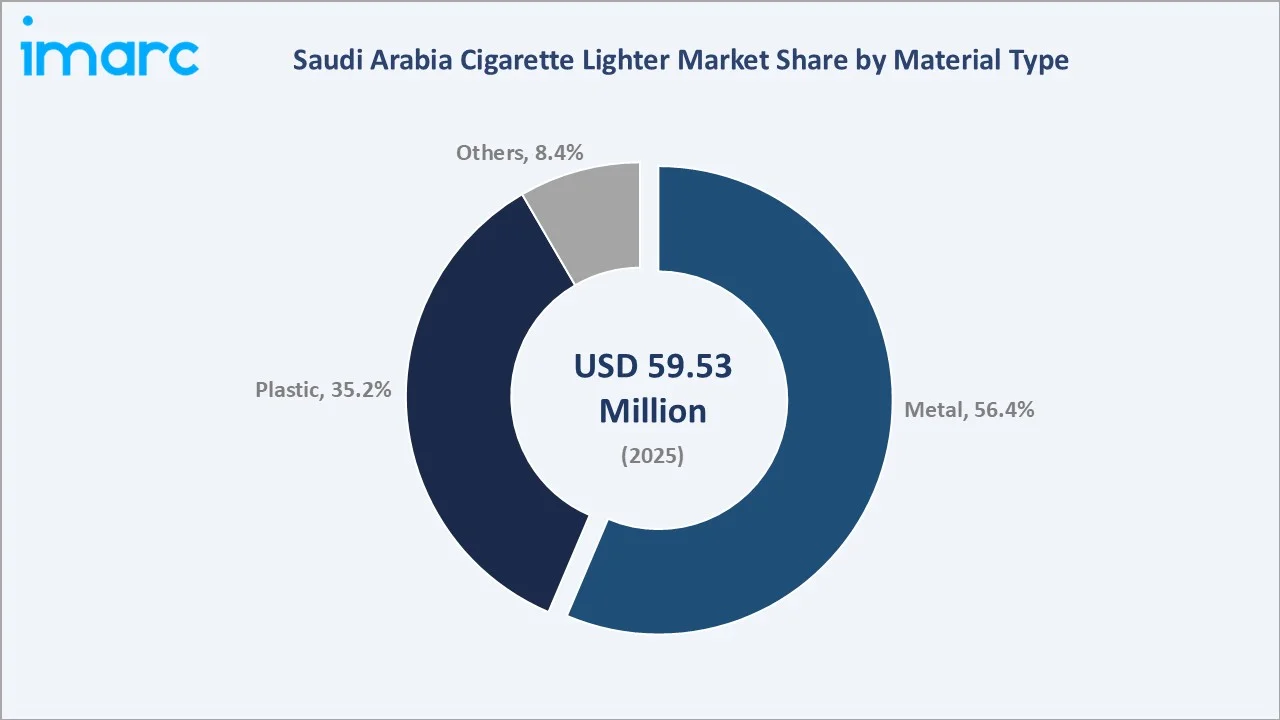
Metal lighters dominate at 56.4% market share in 2025 and grow at about 2.00% CAGR through 2034. Metal casings signal durability and status, and they underpin the refillable and gifting propositions that carry the highest realisation per unit in the Kingdom.
To access detailed market analysis, Request Sample
Plastic accounts for 35.2% and grows at roughly 1.25% CAGR. It is the volume format, sold through impulse locations at low unit prices. Other materials, including composite and wood-finish designs, hold 8.4% and advance at about 1.50% CAGR as niche and decorative ranges widen.
By Distribution Channel
Tobacco shops lead with 38.5% share in 2025. Purchase adjacency to cigarettes and shisha accessories, deeper brand assortment and staff familiarity with refills and flints sustain the channel's position despite slower growth of roughly 0.95% CAGR.
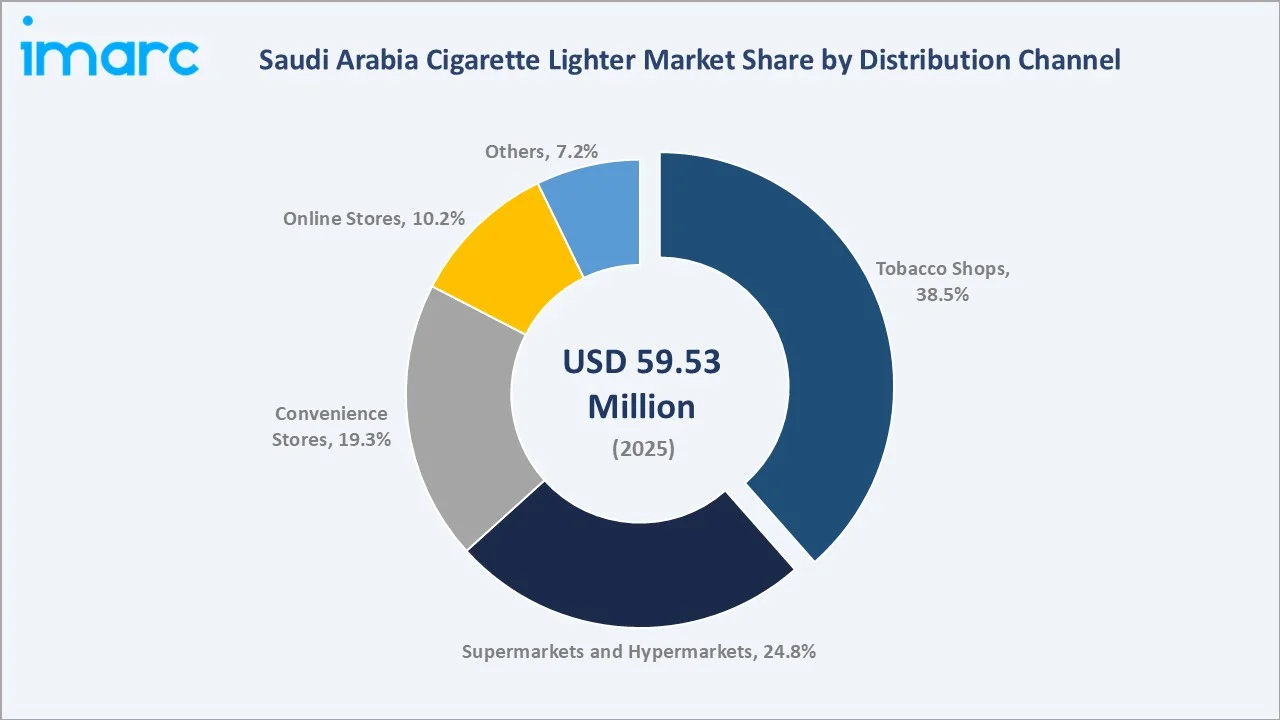
Supermarkets and hypermarkets hold 24.8% and convenience stores 19.3%, growing at about 1.80% and 1.95% CAGR respectively on the strength of basket-add purchases. Online stores at 10.2% expand fastest at roughly 4.20% CAGR, while other channels, including fuel forecourts and hospitality supply, account for 7.2%.
Regional Market Insights
|
Region |
Share (2025) |
Key Growth Drivers & Characteristics |
|
Northern and Central Region |
46.8% |
Largest population and retail concentration centred on Riyadh; dense modern trade and specialist tobacco retail; strong corporate gifting demand; highest count of registered online merchants |
|
Western Region |
24.6% |
Pilgrimage and tourism traffic through Jeddah, Makkah and Madinah; heavy transient retail footfall; major port gateway supporting import distribution; strong hospitality and catering demand |
|
Eastern Region |
17.4% |
Industrial and energy sector workforce with high expatriate concentration; organised retail clusters in the Dammam metropolitan area; steady convenience and forecourt purchasing |
|
Southern Region |
11.2% |
Smaller and more dispersed consumer base; traditional trade and independent grocery dominate; improving connectivity and domestic tourism supporting gradual retail modernisation |
The Northern and Central Region's 46.8% share in 2025 reflects Riyadh's position as the Kingdom's largest consumer market. Monsha'at data places 16,834 active e-commerce registrations in Riyadh by Q4 2024, the highest of any region, which reinforces the region's lead in both offline and online lighter sales.
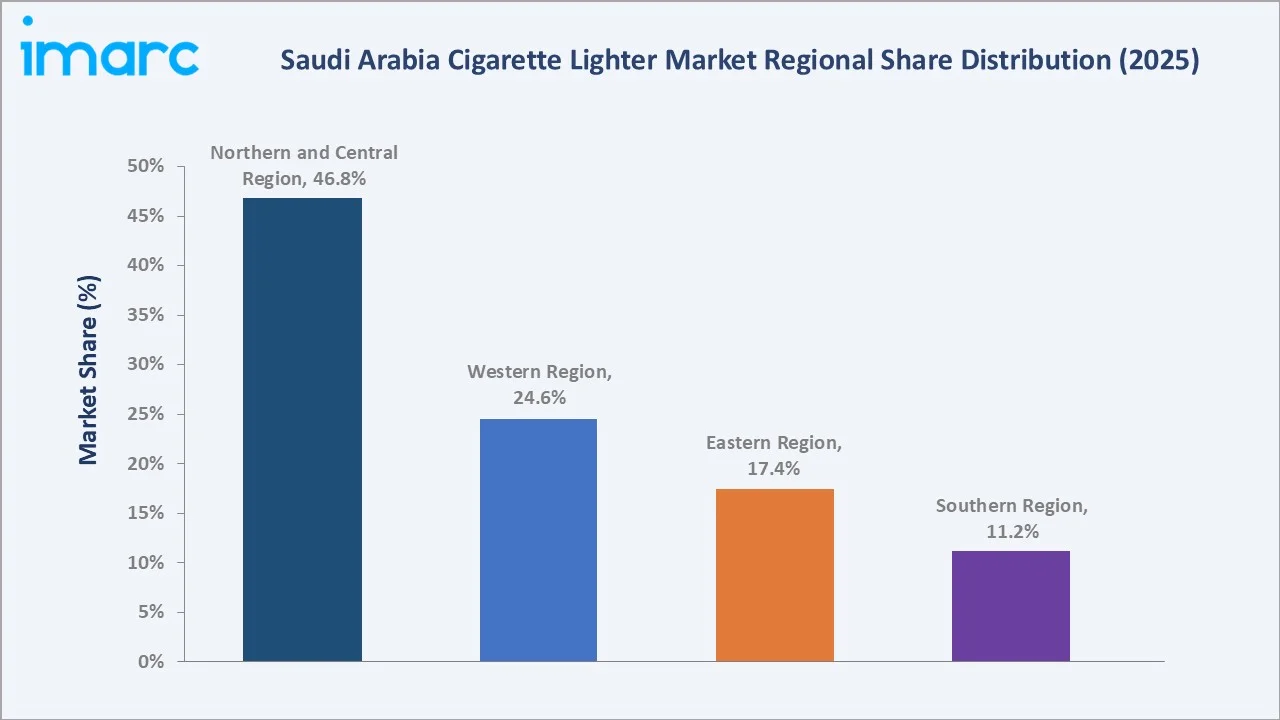
The Western Region holds 24.6%, supported by pilgrim volumes that GASTAT put at 1,707,301 for Hajj 2026 and 15,222,497 Umrah performers in Q1 2025. The Eastern Region's 17.4% is anchored by its industrial workforce and 6,488 e-commerce registrations, while the Southern Region accounts for 11.2% on a smaller and more traditional retail base.
Competitive Landscape
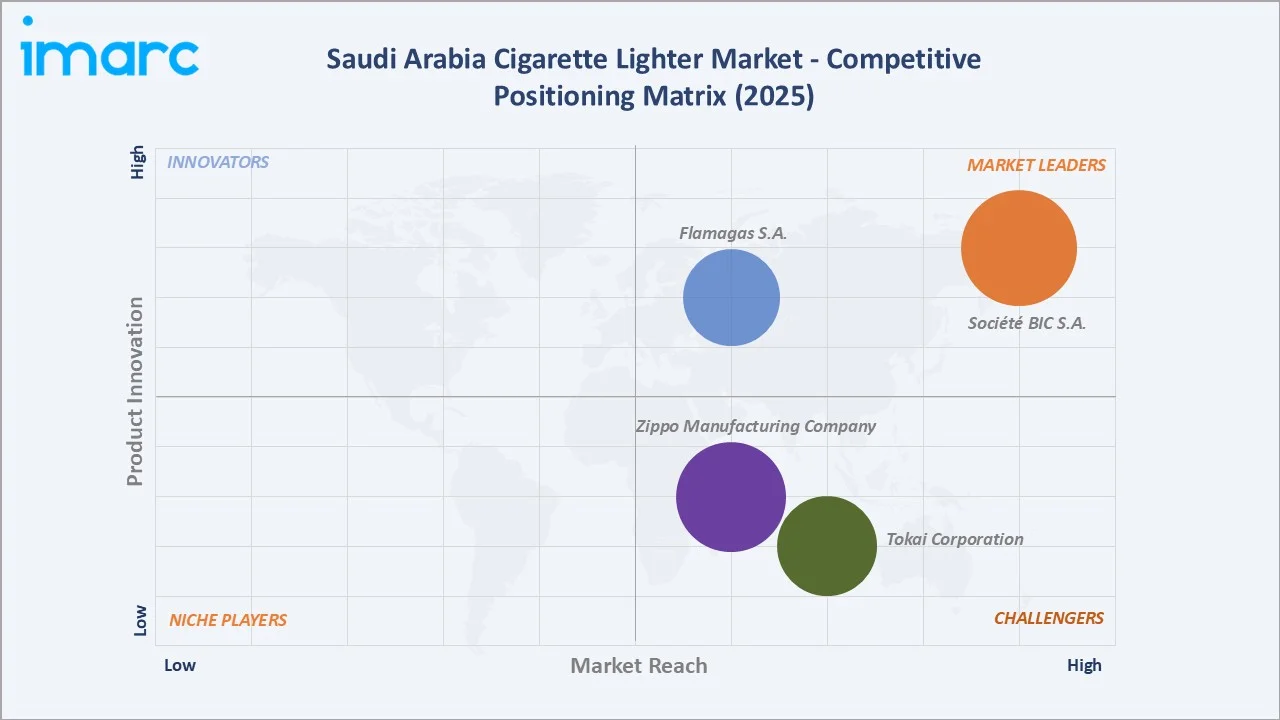
The Saudi Arabia cigarette lighter market is moderately consolidated at the branded tier and highly fragmented below it. Global brands compete on reliability, design and shelf presence, while unbranded imports compete purely on price through independent trade.
|
Company Name |
Brand / Product Line |
Market Position |
Core Strength |
|
Société BIC S.A. |
BIC Maxi (J6), BIC Slim/Mini, BIC Megalighter |
Market Leader |
Global leader in lighters with presence in over 160 countries; Flame for Life division posted a 29.9% adjusted EBIT margin in FY 2025 |
|
Flamagas S.A. |
Clipper Classic, Clipper Metal, Clipper Mini |
Market Leader |
Refillable specialist producing lighters since 1959; strong collectible and design-led positioning among younger consumers |
|
Zippo Manufacturing Company |
Zippo Windproof, Zippo Armor |
Strong Challenger |
More than 600 million windproof lighters produced since 1932, each backed by the company's lifetime guarantee |
|
Tokai Corporation |
Disposable Pocket Lighters, Adjustable Flame Lighters, Utility & BBQ Lighters |
Strong Challenger |
Japanese manufacturer supplying disposable and refillable units to retailers and OEM partners across global markets |
Positioning splits along two axes. BIC and Flamagas combine broad distribution with recognised design language, Zippo defends the collectible premium niche, and Tokai together with private-label importers supply the value tier that competes for shelf space in independent trade.
Key Company Profiles
Société BIC S.A.
Société BIC S.A. is the global leader in lighters and operates its lighter business through the Flame for Life division. The company states a presence in over 160 countries, and its lighters are engineered to meet stringent safety and durability standards.
- Product Portfolio: BIC Maxi (J6), BIC Slim/Mini, BIC Megalighter, and others.
- Strategic Focus: Value-added lighter innovation and distribution gains in discounter and utility segments.
Flamagas S.A.
Flamagas produces the Clipper brand, the reference name in refillable pocket lighters. The company has manufactured lighters since 1959 and built its position on a refillable, flint-replaceable design with a distinctive rounded profile that has become a collectible in its own right.
- Product Portfolio: Clipper Classic Large, Clipper Mini, Clipper Metal, and others.
- Strategic Focus: Refillability as a sustainability and cost argument, supported by continuous design refresh.
Zippo Manufacturing Company
Zippo occupies the premium and collectible tier of the Saudi Arabia cigarette lighter market. Founded in Bradford, Pennsylvania in 1932, the company manufactures its windproof lighters at a single site.
- Product Portfolio: Zippo Windproof, Zippo Armor, and others.
- Strategic Focus: Lifetime-guarantee brand equity, engraving and collectible editions, and adjacency into outdoor categories.
Market Concentration Analysis
The Saudi Arabia cigarette lighter market shows moderate concentration in the branded segment and pronounced fragmentation below it. The leading international brands, led by BIC and Clipper, together account for the majority of branded value, while no single company approaches a dominant share of total market volume.
Fragmentation is heaviest in the disposable plastic tier, which holds 35.2% material share in 2025. Bulk imports of unbranded units enter through independent wholesalers and reach traditional trade at prices well below branded equivalents. This keeps competitive intensity high and limits pricing power for mid-tier brands.
Consolidation is occurring at the distribution layer rather than the manufacturing layer. Importers are broadening multi-brand portfolios to improve buying leverage and to spread SABER compliance cost across more SKUs. Online marketplaces are simultaneously enabling smaller specialist sellers to reach national demand without physical retail footprint.
Investment & Growth Opportunities
Fastest Growing Segments
Online stores (~4.20% CAGR), metal lighters (~2.00% CAGR) and convenience stores (~1.95% CAGR) represent the highest-growth vectors through 2034. Online distribution combines the fastest growth rate with the strongest mix effect, since premium and designer units convert better in digital assortments than on constrained physical shelves.
Emerging Market Opportunities
Hospitality and pilgrimage-linked retail offers underexploited demand. With 1,707,301 Hajj pilgrims recorded for 2026 and 15,222,497 Umrah performers in Q1 2025, Western Region transit retail, hotels and forecourts present a concentrated, high-turnover outlet base for both value and souvenir-grade products.
Investment Themes
- Digital-first premium distribution: Building direct and marketplace storefronts for refillable and designer ranges captures the 4.20% CAGR online channel while protecting brand price integrity.
- Refill and accessory ecosystems: Gas refills, flints and wicks generate recurring revenue from an installed base of refillable lighters and deepen customer retention beyond the initial purchase.
- Compliance-led import consolidation: Scale importers that amortise SABER certification across broad portfolios can secure exclusive brand agreements and improve landed-cost competitiveness against fragmented smaller traders.
Future Market Outlook (2026-2034)
The Saudi Arabia cigarette lighter market is projected to grow from USD 59.53 Million in 2025 to USD 69.28 Million by 2034 at a 1.70% CAGR, passing USD 64.76 Million in 2030. Growth will be led by value rather than volume. A gradually narrowing smoker base is offset by a mix shift toward metal, refillable and designer formats that command higher unit prices.
Three forces anchor the trajectory. First, demographic expansion and visitor inflows sustain the absolute size of the addressable base. Second, digital retail continues to widen assortment and normalise premium purchasing, with online share rising from 10.2% in 2025. Third, sustainability preferences favour refillable architectures, which improve realisation per customer even as disposable unit volumes plateau.
Research Methodology
Primary Research
Primary research comprised structured interviews with industry stakeholders during 2025, including lighter importers and licensed distributors, tobacco retail chain managers in Riyadh, Jeddah and Dammam, supermarket and convenience category buyers, online marketplace sellers, and conformity assessment specialists handling SASO certification for consumer goods.
Secondary Research
Secondary research drew on GASTAT publications covering population estimates, health determinants and Hajj and Umrah statistics, Monsha'at e-commerce registration data, ZATCA excise tax and customs documentation, SASO technical regulation and SABER conformity requirements, and company disclosures from BIC, Zippo Manufacturing Company, Flamagas and Swedish Match Lighters.
Forecasting Models
Value forecasts were built bottom-up from adult population estimates, smoking prevalence, replacement frequency by lighter type and average selling price by material tier. Segment outputs were cross-checked against channel-level retail growth and then reconciled to a top-down market total, yielding a blended 1.70% CAGR for 2026-2034.
Saudi Arabia Cigarette Lighter Market Report Coverage:
| Report Features | Details |
|---|---|
| Base Year of the Analysis | 2025 |
| Historical Period | 2020-2025 |
| Forecast Period | 2026-2034 |
| Units | Million USD |
| Scope of the Report |
Exploration of Historical Trends and Market Outlook, Industry Catalysts and Challenges, Segment-Wise Historical and Future Market Assessment:
|
| Product Types Covered | Flint Cigarette Lighter, Electronic Cigarette Lighter, Others |
| Material Types Covered | Metal, Plastic, Others |
| Distribution Channels Covered | Tobacco Shops, Supermarkets and Hypermarkets, Convenience Stores, Online Stores, Others |
| Regions Covered | Northern and Central Region, Western Region, Eastern Region, Southern Region |
| Companies Covered | Société BIC S.A., Flamagas S.A., Zippo Manufacturing Company, Tokai Corporation, etc. |
| Customization Scope | 10% Free Customization |
| Post-Sale Analyst Support | 10-12 Weeks |
| Delivery Format | PDF and Excel through Email (We can also provide the editable version of the report in PPT/Word format on special request) |
Key Benefits for Stakeholders:
- IMARC’s industry report offers a comprehensive quantitative analysis of various market segments, historical and current market trends, market forecasts, and dynamics of the Saudi Arabia cigarette lighter market from 2020-2034.
- The research report provides the latest information on the market drivers, challenges, and opportunities in the Saudi Arabia cigarette lighter market.
- Porter's five forces analysis assist stakeholders in assessing the impact of new entrants, competitive rivalry, supplier power, buyer power, and the threat of substitution. It helps stakeholders to analyze the level of competition within the Saudi Arabia cigarette lighter industry and its attractiveness.
- Competitive landscape allows stakeholders to understand their competitive environment and provides an insight into the current positions of key players in the market.
Frequently Asked Questions About the Saudi Arabia Cigarette Lighter Market Report
The Saudi Arabia cigarette lighter market reached USD 59.53 Million in 2025, supported by a stable adult tobacco base, population growth to 35.3 million and rising demand for premium metal designs.
The market is projected to grow at a 1.70% CAGR during 2026-2034, reaching USD 69.28 Million by 2034, driven by premiumisation, e-commerce expansion and steady replacement demand.
Metal leads with 56.4% share in 2025. Metal casings support refillable and gift-oriented designs that command higher price points than disposable plastic alternatives across Saudi retail.
Tobacco shops hold the largest share at 38.5% in 2025, benefiting from purchase adjacency to cigarettes and shisha accessories, wider brand assortment and habitual consumer footfall.
Online stores grow fastest at roughly 4.20% CAGR through 2034, supported by 40,953 e-commerce commercial records issued in the Kingdom by the end of Q4 2024.
The Northern and Central Region leads with 46.8% share in 2025, anchored by Riyadh's population density, retail concentration and the largest base of registered online merchants.
Leading companies include Société BIC S.A., Flamagas S.A., Zippo Manufacturing Company, and Tokai Corporation, among others.
GASTAT reported 12.4% smoking prevalence among adults aged 15 and above in 2024. This base drives habitual replacement demand, though gradual decline moderates long-term volume growth.
GASTAT reported 12.4% smoking prevalence among adults aged 15 and above in 2024. This base drives habitual replacement demand, though gradual decline moderates long-term volume growth.
Lighters fall under SASO oversight. Regulated consumer products require a Product Certificate of Conformity and a Shipment Certificate of Conformity through the SABER platform before customs clearance.
The market is projected to reach approximately USD 64.76 Million by 2030, supported by rising online penetration, premium metal adoption and sustained visitor-driven retail demand.
Need more help?
- Speak to our experienced analysts for insights on the current market scenarios.
- Include additional segments and countries to customize the report as per your requirement.
- Gain an unparalleled competitive advantage in your domain by understanding how to utilize the report and positively impacting your operations and revenue.
- For further assistance, please connect with our analysts.
 Request Customization
 Speak to an Analyst
 Request Brochure
 Inquire Before Buying
Benefits of Customization
- Personalize this research
- Triangulate with your data
- Get data as per your format and definition
- Gain a deeper dive into a specific application, geography, customer, or competitor
- Any level of personalization
Get in Touch With Us
UNITED STATES
Phone: +1-201-971-6302
INDIA
Phone: +91-120-433-0800
UNITED KINGDOM
Phone: +44-753-714-6104
Email: [email protected]
Client Testimonials




.webp)




.webp)













Related Reports

Choose your plan
*Please note that the prices mentioned below are starting prices for each bundle type. Kindly contact our team for further details.*
Single User License
- 1 User License, Access on 2 Devices
- PDF Report + Excel Dataset (Password Protected)
- Lifetime Access
- No Printing Rights
- 10% Free Report Customization
- 10–12 Weeks of Analyst Support
Five User License
- Access for 5 Users, 2 Devices per User
- PDF Report + Excel Dataset (Password Protected)
- Lifetime Access
- Dedicated Account Manager
- 12–14 Weeks of Analyst Support
- No Printing Rights
- 15% Free Report Customization
- 25% Discount on Your Next Purchase
Corporate User License
- Unlimited User Access (Within Your Organization)
- PDF Report + Excel Dataset
- Lifetime Access
- Dedicated Account Manager
- 14–20 Weeks of Analyst Support
- No Printing Rights
- 20% Free Report Customization
- 30% Discount on Your Next Purchase
Essential Insights
What's included:
3 reports
- Lifetime Access
- PDF Reports
- Excel Datasets
- 2 Weeks of Free Analyst Support
- 2 User Licenses
- Access on 2 Devices
- Printing Rights
- Complimentary PowerPoint (PPT) Version
- Complimentary License Upgrade
Professional Access
What's included:
5 reports
- Lifetime Access
- PDF Reports
- Excel Datasets
- 8 Weeks of Free Analyst Support
- 2 User Licenses
- Access on 2 Devices
- Printing Rights
- Complimentary PowerPoint (PPT) Version
- Complimentary License Upgrade
Business Advantage
What's included:
8 reports
- Lifetime Access
- PDF Reports
- Excel Datasets
- 14 Weeks of Free Analyst Support
- 2 User Licenses
- Access on 2 Devices
- Printing Rights
- Complimentary PowerPoint (PPT) Version
- Complimentary License Upgrade
Enterprise Intelligence
What's included:
10 reports
- Lifetime Access
- PDF Reports
- Excel Datasets
- 20 Weeks of Free Analyst Support
- 2 User Licenses
- Access on 2 Devices
- Printing Rights
- Complimentary PowerPoint (PPT) Version
- Complimentary License Upgrade