
Saudi Arabia Community Cloud Market Size, Share, Trends and Forecast by Component, Application, Industry Vertical, and Region, 2026-2034
Saudi Arabia Community Cloud Market Summary:
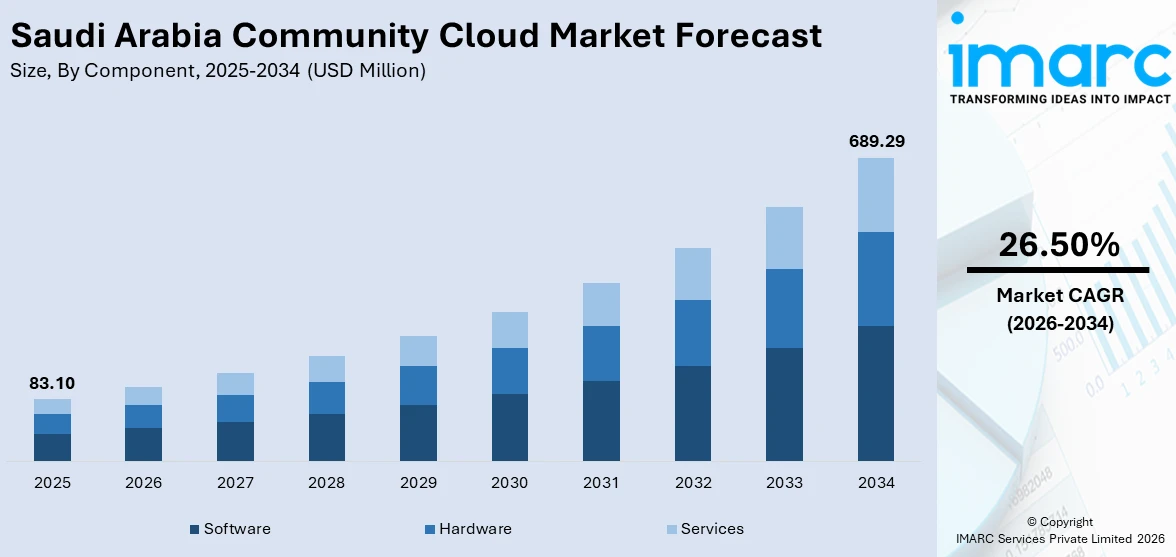
The Saudi Arabia community cloud market size was valued at USD 83.10 Million in 2025 and is projected to reach USD 689.29 Million by 2034, growing at a compound annual growth rate of 26.50% from 2026-2034.
The Saudi Arabia community cloud market is experiencing strong momentum as organizations across regulated industries seek shared cloud environments that offer enhanced security, compliance, and operational efficiency. Growing demand for sector-specific cloud architectures, rising data localization requirements, and the expanding digital ecosystem are accelerating adoption. Advancements in cloud-native technologies, increasing collaboration among industry participants, and the emergence of specialized platform solutions are driving the Saudi Arabia community cloud market share.
Key Takeaways and Insights:
- By Component: Software dominates the market with a share of 44% in 2025, owing to the increasing deployment of enterprise application platforms, collaboration tools, and business intelligence dashboards that streamline multi-tenant community cloud environments.
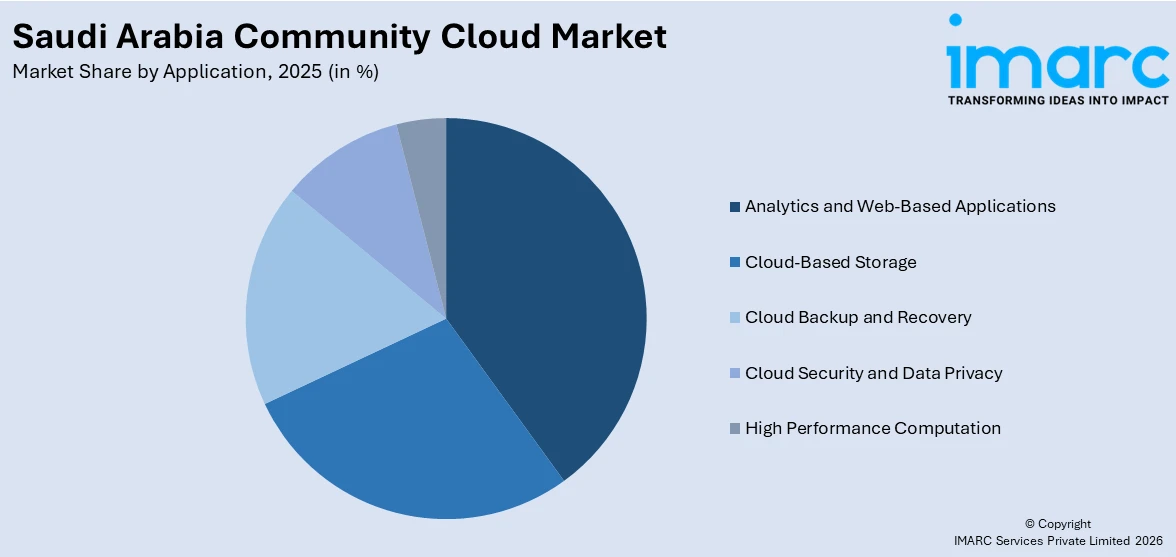
- By Application: Analytics and web-based applications lead the market with a share of 30% in 2025, on account of enterprises focusing on predictive analytics, real-time data processing, and browser-based application delivery via shared cloud infrastructure.
- By Industry Vertical: BFSI represents the biggest segment with a market share of 33% in 2025, reflecting the financial sector’s critical requirement for compliant, secure, and high-performance shared cloud platforms that support digital banking operations.
- By Region: Northern and Central Region is the largest region with 35% share in 2025, driven by the concentration of government ministries, financial institutions, and technology enterprises in Riyadh that anchor demand for community cloud services.
- Key Players: Key players drive the Saudi Arabia community cloud market by expanding service portfolios, strengthening compliance capabilities, investing in localized data center infrastructure, and forming strategic partnerships with regulated industries to enhance adoption and ensure seamless deployment across shared cloud ecosystems.
To get more information on this market Request Sample
The Saudi Arabia community cloud market is advancing as enterprises and government entities increasingly recognize the value of shared, compliance-driven cloud architectures that balance cost efficiency with stringent security requirements. Regulated sectors such as banking, healthcare, and government are transitioning workloads to community cloud environments that provide dedicated resources, uniform regulatory adherence, and collaborative data-sharing capabilities. The emphasis on data sovereignty, reinforced by the enforcement of the Personal Data Protection Law, is encouraging organizations to adopt community cloud models that ensure sensitive information remains within national boundaries while enabling cross-organizational collaboration. The rapid expansion of digital infrastructure is strengthening the foundation for scalable and resilient community cloud deployments. As industry-specific cloud requirements evolve, the market is positioned for sustained expansion supported by robust institutional demand, regulatory alignment, and growing ecosystem maturity across the Kingdom.
Saudi Arabia Community Cloud Market Trends:
Growing Demand for Sovereign and Compliance-Driven Cloud Architectures
The Saudi Arabia community cloud market is witnessing a pronounced shift toward sovereign cloud architectures as organizations prioritize data residency and regulatory adherence. The enforcement of comprehensive data protection regulations has accelerated demand for cloud environments where multiple organizations within the same industry can share infrastructure while maintaining strict data governance. Community cloud models are increasingly preferred by entities in regulated sectors seeking to balance collaborative resource sharing with localized data management, driving the Saudi Arabia community cloud market growth.
Inclusion of Advanced Analytics and Artificial Intelligence in Cloud Platforms
Cloud platforms are increasingly embedding artificial intelligence and advanced analytics capabilities to enhance service delivery within shared environments. Organizations are leveraging community cloud infrastructure to access machine learning tools, predictive analytics engines, and intelligent automation frameworks without incurring the cost of dedicated deployments. This convergence of cloud and intelligent technologies is enabling community cloud users to derive actionable insights from pooled data resources while maintaining operational boundaries and access controls that govern multi-tenant shared environments.
Rising Adoption of Multi-Cloud and Hybrid Cloud Deployment Strategies
Enterprises across the Kingdom are increasingly adopting multi-cloud and hybrid deployment strategies that incorporate community cloud environments as a critical architectural layer. Organizations are combining community cloud platforms with private and public cloud resources to optimize workload distribution, enhance redundancy, and meet varying compliance requirements across different data classifications. This strategic approach enables regulated industries to maintain sensitive operations within community cloud boundaries while leveraging broader cloud ecosystems for less sensitive workloads and scalable computing resources.
How Vision 2030 is Transforming the Saudi Arabia Community Cloud Market:
Saudi Arabia’s Vision 2030 is fundamentally reshaping the community cloud landscape by driving comprehensive digital transformation across government agencies, regulated industries, and public sector entities. The national strategy’s emphasis on economic diversification, technological innovation, and digital governance has created an environment where community cloud adoption is positioned as a strategic enabler for collaborative digital infrastructure. The Cloud First Policy mandates government entities to prioritize cloud-based solutions, catalyzing demand for shared environments that meet stringent compliance and interoperability standards. Furthermore, mega-projects and smart city initiatives are generating unprecedented requirements for sector-specific cloud platforms that support collaborative operations among multiple organizations within common regulatory frameworks. The overarching commitment to building a knowledge-based digital economy continues to reinforce institutional confidence in community cloud deployments across the Kingdom.
Market Outlook 2026-2034:
The Saudi Arabia community cloud market is poised for robust expansion as digital transformation initiatives, regulatory mandates, and enterprise modernization efforts converge to drive sustained adoption across the Kingdom. Organizations in regulated industries are increasingly migrating critical workloads to community cloud environments that offer shared infrastructure with dedicated security, compliance, and governance frameworks. The market generated a revenue of USD 83.10 Million in 2025 and is projected to reach a revenue of USD 689.29 Million by 2034, growing at a compound annual growth rate of 26.50% from 2026-2034. The expansion of hyperscale data center infrastructure, strengthening data sovereignty regulations, and growing demand for industry-specific cloud platforms are expected to create substantial growth opportunities throughout the forecast period. Investments in artificial intelligence integration, advanced analytics capabilities, and edge computing architectures are anticipated to further enhance the value proposition of community cloud solutions, enabling multi-tenant environments to deliver increasingly sophisticated services to organizations operating within shared regulatory and operational frameworks across the Kingdom.
Saudi Arabia Community Cloud Market Report Segmentation:
|
Segment Category |
Leading Segment |
Market Share |
|
Component |
Software |
44% |
|
Application |
Analytics and Web-Based Applications |
30% |
|
Industry Vertical |
BFSI |
33% |
|
Region |
Northern and Central Region |
35% |
Component Insights:
- Hardware
- Server
- Networking
- Storage
- Others
- Software
- Enterprise Application Software
- Collaboration Tools Software
- Dashboards Business Intelligence Software
- Services
- Training Services
- Maintenance and Support
- Regulation and Compliance
- Consulting
Software dominates with a market share of 44% of the total Saudi Arabia community cloud market in 2025.
The software component leads the Saudi Arabia community cloud market as organizations prioritize enterprise application platforms, collaboration tools, and business intelligence dashboards that enable efficient multi-tenant operations within shared cloud environments. The growing demand for cloud-native software solutions that support real-time collaboration, data visualization, and workflow automation across organizational boundaries is reinforcing this segment's dominance. Organizations across regulated industries are increasingly adopting integrated software suites that streamline communication, project management, and resource allocation within shared infrastructure, reducing operational silos and enhancing cross-functional coordination among community cloud participants.
Software solutions within community cloud environments are increasingly incorporating artificial intelligence capabilities, enabling organizations to leverage intelligent automation, natural language processing, and predictive analytics within shared infrastructure. The emphasis on delivering localized software services that comply with national data protection requirements is further strengthening demand. Cloud-based enterprise application software and dashboards are particularly critical for organizations operating within common regulatory frameworks, as they facilitate standardized reporting, unified governance, and collaborative decision-making processes that community cloud architectures are uniquely designed to support across multiple stakeholders.
Application Insights:
Access the comprehensive market breakdown Request Sample
- Cloud-Based Storage
- Cloud Backup and Recovery
- Cloud Security and Data Privacy
- High Performance Computation
- Analytics and Web-Based Applications
Analytics and web-based applications lead with a share of 30% of the total Saudi Arabia community cloud market in 2025.
Analytics and web-based applications represent the leading application segment as enterprises across the Kingdom increasingly leverage community cloud platforms for real-time data processing, business intelligence, and browser-based application delivery. The growing emphasis on data-driven decision-making across regulated industries is driving demand for shared analytical environments that enable organizations within common sectors to derive insights from pooled data resources. The rising need for centralized analytics platforms that consolidate operational metrics, performance indicators, and compliance reporting within unified cloud-hosted dashboards is further accelerating adoption across both public and private sector entities seeking enhanced organizational intelligence.
The proliferation of web-based enterprise applications has accelerated adoption of community cloud platforms that support scalable, browser-accessible computing environments. Organizations in banking, government, and healthcare are deploying analytics-driven web applications within community cloud architectures to enhance operational transparency, customer engagement, and regulatory reporting. The convergence of advanced analytics with cloud-native web application frameworks is enabling community cloud users to access sophisticated data visualization, machine learning-powered insights, and real-time monitoring capabilities through standardized browser interfaces, reducing the need for specialized hardware deployments at individual organizational sites.
Industry Vertical Insights:
- BFSI
- Gaming
- Government
- Healthcare
- Education
- Others
The BFSI segment exhibits a clear dominance with 33% share of the total Saudi Arabia community cloud market in 2025.
The banking, financial services, and insurance sector leads community cloud adoption driven by the critical need for compliant, secure, and high-performance shared cloud infrastructure that supports digital banking, payment processing, and regulatory reporting. Financial institutions increasingly rely on community cloud environments to share computational resources while maintaining strict data separation and governance protocols mandated by financial regulators. By the end of the second quarter of 2024, the number of fintech companies operating in Saudi Arabia reached 224, surpassing the Financial Sector Development Program’s target and intensifying demand for scalable, compliance-ready community cloud platforms.
The BFSI sector’s transition toward digital-first operations has created sustained demand for community cloud solutions that facilitate real-time transaction processing, fraud detection, and customer engagement within shared infrastructure environments. Financial institutions benefit from community cloud architectures that enable them to access common regulatory compliance tools, shared cybersecurity frameworks, and standardized reporting mechanisms while maintaining operational independence. The acceleration of cashless payments, with electronic payments accounting for 79 percent of all retail transactions in 2024, is further reinforcing the need for robust, scalable community cloud platforms that can support the expanding digital financial ecosystem across the Kingdom.
Regional Insights:
- Northern and Central Region
- Western Region
- Eastern Region
- Southern Region
Northern and Central Region represents the leading segment with 35% share of the total Saudi Arabia community cloud market in 2025.
The Northern and Central Region dominates the Saudi Arabia community cloud market, anchored by Riyadh’s position as the Kingdom’s economic, political, and technological hub. The concentration of government ministries, central banking institutions, major financial services organizations, and technology enterprises in the capital creates substantial demand for shared cloud environments that support inter-organizational collaboration within common regulatory frameworks. In 2024, Oracle Corporation launched its second public cloud region in Riyadh, enabling public and private sector organizations to modernize their applications and access a comprehensive range of cloud services for data analytics and artificial intelligence.
Riyadh’s expanding digital infrastructure ecosystem, supported by the establishment of multiple hyperscaler cloud zones and colocation facilities, provides the foundational capacity required for community cloud deployments at scale. The presence of regulatory bodies, industry associations, and sectoral clusters within the Northern and Central Region facilitates the formation of community cloud consortiums where organizations with shared compliance requirements can collectively benefit from standardized cloud resources. The region’s growing concentration of technology startups, innovation hubs, and research institutions further reinforces its leadership position as these entities increasingly adopt community cloud platforms to access shared computational resources efficiently.
Market Dynamics:
Growth Drivers:
Why is the Saudi Arabia Community Cloud Market Growing?
Accelerating Digital Transformation Across Enterprise Sectors
The Saudi Arabia community cloud market is experiencing significant growth as enterprises across diverse sectors accelerate their digital transformation initiatives, creating substantial demand for shared cloud infrastructure that supports collaborative operations within regulated environments. Organizations are migrating legacy systems to cloud-based platforms to enhance operational agility, improve service delivery, and reduce capital expenditure associated with maintaining dedicated on-premise infrastructure. Community cloud environments are particularly attractive to enterprises that require industry-specific compliance frameworks, as they enable multiple organizations within the same sector to share standardized cloud resources while maintaining individual data governance controls. The rapid digitization of government services, healthcare systems, educational institutions, and commercial enterprises has generated unprecedented demand for scalable computing resources that community cloud architectures are uniquely positioned to deliver. Organizations are recognizing that shared cloud environments offer the combined advantages of cost optimization through resource pooling and enhanced security through sector-specific compliance measures, making community cloud adoption an increasingly strategic priority across the Kingdom.
Rapid Growth and Digitalization of the BFSI Sector
The financial services sector’s rapid digitalization is serving as a powerful growth catalyst for the Saudi Arabia community cloud market, as banking institutions, insurance companies, and fintech enterprises seek shared cloud environments that meet stringent regulatory and security requirements. The expansion of digital banking services, mobile payment platforms, and open banking frameworks is generating intensive demand for cloud infrastructure that can support real-time transaction processing, fraud analytics, and regulatory reporting across multiple financial entities within standardized environments. Community cloud models are proving ideal for the financial sector because they enable institutions to access common compliance tools, shared cybersecurity protocols, and unified data governance mechanisms while maintaining strict operational separation. The growth of the fintech ecosystem is further accelerating community cloud adoption as emerging financial technology companies require cost-effective access to enterprise-grade cloud resources that meet regulatory standards without bearing the full cost of dedicated private cloud deployments. This convergence of established financial institutions and innovative fintech companies within shared cloud frameworks is creating a dynamic community cloud ecosystem.
Expansion of Data Center Infrastructure by Global Technology Providers
The substantial expansion of data center infrastructure across Saudi Arabia by major global technology providers is creating a robust foundation for community cloud market growth, as localized computing capacity enables organizations to deploy shared cloud environments with reduced latency and enhanced data sovereignty compliance. The establishment of multiple cloud regions, availability zones, and edge computing nodes within the Kingdom ensures that community cloud deployments can meet stringent data residency requirements while delivering enterprise-grade performance to multi-tenant environments. This infrastructure expansion is lowering barriers to community cloud adoption by providing organizations with locally hosted alternatives that eliminate concerns about cross-border data transfers while offering the scalability and redundancy characteristics of global cloud platforms. The growing network of interconnected data centers also enables community cloud providers to offer geographically distributed architectures that enhance resilience, support disaster recovery, and ensure business continuity for organizations operating within shared cloud environments. As infrastructure maturity increases, community cloud solutions are becoming more accessible, reliable, and cost-competitive across the Kingdom.
Market Restraints:
What Challenges the Saudi Arabia Community Cloud Market is Facing?
Data Sovereignty and Regulatory Compliance Complexities
The evolving and increasingly complex regulatory landscape surrounding data sovereignty and privacy compliance presents significant challenges for community cloud providers and adopters in Saudi Arabia. Organizations must navigate multiple regulatory frameworks, including data protection laws, sector-specific compliance mandates, and cross-border data transfer restrictions, which complicate the design and operation of shared cloud environments. The requirement to ensure that community cloud architectures simultaneously satisfy diverse regulatory obligations across multiple tenant organizations increases operational complexity and implementation costs, potentially slowing adoption rates.
Shortage of Skilled Cloud and Cybersecurity Professionals
The Saudi Arabia community cloud market faces constraints due to a persistent shortage of qualified professionals with expertise in cloud architecture, cybersecurity, and compliance management. The limited availability of skilled personnel capable of designing, deploying, and maintaining multi-tenant community cloud environments hampers organizations’ ability to fully leverage shared cloud infrastructure. This talent gap affects both cloud service providers seeking to expand community cloud offerings and enterprise customers requiring internal capabilities to manage their participation in shared cloud environments effectively across the Kingdom.
High Implementation and Migration Costs for Enterprises
The substantial upfront costs associated with migrating existing workloads to community cloud environments and implementing the necessary integration, security, and compliance frameworks present financial barriers, particularly for small and medium-sized enterprises. Organizations must invest in architectural redesign, data migration, staff training, and ongoing compliance monitoring when transitioning to shared cloud platforms. These cumulative costs can discourage adoption among budget-constrained organizations, even when long-term operational savings are anticipated, limiting the pace of community cloud market expansion across certain enterprise segments in the Kingdom.
Competitive Landscape:
The Saudi Arabia community cloud market features an increasingly competitive landscape as both global technology providers and regional cloud operators seek to capture market share across regulated industries. Companies are focusing on developing sector-specific community cloud solutions that address the unique compliance, security, and performance requirements of industries including banking, healthcare, government, and education. Competition is driven by investments in localized data center infrastructure, advanced security frameworks, and artificial intelligence integration that enhance the value proposition of shared cloud platforms. Strategic partnerships between international cloud providers and local technology companies are fostering innovation and enabling the development of community cloud offerings tailored to Saudi Arabia’s regulatory environment. Market participants are continuously refining their service portfolios to offer enhanced data sovereignty capabilities, multi-tenant governance tools, and industry-specific compliance automation, positioning themselves to capitalize on the Kingdom’s expanding demand for collaborative, secure, and cost-effective cloud infrastructure solutions.
Saudi Arabia Community Cloud Market Report Coverage:
| Report Features | Details |
|---|---|
| Base Year of the Analysis | 2025 |
| Historical Period | 2020-2025 |
| Forecast Period | 2026-2034 |
| Units | Million USD |
| Scope of the Report |
Exploration of Historical Trends and Market Outlook, Industry Catalysts and Challenges, Segment-Wise Historical and Future Market Assessment:
|
| Components Covered |
|
| Applications Covered | Cloud-Based Storage, Cloud Backup and Recovery, Cloud Security and Data Privacy, High Performance Computation, Analytics and Web-Based Applications |
| Industry Verticals Covered | BFSI, Gaming, Government, Healthcare, Education, Others |
| Regions Covered | Northern and Central Region, Western Region, Eastern Region, Southern Region |
| Customization Scope | 10% Free Customization |
| Post-Sale Analyst Support | 10-12 Weeks |
| Delivery Format | PDF and Excel through Email (We can also provide the editable version of the report in PPT/Word format on special request) |
Frequently Asked Questions About the Saudi Arabia Community Cloud Market Report
The Saudi Arabia community cloud market size was valued at USD 83.10 Million in 2025.
The Saudi Arabia community cloud market is expected to grow at a compound annual growth rate of 26.50% from 2026-2034 to reach USD 689.29 Million by 2034.
Software dominated the market with a share of 44%, driven by the widespread deployment of enterprise application platforms, collaboration tools, and business intelligence dashboards that enable efficient multi-tenant operations within shared community cloud environments.
Key factors driving the Saudi Arabia community cloud market include accelerating digital transformation across enterprise sectors, rapid BFSI sector digitalization, expansion of localized data center infrastructure, growing regulatory compliance requirements, and increasing demand for collaborative cloud solutions.
Major challenges include complex data sovereignty and regulatory compliance requirements, persistent shortage of skilled cloud and cybersecurity professionals, high implementation and migration costs, integration complexities with legacy systems, and evolving multi-tenant security and governance demands.
Need more help?
- Speak to our experienced analysts for insights on the current market scenarios.
- Include additional segments and countries to customize the report as per your requirement.
- Gain an unparalleled competitive advantage in your domain by understanding how to utilize the report and positively impacting your operations and revenue.
- For further assistance, please connect with our analysts.
 Request Customization
 Speak to an Analyst
 Request Brochure
 Inquire Before Buying
Benefits of Customization
- Personalize this research
- Triangulate with your data
- Get data as per your format and definition
- Gain a deeper dive into a specific application, geography, customer, or competitor
- Any level of personalization
Get in Touch With Us
UNITED STATES
Phone: +1-201-971-6302
INDIA
Phone: +91-120-433-0800
UNITED KINGDOM
Phone: +44-753-714-6104
Email: [email protected]
Client Testimonials




.webp)




.webp)













Related Reports

Choose your plan
*Please note that the prices mentioned below are starting prices for each bundle type. Kindly contact our team for further details.*
Single User License
- 1 User License, Access on 2 Devices
- PDF Report + Excel Dataset (Password Protected)
- Lifetime Access
- No Printing Rights
- 10% Free Report Customization
- 10–12 Weeks of Analyst Support
Five User License
- Access for 5 Users, 2 Devices per User
- PDF Report + Excel Dataset (Password Protected)
- Lifetime Access
- Dedicated Account Manager
- 12–14 Weeks of Analyst Support
- No Printing Rights
- 15% Free Report Customization
- 25% Discount on Your Next Purchase
Corporate User License
- Unlimited User Access (Within Your Organization)
- PDF Report + Excel Dataset
- Lifetime Access
- Dedicated Account Manager
- 14–20 Weeks of Analyst Support
- No Printing Rights
- 20% Free Report Customization
- 30% Discount on Your Next Purchase
Essential Insights
What's included:
3 reports
- Lifetime Access
- PDF Reports
- Excel Datasets
- 2 Weeks of Free Analyst Support
- 2 User Licenses
- Access on 2 Devices
- Printing Rights
- Complimentary PowerPoint (PPT) Version
- Complimentary License Upgrade
Professional Access
What's included:
5 reports
- Lifetime Access
- PDF Reports
- Excel Datasets
- 8 Weeks of Free Analyst Support
- 2 User Licenses
- Access on 2 Devices
- Printing Rights
- Complimentary PowerPoint (PPT) Version
- Complimentary License Upgrade
Business Advantage
What's included:
8 reports
- Lifetime Access
- PDF Reports
- Excel Datasets
- 14 Weeks of Free Analyst Support
- 2 User Licenses
- Access on 2 Devices
- Printing Rights
- Complimentary PowerPoint (PPT) Version
- Complimentary License Upgrade
Enterprise Intelligence
What's included:
10 reports
- Lifetime Access
- PDF Reports
- Excel Datasets
- 20 Weeks of Free Analyst Support
- 2 User Licenses
- Access on 2 Devices
- Printing Rights
- Complimentary PowerPoint (PPT) Version
- Complimentary License Upgrade