
Saudi Arabia Diesel Engine Market Size, Share, Trends and Forecast by Power Rating, End User, and Region, 2026-2034
Saudi Arabia Diesel Engine Market Size, Share, Trends & Forecast (2026-2034)
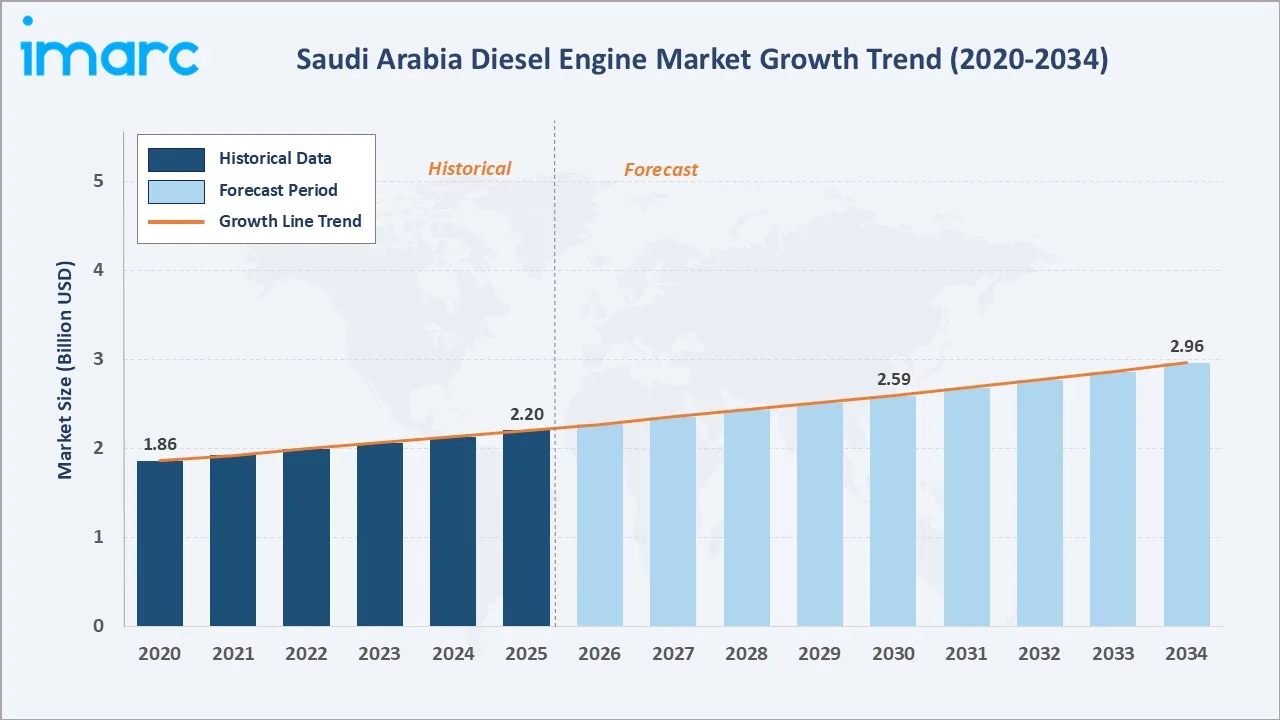
The Saudi Arabia diesel engine market size increased from USD 2.20 Billion in 2025 to USD 2.27 Billion in 2026 and is projected to reach USD 2.96 Billion by 2034, exhibiting a CAGR of 3.35% during 2026-2034. Sustained infrastructure spending under Vision 2030, expanding freight and logistics fleets, rising demand for reliable backup and prime power, and continued reliance on diesel platforms across oil, gas, and mining operations are the primary drivers shaping the market growth.
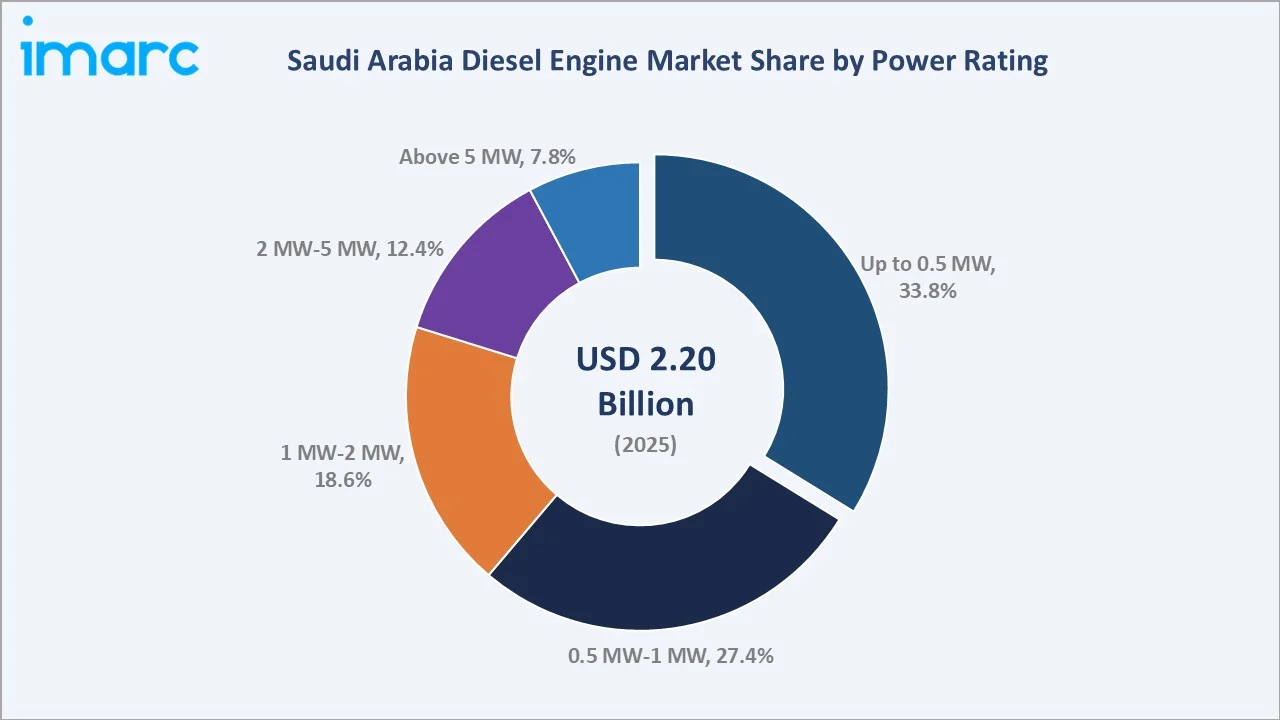
Up to 0.5 MW leads the power rating segment at 33.8%, automotive dominates the end user segment at 64.5%, and Northern and Central Region commands 46.3% regional share.
Market Snapshot
|
Metric |
Value |
|
Base Year Market Size (2025) |
USD 2.20 Billion |
| Market Size (2026) | USD 2.27 Billion |
|
Forecast Market Size (2034) |
USD 2.96 Billion |
|
CAGR (2026-2034) |
3.35% |
|
Base Year |
2025 |
|
Historical Period |
2020-2025 |
|
Forecast Period |
2026-2034 |
|
Largest Region |
Northern and Central Region (46.3%, 2025) |
|
Second Largest Region |
Western Region (24.0%, 2025) |
|
Leading Power Rating |
Up to 0.5 MW (33.8%, 2025) |
|
Leading End User |
Automotive (64.5%, 2025) |
The Saudi Arabia diesel engine market expanded from USD 1.86 Billion in 2020 to USD 2.20 Billion in 2025 and an estimated USD 2.27 Billion in 2026, supported by steady construction activity and rising demand for distributed power across industrial sites. Anchored at USD 2.59 Billion in 2030, the forecast to USD 2.96 Billion by 2034 reflects sustained commercial vehicle demand, expanding critical-facility backup requirements, and a gradual shift toward higher-output engine platforms.
To get more information on this market, Request Sample
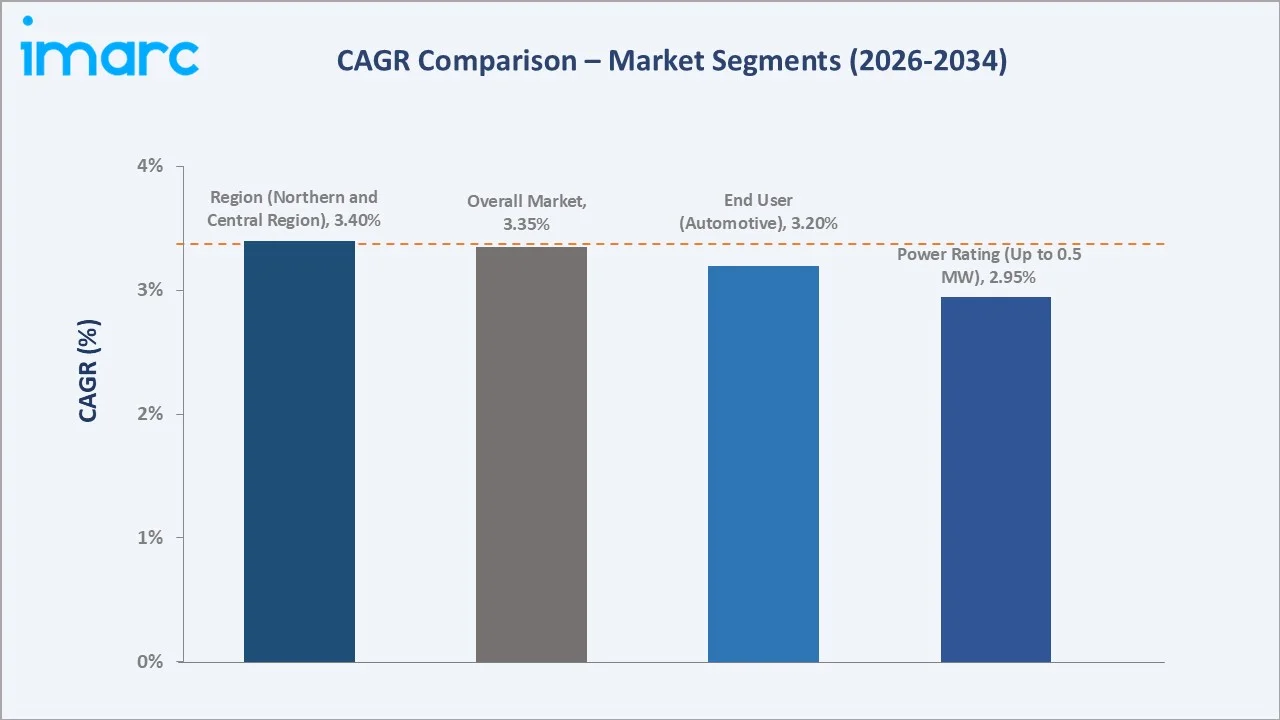
CAGR trajectories across power rating, end user, and regional sub-segments show above 5 MW, non-automotive, and Western Region expanding faster than the overall 3.35% market CAGR. Large-scale power projects, industrial diversification, and coastal logistics growth explain the divergence.
Executive Summary
The Saudi Arabia diesel engine market is on a steady growth path from USD 1.86 Billion in 2020 to USD 2.27 Billion in 2026 and reaching USD 2.96 Billion by 2034. Demand has shifted from basic mechanical units toward electronically managed, emission-compliant platforms. Diesel engines power trucks, buses, generator sets, marine vessels, and industrial equipment across the Kingdom. Vision 2030 construction activity, freight expansion, and continuous power needs at remote sites underpin the trajectory.
Up to 0.5 MW dominates the power rating segment at 33.8% in 2025, supported by light commercial vehicles, compact generator sets, and construction equipment. Automotive leads the end user segment at 64.5%, reflecting the Kingdom's large road freight base. According to the General Authority for Statistics (GASTAT), registered vehicles in operation exceeded 15.8 Million at the end of 2024, a 6.9% increase over the year. Northern and Central Region commands 46.3% of regional share, led by Riyadh's concentration of industrial, logistics, and construction activity.
Key Market Insights
|
Insight |
Data |
|
Leading Power Rating |
Up to 0.5 MW - 33.8% share (2025) |
|
Second Largest Power Rating |
0.5 MW-1 MW - 27.4% share (2025) |
|
Leading End User |
Automotive - 64.5% share (2025) |
|
Second Largest End User |
Non-Automotive - 35.5% share (2025) |
|
Leading Region |
Northern and Central Region - 46.3% share (2025) |
|
Second Largest Region |
Western Region - 24.0% share (2025) |
|
Top Companies |
Cummins Inc., Caterpillar Inc., AB Volvo, Isuzu Motors Limited |
Key Analytical Observations Supporting the Above Data:
- Up to 0.5 MW leadership at 33.8% rests on light commercial vehicles, compact generator sets, and small construction and agricultural equipment.
- 0.5 MW-1 MW at 27.4% reflects mid-range generator sets and medium-duty trucks. Commercial buildings, hospitals, and telecom sites rely on this band for standby power.
- Automotive dominance at 64.5% is anchored in road freight, intercity buses, and heavy haulage. The Kingdom's dispersed urban centers and long inland corridors keep diesel the default powertrain for payload-heavy duty cycles.
- Non-automotive at 35.5% covers power generation, marine propulsion, oil and gas services, and industrial drives. Demand tracks project cycles rather than vehicle sales.
- Northern and Central Region at 46.3% leads regional share, anchored by Riyadh. Administrative concentration, dense logistics corridors, and sustained urban development support both vehicle and stationary demand.
Saudi Arabia Diesel Engine Market Overview
A diesel engine is a compression-ignition internal combustion unit that converts diesel fuel into mechanical power. Advancements in engine technology continue to improve fuel efficiency and emissions performance while maintaining high operational reliability.
The Kingdom's ecosystem links component and fuel-system suppliers, engine manufacturers, aftertreatment specialists, generator set packagers, authorized distributors, and a wide service and rental network. Regulators shape emission and efficiency requirements, determining how quickly newer technologies reach end users.
Market Dynamics
To evaluate market opportunities, Request Sample
Market Drivers
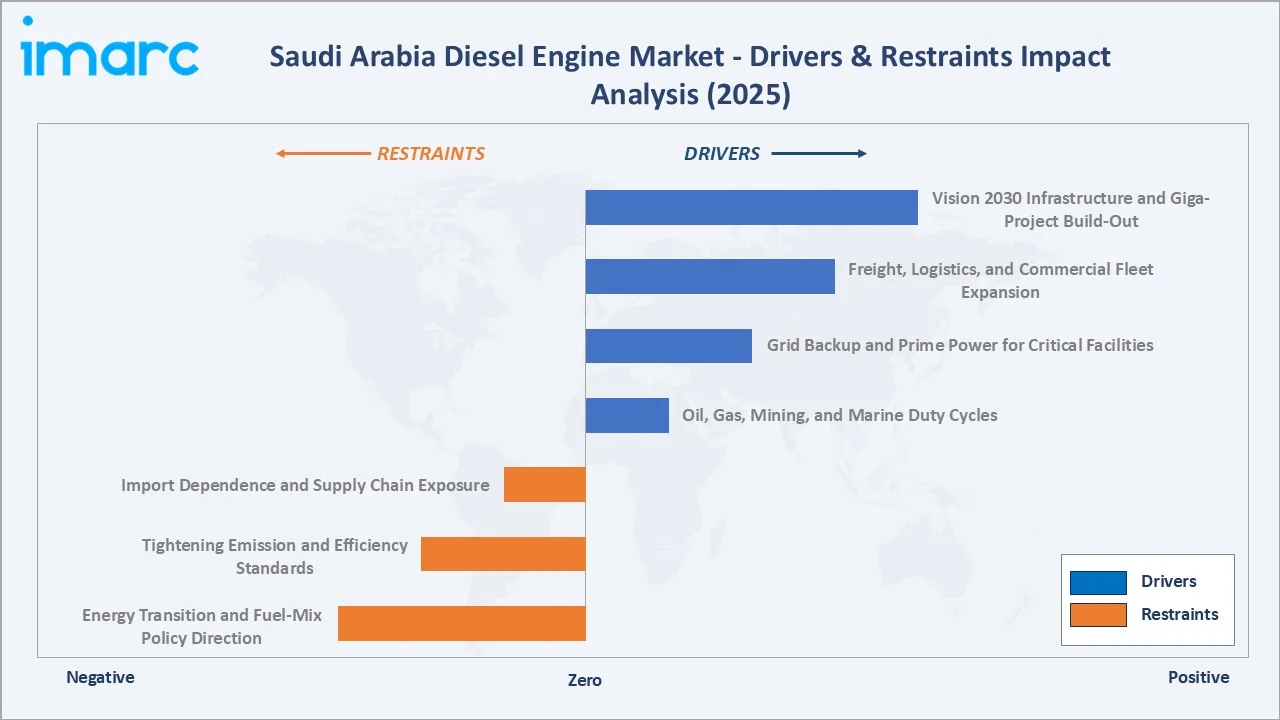
- Vision 2030 Infrastructure and Giga-Project Build-Out: Large-scale development across new cities, transport corridors, tourism assets, and industrial zones requires earthmoving fleets, mobile power, and site logistics. The General Authority for Roads initiated 40 new road projects throughout Saudi Arabia in the initial half of 2026, increasing the Kingdom’s transport network by over 900 Km. Diesel remains the practical choice where grid access is limited or temporary.
- Freight, Logistics, and Commercial Fleet Expansion: Growing domestic consumption, e-commerce volumes, and regional transit traffic are lifting truck and bus utilization. As per IMARC Group, the Saudi Arabia e-commerce market size reached USD 251.3 Billion in 2025. Fleet operators continue to specify diesel for range, payload, and refueling convenience across long inland routes.
- Grid Backup and Prime Power for Critical Facilities: Hospitals, telecom nodes, industrial plants, and data centers need uninterrupted supply. Diesel engines provide dependable backup and prime power solutions, ensuring operational continuity during grid outages and in off-grid locations.
- Oil, Gas, Mining, and Marine Duty Cycles: Upstream operations, drilling support, port equipment, and offshore vessels depend on high-torque diesel platforms. These applications favor proven, serviceable engines with long overhaul intervals and dependable parts availability.
Market Restraints
- Energy Transition and Fuel-Mix Policy Direction: National policy is steering electricity generation toward gas and renewables. Over time this reduces the role of liquid-fuel generation in utility-scale supply and narrows the addressable base for large stationary diesel units.
- Tightening Emission and Efficiency Standards: Progressive alignment with stricter emission norms raises engineering and compliance costs. Aftertreatment hardware, cleaner fuel requirements, and certification workloads add to unit prices and lengthen product development cycles.
- Import Dependence and Supply Chain Exposure: Most engines and critical components are imported. Shipping delays, currency movement, and upstream component shortages can extend lead times and complicate parts planning for operators running mixed fleets.
Market Opportunities
- Localization of Assembly, Parts, and Aftermarket Services: Industrial policy favors domestic value addition. Local assembly, remanufacturing, and expanded service and training capacity offer manufacturers a route to shorter lead times and stronger customer relationships.
- Hybridization and Low-Carbon Fuel Compatibility: Diesel-battery hybrid gensets and engines certified for renewable or blended fuels let operators cut emissions without replacing installed assets.
Market Challenges
- Competition from Gas, Solar, and Battery Hybrid Systems: Falling solar and storage costs, plus expanding gas infrastructure, give buyers credible alternatives for continuous power. Diesel now competes on resilience and capital cost rather than running cost.
- Skilled Technician Availability and Service Coverage: Electronically controlled engines need diagnostic capability and trained technicians. Coverage gaps in remote areas lengthen downtime and favor suppliers with the widest service footprint.
Emerging Market Trends
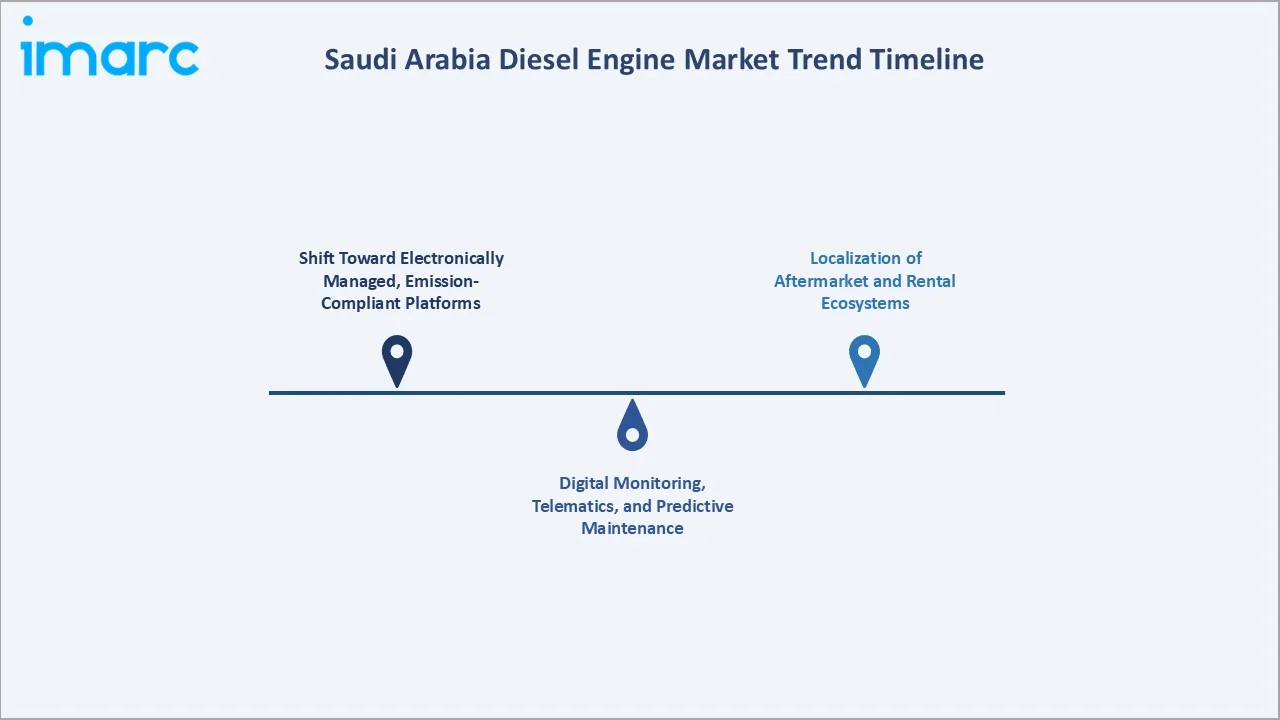
1. Shift Toward Electronically Managed, Emission-Compliant Platforms
Buyers are moving away from purely mechanical engines toward common rail injection and electronic control units. These platforms deliver better fuel economy and cleaner combustion. They also support diagnostics that reduce unplanned downtime across demanding duty cycles.
2. Digital Monitoring, Telematics, and Predictive Maintenance
Connected controllers stream load, temperature, and fuel data to fleet dashboards. Operators use this to schedule service by condition rather than by calendar, lengthening intervals between overhauls and improving visibility across dispersed assets.
3. Localization of Aftermarket and Rental Ecosystems
Rental fleets, remanufactured parts programs, and regional training centers are expanding, lowering ownership costs for contractors with variable workloads and supporting the push toward domestic industrial capability.
Industry Value Chain Analysis
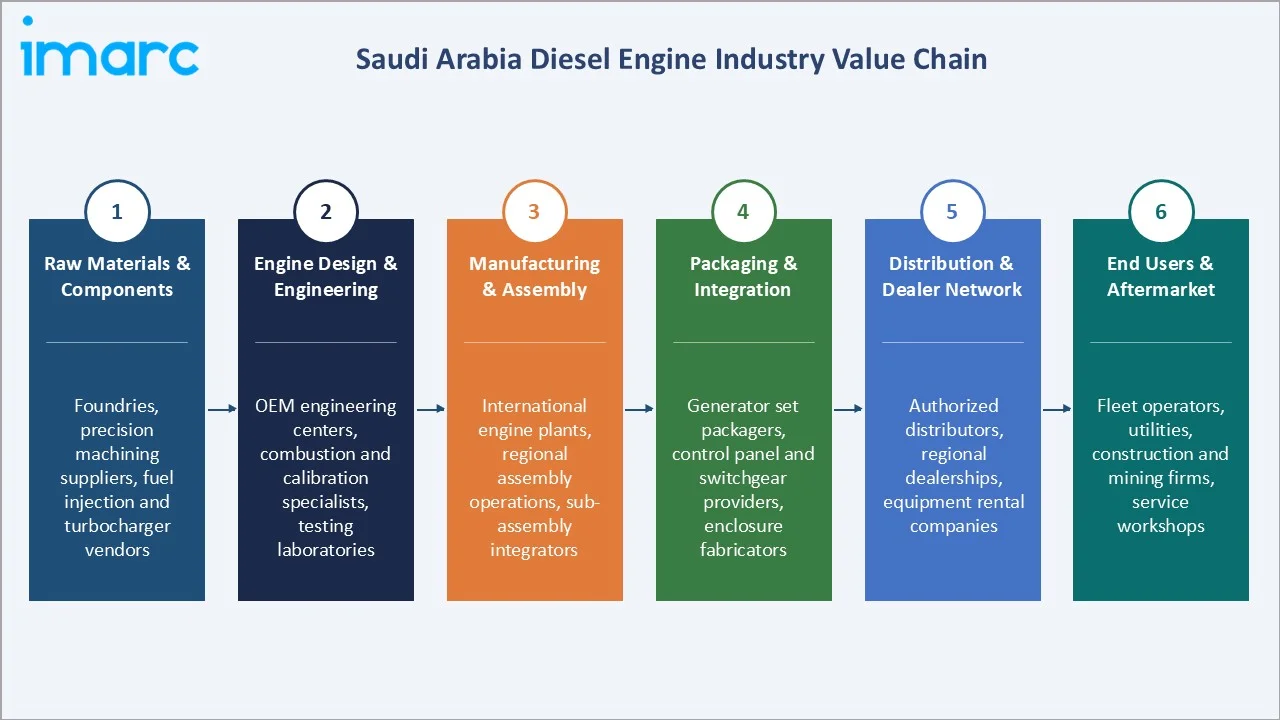
The Saudi Arabia diesel engine value chain spans six stages, from component supply through end-user service and overhaul. Engineering, integration, and aftermarket support capture the highest value, while distribution reach increasingly determines competitive position.
|
Stage |
Key Players / Examples |
|
Raw Materials & Components |
Foundries, precision machining suppliers, fuel injection and turbocharger vendors, filtration and bearing manufacturers |
|
Engine Design & Engineering |
Original equipment engineering centers, combustion and calibration specialists, testing and validation laboratories |
|
Manufacturing & Assembly |
International engine plants, regional assembly operations, and component sub-assembly integrators |
|
Packaging & Integration |
Generator set packagers, control panel and switchgear providers, enclosure fabricators, marine and industrial integrators |
|
Distribution & Dealer Network |
Authorized distributors, regional dealerships, equipment rental companies, and procurement contractors |
|
End Users & Aftermarket |
Fleet operators, utilities, construction and mining firms, service workshops and overhaul specialists |
Suppliers combining proprietary engine technology with an owned service network capture more margin than those relying on third-party distribution. Parts availability and response time are decisive where downtime carries a high project cost.
Technology Landscape in the Saudi Arabia Diesel Engine Industry
Common Rail Injection and Electronic Engine Management
High-pressure common rail systems paired with electronic control units allow precise injection timing and multiple injection events per cycle. This improves fuel efficiency and reduces particulate formation. Calibration can also be tuned for the high ambient temperatures typical of the Kingdom.
Aftertreatment and Emission Control Systems
Selective catalytic reduction, diesel oxidation catalysts, and particulate filters are becoming standard on newer platforms. These systems cut nitrogen oxide and soot output. Their adoption depends closely on fuel sulfur levels and the availability of reagent supply chains.
Thermal Management and Materials Engineering
Desert operation places heavy demands on cooling. Manufacturers are deploying enhanced radiator packages, improved lubricants, and heat-resistant alloys for pistons and turbochargers, protecting rated output under sustained high-load conditions.
Market Segmentation Analysis
The report covers the following segments:
|
Segment Category |
Leading Segment |
Market Share |
Year |
|
Power Rating |
Up to 0.5 MW |
33.8% |
2025 |
|
End User |
Automotive |
64.5% |
2025 |
|
Region |
Northern and Central Region |
46.3% |
2025 |

By Power Rating
Up to 0.5 MW commands a 33.8% share in 2025, the largest of any power band. High unit volumes, broad dealer coverage, and lower capital cost sustain its lead. The segment also benefits from widespread use in commercial facilities, construction sites, and backup power applications requiring reliable and cost-effective diesel engines.
To access detailed market analysis, Request Sample
0.5 MW-1 MW follows at 27.4%, serving mid-range standby power and medium-duty transport. The segment is supported by growing demand from industrial facilities, commercial buildings, and infrastructure projects requiring dependable medium-capacity power solutions.
By End User
Automotive dominates with a 64.5% share in 2025. Road freight, intercity buses, pickups, and heavy haulage form the bulk of demand. Long inland corridors, dispersed population centers, and payload requirements keep diesel the practical powertrain choice for commercial operators.
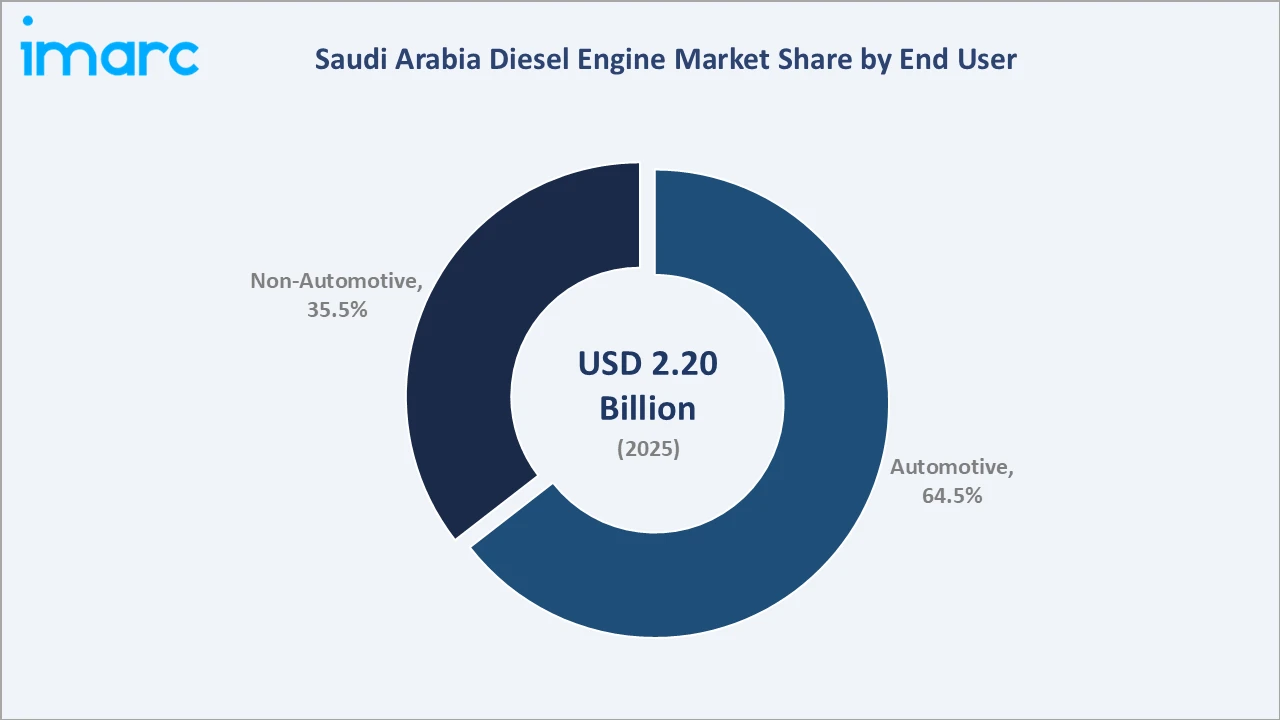
Non-automotive accounts for 35.5% and is the faster growing of the two. Project-linked demand, particularly for standby and prime power, drives its expansion through the forecast period.
Regional Market Insights
|
Region |
Share (2025) |
Key Growth Drivers |
|
Northern and Central Region |
46.3% |
Administrative and industrial concentration, large-scale urban development, dense logistics corridors, high commercial vehicle density |
|
Western Region |
24.0% |
Port and pilgrimage-related traffic, coastal tourism development, expanding industrial zones, growing marine activity |
|
Eastern Region |
19.1% |
Established energy and petrochemical base, heavy industrial operations, large-capacity power needs, mature service infrastructure |
|
Southern Region |
10.6% |
Infrastructure upgrades, mining and agricultural activity, distributed power needs, expanding connectivity projects |
Northern and Central Region at 46.3% in 2025 leads the regional landscape, anchored by Riyadh. Administrative concentration, sustained urban development, and dense inland logistics corridors support demand across both vehicle and stationary applications.
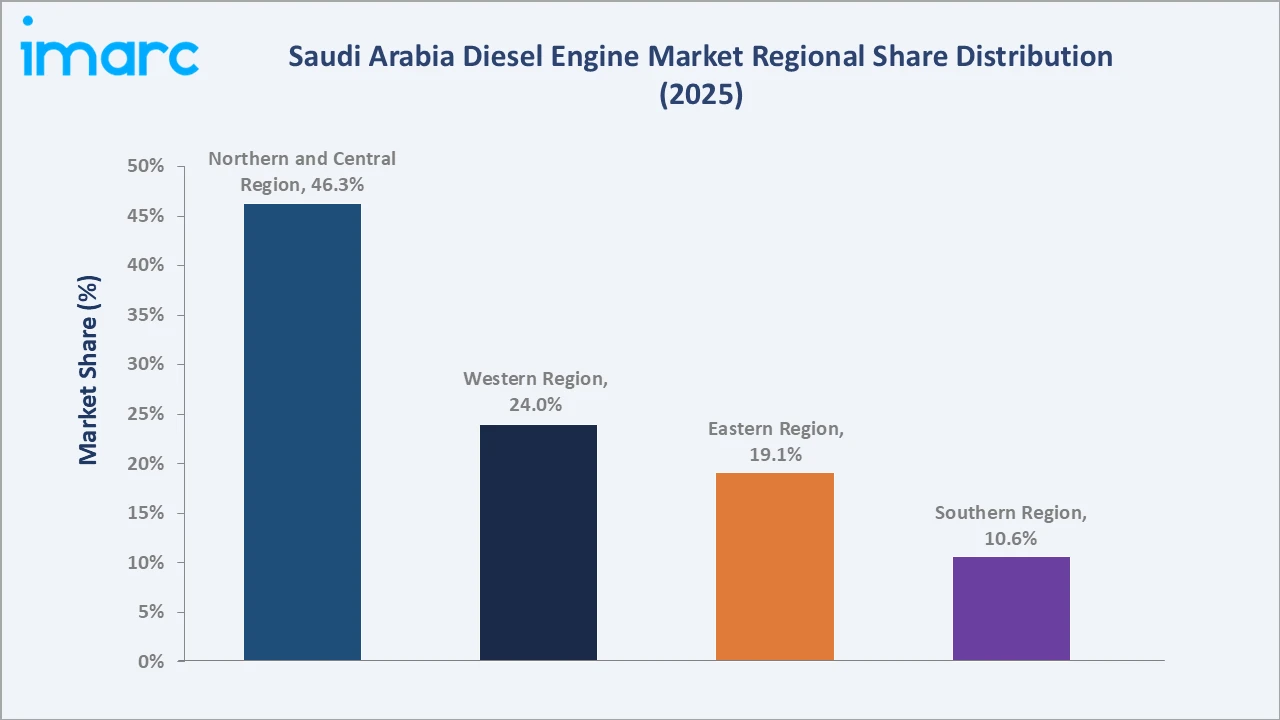
Western Region at 24.0% is the fastest growing. Port throughput, pilgrimage-related transport, coastal tourism development, and expanding industrial zones are accelerating demand for both mobile and stationary diesel power through 2034.
Competitive Landscape
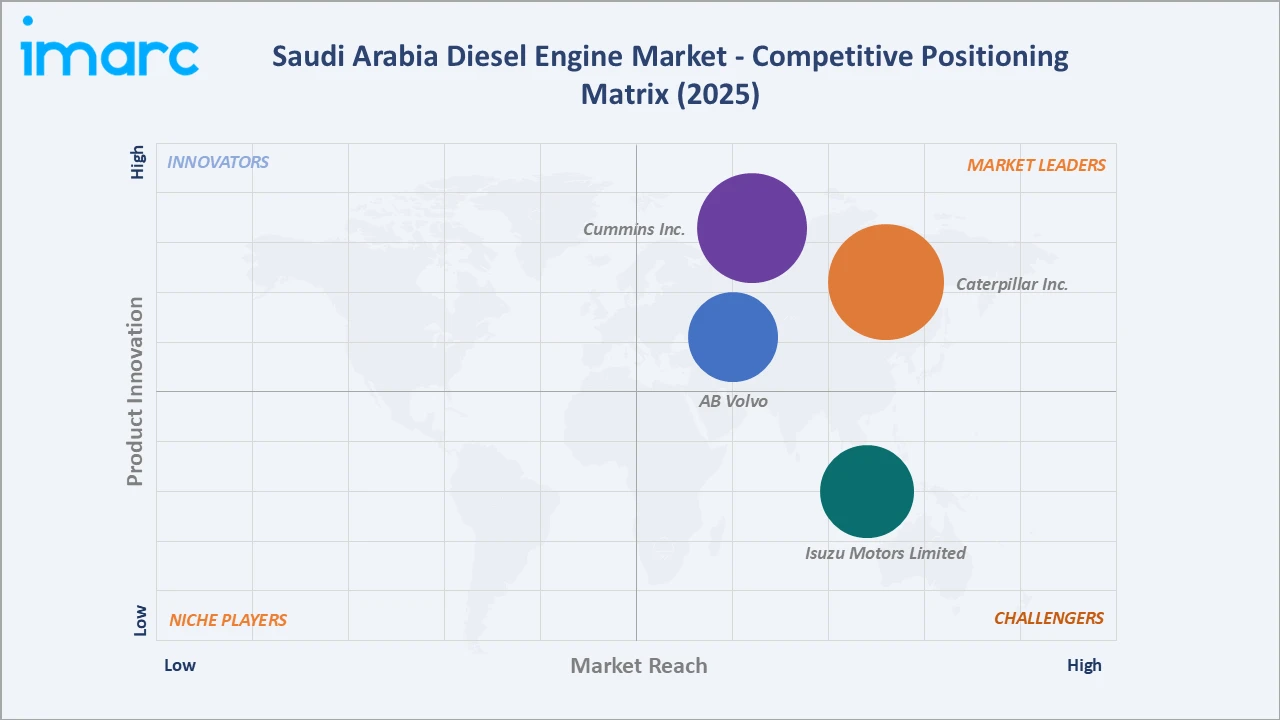
The Saudi Arabia diesel engine market is moderately consolidated. Established global manufacturers lead on product breadth and service reach, while specialist suppliers compete in defined power bands and applications. Distribution depth, parts availability, and emission compliance form the principal competitive moats.
|
Company Name |
Brand / Key Product |
Position |
Strategic Focus |
|
Cummins Inc. |
Cummins Engines |
Leader |
Broad power range coverage with an integrated distribution and service model |
|
Caterpillar Inc. |
Perkins Engines |
Leader |
Heavy-duty industrial platforms supported by an extensive dealer network |
|
AB Volvo |
Volvo Penta |
Leader |
Industrial and marine engine platforms with a focus on efficiency and uptime |
|
Isuzu Motors Limited |
Isuzu Diesel Engines |
Challenger |
Light and medium commercial platforms with regional assembly presence |
Key players include Cummins Inc., Caterpillar Inc., AB Volvo, and Isuzu Motors Limited, among others.
Key Company Profiles
Cummins Inc.
Cummins Inc. is a power solutions company founded in 1919 and headquartered in Columbus, Indiana, United States. It designs, manufactures, and services diesel engines, generator sets, and related components across a wide range of power outputs for on-highway and off-highway applications.
- Product Portfolio: Diesel engine families spanning light-duty to high-horsepower ratings, together with generator sets, aftertreatment, filtration, and fuel systems.
- Recent Developments: Cummins Inc. continues to strengthen its diesel engine portfolio by introducing higher-efficiency engines, expanding power generation solutions, and enhancing aftersales service capabilities to meet evolving industrial and commercial demand.
- Strategic Focus: Broad coverage across power bands, supported by an integrated distribution and aftermarket service model.
Caterpillar Inc.
Caterpillar Inc. is a construction, mining, and power systems manufacturer founded in 1925 and headquartered in Irving, Texas, United States. It supplies diesel and gas engines for industrial, power generation, agricultural, and material handling applications.
- Product Portfolio: Industrial and generator set engine platforms across a wide power range, supported by parts, service, and rebuild programs.
- Recent Developments: Caterpillar Inc. continues to enhance its diesel engine portfolio by improving fuel efficiency, expanding generator set offerings, and strengthening engine rebuild and remanufactured parts programs to support long-term customer demand.
- Strategic Focus: Serving equipment manufacturers and power users through an extensive distributor and dealer network.
AB Volvo
AB Volvo is a Swedish manufacturer of commercial vehicles, industrial engines, and marine propulsion systems, headquartered in Gothenburg. Its Volvo Penta business supplies diesel engines for industrial, generator set, and marine applications.
- Product Portfolio: Industrial and marine diesel engines, generator set drive packages, and complete power systems for off-highway use.
- Recent Developments: The firm is focusing on continued expansion of the engine range, with efficiency improvements and support for operation on renewable fuels.
- Strategic Focus: Building on efficiency and uptime credentials while extending regional service coverage.
Market Concentration Analysis
The Saudi Arabia diesel engine market is moderately consolidated. A small group of global manufacturers, led by Cummins Inc., Caterpillar Inc., and AB Volvo, accounts for a substantial share of installed capacity across both automotive and non-automotive applications through established distribution partnerships.
Barriers to entry are meaningful. New entrants must build a service and parts network, meet evolving emission requirements, and earn credibility with buyers who prioritize uptime. These conditions favor incumbents with regional workshop coverage.
Consolidation is gradual rather than abrupt. Competition is increasingly shaped by aftermarket capability, digital monitoring, and financing rather than engine hardware alone. Partnerships with local distributors and rental operators remain the main route to wider reach.
Investment & Growth Opportunities
Fastest-Growing Segments
Above 5 MW is expanding the fastest among power ratings, supported by utility-scale backup, marine propulsion, and heavy process industries. Non-automotive outpaces automotive, reflecting project-linked demand for standby and prime power across industrial and critical facilities.
Emerging Markets
Western Region is the fastest growing regional market, driven by port activity, tourism development, and industrial zone expansion. Southern Region offers a smaller but improving base as infrastructure and mining activity scale up.
Venture & Investment Trends
Capital is flowing toward localized assembly and remanufacturing, rental and leasing platforms, digital monitoring services, and hybrid power integration. These areas align with industrial policy while addressing the aftermarket gaps operators cite most often.
Future Market Outlook (2026-2034)
The Saudi Arabia diesel engine market is forecast to expand from USD 2.20 Billion in 2025 to an estimated USD 2.27 Billion in 2026 and further to USD 2.96 Billion by 2034 at a CAGR of 3.35%, adding roughly USD 0.76 Billion in incremental market value across the forecast period.
Four forces will shape the market through 2034: sustained infrastructure and freight demand; a gradual shift in the electricity generation mix; tightening emission and efficiency expectations; and the spread of hybrid and fuel-flexible configurations that extend the life of installed assets.
By 2034, diesel should remain the default for mobility and resilience applications while ceding ground in continuous utility-scale generation. Growth will concentrate in higher power bands, non-automotive uses, and regions with active port, industrial, and tourism development.
Research Methodology
Primary Research
Primary research included structured interviews with engine distributors, generator set packagers, fleet operators, and industrial power buyers, validating market sizing, regional demand, power rating mix and end user split.
Secondary Research
Secondary sources included publications from the General Authority for Statistics, the Ministry of Industry and Mineral Resources and the Ministry of Energy, Vision 2030 documentation, trade data, and annual reports from listed engine manufacturers.
Forecasting Models
Forecasts combined top-down and bottom-up models using vehicle parc growth, project pipelines, installed generation capacity, replacement cycles, and macroeconomic variables. Scenario analysis addressed energy transition pace and infrastructure spending intensity.
Saudi Arabia Diesel Engine Market Report Coverage:
| Report Features | Details |
|---|---|
| Base Year of the Analysis | 2025 |
| Historical Period | 2020-2025 |
| Forecast Period | 2026-2034 |
| Units | Billion USD |
| Scope of the Report |
Exploration of Historical Trends and Market Outlook, Industry Catalysts and Challenges, Segment-Wise Historical and Future Market Assessment:
|
| Power Ratings Covered | 0.5 MW–1 MW, Up to 0.5 MW, 2 MW–5 MW, 1 MW–2 MW, Above 5 MW |
| End Users Covered |
|
| Regions Covered | Northern and Central Region, Western Region, Eastern Region, Southern Region |
| Companies Covered | Cummins Inc., Caterpillar Inc., AB Volvo, Isuzu Motors Limited, etc. |
| Customization Scope | 10% Free Customization |
| Post-Sale Analyst Support | 10-12 Weeks |
| Delivery Format | PDF and Excel through Email (We can also provide the editable version of the report in PPT/Word format on special request) |
Key Benefits for Stakeholders:
- IMARC’s industry report offers a comprehensive quantitative analysis of various market segments, historical and current market trends, market forecasts, and dynamics of the Saudi Arabia diesel engine market from 2020-2034.
- The research report provides the latest information on the market drivers, challenges, and opportunities in the Saudi Arabia diesel engine market.
- Porter's five forces analysis assist stakeholders in assessing the impact of new entrants, competitive rivalry, supplier power, buyer power, and the threat of substitution. It helps stakeholders to analyze the level of competition within the Saudi Arabia diesel engine industry and its attractiveness.
- Competitive landscape allows stakeholders to understand their competitive environment and provides an insight into the current positions of key players in the market.
Frequently Asked Questions About the Saudi Arabia Diesel Engine Market Report
The Saudi Arabia diesel engine market size is estimated at USD 2.27 Billion in 2026, supported by infrastructure activity, commercial fleet demand, and requirements for reliable backup power.
The market is projected to grow at a CAGR of 3.35% from 2026-2034, reaching USD 2.96 Billion, driven by freight expansion and continued demand for distributed power.
Up to 0.5 MW leads at 33.8% in 2025, supported by light commercial vehicles and compact generator sets. Its widespread adoption across commercial, industrial, and backup power applications further reinforces its market leadership.
Automotive dominates at 64.5% in 2025, covering trucks, buses, and heavy haulage. Strong demand from freight transportation, construction, and logistics activities continues to support the segment's growth.
Northern and Central Region commands 46.3% in 2025, anchored by Riyadh's administrative concentration, urban development activity, and dense inland logistics corridors.
Leading players include Cummins Inc., Caterpillar Inc., AB Volvo, and Isuzu Motors Limited, among others.
Vision 2030 infrastructure programs, expanding freight and logistics fleets, backup power needs at critical facilities, and demanding duty cycles across oil, gas, and mining operations.
The shift in national electricity generation toward gas and renewables, tightening emission and efficiency standards, and dependence on imported engines and components.
Common rail injection, electronic engine management, aftertreatment systems, and telematics are improving efficiency and emissions while enabling condition-based maintenance across dispersed assets.
Need more help?
- Speak to our experienced analysts for insights on the current market scenarios.
- Include additional segments and countries to customize the report as per your requirement.
- Gain an unparalleled competitive advantage in your domain by understanding how to utilize the report and positively impacting your operations and revenue.
- For further assistance, please connect with our analysts.
 Request Customization
 Speak to an Analyst
 Request Brochure
 Inquire Before Buying
Benefits of Customization
- Personalize this research
- Triangulate with your data
- Get data as per your format and definition
- Gain a deeper dive into a specific application, geography, customer, or competitor
- Any level of personalization
Get in Touch With Us
UNITED STATES
Phone: +1-201-971-6302
INDIA
Phone: +91-120-433-0800
UNITED KINGDOM
Phone: +44-753-714-6104
Email: [email protected]
Client Testimonials




.webp)




.webp)













Related Reports

Choose your plan
*Please note that the prices mentioned below are starting prices for each bundle type. Kindly contact our team for further details.*
Single User License
- 1 User License, Access on 2 Devices
- PDF Report + Excel Dataset (Password Protected)
- Lifetime Access
- No Printing Rights
- 10% Free Report Customization
- 10–12 Weeks of Analyst Support
Five User License
- Access for 5 Users, 2 Devices per User
- PDF Report + Excel Dataset (Password Protected)
- Lifetime Access
- Dedicated Account Manager
- 12–14 Weeks of Analyst Support
- No Printing Rights
- 15% Free Report Customization
- 25% Discount on Your Next Purchase
Corporate User License
- Unlimited User Access (Within Your Organization)
- PDF Report + Excel Dataset
- Lifetime Access
- Dedicated Account Manager
- 14–20 Weeks of Analyst Support
- No Printing Rights
- 20% Free Report Customization
- 30% Discount on Your Next Purchase
Essential Insights
What's included:
3 reports
- Lifetime Access
- PDF Reports
- Excel Datasets
- 2 Weeks of Free Analyst Support
- 2 User Licenses
- Access on 2 Devices
- Printing Rights
- Complimentary PowerPoint (PPT) Version
- Complimentary License Upgrade
Professional Access
What's included:
5 reports
- Lifetime Access
- PDF Reports
- Excel Datasets
- 8 Weeks of Free Analyst Support
- 2 User Licenses
- Access on 2 Devices
- Printing Rights
- Complimentary PowerPoint (PPT) Version
- Complimentary License Upgrade
Business Advantage
What's included:
8 reports
- Lifetime Access
- PDF Reports
- Excel Datasets
- 14 Weeks of Free Analyst Support
- 2 User Licenses
- Access on 2 Devices
- Printing Rights
- Complimentary PowerPoint (PPT) Version
- Complimentary License Upgrade
Enterprise Intelligence
What's included:
10 reports
- Lifetime Access
- PDF Reports
- Excel Datasets
- 20 Weeks of Free Analyst Support
- 2 User Licenses
- Access on 2 Devices
- Printing Rights
- Complimentary PowerPoint (PPT) Version
- Complimentary License Upgrade