
Saudi Arabia Digital Banking Market Size, Share, Trends and Forecast by Type, Service, and Region, 2026-2034
Saudi Arabia Digital Banking Market Summary:
The Saudi Arabia digital banking market size was valued at USD 77.21 Million in 2025 and is projected to reach USD 219.33 Million by 2034, growing at a compound annual growth rate of 12.30% from 2026-2034.
The Saudi Arabia digital banking market is expanding rapidly, driven by the Kingdom's ambitious Vision 2030 initiative. Increasing smartphone penetration, rising demand for seamless financial services, and the emergence of digital-only banks are transforming the financial landscape. Government-led fintech strategies, coupled with a tech-savvy population and robust regulatory frameworks, are accelerating adoption of mobile banking, digital wallets, and contactless payments.
Key Takeaways and Insights:
- By Type: Retail banking dominates the market with a share of 52% in 2025, owing to the widespread adoption of consumer-focused digital services, including mobile banking applications, digital wallets, and online account management platforms. Rising household incomes and increasing financial literacy among the population are driving retail digital banking adoption.
- By Service: Transactional services lead the market with a share of 60% in 2025, driven by consumer preferences for instant fund transfers, bill payments, and mobile payments. The integration of real-time payment systems and the expansion of contactless payment infrastructure are reinforcing the dominance of transactional services.
- By Region: Northern and Central Region represents the largest region with 32% share in 2025, reflecting the concentration of financial institutions, corporate headquarters, and technology infrastructure in Riyadh. The region's status as the economic and administrative capital attracts substantial investments in digital banking innovation.
- Key Players: Major financial institutions drive the Saudi Arabia digital banking market by investing heavily in digital transformation, artificial intelligence (AI) integration, and mobile platform enhancements. Their strategic partnerships with fintech companies, expansion of digital service portfolios, and commitment to customer-centric innovation strengthen market penetration and accelerate industry-wide adoption.
The Saudi Arabia digital banking market is experiencing robust expansion, driven by comprehensive government support and favorable regulatory frameworks established by the Saudi Central Bank. The Financial Sector Development Program has catalyzed innovation by creating pathways for digital-only banks and fintech startups to enter the market. In July 2024, Riyad Bank launched the Center of Intelligence, the first specialized AI hub in the Saudi banking sector, marking a significant milestone in technology-driven financial services. High smartphone penetration among the population provides an extensive customer base for digital banking services. The young demographic profile accelerates digital adoption as this tech-savvy segment demands convenient and seamless financial solutions. Traditional banks are rapidly transforming their operations through investments in cloud computing, data analytics, and automated customer service systems. Strategic collaborations between established financial institutions and innovative fintech firms are creating comprehensive digital ecosystems that address diverse customer needs across retail, corporate, and investment banking segments.
Saudi Arabia Digital Banking Market Trends:
Expansion of Open Banking Infrastructure
The Saudi Central Bank has significantly advanced its Open Banking Framework, enabling secure data sharing between financial institutions and licensed fintech companies. The framework includes Payment Initiation Services alongside Account Information Services, creating opportunities for personalized financial products. The broadening has facilitated the emergence of innovative personal finance management applications and automated investment platforms that aggregate customer banking data across multiple institutions to deliver comprehensive financial insights and recommendations.
Integration of AI and Machine Learning (ML)
Financial institutions across Saudi Arabia are rapidly deploying AI technologies to enhance operational efficiency and customer experience. As per IMARC Group, the Saudi Arabia AI market size was valued at USD 1,242.5 Million in 2025. AI-powered chatbots provide round-the-clock customer support, while ML algorithms enable personalized product recommendations and predictive analytics for risk management. Banks are utilizing advanced fraud detection systems that analyze transaction patterns in real-time, strengthening security measures and building customer trust in digital channels.
Rise of Digital-Only Banking Platforms
The licensing and launch of digital-only banks represent a transformative shift in the Saudi Arabia financial landscape. These platforms leverage technology-first approaches to deliver seamless banking experiences without physical branch networks. In Saudi Arabia, digital banks are targeting tech-savvy consumers with streamlined account opening processes, competitive fee structures, and innovative features, including real-time spending analytics and integrated savings tools that appeal to younger demographics seeking convenient mobile-first financial services.
How Vision 2030 is Transforming the Saudi Arabia Digital Banking Market:
Vision 2030 is fundamentally transforming the Saudi Arabia digital banking market by driving modernization, innovations, and financial inclusion across the Kingdom. The initiative encourages banks to adopt advanced digital platforms, mobile applications, and AI-driven services that enhance customer convenience, efficiency, and accessibility. Regulatory support for digital-only banks, open banking frameworks, and fintech collaborations is expanding competition while improving service quality. Vision 2030 also emphasizes financial inclusion, enabling underserved populations and small businesses to access banking services through secure digital channels. Investments in cybersecurity, cloud infrastructure, and data analytics strengthen operational resilience and trust, while rising smartphone penetration and a tech-savvy population accelerate adoption of mobile payments, online account management, and digital lending solutions.
Market Outlook 2026-2034:
The Saudi Arabia digital banking market demonstrates strong growth potential, supported by sustained government commitment to financial sector modernization and digital economy development. The market generated a revenue of USD 77.21 Million in 2025 and is projected to reach a revenue of USD 219.33 Million by 2034, growing at a compound annual growth rate of 12.30% from 2026-2034. Continued infrastructure investments, expanding fintech ecosystem, and increasing consumer preferences for digital financial services position the market for sustained expansion. The achievement of cashless transaction targets ahead of schedule demonstrates the Kingdom's successful transition toward a digitally-enabled economy, creating favorable conditions for further innovation and market development.
Saudi Arabia Digital Banking Market Report Segmentation:
|
Segment Category |
Leading Segment |
Market Share |
|
Type |
Retail Banking |
52% |
|
Service |
Transactional Services |
60% |
|
Region |
Northern and Central Region |
32% |
Type Insights:
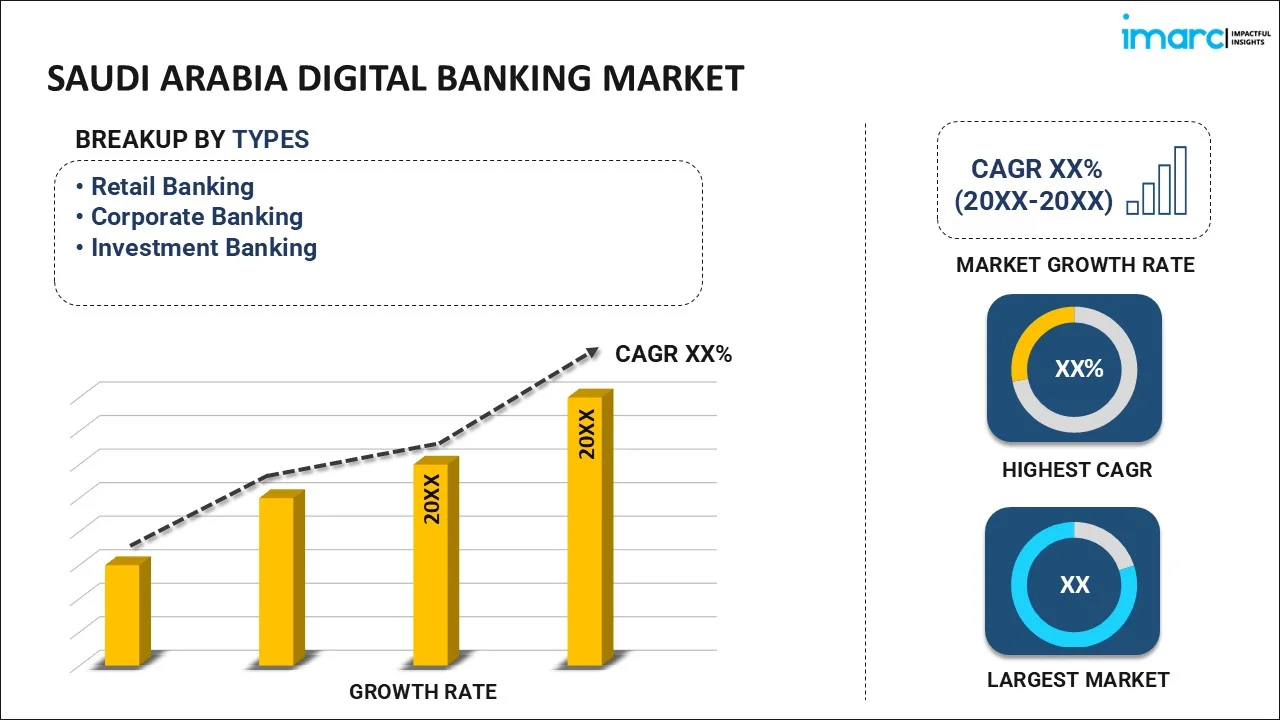
To get detailed segment analysis of this market, Request Sample
- Retail Banking
- Corporate Banking
- Investment Banking
Retail banking dominates with a market share of 52% of the total Saudi Arabia digital banking market in 2025.
Retail banking holds the largest share in the Saudi Arabia digital banking market, driven by the widespread adoption of mobile banking applications and digital payment solutions among individual consumers. The segment benefits from high smartphone penetration rates and a young, tech-savvy population that prefers conducting financial transactions through digital channels. A 2024 survey involving over 1,200 retail banking customers in Saudi Arabia, carried out by Capco, revealed that 81% of those surveyed utilized mobile apps for accessing banking services, demonstrating strong consumer preference for digital convenience.
Features, such as real-time account management, instant fund transfers, bill payments, and mobile wallets, have made digital channels the preferred mode of banking for everyday transactions. Banks are also leveraging AI-driven chatbots, personalized financial insights, and seamless digital onboarding to enhance customer experience. The convenience, speed, and security of these platforms, combined with ongoing government initiatives promoting financial inclusion and cashless transactions, continue to reinforce retail banking’s stronghold in the digital banking landscape.
Service Insights:
- Transactional Services
- Non-Transactional Services
Transactional services lead with a share of 60% of the total Saudi Arabia digital banking market in 2025.
Transactional services constitute the core of digital banking operations, encompassing fund transfers, bill payments, mobile payments, and real-time transaction processing. The segment's dominance reflects consumer demand for instant, seamless financial transactions through digital channels. The Saudi Central Bank reported that electronic payments held 79% of all retail transactions in 2024, up from 70% in 2023, underscoring the rapid shift towards digital transactional services. The growing preference for contactless and mobile-based payments further reinforces the importance of transactional services as the backbone of digital banking.
The expansion of the national payment infrastructure, including the Mada network and integration with international payment platforms, has strengthened transactional service capabilities across the Kingdom. Financial institutions are investing in real-time payment systems and instant settlement technologies to meet consumer expectations for immediate transaction processing. The integration of digital wallets with banking applications provides customers with unified platforms for managing multiple payment methods and conducting diverse transactional activities efficiently.
Regional Insights:
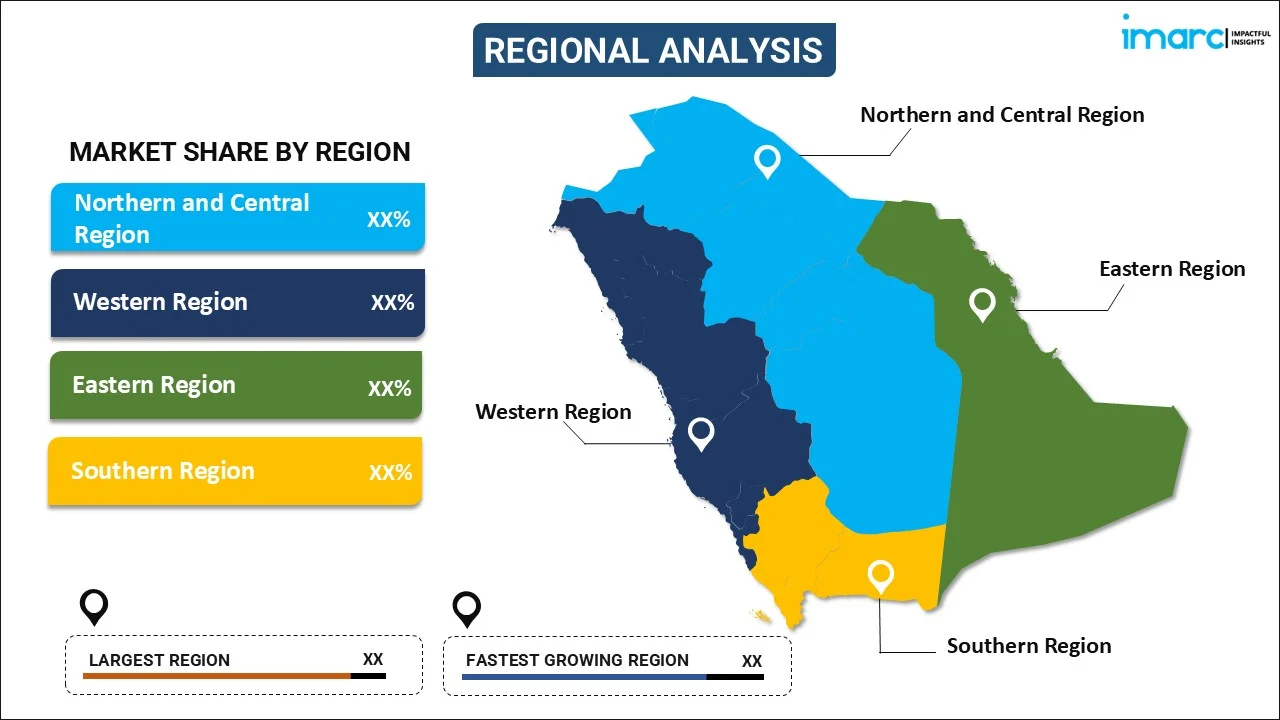
To get detailed regional analysis of this market, Request Sample
- Northern and Central Region
- Western Region
- Eastern Region
- Southern Region
Northern and Central Region exhibits a clear dominance with a 32% share of the total Saudi Arabia digital banking market in 2025.
Northern and Central Region, anchored by the capital city Riyadh, serves as the primary financial and technology hub of Saudi Arabia. The concentration of major bank headquarters, corporate offices, and government institutions creates substantial demand for sophisticated digital banking services. The Financial Sector Development Program's initiative to establish Riyadh as a global fintech hub has attracted significant investments in digital infrastructure and innovation centers, positioning the region at the forefront of banking digitalization.
The region benefits from advanced digital infrastructure, high internet connectivity, and a skilled workforce that drives adoption of innovative financial technologies. The King Abdullah Financial District serves as a dedicated economic zone fostering financial sector development and attracting international financial institutions. Additionally, growing urbanization and a tech-savvy population in the region accelerate demand for mobile banking, online lending, and digital payment solutions. Collaborative partnerships between banks and fintech startups are further enhancing service offerings, driving innovations, and improving customer experience across the Northern and Central Region.
Market Dynamics:
Growth Drivers:
Why is the Saudi Arabia Digital Banking Market Growing?
Government Support and Regulatory Framework Development
The Saudi government’s dedication to the modernization of the financial sector through Vision 2030 and the Financial Sector Development Program is greatly propelling the digital banking industry forward. The Saudi Central Bank is formulating progressive regulatory policies that ensure alignment between technological innovations and financial system soundness and consumer protection, instilling a sense of confidence among banks and fintech companies alike. Regulatory sandbox initiatives enable financial technology firms to pilot new digital solutions within a supervised environment, reducing entry barriers and accelerating innovation cycles. Encouragement of open banking, digital payment services, and alternative financing services is set to boost collaborations between financial banks and fintech companies. The licensing of digital banks also increases industry rivalry, motivating banks to work on improving the quality of financial services and customer-centric innovations.
High Smartphone Penetration and Digital Infrastructure
Widespread smartphone adoption and advanced digital infrastructure form the foundation for digital banking growth in Saudi Arabia. The Kingdom has achieved high smartphone penetration among the population, providing extensive reach for mobile banking applications. Internet connectivity has expanded significantly, with 36.84 Million internet users recorded at the beginning of 2024, enabling seamless access to digital financial services across urban and rural areas. The government's substantial investments in digital infrastructure have strengthened the technological backbone supporting digital banking operations. Advanced telecommunications networks, including 5G coverage, enhance the capability of financial institutions to deliver high-speed, reliable digital services. This robust infrastructure enables the deployment of sophisticated digital banking features, including video conferencing for customer service, real-time biometric authentication, and instant notification systems.
Young Demographics and Changing Consumer Preferences
Saudi Arabia's young population profile significantly drives digital banking adoption as tech-savvy consumers demonstrate strong preference for digital-first financial services. Over 70% of the population was under thirty-five years of age in 2024, representing a demographic that has grown up with digital technologies and expects convenient, mobile-accessible banking solutions. This demographic cohort is highly receptive to mobile banking apps, digital wallets, and instant payment platforms, accelerating the shift away from branch-based banking. Younger consumers value speed, personalization, and seamless user experiences, encouraging banks to invest in intuitive interfaces, AI-driven customer support, and integrated lifestyle services. Social media influence and peer recommendations further amplify adoption of digital financial products among this group. Additionally, rising participation of youth in entrepreneurship, freelancing, and the gig economy increases demand for digital accounts, quick credit access, and cashless transaction tools.
Market Restraints:
What Challenges the Saudi Arabia Digital Banking Market is Facing?
Cybersecurity Threats and Data Protection Concerns
The rapid expansion of digital banking services exposes financial institutions to increasing cybersecurity risks and sophisticated fraud attempts. The financial sector remains a prime target for cybercriminals due to the sensitive nature of financial data and transaction volumes processed through digital channels. Institutions must continuously invest in advanced security measures, fraud detection systems, and regulatory compliance to protect customer information and maintain trust in digital platforms.
Talent Shortage in Technology and Cybersecurity
The shortage of qualified professionals in technology, data analytics, and cybersecurity presents challenges for financial institutions seeking to expand digital capabilities. Rapid digital transformation creates demand for specialized skills that outpace the available talent pool in the local market. Financial institutions compete for limited qualified personnel while also investing in training programs and international recruitment to address workforce requirements.
Legacy System Integration Complexities
Traditional banks face challenges integrating modern digital platforms with existing legacy infrastructure and core banking systems. The complexity of modernizing established systems while maintaining operational continuity requires substantial investments in technology upgrades and system migrations. Banks must balance innovation with operational stability, ensuring seamless customer experiences during digital transformation initiatives.
Competitive Landscape:
The Saudi Arabia digital banking market features a dynamic competitive environment, comprising established traditional banks undergoing digital transformation and emerging digital-native challengers. Major financial institutions are investing significantly in technology infrastructure, AI capabilities, and mobile platform enhancements to maintain market leadership. Strategic partnerships between banks and fintech companies are accelerating innovations and expanding service offerings. The entry of licensed digital-only banks has intensified competition, compelling traditional institutions to accelerate their digital transformation initiatives. Market participants differentiate through customer experience innovations, product diversification, and integration of advanced technologies, including blockchain and AI in their service delivery models.
Recent Developments:
- In July 2025, Banque Saudi Fransi (BSF) introduced its new digital banking platform, in collaboration with Backbase. The launch marked an important achievement in BSF's digital transformation initiatives and was in line with the goals of Saudi Arabia's Vision 2030.
Saudi Arabia Digital Banking Market Report Coverage:
| Report Features | Details |
|---|---|
| Base Year of the Analysis | 2025 |
| Historical Period | 2020-2025 |
| Forecast Period | 2026-2034 |
| Units | Million USD |
| Scope of the Report |
Exploration of Historical Trends and Market Outlook, Industry Catalysts and Challenges, Segment-Wise Historical and Future Market Assessment:
|
| Types Covered | Retail Banking, Corporate Banking, Investment Banking |
| Services Covered | Transactional Services, Non-Transactional Services |
| Regions Covered | Northern and Central Region, Western Region, Eastern Region, Southern Region |
| Customization Scope | 10% Free Customization |
| Post-Sale Analyst Support | 10-12 Weeks |
| Delivery Format | PDF and Excel through Email (We can also provide the editable version of the report in PPT/Word format on special request) |
Frequently Asked Questions About the Saudi Arabia Digital Banking Market Report
The Saudi Arabia digital banking market size was valued at USD 77.21 Million in 2025.
The Saudi Arabia digital banking market is expected to grow at a compound annual growth rate of 12.30% from 2026-2034 to reach USD 219.33 Million by 2034.
Retail banking dominated the market with a share of 52%, driven by widespread consumer adoption of mobile banking applications, digital wallets, and online payment solutions among tech-savvy Saudi consumers.
Key factors driving the Saudi Arabia digital banking market include government support through Vision 2030, high smartphone penetration, young demographics, and expanding fintech ecosystem supported by favorable regulatory frameworks.
Major challenges include cybersecurity threats and data protection concerns, shortage of qualified technology and cybersecurity professionals, legacy system integration complexities, and maintaining customer trust in digital platforms.
Need more help?
- Speak to our experienced analysts for insights on the current market scenarios.
- Include additional segments and countries to customize the report as per your requirement.
- Gain an unparalleled competitive advantage in your domain by understanding how to utilize the report and positively impacting your operations and revenue.
- For further assistance, please connect with our analysts.
 Request Customization
 Speak to an Analyst
 Request Brochure
 Inquire Before Buying
Benefits of Customization
- Personalize this research
- Triangulate with your data
- Get data as per your format and definition
- Gain a deeper dive into a specific application, geography, customer, or competitor
- Any level of personalization
Get in Touch With Us
UNITED STATES
Phone: +1-201-971-6302
INDIA
Phone: +91-120-433-0800
UNITED KINGDOM
Phone: +44-753-714-6104
Email: [email protected]
Client Testimonials




.webp)




.webp)













Related Reports

Choose your plan
*Please note that the prices mentioned below are starting prices for each bundle type. Kindly contact our team for further details.*
Single User License
- 1 User License, Access on 2 Devices
- PDF Report + Excel Dataset (Password Protected)
- Lifetime Access
- No Printing Rights
- 10% Free Report Customization
- 10–12 Weeks of Analyst Support
Five User License
- Access for 5 Users, 2 Devices per User
- PDF Report + Excel Dataset (Password Protected)
- Lifetime Access
- Dedicated Account Manager
- 12–14 Weeks of Analyst Support
- No Printing Rights
- 15% Free Report Customization
- 25% Discount on Your Next Purchase
Corporate User License
- Unlimited User Access (Within Your Organization)
- PDF Report + Excel Dataset
- Lifetime Access
- Dedicated Account Manager
- 14–20 Weeks of Analyst Support
- No Printing Rights
- 20% Free Report Customization
- 30% Discount on Your Next Purchase
Essential Insights
What's included:
3 reports
- Lifetime Access
- PDF Reports
- Excel Datasets
- 2 Weeks of Free Analyst Support
- 2 User Licenses
- Access on 2 Devices
- Printing Rights
- Complimentary PowerPoint (PPT) Version
- Complimentary License Upgrade
Professional Access
What's included:
5 reports
- Lifetime Access
- PDF Reports
- Excel Datasets
- 8 Weeks of Free Analyst Support
- 2 User Licenses
- Access on 2 Devices
- Printing Rights
- Complimentary PowerPoint (PPT) Version
- Complimentary License Upgrade
Business Advantage
What's included:
8 reports
- Lifetime Access
- PDF Reports
- Excel Datasets
- 14 Weeks of Free Analyst Support
- 2 User Licenses
- Access on 2 Devices
- Printing Rights
- Complimentary PowerPoint (PPT) Version
- Complimentary License Upgrade
Enterprise Intelligence
What's included:
10 reports
- Lifetime Access
- PDF Reports
- Excel Datasets
- 20 Weeks of Free Analyst Support
- 2 User Licenses
- Access on 2 Devices
- Printing Rights
- Complimentary PowerPoint (PPT) Version
- Complimentary License Upgrade