
Saudi Arabia Digital Signature Market Size, Share, Trends and Forecast by Component, Deployment Model, Enterprise Size, Industry Vertical, and Region, 2026-2034
Saudi Arabia Digital Signature Market Summary:
The Saudi Arabia digital signature market size was valued at USD 100.07 Million in 2025 and is projected to reach USD 852.49 Million by 2034, growing at a compound annual growth rate of 26.88% from 2026-2034.
The Saudi Arabia digital signature market is experiencing robust expansion driven by the Kingdom's accelerated digital transformation agenda under Vision 2030. Growing demand for secure electronic authentication across government services, banking operations, and commercial transactions is propelling market adoption. The regulatory framework supporting electronic transactions, combined with increasing cloud infrastructure investments, is establishing strong foundations for sustained market development throughout the forecast period.
Key Takeaways and Insights:
- By Component: Software dominates the market with a share of 59% in 2025, driven by the widespread adoption of turnkey digital signature solutions that offer rapid deployment capabilities, seamless integration with existing enterprise systems, and compliance with the Electronic Transactions Law requirements.
- By Deployment Model: Cloud-based leads the market with a share of 65% in 2025, owing to the flexibility, scalability, and cost-effectiveness that cloud infrastructure provides to organizations seeking efficient digital authentication without substantial capital expenditure on hardware infrastructure.
- By Enterprise Size: Large enterprises exhibit a clear dominance with a 57% share in 2025, reflecting significant IT budgets, complex multi-site requirements, and strong regulatory compliance needs that drive adoption of comprehensive digital signature platforms across diversified business operations.
- By Industry Vertical: BFSI holds the largest segment with a market share of 33% in 2025, driven by stringent regulatory requirements, the need for secure transaction authentication, and accelerated digital banking transformation initiatives supported by the Saudi Central Bank.
- By Region: Northern and Central Region represents the largest region with 40% share in 2025, attributed to the concentration of major government institutions, financial headquarters, and technology enterprises in Riyadh, along with superior digital infrastructure development.
- Key Players: Key players drive the Saudi Arabia digital signature market by expanding cloud-based service portfolios, enhancing security protocols with advanced encryption technologies, and strengthening integration capabilities with national identity platforms. Their investments in regulatory compliance, user experience improvements, and strategic partnerships with government entities accelerate adoption and ensure widespread availability across diverse industry sectors.
The Saudi Arabia digital signature market is experiencing transformative growth driven by the Kingdom's comprehensive digital transformation agenda under Vision 2030, which prioritizes secure electronic transactions across government and private sectors. The regulatory modernization of the Electronic Transactions Law and its implementing regulations issued in March 2024 has provided a robust legal framework that recognizes electronic signatures as equivalent to handwritten signatures, creating strong market confidence. Government mandates requiring e-invoicing with digital signatures through the Zakat, Tax and Customs Authority (ZATCA) have accelerated enterprise adoption across industries. The rapid digitization of government services, with over ninety-seven percent now available electronically, creates substantial demand for secure authentication solutions. Integration with national digital identity platforms such as Nafath and Absher enables high-assurance identity verification, enhancing the legal validity of digital signatures. The expanding cloud infrastructure, supported by major technology investments and data center developments, provides the scalable foundation necessary for widespread digital signature platform deployment across organizations of all sizes throughout the Kingdom.
Saudi Arabia Digital Signature Market Trends:
Integration with National Digital Identity Platforms
Digital signature providers are increasingly integrating their platforms with Saudi Arabia's national digital identity services, including Nafath and Absher, to enable high-assurance identity verification. This integration leverages biometric authentication and multi-factor verification capabilities established through government platforms, substantially enhancing the legal validity and non-repudiation of electronic signatures. The connection between digital signature solutions and government-verified identity systems creates a trusted digital ecosystem that supports secure transactions across public and private sectors while ensuring compliance with regulatory requirements for identity authentication. According to the Saudi Ministry of Interior, the Absher platform surpassed 28 million issued unified digital identities as of December 2024, enabling users to interact with more than five hundred government and private entities through the unified national access portal Nafath.
Cloud-First Adoption Strategy Across Enterprises
Organizations throughout Saudi Arabia are prioritizing cloud-based digital signature solutions as part of broader enterprise technology modernization initiatives. The government's cloud-first policy for public sector entities has established precedent that private enterprises increasingly follow, recognizing benefits including operational flexibility, automatic security updates, and reduced infrastructure management requirements. Software-as-a-Service digital signature platforms enable organizations to deploy secure authentication capabilities without substantial capital investment while maintaining compliance with local data residency requirements through regional cloud infrastructure.
Regulatory Framework Evolution Supporting Digital Trust
The regulatory landscape governing digital signatures in Saudi Arabia continues evolving to support expanded electronic transaction capabilities. The Digital Government Authority has assumed oversight responsibility for licensing certification service providers and ensuring compliance with security standards. Enhanced implementing regulations provide clearer guidelines for qualified electronic signatures, strengthening their legal admissibility as presumptive evidence in judicial proceedings. This regulatory clarity encourages broader adoption across industries previously hesitant about the legal enforceability of electronic agreements and contracts. The Digital Government Authority issued updated Implementing Regulations of the Electronic Transactions Law in March 2024 through Board Resolution No. M-8-6 dated 9/3/1445 AH, establishing comprehensive requirements for electronic signatures linked to digital certificates issued by the National Information Centre or DGA-licensed certification service providers.
How Vision 2030 is Transforming the Saudi Arabia Digital Signature Market:
Saudi Arabia's Vision 2030 is reshaping the digital signature market by driving unprecedented digital transformation across government and commercial sectors and positioning the Kingdom as a regional leader in electronic governance and secure transactions. Strategic initiatives including the Digital Government Authority's modernization programs, NEOM's smart city infrastructure, and the National Transformation Program are generating substantial demand for advanced electronic authentication solutions across public services and enterprise operations. Regulatory reforms supporting electronic transactions, streamlined e-invoicing requirements through ZATCA's FATOORA program, and the updated Electronic Transactions Law implementing regulations have strengthened the legal framework for digital signature adoption. The government's achievement of digitizing over ninety-seven percent of public services and the ambitious target of establishing a fully digital economy by 2030 are accelerating platform deployment, while integration with national identity systems including Nafath and Absher is creating trusted authentication ecosystems requiring robust digital signature implementations.
Market Outlook 2026-2034:
The Saudi Arabia digital signature market outlook remains exceptionally positive as the Kingdom accelerates its digital transformation initiatives across all economic sectors. Enterprise adoption is expanding rapidly as organizations recognize the efficiency gains, cost reductions, and regulatory compliance benefits that digital signature solutions provide. Government mandates requiring electronic invoicing and digital authentication across commercial transactions are creating sustained demand momentum. The expansion of cloud infrastructure through major hyperscaler investments ensures the scalable foundation necessary for widespread platform deployment. Small and medium enterprises are increasingly adopting digital signature solutions to comply with regulatory requirements and enhance operational efficiency. Strategic partnerships between global technology providers and local enterprises are strengthening market capabilities while ensuring alignment with Kingdom-specific regulatory requirements. The market generated a revenue of USD 100.07 Million in 2025 and is projected to reach a revenue of USD 852.49 Million by 2034, growing at a compound annual growth rate of 26.88% from 2026-2034.
Saudi Arabia Digital Signature Market Report Segmentation:
|
Segment Category |
Leading Segment |
Market Share |
|
Component |
Software |
59% |
|
Deployment Model |
Cloud-based |
65% |
|
Enterprise Size |
Large Enterprises |
57% |
|
Industry Vertical |
BFSI |
33% |
|
Region |
Northern and Central Region |
40% |

Component Insights:
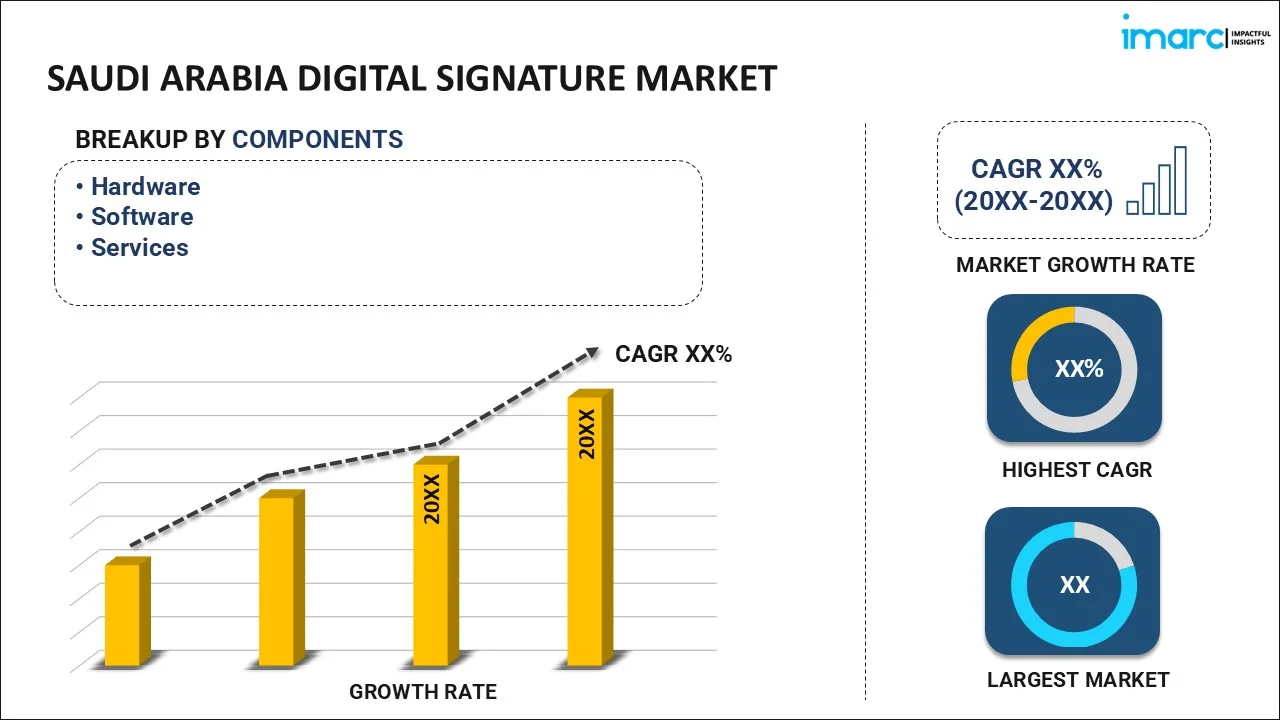
To get detailed segment analysis of this market, Request Sample
- Hardware
- Software
- Services
Software dominates with a market share of 59% of the total Saudi Arabia digital signature market in 2025.
The software segment's commanding market position reflects the strong enterprise preference for comprehensive digital signature platforms that deliver turnkey authentication capabilities with minimal infrastructure requirements. Organizations across Saudi Arabia increasingly favor software-as-a-service solutions that offer immediate deployment, automatic updates, and seamless integration with existing enterprise resource planning and document management systems. The ability to rapidly implement compliant digital signature workflows without substantial hardware investments appeals particularly to organizations pursuing efficiency-focused digital transformation under Vision 2030 mandates.
Software platforms demonstrate significant advantages in supporting the complex compliance requirements established under Saudi Arabia's Electronic Transactions Law and Personal Data Protection Law. In April 2025, Saudi-born digital signature startup Sadq raised SAR 5.5 Million in pre-Series A funding to expand its software platform that integrates with the national single sign-on service Nafath, illustrating investor confidence in locally developed solutions. This investment trend underscores how software providers are prioritizing features including Arabic language support, national identity platform integration, and domestic data residency capabilities that address Kingdom-specific regulatory and operational requirements.
Deployment Model Insights:
- On-premises
- Cloud-based
Cloud-based leads with a share of 65% of the total Saudi Arabia digital signature market in 2025.
The cloud-based deployment model's dominant market position reflects the broader enterprise technology transformation occurring throughout Saudi Arabia as organizations embrace scalable, flexible infrastructure solutions. Cloud platforms enable organizations to deploy digital signature capabilities rapidly while avoiding substantial capital expenditure on hardware infrastructure and specialized IT personnel. The pay-per-use pricing models offered by cloud providers align well with organizational requirements for predictable operational expenditure while maintaining the agility to scale authentication capacity according to transaction volumes.
Major cloud providers have established significant regional presence supporting digital signature platform deployment with local data residency capabilities. In 2024, Oracle introduced its second public cloud region in Saudi Arabia, expanding enterprise cloud options for organizations requiring local data hosting to meet regulatory compliance requirements. This hyperscaler investment pattern demonstrates the growing infrastructure foundation enabling cloud-based digital signature adoption while ensuring that sensitive authentication data remains within Kingdom boundaries as required by the Personal Data Protection Law and National Cybersecurity Authority guidelines.
Enterprise Size Insights:
- Small and Medium-sized Enterprises
- Large Enterprises
Large enterprises exhibits a clear dominance with a 57% share of the total Saudi Arabia digital signature market in 2025.
Large enterprises command the majority market share due to their substantial information technology budgets, complex multi-departmental operational requirements, and strong regulatory compliance obligations that necessitate enterprise-grade digital signature solutions. These organizations typically manage high volumes of contracts, agreements, and transactional documents requiring secure authentication workflows across multiple business units and geographic locations. The implementation of comprehensive digital signature platforms enables large enterprises to standardize authentication processes while maintaining the audit trails and security controls required for regulatory compliance.
Large enterprises in Saudi Arabia are leading digital signature adoption as part of broader digital transformation initiatives aligned with national economic diversification objectives. Banking institutions exemplify this trend, with organizations achieving complete digitization of client agreements while reducing administrative overhead through electronic signature implementation. The concentration of large enterprise headquarters in Riyadh, combined with government incentives encouraging technology modernization, creates sustained demand for sophisticated digital signature platforms capable of supporting complex enterprise workflows with integration across customer relationship management, enterprise resource planning, and document management systems.
Industry Vertical Insights:
- BFSI
- Education
- Human Resource
- IT and Telecommunication
- Government
- Healthcare and Life Science
- Real Estate
- Others
BFSI represents the leading segment with a 33% share of the total Saudi Arabia digital signature market in 2025.
The banking, financial services, and insurance sector's market leadership reflects the industry's extensive regulatory compliance requirements, high transaction volumes, and strong emphasis on secure customer authentication processes. Financial institutions utilize digital signatures across numerous operational workflows including account opening procedures, loan documentation, investment agreements, and insurance policy issuance. The Saudi Central Bank's emphasis on digital banking transformation and its approval of digital national identity usage for banking authentication has accelerated adoption throughout the financial services sector.
BFSI organizations benefit substantially from digital signature implementation through reduced processing times, enhanced customer experience, and strengthened compliance documentation capabilities. In December 2024, D360 Bank became the first licensed digital-only bank to begin operations in Saudi Arabia, demonstrating how new financial institutions are built around digital-first processes including electronic signature authentication. The emergence of digital banks and continued modernization of traditional banking operations creates expanding demand for robust digital signature platforms that meet the stringent security and compliance requirements established by the Saudi Central Bank and Capital Market Authority.
Regional Insights:
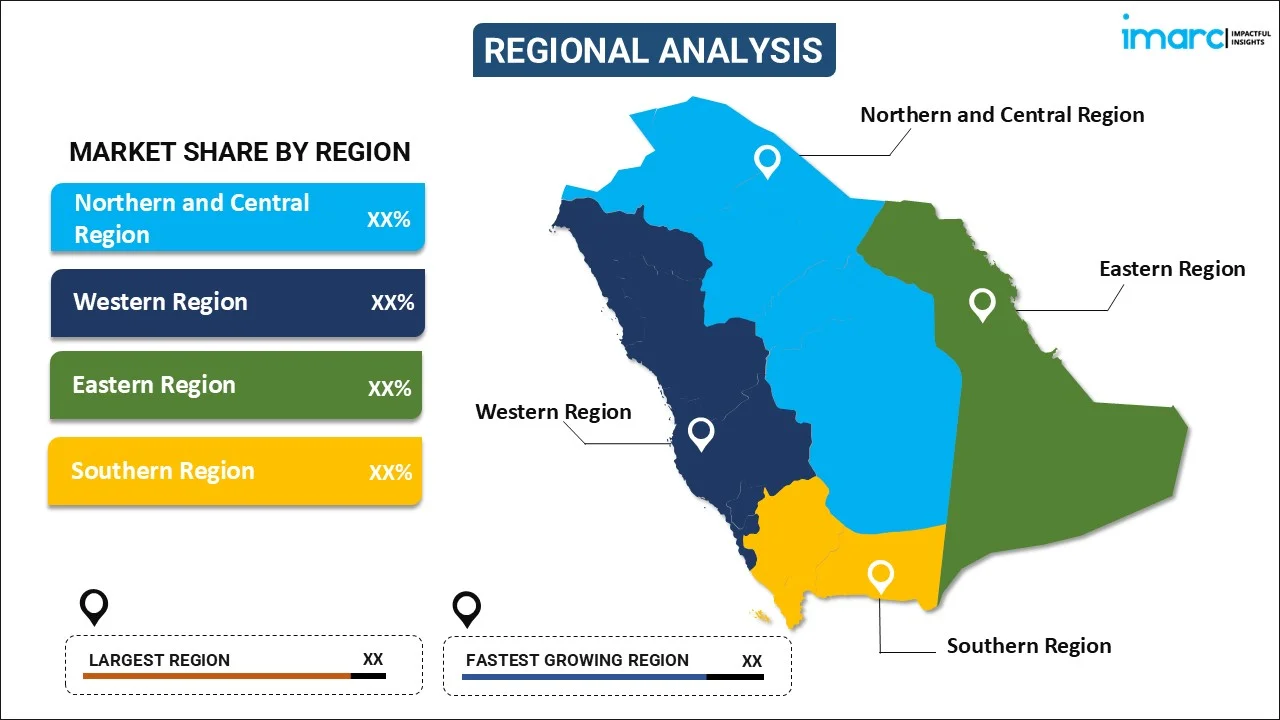
To get detailed segment analysis of this market, Request Sample
- Northern and Central Region
- Western Region
- Eastern Region
- Southern Region
Northern and Central Region dominates with a market share of 40% of the total Saudi Arabia digital signature market in 2025.
The Northern and Central Region's commanding market position stems from its status as Saudi Arabia's administrative, financial, and technology hub centered on Riyadh, the capital city. The concentration of government ministries, central bank headquarters, major financial institutions, and technology enterprises creates substantial demand for digital signature solutions across public and private sectors. Riyadh's advanced digital infrastructure, including extensive fiber-optic connectivity and data center capacity, provides the foundation necessary for widespread cloud-based digital signature platform deployment supporting high-volume authentication requirements.
The region benefits from ongoing technology investment initiatives that strengthen its position as the Kingdom's digital transformation leader. Digital transformation consulting services market analysis indicates that Riyadh dominates demand driven by the concentration of major corporations and thriving technology startup ecosystem actively pursuing Vision 2030 digital initiatives. The establishment of technology companies and digital service providers in the capital creates a competitive marketplace fostering innovation in digital signature solutions while ensuring accessibility to enterprise customers seeking advanced authentication capabilities for their organizational workflows.
Market Dynamics:
Growth Drivers:
Why is the Saudi Arabia Digital Signature Market Growing?
Rapidly Expanding E-Commerce and Digital Retail Ecosystem
The exponential growth of Saudi Arabia's e-commerce sector is generating substantial demand for digital signature solutions as online merchants, logistics providers, and payment platforms require secure electronic authentication for transaction processing and contract execution. The proliferation of digital marketplaces and online retail platforms necessitates robust identity verification mechanisms for vendor onboarding, customer agreements, and delivery confirmation processes. Rising consumer confidence in electronic transactions, supported by advanced payment infrastructure and comprehensive buyer protection policies, creates favorable conditions for digital signature adoption across retail value chains. The Saudi Central Bank reported that electronic payments accounted for 79% of all retail transactions in Saudi Arabia in 2024, significantly exceeding the 70% target originally set for 2025 under the Financial Sector Development Program, demonstrating the rapid shift toward digital commerce that demands secure authentication solutions.
Regulatory Mandates for Electronic Invoicing and Authentication
Government regulatory requirements mandating electronic invoicing and digital authentication across commercial transactions serve as powerful market catalysts accelerating enterprise adoption of digital signature solutions. The Zakat, Tax and Customs Authority's FATOORA e-invoicing program requires businesses to submit invoices electronically with digital signatures, creating compliance-driven demand affecting the majority of commercial entities operating within the Kingdom. Financial sector regulations issued by the Saudi Central Bank establish clear requirements for electronic signature usage in banking transactions, account management, and customer documentation processes. The Personal Data Protection Law and its implementing regulations create additional compliance obligations that organizations address through secure digital signature platforms ensuring proper consent documentation and data handling authentication. These regulatory frameworks transform digital signature adoption from optional efficiency improvement to mandatory compliance requirement, generating sustained market demand across industries subject to government oversight.
Expanding Digital Banking and Financial Services Ecosystem
The rapid evolution of Saudi Arabia's digital banking and financial services ecosystem drives significant demand for secure electronic authentication solutions that enable remote customer onboarding, loan origination, and transaction authorization. The Saudi Central Bank's fintech strategy emphasizes digital banking transformation, supporting the emergence of digital-only banks and encouraging traditional institutions to modernize their service delivery channels. Financial institutions increasingly recognize digital signatures as essential capabilities enabling competitive customer experiences while maintaining the security and compliance standards required in regulated financial services environments. The growing adoption of mobile banking, electronic wallets, and digital payment platforms creates expanding transaction volumes requiring efficient authentication mechanisms. Insurance companies similarly adopt digital signature solutions to streamline policy issuance, claims processing, and customer documentation workflows. This financial services transformation establishes digital signatures as fundamental infrastructure supporting the Kingdom's evolving financial ecosystem.
Market Restraints:
What Challenges the Saudi Arabia Digital Signature Market is Facing?
Complex Regulatory Compliance and Data Residency Requirements
Organizations face challenges navigating the complex regulatory landscape governing digital signatures, data protection, and cybersecurity requirements in Saudi Arabia. The Personal Data Protection Law, Essential Cybersecurity Controls, and Electronic Transactions Law implementing regulations create overlapping compliance obligations that require substantial investment in technology, processes, and legal advisory resources. Data residency requirements mandating that sensitive information remain within Kingdom boundaries limit platform options and increase implementation complexity for multinational organizations seeking unified global solutions.
Integration Challenges with Legacy Enterprise Systems
Many organizations encounter difficulties integrating digital signature platforms with existing legacy enterprise systems that were not designed for electronic authentication workflows. The technical complexity of connecting modern cloud-based signature solutions with traditional document management, enterprise resource planning, and customer relationship management systems requires specialized expertise and extended implementation timelines. These integration challenges can delay deployment, increase project costs, and create operational inefficiencies that reduce the anticipated benefits of digital signature adoption for organizations with substantial legacy technology investments.
User Adoption and Digital Literacy Barriers
Digital signature adoption faces resistance from users unfamiliar with electronic authentication processes or skeptical about the legal validity and security of electronic signatures compared to traditional handwritten alternatives. Organizations must invest in training programs, change management initiatives, and user support resources to achieve widespread adoption across their workforce and customer base. Cultural preferences for in-person transactions and physical document signing in certain industries and demographic segments slow the transition to fully digital workflows and require sustained educational efforts.
Competitive Landscape:
The Saudi Arabia digital signature market features a competitive landscape characterized by the presence of established global technology providers, emerging regional platforms, and specialized local startups developing solutions tailored to Kingdom-specific requirements. Market participants compete across dimensions including regulatory compliance capabilities, integration with national identity platforms, Arabic language support, data residency options, and pricing structures. Global providers leverage their extensive experience and comprehensive feature sets while regional players differentiate through localized support, cultural understanding, and alignment with domestic regulatory frameworks. The market demonstrates consolidation tendencies as larger providers acquire specialized capabilities while simultaneously witnessing new entrant activity driven by venture capital investment in locally developed solutions. Strategic partnerships between technology vendors, systems integrators, and certification service providers create collaborative ecosystems serving diverse customer segments across industries and enterprise sizes.
Recent Developments:
- In July 2025, the Saudi Center for Commercial Arbitration (SSCA) launched its digital signature service enabling users to electronically sign documents while ensuring signer identity authentication. The service uses Public Key Infrastructure technology and is built on a solution licensed by the Saudi Digital Government Authority. This development supports the center's digital transformation in case management, facilitating arbitral proceedings for parties across multiple countries.
Saudi Arabia Digital Signature Market Report Coverage:
| Report Features | Details |
|---|---|
| Base Year of the Analysis | 2025 |
| Historical Period | 2020-2025 |
| Forecast Period | 2026-2034 |
| Units | Billion USD |
| Scope of the Report | Exploration of Historical Trends and Market Outlook, Industry Catalysts and Challenges, Segment-Wise Historical and Future Market Assessment:
|
| Components Covered | Hardware, Software, Services |
| Deployment Models Covered | On-premises, Cloud-based |
| Enterprise Sizes Covered | Small and Medium-sized Enterprises, Large Enterprises |
| Industry Verticals Covered | BFSI, Education, Human Resource, IT and Telecommunication, Government, Healthcare and Life Science, Real Estate, Others |
| Regions Covered | Northern and Central Region, Western Region, Eastern Region, Southern Region |
| Customization Scope | 10% Free Customization |
| Post-Sale Analyst Support | 10-12 Weeks |
| Delivery Format | PDF and Excel through Email (We can also provide the editable version of the report in PPT/Word format on special request) |
Frequently Asked Questions About the Saudi Arabia Digital Signature Market Report
The Saudi Arabia digital signature market size was valued at USD 100.07 Million in 2025.
The Saudi Arabia digital signature market is expected to grow at a compound annual growth rate of 26.88% from 2026-2034 to reach USD 852.49 Million by 2034.
Software dominated the market with a share of 59%, driven by enterprise preference for comprehensive digital signature platforms offering rapid deployment, seamless integration capabilities, and compliance with Electronic Transactions Law requirements.
Key factors driving the Saudi Arabia digital signature market include Vision 2030 digital transformation mandates, regulatory requirements for electronic invoicing and authentication, expanding digital banking ecosystem, and integration with national identity platforms.
Major challenges include complex regulatory compliance and data residency requirements, integration difficulties with legacy enterprise systems, user adoption barriers, limited standardization across platforms, and the need for specialized Arabic language support in digital signature solutions.
Need more help?
- Speak to our experienced analysts for insights on the current market scenarios.
- Include additional segments and countries to customize the report as per your requirement.
- Gain an unparalleled competitive advantage in your domain by understanding how to utilize the report and positively impacting your operations and revenue.
- For further assistance, please connect with our analysts.
 Request Customization
 Speak to an Analyst
 Request Brochure
 Inquire Before Buying
Benefits of Customization
- Personalize this research
- Triangulate with your data
- Get data as per your format and definition
- Gain a deeper dive into a specific application, geography, customer, or competitor
- Any level of personalization
Get in Touch With Us
UNITED STATES
Phone: +1-201-971-6302
INDIA
Phone: +91-120-433-0800
UNITED KINGDOM
Phone: +44-753-714-6104
Email: [email protected]
Client Testimonials




.webp)




.webp)













Related Reports

Choose your plan
*Please note that the prices mentioned below are starting prices for each bundle type. Kindly contact our team for further details.*
Single User License
- 1 User License, Access on 2 Devices
- PDF Report + Excel Dataset (Password Protected)
- Lifetime Access
- No Printing Rights
- 10% Free Report Customization
- 10–12 Weeks of Analyst Support
Five User License
- Access for 5 Users, 2 Devices per User
- PDF Report + Excel Dataset (Password Protected)
- Lifetime Access
- Dedicated Account Manager
- 12–14 Weeks of Analyst Support
- No Printing Rights
- 15% Free Report Customization
- 25% Discount on Your Next Purchase
Corporate User License
- Unlimited User Access (Within Your Organization)
- PDF Report + Excel Dataset
- Lifetime Access
- Dedicated Account Manager
- 14–20 Weeks of Analyst Support
- No Printing Rights
- 20% Free Report Customization
- 30% Discount on Your Next Purchase
Essential Insights
What's included:
3 reports
- Lifetime Access
- PDF Reports
- Excel Datasets
- 2 Weeks of Free Analyst Support
- 2 User Licenses
- Access on 2 Devices
- Printing Rights
- Complimentary PowerPoint (PPT) Version
- Complimentary License Upgrade
Professional Access
What's included:
5 reports
- Lifetime Access
- PDF Reports
- Excel Datasets
- 8 Weeks of Free Analyst Support
- 2 User Licenses
- Access on 2 Devices
- Printing Rights
- Complimentary PowerPoint (PPT) Version
- Complimentary License Upgrade
Business Advantage
What's included:
8 reports
- Lifetime Access
- PDF Reports
- Excel Datasets
- 14 Weeks of Free Analyst Support
- 2 User Licenses
- Access on 2 Devices
- Printing Rights
- Complimentary PowerPoint (PPT) Version
- Complimentary License Upgrade
Enterprise Intelligence
What's included:
10 reports
- Lifetime Access
- PDF Reports
- Excel Datasets
- 20 Weeks of Free Analyst Support
- 2 User Licenses
- Access on 2 Devices
- Printing Rights
- Complimentary PowerPoint (PPT) Version
- Complimentary License Upgrade