
Saudi Arabia Electric Vehicle Component Market Size, Share, Trends and Forecast by Component, Distribution, and Region, 2026-2034
Saudi Arabia Electric Vehicle Component Market Size, Share, Trends & Forecast (2026-2034)
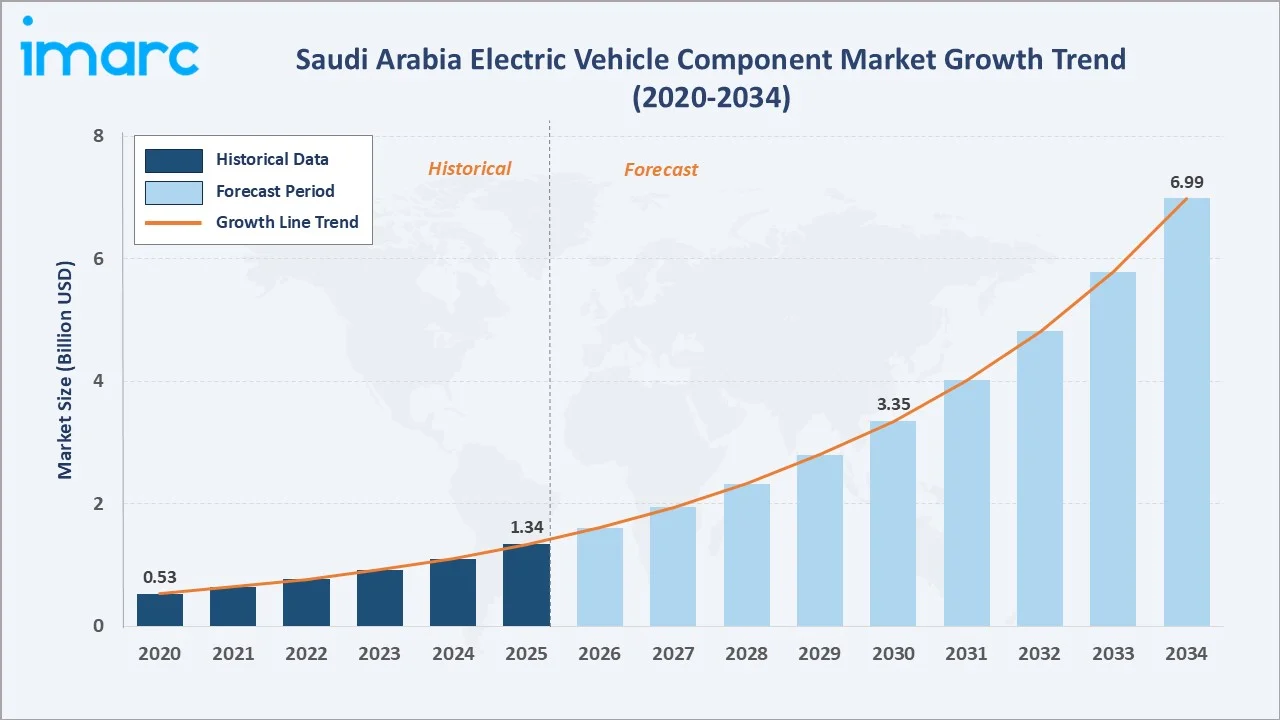
The Saudi Arabia electric vehicle component market grew from USD 1.34 Billion in 2025 to USD 1.61 Billion in 2026 and is projected to reach USD 6.99 Billion by 2034, growing at a CAGR of 20.17% during 2026-2034. Battery Pack dominates at 42.6%. OEMs lead distribution at 72.4%. Northern and Central Region commands 48.2% of the national market share, anchored by Riyadh's automotive retail and government procurement ecosystem.
Market Snapshot
|
Metric |
Value |
|
Base Year Market Size (2025) |
USD 1.34 Billion |
|
Market Size (2026) |
USD 1.61 Billion |
|
Forecast Market Size (2034) |
USD 6.99 Billion |
|
CAGR (2026-2034) |
20.17% |
|
Base Year |
2025 |
|
Historical Period |
2020-2025 |
|
Forecast Period |
2026-2034 |
|
Dominant Component |
Battery Pack (42.6%, 2025) |
|
Dominant Distribution |
OEMs (72.4%, 2025) |
|
Leading Region |
Northern & Central Region (48.2%, 2025) |
The Saudi Arabia electric vehicle component market size increased from USD 0.53 Billion in 2020 to USD 1.34 Billion in 2025 and is estimated to reach USD 1.61 Billion in 2026. The market is further expected to grow to USD 3.35 Billion by 2030 and USD 6.99 Billion by 2034. Saudi Arabia EV component market is commercially unique among GCC markets, combining one of the most government-directed EV adoption programs globally with rapidly growing domestic manufacturing ambitions anchored by Ceer Motors and Lucid Group.
To get more information on this market, Request Sample
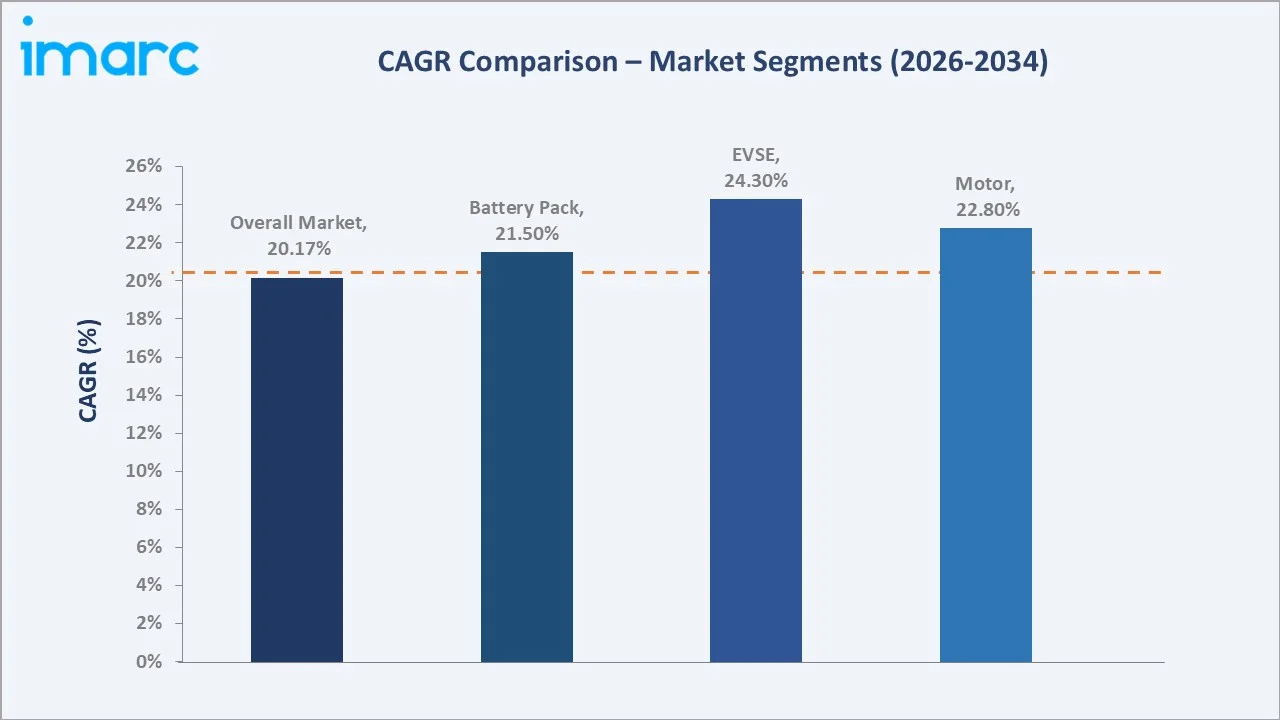
Battery Pack grows fastest at ~21.5% CAGR through localization push and Ceer Motors' battery procurement. EVSE grows at ~24.3% CAGR through the government's target of 5,000 charging stations by 2030. Motor segment grows at ~22.8% CAGR through OEM EV production scale-up at Lucid's Jeddah facility.
Executive Summary
The Saudi Arabia electric vehicle component market expanded from USD 1.34 Billion in 2025 to an estimated USD 1.61 Billion in 2026, positioning it as one of the fastest-growing EV component markets in the Middle East. The market's scale is underpinned by Saudi Vision 2030's EV adoption mandate, PIF investments in domestic vehicle manufacturing, and a structured government program to electrify 30% of Riyadh's vehicles by 2030. The market is projected to reach USD 6.99 Billion by 2034.
Battery Pack at 42.6% leads through OEM integration demand from Lucid and Ceer. OEMs at 72.4% reflect factory-gate procurement dominance. Northern and Central Region leads at 48.2% through Riyadh's automotive retail density and government ministry EV fleet procurement.
Key Market Insights
|
Insight |
Data |
|
Dominant Component |
Battery Pack – 42.6% share (2025) |
|
Dominant Distribution |
OEMs – 72.4% market share (2025) |
|
Leading Region |
Northern and Central Region – 48.2% share (2025) |
|
Market Opportunity |
Battery pack localization; EVSE expansion; thermal management solutions; King Salman Automotive Cluster manufacturing |
Key Analytical Observations Supporting the Above Data:
- Battery Pack at 42.6%: Battery pack dominates as it constitutes the highest-value single EV component and drives the most OEM procurement volume. Saudi Arabia's Vision 2030-aligned EV production at Lucid Group's Jeddah facility and Ceer Motors' planned Riyadh plant create substantial battery pack demand that no other component category matches by value concentration.
- OEMs at 72.4%: The OEM channel dominates EV component distribution through factory-gate procurement by Lucid Group and Ceer Motors, supported by PIF's structured supply chain development program. Saudi Arabia's nascent EV aftermarket cannot yet compete with OEM procurement volumes, which are growing as domestic EV production scales toward Vision 2030 targets.
- Northern and Central Region at 48.2%: The region dominates as Riyadh houses the majority of Saudi Arabia's automotive retail, government ministry EV fleet procurement, and major EV component supply chain entry points. The Northern Region's NEOM project creates a structurally new EV component demand center above Riyadh's traditional automotive market.
Saudi Arabia Electric Vehicle Component Market Overview
Saudi Arabia EV component market is positioned at the strategic intersection of government-directed industrial policy and rapid consumer EV adoption. The Kingdom hosts one of the most ambitious national EV adoption programs globally, making it commercially unique among Middle East markets through its combination of sovereign wealth funding, domestic manufacturing investment, and structured charging infrastructure rollout under Vision 2030.
Market Dynamics
To evaluate market opportunities, Request Sample
Market Drivers
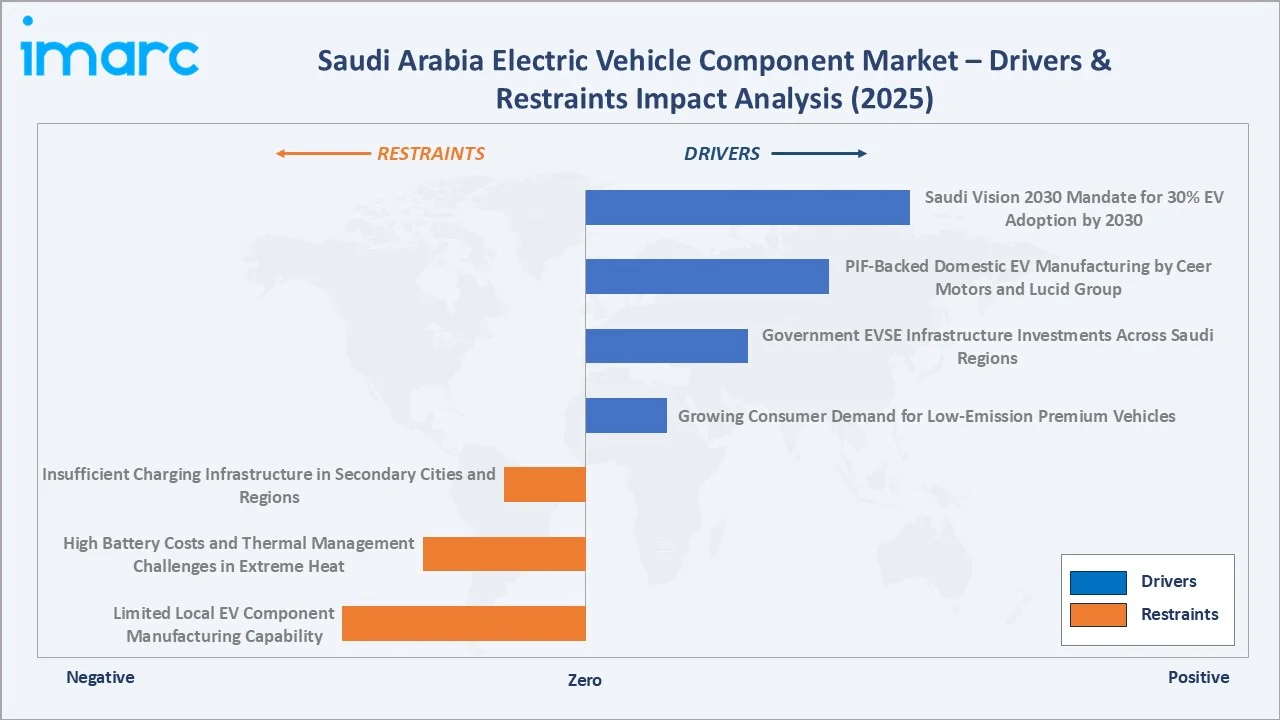
- Saudi Vision 2030 Mandate for 30% EV Adoption by 2030: Saudi Vision 2030's mandate to electrify 30% of vehicles in Riyadh by 2030 is the primary structural driver of EV component market growth, creating a government-directed demand floor that sustains component procurement regardless of pure market economics. NIDLP's transportation electrification targets extend the mandate to commercial vehicles, fleet operators, and public transport, creating multi-sector EV component demand well above the consumer passenger car EV market alone.
- PIF-Backed Domestic EV Manufacturing by Ceer Motors and Lucid Group: The Public Investment Fund's direct investments in Ceer Motors and Lucid Group are creating Saudi Arabia's first domestically anchored EV component demand centers. Ceer Motors' USD 1.3 billion manufacturing complex in King Salman Automotive Cluster will create structured battery pack, motor, and controller procurement demand from Saudi-based suppliers when operational. Lucid Group's Jeddah assembly facility is already creating OEM component procurement volumes that grow as production ramps toward 150,000 vehicles annually.
- Government EVSE Infrastructure Investments Across Saudi Regions: Saudi Arabia's government-directed charging infrastructure investment is creating the single fastest-growing EV component sub-market within the broader component landscape. EVSE procurement through the Saudi EV Infrastructure Company, NEOM's embedded charging network, and public transport electrification programs creates above-market-CAGR demand for charging hardware, grid integration components, and power electronics.
- Growing Consumer Demand for Low-Emission Premium Vehicles: Saudi Arabia's consumer market is demonstrating above-expectation receptivity to premium electric vehicles, with Lucid Air commanding waiting list demand in Riyadh and BYD's Saudi Arabia entry attracting consumer interest across the Northern and Central Region. Premium EV consumer adoption creates disproportionately high battery pack and motor component demand per vehicle sold, as luxury EVs command higher average component specification than mass-market ICE vehicles, structurally elevating average component value per unit above what unit volume alone would suggest.
Market Restraints
- Limited Local EV Component Manufacturing Capability: Saudi Arabia's EV component market remains heavily import-dependent, with battery cells, advanced motors, and power electronics sourced from international suppliers in South Korea, China, Japan, and the United States. This import dependence creates supply chain vulnerability, limits Saudi Arabia's ability to meet Vision 2030 localization content targets and constrains the domestic value creation potential of EV manufacturing investment.
- High Battery Costs and Thermal Management Challenges in Extreme Heat: Saudi Arabia's extreme climate creates EV battery performance degradation, range reduction, and accelerated thermal wear that standard EV battery packs are not optimized for. This requires specialized thermal management systems that add component cost above standard EV market specifications, limiting cost competitiveness against ICE vehicles without government subsidy support. Battery pack suppliers must invest in heat-resilient designs specifically engineered for GCC operating conditions, creating an above-global-market R&D and component cost structure that restrains competitive pricing in the consumer EV segment and delays organic market demand growth below the Vision 2030 policy-stimulated adoption trajectory.
- Insufficient Charging Infrastructure in Secondary Cities and Regions: While Riyadh and Jeddah are advancing EVSE deployment, Saudi Arabia's secondary cities and the Eastern, Western, and Southern regions lag significantly in charging infrastructure density, creating range anxiety that restrains EV consumer adoption in these markets. The 101 charging stations counted nationally in 2024 represent an infrastructure density inadequate for broad consumer EV confidence outside major urban centers.
Market Opportunities
- Battery Pack Localization Through King Salman Automotive Cluster: The King Salman Automotive Cluster's development of a dedicated EV manufacturing zone in Saudi Arabia creates the most commercially transformative opportunity for battery pack component localization. International battery cell manufacturers and module assembly companies establishing Saudi Arabia-based operations within the cluster would directly address the import dependency restraint, capture local content requirements built into government procurement preferences, and position Saudi Arabia as a GCC EV component export hub capable of serving the broader GCC market above purely domestic demand.
- GCC Regional EV Component Export Hub Development: Saudi Arabia's scale, energy cost advantage, and Vision 2030 manufacturing investment create a structural opportunity to develop as the GCC's primary EV component manufacturing and distribution hub for the broader regional market. As UAE, Kuwait, Bahrain, and Qatar accelerate their own EV adoption programs, Saudi Arabia-based component suppliers serving the broader GCC through regional distribution would capture above-domestic EV component market economics, making the Saudi Arabia investment case commercially viable above the pure domestic market addressable revenue at current penetration rates.
Market Challenges
- Talent Gap in EV Component Engineering and Manufacturing: Saudi Arabia faces a structural shortage of locally trained EV component engineers, battery technologists, and power electronics specialists capable of operating and maintaining advanced EV component manufacturing facilities. This engineering talent gap extends manufacturing ramp timelines, increases operational costs through international staff dependency, and limits the pace of technology transfer from international partners to local workforce capability.
- Supply Chain Vulnerability to Global Critical Mineral Price Volatility: Saudi Arabia's EV component market is highly exposed to global lithium, cobalt, and nickel price volatility, which directly impacts battery pack component economics and the financial viability of domestic battery assembly investment. While PIF is pursuing upstream mining investments abroad to secure mineral supply, this strategy creates a complex international supply chain exposed to geopolitical disruptions, shipping cost fluctuations, and export restriction risk from key mineral-producing nations.
Emerging Market Trends
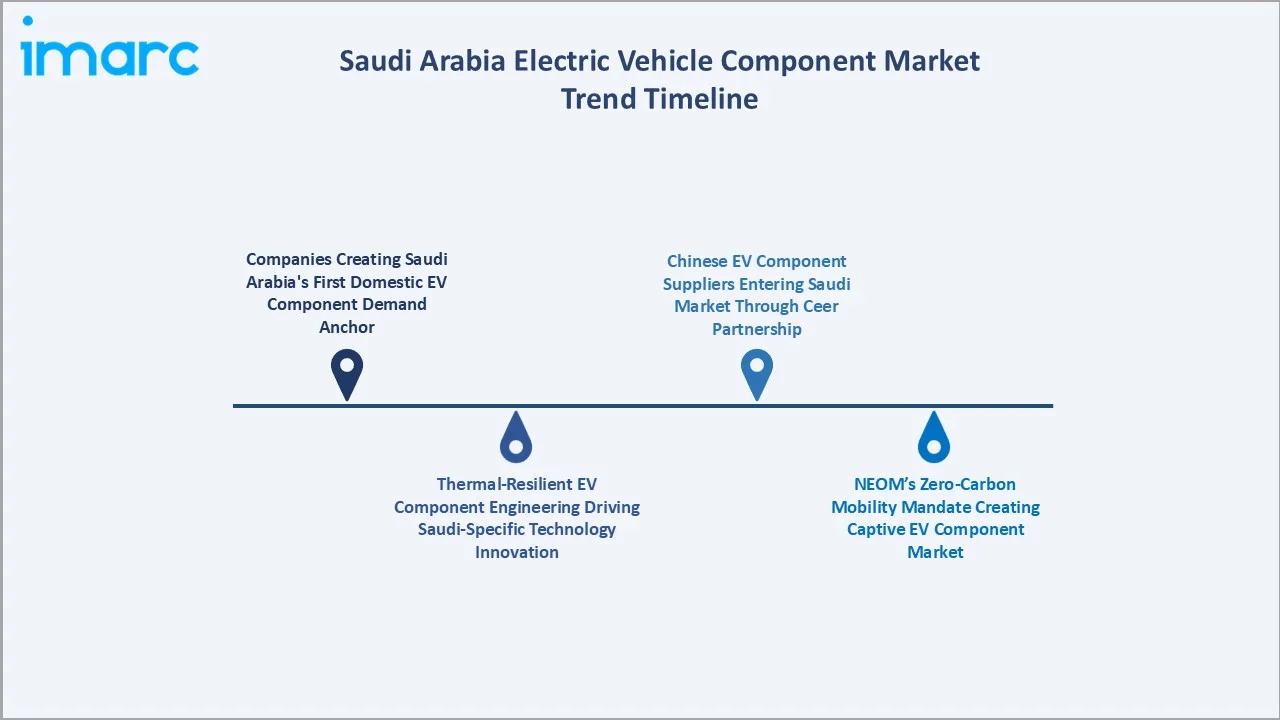
1. Companies Creating Saudi Arabia's First Domestic EV Component Demand Anchor
Various domestic automotive brands or companies are creating a structured domestic EV component procurement program that will anchor the Saudi Arabia EV component market's growth through 2034. Companies planned production creates visibility for component suppliers to justify Saudi Arabia localization investment with contracted volume.
2. Thermal-Resilient EV Component Engineering Driving Saudi-Specific Technology Innovation
Saudi Arabia's extreme heat environment is driving specialized EV component engineering innovation, with thermal management systems, battery cooling technology, and heat-resistant motor insulation becoming commercially differentiating capabilities for suppliers serving the Saudi market. This Saudi-specific technical requirement creates above-global-average EV component complexity and value per unit.
3. NEOM's Zero-Carbon Mobility Mandate Creating Captive EV Component Market
NEOM's commitment to 100% renewable and zero-emission transportation creates a captive EV component market for battery packs, motors, controllers, and EVSE systems at a scale that represents a commercially self-contained EV component demand center within Saudi Arabia, with multi-year infrastructure procurement visibility.
4. Chinese EV Component Suppliers Entering Saudi Market Through Ceer Partnership
Foxconn's manufacturing partnership with Ceer Motors is facilitating Chinese EV component supply chain entry into Saudi Arabia, with Taiwanese and mainland Chinese component suppliers establishing regional presence to serve the Ceer production program. This creates competitive supply chain dynamics that accelerate component technology transfer to Saudi Arabia.
Industry Value Chain Analysis
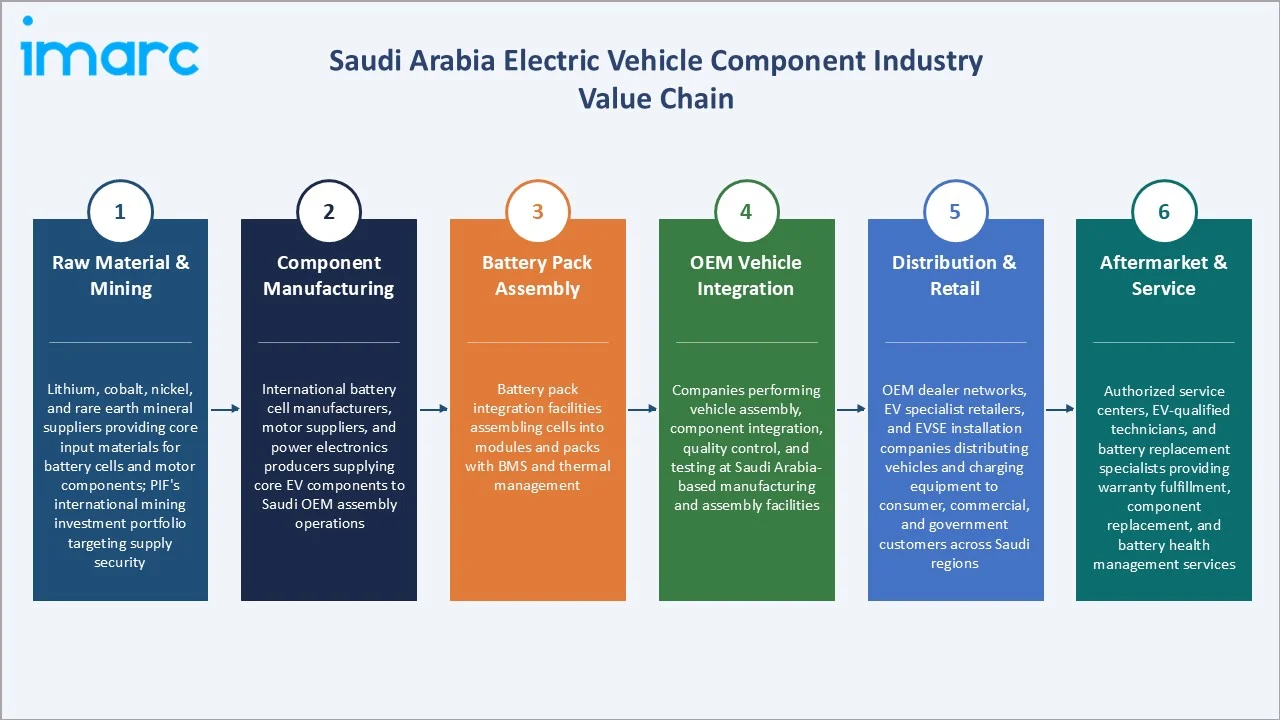
Saudi Arabia EV component value chain is one of the most import-intensive of any industrial market category in the Kingdom. The value chain's commercial structure reflects Saudi Arabia's early-stage EV manufacturing ecosystem, where global component suppliers provide nearly all high-value content while domestic participants focus on assembly, integration, and distribution activities.
|
Stage |
Key Participants |
|
Raw Material & Mining |
Lithium, cobalt, nickel, and rare earth mineral suppliers providing core input materials for battery cells and motor components; PIF's international mining investment portfolio targeting supply security |
|
Component Manufacturing |
International battery cell manufacturers, motor suppliers, and power electronics producers supplying core EV components to Saudi OEM assembly operations |
|
Battery Pack Assembly |
Battery pack integration facilities assembling cells into modules and packs with BMS and thermal management |
|
OEM Vehicle Integration |
Companies performing vehicle assembly, component integration, quality control, and testing at Saudi Arabia-based manufacturing and assembly facilities |
|
Distribution & Retail |
OEM dealer networks, EV specialist retailers, and EVSE installation companies distributing vehicles and charging equipment to consumer, commercial, and government customers across Saudi regions |
|
Aftermarket & Service |
Authorized service centers, EV-qualified technicians, and battery replacement specialists providing warranty fulfillment, component replacement, and battery health management services |
The component manufacturing stage is Saudi Arabia EV component value chain's most commercially critical import stage, where international battery cell manufacturers collectively supply nearly all of Saudi Arabia's battery cell requirement at above-domestic-cost economics that Vision 2030's localization program targets through King Salman Automotive Cluster investment incentives.
Technology Landscape in the Saudi Arabia EV Component Industry
Battery Pack and Cell Technologies
Battery pack and cell technologies form the commercial core of Saudi Arabia's EV component market, with lithium-ion NMC and LFP chemistries representing the dominant cell technologies in deployed Saudi EV applications. Lucid Group's 118 kWh cylindrical cell battery pack represents the technology benchmark for Saudi Arabia's premium EV segment. LFP chemistry's thermal stability advantage creates growing adoption potential for Saudi Arabia's high-temperature operating environment.
Electric Motor and Power Electronics
Electric motor technology in Saudi Arabia's EV component market is dominated by permanent magnet synchronous motors (PMSM) in passenger EV applications, providing the highest torque density and efficiency for premium EV platforms. DC-DC converter and onboard charger technology is evolving toward higher power densities and wider voltage range compatibility as Saudi Arabia's EVSE network transitions from AC Level 2 to DC fast charging predominance.
EV Supply Equipment and Charging Technology
EVSE technology in Saudi Arabia is evolving rapidly from primarily AC Level 2 residential and commercial charging toward DC fast charging (DCFC) network deployment along highways, commercial districts, and giga-project sites. Solar-integrated EVSE systems are gaining commercial interest in Saudi Arabia through the Kingdom's abundant solar resource, creating a unique grid-independent charging application that requires specialized power electronics and battery buffer components not required in grid-dependent EVSE deployments in other markets.
Market Segmentation Analysis
The report covers the following segments:
|
Segment Category |
Leading Segment |
Market Share |
Year |
|
Component |
Battery Pack |
42.6% |
2025 |
|
Distribution |
OEMs |
72.4% |
2025 |
|
Region |
Northern & Central Region |
48.2% |
2025 |

By Component
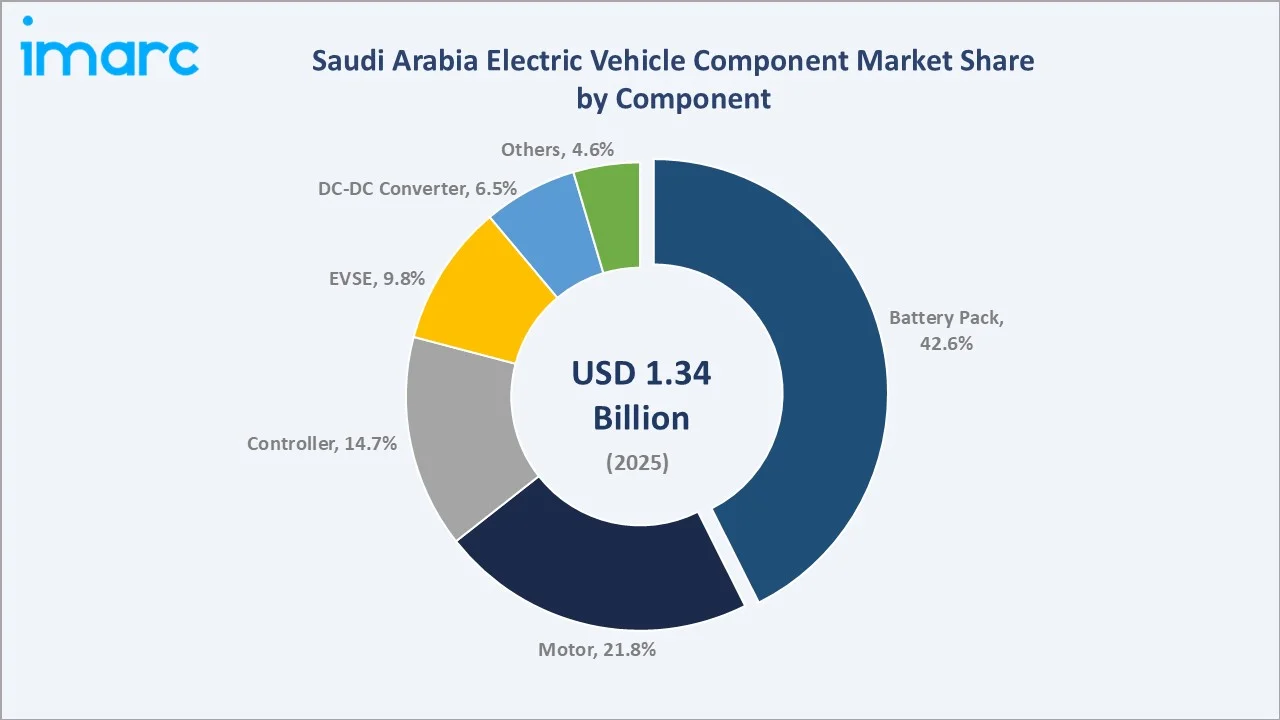
Battery Pack leads at 42.6% (2025). The Battery Pack segment encompasses Saudi Arabia's most commercially valuable single EV component category, driven by Lucid Group's premium EV battery procurement and growing fleet EV battery demand. Battery Pack's dominant share reflects the technology's proportion of total EV bill of materials cost, where battery systems represent 30–40% of EV vehicle total cost in premium applications.
To access detailed market analysis, Request Sample
Motor at 21.8% grows through OEM EV production scale-up. Controller at 14.7% reflects growing power electronics integration. EVSE at 9.8% is the fastest-growing segment. DC-DC Convertor at 6.5% and Others at 4.6% complete the component breakdown.
By Distribution
OEMs lead at 72.4% (2025). This channel serves Saudi Arabia's EV vehicle manufacturing facilities through factory-gate procurement, with Lucid Group and Ceer Motors driving the majority of OEM component volume. OEM distribution dominance reflects Saudi Arabia's early-stage EV market where vehicle manufacturing procurement far exceeds aftermarket replacement demand.
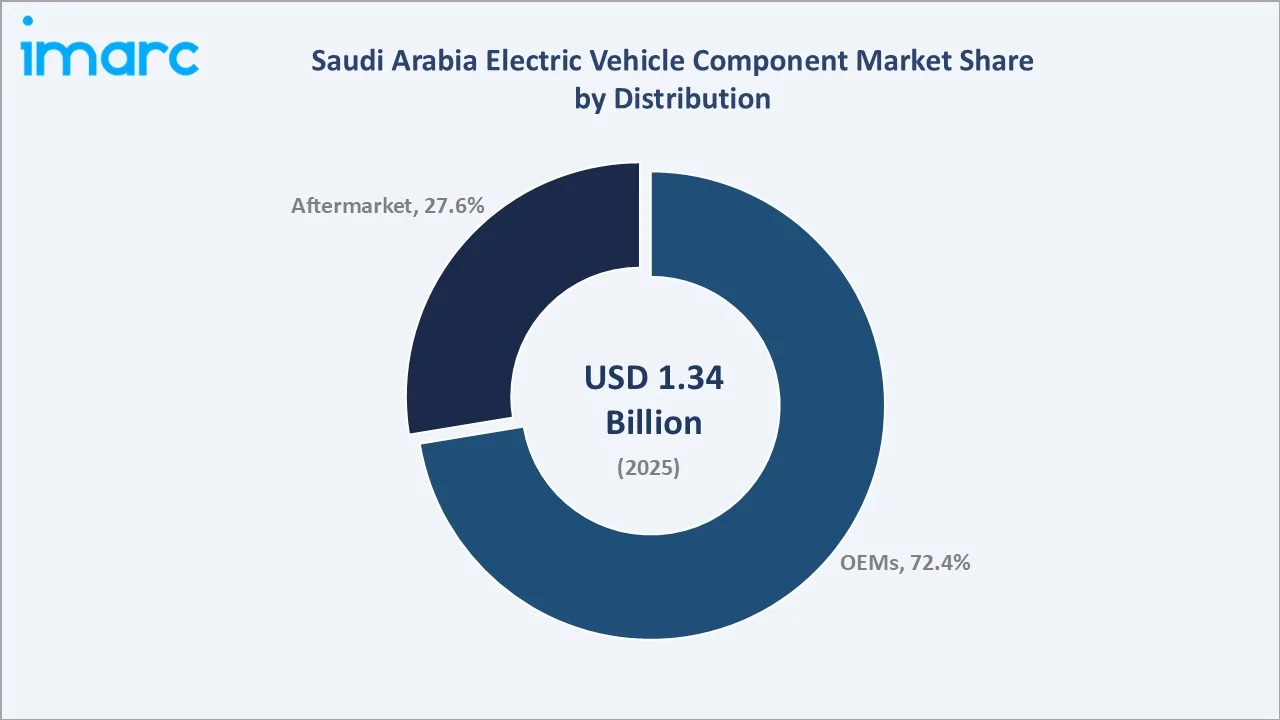
Aftermarket at 27.6% is growing as Saudi Arabia's installed EV fleet expands and first-generation EVs require battery health management, component replacement, and charging equipment upgrades. The Aftermarket channel is projected to grow above OEM channel CAGR through 2034 as the Saudi EV fleet ages beyond initial warranty periods.
Regional Market Insights
|
Region |
Share (2025) |
Key Saudi Arabia EV Component Market Drivers & Characteristics |
|
Northern and Central Region |
48.2% |
Riyadh-anchored EV fleet procurement; government ministry EV adoption; NEOM EV infrastructure component demand from northern giga-project zone; major EV dealer concentration. |
|
Western Region |
23.5% |
Jeddah hosts Lucid Group's assembly facility creating direct OEM component demand; Red Sea Project EVSE procurement; commercial EV fleet adoption in Saudi Arabia's second-largest urban market. |
|
Eastern Region |
18.1% |
Saudi Aramco fleet electrification; industrial EV adoption in Dammam and Al Khobar; port logistics electrification; commercial vehicle EV component demand from Eastern Province manufacturing base. |
|
Southern Region |
10.2% |
Emerging EV adoption driven by Vision 2030 regional development; tourism electrification at Asir and Jizan sites; commercial vehicle fleet replacement with EV alternatives. |
Northern and Central Region's 48.2% market leadership reflects Riyadh's role as Saudi Arabia's primary automotive retail, government procurement, and commercial fleet management center. Western Region's 23.5%, creating direct OEM component procurement demand and positioning the Western Region as Saudi Arabia's de facto EV manufacturing center. Eastern Region's 18.1% is anchored by Saudi Aramco's fleet electrification program and the Eastern Province's industrial EV adoption.
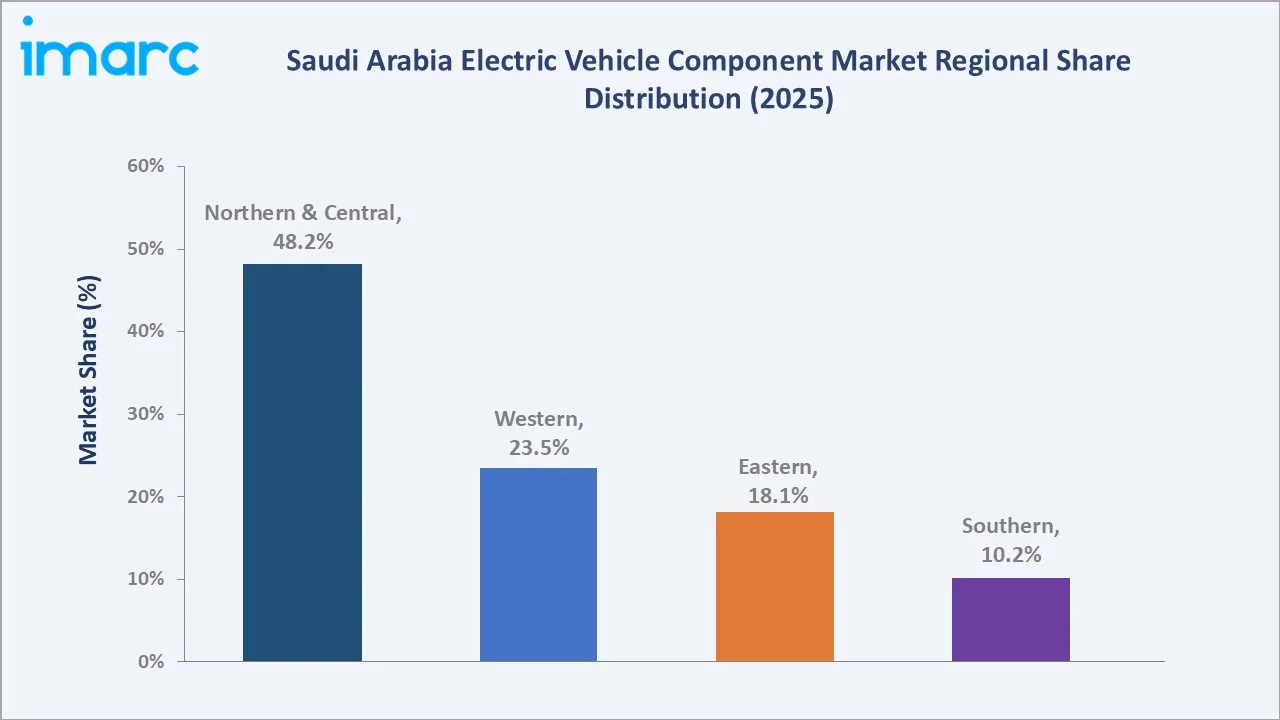
Southern Region's 10.2% represents Saudi Arabia's most commercially underdeveloped EV region but is growing as Vision 2030 regional development programs, Red Sea tourism infrastructure, and commercial vehicle fleet replacement create new EV component demand centers from a comparatively low penetration base.
Competitive Landscape
Saudi Arabia EV component market competitive landscape is shaped by global suppliers serving domestic OEM manufacturing programs, with international battery cell manufacturers, motor suppliers, and EVSE equipment companies competing for OEM supply contracts.
| Company | Key Brands | Market Position | Core Strength |
|---|---|---|---|
| Lucid | Lucid Air, Lucid Gravity, RESS Battery Pack, Lucid Drive | Market Leader | Saudi-anchored EV manufacturer operating Jeddah assembly facility; highest energy density production EV battery globally; PIF majority ownership providing direct Saudi Arabia market commitment and Vision 2030 alignment. |
| BYD Co., Ltd. | BYD Atto 3, BYD Seal, Blade Battery | Strong Challenger | World's largest EV manufacturer by volume entering Saudi Arabia consumer market; Blade Battery's LFP chemistry offers superior thermal stability for Saudi Arabia's extreme heat operating conditions. |
| Hyundai Motor Group | IONIQ 5, IONIQ 6, E-GMP Platform, HTRAC AWD | Strong Challenger | Global EV OEM with Saudi Arabia commercial presence; E-GMP platform components supply chain serving Saudi Arabia market; PIF investment relationship creating strategic alignment with Saudi Vision 2030 EV goals. |
| Contemporary Amperex Technology Co., Limited | CATL Cell-to-Pack, Qilin Battery | Key Innovator | World's largest battery manufacturer by installed capacity; supplying Saudi Arabia's growing EV fleet through Ceer Motors and BYD supply chain relationships; advancing cell-to-pack technology reducing battery pack component count. |
Key players include Lucid, BYD Co., Ltd., Hyundai Motor Group, Contemporary Amperex Technology Co., Limited, and others.
Key Company Profiles
Lucid
Lucid is a Saudi-anchored premium electric vehicle manufacturer and the most commercially consequential player in Saudi Arabia's EV component market, operating the Kingdom's first EV assembly facility in Jeddah with the Public Investment Fund holding a majority ownership stake.
- Key Brands: Lucid Air, Lucid Gravity, RESS Battery Pack, Lucid Drive powertrain system, Wunderbox onboard charging system.
- Strategic Focus: Scaling Jeddah assembly facility production with progressively localizing component manufacturing within Saudi Arabia to meet Vision 2030 domestic content requirements; advancing battery recycling capability to create a Saudi Arabia-based circular economy for EV battery components.
BYD Co., Ltd.
BYD is the world's largest electric vehicle manufacturer by unit volume and a major entrant to the Saudi Arabia EV component market through its consumer EV sales program, with the Blade Battery's LFP chemistry offering unique thermal stability advantages for Saudi Arabia's extreme heat operating environment.
- Key Brands: BYD Atto 3, BYD Seal, BYD Han, Blade Battery
- Strategic Focus: Capturing Saudi Arabia's growing mass-market EV consumer segment through competitively priced BEV models; positioning Blade Battery's heat-resilient LFP chemistry as the technically superior battery solution for Saudi Arabia's extreme climate operating conditions above NMC competitor chemistries.
Market Concentration Analysis
Saudi Arabia EV component market is highly concentrated at the OEM procurement level, with the key players collectively representing the majority of domestic OEM component demand in the near-term forecast period. International battery cell suppliers collectively supply essentially all Saudi Arabia's battery cell requirement through import-dependent supply chains.
Market concentration is evolving through two forces: OEM procurement concentration increasing as Ceer Motors' planned production volume adds a second major anchor beside Lucid Group, creating a Saudi Arabia-specific OEM supply chain competitiveness that attracts component suppliers to evaluate in-Kingdom manufacturing investment; and EVSE market fragmentation increasing through new charging equipment suppliers entering the Saudi Arabia infrastructure buildout program above the established ABB and Schneider Electric incumbents.
Investment & Growth Opportunities
Highest Growth Segments
EVSE segment (~24.3% CAGR), Motor segment (~22.8% CAGR), Controller (~23.1% CAGR), Battery Pack (~21.5% CAGR), and OEM distribution channel (~20.9% CAGR) represent Saudi Arabia's highest-growth EV component investment vectors through 2034.
Emerging Investment Opportunities
Saudi Arabia's battery pack localization opportunity, growing through King Salman Automotive Cluster incentives and Ceer Motors' structured procurement program, represents Saudi Arabia's highest-value EV component investment opportunity. Thermal management system development optimized for Saudi Arabia's extreme heat environment creates a Saudi-specific technology opportunity commanding above-global-market component pricing premium through engineering differentiation.
Investment Themes
- Battery Pack Localization Within King Salman Automotive Cluster: International battery cell manufacturers and module assembly companies establishing Saudi Arabia-based operations within the cluster would capture Ceer Motors' domestic content procurement requirement and position Saudi Arabia as a GCC EV component export hub above domestic market alone.
- Thermal-Resilient EV Component Engineering: Developing heat-optimized battery thermal management, motor cooling, and power electronics for Saudi Arabia's extreme climate creates defensible technology differentiation commanding price premiums above standard global EV component specifications while addressing the most commercially critical performance challenge in Saudi Arabia's EV market.
Future Market Outlook (2026-2034)
The Saudi Arabia electric vehicle component market is projected to grow from USD 1.34 Billion in 2025 to USD 1.61 Billion in 2026, reaching USD 6.99 Billion by 2034, registering a CAGR of 20.17% during 2026–2034. The market's anchor value of USD 3.35 Billion in 2030 represents Saudi Arabia's EV component market at a structural inflection as Ceer Motors' manufacturing program reaches commercial scale and Saudi Arabia's installed EV fleet creates first-generation aftermarket component demand.
Three structural forces define Saudi Arabia EV component market growth through 2034: Vision 2030's persistent government-directed EV adoption mandate creating demand floor above private sector market cyclicality; PIF-anchored domestic manufacturing creating OEM procurement volumes that attract international component supplier localization; and Saudi Arabia's giga-project EV infrastructure creating EVSE component demand independent of consumer EV market maturation pace.
Research Methodology
Primary Research
Primary research comprised structured interviews with Saudi Arabia EV component market stakeholders, including automotive OEM procurement officers, component supply chain executives, EVSE infrastructure project managers, Vision 2030 automotive sector officers at NIDLP, and EV dealer network managers across Riyadh, Jeddah, and Dammam.
Secondary Research
Secondary research encompassed Saudi Arabia automotive import-export data, NIDLP transportation electrification program documents, company annual reports, Ceer Motors and Lucid Group production announcements, PIF investment documentation, and EV component market analysis from over 50 secondary sources including industry publications and government infrastructure databases.
Forecasting Models
Market revenue forecasts were developed using an OEM production volume model: Saudi Arabia EV vehicle production and import volumes by vehicle type multiplied by average EV component value per vehicle by segment, creating total component market revenue by segment aggregation. Government EVSE program procurement multiplier applied to EVSE segment above consumer market demand baseline.
Saudi Arabia Electric Vehicle Component Market Report Coverage:
| Report Features | Details |
|---|---|
| Base Year of the Analysis | 2025 |
| Historical Period | 2020-2025 |
| Forecast Period | 2026-2034 |
| Units | Billion USD |
| Scope of the Report |
Exploration of Historical Trends and Market Outlook, Industry Catalysts and Challenges, Segment-Wise Historical and Future Market Assessment:
|
| Components Covered | Battery Pack, Motor, Controller, Electric Vehicle Supply Equipment, DC-DC Convertor, Others |
| Distributions Covered | OEMs, Aftermarket |
| Regions Covered | Northern and Central Region, Western Region, Eastern Region, Southern Region |
| Companies Covered | Lucid, BYD Co., Ltd., Hyundai Motor Group, Contemporary Amperex Technology Co., Limited, etc. |
| Customization Scope | 10% Free Customization |
| Post-Sale Analyst Support | 10-12 Weeks |
| Delivery Format | PDF and Excel through Email (We can also provide the editable version of the report in PPT/Word format on special request) |
Key Benefits for Stakeholders:
- IMARC’s industry report offers a comprehensive quantitative analysis of various market segments, historical and current market trends, market forecasts, and dynamics of the Saudi Arabia electric vehicle component market from 2020-2034.
- The research report provides the latest information on the market drivers, challenges, and opportunities in the Saudi Arabia electric vehicle component market.
- Porter's five forces analysis assist stakeholders in assessing the impact of new entrants, competitive rivalry, supplier power, buyer power, and the threat of substitution. It helps stakeholders to analyze the level of competition within the Saudi Arabia electric vehicle component industry and its attractiveness.
- Competitive landscape allows stakeholders to understand their competitive environment and provides an insight into the current positions of key players in the market.
Frequently Asked Questions About the Saudi Arabia Electric Vehicle Component Market Report
Saudi Arabia EV component market size is estimated at USD 1.61 Billion in 2026, driven by Vision 2030's 30% EV adoption mandate, PIF-backed domestic manufacturing by Lucid Group and Ceer Motors, and government EVSE infrastructure investment programs.
Saudi Arabia EV component market grows at 20.17% CAGR during 2026-2034, reaching USD 6.99 Billion by 2034. Growth is sustained by Vision 2030 EV mandates, domestic manufacturing scale-up, and expanding EVSE infrastructure deployment.
Battery Pack leads at 42.6% through OEM integration demand from Lucid Group's Jeddah facility and growing fleet EV adoption, as battery systems represent the highest-value single EV component by market share in Saudi Arabia's premium-led EV market.
OEMs lead at 72.4% through factory-gate procurement by Lucid Group and Ceer Motors, supported by PIF's structured supply chain development program, as Saudi Arabia's nascent EV aftermarket cannot yet compete with OEM procurement volumes.
Northern and Central Region leads at 48.2% through Riyadh's automotive retail density, government EV fleet procurement concentration, and the Northern Region's NEOM giga-project creating structurally new EV component demand above the traditional automotive market.
Leading companies include Lucid, BYD Co., Ltd., Hyundai Motor Group, Contemporary Amperex Technology Co., Limited, and others.
Saudi Arabia EV component market is projected to reach approximately USD 3.35 Billion by 2030, with Ceer Motors' manufacturing program reaching commercial scale, EVSE network expanding toward 5,000 charging stations, and Saudi Arabia's EV fleet generating first-generation aftermarket component demand.
Need more help?
- Speak to our experienced analysts for insights on the current market scenarios.
- Include additional segments and countries to customize the report as per your requirement.
- Gain an unparalleled competitive advantage in your domain by understanding how to utilize the report and positively impacting your operations and revenue.
- For further assistance, please connect with our analysts.
 Request Customization
 Speak to an Analyst
 Request Brochure
 Inquire Before Buying
Benefits of Customization
- Personalize this research
- Triangulate with your data
- Get data as per your format and definition
- Gain a deeper dive into a specific application, geography, customer, or competitor
- Any level of personalization
Get in Touch With Us
UNITED STATES
Phone: +1-201-971-6302
INDIA
Phone: +91-120-433-0800
UNITED KINGDOM
Phone: +44-753-714-6104
Email: [email protected]
Client Testimonials


















Related Reports

Choose your plan
*Please note that the prices mentioned below are starting prices for each bundle type. Kindly contact our team for further details.*
Single User License
- 1 User License, Access on 2 Devices
- PDF Report + Excel Dataset (Password Protected)
- Lifetime Access
- No Printing Rights
- 10% Free Report Customization
- 10–12 Weeks of Analyst Support
Five User License
- Access for 5 Users, 2 Devices per User
- PDF Report + Excel Dataset (Password Protected)
- Lifetime Access
- Dedicated Account Manager
- 12–14 Weeks of Analyst Support
- No Printing Rights
- 15% Free Report Customization
- 25% Discount on Your Next Purchase
Corporate User License
- Unlimited User Access (Within Your Organization)
- PDF Report + Excel Dataset
- Lifetime Access
- Dedicated Account Manager
- 14–20 Weeks of Analyst Support
- No Printing Rights
- 20% Free Report Customization
- 30% Discount on Your Next Purchase
Essential Insights
What's included:
3 reports
- Lifetime Access
- PDF Reports
- Excel Datasets
- 2 Weeks of Free Analyst Support
- 2 User Licenses
- Access on 2 Devices
- Printing Rights
- Complimentary PowerPoint (PPT) Version
- Complimentary License Upgrade
Professional Access
What's included:
5 reports
- Lifetime Access
- PDF Reports
- Excel Datasets
- 8 Weeks of Free Analyst Support
- 2 User Licenses
- Access on 2 Devices
- Printing Rights
- Complimentary PowerPoint (PPT) Version
- Complimentary License Upgrade
Business Advantage
What's included:
8 reports
- Lifetime Access
- PDF Reports
- Excel Datasets
- 14 Weeks of Free Analyst Support
- 2 User Licenses
- Access on 2 Devices
- Printing Rights
- Complimentary PowerPoint (PPT) Version
- Complimentary License Upgrade
Enterprise Intelligence
What's included:
10 reports
- Lifetime Access
- PDF Reports
- Excel Datasets
- 20 Weeks of Free Analyst Support
- 2 User Licenses
- Access on 2 Devices
- Printing Rights
- Complimentary PowerPoint (PPT) Version
- Complimentary License Upgrade