
Saudi Arabia Electrical Wires and Cables Market Size, Share, Trends and Forecast by Type, End User, and Region, 2026-2034
Saudi Arabia Electrical Wires and Cables Market Size, Share, Trends & Forecast (2026-2034)
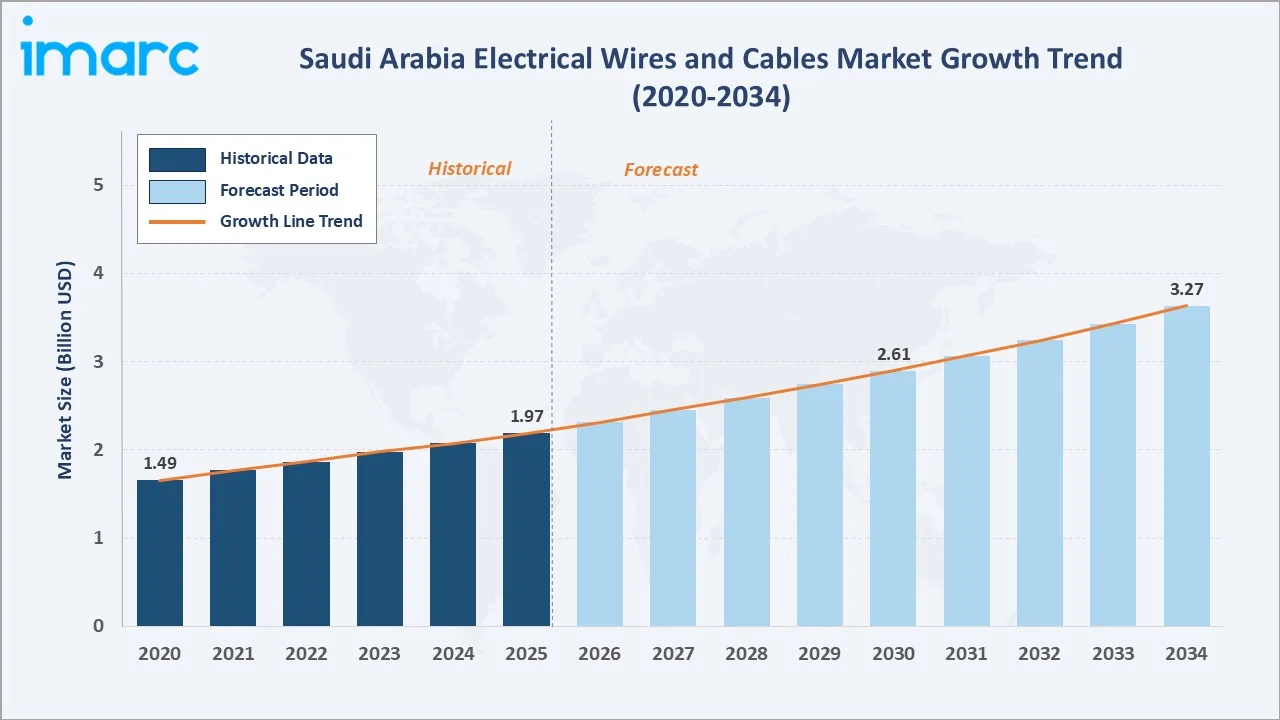
The Saudi Arabia electrical wires and cables market size increased from USD 1.97 Billion in 2025 to USD 2.08 Billion in 2026 and is projected to reach USD 3.27 Billion by 2034, exhibiting a CAGR of 5.80% during 2026-2034. Vision 2030 mega-projects, surging power demand, rapid telecommunications expansion, and growing railway infrastructure are the primary growth catalysts. Saudi Arabia's National Renewable Energy Program (NREP) is accelerating renewable energy deployment through competitive power procurement led by SPPC and strategic investments by PIF, targeting 130 GW of renewable capacity by 2030 across solar, wind, and other clean energy technologies. This is driving the market by increasing demand for power transmission, distribution, and grid connection infrastructure. Power cables lead type at 74.6%, the Power end user segment dominates at 38.7%, and the Northern and Central Region accounts for the largest regional share at 38.2%.
Market Snapshot
|
Metric |
Value |
|
Base Year Market Size (2025) |
USD 1.97 Billion |
| Market Size (2026) | USD 2.08 Billion |
|
Forecast Market Size (2034) |
USD 3.27 Billion |
|
CAGR (2026-2034) |
5.80% |
|
Base Year |
2025 |
|
Historical Period |
2020-2025 |
|
Forecast Period |
2026-2034 |
|
Dominant Type |
Power Cable (74.6%, 2025) |
|
Dominant End User |
Power (38.7%, 2025) |
|
Leading Region |
Northern and Central Region (38.2%, 2025) |
The Saudi Arabia electrical wires and cables market has demonstrated consistent growth, increasing from USD 1.49 Billion in 2020 to USD 1.97 Billion in 2025 and an estimated USD 2.08 Billion in 2026, reflecting accelerating infrastructure development across the Kingdom. The market is projected to reach USD 2.61 Billion by 2030 and further expand to USD 3.27 Billion by 2034, supported by Vision 2030 giga-projects, grid modernization, and the rapid buildout of telecommunications and railway networks. Growth is anchored by the grid expansion, rising renewable energy cable demand, and increasing local manufacturing capacity investments from key players.
To get more information on this market, Request Sample
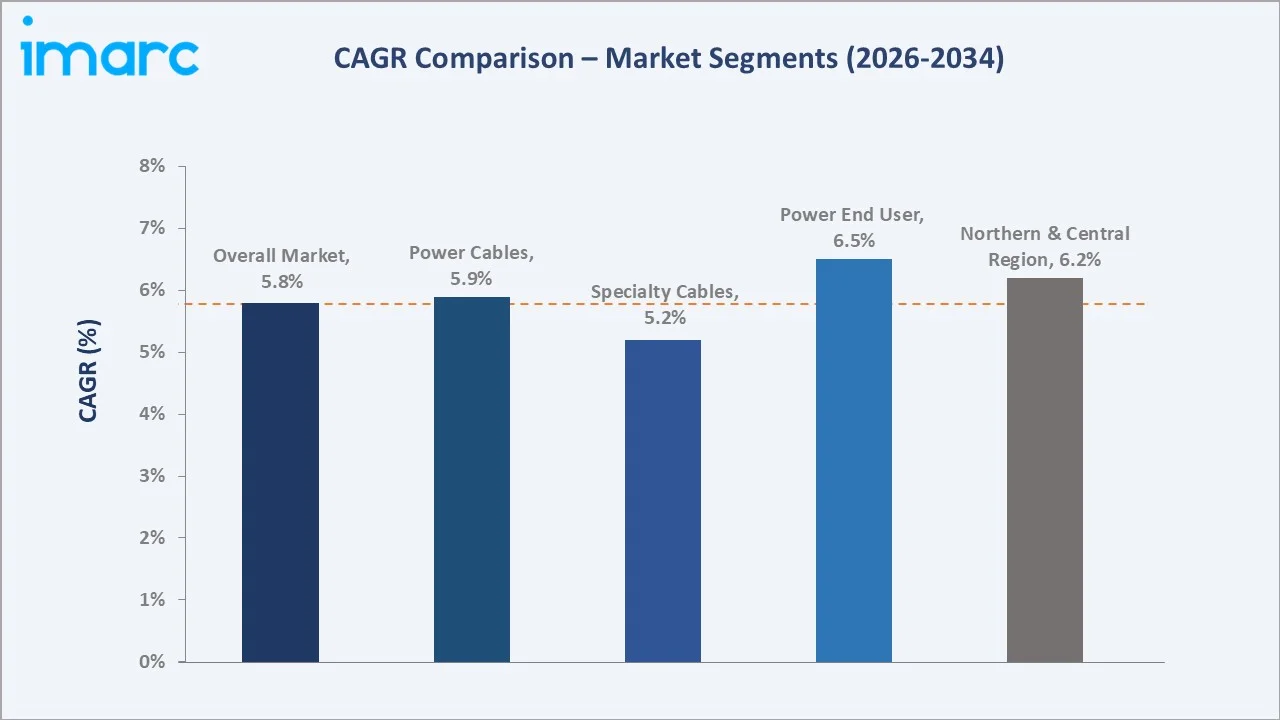
Power cables grow at ~5.9% CAGR through high-voltage transmission and distribution grid buildout. Specialty cables expand at ~5.2% CAGR via telecom fiber, railway signaling, and industrial instrumentation demand. The power end-user segment grows at ~6.5% CAGR, driven by Saudi Arabia's 90GW power demand target and renewable energy integration requirements.
Executive Summary
The Saudi Arabia electrical wires and cables market is expanding rapidly, underpinned by massive government infrastructure investment, a transforming energy landscape, and the Kingdom's ambitious Vision 2030 diversification agenda. Valued at USD 1.97 Billion in 2025 to an estimated USD 2.08 Billion in 2026, reaching USD 3.27 Billion by 2034, reflecting a sustained 5.80% CAGR. Key demand drivers include the Saudi Electricity Company's grid modernization program, giga-project cable requirements for NEOM, Red Sea Project, and Qiddiya, as well as growing renewable energy capacity additions requiring high-performance cable systems.
Power cables lead at 74.6% (2025), reflecting the dominance of transmission and distribution infrastructure as the primary cable application. The power end-user segment commands 38.7% (2025), reflecting SEC's extensive grid expansion, while Construction at 33.4% reflects robust activity across residential, commercial, and mega-project building programs. The Northern and Central Region anchors the market at 38.2% (2025), driven by Riyadh's infrastructure concentration and government project activity.
Key Market Insights
|
Insight |
Data |
|
Dominant Type |
Power Cable – 74.6% share (2025) |
|
Dominant End User |
Power – 38.7% share (2025) |
|
Leading Region |
Northern and Central Region – 38.2% share (2025) |
|
Market Opportunity |
NEOM, Red Sea Project, Qiddiya cable packages; smart grid & renewable energy cable systems |
Key Analytical Observations Supporting The Above Data:
- Power cables at 74.6% (2025): Power cables dominate as they form the backbone of Saudi Arabia's electricity transmission and distribution network. With the SEC’s over 90,000 circuit-kilometers of transmission lines, 600,000 kilometers of distribution networks, and extensive substation infrastructure, power cable demand remains the largest and most sustained segment across all regions.
- Power end user at 38.7% (2025): The power sector leads demand as Saudi Arabia accelerates grid modernization, adds renewable energy generation capacity, and upgrades aging transmission infrastructure. Saudi Aramco and SEC together represent significant ongoing cable procurement volumes for both upstream and grid-side applications.
- Northern and Central Region at 38.2% (2025): Riyadh's concentration of government infrastructure projects, SEC headquarters operations, and the volume of Vision 2030 developments drive the highest regional cable demand. The region also hosts several of the Kingdom's major cable manufacturing facilities.
Saudi Arabia Electrical Wires and Cables Market Overview
The Saudi Arabia electrical wires and cables market encompasses the design, manufacture, import, distribution, and installation of electrical conductors used across power transmission and distribution, telecommunications, construction, railway, and industrial applications. Product scope includes low-voltage (LV), medium-voltage (MV), and high-voltage (HV) power cables, specialty cables covering control, instrumentation, fire-rated, fiber optic, and subsea variants. Macroeconomic drivers include Vision 2030's infrastructure commitment, Saudi Arabia's GDP growth, power demand, and the expansion of 5G telecommunications infrastructure across all major cities.
Market Dynamics
To evaluate market opportunities, Request Sample
Market Drivers
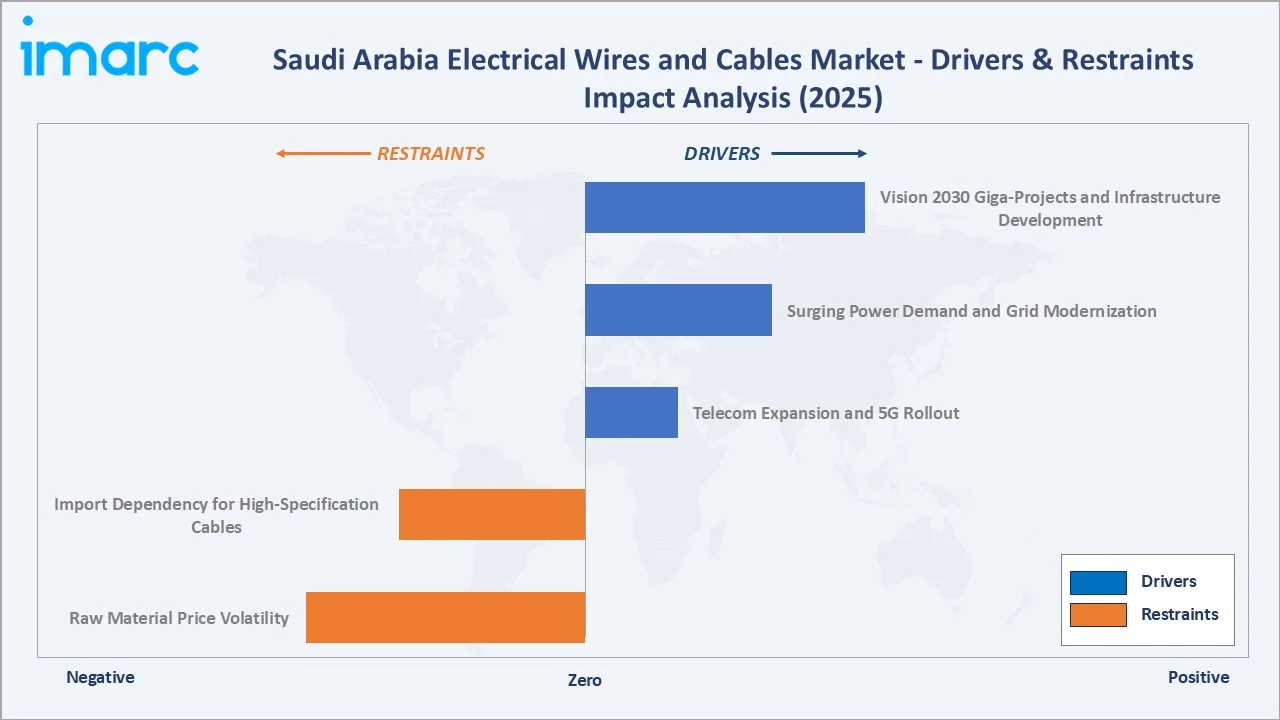
- Vision 2030 Giga-Projects and Infrastructure Development: Saudi Arabia's Vision 2030 agenda is funding extensive cable-intensive infrastructure, including NEOM's 170km The Line, Qiddiya entertainment city, the Red Sea Project resorts, and the Riyadh Metro expansion. These projects collectively demand millions of kilometers of power, data, and specialty cables. In February 2025, Mobily landed the Africa-1 subsea cable in Duba, Saudi Arabia, spanning over 10,000 km with 96Tbps capacity, reflecting growing cable infrastructure investment.
- Surging Power Demand and Grid Modernization: Saudi Arabia's electricity demand necessitates extensive grid expansion and upgrade programs. SEC is deploying smart grid infrastructure requiring advanced cable systems, while renewable energy installations like solar and wind demand dedicated HV and MV cable connections. The Kingdom's target of 50% renewable electricity by 2030 creates sustained demand for high-performance power cables.
- Telecom Expansion and 5G Rollout: Saudi Arabia’s Communications, Space, and Technology Commission reported that the Kingdom’s 5G coverage has exceeded 80%, nearly twice the global average. Riyadh has emerged as one of the world’s leading 5G-enabled capitals, with coverage surpassing 95%. Fiber optic backbone networks, last-mile connections, and data center interconnects are driving demand for specialty telecommunications cables.
Market Restraints
- Raw Material Price Volatility: Raw material price volatility increases the cost of key inputs such as copper, aluminum, PVC, XLPE, and other insulation materials. Fluctuating input prices pressure manufacturer margins, raise cable prices, and make it difficult for contractors and project developers to maintain stable procurement budgets.
- Import Dependency for High-Specification Cables: Import dependency for high-specification cables exposes projects to longer lead times, foreign exchange risks, and global supply disruptions. Specialized cables for renewable energy, smart grids, data centers, oil and gas, and high-voltage applications may rely on overseas suppliers, limiting local availability and increasing project costs.
Market Opportunities
- Renewable Energy Cable Systems: Saudi Arabia aims to generate 50% of its electricity from renewable sources by 2030, requiring around 130 GW of installed solar, wind, and energy storage capacity. This renewable energy target requires extensive cable infrastructure for solar farm connections, wind power transmission, and grid integration.
- Smart Grid and EV Charging Infrastructure: The rollout of smart grid technology and electric vehicle charging infrastructure creates demand for advanced cable solutions, including smart metering connections and EV charging cables. Saudi Arabia's growing EV adoption, supported by Vision 2030 transport electrification targets, is creating a nascent but rapidly growing cable demand segment.
Market Challenges
- Project Delays in Construction, Utilities, and Infrastructure Sectors: Project delays in construction, utilities, and infrastructure sectors are postponing cable procurement, installation schedules, and revenue realization for suppliers. Delayed project execution can also create inventory buildup, cash flow pressure, and uncertainty in demand planning for manufacturers and distributors.
- Compliance with Strict Quality and Safety Standards: Compliance with strict quality and safety standards increases testing, certification, and production costs for manufacturers. Cables used in buildings, utilities, oil and gas, renewable energy, and infrastructure must meet fire safety, durability, voltage, and performance requirements, making product development and approval more complex.
Emerging Market Trends
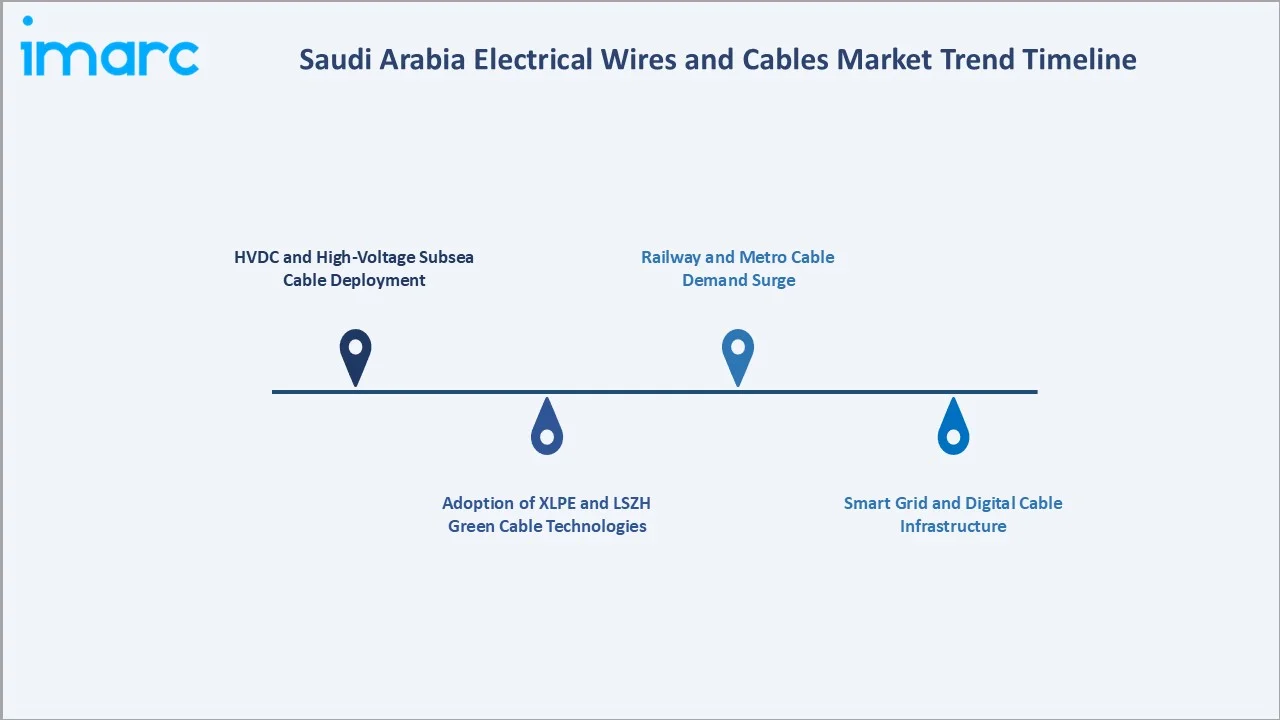
1. HVDC and High-Voltage Subsea Cable Deployment
HVDC and high-voltage subsea cable deployment is emerging as Saudi Arabia expands renewable energy, grid interconnections, and large coastal infrastructure projects. These cables support long-distance, high-capacity power transmission with lower losses, especially for offshore, cross-border, and remote energy projects. Growing investments in smart grids, renewable integration, and regional power connectivity are increasing demand for advanced high-voltage cable systems.
2. Adoption of XLPE and LSZH Green Cable Technologies
Adoption of Cross-linked polyethylene (XLPE) and LSZH green cable technologies is emerging, driven by stricter safety standards and sustainable construction practices. XLPE cables offer higher thermal performance and durability, while LSZH (Low Smoke Zero Halogen) cables improve fire safety by minimizing toxic smoke emissions. Their increasing use in smart buildings, metro systems, data centers, healthcare facilities, and renewable energy projects is accelerating demand for advanced, environmentally friendly cable solutions.
3. Smart Grid and Digital Cable Infrastructure
Smart grid deployment across Saudi Arabia is driving demand for advanced cable solutions, including AMI (Advanced Metering Infrastructure) network cables, smart substation control cables, and fiber optic-copper hybrid installations. The integration of IoT sensors and real-time monitoring capability into cable networks is emerging as a technology differentiator for next-generation infrastructure projects across Riyadh, Jeddah, and NEOM's planned smart city zones.
4. Railway and Metro Cable Demand Surge
A surge in demand for railway and metro cable is emerging as Saudi Arabia expands urban rail, metro systems, airport transit, and intercity railway infrastructure. Saudi Arabia’s train passenger traffic reached a record high in Q4 2025, totaling 46.7 million passengers, mainly supported by strong urban rail usage. Urban rail services accounted for 43.8 million passengers, with Riyadh Metro carrying over 32 million passengers and the Automated People Mover at King Abdulaziz International Airport in Jeddah handling more than 10 million passengers. Rising passenger traffic and continued investment in rail mobility are increasing long-term demand for high-performance cable systems.
Industry Value Chain Analysis
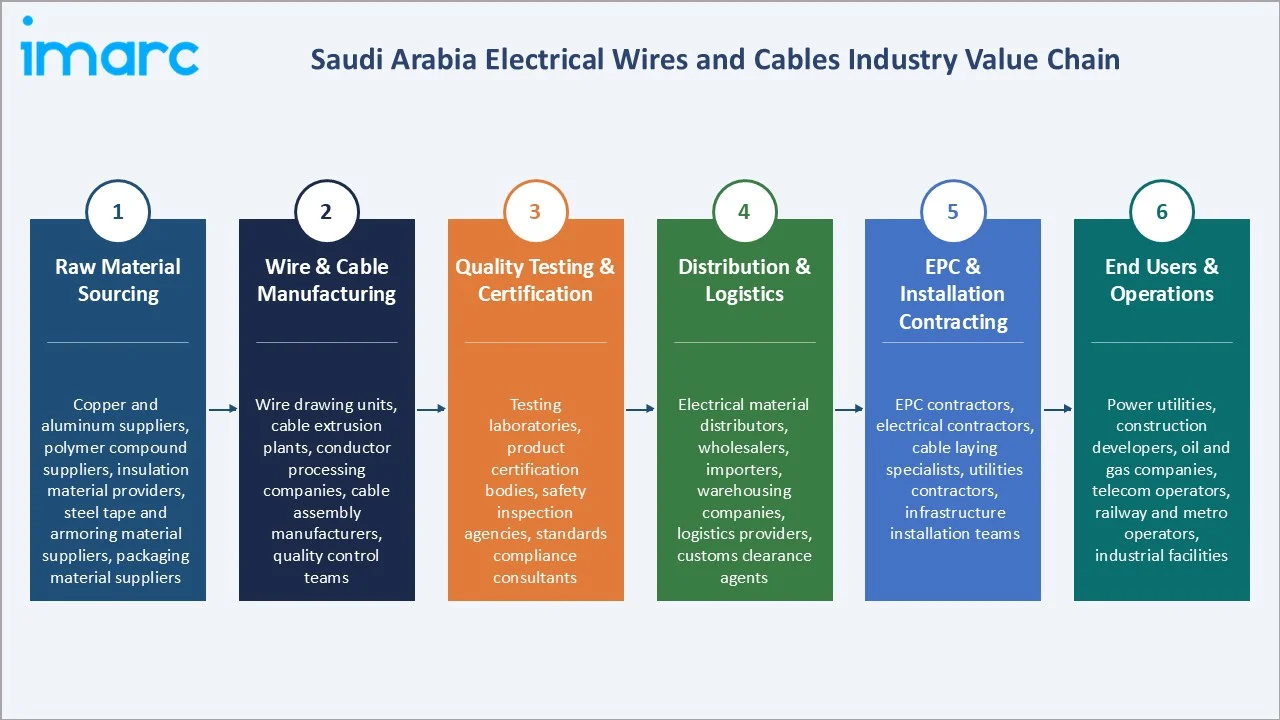
The Saudi Arabia electrical wires and cables market value chain integrates raw material sourcing, wire and cable manufacturing, quality testing and certification, distribution and logistics, EPC installation contracting, and end user operations and maintenance.
|
Stage |
Key Participants |
|
Raw Material Sourcing |
Copper and aluminum suppliers, polymer compound suppliers, insulation material providers, steel tape and armoring material suppliers, packaging material suppliers |
|
Wire & Cable Manufacturing |
Wire drawing units, cable extrusion plants, conductor processing companies, cable assembly manufacturers, quality control teams |
|
Quality Testing & Certification |
Testing laboratories, product certification bodies, safety inspection agencies, standards compliance consultants |
|
Distribution & Logistics |
Electrical material distributors, wholesalers, importers, warehousing companies, logistics providers, customs clearance agents |
|
EPC & Installation Contracting |
EPC contractors, electrical contractors, cable laying specialists, utilities contractors, infrastructure installation teams |
|
End Users & Operations |
Power utilities, construction developers, oil and gas companies, telecom operators, railway and metro operators, industrial facilities |
Wire and cable manufacturing is the most value-added stage in the Saudi Arabia electrical wires and cables value chain, as it converts commodity raw materials into precision-engineered electrical conductors meeting stringent specifications. This stage determines cable performance, safety, and long-term reliability.
Technology Landscape in the Saudi Arabia Electrical Wires and Cables Industry
High-Voltage Cable Technology
High-voltage (HV) and extra-high-voltage (EHV) cable technology is at the forefront of Saudi Arabia's grid expansion. XLPE-insulated HV cables are the primary technology for underground transmission in urban areas and connections to renewable energy plants. Saudi Arabia's extreme ambient temperatures (up to 50°C) and high solar irradiance require cables with enhanced thermal ratings and UV-resistant outer sheaths.
Power Transmission Cable Manufacturing Technology
Power transmission cable manufacturing technology enables the production of high-capacity cables for grid expansion, renewable energy projects, and power infrastructure. In April 2026, Riyadh Cables Group Company secured a SAR 450 million ($120 million) supply contract from Mohammed Al Ojaimi Contracting Establishment for power infrastructure projects in Saudi Arabia. Under the 12-month agreement, Riyadh Cables will supply power transmission cables for multiple projects being developed by Al Ojaimi across the Kingdom. This technology is critical for meeting rising demand from utilities, EPC projects, and national infrastructure development.
Smart Cable and Condition Monitoring Technology
Smart cable technology is enabling real-time condition monitoring of critical cable infrastructure. These systems provide continuous data on cable thermal load, insulation degradation, and mechanical stress, enabling predictive maintenance and reducing unplanned outages. Saudi Arabia's smart grid program and NEOM's digital infrastructure are driving the specification of smart cable solutions in new high-voltage installations and critical building applications across Vision 2030 developments.
Market Segmentation Analysis
The report covers the following segments:
|
Segment Category |
Leading Segment |
Market Share |
Year |
|
Type |
Power Cable |
74.6% |
2025 |
|
End User |
Power |
38.7% |
2025 |
|
Region |
Northern and Central Region |
38.2% |
2025 |

By Type
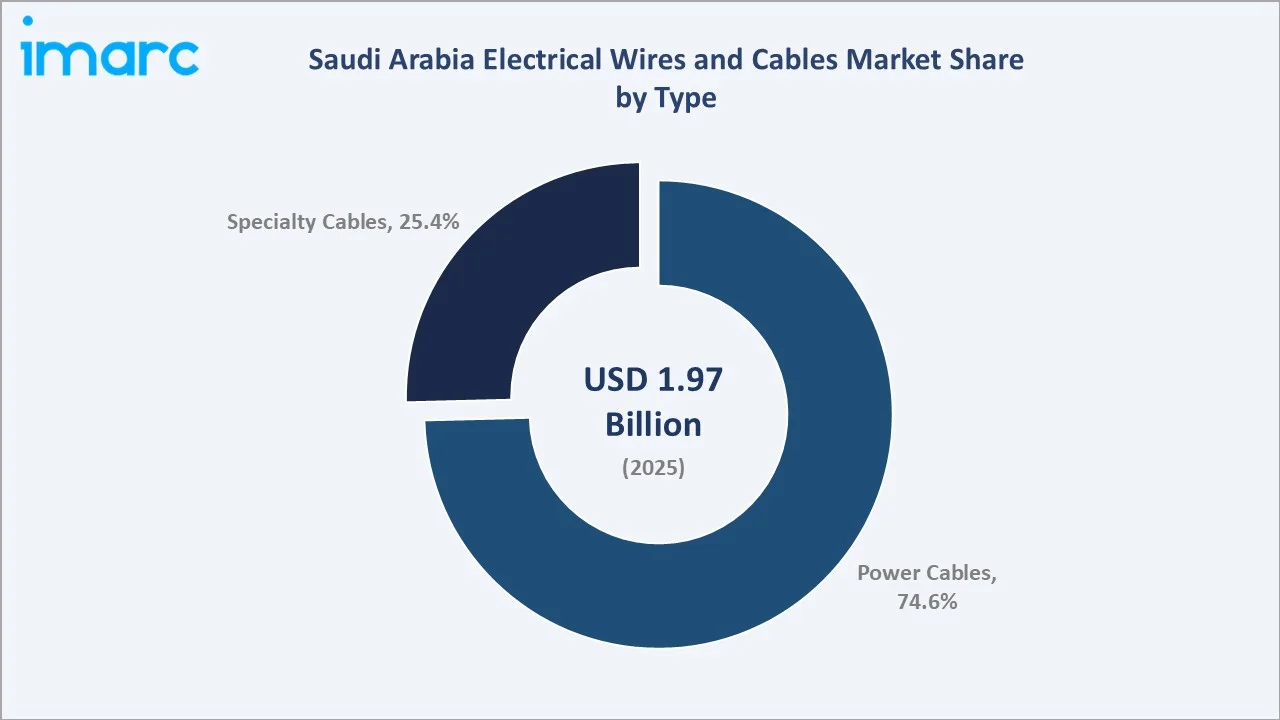
Power cables lead at 74.6% (2025), driven by the overwhelming scale of Saudi Arabia's electricity transmission and distribution network expansion. Power cables span low-voltage distribution in residential and commercial buildings, medium-voltage feeders for industrial and commercial complexes, and high-voltage transmission lines connecting generation assets to the national grid.
To access detailed market analysis, Request Sample
Specialty cables at 25.4% (2025) represent the fastest-growing segment, encompassing fire-rated LSZH cables, fiber optic cables, instrumentation and control cables, subsea cables, and railway signaling cables. This segment benefits from technology upgrade cycles in telecommunications, railway expansion, smart building mandates, and the growing adoption of data center infrastructure across the Kingdom. Specialty cables are projected to grow at ~5.2% CAGR through 2034.
By End User
The power end user segment dominates at 38.7% (2025), reflecting the SEC's ongoing grid modernization program, connection of renewable energy plants, and smart meter rollout, sustaining continuous power cable procurement at significant volumes.
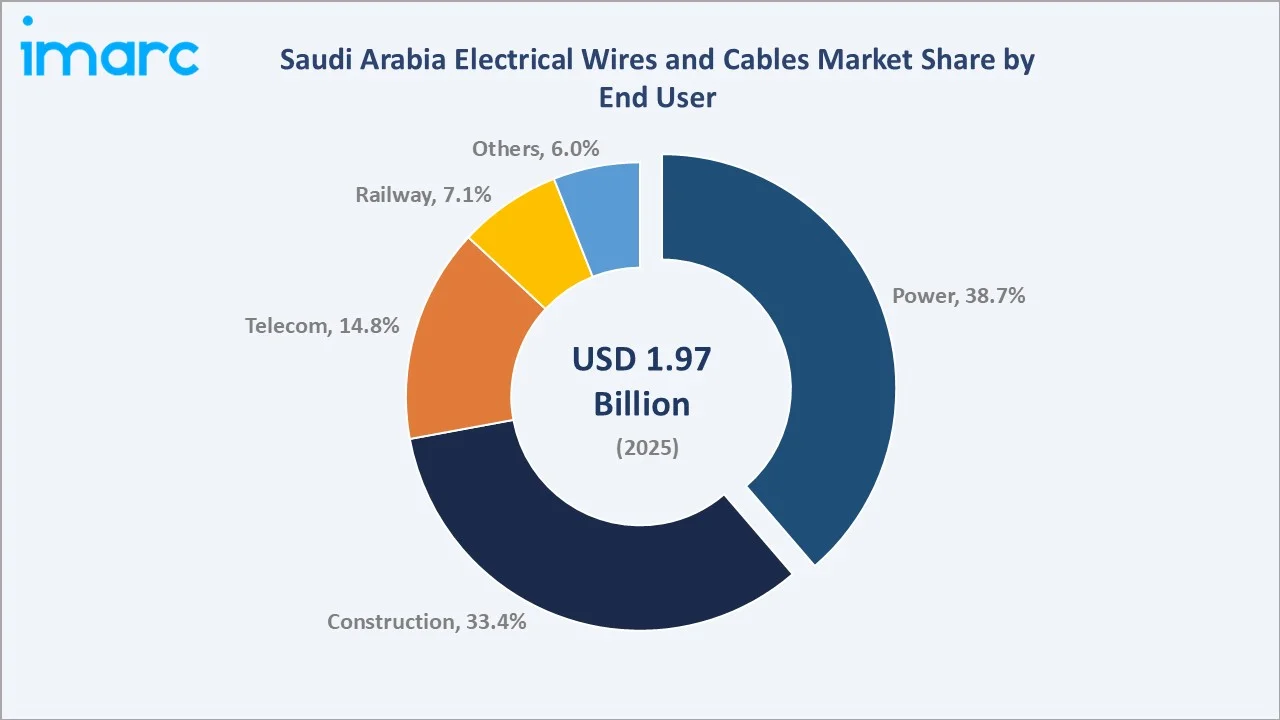
Construction end use at 33.4% (2025) reflects robust activity across residential housing, commercial towers, hospitality, and the building programs associated with Vision 2030 giga-projects. Telecom at 14.8% reflects 5G infrastructure deployment and fiber broadband expansion. Railway at 7.1% is the fastest-growing end user category in relative terms, driven by Riyadh Metro expansion, NEOM transit systems, and regional Railway upgrades. The others category at 6.0% includes oil and gas, industrial, and petrochemical cable applications.
Regional Market Insights
|
Region |
Share (2025) |
Key Saudi Arabia Electrical Wires and Cables Market Drivers & Characteristics |
|
Northern and Central Region |
38.2% |
Reflecting Riyadh's concentration of SEC headquarters operations, government infrastructure projects, Vision 2030 mega-developments, and the largest residential and commercial construction base in the Kingdom. |
|
Western Region |
29.5% |
Reflecting Jeddah's port-based industrial activity, Makkah-Madinah religious tourism infrastructure, Red Sea Project cable requirements, and the Western Grid expansion program. |
|
Eastern Region |
21.3% |
Reflecting Saudi’s extensive cable requirements for oil and gas facilities, petrochemical complexes, and growing commercial and industrial construction activity. |
|
Southern Region |
11.0% |
Reflecting regional development programs, tourism infrastructure under Vision 2030, and the expanding Southern Grid interconnection and upgrade program. |
The Northern and Central regions' 38.2% dominance is driven by Riyadh's position as the national hub for SEC grid operations, government capital project activity, and Vision 2030 mega-development programs. The city's expanding metro network, smart city developments, and the volume of office tower and residential construction sustain the highest regional cable demand. The Western region at 29.5% follows closely, supported by Jeddah's port and industrial activity, the Red Sea Project's coastal resort and infrastructure cable requirements, and Makkah-Madinah's tourism infrastructure.
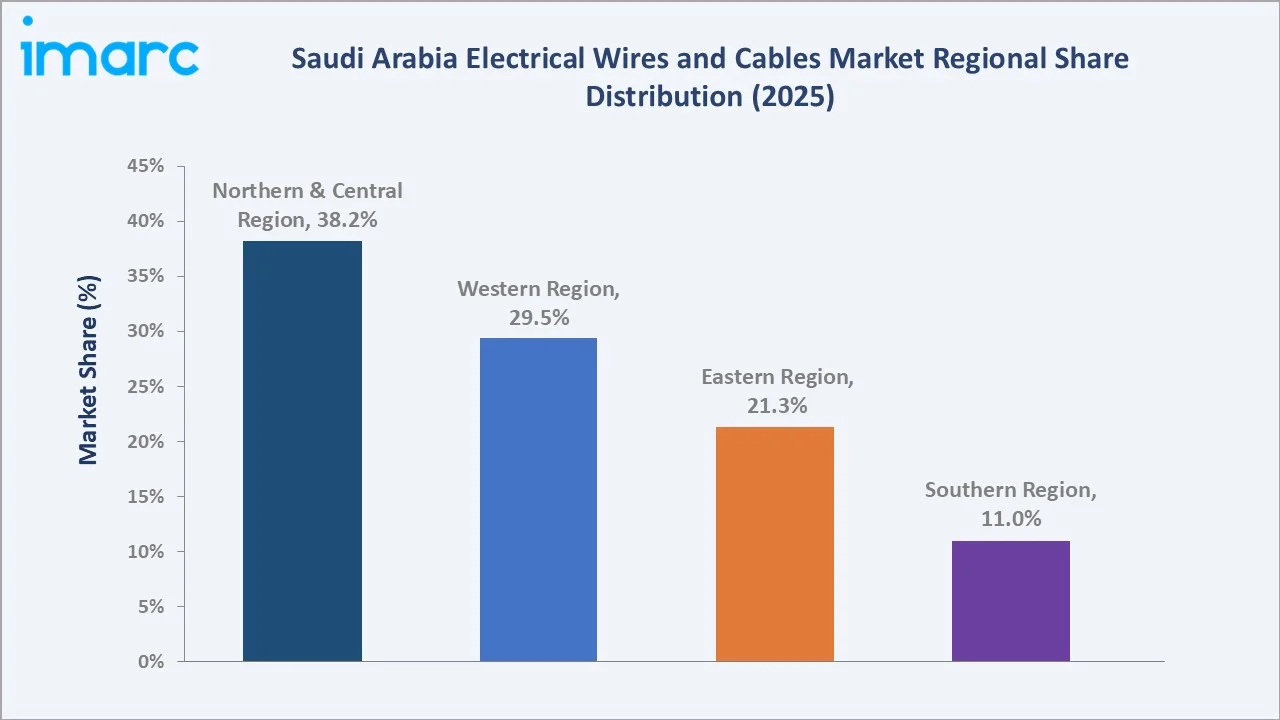
The Eastern region, at 21.3%, is anchored by Saudi’s vast cable procurement for upstream oil and gas operations, refineries, and the petrochemical corridor. The Southern region, at 11.0%, while the smallest, is experiencing increasing investment in regional grid upgrades and new tourism resort developments.
Competitive Landscape
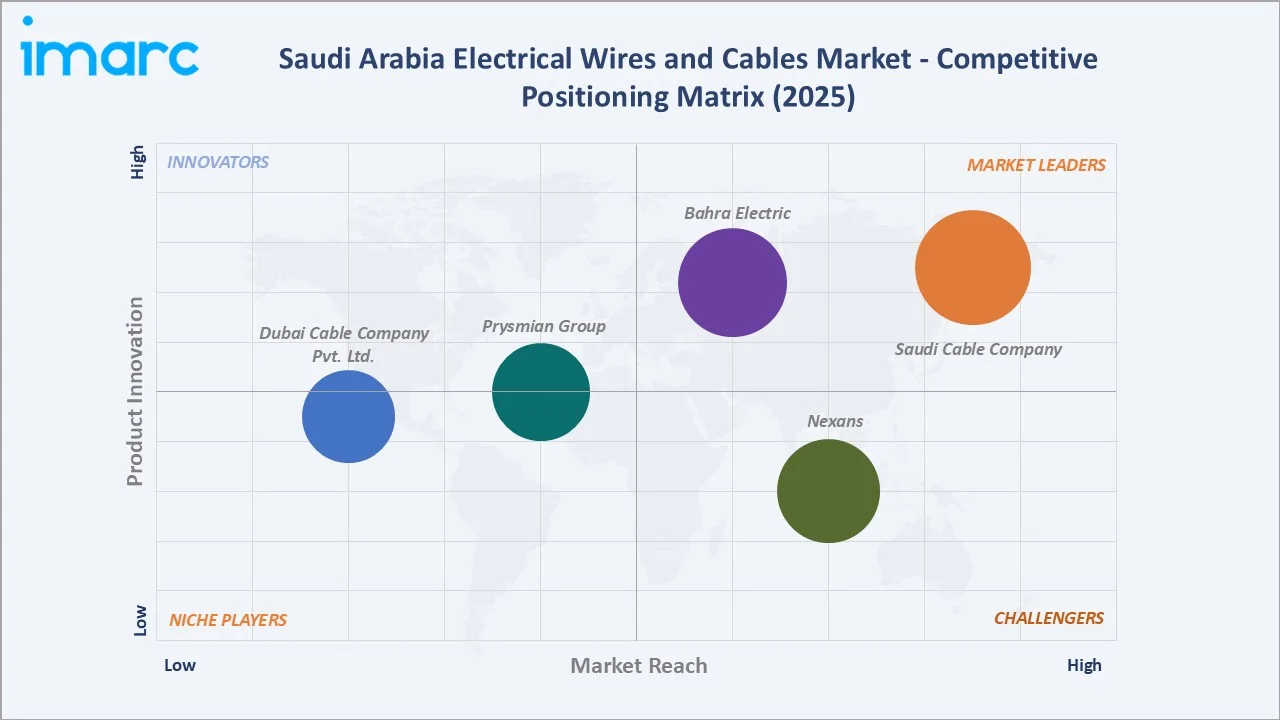
The Saudi Arabia electrical wires and cables market is moderately concentrated, with domestic manufacturers competing alongside international players. Competition is driven by product quality certifications, local manufacturing capability, pricing, and supply chain reliability. Investments in domestic manufacturing are shifting the competitive balance toward local supply.
|
Company |
Key Products |
Market Position |
Core Strength |
|
Saudi Cable Company |
Power Cables, Speciality Cables, Building & Grounding Cables, Communication Cables, LAND HV & EHV Cables |
Market Leader |
The Saudi Cable Company is a pioneer in Saudi Arabia's electrical infrastructure, serving as one of the region's total cable system providers. It manufactures power and telecommunications cables and manages turnkey electrical projects for major utilities, oil and gas facilities, and commercial sectors. |
|
Bahra Electric |
Fire Resistance Wires & Cables, LSF0H Wires & Cables, Low Voltage Power Cables, High Voltage Power Cables, VFD/VSD Cables, DC Photovoltaic Solar Cables |
Market Leader |
Bahra Electric is a premier manufacturer of electrical wires, cables, and related accessories in Saudi Arabia. The company operates a massive facility in the Bahra Industrial City near Jeddah. It serves as a vital domestic supplier and a major global exporter. |
|
Prysmian Group |
Low smoke zero halogen cables, Medium Voltage Cables |
Established Player |
Prysmian Group is a major supplier of high-voltage and specialized electrical cables in Saudi Arabia. Operating through its regional hub in Prysmian Group Middle East, the company supplies land, submarine, and oil & gas cables. Their cables link local grid stations, power cities, and secure energy trades. |
|
Nexans |
HV & EHV cables, Fire-safe cables |
Strong Challenger |
Nexans plays a crucial role in Saudi Arabia's electrical wires and cable market, acting as a top-tier supplier for power grid infrastructure, massive smart cities, and industrial plants. By providing high-voltage, medium-voltage, and low-voltage cable systems, they support the nation's energy transition, commercial real estate development, and digital transformation. |
|
Dubai Cable Company Pvt. Ltd. |
LV Cables, MV Cables, HV/EHV Cables |
Established Player |
The Dubai Cable Company Pvt. Ltd. (Ducab) plays a major cross-border role in the Saudi Arabian electrical sector by supplying premium Low Voltage (LV), Medium Voltage (MV), and High Voltage (HV) cable solutions. |
Companies are increasingly investing in Saudi manufacturing facilities and digital supply chain platforms to strengthen market positions. The market is expected to witness further consolidation and local capacity expansion through joint ventures and strategic partnerships, as giga-project cable procurement programs demand assured local supply and shorter delivery timelines.
Key Company Profiles
Saudi Cable Company
Saudi Cable Company is Saudi Arabia's pioneering domestic cable manufacturer, operating as the Kingdom's largest full-range cable producer. Saudi Cable Company manufactures high-voltage, medium-voltage, and low-voltage power cables, bare conductors, winding wires, and specialty cables from its Jeddah-based facilities.
- Key Products: Power Cables, Speciality Cables, Building & Grounding Cables, Communication Cables, LAND HV & EHV Cables.
- Strategic Focus: Strengthening its position in power, infrastructure, utilities, construction, and industrial cable segments. The company is likely to prioritize operational efficiency, product quality, debt restructuring, project-based supply contracts, and compliance with national standards. Its strategy also aligns with Vision 2030 opportunities, including grid expansion, renewable energy, metro, oil and gas, and large-scale infrastructure projects.
Bahra Electric
Bahra Electric is a Saudi-based electrical manufacturing company and an important participant in the Kingdom’s electrical wires and cables market. The company supplies a wide range of low-voltage, medium-voltage, building, industrial, control, instrumentation, and specialty cable products for construction, utilities, infrastructure, oil and gas, and industrial applications. Its domestic manufacturing presence supports Saudi Arabia’s localization agenda and helps meet rising demand from Vision 2030 projects, renewable energy, smart cities, metro systems, and commercial developments. Bahra Electric competes through product quality, standards compliance, project supply capability, and its ability to serve large-scale electrical infrastructure requirements across the Kingdom.
- Key Products: Fire Resistance Wires & Cables, LSF0H Wires & Cables, Low Voltage Power Cables, High Voltage Power Cables, VFD/VSD Cables, DC Photovoltaic Solar Cables.
- Strategic Focus: Supporting domestic infrastructure, construction, utilities, and industrial electrification projects with locally manufactured cable solutions. The company emphasizes product quality, standards compliance, customized project supply, and a broad portfolio covering low-voltage, medium-voltage, control, instrumentation, and specialty cables.
Market Concentration Analysis
The Saudi Arabia electrical wires and cables market is moderately concentrated. The top five players, Saudi Cable Company, Bahra Electric, Prysmian Group, Nexans, and Dubai Cable Company Pvt. Ltd., collectively account for an estimated 45-52% of total market revenue in 2025. Domestic manufacturers hold dominant positions in LV and MV standard cable segments where local supply is a key differentiator, while international players compete strongly for high-voltage, specialty, and technically complex cable requirements. The market is becoming more competitive at the domestic level as new manufacturing investments add capacity and reduce import dependence. The market is expected to see further consolidation through joint ventures and strategic partnerships, with local manufacturing share projected to increase as the Kingdom achieves its local content targets.
Investment & Growth Opportunities
Highest Growth Segments
Power end user cables (~6.5% CAGR), railway specialty cables (~8.5% CAGR on a small base), renewable energy HV/MV connections (~9%+ CAGR from emerging base), LSZH fire-rated cables for construction (~6.8% CAGR), and fiber optic telecommunications cables (~7.5% CAGR) represent Saudi Arabia's electrical wires and cables market highest-growth investment vectors through 2034.
Investment Themes
- Giga-project cable packages: Large Vision 2030 projects create investment opportunities for suppliers offering integrated cable packages for power, lighting, control, communication, rail, and smart infrastructure systems.
- Domestic manufacturing: Expanding local cable production supports Saudi localization goals, reduces import dependency, improves delivery reliability, and strengthens competitiveness in major infrastructure and utility projects.
Future Market Outlook (2026-2034)
The Saudi Arabia electrical wires and cables market is projected to grow from USD 1.97 Billion in 2025 to USD 2.08 Billion in 2026, and reaching USD 3.27 Billion by 2034, delivering a 5.80% CAGR over the forecast period through Vision 2030 infrastructure execution, power demand growth, telecommunications expansion, and accelerating local manufacturing investment. The market's anchor value of USD 2.61 Billion in 2030 represents a key milestone, coinciding with the targeted completion of initial phases of NEOM, the Red Sea Project, and the Kingdom's first major renewable energy capacity additions.
Three structural forces are expected to define the growth of the Saudi Arabia electrical wires and cables market through 2034. First, Vision 2030 mega-projects, power grid expansion, and rapid urban infrastructure development will sustain demand for low-, medium-, and high-voltage cable systems. Second, accelerating investments in renewable energy, smart grids, data centers, and electrified transportation will increase the need for advanced and high-performance cables. Third, the government's emphasis on domestic manufacturing and localization will strengthen local production capabilities, reduce import dependence, and enhance the competitiveness of Saudi cable manufacturers.
Research Methodology
Primary Research
Primary research comprised in-depth interviews with senior executives from cable manufacturers, electrical material distributors, EPC contractors, SEC procurement teams, and independent electrical engineering consultants operating in Saudi Arabia. These discussions validated market size estimates, assessed emerging technology adoption, evaluated competitive dynamics, and provided insights into Vision 2030 project cable procurement timelines and regulatory developments.
Secondary Research
Secondary research encompassed company annual reports, Saudi government infrastructure announcements, compliance disclosures, certification databases, industry association publications, trade press, electrical engineering journals, and credible market intelligence sources. These were used to analyze market trends, competitive positioning, regulatory developments, and project pipeline activity across Saudi Arabia's four major regions.
Forecasting Models
Forecasting models were developed using historical market trends, Saudi Arabia electricity demand projections, SEC grid investment programs, Vision 2030 project pipeline data, building permit statistics, and macroeconomic indicators. Both top-down and bottom-up approaches were applied and validated through primary research and secondary data. Market projections incorporated copper price scenarios, policy implementation, technology adoption rates, and renewable energy deployment timelines to generate reliable forecasts through 2034.
Saudi Arabia Electrical Wires and Cables Market Report Coverage:
| Report Features | Details |
|---|---|
| Base Year of the Analysis | 2025 |
| Historical Period | 2020-2025 |
| Forecast Period | 2026-2034 |
| Units | Billion USD |
| Scope of the Report |
Exploration of Historical Trends and Market Outlook, Industry Catalysts and Challenges, Segment-Wise Historical and Future Market Assessment:
|
| Types Covered | Power Cable, Specialty Cable |
| End Users Covered | Railway, Power, Construction, Telecom, Others |
| Regions Covered | Northern and Central Region, Western Region, Eastern Region, Southern Region |
| Companies Covered | Saudi Cable Company, Bahra Electric, Prysmian Group, Nexans, Dubai Cable Company Pvt Ltd., etc. |
| Customization Scope | 10% Free Customization |
| Post-Sale Analyst Support | 10-12 Weeks |
| Delivery Format | PDF and Excel through Email (We can also provide the editable version of the report in PPT/Word format on special request) |
Key Benefits for Stakeholders:
- IMARC’s industry report offers a comprehensive quantitative analysis of various market segments, historical and current market trends, market forecasts, and dynamics of the Saudi Arabia electrical wires and cables market from 2020-2034.
- The research report provides the latest information on the market drivers, challenges, and opportunities in the Saudi Arabia electrical wires and cables market.
- Porter's five forces analysis assist stakeholders in assessing the impact of new entrants, competitive rivalry, supplier power, buyer power, and the threat of substitution. It helps stakeholders to analyze the level of competition within the Saudi Arabia electrical wires and cables industry and its attractiveness.
- Competitive landscape allows stakeholders to understand their competitive environment and provides an insight into the current positions of key players in the market.
Frequently Asked Questions About the Saudi Arabia Electrical Wires and Cables Market Report
The Saudi Arabia electrical wires and cables market size is estimated at USD 2.08 Billion in 2026, driven by Vision 2030 infrastructure investment, SEC grid expansion, 5G telecommunications rollout, and growing construction activity across residential, commercial, and mega-project building programs.
The market grows at 5.80% CAGR during 2026-2034, reaching USD 3.27 Billion by 2034. This reflects sustained Vision 2030 construction execution, power demand growth, renewable energy cable requirements, and accelerating domestic manufacturing capacity investment.
Power cables lead at 74.6% (2025), driven by SEC's extensive grid modernization, renewable energy plant connections, and the dominant role of electrical power transmission and distribution infrastructure across Saudi Arabia's construction and industrial development programs.
The Power end user segment leads at 38.7% (2025), reflecting SEC's position as the Kingdom's single largest cable buyer. Construction follows at 33.4%, fueled by Vision 2030 mega-project building activity and residential housing programs across all regions of the Kingdom.
The Northern and Central region leads at 38.2% (2025), reflecting Riyadh's concentration of SEC grid operations, government infrastructure projects, and Vision 2030 mega-development activity.
Leading companies include Saudi Cable Company, Bahra Electric, Prysmian Group, Nexans, and Dubai Cable Company Pvt. Ltd., among others.
The market is projected to reach approximately USD 2.61 Billion by 2030, driven by Vision 2030 giga-project cable requirements, SEC grid expansion, 5G infrastructure deployment, and Riyadh Metro and railway network expansion.
Top opportunities include NEOM and Red Sea Project cable packages, HV/MV cables for renewable energy plant connections, LSZH fire-rated cable production for Vision 2030 building programs, domestic copper rod manufacturing, and railway specialty cable supply for Saudi Arabia's expanding rail network.
Need more help?
- Speak to our experienced analysts for insights on the current market scenarios.
- Include additional segments and countries to customize the report as per your requirement.
- Gain an unparalleled competitive advantage in your domain by understanding how to utilize the report and positively impacting your operations and revenue.
- For further assistance, please connect with our analysts.
 Request Customization
 Speak to an Analyst
 Request Brochure
 Inquire Before Buying
Benefits of Customization
- Personalize this research
- Triangulate with your data
- Get data as per your format and definition
- Gain a deeper dive into a specific application, geography, customer, or competitor
- Any level of personalization
Get in Touch With Us
UNITED STATES
Phone: +1-201-971-6302
INDIA
Phone: +91-120-433-0800
UNITED KINGDOM
Phone: +44-753-714-6104
Email: [email protected]
Client Testimonials




.webp)




.webp)













Related Reports

Choose your plan
*Please note that the prices mentioned below are starting prices for each bundle type. Kindly contact our team for further details.*
Single User License
- 1 User License, Access on 2 Devices
- PDF Report + Excel Dataset (Password Protected)
- Lifetime Access
- No Printing Rights
- 10% Free Report Customization
- 10–12 Weeks of Analyst Support
Five User License
- Access for 5 Users, 2 Devices per User
- PDF Report + Excel Dataset (Password Protected)
- Lifetime Access
- Dedicated Account Manager
- 12–14 Weeks of Analyst Support
- No Printing Rights
- 15% Free Report Customization
- 25% Discount on Your Next Purchase
Corporate User License
- Unlimited User Access (Within Your Organization)
- PDF Report + Excel Dataset
- Lifetime Access
- Dedicated Account Manager
- 14–20 Weeks of Analyst Support
- No Printing Rights
- 20% Free Report Customization
- 30% Discount on Your Next Purchase
Essential Insights
What's included:
3 reports
- Lifetime Access
- PDF Reports
- Excel Datasets
- 2 Weeks of Free Analyst Support
- 2 User Licenses
- Access on 2 Devices
- Printing Rights
- Complimentary PowerPoint (PPT) Version
- Complimentary License Upgrade
Professional Access
What's included:
5 reports
- Lifetime Access
- PDF Reports
- Excel Datasets
- 8 Weeks of Free Analyst Support
- 2 User Licenses
- Access on 2 Devices
- Printing Rights
- Complimentary PowerPoint (PPT) Version
- Complimentary License Upgrade
Business Advantage
What's included:
8 reports
- Lifetime Access
- PDF Reports
- Excel Datasets
- 14 Weeks of Free Analyst Support
- 2 User Licenses
- Access on 2 Devices
- Printing Rights
- Complimentary PowerPoint (PPT) Version
- Complimentary License Upgrade
Enterprise Intelligence
What's included:
10 reports
- Lifetime Access
- PDF Reports
- Excel Datasets
- 20 Weeks of Free Analyst Support
- 2 User Licenses
- Access on 2 Devices
- Printing Rights
- Complimentary PowerPoint (PPT) Version
- Complimentary License Upgrade