
Saudi Arabia Energy-Efficient Buildings Market Size, Share, Trends and Forecast by Material, End Use, and Region, 2026-2034
Saudi Arabia Energy-Efficient Buildings Market Summary:
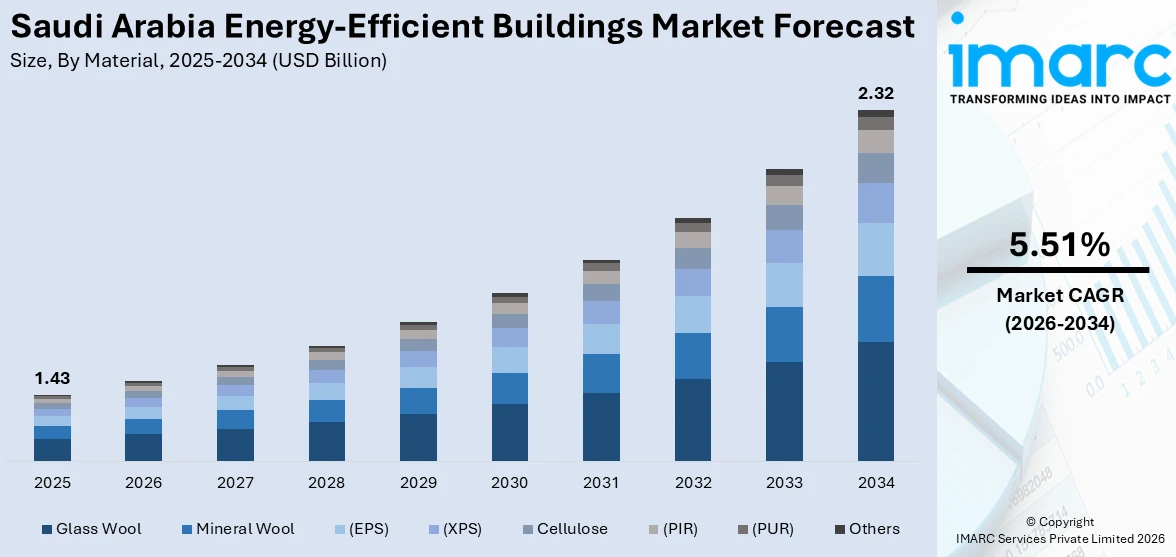
The Saudi Arabia energy-efficient buildings market size was valued at USD 1.43 Billion in 2025 and is projected to reach USD 2.32 Billion by 2034, growing at a compound annual growth rate of 5.51% from 2026-2034.
The Saudi Arabia energy-efficient buildings market is advancing steadily, driven by the Kingdom's ambitious Vision 2030 sustainability agenda and stringent regulatory frameworks mandating energy-saving construction practices. The Saudi Building Code now requires compliance with thermal insulation standards and energy conservation protocols for all new structures, compelling developers and contractors to integrate high-performance building materials and energy-efficient systems across residential and commercial projects. Rapid urbanization, large-scale infrastructure expansion, and an increasing number of mega-projects are further amplifying the demand for insulation materials, smart building technologies, and renewable energy integration within the built environment.
Key Takeaways and Insights:
- By Material: Glass wool dominates the market with a share of 22% in 2025, owing to its superior thermal resistance, cost-effectiveness, lightweight properties, and compliance with Saudi Building Code insulation requirements. Growing demand from residential and commercial construction sectors is accelerating its adoption.
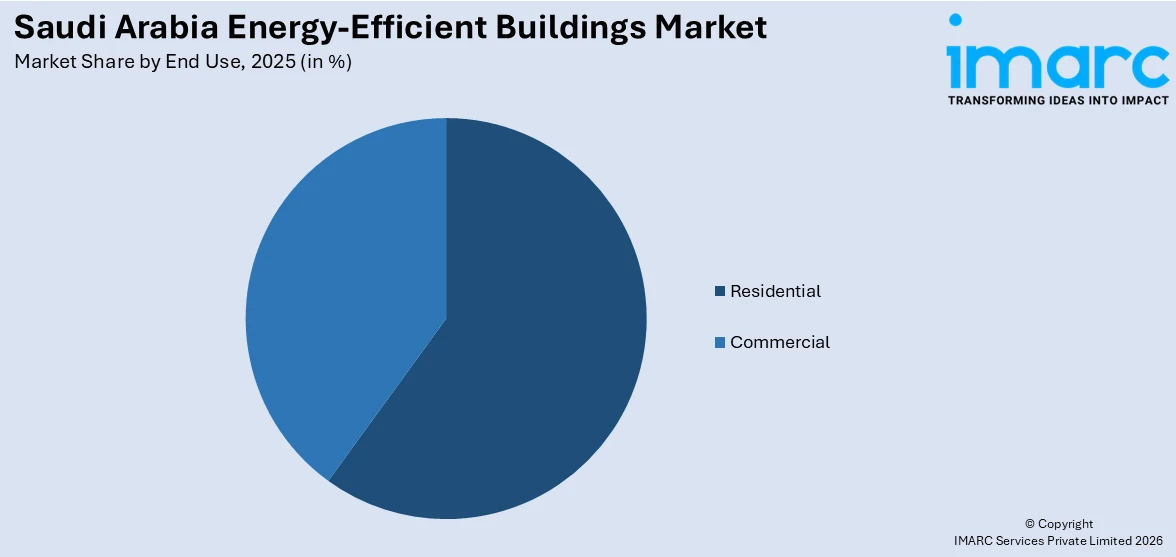
- By End Use: Residential leads the market with a share of 56% in 2025. This dominance is driven by large-scale housing development programs, government-mandated energy efficiency standards for homes, and rising household awareness of long-term energy cost savings.
- By Region: Northern and Central Region represents the largest region with 31% share in 2025, driven by the concentration of major urban centers including Riyadh, significant government infrastructure investments, and high residential construction activity across metropolitan areas.
- Key Players: Key players in the Saudi Arabia energy-efficient buildings market are expanding product portfolios, investing in localized manufacturing, advancing smart insulation technologies, and forging partnerships with construction developers to strengthen nationwide distribution and accelerate adoption of sustainable building solutions.
To get more information on this market Request Sample
The Saudi Arabia energy-efficient buildings market is positioned for sustained expansion as the Kingdom intensifies its commitment to sustainable construction and green building certification. Government-led programs are creating a robust regulatory environment that incentivizes energy-saving upgrades and mandates the incorporation of insulation materials, efficient glazing, and advanced HVAC systems into building designs. The Ministry of Municipal and Rural Affairs' Sustainable Building Program introduced a national sustainability rating system, and by end of 2023, over 70 projects totaling more than 50 Million square meters had been assessed under this framework. The continued emphasis on smart building integration, renewable energy adoption, and prefabricated construction techniques is broadening the scope of energy-efficient building solutions. Simultaneously, rising electricity tariffs and growing environmental consciousness among consumers are reinforcing demand for thermally insulated, resource-efficient residential and commercial structures across the Kingdom.
Saudi Arabia Energy-Efficient Buildings Market Trends:
Integration of Smart Building Management Systems
The Saudi Arabia energy-efficient buildings market is witnessing accelerated integration of smart building management systems that leverage Internet of Things sensors, artificial intelligence, and cloud-based platforms to optimize energy consumption across lighting, HVAC, and ventilation functions. Real-time monitoring and predictive maintenance capabilities enable facility operators to identify inefficiencies and reduce operational costs. For instance, in April 2025, Arabian Fiberglass Insulation Company adopted an AI-powered predictive maintenance solution at its Dammam facility, utilizing six-in-one IoT sensors and advanced analytics to reduce energy waste and unplanned downtime.
Expansion of Prefabricated and Modular Construction Techniques
Prefabricated and modular construction is increasingly finding popularity in the Saudi Arabian energy-efficient building industry, as the demand for faster project execution and minimized material waste, along with improved quality control, is increasing. The prefabricated construction process enables the integration of energy-efficient systems and sustainable materials at the fabrication stage, ensuring that the energy-efficient building meets the required green building standards. The Saudi Arabian government's housing schemes, such as the Sakani affordable housing initiative, have also increased the adoption of prefabricated construction, with thousands of housing units developed across the Kingdom, thereby contributing to the growth of the Saudi Arabia Energy-Efficient Buildings market.
Localization of Insulation Material Manufacturing
Saudi Arabia is actively pursuing the localization of insulation material production to reduce import dependency and support industrial self-sufficiency under Vision 2030. Domestic manufacturing capabilities are expanding across glass wool, mineral wool, and elastomeric rubber insulation segments to meet the growing construction demand. For instance, in May 2025, Gulf-O-Flex inaugurated the Kingdom's first fully localized thermal insulation manufacturing facility, designed to serve expanding construction, HVAC, and infrastructure sectors with locally produced high-performance insulation solutions tailored for regional climate conditions.
How Vision 2030 is Transforming the Saudi Arabia Energy-Efficient Buildings Market:
The Saudi Vision 2030 is, in essence, a paradigm shift in the energy-efficient buildings sector, as sustainability is now being integrated into the very fabric of the construction and development plans of the Kingdom. Large-scale projects such as NEOM, Red Sea Global projects, Qiddiya, and Diriyah Gate are now incorporating best practices in green buildings, thereby creating unprecedented demand for energy-efficient insulation materials, smart building management systems, and energy-saving solutions. Supportive changes in the regulatory environment, such as the mandatory compliance with the Saudi Building Code's thermal insulation requirements, the adoption of 26 energy efficiency standards for building materials and appliances, and the development of the Building Sustainability Assessment System, have further reinforced market structures and the accountability of developers. The fast-paced development of Riyadh and the Sakani initiative's ambitious plans for homeownership in affordable housing are now accelerating the adoption of energy-efficient solutions in residential construction. At the same time, increasing electricity costs and a growing awareness of environmental issues among consumers are now solidifying the voluntary adoption of energy-efficient building principles beyond the minimum regulatory requirements.
Market Outlook 2026-2034:
The Saudi Arabia energy-efficient buildings market is expected to witness positive growth, driven by the Kingdom's unrelenting focus on sustainability, government enforcement of energy-efficient building norms, and the rising pace of urbanization in key cities. The current implementation of mega projects, the growing number of green building certification schemes, and the rising adoption of smart technology solutions are also expected to fuel strong demand for high-performance insulation materials and energy-efficient building solutions. Rising electricity costs, rising environmental awareness, and government support for green building projects are also expected to fuel strong market growth. The market generated a revenue of USD 1.43 Billion in 2025 and is projected to reach a revenue of USD 2.32 Billion by 2034, growing at a compound annual growth rate of 5.51% from 2026-2034.
Saudi Arabia Energy-Efficient Buildings Market Report Segmentation:
|
Segment Category |
Leading Segment |
Market Share |
|
Material |
Glass Wool |
22% |
|
End Use |
Residential |
56% |
|
Region |
Northern and Central Region |
31% |
Material Insights:
- Glass Wool
- Mineral Wool
- (EPS)
- (XPS)
- Cellulose
- (PIR)
- (PUR)
- Others
Glass wool dominates with a market share of 22% of the total Saudi Arabia energy-efficient buildings market in 2025.
Glass wool has proven to be the material of choice in the energy-efficient buildings industry in Saudi Arabia, thanks to its outstanding thermal resistance properties, lightness, and relatively favorable cost-performance ratio. The fact that glass wool can effectively reduce heat transfer has made it a highly sought-after material in the Kingdom's harsh climate, where cooling loads contribute a substantial percentage to building energy consumption. The Saudi Building Code's thermal insulation requirements have also contributed to the popularity of glass wool, as it is the preferred material of choice for wall cavity, roof, and duct insulation in new and existing buildings.
The rising focus on local production is further strengthening the supply chain for glass wool insulation in Saudi Arabia. Arabian Fiberglass Insulation Company, the sole local producer of glass wool insulation in the Kingdom and a subsidiary of Gulf Insulation Group, remains the main local supplier for construction projects across the country. Its production plant in Dammam produces glass wool products that are known worldwide for their quality and performance standards. The rising local production capacity, along with the increasing demand from mega projects and affordable housing schemes, is further solidifying the leading position of glass wool in the energy-efficient buildings material market.
End Use Insights:
Access the comprehensive market breakdown Request Sample
- Residential
- Commercial
Residential leads with a share of 56% of the total Saudi Arabia energy-efficient buildings market in 2025.
The residential sector commands the largest share of Saudi Arabia's energy-efficient buildings market, reflecting the Kingdom's massive housing development initiatives and government-mandated energy conservation standards for homes. With buildings consuming more than 70% of total electricity in Saudi Arabia and the residential sector alone accounting for approximately half of all electricity used, the urgency to improve household energy efficiency has intensified. The Saudi Building Code requirements for thermal insulation, efficient air conditioning systems, and energy-rated appliances are compelling residential developers to integrate energy-saving solutions from the design stage, driving sustained demand for insulation materials and efficient building technologies.
Government programs targeting residential energy efficiency are accelerating market growth within this segment. In September 2024, the Saudi Energy Efficiency Center expanded its Estbdal initiative nationwide, offering SAR 1,000 incentives per household to replace outdated window air conditioners with energy-efficient models, involving over 50 retailers, more than 350 showrooms, and four national manufacturers across the Kingdom. Such initiatives, combined with the growing Sakani affordable housing program and rising electricity tariffs, are motivating homeowners and developers to prioritize energy-efficient building solutions, reinforcing the residential segment's dominance in the market.
Regional Insights:
- Northern and Central Region
- Western Region
- Eastern Region
- Southern Region
Northern and Central Region holds the largest share at 31% of the total Saudi Arabia energy-efficient buildings market in 2025.
The Northern and Central Region is currently at the forefront of the Saudi Arabia energy-efficient buildings market, with Riyadh being the Kingdom's capital and largest city. This region is home to the main infrastructure development and residential growth, accounting for a significant proportion of the construction sector. Major projects such as King Salman Park, Sports Boulevard, and major urban regeneration schemes are fueling significant demand for high-performance insulation materials, intelligent building solutions, and energy-efficient construction solutions.
The strategic concentration of major industrial zones, technology hubs, and government facilities across the Northern and Central Region further reinforces demand for energy-efficient building solutions. In the first quarter of 2025, 18 projects received Design Compliance Certificates under the Sustainable Building Program, with a significant share distributed across Riyadh and the broader Central Region, reflecting a 140% growth compared to the same period in 2024, underscoring the region's accelerating sustainability momentum.
Market Dynamics:
Growth Drivers:
Why is the Saudi Arabia Energy-Efficient Buildings Market Growing?
Stringent Government Regulations and Vision 2030 Sustainability Goals
The Saudi Arabian government's unwavering commitment to sustainability through Vision 2030 is a principal growth catalyst for the energy-efficient buildings market. The Kingdom has implemented comprehensive regulatory frameworks, including the Saudi Building Code with its energy conservation requirements and energy efficiency specifications covering thermal insulation materials, air conditioners, home electrical appliances, and lighting products. These mandates compel all new construction projects to comply with stringent energy performance benchmarks, creating sustained demand for insulation materials and energy-saving technologies across residential and commercial sectors. The establishment of the Saudi Energy Efficiency Center and its active enforcement programs further accelerate market adoption. The Sustainable Building Program introduced the Building Sustainability Assessment System, the first Saudi-developed sustainability rating system aligned with international best practices, enabling developers to measure projects against strict environmental criteria. The government's green investment agenda also underpins market growth, with the Public Investment Fund raising its investment target for green projects to approximately USD 19.4 Billion in October 2024, covering energy efficiency, green buildings, clean transportation, and renewable energy across 91 projects.
Rapid Urbanization and Large-Scale Infrastructure Development
The Kingdom of Saudi Arabia is undergoing unprecedented levels of urbanization and infrastructure development, thereby driving massive demand for energy-efficient building materials and construction solutions. The development agenda of the Kingdom includes a host of mega-projects, smart cities, and massive residential schemes aimed at meeting the growing population and economic diversification. These projects include sustainability goals right from the design stage, thereby integrating energy-efficient building materials and solutions into the construction plans. The residential construction sector, especially the Sakani affordable housing scheme, is creating steady demand for energy-efficient building solutions as thousands of housing units are being constructed across the Kingdom. Commercial projects, including retail malls, office buildings, and hospitality projects, also require cutting-edge thermal insulation and smart energy management solutions to meet government regulations and attract environmentally conscious businesses. This dual demand for residential and commercial construction is solidifying the growth trajectory of the energy-efficient buildings market across all material types.
Rising Energy Costs and Growing Environmental Awareness
Increasing electricity tariffs and heightened environmental consciousness among Saudi consumers and businesses are driving voluntary adoption of energy-efficient building solutions beyond regulatory minimums. As energy prices have risen significantly in recent years, both residential homeowners and commercial operators are seeking to reduce operational expenditures through better insulation, efficient HVAC systems, and smart energy management technologies. The long-term cost savings offered by energy-efficient buildings are becoming a compelling value proposition for property developers and occupants alike. Environmental awareness is gaining momentum across the Kingdom, with a growing proportion of Saudi citizens recognizing climate change as a significant concern. The Saudi Energy Efficiency Center's awareness campaigns, including the Virtual Efficiency House educational platform, are informing consumers about energy-saving behaviors and the benefits of efficient appliances. Additionally, green building certification programs such as LEED have experienced substantial growth in Saudi Arabia, with registered projects increasing from 83 in 2014 to 1,816 by 2023, of which 1,162 were certified, demonstrating the market's accelerating shift toward sustainability-driven construction practices.
Market Restraints:
What Challenges the Saudi Arabia Energy-Efficient Buildings Market is Facing?
High Upfront Costs of Energy-Efficient Building Materials and Technologies
The initial investment costs for high-performance insulation materials, intelligent building management systems, and energy-efficient HVAC systems continue to be substantially higher than traditional construction options. This acts as a hindrance for developers and individual homeowners who are extremely sensitive to costs, especially in the affordable housing sector, where limited budgets make it difficult for them to opt for cutting-edge building solutions. Although the long-term cost savings can be considered a mitigating factor, short-term cost concerns are currently impeding the widespread adoption of energy-efficient solutions.
Insufficient Enforcement and Compliance Monitoring
The lack of consistent enforcement of energy efficiency building standards in some regions and types of projects is still a challenge despite the existence of comprehensive regulatory frameworks. The use of low-quality building materials and the lack of inspection capacity in some areas may lead to the construction of non-compliant buildings, which may hamper market growth. Moreover, majority of the existing residential buildings in Saudi Arabia do not have sufficient thermal insulation.
Limited Skilled Workforce for Energy-Efficient Construction Practices
The lack of skilled professionals in the area of energy-efficient building design, installation of advanced insulation systems, and smart building technology integration is a significant constraint. The installation of insulation materials and energy management systems needs specific skills that are still not available in the construction industry. Incorrect installation can cause a significant reduction in the effectiveness of energy-efficient materials, thus affecting investor confidence in green building solutions.
Competitive Landscape:
The Saudi Arabia energy-efficient buildings market has a highly competitive landscape that is marked by a combination of traditional local producers, global suppliers of building materials, and technology-based energy service companies. The market players are focusing on a set of strategies that are primarily based on product development, development of local production capacities, and collaborations with construction developers and government bodies. The market is witnessing increased competition as players are investing in the development of advanced insulation materials, smart building management systems, and eco-friendly material compositions. The increasing focus on green building ratings and government regulations is forcing market players to improve product performance, develop distribution channels, and provide better support services to tap into a larger share of the growing Saudi Arabia energy-efficient buildings market.
Saudi Arabia Energy-Efficient Buildings Market Report Coverage:
| Report Features | Details |
|---|---|
| Base Year of the Analysis | 2025 |
| Historical Period | 2020-2025 |
| Forecast Period | 2026-2034 |
| Units | Billion USD |
| Scope of the Report |
Exploration of Historical Trends and Market Outlook, Industry Catalysts and Challenges, Segment-Wise Historical and Future Market Assessment:
|
| Materials Covered | Glass Wool, Mineral Wool, (EPS), (XPS), Cellulose, (PIR), (PUR), Others |
| End Uses Covered | Residential, Commercial |
| Regions Covered | Northern and Central Region, Western Region, Eastern Region, Southern Region |
| Customization Scope | 10% Free Customization |
| Post-Sale Analyst Support | 10-12 Weeks |
| Delivery Format | PDF and Excel through Email (We can also provide the editable version of the report in PPT/Word format on special request) |
Frequently Asked Questions About the Saudi Arabia Energy-Efficient Buildings Market Report
The Saudi Arabia energy-efficient buildings market size was valued at USD 1.43 Billion in 2025.
The Saudi Arabia energy-efficient buildings market is expected to grow at a compound annual growth rate of 5.51% from 2026-2034 to reach USD 2.32 Billion by 2034.
Glass wool dominated the market with a share of 22%, driven by its superior thermal resistance, cost-effectiveness, lightweight properties, and compliance with the Saudi Building Code's thermal insulation requirements for energy-efficient construction.
Key factors driving the Saudi Arabia energy-efficient buildings market include stringent government regulations under Vision 2030, mandatory energy efficiency building codes, rapid urbanization and infrastructure expansion, rising energy costs, growing environmental awareness, and increasing adoption of smart building technologies.
Major challenges include high upfront costs of energy-efficient building materials and technologies, insufficient enforcement and compliance monitoring in certain regions, limited availability of skilled workforce for specialized installation, and the large existing stock of non-insulated buildings requiring costly retrofitting.
Need more help?
- Speak to our experienced analysts for insights on the current market scenarios.
- Include additional segments and countries to customize the report as per your requirement.
- Gain an unparalleled competitive advantage in your domain by understanding how to utilize the report and positively impacting your operations and revenue.
- For further assistance, please connect with our analysts.
 Request Customization
 Speak to an Analyst
 Request Brochure
 Inquire Before Buying
Benefits of Customization
- Personalize this research
- Triangulate with your data
- Get data as per your format and definition
- Gain a deeper dive into a specific application, geography, customer, or competitor
- Any level of personalization
Get in Touch With Us
UNITED STATES
Phone: +1-201-971-6302
INDIA
Phone: +91-120-433-0800
UNITED KINGDOM
Phone: +44-753-714-6104
Email: [email protected]
Client Testimonials




.webp)




.webp)













Related Reports

Choose your plan
*Please note that the prices mentioned below are starting prices for each bundle type. Kindly contact our team for further details.*
Single User License
- 1 User License, Access on 2 Devices
- PDF Report + Excel Dataset (Password Protected)
- Lifetime Access
- No Printing Rights
- 10% Free Report Customization
- 10–12 Weeks of Analyst Support
Five User License
- Access for 5 Users, 2 Devices per User
- PDF Report + Excel Dataset (Password Protected)
- Lifetime Access
- Dedicated Account Manager
- 12–14 Weeks of Analyst Support
- No Printing Rights
- 15% Free Report Customization
- 25% Discount on Your Next Purchase
Corporate User License
- Unlimited User Access (Within Your Organization)
- PDF Report + Excel Dataset
- Lifetime Access
- Dedicated Account Manager
- 14–20 Weeks of Analyst Support
- No Printing Rights
- 20% Free Report Customization
- 30% Discount on Your Next Purchase
Essential Insights
What's included:
3 reports
- Lifetime Access
- PDF Reports
- Excel Datasets
- 2 Weeks of Free Analyst Support
- 2 User Licenses
- Access on 2 Devices
- Printing Rights
- Complimentary PowerPoint (PPT) Version
- Complimentary License Upgrade
Professional Access
What's included:
5 reports
- Lifetime Access
- PDF Reports
- Excel Datasets
- 8 Weeks of Free Analyst Support
- 2 User Licenses
- Access on 2 Devices
- Printing Rights
- Complimentary PowerPoint (PPT) Version
- Complimentary License Upgrade
Business Advantage
What's included:
8 reports
- Lifetime Access
- PDF Reports
- Excel Datasets
- 14 Weeks of Free Analyst Support
- 2 User Licenses
- Access on 2 Devices
- Printing Rights
- Complimentary PowerPoint (PPT) Version
- Complimentary License Upgrade
Enterprise Intelligence
What's included:
10 reports
- Lifetime Access
- PDF Reports
- Excel Datasets
- 20 Weeks of Free Analyst Support
- 2 User Licenses
- Access on 2 Devices
- Printing Rights
- Complimentary PowerPoint (PPT) Version
- Complimentary License Upgrade