
Saudi Arabia eSIM Market Size, Share, Trends, and Forecast by Solution Type, Application, and Region, 2026-2034
Saudi Arabia eSIM Market Size, Share, Trends & Forecast (2026-2034)
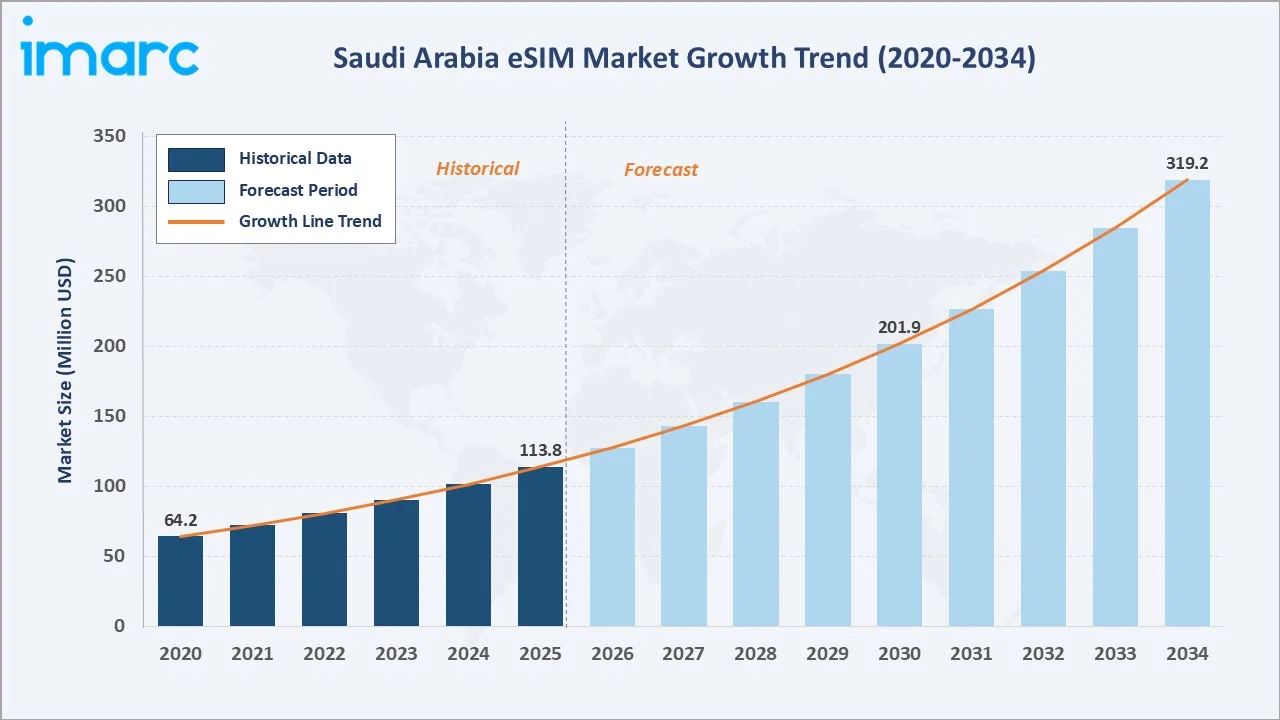
The Saudi Arabia eSIM market reached USD 113.8 Million in 2025 and is projected to reach USD 319.2 Million by 2034, growing at a CAGR of 12.14% during 2026-2034. The market is driven by growing IoT demand, 5G expansion, Vision 2030 digital transformation, and rising consumer preference for flexible connectivity. Connectivity Services leads at 61.4%. Consumer Electronics leads application at 72.8%. Western Region commands 34.9% share.
Market Snapshot
|
Metric |
Value |
|
Market Size (2025) |
USD 113.8 Million |
|
Forecast Market Size (2034) |
USD 319.2 Million |
|
CAGR (2026-2034) |
12.14% |
|
Base Year |
2025 |
|
Historical Period |
2020-2025 |
|
Forecast Period |
2026-2034 |
|
Dominant Solution Type |
Connectivity Services (61.4%, 2025) |
|
Dominant Application |
Consumer Electronics (72.8%, 2025) |
|
Leading Region |
Western Region (34.9%, 2025) |
The market expanded from USD 64.2 Million in 2020 to USD 113.8 Million in 2025, anchored at USD 201.9 Million in 2030 and forecast to reach USD 319.2 Million by 2034.
To get more information on this market, Request Sample
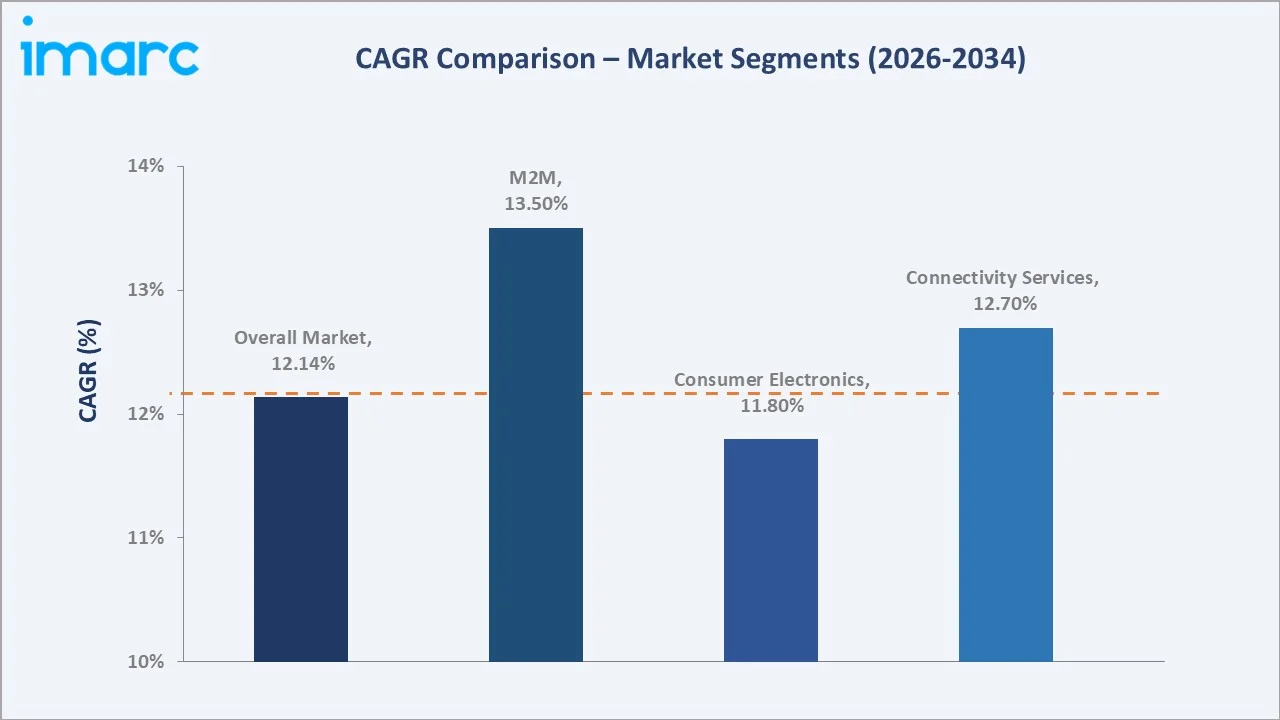
Consumer Electronics drives above-market CAGR through smartphone eSIM adoption and wearable device proliferation. Connectivity Services leads at 61.4% as operators deploy RSP platforms. M2M segment grows fastest at approximately 13.5% CAGR through connected vehicle, smart meter, and IoT logistics applications across Vision 2030 smart city projects.
Executive Summary
The Saudi Arabia eSIM market reached USD 113.8 Million in 2025, representing one of the Kingdom's fastest-growing technology markets driven by world-leading 5G infrastructure, Vision 2030 digital economy mandates, and expanding IoT ecosystems. The market is projected to reach USD 319.2 Million by 2034.
Connectivity Services at 61.4% dominates through operator RSP platform deployments and multi-carrier eSIM management. Consumer Electronics at 72.8% leads through mass smartphone and wearable eSIM adoption. Western Region at 34.9% leads through Riyadh and Jeddah's concentrated telecom infrastructure and the Kingdom's highest smartphone penetration rates.
Key Market Insights
|
Insight |
Data |
|
Dominant Solution Type |
Connectivity Services – 61.4% share (2025) |
|
Dominant Application |
Consumer Electronics – 72.8% market share (2025) |
|
Leading Region |
Western Region – 34.9% market share (2025) |
|
Market Opportunity |
IoT M2M scale-up; connected vehicles; smart meters; MVNO eSIM; enterprise multi-SIM management |
Key Analytical Observations Supporting the Above Data:
- Connectivity Services at 61.4%: The Connectivity Services segment leads as operators deploy GSMA-compliant Remote SIM Provisioning platforms enabling digital SIM activation, carrier switching, and multi-profile device management at scale. In February 2025, Mobily deployed an advanced RSP platform developed by Valid across Saudi Arabia for both IoT and consumer eSIM profile management, anchoring the segment's commercial leadership.
- Consumer Electronics at 72.8%: Consumer Electronics dominates through mass eSIM adoption in smartphones, smartwatches, and tablets across Saudi Arabia's highly mobile-connected population. Saudi Arabia's 3rd-place global 5G speed ranking at 243.7 Mbps drives eSIM device adoption as consumers leverage multi-carrier profile switching for speed optimization and international roaming flexibility.
- Western Region at 34.9%: The Western Region leads through Makkah and Jeddah's high population density, smartphone penetration, and the concentration of STC, Mobily, and Zain's most advanced 5G network infrastructure. Pilgrimage-season connectivity demands further accelerate eSIM roaming profile provisioning, creating cyclical demand spikes that reinforce the region's market leadership.
Saudi Arabia eSIM Market Overview
The Saudi Arabia eSIM market encompasses the provision of embedded SIM hardware components, connectivity services, Remote SIM Provisioning platforms, and carrier profile management solutions used in consumer electronics, M2M applications, and IoT deployments across all four administrative regions of the Kingdom.
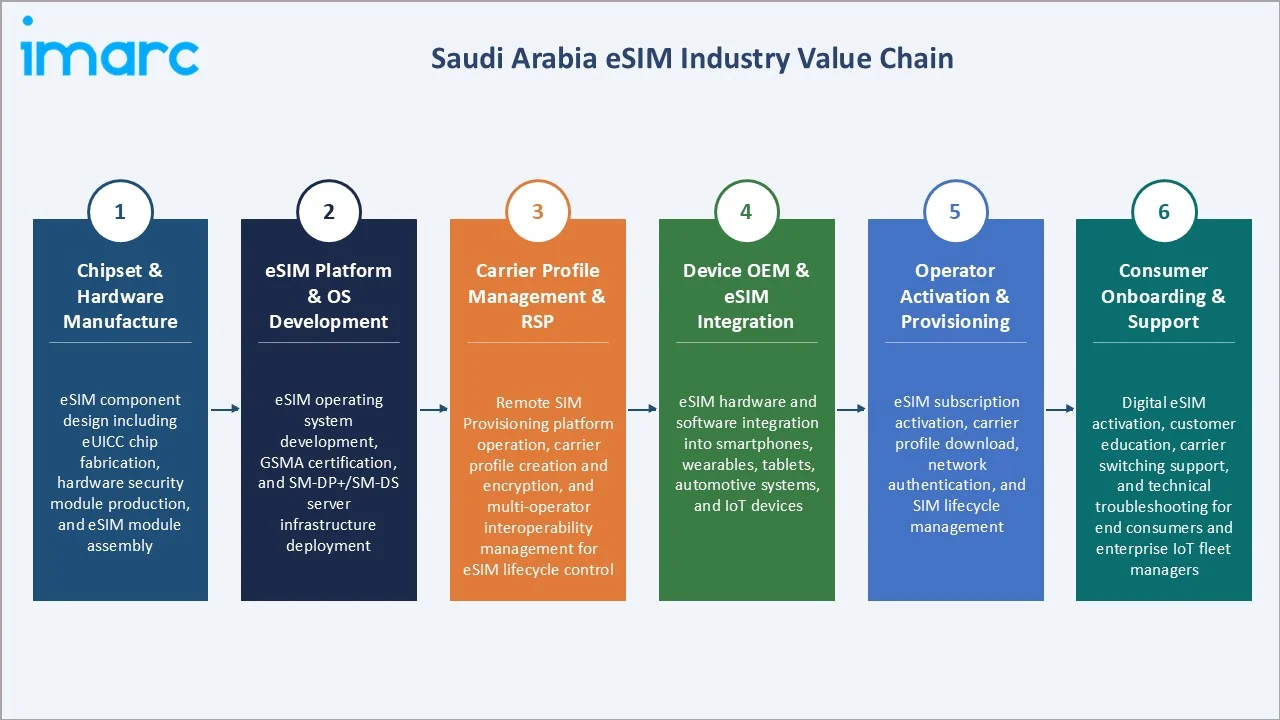
The ecosystem integrates chipset and eSIM hardware manufacturers, platform and OS providers, mobile network operators, device OEMs, enterprise IoT operators, and CITC regulatory oversight aligned with GSMA eSIM specifications.
Market Dynamics
To evaluate market opportunities, Request Sample
Market Drivers
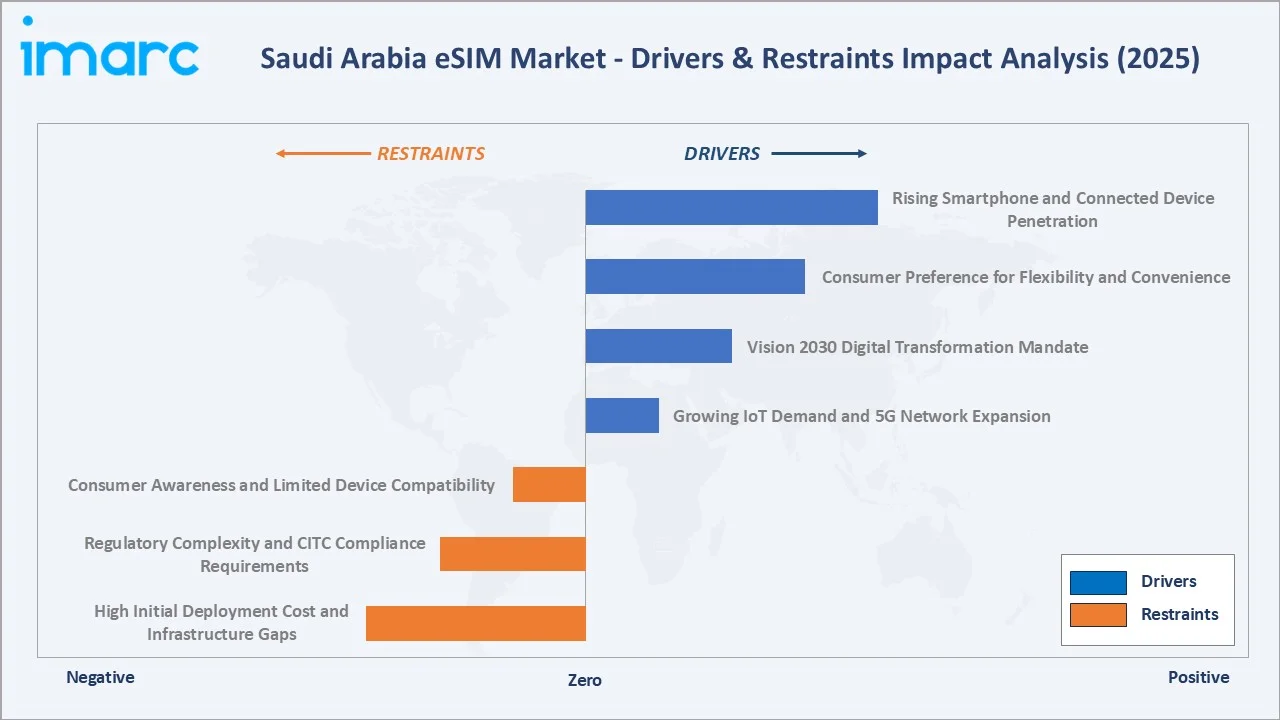
- Growing IoT Demand and 5G Network Expansion: The continued rollout of 5G networks and increasing adoption of IoT technologies are creating favorable conditions for eSIM deployment in Saudi Arabia. Smart city projects, connected vehicles, industrial automation, logistics, and smart infrastructure applications require scalable and remotely managed connectivity solutions. eSIM technology enables seamless provisioning and management of connected devices, making it well-suited for large-scale IoT deployments across multiple industries.
- Vision 2030 Digital Transformation Mandate: Saudi Arabia's Vision 2030 agenda is accelerating investments in digital infrastructure, smart cities, e-government services, and enterprise digitalization. These initiatives are increasing the need for advanced connectivity solutions capable of supporting large-scale device management and network flexibility. Supportive regulatory developments and ongoing modernization of the telecommunications sector are further encouraging eSIM adoption across both public and private sectors.
- Consumer Preference for Flexibility and Convenience: Consumers are increasingly attracted to eSIM technology due to its ability to enable digital carrier switching, multiple profiles on a single device, and simplified international connectivity. The growing demand for seamless mobile experiences, coupled with increasing travel and digital service usage, is encouraging adoption of eSIM-enabled services. As telecom operators expand their eSIM offerings, consumers are gaining greater flexibility in managing connectivity needs.
- Rising Smartphone and Connected Device Penetration: High smartphone penetration and increasing adoption of connected devices are expanding the installed base of eSIM-compatible products in Saudi Arabia. Device manufacturers are integrating eSIM functionality into smartphones, wearables, tablets, laptops, and other connected devices, making the technology more accessible to consumers. This growing ecosystem is supporting broader adoption of eSIM-based connectivity solutions.
Market Restraints
- High Initial Deployment Cost and Infrastructure Gaps: The implementation of eSIM platforms requires investments in remote provisioning systems, network integration, security infrastructure, and operational support systems. These costs can create challenges for smaller telecom providers and may slow deployment in certain market segments. Infrastructure disparities across some regions may also result in uneven service availability.
- Regulatory Complexity and CITC Compliance Requirements: eSIM deployment must comply with telecommunications regulations, security standards, and data protection requirements. Regulatory approval processes and evolving industry standards can increase implementation complexity for service providers. Compliance obligations may also extend deployment timelines for new services and applications.
- Consumer Awareness and Limited Device Compatibility: Although awareness of eSIM technology is increasing, many consumers remain unfamiliar with its benefits and activation processes. In addition, not all smartphones and connected devices currently support eSIM functionality, particularly in lower-priced device categories. These factors may limit adoption among certain consumer groups and slow the transition from traditional SIM cards.
Market Opportunities
- IoT M2M Scale-Up and Smart City eSIM Deployment: Saudi Arabia's Vision 2030 smart city programs including NEOM, Diriyah Gate, and urban transformation projects across Riyadh and Jeddah require large-scale M2M eSIM deployments for connected sensors, smart meters, surveillance systems, and autonomous vehicle infrastructure, creating a multi-billion riyal institutional procurement pipeline for M2M eSIM platform providers. The combination of Saudi Arabia's 5G network leadership, Vision 2030 infrastructure investment commitment, and CITC's progressive IoT regulatory framework positions the Kingdom as a leading M2M eSIM deployment market in the Middle East through the forecast period.
- Enterprise Multi-SIM Management and MVNO eSIM Services: Saudi Arabia's large enterprise sector and expanding MVNO ecosystem represent significant eSIM market expansion opportunities as businesses adopt enterprise eSIM management platforms for distributed workforce connectivity, fleet management, and cross-border employee device provisioning.
Market Challenges
- Inter-Operator Portability and Profile Management Complexity: Enabling seamless eSIM profile switching between STC, Mobily, and Zain requires bilateral RSP interoperability agreements and technical integration that creates coordination complexity limiting the consumer experience of carrier switching that is central to eSIM's value proposition. The absence of standardized portability mechanisms for eSIM profiles across operators reduces consumer incentive to adopt eSIM versus traditional SIM card switching, particularly for price-sensitive segments where carrier cost comparison and frequent switching are the primary motivations for service evaluation.
- Cybersecurity and eSIM Profile Integrity Risks: eSIM technology's digital provisioning model creates new attack surfaces for profile cloning, unauthorized carrier switching, and remote SIM hijacking that require robust security architecture including SM-DP+ server hardening, end-to-end profile encryption, and real-time anomaly detection that add operational complexity and cost to eSIM platform management.
Emerging Market Trends
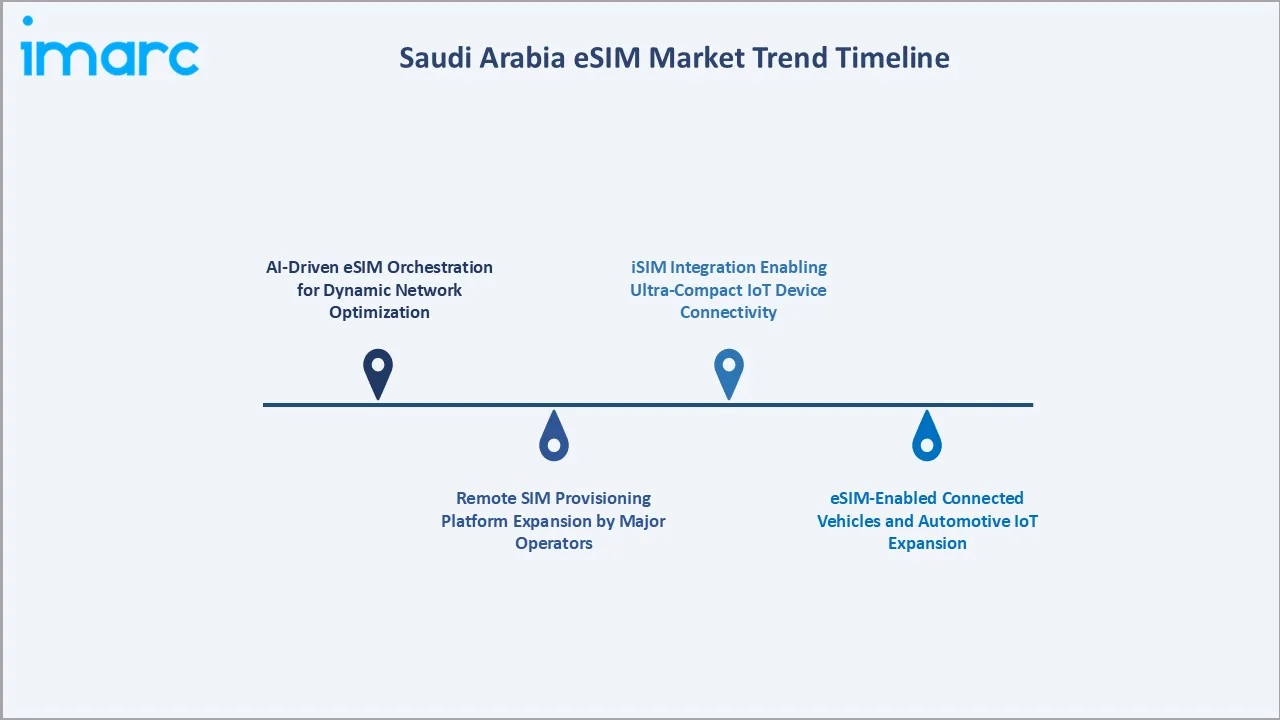
1. AI-Driven eSIM Orchestration for Dynamic Network Optimization
AI-powered eSIM management platforms are emerging as the next-generation standard, using machine learning algorithms to dynamically switch eSIM profiles based on real-time network quality, congestion levels, pricing, and user location to optimize connectivity experience and cost automatically. Saudi Arabia's 5G network leadership and Vision 2030 digital infrastructure investment create an ideal environment for AI-driven eSIM orchestration adoption in both consumer and enterprise segments.
2. Remote SIM Provisioning Platform Expansion by Major Operators
Saudi Arabia's three major mobile operators are actively deploying GSMA-compliant RSP platforms to scale eSIM services across both consumer and IoT M2M segments. Mobily deployed an advanced RSP platform developed by Valid across Saudi Arabia, covering both IoT services and consumer eSIM profile management, demonstrating the operators' commitment to comprehensive eSIM infrastructure deployment.
3. eSIM-Enabled Connected Vehicles and Automotive IoT Expansion
Saudi Arabia's rapidly growing automotive sector and Vision 2030 transportation modernization programs are driving eSIM adoption in connected vehicles for real-time navigation, over-the-air software updates, fleet management, and emergency connectivity. The integration of eSIM in connected cars enables seamless carrier switching as vehicles cross regional and international boundaries, optimizing connectivity cost and quality for both private consumers and commercial fleet operators.
4. iSIM Integration Enabling Ultra-Compact IoT Device Connectivity
The evolution from eSIM to iSIM (integrated SIM) technology, where SIM functionality is embedded directly into the main device chipset rather than a separate module, is gaining momentum in Saudi Arabia's IoT hardware ecosystem for ultra-compact sensor, wearable, and industrial device applications requiring minimal footprint. iSIM adoption represents the next technology upgrade cycle for Saudi Arabia's expanding IoT device base, creating demand for platform providers capable of supporting both eSIM and iSIM provisioning within unified management architectures.
Industry Value Chain Analysis
The eSIM value chain integrates chipset and hardware manufacture, eSIM platform and OS development, carrier profile management and RSP infrastructure, device OEM integration, mobile network operator activation and provisioning, and consumer onboarding and lifecycle support across Saudi Arabia's telecommunications and IoT ecosystem.
|
Stage |
Key Participants |
|
Chipset & Hardware Manufacture |
eSIM component design including eUICC chip fabrication, hardware security module production, and eSIM module assembly |
|
eSIM Platform & OS Development |
eSIM operating system development, GSMA certification, and SM-DP+/SM-DS server infrastructure deployment |
|
Carrier Profile Management & RSP |
Remote SIM Provisioning platform operation, carrier profile creation and encryption, and multi-operator interoperability management for eSIM lifecycle control |
|
Device OEM & eSIM Integration |
eSIM hardware and software integration into smartphones, wearables, tablets, automotive systems, and IoT devices |
|
Operator Activation & Provisioning |
eSIM subscription activation, carrier profile download, network authentication, and SIM lifecycle management |
|
Consumer Onboarding & Support |
Digital eSIM activation, customer education, carrier switching support, and technical troubleshooting for end consumers and enterprise IoT fleet managers |
The eSIM platform and OS development tier is the value chain's most commercially critical stage, with Thales S.A., Giesecke+Devrient GmbH, and IDEMIA controlling dominant global eSIM platform technology positions. The operator activation and provisioning tier is the most rapidly evolving stage as Saudi operators compete to deliver superior eSIM onboarding experiences that reduce activation friction.
Technology Landscape in the Saudi Arabia eSIM Industry
GSMA M2M eSIM Architecture (eUICC SGP.02)
The GSMA SGP.02 M2M eSIM specification provides the foundational technical architecture for industrial IoT eSIM deployments, using Subscription Manager Data Preparation (SM-DP) and Subscription Manager Secure Routing (SM-SR) servers for operator-controlled SIM profile provisioning. This architecture is widely deployed across Saudi Arabia's smart meter, connected vehicle, and industrial IoT applications where centralized enterprise-controlled profile management is preferred over consumer self-service activation models.
GSMA Consumer eSIM Architecture (eUICC SGP.22)
The GSMA SGP.22 Consumer eSIM specification enables user-initiated carrier profile downloading and switching through SM-DP+ servers, delivering the flexibility and convenience that is driving mass consumer eSIM adoption in Saudi Arabia's smartphone and wearable device market. Mobily's February 2025 deployment of Valid's advanced RSP platform supporting SGP.22 consumer eSIM demonstrates Saudi operators' active investment in consumer-grade RSP infrastructure to scale eSIM subscriber acquisition.
iSIM (Integrated SIM) Next-Generation Architecture
iSIM technology integrates eSIM functionality directly into device SoC chipsets, eliminating the separate eUICC module to enable smaller device form factors, lower manufacturing costs, and enhanced security through hardware-level integration. Arm Holdings' Kigen iSIM platform and Qualcomm's integrated iSIM solutions are gaining traction in Saudi Arabia's next-generation IoT hardware procurement as device manufacturers design ultra-compact connected sensors and wearables for Vision 2030 smart infrastructure deployments.
Market Segmentation Analysis
The report covers the following segments:
|
Segment Category |
Leading Segment |
Market Share |
Year |
|
Solution Type |
Connectivity Services |
61.4% |
2025 |
|
Application |
Consumer Electronics |
72.8% |
2025 |
|
Region |
Western Region |
34.9% |
2025 |

By Solution Type
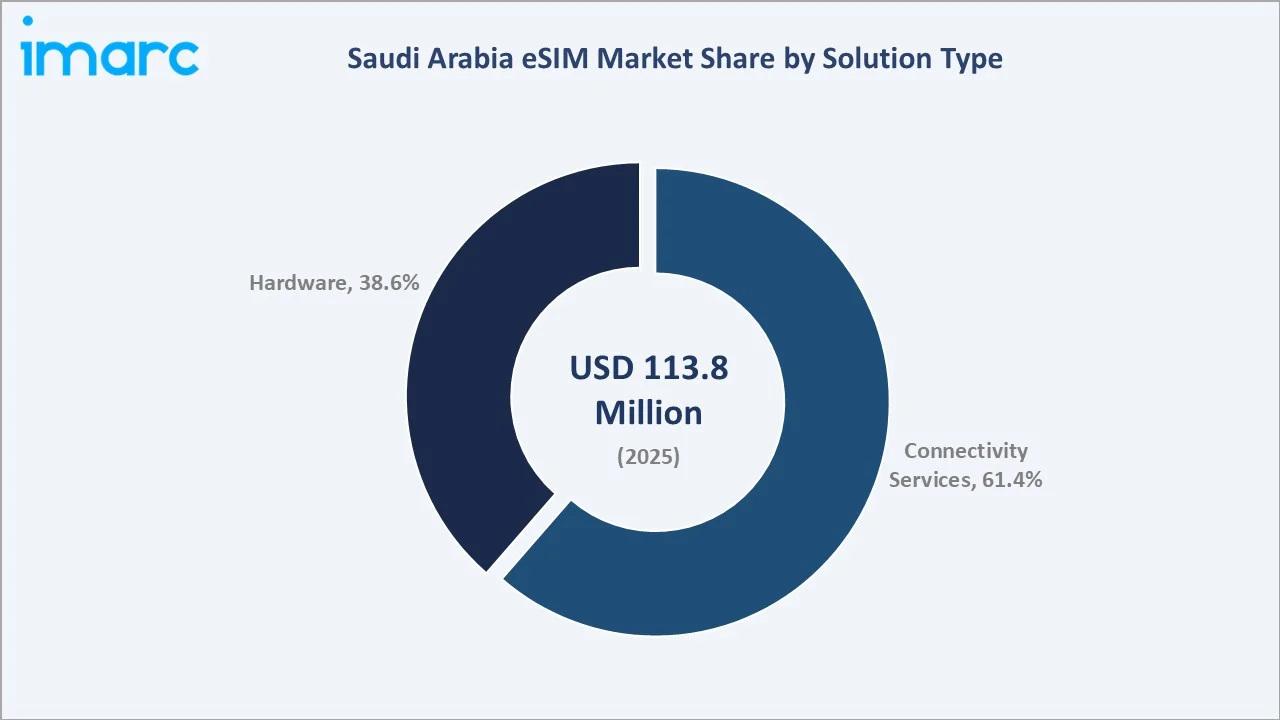
The Connectivity Services segment leads at 61.4% in 2025, encompassing eSIM RSP platform services, carrier profile management, multi-operator connectivity, and enterprise eSIM fleet management, positioned as the highest-value commercial layer of Saudi Arabia's eSIM market ecosystem.
To access detailed market analysis, Request Sample
The Hardware segment at 38.6% captures the eSIM eUICC chipset and module component market, including embedded eSIM modules for smartphones, IoT devices, and automotive applications. Hardware segment growth is driven by the expanding installed base of eSIM-capable devices in Saudi Arabia and the accelerating adoption of eSIM hardware across mid-range smartphone tiers as OEMs standardize eSIM across product portfolios.
By Application
Consumer Electronics leads at 72.8% in 2025, driven by mass eSIM adoption in Saudi Arabia's large and rapidly growing smartphone, smartwatch, and tablet market, supported by world-leading 5G infrastructure and the Kingdom's highly tech-savvy, young consumer population.
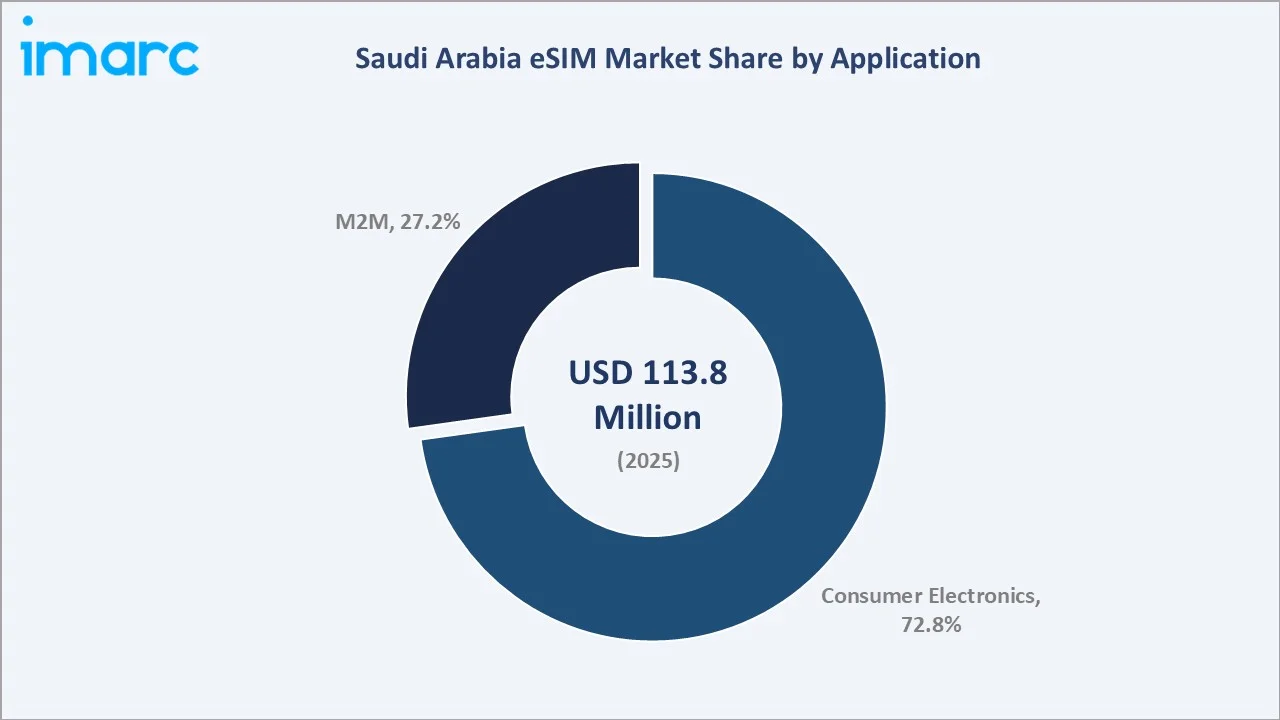
M2M at 27.2% is the fastest-growing application segment at approximately 13.5% CAGR as Vision 2030 smart city programs, connected vehicle adoption, smart meter rollouts, and logistics IoT deployments create large-scale institutional demand for M2M eSIM platform services. The M2M segment's above-market growth trajectory reflects Saudi Arabia's accelerating national IoT infrastructure investment.
Regional Market Insights
|
Region |
Share (2025) |
Key eSIM Market Drivers & Characteristics |
|
Western Region |
34.9% |
Driven by Makkah and Jeddah's high smartphone penetration, major operator 5G network concentration, pilgrimage-season eSIM roaming demand, and Jeddah's smart city infrastructure investment under Vision 2030 |
|
Northern and Central Region |
32.6% |
Driven by Riyadh's large corporate and government enterprise eSIM demand, Vision 2030 NEOM project IoT requirements, and the capital's concentration of multinational and tech-sector employers with international roaming needs |
|
Eastern Region |
21.1% |
Supported by oil and gas sector industrial IoT M2M eSIM demand, ARAMCO smart infrastructure connectivity requirements, Dammam's logistics hub IoT applications, and the region's high-income expatriate smartphone user base |
|
Southern Region |
11.4% |
Emerging with growing 5G network expansion into secondary cities, Vision 2030 rural connectivity programs, increasing cross-border travel eSIM roaming demand, and early-stage industrial IoT deployments in Jizan economic zone |
Western Region, at 34.9%, leads through Makkah and Jeddah's high population density, world-class 5G coverage, and the Kingdom's highest concentration of eSIM-enabled consumer electronics users. Northern and Central Region, at 32.6%, reflects Riyadh's metropolitan dominance and the capital's concentration of Vision 2030 enterprise and government eSIM use cases.
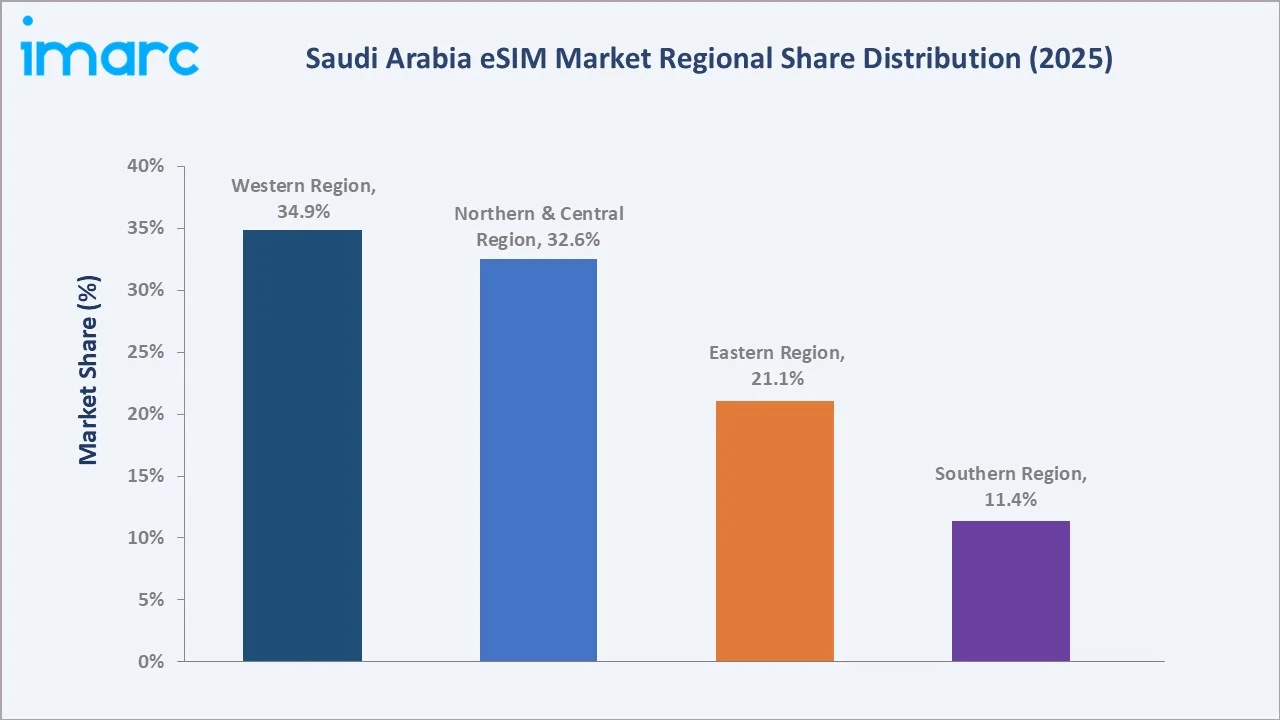
Eastern Region, at 21.1%, reflects the oil and gas industrial sector's M2M IoT eSIM demand and the region's high-income consumer electronics market driven by ARAMCO's large expatriate and professional employee base. Southern Region, at 11.4%, represents the earliest-stage market driven by expanding 5G coverage and growing cross-border eSIM roaming demand.
Competitive Landscape
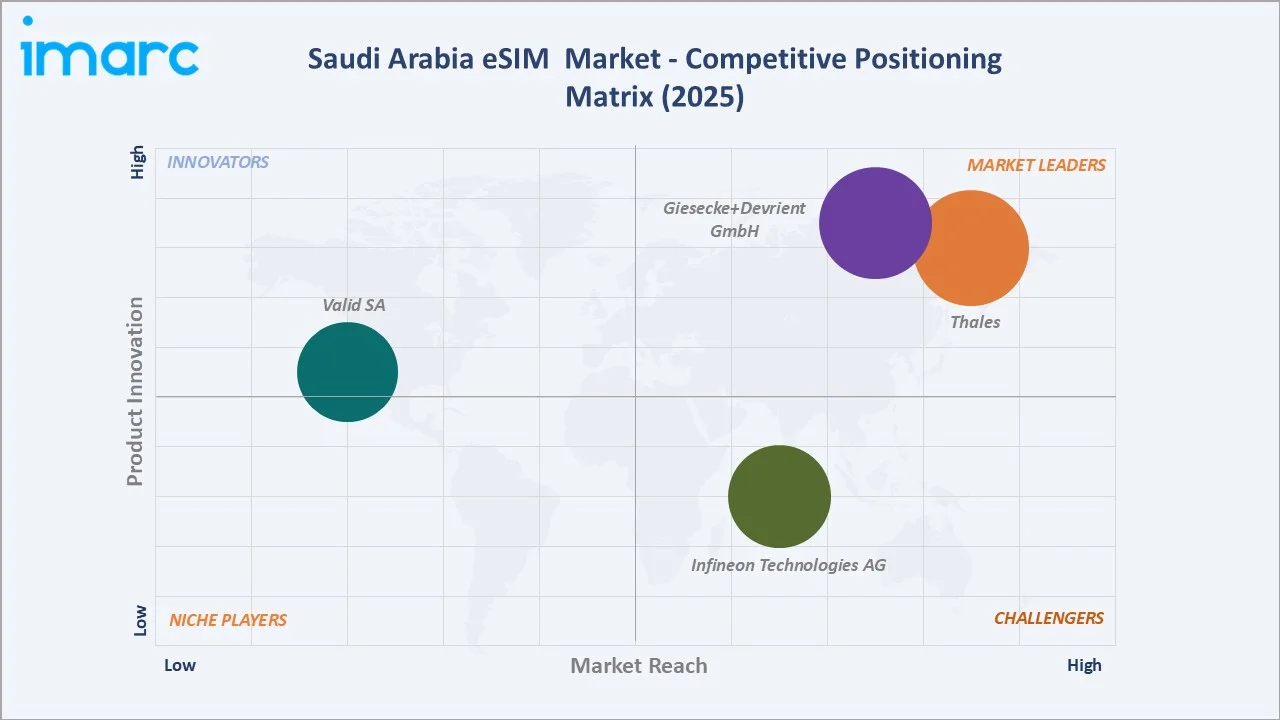
The Saudi Arabia eSIM market competitive landscape is moderately concentrated at the platform and hardware level, with global eSIM specialists leading through dominant RSP platform technology positions, alongside few companies competing through technical differentiation and regional deployment partnerships.
|
Company Name |
Key Products |
Market Position |
Core Strength |
|
Thales |
Consumer RSP Platform |
Market Leader |
Thales is a France-based global digital security leader providing comprehensive eSIM hardware, OS, and RSP platform solutions with dominant market positioning across consumer and M2M eSIM segments in Saudi Arabia and the broader Middle East. |
|
Giesecke+Devrient GmbH |
AirOn eSIM OS, AirOn IoT eSIM Platform, Consumer eSIM Platform |
Market Leader |
Giesecke+Devrient GmbH is a Germany-based security technology company providing enterprise-grade eSIM operating systems and RSP platform solutions with a strong track record in Saudi Arabia's operator and IoT M2M segments. |
|
Infineon Technologies AG |
OPTIGA Connect Consumer OC1230, OPTIGA Connect IoT OC2321, OPTIGA Connect eSIM Platform |
Strong Challenger |
Infineon Technologies AG is a Germany-based semiconductor company providing high-security eSIM eUICC chipsets and security controllers for consumer electronics, automotive, and IoT applications in the Saudi Arabia market. |
|
Valid SA |
Valid Connect RSP, IoT eSIM Platform, Consumer eSIM |
Emerging Player |
Valid SA is a Brazil-based digital security company that deployed its advanced RSP platform for Mobily in February 2025 across Saudi Arabia, providing both IoT and consumer eSIM profile management solutions. |
Key players include Thales, Giesecke+Devrient GmbH, Infineon Technologies AG, Valid SA, and others.
Key Company Profiles
Thales
Thales is a France-based global leader in digital security, aerospace, and defense with a strong position in the Saudi Arabia eSIM market through its Cinterion IoT eSIM modules, enterprise RSP platforms, and consumer eSIM OS solutions deployed across the Kingdom's telecom operator network.
- Key Products: Cinterion eSIM Modules, ELS IoT eSIM Platform, Consumer eSIM RSP, Trusted Key Manager.
- Strategic Focus: Expanding AI-integrated eSIM lifecycle management solutions combining RSP platform capability with real-time network analytics, predictive provisioning, and enterprise IoT fleet management aligned with Saudi Arabia's smart city ambitions. Thales is investing in next-generation iSIM platform capabilities to support Saudi Arabia's evolving ultra-compact IoT device market requirements within a unified eSIM/iSIM management architecture spanning consumer and M2M application domains.
Giesecke+Devrient GmbH
Giesecke+Devrient GmbH is a Germany-based global security technology company with a significant position in the Saudi Arabia eSIM market through its AirOn eSIM OS and comprehensive IoT SAFE eSIM security solutions for enterprise M2M and consumer connectivity applications.
- Key Products: AirOn eSIM Operating System, IoT SAFE eSIM Security Platform, Consumer eSIM RSP, eUICC Security Controller.
- Strategic Focus: Developing end-to-end eSIM security architecture solutions that address Saudi Arabia's CITC regulatory requirements and enterprise cybersecurity mandates, combining eUICC hardware security with RSP platform-level encryption and real-time threat monitoring. G+D is expanding its regional presence in Saudi Arabia to capture the growing M2M IoT eSIM opportunity created by Vision 2030 smart city, connected vehicle, and industrial IoT programs across all four administrative regions of the Kingdom.
Market Concentration Analysis
The Saudi Arabia eSIM market is moderately concentrated at the platform and hardware technology level, with the key players collectively accounting for approximately 55-65% of the Kingdom's eSIM platform revenue. Saudi Arabia's various mobile operators act as the commercial gateway to the end consumer and IoT markets, giving telecom operators significant procurement influence.
Investment & Growth Opportunities
Highest Growth Segments
M2M IoT eSIM (~13.5% CAGR), iSIM next-generation platforms (~18% CAGR from early base), connected vehicle eSIM (~16% CAGR), enterprise multi-profile management (~14% CAGR), and Southern Region 5G expansion eSIM market (~15% CAGR from low base) represent the highest-growth investment vectors through 2034.
Emerging Investment Opportunities
NEOM and Giga-project IoT infrastructure represents the Saudi Arabia eSIM market's highest-value emerging opportunity, with NEOM's planned 9 million connected devices and 10,000+ km of optical fiber network requiring large-scale M2M eSIM platform deployments that create a concentrated multi-year procurement pipeline for eSIM technology providers.
Investment Themes
- Local eSIM platform and RSP infrastructure development under Vision 2030 technology localization: Saudi Arabia's dependence on international eSIM platform providers creates a strategic technology development opportunity aligned with Vision 2030's local content and technology sovereignty objectives, offering potential procurement preference advantages for eSIM platform providers willing to establish local development and operational capabilities within the Kingdom.
- AI-integrated multi-operator eSIM orchestration for enterprise and government digital transformation: Saudi Arabia's enterprise and government sectors' digital transformation programs create demand for AI-driven eSIM management platforms that can optimize multi-operator connectivity, manage large IoT device fleets, and integrate with existing enterprise IT infrastructure to deliver the connectivity intelligence required by Vision 2030 digital economy programs.
Future Market Outlook (2026-2034)
The Saudi Arabia eSIM market is projected to grow from USD 113.8 Million in 2025 to USD 319.2 Million by 2034, delivering a 12.14% CAGR over the forecast period. The market anchor of approximately USD 201.9 Million in 2030 represents the eSIM sector at its Vision 2030 digital infrastructure delivery peak, with mass consumer eSIM adoption achieved and M2M IoT programs reaching operational scale.
Three structural forces define Saudi Arabia's eSIM market growth through 2034. Saudi Arabia's 5G network leadership creates the connectivity infrastructure that makes eSIM's advantages most compelling, sustaining premium eSIM adoption above regional peers. Vision 2030's IoT and smart city investment pipeline provides a committed multi-year M2M eSIM procurement program that adds above-market growth above consumer segment momentum. The progressive evolution from eSIM to iSIM creates continuous technology upgrade cycles that sustain hardware and platform revenue growth through the forecast period.
Research Methodology
Primary Research
Primary research comprised structured interviews with 40+ industry stakeholders (2025), including STC, Mobily, and Zain procurement managers; enterprise IoT connectivity managers; eSIM platform solution architects; CITC regulatory specialists; device OEM regional managers; and eSIM technology platform commercial directors active in the Saudi Arabia and broader MENA market.
Secondary Research
Secondary research encompassed CITC annual telecom sector reports; GSMA eSIM market intelligence publications; Saudi Vision 2030 digital economy program documentation; eSIM platform provider annual reports and press releases; Saudi Arabia IoT and 5G market research publications 2024-2025; global eSIM market reports; and Saudi Arabia enterprise digital transformation studies. Over 45 secondary sources reviewed.
Forecasting Models
Market revenue forecasts developed using a bottom-up model: (i) Saudi Arabia smartphone and connected device installed base eSIM adoption rate projections by device category; (ii) M2M IoT device deployment pipeline from Vision 2030 project databases; (iii) eSIM platform and hardware revenue per device connection by solution type; (iv) operator ARPU contribution from eSIM-enabled multi-profile services; (v) regional allocation based on 5G coverage, population density, and enterprise IoT investment distribution.
Saudi Arabia eSIM Market Report Coverage:
| Report Features | Details |
|---|---|
| Base Year of the Analysis | 2025 |
| Historical Period | 2020-2025 |
| Forecast Period | 2026-2034 |
| Units | Million USD |
| Scope of the Report |
Exploration of Historical Trends and Market Outlook, Industry Catalysts and Challenges, Segment-Wise Historical and Future Market Assessment:
|
| Solution Types Covered | Hardware, Connectivity Services |
| Applications Covered |
|
| Regions Covered | Northern and Central Region, Western Region, Eastern Region, Southern Region |
| Companies Covered | Thales, Giesecke+Devrient GmbH, Infineon Technologies AG, Valid SA, etc. |
| Customization Scope | 10% Free Customization |
| Post-Sale Analyst Support | 10-12 Weeks |
| Delivery Format | PDF and Excel through Email (We can also provide the editable version of the report in PPT/Word format on special request) |
Key Benefits for Stakeholders:
- IMARC’s industry report offers a comprehensive quantitative analysis of various market segments, historical and current market trends, market forecasts, and dynamics of the Saudi Arabia eSIM market from 2020-2034.
- The research report provides the latest information on the market drivers, challenges, and opportunities in the Saudi Arabia eSIM market.
- Porter's five forces analysis assist stakeholders in assessing the impact of new entrants, competitive rivalry, supplier power, buyer power, and the threat of substitution. It helps stakeholders to analyze the level of competition within the Saudi Arabia eSIM industry and its attractiveness.
- Competitive landscape allows stakeholders to understand their competitive environment and provides an insight into the current positions of key players in the market.
Frequently Asked Questions About the Saudi Arabia eSIM Market Report
The Saudi Arabia eSIM market reached USD 113.8 Million in 2025, driven by Connectivity Services dominant at 61.4%, Consumer Electronics application leading at 72.8%, Saudi Arabia's 3rd-place global 5G speed ranking, the Middle East recording 177 million eSIM smartphone connections in 2024, and Western Region commanding 34.9% share.
The Saudi Arabia eSIM market grows at 12.14% CAGR during 2026-2034, reaching USD 319.2 Million by 2034. This growth reflects Vision 2030 digital transformation investment, accelerating M2M IoT eSIM adoption across smart city programs, mass consumer eSIM device penetration, and the progressive commercial deployment of iSIM next-generation technology.
Connectivity Services leads at 61.4%, capturing the highest-value eSIM commercial layer through RSP platform services, carrier profile management, and multi-operator connectivity provisioning. In February 2025, Mobily's deployment of Valid's advanced RSP platform confirms the segment's commercial leadership and operator investment priority in Saudi Arabia.
Consumer Electronics leads at 72.8% through mass eSIM adoption in smartphones, smartwatches, and tablets across Saudi Arabia's highly connected, 5G-enabled consumer population. M2M is the fastest-growing application at approximately 13.5% CAGR as Vision 2030 IoT infrastructure programs scale across smart cities, connected vehicles, and industrial automation applications.
Western Region leads at 34.9% through Makkah and Jeddah's high smartphone penetration and concentrated 5G operator infrastructure. Northern and Central Region at 32.6% reflects Riyadh's enterprise and government eSIM demand, while Eastern Region at 21.1% reflects industrial IoT M2M demand from oil and gas sector connectivity requirements.
Leading companies include Thales, Giesecke+Devrient GmbH, Infineon Technologies AG, Valid SA, and others.
Need more help?
- Speak to our experienced analysts for insights on the current market scenarios.
- Include additional segments and countries to customize the report as per your requirement.
- Gain an unparalleled competitive advantage in your domain by understanding how to utilize the report and positively impacting your operations and revenue.
- For further assistance, please connect with our analysts.
 Request Customization
 Speak to an Analyst
 Request Brochure
 Inquire Before Buying
Benefits of Customization
- Personalize this research
- Triangulate with your data
- Get data as per your format and definition
- Gain a deeper dive into a specific application, geography, customer, or competitor
- Any level of personalization
Get in Touch With Us
UNITED STATES
Phone: +1-201-971-6302
INDIA
Phone: +91-120-433-0800
UNITED KINGDOM
Phone: +44-753-714-6104
Email: [email protected]
Client Testimonials




.webp)




.webp)













Related Reports

Choose your plan
*Please note that the prices mentioned below are starting prices for each bundle type. Kindly contact our team for further details.*
Single User License
- 1 User License, Access on 2 Devices
- PDF Report + Excel Dataset (Password Protected)
- Lifetime Access
- No Printing Rights
- 10% Free Report Customization
- 10–12 Weeks of Analyst Support
Five User License
- Access for 5 Users, 2 Devices per User
- PDF Report + Excel Dataset (Password Protected)
- Lifetime Access
- Dedicated Account Manager
- 12–14 Weeks of Analyst Support
- No Printing Rights
- 15% Free Report Customization
- 25% Discount on Your Next Purchase
Corporate User License
- Unlimited User Access (Within Your Organization)
- PDF Report + Excel Dataset
- Lifetime Access
- Dedicated Account Manager
- 14–20 Weeks of Analyst Support
- No Printing Rights
- 20% Free Report Customization
- 30% Discount on Your Next Purchase
Essential Insights
What's included:
3 reports
- Lifetime Access
- PDF Reports
- Excel Datasets
- 2 Weeks of Free Analyst Support
- 2 User Licenses
- Access on 2 Devices
- Printing Rights
- Complimentary PowerPoint (PPT) Version
- Complimentary License Upgrade
Professional Access
What's included:
5 reports
- Lifetime Access
- PDF Reports
- Excel Datasets
- 8 Weeks of Free Analyst Support
- 2 User Licenses
- Access on 2 Devices
- Printing Rights
- Complimentary PowerPoint (PPT) Version
- Complimentary License Upgrade
Business Advantage
What's included:
8 reports
- Lifetime Access
- PDF Reports
- Excel Datasets
- 14 Weeks of Free Analyst Support
- 2 User Licenses
- Access on 2 Devices
- Printing Rights
- Complimentary PowerPoint (PPT) Version
- Complimentary License Upgrade
Enterprise Intelligence
What's included:
10 reports
- Lifetime Access
- PDF Reports
- Excel Datasets
- 20 Weeks of Free Analyst Support
- 2 User Licenses
- Access on 2 Devices
- Printing Rights
- Complimentary PowerPoint (PPT) Version
- Complimentary License Upgrade