
Saudi Arabia Facade Market Size, Share, Trends and Forecast by Product Type, Material, End Use, and Region, 2026-2034
Saudi Arabia Facade Market Size, Share, Trends & Forecast (2026-2034)
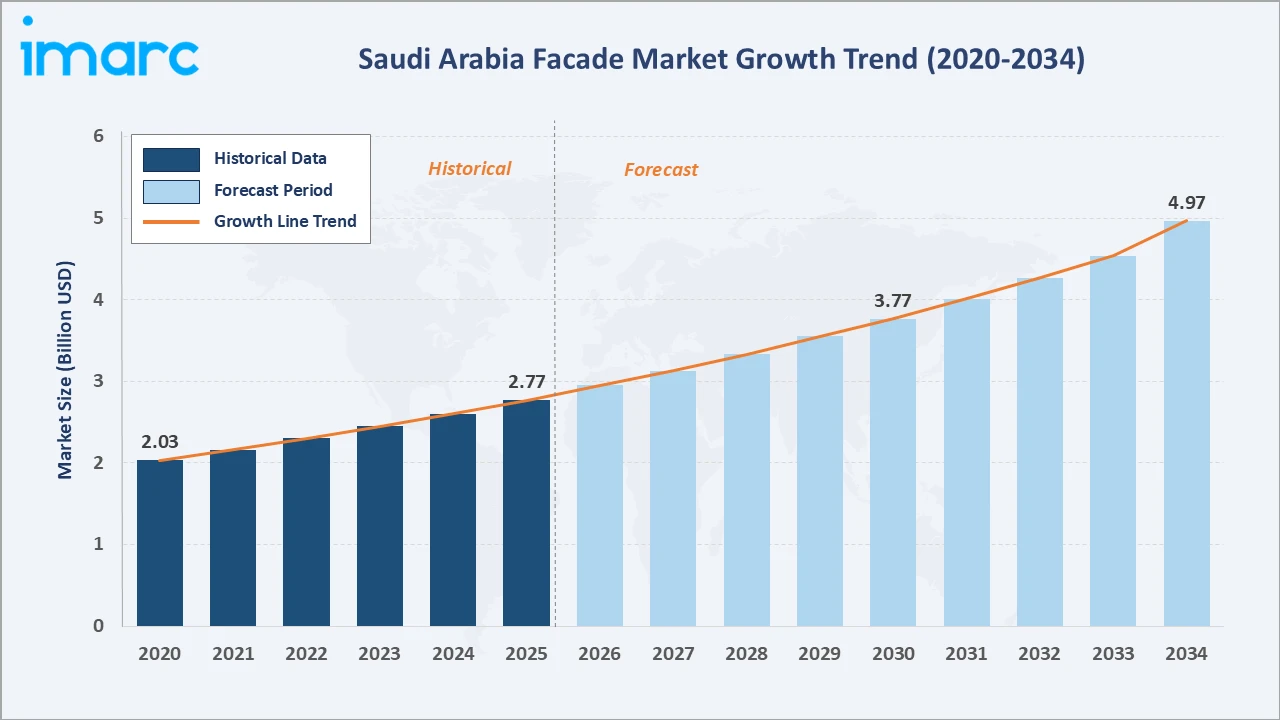
The Saudi Arabia facade market grew from USD 2.77 Billion in 2025 to USD 2.94 Billion in 2026 and is projected to reach USD 4.97 Billion by 2034, exhibiting a CAGR of 6.38% during 2026-2034. Vision 2030 mega-projects, rapid urbanization, and stringent energy-efficiency regulations are the primary catalysts. Saudi Arabia's urbanization rate continues to rise steadily, exceeding 85% in 2024 and projected to reach 86.3% by 2030. Major metropolitan areas, including Riyadh, Jeddah, Makkah, Madinah, and Dammam, remain the primary centers of population growth and economic development. As cities expand vertically and horizontally, demand for modern, energy-efficient, and aesthetically appealing building exteriors is increasing. Ventilated lead product type at 54.8% (2025), commercial end use dominates at 48.5% (2025), and the Northern and Central region accounts for the largest regional share at 39.2% (2025).
Market Snapshot
|
Metric |
Value |
|
Base Year Market Size (2025) |
USD 2.77 Billion |
|
Market Size (2026) |
USD 2.94 Billion |
|
Forecast Market Size (2034) |
USD 4.97 Billion |
|
CAGR (2026-2034) |
6.38% |
|
Base Year |
2025 |
|
Historical Period |
2020-2025 |
|
Forecast Period |
2026-2034 |
|
Dominant Product Type |
Ventilated (54.8%, 2025) |
|
Dominant End Use |
Commercial (48.5%, 2025) |
|
Leading Region |
Northern and Central Region (39.2%, 2025) |
The Saudi Arabia facade market has demonstrated consistent growth, increasing from USD 2.03 Billion in 2020 to USD 2.77 Billion in 2025 and an estimated USD 2.94 Billion in 2026, reflecting growing construction activity and ambitious architectural ambitions across the Kingdom. The market is projected to reach USD 3.77 Billion by 2030 and further expand to USD 4.97 Billion by 2034, supported by large-scale giga-projects, tourism infrastructure, and rising adoption of sustainable building systems. Growth is anchored by Vision 2030-backed developments, expanding demand for thermally efficient facade solutions, and increasing foreign contractor participation.
To get more information on this market, Request Sample
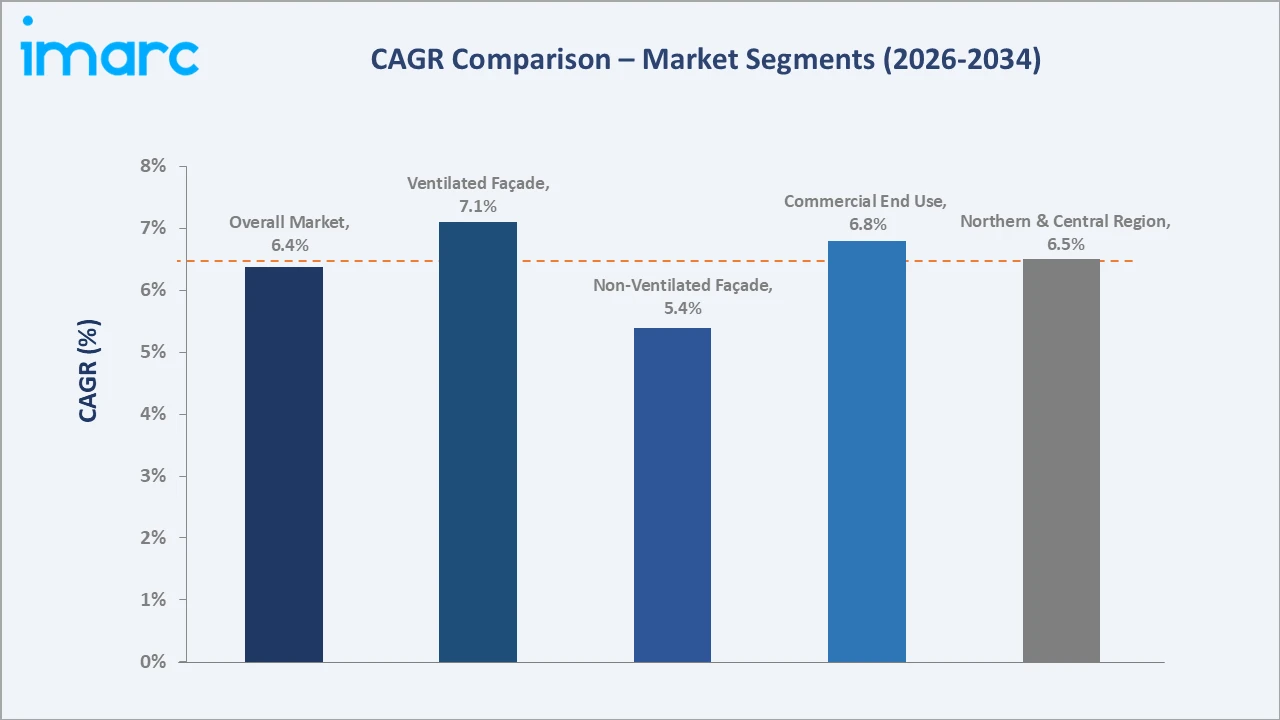
Ventilated facades grow at ~7.1% CAGR through high-rise commercial and hospitality construction under Vision 2030. Non-ventilated facades expand at ~5.4% CAGR via residential villa and mid-rise development. Commercial end use grows at ~6.8% CAGR through giga-project, hotel, and corporate headquarters demand.
Executive Summary
The Saudi Arabia facade market is expanding rapidly, driven by an unprecedented construction boom across residential, commercial, and industrial segments. The Kingdom's Vision 2030 agenda is channeling billions into giga-projects such as NEOM, Qiddiya, and the Red Sea Project, each requiring high-performance, aesthetically superior facade systems. Market is expected to increase from USD 2.77 Billion in 2025 to USD 2.94 Billion in 2026 and further to USD 4.97 Billion by 2034, reflecting sustained 6.38% CAGR growth across the forecast period.
Ventilated facades lead at 54.8% (2025), valued for their thermal insulation and moisture management properties in Saudi Arabia's extreme climate. Commercial end use dominates at 48.5% (2025), fueled by the surge in office towers, hotels, malls, and cultural venues. The Northern and Central region, anchored by Riyadh, commands 39.2% of market share (2025), reflecting concentrated infrastructure investment and government project activity.
Key Market Insights
|
Insight |
Data |
|
Dominant Product Type |
Ventilated – 54.8% share (2025) |
|
Dominant End Use |
Commercial – 48.5% share (2025) |
|
Leading Region |
Northern and Central Region – 39.2% share (2025) |
|
Market Opportunity |
NEOM, Red Sea Project, Qiddiya giga-project facade packages; smart facade systems |
Key Analytical Observations Supporting The Above Data:
- Ventilated facades at 54.8% (2025): Ventilated systems dominate due to their superior thermal performance in Saudi Arabia's harsh climate. The air gap between cladding and structural wall significantly reduces heat transfer, lowering cooling loads, making it the preferred solution for commercial towers and hospitality projects across the Kingdom.
- Commercial end use at 48.5% (2025): Commercial construction leads, driven by a surge in office towers, hotels, convention centers, and retail destinations under Vision 2030. Flagship projects in Riyadh and Jeddah are specifying premium facade systems to achieve iconic skylines and international design standards.
- Northern and Central Region at 39.2% (2025): Riyadh's concentration of government projects, corporate headquarters, and mixed-use mega-developments positions this region as the dominant market. The city's rapid expansion and planned smart city zones generate ongoing, high-value facade demand.
Saudi Arabia Facade Market Overview
The Saudi Arabia facade market encompasses the supply, installation, and maintenance of exterior cladding systems applied to buildings to improve aesthetics, energy performance, weather resistance, and structural protection. Product categories include ventilated rainscreen systems, non-ventilated curtain walls, structural glazing, and specialized facade types such as kinetic, perforated, and BIPV systems. The market serves commercial real estate, government buildings, hospitality, residential towers, and industrial facilities. Key materials include glass, metal, stone, and composite panels. The market is driven by Vision 2030's infrastructure investment commitment, Saudi Arabia's GDP growth, a growing young population, and the government's push for new housing units.
Market Dynamics
To evaluate market opportunities, Request Sample
Market Drivers
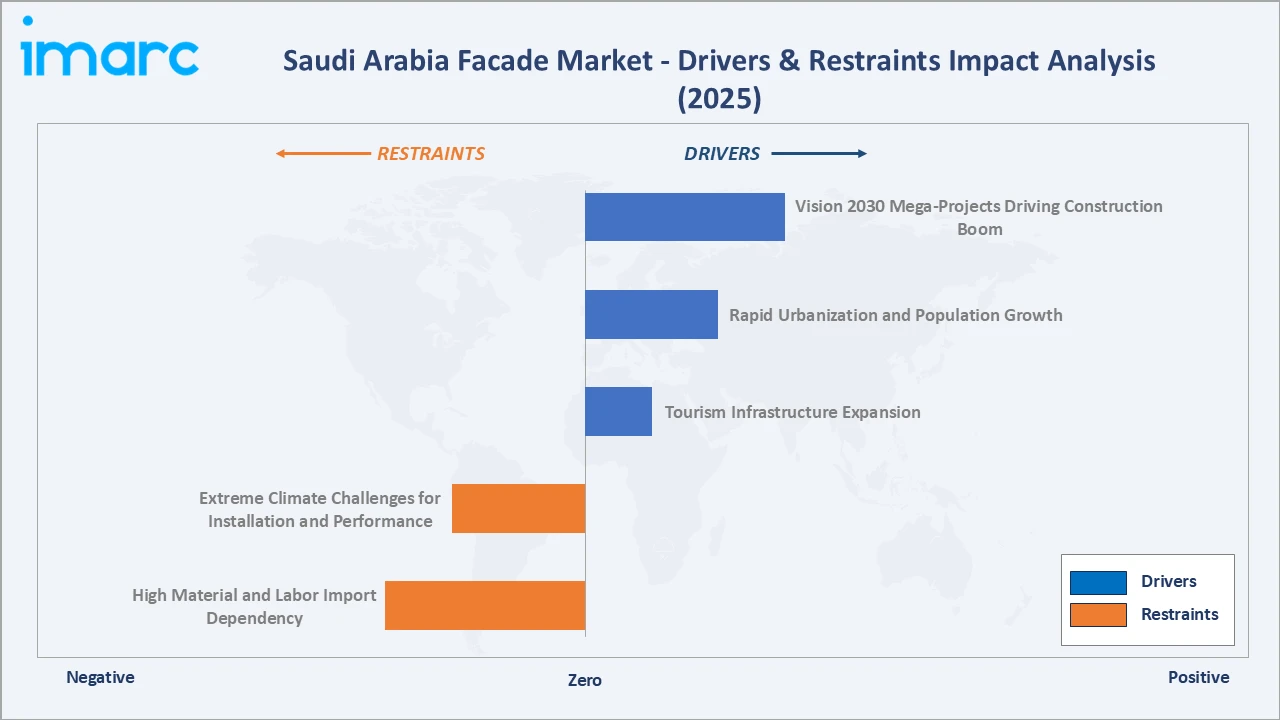
- Vision 2030 Mega-Projects Driving Construction Boom: Saudi Arabia's Vision 2030 resulted in US$1 trillion of real estate and infrastructure projects being announced across Saudi Arabia since 2016. Giga-projects including NEOM, Qiddiya, Diriyah Gate, and the Red Sea Project each require cutting-edge facade systems for iconic structures.
- Rapid Urbanization and Population Growth: Riyadh is Saudi Arabia’s largest city, with its metropolitan population surpassing 8 million. Jeddah, a major commercial hub and Red Sea port city, is home to around 4.5 million people. Makkah and Madinah have permanent populations of approximately 2 million and 1.5 million, respectively, though these numbers rise significantly during the Hajj and Umrah seasons. This rapid urbanization drives sustained demand for commercial, residential, and mixed-use construction, further underpinning facade demand.
- Tourism Infrastructure Expansion: Tourism infrastructure expansion increases demand for hotels, resorts, airports, entertainment venues, and mixed-use developments with modern and visually distinctive exteriors. Saudi Arabia targets 150 million tourist visits annually by 2030, requiring significant investment in hotels, resorts, airports, and cultural attractions.
Market Restraints
- High Material and Labor Import Dependency: Saudi Arabia relies significantly on imported glass, aluminum, and specialized facade components, making the market vulnerable to global supply chain disruptions and currency fluctuations.
- Extreme Climate Challenges for Installation and Performance: Temperatures exceeding 45°C and high UV radiation impose stringent requirements on facade materials and installation practices. Specialized materials and coatings increase project costs and reduce the pool of qualified contractors capable of delivering long-term performance guarantees.
Market Opportunities
- Sustainable and Green Building Facade Solutions: Saudi Arabia recorded the highest score in the region at 76.31 points and certified over 1.03 million square meters of sustainable building space in 2025, as reported by the Saudi Press Agency. Growing adoption of green building rating systems is creating strong demand for sustainable facade solutions. BIPV facades, vegetative facade systems, and recycled-content aluminum systems represent a rapidly growing opportunity segment.
- Smart Facade Technologies: Smart glass, electrochromic panels, and sensor-integrated facade systems are gaining traction in premium commercial and hospitality projects. These technologies offer dynamic solar control, reducing HVAC energy consumption. Growing adoption of Building Information Modeling (BIM) is also enabling more precise facade specification and fabrication, reducing waste and cost overruns.
Market Challenges
- Skilled Workforce Shortage in Facade Engineering: Saudi Arabia faces a shortage of locally trained facade engineers, glazing technicians, and specialist cladding installers. Dependency on expatriate labor for complex facade systems increases cost and coordination complexity, particularly for technically demanding giga-projects like NEOM's The Line.
- Design Complexity of Iconic Structures: Saudi Arabia's ambition for globally distinctive architecture creates significant technical challenges for facade systems. Custom-designed, geometrically complex cladding for NEOM and the Mukaab requires advanced engineering, specialized fabrication, and precision installation capabilities not widely available domestically.
Emerging Market Trends
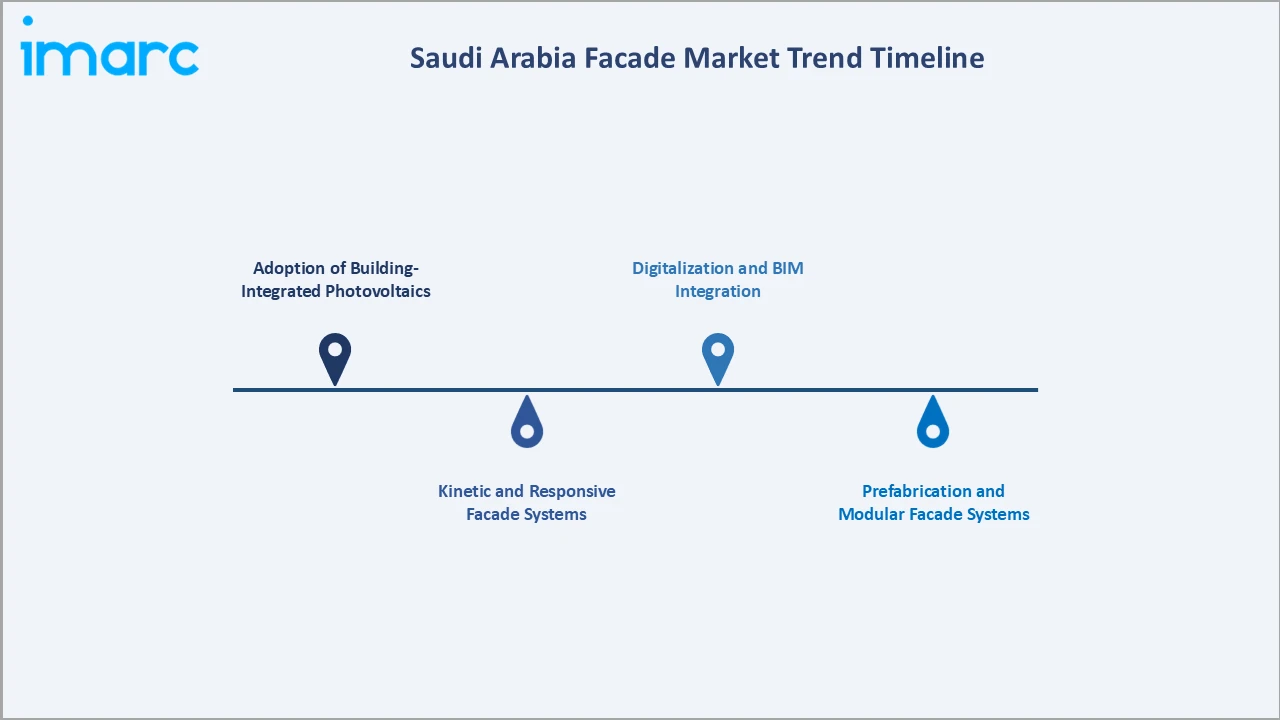
1. Adoption of Building-Integrated Photovoltaics
Building-integrated photovoltaic (BIPV) systems that integrate solar energy generation directly into facade elements are gaining significant traction in Saudi Arabia. Several Vision 2030 mega-projects have mandated solar integration as part of their sustainability targets, with NEOM committing to 100% renewable energy powering all its developments by 2030. Thin-film and crystalline silicon PV systems embedded into spandrel panels and glazing units are being actively specified by major project management offices.
2. Kinetic and Responsive Facade Systems
Kinetic and responsive façade systems are emerging in Saudi Arabia as developers seek building envelopes that can adapt to sunlight, heat, and wind conditions. These systems improve energy efficiency, indoor comfort, and visual appeal, making them attractive for premium commercial, hospitality, and giga-project developments.
3. Prefabrication and Modular Facade Systems
Prefabrication and modular facade systems are emerging as developers seek faster, safer, and more cost-efficient construction methods for large-scale projects. Factory-built façade panels help reduce on-site labor, improve installation quality, and accelerate project timelines across commercial, residential, and giga-project developments.
4. Digitalization and BIM Integration
Digitalization and building information modeling (BIM) integration are emerging trends as developers use 3D modeling, performance simulation, and digital coordination to improve façade design accuracy. BIM Ventures and SBI Holdings have established BIM Capital, a joint venture aimed at supporting growth opportunities in Saudi Arabia and the wider Middle East. BIM Capital plans to attract over $200 million in foreign direct investment (FDI) and target assets under management of over $2 billion. BIM helps reduce design conflicts, optimize material use, and speed up delivery of complex facade systems across giga-projects, commercial towers, and mixed-use developments.
Industry Value Chain Analysis
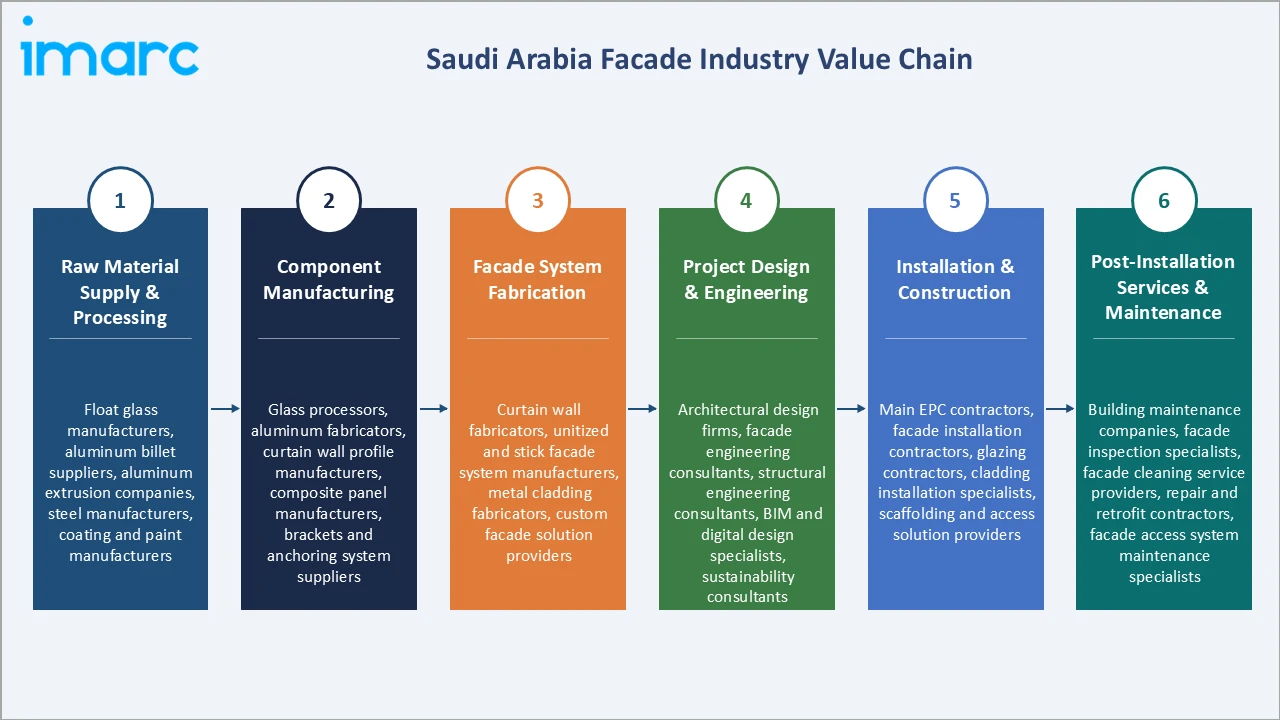
The Saudi Arabia facade market value chain integrates raw material supply and processing, component manufacturing, facade system fabrication, project design and engineering, installation and construction, and post-installation services and maintenance.
|
Stage |
Key Participants |
|
Raw Material Supply & Processing |
Float glass manufacturers, aluminum billet suppliers, aluminum extrusion companies, steel manufacturers, coating and paint manufacturers |
|
Component Manufacturing |
Glass processors, aluminum fabricators, curtain wall profile manufacturers, composite panel manufacturers, brackets and anchoring system suppliers |
|
Facade System Fabrication |
Curtain wall fabricators, unitized and stick facade system manufacturers, metal cladding fabricators, custom facade solution providers |
|
Project Design & Engineering |
Architectural design firms, facade engineering consultants, structural engineering consultants, BIM and digital design specialists, sustainability consultants |
|
Installation & Construction |
Main EPC contractors, facade installation contractors, glazing contractors, cladding installation specialists, scaffolding and access solution providers |
|
Post-Installation Services & Maintenance |
Building maintenance companies, facade inspection specialists, facade cleaning service providers, repair and retrofit contractors, facade access system maintenance specialists |
Facade system fabrication is the most value-added stage in the Saudi Arabia facade value chain, as it directly determines the technical performance, aesthetic quality, and long-term durability of the building envelope. This stage involves precision fabrication of unitized panels, structural glazing, and specialty cladding systems, followed by expert on-site installation and quality verification.
Technology Landscape in the Saudi Arabia Facade Industry
High-Performance Glazing Technology
High-performance glazing encompasses low-emissivity (low-e) coatings, solar control glass, electrochromic smart glass, and triple-glazed insulating units engineered for Saudi Arabia's extreme solar irradiance. These systems significantly reduce solar heat gain coefficients (SHGC) to the 0.20-0.30 range, dramatically cutting building cooling loads.
Advanced Aluminum Facade Systems Technology
Advanced aluminum facade technologies include thermally broken profiles, pressure-equalized rainscreen curtain wall systems, and parametrically designed unitized panels. Thermally broken aluminum, where a non-conductive thermal barrier separates interior and exterior aluminum sections, is rapidly becoming the standard specification in Saudi Arabia's commercial sector. Parametric design software enables fabrication of complex geometric facade systems, reducing custom design time.
Building-Integrated Photovoltaics (BIPV) Technology
BIPV technology integrates photovoltaic cells directly into facade cladding panels, spandrel glass, or shading louvers, enabling buildings to generate on-site renewable energy while maintaining architectural aesthetics. Saudi Arabia's exceptional solar resource makes BIPV one of the most commercially attractive facade technologies in the market. Thin-film PV, crystalline silicon modules, and emerging perovskite cells are all being evaluated for integration into facade systems. NEOM's 100% renewable energy mandate is expected to accelerate BIPV specification across all commercial and residential developments.
.webp)
Market Segmentation Analysis
The report covers the following segments:
|
Segment Category |
Leading Segment |
Market Share |
Year |
|
Product Type |
Ventilated |
54.8% |
2025 |
|
Material |
🔒 |
🔒 |
2025 |
|
End Use |
Commercial |
48.5% |
2025 |
|
Region |
Northern and Central Region |
39.2% |
2025 |

By Product Type
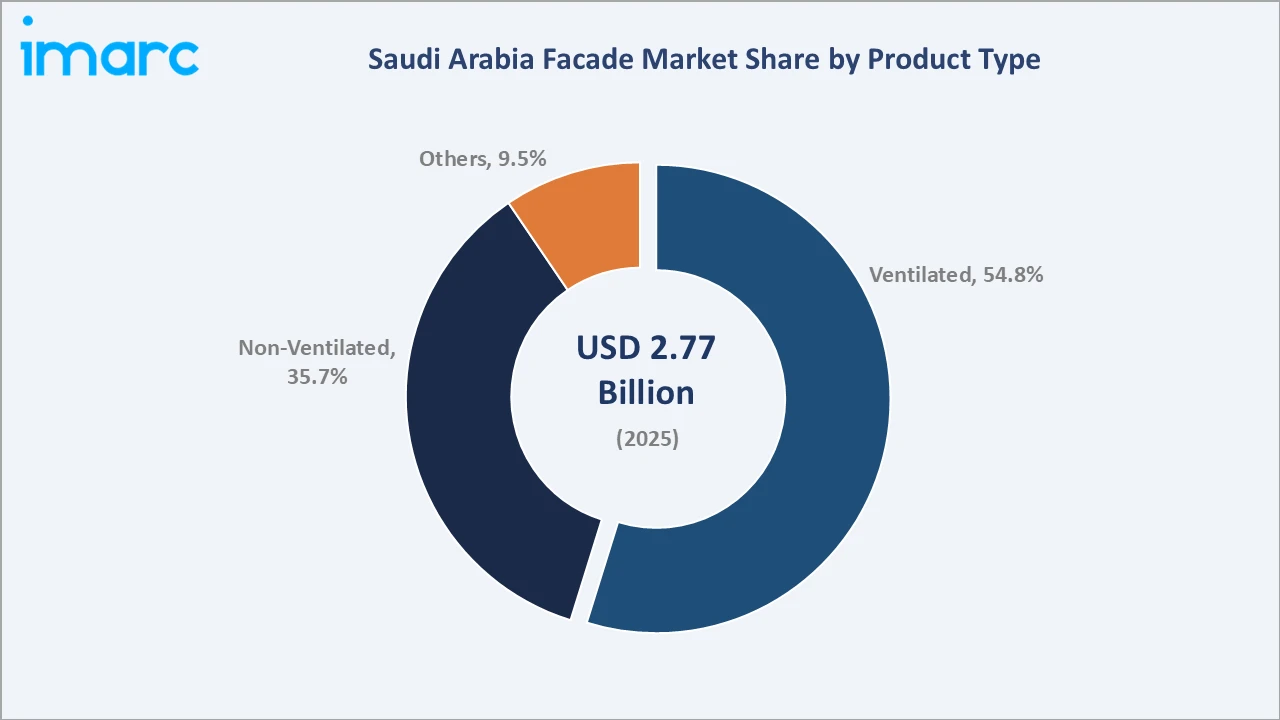
Ventilated leads at 54.8% (2025), driven by their thermal performance advantages in Saudi Arabia's extreme desert climate. The air cavity between the cladding layer and the building structure provides natural ventilation, dramatically reducing solar heat gain. This system is favored for high-rise commercial towers, hotels, and institutional buildings where energy efficiency and facade longevity are paramount. The segment is projected to grow at ~7.1% CAGR through 2034, supported by continued commercial construction and premium hospitality projects under Vision 2030.
To access detailed market analysis, Request Sample
Non-ventilated at 35.7% (2025) serves the residential and mid-range commercial segments, where cost efficiency takes precedence. These systems, including structural glazing and composite cladding, are widely used in residential towers, mid-rise office buildings, and government facilities, growing at ~5.4% CAGR. The others category at 9.5% includes specialized systems such as BIPV, kinetic, and green facades, the fastest-growing niche in the Saudi Arabia facade market.
By End Use
Commercial dominates at 48.5% (2025), anchored by the unprecedented pipeline of office towers, hotels, convention centers, shopping malls, and mixed-use developments across Riyadh, Jeddah, and NEOM. The segment is projected to grow at ~6.8% CAGR through 2034.
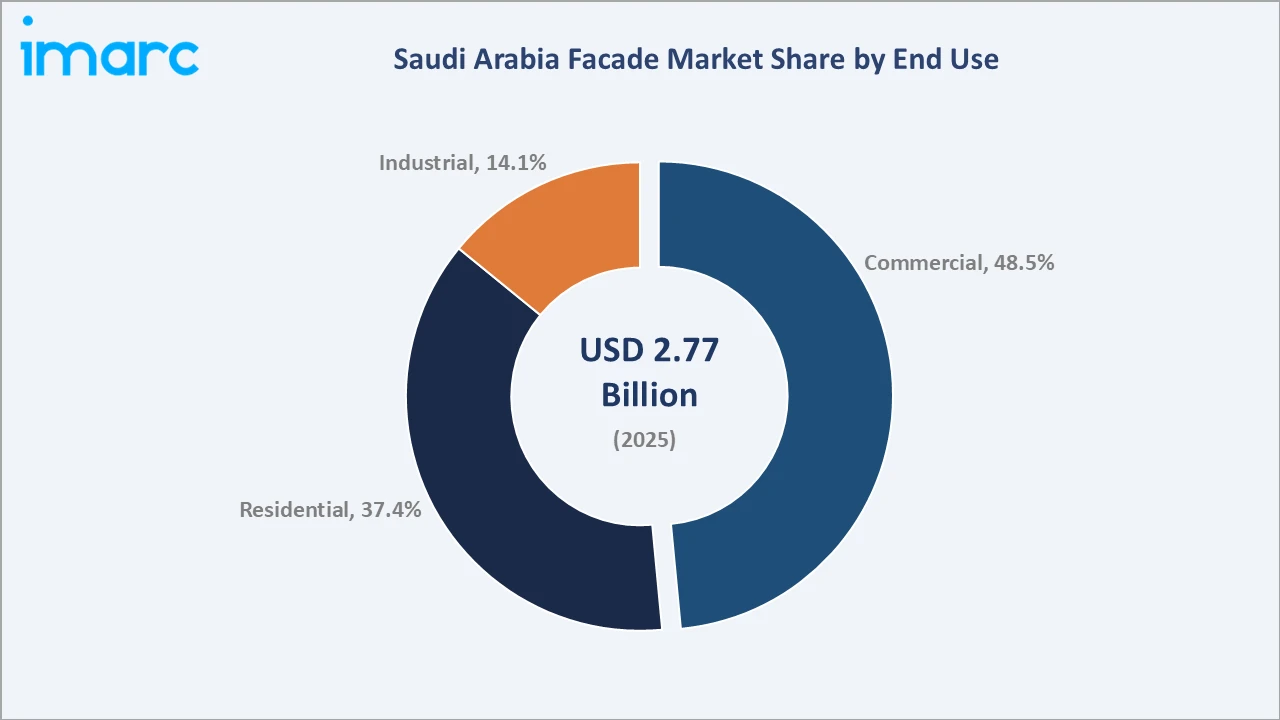
Residential at 37.4% (2025) benefits from the new housing units, supporting sustained facade demand across villa, townhouse, and apartment tower segments. Industrial at 14.1% (2025) reflects growing demand from logistics, manufacturing, and petrochemical facility construction across the newly developed industrial zones.
Regional Market Insights
|
Region |
Share (2025) |
Key Saudi Arabia Facade Market Drivers & Characteristics |
|
Northern and Central Region |
39.2% |
Reflecting Riyadh's concentrated government project activity, corporate headquarters construction, and mega-project development. |
|
Western Region |
28.7% |
Reflecting Jeddah's coastal luxury developments, the Red Sea Project facade demand, and Makkah-Madinah religious tourism infrastructure expansion requiring iconic architectural facades. |
|
Eastern Region |
21.6% |
Reflecting petrochemical industry expansion, facility upgrades, and growing commercial real estate development across the Eastern Province. |
|
Southern Region |
10.5% |
Reflecting emerging tourism and resort development, supported by Vision 2030 regional development investment and eco-tourism facility construction. |
The Northern and Central regions' 39.2% dominance is driven by Riyadh's position as the administrative, financial, and commercial capital of Saudi Arabia. The city is host to the majority of Vision 2030 project management offices and government-funded developments, each requiring extensive facade work. The Western region at 28.7% follows closely, benefiting from Jeddah's historical coastal skyline expansion, the Red Sea Project's resort and hotel facade demand, and increasing tourism-related construction around Makkah and Madinah.
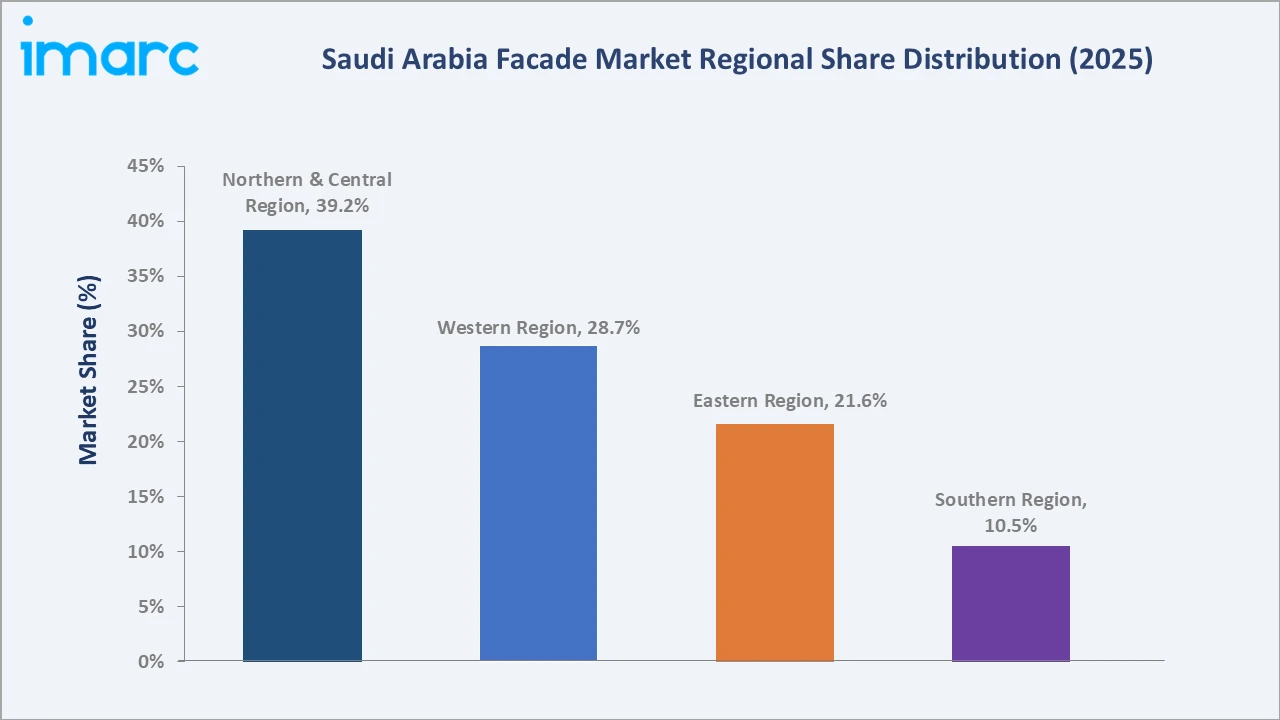
The Eastern region at 21.6% represents a significant and growing market, with ongoing campus upgrades, commercial expansion, and the industrial city development generating sustained facade demand. The Southern region, at 10.5%, while the smallest segment, is experiencing the fastest regional growth rate as Vision 2030's tourism development programs accelerate resort and cultural venue construction in previously underserved areas.
Competitive Landscape
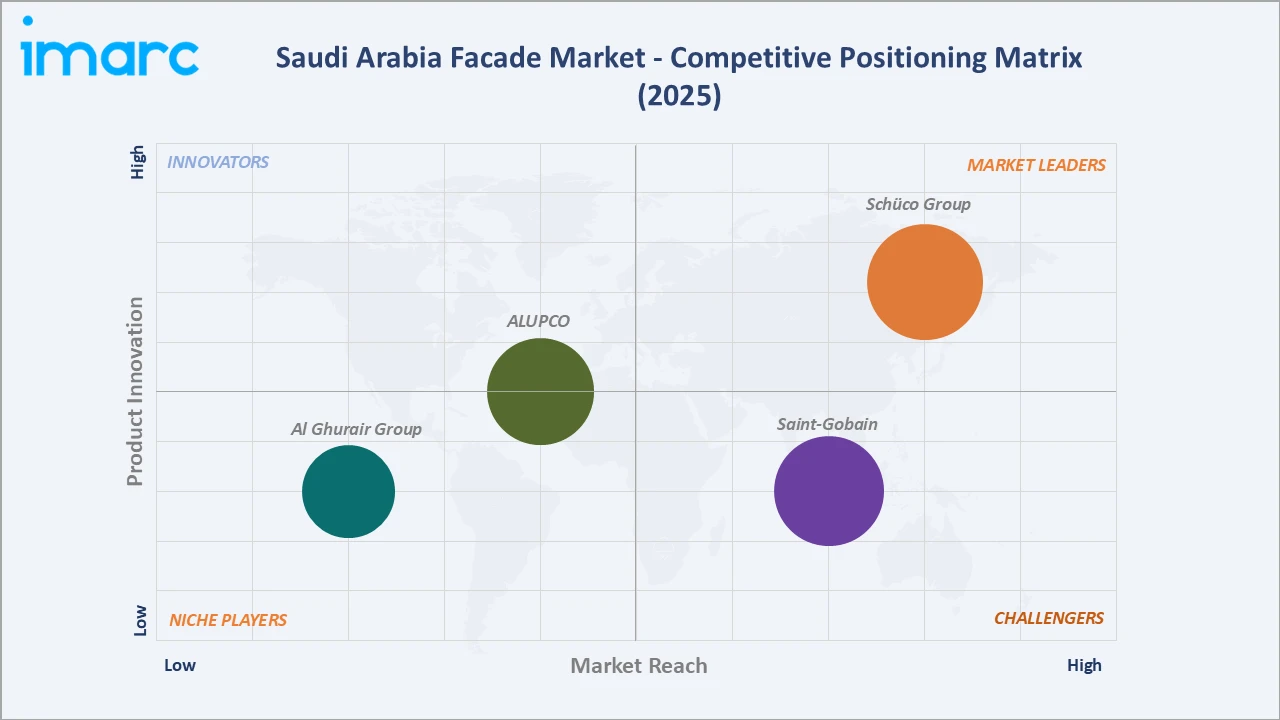
The Saudi Arabia facade market is moderately fragmented, with competition among global specialist contractors, regional construction conglomerates, and specialized material manufacturers. Market participants compete on technical capability, local content compliance, project execution track record, and material supply chain strength. Vision 2030 mega-projects are driving consolidation through joint ventures between international facade specialists and Saudi contractors to meet requirements. Strategic partnerships with project management offices, main contractors, and material suppliers are becoming increasingly important for securing landmark project packages across the Kingdom.
|
Company Name |
Key Products |
Market Position |
Core Strength |
| Schüco Group | Schüco Façade System FWS 60, Schüco Façade System FWS 50.SI, Schüco Façade System FWS 35 PD.SI, Schüco Façade System FWS 35 PD.HI, Schüco Façade System FWS 35 PD |
Market Leader |
The Schüco Group serves as a premier building envelope specialist in Saudi Arabia, supplying high-performance, climate-resilient facade systems. By partnering with local fabricators, they engineer energy-efficient windows, doors, and curtain walls designed to handle the Kingdom's extreme desert temperatures. |
| ALUPCO |
ALUPCO Façade Architectural Systems |
Established Player |
ALUPCO serves as a key player in Saudi Arabia's building envelope and facade industry. Evolving from an aluminum extruder to a fully integrated architectural systems house, the company designs, engineers, and supplies localized, high-performance facade systems for the Kingdom's mega-projects. |
| Al Ghurair Group |
Aluminium Façades |
Niche Player |
The Al Ghurair Group operates across Saudi Arabia to deliver advanced, end-to-end manufacturing and fabrication for architectural metal and facade systems. By supplying high-performance aluminium claddings, curtain walls, and composite materials, the group supports the Kingdom's rapidly expanding commercial and critical infrastructure projects. |
| Saint-Gobain |
Building Facades |
Challenger |
Saint-Gobain plays a vital role in Saudi Arabia's facade market by supplying high-performance, energy-efficient glazing and sustainable construction materials. Their solutions are engineered to withstand the Kingdom's extreme climate by reducing solar heat gain while maximizing natural daylight and acoustic comfort. |
Companies are increasingly investing in local manufacturing, BIM-integrated design capabilities, sustainable facade materials, and digital project management tools to strengthen their competitive positions. The market is expected to witness further consolidation through joint ventures, strategic partnerships with international facade specialists, and capacity investments as sponsors demand faster, higher-quality facade delivery across landmark projects.
Key Company Profiles
Schüco Group
Schüco Group is a leading provider of high-performance aluminum, steel, and PVC-U window, door, facade, and building envelope systems. In the Saudi Arabia facade market, the company supplies advanced curtain wall, unitized facade, skylight, and sun-shading solutions for commercial towers, hospitality developments, airports, healthcare facilities, and mixed-use projects. Through its network of local fabrication partners and engineering support, Schüco serves major developments across the Kingdom, with a strong focus on energy efficiency, sustainability, and compliance with international green building standards.
- Key Products: Schüco Façade System FWS 60, Schüco Façade System FWS 50.SI, Schüco Façade System FWS 35 PD.SI, Schüco Façade System FWS 35 PD.HI, Schüco Façade System FWS 35 PD.
- Strategic Focus: Centers on supplying energy-efficient, high-performance aluminum facade and fenestration systems for premium commercial, hospitality, and mixed-use developments. The company emphasizes sustainable building envelopes, advanced curtain wall solutions, thermal insulation, and digital design support to meet the needs of Vision 2030 projects and modern urban construction.
Saint-Gobain
Saint-Gobain is a building materials and glass solutions company with a strong presence in architectural glazing, high-performance glass, insulation, gypsum, and construction products. In the Saudi Arabia facade market, the company supports commercial, residential, hospitality, and infrastructure projects through advanced glass and envelope solutions that improve thermal insulation, solar control, acoustic comfort, safety, and aesthetics. Its facade-related offerings are well aligned with Saudi Arabia’s growing demand for sustainable, energy-efficient, and premium building envelopes under Vision 2030-led urban development.
- Key Products: Building Facades
- Strategic Focus: Centers on supplying high-performance glass and building envelope solutions that support energy efficiency, solar control, acoustic comfort, and sustainability. The company is well positioned to serve Vision 2030-driven commercial, hospitality, residential, and infrastructure projects requiring advanced glazing and facade materials.
Market Concentration Analysis
The Saudi Arabia facade market is moderately fragmented, with the presence of global specialist contractors, Saudi national construction conglomerates, regional facade subcontractors, and specialized material manufacturers. The top four players, Schüco Group, ALUPCO, Al Ghurair Group, and Saint-Gobain, collectively account for an estimated 35-40% of total market revenue in 2025, reflecting a competitive landscape where technical capability and project execution track record are key differentiators. Large international players hold stronger positions in technically complex, high-value curtain wall and glazing systems for giga-projects, while regional and Saudi-national contractors compete effectively in the broader commercial and residential segments. Consolidation trends are emerging through Vision 2030, which incentivize international facade specialists to partner with Saudi contractors.
Investment & Growth Opportunities
Highest Growth Segments
BIPV and smart facade systems (~9%+ CAGR), premium hospitality facade packages for Red Sea Project (~8.5% CAGR), unitized curtain wall for NEOM giga-project high-rises (~7.5% CAGR), residential tower facade demand (~6.5% CAGR), and industrial facade systems for manufacturing and logistics zones (~5.8% CAGR) represent Saudi Arabia facade market highest-growth investment vectors through 2034.
Investment Themes
- Giga-project facade packages: Vision 2030 mega-developments such as NEOM, The Red Sea, and Qiddiya are creating strong demand for large-scale, high-value facade contracts featuring advanced curtain walls, glazing, and cladding systems.
- Sustainable and green-certified building envelopes: Increasing adoption of green building standards and stricter energy-efficiency requirements is driving investment in high-performance facades that enhance thermal insulation, reduce energy consumption, and support sustainability certifications.
Future Market Outlook (2026-2034)
The Saudi Arabia facade market is projected to grow from USD 2.77 Billion in 2025 to USD 2.94 Billion in 2026, reaching USD 4.97 Billion by 2034, delivering a 6.38% CAGR over the forecast period through Vision 2030 giga-project execution, residential housing program acceleration, tourism infrastructure buildout, and the regulatory push for energy-efficient building envelopes. The market's anchor value of USD 3.77 Billion in 2030 represents a key inflection point coinciding with the completion of initial phases of NEOM, the Red Sea Project, and Qiddiya.
Three structural forces are expected to define the growth of the Saudi Arabia facade market through 2034. First, the unprecedented scale of Vision 2030 construction activity will maintain a sustained, elevated demand for facade systems across all product types, end uses, and regions. Second, the technological evolution of facade systems will increase average facade value per square meter, driving revenue growth beyond volume growth alone. Third, the maturation of Saudi Arabia's local construction ecosystem will gradually reduce import dependence, improving contractor margins and project delivery times. This localization trend, combined with an expanding pool of trained Saudi facade engineers and technicians, will strengthen the market's capacity to execute complex projects with greater efficiency.
Research Methodology
Primary Research
Primary research comprised in-depth interviews with senior executives from facade contractors, material manufacturers, real estate developers, government project management offices, and independent construction consultants operating in Saudi Arabia. These discussions validated market size estimates, assessed emerging technology trends, evaluated competitive dynamics, and provided insights into Vision 2030 project timelines, procurement practices, and regulatory developments in the Saudi Arabia facade market.
Secondary Research
Secondary research encompassed company annual reports, Saudi government project announcements, industry association publications, trade press, construction industry databases, and credible market intelligence sources. These were used to analyze market trends, competitive positioning, regulatory developments, and project pipeline activity across Saudi Arabia's four major construction regions.
Forecasting Models
Forecasting models were developed using historical market trends, Saudi Arabia construction permit data, Vision 2030 project pipeline, building material import statistics, and macroeconomic indicators. Both top-down and bottom-up approaches were applied and validated through primary research and secondary data. Market projections incorporated regulatory developments, technology adoption rates, and project execution timelines to generate reliable forecasts through 2034.
Saudi Arabia Facade Market Report Coverage:
| Report Features | Details |
|---|---|
| Base Year of the Analysis | 2025 |
| Historical Period | 2020-2025 |
| Forecast Period | 2026-2034 |
| Units | Billion USD |
| Scope of the Report |
Exploration of Historical Trends and Market Outlook, Industry Catalysts and Challenges, Segment-Wise Historical and Future Market Assessment:
|
| Product Types Covered | Ventilated, Non-Ventilated, Others |
| Materials Covered | Glass, Metal, Plastic and Fiber, Stones, Others |
| End Uses Covered | Commercial, Residential, Industrial |
| Regions Covered | Northern and Central Region, Western Region, Eastern Region, Southern Region |
| Companies Covered | Schüco Group, ALUPCO, Al Ghurair Group, Saint-Gobain, etc. |
| Customization Scope | 10% Free Customization |
| Post-Sale Analyst Support | 10-12 Weeks |
| Delivery Format | PDF and Excel through Email (We can also provide the editable version of the report in PPT/Word format on special request) |
Key Benefits for Stakeholders:
- IMARC’s industry report offers a comprehensive quantitative analysis of various market segments, historical and current market trends, market forecasts, and dynamics of the Saudi Arabia facade market from 2020-2034.
- The research report provides the latest information on the market drivers, challenges, and opportunities in the Saudi Arabia facade market.
- Porter's five forces analysis assists stakeholders in assessing the impact of new entrants, competitive rivalry, supplier power, buyer power, and the threat of substitution. It helps stakeholders to analyze the level of competition within the Saudi Arabia facade industry and its attractiveness.
- Competitive landscape allows stakeholders to understand their competitive environment and provides an insight into the current positions of key players in the market.
Frequently Asked Questions About the Saudi Arabia Facade Market Report
The Saudi Arabia facade market size is estimated at USD 2.94 Billion in 2026, driven by Vision 2030 mega-projects, rapid urbanization in Riyadh and Jeddah, and growing demand for energy-efficient facade systems across commercial and residential construction sectors.
The Saudi Arabia facade market grows at 6.38% CAGR during 2026-2034, reaching USD 4.97 Billion by 2034. The CAGR reflects sustained Vision 2030 project execution, tourism infrastructure investment, and increasing premium and sustainable facade technology adoption.
Ventilated facades lead at 54.8% (2025), favored for their thermal performance advantages in Saudi Arabia's extreme climate. Their ability to reduce building cooling loads makes them the preferred solution for commercial towers and hospitality projects.
Commercial end use leads at 48.5% (2025), anchored by the surge in office towers, hotels, malls, and mixed-use developments under Vision 2030. The giga-project construction pipeline ensures continued commercial dominance through 2034.
The Northern and Central region leads at 39.2% (2025), reflecting Riyadh's concentration of Vision 2030 government projects, corporate headquarters, and mega-project development activity.
Leading companies include Schüco Group, ALUPCO, Al Ghurair Group, and Saint-Gobain, among others.
The market is projected to reach approximately USD 3.77 Billion by 2030, driven by initial giga-project phase completions, residential housing program delivery, and accelerating tourism infrastructure development across all regions of the Kingdom.
Three priority investment opportunities are expected to shape the Saudi Arabia facade market over the forecast period. First, NEOM and Red Sea Project giga-project facade packages offer unparalleled scale. Second, BIPV and smart facade systems present strong technology-driven returns. Third, local aluminum fabrication delivers premium positioning and preferred contractor status.
Need more help?
- Speak to our experienced analysts for insights on the current market scenarios.
- Include additional segments and countries to customize the report as per your requirement.
- Gain an unparalleled competitive advantage in your domain by understanding how to utilize the report and positively impacting your operations and revenue.
- For further assistance, please connect with our analysts.
 Request Customization
 Speak to an Analyst
 Request Brochure
 Inquire Before Buying
Benefits of Customization
- Personalize this research
- Triangulate with your data
- Get data as per your format and definition
- Gain a deeper dive into a specific application, geography, customer, or competitor
- Any level of personalization
Get in Touch With Us
UNITED STATES
Phone: +1-201-971-6302
INDIA
Phone: +91-120-433-0800
UNITED KINGDOM
Phone: +44-753-714-6104
Email: [email protected]
Client Testimonials




.webp)




.webp)













Related Reports

Choose your plan
*Please note that the prices mentioned below are starting prices for each bundle type. Kindly contact our team for further details.*
Single User License
- 1 User License, Access on 2 Devices
- PDF Report + Excel Dataset (Password Protected)
- Lifetime Access
- No Printing Rights
- 10% Free Report Customization
- 10–12 Weeks of Analyst Support
Five User License
- Access for 5 Users, 2 Devices per User
- PDF Report + Excel Dataset (Password Protected)
- Lifetime Access
- Dedicated Account Manager
- 12–14 Weeks of Analyst Support
- No Printing Rights
- 15% Free Report Customization
- 25% Discount on Your Next Purchase
Corporate User License
- Unlimited User Access (Within Your Organization)
- PDF Report + Excel Dataset
- Lifetime Access
- Dedicated Account Manager
- 14–20 Weeks of Analyst Support
- No Printing Rights
- 20% Free Report Customization
- 30% Discount on Your Next Purchase
Essential Insights
What's included:
3 reports
- Lifetime Access
- PDF Reports
- Excel Datasets
- 2 Weeks of Free Analyst Support
- 2 User Licenses
- Access on 2 Devices
- Printing Rights
- Complimentary PowerPoint (PPT) Version
- Complimentary License Upgrade
Professional Access
What's included:
5 reports
- Lifetime Access
- PDF Reports
- Excel Datasets
- 8 Weeks of Free Analyst Support
- 2 User Licenses
- Access on 2 Devices
- Printing Rights
- Complimentary PowerPoint (PPT) Version
- Complimentary License Upgrade
Business Advantage
What's included:
8 reports
- Lifetime Access
- PDF Reports
- Excel Datasets
- 14 Weeks of Free Analyst Support
- 2 User Licenses
- Access on 2 Devices
- Printing Rights
- Complimentary PowerPoint (PPT) Version
- Complimentary License Upgrade
Enterprise Intelligence
What's included:
10 reports
- Lifetime Access
- PDF Reports
- Excel Datasets
- 20 Weeks of Free Analyst Support
- 2 User Licenses
- Access on 2 Devices
- Printing Rights
- Complimentary PowerPoint (PPT) Version
- Complimentary License Upgrade