
Saudi Arabia False Ceiling Market Size, Share, Trends and Forecast by Material, Cost Range, Installation, Application, and Region, 2026-2034
Saudi Arabia False Ceiling Market Size, Share, Trends & Forecast (2026-2034)
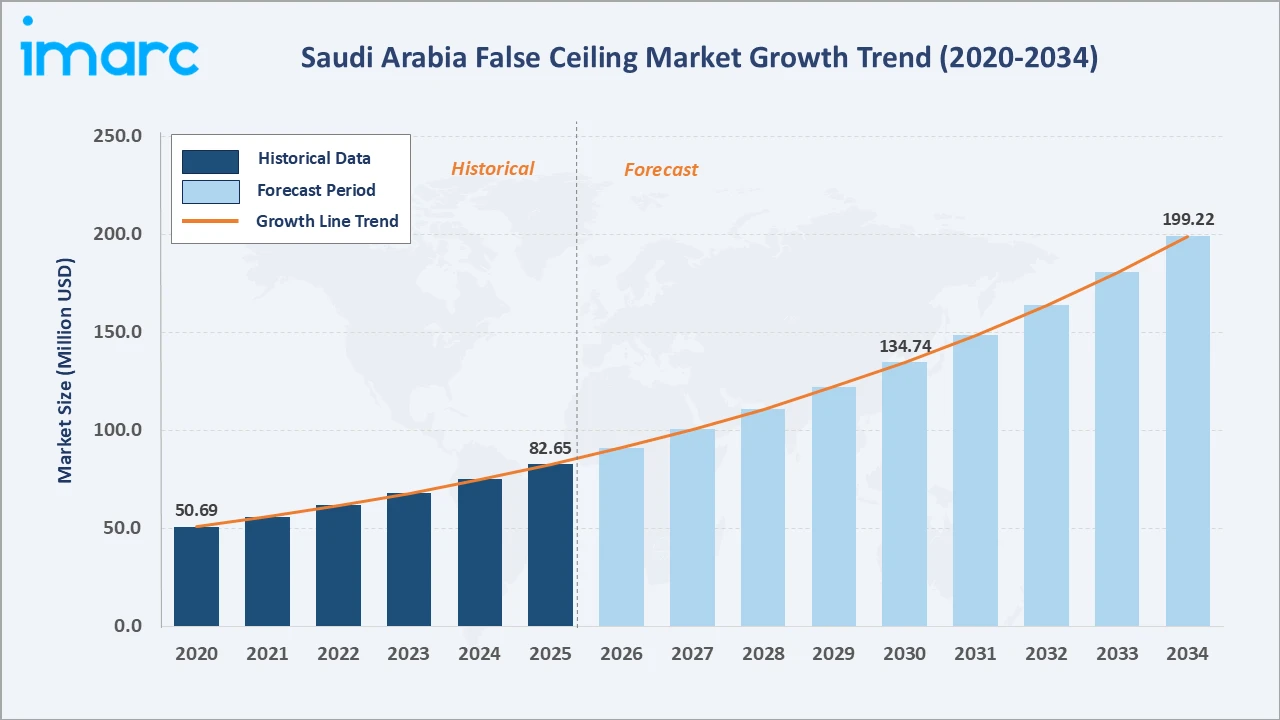
The Saudi Arabia false ceiling market reached USD 82.65 Million in 2025 and is projected to reach USD 199.22 Million by 2034, growing at a CAGR of 10.27% during 2026-2034. Growth is anchored in Vision 2030 construction activity, with Saudi homeownership at 66.24% at the end of 2025 against a 70% target for 2030. Construction GDP hit SAR 98.6 Billion, about USD 26.3 Billion, in the fourth quarter of 2025. Gypsum board leads by material at 41.8% in 2025. Medium-cost systems hold 47.3%. The Northern and Central Region dominates regionally at 40.8%.
Market Snapshot
|
Metric |
Value |
|
Market Size (2025) |
USD 82.65 Million |
|
Forecast Market Size (2034) |
USD 199.22 Million |
|
CAGR (2026-2034) |
10.27% |
|
Base Year |
2025 |
|
Historical Period |
2020-2025 |
|
Forecast Period |
2026-2034 |
|
Largest Material |
Gypsum Board (41.8%, 2025) |
|
Largest Cost Range |
Medium-Cost (47.3%, 2025) |
|
Dominant Region |
Northern and Central Region (40.8%, 2025) |
The market expanded from USD 50.69 Million in 2020 to USD 82.65 Million in 2025, is anchored at USD 134.74 Million in 2030, and reaches USD 199.22 Million by 2034. Demand is supported by the Sakani housing pipeline, which had issued 1,040,215 subsidised contracts through May 2026.
To get more information on this market, Request Sample
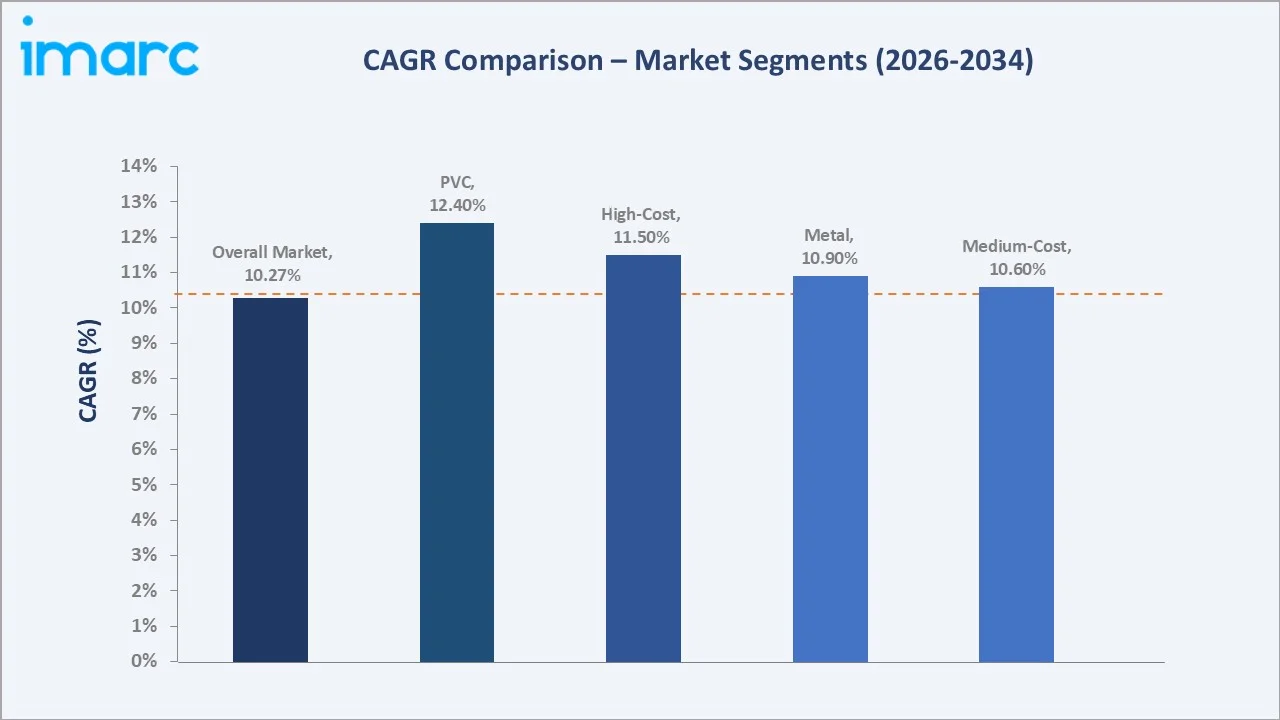
PVC ceilings grow fastest at roughly 12.4% CAGR (2026-2034) as polymer systems displace traditional finishes. High-cost systems follow at about 11.5%, lifted by hospitality projects, while gypsum board grows near 9.8% on code-compliant performance.
Executive Summary
The Saudi Arabia false ceiling market reached USD 82.65 Million in 2025, driven by one of the most active construction programmes in the region. GASTAT recorded construction GDP of SAR 98.6 Billion, about USD 26.3 Billion, in the fourth quarter of 2025. Code enforcement is a second structural driver. SBC 801 governs fire protection, while SBC 601 and SBC 602 set energy requirements, lifting specification of tested ceiling systems.
Residential demand is underpinned by the Housing Program, with homeownership at 66.24% at end-2025 against a 70% Vision 2030 target. Commercial demand tracks tourism, with over 122 million tourists and SAR 300 Billion, about USD 80 Billion, of spending in 2025.
Gypsum board commands 41.8% of the 2025 market, reflecting cost efficiency, workability and certified fire ratings. Medium-cost systems hold 47.3%, where specifiers balance appearance against budget. The Northern and Central Region leads at 40.8%, anchored by Riyadh. The market is forecast to reach USD 199.22 Million by 2034 at a 10.27% CAGR.
Key Market Insights
|
Insight |
Data |
|
Largest Material |
Gypsum Board - 41.8% share (2025) |
|
Fastest Growing Material |
PVC - approximately 12.4% CAGR (2026-2034) |
|
Dominant Cost Range |
Medium-Cost - 47.3% share (2025) |
|
Dominant Region |
Northern and Central Region - 40.8% share (2025) |
|
Top Companies |
Saint-Gobain, Knauf Group, Al Rajhi Holding Group, National Gypsum Company, and Rockwool A/S |
|
Market Opportunity |
Local system manufacturing and certified retrofit under Vision 2030 |
Key Analytical Observations Supporting the Above Data:
- Gypsum board at 41.8% share (2025) is driven by code compliance and installed cost: Boards deliver tested fire ratings under SBC 801 at a lower installed cost than metal or timber. Mada Gypsum Company operates 42 million square metres of annual plasterboard capacity, shortening project lead times.
- PVC is the fastest growing material at nearly 12.4% CAGR (2026-2034): Polymer ceilings resist moisture and salinity in coastal Eastern and Western Region projects. VOX began exporting polymer false ceilings to Saudi Arabia in September 2023 with a 30-year warranty.
- Medium-cost systems hold 47.3% (2025) as the specification default: Volume residential and mid-market commercial projects favour laminated tiles and standard grids, balancing appearance against the GASTAT Construction Cost Index, which rose 1.0% in October 2025.
- High-cost systems grow at about 11.5% CAGR on hospitality demand: Saudi Arabia is adding 94,500 hotel keys to a base of 171,650 rooms as of September 2025, with premium acoustic and metal ceilings raising value per square metre.
- The Northern and Central Region leads with 40.8% share (2025): Riyadh concentrates government and corporate construction. Permits across the Kingdom totalled 6,919 in January 2026, with the capital region taking the largest fit-out share.
- Consolidation is reshaping supply, led by inbound investment: Knauf secured clearance to acquire a 63.2% stake in Jeddah-based United Mining Industries for SAR 504.49 Million, or about USD 134.5 Million, in 2026.
Saudi Arabia False Ceiling Market Overview
The Saudi Arabia false ceiling market covers suspended and fixed secondary ceilings installed below structural slabs in commercial, residential and industrial buildings. Systems pair panels or tiles with concealed or exposed grids across gypsum board, metal, PVC, wood and mineral variants. They conceal services, improve acoustics, integrate lighting and support fire separation.
Regulation is set through the Saudi Building Code. SBC 801 addresses fire protection, SBC 601 and SBC 602 cover energy conservation and SBC 1001 sets green construction requirements, with SASO handling conformity for imports. Support comes from Vision 2030 diversification and a housing programme that has issued over one million subsidised contracts since 2017.
Market Dynamics
To evaluate market opportunities, Request Sample
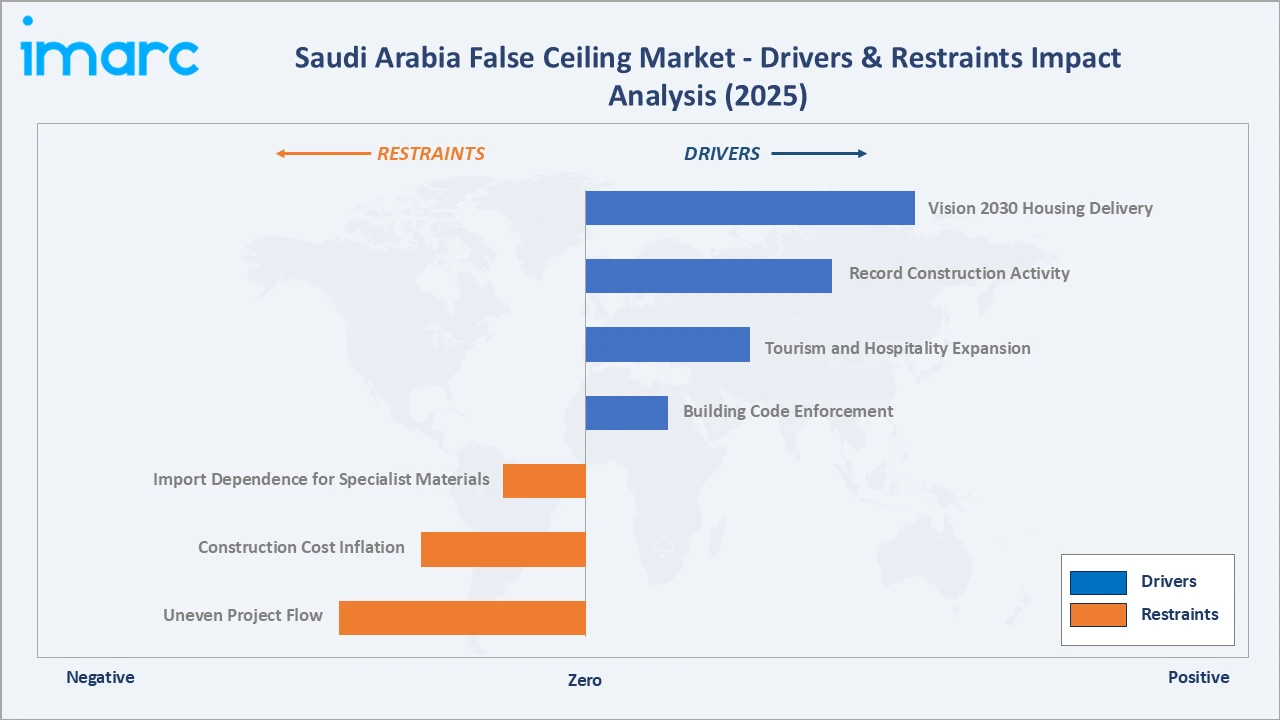
Market direction through 2034 reflects four forces. Construction volume and code enforcement lift demand. Import exposure and cost inflation restrain margins. Localisation and retrofit create openings, while installer capacity and coastal durability remain unresolved.
Market Drivers
- Vision 2030 Housing Delivery: Saudi homeownership reached 66.24% at end-2025 against a 70% target for 2030, and Sakani had issued 1,040,215 subsidised contracts through May 2026. Each completed unit carries ceiling works, creating a steady residential base load.
- Record Construction Activity: Construction GDP reached SAR 98.6 Billion, about USD 26.3 Billion, in the fourth quarter of 2025, the highest quarterly reading recorded by GASTAT. Non-oil investment converts directly into fit-out volume.
- Tourism and Hospitality Expansion: Saudi Arabia welcomed more than 122 million tourists in 2025, with spending of SAR 300 Billion, about USD 80 Billion. Around 94,500 hotel keys are under construction or in advanced planning, and hospitality favours acoustic and decorative ceilings.
- Building Code Enforcement: SBC 801 fire requirements and the SBC 601 and SBC 602 energy provisions push specifiers toward tested systems. Civil Defence approval favours manufacturers holding third-party certification.
Market Restraints
- Import Dependence for Specialist Materials: Mineral fibre tiles, aluminium ceiling systems and PVC feedstock are largely imported. Freight and currency movements feed directly into landed cost, limiting the ability of local contractors to hold fixed prices across long project cycles.
- Construction Cost Inflation: The GASTAT Construction Cost Index rose 1.0% in October 2025 against the same month a year earlier, with residential costs up 1.0% and non-residential up 0.9%. Rising input costs compress contractor margins on fixed-price ceiling packages.
- Uneven Project Flow: Construction permits fell to 6,919 in January 2026 from 7,411 a year earlier, and from 9,452 in December 2025. Permit volatility creates short-term gaps in fit-out demand that suppliers must absorb through inventory.
Market Opportunities
- Industrial Localisation: Vision 2030 industrial policy favours locally manufactured building materials. Mada Gypsum Company already operates 42 million square metres of plasterboard capacity and 2.9 million square metres of laminated ceiling tile capacity, showing that domestic scale is achievable.
- Commercial Retrofit: Ageing office and retail stock in Riyadh, Jeddah and Dammam requires ceiling replacement as energy codes tighten. Retrofit projects favour demountable tile systems that allow service access without full reconstruction.
- Premium Acoustic Specification: Healthcare, education and cultural assets increasingly specify measured acoustic performance. Suppliers offering tested sound absorption and attenuation data capture higher margin work than commodity board suppliers.
Market Challenges
- Installer Capability Gaps: Certified system performance depends on correct installation of grids, hangers and perimeter details. A fragmented subcontractor base produces inconsistent workmanship, creating warranty exposure for manufacturers and rework cost for developers.
- Durability in Coastal Conditions: Humidity and salinity in the Eastern and Western Regions shorten service life for standard boards and untreated metal grids. Specifying moisture-resistant systems raises upfront cost, which price-sensitive projects often resist.
Emerging Market Trends
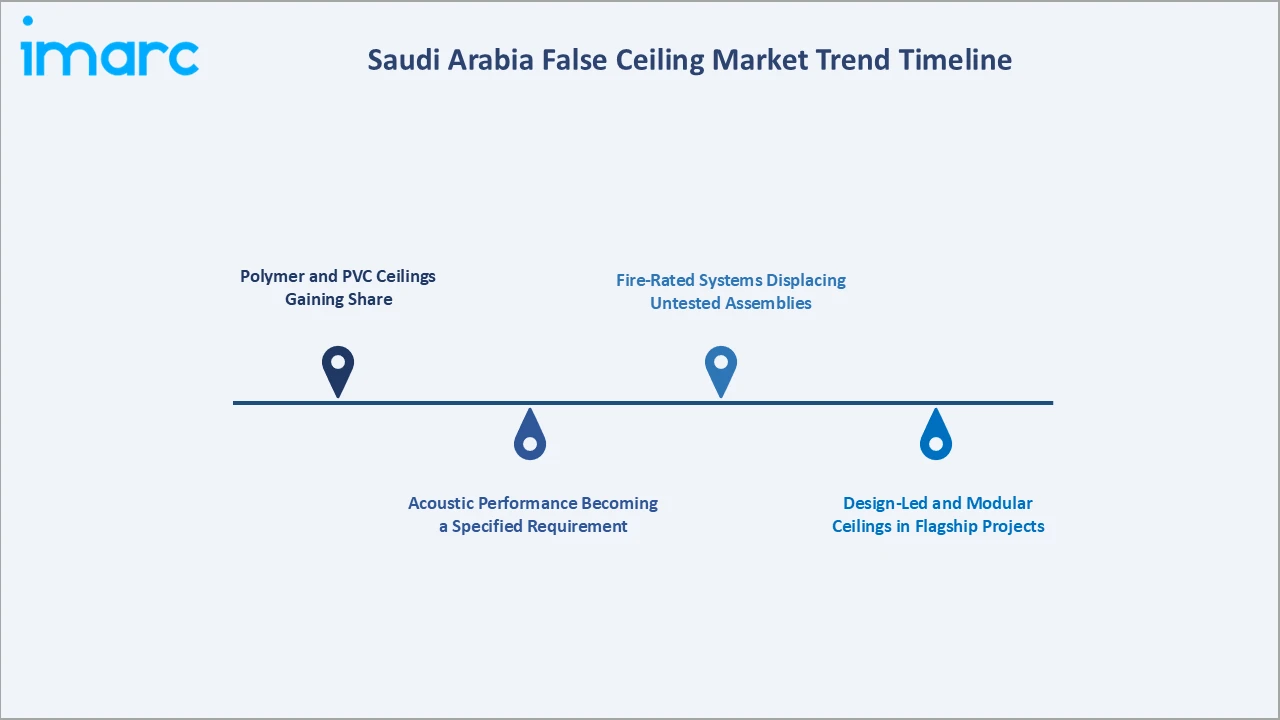
Four trends are reshaping specification between 2020 and 2034, each shifting demand from commodity board toward engineered, tested and design-led systems.
1. Polymer and PVC Ceilings Gaining Share
PVC ceilings are expanding at roughly 12.4% CAGR (2026-2034) from a 15.2% share in 2025. They resist moisture and install quickly. VOX entered Saudi Arabia in September 2023 with polymer ceilings carrying a 30-year warranty.
2. Acoustic Performance Becoming a Specified Requirement
Offices, clinics and classrooms now carry measured acoustic targets rather than general guidance. Manufacturers respond with perforated gypsum and mineral tiles offering published absorption values, such as the Saint-Gobain Gyptone range.
3. Fire-Rated Systems Displacing Untested Assemblies
SBC 801 enforcement and Civil Defence review have moved the market toward complete tested systems, not individual components. Mada Gypsum states that its systems are accepted by major civil defence authorities and listed in national project specifications, illustrating the compliance route suppliers must follow.
4. Design-Led and Modular Ceilings in Flagship Projects
Hospitality and cultural assets are adopting metal baffles, linear systems and bespoke profiles. With 94,500 hotel keys in the pipeline against 171,650 existing rooms as of September 2025, design-led ceilings support the growth of the high-cost tier toward roughly 11.5% CAGR.
Industry Value Chain Analysis
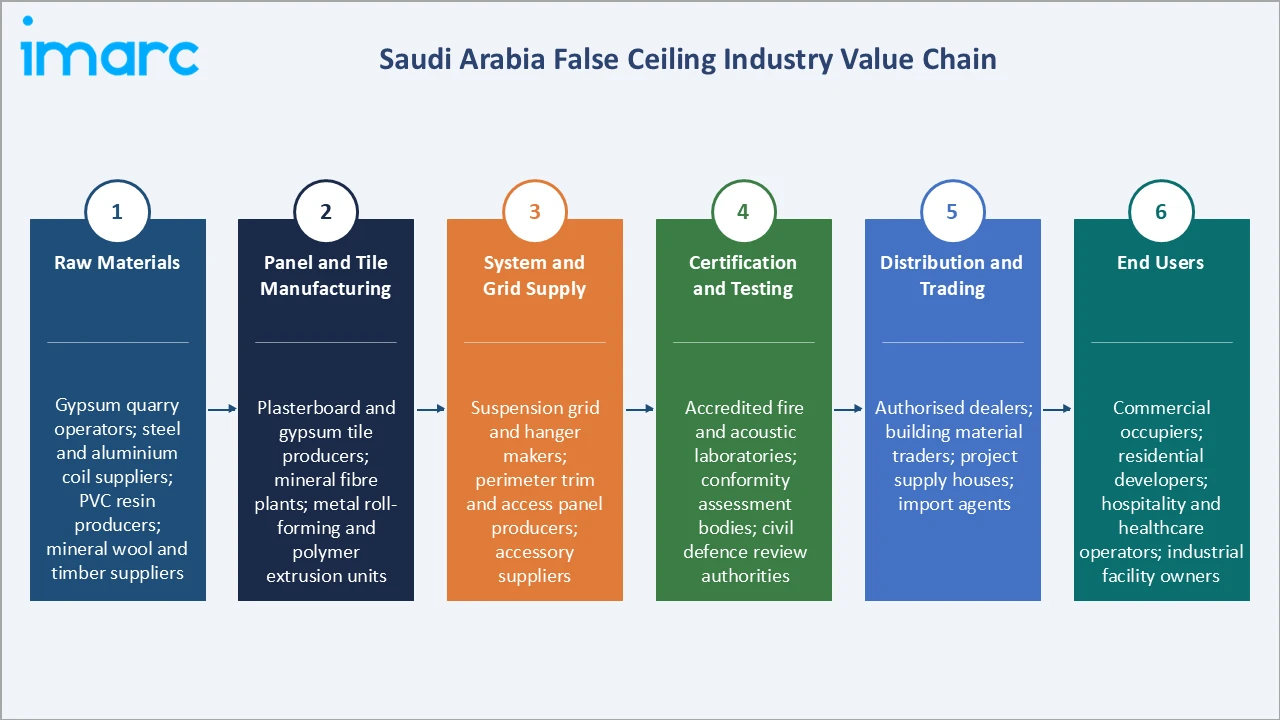
The Saudi false ceiling value chain runs from mineral and polymer inputs through panel manufacturing, system assembly and distribution to installation and building operation. Value concentrates downstream, where specification, certification and installation quality determine project outcomes.
|
Stage |
Key Participants |
|
Raw Materials |
Gypsum quarry operators; steel and aluminium coil suppliers; PVC resin producers; mineral wool and timber suppliers |
|
Panel and Tile Manufacturing |
Plasterboard and gypsum tile producers; mineral fibre plants; metal roll-forming and polymer extrusion units |
|
System and Grid Supply |
Suspension grid and hanger makers; perimeter trim and access panel producers; accessory suppliers |
|
Certification and Testing |
Accredited fire and acoustic laboratories; conformity assessment bodies; civil defence review authorities |
|
Distribution and Trading |
Authorised dealers; building material traders; project supply houses; import agents |
|
End Users |
Commercial occupiers; residential developers; hospitality and healthcare operators; industrial facility owners |
Distribution follows a two-tier structure. Manufacturers and importers supply authorised dealers and project traders, who serve fit-out contractors. Contractors carry specification risk, since certified performance depends on installation detail as much as the panel.
Technology Landscape in the Saudi Arabia False Ceiling Industry
Gypsum Board and Tile Manufacturing Technology
Modern lines combine continuous calcination, controlled foaming and high-speed lamination to produce boards with consistent density and predictable fire behaviour. Mada Gypsum Company operates capacity of 42 million square metres of plasterboard and 2.9 million square metres of laminated gypsum ceiling tiles, supporting local supply of the 41.8% material segment recorded in 2025.
Acoustic and Fire Engineering
Perforation geometry, backing fleece and plenum depth are engineered together to achieve target absorption. Knauf reports that its boards carry Environmental Product Declarations and very low volatile organic compound content below 0.05 µg/m³, reflecting the shift toward measured indoor environmental performance alongside fire ratings under SBC 801.
Digital Specification and BIM Integration
Manufacturers now publish parametric ceiling libraries, letting specifiers model grids, service penetrations and access panels before procurement. Knauf Ceiling Solutions has released BIM files in Autodesk Revit format for metal, mineral and wood wool systems, reducing rework on complex projects.
Market Segmentation Analysis
The report covers the following segments:
|
Segment Category |
Leading Segment |
Market Share |
Year |
|
Material |
Gypsum Board |
41.8% |
2025 |
|
Cost Range |
Medium-Cost |
47.3% |
2025 |
|
Installation |
🔒 |
🔒 |
2025 |
|
Application |
🔒 |
🔒 |
2025 |
|
Region |
Northern and Central Region |
40.8% |
2025 |

By Material
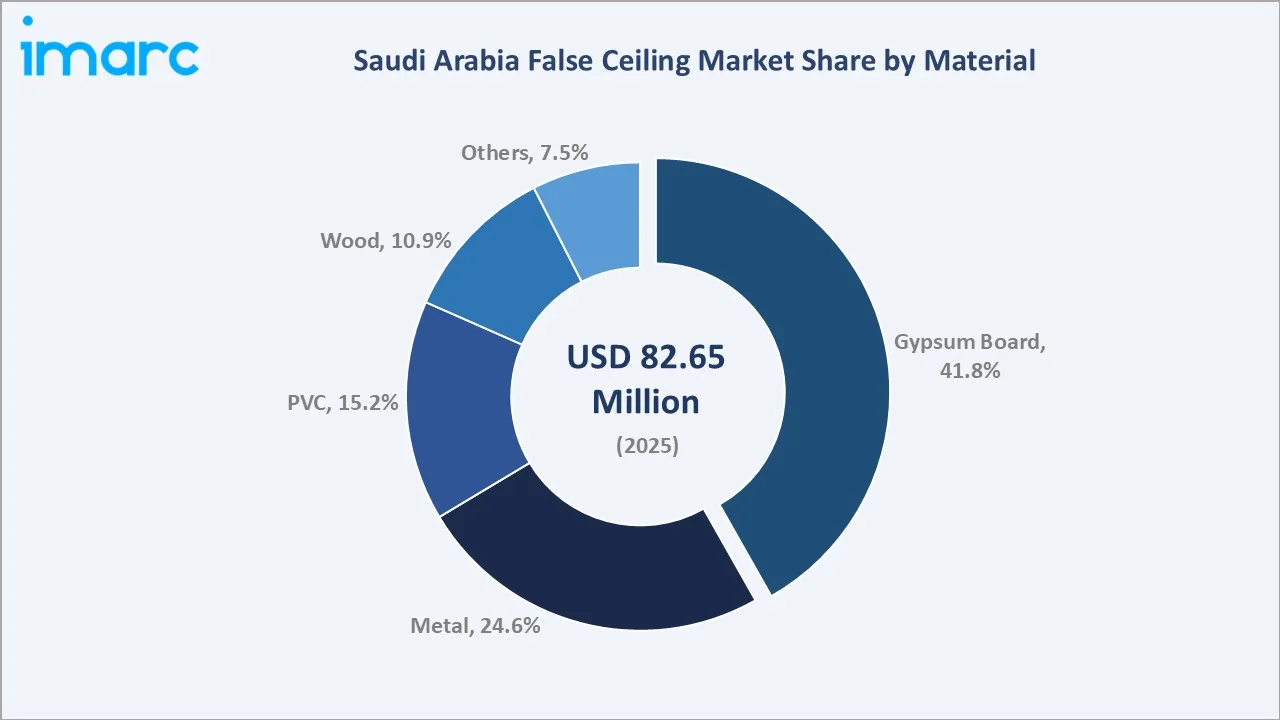
Gypsum board leads with 41.8% share in 2025, roughly USD 34.55 Million, combining low installed cost, tested fire ratings and easy on-site cutting. Metal follows at 24.6%, favoured in airports, transit and premium commercial interiors, and grows at about 10.9% CAGR.
To access detailed market analysis, Request Sample
PVC holds 15.2% in 2025 and is the fastest growing material at approximately 12.4% CAGR through 2034, supported by moisture resistance in coastal projects. Wood accounts for 10.9%, concentrated in hospitality and cultural venues where warmth and acoustic diffusion are valued. Other materials, including mineral fibre and fabric systems, make up 7.5% and grow at close to 10.0%.
By Cost Range
Medium-cost systems dominate at 47.3% in 2025, worth around USD 39.09 Million. This tier covers laminated gypsum tiles, standard exposed grids and mid-specification metal, and serves volume residential and mid-market commercial work. It is forecast to grow at roughly 10.6% CAGR, broadly in line with the overall market.
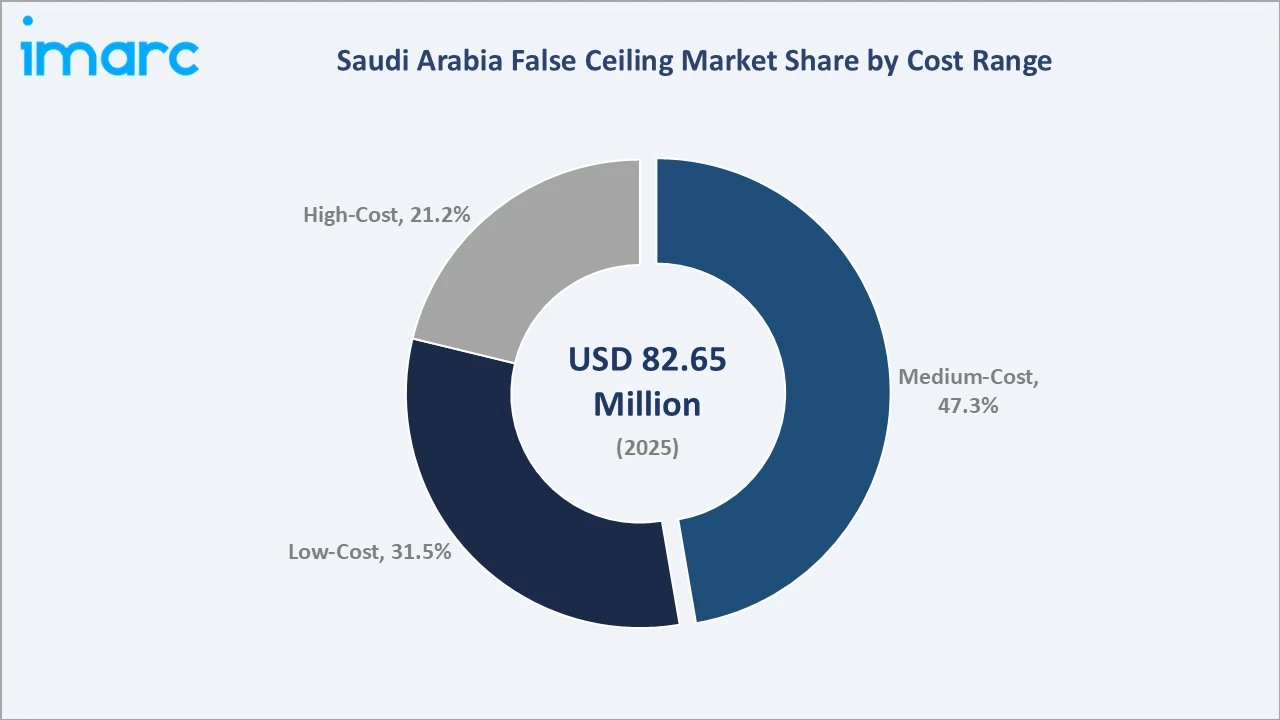
Low-cost systems hold 31.5% in 2025 but grow slowest at about 9.1% CAGR, as code enforcement pushes projects toward tested assemblies. High-cost systems account for 21.2% and expand fastest within this segmentation at roughly 11.5%, driven by hospitality, healthcare and cultural projects that specify bespoke acoustic and metal ceilings.
Regional Market Insights
Regional demand tracks population, commercial activity and industrial infrastructure, with each region showing a distinct end-use and material mix.
|
Region |
Share (2025) |
Key Growth Drivers and Characteristics |
|
Northern and Central Region |
40.8% |
Anchored by the capital and surrounding urban centres; dense government, corporate and institutional building stock; large office and retail fit-out pipeline; preference for certified acoustic and fire-rated systems |
|
Western Region |
26.9% |
Driven by religious and leisure tourism; extensive hotel development; major port and logistics activity; humidity favours moisture-resistant boards and polymer systems |
|
Eastern Region |
20.5% |
Supported by energy and petrochemical facilities; demand for durable, washable ceilings in technical spaces; coastal salinity favours corrosion-resistant grids |
|
Southern Region |
11.8% |
Emerging infrastructure and connectivity programmes; growing residential and public building activity; cost-sensitive specification with gradual upgrading |
The Northern and Central Region holds 40.8% share in 2025, and grows at roughly 10.6% CAGR. Riyadh concentrates the largest volume of commercial fit-out, government construction and institutional projects in the Kingdom, sustaining the region's lead throughout the forecast period.
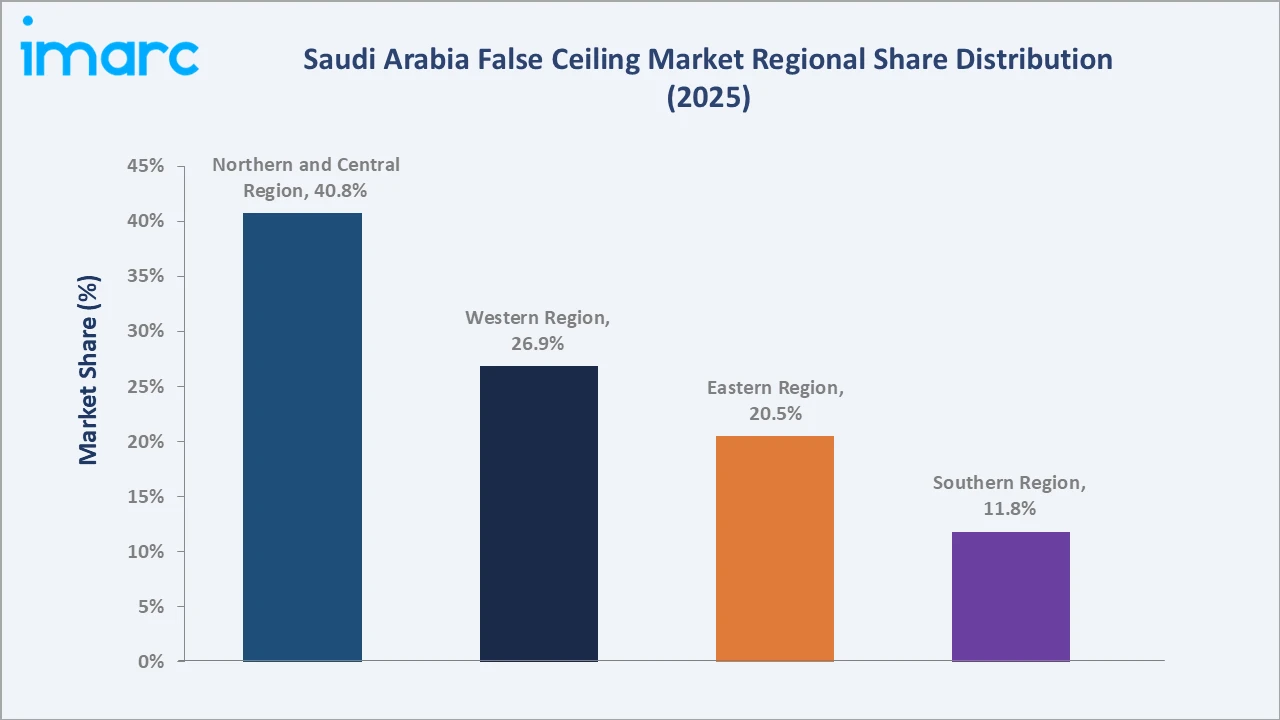
The Western Region follows at 26.9%, or around USD 22.23 Million, growing at about 10.3% CAGR on hospitality construction across Jeddah, Makkah and Madinah. The Eastern Region holds 20.5% at roughly USD 16.94 Million, supported by industrial and petrochemical facilities. The Southern Region accounts for 11.8%, or close to USD 9.75 Million, expanding at approximately 9.5%.
Competitive Landscape
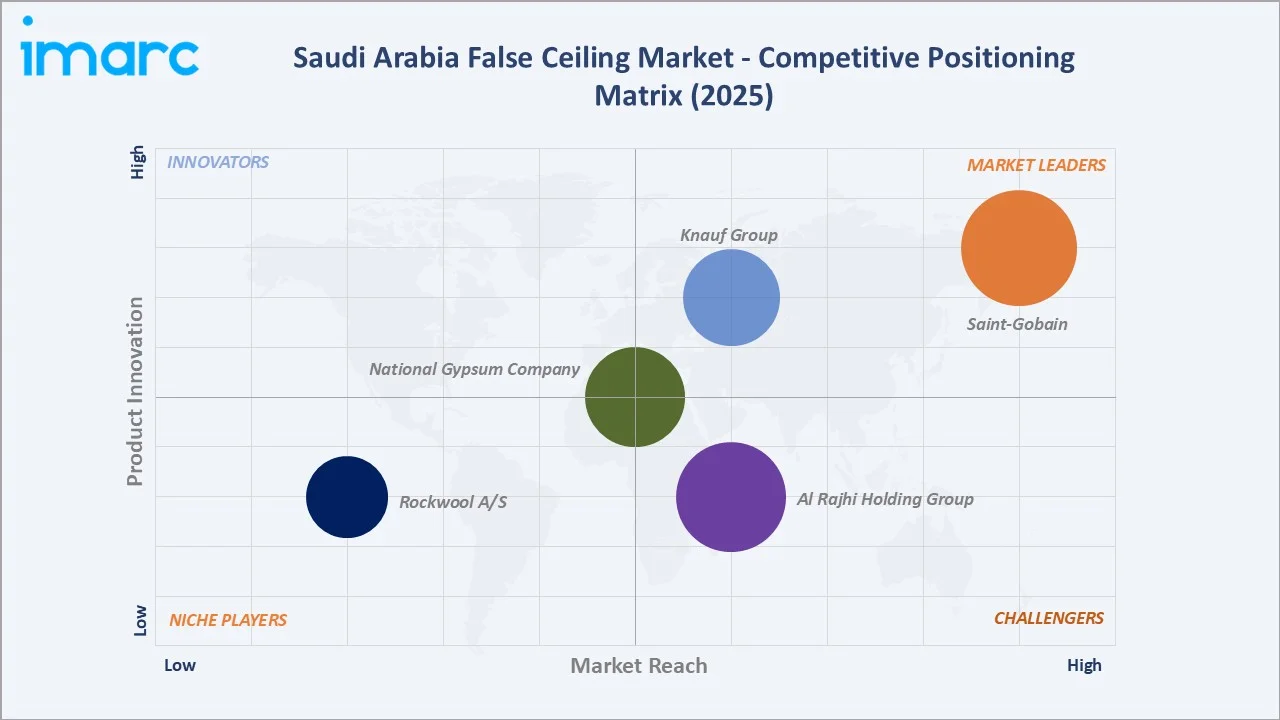
The market blends global system houses with domestic manufacturers. International players lead on certified portfolios and technical support, while Saudi producers compete on capacity, lead times and price.
|
Company Name |
Components |
Market Position |
Core Strength |
|
Saint-Gobain |
Gyptone and Rigitone acoustic boards |
Market Leader |
Global gypsum leader supplying boards, tiles and grids across the Middle East, with a Riyadh presence. |
|
Knauf Group |
Knauf Danoline acoustic boards, Knauf Ceiling Solutions mineral/metal/wood panels, gypsum plasterboards with suspension grid systems |
Market Leader |
Founded in 1932 with about 320 plants in 90+ countries; acquired a 63.2% stake in Jeddah-based United Mining Industries in May 2026. |
|
Al Rajhi Holding Group |
PVC-facing gypsum ceiling tiles, T-Grid suspension systems, and acoustical perforated tiles |
Strong Challenger |
Operates Mada Gypsum Company, which was established 2005 in Yanbu, part of Al Rajhi Holding Group; 42 million square metres of plasterboard capacity as of 2025. |
|
National Gypsum Company |
Regular Gypsum Boards, Fire-Resistant Boards, and Moisture-Resistant Boards |
Established Player |
Founded 1959 as one of the first fully Saudi-owned joint stock companies; Saudi Exchange listed, with plants in Riyadh, Dammam and Yanbu. |
|
Rockwool A/S |
Rockfon Stone Wool Acoustic Ceiling Tiles, Suspended Ceiling Systems, and Wall Solutions |
Niche Player |
Stone wool tiles offering non-combustible performance and high sound absorption for healthcare, education and premium commercial work. |
Competition splits by tier. Saint-Gobain and Knauf lead specification-driven work through tested systems. Mada Gypsum and National Gypsum Company compete on domestic capacity and delivery speed, while Rockwool holds a niche in non-combustible acoustic ceilings.
Key Company Profiles
Saint-Gobain
Saint-Gobain supplies gypsum boards, ceiling tiles, grids and acoustic systems in Saudi Arabia through its regional distribution network, with a Riyadh office supporting specification.
- Product Portfolio: False ceiling range featuring Activ'Air technology integrated with Gyptone and Rigitone acoustic boards, which actively decompose harmful formaldehyde to purify indoor air.
- Strategic Focus: Specification-led growth through certified acoustic and fire-rated ceiling systems for institutional and commercial projects.
Knauf Group
Knauf Group is a family-owned German manufacturer founded in 1932, operating about 320 plants across 90+ countries. In the Saudi Arabian market, it provides comprehensive dry construction solutions including gypsum boards, acoustic panels, and suspended false ceiling systems.
- Product Portfolio: Knauf Danoline acoustic boards, Knauf Ceiling Solutions mineral/metal/wood panels, and standard gypsum plasterboards with suspension grid systems, among others.
- Strategic Focus: Building local Saudi manufacturing depth in line with Vision 2030 while extending certified ceiling system coverage across the Gulf.
Al Rajhi Holding Group
Mada Gypsum Company, a subsidiary of Al Rajhi Holding Group, was established in 2005 in Yanbu Industrial City. It manufactures lightweight drywall and ceiling systems compliant with the Saudi Building Code.
- Product Portfolio: PVC-facing gypsum ceiling tiles, T-Grid suspension systems, and acoustical perforated tiles, among others.
- Strategic Focus: System certification and technical support, with tested assemblies accepted by civil defence authorities and listed in national project specifications.
Market Concentration Analysis
The market is moderately concentrated at the certified system level and fragmented in the commodity board and installation tiers. The leading suppliers account for a substantial share of specification-led volume in 2025, though no single company dominates.
Fragmentation is most visible downstream, where interior fit-out contractors and small subcontractors compete on price for medium-cost and low-cost work, together 78.8% of the market in 2025. Installation margins stay thin and quality uneven.
Consolidation is moving upstream. Knauf taking a 63.2% stake in United Mining Industries for SAR 504.49 Million marks the entry of a global owner into Saudi gypsum capacity, and further inbound investment is likely under Vision 2030 localisation incentives.
Investment & Growth Opportunities
Fastest Growing Segments
PVC ceilings at roughly 12.4% CAGR (2026-2034), high-cost systems at about 11.5%, metal at close to 10.9% and the Northern and Central Region at 10.6% are the strongest growth vectors through 2034. High-cost hospitality work offers the highest revenue per square metre.
Emerging Market Opportunities
Vision 2030 localisation supports domestic production of ceiling tiles, grids and metal profiles, still largely imported. A Saudi grid and profile plant would serve a market moving from USD 82.65 Million in 2025 to USD 134.74 Million by 2030, with Gulf export access.
Investment Themes
- Certified system capability: Investment in fire and acoustic testing, documentation and civil defence approvals converts commodity supply into specified supply, protecting margin as SBC 801 enforcement tightens.
- Installer training and accreditation: Structured installer certification closes the workmanship gap driving warranty exposure and builds a defensible service layer around product sales.
- Retrofit-focused product lines: Demountable tile and grid systems for occupied buildings target ageing commercial stock in Riyadh, Jeddah and Dammam as energy codes tighten.
Future Market Outlook (2026-2034)
The Saudi Arabia false ceiling market is projected to grow from USD 82.65 Million in 2025 to USD 199.22 Million by 2034 at a 10.27% CAGR. The market reaches USD 134.74 Million in 2030, the point at which giga-project and hospitality fit-out activity is expected to peak alongside the Vision 2030 milestone year.
Three structural forces anchor this trajectory. Housing delivery continues as homeownership advances from 66.24% at end-2025 toward the 70% target. Tourism infrastructure expands toward a 150 million visitor goal for 2030. Code enforcement under SBC 801 and SBC 601 and SBC 602 progressively removes untested systems from specification.
The composition of demand will shift more than its direction. Gypsum board retains scale but loses relative share as PVC and metal gain, while high-cost systems expand fastest and lift average project value. Suppliers holding certified portfolios and reliable local supply should capture a disproportionate share.
Research Methodology
Primary Research
Primary research comprised structured interviews with more than 60 industry stakeholders during 2025 and 2026, including ceiling system manufacturers, gypsum board producers, authorised distributors, fit-out contractors, specification consultants and architects.
Secondary Research
Secondary research drew on GASTAT construction GDP, permit and Construction Cost Index releases; Ministry of Municipalities and Housing and Sakani reporting; Saudi Building Code documents SBC 801, SBC 601, SBC 602 and SBC 1001; Ministry of Tourism data; and disclosures from Saint-Gobain, Knauf, Mada Gypsum and National Gypsum. Over 90 secondary sources were reviewed.
Forecasting Models
Forecasts were built bottom-up from building completion pipelines multiplied by ceiling area coefficients and average system value, segmented by material, cost range and region. Outputs were validated against construction GDP growth, permit trends and hotel key schedules, then reconciled to the 2025 base of USD 82.65 Million.
Saudi Arabia False Ceiling Market Report Coverage:
| Report Features | Details |
|---|---|
| Base Year of the Analysis | 2025 |
| Historical Period | 2020-2025 |
| Forecast Period | 2026-2034 |
| Units | Million USD |
| Scope of the Report |
Exploration of Historical Trends and Market Outlook, Industry Catalysts and Challenges, Segment-Wise Historical and Future Market Assessment:
|
| Materials Covered | Gypsum Board, Metal, Wood, PVC, Others |
| Cost Ranges Covered | Low-Cost, Medium-Cost, High-Cost |
| Installations Covered | Drywall, Suspended, Stretch Ceilings, Others |
| Applications Covered | Commercial, Residential, and Industrial |
| Regions Covered | Northern and Central Region, Western Region, Eastern Region, and Southern Region |
| Companies Covered | Saint-Gobain, Knauf Group, Al Rajhi Holding Group, National Gypsum Company, Rockwool A/S, etc. |
| Customization Scope | 10% Free Customization |
| Post-Sale Analyst Support | 10-12 Weeks |
| Delivery Format | PDF and Excel through Email (We can also provide the editable version of the report in PPT/Word format on special request) |
Key Benefits for Stakeholders:
- IMARC’s industry report offers a comprehensive quantitative analysis of various market segments, historical and current market trends, market forecasts, and dynamics of the Saudi Arabia false ceiling market from 2020-2034.
- The research report provides the latest information on the market drivers, challenges, and opportunities in the Saudi Arabia false ceiling market.
- Porter's five forces analysis assist stakeholders in assessing the impact of new entrants, competitive rivalry, supplier power, buyer power, and the threat of substitution. It helps stakeholders to analyze the level of competition within the Saudi Arabia false ceiling industry and its attractiveness.
- Competitive landscape allows stakeholders to understand their competitive environment and provides an insight into the current positions of key players in the market.
Frequently Asked Questions About the Saudi Arabia False Ceiling Market Report
The Saudi Arabia false ceiling market reached USD 82.65 Million in 2025, supported by record construction activity, Vision 2030 housing delivery and expanding commercial and hospitality fit-out volumes.
The market is projected to grow at a CAGR of 10.27% during 2026-2034, reaching USD 199.22 Million by 2034, driven by construction expansion and stricter building code enforcement.
Gypsum board leads with 41.8% share in 2025, reflecting low installed cost, tested fire ratings under SBC 801 and readily available local manufacturing capacity across the Kingdom.
PVC ceilings grow fastest at roughly 12.4% CAGR during 2026-2034, supported by moisture resistance, quick installation and rising adoption in coastal and cost-sensitive building projects.
Medium-cost systems hold 47.3% share in 2025, covering laminated gypsum tiles and standard grids used widely across volume residential and mid-market commercial developments.
The Northern and Central Region leads with 40.8% share in 2025, anchored by Riyadh's concentration of government, corporate and institutional construction and commercial fit-out activity.
Leading companies include Saint-Gobain, Knauf Group, Al Rajhi Holding Group, National Gypsum Company, and Rockwool A/S, among other regional manufacturers and system suppliers.
Vision 2030 drives housing delivery, tourism infrastructure and industrial localisation. Homeownership reached 66.24% at end-2025, while tourism exceeded 122 million visitors during the same year.
The market is projected to reach approximately USD 134.74 Million by 2030, supported by peak giga-project fit-out activity, hotel deliveries and continued residential completions.
SBC 801 governs fire protection, while SBC 601 and SBC 602 set energy conservation requirements. SASO handles conformity assessment for imported ceiling materials and system components.
Need more help?
- Speak to our experienced analysts for insights on the current market scenarios.
- Include additional segments and countries to customize the report as per your requirement.
- Gain an unparalleled competitive advantage in your domain by understanding how to utilize the report and positively impacting your operations and revenue.
- For further assistance, please connect with our analysts.
 Request Customization
 Speak to an Analyst
 Request Brochure
 Inquire Before Buying
Benefits of Customization
- Personalize this research
- Triangulate with your data
- Get data as per your format and definition
- Gain a deeper dive into a specific application, geography, customer, or competitor
- Any level of personalization
Get in Touch With Us
UNITED STATES
Phone: +1-201-971-6302
INDIA
Phone: +91-120-433-0800
UNITED KINGDOM
Phone: +44-753-714-6104
Email: [email protected]
Client Testimonials




.webp)




.webp)













Related Reports

Choose your plan
*Please note that the prices mentioned below are starting prices for each bundle type. Kindly contact our team for further details.*
Single User License
- 1 User License, Access on 2 Devices
- PDF Report + Excel Dataset (Password Protected)
- Lifetime Access
- No Printing Rights
- 10% Free Report Customization
- 10–12 Weeks of Analyst Support
Five User License
- Access for 5 Users, 2 Devices per User
- PDF Report + Excel Dataset (Password Protected)
- Lifetime Access
- Dedicated Account Manager
- 12–14 Weeks of Analyst Support
- No Printing Rights
- 15% Free Report Customization
- 25% Discount on Your Next Purchase
Corporate User License
- Unlimited User Access (Within Your Organization)
- PDF Report + Excel Dataset
- Lifetime Access
- Dedicated Account Manager
- 14–20 Weeks of Analyst Support
- No Printing Rights
- 20% Free Report Customization
- 30% Discount on Your Next Purchase
Essential Insights
What's included:
3 reports
- Lifetime Access
- PDF Reports
- Excel Datasets
- 2 Weeks of Free Analyst Support
- 2 User Licenses
- Access on 2 Devices
- Printing Rights
- Complimentary PowerPoint (PPT) Version
- Complimentary License Upgrade
Professional Access
What's included:
5 reports
- Lifetime Access
- PDF Reports
- Excel Datasets
- 8 Weeks of Free Analyst Support
- 2 User Licenses
- Access on 2 Devices
- Printing Rights
- Complimentary PowerPoint (PPT) Version
- Complimentary License Upgrade
Business Advantage
What's included:
8 reports
- Lifetime Access
- PDF Reports
- Excel Datasets
- 14 Weeks of Free Analyst Support
- 2 User Licenses
- Access on 2 Devices
- Printing Rights
- Complimentary PowerPoint (PPT) Version
- Complimentary License Upgrade
Enterprise Intelligence
What's included:
10 reports
- Lifetime Access
- PDF Reports
- Excel Datasets
- 20 Weeks of Free Analyst Support
- 2 User Licenses
- Access on 2 Devices
- Printing Rights
- Complimentary PowerPoint (PPT) Version
- Complimentary License Upgrade