
Saudi Arabia Fasteners Market Size, Share, Trends and Forecast by Product, Sales Channel, End Use, and Region, 2026-2034
Saudi Arabia Fasteners Market Size, Share, Trends & Forecast (2026-2034)
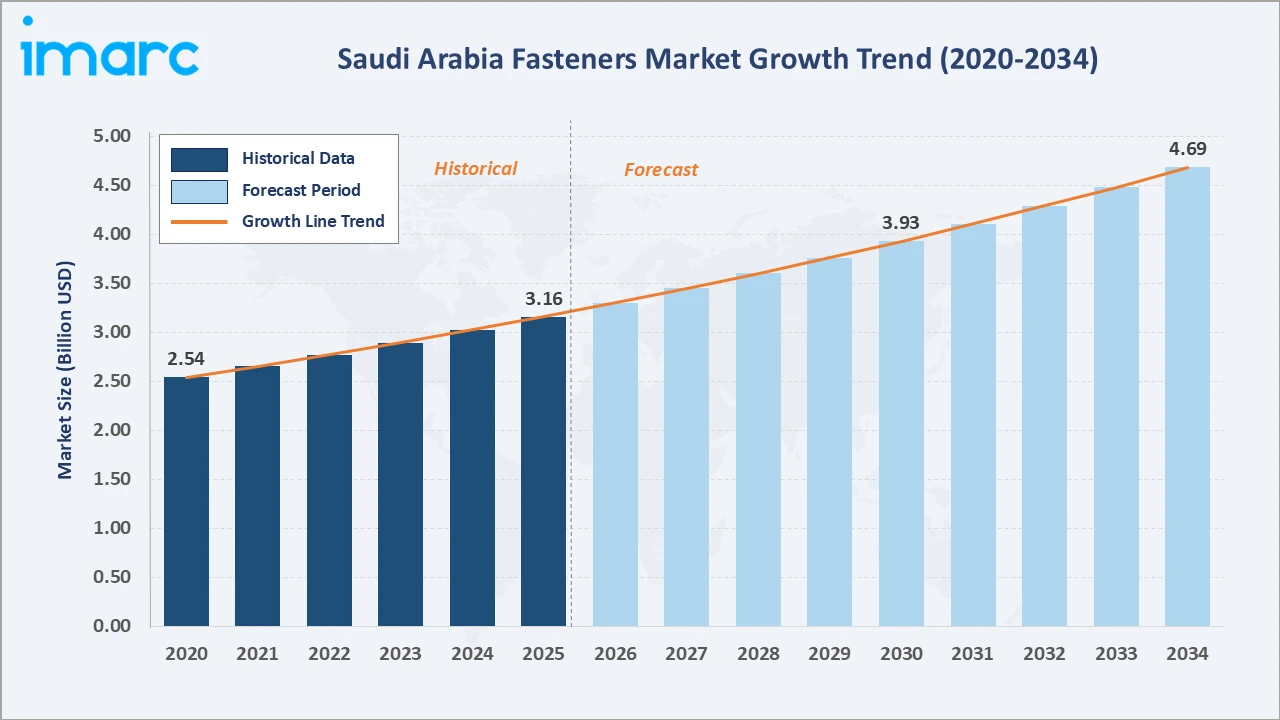
The Saudi Arabia fasteners market grew from USD 3.16 Billion in 2025 to USD 3.30 Billion in 2026 and is projected to reach USD 4.69 Billion by 2034, growing at a CAGR of 4.47% during 2026-2034. Unprecedented construction activity under Vision 2030 giga-projects, sustained capital expenditure in the oil and gas sector, industrial manufacturing expansion under the National Industrial Strategy, and the progressive growth of e-commerce procurement channels for fastener distribution are the primary growth catalysts.
Market Snapshot
|
Metric |
Value |
|
Base Year Market Size (2025) |
USD 3.16 Billion |
| Market Size (2026) | USD 3.30 Billion |
|
Forecast Market Size (2034) |
USD 4.69 Billion |
|
CAGR (2026-2034) |
4.47% |
|
Base Year |
2025 |
|
Historical Period |
2020-2025 |
|
Forecast Period |
2026-2034 |
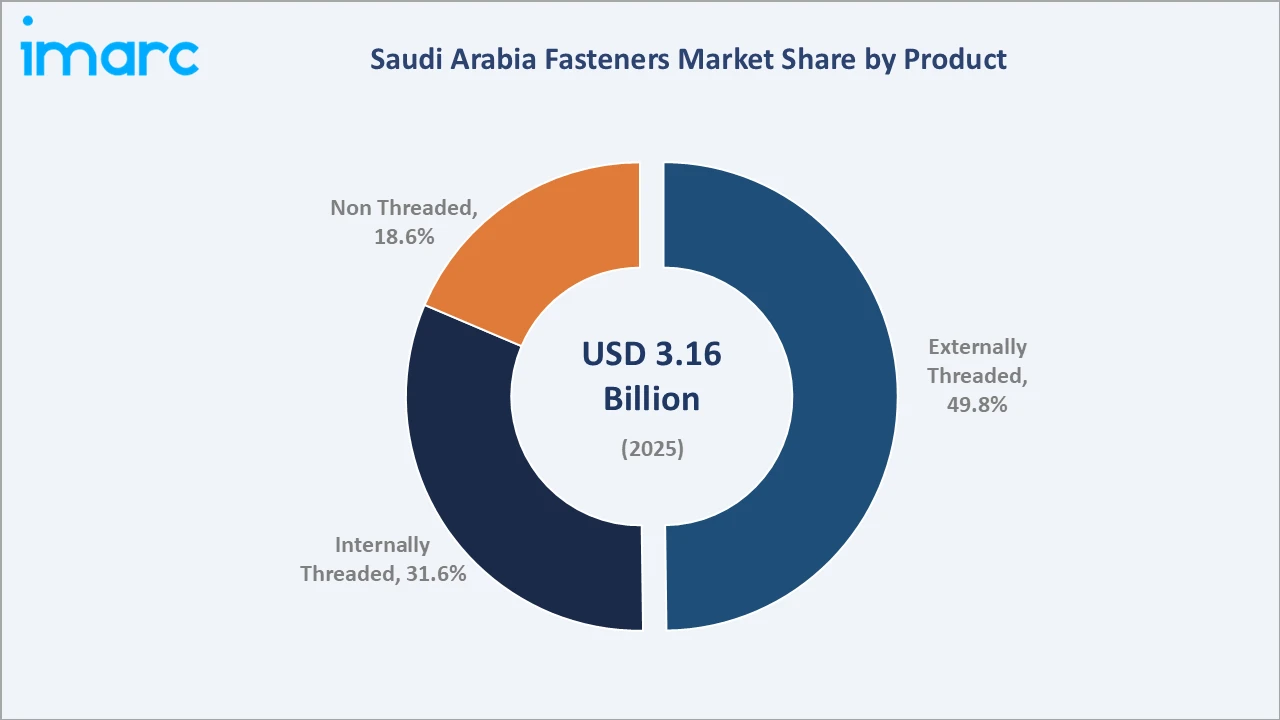
The Northern and Central Region leads nationally with a 36.8% market share in 2025, anchored by Riyadh's concentration of major construction projects, industrial zones, and commercial development activity. Externally threaded fasteners command the dominant product share at 49.8% of market value, while the offline sales channel dominates with 84.7%, reflecting the fasteners market's reliance on established trade relationships, project-based bulk procurement, and specialist fastener distributors across Saudi Arabia.
To get more information on this market, Request Sample
The Saudi Arabia fasteners market is underpinned by three structural forces: a massive and sustained construction pipeline; the Kingdom's extensive oil and gas infrastructure that demands high-specification, corrosion-resistant fasteners for upstream, midstream, and downstream facility maintenance and expansion; and Saudi Arabia's National Industrial Strategy that is developing new manufacturing capacity across metals, chemicals, and automotive assembly, each of which is a major fastener consuming sector.
Executive Summary
The Saudi Arabia fasteners market is experiencing steady, investment-driven growth aligned with the Kingdom's most transformative economic development program in its modern history. The market expanded from USD 3.16 Billion in 2025 to an estimated USD 3.30 Billion in 2026. The market is forecast to reach USD 4.69 Billion by 2034 at a CAGR of 4.47%, underpinned by nearly USD 1.5 trillion worth of ongoing giga-projects and infrastructure development under Vision 2030.
Externally threaded fasteners dominate the product segment at 49.8% in 2025, encompassing bolts, screws, studs, and threaded rods that are the primary structural fastening components across construction, oil and gas, and industrial applications. The Offline sales channel commands 84.7% of the market, reflecting the fastener industry's reliance on established distributor relationships, direct manufacturer supply agreements, and project-specific procurement tenders for large construction and infrastructure projects.
Key Market Insights
|
Insight |
Data |
| Largest Product |
Externally Threaded – 49.8% share (2025) |
| Fastest Growing Product |
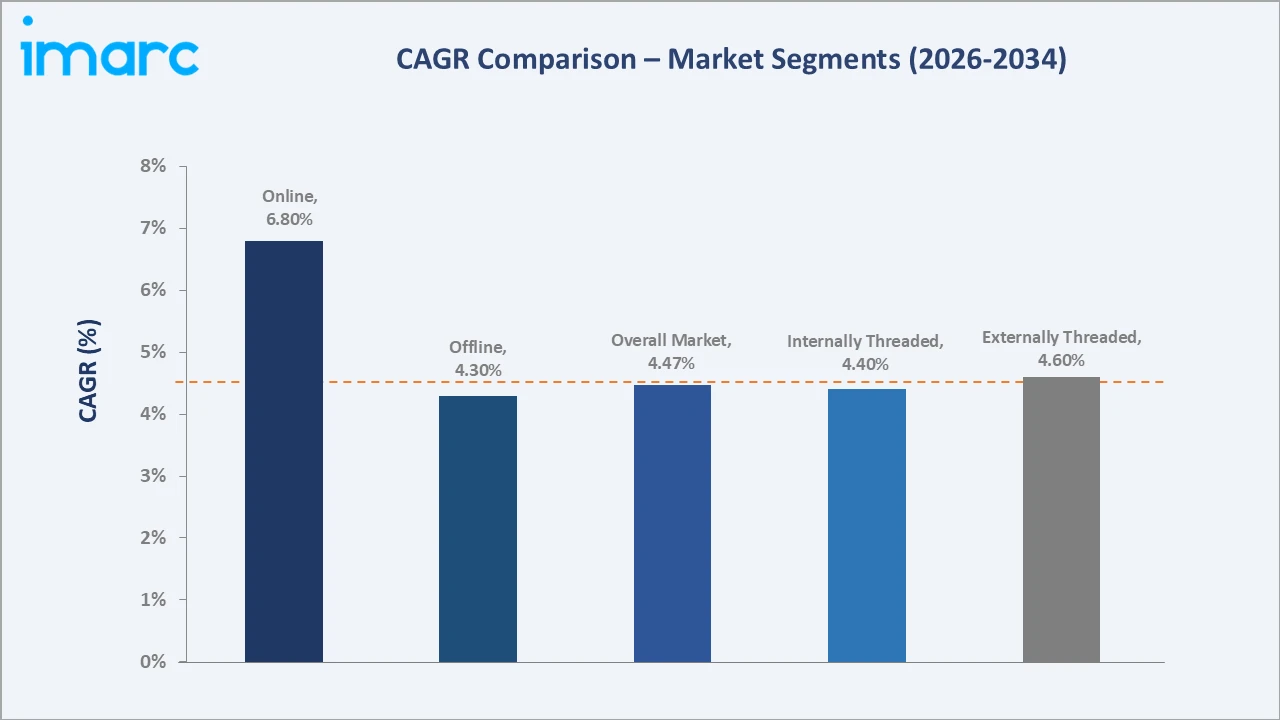
Externally Threaded – ~4.6% CAGR (2026-2034) |
| Dominant Sales Channel |
Offline – 84.7% share (2025) |
| Fastest Growing Sales Channel |
Online – ~6.8% CAGR (2026-2034) |
| Leading Region |
Northern and Central Region – 36.8% share (2025) |
| Top Companies |
Illinois Tool Works Inc., Adolf Würth GmbH & Co. KG, Hilti Aktiengesellschaft, Stanley Black & Decker, Inc. |
Key Analytical Observations Supporting The Above Data:
- Externally threaded fasteners account for 49.8% of Saudi market value in 2025, reflecting the overwhelming role of structural bolts, anchor bolts, concrete screws, and high-strength threaded rods in Saudi Arabia’s construction, oil and gas, and infrastructure sectors.
- The offline channel’s 84.7% dominance (2025) as large construction and infrastructure projects procure fasteners through direct manufacturer supply agreements or specialist distributor tender processes that are entirely offline.
- The Northern and Central Region’s 36.8% (2025) leadership reflects Riyadh’s status as the Kingdom’s primary construction activity hub, hosting Vision 2030 flagship developments, government institutional construction, and industrial zone development in Riyadh and Sudair.
- The 4.47% CAGR reflects the Saudi fasteners market’s position as a materials input market driven by downstream construction and industrial activity rather than direct consumer demand. Vision 2030 project delivery timelines, oil price stability, and the National Industrial Strategy’s manufacturing sector development collectively underpin above-global-average growth for the forecast period.
Saudi Arabia Fasteners Market Overview
Fasteners are mechanical hardware components, including bolts, screws, nuts, washers, rivets, pins, and studs, used to join, assemble, and secure structural elements and mechanical components across construction, oil and gas, automotive, aerospace, industrial manufacturing, and consumer goods applications.
Saudi Arabia’s fasteners market is one of the Middle East’s largest industrial hardware markets, driven by the Kingdom’s extraordinary infrastructure investment program under Vision 2030, its extensive and continuously maintained oil and gas production infrastructure, and its rapidly growing industrial manufacturing base under the National Industrial Strategy.
The market is characterized by a dual-track demand structure: project-based demand from large-scale construction and infrastructure programs that require structural fasteners procured in bulk through project supply contracts; and maintenance, repair and operations (MRO) demand from Saudi Arabia’s extensive operational infrastructure that requires continuous fastener supply for routine and scheduled maintenance activities.
Market Dynamics
To evaluate market opportunities, Request Sample
Market Drivers
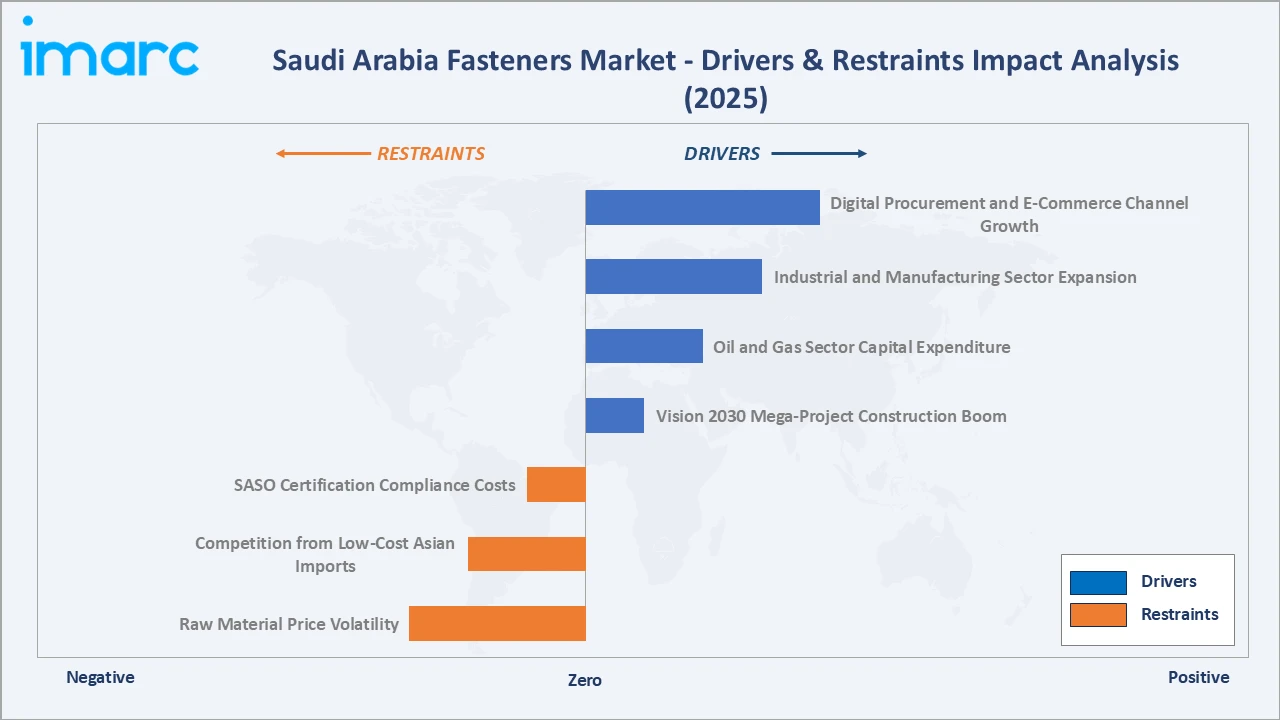
- Vision 2030 Mega-Project Construction Boom: Saudi Arabia’s construction sector is supported by nearly USD 1.5 trillion worth of ongoing giga-projects and infrastructure development under Vision 2030. These investments span housing, tourism, transport, entertainment, and smart-city projects, creating major opportunities for construction and foreign investors.
- Oil and Gas Sector Capital Expenditure: Saudi Aramco set its 2026 capital expenditure guidance at USD 50–55 billion, with increased spending planned across liquid fuels, downstream operations, LNG, and new energy. Each upstream oil and gas wellhead, processing facility, pipeline, and offshore platform requires high-specification, corrosion-resistant fasteners.
- Industrial and Manufacturing Sector Expansion: Saudi Arabia’s National Industrial Strategy (NIS) targets SAR 12.4 trillion in total investment by 2030. Each new manufacturing facility consumes construction fasteners during facility construction and manufacturing fasteners (precision-grade automotive bolts, machine screws, rivets) in ongoing production operations.
- Digital Procurement and E-Commerce Channel Growth: The rapid growth of online B2B procurement platforms in Saudi Arabia is expanding fastener market reach beyond traditional offline distributor networks to serve small-to-medium contractors, maintenance operations, and individual project buyers that previously lacked efficient access to the full breadth of fastener specifications available from international manufacturers.
Market Restraints
- Raw Material Price Volatility: Steel is subject to significant global commodity price volatility, with hot-rolled coil steel prices ranging from USD 450 to USD 950 per ton over the 2020–2024 period. As Saudi Arabia imports the majority of its fasteners, global steel price movements translate directly into fastener import cost fluctuations that compress distributor margins and create price uncertainty for construction project procurement budgeting.
- Competition from Low-Cost Asian Imports: Chinese manufacturers produce commodity-grade fasteners at production costs 40–60% below European and Japanese equivalents, creating persistent price competition in the standard construction and general industrial fastener segments.
- SASO Certification Compliance Costs: The Saudi Standards, Metrology and Quality Organization (SASO) requires product registration and conformity assessment for fasteners used in regulated construction and infrastructure applications, adding compliance costs of USD 15,000–100,000 per product range for international manufacturers seeking Saudi market access.
Market Opportunities
- Domestic Fastener Manufacturing under NIDLP: Saudi Arabia’s National Industrial Development and Logistics Program (NIDLP) provides industrial license fee exemptions, utility subsidies, and concessional SIDF financing for manufacturing facilities established in Saudi Arabia, including fastener production.
- High-Specification Fastener Demand from Offshore Wind and Renewable Energy: Saudi Arabia’s renewable energy program is developing utility-scale solar PV, wind, and green hydrogen projects that require large quantities of specialized fasteners for mounting system installation, turbine tower assembly, and substation construction.
Market Challenges
- Supply Chain Localization and Lead Time Management: Saudi Arabia’s near-total import dependence for fasteners creates supply chain vulnerability to port congestion, global shipping disruptions, and extended international lead times that can delay giga-project construction schedules where fastener availability is on the critical path for structural steel erection milestones.
- Skills Gap in Fastener Engineering Specification: Incorrect fastener specification in construction projects leads to structural failures, corrosion failures in offshore and coastal environments, and non-compliance with SBC requirements, increasing the liability exposure of contractors and driving demand for fastener manufacturer technical support that requires investment in local engineering sales capability.
Emerging Market Trends
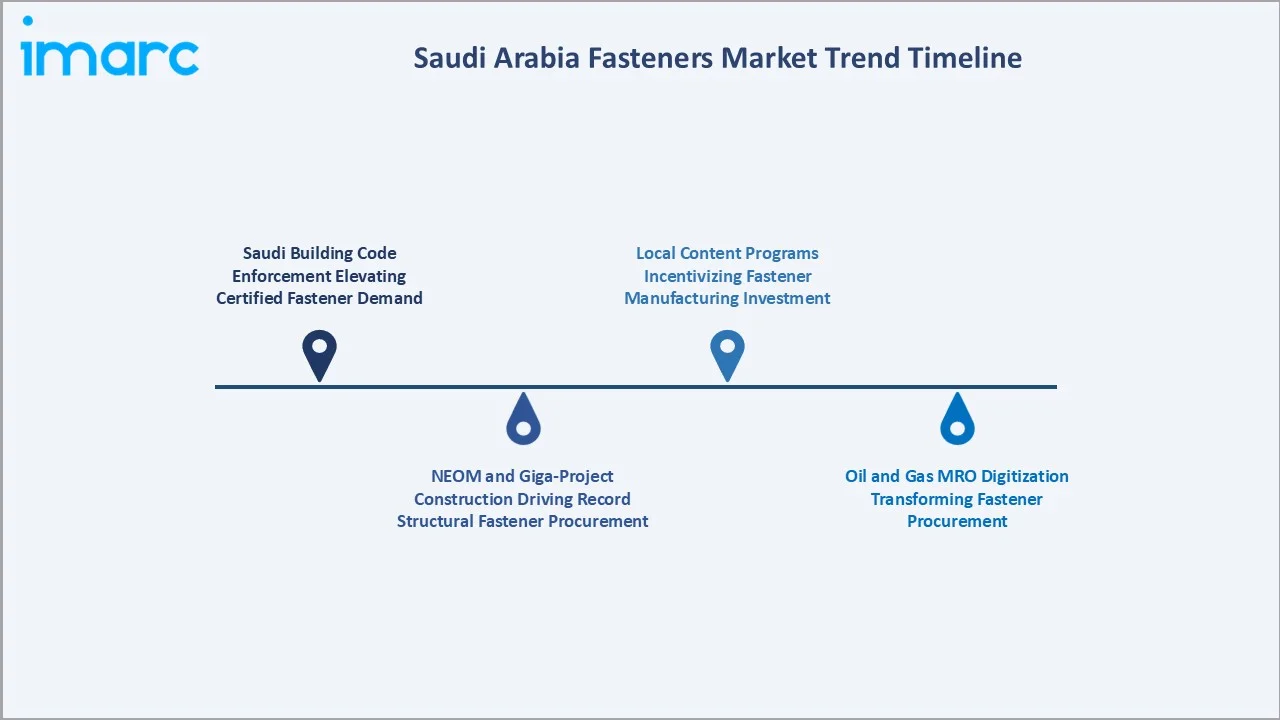
1. Saudi Building Code Enforcement Elevating Certified Fastener Demand
The Saudi Building Code issued by SASO mandates the use of certified, tested, and traceable fasteners across regulated construction applications, requiring conformity assessment documentation for structural bolts, anchor systems, and reinforcement connections in buildings and civil works. This regulatory tightening is progressively shifting procurement away from uncertified commodity imports toward SASO-registered products from certified manufacturers.
2. NEOM and Giga-Project Construction Driving Record Structural Fastener Procurement
The scale of NEOM’s construction program is creating fastener procurement requirements without precedent in the Middle East construction market. The Line’s structural steel exoskeleton requires M24–M72 high-strength structural bolts; Sindalah Island’s marina infrastructure requires marine-grade stainless steel fasteners for submerged and splash-zone applications; and Trojena’s ski resort development at altitude requires cold-climate-rated structural fasteners meeting -30°C temperature performance specifications.
3. Oil and Gas MRO Digitization Transforming Fastener Procurement
Saudi Aramco’s Intelligent Enterprise transformation program includes the migration of MRO procurement to digital platforms that streamline fastener specification, approved vendor validation, and procurement order processing. This digitization is benefiting technically capable fastener suppliers with digital catalogue integration, API connectivity to Aramco’s procurement systems, and traceability documentation in digital format, while creating a compliance burden for traditional offline-only fastener distributors unable to integrate their product data with digital procurement infrastructure.
4. Local Content Programs Incentivizing Fastener Manufacturing Investment
Saudi Aramco’s In-Kingdom Total Value Add (IKTVA) program and the broader Vision 2030 local content requirements for government project procurement are creating commercial incentives for international fastener manufacturers to establish Saudi manufacturing or value-added assembly operations to qualify for local content credit.
Industry Value Chain Analysis
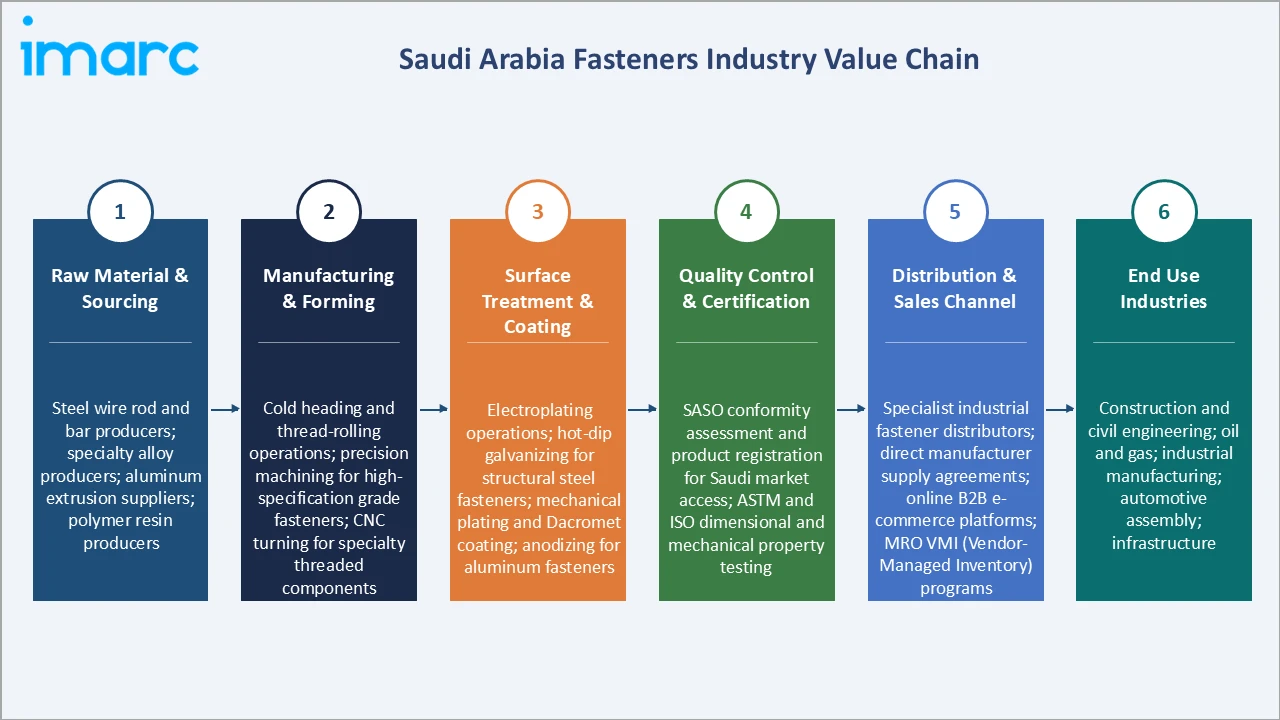
The Saudi Arabia fasteners market value chain spans raw material production through end-use installation, with SASO conformity assessment serving as the critical quality gateway for certified construction and infrastructure applications.
|
Stage |
Key Players / Examples |
| Raw Material & Sourcing |
Steel wire rod and bar producers; specialty alloy producers; aluminum extrusion suppliers; polymer resin producers |
| Manufacturing & Forming |
Cold heading and thread-rolling operations; precision machining for high-specification grade fasteners; CNC turning for specialty threaded components |
| Surface Treatment & Coating |
Electroplating operations; hot-dip galvanizing for structural steel fasteners; mechanical plating and Dacromet coating; anodizing for aluminum fasteners |
| Quality Control & Certification |
SASO conformity assessment and product registration for Saudi market access; ASTM and ISO dimensional and mechanical property testing |
| Distribution & Sales Channel |
Specialist industrial fastener distributors; direct manufacturer supply agreements; online B2B e-commerce platforms; MRO VMI (Vendor-Managed Inventory) programs |
| End Use Industries |
Construction and civil engineering; oil and gas; industrial manufacturing; automotive assembly; infrastructure |
Technology Landscape in the Saudi Arabia Fasteners Industry
High-Strength Structural Fastener Technology
The demand for high-strength structural fasteners is increasing as Saudi Arabia’s construction industry transitions toward higher-rise and more technically complex structural designs that require proof-load rated fastening systems. High-strength bolt tightening technology, including direct tension indicator (DTI) washers, tension control (TC) bolts, and hydraulic tensioning equipment that verifies bolt pre-load without manual torque calculation, is progressively being specified in Saudi large-project structural specifications.
Chemical Anchor and Post-Installed Anchor Systems
The growing adoption of chemical anchor systems is a technology trend with significant market value implications for Saudi Arabia’s construction fastener market. Chemical anchors command 10–20x the installed cost per anchor point compared to mechanical expansion anchors, and their adoption is increasing as Saudi Arabia’s taller and more technically complex buildings require engineered anchor solutions with full structural load capacity documentation under SBC seismic design provisions.
Digital Fastener Management and IoT-Enabled Torque Systems
The digitization of fastener installation verification, through Bluetooth-connected torque wrenches, ultrasonic bolt tension measurement systems, and BIM-integrated fastener specification databases, is gaining traction in Saudi Arabia’s premium construction and oil and gas segments. Saudi Aramco’s Intelligent Enterprise program mandates digital quality documentation for critical infrastructure maintenance activities including bolted joint integrity management, directly driving adoption of digital torque management systems at Aramco facilities.
Market Segmentation Analysis
The report covers the following segments:
|
Segment Category |
Leading Segment |
Market Share |
Year |
| Product | Externally Threaded |
49.8% |
2025 |
| Sales Channel | Offline |
84.7% |
2025 |
| End Use |
🔒 |
🔒 |
2025 |
|
Region |
Northern and Central Region |
36.8% |
2025 |

By Product
The product segment is analyzed across externally threaded (49.8%), internally threaded (31.6%), and non threaded (18.6%). Externally threaded fasteners’ market dominance reflects the breadth of product types included in this category: structural bolts for steel construction; foundation anchor bolts for machinery and equipment mounting; concrete screws and self-tapping screws for wood frame and light steel applications; and specialty high-strength bolts for oil and gas flanged connections.
To access detailed market analysis, Request Sample
Internally threaded fasteners at 31.6% encompass hex nuts, flange nuts, lock nuts, wing nuts, and threaded inserts that complete bolted connections across all end-use applications. Non threaded fasteners at 18.6% cover rivets, spring pins, cotter pins, clips, and washers for diverse assembly applications across automotive, aerospace, electronics, and consumer product manufacturing.
By Sales Channel
The sales channel segment is analyzed across offline (84.7%) and online (15.3%). Offline dominance reflects the construction and industrial project procurement model’s reliance on established distributor relationships, specialist technical support, and bulk delivery logistics that are not yet efficiently served by online platforms.
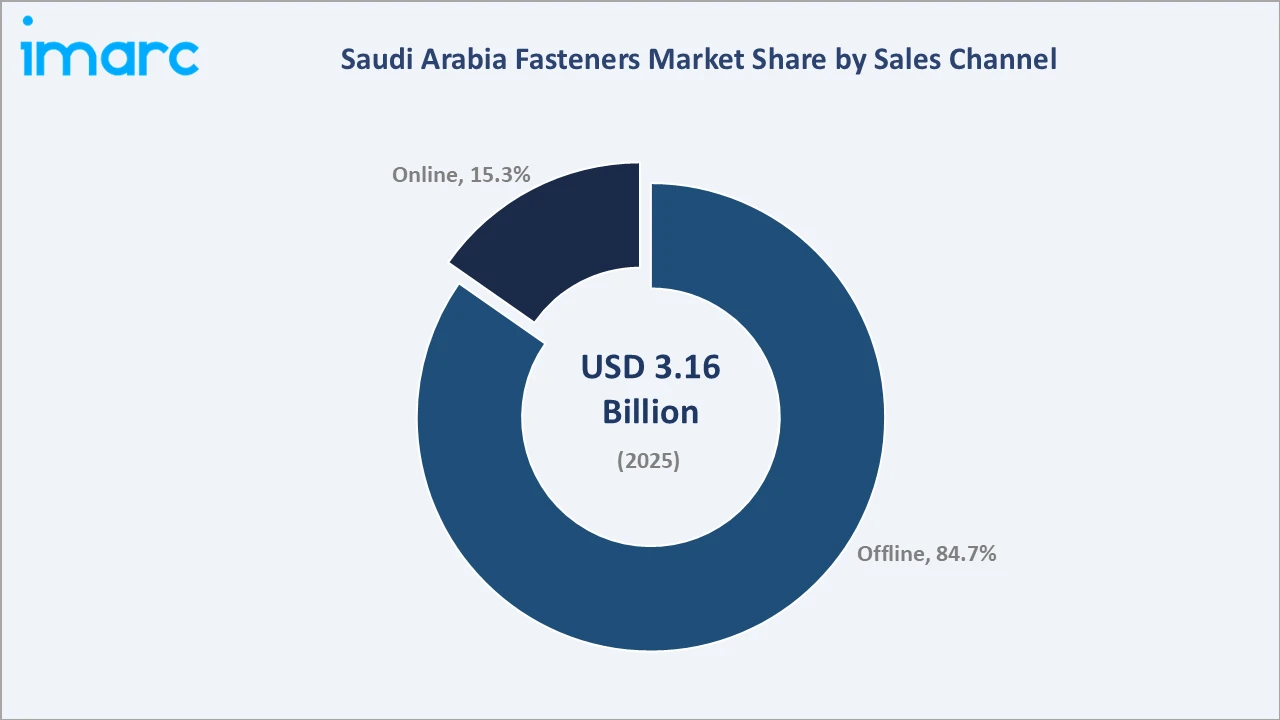
Online serves primarily the small-volume, standard-specification procurement segment: small-to-medium contractors purchasing standard hex bolts and screws; MRO buyers purchasing replacement fasteners for non-critical applications; and retail buyers purchasing general hardware.
Regional Market Insights
The Northern and Central Region’s 36.8% national leadership reflects Riyadh’s dominant role as the Kingdom’s construction, commercial, and industrial activity hub, with the highest concentration of Vision 2030 flagship developments, government institutional construction, and industrial zone development.
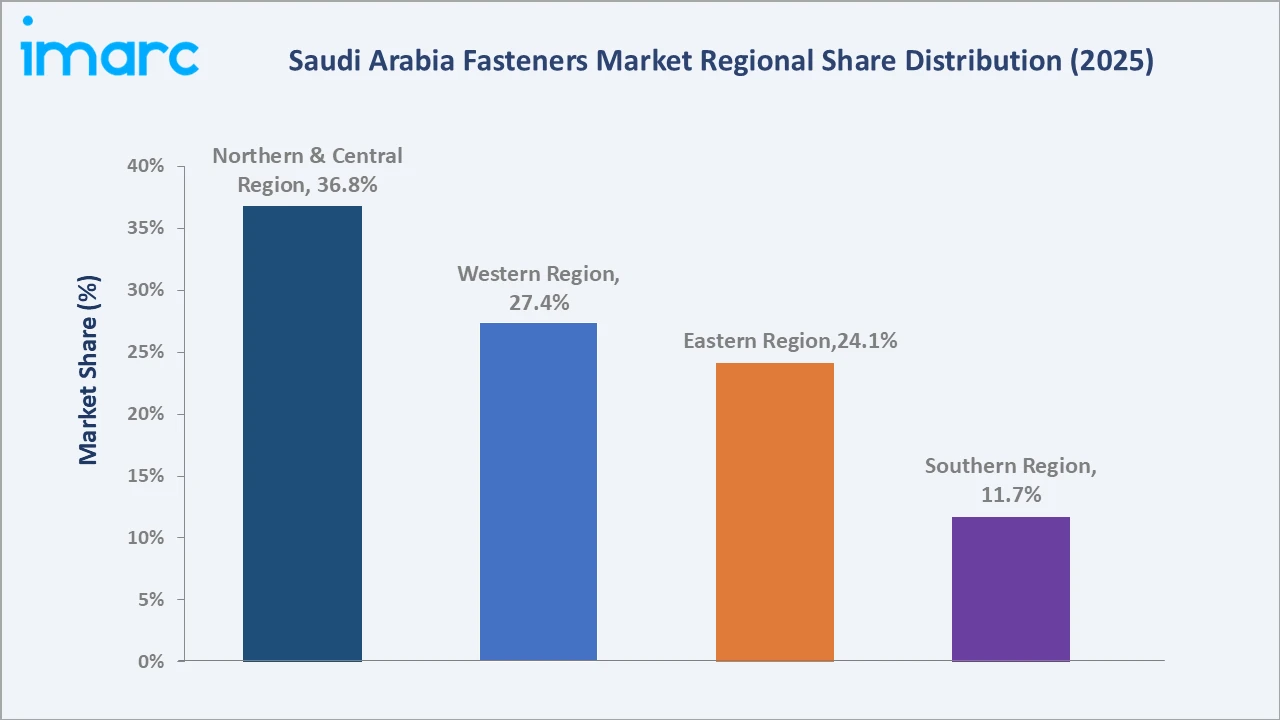
The Eastern Region at 24.1% represents the Kingdom’s oil and gas industrial heartland, generating the highest-value fastener demand through Saudi Aramco’s operations and the Jubail Industrial City complex.
|
Region |
Share (2025) |
Key Growth Drivers |
|
Northern and Central Region |
36.8% |
Highest concentration of Vision 2030 mega-project construction activity; major urban commercial and residential development driving structural fastener demand; industrial zone and logistics city development |
|
Western Region |
27.4% |
Major port city commercial and residential construction; tourism and hospitality mega-project development on Red Sea coast; airport and transport infrastructure expansion; industrial and logistics facility development |
|
Eastern Region |
24.1% |
Oil and gas sector dominance generating premium corrosion-resistant fastener demand for facility maintenance and capital projects; petrochemical industrial complex fastener procurement |
|
Southern Region |
11.7% |
Military and infrastructure project construction; agricultural and food processing facility development; power generation and utility infrastructure expansion |
Competitive Landscape
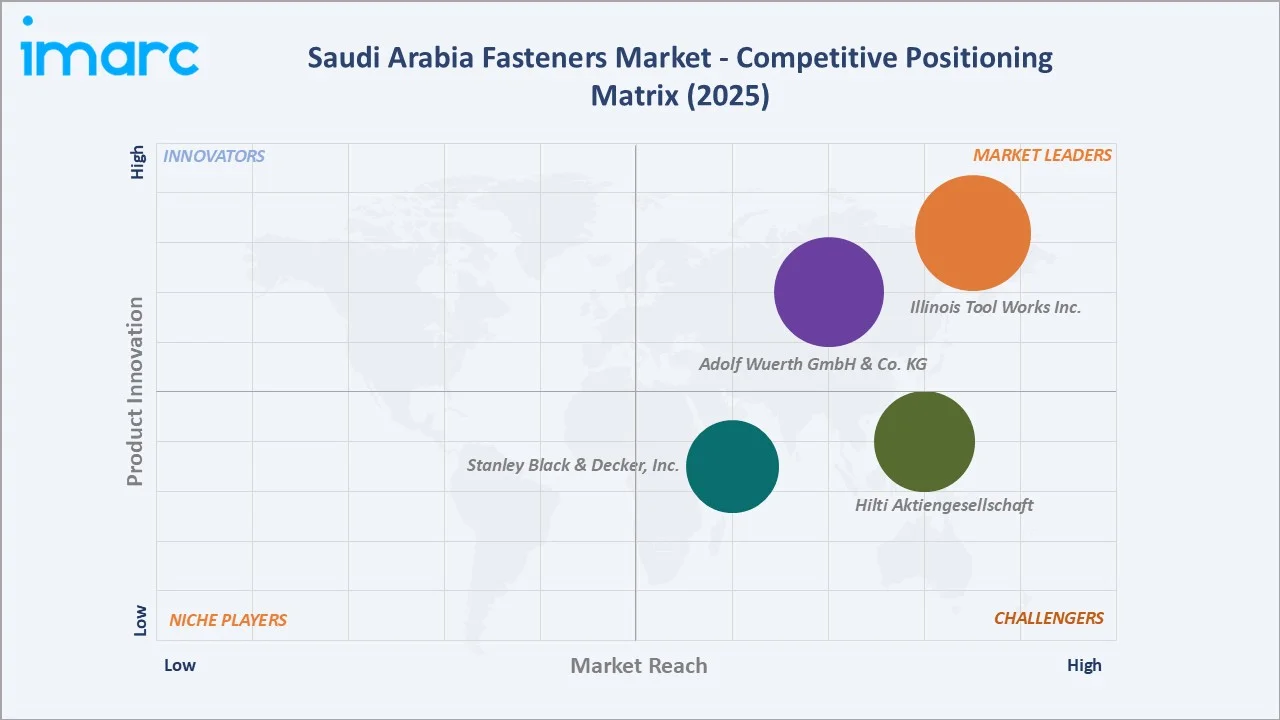
The Saudi Arabia fasteners market is fragmented at the commodity construction grade level and moderately concentrated in the premium industrial, oil and gas, and technical fastener segments.
|
Company Name |
Brand/Product |
Market Position |
Core Strength |
| Illinois Tool Works Inc. | ITW Buildex, Paslode Fastening Systems, Ramset Anchors, Shakeproof Fasteners |
Market Leader |
Diversified industrial fastener and fastening tool portfolio; construction fastening systems; oil and gas segment specialty fasteners; digital engineering support tools |
| Adolf Würth GmbH & Co. KG |
Bolts, Nuts, Rivets, Wood Screws, Sealing Elements, Staples, Nails, Tapping, Thread Rolling, Drilling Screws, Thread Reinforcement And Repair, Threaded Rods, Pieces, Plates, Sockets, Washers, among others |
Market Leader |
Comprehensive catalogue breadth from standard to specialty; strong trade contractor and maintenance buyer relationships |
| Hilti Aktiengesellschaft |
HST4 Wedge Anchor, HST4-R Stainless Steel Wedge Anchor, HST4 BW Wedge Anchor, HST3 Wedge Anchor, HIT-HY 200-R V3 Adhesive Anchor, HIT-RE 500 V4 Epoxy Anchor, among others |
Strong Challenger |
Premium post-installed anchor and fastening system specialist; PROFIS Engineering design software; customer service and digital tool support; fire-rated anchoring solutions |
| Stanley Black & Decker, Inc. |
STANLEY Assembly Technologies, POP rivets, Avdel blind rivets, Nelson, among others |
Strong Challenger |
Aerospace and automotive grade specialty fastener expertise; blind rivet and insert technology; comprehensive specialty fastening tool range |
International fastener manufacturers compete through technical differentiation, SBC compliance documentation, and local engineering service capability. Domestic Saudi distributors compete through established contractor relationships, local stock availability, and competitive pricing on commodity grade imports.
Key Company Profiles
Illinois Tool Works Inc.
Illinois Tool Works Inc. is a diversified global manufacturer of industrial components and systems with one of the world’s broadest fastener and fastening system portfolios spanning construction, automotive, industrial, and food equipment applications.
- Product Portfolio: ITW Buildex construction fasteners (self-drilling screws, anchor systems, concrete fixings); Paslode cordless fastening tools and strip nails for structural timber; Ramset anchor systems and powder-actuated tools for concrete and steel; Shakeproof locking fasteners for industrial vibration-resistance applications; Impulse blind fasteners for blind-hole applications.
- Recent Developments: Illinois Tool Works Inc. reported Q1 2026 revenue of USD 4.02 billion, up 4.6%, while operating margin expanded to 25.4%. The company raised its full-year 2026 GAAP EPS guidance to USD 11.10–11.50 and maintained its revenue growth outlook of 2%–4%.
- Strategic Focus: Engineering fastening system integration with Saudi Arabia’s digital construction workflows; oil and gas specialty fastener portfolio development for Aramco-qualified applications; expansion of digital product selection tools for Saudi contractors; capturing premium fastener demand from Vision 2030 giga-project steel construction programs.
Adolf Würth GmbH & Co. KG
Adolf Würth GmbH & Co. KG is one of the world’s largest trading companies for assembly and fastening materials. In Saudi Arabia, Würth operates through Würth Saudi Arabia, maintaining a direct sales force of technical representatives serving construction contractors, industrial maintenance operations, and automotive aftermarket businesses.
- Product Portfolio: Bolts, nuts, rivets, wood screws, sealing elements, staples, nails, tapping, thread rolling, drilling screws, thread reinforcement and repair, threaded rods, pieces, plates, sockets, and washers, among others.
- Recent Developments: In January 2026, Adolf Würth GmbH & Co. KG announced record 2025 sales of approximately EUR 20.7 billion, up 2.3% year over year. Its operating result remained stable at EUR 940 million before tax, supported by growth in international markets.
- Strategic Focus: Direct sales force expansion to serve Vision 2030 project construction sites with dedicated account management; digital procurement portal development enabling Würth product ordering through integrated construction management platforms.
Market Concentration Analysis
The Saudi Arabia fasteners market exhibits a bifurcated concentration structure: high fragmentation in the commodity construction grade segment, where hundreds of importers and distributors compete on price with limited product differentiation; and moderate concentration in the premium industrial, oil and gas, and post-installed anchor segments, where established international manufacturers with SASO-certified product portfolios and local engineering service capability hold defensible positions.
Investment & Growth Opportunities
Fastest Growing Segments
Online B2B fastener procurement channel (~6.8% CAGR, 1.5x above overall market rate); specialty oil and gas grade fasteners; post-installed anchor systems for seismic and SBC-compliant construction applications; and wind energy and renewable infrastructure specialty fasteners represent the highest-growth, highest-margin investment vectors within the Saudi fasteners market through 2034.
Emerging Market Expansion
NEOM in Saudi Arabia’s Tabuk Province represents the single largest emerging fastener demand geography, with the phased construction of The Line, Sindalah, Aqaba, Qurayyah, and Trojena requiring fastener quantities that will create a substantial discrete fastener procurement market in a previously minimal construction activity region.
Venture and Institutional Investment Trends
- Vision 2030 NIDLP provides financial incentives for domestic fastener manufacturing investment through concessional SIDF loans at 2–4% annual interest, industrial land at nominal lease rates in Saudi industrial cities, and 25% local content bid preference in government project tenders, creating a pathway to commercial competitiveness for domestic fastener manufacturing despite higher Saudi production cost structures relative to Asian import competition.
- Saudi Aramco’s IKTVA program is creating commercial incentives for international fastener manufacturers to establish Saudi Arabia joint ventures or manufacturing partnerships with Saudi industrial companies, enabling IKTVA credit that improves supplier bid competitiveness for Aramco project and MRO procurement tenders.
Future Market Outlook (2026-2034)
The Saudi Arabia fasteners market is positioned for sustained, investment-driven growth through 2034. From a base of USD 3.16 Billion in 2025 to USD 3.30 Billion in 2026, the market is projected to reach USD 4.69 Billion by 2034 at a CAGR of 4.47%, representing total incremental value creation of USD 1.53 Billion.
By 2034, the Eastern Region will grow its market share relative to 2025 as oil and gas CAPEX sustains above-average premium fastener demand growth, while the Western Region’s accelerating tourism infrastructure development will drive above-market growth in the marine-grade and architectural fastener segments.
Research Methodology
Primary Research
Primary research comprised structured interviews with over 65 industry participants in 2024–2025, including construction fastener distributors, oil and gas procurement managers, industrial maintenance buyers, international fastener manufacturer Saudi Arabia country representatives, SASO certification specialists, construction project procurement directors, and industrial zone management authorities across Riyadh, Jeddah, Dammam, and NEOM project sites.
Secondary Research
Secondary research encompassed Saudi Customs Authority import data for fastener HS codes (7318, 7319, 7320), Saudi Arabia General Authority for Statistics industrial production data, SASO product registration database for certified fastener products, Vision 2030 giga-project construction investment announcement data, Saudi Aramco CAPEX and project announcements, National Industrial Development and Logistics Program localization target documentation, and annual reports.
Forecasting Models
Market size estimations were derived using top-down and bottom-up forecasting, incorporating Saudi Arabia construction sector investment pipeline data by project type and construction phase, oil and gas sector CAPEX and production data, industrial manufacturing output growth projections under the National Industrial Strategy, fastener intensity modelling by construction type (tons of fastener per billion SAR of construction value), and import price index adjustments for raw material cost passthrough.
Saudi Arabia Fasteners Market Report Coverage:
| Report Features | Details |
|---|---|
| Base Year of the Analysis | 2025 |
| Historical Period | 2020-2025 |
| Forecast Period | 2026-2034 |
| Units | Billion USD |
| Scope of the Report |
Exploration of Historical Trends and Market Outlook, Industry Catalysts and Challenges, Segment-Wise Historical and Future Market Assessment:
|
| Products Covered | Internally Threaded, Non Threaded, Externally Threaded |
| Sales Channels Covered | Online, Offline |
| End Uses Covered | Automotive, Building and Construction, Aerospace, Machinery, Electronics, Others |
| Regions Covered | Northern and Central Region, Western Region, Eastern Region, Southern Region |
| Companies Covered | Illinois Tool Works Inc., Adolf Würth GmbH & Co. KG, Hilti Aktiengesellschaft, Stanley Black & Decker Inc., etc. |
| Customization Scope | 10% Free Customization |
| Post-Sale Analyst Support | 10-12 Weeks |
| Delivery Format | PDF and Excel through Email (We can also provide the editable version of the report in PPT/Word format on special request) |
Key Benefits for Stakeholders:
- IMARC’s industry report offers a comprehensive quantitative analysis of various market segments, historical and current market trends, market forecasts, and dynamics of the Saudi Arabia fasteners market from 2020-2034.
- The research report provides the latest information on the market drivers, challenges, and opportunities in the Saudi Arabia fasteners market.
- Porter's five forces analysis assist stakeholders in assessing the impact of new entrants, competitive rivalry, supplier power, buyer power, and the threat of substitution. It helps stakeholders to analyze the level of competition within the Saudi Arabia fasteners industry and its attractiveness.
- Competitive landscape allows stakeholders to understand their competitive environment and provides an insight into the current positions of key players in the market.
Frequently Asked Questions About the Saudi Arabia Fasteners Market Report
The Saudi Arabia fasteners market size is estimated at USD 3.30 Billion in 2026 and is projected to reach USD 4.69 Billion by 2034.
The market is expected to grow at a CAGR of 4.47% during 2026-2034, driven by Vision 2030 mega-project construction demand, sustained oil and gas sector capital expenditure, and growing digital procurement channel penetration.
The Northern and Central Region leads with a 36.8% market share in 2025, anchored by Riyadh’s concentration of Vision 2030 flagship developments, government institutional construction, and the highest density of construction contractor and industrial facility activity nationwide.
Externally threaded fasteners dominate with a 49.8% share in 2025, reflecting the universal application of bolts, screws, studs, and threaded rods across Saudi Arabia’s three largest fastener-consuming sectors: construction, oil and gas, and industrial manufacturing.
Offline channels command 84.7% of market share in 2025, reflecting the fastener industry’s reliance on established distributor relationships, project-based bulk procurement, and specialist technical sales support that offline channels deliver more effectively than current online platforms.
Some of the key players include Illinois Tool Works Inc., Adolf Würth GmbH & Co. KG, Hilti Aktiengesellschaft, and Stanley Black & Decker, Inc.
Key drivers include Vision 2030’s construction and infrastructure investment pipeline, National Industrial Strategy manufacturing expansion, Saudi Building Code enforcement driving certified fastener adoption, and e-commerce platform growth expanding market access.
Key challenges include raw material (steel) price volatility creating import cost uncertainty, price competition from low-cost Asian commodity fastener imports, supply chain lead time risk from import dependence, and the skills gap in fastener engineering specification within Saudi Arabia’s construction sector.
Need more help?
- Speak to our experienced analysts for insights on the current market scenarios.
- Include additional segments and countries to customize the report as per your requirement.
- Gain an unparalleled competitive advantage in your domain by understanding how to utilize the report and positively impacting your operations and revenue.
- For further assistance, please connect with our analysts.
 Request Customization
 Speak to an Analyst
 Request Brochure
 Inquire Before Buying
Benefits of Customization
- Personalize this research
- Triangulate with your data
- Get data as per your format and definition
- Gain a deeper dive into a specific application, geography, customer, or competitor
- Any level of personalization
Get in Touch With Us
UNITED STATES
Phone: +1-201-971-6302
INDIA
Phone: +91-120-433-0800
UNITED KINGDOM
Phone: +44-753-714-6104
Email: [email protected]
Client Testimonials




.webp)




.webp)













Related Reports

Choose your plan
*Please note that the prices mentioned below are starting prices for each bundle type. Kindly contact our team for further details.*
Single User License
- 1 User License, Access on 2 Devices
- PDF Report + Excel Dataset (Password Protected)
- Lifetime Access
- No Printing Rights
- 10% Free Report Customization
- 10–12 Weeks of Analyst Support
Five User License
- Access for 5 Users, 2 Devices per User
- PDF Report + Excel Dataset (Password Protected)
- Lifetime Access
- Dedicated Account Manager
- 12–14 Weeks of Analyst Support
- No Printing Rights
- 15% Free Report Customization
- 25% Discount on Your Next Purchase
Corporate User License
- Unlimited User Access (Within Your Organization)
- PDF Report + Excel Dataset
- Lifetime Access
- Dedicated Account Manager
- 14–20 Weeks of Analyst Support
- No Printing Rights
- 20% Free Report Customization
- 30% Discount on Your Next Purchase
Essential Insights
What's included:
3 reports
- Lifetime Access
- PDF Reports
- Excel Datasets
- 2 Weeks of Free Analyst Support
- 2 User Licenses
- Access on 2 Devices
- Printing Rights
- Complimentary PowerPoint (PPT) Version
- Complimentary License Upgrade
Professional Access
What's included:
5 reports
- Lifetime Access
- PDF Reports
- Excel Datasets
- 8 Weeks of Free Analyst Support
- 2 User Licenses
- Access on 2 Devices
- Printing Rights
- Complimentary PowerPoint (PPT) Version
- Complimentary License Upgrade
Business Advantage
What's included:
8 reports
- Lifetime Access
- PDF Reports
- Excel Datasets
- 14 Weeks of Free Analyst Support
- 2 User Licenses
- Access on 2 Devices
- Printing Rights
- Complimentary PowerPoint (PPT) Version
- Complimentary License Upgrade
Enterprise Intelligence
What's included:
10 reports
- Lifetime Access
- PDF Reports
- Excel Datasets
- 20 Weeks of Free Analyst Support
- 2 User Licenses
- Access on 2 Devices
- Printing Rights
- Complimentary PowerPoint (PPT) Version
- Complimentary License Upgrade