
Saudi Arabia Frozen Foods Market Size, Share, Trends and Forecast by Product and Region, 2026-2034
Saudi Arabia Frozen Foods Market Size, Share, Trends & Forecast (2026-2034)
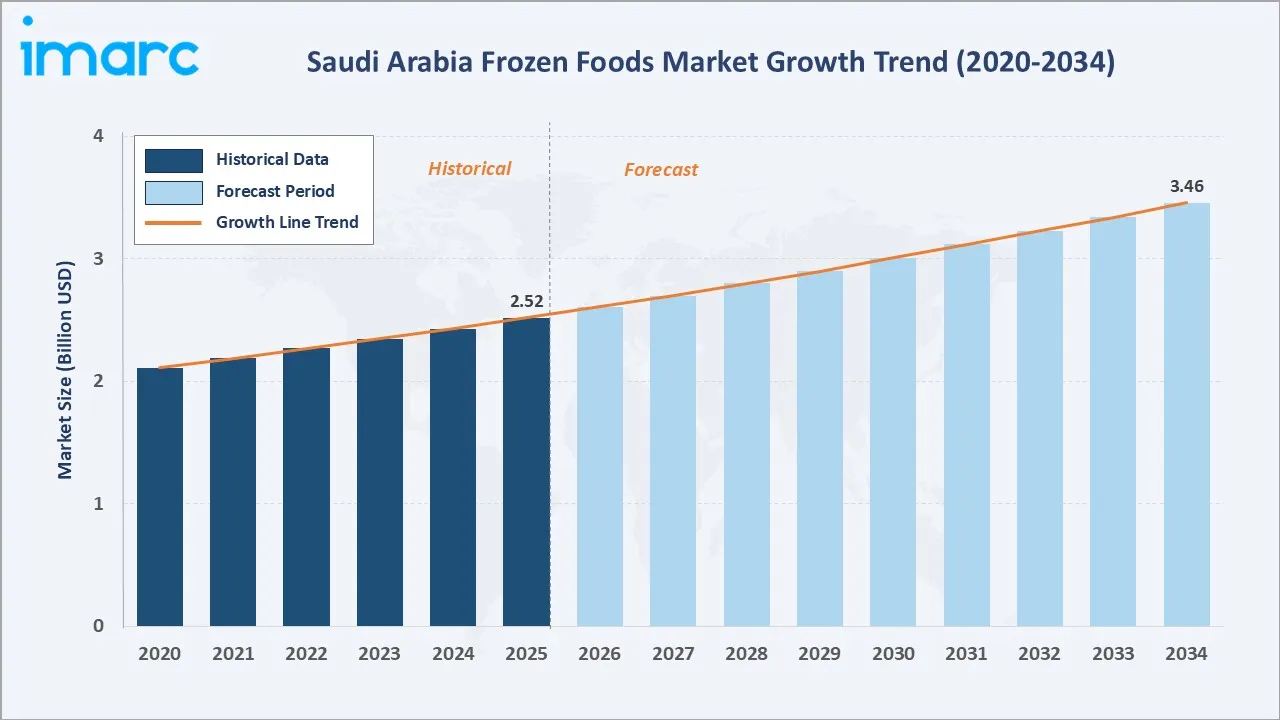
The Saudi Arabia frozen foods market grew from USD 2.52 Billion in 2025 to USD 2.61 Billion in 2026 and is projected to reach USD 3.46 Billion by 2034, growing at a CAGR of 3.59% during 2026-2034. Busy lifestyles, modern retail expansion, and foodservice growth are supporting steady demand. Farm Frites and Americana Foods started production in 2026 at a frozen french fries factory in Sudair Industrial and Business City (Riyadh Region) with an initial capacity of 70,000 tons annually.
Investment in local manufacturing, cold chain infrastructure, and e-grocery platforms continue to broaden access to frozen foods across the Kingdom. Frozen meat products dominate at 40.0%. The Northern and Central Region commands 42.0% of national market share.
Market Snapshot
|
Metric |
Value |
|
Base Year Market Size (2025) |
USD 2.52 Billion |
|
Market Size (2026) |
USD 2.61 Billion |
|
Forecast Market Size (2034) |
USD 3.46 Billion |
|
CAGR (2026-2034) |
3.59% |
|
Base Year |
2025 |
|
Historical Period |
2020-2025 |
|
Forecast Period |
2026-2034 |
|
Dominant Product |
Frozen Meat Products (40.0%, 2025) |
|
Leading Region |
Northern and Central Region (42.0%, 2025) |
The Saudi Arabia frozen foods market size increased from USD 2.11 Billion in 2020 to USD 2.52 Billion in 2025 and is estimated to reach USD 2.61 Billion in 2026. The market is further expected to grow to USD 3.01 Billion by 2030 and USD 3.46 Billion by 2034. Growth reflects rising convenience food consumption and expanding local production.
To get more information on this market, Request Sample
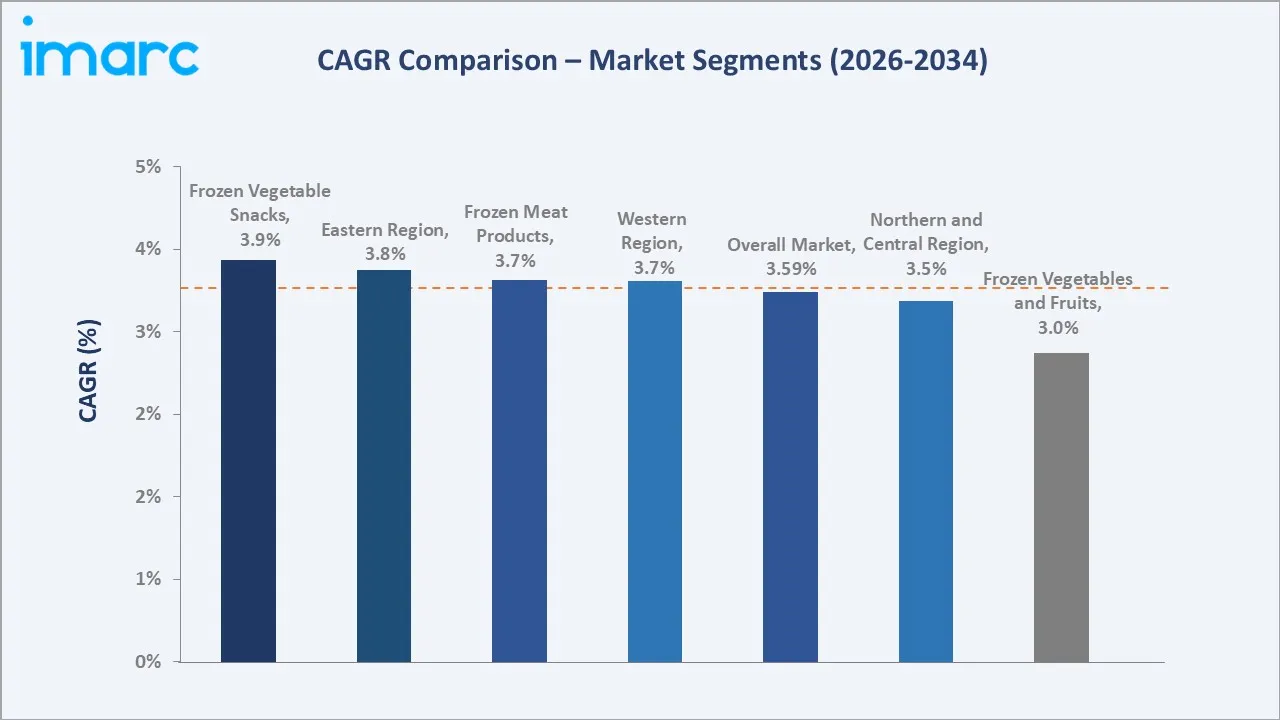
Frozen vegetable snacks are expected to grow fastest at ~3.9% CAGR, supported by demand for fries, appetizers, and ready-to-cook snacks. The Eastern Region follows at ~3.8% CAGR as retail and foodservice networks expand in Dammam and Al Khobar.
Executive Summary
The Saudi Arabia frozen foods market expanded from USD 2.52 Billion in 2025 to an estimated USD 2.61 Billion in 2026. Saudi households increasingly rely on frozen meat, snacks, and vegetables for quick meal preparation, while restaurants and quick-service chains use frozen products for consistency and efficiency. Local and international manufacturers are investing in new plants in line with Vision 2030 food security goals. The market is projected to reach USD 3.46 Billion by 2034. Frozen meat products at 40.0% lead products. The Northern and Central Region leads at 42.0%.
Key Market Insights
|
Insight |
Data |
|
Dominant Product |
Frozen Meat Products - 40.0% share (2025) |
|
Leading Region |
Northern and Central Region - 42.0% share (2025) |
|
Market Opportunity |
Locally produced frozen fries and poultry; ready meals; premium and healthy frozen products; e-grocery and quick commerce |
Key Analytical Observations Supporting the Above Data:
- Frozen Meat Products at 40.0%: Frozen meat products dominate because chicken, beef, and processed meat items such as nuggets, burgers, and sausages are staples in Saudi diets and are widely used by households and foodservice operators.
- Northern and Central Region at 42.0%: The Northern and Central Region leads due to Riyadh’s large population, dense modern retail network, and concentration of restaurants, quick-service chains, and distribution centers.
Saudi Arabia Frozen Foods Market Overview
Frozen foods include frozen meat and poultry products, frozen vegetable snacks such as fries and appetizers, and frozen vegetables and fruits. Freezing preserves freshness, nutrition, and flavor, allowing products to be stored for long periods and distributed across the Kingdom. Frozen foods are sold through hypermarkets, supermarkets, convenience stores, online platforms, and foodservice distributors. Leading players include local food companies, regional processors, and multinational brands.
The industry ecosystem links farmers and meat suppliers, frozen food manufacturers, cold chain providers, packaging suppliers, regulators, retailers, foodservice operators, and consumers. Macroeconomic factors include population growth, urbanization, household income, food import costs, and food security policies, all of which shape demand. Saudi Arabia’s young, urban population and growing expatriate community also support demand for diverse frozen products. Pilgrimage and tourism inflows also create seasonal peaks in foodservice demand.
Role of Vision 2030 in Transforming the Saudi Arabia Frozen Foods Market
Vision 2030 is reshaping the Saudi Arabia frozen foods market through four levers: food security programs that are scaling domestic poultry and potato supply, localization of food processing, investment in cold chain and logistics infrastructure, and digital retail and lifestyle shifts that favor convenient food formats.
Together, these initiatives are reducing import dependence for core frozen categories, strengthening temperature-controlled distribution, and broadening the consumer base for frozen meat, fries, and ready-to-cook products.
Food Security and Poultry Self-Sufficiency
Poultry meat self-sufficiency rose from 45% in 2016 to 68% in 2022, when the Ministry of Environment, Water and Agriculture (MEWA) announced a SAR 17 billion poultry investment plan to 2025 targeting 80% self-sufficiency, with Agricultural Development Fund financing of up to about 70% for projects using advanced technology.
In October 2026, MEWA reported that broiler production had reached about 1.4 million tons, achieving 80% self-sufficiency in poultry meat, with a longer-term target of 90% by 2030. The Agricultural Development Fund approved SAR 6.5 billion in loans in 2025, up 5.8%, covering poultry, red meat, cold storage, automated slaughterhouses, and agro-industrial projects.
GASTAT data also show potato self-sufficiency rising from 87% in 2023 to 93% in 2024, strengthening the local raw material base for frozen fries.
Localization of Food Processing
The Kingdom has more than 1,900 food factories with total investments exceeding SAR 88 billion, and the Ministry of Industry and Mineral Resources aims to attract a further SAR 78 billion of investment into the sector by 2035.
In 2024, MODON launched the world's largest food cluster across Jeddah Second and Third Industrial Cities, spanning more than 11 million sq m with shared cold and dry warehouses and ready-built factories. In January 2026, the Minister of Industry and Mineral Resources visited Seara Food Industries' plant in Jeddah, which has annual capacity exceeding 30,000 tons of chilled and frozen food and total investment, including expansion, of SAR 320 million, and inaugurated a 10,000-ton Siniora Food Industries facility producing chilled and frozen food.
Cold Chain and Logistics Infrastructure
The Master Plan for Logistics Centers, launched in August 2023 under the National Transport and Logistics Strategy, provides for 59 centers covering more than 100 million sq m, all to be completed by 2030. By 2024, 23 logistics centers covering 34.6 million sq m had been activated, and the Kingdom had 12,234 licensed commercial warehouses with a total area of 22 million sq m.
The Saudi Food and Drug Authority (SFDA) requires chilled and frozen food shipments to carry a data logger activated from the time of shipping, and its technical guidance requires refrigerated vehicles to be equipped with electronic temperature-measuring devices, raising compliance standards across the cold chain.
Delivery Platforms and Changing Lifestyles
Delivery applications processed more than 290 million orders in 2024, up 27.2%, supporting foodservice and home-delivery demand. The employment rate of Saudi women reached 31% in Q4 2025, up 4.2 percentage points over five years, adding to the dual-income households that favor quick-to-prepare frozen meals.
Implications for Market Participants
Rising domestic poultry and potato supply favors local processors that can convert raw output into branded frozen products, while food clusters and logistics centers lower the cost of entry for new capacity. Stricter SFDA cold chain rules and fast-growing online ordering and delivery reward suppliers with temperature-controlled distribution and last-mile capabilities.
Market Dynamics
To evaluate market opportunities, Request Sample
Market Drivers
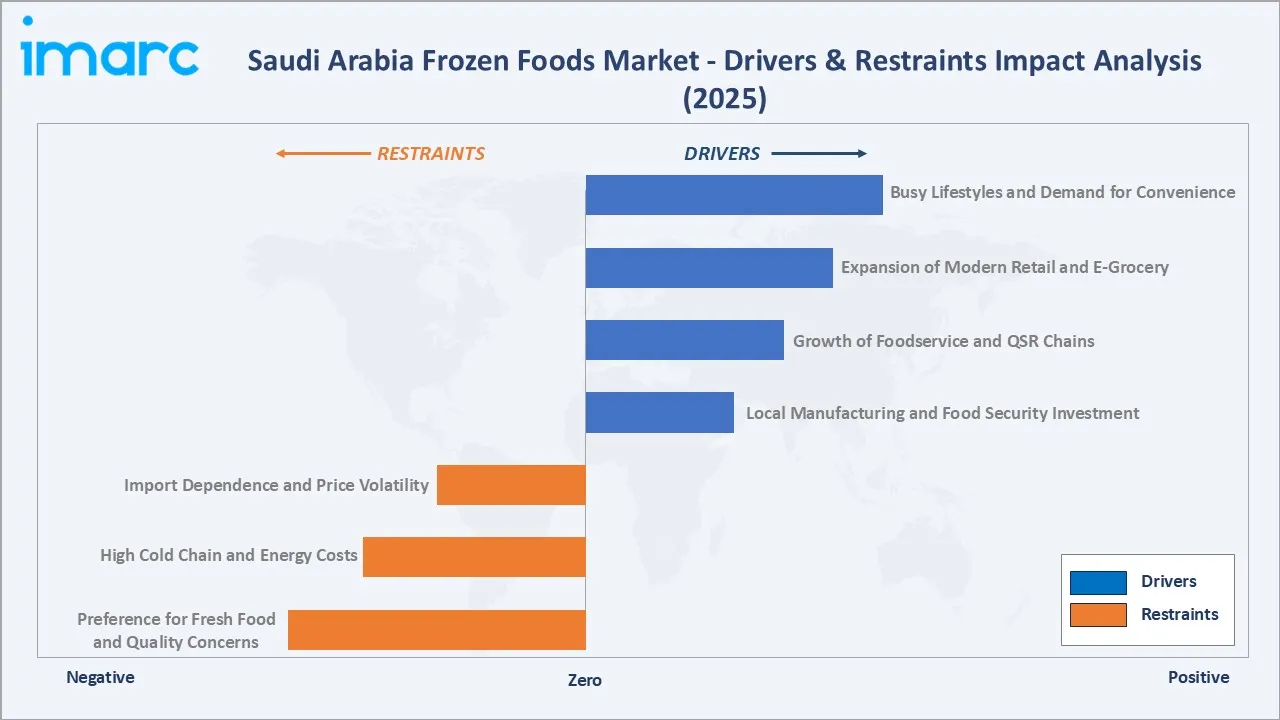
- Busy Lifestyles and Demand for Convenience: Rising workforce participation, including more women entering employment, and longer working hours are increasing demand for quick, easy meal solutions. Frozen foods allow households to prepare meals in minutes while reducing food waste and shopping frequency. Young professionals, students, and expatriate workers living alone or in small households find frozen products particularly practical. Larger family stock-up purchases, especially during Ramadan and holiday seasons, also lift frozen food sales, as families prepare traditional dishes and snacks for gatherings with ready-to-cook ingredients. Rising awareness of food safety and hygienic processing also supports confidence in packaged frozen products from trusted brands. Growing female workforce participation has particularly increased demand for easy-to-prepare family meals. Smaller household sizes in cities further favor convenient, portioned frozen products that reduce preparation time and waste.
- Expansion of Modern Retail and E-Grocery: Hypermarkets, supermarkets, and online grocery platforms are expanding frozen food sections and offering a wide range of local and imported brands. Quick commerce and home delivery make frozen products more accessible to busy consumers. Retailers are investing in larger freezer displays, private label ranges, and in-store promotions that encourage trial of new products. Online platforms with reliable cold chain delivery are expanding frozen food reach beyond major cities, while digital promotions and bundled offers encourage regular repeat purchases. Convenience stores at fuel stations and residential areas are also adding frozen food freezers to capture impulse purchases. Retailers also use frozen food promotions to drive store traffic during key shopping seasons. Wider product ranges from local and international brands are giving consumers more choice.
- Growth of Foodservice and QSR Chains: Restaurants, cafes, and quick-service chains rely on frozen fries, chicken, and appetizers for consistent quality and efficient operations. Tourism, entertainment, and events under Vision 2030 are increasing foodservice demand. Delivery apps and cloud kitchens are also expanding, creating additional demand for frozen ingredients that can be stored and prepared quickly. Large events, entertainment destinations, and new hotels add to the steady growth of institutional frozen food purchases. Hospitals, schools, airlines, and catering companies also rely on frozen foods for consistent quality and supply. Foodservice buyers value frozen products for portion control, reduced waste, and year-round availability. Central kitchens serving multiple outlets also depend heavily on frozen ingredients.
- Local Manufacturing and Food Security Investment: Government food security priorities are encouraging investment in local frozen food production, reducing reliance on imports and improving supply reliability. New plants for frozen fries, poultry, and processed meat are expanding domestic capacity and creating jobs for Saudi nationals. Localization also helps manufacturers respond faster to local taste preferences and reduce logistics costs. Government support through industrial cities, financing, and incentives further encourages local food manufacturing. Partnerships between local and international firms bring technology and expertise to the Kingdom. New capacity also supports exports to neighboring Gulf markets. Further details on Saudi Arabia's food security initiatives, localization policies, and cold chain development are covered in the Vision 2030 section above.
Market Restraints
- Preference for Fresh Food and Quality Concerns: Many consumers still prefer fresh meat and produce and perceive frozen foods as lower in quality or nutrition, limiting adoption in some categories. Traditional cooking habits and the availability of fresh markets in many cities reinforce this preference. Brands are investing in education and marketing to highlight the quality and nutrition of modern frozen foods. Visible quality improvements and trusted brands are gradually changing consumer perceptions. Younger consumers are generally more open to frozen products than older generations.
- High Cold Chain and Energy Costs: Maintaining frozen storage and transport in extreme heat requires significant energy and investment, raising costs across the supply chain. Power interruptions or poor handling can damage products and lead to waste. High electricity consumption for freezers also adds to retailer and distributor operating costs.
- Import Dependence and Price Volatility: A large share of frozen meat and potato products is imported, exposing the market to global price changes and supply disruptions. Currency movements and shipping costs can further affect pricing. Disruptions in global trade can also cause temporary shortages of key frozen products. Importers are diversifying supplier countries to reduce supply risk. Rising local production is expected to gradually reduce this exposure.
Market Opportunities
- Ready Meals and Premium Frozen Products: Demand for frozen ready meals, premium cuts, and international cuisines offers higher-value opportunities for manufacturers. Premium ranges featuring regional and international flavors appeal to younger and more affluent consumers. Gourmet frozen desserts and international cuisine ranges are also gaining shelf space. Seasonal and limited-edition products help brands keep consumers engaged. Kids’ ranges and family packs also support category expansion.
- Healthy and Clean-Label Frozen Foods: Consumers seeking healthier options create demand for frozen vegetables, fruits, and products with natural ingredients and lower fat and sodium. Frozen fruits for smoothies and desserts are also gaining popularity in urban households. Plant-based frozen products represent a small but emerging niche. Interest in high-protein and low-carb frozen meals is also rising among fitness-conscious consumers. Clean-label claims and natural ingredients are increasingly important purchase factors.
Market Challenges
- Cold Chain Gaps in Smaller Cities: Limited cold storage and refrigerated transport in remote areas can affect product quality and availability. Investment in regional cold storage hubs can help address these gaps. Partnerships with logistics providers can extend frozen distribution to smaller towns. Retailers are also expanding store networks in smaller cities, improving access to frozen foods. Mobile cold storage units can also support seasonal demand peaks. Coordination between retailers and suppliers improves availability in remote areas. Shared cold storage facilities can also reduce costs for smaller producers and distributors entering new regions. Third-party logistics providers are investing in modern frozen warehouses near major cities. Such facilities improve stock availability during peak seasons in the Kingdom.
- Intense Price Competition: Competition between local producers, importers, and private labels puts pressure on prices and margins. Brands must differentiate through quality, innovation, and marketing to protect market share. Private label growth at major retailers adds further pricing pressure. Consumers often switch brands based on promotions, making loyalty programs important. Strong brands use quality and innovation to justify premium pricing. Value packs help attract price-sensitive shoppers. Loyalty programs and digital coupons from major retailers further influence brand choice and encourage repeat purchases across frozen food categories.
Emerging Market Trends
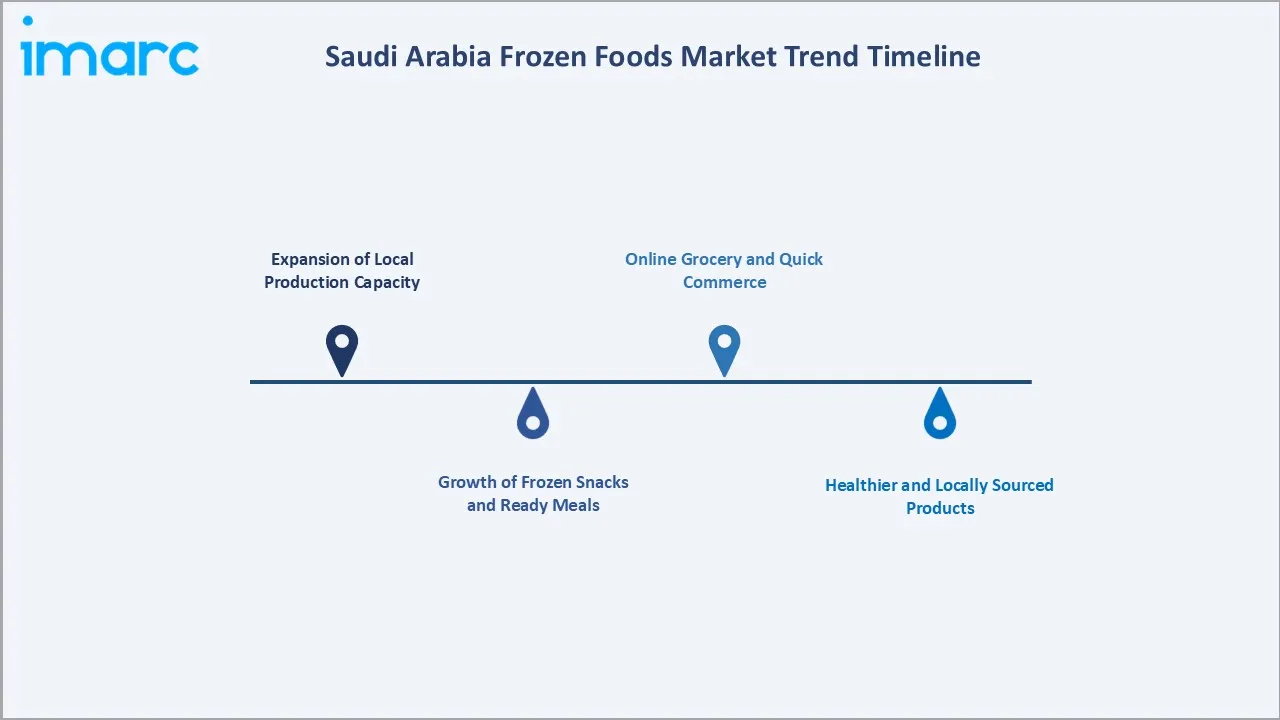
1. Expansion of Local Production Capacity
Manufacturers are building new plants for frozen fries, poultry, and processed meat in Saudi Arabia to meet rising demand and support Vision 2030 localization targets. These investments are reducing reliance on imported frozen products and improving supply security. Plants located in industrial cities benefit from infrastructure and government support. New capacity is expected to come online steadily over the forecast period.
2. Growth of Frozen Snacks and Ready Meals
Frozen fries, appetizers, pastries, and ready meals are gaining popularity among younger consumers and busy families seeking quick and tasty options. Product innovation in flavors, coatings, and portion sizes supports continued category growth. Frozen pastries and baked goods are also popular, especially during Ramadan. Samosas, spring rolls, and pastries are traditional favorites during this season. Manufacturers increase production ahead of Ramadan to meet peak demand. Promotional activity also peaks during this period, supporting strong seasonal sales. Hajj and Umrah seasons similarly increase demand from hotels and catering services in the Western Region.
3. Online Grocery and Quick Commerce
E-grocery platforms and quick commerce apps are expanding frozen food assortments with reliable cold chain delivery, increasing convenience and reach. Digital marketing and personalized offers are helping brands reach new customers online. Subscription and bulk-buy options are emerging for regular frozen food buyers. Quick delivery windows have made online frozen food purchases more reliable. Online channels are especially popular among younger, urban consumers. Bulk packs and family bundles are popular choices on e-grocery platforms. Retailers are using customer data to tailor frozen food promotions and assortments. Same-day delivery services have also made frozen food orders more convenient for households in major cities.
4. Healthier and Locally Sourced Products
Brands are highlighting locally sourced ingredients, clean labels, and healthier formulations to build consumer trust and differentiate from imports. Halal certification and transparent sourcing remain important purchase factors for Saudi consumers. Clear labeling of origin and ingredients helps brands build loyalty. Products highlighting Saudi-grown or Saudi-produced ingredients are gaining popularity. Sustainability claims are also beginning to influence purchasing decisions. Retailers increasingly highlight local products in promotions and store displays.
Industry Value Chain Analysis
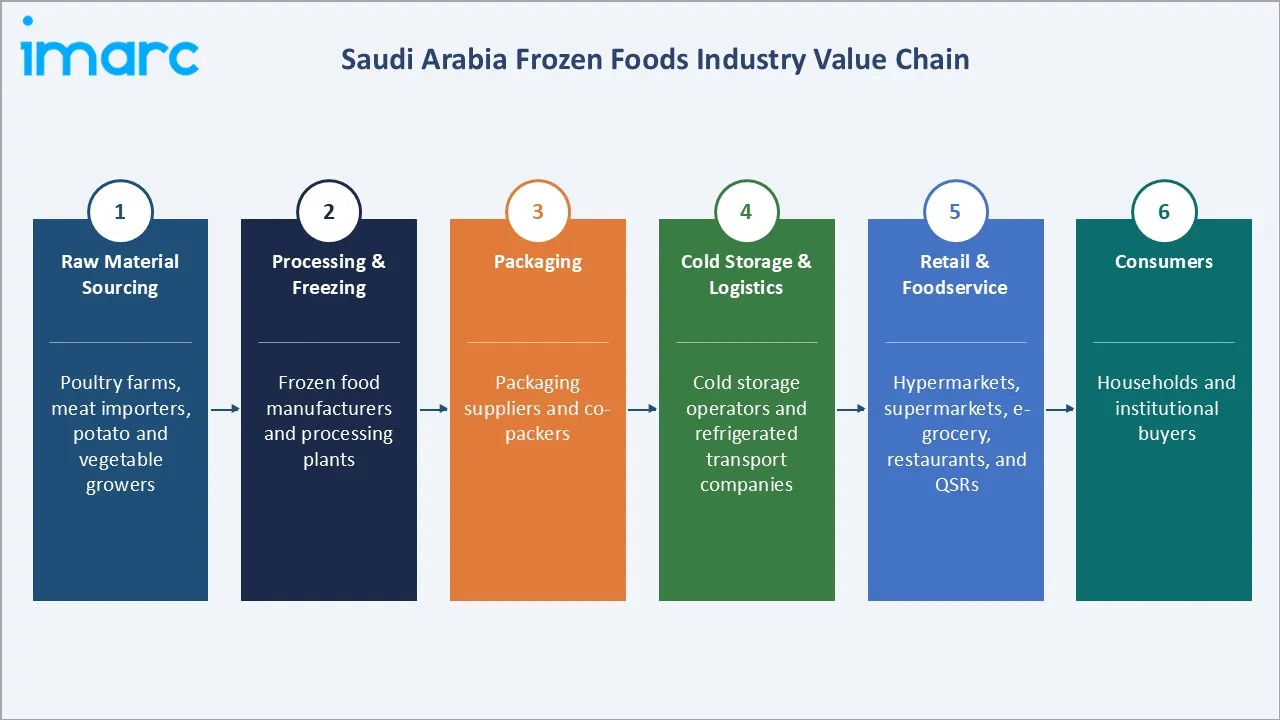
The Saudi Arabia frozen foods value chain spans raw material sourcing, processing and freezing, packaging, cold storage and logistics, retail and foodservice, and consumers. Value is concentrated in processing, branding, and cold chain distribution.
|
Stage |
Key Participants |
|
Raw Material Sourcing |
Poultry farms, meat importers, potato and vegetable growers |
|
Processing & Freezing |
Frozen food manufacturers and processing plants |
|
Packaging |
Packaging suppliers and co-packers |
|
Cold Storage & Logistics |
Cold storage operators and refrigerated transport companies |
|
Retail & Foodservice |
Hypermarkets, supermarkets, e-grocery, restaurants, and QSRs |
|
Consumers |
Households and institutional buyers |
Cold storage and logistics is the most consequential stage of the chain. Reliable frozen distribution in extreme heat determines product quality, shelf life, and availability across the Kingdom. Processing and branding also add significant value by creating products that meet local tastes. Efficient logistics help maintain product quality from factory to consumer. Retail and foodservice channels determine product visibility and reach. Packaging plays a key role in protecting products and communicating brand value. Strong brands can command premium prices in key product categories. Smaller brands often compete through niche products and regional distribution. Collaborations with chefs and influencers are also helping brands promote new frozen recipes and meal ideas to younger audiences across social media platforms.
Technology Landscape in the Saudi Arabia Frozen Foods Industry
Individual Quick Freezing and Advanced Processing
IQF and blast freezing technologies preserve texture, taste, and nutrients, improving the quality of frozen meat, vegetables, and fruits. Modern processing lines also improve efficiency and food safety. Automation reduces labor needs and improves consistency in high-volume production. Advanced quality control systems help meet SFDA and halal requirements. Traceability systems allow companies to track products from source to shelf. These systems support rapid recalls and strengthen consumer trust.
Cold Chain Monitoring and Storage Automation
Temperature sensors, IoT monitoring, and automated cold storage systems ensure product safety and reduce losses across the supply chain. Real-time data helps distributors respond quickly to temperature deviations. Solar-powered cold storage is being explored to reduce energy costs. Energy-efficient freezers and refrigerants also help lower environmental impact. Fleet tracking helps logistics providers maintain delivery schedules and temperatures. Warehouse management systems also optimize inventory and reduce spoilage.
Packaging and Shelf-Life Innovation
Vacuum packaging, resealable bags, and moisture-resistant materials extend shelf life and improve convenience for consumers. Sustainable and recyclable packaging is gaining attention among retailers and consumers. Portion-controlled packs support convenience and reduce waste. Clear cooking instructions and microwave-ready formats improve consumer convenience. Freezer-to-oven and air-fryer-ready formats are becoming more common. Clear nutritional information on packs helps health-conscious shoppers make informed choices.
Market Segmentation Analysis
The report covers the following segments:
|
Segment Category |
Leading Segment |
Market Share |
Year |
|
Product |
Frozen Meat Products |
40.0% |
2025 |
|
Region |
Northern and Central Region |
42.0% |
2025 |

By Product
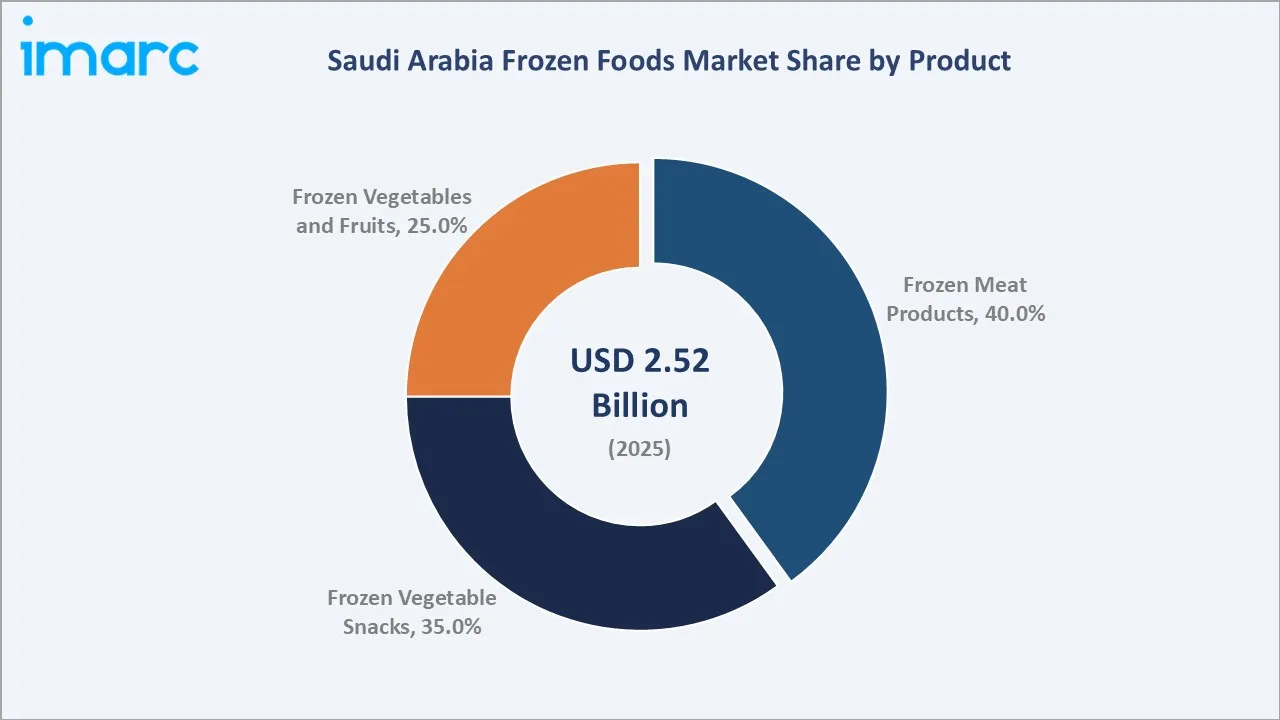
Frozen meat products lead at 40.0% (2025). Chicken, beef, and processed meat items are central to Saudi meals and are widely purchased by households and foodservice operators.
To access detailed market analysis, Request Sample
Frozen vegetable snacks at 35.0% are growing fastest at ~3.9% CAGR, driven by fries and appetizers. Frozen vegetables and fruits at 25.0% are growing at ~3.0%, supported by health-conscious consumers. Mixed vegetables, peas, corn, and berries are popular choices in this segment. Frozen fruits are increasingly used in smoothies, desserts, and baking. Frozen vegetables also offer year-round availability regardless of season. Frozen fruits also support growing demand for healthy snacks and beverages. Retailers are dedicating more freezer space to healthy and organic frozen ranges.
Regional Market Insights
|
Region |
Share (2025) |
Key Saudi Arabia Frozen Foods Market Drivers & Characteristics |
|
Northern and Central Region |
42.0% |
Riyadh’s large population, modern retail, and foodservice concentration. |
|
Western Region |
28.0% |
Jeddah, Makkah, and Madinah with strong pilgrimage and tourism demand. |
|
Eastern Region |
20.0% |
Dammam and Al Khobar with growing retail and expatriate demand. |
|
Southern Region |
10.0% |
Emerging retail networks and tourism projects. |
The Northern and Central Region's 42.0% market leadership reflects Riyadh's large population, modern retail network, and foodservice concentration. The Western Region's 28.0% reflects strong demand in Jeddah, Makkah, and Madinah, supported by pilgrimage and tourism. Large hotel and catering operations in the region are major buyers of frozen products.
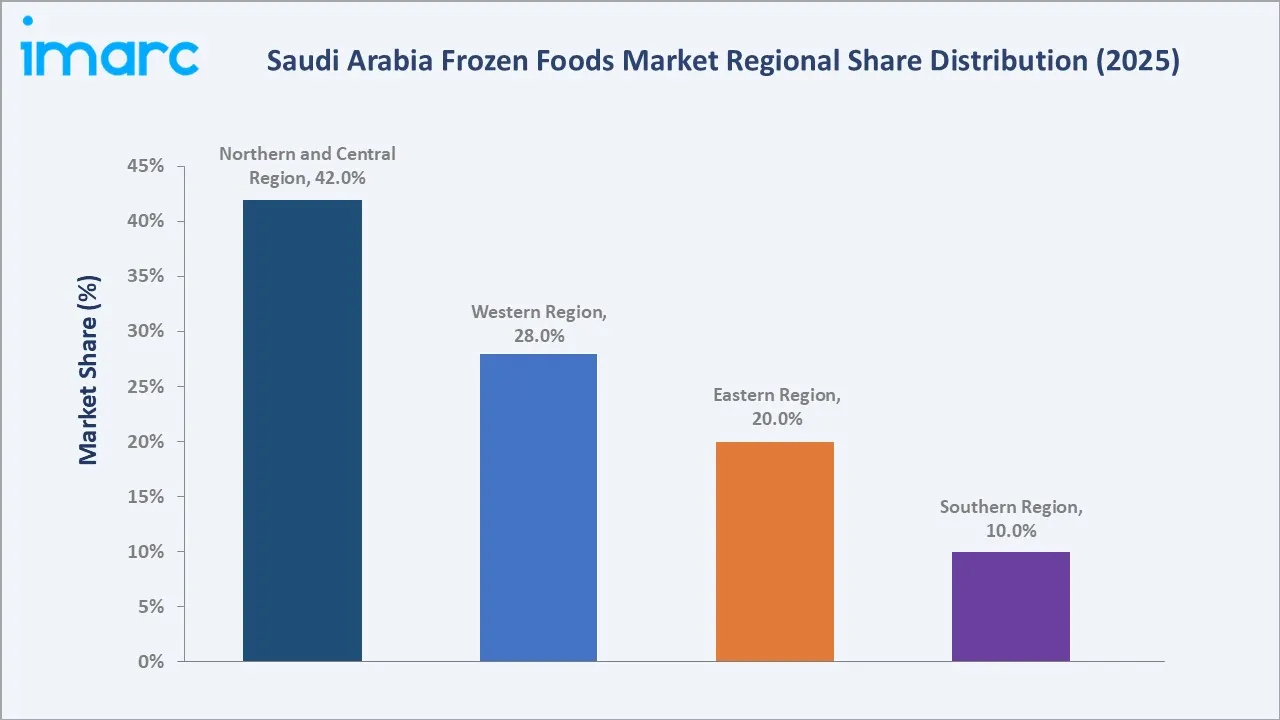
The Eastern Region's 20.0% reflects growing retail and expatriate demand in Dammam and Al Khobar. The Southern Region's 10.0% is the smallest share, but expanding retail networks support steady growth. Tourism projects in Asir and the southern coast are expected to increase foodservice demand. Improving cold chain infrastructure will support gradual market expansion in the region. Growing populations in Jazan and Asir also support rising retail demand. Retailers are expanding store formats with larger frozen sections in these areas. Improving road and logistics infrastructure is expected to support distribution growth.
Recent Developments in the Saudi Arabia Frozen Foods Market
Recent developments show a market adding local frozen fries and processed poultry capacity, deepening partnerships between international food companies and Saudi investors, and investing in value-added product lines.
- October 2026: Farm Frites announced the start of production at its frozen fries factory in Sudair Industrial and Business City, its second joint venture with Americana Foods. Operational since mid-July 2026, the plant has an initial capacity of 70,000 tons of finished product per year, with plans to double capacity, and processes Saudi-grown potatoes.
- October 2026: Al Jouf Agricultural Development Company completed construction of its french fries plant expansion and began trial operation on 30 September 2026; the project is designed to increase production capacity by 50%.
- August 2026: Savola Group reported that its frozen food business, Al Kabeer, recorded revenue of SAR 411 million in the first half of 2026, down 1.4% year-on-year as the regional geopolitical situation weighed on trading conditions in Saudi Arabia, while net profit rose 19.9% to SAR 36 million on a stronger, higher-margin product mix.
- May 2026: MBRF and PIF-owned HPDC completed a USD 2.07 billion transaction establishing Sadia Halal, consolidating MBRF's manufacturing facilities in Saudi Arabia and the UAE, alongside distribution operations across five Gulf countries. MBRF retained a 90% stake, while HPDC acquired 10%, with plans to increase its ownership to at least 20% by June 2027 or before the IPO. A potential listing on the Saudi Exchange is anticipated from 2027, subject to regulatory approvals and market conditions.
Competitive Landscape
The Saudi Arabia frozen foods market includes large local food companies, regional processors, and international brands. Competition centers on product quality, brand trust, halal certification, pricing, and cold chain distribution.
|
Company |
Key Brands |
Market Position |
Core Strength |
|
Almarai |
Alyoum, 7DAYS |
Market Leader |
Integrated poultry and food production with wide distribution. |
|
BRF Global |
Sadia, Perdigão |
Market Leader |
Leading frozen poultry and processed meat brand. |
|
Sunbulah Group |
Al Sunbulah |
Strong Challenger |
Frozen pastries, vegetables, and processed meat. |
|
Agthia Group PJSC |
Agthia Protein & Frozen Products |
Strong Challenger |
Frozen and processed meat manufacturing in Jeddah. |
|
Tanmiah Food Company |
Tanmiah, Supreme |
Strong Challenger |
Vertically integrated Saudi poultry producer. |
|
McCain Foods Limited |
McCain |
Innovator |
Global frozen potato product leader. |
|
Farm Frites |
Farm Frites |
Niche Player |
Frozen fries with new local production in Riyadh. |
The most important competitive dynamic is the shift toward local production. Companies building plants in Saudi Arabia gain advantages in freshness, supply reliability, and alignment with Vision 2030. Partnerships between international brands and local companies are increasingly common. Strong distribution networks and retailer relationships remain key competitive advantages. Halal certification, quality consistency, and local production are important differentiators. Extensive distribution reach gives leading players an advantage in serving retail and foodservice. Companies with their own cold chain fleets can maintain quality and respond quickly to customer needs.
Key Company Profiles
Farm Frites
Farm Frites, founded in 1971 as an independent family business, processes over 1.2 million tons of potato products annually and supplies frozen fries to foodservice and retail customers.
- Key Brands: Farm Frites.
- Recent Developments: Farm Frites, in partnership with Americana Foods, began production in mid-July 2026 at its greenfield frozen french fries factory in Sudair Industrial and Business City, Riyadh Region, with an initial capacity of 70,000 tons per year.
- Strategic Focus: Becoming the largest producer of frozen french fries in the MENA region, with Saudi Arabia as its fifth largest market.
Tanmiah Food Company
Tanmiah Food Company, established in 1962, is one of the Middle East’s leading providers of poultry, processed proteins, animal feed, and health products.
- Key Brands: Tanmiah, Supreme.
- Recent Developments: In December 2025, Tanmiah launched a new frozen breaded chicken range for retail and foodservice channels.
- Strategic Focus: Expanding processing capacity, including a new poultry processing plant in Al Majmaa and a feed mill in Dahna.
Agthia Group PJSC
Agthia Group PJSC is a leading food and beverage company in the Middle East with protein, snacks, and other food businesses.
- Key Brands: Agthia protein and frozen meat products.
- Recent Developments: In July 2024, Agthia opened a new protein manufacturing facility in Jeddah with a capacity of 9,000 tons per year to meet demand for frozen and processed meat products.
- Strategic Focus: Expanding its frozen and processed protein portfolio in Saudi Arabia.
Market Concentration Analysis
The Saudi Arabia frozen foods market is moderately concentrated, with a few large companies leading frozen poultry and processed meat, while many importers and regional brands compete in snacks and vegetables.
Market concentration is evolving as new local plants strengthen leading players, while imports and private labels continue to compete on price. Mergers, acquisitions, and joint ventures are also shaping the competitive landscape. International brands compete through quality, innovation, and global sourcing. Price competition is particularly strong in frozen chicken and fries. Local producers benefit from freshness and shorter supply chains compared with importers. Product innovation in flavors, formats, and healthier recipes is increasingly important for maintaining shelf space and consumer interest in a crowded market.
Investment & Growth Opportunities
Highest Growth Segments
Frozen vegetable snacks (~3.9% CAGR through fries and appetizers), the Eastern Region (~3.8% CAGR through retail growth), frozen meat products (~3.7% CAGR through foodservice), and the Western Region (~3.7% CAGR through tourism) represent the highest-growth investment areas through 2034.
Emerging Investment Opportunities
Local frozen potato and poultry processing are among the most promising opportunities, supporting food security and reducing imports. Investment in ready meals and premium frozen products also offers attractive returns. Cold chain logistics and e-grocery fulfilment are additional attractive areas for investment. Investment in automation and energy-efficient facilities can also improve competitiveness.
Investment Themes
- Cold chain infrastructure: Storage and logistics improve reach and quality.
- Ready meals and premium products: Higher-value products attract growing demand.
Future Market Outlook (2026-2034)
The Saudi Arabia frozen foods market is projected to grow from USD 2.52 Billion in 2025 to USD 2.61 Billion in 2026, reaching USD 3.46 Billion by 2034, registering a CAGR of 3.59% during 2026-2034. The anchor value of USD 3.01 Billion in 2030 marks a point at which local production should supply a larger share of demand. By then, e-grocery and quick commerce should also account for a larger share of frozen food sales. Healthier and premium frozen products are expected to gain share over the forecast period.
Three structural forces define Saudi Arabia frozen foods market growth through 2034 convenience-driven consumption; foodservice expansion; and local manufacturing investment. Together, these forces support steady growth across products and regions over the forecast period.
Research Methodology
Primary Research
Primary research comprised structured interviews with industry stakeholders, including manufacturers, importers, distributors, retailers, and foodservice operators across Saudi Arabia.
Secondary Research
Secondary research covered company press releases, government statistics, trade data, and industry reports. Over 50 credible secondary sources were reviewed, compared, and cross-checked for accuracy and consistency across datasets. Sources include Ministry of Environment, Water and Agriculture (MEWA) releases, General Authority for Statistics (GASTAT) food security, logistics, and labor statistics, Saudi Food and Drug Authority (SFDA) regulations, Saudi Press Agency (SPA) releases, Saudi Exchange filings, company press releases, and business news.
Forecasting Models
Market revenue forecasts were developed using a consumption-based model: frozen food volumes by product and region multiplied by average prices, with segment results aggregated to total market value. Assumptions were validated through detailed discussions with experienced industry experts, manufacturers, cold chain providers, and retail buyers across Saudi Arabia.
Saudi Arabia Frozen Foods Market Report Coverage:
| Report Features | Details |
|---|---|
| Base Year of the Analysis | 2025 |
| Historical Period | 2020-2025 |
| Forecast Period | 2026-2034 |
| Units | Billion USD |
| Scope of the Report |
Exploration of Historical Trends and Market Outlook, Industry Catalysts and Challenges, Segment-Wise Historical and Future Market Assessment:
|
| Products Covered |
|
| Regions Covered | Northern and Central Region, Western Region, Eastern Region, Southern Region |
| Companies Covered | Almarai, BRF Global, Sunbulah Group, Agthia Group PJSC, Tanmiah Food Company, McCain Foods Limited, Farm Frites, etc. |
| Customization Scope | 10% Free Customization |
| Post-Sale Analyst Support | 10-12 Weeks |
| Delivery Format | PDF and Excel through Email (We can also provide the editable version of the report in PPT/Word format on special request) |
Key Benefits for Stakeholders:
- IMARC’s industry report offers a comprehensive quantitative analysis of various market segments, historical and current market trends, market forecasts, and dynamics of the Saudi Arabia frozen foods market from 2020-2034.
- The research report provides the latest information on the market drivers, challenges, and opportunities in the Saudi Arabia frozen foods market.
- Porter's five forces analysis assist stakeholders in assessing the impact of new entrants, competitive rivalry, supplier power, buyer power, and the threat of substitution. It helps stakeholders to analyze the level of competition within the Saudi Arabia frozen foods industry and its attractiveness.
- Competitive landscape allows stakeholders to understand their competitive environment and provides an insight into the current positions of key players in the market.
Frequently Asked Questions About the Saudi Arabia Frozen Foods Market Report
The market size is estimated at USD 2.61 Billion in 2026, supported by convenience demand and retail expansion.
The market grows at 3.59% CAGR during 2026-2034, reaching USD 3.46 Billion by 2034.
Frozen meat products lead at 40.0%, owing to strong household and foodservice demand.
Frozen vegetable snacks are growing fastest at about 3.9% CAGR, driven by fries and appetizers.
The Northern and Central Region leads at 42.0%, driven by Riyadh’s population and retail network.
Leading companies include Almarai, BRF Global, Sunbulah Group, Agthia Group PJSC, Tanmiah Food Company, McCain Foods Limited, and Farm Frites, among others.
The market is projected to reach approximately USD 3.01 Billion by 2030.
Key trends include local production, frozen snacks and ready meals, online grocery, and healthier products.
Vision 2030 supports the market through food security programs that raised poultry meat self-sufficiency to 80% in 2026, localization of food processing through clusters such as MODON's Jeddah Food Cluster, a master plan for 59 logistics centers by 2030, and stricter SFDA cold chain requirements.
Need more help?
- Speak to our experienced analysts for insights on the current market scenarios.
- Include additional segments and countries to customize the report as per your requirement.
- Gain an unparalleled competitive advantage in your domain by understanding how to utilize the report and positively impacting your operations and revenue.
- For further assistance, please connect with our analysts.
 Request Customization
 Speak to an Analyst
 Request Brochure
 Inquire Before Buying
Benefits of Customization
- Personalize this research
- Triangulate with your data
- Get data as per your format and definition
- Gain a deeper dive into a specific application, geography, customer, or competitor
- Any level of personalization
Get in Touch With Us
UNITED STATES
Phone: +1-201-971-6302
INDIA
Phone: +91-120-433-0800
UNITED KINGDOM
Phone: +44-753-714-6104
Email: [email protected]
Client Testimonials
















Related Reports

Choose your plan
*Please note that the prices mentioned below are starting prices for each bundle type. Kindly contact our team for further details.*
Single User License
- 1 User License, Access on 2 Devices
- PDF Report + Excel Dataset (Password Protected)
- Lifetime Access
- No Printing Rights
- 10% Free Report Customization
- 10–12 Weeks of Analyst Support
Five User License
- Access for 5 Users, 2 Devices per User
- PDF Report + Excel Dataset (Password Protected)
- Lifetime Access
- Dedicated Account Manager
- 12–14 Weeks of Analyst Support
- No Printing Rights
- 15% Free Report Customization
- 25% Discount on Your Next Purchase
Corporate User License
- Unlimited User Access (Within Your Organization)
- PDF Report + Excel Dataset
- Lifetime Access
- Dedicated Account Manager
- 14–20 Weeks of Analyst Support
- No Printing Rights
- 20% Free Report Customization
- 30% Discount on Your Next Purchase
Essential Insights
What's included:
3 reports
- Lifetime Access
- PDF Reports
- Excel Datasets
- 2 Weeks of Free Analyst Support
- 2 User Licenses
- Access on 2 Devices
- Printing Rights
- Complimentary PowerPoint (PPT) Version
- Complimentary License Upgrade
Professional Access
What's included:
5 reports
- Lifetime Access
- PDF Reports
- Excel Datasets
- 8 Weeks of Free Analyst Support
- 2 User Licenses
- Access on 2 Devices
- Printing Rights
- Complimentary PowerPoint (PPT) Version
- Complimentary License Upgrade
Business Advantage
What's included:
8 reports
- Lifetime Access
- PDF Reports
- Excel Datasets
- 14 Weeks of Free Analyst Support
- 2 User Licenses
- Access on 2 Devices
- Printing Rights
- Complimentary PowerPoint (PPT) Version
- Complimentary License Upgrade
Enterprise Intelligence
What's included:
10 reports
- Lifetime Access
- PDF Reports
- Excel Datasets
- 20 Weeks of Free Analyst Support
- 2 User Licenses
- Access on 2 Devices
- Printing Rights
- Complimentary PowerPoint (PPT) Version
- Complimentary License Upgrade