
Saudi Arabia Green Building Materials Market Size, Share, Trends and Forecast by Application and Region, 2026-2034
Saudi Arabia Green Building Materials Market Size, Share, Trends & Forecast (2026-2034)
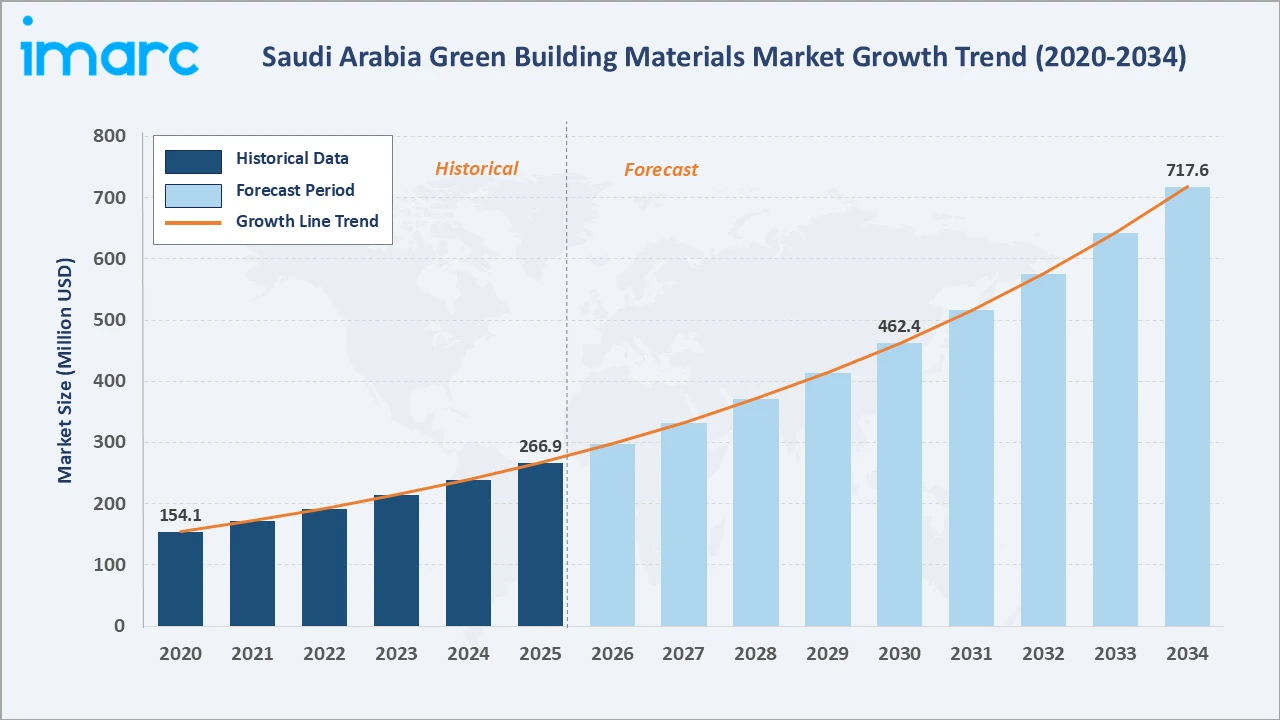
The Saudi Arabia green building materials market reached USD 266.9 Million in 2025 and is projected to reach USD 717.6 Million by 2034, growing at a CAGR of 11.62% during 2026-2034, driven by Vision 2030 sustainability mandates, MOSTADAM certification, and giga-project construction activity.
Market Snapshot
|
Metric |
Value |
|
Market Size (2025) |
USD 266.9 Million |
|
Forecast Market Size (2034) |
USD 717.6 Million |
|
CAGR (2026-2034) |
11.62% |
|
Base Year |
2025 |
|
Historical Period |
2020-2025 |
|
Forecast Period |
2026-2034 |
|
Dominant Application |
Insulation (29.8%, 2025) |
|
Leading Region |
Northern and Central Region (41.3%, 2025) |
The market expanded from an estimated USD 154.1 Million in 2020 to USD 266.9 Million in 2025, anchored at an estimated USD 462.4 Million in 2030 and forecast to reach USD 717.6 Million by 2034, as Vision 2030 infrastructure programmes steadily embed sustainability requirements into Saudi construction procurement.
To get more information on this market, Request Sample
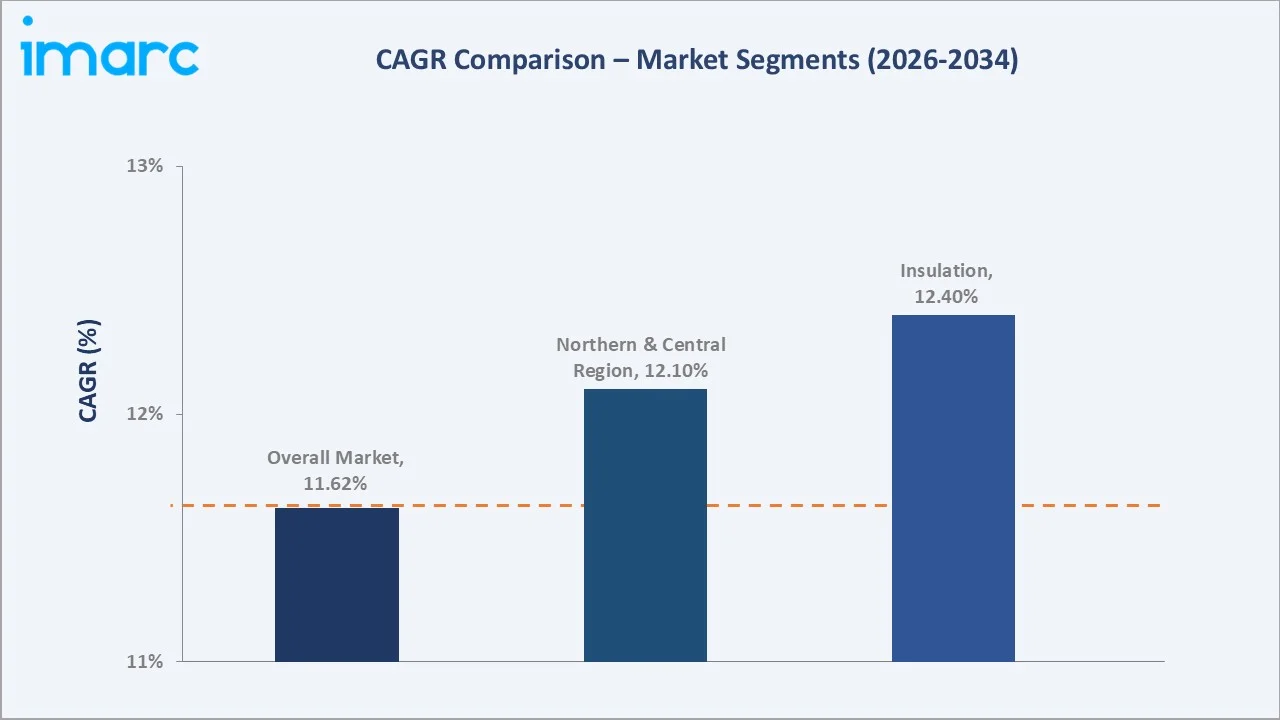
Insulation, the leading application segment, is estimated to grow marginally faster than the overall market as thermal-performance codes tighten, while the Northern and Central Region is expected to sustain the fastest regional growth on the back of Riyadh-centred giga-projects. Both segments are expected to consistently outpace or track closely with the market's blended 11.62% CAGR through 2034, reflecting the structural, code-driven nature of demand growth rather than short-term cyclical factors.
Executive Summary
The Saudi Arabia green building materials market reached USD 266.9 Million in 2025, reflecting the Kingdom's structural shift toward sustainable construction under Vision 2030 and the Saudi Green Building Forum's MOSTADAM certification framework. The market is projected to reach USD 717.6 Million by 2034, expanding at an 11.62% CAGR.
Insulation leads application demand at 29.8%, supported by extreme-climate thermal-performance requirements across residential, commercial, and giga-project developments. The Northern and Central Region leads geographically at 41.3%, anchored by Riyadh's concentration of government-backed sustainable construction activity, followed by the Western Region at 27.2%.
Key Market Insights
|
Insight |
Data |
|
Dominant Application |
Insulation - 29.8% share (2025) |
|
Leading Region |
Northern and Central Region - 41.3% share (2025) |
|
Market Opportunity |
MOSTADAM-certified insulation systems; low-carbon interior finishes; recycled roofing membranes; NEOM and Red Sea supply contracts |
Key Analytical Observations Supporting the Above Data:
- Insulation, at 29.8%, dominates as the Kingdom's extreme summer temperatures make thermal insulation the single most code-mandated green material category under the Saudi Building Code and MOSTADAM standards, spanning residential towers, schools, and government facilities. Continued tightening of thermal-performance requirements is expected to sustain this segment's lead through the forecast period.
- Northern and Central Region, at 41.3%, leads through Riyadh's concentration of Vision 2030 mega-developments, government headquarters projects, and the highest density of MOSTADAM-registered buildings nationally, a lead expected to persist as further giga-project phases progress toward completion.
Saudi Arabia Green Building Materials Market Overview
The Saudi Arabia green building materials market encompasses insulation systems, interior finishing products, roofing membranes, framing components, and exterior siding manufactured or specified to meet sustainability, energy-efficiency, and low-carbon-emission criteria under MOSTADAM and international frameworks such as LEED. The market spans residential, commercial, institutional, and giga-project construction segments, reflecting the breadth of Vision 2030's sustainable construction agenda.
The ecosystem integrates raw-material suppliers, material manufacturers, green-certification bodies, architects and specifiers, EPC contractors, and government regulators enforcing the Saudi Green Building Code. Rising urbanization, Vision 2030 diversification, and giga-projects including NEOM, Red Sea Global, and Qiddiya are central macroeconomic demand drivers.
Market Dynamics
To evaluate market opportunities, Request Sample
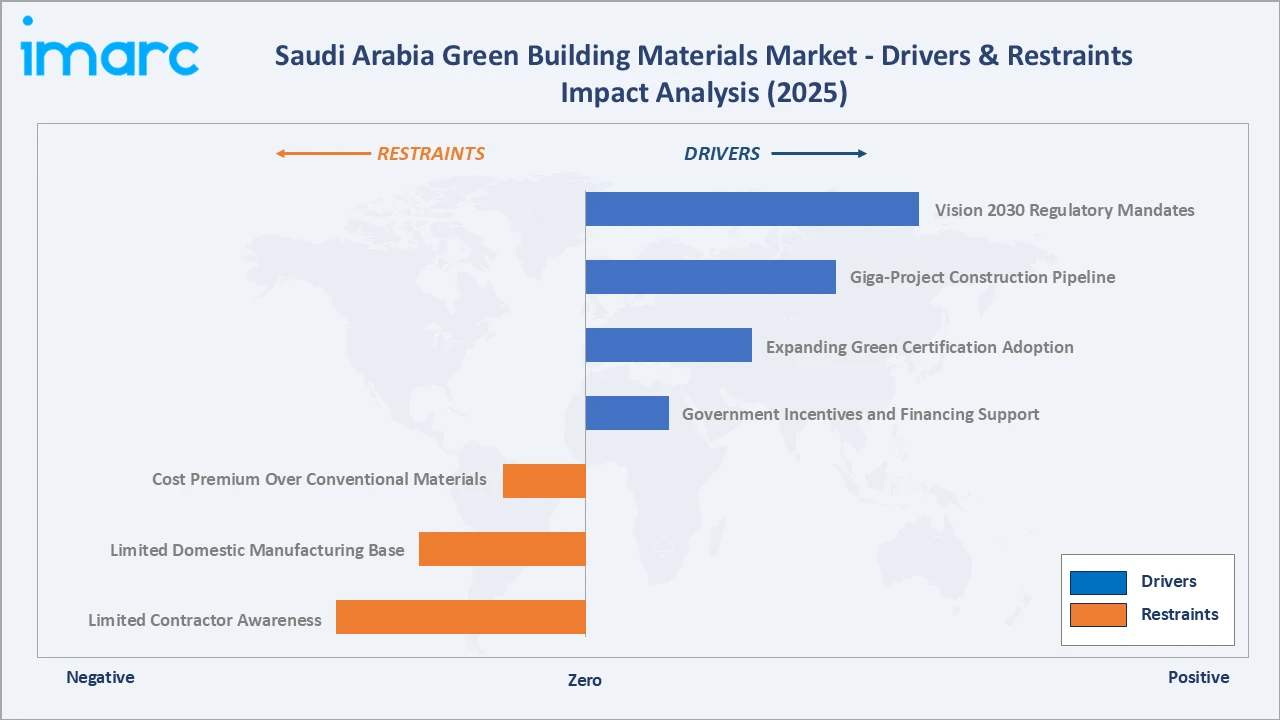
Market Drivers
- Vision 2030 Regulatory Mandates: Vision 2030 and mandatory green building codes are compelling developers to specify certified sustainable materials across public and private construction, directly expanding addressable demand for insulation, roofing, and finishing products. As enforcement of these codes broadens beyond flagship developments into mainstream residential and commercial construction, the addressable base for certified material suppliers continues to widen.
- Giga-Project Construction Pipeline: Giga-projects are embedding low-carbon material specifications from the design stage, creating large, long-duration procurement pipelines for certified green materials. These projects also serve as reference specifications that influence material standards across the wider construction industry.
- Expanding Green Certification Adoption: Growing MOSTADAM and LEED certification of residential, commercial, and institutional buildings is raising baseline specification standards, pushing conventional-material demand toward certified alternatives. Certification bodies are progressively tightening scoring criteria, further reinforcing this shift over the forecast period.
- Government Incentives and Financing Support: Government incentives, subsidised financing, and public-sector procurement preferences for sustainable materials are lowering adoption barriers for developers and contractors, particularly for small and mid-sized projects that would otherwise default to conventional material specifications.
Market Restraints
- Cost Premium Over Conventional Materials: Green building materials generally carry a cost premium over conventional alternatives, and this perception continues to slow adoption among smaller developers despite long-term operational savings, particularly in price-sensitive residential segments outside flagship giga-projects.
- Limited Domestic Manufacturing Base: The Kingdom's domestic manufacturing base for advanced green materials remains limited, requiring import dependence that raises costs and lengthens project lead times, exposing developers to currency and logistics-related supply risk.
- Limited Contractor Awareness: Awareness of the long-term cost and performance benefits of green materials remains uneven among small and mid-sized contractors, slowing specification outside flagship giga-projects and limiting the pace of nationwide adoption.
Market Opportunities
- MOSTADAM-Certified Product Expansion: Rising specification of MOSTADAM-certified insulation and roofing systems across giga-projects is opening a growing addressable market for certified sustainable material manufacturers, with long-duration supply agreements offering revenue visibility beyond individual project cycles.
- Domestic Manufacturing Localisation: Localisation of green material manufacturing, supported by government incentives, offers opportunities to reduce import dependence and capture rising domestic demand, while positioning early movers favourably for future giga-project qualification requirements.
Market Challenges
- Certification Cost-Competitiveness Balance: Balancing certification compliance costs with competitive pricing remains a persistent challenge for manufacturers targeting price-sensitive segments of the construction market, particularly outside flagship giga-project procurement channels.
- Raw Material Supply Constraints: Securing consistent, high-quality raw material supply for advanced green materials remains constrained by the Kingdom's developing domestic supply chain, requiring manufacturers to maintain diversified sourcing strategies.
Emerging Market Trends
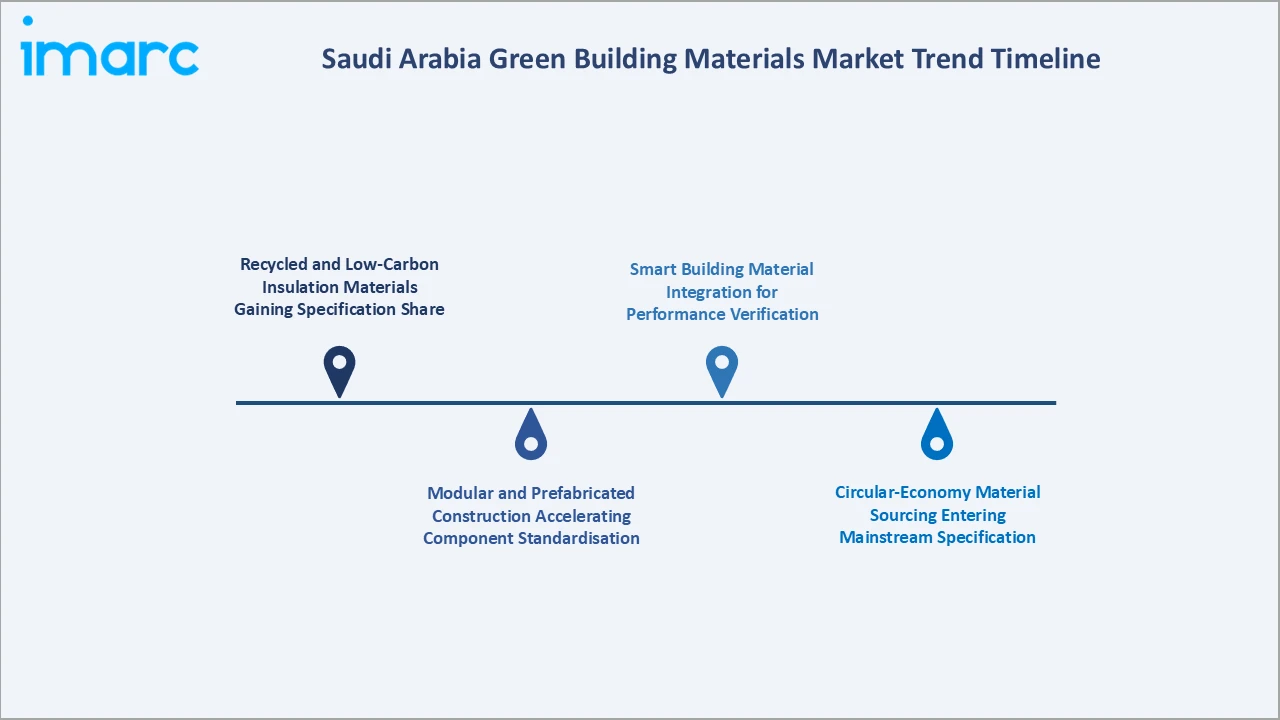
1. Recycled and Low-Carbon Insulation Materials Gaining Specification Share
Growing adoption of recycled and low-carbon insulation materials is reshaping product specifications across residential and commercial giga-projects, as developers seek to reduce embodied carbon alongside operational energy performance. This shift is supported by expanding certification criteria that increasingly account for a material's full life-cycle carbon footprint rather than in-use energy performance alone.
2. Smart Building Material Integration for Performance Verification
Increasing integration of smart building technologies with green materials is enhancing energy monitoring and efficiency validation across MOSTADAM-certified developments, supporting post-occupancy performance verification requirements. Sensor-enabled insulation and finishing products are gaining early traction in premium giga-project developments seeking continuous compliance monitoring.
3. Modular and Prefabricated Construction Accelerating Component Standardisation
Modular and prefabricated construction methods are accelerating adoption of standardised, factory-certified green building components, reducing on-site installation variability and supporting faster giga-project delivery timelines. This trend is particularly pronounced in framing and exterior siding applications, where factory-controlled conditions improve certification consistency.
4. Circular-Economy Material Sourcing Entering Mainstream Specification
Circular-economy sourcing practices, including recycled aggregate and reclaimed material inputs, are gradually moving from pilot-scale applications into mainstream specification as manufacturers seek to meet tightening embodied-carbon disclosure requirements across giga-project supply chains.
Industry Value Chain Analysis
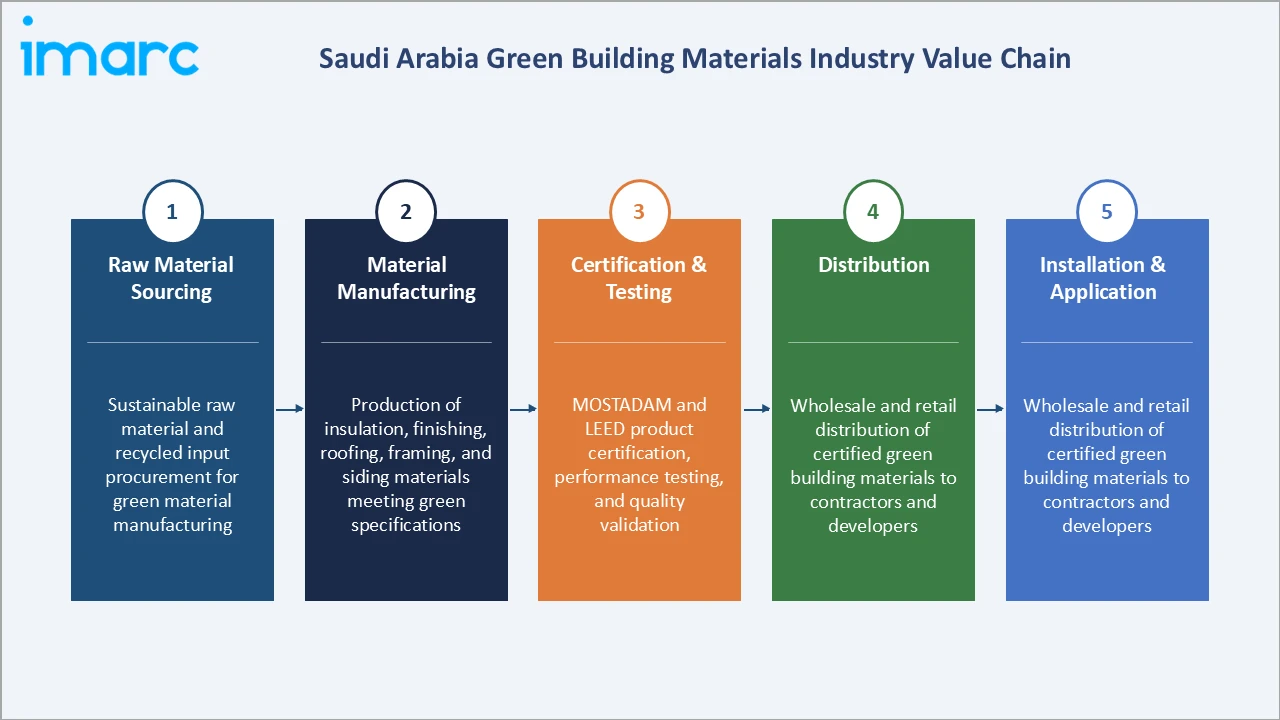
The Saudi Arabia green building materials value chain integrates raw material sourcing, sustainable material manufacturing, certification and testing, distribution, and installation by EPC contractors and developers. This structure is broadly representative of value chains across the wider construction materials industry.
|
Stage |
Key Participants |
|
Raw Material Sourcing |
Sustainable raw material and recycled input procurement for green material manufacturing |
|
Material Manufacturing |
Production of insulation, finishing, roofing, framing, and siding materials meeting green specifications |
|
Certification & Testing |
MOSTADAM and LEED product certification, performance testing, and quality validation |
|
Distribution |
Wholesale and retail distribution of certified green building materials to contractors and developers |
|
Installation & Application |
On-site installation by EPC contractors across residential, commercial, and giga-project developments |
Certification and testing represent the value chain's most commercially critical stage, as MOSTADAM compliance increasingly determines qualification for giga-project supply contracts.
Distribution and installation stages remain relatively fragmented across regional players, though giga-project procurement is progressively consolidating volumes toward suppliers capable of servicing large-scale, multi-year delivery schedules.
Technology Landscape in the Green Building Materials Industry
Advanced Insulation Technologies
Advanced insulation technologies, including aerogel and reflective foam systems, are improving thermal performance while reducing material thickness and weight, supporting compact building envelope designs in high-density urban developments. Their compatibility with retrofit and new-build applications is accelerating adoption across both residential and commercial segments.
Geopolymer and Low-Carbon Cement Technologies
Geopolymer and low-clinker cementitious technologies are reducing embodied carbon in concrete-based green building materials, offering durability advantages suited to the Kingdom's extreme climate conditions. Their growing use in framing and structural applications reflects rising specification of low-carbon alternatives across giga-project developments.
Digital Material Verification Tools
Digital material passports and life-cycle assessment tools are gaining traction, enabling developers to quantify and verify the sustainability credentials of specified building materials. These tools are increasingly integrated into MOSTADAM certification workflows to streamline compliance documentation.
Market Segmentation Analysis
The report covers the following segments:
|
Segment Category |
Leading Segment |
Share |
Year |
|
Application |
Insulation |
29.8% |
2025 |
|
Region |
Northern and Central Region |
41.3% |
2025 |

By Application
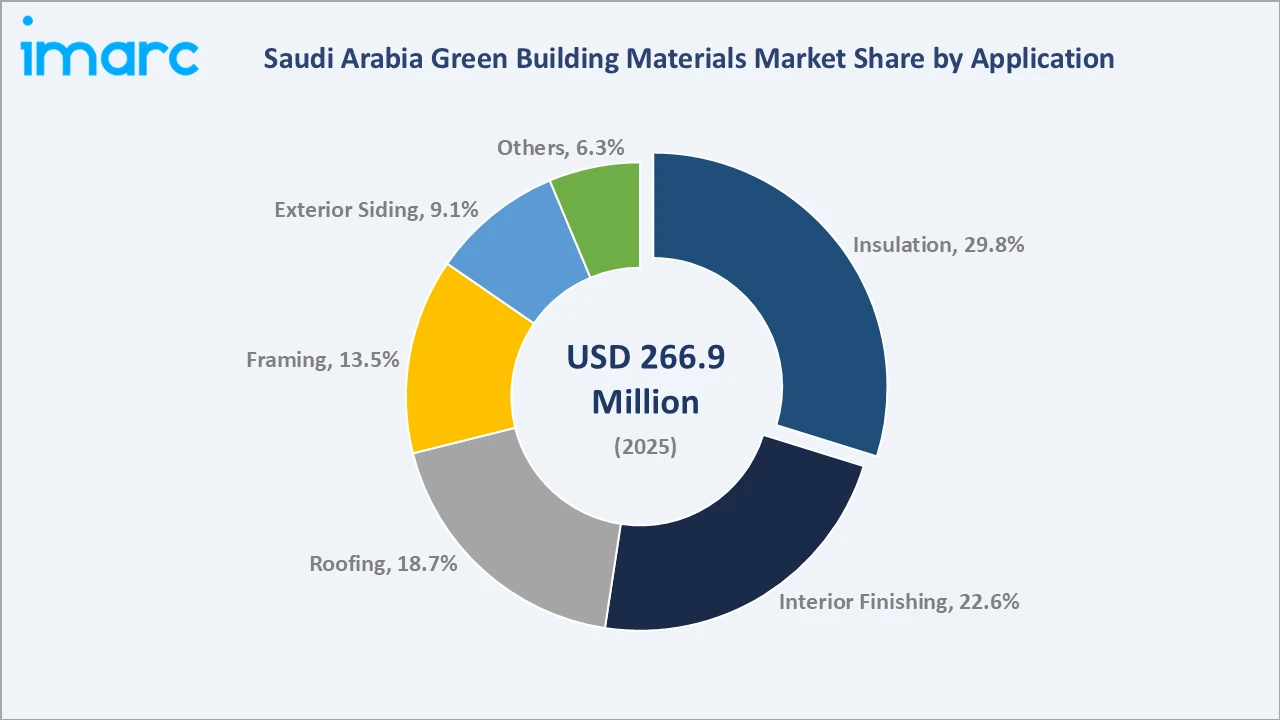
The Saudi Arabia green building materials market is segmented by application into insulation, interior finishing, roofing, framing, exterior siding, and other categories. Insulation leads application demand at 29.8% in 2025, the single largest and most code-driven green material category given the Kingdom's extreme-heat climate and mandatory thermal-performance requirements.
To access detailed market analysis, Request Sample
Interior finishing follows at 22.6%, driven by demand for low-VOC paints, sustainable flooring, and certified finishing materials in commercial and hospitality developments. Roofing accounts for 18.7%, led by reflective and recycled roofing membranes; framing represents 13.5% through engineered and sustainably sourced structural components; exterior siding contributes 9.1%; and other applications account for the remaining 6.3%.
Regional Market Insights
|
Region |
Share (2025) |
Key Market Drivers & Characteristics |
|
Northern and Central Region |
41.3% |
Driven by Riyadh's concentration of Vision 2030 giga-projects, government facilities, and the highest density of MOSTADAM-certified developments |
|
Western Region |
27.2% |
Supported by Jeddah and Red Sea Global tourism and coastal development, alongside expanding commercial and hospitality construction |
|
Eastern Region |
20.0% |
Backed by industrial-city expansion, Aramco-linked sustainability initiatives, and growing petrochemical-sector green infrastructure investment |
|
Southern Region |
11.5% |
An early stage but growing market driven by regional infrastructure modernization and rising residential construction activity |
The Northern and Central Region, at 41.3%, leads through Riyadh's giga-project concentration and public-sector procurement standards, while the Western Region, at 27.2%, benefits from Red Sea Global and Jeddah's expanding hospitality and commercial construction activity. Regional demand concentration is expected to persist through the forecast period, given the multi-year construction timelines associated with the Kingdom's largest giga-project developments.
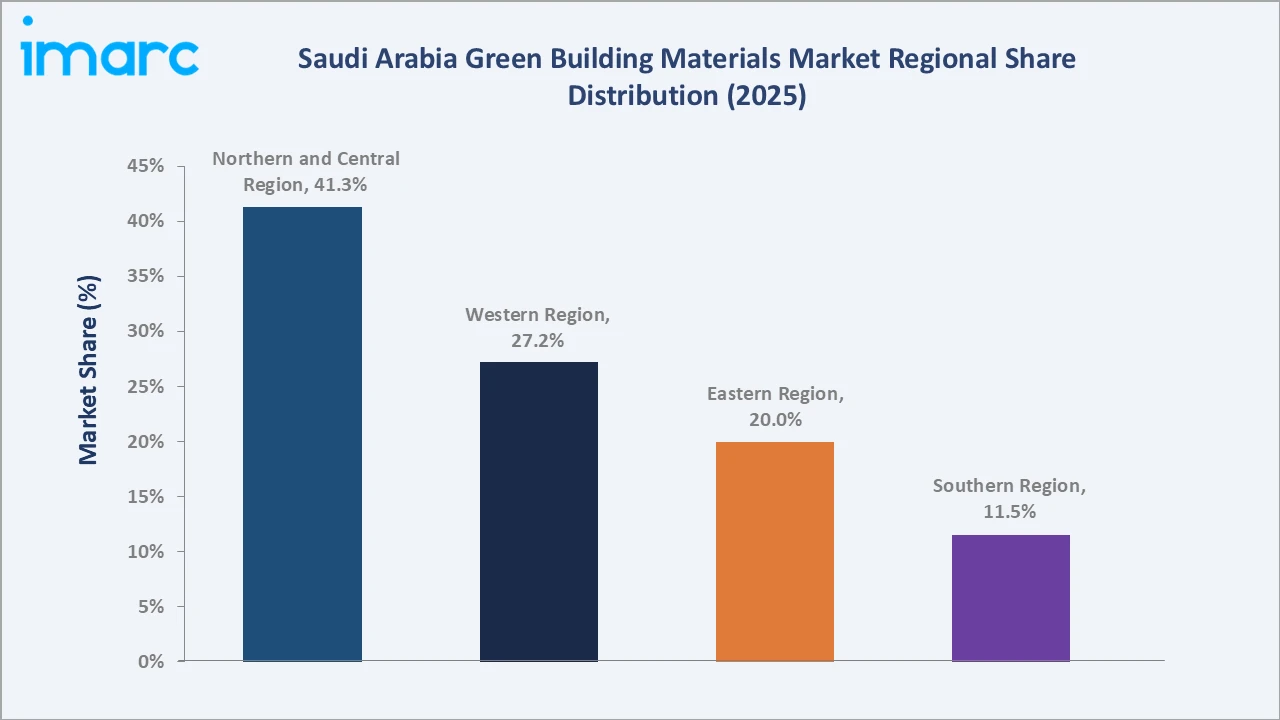
The Eastern Region, at 20.0%, reflects industrial-city sustainability investment linked to Aramco and petrochemical-sector initiatives, while the Southern Region, at 11.5%, represents an early-stage but steadily expanding market as regional infrastructure programmes scale up.
Competitive Landscape
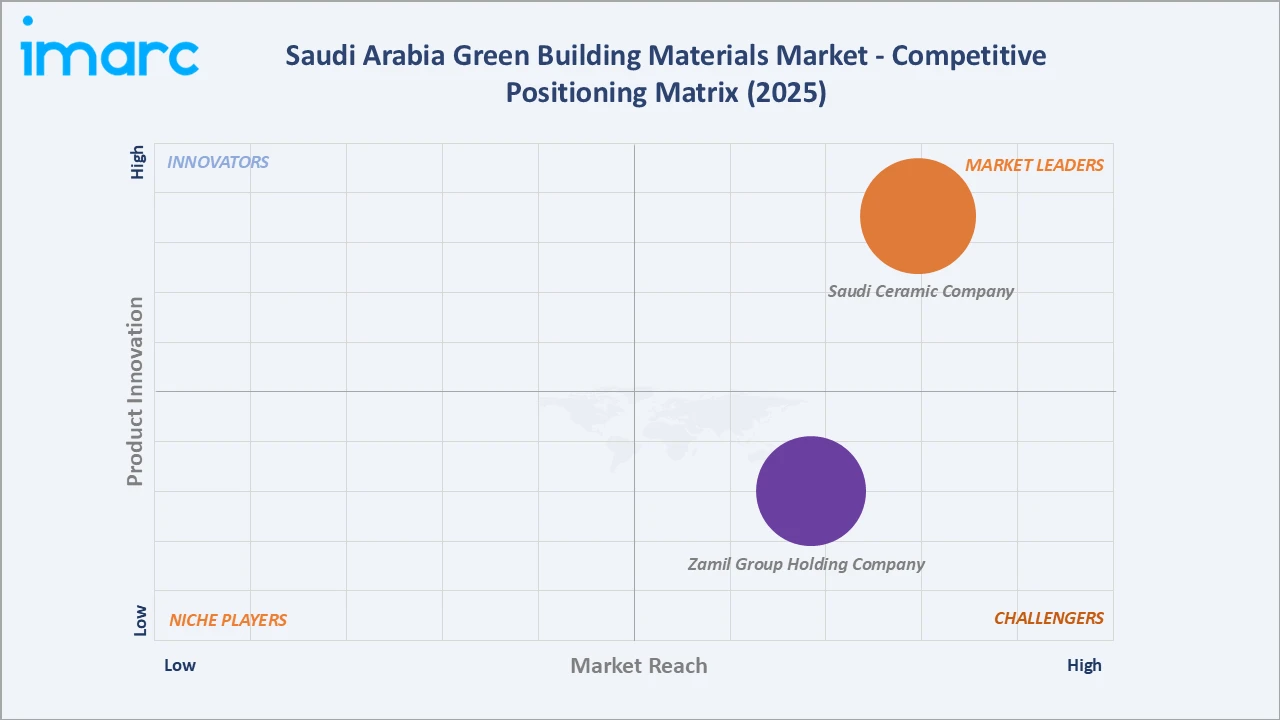
The Saudi Arabia green building materials market competitive landscape is moderately fragmented, comprising large diversified industrial conglomerates, specialised material manufacturers, and regional building-products suppliers competing on certification credentials, product performance, and giga-project supply relationships.
|
Company Name |
Key Products |
Market Position |
Core Strength |
|
Saudi Ceramic Company |
Certified ceramic tiles, sanitaryware, low-emission finishing materials |
Market Leader |
Saudi Ceramic Company is a leading domestic manufacturer of sustainable ceramic tiles and finishing materials with an established nationwide distribution network. |
|
Zamil Group Holding Company |
Pre-engineered buildings, energy-efficient insulation panels |
Strong Challenger |
Zamil Industrial specializes in pre-engineered building systems and insulation panels, supporting energy-efficient design across commercial and industrial construction. |
Key players include Saudi Ceramic Company, Zamil Group Holding Company, and others.
Key Company Profiles
Saudi Ceramic Company
Saudi Ceramic Company is a leading Saudi Arabia-based manufacturer of ceramic tiles, sanitaryware, and building finishing materials with an expanding sustainable and energy-efficient product range.
- Key Products: Sustainable ceramic tiles, sanitaryware, and low-emission finishing materials.
- Strategic Focus: Broadening its green-certified product range to align with MOSTADAM specification requirements. The company's established domestic manufacturing footprint and distribution reach support its position as a preferred supplier for certified interior finishing materials across residential and commercial developments nationwide.
Zamil Group Holding Company
Zamil Group Holding Company is a Saudi Arabia-based diversified investment holding conglomerate with a strong presence in building materials manufacturing and sustainable construction material solutions through its industrial subsidiaries.
- Key Products: Pre-engineered buildings, energy-efficient insulation panels
- Strategic Focus: Leveraging its diversified industrial holding structure, including stakes in steel manufacturing and insulation production, to expand certified sustainable material offerings across the Kingdom's green construction value chain. Zamil Group's century-long industrial legacy and extensive infrastructure project relationships provide a strong platform for scaling its footprint in sustainable building materials.
Market Concentration Analysis
The Saudi Arabia green building materials market is moderately fragmented, with diversified industrial conglomerates holding leading positions alongside a broad base of specialised and regional manufacturers. Market concentration is expected to gradually increase as giga-project certification requirements favour manufacturers with established MOSTADAM compliance track records.
Smaller regional suppliers continue to play an important role in serving localised demand and niche applications, particularly outside the Northern and Central Region, though their ability to compete for large giga-project contracts remains constrained by certification and scale requirements. Over the forecast period, consolidation is more likely to occur through capacity expansion and certification investment by existing leaders than through large-scale mergers or acquisitions.
Investment & Growth Opportunities
Highest Growth Segments
Insulation (leading application segment) and the Northern and Central Region (leading regional segment) represent the highest-growth investment vectors through 2034, supported by continued Vision 2030 giga-project momentum and tightening thermal-performance codes.
Emerging Investment Opportunities
Domestic manufacturing of certified green insulation and roofing materials represents a significant import-substitution opportunity, as giga-project procurement increasingly favours locally certified, supply-secure manufacturers.
Investment Themes
- Domestic Certified Manufacturing Capacity: Building domestic MOSTADAM-certified manufacturing capacity offers a structural cost and supply-security advantage as giga-project demand scales through 2034.
- Giga-Project Supply Partnerships: Partnerships with EPC contractors on giga-project supply agreements offer long-duration, high-volume revenue visibility for certified material manufacturers.
- Recycled and Low-Carbon Material Technologies: Investment in recycled-content and low-carbon material technologies positions manufacturers to capture demand as circular-economy requirements become more prevalent in specification standards.
Future Market Outlook (2026-2034)
The Saudi Arabia green building materials market is projected to grow from USD 266.9 Million in 2025 to USD 717.6 Million by 2034, delivering an 11.62% CAGR. The market's anchor value of approximately USD 462.4 Million in 2030 reflects continued Vision 2030 momentum, with insulation and interior finishing expected to remain the leading application categories through the forecast period.
Sustained giga-project construction, tightening green building codes, and growing MOSTADAM certification coverage are expected to progressively shift material specification toward certified sustainable alternatives, while the Northern and Central Region is expected to retain regional leadership through continued Riyadh-centred development activity.
Research Methodology
Primary Research
Primary research comprised structured interviews with industry stakeholders, including material manufacturers, EPC contractors, architects, and green-certification specialists across Saudi Arabia. These interviews provided qualitative insight into specification trends, certification timelines, and giga-project procurement practices that inform the report's demand assumptions.
Secondary Research
Secondary research encompassed company disclosures, Saudi Green Building Forum publications, MOSTADAM certification records, Vision 2030 programme documentation, and construction industry association data. Additional cross-referencing against publicly available giga-project procurement announcements supported validation of demand and regional distribution estimates.
Forecasting Models
Market revenue forecasts were developed using a bottom-up model incorporating construction activity by region, application-wise material specification rates, and green-certification adoption trajectories. Historical data for 2020-2025 was triangulated against multiple secondary sources, while forecast-period estimates account for anticipated regulatory tightening and giga-project construction schedules.
Saudi Arabia Green Building Materials Market Report Coverage:
| Report Features | Details |
|---|---|
| Base Year of the Analysis | 2025 |
| Historical Period | 2020-2025 |
| Forecast Period | 2026-2034 |
| Units | Million USD |
| Scope of the Report |
Exploration of Historical Trends and Market Outlook, Industry Catalysts and Challenges, Segment-Wise Historical and Future Market Assessment:
|
| Applications Covered | Insulation, Roofing, Framing, Interior Finishing, Exterior Siding, Others |
| Regions Covered | Northern and Central Region, Western Region, Eastern Region, Southern Region |
| Companies Covered | Saudi Ceramic Company, Zamil Group Holding Company, etc. |
| Customization Scope | 10% Free Customization |
| Post-Sale Analyst Support | 10-12 Weeks |
| Delivery Format | PDF and Excel through Email (We can also provide the editable version of the report in PPT/Word format on special request) |
Key Benefits for Stakeholders:
- IMARC’s industry report offers a comprehensive quantitative analysis of various market segments, historical and current market trends, market forecasts, and dynamics of the Saudi Arabia green building materials market from 2020-2034.
- The research report provides the latest information on the market drivers, challenges, and opportunities in the Saudi Arabia green building materials market.
- Porter's five forces analysis assist stakeholders in assessing the impact of new entrants, competitive rivalry, supplier power, buyer power, and the threat of substitution. It helps stakeholders to analyze the level of competition within the Saudi Arabia green building materials industry and its attractiveness.
- Competitive landscape allows stakeholders to understand their competitive environment and provides an insight into the current positions of key players in the market.
Frequently Asked Questions About the Saudi Arabia Green Building Materials Market Report
The Saudi Arabia green building materials market reached USD 266.9 Million in 2025, driven by the insulation segment dominant at 29.8%, the Northern and Central Region leading at 41.3% share, and sustained Vision 2030 giga-project construction activity across residential, commercial, and institutional developments.
The market grows at an 11.62% CAGR during 2026-2034, reaching USD 717.6 Million by 2034. This growth reflects tightening green building codes, expanding MOSTADAM certification coverage, and sustained giga-project procurement demand throughout the forecast period.
Insulation leads at 29.8% share, capturing the largest and most code-mandated green material category given the Kingdom's extreme-climate thermal-performance requirements. It is followed by interior finishing at 22.6%, roofing at 18.7%, framing at 13.5%, and exterior siding at 9.1%.
The Northern and Central Region leads at 41.3% share through Riyadh's concentration of Vision 2030 giga-projects and public-sector procurement standards, followed by the Western Region at 27.2%, the Eastern Region at 20.0%, and the Southern Region at 11.5%.
Leading companies include Saudi Ceramic Company, Zamil Group Holding Company, and others.
The market is projected to reach approximately USD 462.4 Million by 2030, with insulation and interior finishing expected to remain the leading application categories as certification coverage continues to expand across residential and commercial construction.
Priority investment opportunities include domestic MOSTADAM-certified manufacturing capacity, giga-project supply partnerships, and localisation of insulation and roofing material production to reduce import dependence and strengthen supply-chain resilience.
Key drivers include Vision 2030 regulatory mandates, giga-project construction, expanding green certification adoption, and government incentives, while restraints include cost premiums over conventional materials, a limited domestic manufacturing base, and uneven contractor awareness outside major urban centres.
Need more help?
- Speak to our experienced analysts for insights on the current market scenarios.
- Include additional segments and countries to customize the report as per your requirement.
- Gain an unparalleled competitive advantage in your domain by understanding how to utilize the report and positively impacting your operations and revenue.
- For further assistance, please connect with our analysts.
 Request Customization
 Speak to an Analyst
 Request Brochure
 Inquire Before Buying
Benefits of Customization
- Personalize this research
- Triangulate with your data
- Get data as per your format and definition
- Gain a deeper dive into a specific application, geography, customer, or competitor
- Any level of personalization
Get in Touch With Us
UNITED STATES
Phone: +1-201-971-6302
INDIA
Phone: +91-120-433-0800
UNITED KINGDOM
Phone: +44-753-714-6104
Email: [email protected]
Client Testimonials




.webp)




.webp)













Related Reports

Choose your plan
*Please note that the prices mentioned below are starting prices for each bundle type. Kindly contact our team for further details.*
Single User License
- 1 User License, Access on 2 Devices
- PDF Report + Excel Dataset (Password Protected)
- Lifetime Access
- No Printing Rights
- 10% Free Report Customization
- 10–12 Weeks of Analyst Support
Five User License
- Access for 5 Users, 2 Devices per User
- PDF Report + Excel Dataset (Password Protected)
- Lifetime Access
- Dedicated Account Manager
- 12–14 Weeks of Analyst Support
- No Printing Rights
- 15% Free Report Customization
- 25% Discount on Your Next Purchase
Corporate User License
- Unlimited User Access (Within Your Organization)
- PDF Report + Excel Dataset
- Lifetime Access
- Dedicated Account Manager
- 14–20 Weeks of Analyst Support
- No Printing Rights
- 20% Free Report Customization
- 30% Discount on Your Next Purchase
Essential Insights
What's included:
3 reports
- Lifetime Access
- PDF Reports
- Excel Datasets
- 2 Weeks of Free Analyst Support
- 2 User Licenses
- Access on 2 Devices
- Printing Rights
- Complimentary PowerPoint (PPT) Version
- Complimentary License Upgrade
Professional Access
What's included:
5 reports
- Lifetime Access
- PDF Reports
- Excel Datasets
- 8 Weeks of Free Analyst Support
- 2 User Licenses
- Access on 2 Devices
- Printing Rights
- Complimentary PowerPoint (PPT) Version
- Complimentary License Upgrade
Business Advantage
What's included:
8 reports
- Lifetime Access
- PDF Reports
- Excel Datasets
- 14 Weeks of Free Analyst Support
- 2 User Licenses
- Access on 2 Devices
- Printing Rights
- Complimentary PowerPoint (PPT) Version
- Complimentary License Upgrade
Enterprise Intelligence
What's included:
10 reports
- Lifetime Access
- PDF Reports
- Excel Datasets
- 20 Weeks of Free Analyst Support
- 2 User Licenses
- Access on 2 Devices
- Printing Rights
- Complimentary PowerPoint (PPT) Version
- Complimentary License Upgrade