
Saudi Arabia Gypsum Board Market Size, Share, Trends and Forecast by Product Type, End Use, and Region, 2026-2034
Saudi Arabia Gypsum Board Market Size, Share, Trends & Forecast (2026-2034)
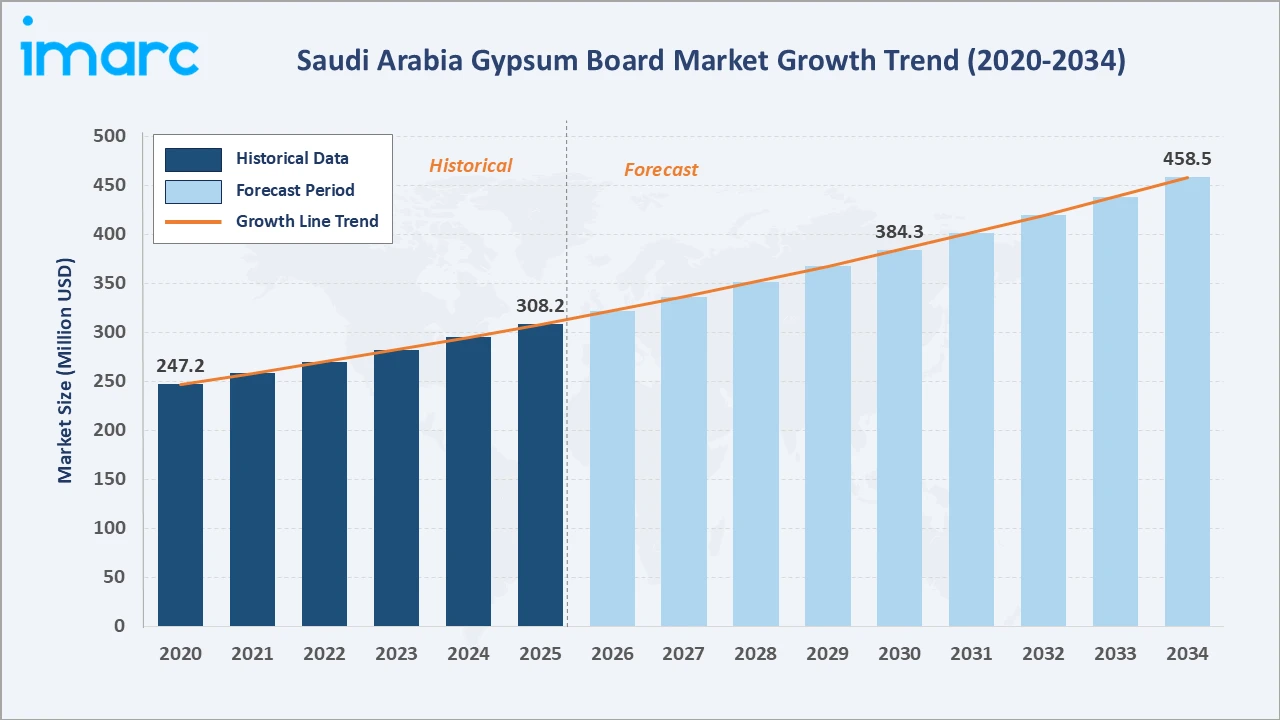
The Saudi Arabia gypsum board market grew from USD 308.2 Million in 2025 to USD 322.1 Million in 2026 and is projected to reach USD 458.5 Million by 2034, growing at a CAGR of 4.51% during 2026-2034. The market is primarily driven by the country's booming construction sector, supported by Vision 2030, large-scale residential housing projects, commercial developments, tourism infrastructure, and mega-projects such as NEOM, which are increasing demand for lightweight, fire-resistant, and sustainable building materials. Saudi Arabia plans to develop 600,000 new housing units by 2030 under Vision 2030, aiming to raise national home ownership to 70%, according to the National Housing Company (NHC). This large-scale residential construction pipeline is driving demand for gypsum boards. By product type, wallboard leads at 46.8%. By end use, residential dominates at 41.6%. Regionally, the Northern and Central region leads at 37.8%.
Market Snapshot
|
Metric |
Value |
|
Base Year Market Size (2025) |
USD 308.2 Million |
| Market Size (2026) | USD 322.1 Million |
|
Forecast Market Size (2034) |
USD 458.5 Million |
|
CAGR (2026-2034) |
4.51% |
|
Base Year |
2025 |
|
Historical Period |
2020-2025 |
|
Forecast Period |
2026-2034 |
|
Dominant Product Type |
Wallboard (46.8%, 2025) |
|
Dominant End Use |
Residential (41.6%, 2025) |
|
Leading Region |
Northern and Central Region (37.8%, 2025) |
The Saudi Arabia gypsum board market grew steadily from USD 247.2 Million in 2020 to USD 308.2 Million in 2025, reaching an estimated USD 322.1 Million in 2026, supported by rising construction, housing, and commercial infrastructure activity. The market is expected to reach USD 384.3 Million by 2030, reflecting continued demand from Vision 2030 projects, tourism developments, and urban expansion. By 2034, the market is forecast to attain USD 458.5 Million, driven by increased adoption of lightweight, fire-resistant, and cost-effective interior building materials. This indicates a stable long-term growth trajectory across residential, commercial, and institutional construction segments.
To get more information on this market, Request Sample
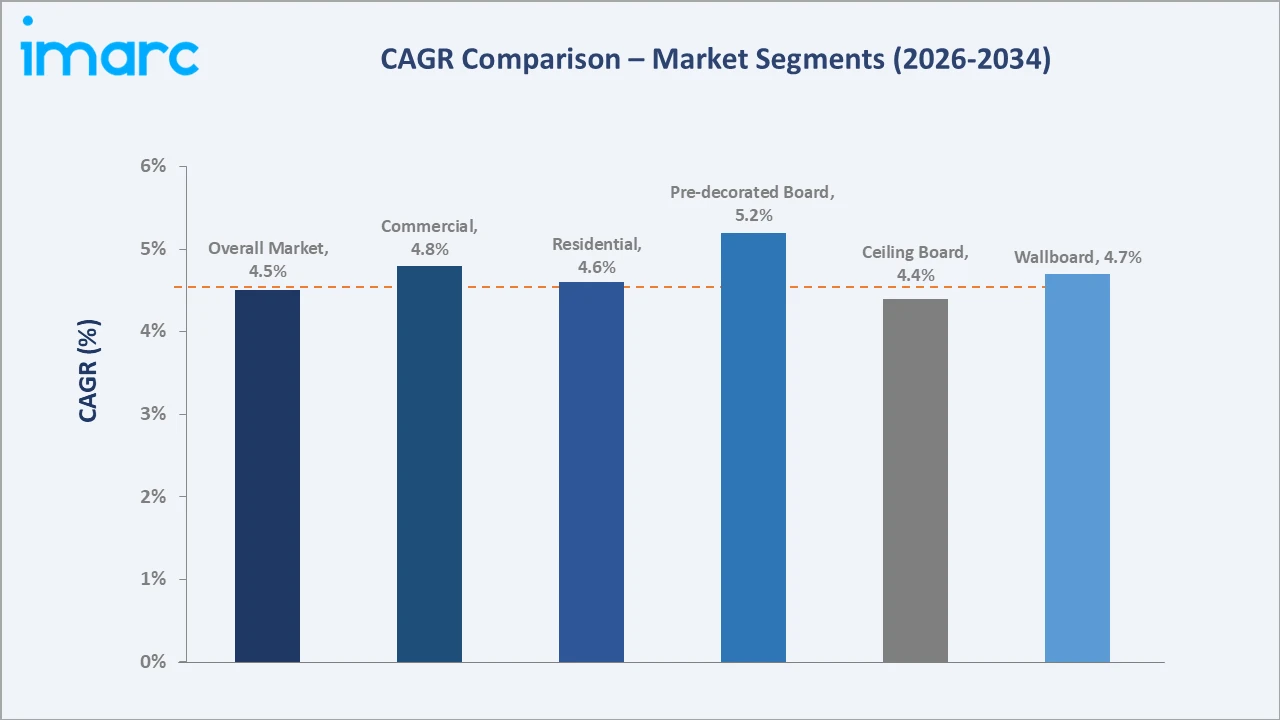
Wallboard grows at ~4.7% CAGR, and pre-decorated board grows fastest at ~5.2% CAGR through luxury fit-out demand. The commercial segment grows at 4.8% CAGR.
Executive Summary
The Saudi Arabia gypsum board market is witnessing steady growth, supported by large-scale residential, commercial, hospitality, and institutional construction under Vision 2030. Rising demand for modern interiors, faster construction methods, and lightweight partitioning systems is increasing gypsum board adoption across new housing and mixed-use projects. The market is also benefiting from Saudi Arabia’s push for urban expansion, tourism infrastructure, and smart city developments. Fire resistance, acoustic performance, design flexibility, and cost efficiency are making gypsum boards a preferred alternative to conventional wall and ceiling materials. Growing investment in local manufacturing and sustainable building solutions is further strengthening supply reliability. Overall, the market is positioned for consistent expansion through 2034, driven by construction modernization and long-term infrastructure development. Wallboard at 46.8% and residential at 41.6% lead their respective segments. Northern and Central region at 37.8% reflects Riyadh's Vision 2030 centrality.
Key Market Insights
|
Insight |
Data |
|
Dominant Product Type |
Wallboard - 46.8% share (2025) |
|
Dominant End Use |
Residential - 41.6% market share (2025) |
|
Leading Region |
Northern & Central Region - 37.8% share (2025) |
|
Key Opportunity |
NEOM, Red Sea Project, giga-project wallboard; affordable housing ceiling board; Saudi Green Building Code pre-decorated sustainable board |
Key Analytical Observations Supporting The Above Data:
- Wallboard at 46.8%: Wallboard leads due to its extensive use in interior walls, partitions, and ceilings across residential, commercial, and hospitality construction projects. Its cost-effectiveness, fire resistance, lightweight nature, and ease of installation make it the preferred choice for fast-paced building developments.
- Residential at 41.6%: Residential leads due to the rapid development of new housing units, apartments, and villas under Vision 2030’s home ownership targets. Gypsum boards are widely used in residential interiors for ceilings, partitions, and fire-resistant wall systems.
- Northern and Central Region at 37.8%: Northern and Central Region leads due to strong construction activity in Riyadh and surrounding urban centers, supported by housing, commercial, and infrastructure projects. The region’s rapid urban expansion and government-backed development programs are increasing gypsum board demand for walls, ceilings, and partitions.
Saudi Arabia Gypsum Board Market Overview
The Saudi Arabia gypsum board market encompasses wallboards, ceiling boards, pre-decorated boards, and specialized gypsum panels used across residential, commercial, and institutional construction. It serves applications such as interior walls, partitions, ceilings, cladding, and fire-resistant building systems. The market is supported by large-scale housing programs, urban development, hospitality projects, and smart city construction under Vision 2030. Demand is also shaped by the need for lightweight, durable, and easy-to-install building materials. Growing preference for modern interiors and faster construction practices is further expanding gypsum board usage across the country. Macroeconomic factors include Saudi Arabia’s strong construction spending, rising urbanization, population growth, and Vision 2030-backed infrastructure investment. Higher residential development, tourism expansion, and diversification away from oil are supporting demand for gypsum boards across housing, commercial, and institutional projects.
Market Dynamics
To evaluate market opportunities, Request Sample
Market Drivers
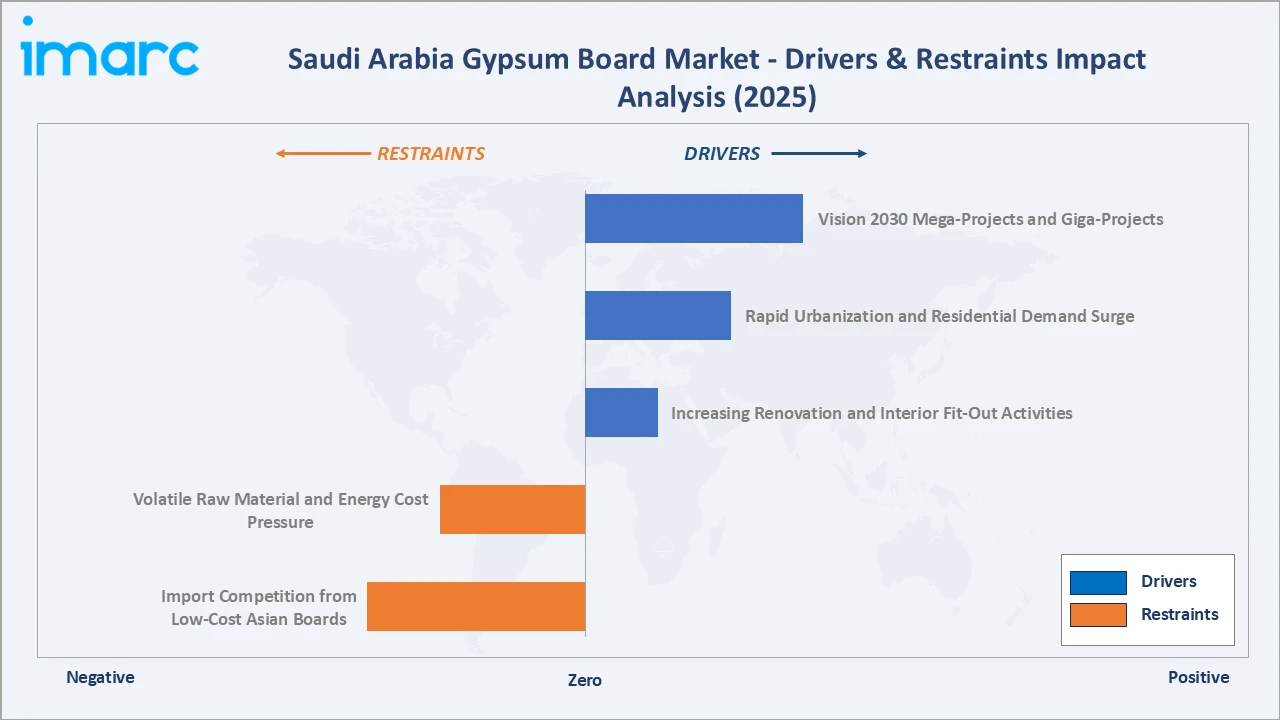
- Vision 2030 Mega-Projects and Giga-Projects: Vision 2030 mega-projects and giga-projects such as NEOM, The Line, The Red Sea, Qiddiya, Diriyah, and Roshn communities are significantly driving demand for gypsum boards in Saudi Arabia. The Line in Saudi Arabia is not a completed city as of 2026, but a planned linear urban development within NEOM. It is designed to span 170 kilometers, with a width of 200 meters and a height of 500 meters, operating without cars, powered by renewable energy, and ultimately intended to accommodate 9 million residents. As project pipelines expand, demand for high-performance and sustainable gypsum board solutions continues to rise.
- Rapid Urbanization and Residential Demand Surge: Rapid urbanization and rising residential demand are increasing the need for modern housing, apartments, villas, and community developments. Saudi Arabia’s urbanization rate has steadily increased, exceeding 85% in 2024 and expected to reach 86.3% by 2030. Major cities such as Riyadh, Jeddah, Makkah, Madinah, and Dammam remain key urban hubs, concentrating population, business activity, and infrastructure development. As cities expand and population density rises, gypsum boards are increasingly used for interior walls, ceilings, partitions, and finishing systems.
- Increasing Renovation and Interior Fit-Out Activities: Increasing renovation and interior fit-out activities are driving the market as homes, offices, hotels, malls, and commercial spaces upgrade to modern interior designs. Gypsum boards are widely used for false ceilings, partitions, wall linings, decorative features, and acoustic solutions. Their ease of installation, design flexibility, and smooth finishing make them ideal for remodeling and fit-out projects. Rising demand for premium, fire-resistant, and energy-efficient interiors is further supporting gypsum board adoption across renovation activities.
Market Restraints
- Volatile Raw Material and Energy Cost Pressure: Volatile raw material and energy costs are hampering the Saudi Arabia gypsum board market by increasing production expenses for gypsum processing, paper liner, additives, drying, and transportation. Since gypsum board manufacturing is energy-intensive, fluctuations in fuel, electricity, and logistics costs can pressure manufacturer margins. Rising input costs may also lead to higher product prices, affecting affordability for contractors and developers. This can slow adoption in price-sensitive residential and commercial projects, especially where alternative wall and ceiling materials remain competitive.
- Import Competition from Low-Cost Asian Boards: Low-cost gypsum board imports from Asian markets are hampering Saudi Arabia’s domestic market by intensifying price competition. These cheaper products can pressure local manufacturers to reduce prices, affecting profit margins and investment capacity. Contractors working on cost-sensitive projects may prefer imported boards, limiting demand for locally produced premium products. This can also make it harder for domestic players to differentiate on quality, certification, and performance standards.
Market Opportunities
- Growth in Green Building and Sustainable Construction Practices: Saudi Arabia recorded the region’s highest score of 76.31 points and certified over 1.03 million square meters of sustainable building space in 2025, according to the Saudi Press Agency. These achievements reflect clear efficiency improvements across 6,662 projects completed since 2010, setting a new regional benchmark for sustainability performance and institutional excellence. As developers increasingly pursue green building certifications and comply with stricter environmental standards, demand for eco-friendly and low-carbon construction materials is expected to rise. This trend is encouraging manufacturers to introduce high-performance gypsum boards with improved thermal, acoustic, and environmental characteristics.
- Demand from Healthcare, Education, and Industrial Facilities: Demand from healthcare, education, and industrial facilities creates strong opportunities as these sectors require durable, fire-rated, acoustic, and hygienic interior solutions. Hospitals, schools, universities, factories, and logistics facilities use gypsum boards for partitions, ceilings, wall linings, and service areas. Ongoing investment in social infrastructure and industrial diversification under Vision 2030 is expanding these end-use segments. This supports demand for specialized boards, including moisture-resistant, impact-resistant, and acoustic gypsum board systems.
Market Challenges
- Maintaining Product Quality While Controlling Production Costs: Maintaining product quality while controlling production costs is challenging as manufacturers must balance durability, fire resistance, moisture control, and smooth finishing with rising input and energy expenses. High-quality boards require consistent gypsum purity, paper liner strength, additives, and strict production controls, which increase costs. At the same time, price-sensitive contractors often demand competitive pricing, especially amid low-cost imports. This creates pressure on producers to improve efficiency without compromising performance, certifications, and long-term product reliability.
- Supply Chain Disruptions Affecting Raw Material Availability: Supply chain disruptions affecting the timely availability of gypsum, paper liners, additives, and packaging materials. Delays in raw material supply can interrupt production schedules and create shortages for contractors and distributors. Logistics issues, port congestion, or import dependency may also increase procurement and transportation costs. This makes it difficult for manufacturers to maintain stable pricing, consistent inventory, and timely delivery for large construction projects.
Emerging Market Trends
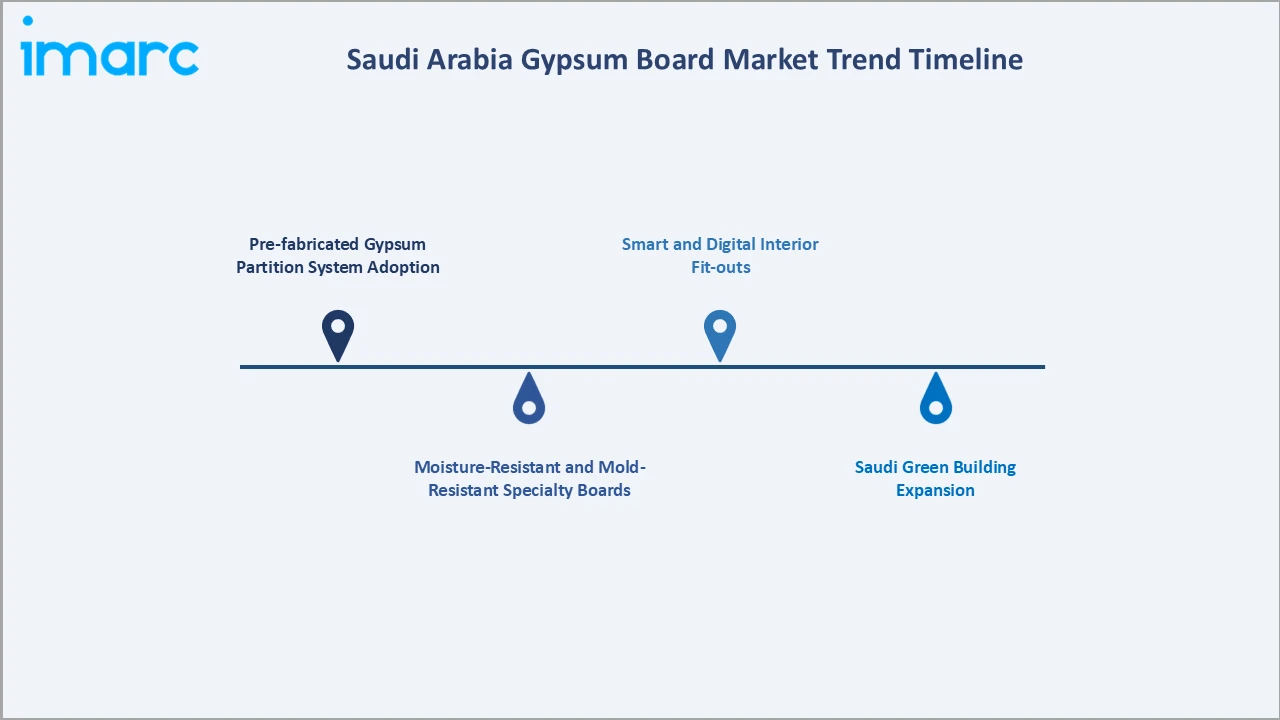
1. Pre-fabricated Gypsum Partition System Adoption
Pre-fabricated gypsum partition system adoption is emerging as Saudi construction projects increasingly require faster, cleaner, and more standardized interior installation methods. These systems reduce on-site labor, waste, and installation time compared with traditional masonry partitions. They are especially useful in large housing, hospitality, healthcare, and commercial projects where repeatable layouts and faster handover are important. Growing demand for lightweight, fire-rated, and acoustic interior solutions is further supporting their uptake.
2. Moisture-Resistant and Mold-Resistant Specialty Boards
Moisture-resistant and mold-resistant specialty boards are emerging due to rising demand from kitchens, bathrooms, hospitals, hotels, and humid coastal areas. These boards offer better durability, hygiene, and protection against dampness compared with standard gypsum boards. Their use is increasing in premium residential, healthcare, hospitality, and commercial interiors where long-term performance is important. Growing focus on healthier indoor environments and low-maintenance construction is further supporting adoption.
3. Saudi Green Building Expansion
Saudi green building expansion is emerging as Saudi Arabia increases its focus on sustainable, energy-efficient, and environmentally responsible construction. In 2025, Saudi Arabia’s green building sector reached a key milestone, moving beyond technical design practices toward a more institutionalized framework based on measurable performance indicators and strategic partnerships. Under the Saudi Green Building Forum’s SAAF conformity and specifications system, the Kingdom became a regional leader with a top score of 76.31 points and more than 1.03 million square meters of certified space. This progress is backed by over 7,300 registered professionals and 6,662 completed projects, helping cut around 62,800 tons of CO₂ emissions annually. This is boosting demand for gypsum boards that support green building standards through recyclability, lightweight design, improved insulation, and lower material waste.
4. Smart and Digital Interior Fit-outs
Smart and digital interior fit-outs are emerging as modern buildings increasingly integrate smart lighting, HVAC controls, sensors, and automation systems. Gypsum board systems provide flexible wall and ceiling solutions that can easily accommodate concealed wiring, smart devices, and building management infrastructure. This trend is gaining momentum in smart cities, premium offices, hotels, healthcare facilities, and residential developments under Vision 2030. As demand for intelligent and connected buildings grows, gypsum boards are becoming an essential component of modern interior construction.
Industry Value Chain Analysis
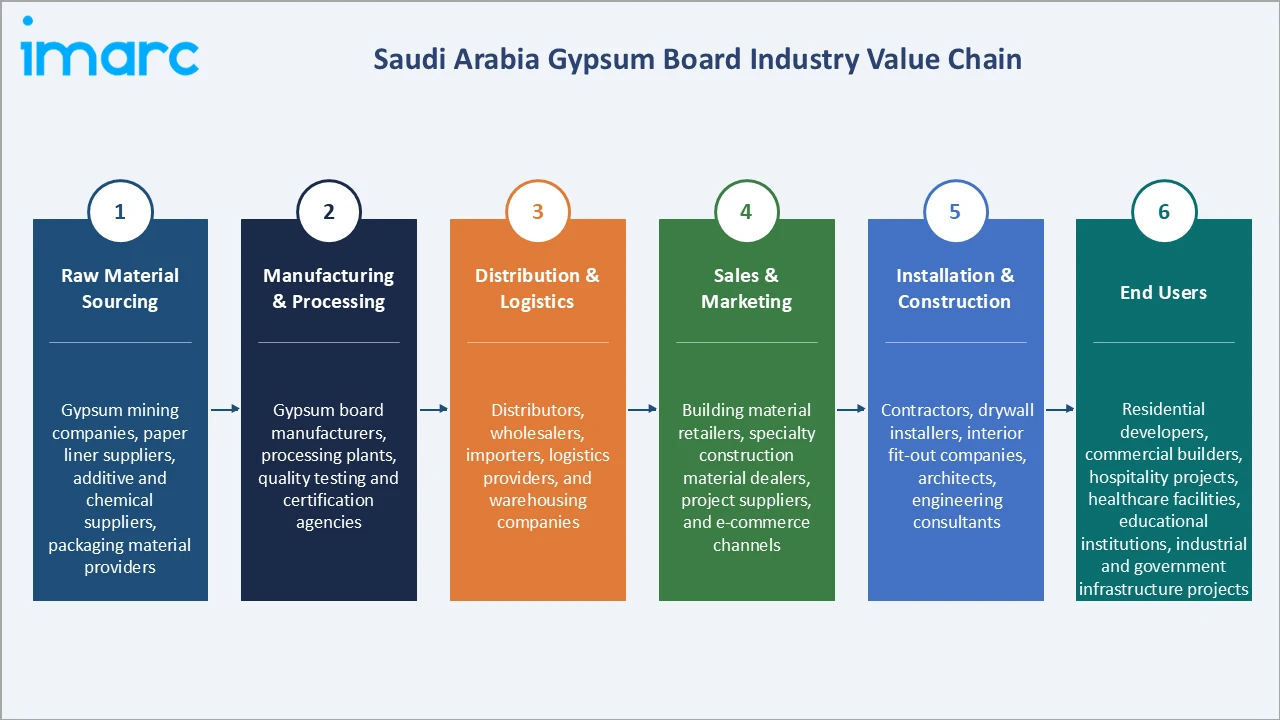
The Saudi Arabia gypsum board value chain integrates raw material sourcing, manufacturing & processing, distribution & logistics, sales & marketing, installation & construction, and end users.
|
Stage |
Key Participants |
|
Raw Material Sourcing |
Gypsum mining companies, paper liner suppliers, additive and chemical suppliers, packaging material providers |
|
Manufacturing & Processing |
Gypsum board manufacturers, processing plants, quality testing and certification agencies |
|
Distribution & Logistics |
Distributors, wholesalers, importers, logistics providers, and warehousing companies |
|
Sales & Marketing |
Building material retailers, specialty construction material dealers, project suppliers, and e-commerce channels |
|
Installation & Construction |
Contractors, drywall installers, interior fit-out companies, architects, engineering consultants |
|
End Users |
Residential developers, commercial builders, hospitality projects, healthcare facilities, educational institutions, industrial and government infrastructure projects |
Manufacturing and processing is the most value-added stage in the Saudi Arabia gypsum board value chain, as it transforms raw gypsum into high-performance construction boards through calcination, board forming, drying, finishing, and quality control. This stage determines key product attributes such as fire resistance, moisture resistance, acoustic performance, and durability while contributing the highest share of production costs and value creation. Continuous investment in automation, product innovation, and sustainable manufacturing further enhances competitiveness and profitability.
Technology Landscape in the Saudi Arabia Gypsum Board Industry
Calcination Technology
Advanced calcination systems help control particle size, purity, setting time, and moisture content, ensuring consistent board strength and performance. Improved kiln and fluidized-bed calcination technologies also enhance energy efficiency and reduce production costs. This supports the manufacture of high-quality fire-resistant, lightweight, and specialty gypsum boards for modern construction projects.
Lightweight Core Formulation Technology
Lightweight core formulation technology enables manufacturers to produce boards with lower weight while maintaining strength and durability. It uses optimized gypsum slurry, foaming agents, fibers, and additives to reduce board density without compromising performance. This supports easier handling, faster installation, lower transportation costs, and reduced structural load in modern buildings. The technology is especially valuable for large residential, hospitality, and commercial projects requiring efficient and cost-effective interior systems.
Moisture- and Mold-Resistant Board Technology
Moisture- and mold-resistant board technology improves board performance in humid, wet, and hygiene-sensitive areas. It uses water-repellent additives, treated paper liners, and mold-inhibiting formulations to enhance durability and prevent surface degradation. This technology is increasingly important for bathrooms, kitchens, hospitals, hotels, coastal buildings, and commercial interiors. As construction standards rise, demand for specialty boards with better moisture control and indoor air quality performance is growing.
Market Segmentation Analysis
The report covers the following segments:
|
Segment Category |
Leading Segment |
Market Share |
Year |
|
Product Type |
Wallboard |
46.8% |
2025 |
|
End Use |
Residential |
41.6% |
2025 |
|
Region |
Northern and Central Region |
37.8% |
2025 |

By Product Type
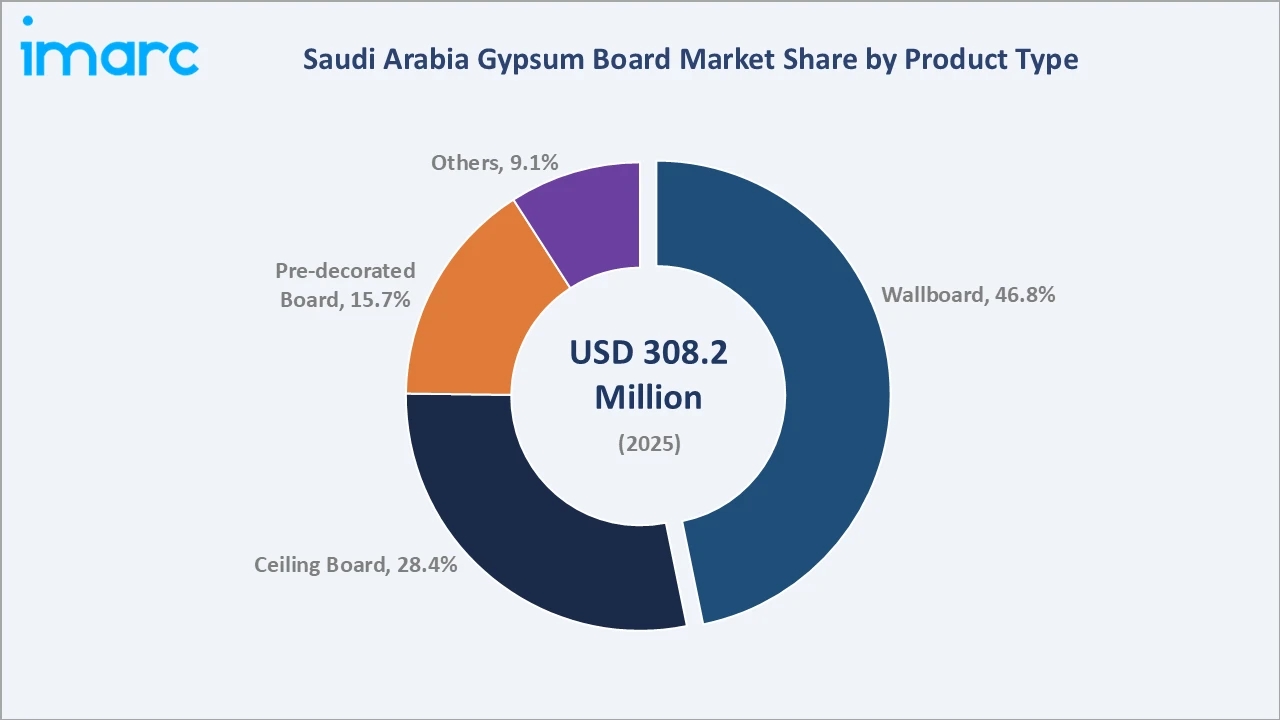
Wallboard dominates at 46.8%, reflecting its foundational role as the primary interior partition wall system across Saudi Arabia's residential, commercial, and giga-project construction. Gypsum wallboard replaces conventional concrete hollow block partitions, offering lightweight and fire advantages critical for Vision 2030 construction timelines.
To access detailed market analysis, Request Sample
Ceiling board at 28.4% reflects strong usage in false ceilings, suspended ceiling systems, and interior finishing across residential, commercial, hospitality, and institutional buildings. Pre-decorated board at 15.7% indicates growing demand for ready-to-install boards with finished surfaces, reducing painting, labor time, and on-site finishing costs. Others at 9.1% include specialty boards such as fire-resistant, moisture-resistant, acoustic, impact-resistant, and mold-resistant gypsum boards used in specific applications.
By End Use
Residential dominates at 41.6% due to Saudi Arabia’s large housing pipeline, rising urbanization, and Vision 2030 home ownership initiatives. Gypsum boards are widely used in homes for ceilings, partitions, wall linings, and fire-resistant interior systems.
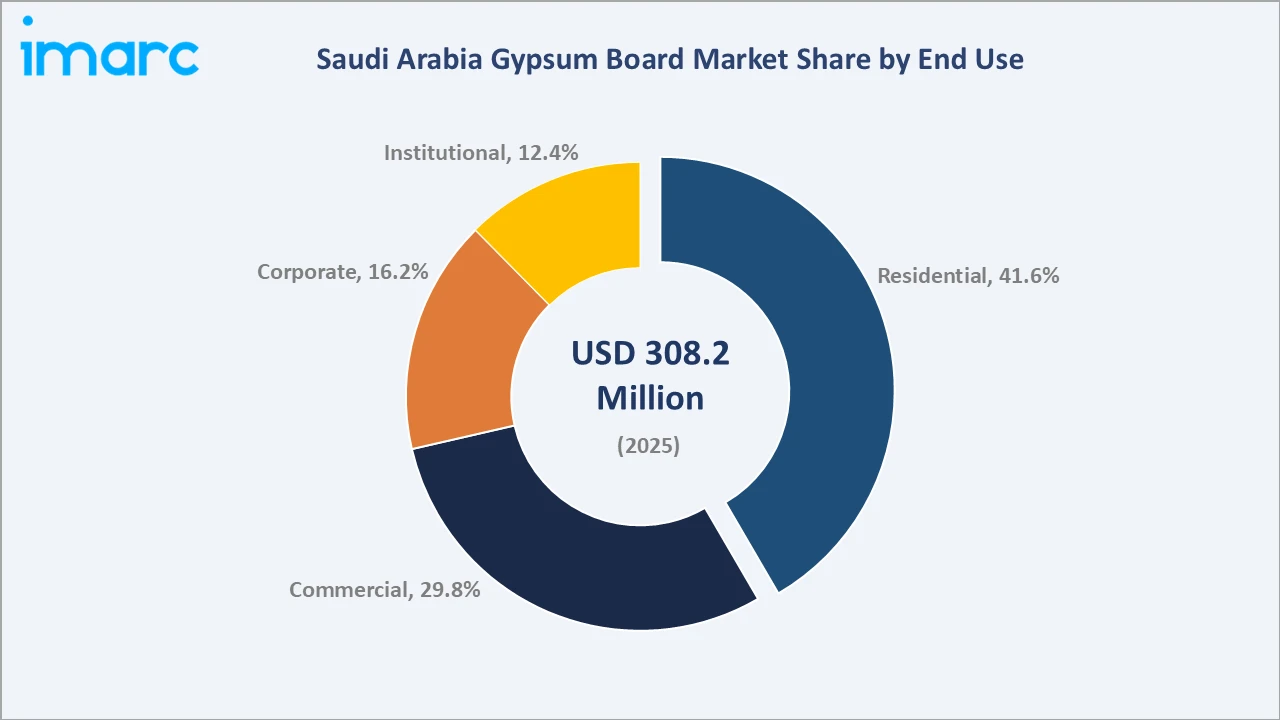
Commercial at 29.8% reflects strong demand from shopping malls, hotels, retail outlets, restaurants, and mixed-use developments requiring modern interior partition and ceiling systems. Corporate at 16.2% reflects increasing use of gypsum boards in office buildings and business parks for flexible workspaces, acoustic partitions, and high-quality interior finishes. Institutional at 12.4% reflects demand from hospitals, schools, universities, government buildings, and public facilities, where fire-resistant, moisture-resistant, and durable gypsum board systems are widely used.
Regional Market Insights
|
Region |
Share (2025) |
Key Drivers & Characteristics |
|
Northern & Central Region |
37.8% |
Driven by large-scale residential developments, commercial projects, government infrastructure investments, and ongoing mega-projects. |
|
Western Region |
30.6% |
Supported by strong demand from hospitality, religious tourism infrastructure, mixed-use developments, and commercial construction in cities. |
|
Eastern Region |
20.1% |
Supported by industrial expansion, corporate office developments, residential projects, and investments linked to the oil, gas, and petrochemical sectors. |
|
Southern Region |
11.5% |
Driven by growing residential construction, public infrastructure development, educational and healthcare facilities, and regional urban expansion initiatives. |
The Northern and Central Region's 37.8% dominance is supported by strong construction activity in Riyadh, residential developments, commercial projects, and government-backed infrastructure expansion. The Western Region's 30.6% is driven by hospitality, religious tourism, mixed-use developments, and urban growth in Jeddah, Makkah, and Madinah.
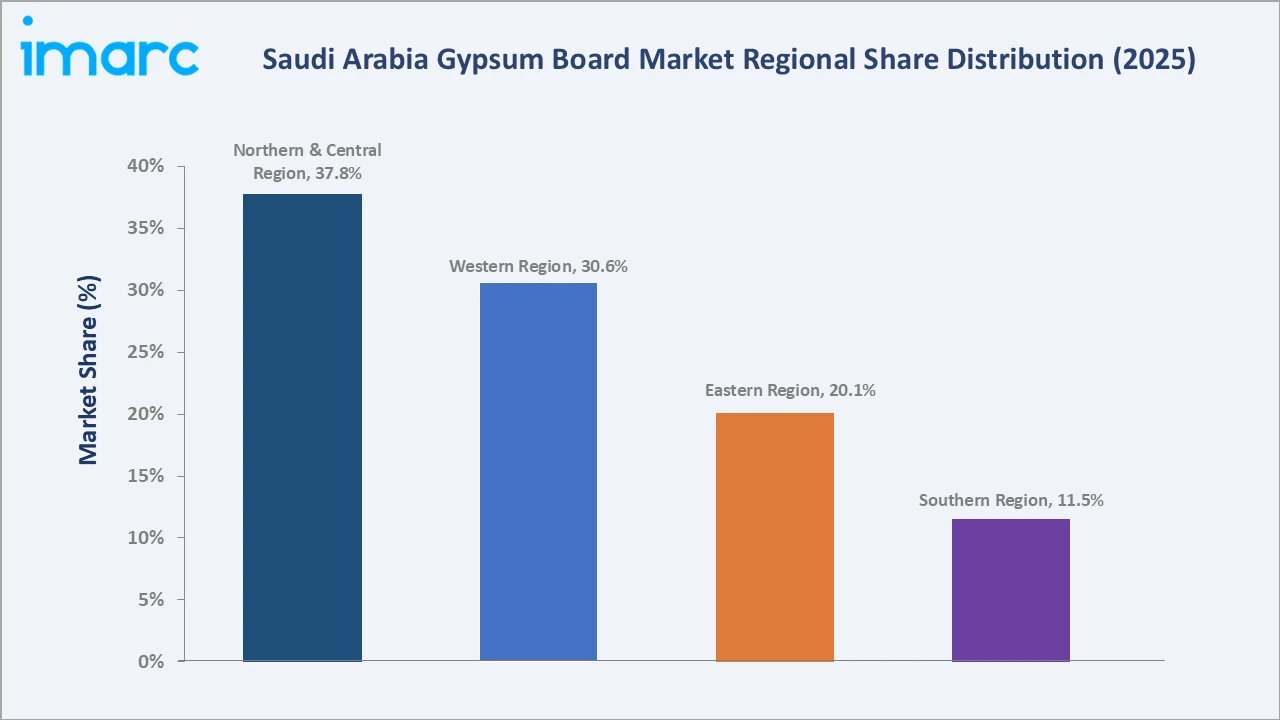
The Eastern Region's 20.1% benefits from industrial, petrochemical, corporate, and residential construction demand. The Southern Region's 11.5% is gradually expanding due to public infrastructure, housing, healthcare, and education projects.
Competitive Landscape
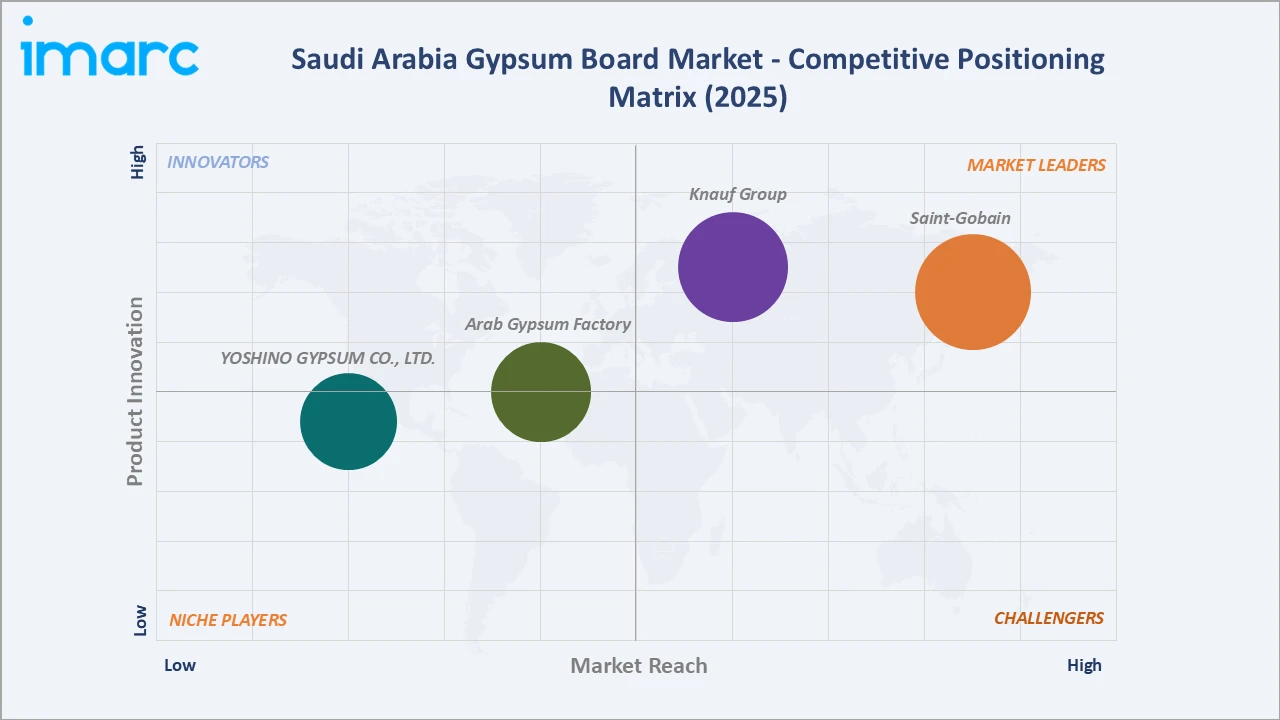
The Saudi Arabia gypsum board market is moderately competitive, with the presence of local manufacturers, regional suppliers, and imported board providers. Companies compete on product quality, pricing, fire resistance, moisture resistance, acoustic performance, and delivery reliability. Local players benefit from proximity to construction hubs and better alignment with project timelines.
|
Company |
Key Products |
Market Position |
Core Strength |
|
Saint-Gobain |
HABITO, GLASROC X |
Market Leader |
Saint-Gobain is a leading international provider of gypsum boards and drylining solutions in Saudi Arabia. Operating through its Saint-Gobain Gyproc Middle East and British Gypsum brands, the company supplies the Kingdom's booming construction sector with high-performance, fire-resistant, and acoustic plasterboard systems vital for the country's mega-projects. |
|
Knauf Group |
FireBloc 12.5mm, FireBloc 15mm, FireMoistBloc 12.5mm, MoistBloc 12.5mm, MoistBloc 15mm, MultiStop3, Sheetrock Standard 12.5mm |
Market Leader |
The Knauf Group plays a dominant, transformative role in the Saudi Arabian gypsum boards market, acting as a major catalyst for its rapid expansion. With the Kingdom's construction sector booming under Saudi Vision 2030, Knauf supplies the drywall systems, wallboards, and high-performance building materials needed for massive infrastructure and giga-projects. |
|
Arab Gypsum Factory |
8 mm thick gypsum board |
Established Player |
The Arab Gypsum Factory (Alarb Gypsum Factory) is a prominent regional supplier of gypsum boards and derivatives. By leveraging advanced, sustainable manufacturing technologies, the company supplies lightweight, fire-resistant, and eco-friendly plasterboard solutions crucial for accelerating construction timelines in the Middle East and North Africa (MENA) region. |
|
YOSHINO GYPSUM CO., LTD. |
Tiger Hi-Clean Marbletone Light, Tiger EX Hyper, Tiger EX Board 9.5mm, Tiger Fe board, Tiger Ultra Lightweight Gypsum Board, Tiger Water Vapor Resistant Board |
Established Player |
YOSHINO GYPSUM CO., LTD operates as a premier international participant in the Saudi Arabia Gypsum Board Market. Rather than operating as a dominant domestic manufacturer, Yoshino Gypsum functions as an elite technical pioneer and high-quality supplier to the region. |
Imported products, especially low-cost boards, add pricing pressure across the market. Manufacturers are increasingly focusing on specialty boards, sustainable production, certifications, and strong distributor networks to strengthen their market position.
Key Company Profiles
Saint-Gobain
Saint-Gobain is one of the leading manufacturers of gypsum-based building materials and operates in Saudi Arabia through its Gyproc brand, supplying plasterboards, ceiling systems, drywall solutions, and related accessories for residential, commercial, healthcare, hospitality, and infrastructure projects. The company leverages its global expertise in lightweight construction, fire-resistant systems, acoustic solutions, and sustainable building materials to support the Kingdom's growing construction sector. It maintains a commercial presence in major Saudi cities, including Riyadh and Jeddah, serving contractors, developers, and distributors across the country.
- Key Products: HABITO, GLASROC X.
- Strategic Focus: Centered on lightweight and sustainable construction, aligned with its global goal to become a leader in sustainable building solutions. It focuses on high-performance gypsum boards, drywall systems, fire-rated solutions, acoustic comfort, and moisture-resistant products for modern construction.
Knauf Group
Knauf Group is a building materials manufacturer and one of the leading producers of gypsum-based construction systems. In Saudi Arabia, Knauf serves the gypsum board market with gypsum boards, drywall partition systems, ceiling systems, plasters, jointing compounds, and related accessories. The company has a Saudi presence in Riyadh and works through local distributors to serve residential, commercial, healthcare, education, hospitality, and infrastructure projects.
- Key Products: FireBloc 12.5mm, FireBloc 15mm, FireMoistBloc 12.5mm, MoistBloc 12.5mm, MoistBloc 15mm, MultiStop3, Sheetrock Standard 12.5mm.
- Strategic Focus: Centers on expanding high-performance drywall and ceiling systems for fast-growing residential, commercial, hospitality, and infrastructure projects. The company emphasizes fire-rated, moisture-resistant, acoustic, and lightweight gypsum board solutions to meet modern construction requirements.
Market Concentration Analysis
The Saudi Arabia gypsum board market shows moderate concentration, with a mix of established local manufacturers, regional GCC suppliers, and international brands competing for project-based demand. Leading companies differentiate through product quality, fire-rated and moisture-resistant boards, technical support, and distributor reach. However, the presence of low-cost imports keeps pricing competitive and prevents excessive market dominance by a few players. Large construction and giga-projects often favor suppliers with certified systems, reliable delivery, and strong installation support. Overall, the market is competitive but not highly fragmented, with value shifting toward specialized, sustainable, and high-performance gypsum board solutions.
Investment & Growth Opportunities
Highest Growth Segments
Pre-decorated board (~5.2% CAGR through luxury fit-out), commercial end use (~4.8% CAGR through giga-project hotel and office), Northern and Central Region (~4.9% CAGR), moisture-resistant board for coastal regions (~5.5% CAGR), and fire-rated type X board for institutional healthcare (~4.6% CAGR through hospital construction) represent Saudi Arabia's highest-growth gypsum board investment vectors through 2034.
Investment Themes
- NEOM giga-project preferred domestic supplier: Investment opportunities are increasing for local gypsum board manufacturers that can secure long-term supply contracts for NEOM and other Vision 2030 mega-projects by offering certified, high-quality, and sustainable building materials.
- Saudi domestic gypsum mineral integration upstream: Investing in domestic gypsum mining and integrated processing facilities can strengthen raw material security, reduce import dependence, lower production costs, and improve supply chain resilience for gypsum board manufacturers.
Future Market Outlook (2026-2034)
The Saudi Arabia gypsum board market is projected to grow from USD 308.2 Million in 2025 to USD 322.1 Million in 2026, reaching USD 458.5 Million by 2034, registering a CAGR of 4.51% during 2026-2034. The market's anchor value of USD 384.3 Million in 2030, supported by residential construction, commercial development, urbanization, and Vision 2030 infrastructure projects. A CAGR reflects moderate but stable growth, driven by the shift toward lightweight, fire-resistant, and cost-efficient construction materials. Overall, the market is expected to maintain healthy momentum as Saudi Arabia continues investing in housing, tourism, healthcare, education, and giga-project developments.
Three structural forces driving the Saudi Arabia gypsum board market are Vision 2030-led construction expansion, rising urban housing demand, and the shift toward modern lightweight building systems. Mega-projects, tourism developments, and infrastructure investments are creating large-scale demand for interior walls, ceilings, and partitions. Rapid urbanization and housing programs are expanding gypsum board use in apartments, villas, and community projects. At the same time, contractors increasingly prefer gypsum boards for faster installation, fire resistance, acoustic performance, and cost efficiency.
Research Methodology
Primary Research
Primary research comprised interviews with gypsum board manufacturers, raw material suppliers, distributors, construction contractors, architects, interior fit-out companies, and industry consultants across Saudi Arabia. These discussions were conducted to validate market size, demand trends, pricing dynamics, application patterns, competitive positioning, and future growth opportunities.
Secondary Research
Secondary research encompassed company websites, annual reports, industry publications, government construction data, trade sources, and news releases related to Saudi Arabia’s building materials sector. It also included a review of Vision 2030 projects, housing programs, green building initiatives, and import/export trends to support market validation and forecasting.
Forecasting Models
Forecasting models were developed using a combination of historical market trends, construction activity, macroeconomic indicators, housing and infrastructure investments, and end-use demand analysis. The projections were validated through primary industry interviews and triangulated with secondary research to ensure robust, reliable, and market-aligned forecasts through 2034.
Saudi Arabia Gypsum Board Market Report Coverage:
| Report Features | Details |
|---|---|
| Base Year of the Analysis | 2025 |
| Historical Period | 2020-2025 |
| Forecast Period | 2026-2034 |
| Units | Million USD |
| Scope of the Report | Exploration of Historical Trends and Market Outlook, Industry Catalysts and Challenges, Segment-Wise Historical and Future Market Assessment:
|
| Product Types Covered | Wallboard, Ceiling Board, Pre-decorated Board, Others |
| End Uses Covered | Residential, Corporate, Commercial, Institutional |
| Regions Covered | Northern and Central Region, Western Region, Eastern Region, Southern Region |
| Companies Covered | Saint-Gobain, Knauf Group, Arab Gypsum Factory, YOSHINO GYPSUM CO. LTD., etc. |
| Customization Scope | 10% Free Customization |
| Post-Sale Analyst Support | 10-12 Weeks |
| Delivery Format | PDF and Excel through Email (We can also provide the editable version of the report in PPT/Word format on special request) |
Key Benefits for Stakeholders:
- IMARC’s industry report offers a comprehensive quantitative analysis of various market segments, historical and current market trends, market forecasts, and dynamics of the Saudi Arabia gypsum board market from 2020-2034.
- The research report provides the latest information on the market drivers, challenges, and opportunities in the Saudi Arabia gypsum board market.
- Porter's five forces analysis assist stakeholders in assessing the impact of new entrants, competitive rivalry, supplier power, buyer power, and the threat of substitution. It helps stakeholders to analyze the level of competition within the Saudi Arabia gypsum board industry and its attractiveness.
- Competitive landscape allows stakeholders to understand their competitive environment and provides an insight into the current positions of key players in the market.
Frequently Asked Questions About the Saudi Arabia Gypsum Board Market Report
The Saudi Arabia gypsum board market size is estimated at USD 322.1 Million in 2026, driven by strong construction activity under Vision 2030, including housing, commercial, hospitality, healthcare, and infrastructure projects. Rising demand for lightweight, fire-resistant, cost-efficient, and fast-install interior solutions is increasing gypsum board adoption across walls, ceilings, partitions, and fit-outs.
The market grows at 4.51% CAGR, reaching USD 458.5 Million by 2034. The CAGR is anchored by Vision 2030 giga-project construction, residential housing volume, and Saudi green building growth.
Wallboard leads at 46.8% due to its wide use in interior walls, partitions, and wall linings across residential and commercial construction. Its affordability, fire resistance, smooth finish, and quick installation make it the most preferred gypsum board type.
Residential leads at 41.6% due to large-scale housing developments, rising homeownership initiatives under Vision 2030, and increasing demand for apartments and villas. Gypsum boards are extensively used for ceilings, partitions, and interior wall systems because of their fast installation and cost efficiency.
Northern and Central Region leads at 37.8% due to strong construction activity in Riyadh and surrounding urban centers, supported by housing, commercial, and infrastructure projects. Vision 2030-led urban expansion and government-backed developments are further boosting gypsum board demand in the region.
Leading companies include Saint-Gobain, Knauf Group, Arab Gypsum Factory, and YOSHINO GYPSUM CO., LTD., among others.
The market is projected to reach approximately USD 384.3 Million by 2030, reflecting steady demand from residential, commercial, and infrastructure construction. Growth will be supported by Vision 2030 projects, urban expansion, and rising use of gypsum boards in modern interior systems.
Three priority investment opportunities include expanding domestic gypsum board manufacturing capacity to meet demand from Vision 2030 mega-projects, investing in specialty boards such as fire-, moisture-, and acoustic-resistant products, and integrating upstream gypsum mining with board production to strengthen raw material security and improve cost competitiveness. These areas are expected to generate long-term growth as sustainable and modern construction accelerates across Saudi Arabia.
Need more help?
- Speak to our experienced analysts for insights on the current market scenarios.
- Include additional segments and countries to customize the report as per your requirement.
- Gain an unparalleled competitive advantage in your domain by understanding how to utilize the report and positively impacting your operations and revenue.
- For further assistance, please connect with our analysts.
 Request Customization
 Speak to an Analyst
 Request Brochure
 Inquire Before Buying
Benefits of Customization
- Personalize this research
- Triangulate with your data
- Get data as per your format and definition
- Gain a deeper dive into a specific application, geography, customer, or competitor
- Any level of personalization
Get in Touch With Us
UNITED STATES
Phone: +1-201-971-6302
INDIA
Phone: +91-120-433-0800
UNITED KINGDOM
Phone: +44-753-714-6104
Email: [email protected]
Client Testimonials




.webp)




.webp)













Related Reports

Choose your plan
*Please note that the prices mentioned below are starting prices for each bundle type. Kindly contact our team for further details.*
Single User License
- 1 User License, Access on 2 Devices
- PDF Report + Excel Dataset (Password Protected)
- Lifetime Access
- No Printing Rights
- 10% Free Report Customization
- 10–12 Weeks of Analyst Support
Five User License
- Access for 5 Users, 2 Devices per User
- PDF Report + Excel Dataset (Password Protected)
- Lifetime Access
- Dedicated Account Manager
- 12–14 Weeks of Analyst Support
- No Printing Rights
- 15% Free Report Customization
- 25% Discount on Your Next Purchase
Corporate User License
- Unlimited User Access (Within Your Organization)
- PDF Report + Excel Dataset
- Lifetime Access
- Dedicated Account Manager
- 14–20 Weeks of Analyst Support
- No Printing Rights
- 20% Free Report Customization
- 30% Discount on Your Next Purchase
Essential Insights
What's included:
3 reports
- Lifetime Access
- PDF Reports
- Excel Datasets
- 2 Weeks of Free Analyst Support
- 2 User Licenses
- Access on 2 Devices
- Printing Rights
- Complimentary PowerPoint (PPT) Version
- Complimentary License Upgrade
Professional Access
What's included:
5 reports
- Lifetime Access
- PDF Reports
- Excel Datasets
- 8 Weeks of Free Analyst Support
- 2 User Licenses
- Access on 2 Devices
- Printing Rights
- Complimentary PowerPoint (PPT) Version
- Complimentary License Upgrade
Business Advantage
What's included:
8 reports
- Lifetime Access
- PDF Reports
- Excel Datasets
- 14 Weeks of Free Analyst Support
- 2 User Licenses
- Access on 2 Devices
- Printing Rights
- Complimentary PowerPoint (PPT) Version
- Complimentary License Upgrade
Enterprise Intelligence
What's included:
10 reports
- Lifetime Access
- PDF Reports
- Excel Datasets
- 20 Weeks of Free Analyst Support
- 2 User Licenses
- Access on 2 Devices
- Printing Rights
- Complimentary PowerPoint (PPT) Version
- Complimentary License Upgrade