
Saudi Arabia Head-Up Display Market Size, Share, Trends and Forecast by Product Type, Reality, Technology, Application, and Region, 2026-2034
Saudi Arabia Head-Up Display Market Summary:
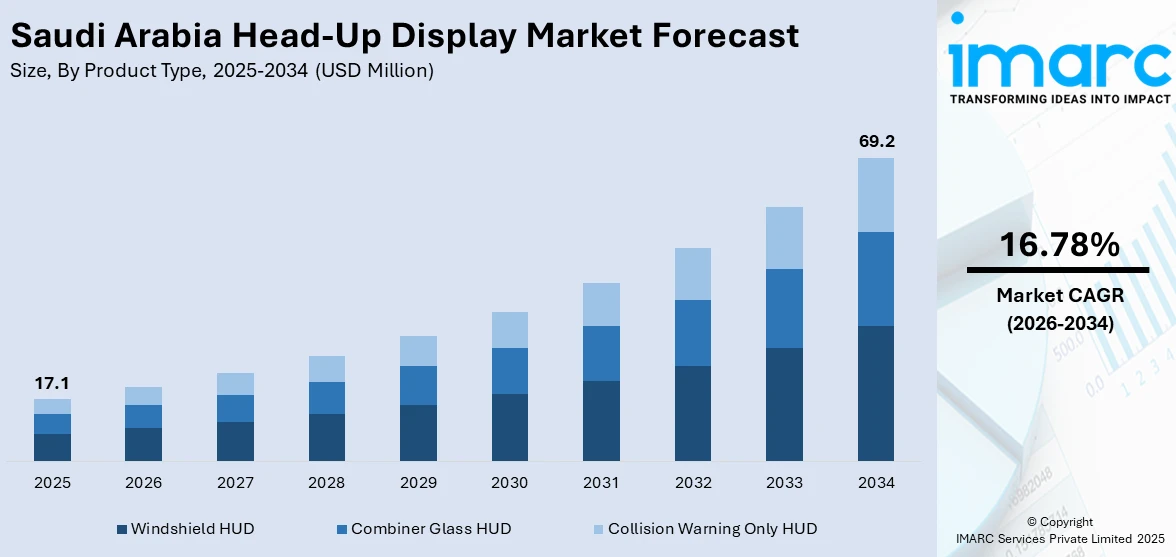
The Saudi Arabia head-up display market size was valued at USD 17.1 Million in 2025 and is projected to reach USD 69.2 Million by 2034, growing at a compound annual growth rate of 16.78% from 2026-2034.
The market expansion is propelled by the Kingdom's ambitious Vision 2030 initiative, which emphasizes smart city development, autonomous mobility integration, and advanced vehicle technology adoption. Moreover, the rapid adoption of augmented reality HUD systems that project contextual information directly onto vehicle windscreens is supporting the market growth. Apart from this, the government's focus on reducing road fatalities in the country is driving the demand for safety-enhancing technologies like HUD systems, expanding the Saudi Arabia head-up display market share.
Key Takeaways and Insights:
- By Product Type: Windshield HUD dominates the market with a share of 50% in 2025, driven by superior visual integration that projects information directly onto the windshield without requiring separate display components, appealing to Saudi consumers' preference for seamless premium vehicle aesthetics and enhanced augmented reality capabilities.
- By Reality: Conventional HUD leads the market with a share of 68% in 2025, reflecting its established reliability, proven performance across the Kingdom's extreme climate conditions, and widespread adoption by automakers due to lower manufacturing costs and straightforward integration with existing vehicle platforms.
- By Technology: Digital HUD represents the largest segment with a market share of 87% in 2025, powered by its advanced customization capabilities, compatibility with smartphone connectivity and navigation systems, and ability to support the real-time data processing requirements essential for Saudi Arabia's autonomous driving initiatives and smart mobility vision.
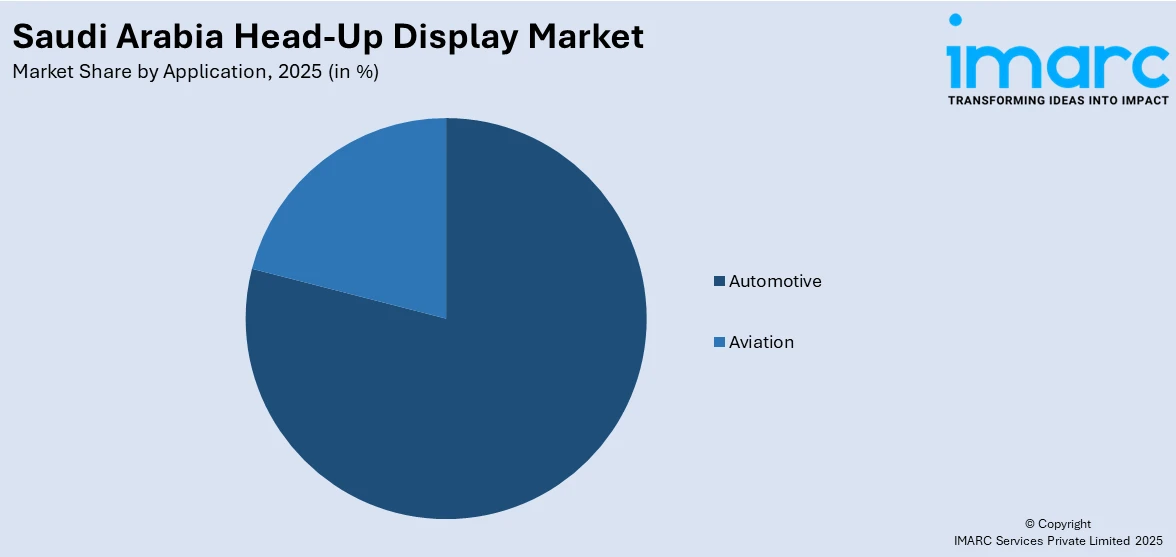
- By Application: Automotive leads the market with a share of 79% in 2025, propelled by the Kingdom's substantial vehicle ownership rates, government road safety initiatives targeting fatality reduction, and strong consumer demand for advanced safety technologies across passenger vehicles and luxury SUVs.
- By Region: Northern and Central Region represents the largest segment with a market share of 35% in 2025, anchored by Riyadh's position as the economic and political capital with the highest concentration of luxury vehicle dealerships, high-net-worth individuals, and extensive smart city infrastructure projects including the Riyadh Metro system.
- Key Players: Key market players focus on automotive OEM collaborations, advanced AR integration, premium vehicle demand, localization strategies, smart mobility adoption, and government-backed digital transformation. Emphasis on safety, infotainment innovation, and cost optimization helps strengthen competitiveness in Saudi Arabia’s head-up display market.
To get more information on this market Request Sample
The Saudi Arabia HUD market is experiencing transformative growth driven by the convergence of technological innovation and government-led modernization initiatives. The Kingdom's Vision 2030 strategy is catalyzing substantial investments in smart transportation infrastructure, including the Riyadh Metro that opened in November 2024 and the NEOM megacity project valued at USD 500 billion, which integrates AI, IoT, and autonomous vehicle technologies. These developments create a fertile environment for HUD adoption across passenger vehicles and commercial fleets. In 2024, The Kingdom of Saudi Arabia is entering a new phase of sustainable transport with the introduction of BYD, the leading global brand for New Energy Vehicles (Electric & Hybrid) and Plug-In Hybrid Technologies (PHEV). BYD’s launch, in partnership with Al-Futtaim Electric Mobility Company, signifies a pivotal change in the automotive scene of the Kingdom and the country's progression towards electrification, aiming to fulfill the ambitious objectives outlined in Vision 2030 for a sustainable future. A symbol of luxury and ingenuity, the BYD HAN redefines benchmarks for electric sedans through its unmatched performance and sophistication. Created for individuals who seek the highest standards in technology, comfort, and fully electric performance. It offers an astonishing range of 521 kilometers on one charge (WLTP combined) and exudes the highest level of luxury interiors, featuring a 12-speaker Dynaudio HiFi audio system, a 15.6” rotating multimedia display, heads-up display, and a collection of state-of-the-art features.
Saudi Arabia Head-Up Display Market Trends:
Integration of Augmented Reality (AR) Head-Up Display Technology
The Saudi market is witnessing rapid adoption of AR-HUD systems that project contextual information directly onto vehicle windscreens, transforming the driving experience through enhanced situational awareness. AR-HUD technology overlays navigation instructions, hazard warnings, and real-time traffic data onto the driver's field of view, creating an immersive and safer driving environment. This trend is accelerating as automakers recognize Saudi consumers' preference for premium technology features and advanced safety systems. The Kingdom's growing luxury vehicle segment, characterized by high import volumes from European and North American manufacturers, provides an ideal market for AR-HUD deployment, particularly in premium and mid-segment vehicles equipped with comprehensive ADAS suites. Moreover, innumerable companies are launching luxury vehicles in the country, which is further driving the use of high quality AR-HUDs. In 2024, Porsche Saudi Arabia and SAMACO Motors launched the all-new Panamera, which challenges boundaries with better power, outstanding technology, an advanced driving dynamic, and novel design features.
Rising Adoption of Advanced Driver Assistance Systems
The increasing integration of HUD technology with advanced driver assistance systems represents a critical market trend, driven by Saudi Arabia's commitment to improving road safety and reducing traffic fatalities. HUD systems are becoming integral components of ADAS ecosystems, displaying collision warnings, lane departure alerts, and speed limit information within the driver's direct line of sight. This integration enables faster reaction times and maintains driver attention on the road, addressing the primary cause of traffic accidents, human error, while supporting the Kingdom's broader road safety objectives and smart mobility transformation. IMARC Group predicts that the Saudi Arabia driver assistance systems market is projected to attain USD 627.9 Million by 2034.
Government-Led Smart City and Autonomous Vehicle Initiatives
Saudi Arabia's Vision 2030 program is driving unprecedented investments in smart city infrastructure and autonomous mobility solutions, creating substantial demand for advanced HUD technologies across the automotive ecosystem. The government's initiative to achieve 15 percent autonomous public transport vehicles by 2030, combined with megaprojects like NEOM and the Riyadh Metro, establishes a comprehensive framework for HUD integration in next-generation transportation systems. These developments include installation of smart communication devices along roadways that interact with vehicles in real-time, providing critical data for safe autonomous operation. The Kingdom's focus on modernizing transportation infrastructure through AI-driven solutions and intelligent mobility platforms positions HUD technology as an essential interface between drivers, vehicles, and smart city ecosystems.
How Vision 2030 is Transforming the Saudi Arabia Head-Up Display Market:
Saudi Vision 2030 is significantly transforming the HUD market by accelerating digitalization, smart mobility, and advanced automotive technologies. As the Kingdom diversifies its economy beyond oil, strong investments in smart cities, intelligent transportation systems, and connected infrastructure are increasing demand for advanced vehicle technologies like HUDs. Vision 2030 emphasizes road safety, reduced accident rates, and enhanced driving experiences, directly supporting HUD adoption for real-time navigation, speed monitoring, and driver assistance features. The growing electric and autonomous vehicle ecosystem, supported by government incentives and foreign investment, further fuels HUD integration in next-generation vehicles. Additionally, localization initiatives and technology partnerships encourage innovation, manufacturing capabilities, and skilled workforce development within Saudi Arabia. Rising consumer preference for premium and technologically advanced vehicles aligns with Vision 2030’s quality-of-life goals. Overall, Vision 2030 acts as a catalyst, positioning the HUD market for sustained growth, innovation, and long-term competitiveness in the Kingdom.
Market Outlook 2026-2034:
The convergence of government-led digitalization initiatives, autonomous mobility ambitions, and consumer demand for advanced safety technologies positions the Saudi Arabia head-up display market for exceptional growth through the next decade. The market generated a revenue of USD 17.1 Million in 2025 and is projected to reach a revenue of USD 69.2 Million by 2034, growing at a compound annual growth rate of 16.78% from 2026-2034. The market's transformation from niche luxury feature to mainstream automotive technology reflects broader shifts in the Kingdom's transportation ecosystem and technological infrastructure. The Northern and Central regions, anchored by Riyadh's economic prominence and ongoing infrastructure modernization, will continue dominating market share, while technological advancements in AR-HUD systems and declining component costs broaden accessibility across mid-segment vehicles, creating new market opportunities throughout the forecast period.
Saudi Arabia Head-Up Display Market Report Segmentation:
|
Segment Category |
Leading Segment |
Market Share |
|
Product Type |
Windshield HUD |
50% |
|
Reality |
Conventional HUD |
68% |
|
Technology |
Digital HUD |
87% |
|
Application |
Automotive |
79% |
|
Region |
Northern and Central Region |
35% |
Product Type Insights:
- Windshield HUD
- Combiner Glass HUD
- Collision Warning Only HUD
Windshield HUD dominates with a market share of 50% of the total Saudi Arabia head-up display market in 2025.
Windshield HUD systems dominate the Saudi market due to their seamless integration with modern vehicle architecture and superior visual experience compared to combiner-based alternatives. These systems project information directly onto the windshield, creating a larger, more immersive display area that aligns naturally with the driver's line of sight without requiring additional physical components in the cabin. The windshield approach delivers enhanced aesthetic appeal and preserves interior space, making it the preferred choice for luxury and premium vehicle manufacturers entering the Saudi market. The technology's compatibility with augmented reality features further strengthens its market position, as AR-HUD capabilities require the expanded projection surface that windshield systems provide.
Saudi consumers' strong preference for high-tech vehicle features and willingness to invest in premium automotive technologies accelerate windshield HUD adoption across the luxury and upper mid-segment vehicle categories. The system's ability to display complex navigation overlays, multi-layered information, and dynamic warnings positions it as essential equipment for vehicles targeting affluent Saudi buyers who prioritize cutting-edge technology. Automakers recognize that windshield HUD systems enhance perceived vehicle value and differentiate premium models in the competitive Saudi market, where consumers expect sophisticated features as standard equipment. The technology's integration with connected vehicle platforms and smartphone mirroring capabilities aligns with Saudi digital lifestyle preferences and smart city initiatives.
Conventional and Augmented Reality Insights:
- Conventional HUD
- Augmented Reality Based HUD
Conventional HUD leads with a share of 68% of the total Saudi Arabia head-up display market in 2025.
Conventional HUD systems maintain market leadership through their proven reliability, mature technology platform, and extensive deployment across existing vehicle fleets in Saudi Arabia. These systems project essential driving information such as speed, navigation directions, and warning indicators onto a transparent display, providing functional benefits without the complexity and cost premiums associated with augmented reality implementations. Conventional HUDs have gained widespread acceptance among Saudi consumers and automakers due to their straightforward integration with existing vehicle electronics, lower manufacturing costs, and proven performance across diverse driving conditions including the Kingdom's extreme heat and bright sunlight exposure.
The technology's established supply chain, standardized components, and extensive manufacturer experience support continued market dominance, particularly in mid-segment and luxury vehicles where HUD features are increasingly standard equipment. The Kingdom's current automotive fleet composition, dominated by conventional combustion engine and hybrid vehicles, aligns well with traditional HUD technology deployment. Automakers appreciate conventional HUD systems for their reliability record, simplified service requirements, and compatibility with existing vehicle platforms, enabling rapid market introduction without extensive vehicle redesign. Consumer familiarity with conventional HUD functionality reduces training requirements and accelerates adoption, while the technology's lower price point makes it accessible across broader vehicle segments beyond ultra-premium categories.
Technology Insights:
- CRT Based HUD
- Digital HUD
- Optical Waveguide HUD
- Digital Micromirror Device (DMD) HUD
- Light Emitting Diode (LED) HUD
- Others
Digital HUD exhibits a clear dominance with an 87% share of the total Saudi Arabia head-up display market in 2025.
Digital HUD systems have achieved overwhelming market dominance in Saudi Arabia through their advanced display capabilities, extensive customization options, and seamless integration with contemporary vehicle infotainment and telematics platforms. Digital technology enables high-resolution graphics, color-coded warnings, dynamic information updating, and personalized display configurations that align with individual driver preferences and vehicle operating conditions. The technology's compatibility with smartphone connectivity, navigation systems, and advanced driver assistance features makes it essential for modern vehicles targeting the Saudi market, where consumers demand sophisticated in-vehicle technology and comprehensive connectivity solutions.
Digital HUD systems support the real-time data processing requirements of autonomous driving features, vehicle-to-everything communication protocols, and cloud-based navigation services that are central to Saudi Arabia's smart mobility vision under Vision 2030. The declining cost of digital display components, combined with economies of scale achieved through global automotive production, has made digital HUD technology accessible across a broader range of vehicle price points. Manufacturers favor digital systems for their software update capabilities, enabling remote feature enhancements and continuous improvement throughout vehicle lifecycles. The technology's flexibility allows localization for Arabic language displays, integration with regional navigation databases, and customization for Saudi-specific traffic regulations and road conditions.
Application Insights:
Access the comprehensive market breakdown Request Sample
- Aviation
- Automotive
Automotive leads with a share of 79% of the total Saudi Arabia head-up display market in 2025.
The automotive application dominates the Saudi HUD market driven by the Kingdom's substantial vehicle ownership rates, growing luxury car segment, and government initiatives promoting advanced safety technologies. Saudi Arabia's automotive market, characterized by high per-capita vehicle ownership and strong preference for premium features, provides an ideal environment for HUD technology adoption across passenger vehicles, luxury SUVs, and commercial fleets. The government's Vision 2030 objectives, including road safety improvements and smart mobility integration, directly support automotive HUD deployment as manufacturers incorporate these systems into ADAS-equipped vehicles targeting the Saudi market.
The automotive segment benefits from economies of scale in HUD production, extensive OEM partnerships with global technology suppliers, and consumer willingness to invest in safety and convenience features. Automotive HUD adoption is further accelerated by the increasing availability of mid-segment vehicles equipped with basic HUD functionality, expanding the technology's reach beyond traditional luxury segments into mainstream consumer markets. Fleet operators in Saudi Arabia, including government agencies, corporate transportation services, and rental companies, increasingly specify HUD-equipped vehicles to enhance driver safety and reduce accident-related costs. The automotive sector's rapid electrification and autonomous driving developments create additional demand for sophisticated HUD interfaces that support new mobility paradigms.
Regional Insights:
- Northern and Central Region
- Western Region
- Eastern Region
- Southern Region
Northern and central region exhibit a clear dominance with a 35% share of the total Saudi Arabia head-up display market in 2025.
The Northern and Central Region dominates the market due to Riyadh's position as the Kingdom's political and economic capital, hosting the highest concentration of high-net-worth individuals, luxury vehicle dealerships, and advanced automotive technology adoption. The region benefits from extensive infrastructure modernization projects, including the Riyadh Metro system and numerous smart city initiatives that create demand for vehicles equipped with advanced HUD technology. Consumers in the capital region demonstrate strong preferences for premium automotive features and cutting-edge vehicle technologies, viewing HUD systems as essential rather than optional equipment in their vehicle purchasing decisions.
The area's robust economic activity, high population density, and government presence support elevated vehicle ownership rates and frequent vehicle replacement cycles, accelerating the adoption of HUD-equipped vehicles across both individual and fleet segments. Major automotive dealerships concentrate their premium inventory and latest-model introductions in Riyadh and surrounding cities, ensuring early availability of HUD-equipped vehicles for discerning buyers. The region's role as the Kingdom's administrative center means government procurement of advanced vehicle technologies influences broader market trends, as public sector fleet specifications often include HUD systems for enhanced driver safety and operational efficiency. Corporate headquarters located in the region maintain modern vehicle fleets featuring the latest safety technologies to support executive transportation and employee mobility programs.
Market Dynamics:
Growth Drivers:
Why is the Saudi Arabia Head-Up Display Market Growing?
Saudi Vision 2030 and Smart City Development Initiatives
The Kingdom's transformative Vision 2030 program serves as the primary catalyst for HUD market expansion, establishing comprehensive frameworks for technological advancement, infrastructure modernization, and quality of life improvements that directly support automotive technology adoption. The program's emphasis on smart city development, exemplified by the NEOM megacity valued at USD 500 billion, integrates cutting-edge technologies including AI, IoT, blockchain, and autonomous vehicle systems with fully renewable energy infrastructure. The digital transformation of smart cities in the Kingdom, backed by the Saudi Data & AI Authority (SDAIA) in partnership with various government entities through data and AI technologies, has propelled five Saudi cities up the rankings in the IMD Smart City Index 2024. These initiatives create ecosystem-wide demand for advanced vehicle technologies, positioning HUD systems as essential interfaces for next-generation transportation networks.
Increasing Focus on Road Safety and Advanced Vehicle Technology
Saudi Arabia's ambitious target to reduce road fatalities drives substantial demand for safety-enhancing vehicle technologies, with HUD systems playing a critical role in improving driver awareness and reducing accident rates. In 2024, 4,282 deaths occurred from fatalities, whereas 4,423 deaths took place in 2023. The government recognizes that human error causes the majority of traffic accidents, necessitating technological interventions that maintain driver attention, provide timely warnings, and support safer decision-making processes. HUD technology addresses these requirements by projecting critical information directly into the driver's line of sight, eliminating the need to look away from the road to check speed, navigation, or warning indicators. This capability aligns perfectly with Saudi Arabia's road safety objectives, encouraging both regulatory support and consumer adoption of HUD-equipped vehicles. The Kingdom's investment in smart roadway infrastructure, including real-time communication devices that interact with vehicles to provide road condition data, creates synergies with HUD technology that enhance overall transportation system safety and efficiency.
Growing Demand for Luxury and Premium Vehicles with Advanced Features
Saudi Arabia's expanding luxury automotive segment, characterized by substantial imports of premium vehicles from European and North American manufacturers, creates strong demand for advanced HUD technology as consumers seek sophisticated in-vehicle features and cutting-edge automotive innovations. The Kingdom's high per-capita income levels, cultural appreciation for premium automobiles, and preference for latest-generation vehicle technologies support robust luxury vehicle sales, with HUD systems increasingly standard equipment in premium segments. Saudi consumers demonstrate willingness to invest in advanced safety features, connectivity solutions, and driver assistance technologies that enhance the ownership experience and provide competitive differentiation. This market dynamic encourages automakers to equip Saudi-market vehicles with comprehensive technology packages including HUD systems, AR displays, and integrated ADAS features. In 2025, Volkswagen launched the Tiguan in Saudi Arabia. It came with a 15-inch entertainment screen, a completely new list structure, and the head-up display that showcases speed and crucial notifications directly on the windshield.
Market Restraints:
What Challenges the Saudi Arabia Head-Up Display Market is Facing?
High Initial Cost and Limited Consumer Awareness
The substantial upfront investment required for HUD technology implementation, particularly advanced AR-HUD systems, presents a significant barrier to widespread market adoption, especially in mid-segment and economy vehicle categories where price sensitivity constrains technology uptake. HUD system costs encompass specialized optical components, projection hardware, software development, and vehicle integration engineering, creating price premiums that consumers may perceive as discretionary rather than essential features. Limited awareness among Saudi consumers regarding HUD functionality, safety benefits, and operational advantages further constrains market expansion, as many potential buyers remain unfamiliar with the technology's capabilities or perceive it as unnecessary luxury rather than practical safety enhancement. Consumer education initiatives, demonstration programs, and expanded availability of HUD-equipped test drive vehicles are necessary to overcome awareness gaps and communicate value propositions effectively.
Technical Integration and User Experience Challenges
Ensuring seamless HUD integration with diverse vehicle architectures while maintaining intuitive user experiences across varying driving conditions poses ongoing technical challenges that can impact consumer satisfaction and adoption rates. HUD systems must function reliably under extreme temperature variations, direct sunlight exposure, nighttime conditions, and different windshield angles, requiring sophisticated calibration and robust engineering to deliver consistent performance across Saudi Arabia's diverse geographic and climatic conditions. User interface design must balance information density with clarity, avoiding driver distraction while providing sufficient data to enhance safety and navigation. Integration with existing vehicle electronics, infotainment systems, and ADAS platforms requires extensive validation and testing to prevent conflicts, ensure reliable operation, and deliver cohesive user experiences that meet consumer expectations.
Regulatory Framework and Standardization Requirements
The absence of comprehensive regulatory frameworks specifically addressing HUD technology usage, performance standards, and safety requirements creates uncertainty for manufacturers and potentially delays market adoption as industry stakeholders await clear guidelines. Regulations must define acceptable information types, display brightness limits, positioning standards, and interaction protocols to ensure HUD systems enhance rather than compromise road safety. Standardization challenges across different HUD implementations, display formats, and control interfaces can confuse consumers and complicate aftermarket support, necessitating industry collaboration to establish common practices while preserving competitive innovation. Regulatory clarity regarding HUD usage in autonomous and semi-autonomous vehicles becomes increasingly important as the Kingdom pursues its 2030 autonomous mobility targets.
Competitive Landscape:
The Saudi Arabia head-up display market features a competitive landscape dominated by established global automotive technology suppliers with extensive expertise in optical systems, display technologies, and vehicle electronics integration. Various international market players lead industry participation through comprehensive HUD portfolios spanning conventional and augmented reality systems across diverse vehicle segments. These industry leaders leverage strong OEM relationships with international automakers, advanced R&D capabilities, and proven manufacturing excellence to maintain competitive positions in the premium and luxury vehicle segments that dominate Saudi HUD adoption. The competitive environment emphasizes continuous technological advancement, cost reduction initiatives, and customization capabilities that address specific requirements of vehicles targeting the Saudi market, including adaptation to extreme climate conditions and Arabic language support.
Saudi Arabia Head-Up Display Market Report Coverage:
| Report Features | Details |
|---|---|
| Base Year of the Analysis | 2025 |
| Historical Period | 2020-2025 |
| Forecast Period | 2026-2034 |
| Units | Million USD |
| Scope of the Report |
Exploration of Historical Trends and Market Outlook, Industry Catalysts and Challenges, Segment-Wise Historical and Future Market Assessment:
|
| Product Types Covered | Windshield HUD, Combiner Glass HUD, and Collision Warning Only HUD |
| Conventional and Augmented Realities Covered | Conventional HUD, Augmented Reality Based HUD |
| Technologies Covered |
|
| Applications Covered | Aviation, Automotive |
| Regions Covered | Northern and Central Region, Western Region, Eastern Region, Southern Region |
| Customization Scope | 10% Free Customization |
| Post-Sale Analyst Support | 10-12 Weeks |
| Delivery Format | PDF and Excel through Email (We can also provide the editable version of the report in PPT/Word format on special request) |
Frequently Asked Questions About the Saudi Arabia Head-Up Display Market Report
The Saudi Arabia head-up display market size was valued at USD 17.1 Million in 2025.
The Saudi Arabia head-up display market is expected to grow at a compound annual growth rate of 16.78% from 2026-2034 to reach USD 69.2 Million by 2034.
Windshield HUD holds the largest market share of 50% in 2025, driven by superior visual integration, seamless vehicle design aesthetics, compatibility with augmented reality features, and strong preference among Saudi consumers for premium technologies that enhance driving experience without compromising interior space.
The Saudi Arabia head-up display market is driven by Saudi Vision 2030 initiatives promoting smart city development and autonomous mobility, increasing focus on road safety with targets to reduce fatalities, and growing demand for luxury vehicles equipped with advanced technology features. The Kingdom's substantial infrastructure investments, including the NEOM megacity valued at USD 500 billion and the Riyadh Metro system, create ecosystem-wide demand for advanced automotive technologies including HUD systems.
Major challenges include high initial implementation costs particularly for advanced AR-HUD systems, technical integration complexities ensuring reliable performance across extreme climate conditions, limited consumer awareness regarding HUD functionality and benefits, and absence of comprehensive regulatory frameworks addressing technology standards and safety requirements.
Need more help?
- Speak to our experienced analysts for insights on the current market scenarios.
- Include additional segments and countries to customize the report as per your requirement.
- Gain an unparalleled competitive advantage in your domain by understanding how to utilize the report and positively impacting your operations and revenue.
- For further assistance, please connect with our analysts.
 Request Customization
 Speak to an Analyst
 Request Brochure
 Inquire Before Buying
Benefits of Customization
- Personalize this research
- Triangulate with your data
- Get data as per your format and definition
- Gain a deeper dive into a specific application, geography, customer, or competitor
- Any level of personalization
Get in Touch With Us
UNITED STATES
Phone: +1-201-971-6302
INDIA
Phone: +91-120-433-0800
UNITED KINGDOM
Phone: +44-753-714-6104
Email: [email protected]
Client Testimonials




.webp)




.webp)













Related Reports

Choose your plan
*Please note that the prices mentioned below are starting prices for each bundle type. Kindly contact our team for further details.*
Single User License
- 1 User License, Access on 2 Devices
- PDF Report + Excel Dataset (Password Protected)
- Lifetime Access
- No Printing Rights
- 10% Free Report Customization
- 10–12 Weeks of Analyst Support
Five User License
- Access for 5 Users, 2 Devices per User
- PDF Report + Excel Dataset (Password Protected)
- Lifetime Access
- Dedicated Account Manager
- 12–14 Weeks of Analyst Support
- No Printing Rights
- 15% Free Report Customization
- 25% Discount on Your Next Purchase
Corporate User License
- Unlimited User Access (Within Your Organization)
- PDF Report + Excel Dataset
- Lifetime Access
- Dedicated Account Manager
- 14–20 Weeks of Analyst Support
- No Printing Rights
- 20% Free Report Customization
- 30% Discount on Your Next Purchase
Essential Insights
What's included:
3 reports
- Lifetime Access
- PDF Reports
- Excel Datasets
- 2 Weeks of Free Analyst Support
- 2 User Licenses
- Access on 2 Devices
- Printing Rights
- Complimentary PowerPoint (PPT) Version
- Complimentary License Upgrade
Professional Access
What's included:
5 reports
- Lifetime Access
- PDF Reports
- Excel Datasets
- 8 Weeks of Free Analyst Support
- 2 User Licenses
- Access on 2 Devices
- Printing Rights
- Complimentary PowerPoint (PPT) Version
- Complimentary License Upgrade
Business Advantage
What's included:
8 reports
- Lifetime Access
- PDF Reports
- Excel Datasets
- 14 Weeks of Free Analyst Support
- 2 User Licenses
- Access on 2 Devices
- Printing Rights
- Complimentary PowerPoint (PPT) Version
- Complimentary License Upgrade
Enterprise Intelligence
What's included:
10 reports
- Lifetime Access
- PDF Reports
- Excel Datasets
- 20 Weeks of Free Analyst Support
- 2 User Licenses
- Access on 2 Devices
- Printing Rights
- Complimentary PowerPoint (PPT) Version
- Complimentary License Upgrade