
Saudi Arabia Home Cleaning Equipment Market Size, Share, Trends and Forecast by Type, Application, and Region, 2026-2034
Saudi Arabia Home Cleaning Equipment Market Size, Share, Trends & Forecast (2026-2034)
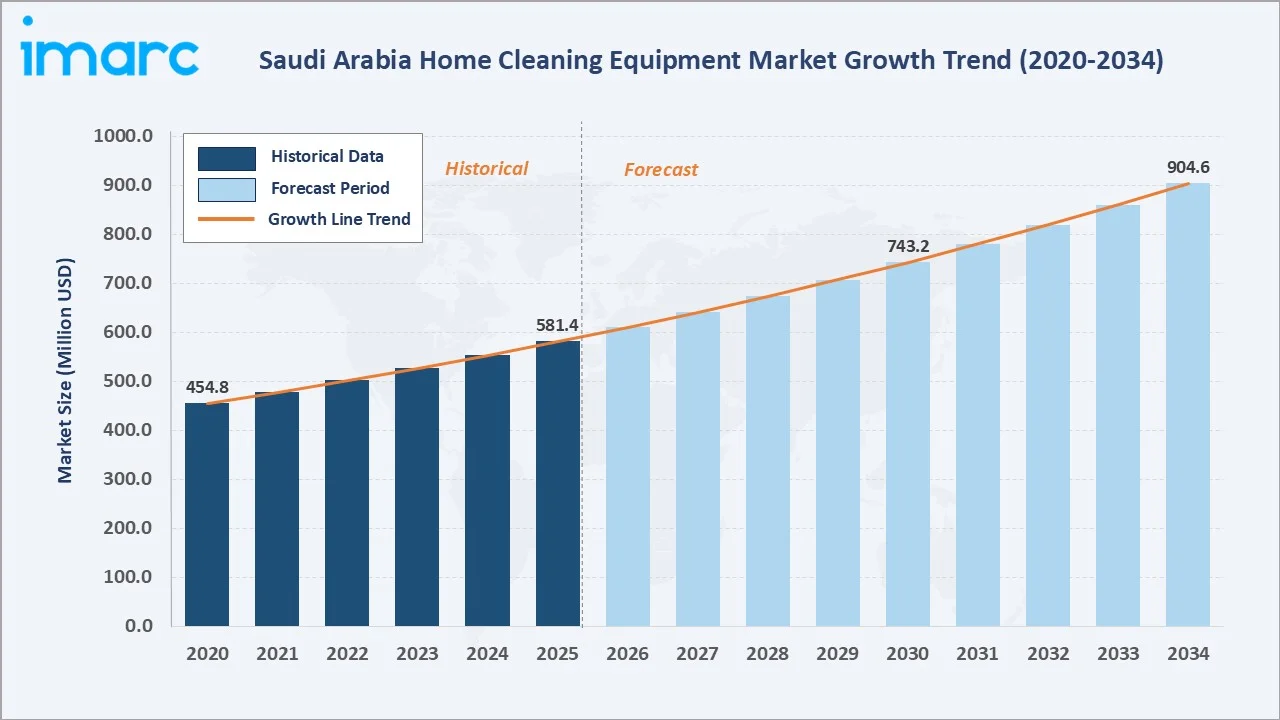
The Saudi Arabia home cleaning equipment market reached USD 581.4 Million in 2025 and is projected to reach USD 904.6 Million by 2034, expanding at a CAGR of 5.04% during 2026-2034. Market growth is anchored in the Kingdom's expanding housing stock, a young and rapidly urbanizing population, and rising female workforce participation, which is reshaping household cleaning routines and lifting demand for time-saving appliances. Vacuum cleaners lead the type segmentation with a 39.6% share in 2025, while household applications command 74.3% of total demand. The Northern and Central Region, anchored by Riyadh, dominates regionally at 46.9% share, supported by the Kingdom's highest population density and most developed organized-retail infrastructure.
Market Snapshot
|
Metric |
Value |
|
Market Size (2025) |
USD 581.4 Million |
|
Forecast Market Size (2034) |
USD 904.6 Million |
|
CAGR (2026-2034) |
5.04% |
|
Base Year |
2025 |
|
Historical Period |
2020-2025 |
|
Forecast Period |
2026-2034 |
|
Largest Type |
Vacuum Cleaners (39.6%, 2025) |
|
Largest Application |
Household (74.3%, 2025) |
|
Dominant Region |
Northern & Central Region (46.9%, 2025) |
The market expanded from USD 454.8 Million in 2020 to USD 581.4 Million in 2025, is anchored at USD 743.2 Million by 2030, and is forecast to reach USD 904.6 Million by 2034. Growth is supported by Vision 2030's housing expansion, GASTAT-reported growth in Saudi household units to 4.4 million in 2024 and rising disposable incomes that are lifting purchases of premium and technology-enabled cleaning appliances.
To get more information on this market, Request Sample
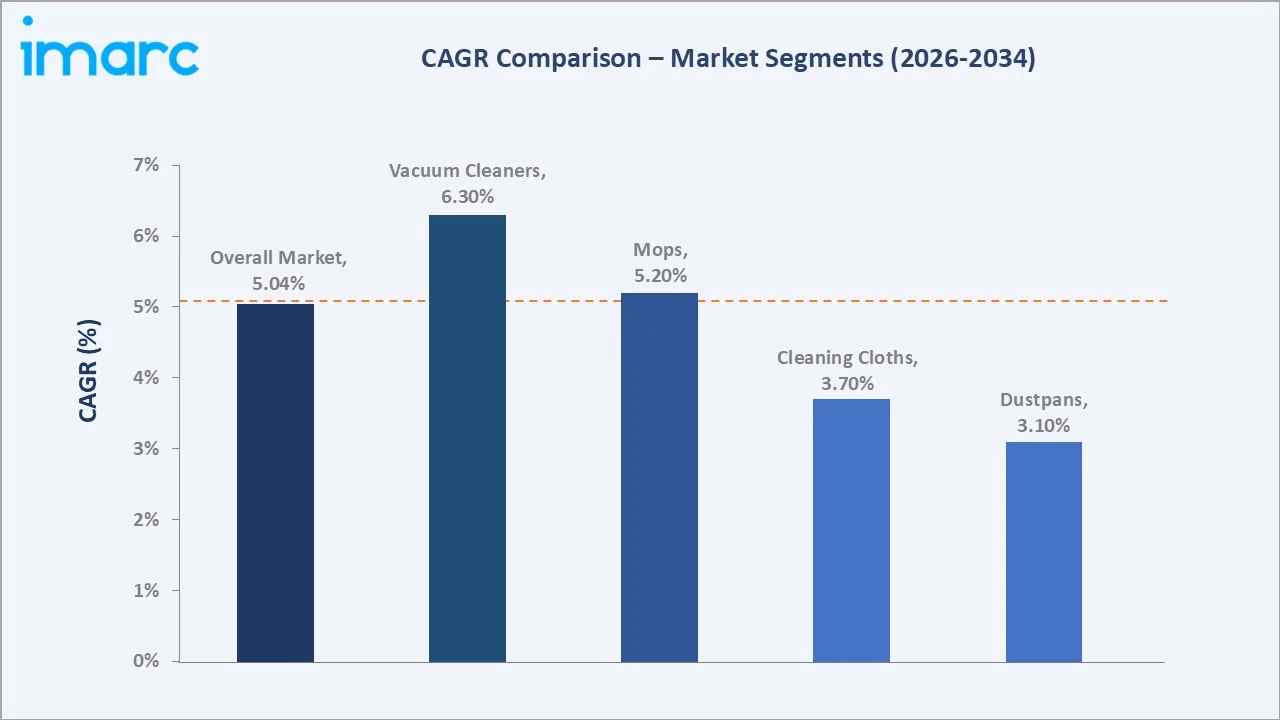
Vacuum cleaners grow fastest among the type segments at an estimated 6.3% CAGR (2026-2034), propelled by rising robotic and cordless-battery adoption in urban households. Mops follow at approximately 5.2%, while cleaning cloths and dustpans expand more moderately as demand gradually consolidates toward machine-based and semi-automated cleaning solutions.
Executive Summary
The Saudi Arabia home cleaning equipment market reached USD 581.4 Million in 2025, propelled by rapid urban housing growth, an expanding middle class, and evolving consumer preference for time-saving cleaning solutions. According to GASTAT, the Kingdom's population reached approximately 35 million in 2025, with 71% of Saudi nationals under the age of 35 - a demographic profile that favors adoption of modern home-care appliances over traditional manual tools.
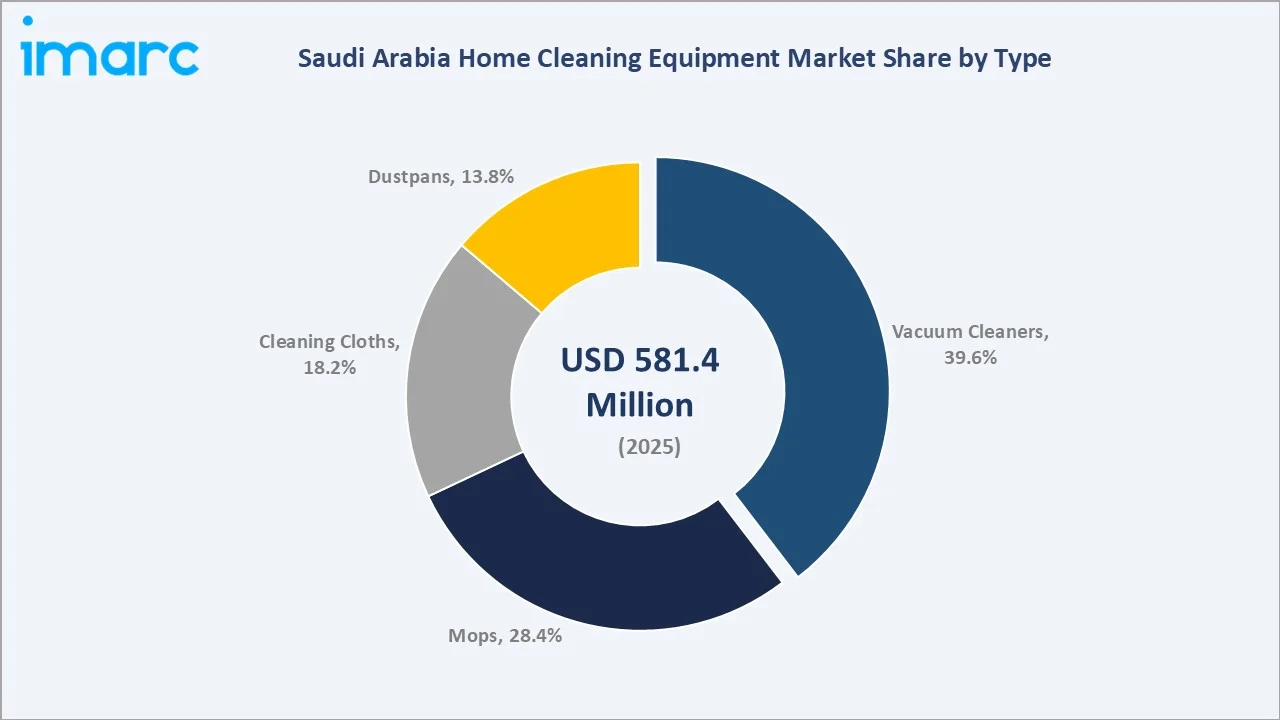
Vacuum cleaners commanded 39.6% of the 2025 market, reflecting strong uptake of upright, canister, and increasingly robotic formats among urban households. Mops held 28.4% share, followed by cleaning cloths at 18.2% and dustpans at 13.8%. Household application dominated with 74.3% share, while commercial demand, spanning hospitality, healthcare, and retail facilities, accounted for the remaining 25.7%, expanding alongside Saudi Arabia's tourism and giga-project pipeline.
The Northern and Central Region led with 46.9% share in 2025, anchored by Riyadh's population concentration, while the Western Region benefited from Jeddah's commercial density and pilgrimage-linked hospitality demand. The market is projected to reach USD 904.6 Million by 2034 at a 5.04% CAGR, supported by e-commerce retail expansion, smart-home integration, and the continued formalization of retail channels across the Kingdom.
Key Market Insights
|
Insight |
Data |
|
Largest Type |
Vacuum Cleaners- 39.6% share (2025) |
|
Largest Application |
Household - 74.3% share (2025) |
|
Dominant Region |
Northern & Central Region - 46.9% share (2025) |
|
Top Companies |
Alfred Kärcher SE & Co. KG, Groupe SEB, BISSELL Homecare, Inc., and Hitachi Ltd. |
|
Market Opportunity |
Robotic and smart-vacuum penetration in urban Saudi households |
Key Analytical Observations Supporting The Above Data:
- Vacuum cleaners at 39.6% share (2025) driven by smart-home adoption: Rising penetration of robotic and cordless vacuum models among Saudi households is displacing traditional upright and canister formats, particularly in newly built apartments and villas.
- Mops at 28.4% share supported by affordability and hard-flooring prevalence: Spray and steam mop formats remain a staple across Saudi households, where tiled and marble flooring is common in both villas and apartments.
- Household applications at 74.3% anchored by GASTAT-reported housing growth: Saudi households in owned or rented housing units rose 2.7% to 4.4 million in 2024, directly expanding the addressable base for home cleaning equipment.
- Commercial application growing at a faster ~4.4% CAGR: Hospitality, healthcare, and retail facility expansion under Vision 2030 giga-projects is lifting institutional demand for commercial-grade cleaning equipment.
- Northern & Central Region dominant with 46.9% share (2025): The region benefits from Riyadh's concentration of population, organized retail, and e-commerce fulfilment infrastructure.
Saudi Arabia Home Cleaning Equipment Market Overview
Saudi Arabia's home cleaning equipment market covers vacuum cleaners, mops, cleaning cloths, and dustpans sold for household and commercial use, spanning manual tools to motorized and increasingly robotic devices. The market remains largely import-dependent, with global manufacturers supplying the Kingdom through licensed distributors and organized retail chains regulated under Saudi Standards, Metrology and Quality Organization (SASO) product-safety and energy-efficiency standards. Macroeconomic tailwinds include Vision 2030's housing and giga-project pipeline, GASTAT-reported household growth to 4.4 million units among Saudi families in 2024, and rising participation of women in the workforce, which is compressing available time for manual household cleaning and lifting demand for labor-saving appliances.
Market Dynamics
To evaluate market opportunities, Request Sample
Market Drivers
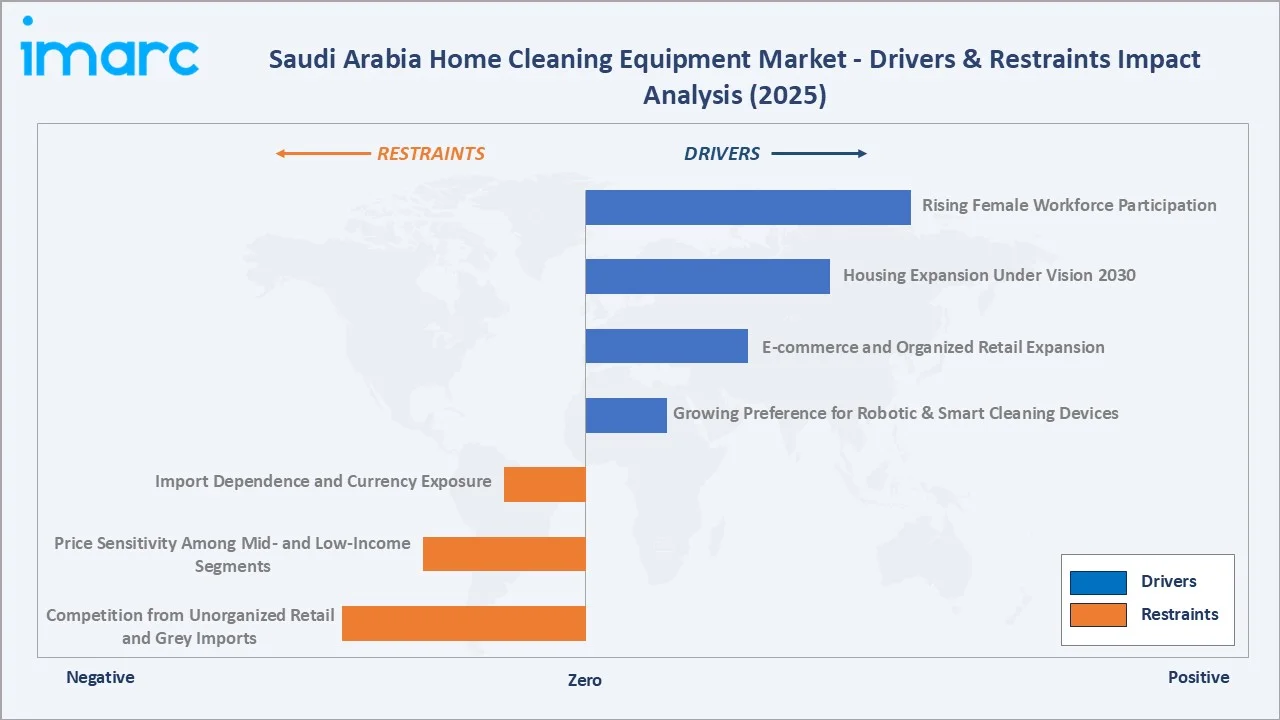
- Rising Female Workforce Participation: Growing employment among Saudi women under Vision 2030's labor-market reforms is reducing time available for manual household cleaning, lifting demand for efficient and semi-automated cleaning equipment.
- Housing Expansion Under Vision 2030: GASTAT reported that Saudi households occupying owned or rented housing units grew by around 2.7% (233,000 units) to reach 4.4 million in 2024, directly expanding the addressable household base.
- E-commerce and Organized Retail Expansion: Saudi Arabia's national payment network Mada processed SAR 197.42 Billion in e-commerce transactions in 2024, a 25.8% year-on-year increase, easing online discovery and purchase of cleaning appliances.
- Growing Preference for Robotic & Smart Cleaning Devices: Urban, dual-income households are increasingly adopting app-controlled and robotic vacuum cleaners that integrate with broader smart-home ecosystems.
Market Restraints
- Import Dependence and Currency Exposure: Saudi Arabia's near-total reliance on imported cleaning appliances exposes distributors to USD/SAR exchange-rate movements and international freight-cost volatility.
- Price Sensitivity Among Mid- and Low-Income Segments: A large expatriate and price-conscious consumer base continues to favor low-cost manual mops, cloths, and dustpans over premium motorized alternatives.
Market Opportunities
- Smart-Home and IoT Integration: Growing smartphone and 5G penetration, which covers around 78% of residents, creates opportunities for connected, app-controlled cleaning devices bundled with broader smart-home platforms.
- Localized Assembly and Value-Added Distribution: Vision 2030's industrial-localization incentives create potential for regional assembly and after-sales service hubs serving Saudi Arabia and the wider GCC market.
Market Challenges
- Competition from Unorganized Retail and Grey Imports: Informal retailers and parallel-import channels offering unbranded cleaning tools continue to pressure margins for authorized distributors.
- Consumer Awareness Gap for Premium Robotic Devices: Limited after-sales service infrastructure outside major cities constrains adoption of higher-value robotic and cordless vacuum categories in smaller urban centers.
Emerging Market Trends
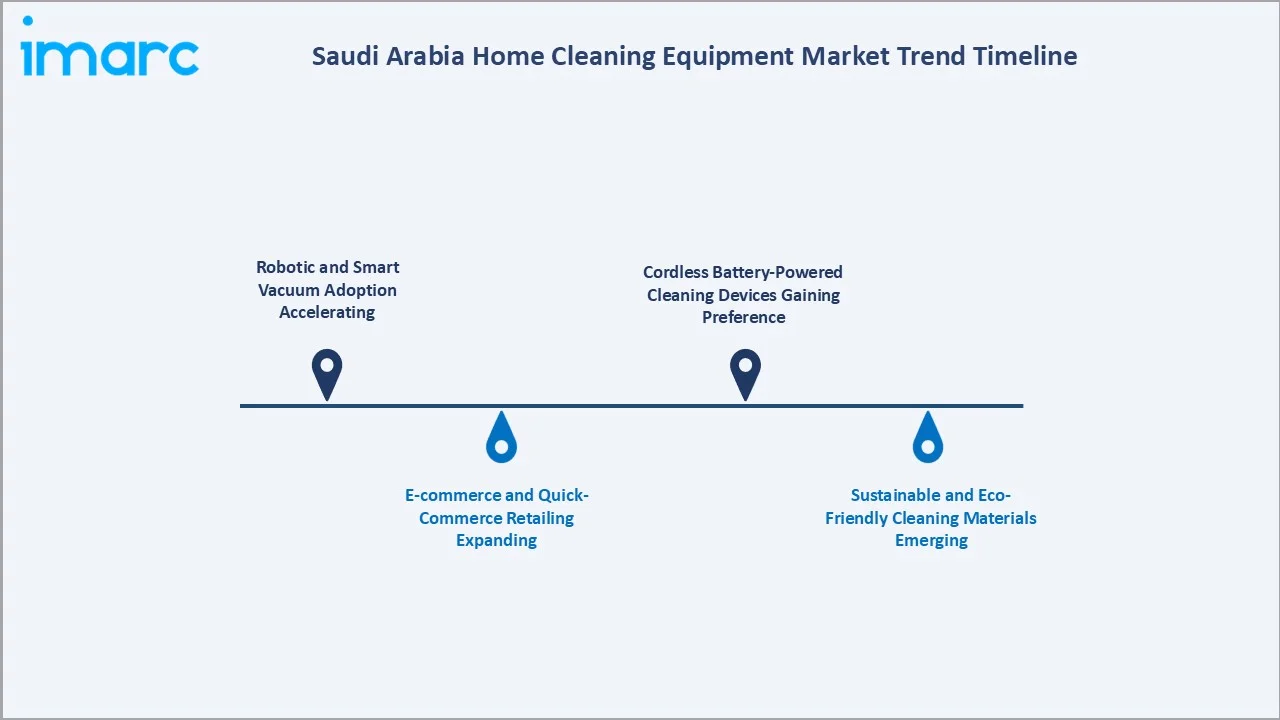
1. Robotic and Smart Vacuum Adoption Accelerating
Robotic vacuum cleaners with app-based scheduling and mapping are gaining traction in Saudi Arabia's urban apartments and villas. Brands are increasingly pairing suction technology with mopping functions, mirroring global product launches such as Rowenta's Narwal-engineered cordless vacuum-and-wash cleaner introduced in late 2024.
2. E-commerce and Quick-Commerce Retailing Expanding
Consumer-electronics and home-appliance categories remain among the largest online retail segments in Saudi Arabia, supported by nearly universal internet penetration and rapid digital-payment adoption through the Mada network and mobile wallets.
3. Cordless Battery-Powered Cleaning Devices Gaining Preference
Lithium-ion battery advances are extending run-times and reducing weight across stick and handheld vacuum categories, prompting global brands to prioritize cordless launches for hard-floor-dominant Gulf households.
4. Sustainable and Eco-Friendly Cleaning Materials Emerging
Manufacturers are introducing recycled-material vacuum bodies and reusable microfiber cloths in response to growing environmental awareness among younger Saudi consumers, aligning with the Kingdom's broader sustainability agenda.
Industry Value Chain Analysis
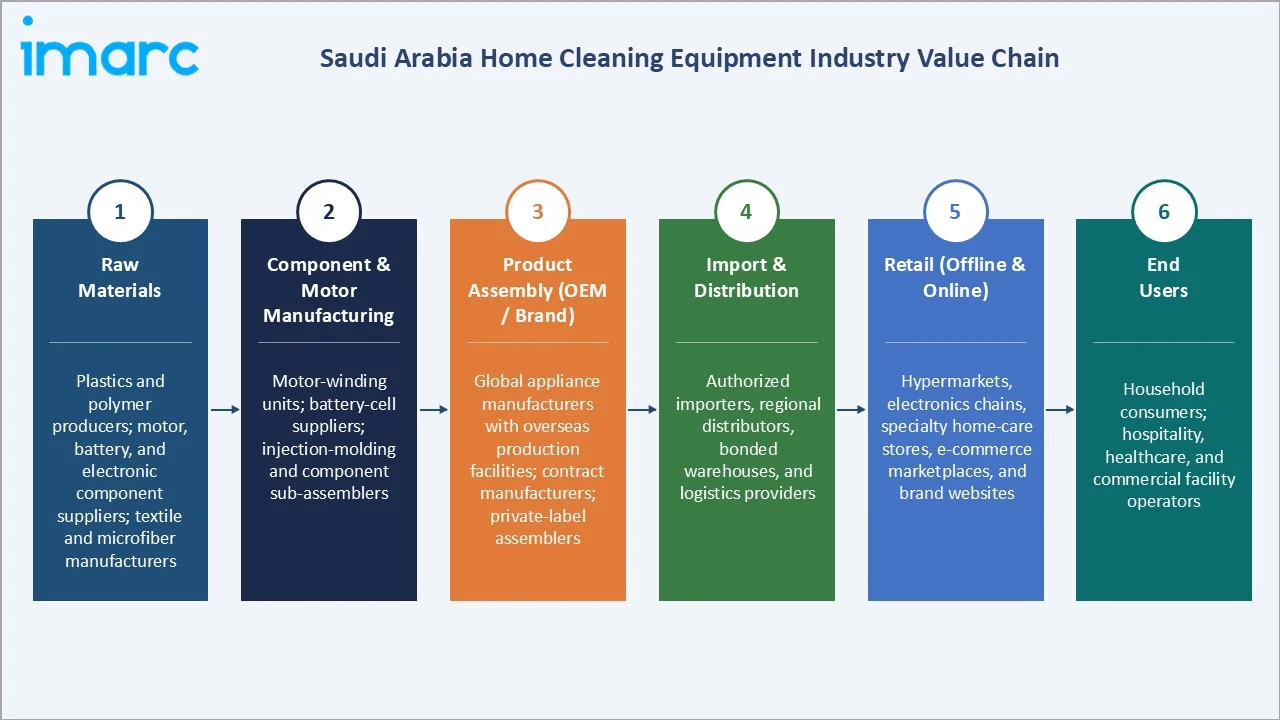
Saudi Arabia's home cleaning equipment value chain spans global raw-material sourcing, component and motor manufacturing, brand assembly, multi-tier Saudi distribution, and end-consumer retail across offline and online channels serving both household and commercial demand.
|
Stage |
Key Participants |
|
Raw Materials |
Plastics and polymer producers; motor, battery, and electronic component suppliers; textile and microfiber manufacturers |
|
Component & Motor Manufacturing |
Motor-winding units; battery-cell suppliers; injection-molding and component sub-assemblers |
|
Product Assembly (OEM / Brand) |
Global appliance manufacturers with overseas production facilities; contract manufacturers; private-label assemblers |
|
Import & Distribution |
Authorized importers, regional distributors, bonded warehouses, and logistics providers |
|
Retail (Offline & Online) |
Hypermarkets, electronics chains, specialty home-care stores, e-commerce marketplaces, and brand websites |
|
End Users |
Household consumers; hospitality, healthcare, and commercial facility operators |
Distribution in the Kingdom typically follows a two-tier model in which global brands supply licensed importers, who in turn service organized retail chains and a growing base of e-commerce marketplaces. The rise of direct-to-consumer online channels is gradually compressing traditional importer margins and encouraging brands to strengthen localized after-sales service networks.
Technology Landscape in the Saudi Arabia Home Cleaning Equipment Industry
Cordless & Battery Technology
Lithium-ion battery systems are replacing older nickel-based packs across stick and handheld vacuum categories, extending run-times while reducing appliance weight for easier handling across Saudi Arabia's predominantly hard-flooring households.
Robotic & Smart Connectivity
App-controlled navigation, room-mapping sensors, and voice-assistant integration are becoming standard in mid- and premium-tier robotic vacuum models, aligning with Saudi Arabia's broader smart-home and digital-transformation push under Vision 2030.
Sustainable Materials Innovation
Leading brands are introducing recycled-plastic housings and reusable microfiber cleaning cloths, responding to rising environmental awareness and aligning with global manufacturers' sustainability commitments.
Market Segmentation Analysis
The report covers the following segments:
|
Segment Category |
Leading Segment |
Market Share |
Year |
|
Type |
Vacuum Cleaners |
39.6% |
2025 |
|
Application |
Household |
74.3% |
2025 |
|
Region |
Northern & Central Region |
46.9% |
2025 |

By Type
Vacuum cleaners dominate at 39.6% market share (2025), reflecting broad adoption across upright, canister, stick, and robotic formats in both villas and apartments. Rising smart-home integration and dual-income households are reinforcing the category's lead position through the forecast period.
To access detailed market analysis, Request Sample
Mops hold the second-largest share at 28.4%, supported by affordability and the prevalence of tiled and marble hard flooring across Saudi homes. Cleaning cloths at 18.2% and dustpans at 13.8% remain essential low-cost complements, though their growth trails motorized categories as consumer preference gradually shifts toward machine-based cleaning.
By Application
Household application leads with 74.3% share (2025), anchored by GASTAT-reported growth in Saudi housing units and rising disposable incomes that support premium appliance purchases across urban and suburban families.
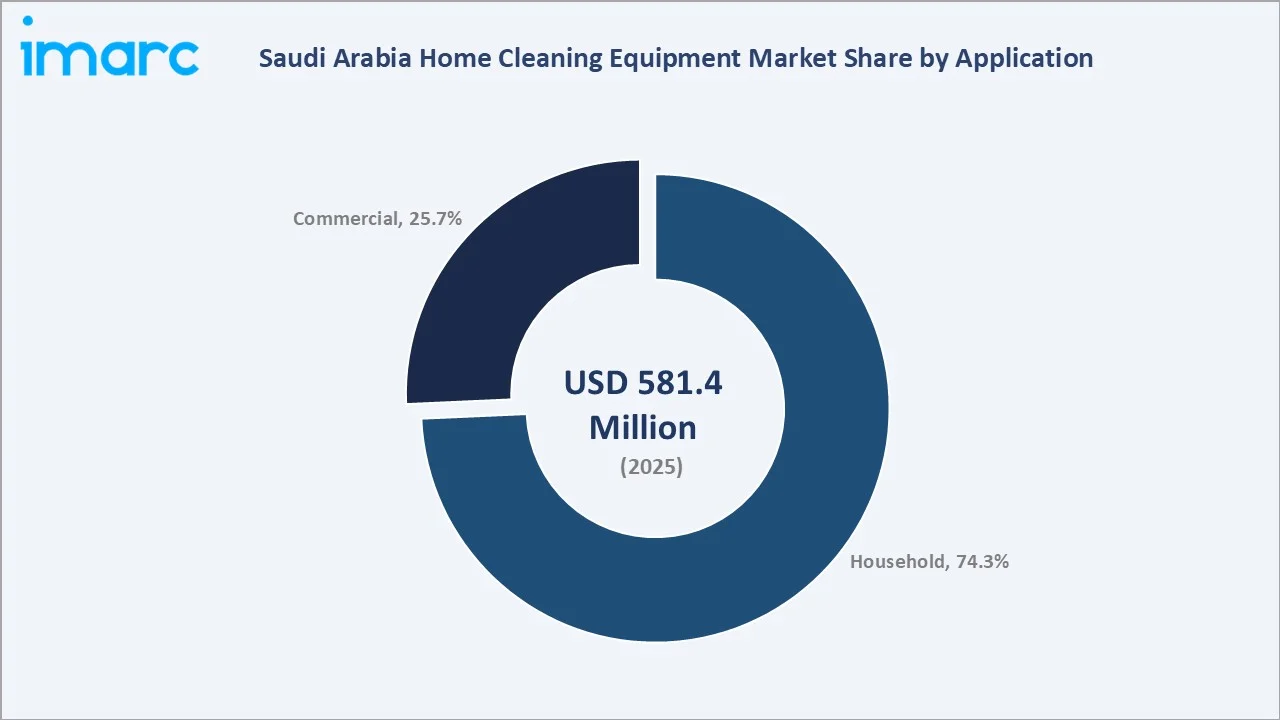
Commercial application, comprising hospitality, healthcare, retail, and institutional facilities, accounts for 25.7% of demand and is expanding at a comparatively faster pace as Vision 2030 giga-projects and tourism-sector growth expand the Kingdom's serviced-facility base.
Regional Market Insights
|
Region |
Share (2025) |
Key Growth Drivers & Characteristics |
|
Northern & Central Region |
46.9% |
Highest population density anchored by Riyadh; concentration of organized retail, corporate offices, and e-commerce fulfilment infrastructure driving broad appliance demand |
|
Western Region |
23.8% |
Jeddah's commercial port activity and Makkah and Madinah's year-round pilgrimage-linked hospitality demand supporting sustained commercial cleaning equipment purchases |
|
Eastern Region |
18.7% |
Industrial and expatriate population concentration around Dammam and Khobar, with steady household and facility-management demand tied to the oil and petrochemical corridor |
|
Southern Region |
10.6% |
Emerging infrastructure development and gradual formalization of retail channels supporting a nascent but growing appliance base |
The Northern and Central Region's 46.9% share (2025) reflects Riyadh's status as the Kingdom's political and economic capital, home to the highest concentration of new housing developments and organized retail footprint. The Western Region follows at 23.8%, anchored by Jeddah's role as Saudi Arabia's principal commercial port and the sustained flow of Hajj and Umrah pilgrims into Makkah and Madinah.
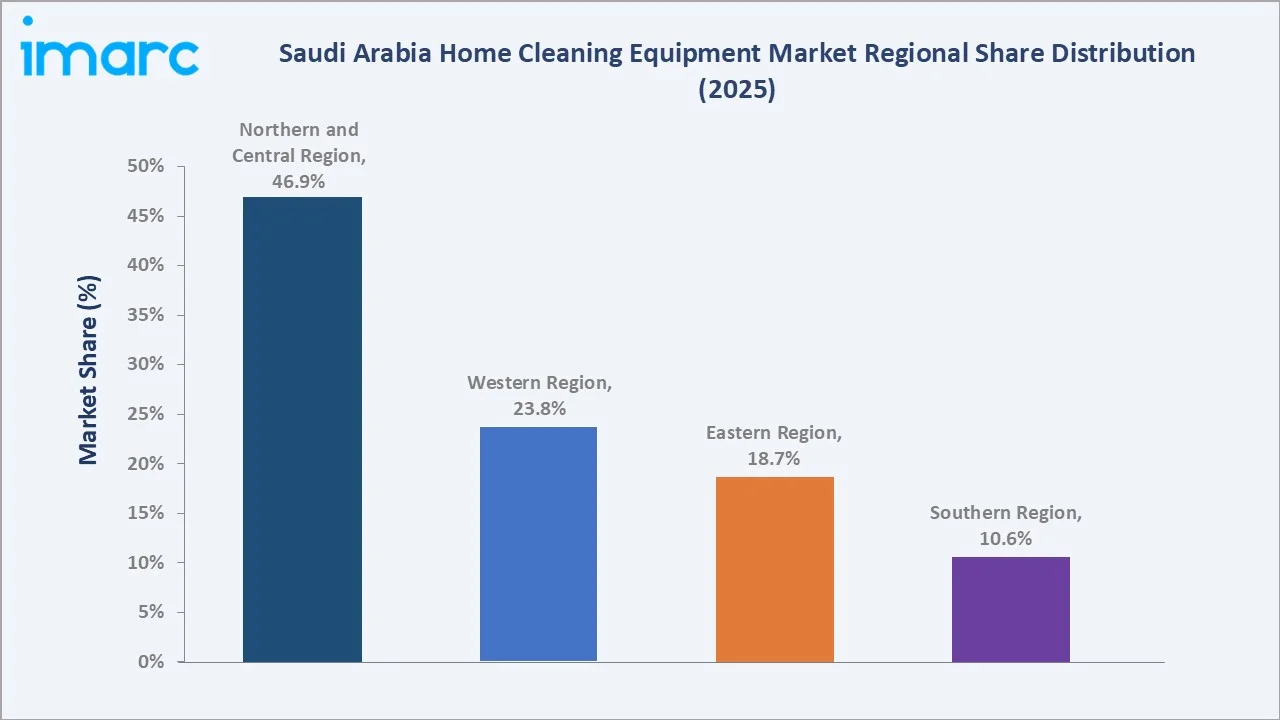
The Eastern Region holds 18.7% share, supported by Dammam and Khobar's industrial and expatriate population base, while the Southern Region accounts for 10.6%, reflecting its comparatively early stage of retail and infrastructure development relative to the rest of the Kingdom.
Competitive Landscape
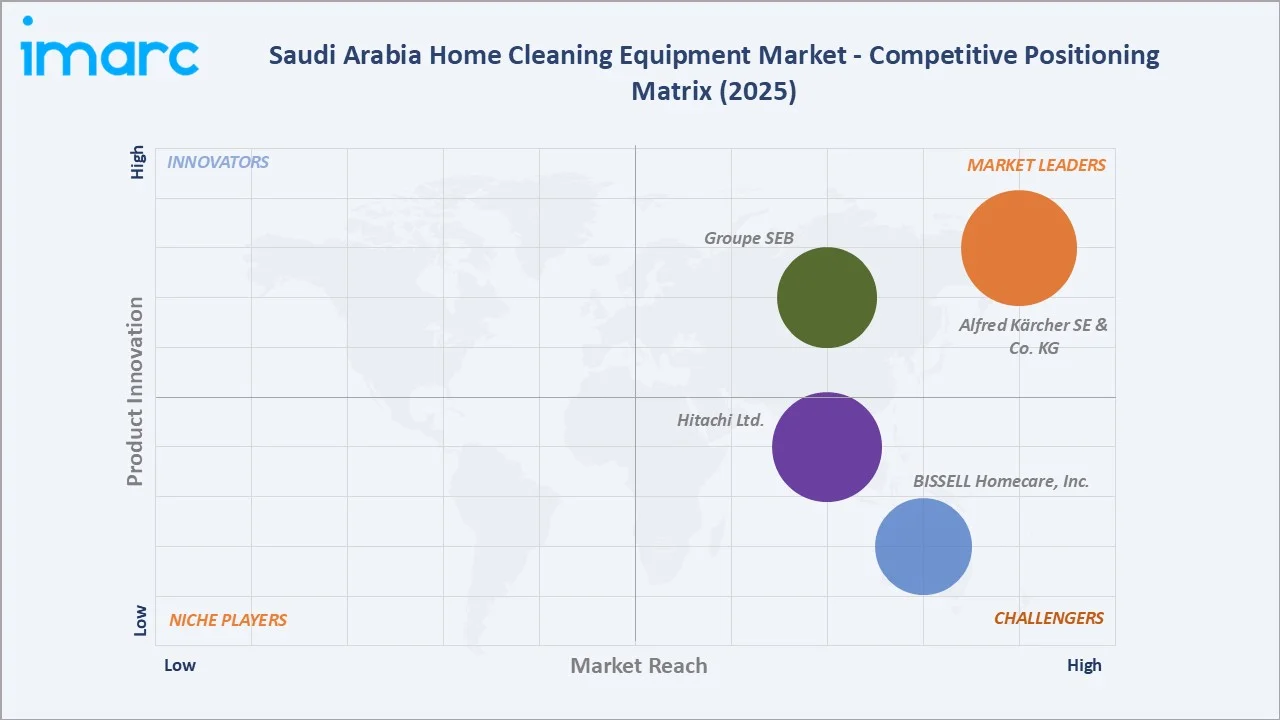
Saudi Arabia's home cleaning equipment market is moderately concentrated among established global appliance brands, with growing competitive pressure from value-tier Asian manufacturers in the mid- and budget-price segments.
|
Company Name |
Product Line |
Market Position |
Core Strength |
|
Alfred Kärcher SE & Co. KG |
Pressure Washers, Wet & Dry Vacuums, Hard Floor & Window Cleaners, Robotic Vacuums |
Market Leader |
Known locally as Kärcher Saudi Arabia – Juffali, German engineering reputation, unmatched brand trust, premium product durability |
|
Groupe SEB |
Canister Vacuums, Versatile Cordless Stick Vacuums, Wet-And-Dry Cleaning Units |
Market Leader |
Operates via Alesayi Household Appliances Co. Ltd., premium cordless innovation, energy and ergonomic focus, local adaptation |
|
BISSELL Homecare, Inc. |
Portable Spot Cleaners, Multi-Surface Cleaners, Wet & Dry Vacuums, Stick Vacuums |
Strong Challenger |
Products distributed in the Kingdom via Modern Electronics Co. (MEC) and Shaker Group, specialized deep cleaning, hard-floor & carpet multi-tasking, strong local distribution network |
|
Hitachi Ltd. |
Robot Vacuum Cleaners, Cordless Stick Vacuums, Drum/Canister Vacuums, Air Purifiers |
Strong Challenger |
Operates in the region as Arçelik Hitachi Home Appliances, Japanese durability, high suction power, ergonomic design tailored for large homes |
The premium and mid-tier segments are led by Kärcher and Groupe SEB's Tefal and Rowenta brands, both of which maintain strong regional distribution through licensed importers, while BISSELL and Hitachi compete on price-performance value across the broader household segment.
Key Company Profiles
Alfred Kärcher SE & Co. KG
Alfred Kärcher SE & Co. KG is a family-owned German company and a global leader in cleaning technology, which operates in Saudi Arabia through its local distributor, Juffali Technical Equipment.
- Product Portfolio: Pressure washers, wet & dry vacuums, hard floor & window cleaners, robotic vacuums, and others.
- Strategic Focus: Premium brand positioning anchored by cleaning-technology innovation and an extensive regional dealer and service network.
Groupe SEB
Groupe SEB is a French home-appliance manufacturer which operates in the Kingdom via Alesayi Household Appliances Co, its majority-owned Saudi subsidiary. Its brands, Tefal, Moulinex, and Rowenta, hold a significant presence across the Middle East, offering vacuum cleaners, steam cleaners, and related home-care appliances through regional distributor networks.
- Product Portfolio: Canister vacuums, versatile cordless stick vacuums, wet-and-dry cleaning units, and others.
- Strategic Focus: Innovation-led expansion of connected and robotic home-care appliances alongside its established manual and corded product range.
BISSELL Homecare, Inc.
BISSELL is a fifth-generation, family-led American floor-care company with over 150 years of operating history. Their products are officially imported and distributed in the Kingdom through Modern Electronics Co. (MEC) and Shaker Group.
- Product Portfolio: Portable spot cleaners, multi-surface cleaners, wet & dry vacuums, stick vacuums, and others.
- Strategic Focus: Product innovation centered on multi-surface and pet-focused cleaning performance across both corded and cordless formats.
Market Concentration Analysis
Saudi Arabia's home cleaning equipment market exhibits moderate concentration at the premium and mid-tier brand level, with meaningful fragmentation across budget manual-tool categories such as cleaning cloths and dustpans. Kärcher and Groupe SEB's Tefal, Moulinex, and Rowenta brands collectively account for a substantial share of premium and mid-tier vacuum cleaner and steam-cleaning device sales through their established regional distribution networks.
Fragmentation is more pronounced in the manual-tool segments, where numerous unbranded and regionally manufactured mops, cloths, and dustpans compete primarily on price. Consolidation trends remain limited at the importer level, though global brands are increasingly pursuing direct distribution agreements to reduce reliance on multi-tier importer margins and strengthen after-sales service coverage across the Kingdom.
Investment & Growth Opportunities
Fastest Growing Segments
The vacuum cleaner segment (~6.3% CAGR) and commercial application (~4.4% CAGR) represent Saudi Arabia's highest-growth investment vectors through 2034, alongside the fast-expanding online retail channel supported by rising digital-payment adoption.
Emerging Market Opportunities
Vision 2030's industrial-localization incentives create a viable pathway for global appliance manufacturers to establish regional assembly or value-added distribution operations serving Saudi Arabia and the broader six-nation GCC market.
Investment Themes
- Robotic and smart-vacuum portfolio expansion: Brands establishing early Saudi-specific robotic vacuum distribution and after-sales service networks stand to capture first-mover advantage ahead of broader smart-home adoption.
- Digital retail platform investment: Saudi Arabia's e-commerce growth trajectory creates opportunities for appliance-focused online platforms integrating price comparison, financing, and installation-support services.
- Commercial facility-management service bundling: Hospitality and healthcare sector expansion under Vision 2030 is creating demand for equipment-supply contracts bundled with maintenance and consumables replenishment services.
Future Market Outlook (2026-2034)
The Saudi Arabia home cleaning equipment market is projected to grow from USD 581.4 Million in 2025 to USD 904.6 Million by 2034, at a 5.04% CAGR, reflecting steady, structurally supported growth underpinned by continued housing expansion and rising appliance penetration across the Kingdom.
Three structural forces anchor this growth trajectory through 2034: Vision 2030's sustained housing and giga-project pipeline expanding the addressable household and commercial facility base; the Kingdom's youthful demographic profile, with 71% of Saudi nationals under 35, sustaining long-term appliance-replacement demand; and continued e-commerce and digital-payment penetration lowering barriers to premium and robotic appliance adoption across both major cities and emerging regional markets.
Research Methodology
Primary Research
Primary research comprised structured interviews with regional appliance distributors and importers, organized-retail category managers in Riyadh and Jeddah, e-commerce platform category leads, and industry association representatives across Saudi Arabia's home-appliance retail ecosystem.
Secondary Research
Secondary research drew on GASTAT population, household, and family-statistics publications, SASO product-standards documentation, Saudi Central Bank (SAMA) digital-payment and e-commerce statistics, Vision 2030 program documentation, and company disclosures from leading global home-appliance manufacturers.
Forecasting Models
Market-size forecasts were developed using a bottom-up household-penetration model, incorporating GASTAT household-growth projections, appliance replacement-cycle assumptions by type, and e-commerce channel-adoption trends, validated against reported historical market growth for 2020-2025.
Saudi Arabia Home Cleaning Equipment Market Report Coverage:
| Report Features | Details |
|---|---|
| Base Year of the Analysis | 2025 |
| Historical Period | 2020-2025 |
| Forecast Period | 2026-2034 |
| Units | Million USD |
| Scope of the Report |
Exploration of Historical Trends and Market Outlook, Industry Catalysts and Challenges, Segment-Wise Historical and Future Market Assessment:
|
| Types Covered | Mops, Dustpans, Vacuum Cleaners, Cleaning Cloths |
| Applications Covered | Household, Commercial |
| Regions Covered | Northern and Central Region, Western Region, Eastern Region, Southern Region |
| Companies Covered | Alfred Kärcher SE & Co. KG, Groupe SEB, BISSELL Homecare, Inc., Hitachi Ltd., etc. |
| Customization Scope | 10% Free Customization |
| Post-Sale Analyst Support | 10-12 Weeks |
| Delivery Format | PDF and Excel through Email (We can also provide the editable version of the report in PPT/Word format on special request) |
Key Benefits for Stakeholders:
- IMARC’s industry report offers a comprehensive quantitative analysis of various market segments, historical and current market trends, market forecasts, and dynamics of the Saudi Arabia home cleaning equipment market from 2020-2034.
- The research report provides the latest information on the market drivers, challenges, and opportunities in the Saudi Arabia home cleaning equipment market.
- Porter's five forces analysis assist stakeholders in assessing the impact of new entrants, competitive rivalry, supplier power, buyer power, and the threat of substitution. It helps stakeholders to analyze the level of competition within the Saudi Arabia home cleaning equipment industry and its attractiveness.
- Competitive landscape allows stakeholders to understand their competitive environment and provides an insight into the current positions of key players in the market.
Frequently Asked Questions About the Saudi Arabia Home Cleaning Equipment Market Report
The Saudi Arabia home cleaning equipment market reached USD 581.4 Million in 2025, driven by housing growth, rising female workforce participation, and expanding organized retail infrastructure.
The market is projected to grow at a CAGR of 5.04% during 2026-2034, reaching USD 904.6 Million by 2034, supported by e-commerce growth and rising appliance penetration.
Vacuum cleaners lead at 39.6% share (2025), driven by rising robotic and cordless adoption among urban Saudi households seeking time-saving cleaning solutions.
Household application holds the largest share at 74.3% (2025), anchored by GASTAT-reported growth in Saudi housing units and rising disposable incomes.
Commercial application grows fastest at an estimated 4.4% CAGR (2026-2034), driven by hospitality and healthcare facility expansion under Vision 2030 giga-projects.
The Northern and Central Region leads with 46.9% market share (2025), anchored by Riyadh's population density and organized-retail concentration.
Leading companies include Alfred Kärcher SE & Co. KG, Groupe SEB, BISSELL Homecare, Inc., and Hitachi Ltd., among others.
Vision 2030 is expanding housing supply, tourism-linked hospitality facilities, and female workforce participation, collectively driving both household and commercial cleaning equipment demand.
The market is projected to reach approximately USD 743.2 Million by 2030, supported by continued housing growth and rising e-commerce appliance sales.
E-commerce is an increasingly important channel, supported by Saudi Arabia's Mada network processing SAR 197.42 Billion in e-commerce sales in 2024, up 25.8% year-on-year.
Need more help?
- Speak to our experienced analysts for insights on the current market scenarios.
- Include additional segments and countries to customize the report as per your requirement.
- Gain an unparalleled competitive advantage in your domain by understanding how to utilize the report and positively impacting your operations and revenue.
- For further assistance, please connect with our analysts.
 Request Customization
 Speak to an Analyst
 Request Brochure
 Inquire Before Buying
Benefits of Customization
- Personalize this research
- Triangulate with your data
- Get data as per your format and definition
- Gain a deeper dive into a specific application, geography, customer, or competitor
- Any level of personalization
Get in Touch With Us
UNITED STATES
Phone: +1-201-971-6302
INDIA
Phone: +91-120-433-0800
UNITED KINGDOM
Phone: +44-753-714-6104
Email: [email protected]
Client Testimonials




.webp)




.webp)













Related Reports

Choose your plan
*Please note that the prices mentioned below are starting prices for each bundle type. Kindly contact our team for further details.*
Single User License
- 1 User License, Access on 2 Devices
- PDF Report + Excel Dataset (Password Protected)
- Lifetime Access
- No Printing Rights
- 10% Free Report Customization
- 10–12 Weeks of Analyst Support
Five User License
- Access for 5 Users, 2 Devices per User
- PDF Report + Excel Dataset (Password Protected)
- Lifetime Access
- Dedicated Account Manager
- 12–14 Weeks of Analyst Support
- No Printing Rights
- 15% Free Report Customization
- 25% Discount on Your Next Purchase
Corporate User License
- Unlimited User Access (Within Your Organization)
- PDF Report + Excel Dataset
- Lifetime Access
- Dedicated Account Manager
- 14–20 Weeks of Analyst Support
- No Printing Rights
- 20% Free Report Customization
- 30% Discount on Your Next Purchase
Essential Insights
What's included:
3 reports
- Lifetime Access
- PDF Reports
- Excel Datasets
- 2 Weeks of Free Analyst Support
- 2 User Licenses
- Access on 2 Devices
- Printing Rights
- Complimentary PowerPoint (PPT) Version
- Complimentary License Upgrade
Professional Access
What's included:
5 reports
- Lifetime Access
- PDF Reports
- Excel Datasets
- 8 Weeks of Free Analyst Support
- 2 User Licenses
- Access on 2 Devices
- Printing Rights
- Complimentary PowerPoint (PPT) Version
- Complimentary License Upgrade
Business Advantage
What's included:
8 reports
- Lifetime Access
- PDF Reports
- Excel Datasets
- 14 Weeks of Free Analyst Support
- 2 User Licenses
- Access on 2 Devices
- Printing Rights
- Complimentary PowerPoint (PPT) Version
- Complimentary License Upgrade
Enterprise Intelligence
What's included:
10 reports
- Lifetime Access
- PDF Reports
- Excel Datasets
- 20 Weeks of Free Analyst Support
- 2 User Licenses
- Access on 2 Devices
- Printing Rights
- Complimentary PowerPoint (PPT) Version
- Complimentary License Upgrade