
Saudi Arabia Home Fragrances Market Size, Share, Trends and Forecast by Product, Distribution Channel, and Region, 2026-2034
Saudi Arabia Home Fragrances Market Size, Share, Trends & Forecast (2026-2034)
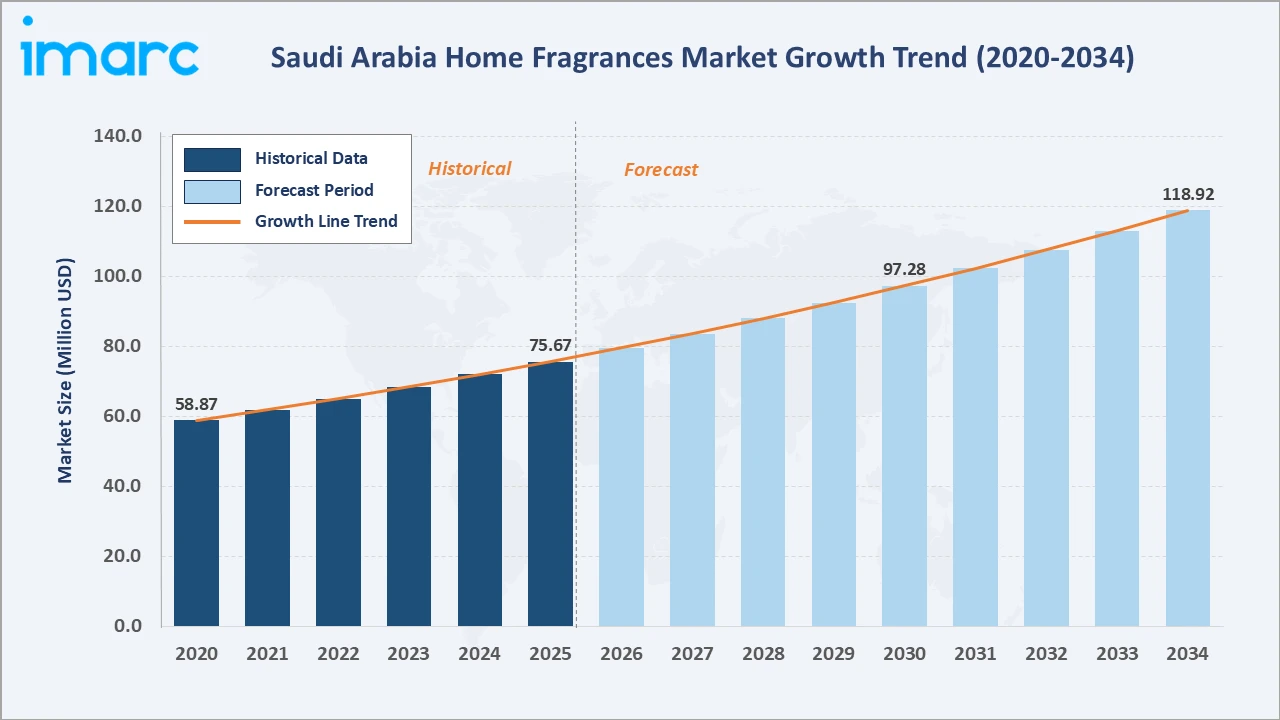
The Saudi Arabia home fragrances market reached USD 75.67 Million in 2025 and is projected to reach USD 118.92 Million by 2034, growing at a CAGR of 5.15% during 2026-2034. Deep-rooted oud and bakhoor hospitality customs, rising Umrah and Hajj footfall, and Vision 2030 retail expansion anchor sustained demand. Sprays lead product share at 31.8%, followed by incense sticks at 24.6%. Specialty stores dominate distribution at 36.4% share. The Northern and Central Region leads regionally at 47.1%, anchored by Riyadh's household density and gifting culture.
Market Snapshot
|
Metric |
Value |
|
Market Size (2025) |
USD 75.67 Million |
|
Forecast Market Size (2034) |
USD 118.92 Million |
|
CAGR (2026-2034) |
5.15% |
|
Base Year |
2025 |
|
Historical Period |
2020-2025 |
|
Forecast Period |
2026-2034 |
|
Largest Product Segment |
Sprays (31.8%, 2025) |
|
Largest Distribution Channel |
Specialty Stores (36.4%, 2025) |
|
Dominant Region |
Northern & Central Region (47.1%, 2025) |
The market expanded from USD 58.87 Million in 2020 to USD 75.67 Million in 2025, tracking toward an estimated USD 97.28 Million by 2030, and forecast to reach USD 118.92 Million by 2034. Growth is underpinned by Vision 2030's retail and tourism programs, over 18.5 million Hajj and Umrah pilgrims in 2024, and rising household spending on premium home ambiance products.
To get more information on this market, Request Sample
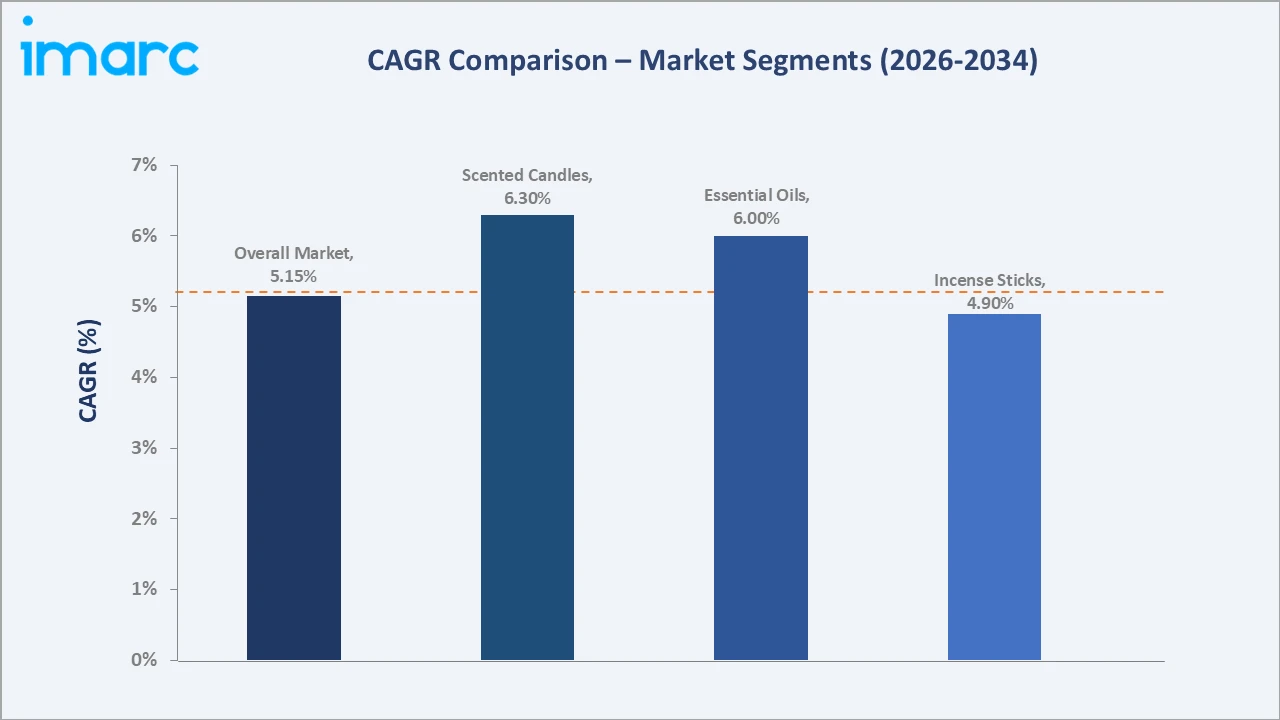
Scented candles post the fastest product-segment growth at an estimated 6.3% CAGR (2026-2034), driven by premiumization and home-decor trends, while sprays retain volume leadership on affordability and daily-use convenience. Essential oils follow closely at 6.0% CAGR, reflecting rising wellness-led purchasing among urban Saudi households.
Executive Summary
The Saudi Arabia home fragrances market reached USD 75.67 Million in 2025, shaped by a fragrance culture that spans daily bakhoor rituals, guest-hospitality incense burning, and gifting occasions tied to religious and social events. The market is projected to reach USD 118.92 Million by 2034 at a 5.15% CAGR, reflecting steady expansion supported by Vision 2030 retail diversification, rising tourism inflows, and premiumization of traditional fragrance formats.
Sprays command 31.8% of market share, valued for affordability and ease of use across residential and commercial settings, while incense sticks retain 24.6% share on cultural continuity. Scented candles, at 18.7% share, are the fastest-growing format as urban households adopt Western-style home decor alongside traditional Arabian scent profiles. Specialty stores lead distribution at 36.4%, anchored by consumer preference for scent discovery and personalized fragrance-blending services before purchase.
The Northern and Central Region dominates at 47.1% share, propelled by Riyadh's population concentration and government-led retail development, while the Western Region benefits from Jeddah, Makkah, and Madinah's sustained pilgrim traffic. Outlook through 2034 remains positive, with online retail, sustainable ingredient sourcing, and smart diffuser adoption forming the primary growth vectors.
Key Market Insights
|
Insight |
Data |
|
Largest Product Segment |
Sprays - 31.8% share (2025) |
|
Fastest-Growing Product Segment |
Scented Candles - ~6.3% CAGR (2026-2034) |
|
Dominant Distribution Channel |
Specialty Stores - 36.4% share (2025) |
|
Fastest-Growing Channel |
Online - ~9.8% CAGR (2026-2034) |
|
Leading Region |
Northern & Central Region - 47.1% share (2025) |
|
Top Companies |
Arabian Oud, Ajmal Perfumes, Rasasi Perfumes Industry LLC, Abdul Samad Al Qurashi, and Swiss Arabian Perfumes Group |
Key Analytical Observations Supporting the Above Data:
- Sprays lead at 31.8% share: Sprays' 31.8% share (2025) is anchored by everyday air-freshening use across homes, offices, and vehicles, their low unit price and wide hypermarket availability sustain volume leadership over premium candle and oil formats.
- Incense sticks retain 24.6% share: Incense sticks hold 24.6% share, reflecting bakhoor's role in daily hospitality rituals, over 75% of Saudi households reportedly burn oud or bakhoor regularly, sustaining structural demand independent of seasonal cycles.
- Scented candles expand at ~6.3% CAGR: Scented candles at 18.7% share grow fastest as urban millennials blend Western home-decor aesthetics with Arabian scent notes, supported by rising disposable incomes and social-media-driven gifting culture.
- Specialty stores dominate at 36.4%: Specialty stores' 36.4% share is anchored by consumer preference for in-person scent testing and custom oud blending, a service format that mass retail and online channels cannot easily replicate.
- Online distribution is the fastest-growing channel: Online channels, though smaller at 16.8% share, grow fastest as fragrance brands launch direct-to-consumer platforms offering subscription refills and app-based scent customization for younger consumers.
- Northern & Central Region leads at 47.1%: The Northern and Central Region's 47.1% share reflects Riyadh's concentration of affluent households, government offices, and hospitality venues that drive both personal and institutional fragrance purchasing.
Saudi Arabia Home Fragrances Market Overview
Saudi Arabia's home fragrances market covers sprays, incense sticks, scented candles, essential oils, and diffusers sold for residential, hospitality, and retail-gifting use. The category is deeply embedded in Saudi cultural life, spanning daily bakhoor rituals to oud-based incense burned for guests. Market activity spans regulated cosmetic and consumer-product imports, domestic oud-blending houses, and a growing base of international home-fragrance brands entering via specialty retail and e-commerce.
Macroeconomic influences include Vision 2030's non-oil retail diversification, rising household incomes, and record religious tourism, with over 18.5 million Hajj and Umrah pilgrims recorded in 2024. The Kingdom's General Authority for Statistics tracks retail trade activity that increasingly captures home-fragrance categories within broader personal-care and household-goods spending baskets.
Market Dynamics
To evaluate market opportunities, Request Sample
Market Drivers
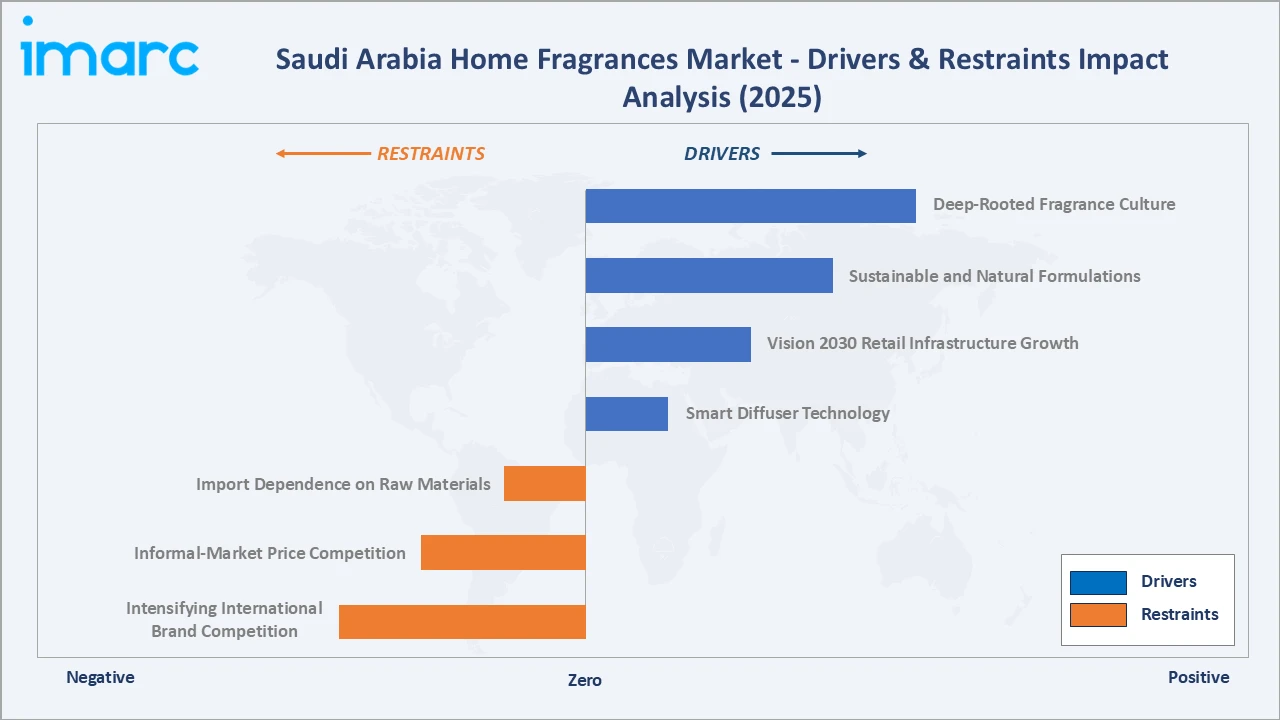
- Deep-Rooted Fragrance Culture: Saudi Arabia's oud and bakhoor hospitality tradition drives near-universal household usage, with regular fragrance burning embedded in daily routines, guest reception, and religious observance across all income segments.
- Record Religious Tourism: Over 18.5 million Hajj and Umrah pilgrims visited the Kingdom in 2024, lifting demand for gifting-format fragrances, hotel-amenity scenting, and mosque incense programs, including the Prophet's Mosque's daily bakhoor rituals.
- Vision 2030 Retail Infrastructure Growth: Vision 2030's retail-sector expansion, new shopping destinations, and tourism infrastructure investment are broadening specialty fragrance retail footprints across Riyadh, Jeddah, and secondary cities.
- Rising Household Incomes: Rising female workforce participation and household incomes are expanding premium and luxury home-fragrance purchasing beyond traditional gifting occasions into routine home-decor spending.
Market Restraints
- Import Dependence on Raw Materials: Saudi Arabia's near-total reliance on imported aroma compounds, glassware, and packaging materials exposes brands to freight-cost volatility and currency exchange fluctuations.
- Informal-Market Price Competition: Extensive informal-market bakhoor and unbranded incense sold through souks compete aggressively on price, compressing margins for branded specialty retailers.
Market Opportunities
- Smart Diffuser Technology: Smart, app-connected diffusers integrating scheduling and scent-intensity controls present a high-margin opportunity as Saudi consumers adopt connected home-decor technology.
- Sustainable and Natural Formulations: Sustainable, natural-ingredient fragrance lines align with growing consumer preference for halal-certified, chemical-free home products across the GCC.
Market Challenges
- Intensifying International Brand Competition: Global luxury fragrance houses entering via Riyadh and Jeddah malls intensify competition for premium retail shelf space against established Saudi oud houses.
- Raw Material Cost Volatility: Fluctuating raw-material costs for natural oud, essential oils, and packaging materials create periodic margin pressure across the value chain.
Emerging Market Trends
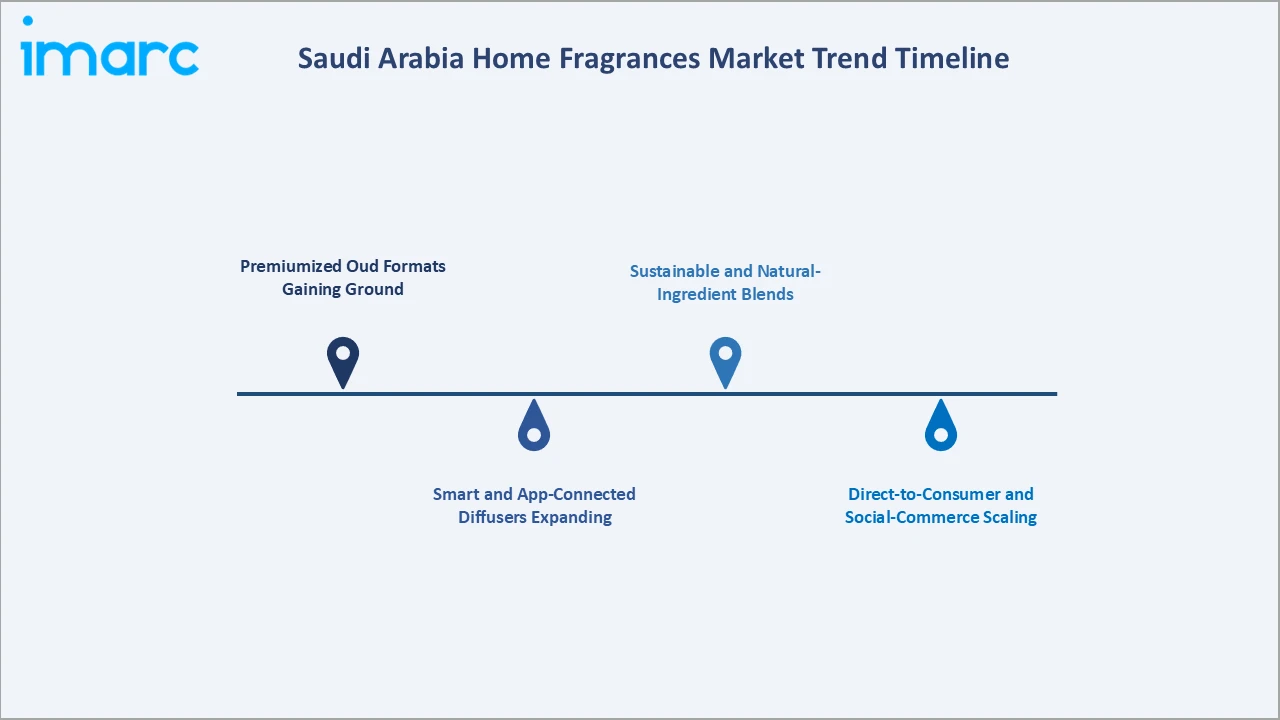
1. Premiumized Oud Formats Gaining Ground
Traditional oud and bakhoor are being reformulated into premium candle, spray, and diffuser formats. Heritage houses are pairing classic agarwood notes with modern packaging to attract younger, design-conscious buyers.
2. Smart and App-Connected Diffusers Expanding
Connected diffusers offering scheduling, intensity control, and scent-blend customization via mobile apps are entering Saudi retail, appealing to tech-forward urban households furnishing smart homes.
3. Sustainable and Natural-Ingredient Blends
Consumer demand for halal-certified, chemical-free fragrances is pushing brands toward natural essential-oil bases and recyclable packaging, mirroring broader GCC wellness and clean-living trends.
4. Direct-to-Consumer and Social-Commerce Scaling
Saudi fragrance brands are launching Instagram- and TikTok-driven direct sales channels, with celebrity-founded lines such as Sara Murad's oud-inspired brand illustrating the shift toward influencer-led product discovery.
Industry Value Chain Analysis
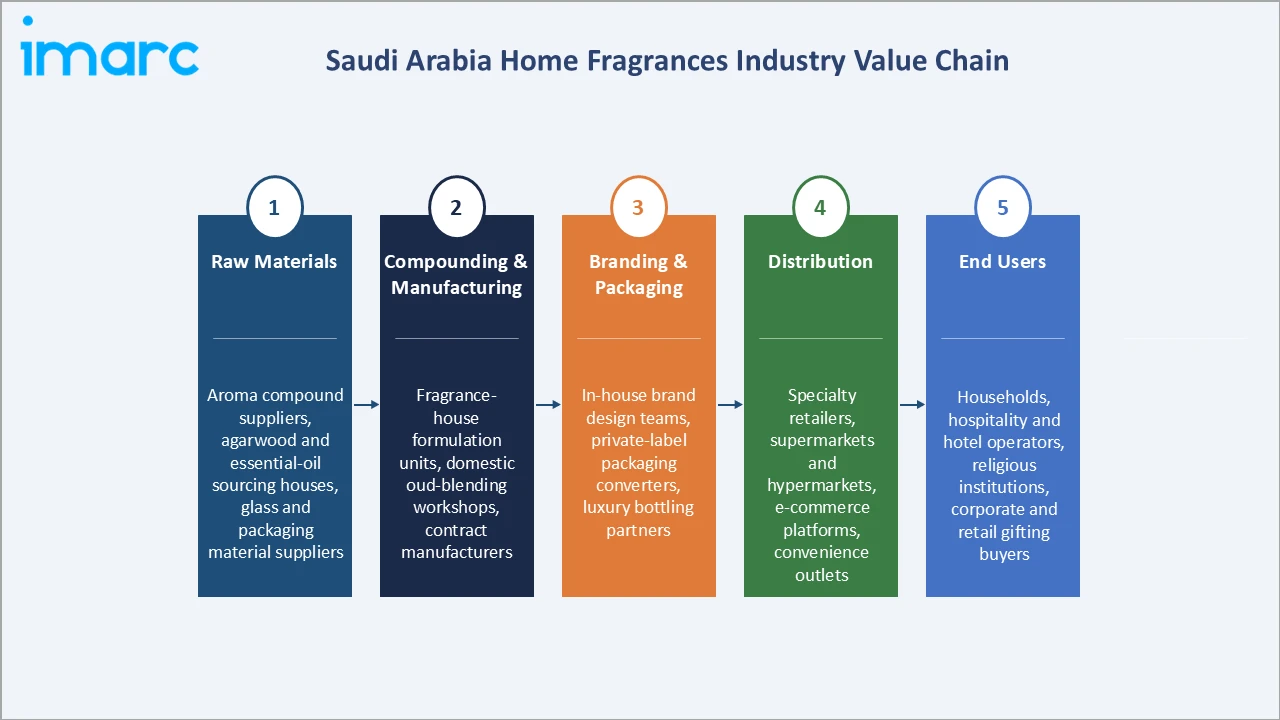
Saudi Arabia's home fragrances value chain spans raw-material sourcing from regional and international aroma-compound suppliers through domestic and imported manufacturing, brand packaging, multi-channel distribution, and end-consumer retail across residential, hospitality, and gifting occasions.
|
Stage |
Key Participants |
|
Raw Materials |
Aroma compound suppliers, agarwood and essential-oil sourcing houses, glass and packaging material suppliers |
|
Compounding & Manufacturing |
Fragrance-house formulation units, domestic oud-blending workshops, contract manufacturers |
|
Branding & Packaging |
In-house brand design teams, private-label packaging converters, luxury bottling partners |
|
Distribution |
Specialty retailers, supermarkets and hypermarkets, e-commerce platforms, convenience outlets |
|
End Users |
Households, hospitality and hotel operators, religious institutions, corporate and retail gifting buyers |
Specialty retailers and heritage oud houses retain the strongest margin position through direct scent-blending services, while distributors handling supermarket and online channels operate on thinner, volume-driven margins. Growing direct-to-consumer investment by leading brands is gradually compressing traditional wholesale distribution layers.
Technology Landscape in the Saudi Arabia Home Fragrances Industry
Encapsulation and Scent-Release Technology
Microencapsulation techniques are extending fragrance longevity in candles and sprays, allowing scent release to be calibrated for extended room coverage, a feature increasingly marketed by premium Saudi and international brands.
Smart Connectivity and App Integration
App-connected diffusers with scheduling, intensity, and remote-control features are entering Saudi smart-home ecosystems, aligning with the Kingdom's broader consumer electronics and home-automation adoption curve.
Natural Ingredient and Sustainable Processing Innovation
Cold-pressed essential-oil extraction and sustainably sourced agarwood alternatives are gaining traction as brands respond to consumer demand for halal-certified, environmentally responsible formulations without compromising traditional scent profiles.
.webp)
Market Segmentation Analysis
The report covers the following segments:
|
Segment Category |
Leading Segment |
Market Share |
Year |
|
Product |
Sprays |
31.8% |
2025 |
|
Distribution Channel |
Specialty Stores |
36.4% |
2025 |
|
Region |
Northern and Central Region |
47.1% |
2025 |

By Product
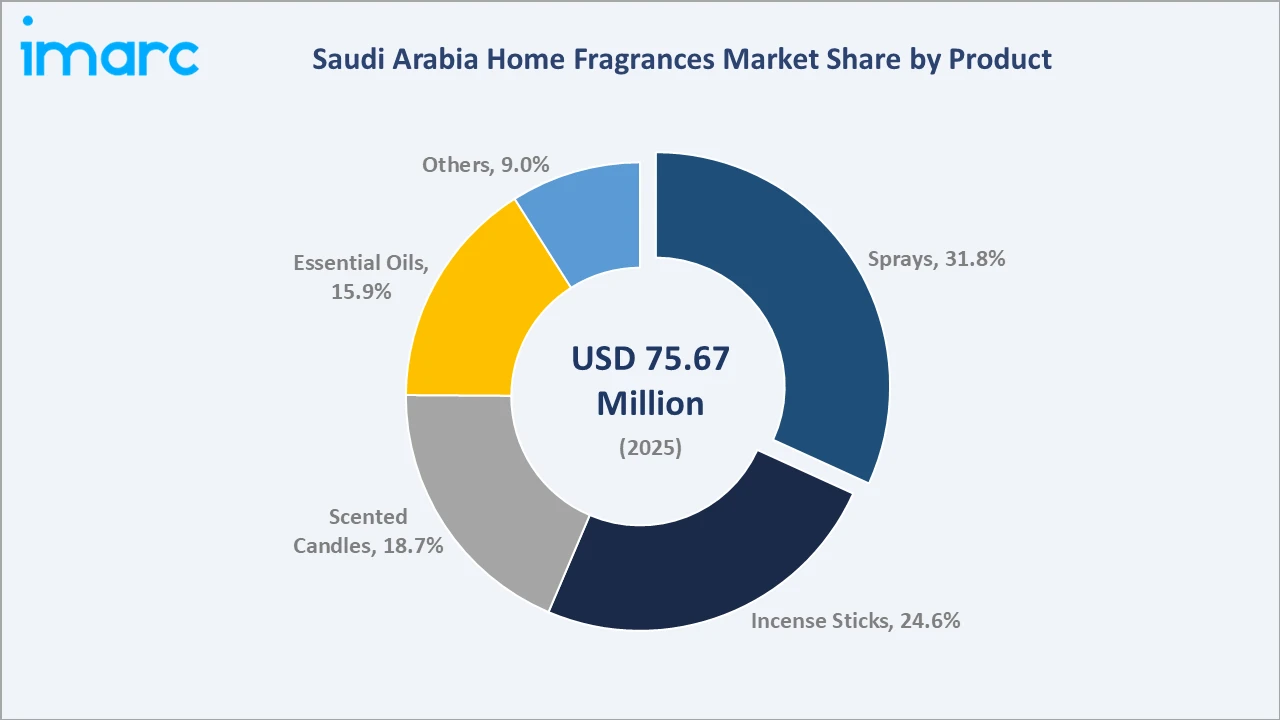
Sprays lead at 31.8% share (2025), valued for affordability, ease of application, and broad availability across hypermarkets and convenience outlets, making them the default entry format for everyday fragrance use.
To access detailed market analysis, Request Sample
Incense sticks hold 24.6% share, sustained by daily rituals, while scented candles at 18.7% and essential oils at 15.9% are growing fastest, at an estimated 6.3% and 6.0% CAGR respectively (2026-2034), as premiumization and wellness trends reshape purchasing habits. Others hold around 9.0% of the market share.
By Distribution Channel
Specialty stores capture 36.4% share (2025), anchored by scent-testing experiences and personalized oud-blending services that mass retail formats cannot replicate, reinforcing customer loyalty among traditional fragrance buyers.
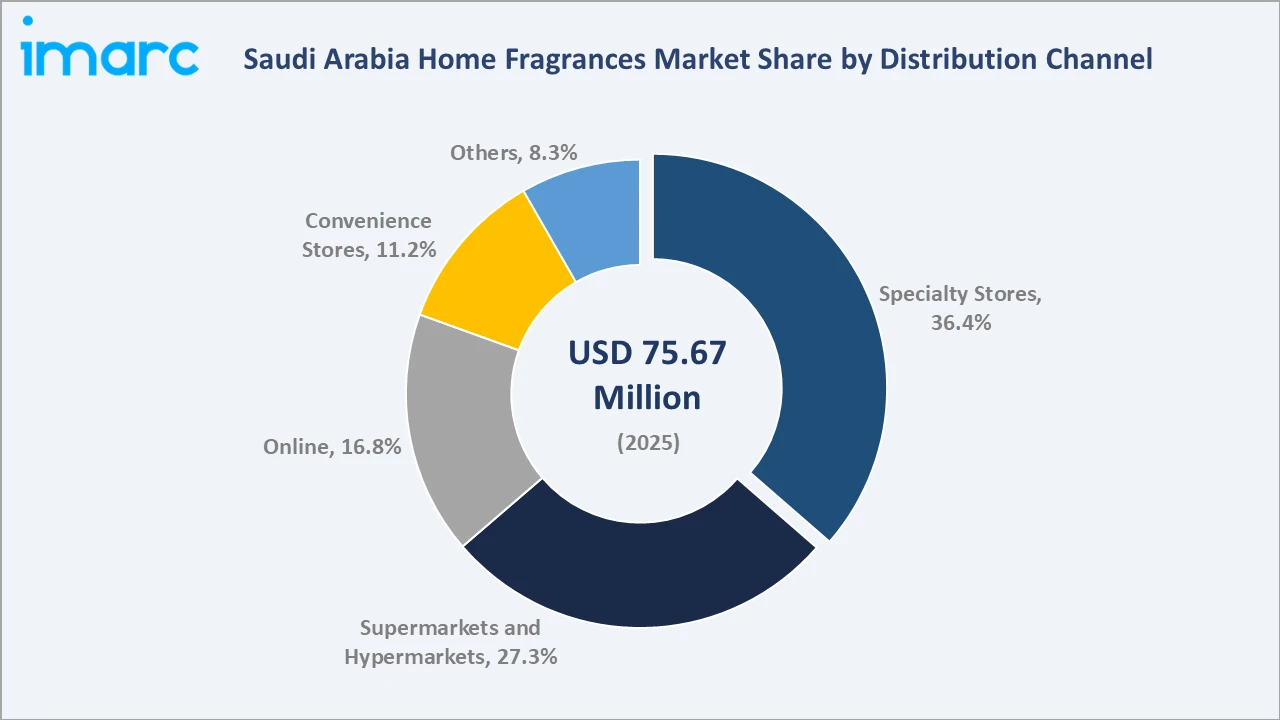
Supermarkets and hypermarkets follow at 27.3% share on convenience-driven volume purchases, while online channels at 16.8% grow fastest at an estimated 9.8% CAGR (2026-2034), driven by direct-to-consumer platforms and social-commerce adoption among younger Saudi consumers. Convenience stores and others hold 11.2% and 8.3%, respectively.
Regional Market Insights
Regional demand for home fragrances in Saudi Arabia tracks population density, household income levels, and religious-tourism footfall, with the Northern and Central Region, Western Region, Eastern Region, and Southern Region each exhibiting distinct consumption patterns.
|
Region |
Share (2025) |
Market Characteristics |
|
Northern & Central Region |
47.1% |
Highest household density and disposable income concentrated around Riyadh; strong specialty retail and hospitality-sector fragrance demand; government and corporate gifting activity |
|
Western Region |
24.2% |
High volumes of Hajj and Umrah pilgrim traffic through Jeddah, Makkah, and Madinah; strong hospitality and religious-institution fragrance procurement |
|
Eastern Region |
17.6% |
Growing urban household base around Dammam and Khobar; rising modern retail penetration supporting hypermarket and specialty fragrance sales |
|
Southern Region |
11.1% |
Emerging retail infrastructure and gradual urbanization supporting steady, income-linked growth in fragrance consumption |
The Northern and Central Region's 47.1% share (2025) reflects Riyadh's status as Saudi Arabia's economic and administrative capital, home to the highest concentration of specialty retail outlets, corporate gifting demand, and affluent households sustaining premium fragrance purchasing.
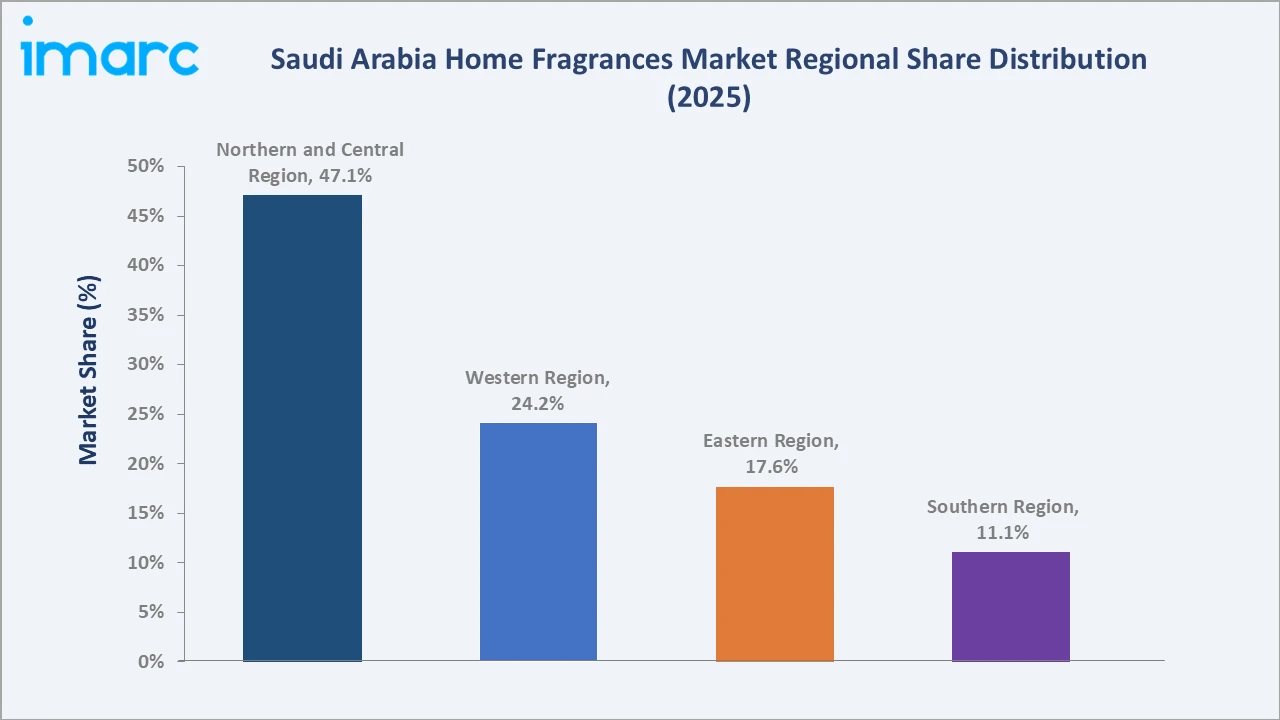
The Western Region's 24.2% share is anchored by Makkah and Madinah's year-round pilgrim traffic, which sustains hospitality-sector and gifting-format fragrance demand well above what resident population alone would generate. The Eastern Region's 17.6% share reflects steady urban household growth around the Dammam metropolitan area, while the Southern Region's 11.1% share is expanding gradually alongside broader regional infrastructure investment.
Competitive Landscape
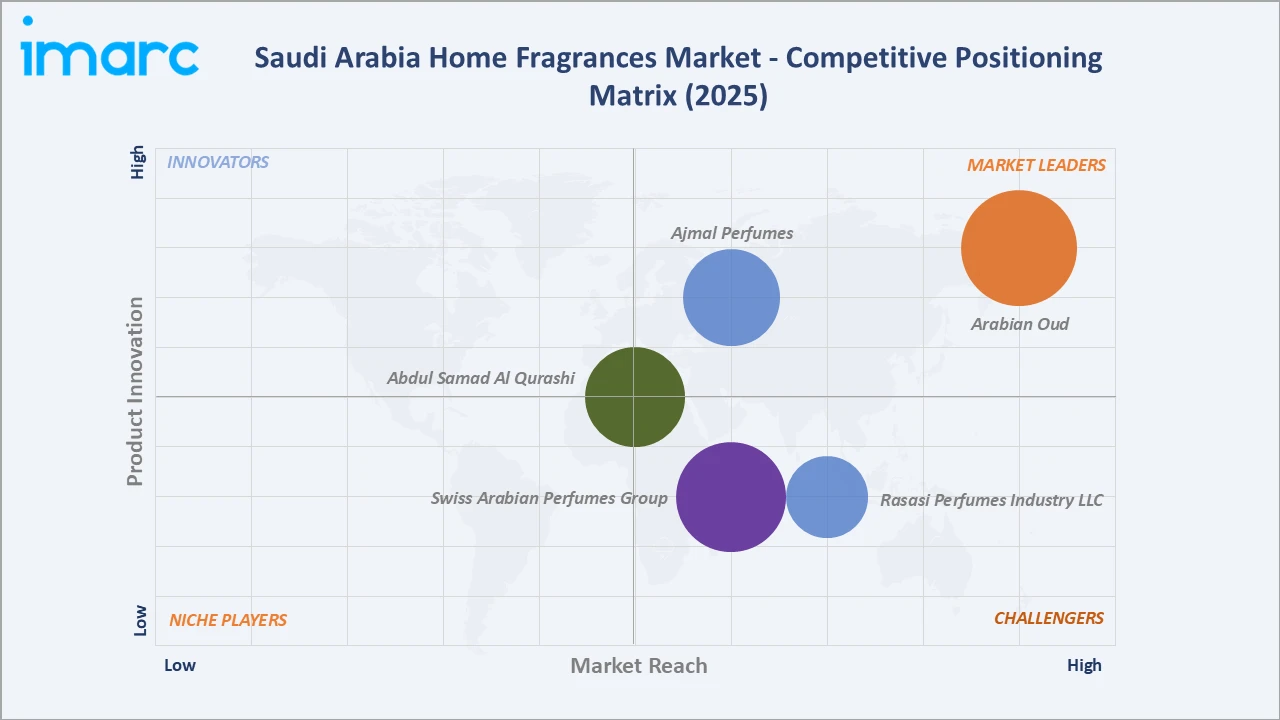
Saudi Arabia's home fragrances market is moderately concentrated among heritage oud houses at the premium tier, with intensifying competition from Gulf-based fragrance groups and entering international home-decor brands in the mass and mid-tier segments.
|
Company Name |
Product Line |
Market Position |
Core Strength |
|
Arabian Oud |
Room sprays, Scented Candles, Reed Diffusers, and Traditional Incense (bakhoor) |
Market Leader |
Saudi Arabia's largest fragrance manufacturer and retailer, founded in 1982; over 1,200 stores across 37 countries |
|
Ajmal Perfumes |
Bakhoor & Incense, Dahn Oud & Oils, Air Fresheners & Mists |
Market Leader |
Vertically integrated oud grower, manufacturer, and retailer with prominent GCC outlets |
|
Rasasi Perfumes Industry LLC |
Home Fresheners & Room Sprays, Oriental & Floral Blends |
Strong Challenger |
40+ years of Oriental-Occidental fragrance blending; 160+ GCC showrooms |
|
Abdul Samad Al Qurashi |
Bakhoor & Incense, Home Sprays & Mists, Oud Oils & Diffuser Blends |
Established Player |
Founded in Makkah; among the Arab world's oldest oud and incense houses |
|
Swiss Arabian Perfumes Group |
Bakhoor and Oud Muattar Lineup, Room Air Perfumes, Reed Diffusers |
Strong Challenger |
GCC-wide distribution blending Western and Oriental fragrance traditions |
The premium OEM and specialty-retail segment is dominated by Arabian Oud, Ajmal Perfumes, and Abdul Samad Al Qurashi through decades-long brand heritage, while the mass and mid-tier segments face growing competition from international home-fragrance chains expanding into Riyadh and Jeddah malls.
Key Company Profiles
Arabian Oud
Arabian Oud is Saudi Arabia's largest fragrance manufacturer and retailer, founded in Riyadh in 1982. The company operates more than 1,200 stores across 37 countries and employs over 3,700 people, specializing in incense, oriental perfumes, and oil-based fragrances.
- Product Portfolio: Room sprays, scented candles, reed diffusers, and traditional incense (bakhoor), among others.
- Strategic Focus: Global expansion of Saudi-made oud heritage products while broadening into modern home-fragrance formats.
Ajmal Perfumes
Ajmal Perfumes is a vertically integrated fragrance house founded in 1951, controlling its own agarwood growing, distillation, and retail operations, with a strong presence across Saudi Arabia's specialty fragrance retail landscape.
- Product Portfolio: Bakhoor & incense, dahn oud & oils, air fresheners & mists, and others.
- Strategic Focus: Vertical integration from raw-material sourcing to retail, ensuring quality control across the value chain.
Abdul Samad Al Qurashi
Abdul Samad Al Qurashi, founded in Makkah, is among the Arab world's oldest fragrance houses, occupying a heritage-premium niche within Saudi Arabia's oud and incense market.
- Product Portfolio: Bakhoor & Incense, Home Sprays & Mists, Oud Oils & Diffuser Blends, and others.
- Strategic Focus: Heritage authenticity and exclusivity through curated, limited-availability oud collections.
Market Concentration Analysis
Saudi Arabia's home fragrances market exhibits moderate concentration at the heritage-premium level and meaningful fragmentation across the mass and mid-tier segments. Arabian Oud, Ajmal Perfumes, Rasasi Perfumes Industry LLC, and Abdul Samad Al Qurashi collectively hold an estimated 30-38% of Saudi Arabia's branded home-fragrance market by value (2025), with no single brand exceeding 15% total volume share.
The market's structural fragmentation below the premium tier reflects Saudi Arabia's diverse consumer base, from price-sensitive buyers of unbranded souk bakhoor to affluent consumers purchasing exclusive oud collections. International home-decor and candle brands hold a collectively growing but still modest share of the mid-tier scented-candle segment.
Consolidation trends remain limited, with heritage Saudi houses expanding organically rather than through acquisition. Global fragrance groups are increasingly pursuing direct Saudi retail agreements to reduce reliance on regional distributors, a trend gradually reshaping traditional wholesale margins.
Investment & Growth Opportunities
Fastest Growing Segments
Online distribution channel (~9.8% CAGR), scented candles (~6.3% CAGR), essential oils (~6.0% CAGR), and smart diffuser technology represent Saudi Arabia's highest-growth investment vectors through 2034. Direct-to-consumer platforms offer the strongest per-unit margin opportunity.
Emerging Market Opportunities
Vision 2030's industrial localization agenda creates incentives for domestic fragrance-compounding and bottling investment, reducing import dependence. A Saudi-based aroma-compound production facility could position the Kingdom as a regional fragrance-manufacturing hub serving the broader GCC market.
Investment Themes
- Connected Fragrance Technology: Smart diffuser and connected-home fragrance technology: first-mover advantage exists for brands establishing Saudi-specific app-connected product lines ahead of broader smart-home adoption.
- Direct-to-Consumer Platform Investment: Digital-first fragrance retail platforms integrating scent-matching quizzes, subscription refills, and influencer-led product discovery represent a compelling investment opportunity.
- Hospitality & Institutional Fragrance Services: Hospitality-sector fragrance contracts, covering hotel lobby scenting and mosque incense programs, offer recurring B2B revenue streams tied to Saudi Arabia's expanding tourism infrastructure.
Future Market Outlook (2026-2034)
The Saudi Arabia home fragrances market is projected to grow from USD 75.67 Million in 2025 to USD 118.92 Million by 2034, at a 5.15% CAGR, reflecting steady, culturally anchored growth in one of the Middle East's most fragrance-intensive consumer markets. An estimated USD 97.28 Million market size by 2030 will be shaped by Vision 2030's retail transformation and sustained religious-tourism inflows.
Three structural forces anchor Saudi Arabia's home fragrances market trajectory through 2034 with high confidence: enduring cultural attachment to oud and bakhoor rituals that sustains baseline demand independent of economic cycles; Vision 2030's tourism and retail infrastructure expansion drawing sustained pilgrim and visitor spending; and rising household incomes that support gradual premiumization from traditional incense toward candles, diffusers, and smart-connected formats.
Research Methodology
Primary Research
Primary research comprised structured discussions with home-fragrance retailers, specialty-store category managers in Riyadh and Jeddah, fragrance-house distribution executives, and hospitality-sector procurement contacts (2025).
Secondary Research
Secondary research drew on Saudi General Authority for Statistics (GASTAT) retail-trade and pilgrim-arrival data, Saudi Food and Drug Authority (SFDA) cosmetic-product regulatory documentation, Saudi Customs import statistics, Vision 2030 program disclosures, and company-published brand and store-network information.
Forecasting Models
Market-value forecasts were developed using historical growth-rate extrapolation validated against GASTAT retail-trade indicators and pilgrim-arrival trends, segmented by product and distribution channel, with regional allocation based on population and tourism-footfall weighting.
Saudi Arabia Home Fragrances Market Report Coverage:
| Report Features | Details |
|---|---|
| Base Year of the Analysis | 2025 |
| Historical Period | 2020-2025 |
| Forecast Period | 2026-2034 |
| Units | Million USD |
| Scope of the Report |
Exploration of Historical Trends and Market Outlook, Industry Catalysts and Challenges, Segment-Wise Historical and Future Market Assessment:
|
| Products Covered | Scented Candles, Sprays, Essential Oils, Incense Sticks, Others |
| Distribution Channels Covered | Supermarkets and Hypermarkets, Specialty Stores, Convenience Stores, Online, Others |
| Regions Covered | Northern and Central Region, Western Region, Eastern Region, Southern Region |
| Companies Covered | Arabian Oud, Ajmal Perfumes, Rasasi Perfumes Industry LLC, Abdul Samad Al Qurashi, Swiss Arabian Perfumes Group, etc. |
| Customization Scope | 10% Free Customization |
| Post-Sale Analyst Support | 10-12 Weeks |
| Delivery Format | PDF and Excel through Email (We can also provide the editable version of the report in PPT/Word format on special request) |
Key Benefits for Stakeholders:
- IMARC’s industry report offers a comprehensive quantitative analysis of various market segments, historical and current market trends, market forecasts, and dynamics of the Saudi Arabia home fragrances market from 2020-2034.
- The research report provides the latest information on the market drivers, challenges, and opportunities in the Saudi Arabia home fragrances market.
- Porter's five forces analysis assist stakeholders in assessing the impact of new entrants, competitive rivalry, supplier power, buyer power, and the threat of substitution. It helps stakeholders to analyze the level of competition within the Saudi Arabia home fragrances industry and its attractiveness.
- Competitive landscape allows stakeholders to understand their competitive environment and provides an insight into the current positions of key players in the market.
Frequently Asked Questions About the Saudi Arabia Home Fragrances Market Report
The Saudi Arabia home fragrances market reached USD 75.67 Million in 2025, driven by deep-rooted oud and bakhoor culture, rising pilgrim traffic, and Vision 2030 retail expansion.
The market is projected to grow at a CAGR of 5.15% during 2026-2034, reaching USD 118.92 Million by 2034, supported by premiumization and rising household incomes.
Sprays lead at 31.8% share (2025), valued for affordability and broad hypermarket availability, followed by incense sticks at 24.6% on cultural continuity.
Scented candles grow fastest at an estimated 6.3% CAGR (2026-2034), driven by premiumization and home-decor trends among urban Saudi households.
Specialty stores hold the largest share at 36.4% (2025), anchored by personalized scent-testing and oud-blending services unavailable through mass retail.
Online channels grow fastest at an estimated 9.8% CAGR (2026-2034), driven by direct-to-consumer platforms and social-commerce adoption.
The Northern and Central Region leads with 47.1% share (2025), anchored by Riyadh's household density and specialty retail concentration.
Leading companies include Arabian Oud, Ajmal Perfumes, Rasasi Perfumes Industry LLC, Abdul Samad Al Qurashi, and Swiss Arabian Perfumes Group, among others.
Vision 2030 drives retail infrastructure expansion, tourism growth, and industrial localization incentives, supporting both demand and domestic manufacturing capacity.
The market is estimated to reach approximately USD 97.28 Million by 2030, supported by sustained pilgrim traffic and premiumization trends.
Need more help?
- Speak to our experienced analysts for insights on the current market scenarios.
- Include additional segments and countries to customize the report as per your requirement.
- Gain an unparalleled competitive advantage in your domain by understanding how to utilize the report and positively impacting your operations and revenue.
- For further assistance, please connect with our analysts.
 Request Customization
 Speak to an Analyst
 Request Brochure
 Inquire Before Buying
Benefits of Customization
- Personalize this research
- Triangulate with your data
- Get data as per your format and definition
- Gain a deeper dive into a specific application, geography, customer, or competitor
- Any level of personalization
Get in Touch With Us
UNITED STATES
Phone: +1-201-971-6302
INDIA
Phone: +91-120-433-0800
UNITED KINGDOM
Phone: +44-753-714-6104
Email: [email protected]
Client Testimonials




.webp)




.webp)













Related Reports

Choose your plan
*Please note that the prices mentioned below are starting prices for each bundle type. Kindly contact our team for further details.*
Single User License
- 1 User License, Access on 2 Devices
- PDF Report + Excel Dataset (Password Protected)
- Lifetime Access
- No Printing Rights
- 10% Free Report Customization
- 10–12 Weeks of Analyst Support
Five User License
- Access for 5 Users, 2 Devices per User
- PDF Report + Excel Dataset (Password Protected)
- Lifetime Access
- Dedicated Account Manager
- 12–14 Weeks of Analyst Support
- No Printing Rights
- 15% Free Report Customization
- 25% Discount on Your Next Purchase
Corporate User License
- Unlimited User Access (Within Your Organization)
- PDF Report + Excel Dataset
- Lifetime Access
- Dedicated Account Manager
- 14–20 Weeks of Analyst Support
- No Printing Rights
- 20% Free Report Customization
- 30% Discount on Your Next Purchase
Essential Insights
What's included:
3 reports
- Lifetime Access
- PDF Reports
- Excel Datasets
- 2 Weeks of Free Analyst Support
- 2 User Licenses
- Access on 2 Devices
- Printing Rights
- Complimentary PowerPoint (PPT) Version
- Complimentary License Upgrade
Professional Access
What's included:
5 reports
- Lifetime Access
- PDF Reports
- Excel Datasets
- 8 Weeks of Free Analyst Support
- 2 User Licenses
- Access on 2 Devices
- Printing Rights
- Complimentary PowerPoint (PPT) Version
- Complimentary License Upgrade
Business Advantage
What's included:
8 reports
- Lifetime Access
- PDF Reports
- Excel Datasets
- 14 Weeks of Free Analyst Support
- 2 User Licenses
- Access on 2 Devices
- Printing Rights
- Complimentary PowerPoint (PPT) Version
- Complimentary License Upgrade
Enterprise Intelligence
What's included:
10 reports
- Lifetime Access
- PDF Reports
- Excel Datasets
- 20 Weeks of Free Analyst Support
- 2 User Licenses
- Access on 2 Devices
- Printing Rights
- Complimentary PowerPoint (PPT) Version
- Complimentary License Upgrade