
Saudi Arabia Home Furnishings Market Size, Share, Trends and Forecast by Product, Price, Distribution Channel, and Region, 2026-2034
Saudi Arabia Home Furnishings Market Size, Share, Trends & Forecast (2026-2034)
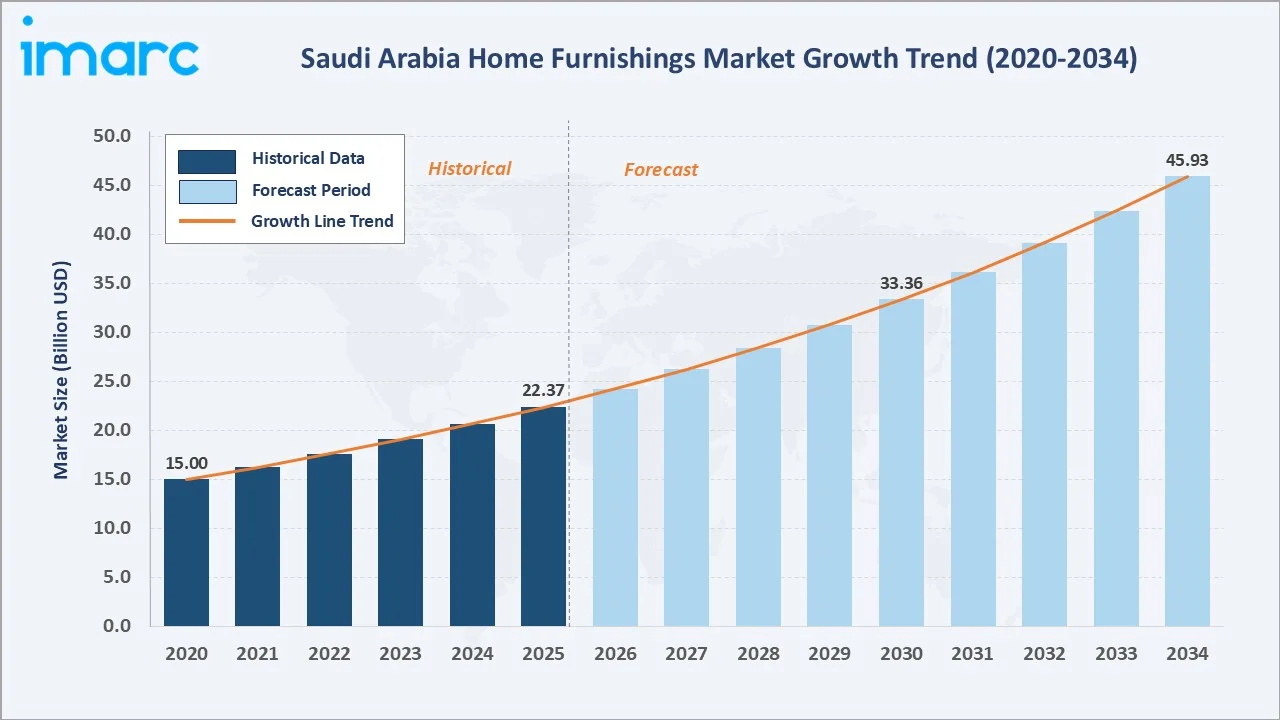
The Saudi Arabia home furnishings market grew from USD 22.37 Billion in 2025 to USD 24.23 Billion in 2026 and is projected to touch USD 45.93 Billion by 2034, expanding at a CAGR of 8.32% during 2026-2034. Growth is anchored in Vision 2030-driven urbanization, a fast-expanding residential pipeline, and rising disposable incomes across the Kingdom. Home furniture leads product demand at 48.7% share, while mass-priced goods hold 68.5% of 2025 shares. The Northern and Central Region dominates regionally with 46.8% share, reflecting Riyadh's outsized housing and retail footprint.
Market Snapshot
|
Metric |
Value |
|
Base Year Market Size (2025) |
USD 22.37 Billion |
| Market Size (2026) | USD 24.23 Billion |
|
Forecast Market Size (2034) |
USD 45.93 Billion |
|
CAGR (2026-2034) |
8.32% |
|
Base Year |
2025 |
|
Historical Period |
2020-2025 |
|
Forecast Period |
2026-2034 |
|
Largest Product Segment |
Home Furniture (48.7%, 2025) |
|
Largest Price Tier |
Mass (68.5%, 2025) |
|
Dominant Region |
Northern & Central Region (46.8%, 2025) |
The market expanded from USD 15.00 Billion in 2020 to USD 22.37 Billion in 2025 and an estimated USD 24.23 Billion in 2026, anchored at USD 33.36 Billion by 2030 in route to USD 45.93 Billion by 2034. Growth is underpinned by Vision 2030 housing programs, giga-project residential deliveries, and a young, design-conscious population.
To get more information on this market, Request Sample
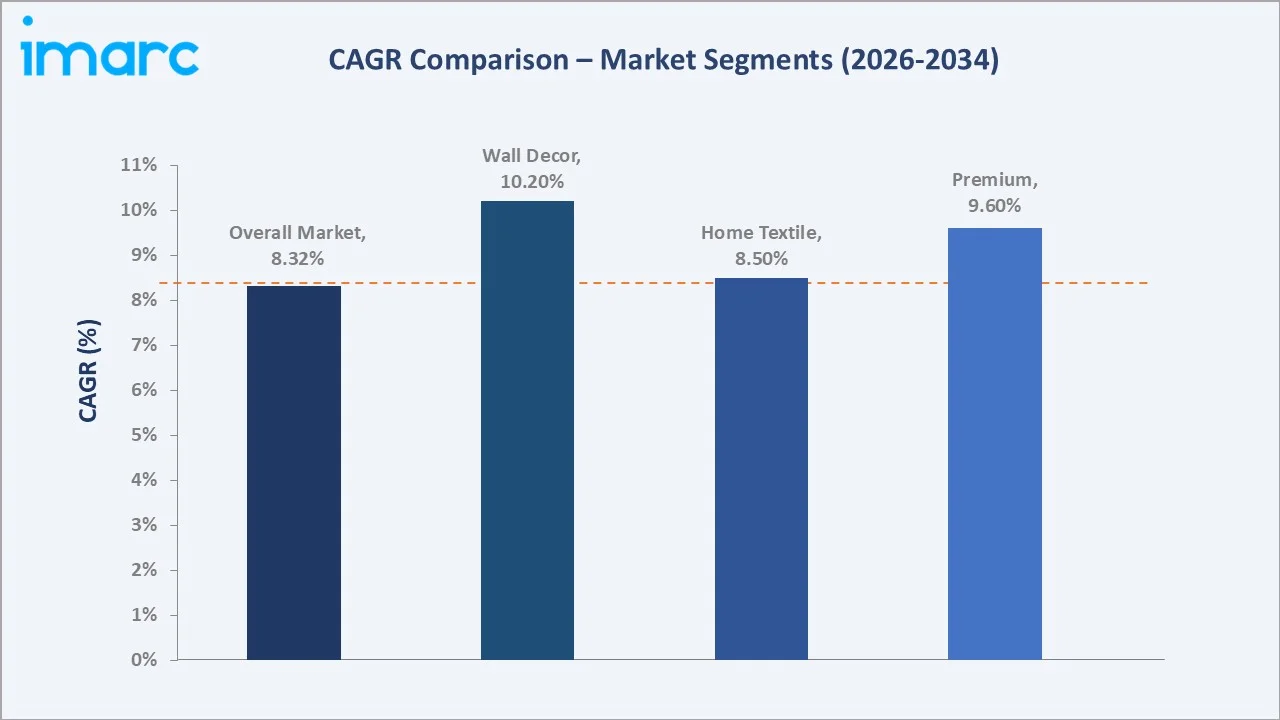
Wall decor is the fastest-growing product category at an estimated 10.2% CAGR (2026-2034), reflecting rising spend on aesthetics and personalization. Within price tiers, premium furnishings are expanding faster than mass-market goods, at roughly 9.6% versus 7.8% CAGR, respectively.
Executive Summary
The Saudi Arabia home furnishings market, which increased from USD 22.37 Billion in 2025 to an estimated USD 24.23 Billion in 2026, driven by one of the Gulf's most active residential construction pipelines and a rapidly modernizing consumer base. Vision 2030's housing agenda, including the Sakani home-ownership program and giga-projects such as ROSHN, NEOM, and Diriyah Gate, is generating sustained structural demand for furniture, textiles, and decor across new and renovated homes.
Home furniture commands 48.7% of 2025 shares, reflecting its role as the largest and most essential purchase category across new households. Mass-priced products retain 68.5% share, anchored by affordability-focused buyers, while premium furnishings are scaling quickly among upper-income and expatriate households seeking branded, design-led interiors.
The market is projected to reach USD 45.93 Billion by 2034 at an 8.32% CAGR, supported by e-commerce expansion, showroom investment by international retailers, and growing demand for space-efficient, multifunctional furniture in dense urban developments across Riyadh, Jeddah, and the Eastern Province.
Key Market Insights
|
Insight |
Data |
|
Largest Product Segment |
Home Furniture - 48.7% share (2025) |
|
Fastest-Growing Product Segment |
Wall Decor - ~10.2% CAGR (2026-2034) |
|
Dominant Price Tier |
Mass - 68.5% share (2025) |
|
Fastest-Growing Price Tier |
Premium - ~9.6% CAGR (2026-2034) |
|
Dominant Region |
Northern & Central Region - 46.8% share (2025) |
|
Key Companies |
Inter IKEA Holding B.V., Landmark Group, and Almutlaq Group |
Key Analytical Observations Supporting The Above Data:
- Home furniture leads at 48.7% share (2025) on essential-purchase demand: Every new residential unit delivered under Vision 2030 housing programs generates immediate demand for beds, sofas, storage, and dining furniture, anchoring this segment's scale.
- Wall decor is scaling fastest at ~10.2% CAGR: Social-media-driven design awareness and a young population are lifting spend on art, mirrors, and decorative accents well above overall market growth.
- Mass-tier products hold 68.5% share (2025) on affordability needs: Price-sensitive nationals and the Kingdom's large expatriate workforce continue to favor value-priced furnishings for rental and starter homes.
- Premium furnishings are the fastest-growing price tier at ~9.6% CAGR: Branded residences and luxury developments such as Diriyah's Armani-designed units are lifting demand for designer and made-to-order furniture.
- Northern & Central Region dominates with 46.8% share (2025): Riyadh's population growth, giga-project activity, and concentration of retail showrooms sustain the region's outsized contribution.
Saudi Arabia Home Furnishings Market Overview
Saudi Arabia's home furnishings market covers furniture, textiles, wall decor, and related accessories sold to households, hospitality operators, and institutional buyers across the Kingdom. The industry blends a growing base of local manufacturers with import-driven brands serving both mass and premium price tiers.
The market operates under Saudi Standards, Metrology and Quality Organization (SASO) requirements governing material safety, flammability, and labeling. Macroeconomic tailwinds include Vision 2030 economic diversification, non-oil GDP growth, and sustained government investment in housing and giga-project infrastructure.
Market Dynamics
To evaluate market opportunities, Request Sample
Market Drivers
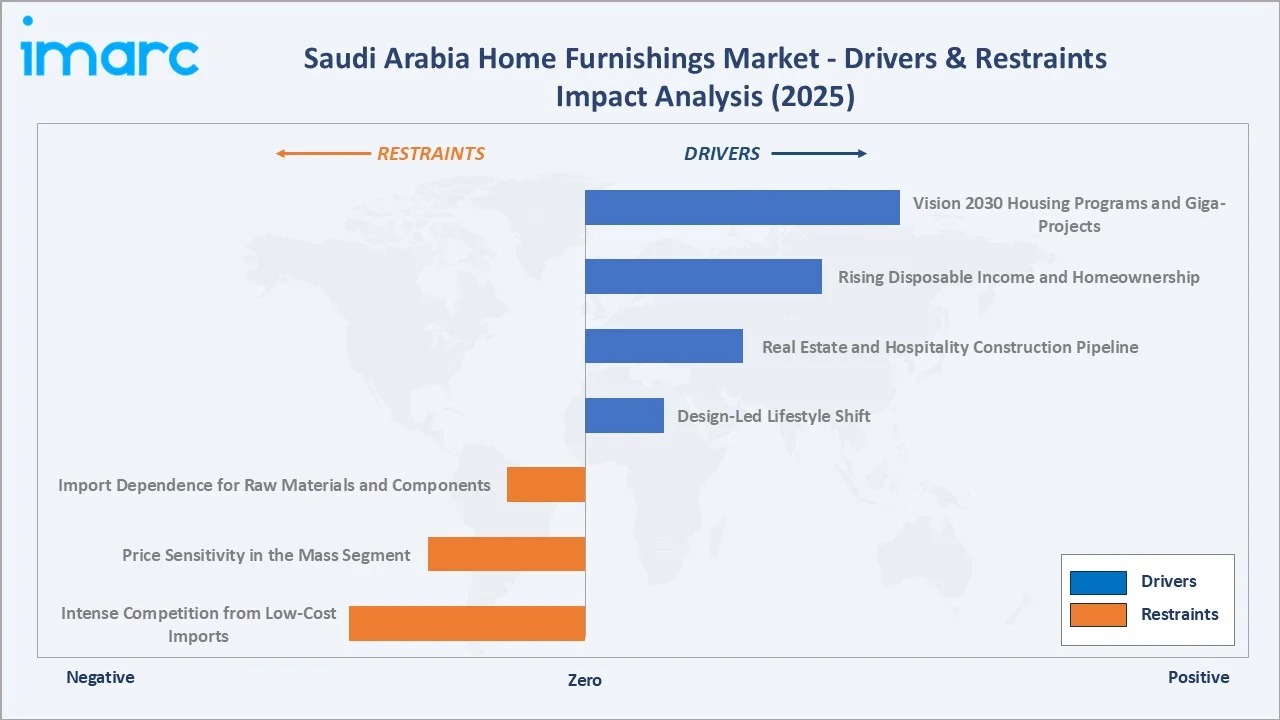
- Vision 2030 Housing Programs and Giga-Projects: The Sakani program, ROSHN, NEOM, and Diriyah Gate are collectively delivering hundreds of thousands of new residential units, each generating immediate furnishing demand.
- Rising Disposable Income and Homeownership: Growing household incomes and government-backed mortgage support are expanding the pool of buyers able to invest in quality furniture and decor.
- Real Estate and Hospitality Construction Pipeline: Large-scale tourism and hospitality developments tied to Red Sea Global and Qiddiya are creating bulk procurement demand for commercial-grade furnishings.
- Design-Led Lifestyle Shift: A young, tech-savvy population influenced by social platforms is prioritizing curated, aesthetically driven interiors over purely functional furnishing choices.
Market Restraints
- Import Dependence for Raw Materials and Components: Reliance on imported wood, upholstery fabric, and hardware exposes manufacturers to currency and freight-cost volatility.
- Price Sensitivity in the Mass Segment: Budget-focused buyers, who account for prominent portion of the regional population, remain highly responsive to price changes, compressing retailer margins.
Market Opportunities
- Domestic Manufacturing Localization: Vision 2030's industrial localization agenda creates incentives for furniture and textile production facilities within the Kingdom.
- Premium and Branded Residence Furnishing: Luxury developments, including designer-branded residences, are opening high-margin opportunities for premium furniture and decor brands.
Market Challenges
- Intense Competition from Low-Cost Imports: Budget furniture imports from Asia compete aggressively on price, pressuring margins for mid-tier domestic retailers.
- Logistics and Last-Mile Delivery Complexity: Bulky furniture items require specialized delivery and assembly infrastructure, adding cost and complexity for e-commerce players.
Emerging Market Trends
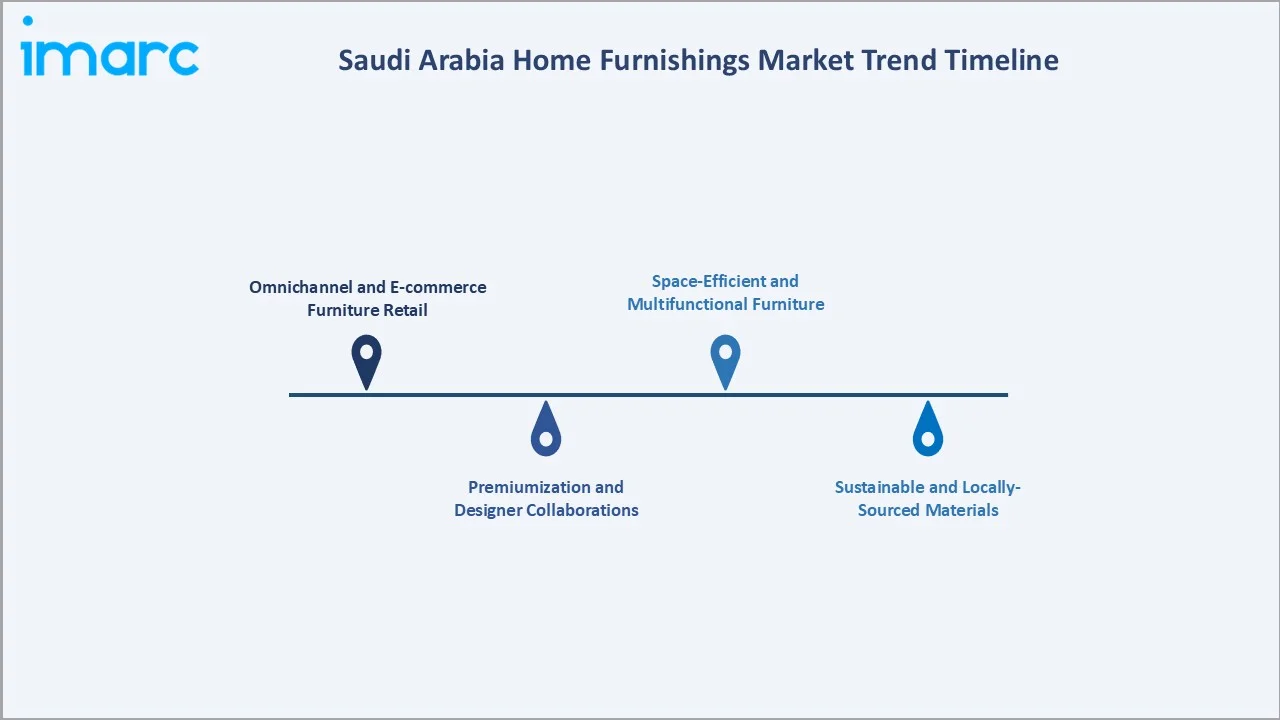
1. Omnichannel and E-commerce Furniture Retail
Online furniture platforms are scaling rapidly as brands integrate augmented-reality room planning, home delivery, and installation services, mirroring the click-and-fit convenience already popular in other retail categories.
2. Premiumization and Designer Collaborations
Branded residences and luxury developments are driving demand for designer furniture lines, with international names expanding showroom footprints in Riyadh and Jeddah to serve high-net-worth buyers.
3. Space-Efficient and Multifunctional Furniture
Rising apartment living in dense urban developments is lifting demand for modular, foldable, and multipurpose furniture designed for compact footprints.
4. Sustainable and Locally-Sourced Materials
Consumers and developers are increasingly favoring furnishings made from sustainable or regionally sourced materials, aligning with Vision 2030's broader sustainability commitments.
Industry Value Chain Analysis
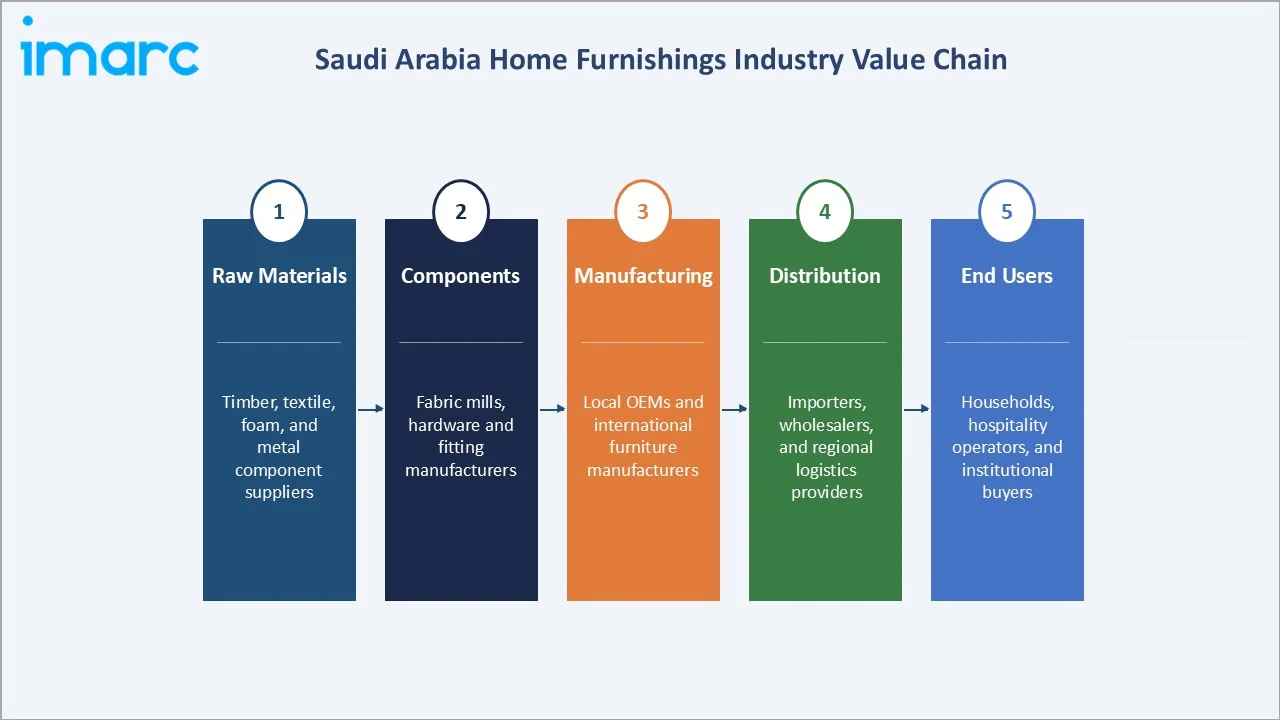
Saudi Arabia's home furnishings value chain spans raw material sourcing, manufacturing and assembly, quality certification, multi-tier distribution, and end-consumer retail across offline and online channels serving the Kingdom's USD 22.37 Billion market (2025).
|
Stage |
Key Players |
|
Raw Materials |
Timber, textile, foam, and metal component suppliers |
|
Components |
Fabric mills, hardware and fitting manufacturers |
|
Manufacturing |
Local OEMs and international furniture manufacturers |
|
Distribution |
Importers, wholesalers, and regional logistics providers |
|
End Users |
Households, hospitality operators, and institutional buyers |
Distribution follows a multi-tier model: global and regional manufacturers supply importers and wholesalers, who in turn stock hypermarkets, specialty stores, and fast-growing online marketplaces serving end consumers across the Kingdom's four regions.
Technology Landscape in the Home Furnishings Industry
Smart and Connected Furniture
Furniture integrated with wireless charging, ambient lighting, and app-based controls is gaining traction among tech-forward Saudi households, particularly in premium apartment and villa segments.
Materials and Manufacturing Innovation
Advances in engineered wood, recycled textiles, and modular manufacturing are lowering production costs while improving durability suited to the Kingdom's climate.
Digital Design and Visualization Tools
Retailers are deploying augmented-reality room planners and 3D configurators, helping online shoppers visualize furniture before purchase and reducing return rates.
.webp)
Market Segmentation Analysis
The report covers the following segments:
|
Segment Category |
Leading Segment |
Market Share |
Year |
|
Product |
Home Furniture |
48.7% |
2025 |
|
Price |
Mass |
68.5% |
2025 |
|
Distribution Channel |
🔒 |
🔒 |
2025 |
|
Region |
Northern & Central Region |
46.8% |
2025 |

By Product
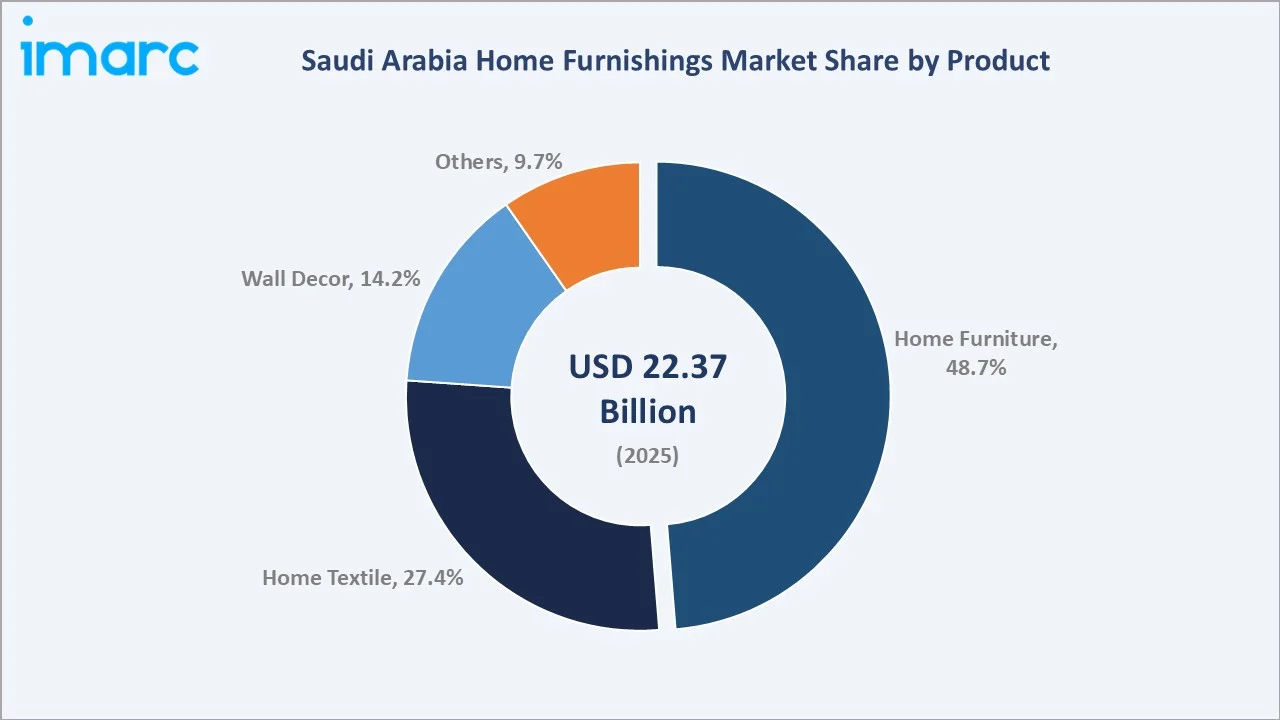
Home furniture leads at 48.7% share (2025), spanning bedroom, living room, and dining furniture purchased across new and existing households. The segment benefits directly from Vision 2030's residential delivery pipeline.
To access detailed market analysis, Request Sample
Home textile follows at 27.4% share, covering bedding, curtains, and upholstery fabric, while wall decor at 14.2% is the fastest-growing category as consumers personalize interiors. The remaining 9.7% spans lighting, mirrors, and accessory categories grouped under Others.
By Price
Mass-priced furnishings hold 68.5% share (2025), reflecting the Kingdom's large price-sensitive population, including a substantial expatriate workforce furnishing rental accommodation.
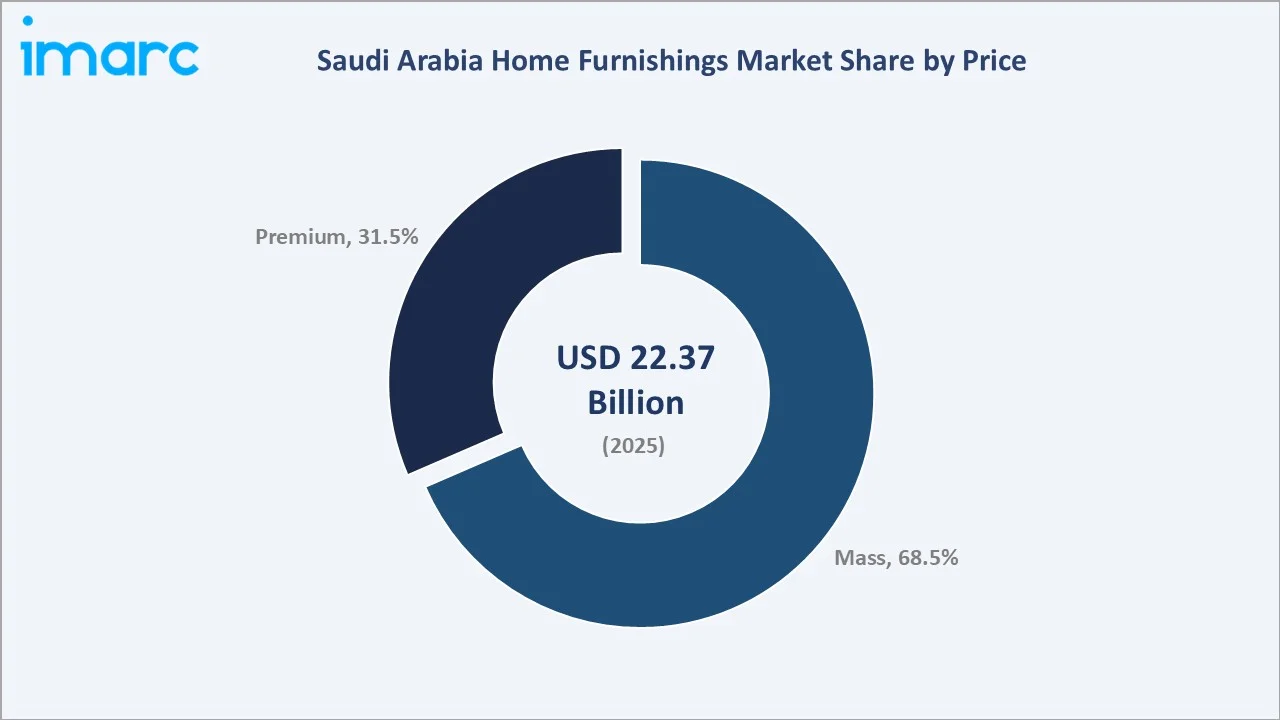
Premium furnishings account for the remaining 31.5% and are growing fastest at an estimated 9.6% CAGR, driven by branded residences, luxury villas, and hospitality projects demanding designer-grade furniture and decor.
Regional Market Insights
|
Region |
Share (2025) |
Key Growth Drivers & Characteristics |
|
Northern & Central Region |
46.8% |
Riyadh's population growth, giga-project activity, and dense retail and showroom concentration |
|
Western Region |
24.1% |
Jeddah's port-driven trade access, Hajj and Umrah-linked hospitality furnishing demand |
|
Eastern Region |
18.3% |
Industrial and expatriate population base around Dammam and Khobar supporting steady replacement demand |
|
Southern Region |
10.8% |
Emerging infrastructure and tourism development supporting gradual furnishings demand growth |
The Northern and Central Region's 46.8% dominance reflects Riyadh's status as the Kingdom's economic and administrative capital, home to the highest concentration of new housing developments and furniture retail showrooms.
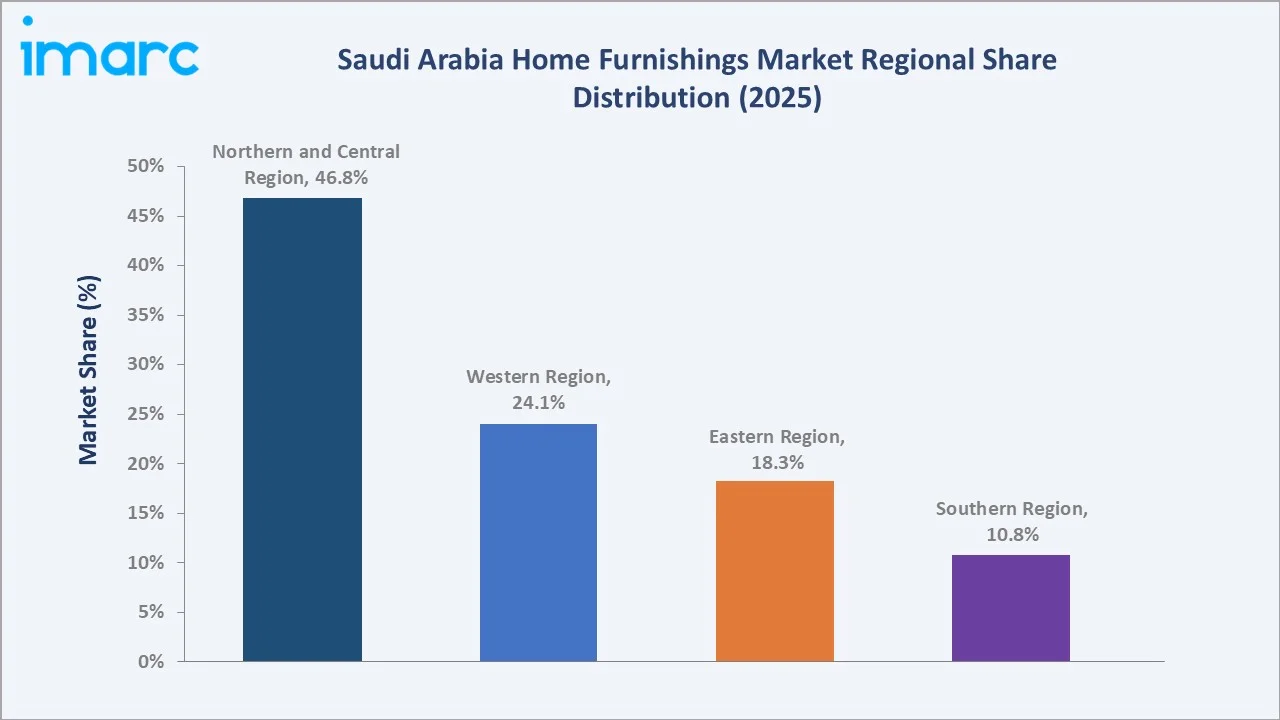
The Western Region's 24.1% share is anchored by Jeddah's commercial port access and sustained hospitality furnishing demand from Makkah and Madinah's year-round pilgrimage traffic. The Eastern Region's 18.3% share reflects its industrial base and expatriate housing concentration around Dammam and Khobar.
Competitive Landscape
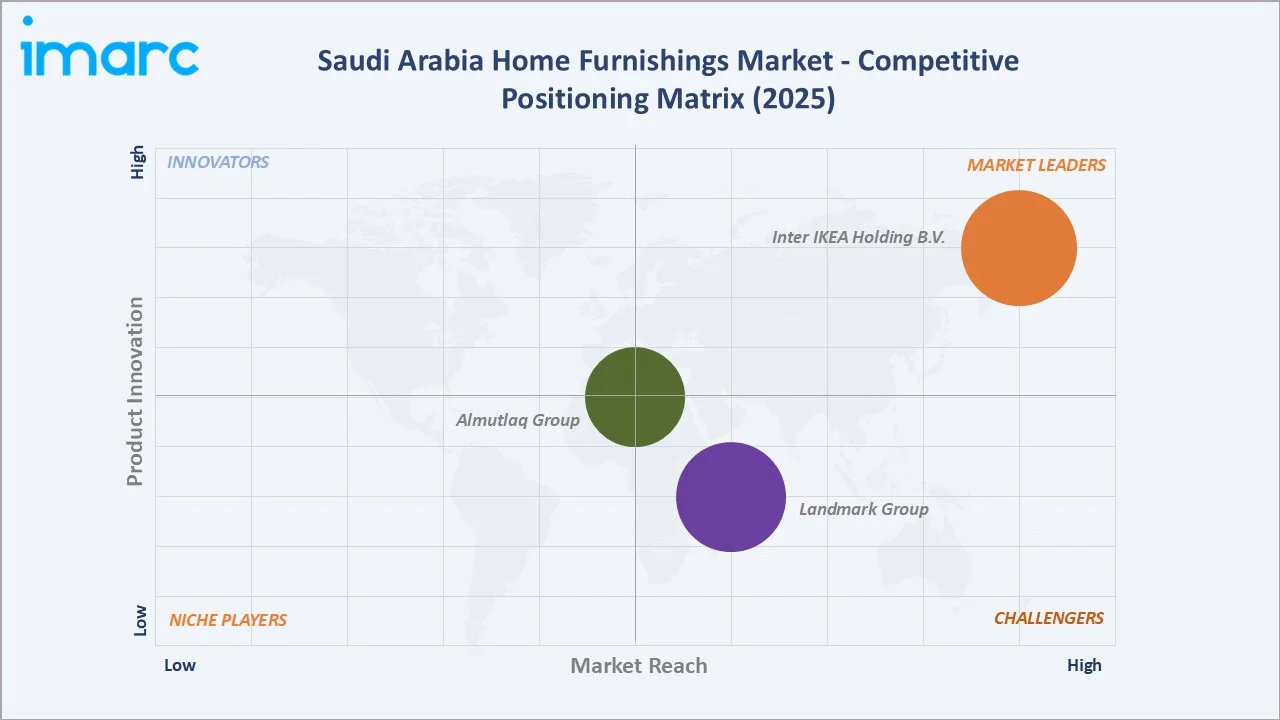
Saudi Arabia's home furnishings market is moderately fragmented, with global value-format retailers competing alongside established domestic players and fast-growing online-first brands. Leading names collectively hold a meaningful but not dominant share of 2025 shares.
|
Company Name |
Brand / Product Line |
Market Position |
Core Strength |
|
Inter IKEA Holding B.V. |
IKEA Saudi Arabia |
Market Leader |
Broad affordable product range with stores in Riyadh, Jeddah, Dhahran, and Madinah |
|
Landmark Group |
Home Centre |
Strong Challenger |
Regional retail scale with curated furniture and home decor collections |
|
Almutlaq Group |
Homeworks, Ethan Allen |
Established Player |
Operates Almutlaq Furniture, longstanding domestic manufacturer and retailer of home and office furniture |
Competitive intensity is highest in the mass-market segment, where price and store footprint drive share, while the premium tier is more fragmented across boutique and international designer brands.
Key Company Profiles
Inter IKEA Holding B.V.
IKEA in Saudi Arabia operates in a partnership with the Ghassan Ahmed Al Sulaiman Furniture Trading Company (Alsulaiman Group). It is the Kingdom's largest affordable home-furnishings retailer, with stores in Riyadh, Jeddah, Dhahran, and Madinah alongside a growing online platform.
- Product Portfolio: Modular bedroom, living room, and kitchen furniture; home textiles; storage solutions.
- Strategic Focus: Affordable, design-forward furniture at scale, supported by installment payment partnerships with local banks.
Landmark Group
Home Centre, part of the Landmark Group, is a regional retail chain offering curated furniture and home decor collections across the Gulf, including Saudi Arabia.
- Product Portfolio: Furniture, home textiles, decor accessories, and seasonal collections.
- Strategic Focus: Curated, trend-led collections balancing style and affordability for urban households.
Market Concentration Analysis
Saudi Arabia's home furnishings market exhibits low-to-moderate concentration, with the top retailers collectively holding an estimated 30-38% of 2025 revenue, reflecting a fragmented mid-tier and highly competitive mass segment.
Fragmentation is most pronounced in the wall decor and accessories categories, where small specialty stores and online sellers compete alongside larger chains. Premium furniture remains dispersed across boutique and designer-branded showrooms.
Consolidation trends are gradually emerging as regional retail groups expand store footprints and online-first brands acquire smaller specialty players to accelerate distribution reach across the Kingdom's four regions.
Investment & Growth Opportunities
Fastest Growing Segments
Wall decor (~10.2% CAGR), premium furnishings (~9.6% CAGR), and online distribution represent the market's highest-growth investment vectors through 2034, outpacing the 8.32% overall market CAGR.
Emerging Market Opportunities
Vision 2030's industrial localization incentives create a viable pathway for furniture manufacturers to establish Saudi-based production, serving both domestic demand and regional GCC export opportunities.
Investment Themes
- Domestic manufacturing capacity: Localized production reduces import dependence and aligns with government procurement preferences for locally manufactured goods.
- Digital-first retail platforms: Investment in augmented-reality visualization and last-mile delivery infrastructure supports continued e-commerce channel growth.
- Premium and branded residence furnishing: Luxury giga-project deliveries create sustained demand for designer furniture partnerships and made-to-order collections.
Future Market Outlook (2026-2034)
The Saudi Arabia home furnishings market is projected to grow from USD 22.37 Billion in 2025 to USD 24.23 Billion in 2026, reaching USD 45.93 Billion by 2034, at an 8.32% CAGR, reflecting sustained structural demand tied to one of the region's most active housing pipelines.
The market's USD 33.36 Billion milestone in 2030 will be shaped by Vision 2030's giga-project deliveries, with premium and design-led categories serving as the primary value-growth drivers above baseline mass-market replacement demand.
Research Methodology
Primary Research
Primary research comprised structured interviews with furniture retailers, distributors, interior designers, and real estate developers across Riyadh, Jeddah, and the Eastern Province to validate demand and channel trends.
Secondary Research
Secondary research drew on General Authority for Statistics (GASTAT) population and housing data, Vision 2030 program documentation, SASO regulatory publications, and company disclosures from leading furniture retailers operating in the Kingdom.
Forecasting Models
Market forecasts were developed using a bottom-up approach linking housing-unit delivery projections to average furnishing spend per household, validated against historical 2020-2025 trends and cross-checked with top-down macroeconomic indicators.
Saudi Arabia Home Furnishings Market Report Coverage:
| Report Features | Details |
|---|---|
| Base Year of the Analysis | 2025 |
| Historical Period | 2020-2025 |
| Forecast Period | 2026-2034 |
| Units | Billion USD |
| Scope of the Report |
Exploration of Historical Trends and Market Outlook, Industry Catalysts and Challenges, Segment-Wise Historical and Future Market Assessment:
|
| Products Covered | Home Furniture, Home Textile, Wall Decor, Others |
| Prices Covered | Mass, Premium |
| Distribution Channels Covered | Supermarkets and Hypermarkets, Specialty Stores, Online Stores, Others |
| Regions Covered | Northern and Central Region, Western Region, Eastern Region, Southern Region |
| Companies Covered | Inter IKEA Holding B.V., Landmark Group, Almutlaq Group, etc. |
| Customization Scope | 10% Free Customization |
| Post-Sale Analyst Support | 10-12 Weeks |
| Delivery Format | PDF and Excel through Email (We can also provide the editable version of the report in PPT/Word format on special request) |
Key Benefits for Stakeholders:
- IMARC’s industry report offers a comprehensive quantitative analysis of various market segments, historical and current market trends, market forecasts, and dynamics of the Saudi Arabia home furnishings market from 2020-2034.
- The research report provides the latest information on the market drivers, challenges, and opportunities in the Saudi Arabia home furnishings market.
- Porter's five forces analysis assist stakeholders in assessing the impact of new entrants, competitive rivalry, supplier power, buyer power, and the threat of substitution. It helps stakeholders to analyze the level of competition within the Saudi Arabia home furnishings industry and its attractiveness.
- Competitive landscape allows stakeholders to understand their competitive environment and provides an insight into the current positions of key players in the market.
Frequently Asked Questions About the Saudi Arabia Home Furnishings Market Report
The Saudi Arabia home furnishings market size increased from USD 22.37 Billion in 2025 to USD 24.23 Billion in 2026, driven by Vision 2030 housing programs, giga-project residential deliveries, and rising disposable incomes across the Kingdom.
The market is projected to grow at an 8.32% CAGR during 2026-2034, reaching USD 45.93 Billion by 2034, supported by urbanization and premiumization trends.
Home furniture leads at 48.7% share (2025), driven by essential furnishing demand from new residential deliveries under Vision 2030 housing programs.
Wall decor is growing fastest at an estimated 10.2% CAGR (2026-2034), driven by design-led lifestyle shifts and social-media-influenced personalization trends.
Mass-priced products hold 68.5% share (2025), reflecting strong demand from price-sensitive nationals and the Kingdom's large expatriate workforce.
The Northern and Central Region leads with 46.8% share (2025), anchored by Riyadh's population growth and dense retail and showroom concentration.
Leading companies include Inter IKEA Holding B.V., Landmark Group, and Almutlaq Group, among others.
Vision 2030 housing programs, including ROSHN, and giga-projects like NEOM and Diriyah Gate, are generating sustained structural furnishing demand.
The market is projected to reach approximately USD 33.36 Billion by 2030, supported by continued giga-project residential deliveries and rising premiumization.
Online stores are the fastest-growing distribution channel, supported by augmented-reality visualization tools and expanding last-mile delivery infrastructure.
Need more help?
- Speak to our experienced analysts for insights on the current market scenarios.
- Include additional segments and countries to customize the report as per your requirement.
- Gain an unparalleled competitive advantage in your domain by understanding how to utilize the report and positively impacting your operations and revenue.
- For further assistance, please connect with our analysts.
 Request Customization
 Speak to an Analyst
 Request Brochure
 Inquire Before Buying
Benefits of Customization
- Personalize this research
- Triangulate with your data
- Get data as per your format and definition
- Gain a deeper dive into a specific application, geography, customer, or competitor
- Any level of personalization
Get in Touch With Us
UNITED STATES
Phone: +1-201-971-6302
INDIA
Phone: +91-120-433-0800
UNITED KINGDOM
Phone: +44-753-714-6104
Email: [email protected]
Client Testimonials




.webp)




.webp)













Related Reports

Choose your plan
*Please note that the prices mentioned below are starting prices for each bundle type. Kindly contact our team for further details.*
Single User License
- 1 User License, Access on 2 Devices
- PDF Report + Excel Dataset (Password Protected)
- Lifetime Access
- No Printing Rights
- 10% Free Report Customization
- 10–12 Weeks of Analyst Support
Five User License
- Access for 5 Users, 2 Devices per User
- PDF Report + Excel Dataset (Password Protected)
- Lifetime Access
- Dedicated Account Manager
- 12–14 Weeks of Analyst Support
- No Printing Rights
- 15% Free Report Customization
- 25% Discount on Your Next Purchase
Corporate User License
- Unlimited User Access (Within Your Organization)
- PDF Report + Excel Dataset
- Lifetime Access
- Dedicated Account Manager
- 14–20 Weeks of Analyst Support
- No Printing Rights
- 20% Free Report Customization
- 30% Discount on Your Next Purchase
Essential Insights
What's included:
3 reports
- Lifetime Access
- PDF Reports
- Excel Datasets
- 2 Weeks of Free Analyst Support
- 2 User Licenses
- Access on 2 Devices
- Printing Rights
- Complimentary PowerPoint (PPT) Version
- Complimentary License Upgrade
Professional Access
What's included:
5 reports
- Lifetime Access
- PDF Reports
- Excel Datasets
- 8 Weeks of Free Analyst Support
- 2 User Licenses
- Access on 2 Devices
- Printing Rights
- Complimentary PowerPoint (PPT) Version
- Complimentary License Upgrade
Business Advantage
What's included:
8 reports
- Lifetime Access
- PDF Reports
- Excel Datasets
- 14 Weeks of Free Analyst Support
- 2 User Licenses
- Access on 2 Devices
- Printing Rights
- Complimentary PowerPoint (PPT) Version
- Complimentary License Upgrade
Enterprise Intelligence
What's included:
10 reports
- Lifetime Access
- PDF Reports
- Excel Datasets
- 20 Weeks of Free Analyst Support
- 2 User Licenses
- Access on 2 Devices
- Printing Rights
- Complimentary PowerPoint (PPT) Version
- Complimentary License Upgrade