
Saudi Arabia HVAC Ductwork Market Size, Share, Trends and Forecast by Type, Shape, Application, and Region, 2026-2034
Saudi Arabia HVAC Ductwork Market Size, Share, Trends & Forecast (2026-2034)
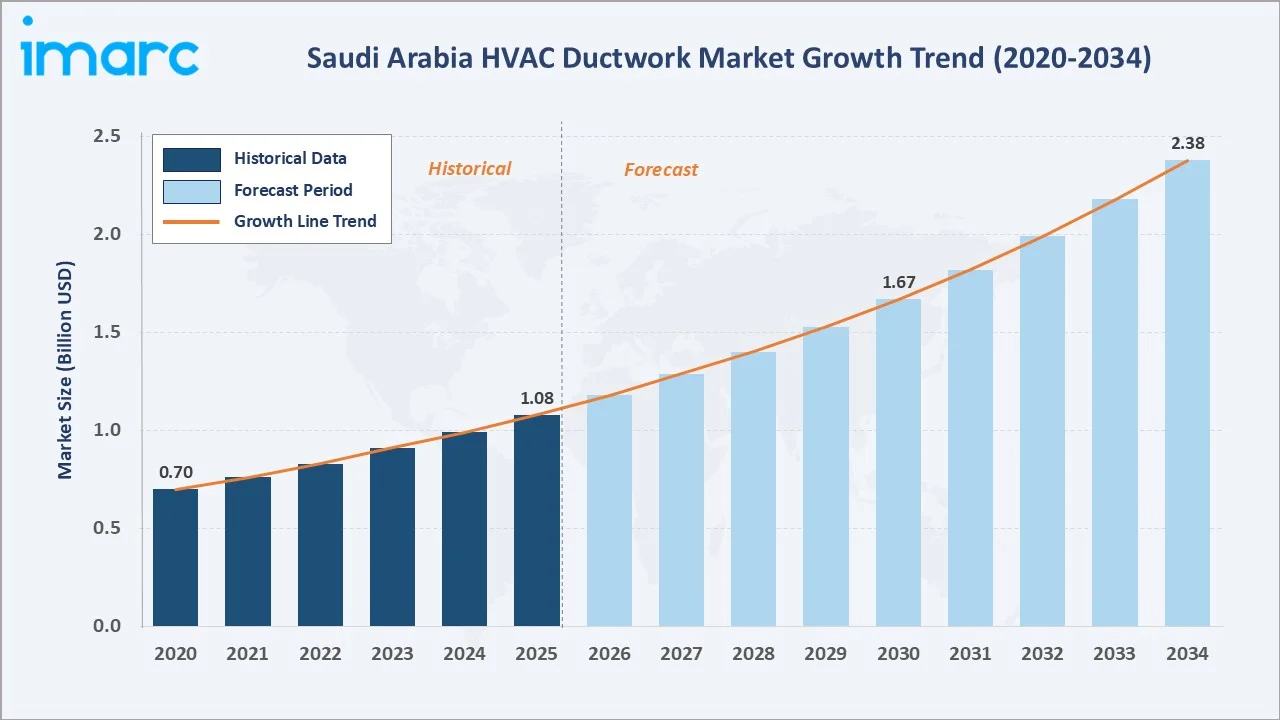
The Saudi Arabia HVAC ductwork market reached USD 1.08 Billion in 2025 and is projected to reach USD 2.38 Billion by 2034, growing at a CAGR of 9.19% during 2026-2034. Growth is driven by Vision 2030 infrastructure projects, rising demand for energy-efficient ventilation, and expanding commercial and residential construction activity across the Kingdom, alongside growing adoption of smart building technologies that require modern, efficient ductwork infrastructure.
Market Snapshot
|
Metric |
Value |
|
Market Size (2025) |
USD 1.08 Billion |
|
Forecast Market Size (2034) |
USD 2.38 Billion |
|
CAGR (2026-2034) |
9.19% |
|
Base Year |
2025 |
|
Historical Period |
2020-2025 |
|
Forecast Period |
2026-2034 |
|
Dominant Type |
Galvanized Steel (44.7%, 2025) |
|
Dominant Shape |
Rectangular Ducts (53.6%, 2025) |
|
Leading Region |
Northern and Central Region (46.5%, 2025) |
The market expanded from USD 0.70 Billion in 2020 to USD 1.08 Billion in 2025, more than fifty percent growth in five years, anchored at USD 1.67 Billion in 2030 and forecast to reach USD 2.38 Billion by 2034, reflecting sustained infrastructure-led demand across the historical and forecast periods.
To get more information on this market, Request Sample
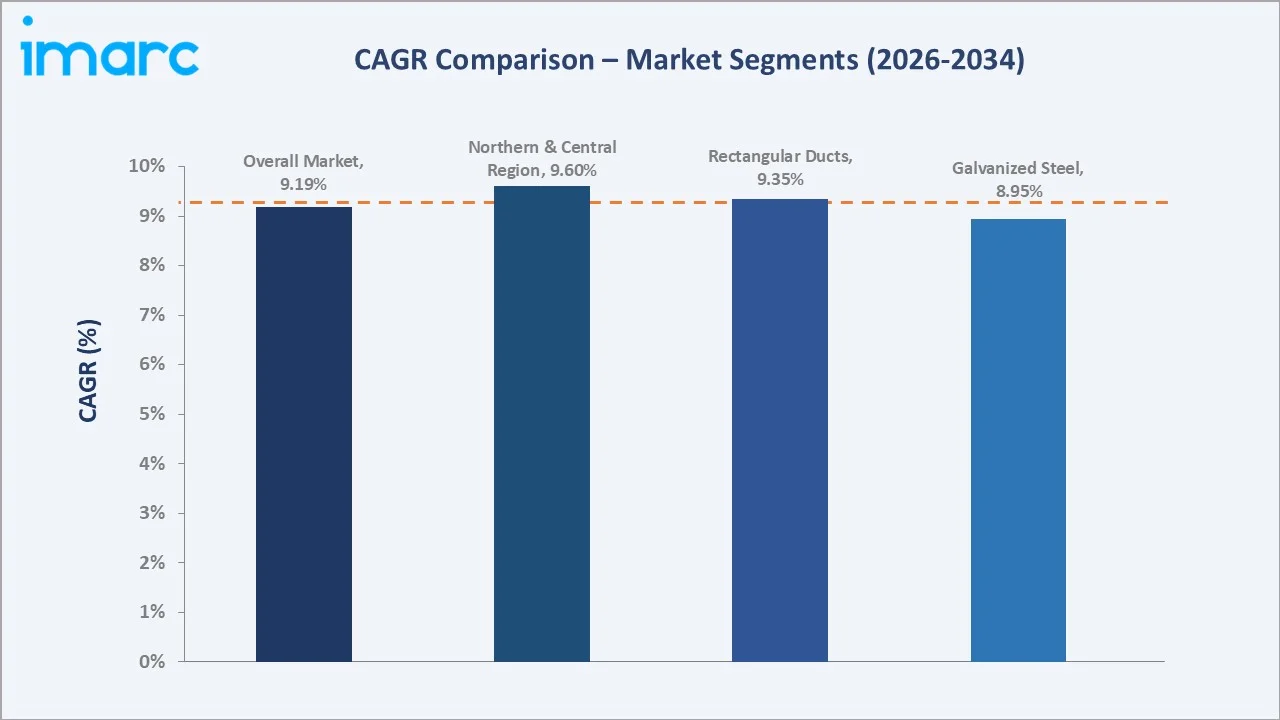
Growth momentum strengthens through the forecast period, with the 2026-2030 and 2030-2034 windows both delivering CAGRs above 9%, slightly outpacing the historical 2020-2025 growth rate as Vision 2030 construction activity accelerates ductwork demand across commercial and residential projects.
Executive Summary
The Saudi Arabia HVAC ductwork market reached USD 1.08 Billion in 2025, representing a critical infrastructure component of the Kingdom's construction and building services industry. Ductwork forms the backbone of HVAC systems, distributing conditioned air across commercial, residential, and industrial buildings, and its demand is closely tied to the pace of construction activity, climate conditions, and evolving energy-efficiency regulations.
Galvanized Steel leads the type segment at 44.7% owing to its durability, corrosion resistance, and cost-efficiency, while Rectangular Ducts dominate the shape segment at 53.6% due to widespread use in commercial and institutional buildings. The Northern and Central Region leads geographically at 46.5%, anchored by the concentration of large-scale construction and infrastructure development activity in the region.
Key Market Insights
|
Insight |
Data |
|
Dominant Type |
Galvanized Steel - 44.7% share (2025) |
|
Dominant Shape |
Rectangular Ducts - 53.6% share (2025) |
|
Leading Region |
Northern and Central Region - 46.5% share (2025) |
|
Market Opportunity |
Fire-rated boards; smart/IoT-enabled ductwork; sustainable and recycled duct materials |
Key Analytical Observations Supporting the Above Data:
- Galvanized Steel at 44.7%: This segment dominates due to its high strength-to-weight ratio, corrosion resistance, and cost efficiency, making it the preferred material for commercial and industrial HVAC installations across Saudi Arabia.
- Rectangular Ducts at 53.6%: Rectangular ducts lead due to their ease of installation in constrained ceiling spaces and compatibility with large commercial and institutional buildings prevalent across the Kingdom's urban centers.
- Northern and Central Region at 46.5%: This region dominates through its concentration of large-scale construction projects, government infrastructure spending, and dense commercial and residential development activity.
Saudi Arabia HVAC Ductwork Market Overview
The market encompasses the design, fabrication, and supply of ductwork systems used to distribute heated, cooled, and ventilated air across residential, commercial, and industrial buildings. It includes galvanized steel, aluminum, fiberglass, and flexible ducting products manufactured in rectangular, round, and oval shapes to suit varied building designs and airflow requirements.
The ecosystem integrates raw material suppliers, duct fabricators, HVAC contractors, and construction developers operating under evolving regulatory and energy-efficiency standards. Macroeconomic factors including Vision 2030 infrastructure investment, urbanization, extreme climate conditions, and rising sustainability requirements shape overall market demand and competitive dynamics.
Regulatory and standards bodies play an increasingly central role within this ecosystem, setting fire-safety, energy-efficiency, and material-quality requirements that shape procurement decisions across contractors and developers, while also influencing the pace at which manufacturers upgrade production capabilities.
Market Dynamics
To evaluate market opportunities, Request Sample
Market Drivers
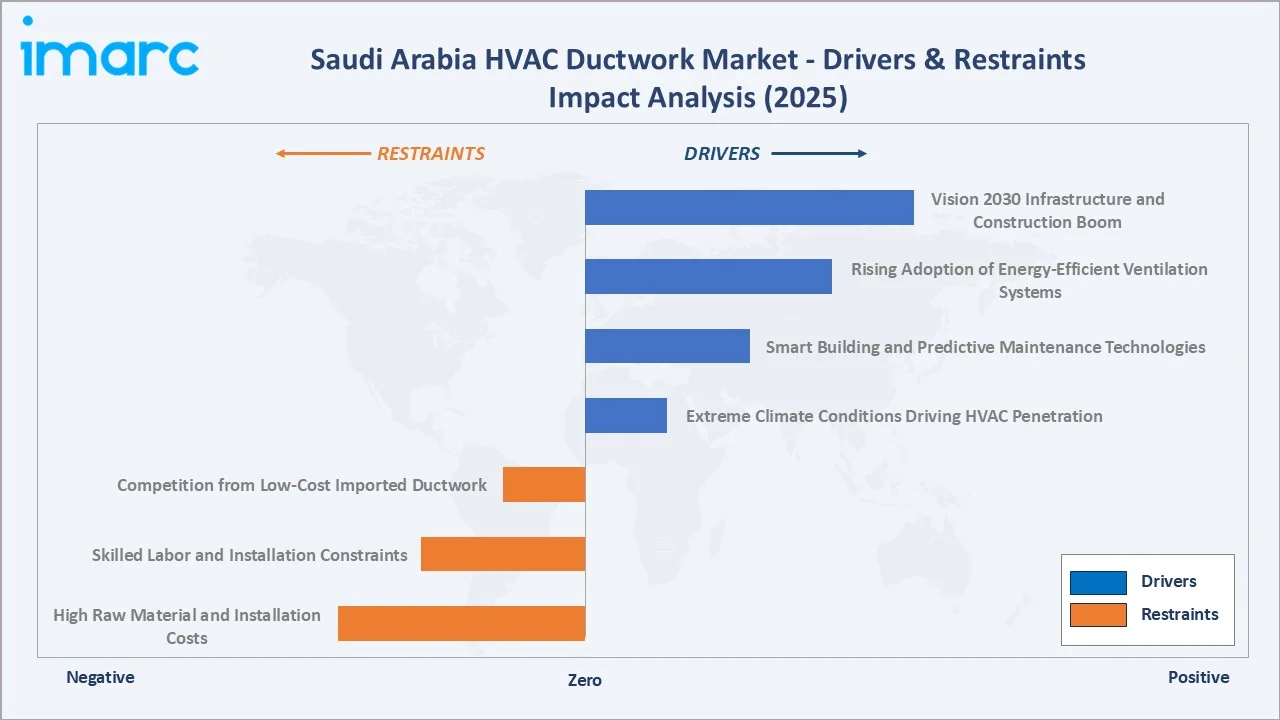
- Vision 2030 Infrastructure and Construction Boom: Large-scale urban development and infrastructure initiatives under Vision 2030 are driving sustained demand for HVAC ductwork across new commercial, residential, and industrial buildings. Mega-projects and new city developments are creating sustained multi-year demand for ductwork across commercial and residential buildings. Government-backed infrastructure spending is accelerating construction timelines, driving parallel growth in HVAC system procurement.
- Rising Adoption of Energy-Efficient Ventilation Systems: Growing emphasis on energy conservation is accelerating demand for optimized ductwork designs that minimize air leakage and improve overall HVAC system efficiency. Building owners are increasingly specifying low-leakage duct designs to reduce cooling costs in the Kingdom's extreme climate. Energy audits and efficiency certifications are becoming standard practice for new commercial developments.
- Smart Building and Predictive Maintenance Technologies: Integration of IoT-enabled monitoring and predictive maintenance solutions is improving ductwork performance tracking, reducing downtime, and boosting demand for compatible duct systems. Facility managers are adopting sensor-equipped ductwork to reduce maintenance costs and extend system lifespan. Integration with building management systems is enabling real-time airflow optimization across large commercial complexes.
- Extreme Climate Conditions Driving HVAC Penetration: Saudi Arabia's harsh desert climate necessitates robust cooling and ventilation infrastructure, sustaining consistent ductwork demand across residential, commercial, and industrial sectors. Year-round cooling requirements ensure continuous replacement and upgrade demand for ductwork across all building types. Rising summer temperatures are pushing developers to specify higher-capacity ventilation systems in new construction.
Market Restraints
- High Raw Material and Installation Costs: Fluctuating prices of galvanized steel, aluminum, and fiberglass, combined with specialized installation requirements, increase overall project costs and can constrain smaller-scale adoption. Volatile global steel and aluminum prices directly affect ductwork production costs and project budgets. Rising labor costs for specialized installation crews add further pressure on overall project economics.
- Skilled Labor and Installation Constraints: Shortages of trained HVAC ductwork technicians can delay project timelines and affect installation quality, particularly for complex commercial and industrial applications. Limited local technical training programs constrain the pipeline of qualified ductwork installation professionals. Reliance on expatriate labor exposes projects to visa and workforce mobility-related delays.
- Competition from Low-Cost Imported Ductwork: The influx of lower-priced imported ductwork products creates pricing pressure for domestic manufacturers, potentially impacting margins and local production capacity utilization. Imported products from lower-cost manufacturing hubs undercut domestic pricing on standard duct specifications. Price-sensitive contractors often prioritize cost over certification when sourcing for smaller projects.
Market Opportunities
- Fire-Rated and Moisture-Resistant Duct Boards: Growing regulatory emphasis on building safety is creating opportunities for manufacturers offering ASTM-compliant fire-rated and moisture-resistant ductwork solutions. Hospitals, schools, and high-rise buildings increasingly require certified fire-rated ductwork as a baseline specification. Manufacturers offering compliant products can command premium pricing in safety-critical project segments.
- Sustainable and Recycled Duct Materials: Rising sustainability goals under Vision 2030 are opening opportunities for ductwork manufactured using recycled inputs and low-emission production processes. Green building certification programs are creating demand for ductwork with verified recycled content. Vision 2030 sustainability targets are encouraging developers to specify environmentally certified building materials.
Market Challenges
- Fragmented Supplier Base Affecting Quality Consistency: Many small, unorganized fabricators can result in inconsistent product quality and complicate standardization across large infrastructure projects. Numerous small fabricators without standardized quality processes complicate large-scale project sourcing decisions. Inconsistent quality across suppliers increases inspection and rework costs for contractors.
- Balancing Cost Efficiency with Rising Compliance Requirements: Manufacturers face growing pressure to meet stricter fire-safety and energy-efficiency standards while maintaining competitive pricing in a cost-sensitive construction market. Meeting stricter fire-safety and efficiency standards often requires costly upgrades to production processes. Smaller manufacturers may struggle to absorb compliance costs without raising prices beyond market tolerance.
Emerging Market Trends
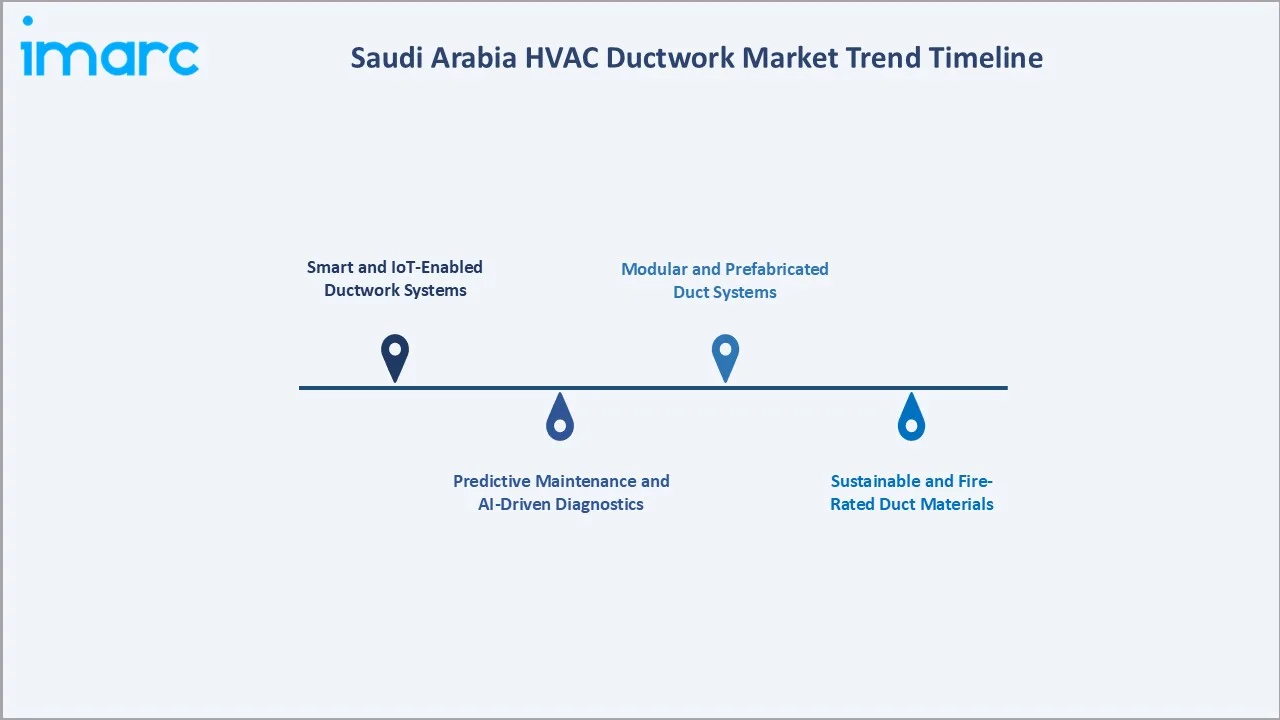
1. Smart and IoT-Enabled Ductwork Systems
Smart and IoT-enabled ductwork systems are gaining traction, allowing real-time monitoring of airflow, temperature, and energy consumption across commercial buildings. This shift supports proactive facility management and helps building operators reduce energy waste while maintaining consistent indoor air quality standards.
2. Predictive Maintenance and AI-Driven Diagnostics
Predictive maintenance and AI-driven diagnostics are becoming standard practice across the industry, helping companies identify inefficiencies and potential faults before they escalate into costly failures, thereby reducing unplanned downtime and aligning with the Kingdom's broader sustainability goals.
3. Sustainable and Fire-Rated Duct Materials
Sustainable and fire-rated duct materials, including boards manufactured with recycled content, are gaining adoption as environmental and building-safety regulations tighten. Manufacturers are increasingly positioning fire-resistant and moisture-proof products as differentiators in a competitive supply landscape.
4. Modular and Prefabricated Duct Systems
Modular and prefabricated duct systems are emerging as contractors seek faster installation timelines for large-scale infrastructure projects. These systems reduce on-site labor requirements and support the accelerated construction schedules associated with Vision 2030 development programs.
Industry Value Chain Analysis
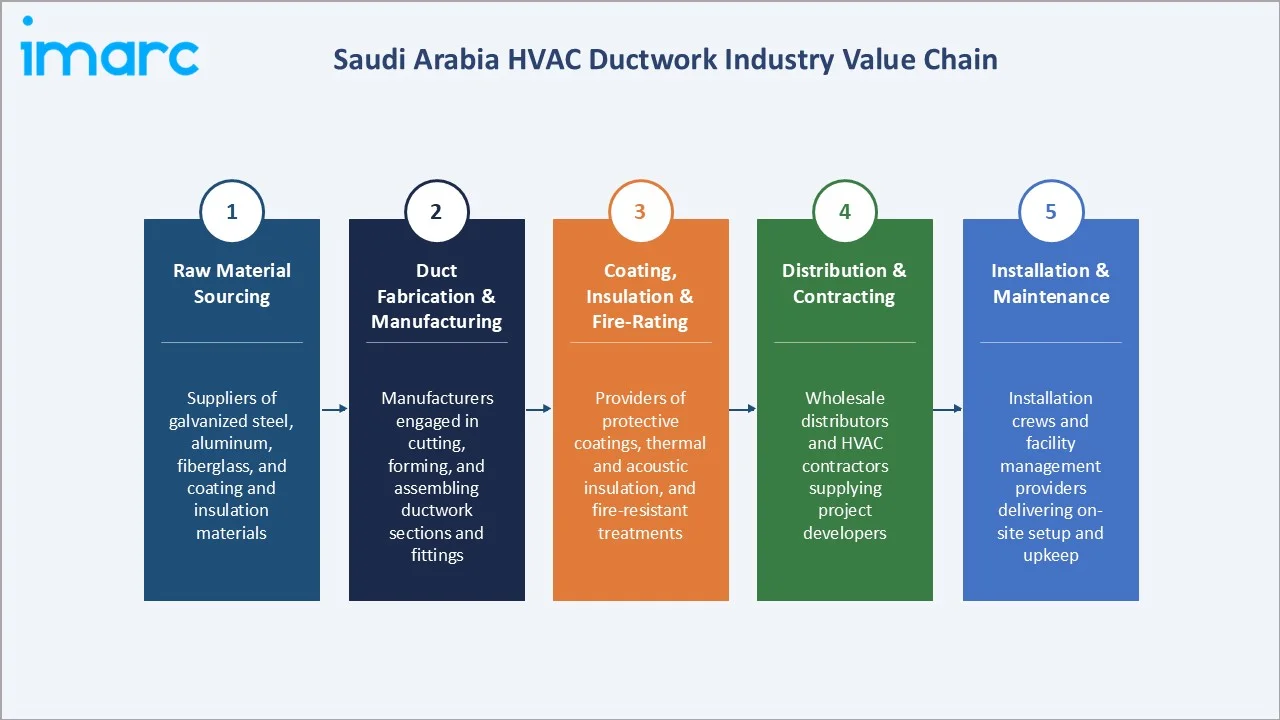
The Saudi Arabia HVAC ductwork value chain spans raw material sourcing, duct fabrication and manufacturing, coating and fire-rating treatment, distribution and contracting, and installation and maintenance services delivered to end-use building projects across the residential, commercial, and industrial sectors.
|
Stage |
Key Participants |
|
Raw Material Sourcing |
Suppliers of galvanized steel, aluminum, fiberglass, and coating and insulation materials |
|
Duct Fabrication & Manufacturing |
Manufacturers engaged in cutting, forming, and assembling ductwork sections and fittings |
|
Coating, Insulation & Fire-Rating |
Providers of protective coatings, thermal and acoustic insulation, and fire-resistant treatments |
|
Distribution & Contracting |
Wholesale distributors and HVAC contractors supplying project developers |
|
Installation & Maintenance |
Installation crews and facility management providers delivering on-site setup and upkeep |
The duct fabrication and manufacturing stage remains the value chain's most commercially significant tier, while the coating, insulation, and fire-rating stage is experiencing the fastest technology-driven transformation as regulatory compliance requirements continue to tighten across the Kingdom. Distribution and contracting relationships increasingly determine competitive advantage, as manufacturers that maintain close working relationships with HVAC contractors and construction developers are better positioned to secure large, multi-phase infrastructure contracts across the forecast period.
Technology Landscape in the Saudi Arabia HVAC Ductwork Industry
Fire-Rated and Moisture-Resistant Duct Board Technology
Fire-rated and moisture-resistant duct board technology offers enhanced building safety and durability, incorporating ASTM-compliant materials suited for both interior and exterior applications. Growing regulatory emphasis on fire safety is accelerating adoption across commercial and institutional construction projects.
Spiral and Modular Duct Fabrication Technology
Spiral and modular duct fabrication technology enables faster, more precise production of ductwork sections, reducing on-site installation time. This approach is gaining traction among contractors seeking to meet accelerated construction timelines under Vision 2030 infrastructure programs.
Smart and IoT-Enabled Ductwork Systems
Smart and IoT-enabled ductwork systems integrate sensors and connected monitoring platforms to track airflow, temperature, and system performance in real time, supporting predictive maintenance and improving overall energy efficiency across large commercial facilities.
Acoustic and Thermal Insulation Innovation
Advances in acoustic and thermal insulation materials are improving ductwork performance in noise-sensitive and energy-conscious building environments, with fiberglass and composite insulation solutions increasingly specified for hospitals, offices, and hospitality projects across the Kingdom.
.webp)
Market Segmentation Analysis
The report covers the following segments:
|
Segment Category |
Leading Segment |
Market Share |
Year |
|
Type |
Galvanized Steel |
44.7% |
2025 |
|
Shape |
Rectangular Ducts |
53.6% |
2025 |
|
Application |
🔒 |
🔒 |
2025 |
|
Region |
Northern and Central Region |
46.5% |
2025 |

By Type
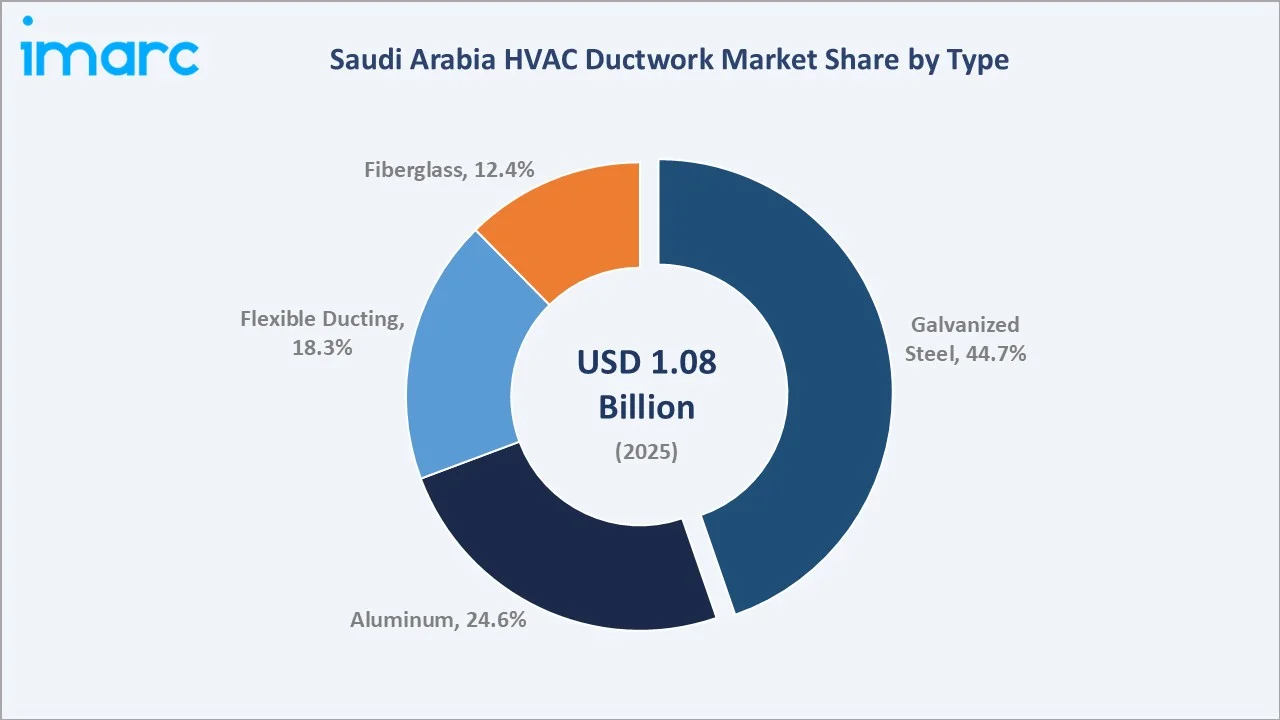
Galvanized Steel leads the type segment at 44.7% in 2025, favored for its durability, corrosion resistance, and cost-effectiveness in large-scale commercial and industrial installations across the Kingdom.
To access detailed market analysis, Request Sample
Aluminum follows at 24.6%, valued for its lightweight properties in residential applications, while Flexible Ducting at 18.3% supports quick, low-cost installations. Fiberglass, at 12.4%, is used chiefly for its thermal and acoustic insulation benefits in specialized building environments.
By Shape
Rectangular Ducts dominate the shape segment at 53.6% in 2025, driven by their compatibility with constrained ceiling spaces in large commercial and institutional buildings across Saudi Arabia.
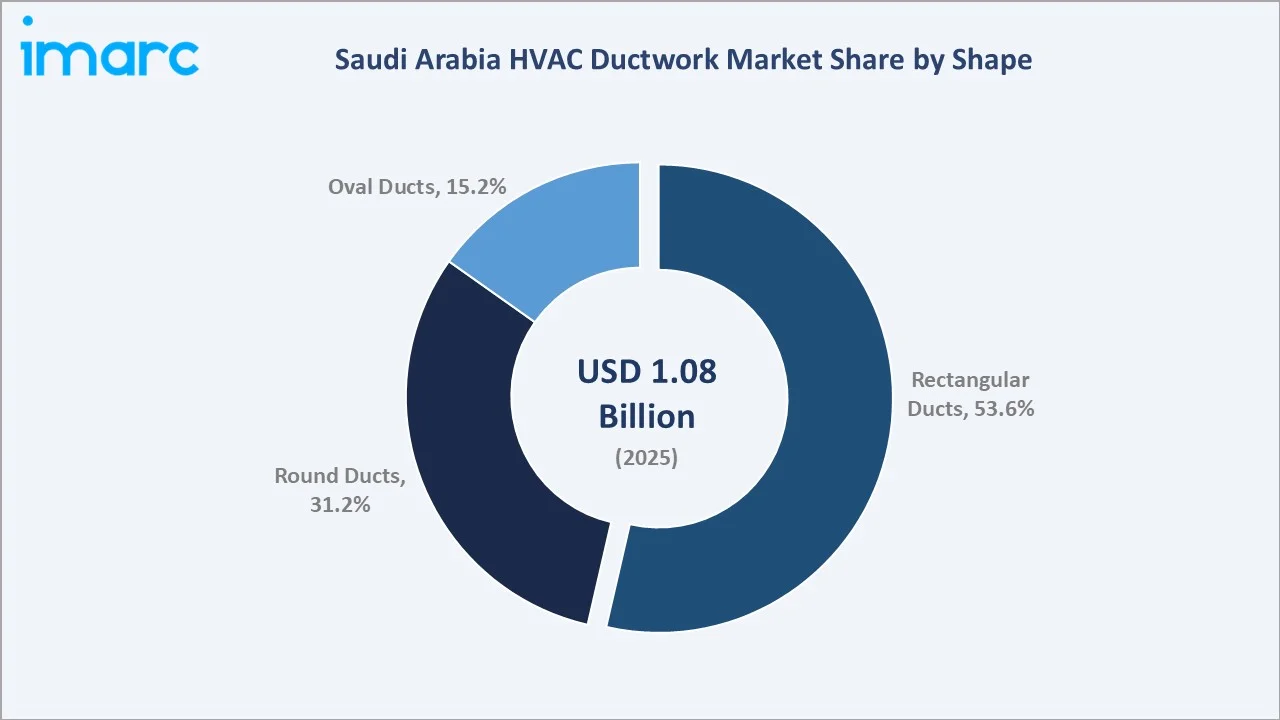
Round Ducts hold 31.2% share, preferred for their superior airflow efficiency and lower resistance, while Oval Ducts at 15.2% offer a practical balance between rectangular and round profiles for space-constrained retrofit projects.
Regional Market Insights
|
Region |
Share (2025) |
Key Market Drivers & Characteristics |
|
Northern and Central Region |
46.5% |
Driven by large-scale urban construction, government infrastructure spending, and dense commercial development activity |
|
Western Region |
24.8% |
Supported by hospitality, tourism, and residential construction activity across major urban centers |
|
Eastern Region |
17.6% |
Driven by industrial and petrochemical facility expansion and related infrastructure development |
|
Southern Region |
11.1% |
Emerging demand from public infrastructure and residential development initiatives |
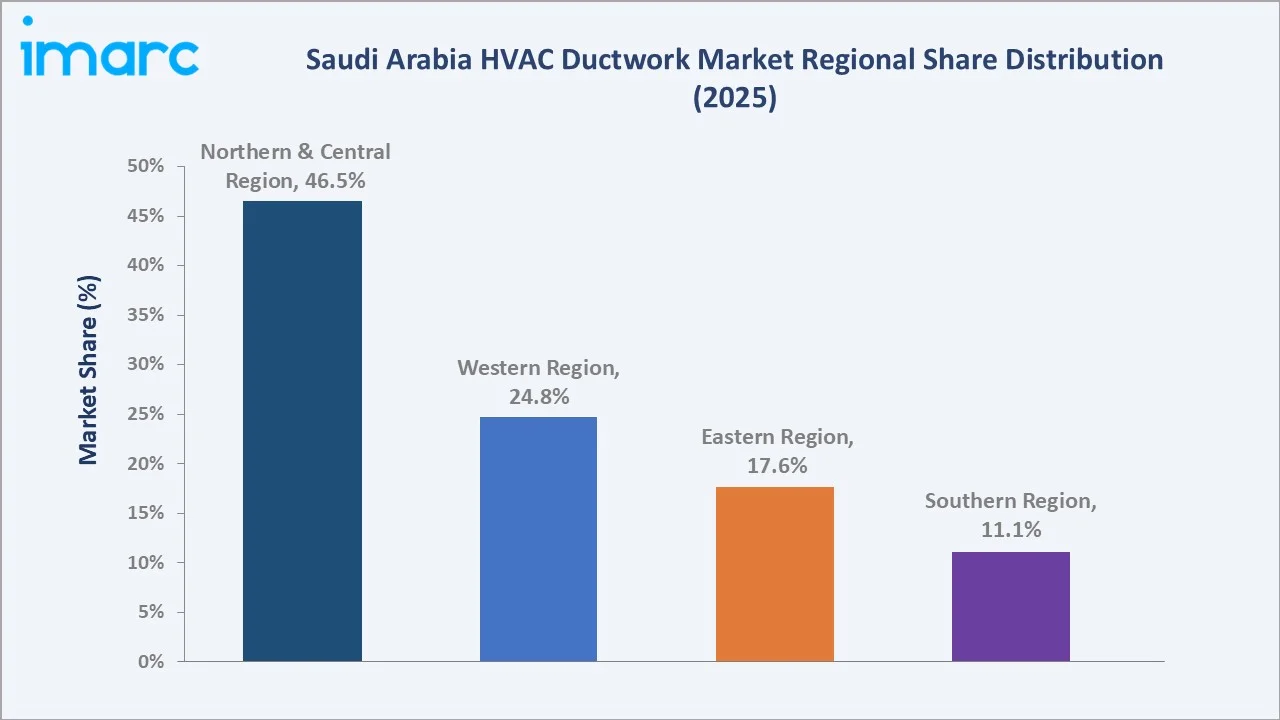
The Northern and Central Region, at 46.5%, leads through its concentration of large-scale construction and government-led infrastructure investment. The Western Region, at 24.8%, benefits from hospitality and tourism-driven construction, while the Eastern Region, at 17.6%, is anchored by industrial and petrochemical facility expansion. The Southern Region, at 11.1%, represents an early-stage but steadily growing market.
Competitive Landscape
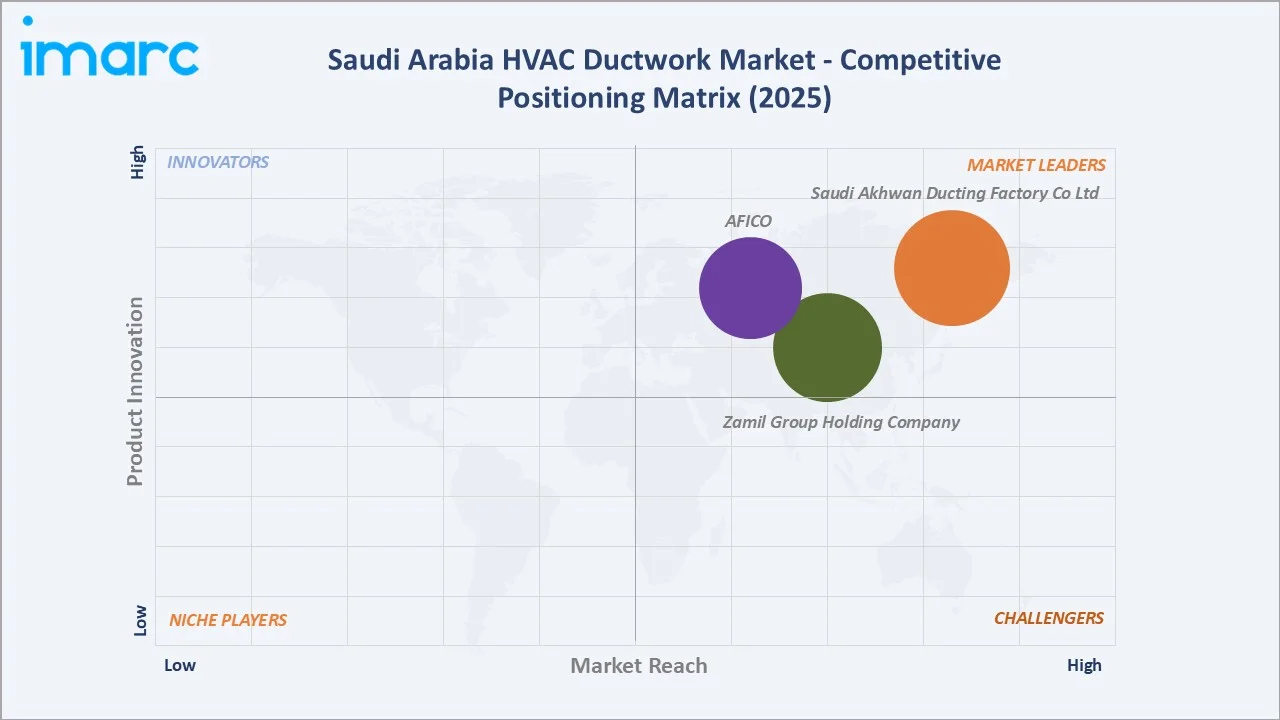
The Saudi Arabia HVAC ductwork market is moderately fragmented, comprising established insulation and fabrication specialists, diversified construction group subsidiaries, and emerging sustainable-material innovators competing across residential, commercial, and industrial project segments.
|
Company Name |
Key Products |
Market Position |
Core Strength |
|
Saudi Akhwan Ducting Factory Co Ltd |
HVAC ductwork, post-tension pipes, air distribution systems |
Market Leader |
Leading domestic manufacturer of HVAC ductwork products and accessories in Saudi Arabia |
|
AFICO |
Fiberglass duct insulation, sound liners, board insulation |
Market Leader |
Saudi-made certified insulation specialist and Owens Corning technology partner since 1981 |
|
Zamil Group Holding Company |
Galvanized steel components, insulated panels, structural steel |
Market Leader |
Large-scale steel fabrication capacity supporting regional ductwork material supply |
Key players include Saudi Akhwan Ducting Factory Co Ltd, AFICO, Zamil Group Holding Company, and others.
Key Company Profiles
Saudi Akhwan Ducting Factory Co Ltd
Saudi Akhwan Ducting Factory Co Ltd is a Saudi Arabia-based manufacturer recognized as a leading supplier of HVAC ductwork products and accessories across the Kingdom, serving commercial and residential construction projects nationwide.
- Key Products: HVAC ductwork, post-tension pipes, void formers, gripple hanging systems, and air distribution systems.
- Strategic Focus: Expanding its fire-rated ductwork and air distribution system portfolio to serve large-scale commercial and residential construction projects. Strengthening partnerships with contractors and developers to secure long-term supply agreements for major infrastructure projects. Investing in expanded production capacity to meet rising demand from Vision 2030-linked commercial and residential construction activity.
AFICO
AFICO is a leading provider of fiberglass thermal and acoustic insulation solutions for HVAC ductwork across Saudi Arabia and the wider GCC region.
- Key Products: Duct board insulation, pipe insulation sections, and acoustic sound liners for HVAC ductwork applications.
- Strategic Focus: Leveraging its Owens Corning technology partnership and Saudi Made certification to expand sustainable insulation solutions for HVAC and construction projects. Broadening its product range of fire-resistant and acoustic insulation solutions to meet tightening building-safety regulations. Strengthening its regional distribution network across the GCC to support growing demand for certified fiberglass insulation products.
Market Concentration Analysis
The Saudi Arabia HVAC ductwork market remains moderately fragmented, with leading manufacturers collectively holding a notable share of domestic supply, while diversified construction group subsidiaries and niche sustainable-material innovators compete for project-specific contracts. Market concentration is expected to gradually increase as regulatory compliance requirements increasingly favor established, certified manufacturers over smaller, unorganized fabricators, particularly as large infrastructure developers prioritize suppliers with proven fire-safety and quality certifications.
Investment & Growth Opportunities
Highest Growth Segments
Galvanized Steel ductwork, Rectangular Duct fabrication, and the Northern and Central Region collectively represent the highest-growth investment vectors through 2034, supported by sustained infrastructure investment and construction activity across the Kingdom's major urban centers, alongside steady expansion in the Western Region's hospitality and tourism-linked construction pipeline.
Emerging Investment Opportunities
Fire-rated and sustainable duct board manufacturing represents the market's highest-value emerging opportunity, as regulatory compliance and sustainability requirements create structurally growing demand for certified, higher-margin ductwork products through the forecast period, particularly for hospitals, schools, and other safety-critical commercial facilities.
Investment Themes
- Fire-safety compliant manufacturing capacity expansion as a structural differentiator: Manufacturers investing in ASTM-compliant fire-rated production lines are positioned to capture premium demand from large-scale commercial and institutional projects.
- Sustainable and recycled-content duct material development: Companies developing low-emission, recycled-content ductwork solutions are positioned to benefit from the Kingdom's sustainability goals and Vision 2030 green-building initiatives.
- Smart ductwork and IoT-integration partnerships: Collaborations between duct manufacturers and building-automation technology providers can accelerate adoption of connected, performance-monitored ductwork systems across new commercial developments.
Future Market Outlook (2026-2034)
The Saudi Arabia HVAC ductwork market is projected to grow from USD 1.08 Billion in 2025 to USD 2.38 Billion by 2034, delivering a 9.19% CAGR. The market's anchor value of USD 1.67 Billion in 2030 reflects continued infrastructure-led expansion at the midpoint of the forecast period.
Continued Vision 2030 infrastructure investment, rising energy-efficiency regulations, and growing adoption of smart and sustainable ductwork solutions are expected to define the market's trajectory through the forecast period, with fire-rated and IoT-enabled products increasingly shaping competitive differentiation. Manufacturers that combine certified quality standards with sustainable material innovation are best positioned to capture the largest share of incremental demand through 2034.
Research Methodology
Primary Research
Primary research comprised structured interviews with HVAC contractors, ductwork manufacturers, construction project managers, and regulatory stakeholders across Saudi Arabia.
Secondary Research
Secondary research encompassed company reports, Saudi construction and Vision 2030 infrastructure publications, industry association data, and regional HVAC market studies.
Forecasting Models
Market forecasts were developed using a bottom-up and top-down triangulation approach incorporating construction activity trends, material cost dynamics, and regional infrastructure investment plans.
Saudi Arabia HVAC Ductwork Market Report Coverage:
| Report Features | Details |
|---|---|
| Base Year of the Analysis | 2025 |
| Historical Period | 2020-2025 |
| Forecast Period | 2026-2034 |
| Units | Billion USD |
| Scope of the Report |
Exploration of Historical Trends and Market Outlook, Industry Catalysts and Challenges, Segment-Wise Historical and Future Market Assessment:
|
| Types Covered | Galvanized Steel, Aluminum, Fiberglass, Flexible Ducting |
| Shapes Covered | Rectangular Ducts, Round Ducts, Oval Ducts |
| Applications Covered | Commercial, Residential, Industrial |
| Regions Covered | Northern and Central Region, Western Region, Eastern Region, Southern Region |
| Companies Covered | Saudi Akhwan Ducting Factory Co Ltd, AFICO, Zamil Group Holding Company, etc. |
| Customization Scope | 10% Free Customization |
| Post-Sale Analyst Support | 10-12 Weeks |
| Delivery Format | PDF and Excel through Email (We can also provide the editable version of the report in PPT/Word format on special request) |
Key Benefits for Stakeholders:
- IMARC’s industry report offers a comprehensive quantitative analysis of various market segments, historical and current market trends, market forecasts, and dynamics of the Saudi Arabia HVAC ductwork market from 2020-2034.
- The research report provides the latest information on the market drivers, challenges, and opportunities in the Saudi Arabia HVAC ductwork market.
- Porter's five forces analysis assist stakeholders in assessing the impact of new entrants, competitive rivalry, supplier power, buyer power, and the threat of substitution. It helps stakeholders to analyze the level of competition within the Saudi Arabia HVAC ductwork industry and its attractiveness.
- Competitive landscape allows stakeholders to understand their competitive environment and provides an insight into the current positions of key players in the market.
Frequently Asked Questions About the Saudi Arabia HVAC Ductwork Market Report
The Saudi Arabia HVAC ductwork market reached USD 1.08 Billion in 2025, driven by Vision 2030 infrastructure investment, extreme climate conditions, and rising demand for energy-efficient ventilation systems across commercial and residential construction, with Galvanized Steel and Rectangular Ducts representing the leading product categories by revenue share.
The market is projected to grow at a CAGR of 9.19% during 2026-2034, reaching USD 2.38 Billion by 2034, supported by sustained construction and infrastructure development activity, rising energy-efficiency regulation, and continued adoption of smart and sustainable ductwork technologies.
Galvanized Steel leads at 44.7% share in 2025, owing to its durability, corrosion resistance, and cost-efficiency in large-scale commercial and industrial installations, followed by Aluminum, Flexible Ducting, and Fiberglass.
Rectangular Ducts lead at 53.6% share, driven by their compatibility with commercial and institutional building designs and ease of installation in constrained spaces, ahead of Round Ducts and Oval Ducts.
The Northern and Central Region leads at 46.5% share, anchored by its concentration of large-scale infrastructure and construction projects, followed by the Western, Eastern, and Southern regions.
Leading companies include include Saudi Akhwan Ducting Factory Co Ltd, AFICO, Zamil Group Holding Company, and others.
The market is projected to reach approximately USD 1.67 Billion by 2030, with smart and IoT-enabled ductwork systems and fire-rated duct materials gaining wider adoption across commercial construction projects as regulatory and sustainability requirements continue to tighten.
Priority investment opportunities include fire-safety compliant manufacturing capacity expansion, sustainable and recycled-content duct material development, and smart, IoT-enabled ductwork system integration, particularly across the fast-growing Northern and Central Region.
Need more help?
- Speak to our experienced analysts for insights on the current market scenarios.
- Include additional segments and countries to customize the report as per your requirement.
- Gain an unparalleled competitive advantage in your domain by understanding how to utilize the report and positively impacting your operations and revenue.
- For further assistance, please connect with our analysts.
 Request Customization
 Speak to an Analyst
 Request Brochure
 Inquire Before Buying
Benefits of Customization
- Personalize this research
- Triangulate with your data
- Get data as per your format and definition
- Gain a deeper dive into a specific application, geography, customer, or competitor
- Any level of personalization
Get in Touch With Us
UNITED STATES
Phone: +1-201-971-6302
INDIA
Phone: +91-120-433-0800
UNITED KINGDOM
Phone: +44-753-714-6104
Email: [email protected]
Client Testimonials




.webp)




.webp)













Related Reports

Choose your plan
*Please note that the prices mentioned below are starting prices for each bundle type. Kindly contact our team for further details.*
Single User License
- 1 User License, Access on 2 Devices
- PDF Report + Excel Dataset (Password Protected)
- Lifetime Access
- No Printing Rights
- 10% Free Report Customization
- 10–12 Weeks of Analyst Support
Five User License
- Access for 5 Users, 2 Devices per User
- PDF Report + Excel Dataset (Password Protected)
- Lifetime Access
- Dedicated Account Manager
- 12–14 Weeks of Analyst Support
- No Printing Rights
- 15% Free Report Customization
- 25% Discount on Your Next Purchase
Corporate User License
- Unlimited User Access (Within Your Organization)
- PDF Report + Excel Dataset
- Lifetime Access
- Dedicated Account Manager
- 14–20 Weeks of Analyst Support
- No Printing Rights
- 20% Free Report Customization
- 30% Discount on Your Next Purchase
Essential Insights
What's included:
3 reports
- Lifetime Access
- PDF Reports
- Excel Datasets
- 2 Weeks of Free Analyst Support
- 2 User Licenses
- Access on 2 Devices
- Printing Rights
- Complimentary PowerPoint (PPT) Version
- Complimentary License Upgrade
Professional Access
What's included:
5 reports
- Lifetime Access
- PDF Reports
- Excel Datasets
- 8 Weeks of Free Analyst Support
- 2 User Licenses
- Access on 2 Devices
- Printing Rights
- Complimentary PowerPoint (PPT) Version
- Complimentary License Upgrade
Business Advantage
What's included:
8 reports
- Lifetime Access
- PDF Reports
- Excel Datasets
- 14 Weeks of Free Analyst Support
- 2 User Licenses
- Access on 2 Devices
- Printing Rights
- Complimentary PowerPoint (PPT) Version
- Complimentary License Upgrade
Enterprise Intelligence
What's included:
10 reports
- Lifetime Access
- PDF Reports
- Excel Datasets
- 20 Weeks of Free Analyst Support
- 2 User Licenses
- Access on 2 Devices
- Printing Rights
- Complimentary PowerPoint (PPT) Version
- Complimentary License Upgrade