
Saudi Arabia LED Lighting Market Report by Application (Retrofit, Retail and Hospitality, Outdoor, Offices, Architectural, Homes, Industrial), and Region 2026-2034
Market Overview:
Saudi Arabia LED lighting market size reached USD 953.1 Million in 2025. Looking forward, IMARC Group expects the market to reach USD 2,873.2 Million by 2034, exhibiting a growth rate (CAGR) of 13.04% during 2026-2034. Saudi Arabia’s lighting market is expecting rapid growth, driven by strong government initiatives under Vision 2030 promoting energy efficiency and stricter lighting standards. Major urban megaprojects are accelerating demand for smart, sustainable lighting solutions. Moreover, the growing adoption across commercial and industrial sectors for cost savings, durability, and smart integration is further expanding the Saudi Arabia LED lighting market share.
|
Report Attribute
|
Key Statistics
|
|---|---|
|
Base Year
|
2025
|
|
Forecast Years
|
2026-2034
|
|
Historical Years
|
2020-2025
|
|
Market Size in 2025
|
USD 953.1 Million |
|
Market Forecast in 2034
|
USD 2,873.2 Million |
| Market Growth Rate 2026-2034 | 13.04% |
Access the full market insights report Request Sample
Light emitting diode (LED) lighting stands as an innovative and energy-efficient lighting technology. This method generates light by passing an electric current through a semiconductor material, producing light without the inefficient heat production associated with older technologies. LED lighting brings forth various advantages, such as markedly reduced energy consumption, an extended lifespan, and diminished maintenance expenses. Furthermore, the eco-friendly and durable characteristics of LED lighting are well-aligned with the growing emphasis on energy conservation and environmental stewardship. Presently, LED lighting is experiencing significant popularity in both residential and commercial applications across the country.
Saudi Arabia LED Lighting Market Trends:
Government Programs and Policies Supporting Energy Efficiency
The government of Saudi Arabia is constantly pushing the LED lighting industry through ambitious initiatives and programs intended to improve energy efficiency and sustainability. As part of its Vision 2030 program, the Kingdom is focusing on shifting towards green and energy-efficient technologies, and LED lighting is at the forefront of this shift. Governments are imposing tighter controls to phase out incandescent and traditional fluorescent lighting systems and are compelling the public and private sectors to shift to LED solutions. The Saudi Energy Efficiency Center (SEEC) and the Ministry of Energy are taking crucial steps by establishing efficiency standards and certification requirements for lighting products. These efforts are not only providing market growth assurance but also creating a competitive market that encourages innovation among producers. In line with its continuous pursuit of boosting energy efficiency and enhancing market performance, the Saudi Energy Efficiency Center (SEEC) revealed a notable advancement in the Energy Efficiency Product Compliance Index for 2024. This accomplishment resulted from strong cooperation with various key government agencies, within a national framework designed to attain environmental and economic sustainability objectives. SEEC stated that this advancement was due to 24 thorough inspection campaigns carried out during the year, encompassing markets and warehouses in different areas of the Kingdom. These inspections concentrated on assessing products to ensure they meet the authorized Saudi standards and specifications for energy efficiency.
Urban Developments and Infrastructure Growth
Saudi Arabia is experiencing various urban developments, which are proving to be one of the key growth drivers for the market. The nation is heavily investing in megacities and infrastructure developments like NEOM, The Red Sea Project, Qiddiya, and Amaala, which are all incorporating energy-efficient light systems into their city plans. The increasing population and higher urban migration are causing higher demand for residential, commercial, and public infrastructure, thus spurring the demand for high-tech lighting solutions. Cities are switching from conventional streetlights to smart LED lighting systems that curb energy consumption and enhance operational efficiency by means of automated control and internet of things (IoT) integration. Furthermore, the establishment of new industrial parks and transport networks, such as airports, highways, and metro routes, is also increasing the demand for LEDs. Such projects are demanding robust, long-lasting, and cost-effective lighting solutions consonant with green goals. In 2024, New Murabba, a company under the Public Investment Fund (PIF), showcased its transformative vision for urban living at Cityscape Global 2024, one of the largest global exhibitions for real estate and urban development, where it served as the Foundation Sponsor. Launched by the Ministry of Municipalities and Housing, Cityscape Global 2024 took place at the Riyadh Exhibition and Conference Centre in Malham from November 11 to 14 with the theme "The Future of Living," attracting more than 400 participants, including international industry leaders, investors, and urban development specialists, all dedicated to influencing the future of real estate and architecture.
Increasing Demand in Commercial and Industrial Applications
The industrial and commercial units of Saudi Arabia are increasingly switching to LED lighting because of its higher efficiency, longevity, and cost-effectiveness. The speedy growth of shopping centers, hotels, offices, and manufacturing units is generating an ever-growing demand for state-of-the-art lighting systems that can boost production and reduce operational costs. In industrial settings, LED lighting is increasingly being preferred for long life and resistance to harsh conditions, lowering maintenance costs and frequency. In the commercial market, LED lighting is enhancing looks and customer experience, especially in hospitality, entertainment, and retail where consistent lighting and adaptability in design are needed. Also, companies are seeing the economic benefits of reduced electricity use, coinciding with business objectives to maximize energy efficiency. As Saudi Arabian industries become more modern and digital, LED lighting is being applied in more comprehensive energy management systems and smart industrial platforms. This increasing industrial and commercial uptake of LED bulbs and other lights is also promoting innovation in LED product design and application flexibility, underpinning the nation's continued industrial diversification and sustainability objectives. IMARC Group predicts that the Saudi Arabia LED bulb market is projected to attain USD 220.67 Million by 2033.
Saudi Arabia LED Lighting Market Growth Drivers:
Rising Emphasis on Sustainability and Environmental Consciousness
There is rising environmental awareness concerning sustainability that is heavily influencing the LED lighting market in Saudi Arabia. Both the government and people are becoming more aware of the environmental consequences of high energy consumption and carbon footprint from conventional lighting systems. LED technology, with its high energy efficiency and minimal environmental cost, is being considered as a green alternative that supports Saudi Arabia's green transformation vision. Corporates and industries are now embracing LED solutions to meet environmental regulations and corporate social responsibility (CSR) policies. In addition, Saudi consumers are increasingly becoming environment-conscious and opting for lighting solutions that save electricity and help in cutting greenhouse gas emissions. The model of the circular economy is also gaining traction, with energy-efficient lighting solutions at the forefront of waste reduction and consumption of resources. As part of the sustainability agenda of Vision 2030, the adoption of LEDs is being incorporated in green building certifications and eco-friendly urban development. This growing emphasis on sustainability is urging producers to develop and provide products with better recyclability, reduced toxicity, and greater efficiency, further boosting the market's growth in an eco-friendly direction.
Technological Innovations and Smart Lighting Integration
Ongoing technological innovations are driving the Saudi LED lighting market by improving the performance of the products and broadening the scope of applications. Smart lighting technology, where LEDs are brought together with sensors, IoT platforms, and control systems, is gaining firm momentum in residential, commercial, and industrial applications. Saudi Arabia's digital transformation push under Vision 2030 is driving the uptake of smart LED solutions in smart cities and smart infrastructure. The potential to control and monitor lighting systems over a distance is enhancing operational efficiency and energy management, drawing the interest of government as well as private enterprise. Additionally, improvements in LED chip, optical control, and color rendering are yielding high-performance lighting products that serve a variety of functional and aesthetic purposes. The marriage of automation with data analytics is delivering predictive maintenance, minimizing downtime, and decreasing operational expenses. These advancements are not only improving user experience but also supporting national innovation and sustainability goals. As technology keeps advancing, Saudi Arabia's LED market is gaining from increasing demand for smarter, adaptive, and energy-efficient lighting systems for smart and sustainable development.
Facilative Economic Diversification and Investment Policies
Saudi Arabia's continued economic diversification push under Vision 2030 is having a positive impact on the LED lighting market. The government is actively encouraging non-oil industries such as construction, manufacturing, and renewable energy, all of which are directly supporting growth in LED demand. Public and private investment is pouring into infrastructure, housing, and energy-efficient technologies, opening up opportunities for local and foreign lighting firms. Domestic policies promoting the manufacture of LED products are reinforcing the supply chain and lessening dependence on imports. In addition, positive tax concessions, business liberalization, and simplified investment processes are drawing international players to set up production and distribution units in the Kingdom. These efforts are increasing market competitiveness, stimulating innovation, and creating employment opportunities in the lighting industry. By incorporating LED technology into new economic complexes and industrial ventures, Saudi Arabia is coupling its diversification strategy with international sustainability patterns. The steady flow of foreign direct investment (FDI) and public-private partnerships (PPPs) is making the LED lighting sector an integral part of the country's modernization and industrialization.
Saudi Arabia LED Lighting Market Segmentation:
IMARC Group provides an analysis of the key trends in each segment of the market, along with forecasts at the country level for 2026-2034. Our report has categorized the market based on application.
Application Insights:
To get detailed segment analysis of this market Request Sample
- Retrofit
- Retail and Hospitality
- Outdoor
- Offices
- Architectural
- Homes
- Industrial
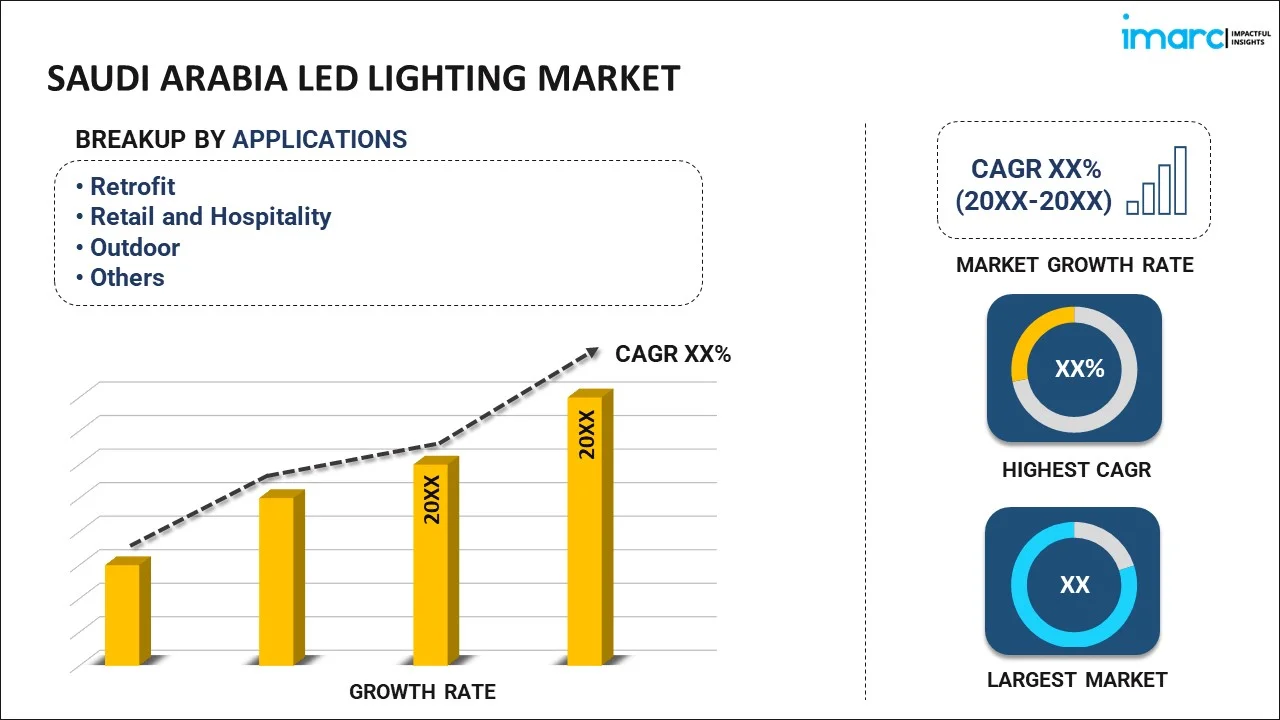
The report has provided a detailed breakup and analysis of the market based on the application. This includes retrofit, retail and hospitality, outdoor, offices, architectural, homes, and industrial.
Regional Insights:
To get detailed regional analysis of this market Request Sample
- Northern and Central Region
- Western Region
- Eastern Region
- Southern Region
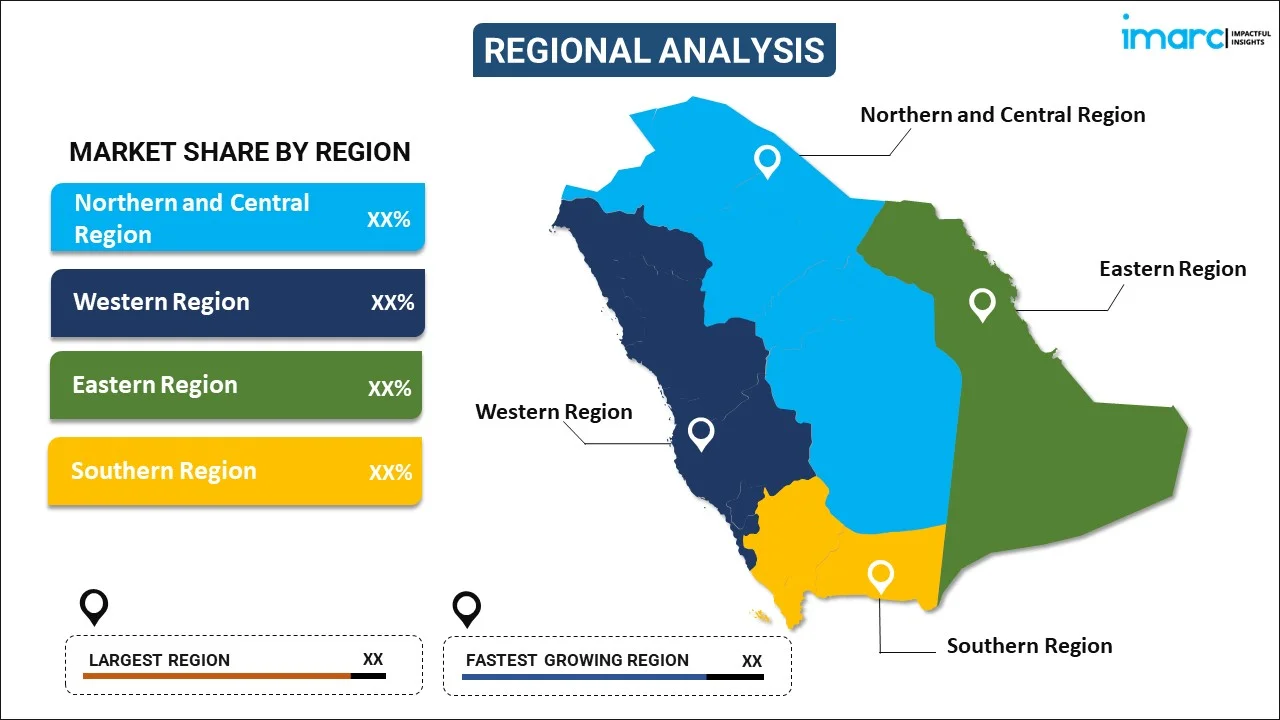
The report has also provided a comprehensive analysis of all the major regional markets, which include Northern and Central Region, Western Region, Eastern Region, and Southern Region.
Competitive Landscape:
The market research report has also provided a comprehensive analysis of the competitive landscape in the market. Competitive analysis such as market structure, key player positioning, top winning strategies, competitive dashboard, and company evaluation quadrant has been covered in the report. Also, detailed profiles of all major companies have been provided.
Saudi Arabia LED Lighting Market News:
- May 2025: NMK Electronics, a leading distributor of professional audio-visual, lighting, and communication solutions, wrapped up its successful involvement at SLS Expo 2025, solidifying its leadership role in the Middle East and speeding up its strategic growth into the Saudi Arabian market. The company presented a remarkable selection of top-tier brands within a larger 220-square-meter exhibition area, directly aimed at capitalizing on growth prospects in Saudi Arabia’s swiftly evolving AV industry.
- February 2025: Hansa Green Technology, a UAE-based producer of premium LED lights, has revealed new strategies to enhance its production capacity in the Hamriyah Free Zone to over one million LED lighting fixtures each year and significantly increase investments. This initiative comes in response to the growing demand for its products throughout the Gulf, Middle East, and Africa, showcasing HFZA’s role as a prominent investment center that supports the growth and development of businesses both regionally and globally. Talks also included the creation of a manufacturing plant in Riyadh, Saudi Arabia, scheduled for 2025, as part of Hansa Green Technology's expansion efforts in the Middle East and Africa.
Saudi Arabia LED Lighting Market Report Coverage:
| Report Features | Details |
|---|---|
| Base Year of the Analysis | 2025 |
| Historical Period | 2020-2025 |
| Forecast Period | 2026-2034 |
| Units | Million USD |
| Scope of the Report | Exploration of Historical Trends and Market Outlook, Industry Catalysts and Challenges, Segment-Wise Historical and Future Market Assessment:
|
| Applications Covered | Retrofit, Retail and Hospitality, Outdoor, Offices, Architectural, Homes, Industrial |
| Regions Covered | Northern and Central Region, Western Region, Eastern Region, Southern Region |
| Customization Scope | 10% Free Customization |
| Post-Sale Analyst Support | 10-12 Weeks |
| Delivery Format | PDF and Excel through Email (We can also provide the editable version of the report in PPT/Word format on special request) |
Key Benefits for Stakeholders:
- IMARC’s industry report offers a comprehensive quantitative analysis of various market segments, historical and current market trends, market forecasts, and dynamics of the Saudi Arabia LED lighting market from 2020-2034.
- The research report provides the latest information on the market drivers, challenges, and opportunities in the Saudi Arabia LED lighting market.
- Porter's five forces analysis assist stakeholders in assessing the impact of new entrants, competitive rivalry, supplier power, buyer power, and the threat of substitution. It helps stakeholders to analyze the level of competition within the Saudi Arabia LED lighting industry and its attractiveness.
- Competitive landscape allows stakeholders to understand their competitive environment and provides an insight into the current positions of key players in the market.
Frequently Asked Questions About the Saudi Arabia LED Lighting Market Report
The LED lighting market in Saudi Arabia was valued at USD 953.1 Million in 2025.
The Saudi Arabia LED lighting market is projected to exhibit a CAGR of 13.04% during 2026-2034, reaching a value of USD 2,873.2 Million by 2034.
The LED lighting market in Saudi Arabia is growing swiftly, fueled by robust government efforts aligned with Vision 2030 that encourage energy efficiency and enforce stricter lighting regulations. Large urban megaprojects such as NEOM, Qiddiya, and New Murabba are driving the need for intelligent, eco-friendly lighting options. Increasing uptake in commercial and industrial sectors for cost efficiency, longevity, and intelligent integration boosts market expansion, with the LED bulb market anticipated to hit USD 220.67 million by 2033.
Need more help?
- Speak to our experienced analysts for insights on the current market scenarios.
- Include additional segments and countries to customize the report as per your requirement.
- Gain an unparalleled competitive advantage in your domain by understanding how to utilize the report and positively impacting your operations and revenue.
- For further assistance, please connect with our analysts.
 Request Customization
 Speak to an Analyst
 Request Brochure
 Inquire Before Buying
Benefits of Customization
- Personalize this research
- Triangulate with your data
- Get data as per your format and definition
- Gain a deeper dive into a specific application, geography, customer, or competitor
- Any level of personalization
Get in Touch With Us
UNITED STATES
Phone: +1-201-971-6302
INDIA
Phone: +91-120-433-0800
UNITED KINGDOM
Phone: +44-753-714-6104
Email: [email protected]
Client Testimonials




.webp)




.webp)













Related Reports

Choose your plan
*Please note that the prices mentioned below are starting prices for each bundle type. Kindly contact our team for further details.*
Single User License
- 1 User License, Access on 2 Devices
- PDF Report + Excel Dataset (Password Protected)
- Lifetime Access
- No Printing Rights
- 10% Free Report Customization
- 10–12 Weeks of Analyst Support
Five User License
- Access for 5 Users, 2 Devices per User
- PDF Report + Excel Dataset (Password Protected)
- Lifetime Access
- Dedicated Account Manager
- 12–14 Weeks of Analyst Support
- No Printing Rights
- 15% Free Report Customization
- 25% Discount on Your Next Purchase
Corporate User License
- Unlimited User Access (Within Your Organization)
- PDF Report + Excel Dataset
- Lifetime Access
- Dedicated Account Manager
- 14–20 Weeks of Analyst Support
- No Printing Rights
- 20% Free Report Customization
- 30% Discount on Your Next Purchase
Essential Insights
What's included:
3 reports
- Lifetime Access
- PDF Reports
- Excel Datasets
- 2 Weeks of Free Analyst Support
- 2 User Licenses
- Access on 2 Devices
- Printing Rights
- Complimentary PowerPoint (PPT) Version
- Complimentary License Upgrade
Professional Access
What's included:
5 reports
- Lifetime Access
- PDF Reports
- Excel Datasets
- 8 Weeks of Free Analyst Support
- 2 User Licenses
- Access on 2 Devices
- Printing Rights
- Complimentary PowerPoint (PPT) Version
- Complimentary License Upgrade
Business Advantage
What's included:
8 reports
- Lifetime Access
- PDF Reports
- Excel Datasets
- 14 Weeks of Free Analyst Support
- 2 User Licenses
- Access on 2 Devices
- Printing Rights
- Complimentary PowerPoint (PPT) Version
- Complimentary License Upgrade
Enterprise Intelligence
What's included:
10 reports
- Lifetime Access
- PDF Reports
- Excel Datasets
- 20 Weeks of Free Analyst Support
- 2 User Licenses
- Access on 2 Devices
- Printing Rights
- Complimentary PowerPoint (PPT) Version
- Complimentary License Upgrade