
Saudi Arabia Lighting Market Size, Share, Trends and Forecast by Type, Application, End User, and Region, 2026-2034
Saudi Arabia Lighting Market Size, Share, Trends & Forecast (2026-2034)
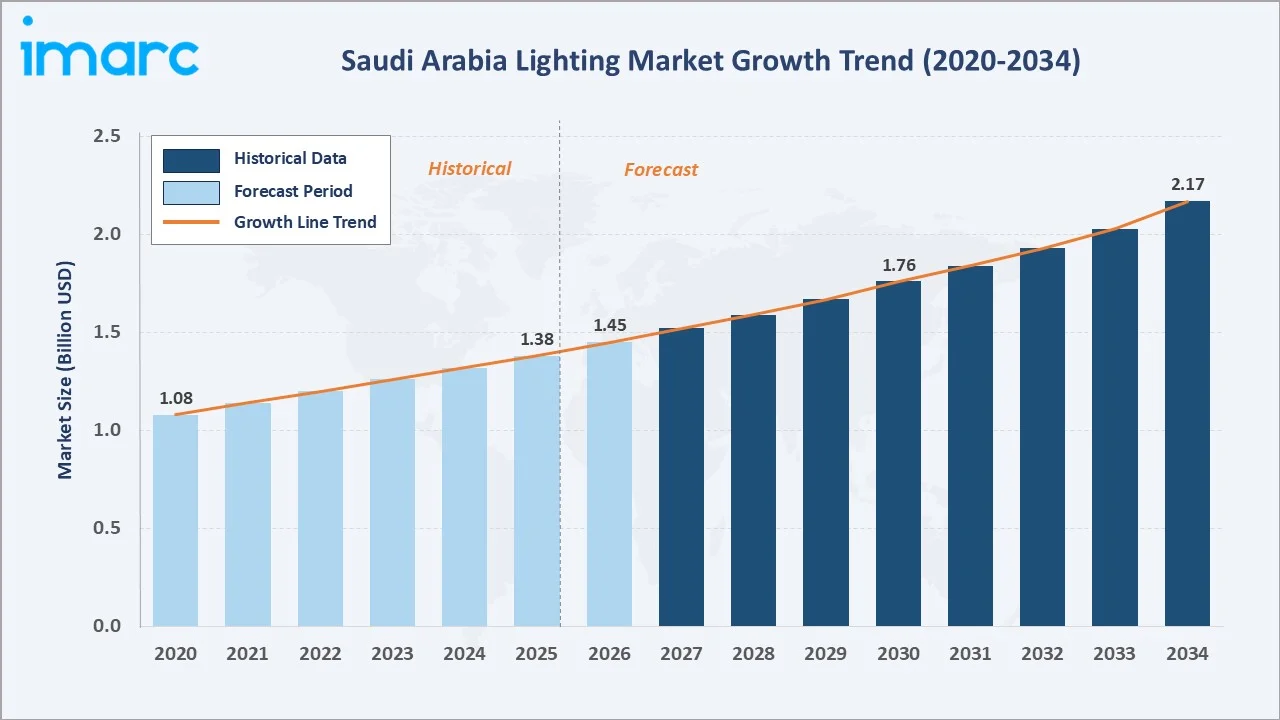
The Saudi Arabia lighting market grew from USD 1.38 Billion in 2025 to USD 1.45 Billion in 2026 and is projected to reach USD 2.17 Billion by 2034, growing at a CAGR of 4.94% during 2026-2034. The market is driven by accelerating infrastructure development under Vision 2030 and rising demand for energy-efficient LED solutions across commercial, industrial, and public sectors.
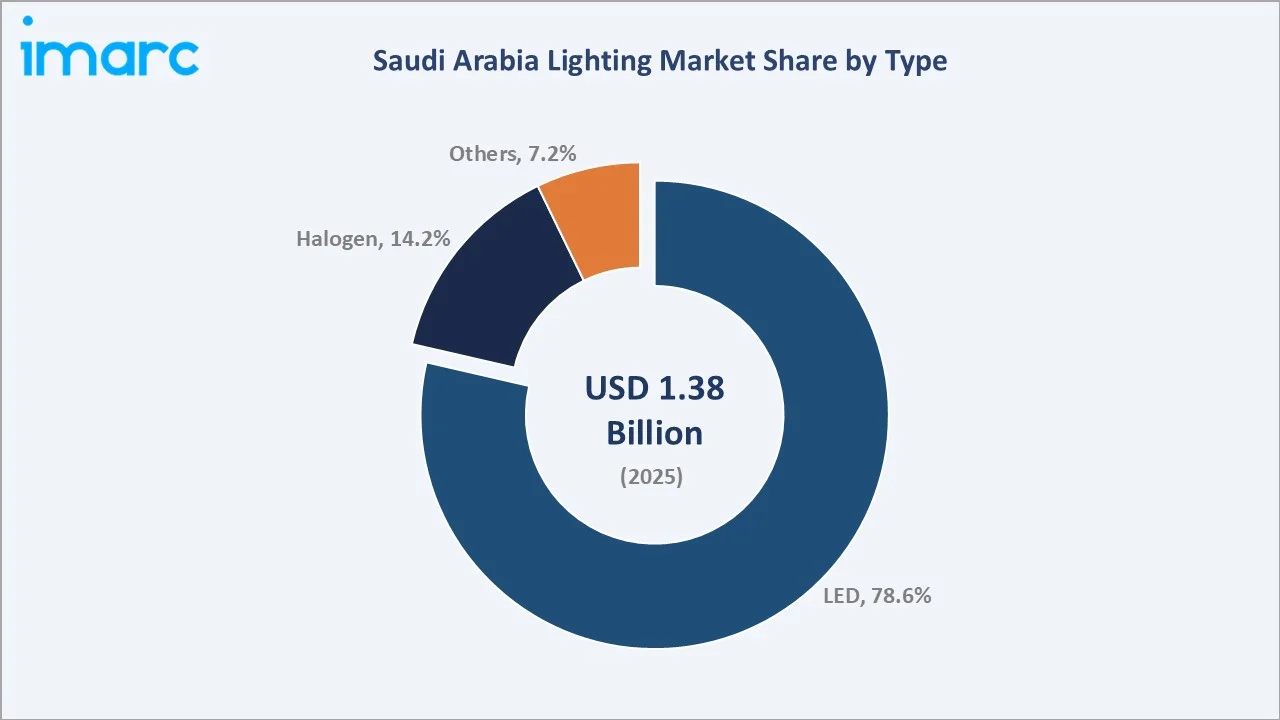
LED dominates the type segment at 78.6%, indoor prevails over the application segment with 68.4% share, and Northern and Central Region leads with a 39.3% regional share.
Market Snapshot
|
Metric |
Value |
|
Base Year Market Size (2025) |
USD 1.38 Billion |
|
Market Size (2026) |
USD 1.45 Billion |
|
Forecast Market Size (2034) |
USD 2.17 Billion |
|
CAGR (2026-2034) |
4.94% |
|
Base Year |
2025 |
|
Historical Period |
2020-2025 |
|
Forecast Period |
2026-2034 |
|
Largest Region |
Northern and Central Region (39.3%, 2025) |
|
Second Largest Region |
Western Region (29.0%, 2025) |
|
Leading Type |
LED (78.6%, 2025) |
|
Leading Application |
Indoor (68.4%, 2025) |
The Saudi Arabia lighting market size increased from USD 1.08 Billion in 2020 to USD 1.38 Billion in 2025 and is estimated to reach USD 1.45 Billion in 2026. The market is further expected to grow to USD 1.76 Billion by 2030 and USD 2.17 Billion by 2034. The market is uniquely positioned among Middle Eastern markets, anchored by one of the region's large construction pipelines, an aggressive government-led energy efficiency transition, and a rapidly expanding smart city infrastructure program under Vision 2030.
To get more information on this market, Request Sample
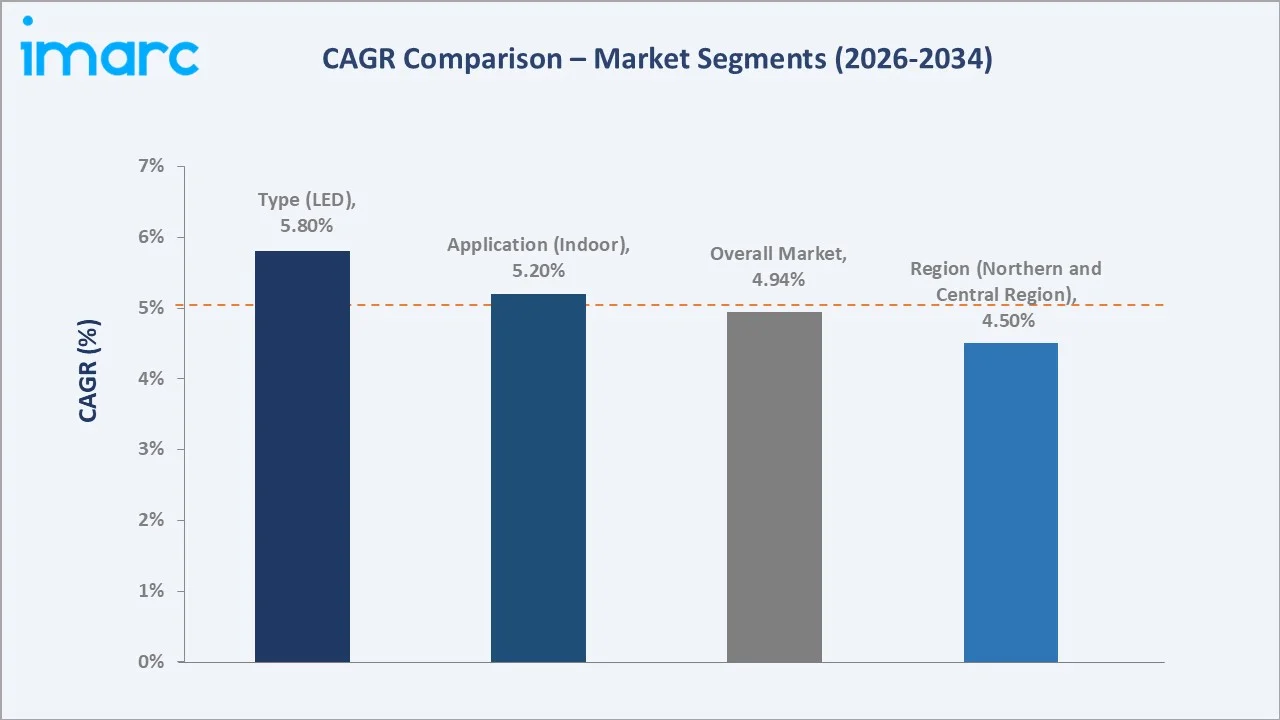
CAGR trajectories across type and application sub-segments, together with regional patterns, show LED and indoor expanding faster than the overall 4.94% market CAGR, driven by accelerating energy efficiency mandates, strong new construction demand, and growing adoption of smart lighting solutions across commercial and infrastructure projects.
Executive Summary
The Saudi Arabia lighting market expanded from USD 1.38 Billion in 2025 to an estimated USD 1.45 Billion in 2026, positioning it among the most dynamic lighting markets. Ongoing construction of mega-projects, smart cities, and mixed-use developments under Vision 2030 continues to generate consistent demand for both indoor and outdoor lighting solutions.
LED dominates the type segment at 78.6% in 2025, reflecting the technology's superior energy efficiency and declining cost base. Indoor commands 68.4% of the application segment, driven by commercial buildings, hospitality properties, and residential construction. Northern and Central Region leads with 39.3% of regional share, anchored by Riyadh's infrastructure concentration and ongoing Qiddiya and NEOM-adjacent developments.
Key Market Insights
|
Insight |
Data |
|
Leading Type |
LED - 78.6% share (2025) |
|
Second Largest Type |
Halogen - 14.2% share (2025) |
|
Leading Application |
Indoor - 68.4% share (2025) |
|
Second Largest Application |
Outdoor - 31.6% share (2025) |
|
Leading Region |
Northern and Central Region - 39.3% share (2025) |
|
Second Largest Region |
Western Region - 29.0% share (2025) |
|
Top Companies |
Signify N.V., MLS Co., Ltd., Schréder SA, Panasonic Holdings Corporation |
Key Analytical Observations Expanding On the Data Above:
- LED dominance at 78.6% reflects the combination of Saudi Arabia's mandatory energy efficiency standards and the significant total cost-of-ownership advantage LED technology offers over conventional alternatives in the Kingdom's high-ambient-temperature environment.
- Halogen at 14.2% represents a declining share as replacement cycles in residential and hospitality segments accelerate, supported by government programs for LED retrofitting and rising consumer awareness of energy cost savings.
- Indoor at 68.4% is driven by booming commercial real estate, hospitality construction, healthcare facility expansion, and a large base of residential projects across major metropolitan areas including Riyadh, Jeddah, and Dammam.
- Outdoor at 31.6% is expanding rapidly as municipalities invest in street lighting upgrades, infrastructure corridor illumination, and landmark lighting for tourism and entertainment destinations including AlUla, Diriyah, and Red Sea Project sites.
- Northern and Central Region at 39.3% leads regional share due to Riyadh's position as the administrative and commercial capital, hosting a large concentration of government, commercial, and mixed-use construction projects in the Kingdom.
Saudi Arabia Lighting Market Overview
The Saudi Arabia lighting market encompasses the design, manufacture, distribution, and sale of all categories of artificial lighting products, including LED, halogen, and other sources, across indoor and outdoor applications. The market serves a broad ecosystem of end users spanning residential, commercial, industrial, infrastructure, and public sectors.
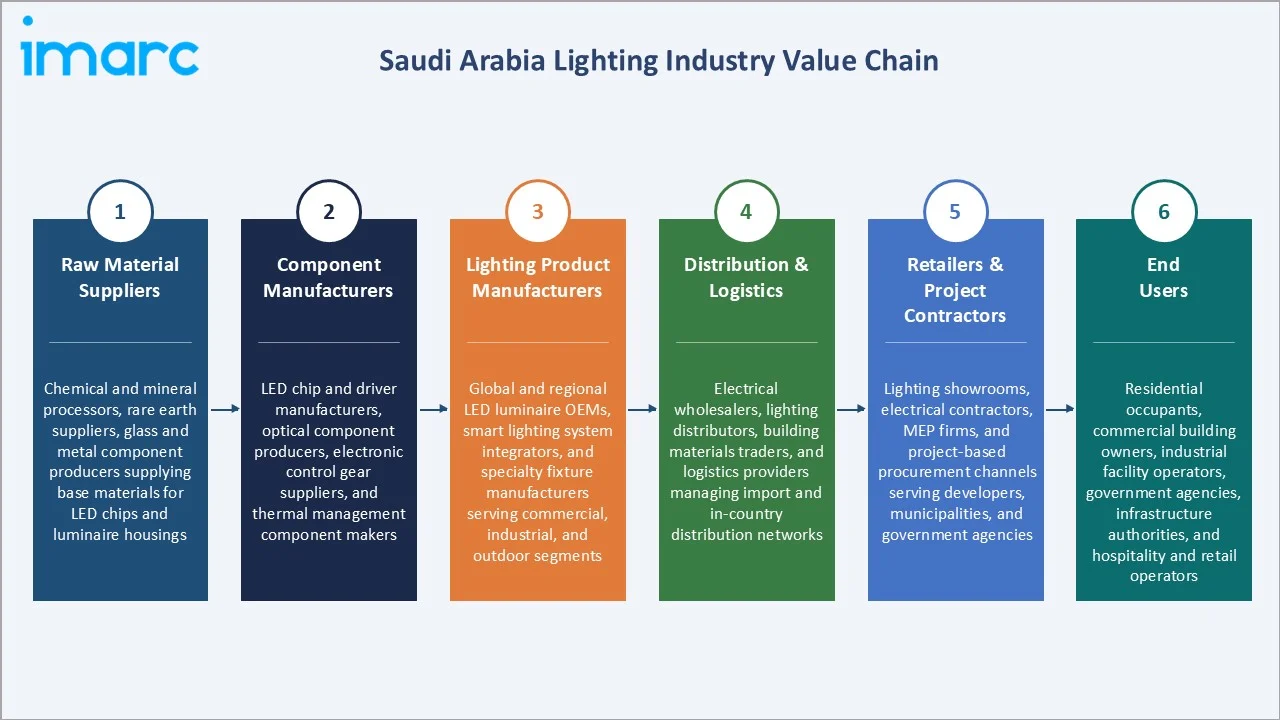
The Saudi lighting ecosystem integrates raw material suppliers, semiconductor and component manufacturers, lighting product OEMs, distribution and project channels, and a diverse base of end-use customers supported by energy efficiency regulatory frameworks administered by the Saudi Energy Efficiency Center and the Saudi Standards, Metrology, and Quality Organization (SASO). Together, these elements support a growing demand base anchored by large-scale infrastructure development, rising urbanization, and shifting preference toward smart, connected lighting solutions.
Market Dynamics
To evaluate market opportunities, Request Sample
Market Drivers
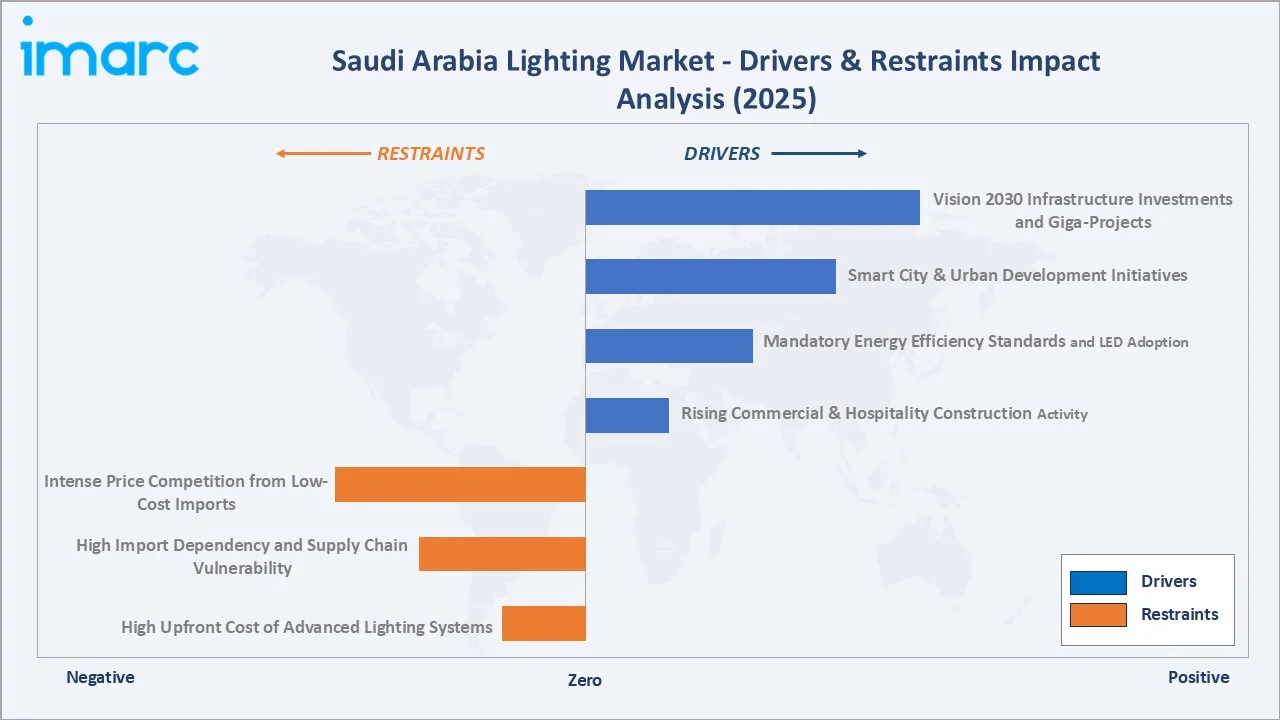
- Vision 2030 Infrastructure Investments and Giga-Projects: Saudi Arabia's Vision 2030 agenda is driving unprecedented infrastructure spending, including NEOM, the Red Sea Project, Diriyah Gate, and Qiddiya, all of which require extensive lighting infrastructure across commercial, hospitality, transport, and public spaces. These mega-projects are creating sustained, large-volume demand for both conventional and smart lighting systems through 2034.
- Mandatory Energy Efficiency Standards and LED Adoption: Saudi Arabia's energy efficiency regulations and lighting standards are encouraging the replacement of conventional lighting with energy-efficient LED systems across residential, commercial, and public applications. Growing awareness of lower electricity consumption, longer service life, and reduced maintenance requirements is accelerating LED penetration and increasing demand for compliant, high-efficiency lighting products.
- Smart City and Urban Development Initiatives: Riyadh's smart city master plan and similar initiatives in Jeddah, Dammam, and NEOM are incorporating intelligent street lighting, adaptive outdoor illumination, and connected building lighting systems into their core infrastructure. As per IMARC Group, the Saudi Arabia smart cities market size reached USD 14,424.9 Million in 2025. The programs are stimulating demand for advanced LED-based smart lighting products and integrated control systems.
- Rising Commercial and Hospitality Construction Activity: Sustained expansion of retail malls, hotels, entertainment facilities, and mixed-use developments across Saudi Arabia is generating consistent demand for high-performance indoor and decorative lighting solutions, particularly in the premium and luxury segment, where specification-grade products command higher unit values.
Market Restraints
- High Import Dependency and Supply Chain Vulnerability: The Saudi Arabia lighting market relies heavily on imported components, particularly LED chips, drivers, and luminaire assemblies sourced predominantly from China and Southeast Asia. This dependency creates exposure to supply disruptions, currency fluctuation impacts on landed costs, and limited domestic manufacturing resilience.
- High Upfront Cost of Advanced Lighting Systems: The capital cost of smart and connected lighting systems, including sensors, controllers, and network infrastructure, remains a significant barrier to adoption, particularly for mid-market commercial developers and municipal authorities with constrained capital budgets.
- Intense Price Competition from Low-Cost Imports: A significant volume of low-cost, substandard lighting products enters the Saudi market through informal trade channels, creating pricing pressure on quality manufacturers and undermining end-user confidence in LED performance and longevity claims.
Market Opportunities
- Solar-Integrated and Off-Grid Lighting Solutions: Saudi Arabia's solar irradiance advantage creates significant opportunity for solar-integrated outdoor lighting systems in remote infrastructure projects, desert tourism sites, and utility-scale public lighting installations where grid extension is cost-prohibitive.
- Retrofit Upgrades in Existing Commercial and Industrial Facilities: A large installed base of fluorescent and metal halide lighting in commercial buildings, warehouses, and industrial facilities represents a substantial retrofit opportunity, supported by favorable payback periods driven by high electricity tariffs for commercial users.
- Lighting-as-a-Service Business Models: Growing interest from facility managers and municipalities in outcome-based procurement is creating demand for managed lighting service contracts, offering suppliers a recurring revenue model while reducing upfront capital burden for end users.
Market Challenges
- Skilled Workforce and Technical Expertise Gap: Advanced smart lighting systems require specialized design, installation, and commissioning expertise that is in limited supply domestically, slowing adoption in technically demanding applications such as controls integration, IoT-enabled lighting, and human-centric lighting design.
- Counterfeit and Non-Compliant Product Infiltration: Enforcement of SASO quality and energy efficiency standards remains uneven, allowing substandard imported products to undercut compliant manufacturers on price and creating reliability and safety risks for end users.
Emerging Market Trends
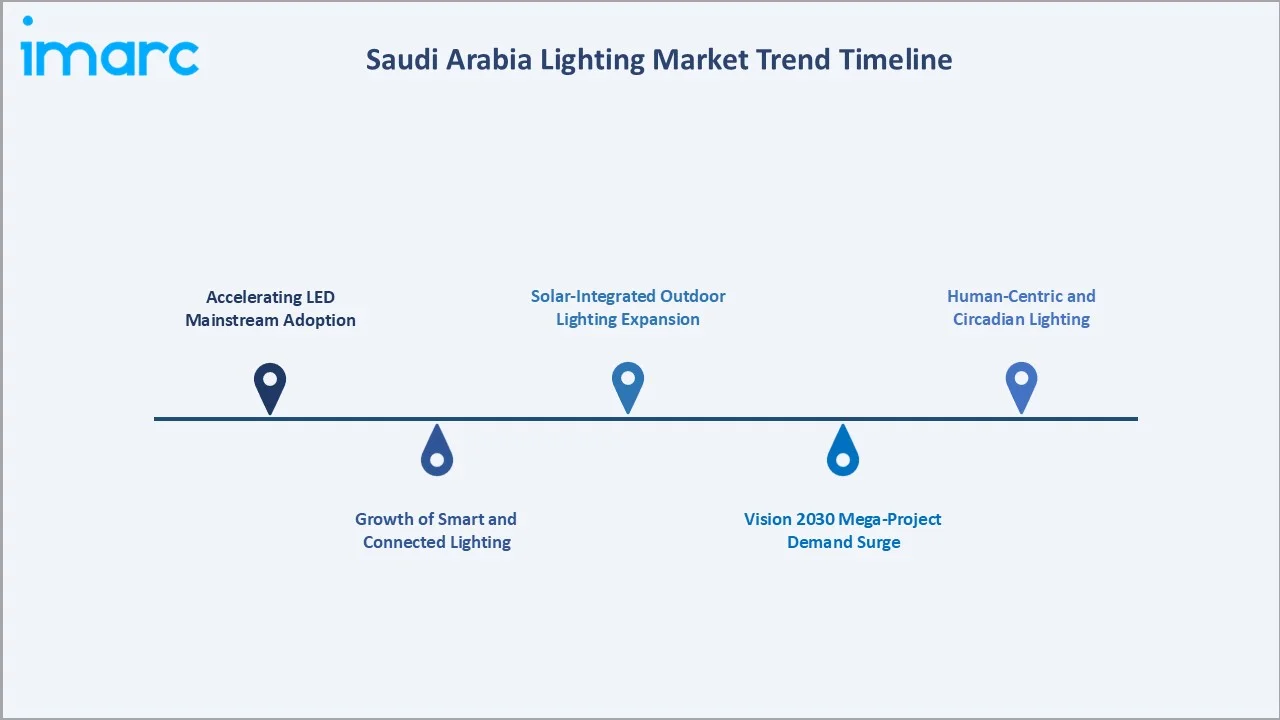
1. Accelerating LED Mainstream Adoption
LED penetration has moved from early-adopter to mainstream status across all market segments, displacing legacy halogen and fluorescent technologies at an accelerating pace. The combination of mandatory product standards, improving product quality, and declining fixture costs has made LED the default choice for new construction and retrofit applications across Saudi Arabia.
2. Growth of Smart and Connected Lighting
Demand for connected lighting systems incorporating wireless control, occupancy sensing, daylight harvesting, and IoT integration is rising across commercial office, retail, and hospitality applications. Saudi Arabia's smart city programs, including those in Riyadh and NEOM, are embedding intelligent lighting infrastructure into their core urban management frameworks.
3. Vision 2030 Mega-Project Demand Surge
Giga-projects including NEOM, the Red Sea Project, Diriyah Gate, and Qiddiya are generating demand for specification-grade, premium, and architecturally integrated lighting solutions across hospitality, entertainment, retail, and transport applications. These projects are also attracting global lighting brands and specialists to establish stronger commercial presence in Saudi Arabia.
4. Solar-Integrated Outdoor Lighting Expansion
Solar-powered street lighting and outdoor area lighting is gaining adoption in highway infrastructure, remote tourism sites, and border zone developments where grid-connected installation costs are prohibitive. Saudi Arabia's high solar irradiance profile makes solar-LED integration highly cost-effective, supporting growing procurement by municipalities and infrastructure agencies.
5. Human-Centric and Circadian Lighting
Interest in tunable-white and human-centric lighting solutions is growing in healthcare, education, and corporate office applications, driven by increasing awareness of the impact of light quality on occupant productivity, wellbeing, and recovery outcomes. This trend is expected to gain momentum in Saudi Arabia's expanding healthcare and premium workplace segments through 2034.
Industry Value Chain Analysis
The Saudi Arabia lighting value chain spans six stages, from raw material sourcing and component manufacturing through product assembly, distribution, project delivery, and end-user engagement. Lighting product manufacturers and distribution and project contractor stages capture the highest value-add, while raw material and component stages are predominantly served by international suppliers.
|
Stage |
Key Players / Examples |
|
Raw Material Suppliers |
Chemical and mineral processors, rare earth suppliers, glass and metal component producers supplying base materials for LED chips and luminaire housings |
|
Component Manufacturers |
LED chip and driver manufacturers, optical component producers, electronic control gear suppliers, and thermal management component makers |
|
Lighting Product Manufacturers |
Global and regional LED luminaire OEMs, smart lighting system integrators, and specialty fixture manufacturers serving commercial, industrial, and outdoor segments |
|
Distribution & Logistics |
Electrical wholesalers, lighting distributors, building materials traders, and logistics providers managing import and in-country distribution networks |
|
Retailers & Project Contractors |
Lighting showrooms, electrical contractors, MEP firms, and project-based procurement channels serving developers, municipalities, and government agencies |
|
End Users |
Residential occupants, commercial building owners, industrial facility operators, government agencies, infrastructure authorities, and hospitality and retail operators |
Manufacturers maintaining direct relationships with major project developers and specification consultants, alongside distributors with strong project channel presence, are positioned to capture disproportionate value within the Saudi Arabia lighting supply chain.
Technology Landscape in the Saudi Arabia Lighting Industry
LED and Solid-State Lighting Advancements
Continued improvements in LED efficacy, color rendering, and thermal management are expanding the technology's addressable applications in Saudi Arabia, including demanding outdoor, industrial, and high-bay environments. Higher efficacy LED packages are reducing energy consumption and heat load in a climate where cooling costs significantly amplify the total operating cost of lighting systems.
Smart Lighting Controls and IoT Integration
Wireless dimming and control systems, occupancy and daylight sensors, and IoT-enabled lighting management platforms are being integrated into commercial and infrastructure projects at an increasing rate. Saudi Arabia's giga-projects are embedding these technologies into their building management system frameworks, creating a model for broader adoption across the commercial real estate sector.
Li-Fi and Visible Light Communication
Emerging visible light communication technologies, which use LED infrastructure to transmit data, are being evaluated for secure indoor communication in government, defense, and smart building applications. While still nascent in Saudi Arabia, growing awareness of Li-Fi's potential is driving early pilot projects in premium commercial settings.
Solar and Renewable Energy Integration
Advances in solar panel efficiency and battery storage are enabling reliable off-grid solar-LED lighting systems suitable for Saudi Arabia's outdoor infrastructure requirements. Declining solar component costs and improving system reliability are supporting broader adoption in highway, airport perimeter, and remote site lighting applications across the Kingdom.
Market Segmentation Analysis
The report covers the following segments:
|
Segment Category |
Leading Segment |
Market Share |
Year |
|
Type |
LED |
78.6% |
2025 |
|
Application |
Indoor |
68.4% |
2025 |
|
End User |
🔒 |
🔒 |
2025 |
|
Region |
Northern and Central Region |
39.3% |
2025 |

By Type
LED commands a 78.6% majority share in the Saudi Arabia lighting market, driven by mandatory energy efficiency standards, declining product costs, and strong demand from commercial construction and infrastructure projects.
To access detailed market analysis, Request Sample
Halogen at 14.2% retains relevance in decorative, accent, and specialty applications where its warm light quality and precise beam control are valued, particularly in high-end residential, hospitality, and retail environments.
By Application
Indoor leads with a 68.4% share in 2025, supported by the dominance of commercial office, retail, hospitality, and residential construction in Saudi Arabia's overall building activity. Rising commercial tenant expectations for lighting quality and energy performance are driving specification of higher-efficacy LED systems in new builds and retrofits.
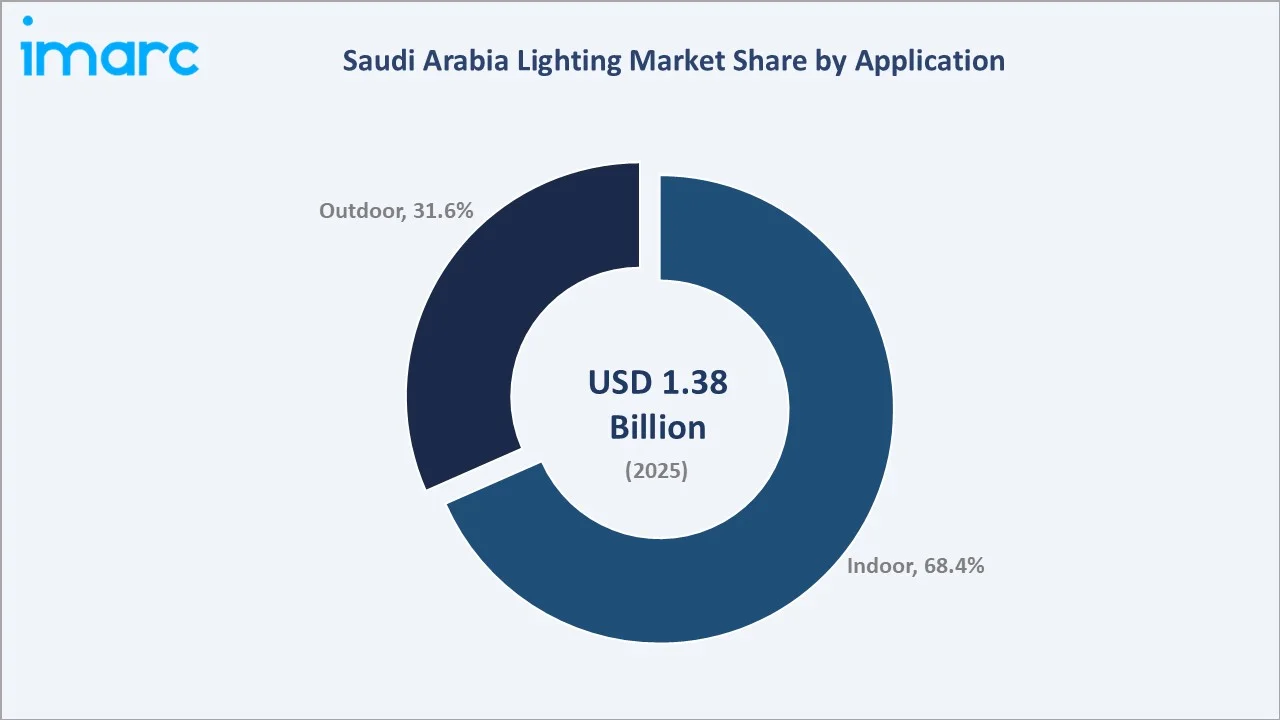
Outdoor at 31.6% is growing in strategic importance as Vision 2030 tourism, entertainment, and infrastructure projects require extensive external illumination for streets, facades, landscapes, and public spaces. Municipal programs upgrading conventional street lighting to LED are also generating significant outdoor procurement volumes across major and secondary cities.
Regional Market Insights
|
Region |
Share (2025) |
Key Growth Drivers |
|
Northern and Central Region |
39.3% |
Large concentration of government and commercial construction, Riyadh smart city investments, major infrastructure projects, and high urbanization rate |
|
Western Region |
29.0% |
Jeddah commercial and retail expansion, Islamic tourism infrastructure around Makkah and Madinah, Red Sea Project hospitality developments, and growing industrial base |
|
Eastern Region |
20.1% |
Industrial and oil and gas facility lighting demand, expanding petrochemical complex, growing commercial real estate in Dammam and Al Khobar, and Ras Al Khair industrial city development |
|
Southern Region |
11.6% |
Emerging residential and municipal infrastructure growth, expanding tourism along the Aseer highlands corridor, and increasing government investment in regional city development |
Northern and Central Region at 39.3% in 2025 leads the Saudi Arabia lighting market, anchored by Riyadh's status as the Kingdom's administrative, commercial, and financial hub. The region concentrates a disproportionate share of mega-project activity, including Diriyah Gate and Qiddiya, alongside ongoing commercial and residential construction driven by the capital's rapidly expanding population.
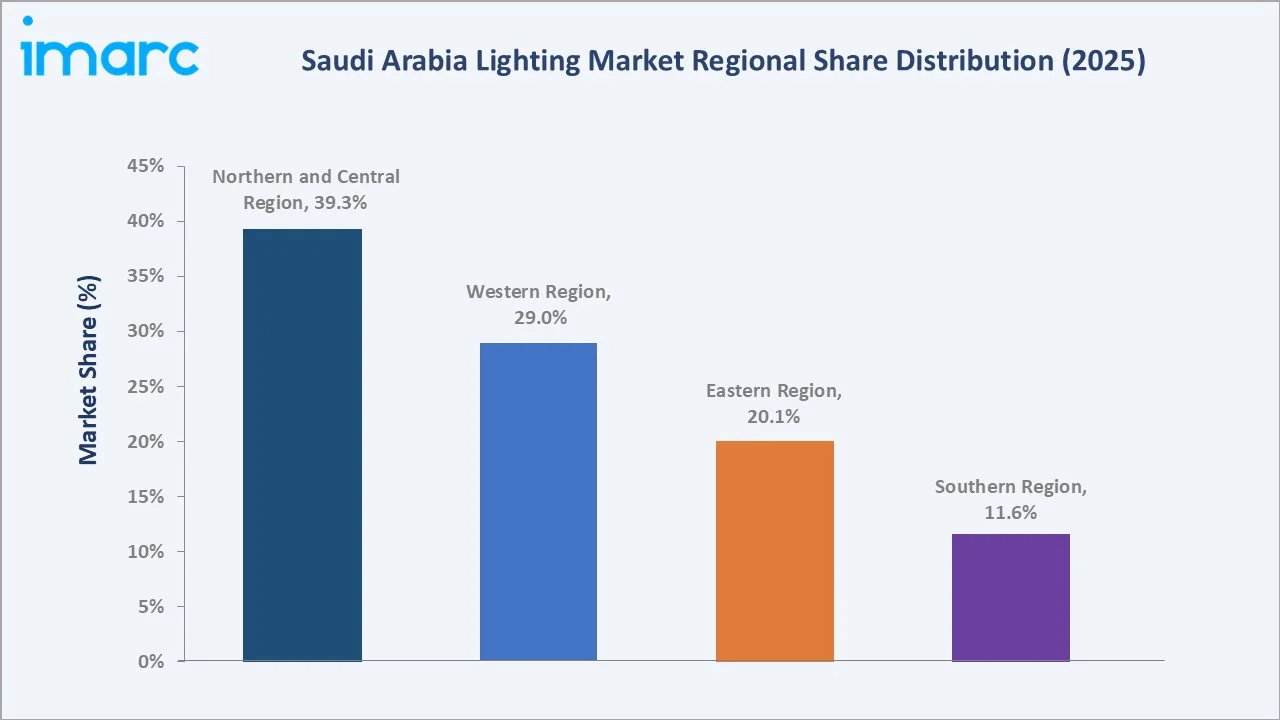
Southern Region, while currently the smallest regional contributor at 11.6%, is expected to grow faster than the market average through 2034 as government investment in Aseer Region development, tourism infrastructure, and secondary city expansion accelerates, supported by improving road connectivity and growing domestic tourism to the Kingdom's highland and natural areas.
Competitive Landscape
The Saudi Arabia lighting market is moderately competitive, with established global manufacturers dominating the premium and specification-grade segments while regional distributors and traders play a significant role in the mid-market and commodity segments. Technology leadership, regulatory compliance certification, project channel relationships, and local distribution depth are the primary competitive differentiators.
|
Company Name |
Brand / Key Product |
Position |
Strategic Focus |
|
Signify N.V. |
Philips |
Leader |
Expanding connected LED and smart city lighting portfolio through local manufacturing and distribution in Saudi Arabia and the broader Middle East |
|
MLS Co., Ltd. |
LEDVANCE |
Leader |
Growing general LED lighting product range across professional and consumer segments |
|
Schréder SA |
Schréder / Bahra-Schréder |
Leader |
Deepening smart outdoor and public lighting capabilities through local manufacturing joint venture, expanding across infrastructure and smart city segments in Saudi Arabia |
|
Panasonic Holdings Corporation |
Panasonic Lighting |
Challenger |
Strengthening LED and smart lighting offerings through direct market presence |
Key players include Signify N.V., MLS Co., Ltd., Schréder SA, and Panasonic Holdings Corporation, among others.
Key Company Profiles
Signify N.V.
Signify N.V., headquartered in Eindhoven, the Netherlands, is the world's leading lighting company operating in several countries. In Saudi Arabia, the company offers a broad portfolio of connected, energy-efficient, and professional lighting solutions serving commercial, industrial, infrastructure, and residential applications.
- Product Portfolio: Broad LED product range spanning indoor luminaires, outdoor and street lighting, connected lighting systems, the Interact IoT platform, and smart home and building solutions, marketed under the Philips brand.
- Recent Developments: The firm has continued to strengthen its product portfolio and regional operations, reinforcing its position as a leading lighting provider across Middle Eastern markets including Saudi Arabia.
- Strategic Focus: Broadening its connected lighting and smart city solutions through locally rooted manufacturing operations and distribution channels across Saudi Arabia and the wider Middle East.
MLS Co., Ltd.
MLS Co., Ltd. is a leading Chinese LED lighting company headquartered in Guangdong, China. The firm operates in several countries and markets lighting products under the LEDVANCE brand name, serving the Kingdom and broader Middle East region.
- Product Portfolio: LED lamps, LED luminaires, traditional lamps, intelligent lighting products for smart homes and smart buildings, and outdoor lighting solutions.
- Recent Developments: MLS Co., Ltd. has continued to strengthen its regional lighting footprint through LEDVANCE, expanding product offerings and distribution capabilities across key international markets including the Middle East.
- Strategic Focus: Strengthening its general LED lighting offering across both professional and consumer end use segments through product range expansion and global distribution scale.
Schréder SA
Schréder SA is a Belgian private multinational specializing in smart outdoor and public lighting solutions, headquartered in Brussels, Belgium. In Saudi Arabia, the company provides intelligent outdoor lighting solutions for roads, public spaces, urban areas, and infrastructure projects.
- Product Portfolio: Smart outdoor luminaires, street lighting systems, tunnel lighting, sports facility lighting, solar-integrated lighting columns, architectural and decorative lighting, and IoT-connected smart city lighting control platforms.
- Recent Developments: Schréder SA has continued to advance its smart outdoor lighting capabilities and expand its geographic presence, deepening partnerships with local entities to strengthen its position in key markets including Saudi Arabia.
- Strategic Focus: Advancing smart outdoor and public lighting capabilities by leveraging a locally established manufacturing joint venture to drive growth across infrastructure and smart city segments in Saudi Arabia.
Market Concentration Analysis
The Saudi Arabia lighting market is moderately fragmented, with global lighting leaders collectively accounting for a significant share of the premium and specification-grade product segments while a large number of regional distributors, traders, and second-tier brands compete across the mid-market and value segments.
Barriers to entry in the premium segment include SASO regulatory certification requirements, the need for established project channel relationships, and the technical capability to support specification and commissioning of complex smart lighting systems. These factors favor established global players with proven product compliance credentials and local commercial infrastructure.
The market is experiencing gradual consolidation at the upper end as global manufacturers invest in expanding their Saudi Arabia commercial presence in anticipation of Vision 2030 project-driven demand, while the commodity segment remains highly fragmented with persistent entry from low-cost import sources. Strategic partnerships between global brands and local distributors are increasingly common as a market entry mechanism for international suppliers.
Investment & Growth Opportunities
Fastest-Growing Segments
LED is the fastest-growing type category, supported by accelerating replacement cycles in legacy commercial and industrial facilities and sustained demand from new construction. Growing adoption of energy-efficient lighting solutions and smart controls is further accelerating LED penetration across commercial, residential, and outdoor applications.
Emerging Markets
Southern Region, while currently the smallest regional contributor, represents the highest forward growth opportunity as government investment in Aseer Region, domestic tourism infrastructure, and secondary city development accelerates.
Venture & Investment Trends
Investment activity is concentrated in smart lighting infrastructure for Vision 2030 giga-projects, solar-integrated outdoor lighting systems, and retrofit service businesses targeting the large commercial and industrial installed base. Growing interest in lighting-as-a-service financing models is also attracting structured investment from facilities management and energy services companies operating in the Kingdom.
Future Market Outlook (2026-2034)
The Saudi Arabia lighting market is projected to grow from USD 1.38 Billion in 2025 to USD 1.45 Billion in 2026, reaching USD 2.17 Billion by 2034, registering a CAGR of 4.94% during 2026-2034.
Four forces will shape the Saudi Arabia lighting market through 2034: continued LED technology advancement and cost reduction; deepening integration of smart controls and IoT platforms into commercial and infrastructure projects; expansion of solar-integrated and off-grid lighting into remote and tourism sites; and growing adoption of human-centric lighting in healthcare, education, and premium commercial facilities.
By 2034, the Saudi Arabia lighting market is expected to be defined by predominantly LED-based illumination across all segments, with smart connected systems representing a growing share of installed value. The successful execution of Vision 2030 infrastructure and tourism projects will remain the primary demand driver, while domestic manufacturing investment may gradually reduce the market's current import dependency through the latter half of the forecast period.
Research Methodology
Primary Research
Primary research included structured discussions with lighting product distributors, project contractors, commercial building developers, facility managers, and regulatory specialists operating in Saudi Arabia, validating market sizing estimates, segment demand patterns, and regional growth dynamics.
Secondary Research
Secondary sources included Saudi Energy Efficiency Center publications, SASO product standards and certification databases, Saudi Vision 2030 project documentation, Ministry of Energy energy audit reports, company annual reports, press releases, and investor presentations from major listed lighting manufacturers active in the Saudi market.
Forecasting Models
Market forecasts were developed using top-down and bottom-up models combining construction activity data, LED product adoption rates, energy efficiency program timelines, regional infrastructure investment projections, and macroeconomic variables. Scenario analysis addressed Vision 2030 execution pace, oil price sensitivity, and technology adoption rates across key segments.
Saudi Arabia Lighting Market Report Coverage:
| Report Features | Details |
|---|---|
| Base Year of the Analysis | 2025 |
| Historical Period | 2020-2025 |
| Forecast Period | 2026-2034 |
| Units | Billion USD |
| Scope of the Report |
Exploration of Historical Trends and Market Outlook, Industry Catalysts and Challenges, Segment-Wise Historical and Future Market Assessment:
|
| Types Covered | LED, Halogen, Others |
| Applications Covered | Indoor, Outdoor |
| End Users Covered | Residential, Commercial, Industrial, Others |
| Regions Covered | Northern and Central Region, Western Region, Eastern Region, Southern Region |
| Companies Covered | Signify N.V., MLS Co., Ltd., Schréder SA, Panasonic Holdings Corporation, etc. |
| Customization Scope | 10% Free Customization |
| Post-Sale Analyst Support | 10-12 Weeks |
| Delivery Format | PDF and Excel through Email (We can also provide the editable version of the report in PPT/Word format on special request) |
Key Benefits for Stakeholders:
- IMARC’s industry report offers a comprehensive quantitative analysis of various market segments, historical and current market trends, market forecasts, and dynamics of the Saudi Arabia lighting market from 2020-2034.
- The research report provides the latest information on the market drivers, challenges, and opportunities in the Saudi Arabia lighting market.
- Porter's five forces analysis assist stakeholders in assessing the impact of new entrants, competitive rivalry, supplier power, buyer power, and the threat of substitution. It helps stakeholders to analyze the level of competition within the Saudi Arabia lighting industry and its attractiveness.
- Competitive landscape allows stakeholders to understand their competitive environment and provides an insight into the current positions of key players in the market.
Frequently Asked Questions About the Saudi Arabia Lighting Market Report
The Saudi Arabia lighting market size is estimated at USD 1.45 Billion in 2026, driven by accelerating LED adoption, Vision 2030 infrastructure investment, and expanding commercial and hospitality construction activity across the Kingdom.
The market is projected to grow at a CAGR of 4.94% from 2026-2034, reaching USD 2.17 Billion, supported by continued mega-project execution, smart city lighting investment, and growing penetration of advanced LED and connected lighting systems.
LED dominates the type segment at 78.6% in 2025, driven by mandatory energy efficiency standards, declining product costs, and the technology's superior performance in Saudi Arabia's high-ambient-temperature environment.
Indoor leads the market at 68.4% in 2025, supported by high volumes of commercial office, retail, hospitality, and residential construction across Saudi Arabia's major metropolitan areas.
Northern and Central Region commands 39.3% share in 2025, led by Riyadh's concentration of government, commercial, and infrastructure development and its disproportionate share of Vision 2030 mega-project activity.
Leading players include Signify N.V., MLS Co., Ltd., Schréder SA, and Panasonic Holdings Corporation, among others.
Vision 2030 mega-projects including NEOM, the Red Sea Project, Diriyah Gate, and Qiddiya are generating demand for specification-grade LED, smart, and architecturally integrated lighting solutions, creating a sustained demand catalyst through 2034.
The major challenges include high initial costs of advanced lighting systems, intense price competition, regulatory compliance requirements, and the complexity of integrating smart lighting technologies with existing infrastructure.
Need more help?
- Speak to our experienced analysts for insights on the current market scenarios.
- Include additional segments and countries to customize the report as per your requirement.
- Gain an unparalleled competitive advantage in your domain by understanding how to utilize the report and positively impacting your operations and revenue.
- For further assistance, please connect with our analysts.
 Request Customization
 Speak to an Analyst
 Request Brochure
 Inquire Before Buying
Benefits of Customization
- Personalize this research
- Triangulate with your data
- Get data as per your format and definition
- Gain a deeper dive into a specific application, geography, customer, or competitor
- Any level of personalization
Get in Touch With Us
UNITED STATES
Phone: +1-201-971-6302
INDIA
Phone: +91-120-433-0800
UNITED KINGDOM
Phone: +44-753-714-6104
Email: [email protected]
Client Testimonials

.webp)

.webp)



Related Reports

Choose your plan
*Please note that the prices mentioned below are starting prices for each bundle type. Kindly contact our team for further details.*
Single User License
- 1 User License, Access on 2 Devices
- PDF Report + Excel Dataset (Password Protected)
- Lifetime Access
- No Printing Rights
- 10% Free Report Customization
- 10–12 Weeks of Analyst Support
Five User License
- Access for 5 Users, 2 Devices per User
- PDF Report + Excel Dataset (Password Protected)
- Lifetime Access
- Dedicated Account Manager
- 12–14 Weeks of Analyst Support
- No Printing Rights
- 15% Free Report Customization
- 25% Discount on Your Next Purchase
Corporate User License
- Unlimited User Access (Within Your Organization)
- PDF Report + Excel Dataset
- Lifetime Access
- Dedicated Account Manager
- 14–20 Weeks of Analyst Support
- No Printing Rights
- 20% Free Report Customization
- 30% Discount on Your Next Purchase
Essential Insights
What's included:
3 reports
- Lifetime Access
- PDF Reports
- Excel Datasets
- 2 Weeks of Free Analyst Support
- 2 User Licenses
- Access on 2 Devices
- Printing Rights
- Complimentary PowerPoint (PPT) Version
- Complimentary License Upgrade
Professional Access
What's included:
5 reports
- Lifetime Access
- PDF Reports
- Excel Datasets
- 8 Weeks of Free Analyst Support
- 2 User Licenses
- Access on 2 Devices
- Printing Rights
- Complimentary PowerPoint (PPT) Version
- Complimentary License Upgrade
Business Advantage
What's included:
8 reports
- Lifetime Access
- PDF Reports
- Excel Datasets
- 14 Weeks of Free Analyst Support
- 2 User Licenses
- Access on 2 Devices
- Printing Rights
- Complimentary PowerPoint (PPT) Version
- Complimentary License Upgrade
Enterprise Intelligence
What's included:
10 reports
- Lifetime Access
- PDF Reports
- Excel Datasets
- 20 Weeks of Free Analyst Support
- 2 User Licenses
- Access on 2 Devices
- Printing Rights
- Complimentary PowerPoint (PPT) Version
- Complimentary License Upgrade