
Saudi Arabia Logistics Automation Market Size, Share, Trends and Forecast by Component, Enterprise Size, Industry Vertical, and Region, 2026-2034
Saudi Arabia Logistics Automation Market Size, Share, Trends & Forecast (2026-2034)
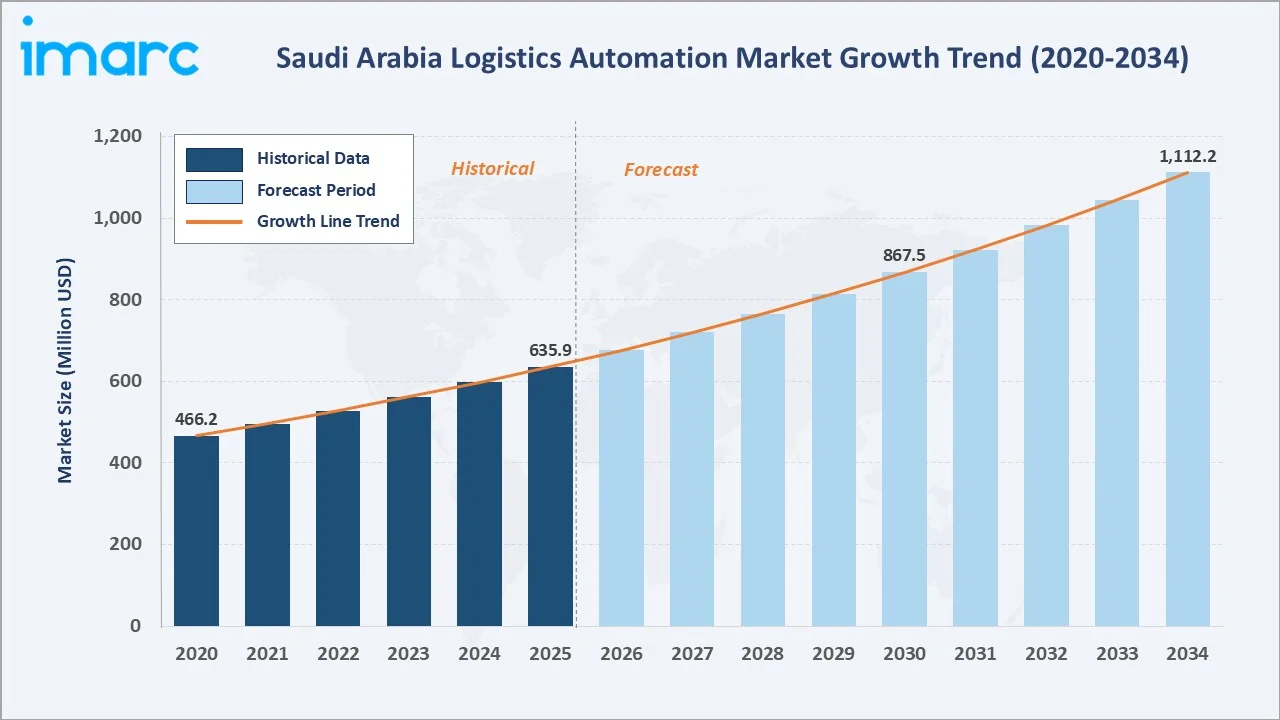
The Saudi Arabia logistics automation market reached USD 635.9 Million in 2025 and is projected to reach USD 1,112.2 Million by 2034, growing at a CAGR of 6.41% during 2026-2034. The market is driven by Vision 2030 National Logistics Strategy, expanding e-commerce and retail sectors, rising demand for operational efficiency, and increasing adoption of warehouse management and AI-driven automation technologies. Warehouse and Storage Management leads the function segment at 66.8%, Large Enterprises dominate at 70.6%, and the Northern and Central Region commands 43.1% of regional share.
Market Snapshot
|
Metric |
Value |
|
Market Size (2025) |
USD 635.9 Million |
|
Forecast Market Size (2034) |
USD 1,112.2 Million |
|
CAGR (2026-2034) |
6.41% |
|
Base Year |
2025 |
|
Historical Period |
2020-2025 |
|
Forecast Period |
2026-2034 |
|
Dominant Function |
Warehouse and Storage Management (66.8%, 2025) |
|
Dominant Enterprise Size |
Large Enterprises (70.6%, 2025) |
|
Leading Region |
Northern and Central Region (43.1%, 2025) |
The market expanded from USD 466.2 Million in 2020 to USD 635.9 Million in 2025, anchored at USD 867.5 Million in 2030 and forecast to reach USD 1,112.2 Million by 2034. E-commerce acceleration and Vision 2030 logistics mandates sustained strong demand trajectories, with recovery and acceleration through 2022-2025 as large enterprises rapidly scaled automation deployments.
To get more information on this market, Request Sample
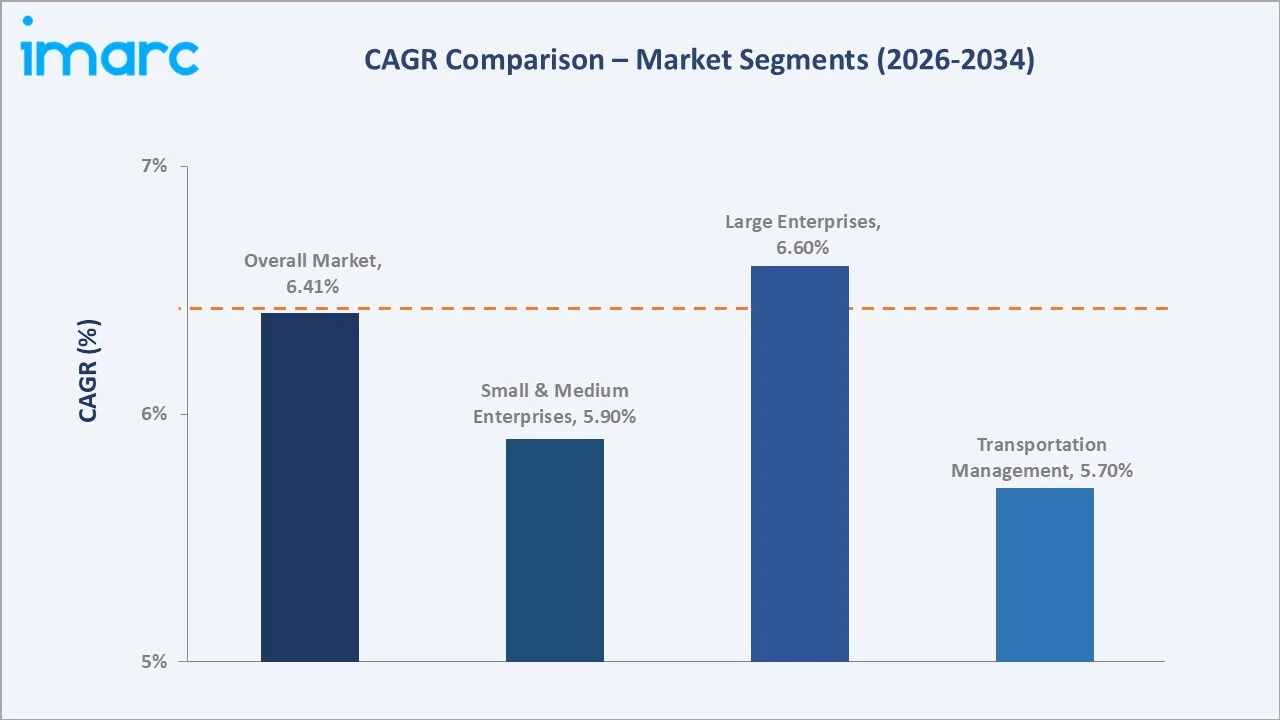
Warehouse and storage management grows at approximately 6.8% CAGR as automated fulfillment centers, robotic picking, and WMS adoption expand across major logistics hubs. Large enterprise deployments drive above-market growth at ~6.6% CAGR as digital supply chain transformation accelerates across manufacturing, FMCG, and healthcare sectors.
Executive Summary
The Saudi Arabia logistics automation market reached USD 635.9 Million in 2025, representing one of the Middle East's fastest-growing technology adoption markets driven by Vision 2030 economic transformation and the fundamental digitization of supply chain and logistics operations across the Kingdom. The market is projected to reach USD 1,112.2 Million by 2034.
Warehouse and Storage Management at 66.8% dominates by capturing the highest-volume automation procurement category across fulfillment, distribution, and storage operations. Large Enterprises at 70.6% lead through scale-driven automation investments in manufacturing, FMCG, and retail supply chains. The Northern and Central Region at 43.1% commands the highest share through Riyadh-concentrated logistics infrastructure investment.
Key Market Insights
|
Insight |
Data |
|
Dominant Function |
Warehouse and Storage Management – 66.8% share (2025) |
|
Dominant Enterprise Size |
Large Enterprises – 70.6% market share (2025) |
|
Leading Region |
Northern and Central Region – 43.1% market share (2025) |
|
Market Opportunity |
AI-powered WMS; autonomous mobile robots; last-mile delivery automation; cold chain automation for healthcare |
Key Analytical Observations Supporting the Above Data:
- Warehouse and Storage Management at 66.8%: The segment dominates as automated warehousing underpins all major logistics operations across manufacturing, FMCG, and retail sectors in Saudi Arabia. Robotic picking systems, AS/RS, and WMS deployments are accelerating across Riyadh and Jeddah industrial corridors driven by e-commerce order fulfillment volume growth.
- Large Enterprises at 70.6%: Large enterprises lead adoption through scale-driven capital investment capacity, complex multi-site supply chain requirements, and stronger ROI realization from automation deployments. Manufacturing, healthcare, and oil and gas sector enterprises are the primary procurement drivers for advanced logistics automation systems across the Kingdom.
- Northern and Central Region at 43.1%: The Northern and Central Region dominates through Riyadh's concentration of national distribution centers, government logistics mandates, and the highest-density manufacturing and retail infrastructure in the Kingdom. The region's role as the primary hub for Vision 2030 government project execution and corporate headquarters concentration further anchors the highest logistics automation investment demand in the country.
Saudi Arabia Logistics Automation Market Overview
The Saudi Arabia logistics automation market encompasses the design, supply, integration, and operation of automated systems for warehousing, storage, and transportation management across all industrial verticals. Core technology categories include hardware (mobile robots, AS/RS, conveyor systems), software (WMS, WES), and services (integration, maintenance).
The ecosystem integrates hardware manufacturers, software developers, systems integrators, logistics operators, and government regulatory entities. Macroeconomic drivers include Vision 2030 National Transport and Logistics Strategy, e-commerce growth, labor cost pressures, and Saudization mandates driving automation investment across supply chains.
Market Dynamics
To evaluate market opportunities, Request Sample
Market Drivers
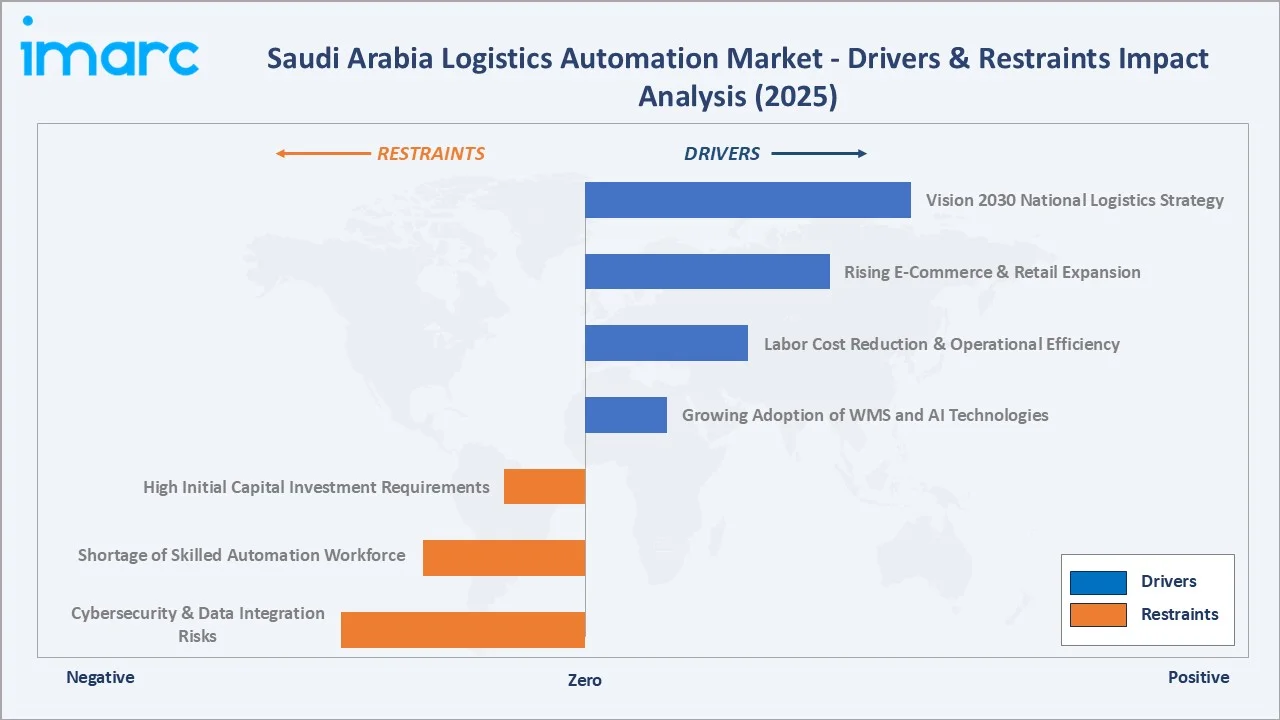
- Vision 2030 National Logistics Strategy: Saudi Arabia's Vision 2030 National Transport and Logistics Strategy targets the Kingdom becoming a global logistics hub, driving significant government and private investment in logistics automation infrastructure. The strategy encompasses smart port development, integrated supply chain digitization, and automation mandates across NEOM, King Abdullah Port, and King Khalid International Airport logistics zones. These initiatives are generating multi-year procurement cycles for warehouse automation, conveyor systems, and transportation management platforms.
- Rising E-Commerce & Retail Expansion: Rapid growth in Saudi Arabia's e-commerce sector, with online retail penetration accelerating post-2022, is generating unprecedented demand for automated fulfillment center infrastructure. Major retailers and marketplace platforms are investing in robotic picking, automated sorting, and last-mile delivery automation to meet faster delivery expectations from a digitally native consumer base. The Kingdom's young, tech-savvy population and high smartphone penetration are sustaining above-regional e-commerce growth rates that directly drive logistics automation procurement.
- Labor Cost Reduction & Operational Efficiency: Rising labor costs alongside Saudization requirements are compelling logistics operators to accelerate automation investments that reduce dependency on manual labor for sorting, picking, packing, and transportation management tasks. Automation delivers measurable ROI through reduced error rates, higher throughput volumes, and lower per-unit operational costs. The combination of government-mandated workforce localization and skill availability constraints is making automation economically compelling across all enterprise sizes.
- Growing Adoption of WMS and AI Technologies: Increasing adoption of AI-powered warehouse management systems, real-time freight tracking platforms, and autonomous mobile robots is transforming logistics operational models across Saudi Arabia. WMS deployments with integrated AI enable dynamic inventory positioning, predictive replenishment, and optimized pick-path routing that deliver 20-35% throughput improvements. Growing familiarity with automation ROI metrics is accelerating procurement decision cycles across manufacturing, healthcare, and FMCG sector enterprises.
Market Restraints
- High Initial Capital Investment Requirements: Logistics automation system deployment requires substantial upfront capital expenditure for hardware procurement, software licensing, facility modification, and system integration services. This creates adoption barriers particularly for SMEs and mid-market enterprises that cannot justify automation investments without guaranteed long-term volume commitments. High capital requirements also extend payback periods, reducing willingness to invest during periods of market uncertainty.
- Shortage of Skilled Automation Workforce: The Kingdom faces a significant shortage of technically skilled personnel capable of operating, maintaining, and optimizing advanced logistics automation systems. This skills gap extends across robotics technicians, WMS configuration specialists, and automation systems integrators. Dependency on expatriate technical expertise creates operational vulnerability and increases total cost of ownership for deployed automation systems.
- Cybersecurity & Data Integration Risks: Increasing connectivity of logistics automation systems to enterprise ERP, TMS, and cloud platforms creates expanded cybersecurity attack surfaces and data integration complexity. Incidents of system disruption in connected logistics environments can generate operational losses exceeding the cost of automation investments. Regulatory uncertainty around cross-border data flows and supply chain data sovereignty requirements add compliance complexity to multi-national logistics automation deployments.
Market Opportunities
- Cold Chain Automation for Healthcare and FMCG: Saudi Arabia's expanding pharmaceutical manufacturing sector and growing fresh food distribution requirements create significant demand for automated cold chain logistics solutions. Temperature-controlled AS/RS, automated pharmaceutical dispensing systems, and cold chain WMS represent high-value automation segments with above-market growth potential.
- SME Automation-as-a-Service Models: Emerging automation-as-a-service and robotics-as-a-service business models are creating new market entry pathways for SMEs previously excluded by high capital barriers. Subscription-based mobile robot deployments and cloud WMS platforms are expanding the addressable automation market to smaller logistics operators across the Kingdom.
Market Challenges
- Legacy System Integration Complexity: Saudi Arabia's large installed base of legacy ERP and warehouse management systems creates significant integration complexity for new automation deployments. Compatibility gaps between legacy infrastructure and modern robotics platforms generate extended implementation timelines and cost overruns that reduce automation project ROI and deter adoption.
- Regulatory Compliance Across Multiple Industry Verticals: Logistics automation deployments across healthcare, food, and oil and gas sectors require compliance with sector-specific regulatory frameworks from SFDA, ZATCA, and the Saudi Standards Authority. Navigating overlapping compliance requirements increases implementation complexity and extends project approval timelines for automation system deployments.
Emerging Market Trends
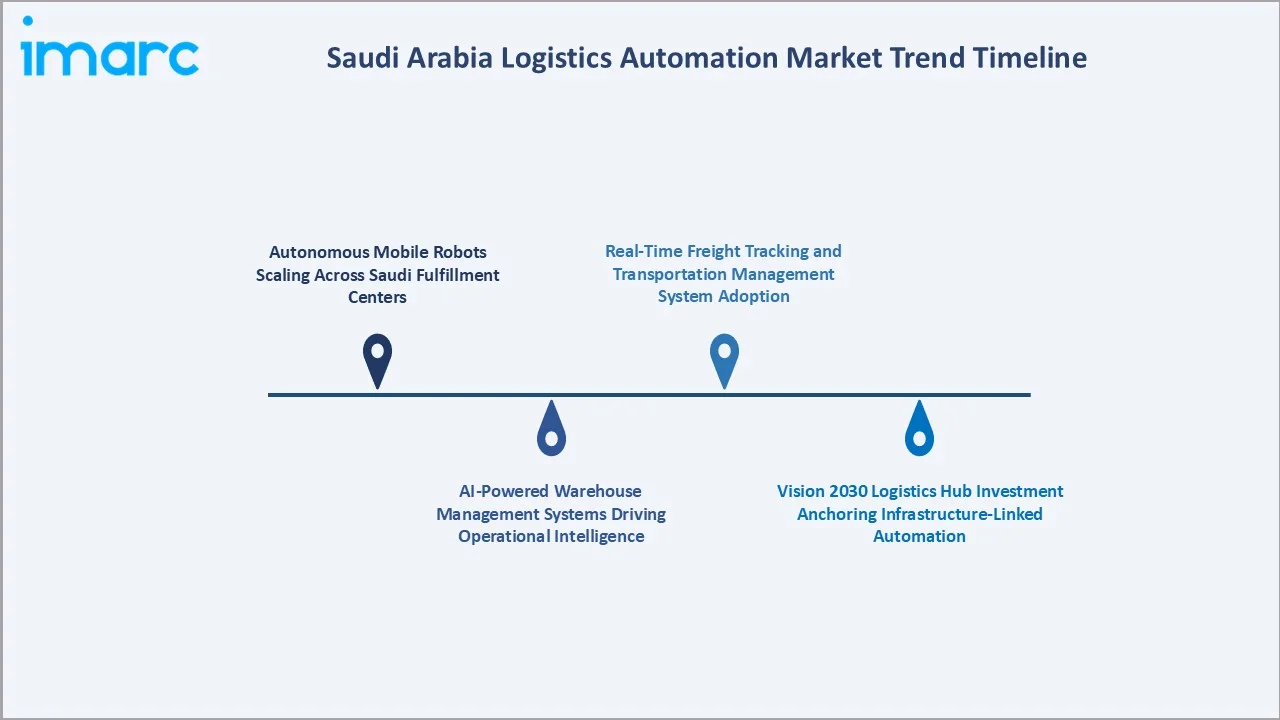
1. Autonomous Mobile Robots Scaling Across Saudi Fulfillment Centers
Autonomous mobile robots (AMRs) are rapidly displacing traditional conveyor-based fulfillment systems in Saudi Arabia's expanding e-commerce and 3PL warehouse network. AMR deployments offer flexible, scalable automation that accommodates variable order profiles without requiring permanent infrastructure modification. Major Riyadh and Jeddah distribution centers are deploying AMR fleets of 50-200 units, creating significant recurring revenue streams for maintenance, fleet management, and software subscription services.
2. AI-Powered Warehouse Management Systems Driving Operational Intelligence
AI-powered WMS platforms with demand forecasting, dynamic slotting, and labor management optimization are achieving widespread adoption among large Saudi enterprises. These platforms deliver measurable throughput improvements and inventory accuracy gains that generate compelling ROI justification for automation investment. Cloud-based WMS deployment models are accelerating adoption by reducing implementation timelines and upfront capital requirements for mid-market Saudi logistics operators.
3. Vision 2030 Logistics Hub Investment Anchoring Infrastructure-Linked Automation
The development of NEOM, King Abdullah Port, and the Saudi Landbridge rail corridor is creating large-scale, infrastructure-linked logistics automation procurement opportunities. Purpose-built smart logistics zones are specifying automation requirements at the infrastructure design stage, creating captive long-term deployment pipelines for warehouse automation, conveyor systems, and transportation management platforms that anchor forecast market growth.
4. Real-Time Freight Tracking and Transportation Management System Adoption
Growing adoption of real-time freight tracking, carrier management platforms, and integrated TMS solutions is transforming transportation visibility across Saudi Arabia's logistics network. ZATCA's e-invoicing mandate and customs digitization initiatives are accelerating TMS adoption by creating compliance-driven automation requirements for freight documentation, customs clearance, and trade finance workflows across the Kingdom's 3PL and freight forwarding sectors.
Industry Value Chain Analysis
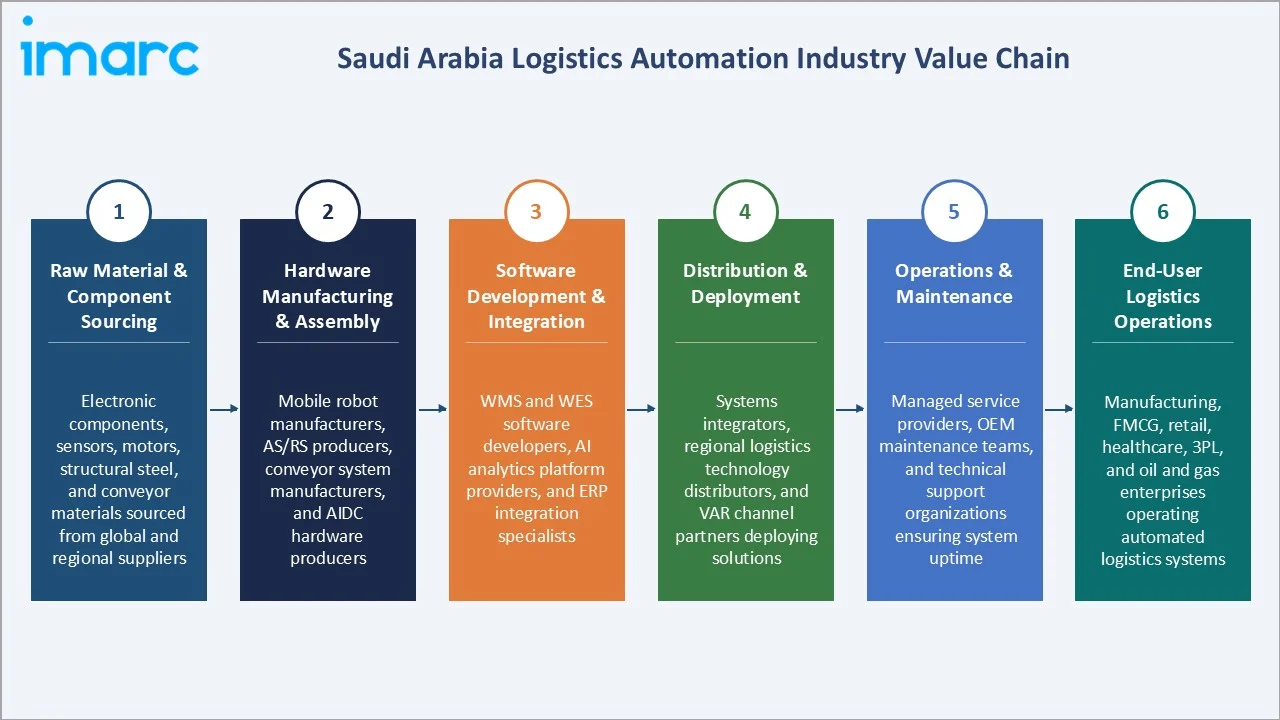
The Saudi Arabia logistics automation value chain integrates raw material and component sourcing, hardware manufacturing, software development, system integration, deployment, and ongoing maintenance services. The value chain is progressively shifting toward integrated solution delivery as primary commercial formats, with systems integrators consolidating hardware, software, and services procurement.
|
Stage |
Key Participants |
|
Raw Material & Component Sourcing |
Electronic components, sensors, motors, structural steel, and conveyor materials sourced from global and regional suppliers |
|
Hardware Manufacturing & Assembly |
Mobile robot manufacturers, AS/RS producers, conveyor system manufacturers, and AIDC hardware producers |
|
Software Development & Integration |
WMS and WES software developers, AI analytics platform providers, and ERP integration specialists |
|
Distribution & Deployment |
Systems integrators, regional logistics technology distributors, and VAR channel partners deploying solutions |
|
Operations & Maintenance |
Managed service providers, OEM maintenance teams, and technical support organizations ensuring system uptime |
|
End-User Logistics Operations |
Manufacturing, FMCG, retail, healthcare, 3PL, and oil and gas enterprises operating automated logistics systems |
The systems integration tier is the most commercially critical stage in the Saudi Arabia logistics automation value chain. The software and AI analytics tier is experiencing the most rapid investment growth as WMS and predictive analytics platforms generate recurring subscription revenue streams that enhance lifetime customer value.
Technology Landscape in the Saudi Arabia Logistics Automation Industry
Autonomous Mobile Robot (AMR) and Automated Guided Vehicle (AGV) Technology
AMR technology enables flexible, infrastructure-independent warehouse automation through AI-driven navigation and dynamic path planning. Unlike AGVs, AMRs adapt routing in real time around obstacles and changing warehouse configurations, making them well-suited for high-SKU, variable-volume Saudi fulfillment operations. Their rapid deployment and scalability are accelerating adoption across e-commerce and 3PL warehousing sectors.
Warehouse Management System (WMS) and AI Analytics Technology
Cloud-native WMS platforms with embedded AI deliver real-time inventory visibility, demand-driven replenishment, and labor optimization capabilities that generate measurable operational ROI. Integration with ERP, TMS, and robotics control systems through open APIs enables end-to-end supply chain orchestration. Saudi enterprises are deploying AI-powered WMS to achieve 99.5%+ inventory accuracy and 30-40% pick productivity improvements across automated distribution centers.
Automated Storage and Retrieval System (AS/RS) Technology
Several global automation providers introduced next-generation shuttle-based AS/RS systems designed for high-density, high-throughput storage in Saudi Arabia's growing pharmaceutical, FMCG, and retail distribution sectors. These systems achieve 3-5x storage density improvement over conventional racking while delivering sub-second retrieval speeds that enable same-day order fulfillment commitments. Their energy efficiency and space optimization align with Saudi Arabia's industrial sustainability requirements under Vision 2030 green building standards.
Market Segmentation Analysis
The report covers the following segments:
|
Segment Category |
Leading Segment |
Market Share |
Year |
|
Component |
🔒 |
🔒 |
2025 |
|
Function |
Warehouse and Storage Management |
66.8% |
2025 |
|
Enterprise Size |
Large Enterprises |
70.6% |
2025 |
|
Industry Vertical |
🔒 |
🔒 |
2025 |
|
Region |
Northern and Central Region |
43.1% |
2025 |

By Function
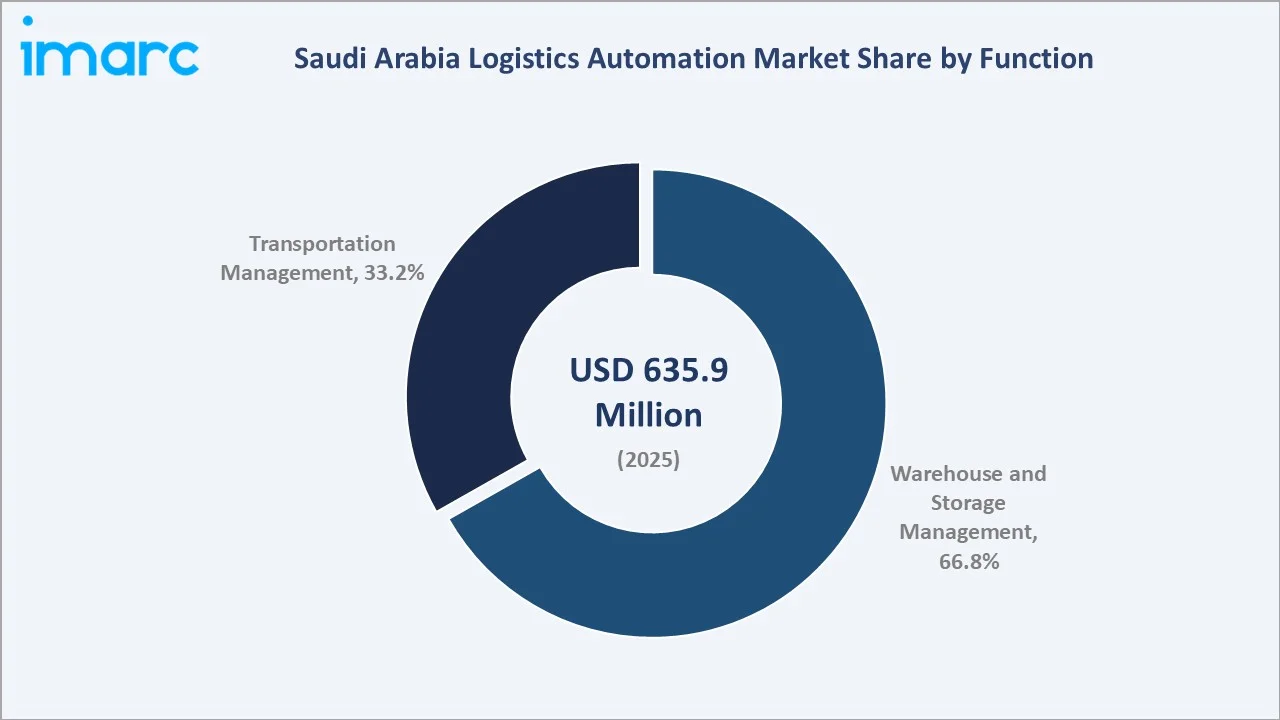
Warehouse and Storage Management leads at 66.8% in 2025, driven by intensive investment in automated fulfillment, robotic picking, AS/RS, and WMS deployments across manufacturing, FMCG, retail, and healthcare sectors. The expansion of e-commerce and third-party logistics warehousing is the primary volume driver for this segment.
To access detailed market analysis, Request Sample
Transportation Management at 33.2% reflects growing TMS, freight visibility, and carrier management platform adoption across Saudi Arabia's road, air, and sea freight networks. ZATCA digital trade mandates and real-time tracking requirements are accelerating TMS adoption, with this segment growing at above-market rates through 2034.
By Enterprise Size
Large Enterprises lead at 70.6% through their scale-driven capital investment capacity and complex multi-facility logistics automation requirements. Manufacturing conglomerates, FMCG distributors, and healthcare supply chain operators represent the primary large enterprise procurement cohort for advanced automation systems in Saudi Arabia.
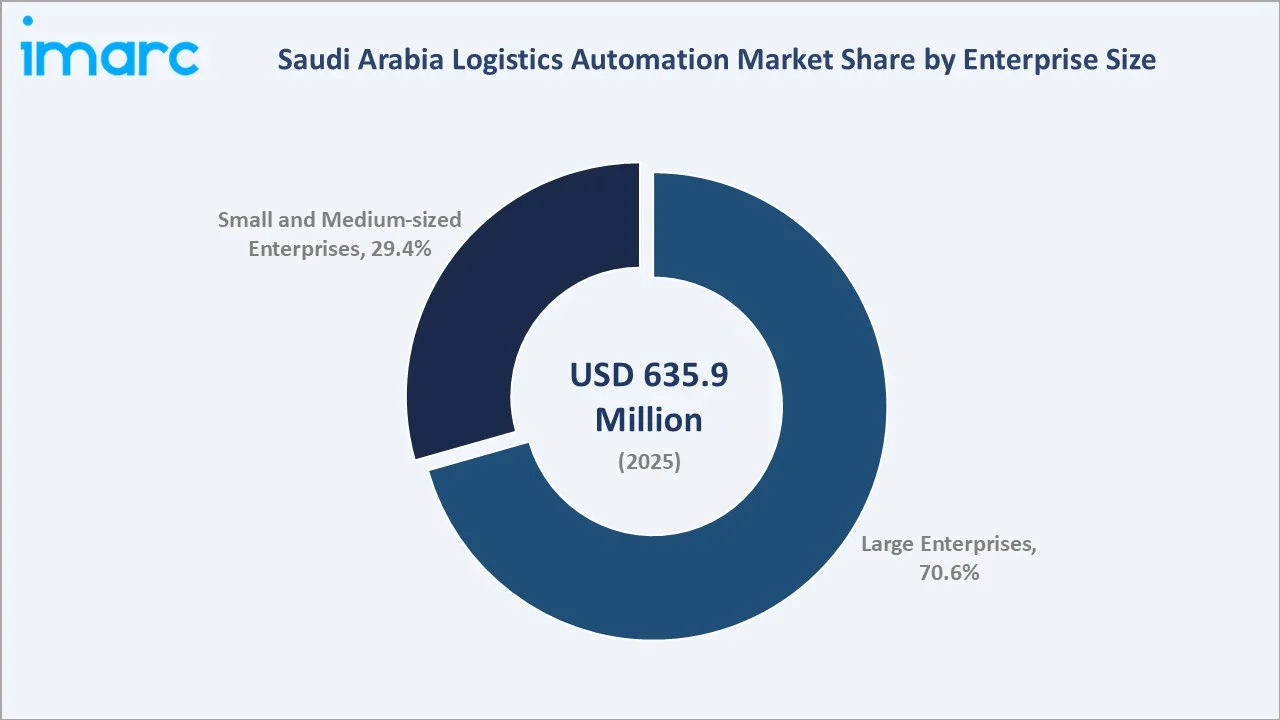
Small and Medium-sized Enterprises at 29.4% represent a rapidly growing segment as automation-as-a-service models, cloud WMS, and affordable AMR platforms reduce adoption barriers. Government SME support programs and Saudization-driven labor substitution incentives are accelerating SME automation investment across the Kingdom.
Regional Market Insights
|
Region |
Share (2025) |
Key Logistics Automation Market Drivers & Characteristics |
|
Northern and Central Region |
43.1% |
Anchored by Riyadh national distribution center concentration, government logistics mandates, NEOM logistics corridor investment, and the Kingdom's highest-density manufacturing and retail automation procurement activity |
|
Western Region |
24.8% |
Driven by Jeddah Islamic Port logistics automation investment, Red Sea tourism supply chain development, and Makkah and Madinah pharmaceutical and food distribution automation requirements |
|
Eastern Region |
20.9% |
Supported by ARAMCO and petrochemical sector supply chain automation, industrial zone logistics investment, and Dammam Port freight management system deployments |
|
Southern Region |
11.2% |
Emerging region with growing warehousing infrastructure investment, cross-border trade automation, and government development programs expanding logistics connectivity to underserved provinces |
The Northern and Central Region at 43.1% leads through Riyadh's concentration of national distribution centers and government-mandated logistics digitization programs. The Western Region at 24.8% benefits from Jeddah Port's role as the Kingdom's primary import gateway and the expanding Red Sea tourism supply chain.
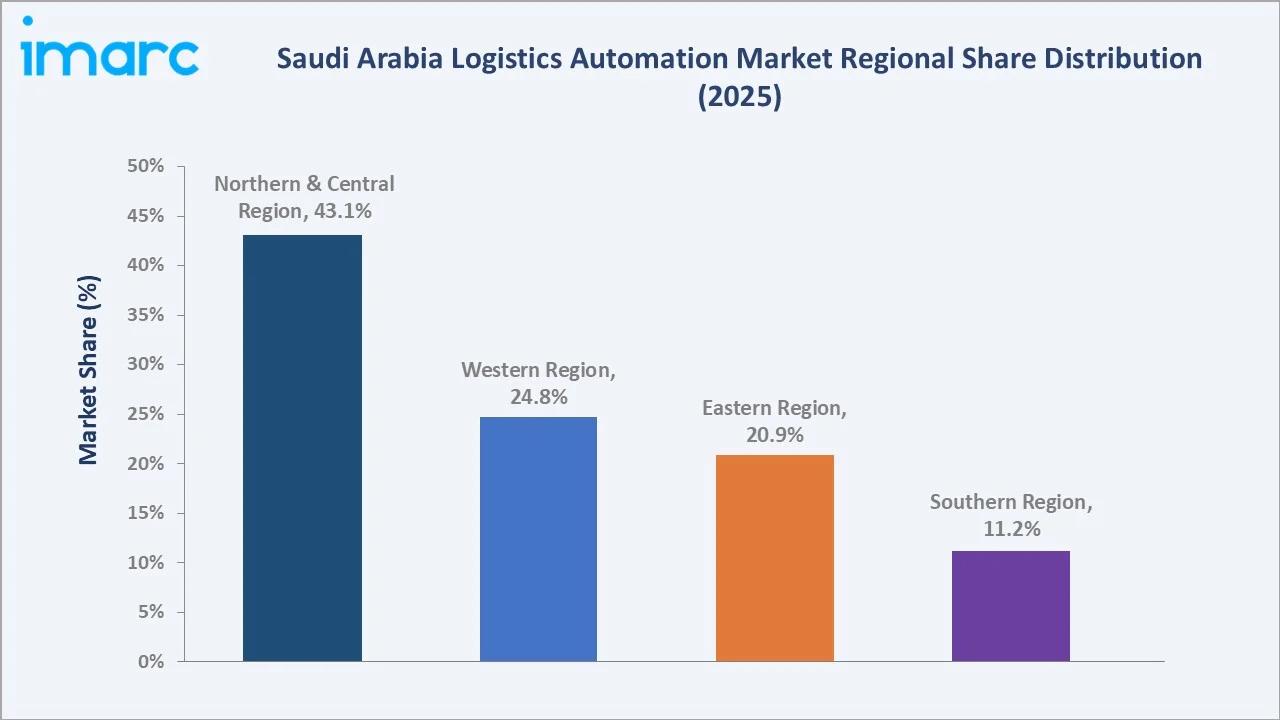
The Eastern Region at 20.9% is sustained by petrochemical and energy sector supply chain automation from ARAMCO-linked operations and industrial zone expansion. The Southern Region at 11.2% represents early-stage but growing opportunity as government infrastructure programs expand logistics capacity in underserved southern provinces.
Competitive Landscape
The Saudi Arabia logistics automation market competitive landscape is moderately concentrated, with global technology leaders operating alongside regional systems integrators and specialist automation solution providers. The market features three distinct competitive tiers: dominant global automation platform providers, regional systems integrators and VARs, and specialist point-solution vendors serving vertical-specific automation requirements.
|
Company Name |
Key Products / Solutions |
Market Position |
Core Strength |
|
Honeywell International Inc |
Intelligrated Conveyor Systems, Momentum WMS, Robotic Picking Solutions |
Market Leader |
Honeywell International Inc specializes in integrated warehouse automation solutions combining conveyor systems, robotic picking, and WMS software for high-throughput distribution center applications. |
|
Siemens |
SIMATIC Logistics, Automated Sorting Systems, Digital Twin Logistics Platform |
Market Leader |
Siemens provides end-to-end logistics automation technology encompassing automated sorting, conveyor systems, and digital twin simulation platforms for large-scale logistics operations. |
|
Zebra Technologies Corp. |
ZSL Warehouse Management, RFID and Barcode AIDC Systems, Symmetry WFM |
Strong Challenger |
Zebra Technologies specializes in automatic identification, data collection hardware, and workforce management software that enhance real-time inventory visibility across logistics operations. |
|
Körber AG |
Infios WMS, Warehouse Control Systems, AMR Integration Platform |
Strong Challenger |
Körber specializes in warehouse management and execution software with strong AMR integration capabilities and deep vertical expertise across retail, healthcare, and 3PL logistics sectors. |
|
Manhattan Associates |
Manhattan Active WM, Supply Chain Commerce Platform, TMS |
Market Leader |
Manhattan Associates provides cloud-native warehouse management and supply chain commerce platforms that deliver AI-driven operational intelligence across complex multi-facility logistics networks. |
Key players include Honeywell International Inc, Siemens, Zebra Technologies Corp., Körber AG, Manhattan Associates, and others.
Key Company Profiles
Honeywell International Inc
Honeywell International Inc is a United States-based diversified technology conglomerate with a strong presence in the Saudi Arabia logistics automation market through its Intelligrated warehouse automation division, offering comprehensive conveyor, robotic picking, sortation, and WMS solutions for high-throughput distribution center applications.
- Key Products: Intelligrated Conveyor Systems, Momentum WMS, Robotic Picking Solutions, Automated Sortation Systems.
- Strategic Focus: Expanding integrated warehouse automation solutions combining robotics, conveyor systems, and AI-powered WMS software to serve growing demand from large enterprise and 3PL operators investing in automated fulfillment infrastructure across Saudi Arabia's expanding logistics network. The company is investing in cloud WMS capabilities and autonomous robotics integration to address the increasing demand for flexible, scalable automation solutions in high-growth Saudi market segments.
Siemens
Siemens is a Germany-based global technology leader with a strong presence in the Saudi Arabia logistics automation market through its SIMATIC Logistics division, providing automated sorting systems, conveyor technology, and digital twin simulation platforms for large-scale airport, postal, and industrial logistics applications.
- Key Products: SIMATIC Logistics Automated Sorting Systems, Digital Twin Logistics Simulation Platform, Conveyor and Material Handling Systems.
- Strategic Focus: Strengthening digital logistics automation capabilities through digital twin simulation, AI-driven sortation optimization, and energy-efficient conveyor system technologies that align with Saudi Arabia's Vision 2030 sustainability requirements and smart logistics hub development program. The company is pursuing expanded local content and Saudization compliance frameworks to strengthen competitive positioning in government-procured logistics infrastructure projects.
Market Concentration Analysis
The Saudi Arabia logistics automation market exhibits moderate concentration at the enterprise WMS and large-scale hardware automation tiers, with global leaders collectively accounting for an estimated 35-45% of enterprise automation revenue. The mid-market and SME segments are more fragmented, served by regional systems integrators and cloud WMS providers. Market concentration is expected to moderate as cloud-native WMS and AMR-as-a-service models expand the competitive field across all enterprise size segments.
Investment & Growth Opportunities
Highest Growth Segments
Warehouse automation for e-commerce fulfillment (~7.2% CAGR), AI-powered WMS and analytics platforms, autonomous mobile robot deployments for 3PL and retail, cold chain automation for healthcare and FMCG, transportation management systems driven by ZATCA compliance mandates, and AMR-as-a-service models for SME market expansion represent the highest-growth investment vectors through 2034.
Emerging Investment Opportunities
Pharmaceutical and healthcare cold chain automation represents a high per-unit-value emerging opportunity as Saudi Arabia's Vision 2030 pharmaceutical manufacturing expansion creates demand for FDA-compliant automated dispensing and cold chain WMS systems. NEOM's autonomous logistics zone specifications create a greenfield opportunity for next-generation unmanned delivery and drone logistics automation investment.
Investment Themes
- Saudization-compliant service delivery model investment: Vision 2030 local content requirements and Saudization mandates create strong incentives for establishing Saudi-based logistics automation support, integration, and maintenance capability. Companies achieving early-mover local delivery model advantage gain preferential access to government and quasi-government logistics project procurement.
- AI and cloud WMS platform investment for SME market expansion: The untapped SME automation market represents a significant growth opportunity for cloud-native WMS and subscription-based AMR platforms that reduce adoption barriers through capex-free deployment models. Early investment in SME-focused automation channels positions providers to capture a rapidly expanding addressable market as automation economics improve through 2034.
Future Market Outlook (2026-2034)
The Saudi Arabia logistics automation market is projected to grow from USD 635.9 Million in 2025 to USD 1,112.2 Million by 2034 at a 6.41% CAGR. The market's anchor value of USD 867.5 Million in 2030 represents the industry at its digital transformation inflection point, as Vision 2030 logistics infrastructure reaches operational maturity and enterprise automation deployments shift from pilot to full-scale implementation.
Research Methodology
Primary Research
Primary research comprised structured interviews with 40+ industry stakeholders (2025), including logistics automation procurement directors; warehouse operations managers at major Saudi enterprises; regional systems integrators; and government logistics program officers at Vision 2030 executing authorities.
Secondary Research
Secondary research encompassed Saudi National Transport and Logistics Strategy publications; General Authority of Civil Aviation (GACA) logistics investment data; Saudi Customs digital trade reports; ZATCA e-invoicing mandate documentation; regional logistics automation market reports; and company annual reports. Over 45 secondary sources were reviewed.
Forecasting Models
Market revenue forecasts developed using a demand-side bottom-up model: (i) enterprise automation investment by sector and enterprise size; (ii) average automation system value by function type; (iii) technology adoption rate trajectories by enterprise size tier; (iv) policy adjustment factors for Vision 2030 logistics infrastructure investment and Saudization compliance incentives.
Saudi Arabia Logistics Automation Market Report Coverage:
| Report Features | Details |
|---|---|
| Base Year of the Analysis | 2025 |
| Historical Period | 2020-2025 |
| Forecast Period | 2026-2034 |
| Units | Million USD |
| Scope of the Report |
Exploration of Historical and Forecast Trends, Industry Catalysts and Challenges, Segment-Wise Historical and Predictive Market Assessment:
|
| Components Covered |
|
| Functions Covered | Warehouse and Storage Management, Transportation Management |
| Enterprise Sizes Covered | Small and Medium-sized Enterprises, Large Enterprises |
| Industry Verticals Covered | Manufacturing, Healthcare and Pharmaceuticals, Fast-Moving Consumer Goods (FMCG), Retail and E-Commerce, 3PL, Aerospace and Defense, Oil, Gas and Energy, Chemicals, Others |
| Regions Covered | Northern and Central Region, Western Region, Eastern Region, Southern Region |
| Companies Covered | Honeywell International Inc, Siemens, Zebra Technologies Corp., Körber AG, Manhattan Associates, etc. |
| Customization Scope | 10% Free Customization |
| Post-Sale Analyst Support | 10-12 Weeks |
| Delivery Format | PDF and Excel through Email (We can also provide the editable version of the report in PPT/Word format on special request) |
Key Benefits for Stakeholders:
- IMARC’s industry report offers a comprehensive quantitative analysis of various market segments, historical and current market trends, market forecasts, and dynamics of the Saudi Arabia logistics automation market from 2020-2034.
- The research report provides the latest information on the market drivers, challenges, and opportunities in the Saudi Arabia logistics automation market.
- Porter's five forces analysis assist stakeholders in assessing the impact of new entrants, competitive rivalry, supplier power, buyer power, and the threat of substitution. It helps stakeholders to analyze the level of competition within the Saudi Arabia logistics automation industry and its attractiveness.
- Competitive landscape allows stakeholders to understand their competitive environment and provides an insight into the current positions of key players in the market.
Frequently Asked Questions About the Saudi Arabia Logistics Automation Market Report
The Saudi Arabia logistics automation market reached USD 635.9 Million in 2025, driven by Warehouse and Storage Management at 66.8%, Large Enterprises leading at 70.6%, Vision 2030 logistics infrastructure investment, and the Northern and Central Region commanding 43.1% market share through Riyadh-concentrated distribution center automation procurement.
The market grows at 6.41% CAGR during 2026-2034, reaching USD 1,112.2 Million by 2034, reflecting Vision 2030 logistics strategy execution, e-commerce fulfillment automation expansion, Saudization-driven labor substitution demand, and AI-powered WMS adoption increasing average deployment value.
Warehouse and Storage Management leads at 66.8%, driven by automated fulfillment center deployments, robotic picking, AS/RS systems, and WMS adoption across manufacturing, FMCG, retail, and healthcare sectors. E-commerce growth is the primary volume driver sustaining above-market CAGR for this segment through 2034.
Large Enterprises lead at 70.6% through scale-driven capital investment capacity, complex multi-facility automation requirements, and established ROI justification for advanced logistics technology deployments. Manufacturing, FMCG, and healthcare enterprises are the primary large enterprise procurement cohort across the Kingdom.
The Northern and Central Region leads at 43.1% through Riyadh's concentration of national distribution infrastructure, government logistics digitization mandates, and the highest-density enterprise automation investment activity in the Kingdom, further anchored by NEOM logistics corridor development.
Key players include Honeywell International Inc, Siemens, Zebra Technologies Corp., Körber AG, Manhattan Associates, and others.
Need more help?
- Speak to our experienced analysts for insights on the current market scenarios.
- Include additional segments and countries to customize the report as per your requirement.
- Gain an unparalleled competitive advantage in your domain by understanding how to utilize the report and positively impacting your operations and revenue.
- For further assistance, please connect with our analysts.
 Request Customization
 Speak to an Analyst
 Request Brochure
 Inquire Before Buying
Benefits of Customization
- Personalize this research
- Triangulate with your data
- Get data as per your format and definition
- Gain a deeper dive into a specific application, geography, customer, or competitor
- Any level of personalization
Get in Touch With Us
UNITED STATES
Phone: +1-201-971-6302
INDIA
Phone: +91-120-433-0800
UNITED KINGDOM
Phone: +44-753-714-6104
Email: [email protected]
Client Testimonials




.webp)




.webp)













Related Reports

Choose your plan
*Please note that the prices mentioned below are starting prices for each bundle type. Kindly contact our team for further details.*
Single User License
- 1 User License, Access on 2 Devices
- PDF Report + Excel Dataset (Password Protected)
- Lifetime Access
- No Printing Rights
- 10% Free Report Customization
- 10–12 Weeks of Analyst Support
Five User License
- Access for 5 Users, 2 Devices per User
- PDF Report + Excel Dataset (Password Protected)
- Lifetime Access
- Dedicated Account Manager
- 12–14 Weeks of Analyst Support
- No Printing Rights
- 15% Free Report Customization
- 25% Discount on Your Next Purchase
Corporate User License
- Unlimited User Access (Within Your Organization)
- PDF Report + Excel Dataset
- Lifetime Access
- Dedicated Account Manager
- 14–20 Weeks of Analyst Support
- No Printing Rights
- 20% Free Report Customization
- 30% Discount on Your Next Purchase
Essential Insights
What's included:
3 reports
- Lifetime Access
- PDF Reports
- Excel Datasets
- 2 Weeks of Free Analyst Support
- 2 User Licenses
- Access on 2 Devices
- Printing Rights
- Complimentary PowerPoint (PPT) Version
- Complimentary License Upgrade
Professional Access
What's included:
5 reports
- Lifetime Access
- PDF Reports
- Excel Datasets
- 8 Weeks of Free Analyst Support
- 2 User Licenses
- Access on 2 Devices
- Printing Rights
- Complimentary PowerPoint (PPT) Version
- Complimentary License Upgrade
Business Advantage
What's included:
8 reports
- Lifetime Access
- PDF Reports
- Excel Datasets
- 14 Weeks of Free Analyst Support
- 2 User Licenses
- Access on 2 Devices
- Printing Rights
- Complimentary PowerPoint (PPT) Version
- Complimentary License Upgrade
Enterprise Intelligence
What's included:
10 reports
- Lifetime Access
- PDF Reports
- Excel Datasets
- 20 Weeks of Free Analyst Support
- 2 User Licenses
- Access on 2 Devices
- Printing Rights
- Complimentary PowerPoint (PPT) Version
- Complimentary License Upgrade