
Saudi Arabia Luxury Hotel Market Size, Share, Trends and Forecast by Type, Room Type, Category, and Region, 2026-2034
Saudi Arabia Luxury Hotel Market Size, Share, Trends & Forecast (2026-2034)
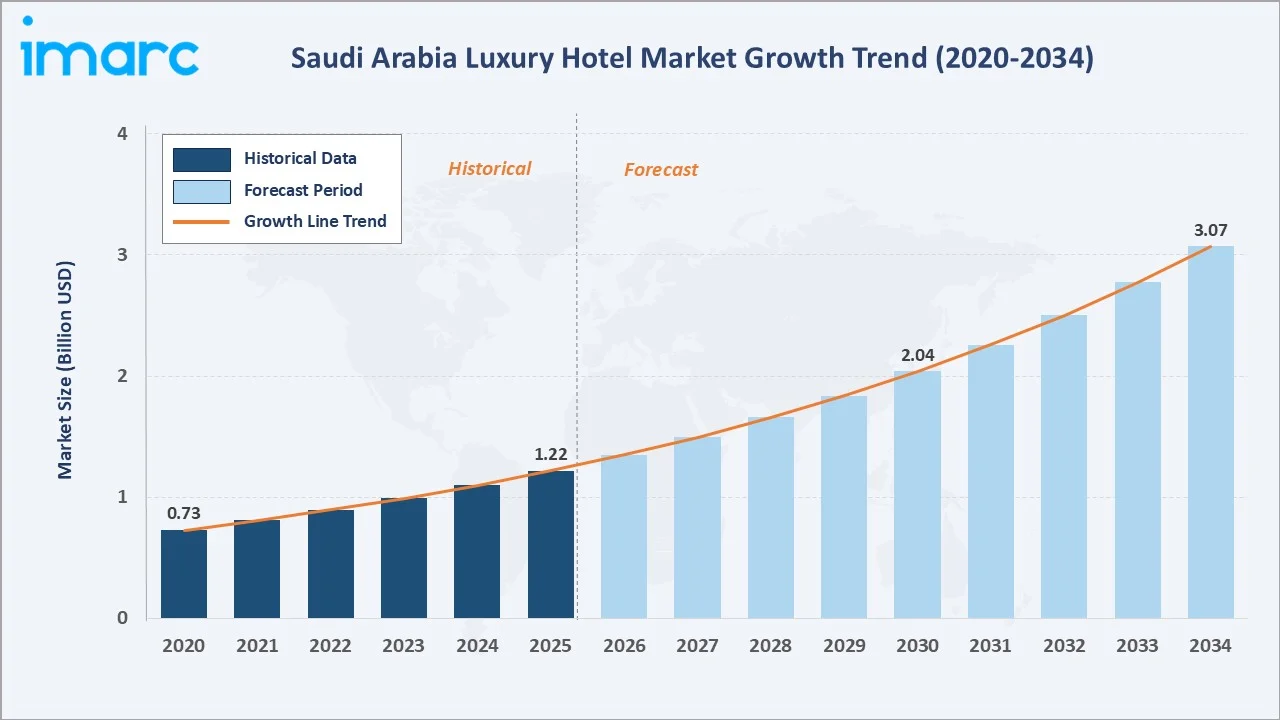
The Saudi Arabia luxury hotel market reached USD 1.22 Billion in 2025 and is projected to reach USD 3.07 Billion by 2034, growing at a CAGR of 10.76% during 2026-2034. The market is driven by Vision 2030's National Tourism Strategy targeting 150 million annual visitors by 2030, transformative Red Sea, NEOM, and Diriyah giga-projects creating world-class luxury resort destinations, the liberalization of tourism and entertainment sectors attracting high-spending international visitors, and PIF's strategic investment in premium hospitality infrastructure. Business hotels lead at 34.8% by type, luxury room category commands 45.7% by room type, and the Northern and Central region holds the largest share at 42.7%.
Market Snapshot
|
Metric |
Value |
|
Market Size (2025) |
USD 1.22 Billion |
|
Forecast Market Size (2034) |
USD 3.07 Billion |
|
CAGR (2026-2034) |
10.76% |
|
Base Year |
2025 |
|
Historical Period |
2020-2025 |
|
Forecast Period |
2026-2034 |
|
Dominant Type |
Business Hotels (34.8%, 2025) |
|
Dominant Room Type |
Luxury (45.7%, 2025) |
|
Leading Region |
Northern and Central Region (42.7%, 2025) |
The Saudi Arabia luxury hotel market has grown from USD 0.73 Billion in 2020 to USD 1.22 Billion in 2025, representing a recovery and growth trajectory that follows the COVID-19 impact on global tourism, with structural momentum provided by Vision 2030's tourism transformation. The market is projected to reach USD 2.04 Billion by 2030 and USD 3.07 Billion by 2034.
To get more information on this market, Request Sample
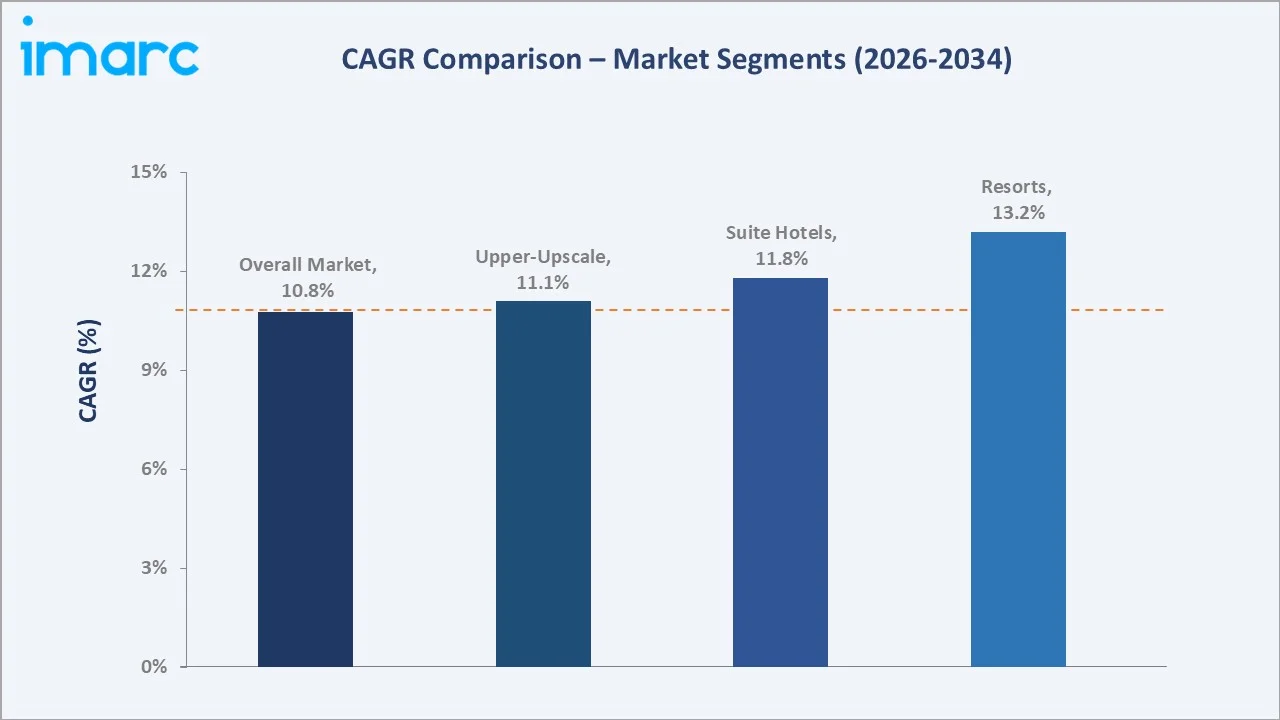
Resorts grow at ~13.2% CAGR through Red Sea, NEOM, and other luxury destination development. Suite hotels grow at ~11.8% CAGR through long-stay business and lifestyle traveler demand. Upper-upscale room segment grows at ~11.1% CAGR as international travelers upgrade from standard categories.
Executive Summary
The Saudi Arabia luxury hotel market is experiencing one of the most remarkable transformations of any hospitality market globally, driven by Vision 2030's wholesale reimagining of the Kingdom as a world-class tourism destination and a domestic leisure society. Saudi Arabia has progressed from a market with historically limited international tourism, restricted largely to religious pilgrimages and business travel, to an increasingly diversified destination attracting leisure travelers, cultural tourists, adventure seekers, and ultra-high-net-worth guests through a combination of regulatory reform, infrastructure investment, and compelling destination development. Business hotels lead at 34.8% through corporate travel demand in Riyadh and business centers. The luxury room category leads at 45.7% through premium accommodation demand from international guests. Northern & Central region leads regionally at 42.7%.
Key Market Insights
|
Insight |
Data |
|
Dominant Type |
Business Hotels - 34.8% share (2025) |
|
Dominant Room Type |
Luxury - 45.7% share (2025) |
|
Leading Region |
Northern & Central Region - 42.7% (2025) |
|
Key Market Opportunities |
Development of ultra-luxury resorts, expansion in emerging tourism destinations, growth in wellness and experiential hospitality, branded residences, and rising demand from international leisure and business travelers. |
Key Analytical Observations Supporting the Above Data:
- Business Hotels at 34.8%: Business hotels lead through Riyadh's consolidation as Saudi Arabia's premier corporate destination. The concentration of government decision-making, business deal-making, and international diplomatic activity in the capital creates persistent high-value corporate travel demand for luxury business hotels.
- Luxury room category at 45.7%: The luxury room segment leads because Saudi Arabia's tourism transformation strategy explicitly targets high-spending, high-value international visitors who generate maximum economic multiplier benefits. Saudi Arabia's natural competitive advantage of owning some of the most spectacular and relatively undiscovered destinations enables authentic luxury positioning at ADRs competitive with or exceeding established global luxury destinations.
- Northern & Central Region at 42.7%: The Northern and Central region commands the largest share through Riyadh's position as the undisputed hub for luxury business hotels, corporate travel, and premium hospitality demand.
Saudi Arabia Luxury Hotel Market Overview
The Saudi Arabia luxury hotel market encompasses properties operating across five-star and ultra-luxury hotel categories, including business hotels serving corporate travelers, resort hotels targeting leisure and wellness guests, suite hotels for extended-stay and lifestyle segments, airport hotels serving transit passengers and early/late arriving travelers, and boutique and heritage properties. The market serves both the inbound international tourist segment and the growing domestic premium traveler segment of Saudi nationals increasingly choosing luxury hospitality within the Kingdom. PIF's direct investment creates a government-backed luxury tourism development ecosystem that de-risks private hotel group investment and provides development partner structures unavailable in most markets.
Market Dynamics
To evaluate market opportunities, Request Sample
Market Drivers
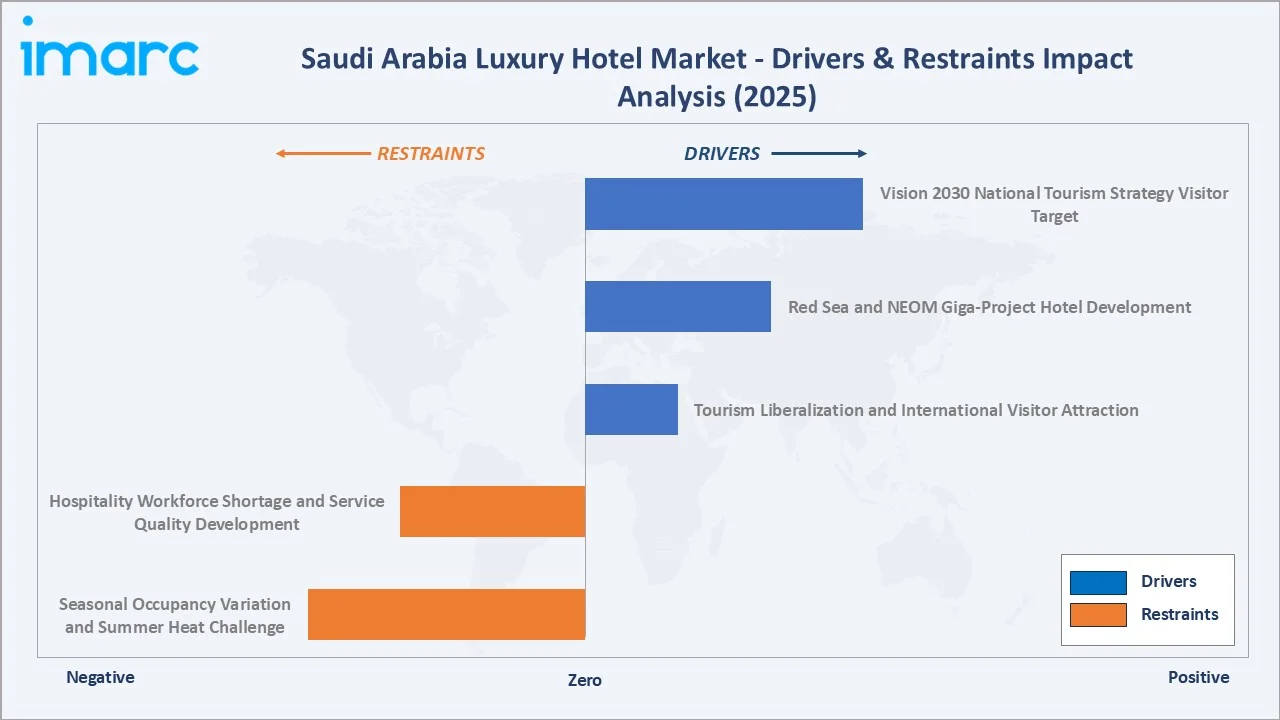
- Vision 2030 National Tourism Strategy Visitor Target: Saudi Arabia's National Tourism Strategy mandates the development of a world-class tourism ecosystem capable of welcoming 150 million annual visitors by 2030. This target requires massive luxury hotel capacity expansion, with the Saudi Tourism Authority tracking hotel key additions as a primary performance metric. Saudi Arabia targets 320,000 new hotel rooms by 2030.
- Red Sea and NEOM Giga-Project Hotel Development: Red Sea Global is developing a USD 13 billion luxury tourism destination spanning 90 pristine Saudi islands, with 16 hotels targeted by 2025 and a total of 50 hotels planned by 2030, targeting approximately 1 million visitors annually by 2030. NEOM's Sindalah island is developing a superyacht and ultra-luxury marina resort destination. Each of these giga-projects adds significant luxury resort hotel capacity that directly expands the market's addressable revenue.
- Tourism Liberalization and International Visitor Attraction: Saudi Arabia’s tourism liberalization, including streamlined e-visas, regulatory reforms, and the development of new tourism destinations, is making the Kingdom more accessible to international travelers. International visitors are strengthening demand for premium accommodation and hospitality experiences. This growing visitor base is encouraging the expansion of luxury hotels and resorts across destinations such as Riyadh, Diriyah, and the Red Sea.
Market Restraints
- Seasonal Occupancy Variation and Summer Heat Challenge: Saudi Arabia's extreme summer heat significantly reduces international tourist arrivals and domestic leisure travel, creating structural seasonal occupancy dips at resort and leisure-focused luxury properties. Beach and desert resort properties experience lower occupancy during peak summer months, affecting full-year performance and investor return projections. Indoor facilities, specialized desert night experiences, and mountainous resort destinations in Asir provide partial mitigation.
- Hospitality Workforce Shortage and Service Quality Development: Saudi Arabia's ambition to become a world-class luxury tourism destination requires developing a large, skilled, and culturally fluent hospitality workforce. The Kingdom faces significant shortages of experienced luxury hospitality professionals, particularly in guest-facing roles requiring multilingual capability, cultural intelligence, and international service standards experience. Saudization requirements add complexity to staffing strategies for international hotel groups accustomed to drawing from global hospitality talent pools.
Market Opportunities
- Ultra-Luxury and UHNW Segment Development: Saudi Arabia's tourism development strategy explicitly targets the ultra-high-net-worth (UHNW) traveler segment that generates maximum revenue per visitor and maximum international profile. Ultra-luxury hospitality brands' pricing strategy targets guests willing to pay a premium per night for exclusive eco-resort experiences. Developing ultra-luxury hospitality at iconic natural and heritage sites creates uniquely positioned properties that cannot be replicated globally.
- Religious Tourism Premium Hospitality Expansion: In 2024, Saudi Arabia welcomed approximately 18.5 million pilgrims, comprising 16.92 million Umrah pilgrims and around 1.61 million Hajj pilgrims, creating a vast premium hospitality market around the holy cities of Makkah and Madinah. Rising affluence among global Muslim communities is creating demand for premium and luxury hospitality experiences during religious visits, with adjacent luxury hotel markets developing around the core pilgrimage infrastructure. Expanding premium Umrah packages through luxury hospitality partnerships represents a growing revenue opportunity.
Market Challenges
- Competition from Established Gulf Luxury Destinations: Saudi Arabia's luxury hotel market competes directly with Dubai and Abu Dhabi for international luxury travelers' Middle East destination selection. Differentiating Saudi Arabia through authentic heritage, unspoiled natural environments, and unique experiences inaccessible elsewhere is critical for capturing market share from established Gulf competitors.
- Development Pipeline Delivery Risk and Construction Timeline Execution: Saudi Arabia's luxury hotel development pipeline is among the largest and most ambitious, with multiple mega-project destinations simultaneously under development. Managing construction timelines, supply chain logistics, contractor capacity, and commissioning quality across dozens of simultaneous luxury hotel projects creates execution risk that could delay supply delivery and affect investor confidence in project economics.
Emerging Market Trends
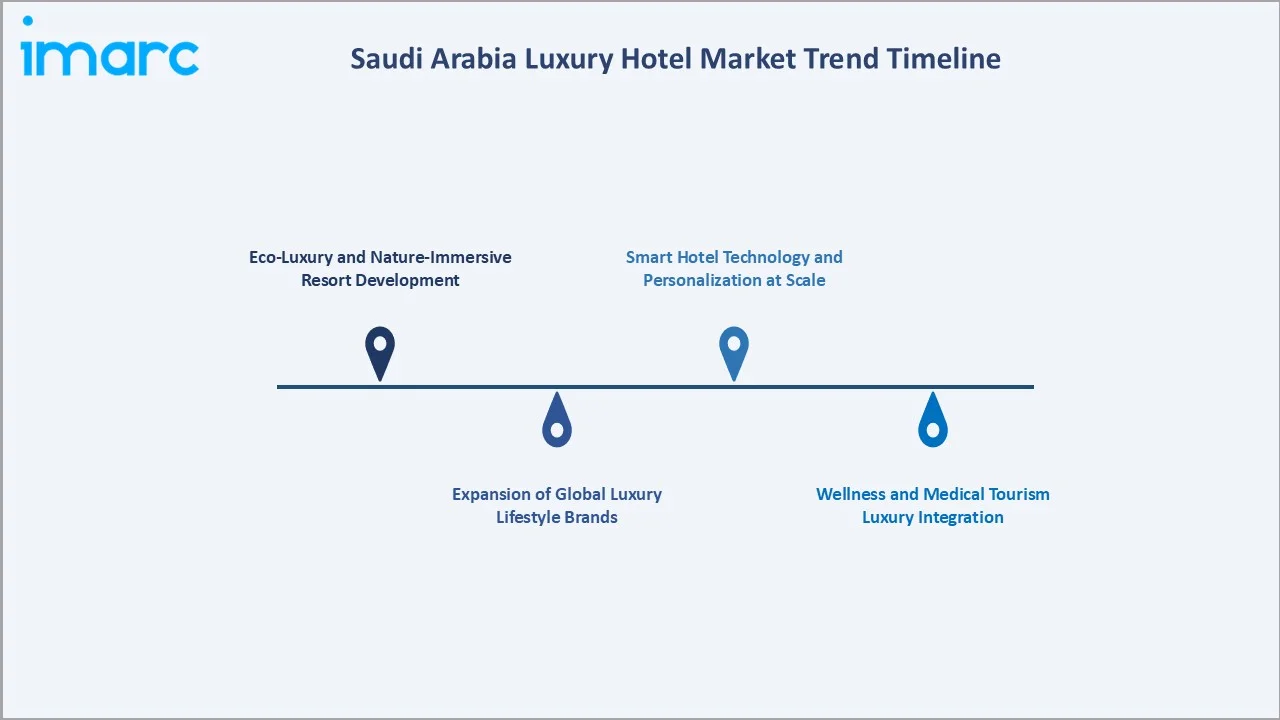
1. Eco-Luxury and Nature-Immersive Resort Development
Saudi Arabia's luxury tourism strategy prioritizes sustainable, nature-immersive resort development that preserves the Kingdom's extraordinary natural heritage while delivering world-class luxury experiences. The Red Sea Project's commitment to 100% renewable energy, zero single-use plastics, and coral reef restoration alongside luxury resort operations establishes a global benchmark for sustainable luxury hospitality. These eco-luxury models appeal to the environmental consciousness of high-spending international travelers while leveraging Saudi Arabia's irreplaceable natural assets.
2. Expansion of Global Luxury Lifestyle Brands
Saudi Arabia is increasingly attracting internationally recognized luxury hospitality brands to emerging destinations such as AMAALA and the Red Sea coast. In September 2026, Red Sea Global opened Nammos Resort AMAALA, marking the brand’s first resort hotel globally and expanding AMAALA’s luxury lifestyle and hospitality portfolio. The opening introduces the Nammos brand’s Mykonos-inspired experience to Saudi Arabia’s Red Sea coast and supports AMAALA’s positioning as a leading global luxury, wellness, and lifestyle destination. This trend is diversifying high-end accommodation offerings and strengthening the Kingdom’s appeal among affluent international travelers.
3. Smart Hotel Technology and Personalization at Scale
Saudi Arabia's newly built luxury hotels are incorporating the most advanced hospitality technology architecture, AI-personalized guest services, smart room automation, biometric check-in, robotic service delivery, and real-time guest preference learning, from their inception rather than retrofitting legacy systems. NEOM's planned hospitality operations will leverage the city's 5G, AI, and IoT infrastructure for seamless guest experiences that anticipate needs before they are articulated. These technology-native luxury properties are defining next-generation luxury standards that will influence global hospitality design.
4. Wellness and Medical Tourism Luxury Integration
Saudi Arabia's luxury hotel market is progressively integrating wellness tourism programming, spas, wellness retreats, longevity medicine, and mental health hospitality that caters to the global wellness tourism market. AMAALA's development concept centers on wellness and healthy living as its core hospitality value proposition. Planned Saudi properties and the wellness-oriented programming at Red Sea destination hotels position Saudi Arabia for the premium wellness travel segment that commands among the hospitality industry's highest ADRs and most loyal repeat-visit patterns.
Industry Value Chain Analysis
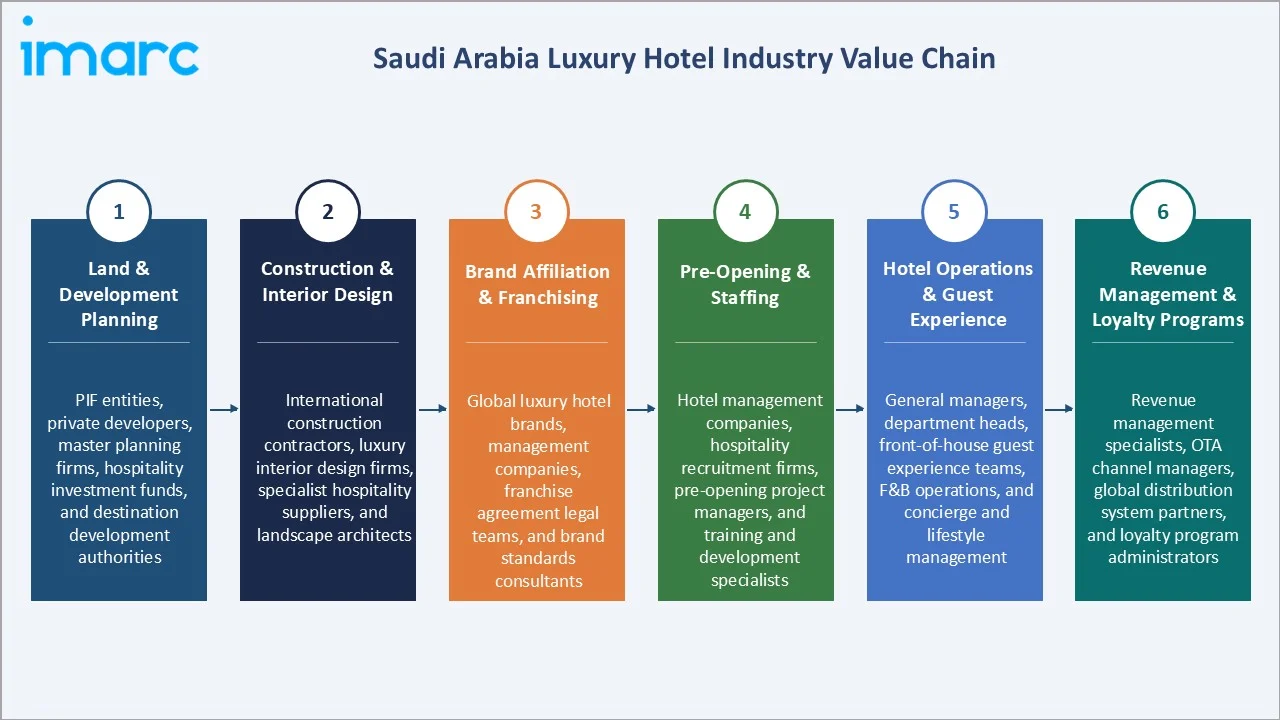
The Saudi Arabia luxury hotel value chain integrates land acquisition and development planning, construction and interior design, brand affiliation and franchising, pre-opening operations and staffing, hotel operations and guest experience delivery, and revenue management and loyalty programs across business hotel, resort, suite hotel, and airport hotel property categories.
|
Stage |
Key Participants |
|
Land & Development Planning |
PIF entities, private developers, master planning firms, hospitality investment funds, and destination development authorities. |
|
Construction & Interior Design |
International construction contractors, luxury interior design firms, specialist hospitality suppliers, and landscape architects. |
|
Brand Affiliation & Franchising |
Global luxury hotel brands, management companies, franchise agreement legal teams, and brand standards consultants. |
|
Pre-Opening & Staffing |
Hotel management companies, hospitality recruitment firms, pre-opening project managers, and training and development specialists. |
|
Hotel Operations & Guest Experience |
General managers, department heads, front-of-house guest experience teams, F&B operations, and concierge and lifestyle management. |
|
Revenue Management & Loyalty Programs |
Revenue management specialists, OTA channel managers, global distribution system partners, and loyalty program administrators. |
Hotel operations and guest experience delivery represent the highest-value and most reputation-defining stage in the Saudi Arabia luxury hotel value chain. In a market where social media amplification of exceptional guest experiences can generate global travel consideration, and where international travel press coverage of new Saudi luxury destinations directly influences source market visitor volumes, the quality and consistency of in-property guest experiences determines whether Saudi Arabia's luxury hospitality reputation ascends to match the ambition of its physical development investments.
Technology Landscape in the Saudi Arabia Luxury Hotel Industry
AI-Powered Guest Experience Personalization
Saudi Arabia's newly constructed luxury hotels are deploying AI-driven guest experience platforms that create hyper-personalized stays from pre-arrival through post-departure. Machine learning systems analyze guest preference data, booking history, in-property behavior, and social media profiles to enable proactive service anticipation; preferred pillow types, dietary preferences, activity interests, and temperature settings are automatically configured before check-in. Digital butler services accessible through app-based interfaces and smart speakers enable seamless guest-staff communication that maintains luxury service standards while reducing staffing cost-per-interaction.
Smart Building and Sustainability Technology
Saudi Arabia's luxury hotel development pipeline incorporates proprietary sustainability standards that deploy intelligent building management systems for energy optimization, water conservation, and waste management. The Red Sea Project's commitment to 100% renewable energy requires advanced solar energy management, battery storage, and microgrid technology integrated within resort operations. Smart HVAC systems optimized for Saudi Arabia's extreme climate maintain luxury comfort standards while minimizing energy consumption, directly improving hotel operational cost profiles relative to conventional systems.
Revenue Management and Distribution Technology
Luxury hotels in Saudi Arabia's competitive environment require sophisticated revenue management platforms that optimize room rate pricing in real time based on demand patterns, competitive set pricing, event calendars, and booking window analysis. Integration with global distribution systems (GDS), luxury travel agency networks, and OTA platforms enables Saudi luxury properties to reach international high-net-worth traveler segments efficiently. Saudi Tourism Authority's national tourism data platform provides market intelligence that enables individual hotel properties to benchmark performance against national occupancy and ADR trends.
Market Segmentation Analysis
The report covers the following segments:
|
Segment Category |
Leading Segment |
Market Share |
Year |
|
Type |
Business Hotels |
34.8% |
2025 |
|
Room Type |
Luxury |
45.7% |
2025 |
|
Category |
🔒 |
🔒 |
2025 |
|
Region |
Northern and Central Region |
42.7% |
2025 |

By Type
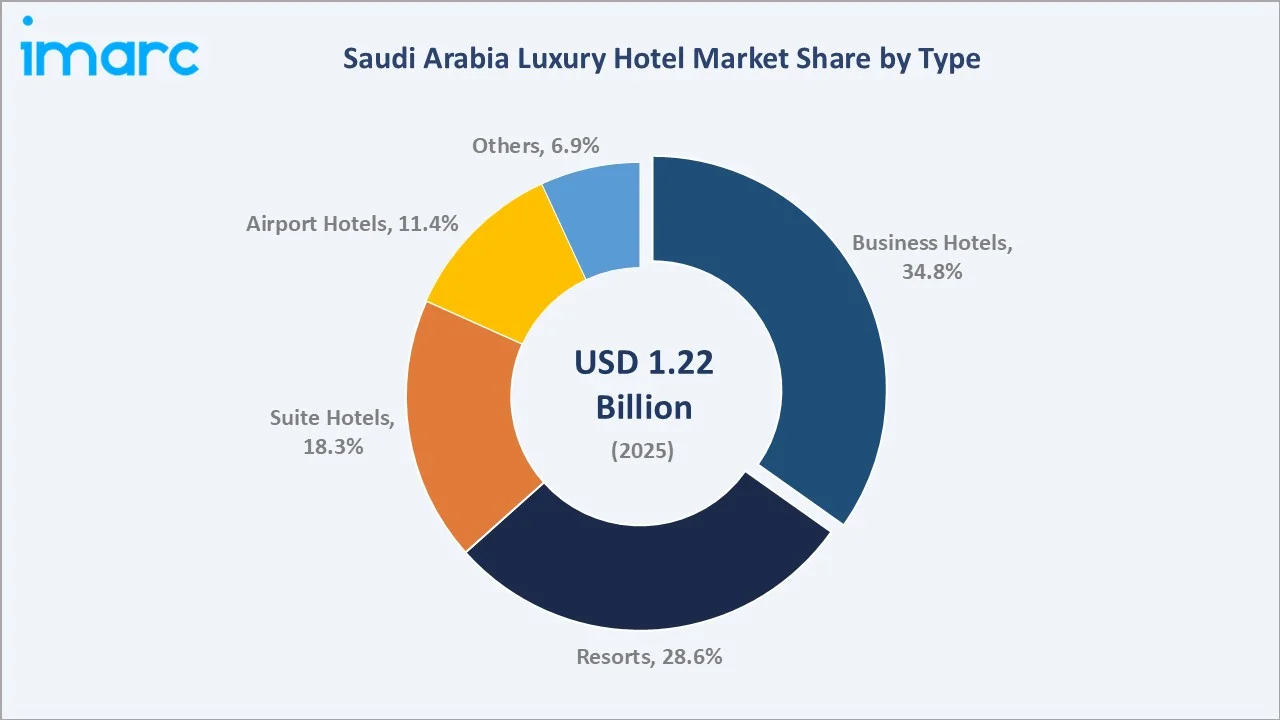
Business hotels lead at 34.8% (2025), serving Riyadh's corporate travel market, government delegation hospitality, and international conference and events demand that sustains year-round high occupancy at premium business hotel rates.
To access detailed market analysis, Request Sample
Resorts at 28.6% are the fastest-growing type at ~13.2% CAGR through Red Sea, NEOM, and Asir mountain resort destination development. Suite hotels at 18.3% serve extended-stay business and lifestyle travelers. Airport hotels at 11.4% benefit from growing transit traffic and planned expansion. Others at 6.9% include boutique, heritage, and wellness specialty properties growing rapidly through AlUla and Diriyah development.
By Room Type
The luxury room category leads at 45.7% (2025), reflecting Saudi Arabia's deliberate positioning as a premium destination attracting high-spending international visitors and serving domestic luxury traveler demand from Saudi nationals with growing luxury lifestyle preferences.
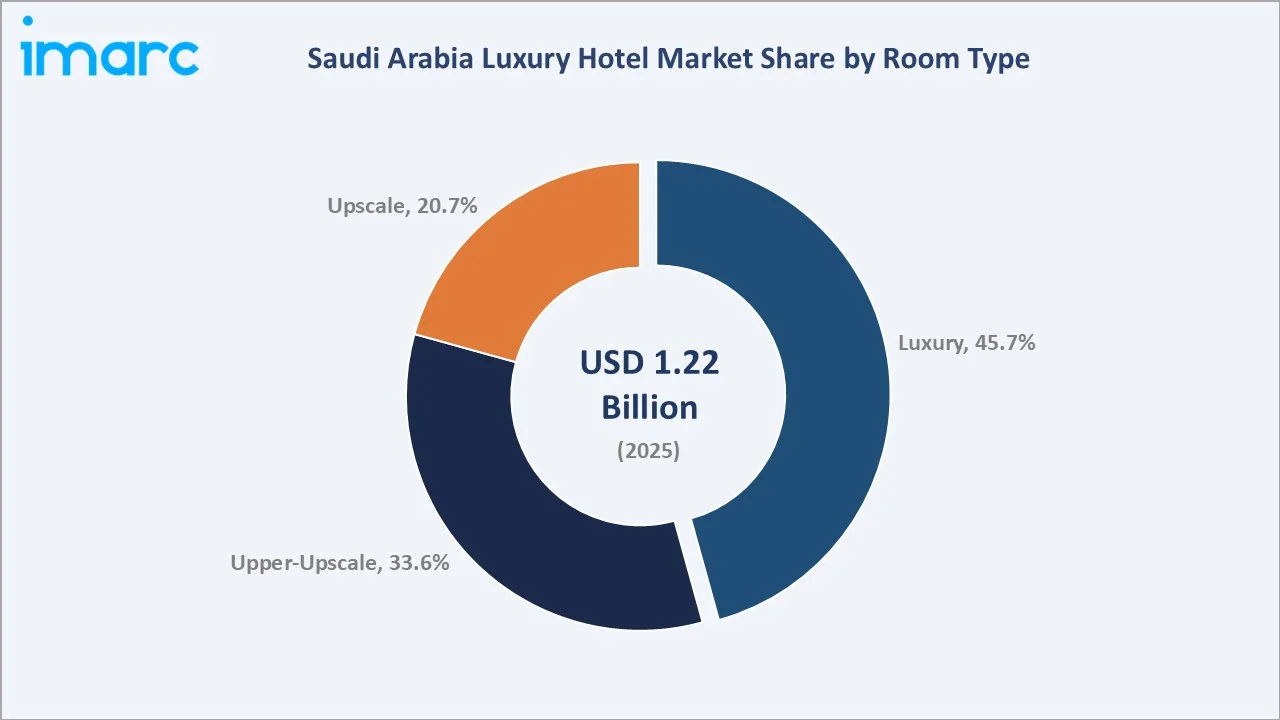
Upper-upscale at 33.6% serves the large business traveler and premium leisure segment who seek quality accommodation without the highest price points. Upscale at 20.7% captures corporate volume accounts and price-conscious premium travelers choosing quality over ultra-luxury.
Regional Market Insights
|
Region |
Share (2025) |
Key Saudi Arabia Luxury Hotel Market Drivers & Characteristics |
|
Northern & Central Region |
42.7% |
Reflecting Riyadh's dominant luxury business hotel market serving corporate travelers, government delegations, and international events, and Riyadh Season entertainment programming generating hospitality demand. |
|
Western Region |
25.8% |
Reflecting Jeddah's established luxury hotel market serving Red Sea tourism gateway, Makkah and Madinah's premium pilgrimage hospitality economy, and the Red Sea Project coastal resort destination under active development in the northwestern Red Sea. |
|
Eastern Region |
20.4% |
Reflecting a luxury business hotel market serving corporate travel, oil industry executive accommodation, and the Eastern Province's large high-income professional population's domestic leisure demand. |
|
Southern Region |
11.1% |
Reflecting premium mountain resort destination growing through Asir Province tourism development, and government investment in southern provincial luxury hospitality infrastructure serving domestic mountain tourism. |
The Northern and Central region's 42.7% dominance is anchored by Riyadh's concentration of five-star international hotel brand flagship properties that collectively serve the capital's premium corporate and government hospitality demand. The Western region's 25.8% reflects Jeddah's sophisticated luxury hospitality market and the transformative impact of Red Sea Global's coastal resort development, creating premium leisure hotel supply across the development zone.
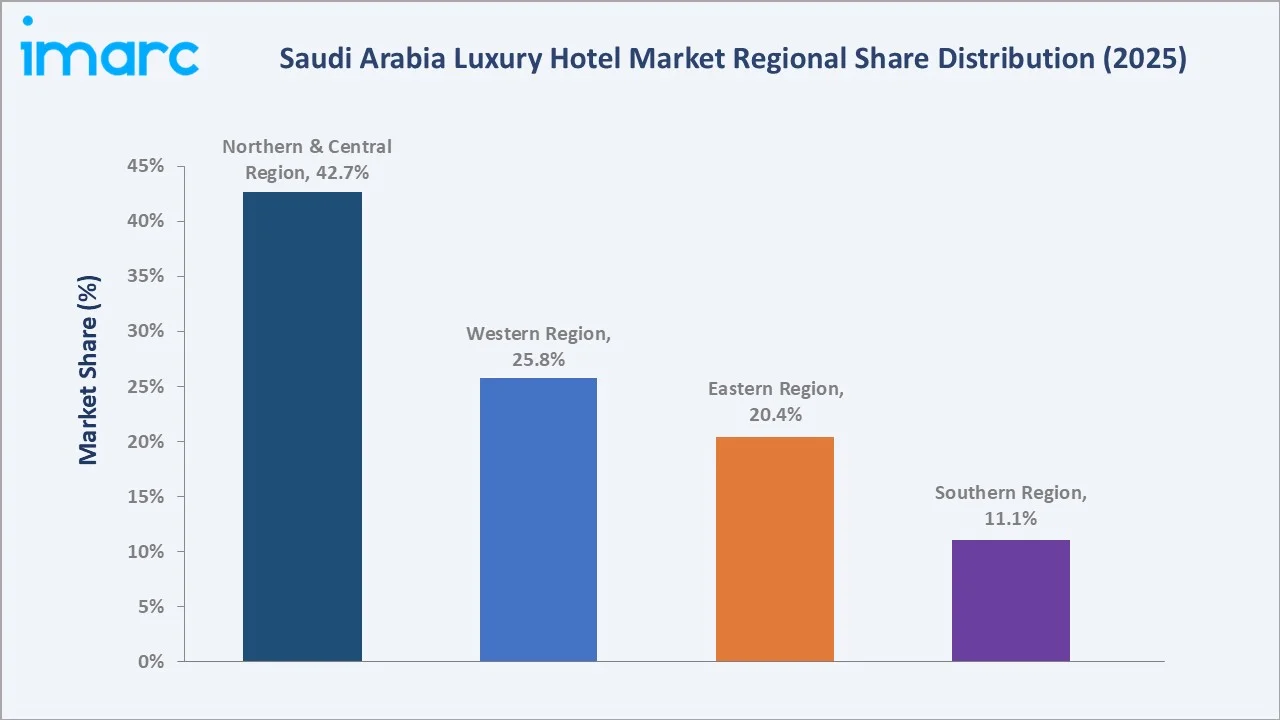
The Eastern region's 20.4% reflects the luxury hotel corridor serving global business executive travel, the Eastern Province's high-income population's domestic leisure hospitality demand, and the growing international exhibition and conference facilities. The Southern region at 11.1% represents high potential with cool climate mountain resort positioning as Saudi Arabia's most distinctive domestic leisure destination for summer travel during the period when coastal and desert regions experience extreme heat.
Competitive Landscape
The Saudi Arabia luxury hotel market features the most prestigious hospitality brands competing for management agreements and franchise opportunities across an unprecedented development pipeline. Competition is driven by portfolio scale, brand positioning, management fee structures, and relationships with Saudi development authorities.
|
Company |
Key Offerings |
Market Position |
Core Strength |
|
Marriott International, Inc. |
Le Méridien Al Khobar, Marriott Executive Apartments Al Khobar, Aloft by Marriott Dhahran, Le Méridien Medina, Element by Marriott Al Qassim |
Market Leader |
Marriott International, Inc. is expanding its luxury and hospitality footprint in Saudi Arabia to align with the country's Vision 2030 economic and tourism diversification goals. |
|
IHG |
Crowne Plaza Jeddah Al Salam, InterContinental Dar Al Tawhid Makkah, InterContinental Al Ahsa, Holiday Inn Yanbu, InterContinental Al Khobar, Kimpton KAFD Riyadh |
Market Leader |
IHG is driving Saudi Arabia's luxury and lifestyle hospitality boom by expanding its high-end footprint to align with the Kingdom’s Vision 2030 tourism goals. |
|
Hyatt Corporation |
Grand Hyatt Al Khobar Hotel and Residences |
Established Player |
Hyatt Corporation is expanding its luxury and lifestyle footprint in Saudi Arabia through high-profile properties. |
|
Accor |
Fairmont Ramla Riyadh, Sofitel Shahd Al Madinah, Sofitel Al Khobar The Corniche, Rixos Obhur Jeddah Resort & Villas, Raffles Jeddah |
Established Player |
Accor serves as the largest international hotel operator in Saudi Arabia, playing a foundational role in shaping the Kingdom's luxury, lifestyle, and multi-tier hospitality landscape under Saudi Vision 2030. |
|
Four Seasons Hotels Limited |
AMAALA at Triple Bay, Red Sea at Shura Island, Riyadh at Kingdom Centre |
Innovator |
Four Seasons Hotels Limited acts as a premier operator and strategic hospitality partner in Saudi Arabia, aligning its legendary service standards with the Kingdom’s Vision 2030 luxury tourism expansion |
Companies across the competitive landscape are signing Saudi Arabia management agreements at an accelerating pace as the development pipeline scales, and government commitment clarity de-risks market entry investment. The competition for high-profile giga-project management agreements is particularly intense, with multiple global luxury brands submitting competitive bids for flagship resort and heritage destination contracts.
Key Company Profiles
Marriott International, Inc.
Marriott International, Inc., the world's largest hotel company with a high number of properties across various brands, operates the most extensive luxury hotel portfolio in Saudi Arabia. Marriott International's Saudi Arabia strategy benefits from its unmatched loyalty program that provides consistent demand generation for Saudi properties through global corporate accounts, leisure traveler loyalty redemptions, and group bookings.
- Key Offerings: Le Méridien Al Khobar, Marriott Executive Apartments Al Khobar, Aloft by Marriott Dhahran, Le Méridien Medina, Element by Marriott Al Qassim.
- Strategic Focus: Expanding Saudi Arabia management agreement portfolio through aggressive signing of giga-project resort and heritage destination properties, leveraging Marriott global loyalty database to drive international source market demand for Saudi properties, and developing Saudi hospitality talent programs that build Saudization-compliant management pipelines.
IHG
IHG is a global hospitality company with a growing presence in Saudi Arabia’s luxury hotel market. The company operates a diversified portfolio of premium and luxury brands serving business, leisure, and religious travelers across major Saudi cities and tourism destinations. Its presence supports the Kingdom’s expanding high-end hospitality infrastructure and rising demand for internationally branded accommodation.
- Key Offerings: Crowne Plaza Jeddah Al Salam, InterContinental Dar Al Tawhid Makkah, InterContinental Al Ahsa, Holiday Inn Yanbu, InterContinental Al Khobar, Kimpton KAFD Riyadh.
- Strategic Focus: Expanding its luxury and premium hotel portfolio across key Saudi cities and emerging tourism destinations. Its strategy emphasizes brand diversification, strategic partnerships, and capturing rising demand from international, leisure, business, and religious travelers.
Market Concentration Analysis
The Saudi Arabia luxury hotel market exhibits moderate concentration at the brand operator level, with Marriott International, Inc., IHG, Hyatt Corporation, and Accor collectively commanding the majority of signed management agreements and operating keys. The ultra-luxury segment is more fragmented, with each operating a smaller number of premium properties positioned at the highest ADR points. Market concentration is expected to remain moderate through 2034, with the scale of Saudi Arabia's development pipeline creating sufficient management agreement opportunities for 15-20 luxury hotel groups to build meaningful Saudi portfolios simultaneously.
Investment & Growth Opportunities
Highest Growth Segments
Resorts (~13.2% CAGR), ultra-luxury UHNW hospitality, wellness and health tourism resort hotels, heritage boutique properties, suite hotels for extended-stay travelers, and premium pilgrimage hospitality represent the highest-growth investment vectors in the Saudi Arabia luxury hotel market through 2034.
Investment Themes
- Giga-project resort management agreement positioning: Securing management agreements at Red Sea, NEOM, and AMAALA developments before final brand allocations are completed represents the most strategically valuable Saudi luxury hotel investment vector. These agreements provide revenue streams from properties in globally unique destinations that will generate extraordinary international media exposure and traveler attention as they open.
- Religious tourism premium hospitality investment: Developing or acquiring premium hotel properties in Makkah and Madinah adjacent to the primary pilgrimage sites captures the growing affluent Muslim traveler segment upgrading their pilgrimage accommodation experience. The Umrah visitors represent a substantial and growing premium hospitality market with guaranteed demand season alignment distinct from conventional tourism seasonality.
Future Market Outlook (2026-2034)
The Saudi Arabia luxury hotel market is projected to grow from USD 1.22 Billion in 2025 to USD 3.07 Billion by 2034, exhibiting a CAGR of 10.76% during 2026-2034. The market is projected to reach an anchor value of USD 2.04 Billion by 2030, representing the mid-period milestone at which Vision 2030's 150-million visitor target approaches attainment and the first Red Sea, NEOM, and other luxury properties reach stabilized operations.
Three structural forces will define the Saudi Arabia luxury hotel market through 2034. First, the progressive opening of transformational luxury tourism destinations will add thousands of ultra-luxury hotel keys in internationally unique settings. Second, FIFA World Cup 2034 will serve as the single most impactful catalyst for Saudi luxury hotel market development since Vision 2030's launch. The event requires world-class hotel accommodation across multiple Saudi host cities, creating mandated supply expansion backed by FIFA compliance requirements. Third, rising domestic luxury travel demand will provide a resilient foundation for Saudi luxury hotel revenue that smooths seasonal and source market volatility.
Research Methodology
Primary Research
Primary research comprised in-depth interviews with luxury hotel general managers, Saudi Tourism Authority representatives, real estate and hospitality investment analysts, global hotel brand vice presidents for Middle East development, and destination management company executives. These discussions validated market size estimates, assessed hotel type and room category demand dynamics, evaluated competitive positioning, and provided insights into giga-project development timelines and future market evolution.
Secondary Research
Secondary research encompassed annual tourism statistics, accommodation licensing data, Vision 2030 National Tourism Strategy publications, hospitality investment portfolio disclosures, hotel performance benchmarking data for the Saudi Arabia market, major hotel group annual reports and investor presentations, and industry publications covering Middle East luxury hospitality market developments.
Forecasting Models
Forecasting models incorporated historical luxury hotel market revenue trends, Vision 2030 tourism target trajectories, giga-project hotel key delivery schedules, international visitor arrival growth projections, domestic tourism spending growth forecasts, and ADR evolution assumptions based on supply quality mix shift toward ultra-luxury. Both demand-side visitor spending models and supply-side estimation approaches were cross-validated.
Saudi Arabia Luxury Hotel Market Report Coverage:
| Report Features | Details |
|---|---|
| Base Year of the Analysis | 2025 |
| Historical Period | 2020-2025 |
| Forecast Period | 2026-2034 |
| Units | Billion USD |
| Scope of the Report |
Exploration of Historical Trends and Market Outlook, Industry Catalysts and Challenges, Segment-Wise Historical and Future Market Assessment:
|
| Types Covered | Business Hotels, Airport Hotels, Suite Hotels, Resorts, Others |
| Room Types Covered | Luxury, Upper-Upscale, Upscale |
| Categories Covered | Chain, Independent |
| Regions Covered | Northern and Central Region, Western Region, Eastern Region, Southern Region |
| Companies Covered | Marriott International, Inc., IHG, Hyatt Corporation, Accor, Four Seasons Hotels Limited, etc. |
| Customization Scope | 10% Free Customization |
| Post-Sale Analyst Support | 10-12 Weeks |
| Delivery Format | PDF and Excel through Email (We can also provide the editable version of the report in PPT/Word format on special request) |
Key Benefits for Stakeholders:
- IMARC’s industry report offers a comprehensive quantitative analysis of various market segments, historical and current market trends, market forecasts, and dynamics of the Saudi Arabia luxury hotel market from 2020-2034.
- The research report provides the latest information on the market drivers, challenges, and opportunities in the Saudi Arabia luxury hotel market.
- Porter's five forces analysis assist stakeholders in assessing the impact of new entrants, competitive rivalry, supplier power, buyer power, and the threat of substitution. It helps stakeholders to analyze the level of competition within the Saudi Arabia luxury hotel industry and its attractiveness.
- Competitive landscape allows stakeholders to understand their competitive environment and provides an insight into the current positions of key players in the market.
Frequently Asked Questions About the Saudi Arabia Luxury Hotel Market Report
The Saudi Arabia luxury hotel market reached USD 1.22 Billion in 2025, driven by Vision 2030's National Tourism Strategy, Red Sea and NEOM giga-project resort development, FIFA World Cup 2034 capacity investment, tourism liberalization attracting international visitors, and rising domestic luxury traveler demand.
The Saudi Arabia luxury hotel market is projected to grow at a CAGR of 10.76% during 2026-2034, sustained by progressive giga-project resort openings, 150-million visitor target attainment, FIFA World Cup 2034 demand surge, growing domestic luxury travel, and ultra-luxury segment ADR premium expansion.
The market is projected to reach approximately USD 2.04 Billion by 2030, representing the mid-period milestone at which Vision 2030's visitor targets approach attainment, first-wave Red Sea and NEOM luxury resort properties reach stabilized operations, and Riyadh Expo 2030 generates peak hospitality demand.
Business hotels lead with a 34.8% share in 2025, serving Riyadh's corporate travel market, government delegation hospitality, and international conference demand that sustains year-round high occupancy at premium rates, reflecting Riyadh's consolidation as a premier global business destination.
The luxury room category leads with a 45.7% share in 2025, reflecting Saudi Arabia's deliberate premium positioning strategy targeting high-spending international visitors through giga-project ultra-luxury destinations and serving domestic luxury traveler demand from Saudi nationals with sophisticated international hospitality experience.
The Northern and Central region leads with a 42.7% share in 2025, driven by Riyadh's concentration of flagship international luxury hotel brand properties serving corporate travel, government hospitality, and international events, supplemented by the Diriyah luxury heritage destination development.
Key players include Marriott International, Inc., IHG, Hyatt Corporation, Accor, and Four Seasons Hotels Limited, among others.
The Saudi Arabia luxury hotel market is projected to reach USD 3.07 Billion by 2034, driven by FIFA World Cup 2034 demand, full giga-project resort portfolio operational maturity, Saudi Arabia's establishment as a top-tier global luxury tourism destination, and sustained domestic luxury travel culture normalization.
Need more help?
- Speak to our experienced analysts for insights on the current market scenarios.
- Include additional segments and countries to customize the report as per your requirement.
- Gain an unparalleled competitive advantage in your domain by understanding how to utilize the report and positively impacting your operations and revenue.
- For further assistance, please connect with our analysts.
 Request Customization
 Speak to an Analyst
 Request Brochure
 Inquire Before Buying
Benefits of Customization
- Personalize this research
- Triangulate with your data
- Get data as per your format and definition
- Gain a deeper dive into a specific application, geography, customer, or competitor
- Any level of personalization
Get in Touch With Us
UNITED STATES
Phone: +1-201-971-6302
INDIA
Phone: +91-120-433-0800
UNITED KINGDOM
Phone: +44-753-714-6104
Email: [email protected]
Client Testimonials




.webp)




.webp)













Related Reports

Choose your plan
*Please note that the prices mentioned below are starting prices for each bundle type. Kindly contact our team for further details.*
Single User License
- 1 User License, Access on 2 Devices
- PDF Report + Excel Dataset (Password Protected)
- Lifetime Access
- No Printing Rights
- 10% Free Report Customization
- 10–12 Weeks of Analyst Support
Five User License
- Access for 5 Users, 2 Devices per User
- PDF Report + Excel Dataset (Password Protected)
- Lifetime Access
- Dedicated Account Manager
- 12–14 Weeks of Analyst Support
- No Printing Rights
- 15% Free Report Customization
- 25% Discount on Your Next Purchase
Corporate User License
- Unlimited User Access (Within Your Organization)
- PDF Report + Excel Dataset
- Lifetime Access
- Dedicated Account Manager
- 14–20 Weeks of Analyst Support
- No Printing Rights
- 20% Free Report Customization
- 30% Discount on Your Next Purchase
Essential Insights
What's included:
3 reports
- Lifetime Access
- PDF Reports
- Excel Datasets
- 2 Weeks of Free Analyst Support
- 2 User Licenses
- Access on 2 Devices
- Printing Rights
- Complimentary PowerPoint (PPT) Version
- Complimentary License Upgrade
Professional Access
What's included:
5 reports
- Lifetime Access
- PDF Reports
- Excel Datasets
- 8 Weeks of Free Analyst Support
- 2 User Licenses
- Access on 2 Devices
- Printing Rights
- Complimentary PowerPoint (PPT) Version
- Complimentary License Upgrade
Business Advantage
What's included:
8 reports
- Lifetime Access
- PDF Reports
- Excel Datasets
- 14 Weeks of Free Analyst Support
- 2 User Licenses
- Access on 2 Devices
- Printing Rights
- Complimentary PowerPoint (PPT) Version
- Complimentary License Upgrade
Enterprise Intelligence
What's included:
10 reports
- Lifetime Access
- PDF Reports
- Excel Datasets
- 20 Weeks of Free Analyst Support
- 2 User Licenses
- Access on 2 Devices
- Printing Rights
- Complimentary PowerPoint (PPT) Version
- Complimentary License Upgrade