
Saudi Arabia Packaging Market Size, Share, Trends and Forecast by Packaging Type, Packaging Material, End Use Industry, and Region, 2026-2034
Saudi Arabia Packaging Market Size, Share, Trends & Forecast (2026-2034)
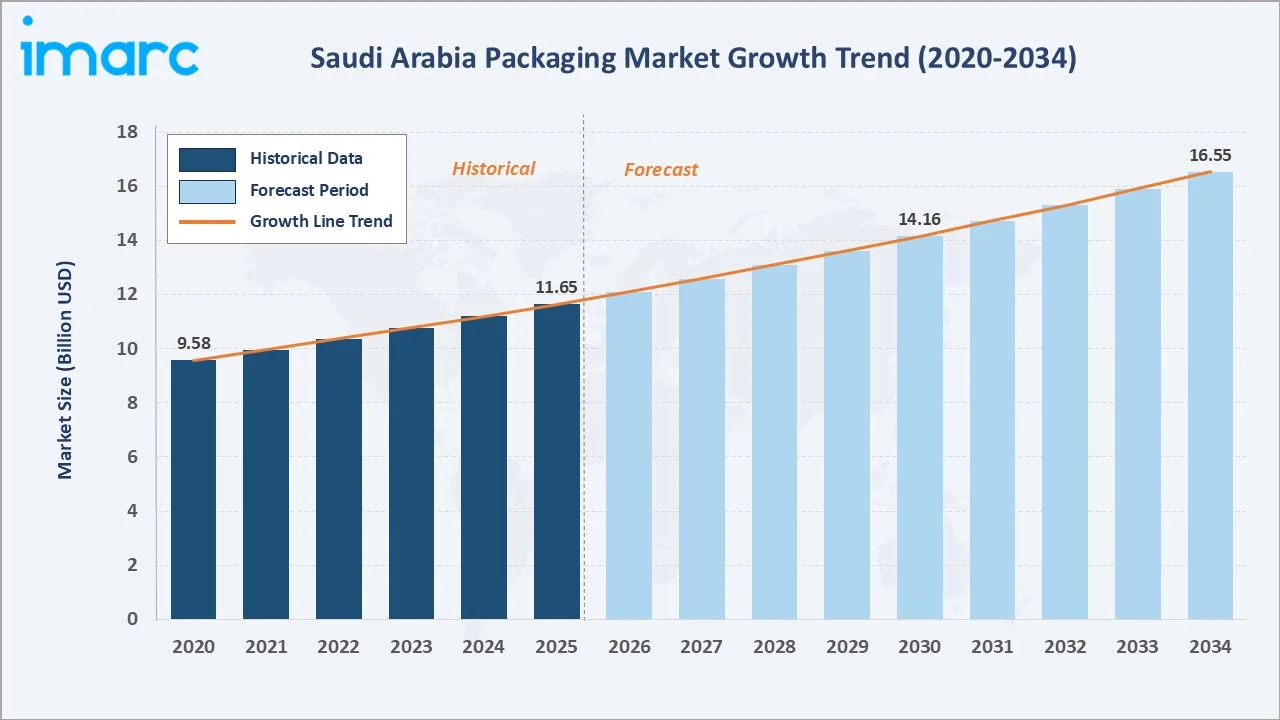
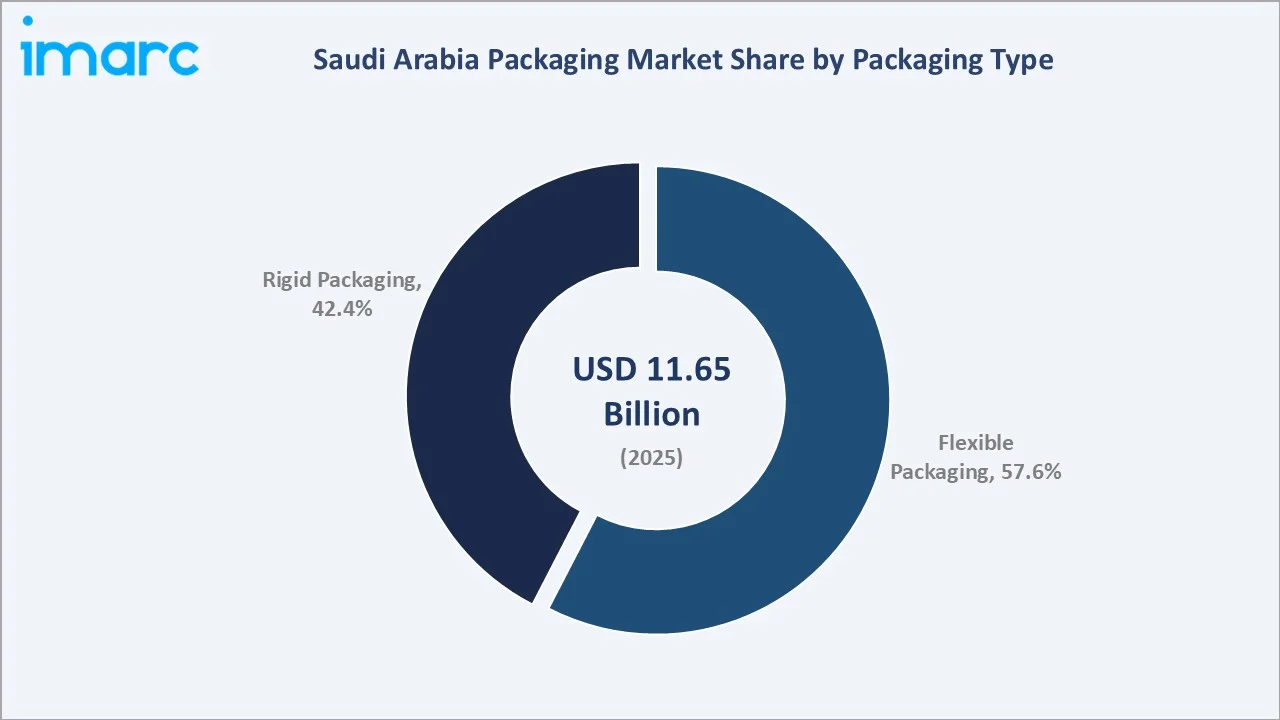
The Saudi Arabia packaging market grew from USD 11.65 Billion in 2025 to USD 12.11 Billion in 2026 and is projected to reach USD 16.55 Billion by 2034, growing at a CAGR of 3.98% during 2026-2034. The market is driven by Vision 2030's food and beverage industrialization program, rapid e-commerce expansion requiring protective and branded packaging solutions, healthcare sector investment creating pharmaceutical packaging demand, and growing FMCG and beauty industry consumption. Flexible packaging leads at 57.6% by type, plastic dominates at 56.8% by material, and the Northern and Central region commands the largest share at 39.1%.
Market Snapshot
|
Metric |
Value |
|
Base Year Market Size (2025) |
USD 11.65 Billion |
| Market Size (2026) | USD 12.11 Billion |
|
Forecast Market Size (2034) |
USD 16.55 Billion |
|
CAGR (2026-2034) |
3.98% |
|
Base Year |
2025 |
|
Historical Period |
2020-2025 |
|
Forecast Period |
2026-2034 |
|
Dominant Packaging Type |
Flexible Packaging (57.6%, 2025) |
|
Dominant Packaging Material |
Plastic (56.8%, 2025) |
|
Leading Region |
Northern and Central Region (39.1%, 2025) |
The Saudi Arabia packaging market expanded from USD 9.58 Billion in 2020 to USD 11.65 Billion in 2025 and an estimated USD 12.11 Billion in 2026, driven by consistent demand across food and beverage, healthcare, retail, and beauty sectors. The market is projected to reach USD 14.16 Billion by 2030 and USD 16.55 Billion by 2034.
To get more information on this market, Request Sample
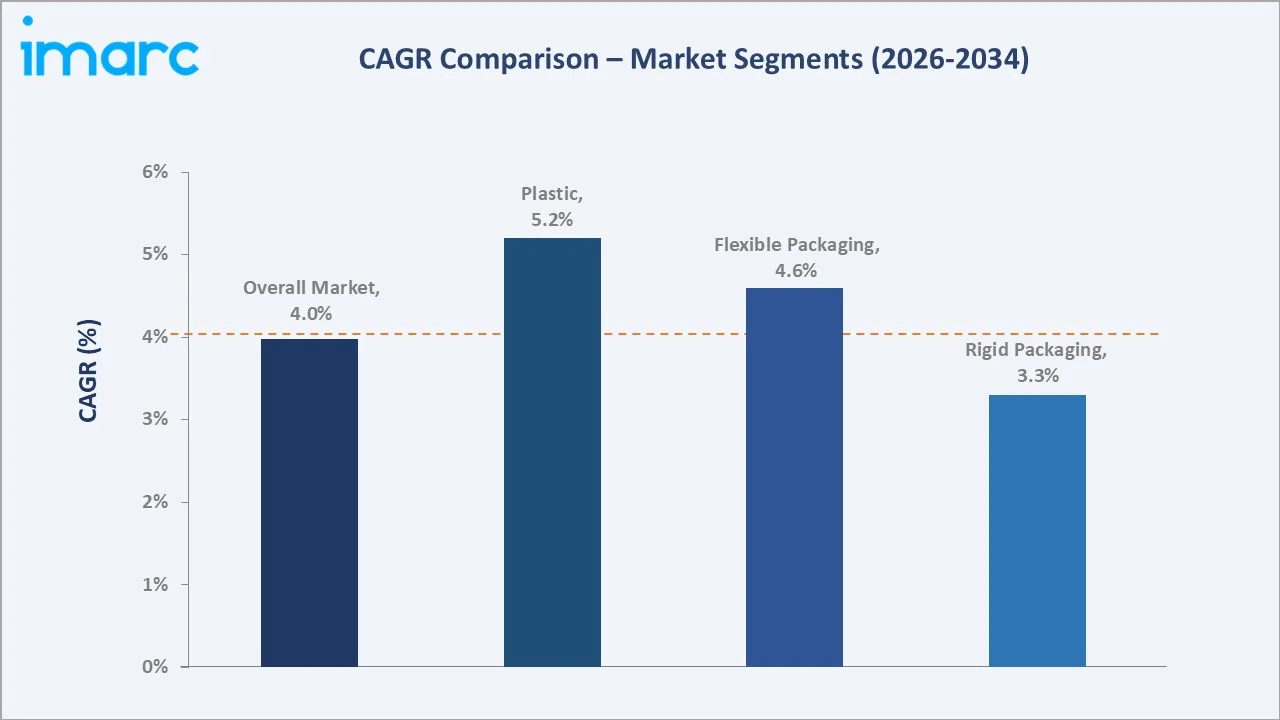
Plastic grows at ~5.2% CAGR through food, beverage, personal care, and e-commerce applications. Flexible packaging grows at ~4.6% CAGR through food, beverage, and e-commerce applications. Rigid packaging grows at ~3.3% CAGR through e-commerce expansion.
Executive Summary
The Saudi Arabia packaging market represents one of the GCC's most substantial and structurally diverse industrial segments, serving a broad and growing range of end-use industries including food processing, beverage manufacturing, pharmaceutical production, retail distribution, and beauty and personal care. Flexible packaging at 57.6% leads through versatility and food, beverage, and e-commerce demand. Plastic at 56.8% leads by material through cost efficiency and domestic feedstock advantage. Northern & Central region leads regionally at 39.1%.
Key Market Insights
|
Insight |
Data |
|
Dominant Packaging Type |
Flexible Packaging - 57.6% share (2025) |
|
Dominant Packaging Material |
Plastic - 56.8% share (2025) |
|
Leading Region |
Northern & Central Region - 39.1% (2025) |
|
Key Market Opportunities |
Rising demand for sustainable, recyclable, and smart packaging solutions, supported by rapid growth in e-commerce, food and beverage, pharmaceuticals, and Saudi Arabia’s broader sustainability initiatives. |
Key Analytical Observations Supporting the Above Data:
- Flexible Packaging at 57.6%: Flexible packaging dominates through its superior cost efficiency, lightweight characteristics, extended shelf life capabilities, and versatility across food, beverage, personal care, and e-commerce applications. Pouches, films, bags, wraps, and laminates serve Saudi Arabia's large food processing sector, where snack foods, dairy products, confectionery, and ready meals require moisture barriers, oxygen barriers, and tamper evidence that flexible formats deliver cost-effectively.
- Plastic at 56.8%: Plastic materials dominate Saudi Arabia's packaging market through the structural advantage of domestic petrochemical production that provides Saudi packaging manufacturers with access to polyolefin resins, PET, and polystyrene at globally competitive prices.
- Northern & Central Region at 39.1%: The Northern and Central region leads through Riyadh's concentration of Saudi Arabia's largest food and beverage manufacturers, FMCG brand headquarters, pharmaceutical companies, and e-commerce distribution centers that collectively generate the highest packaging procurement volumes.
Saudi Arabia Packaging Market Overview
The Saudi Arabia packaging market encompasses the design, production, and distribution of packaging solutions across two primary format categories: flexible packaging (pouches, films, bags, wraps, sachets, and laminates) and rigid packaging (bottles, jars, containers, cans, boxes, and cartons). The market is served across packaging materials including plastic (PET, HDPE, LLDPE, PP, PS, PVC), glass, metal (aluminum and steel), paper and paperboard, and emerging bio-based and compostable alternatives. End-use industries served include food, beverage, healthcare and pharmaceutical, retail, beauty and personal care, and industrial applications.
Market Dynamics
To evaluate market opportunities, Request Sample
Market Drivers
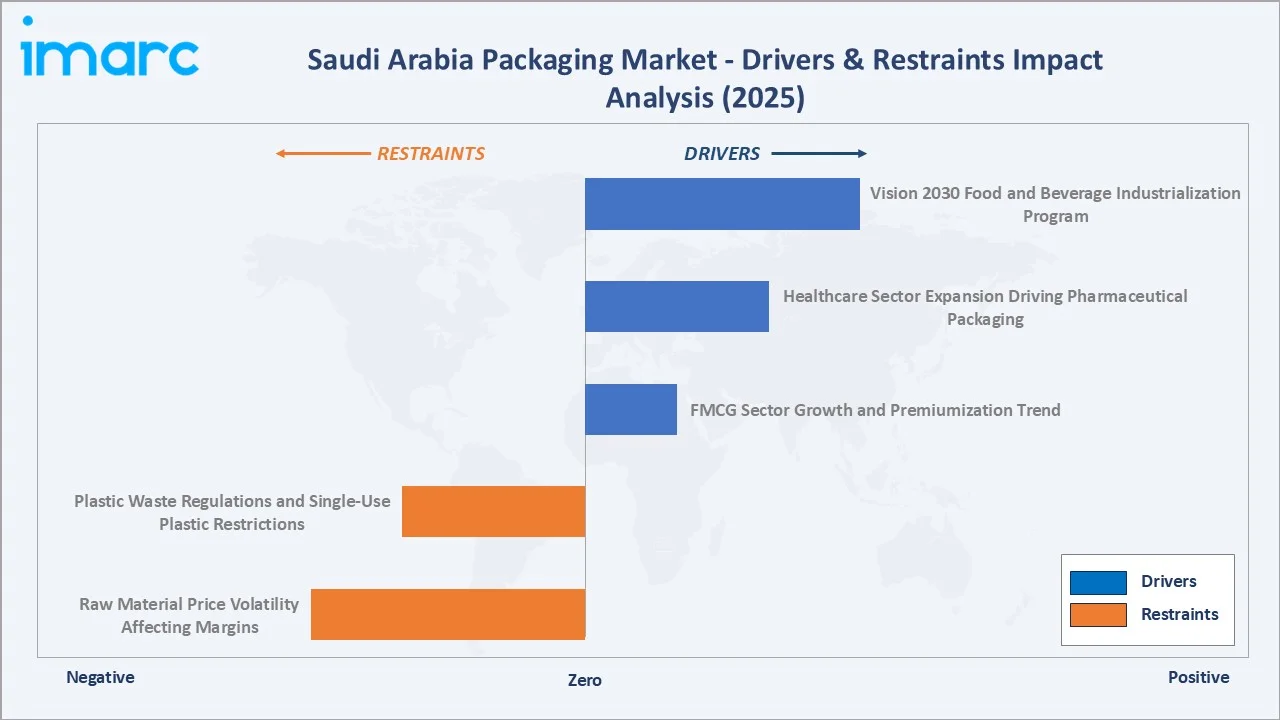
- Vision 2030 Food and Beverage Industrialization Program: Saudi Arabia's Vision 2030 food sector localization targets are driving significant new food manufacturing investment that directly generates packaging demand. The Saudi government's initiative to increase domestic food production, targeting 80% food self-sufficiency, is attracting food processing investments in dairy, confectionery, snacks, beverages, and processed meat that require substantial packaging volumes.
- Healthcare Sector Expansion Driving Pharmaceutical Packaging: Vision 2030's healthcare investment is generating substantial pharmaceutical packaging demand across blister packs, bottles, vials, ampoules, and medical device packaging. The Kingdom's pharmaceutical manufacturing expansion under Vision 2030's healthcare localization objectives is creating additional local pharmaceutical packaging procurement that directly supports the specialty packaging segment.
- FMCG Sector Growth and Premiumization Trend: Saudi Arabia's expanding FMCG sector, serving 36 million people, is growing consumption across food, beverage, personal care, and household products that are all primary packaging consumers. The premiumization trend in Saudi FMCG, where brand owners invest in higher-quality packaging materials, finishes, and designs to command price premiums and brand differentiation, supports packaging revenue growth beyond volume alone.
Market Restraints
- Plastic Waste Regulations and Single-Use Plastic Restrictions: Saudi Arabia's increasing environmental consciousness, driven by the Saudi Green Initiative's sustainability commitments and regional regulatory alignment with global plastic reduction trends, is creating compliance challenges for plastic packaging manufacturers and buyers. Extended producer responsibility frameworks, single-use plastic restrictions, and mandatory recyclability requirements being progressively introduced in Saudi Arabia are imposing additional cost and formulation complexity on plastic packaging businesses.
- Raw Material Price Volatility Affecting Margins: Despite domestic feedstock advantage for polyolefin-based plastics, Saudi packaging manufacturers relying on imported materials face raw material cost volatility linked to global commodity markets, currency fluctuations, and supply chain disruptions. These cost pressures compress manufacturer margins and create uncertainty in long-term contract pricing that complicates procurement planning for both manufacturers and buyers.
Market Opportunities
- Sustainable and Recyclable Packaging Development: Saudi Arabia's Saudi Green Initiative and its commitment to achieving Net Zero by 2060 are creating growing demand for sustainable packaging innovations including recyclable mono-material structures, post-consumer recycled (PCR) content incorporation, bio-based plastic alternatives, and compostable packaging materials. Brand owners in Saudi Arabia's FMCG sector are progressively setting sustainability targets for their packaging portfolios that create premium demand for environmentally compliant packaging solutions.
- Smart and Active Packaging Technology: Advanced packaging technologies including QR-code-enabled traceability, active atmosphere modification for fresh food shelf-life extension, time-temperature indicators for cold chain compliance, and RFID-enabled inventory management are creating higher-value packaging product categories. Saudi Arabia's advanced digital infrastructure and sophisticated retail supply chain create a favorable environment for smart packaging technology adoption in premium food, healthcare, and retail packaging applications.
Market Challenges
- Domestic Manufacturing Capacity Gaps for Specialty Packaging: Saudi Arabia's domestic packaging manufacturing base still relies on imports for significant proportions of specialty packaging, including high-barrier flexible films, pharmaceutical blister packaging, luxury packaging, and advanced composite material structures. Building domestic capability in these specialty areas requires capital investment, technology transfer, and skilled workforce development that extends over multiple years.
- Circular Economy Infrastructure Development: Saudi Arabia's packaging recycling and circular economy infrastructure, collection systems, sorting facilities, reprocessing plants, and recycled material offtake markets are at an early development stage relative to the packaging market's scale. Without robust recycling infrastructure, packaging manufacturers cannot credibly incorporate post-consumer recycled content or close the circular economy loop that sustainability-committed brand owners and regulators increasingly require.
Emerging Market Trends
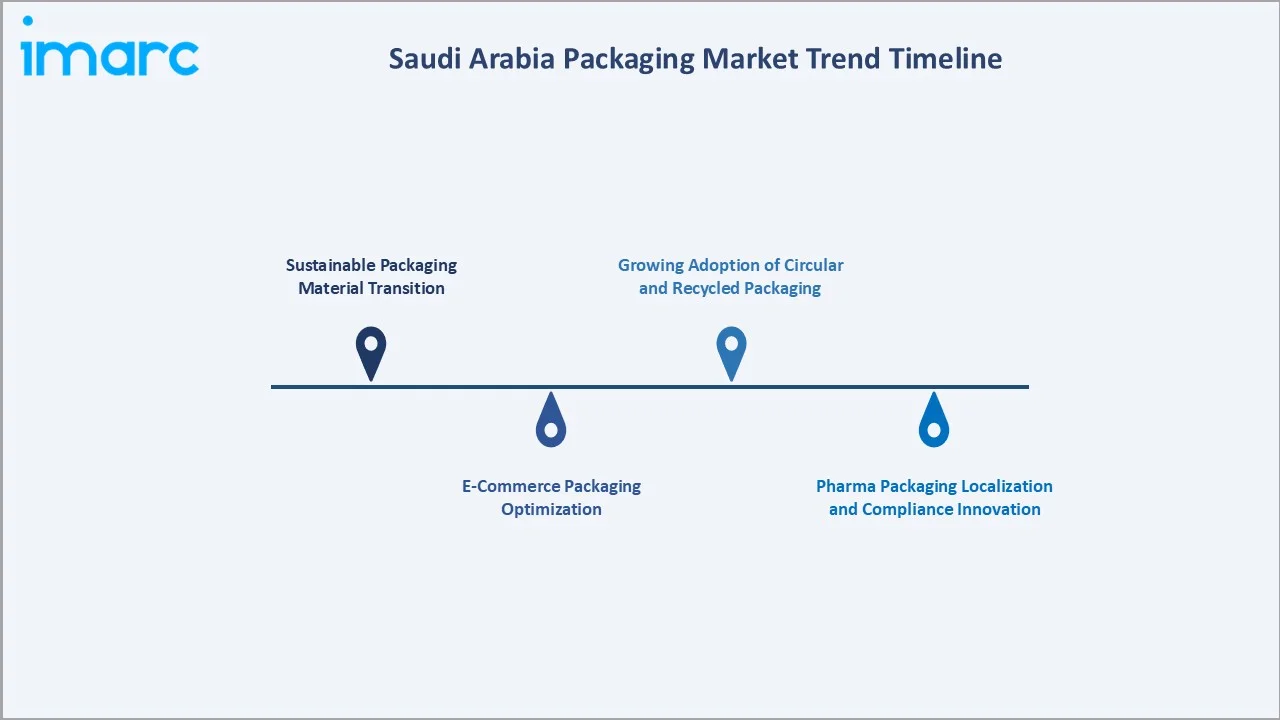
1. Sustainable Packaging Material Transition
Saudi Arabia's packaging market is experiencing accelerating material innovation toward sustainable alternatives driven by brand owner sustainability commitments, regulatory trends, and growing consumer environmental consciousness. In October 2024, Tetra Pak launched its “Made, consumed and recycled in Saudi Arabia” campaign to mark 44 years of supporting the Kingdom’s economic development, sustainability, and food security. The initiative also highlights Saudi Arabia’s growing role as a regional hub for food packaging and manufacturing. Recyclable mono-material flexible packaging replacing multi-layer laminates, bio-based PET from plant feedstocks, post-consumer recycled (PCR) plastic content incorporation, and paper-based barrier packaging replacing plastic flexible formats are all gaining commercial traction in Saudi FMCG applications.
2. E-Commerce Packaging Optimization
The rapid growth of Saudi Arabia's e-commerce sector is driving specialized packaging development for direct-to-consumer fulfillment that must balance protection performance, unboxing experience quality, dimensional efficiency for shipping cost optimization, and sustainability credentials that online shoppers increasingly expect. Right-sizing automation, paper-based cushioning alternatives to polystyrene void fill, and branded sustainable mailers are becoming standard requirements from Saudi e-commerce operators.
3. Growing Adoption of Circular and Recycled Packaging
In April 2024, SABIC launched Saudi Arabia’s first circular packaging project under its TRUCIRCLE program. As part of the initiative, FONTE introduced bread bags made by Napco National using SABIC’s certified circular polyethylene grades for its Oat Arabic Bread. This trend is encouraging packaging manufacturers and food companies in Saudi Arabia to adopt more sustainable materials and closed-loop packaging solutions.
4. Pharma Packaging Localization and Compliance Innovation
Saudi Arabia's pharmaceutical packaging sector is undergoing localization and quality upgrading driven by Vision 2030's pharmaceutical manufacturing development targets and progressively stringent serialization, tamper-evidence, and child-resistant packaging requirements. Local pharmaceutical manufacturers are investing in blister packaging lines, secondary carton printing with variable data and serialization, and pharmaceutical-grade flexible packaging that meets regulatory standards while reducing import dependence on finished drug products packaged abroad.
Industry Value Chain Analysis
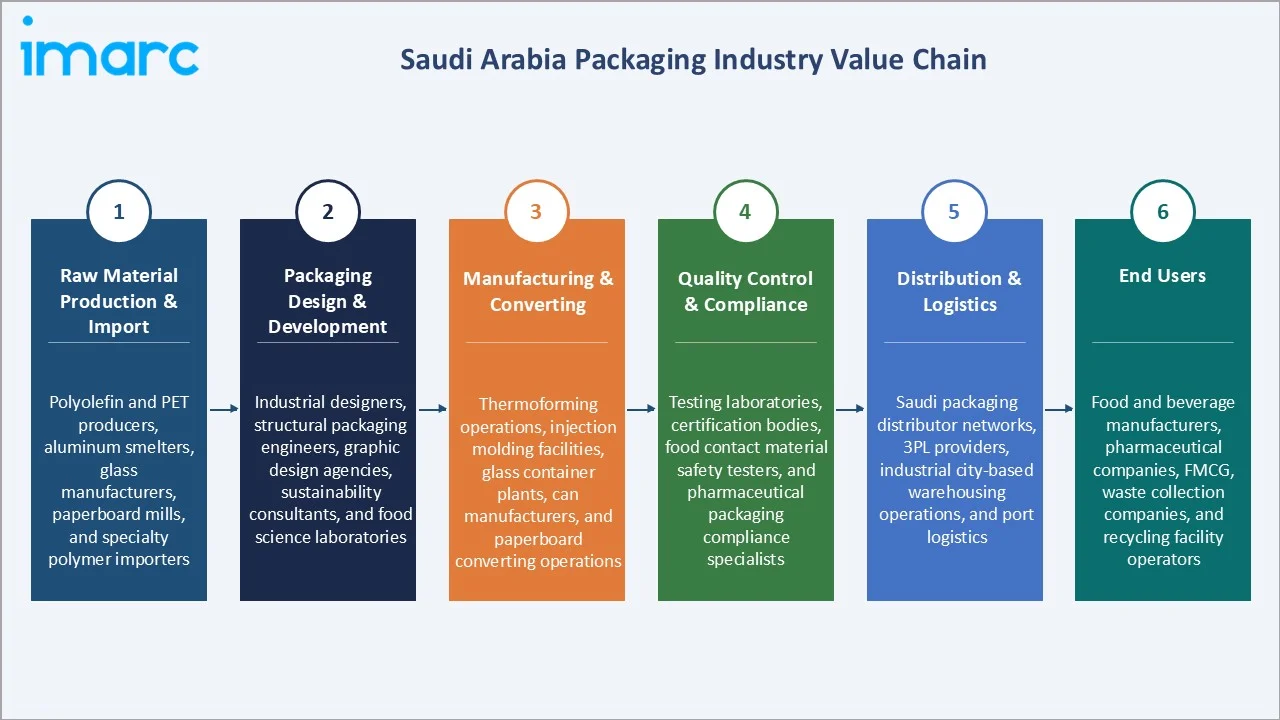
The Saudi Arabia packaging value chain integrates raw material production and import, packaging design and development, manufacturing and converting operations, quality control and regulatory compliance, distribution and logistics, and end use application with recycling and circular economy recovery.
|
Stage |
Key Participants |
|
Raw Material Production & Import |
Polyolefin and PET producers, aluminum smelters, glass manufacturers, paperboard mills, and specialty polymer importers. |
|
Packaging Design & Development |
Industrial designers, structural packaging engineers, graphic design agencies, sustainability consultants, and food science laboratories. |
|
Manufacturing & Converting |
Thermoforming operations, injection molding facilities, glass container plants, can manufacturers, and paperboard converting operations. |
|
Quality Control & Compliance |
Testing laboratories, certification bodies, food contact material safety testers, and pharmaceutical packaging compliance specialists. |
|
Distribution & Logistics |
Saudi packaging distributor networks, 3PL providers, industrial city-based warehousing operations, and port logistics. |
|
End Users |
Food and beverage manufacturers, pharmaceutical companies, FMCG, waste collection companies, and recycling facility operators. |
Manufacturing and converting represents the highest value-adding stage in Saudi Arabia's packaging value chain, where raw polymer resins, aluminum sheets, glass sand, and paperboard are transformed into functional packaging formats through capital-intensive conversion processes. Saudi Arabia's growing domestic converting capacity is progressively capturing value that was previously exported to packaging manufacturers in Asia and Europe, improving the domestic value chain's economic returns.
Technology Landscape in the Saudi Arabia Packaging Industry
Advanced Flexible Packaging Converting Technology
Saudi Arabia's flexible packaging converting industry is progressively adopting advanced manufacturing technologies including solvent-free lamination that eliminates VOC emissions from traditional solvent-based adhesive systems, digital printing enabling shorter print runs, variable data, and faster time-to-market for seasonal and regional product variants, and recyclable mono-material barrier structures using advanced coating and metallization processes that maintain barrier performance without multi-material laminates. Extended shelf-life flexible packaging using active barrier technologies is growing in Saudi Arabia's food manufacturing sector, where ambient temperature distribution creates shelf-life challenges.
Sustainability Technology and Circular Economy Innovation
SABIC's Trucircle program, which produces certified circular polymers from chemically recycled mixed plastic waste and bio-based feedstocks, provides Saudi packaging manufacturers with access to sustainability-certified plastic materials that maintain virgin polymer performance while meeting brand owner recycled content commitments. These developments are progressively enabling closed-loop packaging systems in Saudi Arabia for the first time.
Rigid Packaging Innovation: Lightweighting and Active Solutions
Saudi Arabia's rigid packaging sector is benefiting from lightweighting innovation across glass, aluminum, and plastic formats that reduces material consumption per unit while maintaining performance. Lightweight PET bottle technology for water and beverages has reduced bottle weights progressively. Aluminum can downgauge reduces metal consumption. Active rigid packaging, including oxygen-scavenging PET bottle preforms and CO2-retaining closures for carbonated beverages, improves beverage quality and shelf life for Saudi Arabia's demanding desert ambient temperature distribution environment.
Market Segmentation Analysis
The report covers the following segments:
|
Segment Category |
Leading Segment |
Market Share |
Year |
|
Packaging Type |
Flexible Packaging |
57.6% |
2025 |
|
Packaging Material |
Plastic |
56.8% |
2025 |
|
End Use Industry |
🔒 |
🔒 |
2025 |
|
Region |
Northern and Central Region |
39.1% |
2025 |

By Packaging Type
Flexible packaging leads at 57.6% (2025), through its versatility across food, beverage, personal care, and e-commerce applications combined with cost efficiency, lightweight logistics advantages, and extended shelf life capabilities for Saudi Arabia's hot climate distribution requirements.
To access detailed market analysis, Request Sample
Rigid packaging at 42.4% serves applications where structural protection, premium presentation, shelf stability, and regulatory compliance requirements mandate solid container formats. Rigid packaging dominates in bottled water, carbonated beverages, pharmaceutical products, premium personal care, and industrial applications where flexible alternatives cannot meet performance specifications.
By Packaging Material
Plastic leads at 56.8% (2025), through SABIC's domestic polyolefin and PET supply advantage, plastic's unmatched versatility across both flexible and rigid format requirements, and established processing and conversion capabilities among Saudi packaging manufacturers.
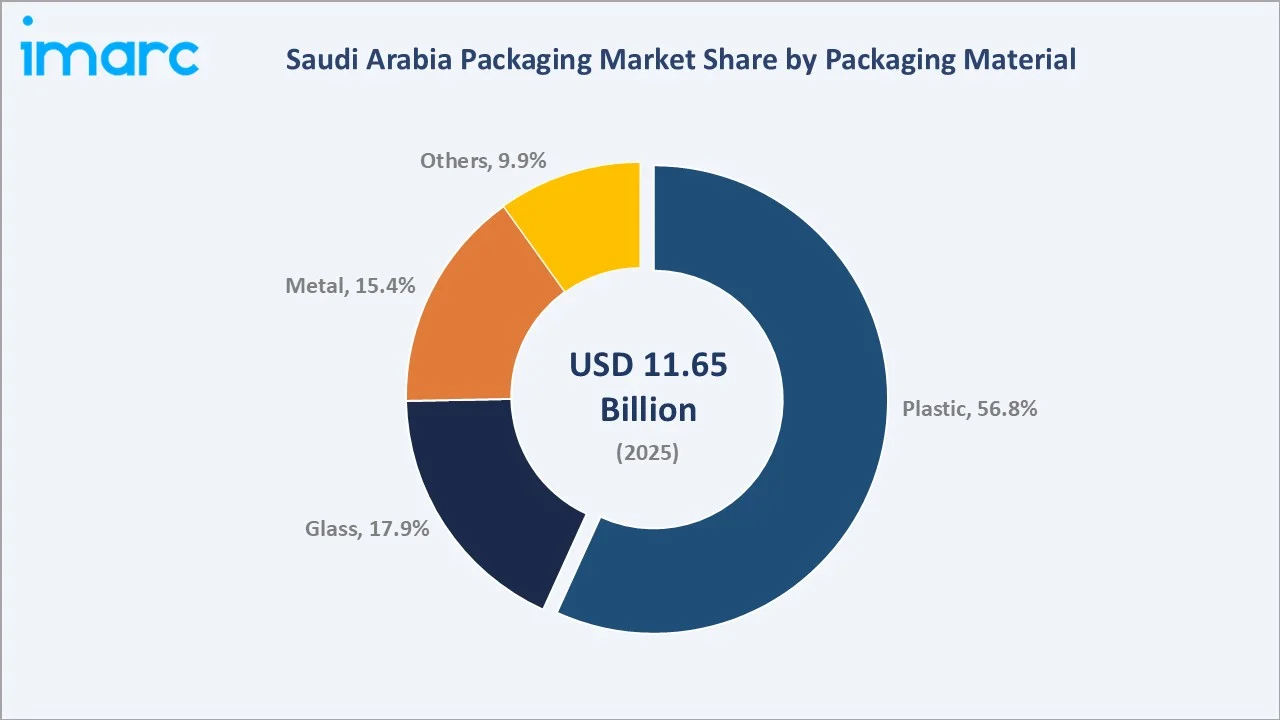
Glass at 17.9% serves premium beverage, pharmaceutical, and beauty applications where transparency, inertness, and premium presentation command the weight and cost premium over plastic alternatives. Metal at 15.4% serves the significant canned food and beverage segment, including aluminum cans for carbonated drinks and steel cans for processed foods with long shelf-life requirements. Others at 9.9% include paper, paperboard, and emerging bio-based materials growing through e-commerce packaging and sustainability-driven material switching.
Regional Market Insights
|
Region |
Share (2025) |
Key Saudi Arabia Packaging Market Drivers & Characteristics |
|
Northern & Central Region |
39.1% |
Reflecting Riyadh's concentration of food and beverage manufacturers, FMCG headquarters, pharmaceutical companies, e-commerce distribution centers, and industrial cities hosting Saudi Arabia's largest packaging manufacturing and converting operations. |
|
Western Region |
29.2% |
Reflecting Jeddah's major seaport driving packaging import volumes, Western Region's large food and beverage processing base, Makkah and Madinah pilgrimage hospitality packaging demand, and expanding pharmaceutical manufacturing investment in the region. |
|
Eastern Region |
20.0% |
Reflecting industrial complexes generating specialty chemical and petrochemical packaging demand, and industrial city manufacturers requiring industrial packaging. |
|
Southern Region |
11.7% |
Reflecting growing food and agricultural product packaging demand in Asir and Jizan provinces and developing regional food processing industry generating flexible packaging demand. |
The Northern and Central region's 39.1% leadership reflects Riyadh's extraordinary concentration of end-use industries generating packaging demand alongside the third and second industrial cities that host significant packaging manufacturing capacity. The Western region's 29.2% reflects Jeddah Islamic Port's status as Saudi Arabia's largest seaport through which significant packaging material imports transit, combined with the region's own substantial consumer goods manufacturing base.
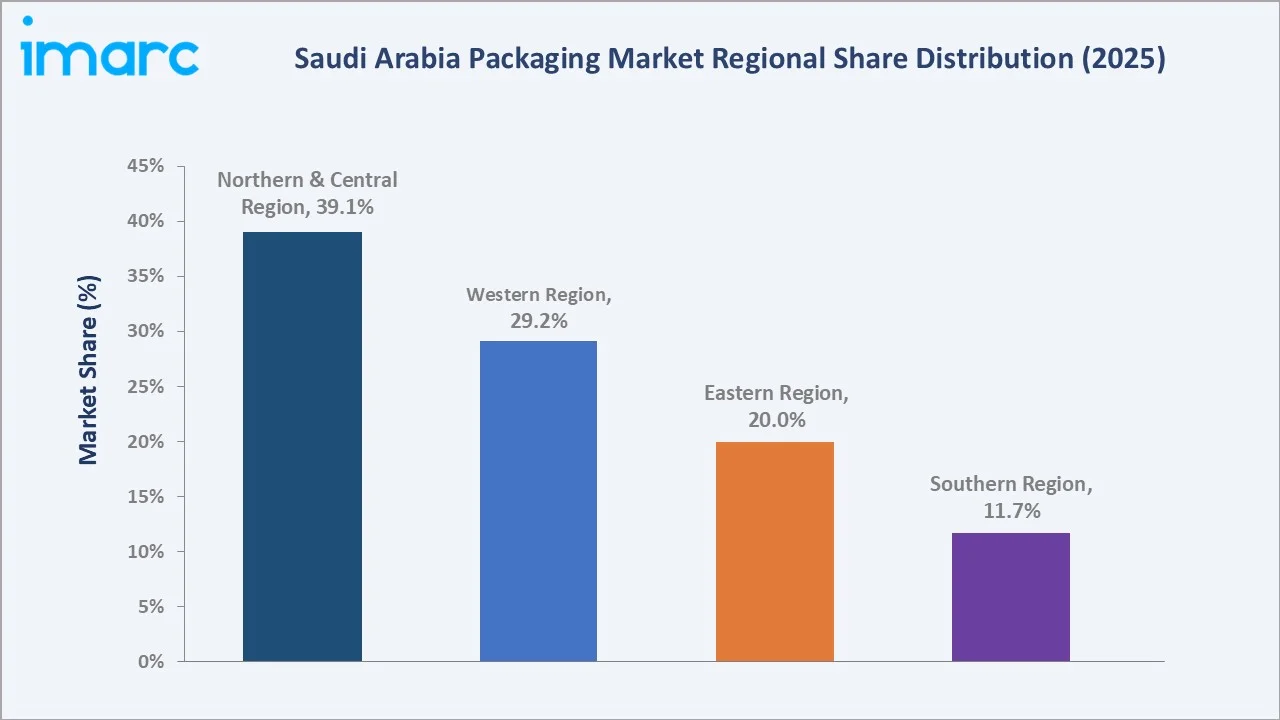
The Eastern region's 20.0% reflects the dual demand profile of Saudi Aramco's massive industrial operations requiring specialty chemical and petroleum product packaging, and the industrial cities that host petrochemical and basic industry manufacturers requiring significant packaging volumes. The Southern region at 11.7% represents a growing market as Vision 2030's industrial development and regional agricultural processing expansion generate new packaging demand in historically underserved southern provinces.
Competitive Landscape
The Saudi Arabia packaging market features a mixed competitive landscape of global packaging multinationals with Saudi Arabia operations, domestic Saudi packaging manufacturers, and regional players serving the GCC market. Competition is driven by material innovation, sustainability credentials, customer service, technical support, and price competitiveness across flexible, rigid, and specialty packaging formats.
|
Company |
Key Products |
Market Position |
Core Strength |
|
Tetra Pak International S.A. |
Tetra Brik, Tetra Gemina Aseptic, Tetra Rex, Tetra Classic Aseptic, Tetra Prisma Aseptic, Tetra Top, Tetra Recart |
Market Leader |
Tetra Pak International S.A. operates a major regional manufacturing and recycling hub in Saudi Arabia, supporting local food security, economic diversification, and Vision 2030 goals. |
|
Seal Pack Industries |
Poly Bags, Tamper Proof Courier Bag, Cash-Gold Loan Bag, Colored Courier Bags, Paper Bag |
Market Leader |
Seal Pack Industries supplies specialized pouch packing, sealing machines, and flexible packaging materials that support Saudi Arabia's expanding manufacturing and logistics sectors. |
|
Amcor plc |
AmFiber paper-based packaging solutions, AmPrima, Sustainable High Shield Pharma Laminates |
Market Leader |
Amcor plc acts as a critical technological and structural driver within Saudi Arabia’s expanding industrial sector. |
|
Mondi |
Containerboard Paper, Corrugated and solid board packaging solutions, Flexible packaging, Industrial paper bags, Uncoated printing paper |
Established Player |
Mondi, a leader in sustainable packaging and paper, plays a key role as a strategic innovator and supplier in the expanding Saudi Arabian packaging market |
|
Crown |
Beverage Cans, Beverage Ends, Aerosol Cans, Closures, Food Cans, Promotional Tins |
Established Player |
Crown plays a major role in Saudi Arabia's packaging sector as a leading manufacturer of aluminum beverage cans and metal packaging. |
Companies across the competitive landscape are investing in sustainable packaging material innovation, regulatory compliance capabilities, e-commerce packaging product development, and digital printing technology to address Saudi Arabia's evolving packaging requirements. The market is expected to see continued growth in domestic packaging manufacturing capacity as Vision 2030 industrial localization programs incentivize investment.
Key Company Profiles
Tetra Pak International S.A.
Tetra Pak International S.A., the food processing and packaging company, has operated in Saudi Arabia for decades as the indispensable supplier of aseptic carton packaging to the Kingdom's liquid food and beverage industry. Tetra Pak's unique aseptic technology is critically important for Saudi Arabia's hot-climate food distribution system, where cold chain reliability is challenging across the Kingdom's vast geography. Tetra Pak's Saudi Arabia processing and packaging system installations provide an integrated filling line, packaging supply, and technical service support.
- Key Products: Tetra Brik, Tetra Gemina Aseptic, Tetra Rex, Tetra Classic Aseptic, Tetra Prisma Aseptic, Tetra Top, Tetra Recart.
- Strategic Focus: Expanding Tetra Pak's renewable and recyclable material content in Saudi Arabia carton packaging through certified paperboard and bio-based polyethylene coatings from plant-based feedstocks, growing Tetra Pak's Saudi Arabia carton recycling collection and processing infrastructure, and developing new food processing and packaging solutions for Saudi Arabia's Vision 2030 food manufacturing sector.
Seal Pack Industries
Seal Pack Industries is one of the largest and most established flexible packaging manufacturers, producing a comprehensive range of plastic flexible packaging products for Saudi food, FMCG, and agricultural clients. Seal Pack's manufacturing presence enables it to offer Saudi food manufacturers the supply security, short lead times, customization flexibility, and competitive pricing that imported packaging cannot match for fast-moving production requirements.
- Key Products: Poly Bags, Tamper Proof Courier Bag, Cash-Gold Loan Bag, Colored Courier Bags, Paper Bag.
- Strategic Focus: Expanding sustainable packaging product range through recyclable mono-material film development and post-consumer recycled polyethylene content incorporation, growing the company's food packaging customer base as Saudi Arabia's Vision 2030 food manufacturing sector expands, and investing in digital printing capability to serve shorter print runs and variable data requirements from Saudi food and FMCG clients.
Market Concentration Analysis
The Saudi Arabia packaging market exhibits moderate concentration at the sector level, with no single company commanding dominant market share across all packaging segments. Global packaging multinationals command significant shares within their respective product categories, while Saudi domestic manufacturers compete effectively in standard flexible and paper-based packaging segments. Market concentration is expected to remain moderate through 2034, with Vision 2030 industrial localization creating opportunities for new domestic packaging manufacturers to increase their collective market share.
Investment & Growth Opportunities
Highest Growth Segments
Plastic packaging (~5.2% CAGR), e-commerce and retail packaging, sustainable packaging material alternatives, smart packaging technology integration, and food-grade flexible packaging for Vision 2030 food manufacturing expansion represent the highest-growth investment vectors in the Saudi Arabia packaging market through 2034.
Investment Themes
- Pharmaceutical packaging localization investment: Building pharmaceutical-grade flexible and rigid packaging manufacturing capability in Saudi Arabia addresses the Vision 2030 healthcare localization objective while capturing a high-value, fast-growing packaging segment with premium pricing power. Regulatory-compliant blister packaging, pharmaceutical pouches, and serialized secondary packaging for Saudi Arabia's expanding drug manufacturing sector represent sustainable demand growth independent of commodity price cycles.
- Sustainable packaging technology and circular economy infrastructure: Investing in advanced recycling technology, PCR content incorporation capability, and bio-based packaging material development positions Saudi packaging manufacturers for the regulatory and brand owner sustainability requirements that will progressively intensify through 2034. Saudi Arabia's Green Initiative creates government policy support for circular economy infrastructure investment that de-risks private sector sustainability packaging investment.
Future Market Outlook (2026-2034)
The Saudi Arabia packaging market is projected to grow from USD 11.65 Billion in 2025 to USD 12.11 Billion in 2026, reaching USD 16.55 Billion by 2034, exhibiting a CAGR of 3.98% during 2026-2034. The market is projected to reach an anchor value of USD 14.16 Billion by 2030, representing the mid-period milestone at which Vision 2030's food manufacturing localization investments reach production scale and e-commerce packaging becomes a structural growth pillar of the market.
Three structural forces will define the Saudi Arabia packaging market through 2034. First, Vision 2030's food and beverage manufacturing expansion will generate a sustained and growing wave of new packaging demand as domestic food processors scale production to address the Kingdom's food self-sufficiency targets. Second, the sustainability transformation of Saudi Arabia's packaging sector will progressively shift material and format preferences toward sustainable alternatives that generate both replacement demand and premium pricing uplift. Third, e-commerce infrastructure growth will embed packaging as a critical service requirement for Saudi Arabia's digital commerce ecosystem.
Research Methodology
Primary Research
Primary research comprised in-depth interviews with Saudi packaging manufacturer executives, FMCG brand packaging managers, packaging material suppliers, regulatory specialists, Vision 2030 industrial localization program officers, and packaging industry association representatives. These discussions validated market size estimates, assessed packaging type and material demand dynamics, evaluated competitive positioning, and provided insights into sustainability trends and future market evolution.
Secondary Research
Secondary research encompassed packaging regulation publications, material standard documents, industrial development reports, data on manufacturing sector investment, major packaging company annual reports and Saudi Arabia disclosures, and industry publications tracking GCC and Saudi Arabia packaging market developments.
Forecasting Models
Forecasting models incorporated historical packaging market revenue trends, Vision 2030 food manufacturing investment schedules, e-commerce market growth projections, pharmaceutical sector expansion plans, GDP and consumer spending growth forecasts, sustainability regulation implementation timelines, and raw material cost trend analysis. Both supply-side production capacity modeling and demand-side end-use industry packaging intensity estimation were cross-validated for forecast consistency.
Saudi Arabia Packaging Market Report Coverage:
| Report Features | Details |
|---|---|
| Base Year of the Analysis | 2025 |
| Historical Period | 2020-2025 |
| Forecast Period | 2026-2034 |
| Units | Billion USD |
| Scope of the Report |
Exploration of Historical and Forecast Trends, Industry Catalysts and Challenges, Segment-Wise Historical and Predictive Market Assessment:
|
| Packaging Types Covered | Flexible Packaging, Rigid Packaging |
| Packaging Materials Covered | Plastic, Glass, Metal, Others |
| End Use Industries Covered | Food, Beverage, Healthcare and Pharmaceutical, Retail, Beauty and Personal Care, Others |
| Regions Covered | Northern and Central Region, Western Region, Eastern Region, Southern Region |
| Companies Covered | Tetra Pak International S.A., Seal Pack Industries, Amcor plc, Mondi, Crown, etc. |
| Customization Scope | 10% Free Customization |
| Post-Sale Analyst Support | 10-12 Weeks |
| Delivery Format | PDF and Excel through Email (We can also provide the editable version of the report in PPT/Word format on special request) |
Key Benefits for Stakeholders:
- IMARC’s industry report offers a comprehensive quantitative analysis of various market segments, historical and current market trends, market forecasts, and dynamics of the Saudi Arabia packaging market from 2020-2034.
- The research report provides the latest information on the market drivers, challenges, and opportunities in the Saudi Arabia packaging market.
- Porter's five forces analysis assist stakeholders in assessing the impact of new entrants, competitive rivalry, supplier power, buyer power, and the threat of substitution. It helps stakeholders to analyze the level of competition within the Saudi Arabia packaging industry and its attractiveness.
- Competitive landscape allows stakeholders to understand their competitive environment and provides an insight into the current positions of key players in the market.
Frequently Asked Questions About the Saudi Arabia Packaging Market Report
The Saudi Arabia packaging market size is estimated at USD 12.11 Billion in 2026, driven by Vision 2030 food and beverage industrialization, e-commerce packaging demand growth, healthcare sector expansion requiring pharmaceutical packaging, FMCG sector growth, and Saudi Arabia's strategic advantage from domestic petrochemical supply.
The Saudi Arabia packaging market is projected to grow at a CAGR of 3.98% during 2026-2034, sustained by Vision 2030 food manufacturing expansion, e-commerce packaging infrastructure development, pharmaceutical packaging localization, sustainability-driven material innovation, and industrial localization programs expanding domestic packaging capacity.
The market is projected to reach approximately USD 14.16 Billion by 2030, representing the mid-period milestone at which Vision 2030's food manufacturing investments reach production scale, e-commerce packaging becomes a structural growth pillar, and pharmaceutical packaging localization achieves significant domestic procurement share.
Flexible packaging leads with a 57.6% share in 2025, through its versatility across food, beverage, personal care, and e-commerce applications, cost efficiency, lightweight logistics advantages, and extended shelf-life capabilities relevant to Saudi Arabia's hot climate distribution requirements.
Plastic leads with a 56.8% share in 2025, through domestic polyolefin and PET supply advantage providing competitive raw material access, plastic's versatility across both flexible and rigid format requirements, and established processing capabilities among Saudi packaging manufacturers.
The Northern and Central region leads with a 39.1% share in 2025, driven by Riyadh's concentration of food and beverage manufacturers, FMCG headquarters, pharmaceutical companies, e-commerce distribution centers, and industrial cities hosting Saudi Arabia's largest packaging manufacturing and converting operations.
Key players include Tetra Pak International S.A., Seal Pack Industries, Amcor plc, Mondi, and Crown, among others.
The Saudi Arabia packaging market is projected to reach USD 16.55 Billion by 2034, driven by sustained food manufacturing expansion, mature e-commerce packaging infrastructure, sustainable packaging material transition investment, pharmaceutical packaging growth, and continued FMCG sector development.
Need more help?
- Speak to our experienced analysts for insights on the current market scenarios.
- Include additional segments and countries to customize the report as per your requirement.
- Gain an unparalleled competitive advantage in your domain by understanding how to utilize the report and positively impacting your operations and revenue.
- For further assistance, please connect with our analysts.
 Request Customization
 Speak to an Analyst
 Request Brochure
 Inquire Before Buying
Benefits of Customization
- Personalize this research
- Triangulate with your data
- Get data as per your format and definition
- Gain a deeper dive into a specific application, geography, customer, or competitor
- Any level of personalization
Get in Touch With Us
UNITED STATES
Phone: +1-201-971-6302
INDIA
Phone: +91-120-433-0800
UNITED KINGDOM
Phone: +44-753-714-6104
Email: [email protected]
Client Testimonials








Related Reports
Choose your plan
*Please note that the prices mentioned below are starting prices for each bundle type. Kindly contact our team for further details.*
Single User License
- 1 User License, Access on 2 Devices
- PDF Report + Excel Dataset (Password Protected)
- Lifetime Access
- No Printing Rights
- 10% Free Report Customization
- 10–12 Weeks of Analyst Support
Five User License
- Access for 5 Users, 2 Devices per User
- PDF Report + Excel Dataset (Password Protected)
- Lifetime Access
- Dedicated Account Manager
- 12–14 Weeks of Analyst Support
- No Printing Rights
- 15% Free Report Customization
- 25% Discount on Your Next Purchase
Corporate User License
- Unlimited User Access (Within Your Organization)
- PDF Report + Excel Dataset
- Lifetime Access
- Dedicated Account Manager
- 14–20 Weeks of Analyst Support
- No Printing Rights
- 20% Free Report Customization
- 30% Discount on Your Next Purchase
Essential Insights
What's included:
3 reports
- Lifetime Access
- PDF Reports
- Excel Datasets
- 2 Weeks of Free Analyst Support
- 2 User Licenses
- Access on 2 Devices
- Printing Rights
- Complimentary PowerPoint (PPT) Version
- Complimentary License Upgrade
Professional Access
What's included:
5 reports
- Lifetime Access
- PDF Reports
- Excel Datasets
- 8 Weeks of Free Analyst Support
- 2 User Licenses
- Access on 2 Devices
- Printing Rights
- Complimentary PowerPoint (PPT) Version
- Complimentary License Upgrade
Business Advantage
What's included:
8 reports
- Lifetime Access
- PDF Reports
- Excel Datasets
- 14 Weeks of Free Analyst Support
- 2 User Licenses
- Access on 2 Devices
- Printing Rights
- Complimentary PowerPoint (PPT) Version
- Complimentary License Upgrade
Enterprise Intelligence
What's included:
10 reports
- Lifetime Access
- PDF Reports
- Excel Datasets
- 20 Weeks of Free Analyst Support
- 2 User Licenses
- Access on 2 Devices
- Printing Rights
- Complimentary PowerPoint (PPT) Version
- Complimentary License Upgrade