
Saudi Arabia Patient Handling Equipment Market Size, Share, Trends and Forecast by Product, Type Of Care, End User, and Region, 2026-2034
Saudi Arabia Patient Handling Equipment Market Size, Share, Trends & Forecast (2026-2034)
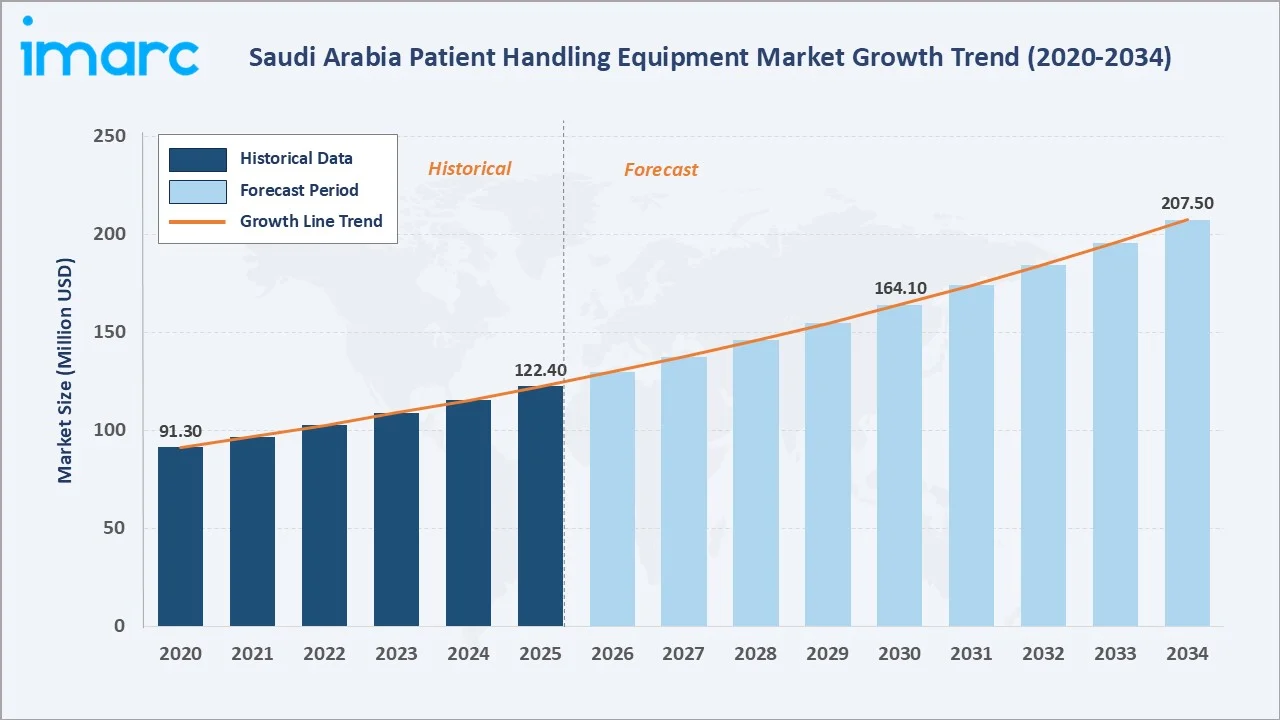
The Saudi Arabia patient handling equipment market grew from USD 122.4 Million in 2025 to USD 129.8 Million in 2026 and is projected to reach USD 207.5 Million by 2034, growing at a CAGR of 6.04% during 2026-2034. The growing burden of non-communicable diseases, including diabetes, cardiovascular disorders, and musculoskeletal conditions, is significantly increasing the patient population requiring mobility assistance and specialized care equipment. Saudi Arabia's rising obesity prevalence is further accelerating demand for bariatric-grade patient handling solutions across hospitals and long-term care settings.
The market is driven by the expanding healthcare infrastructure under Saudi Vision 2030, rising geriatric population, and growing prevalence of chronic diseases and obesity. Wheelchairs and Scooters dominate at 31.7%. Critical Care leads type of care at 28.6%. Northern and Central Region commands 41.7% of the national market share.
Market Snapshot
|
Metric |
Value |
|
Base Year Market Size (2025) |
USD 122.4 Million |
|
Market Size (2026) |
USD 129.8 Million |
|
Forecast Market Size (2034) |
USD 207.5 Million |
|
CAGR (2026-2034) |
6.04% |
|
Base Year |
2025 |
|
Historical Period |
2020-2025 |
|
Forecast Period |
2026-2034 |
|
Dominant Product |
Wheelchairs and Scooters (31.7%, 2025) |
|
Dominant Type of Care |
Critical Care (28.6%, 2025) |
|
Leading Region |
Northern and Central Region (41.7%, 2025) |
The Saudi Arabia patient handling equipment market size increased from USD 91.3 Million in 2020 to USD 122.4 Million in 2025 and is estimated to reach USD 129.8 Million in 2026. The market is further expected to grow to USD 164.1 Million by 2030 and USD 207.5 Million by 2034. Saudi Arabia's healthcare transformation under Vision 2030 is creating significant demand for advanced patient handling solutions across hospitals, long-term care facilities, and home care settings.
To get more information on this market, Request Sample
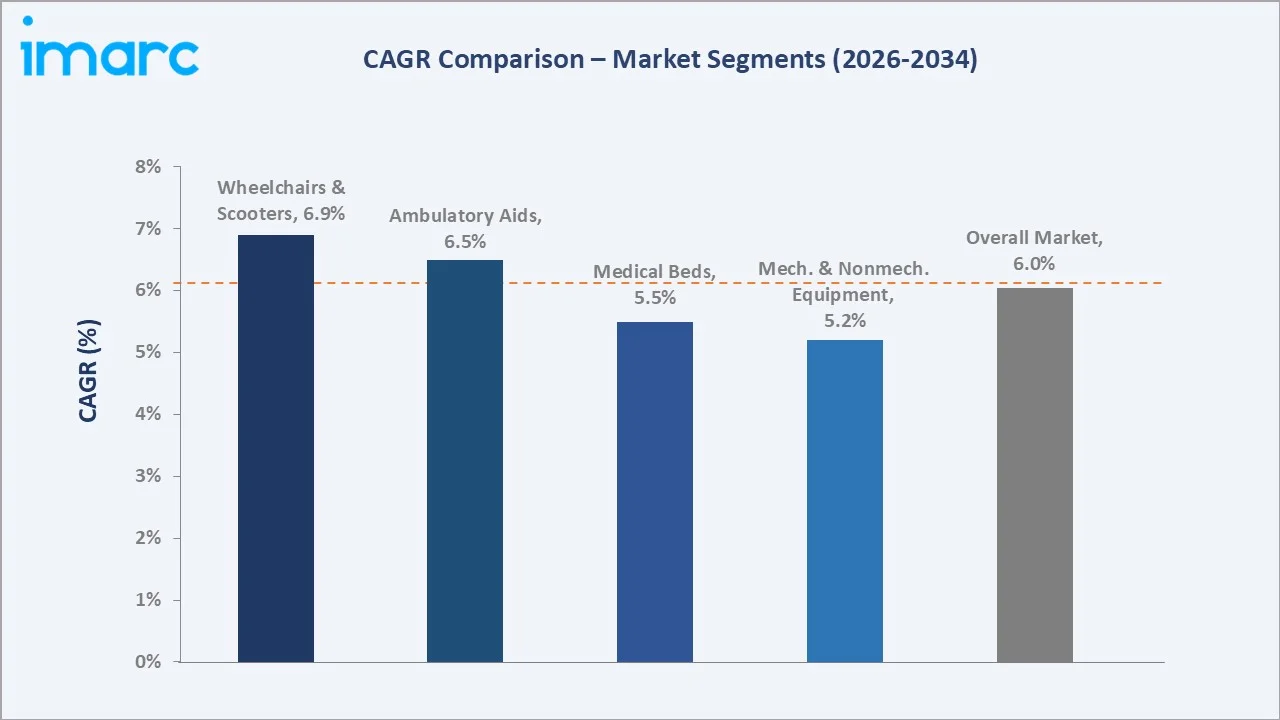
Wheelchairs and Scooters are estimated to grow at ~6.9% CAGR through Saudi Arabia's aging population. Ambulatory Aids grow at ~6.5% CAGR driven by outpatient and rehabilitation care expansion. Medical Beds grow at ~5.5% CAGR through hospital infrastructure investments under Vision 2030.
Executive Summary
The Saudi Arabia patient handling equipment market expanded from USD 122.4 Million in 2025 to an estimated USD 129.8 Million in 2026, positioning it among the Middle East's most dynamic medical device markets. Saudi Vision 2030's USD 65 billion healthcare investment is the primary structural driver, supporting construction of new hospitals, rehabilitation centers, and long-term care facilities requiring advanced patient handling solutions. The market is projected to reach USD 207.5 Million by 2034. Wheelchairs and Scooters at 31.7% lead through broad clinical applicability. Critical Care at 28.6% reflects the priority of acute patient mobility solutions. Northern and Central Region leads regionally at 41.7%.
Key Market Insights
|
Insight |
Data |
|
Dominant Product |
Wheelchairs and Scooters – 31.7% share (2025) |
|
Dominant Type of Care |
Critical Care – 28.6% market share (2025) |
|
Leading Region |
Northern and Central Region – 41.7% share (2025) |
|
Market Opportunity |
Home healthcare expansion, Vision 2030 hospital projects, smart patient handling technology integration, bariatric care solutions for rising obesity rates |
Key Analytical Observations Supporting the Above Data:
- Wheelchairs and Scooters at 31.7%: Dominate due to broad applicability across hospital wards, rehabilitation centers, and outpatient facilities. Saudi Arabia's aging population and rising disability rates drive sustained demand across all care settings.
- Critical Care at 28.6%: Leads as Saudi Arabia's growing network of ICUs and acute care wards requires specialized patient lifting, transfer, and positioning equipment to ensure patient safety and reduce caregiver injuries.
- Northern and Central Region at 41.7%: Dominates due to Riyadh's dense hospital infrastructure, highest healthcare spending per capita, and concentration of Vision 2030 healthcare mega-projects.
Saudi Arabia Patient Handling Equipment Market Overview
Saudi Arabia's patient handling equipment market is positioned at a critical intersection of demographic change, healthcare infrastructure expansion, and regulatory modernization. Vision 2030's healthcare initiatives, a growing geriatric population, and rising chronic disease burden are creating structural demand for patient handling solutions across hospitals, rehabilitation centers, and home care settings.
The market ecosystem integrates international manufacturers, regional distributors, government hospital procurement, and private healthcare networks. Macroeconomic drivers include increased healthcare budgets, PPP healthcare projects, and growing private health insurance penetration driven by mandatory insurance expansion.
Market Dynamics
To evaluate market opportunities, Request Sample
Market Drivers
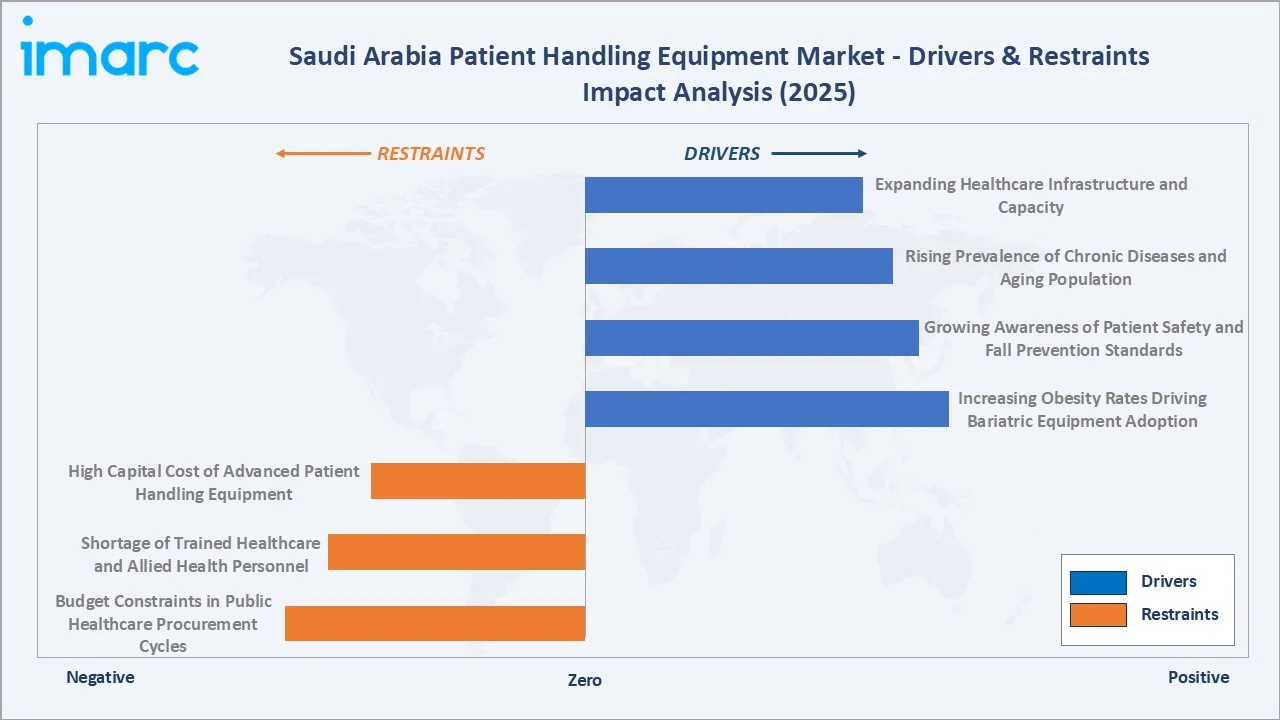
- Expanding Healthcare Infrastructure and Capacity: Growing investment in hospital construction, rehabilitation centers, and long-term care facilities across the region is generating consistent demand for patient handling equipment. New healthcare facilities require comprehensive equipment procurement, spanning patient lifts, medical beds, ambulatory aids, and mobility support devices across all clinical departments and care settings.
- Rising Prevalence of Chronic Diseases and Aging Population: Increasing incidence of chronic conditions including diabetes, cardiovascular disease, and musculoskeletal disorders is expanding the patient population requiring mobility assistance. A growing geriatric demographic drives sustained demand for wheelchairs, patient transfer devices, and repositioning equipment across hospital and home care settings throughout the forecast period.
- Growing Awareness of Patient Safety and Fall Prevention Standards: Healthcare accreditation bodies are increasingly mandating structured patient handling programs and ergonomic equipment standards to reduce caregiver injuries and patient fall incidents. Compliance-driven procurement of advanced patient handling systems is becoming a standard capital expenditure priority across hospital networks.
- Increasing Obesity Rates Driving Bariatric Equipment Adoption: Rising obesity prevalence is creating specific clinical demand for bariatric-grade patient handling equipment with higher weight capacities. Hospitals and long-term care facilities are investing in heavy-duty wheelchairs, bariatric medical beds, and specialized patient lifts to address the clinical needs of bariatric patients safely.
Market Restraints
- High Capital Cost of Advanced Patient Handling Equipment: Premium-grade motorized patient lifts, smart hospital beds, and specialized bariatric handling systems carry significant price premiums that create adoption barriers in price-sensitive healthcare segments. High initial capital expenditure requirements can delay procurement cycles, particularly in smaller facilities and home care settings where budget constraints are more pronounced.
- Shortage of Trained Healthcare and Allied Health Personnel: Effective utilization of patient handling equipment requires trained nursing staff, physiotherapists, and patient care assistants. Shortages of specialized healthcare personnel limit the full operational deployment of advanced handling equipment and reduce return on investment for healthcare facilities that have procured such systems.
- Budget Constraints in Public Healthcare Procurement Cycles: Government-owned hospitals operating under fixed annual budget allocations may face restrictions on timely patient handling equipment procurement and replacement. Budget cycle constraints can delay capital equipment upgrades, particularly in secondary and tertiary care facilities where equipment replacement needs are ongoing.
Market Opportunities
- Expansion of Home Healthcare and Community-Based Care Services: The growing shift toward home-based and community healthcare delivery is creating new demand for lightweight, portable patient handling solutions suitable for residential settings. Post-acute care rehabilitation and aging-in-place programs represent expanding addressable market segments for ambulatory aids and compact patient lifts.
- Integration of Smart Technology and Connected Equipment Solutions: IoT connectivity, sensor-based patient monitoring, and digital health integration in patient handling equipment are creating significant product differentiation opportunities. Smart equipment offering real-time patient safety data and predictive maintenance capabilities commands premium pricing in technology-forward hospital procurement environments.
Market Challenges
- After-Sales Service and Equipment Maintenance Infrastructure: Ensuring timely after-sales servicing, spare parts availability, and technical maintenance support for complex patient handling equipment across geographically dispersed healthcare facilities presents operational and logistical challenges for manufacturers and authorized distributors operating in the market.
- Regulatory Compliance and Product Registration Requirements: International manufacturers must navigate local regulatory approval requirements, product registration processes, and healthcare facility procurement compliance standards. Regulatory compliance timelines can extend market entry periods and increase operational costs for manufacturers entering new regional markets.
Emerging Market Trends
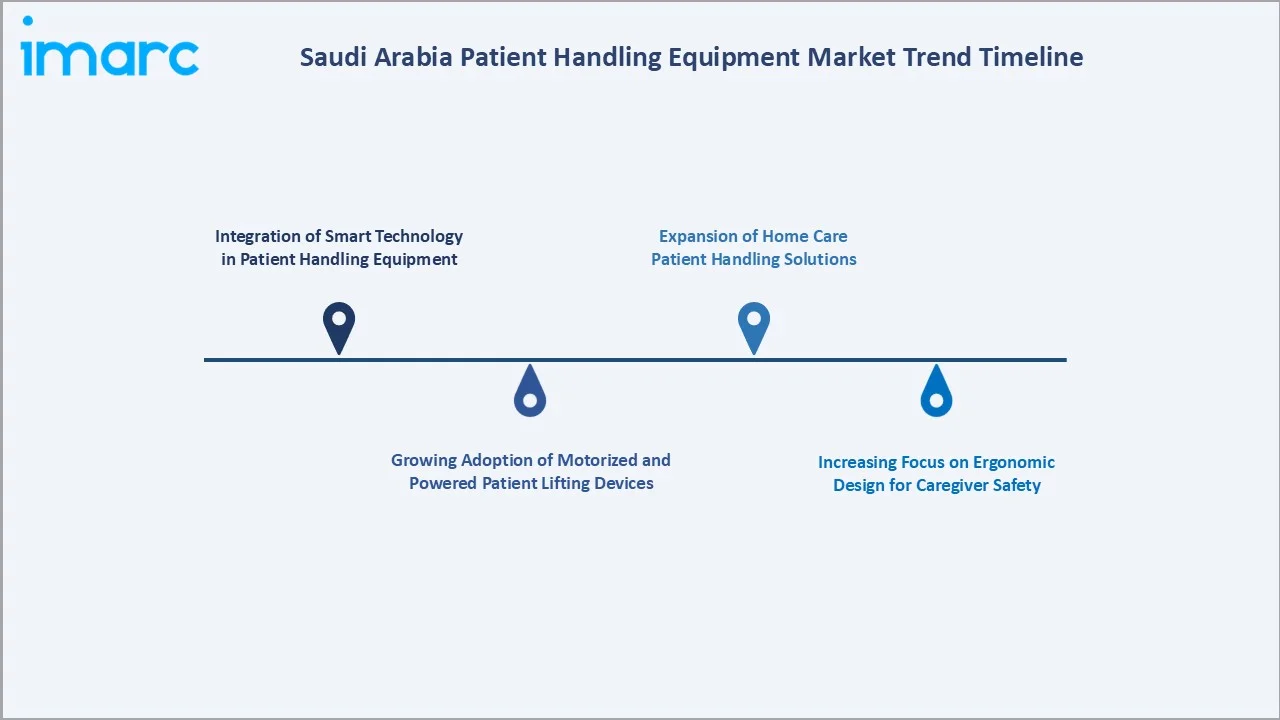
1. Integration of Smart Technology in Patient Handling Equipment
Smart technology integration is transforming patient handling equipment through IoT connectivity, sensor-based monitoring, and data-driven operational management. These innovations enable real-time patient movement tracking, caregiver workload analysis, and predictive maintenance scheduling — improving patient safety outcomes and hospital operational efficiency across clinical settings.
2. Growing Adoption of Motorized and Powered Patient Lifting Devices
Motorized patient lifts and powered transfer systems are gaining adoption across hospitals and long-term care facilities as awareness of caregiver musculoskeletal injury prevention grows. Healthcare accreditation standards are accelerating the replacement of manual patient handling practices with powered equipment solutions that reduce occupational injury risk and improve patient transfer safety.
3. Increasing Focus on Ergonomic Design for Caregiver Safety
Ergonomically designed patient handling equipment that minimizes caregiver strain is increasingly a priority procurement criterion across healthcare facilities. Accreditation standards emphasizing staff safety programs are driving investment in ergonomic handling solutions that reduce occupational injuries and support caregiver wellbeing and retention.
4. Expansion of Home Care Patient Handling Solutions
The growing shift toward community-based and home healthcare delivery is expanding demand for portable patient handling equipment suited for residential environments. Lightweight wheelchairs, compact patient lifts, and foldable ambulatory aids are seeing increased adoption as post-acute rehabilitation and home nursing service programs expand across the region.
Industry Value Chain Analysis
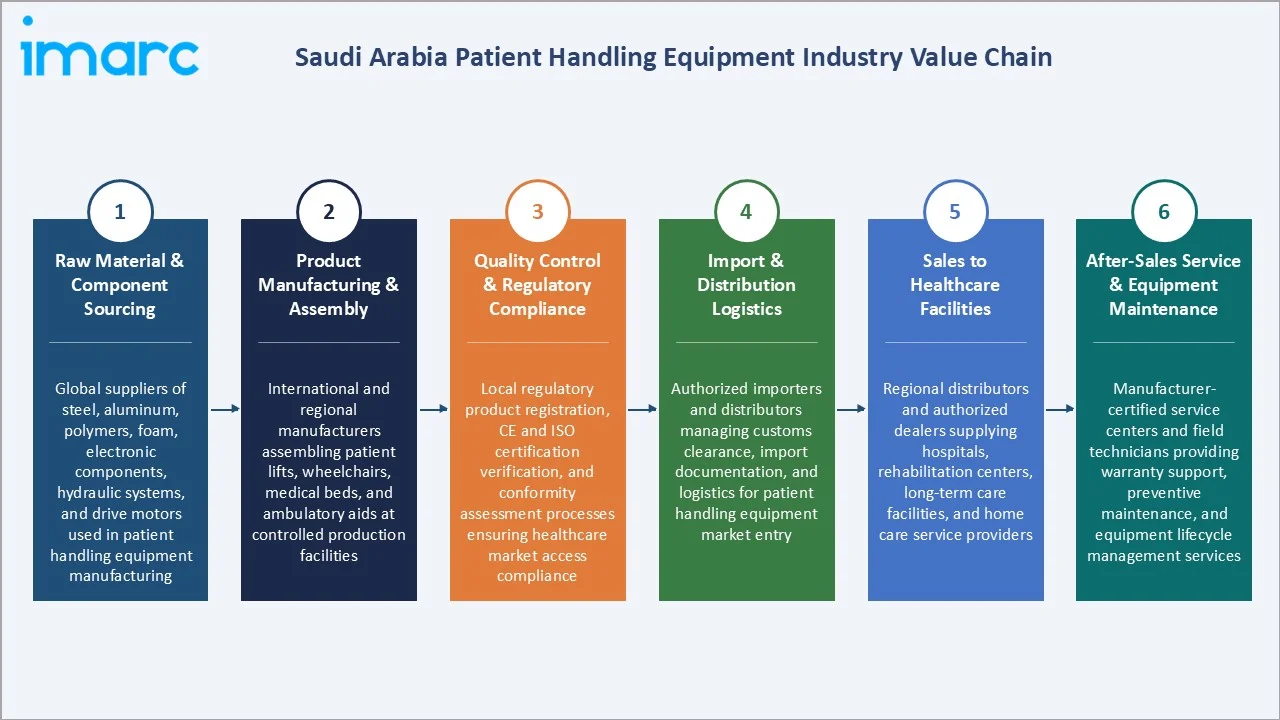
The patient handling equipment value chain spans international manufacturing origins, regional distribution, regulatory clearance, healthcare facility procurement, and post-sale servicing. Commercial dynamics are shaped by healthcare infrastructure investment priorities, local regulatory requirements, and growing preference for regionally registered and serviced equipment solutions.
|
Stage |
Key Participants |
| Raw Material & Component Sourcing | Global suppliers of steel, aluminum, polymers, foam, electronic components, hydraulic systems, and drive motors used in patient handling equipment manufacturing |
| Product Manufacturing & Assembly | International and regional manufacturers assembling patient lifts, wheelchairs, medical beds, and ambulatory aids at controlled production facilities |
| Quality Control & Regulatory Compliance | Local regulatory product registration, CE and ISO certification verification, and conformity assessment processes ensuring healthcare market access compliance |
| Import & Distribution Logistics | Authorized importers and distributors managing customs clearance, import documentation, and logistics for patient handling equipment market entry |
| Sales to Healthcare Facilities | Regional distributors and authorized dealers supplying hospitals, rehabilitation centers, long-term care facilities, and home care service providers |
| After-Sales Service & Equipment Maintenance | Manufacturer-certified service centers and field technicians providing warranty support, preventive maintenance, and equipment lifecycle management services |
The distribution and healthcare facility sales stage is the most commercially consequential. Manufacturers with established local distributor partnerships and registered product portfolios maintain significant competitive advantages in hospital tender procurement processes, the primary sales channel for patient handling equipment.
Technology Landscape in the Saudi Arabia Patient Handling Equipment Industry
Mechanical and Powered Patient Handling Technologies
Mechanical and powered patient handling technologies encompass a broad spectrum of solutions serving diverse clinical acuity levels and care environments. Hydraulic and electric patient lifts, height-adjustable motorized hospital beds, and powered wheelchair systems are increasingly deployed across acute care, rehabilitation, and long-term care settings, driven by patient safety standards and caregiver ergonomic requirements in modern healthcare facility design.
Smart Sensor and IoT-Enabled Monitoring Technologies
Advanced sensor and IoT-enabled technologies are transforming patient handling equipment capabilities through real-time patient weight monitoring, movement detection, and position tracking integration. Connected medical beds with nurse call systems and automated fall risk alerts represent the leading edge of technology adoption, supporting hospital digital health strategies and improving patient safety compliance outcomes across clinical environments.
Bariatric and Specialized Clinical Handling Technologies
Bariatric patient handling technology addresses the specific clinical requirements of higher-weight patients through reinforced structural engineering in patient lifts, hospital beds, and wheelchair systems. Specialized repositioning and pressure injury prevention technologies are emerging as standard care components in wound care and long-term care settings, addressing the clinical complexity of extended patient handling scenarios across healthcare facilities.
Market Segmentation Analysis
The report covers the following segments:
|
Segment Category |
Leading Segment |
Market Share |
Year |
|
Product |
Wheelchairs and Scooters |
31.7% |
2025 |
|
End User |
🔒 |
🔒 |
2025 |
|
Type of Care |
Critical Care |
28.6% |
2025 |
|
Region |
Northern and Central Region |
41.7% |
2025 |

By Product
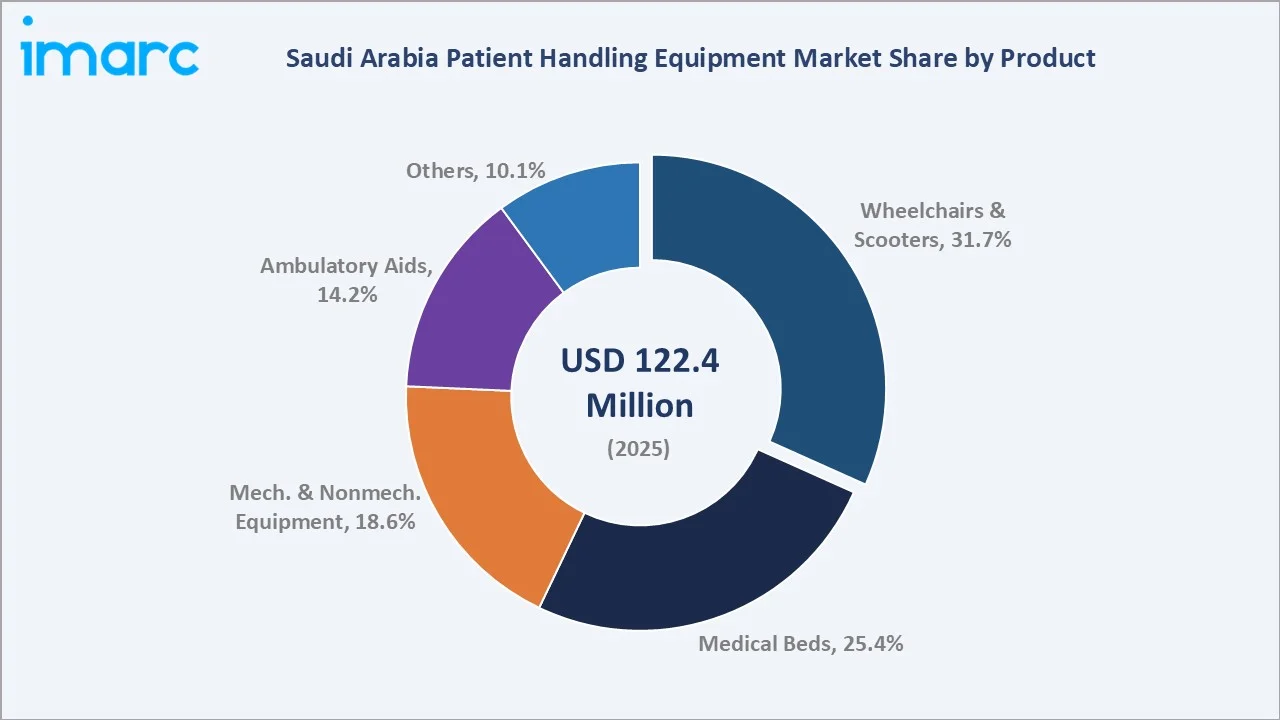
Wheelchairs and Scooters lead the market at 31.7% share in 2025, growing at a CAGR of ~6.9% during 2026-2034. This segment encompasses the most widely deployed patient mobility solution, serving hospitals, rehabilitation centers, outpatient clinics, and long-term care facilities. Strong demand is driven by a growing aging population, post-surgical rehabilitation programs, and rising accessibility requirements.
To access detailed market analysis, Request Sample
Medical Beds hold 25.4% share and grow through hospital infrastructure expansion. Mechanical and Nonmechanical Equipment at 18.6% supports patient transfer and repositioning in ICU and general ward settings. Ambulatory Aids at 14.2% grow at ~6.5% CAGR driven by outpatient rehabilitation expansion. Others account for 10.1%.
By Type of Care
Critical Care leads at 28.6% share in 2025. Expanding ICU capacity and growing acute care patient volumes create consistent demand for specialized patient handling equipment designed for critical care environments. Patient lifts, ICU-grade medical beds, and repositioning systems for critically ill patients are essential care infrastructure components, underpinning this segment's leading market position.
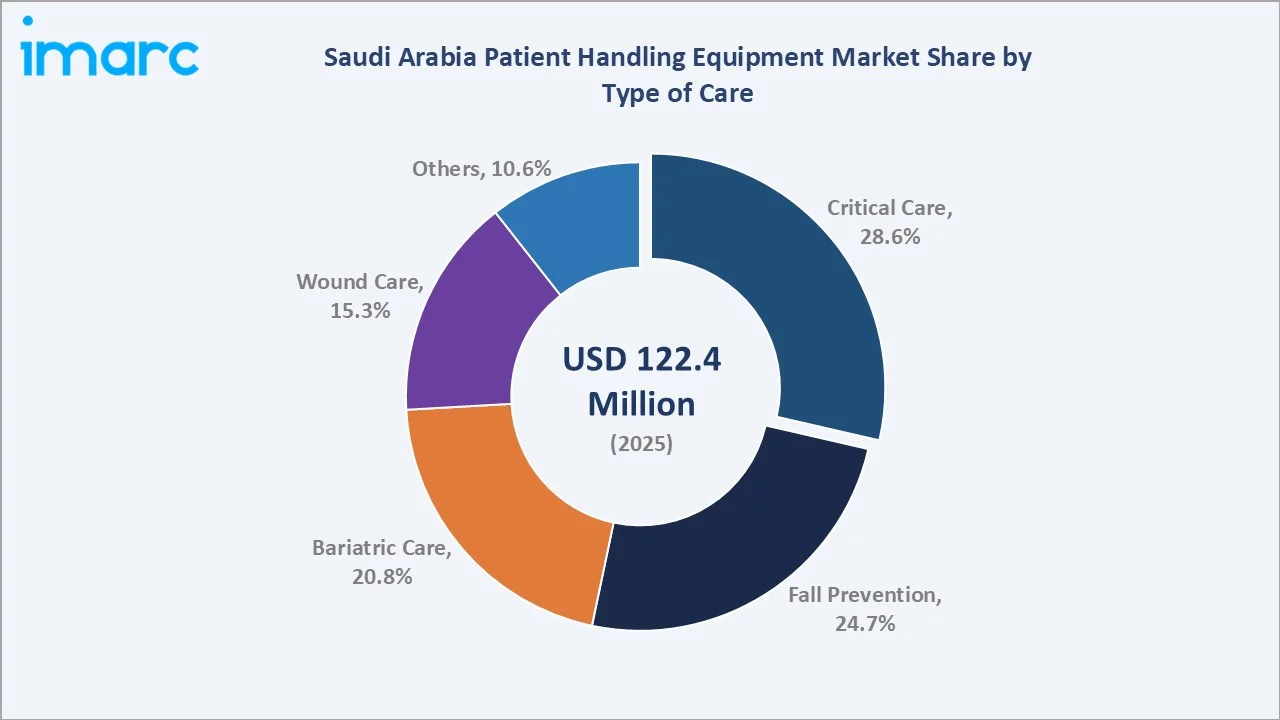
Fall Prevention at 24.7% grows at ~7.2% CAGR through increasing hospital safety program mandates. Bariatric Care at 20.8% is the fastest-growing segment at ~8.1% CAGR through rising obesity prevalence. Wound Care at 15.3% supports specialized pressure injury prevention and extended wound treatment positioning equipment.
Regional Market Insights
|
Region |
Share (2025) |
Key Market Drivers & Characteristics |
|
Northern and Central Region |
41.7% |
Driven by Riyadh's dense hospital infrastructure, highest healthcare capital investment under Vision 2030, and concentration of tertiary care and specialty hospitals. |
|
Western Region |
28.4% |
Supporting widespread adoption through Jeddah's private hospital networks, Makkah's pilgrimage healthcare infrastructure, and Madinah's expanding medical city complex. |
|
Eastern Region |
18.2% |
Reflects Al-Ahsa and Dammam's industrial workforce healthcare requirements, strong oil sector corporate healthcare programs, and Aramco-affiliated hospital procurement. |
|
Southern Region |
11.7% |
Growing government hospital expansion programs and increasing MOH healthcare investment in underserved southern provinces of Jizan, Najran, and Asir. |
Northern and Central Region's 41.7% leadership reflects Riyadh's position as Saudi Arabia's healthcare capital, hosting King Faisal Specialist Hospital, Security Forces Hospital, and the National Guard Health Affairs network. Western Region's 28.4% reflects Jeddah's large private hospital sector and Makkah's unique demand for patient handling equipment within Hajj and Umrah healthcare facilities.
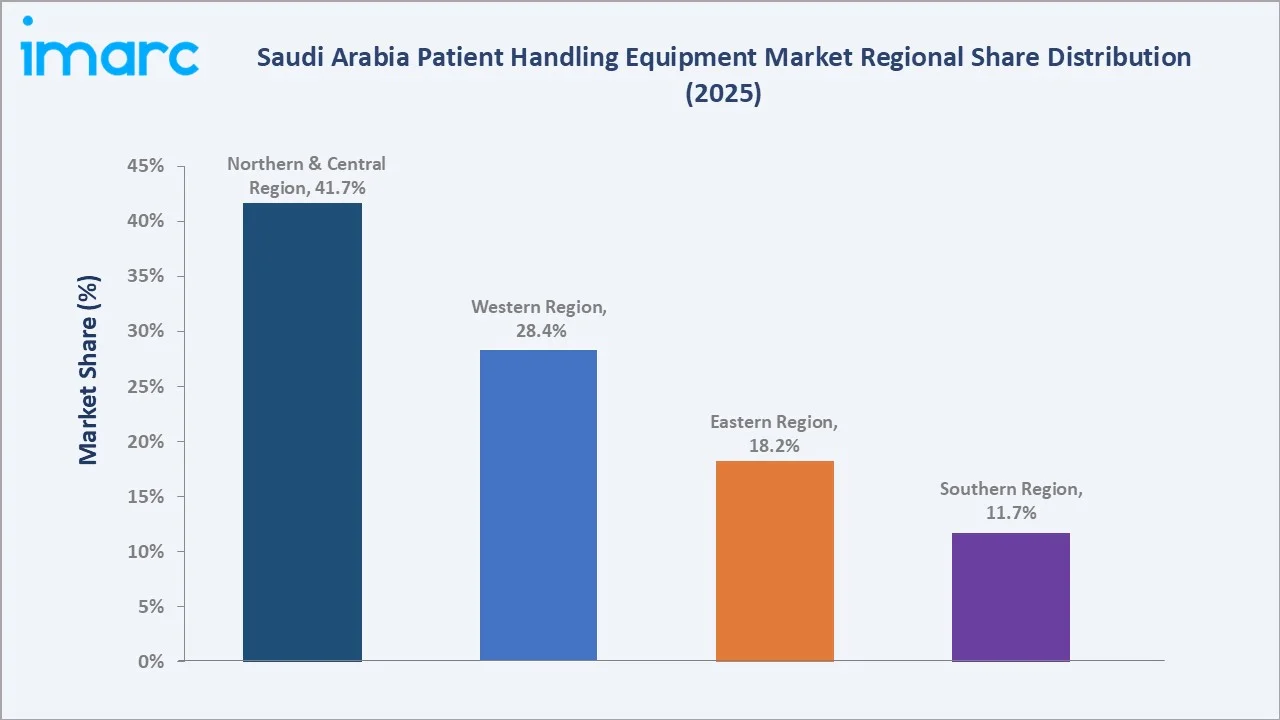
Eastern Region's 18.2% reflects Saudi Aramco's extensive healthcare network and industrial sector employee health programs. Southern Region at 11.7% represents the most commercially underdeveloped region but is growing above the overall market CAGR through government hospital construction programs in southern provinces.
Competitive Landscape
Saudi Arabia patient handling equipment competitive landscape is characterized by international manufacturers distributing through authorized regional partners and government hospital tender networks. Competition is intensifying through growing private hospital sector procurement, Vision 2030 hospital infrastructure projects, and increasing demand for smart and bariatric equipment solutions.
| Company | Key Offerings | Market Position | Core Strength |
|---|---|---|---|
| Arjo AB | Patient lifts, medical beds, hygiene systems | Market Leader | Arjo AB provides comprehensive patient handling and hygiene solutions with a strong Saudi Arabia presence through authorized distribution networks. |
| Hill-Rom Holdings, Inc. (a Baxter company) | Hospital beds, patient lifts, transfer systems | Strong Challenger | Hill-Rom delivers advanced hospital bed systems and patient transfer solutions widely deployed in Saudi tertiary care hospitals and Vision 2030 hospital projects. |
| Stryker Corporation | Medical beds, stretchers, patient handling systems | Innovator | Stryker plays a significant role in Saudi Arabia's hospital equipment market through its advanced medical bed and patient handling product portfolio. |
| Invacare Corporation | Wheelchairs, scooters | Strong Challenger | Invacare serves both institutional and home care segments in Saudi Arabia with a diversified portfolio of manual and powered mobility solutions. |
| Medline Industries, L.P. | Medical beds, positioning aids | Niche Player | Medline Industries supplies a broad range of patient care and handling products to Saudi Arabian healthcare facilities through established distribution partnerships. |
The competitive landscape's most commercially significant dynamic is the government hospital tender system's influence on procurement. Manufacturers with SFDA product registrations, established local distributor relationships, and proven track records in Saudi hospital projects maintain structural competitive advantages in Ministry of Health and Vision 2030 infrastructure tenders.
Key Company Profiles
Arjo AB
Arjo AB is a global leader in patient handling and hygiene solutions, serving acute care, long-term care, and rehabilitation facilities. The company operates through authorized distribution partners in Saudi Arabia, providing patient lift systems, medical beds, and preventive care equipment aligned with Saudi hospital accreditation requirements.
- Key Products: Patient lifts, ceiling track systems, medical beds, hygiene and bathing systems, DVT prevention equipment, and positioning aids.
- Recent Developments: On April 16, 2025, Arjo launched the Maxi Move 5 patient floor lift, featuring motion-assist technology and powered positioning to improve patient transfers, reduce caregiver physical effort, and enhance patient safety. An independent clinical study found that the equipment reduced the accumulated forces required for patient transfers by up to 68% compared with competitor devices included in the study.
- Strategic Focus: Strengthening Saudi Arabia market presence through authorized distributor partnerships, SFDA product registration expansion, and participation in MOH hospital tender programs.
Stryker Corporation
Stryker Corporation is a leading global medical technology company with a significant presence in Saudi Arabia's hospital equipment market. Stryker's medical and surgical equipment divisions provide advanced patient handling and hospital bed solutions to Saudi tertiary care hospitals and Vision 2030 hospital projects.
- Key Products: Hospital beds, stretchers, patient transfer and positioning systems, surgical tables, and emergency care equipment.
- Strategic Focus: Advancing smart hospital infrastructure solutions in Saudi Arabia through technology integration in patient handling equipment, targeting premium hospital segments and Vision 2030 greenfield hospital projects.
Invacare Corporation
Invacare Corporation is a leading manufacturer and distributor of medical devices, with a diversified portfolio covering institutional and home care patient handling products. The company serves Saudi Arabia's rehabilitation centers, long-term care facilities, and home healthcare market through established regional distribution partnerships.
- Key Products: Manual and powered wheelchairs, scooters, home care beds, patient lifts, ambulatory aids, and seating and positioning products.
- Strategic Focus: Expanding home care and rehabilitation equipment market presence in Saudi Arabia, leveraging the growing aging population and Vision 2030's shift toward community-based healthcare delivery.
Market Concentration Analysis
Saudi Arabia patient handling equipment market is moderately fragmented at the institutional level, with multiple international manufacturers competing through authorized regional distributors in government and private hospital tender processes. No single manufacturer commands a dominant market share across all product categories, creating competitive opportunity for differentiated product and service propositions. The market is evolving through Vision 2030 healthcare procurement modernization, increasing transparency and creating structured bidding processes that favor manufacturers with proven clinical evidence, SFDA registrations, and established local service networks.
Investment & Growth Opportunities
Highest Growth Segments
Wheelchairs and Scooters (~6.9% CAGR through aging population growth and mobility demand), Ambulatory Aids (~6.5% CAGR through outpatient care expansion), Medical Beds (~5.5% CAGR through hospital infrastructure investment), and Mechanical and Nonmechanical Equipment (~5.2% CAGR through acute care facility upgrades) represent Saudi Arabia’s key investment segments, all aligning with the overall market CAGR of 6.04% through 2034.
Emerging Investment Opportunities
Saudi Arabia's Vision 2030 hospital construction pipeline, representing over 60 new hospital projects, creates one of the region's most significant institutional procurement opportunities for patient handling equipment. The parallel expansion of home care services, supported by the MOH's community healthcare strategy, is opening a new addressable market for portable and home-adapted patient handling solutions.
Investment Themes
- Vision 2030 Hospital Infrastructure Procurement: Hospital projects represent the primary investment opportunity for patient handling equipment manufacturers and distributors seeking SFDA-registered product portfolios and established government hospital relationships. Early-stage distributor partnerships aligned with hospital construction timelines offer the most commercially advantageous market entry positioning.
- Home Care Patient Handling Market Development: Saudi Arabia's home care market for patient handling equipment is emerging as a high-growth investment vector with lower procurement complexity than government hospital tenders. The growing aging-in-place care preferences and post-acute home rehabilitation programs create a sustainable demand foundation for portable patient handling solutions.
Future Market Outlook (2026-2034)
The Saudi Arabia patient handling equipment market is projected to grow from USD 122.4 Million in 2025 to USD 129.8 Million in 2026, reaching USD 207.5 Million by 2034, registering a CAGR of 6.04% during 2026-2034. The market's anchor value of USD 164.1 Million in 2030 represents a structural inflection driven by Vision 2030 mid-cycle healthcare infrastructure completions. Three structural forces define the market's growth trajectory: Saudi Arabia's demographic transformation creating the region's fastest-growing elderly care equipment market; Vision 2030's sustained healthcare investment pipeline; and digital health transformation driving premium smart equipment adoption in Saudi Arabia's technology-oriented hospital sector.
Research Methodology
Primary Research
Primary research comprised structured interviews with Saudi Arabia patient handling equipment market stakeholders, including hospital procurement directors, clinical equipment managers, rehabilitation center administrators, authorized distributors, and home healthcare service providers across all Saudi regions.
Secondary Research
Secondary research encompassed Saudi MOH annual reports, SFDA product registration databases, SASO technical standards, company annual reports, Vision 2030 healthcare investment reports, Saudi hospital construction project data, and regional medical device market analysis. Over 40 secondary sources were reviewed.
Forecasting Models
Market revenue forecasts were developed using a healthcare facility-based demand model: Saudi Arabia's hospital bed count multiplied by patient handling equipment deployment ratios per bed by product category, aggregated across institutional and home care settings, calibrated against Vision 2030 healthcare investment milestones.
Saudi Arabia Patient Handling Equipment Market Report Coverage:
| Report Features | Details |
|---|---|
| Base Year of the Analysis | 2025 |
| Historical Period | 2020-2025 |
| Forecast Period | 2026-2034 |
| Units | Million USD |
| Scope of the Report | Exploration of Historical Trends and Market Outlook, Industry Catalysts and Challenges, Segment-Wise Historical and Future Market Assessment:
|
| Products Covered | Wheelchairs and Scooters, Medical Beds, Mechanical and Nonmechanical Equipment, Ambulatory Aids, Others |
| Types of Care Covered | Bariatric Care, Fall Prevention, Critical Care, Wound Care, Others |
| End Users Covered | Hospitals, Home Care Settings, Elderly Care Facilities, Others |
| Regions Covered | Northern and Central Region, Western Region, Eastern Region, Southern Region |
| Companies Covered | Arjo AB, Hill-Rom Holdings, Inc. (a Baxter company), Stryker Corporation, Invacare Corporation, Medline Industries, L.P., etc. |
| Customization Scope | 10% Free Customization |
| Post-Sale Analyst Support | 10-12 Weeks |
| Delivery Format | PDF and Excel through Email (We can also provide the editable version of the report in PPT/Word format on special request) |
Key Benefits for Stakeholders:
- IMARC’s industry report offers a comprehensive quantitative analysis of various market segments, historical and current market trends, market forecasts, and dynamics of the Saudi Arabia patient handling equipment market from 2020-2034.
- The research report provides the latest information on the market drivers, challenges, and opportunities in the Saudi Arabia patient handling equipment market.
- Porter's five forces analysis assist stakeholders in assessing the impact of new entrants, competitive rivalry, supplier power, buyer power, and the threat of substitution. It helps stakeholders to analyze the level of competition within the Saudi Arabia patient handling equipment industry and its attractiveness.
- Competitive landscape allows stakeholders to understand their competitive environment and provides an insight into the current positions of key players in the market.
Frequently Asked Questions About the Saudi Arabia Patient Handling Equipment Market Report
Saudi Arabia patient handling equipment market size is estimated at USD 129.8 Million in 2026, driven by Vision 2030 healthcare infrastructure investment, growing geriatric population, and rising chronic disease prevalence increasing demand for patient mobility and positioning solutions across hospitals and long-term care facilities.
Saudi Arabia patient handling equipment market grows at 6.04% CAGR during 2026-2034, reaching USD 207.5 Million by 2034. Growth is sustained by Vision 2030 hospital projects, rising obesity and bariatric care demand, aging population expansion, and increasing adoption of smart patient handling technology.
Wheelchairs and Scooters lead at 31.7% through broad clinical applicability across hospital wards, rehabilitation centers, and outpatient facilities, supported by Saudi Arabia's growing aging population and rising mobility impairment prevalence.
Critical Care leads at 28.6% through Saudi Arabia's expanding ICU capacity and acute care infrastructure, requiring specialized patient lifting, transfer, and positioning equipment for critically ill patient management and caregiver safety compliance.
Northern and Central Region leads at 41.7% through Riyadh's dense hospital infrastructure, highest healthcare capital investment per capita, and concentration of Vision 2030 healthcare mega-projects and tertiary care facilities.
Leading companies include Arjo AB, Hill-Rom Holdings, Inc. (a Baxter company), Stryker Corporation, Invacare Corporation, and Medline Industries, L.P., among others.
Saudi Arabia patient handling equipment market is projected to reach approximately USD 164.1 Million by 2030, driven by Vision 2030 hospital completions generating institutional procurement demand, bariatric care equipment adoption, and expanding home healthcare patient handling solutions.
Three priority investment opportunities: Vision 2030 hospital procurement partnerships capturing institutional patient handling equipment demand across 60+ new hospital projects; bariatric patient handling equipment representing the fastest-growing product segment; and home care patient handling solutions targeting Saudi Arabia's expanding community-based healthcare services.
Need more help?
- Speak to our experienced analysts for insights on the current market scenarios.
- Include additional segments and countries to customize the report as per your requirement.
- Gain an unparalleled competitive advantage in your domain by understanding how to utilize the report and positively impacting your operations and revenue.
- For further assistance, please connect with our analysts.
 Request Customization
 Speak to an Analyst
 Request Brochure
 Inquire Before Buying
Benefits of Customization
- Personalize this research
- Triangulate with your data
- Get data as per your format and definition
- Gain a deeper dive into a specific application, geography, customer, or competitor
- Any level of personalization
Get in Touch With Us
UNITED STATES
Phone: +1-201-971-6302
INDIA
Phone: +91-120-433-0800
UNITED KINGDOM
Phone: +44-753-714-6104
Email: [email protected]
Client Testimonials





















Related Reports

Choose your plan
*Please note that the prices mentioned below are starting prices for each bundle type. Kindly contact our team for further details.*
Single User License
- 1 User License, Access on 2 Devices
- PDF Report + Excel Dataset (Password Protected)
- Lifetime Access
- No Printing Rights
- 10% Free Report Customization
- 10–12 Weeks of Analyst Support
Five User License
- Access for 5 Users, 2 Devices per User
- PDF Report + Excel Dataset (Password Protected)
- Lifetime Access
- Dedicated Account Manager
- 12–14 Weeks of Analyst Support
- No Printing Rights
- 15% Free Report Customization
- 25% Discount on Your Next Purchase
Corporate User License
- Unlimited User Access (Within Your Organization)
- PDF Report + Excel Dataset
- Lifetime Access
- Dedicated Account Manager
- 14–20 Weeks of Analyst Support
- No Printing Rights
- 20% Free Report Customization
- 30% Discount on Your Next Purchase
Essential Insights
What's included:
3 reports
- Lifetime Access
- PDF Reports
- Excel Datasets
- 2 Weeks of Free Analyst Support
- 2 User Licenses
- Access on 2 Devices
- Printing Rights
- Complimentary PowerPoint (PPT) Version
- Complimentary License Upgrade
Professional Access
What's included:
5 reports
- Lifetime Access
- PDF Reports
- Excel Datasets
- 8 Weeks of Free Analyst Support
- 2 User Licenses
- Access on 2 Devices
- Printing Rights
- Complimentary PowerPoint (PPT) Version
- Complimentary License Upgrade
Business Advantage
What's included:
8 reports
- Lifetime Access
- PDF Reports
- Excel Datasets
- 14 Weeks of Free Analyst Support
- 2 User Licenses
- Access on 2 Devices
- Printing Rights
- Complimentary PowerPoint (PPT) Version
- Complimentary License Upgrade
Enterprise Intelligence
What's included:
10 reports
- Lifetime Access
- PDF Reports
- Excel Datasets
- 20 Weeks of Free Analyst Support
- 2 User Licenses
- Access on 2 Devices
- Printing Rights
- Complimentary PowerPoint (PPT) Version
- Complimentary License Upgrade