
Saudi Arabia Pet Care Products Market Size, Share, Trends and Forecast by Pet Type, Type, and Region, 2026-2034
Saudi Arabia Pet Care Products Market Size, Share, Trends & Forecast (2026-2034)
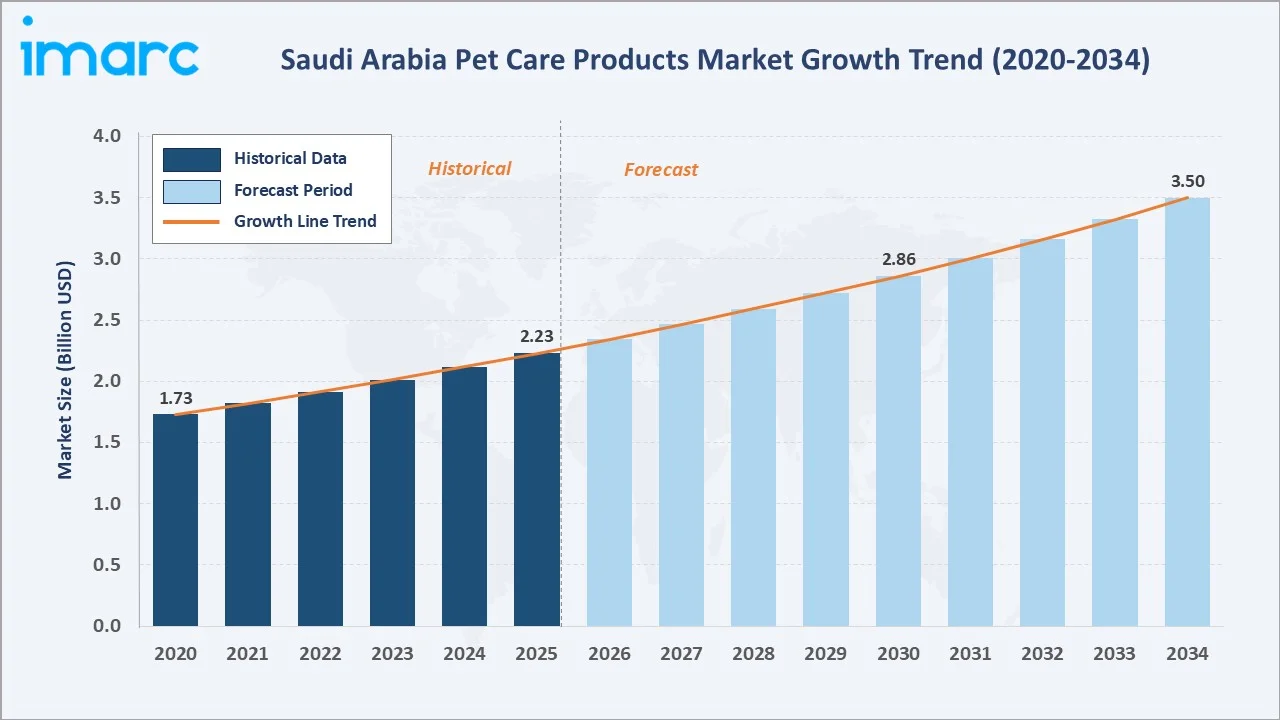
The Saudi Arabia pet care products market reached USD 2.23 Billion in 2025 and is projected to reach USD 3.50 Billion by 2034, expanding at a CAGR of 5.15% during 2026-2034. Growth is anchored in rising pet humanization, expanding veterinary infrastructure, and Vision 2030's push toward domestic pet food manufacturing. Saudi Arabia's pet population has more than tripled in recent years to reach approximately 2.4 million animals, lifting demand across food, grooming, and accessory categories. Cats lead pet-type demand at 38.4% share (2025), while pet food commands 64.7% market share. The Northern and Central Region dominates regionally at 46.8%, anchored by Riyadh's dense, affluent pet-owning households.
Market Snapshot
|
Metric |
Value |
|
Market Size (2025) |
USD 2.23 Billion |
|
Forecast Market Size (2034) |
USD 3.50 Billion |
|
CAGR (2026-2034) |
5.15% |
|
Base Year |
2025 |
|
Historical Period |
2020-2025 |
|
Forecast Period |
2026-2034 |
|
Largest Pet Type |
Cat (38.4%, 2025) |
|
Largest Category (Type) |
Food (64.7%, 2025) |
|
Dominant Region |
Northern & Central Region (46.8%, 2025) |
The market expanded from USD 1.73 Billion in 2020 to USD 2.23 Billion in 2025, and is set to reach USD 2.86 Billion by 2030 before climbing to USD 3.50 Billion by 2034. Growth is reinforced by Saudi Arabia's rising per capita income, which climbed to SAR 93,000 in 2023 from SAR 88,000 in 2021 according to the General Authority for Statistics (GASTAT), alongside expanding veterinary and pet-retail infrastructure across Riyadh, Jeddah, and Dammam.
To get more information on this market, Request Sample
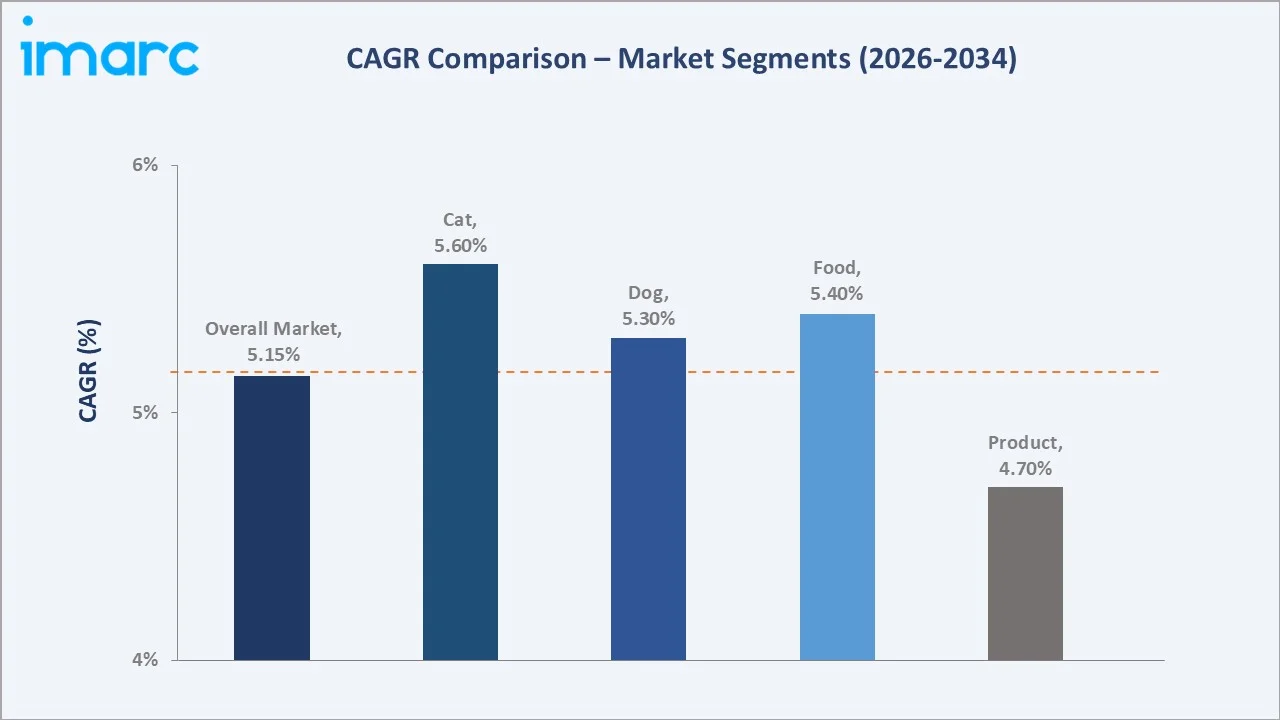
Cat-focused products post the fastest estimated category growth at 5.6% CAGR (2026-2034), outperforming the market average as premiumization accelerates among urban, higher-income households. Within product categories, pet food is estimated to grow at 5.4% CAGR, ahead of pet accessories and grooming products at roughly 4.7%, aided by the government's domestic manufacturing push under Vision 2030's food security agenda.
Executive Summary
The Saudi Arabia pet care products market reached USD 2.23 Billion in 2025, propelled by rapid pet humanization, a tripling of the Kingdom's pet population to roughly 2.4 million animals, and sustained government investment in veterinary and animal-welfare infrastructure under Vision 2030. The market is projected to reach USD 3.50 Billion by 2034, growing at a 5.15% CAGR, as rising disposable incomes and urbanization in Riyadh, Jeddah, and Dammam continue to reshape household spending toward premium nutrition and specialized products.
Cats command the largest pet-type share at 38.4% (2025), followed by dogs at 34.6%, reflecting Saudi households' preference for companion animals suited to apartment and villa living alike. Pet food dominates product categories at 64.7% share, anchored by trusted multinational brands and a growing base of domestic manufacturers. The Northern and Central Region leads regionally with 46.8% share, concentrated around Riyadh's high-income, pet-owning population.
Looking ahead, the market outlook remains positive, supported by expanding e-commerce penetration, tightened SFDA pet food registration standards that raise product quality, and the entry of large-scale domestic manufacturing capacity expected to reduce import dependence through 2034.
Key Market Insights
|
Insight |
Data |
|
Largest Pet Type |
Cat - 38.4% share (2025) |
|
Largest Category |
Food - 64.7% share (2025) |
|
Dominant Region |
Northern & Central Region - 46.8% share (2025) |
|
Top Companies |
Mars, Incorporated, Nestlé S.A., Colgate-Palmolive Company, and Delicious Food Factory |
|
Market Opportunity |
Domestic pet food manufacturing & premium/organic product lines |
Key Analytical Observations Supporting The Above Data:
- Cat products lead at 38.4% share (2025): Driven by the apartment-friendly pet ownership trend across urban Saudi households, where cats require less space and outdoor access than larger dog breeds.
- Dogs form the second-largest pet-type category at 34.6% share: Supported by rising demand for guard and companion breeds among suburban and villa-owning households in Riyadh and Jeddah.
- Pet food anchors at 64.7% share (2025): As recurring nutrition purchases outweigh one-time spending on grooming tools, toys, and accessories.
- Northern & Central Region is dominant with 46.8% share (2025): Reflecting Riyadh's concentration of affluent, pet-owning households and its dense veterinary and retail infrastructure.
- E-commerce platforms are capturing rising share of pet product sales: With Amazon.sa, PetZone, and MyPets expanding subscription delivery and virtual veterinary consultations, aligned with Vision 2030's digital economy objectives.
Saudi Arabia Pet Care Products Market Overview
Saudi Arabia's pet care products market encompasses food, grooming products, accessories, and wellness items sold for cats, dogs, fish, birds, and other companion animals across the Kingdom. The market remains largely import-dependent, with global brands supplying the bulk of packaged pet food through licensed distributors, though domestic manufacturing capacity is scaling rapidly under Vision 2030's food security agenda. All products, whether imported or locally produced, must be registered with the Saudi Food and Drug Authority (SFDA) under the Kingdom's 2023 pet food regulations, which mandate ingredient disclosure, Halal certification for animal-derived components, and traceability protocols. Macroeconomic tailwinds include rising per capita income, rapid urbanization, and a young, digitally engaged population increasingly embracing pet ownership as a lifestyle choice.
Market Dynamics
To evaluate market opportunities, Request Sample
Market Drivers
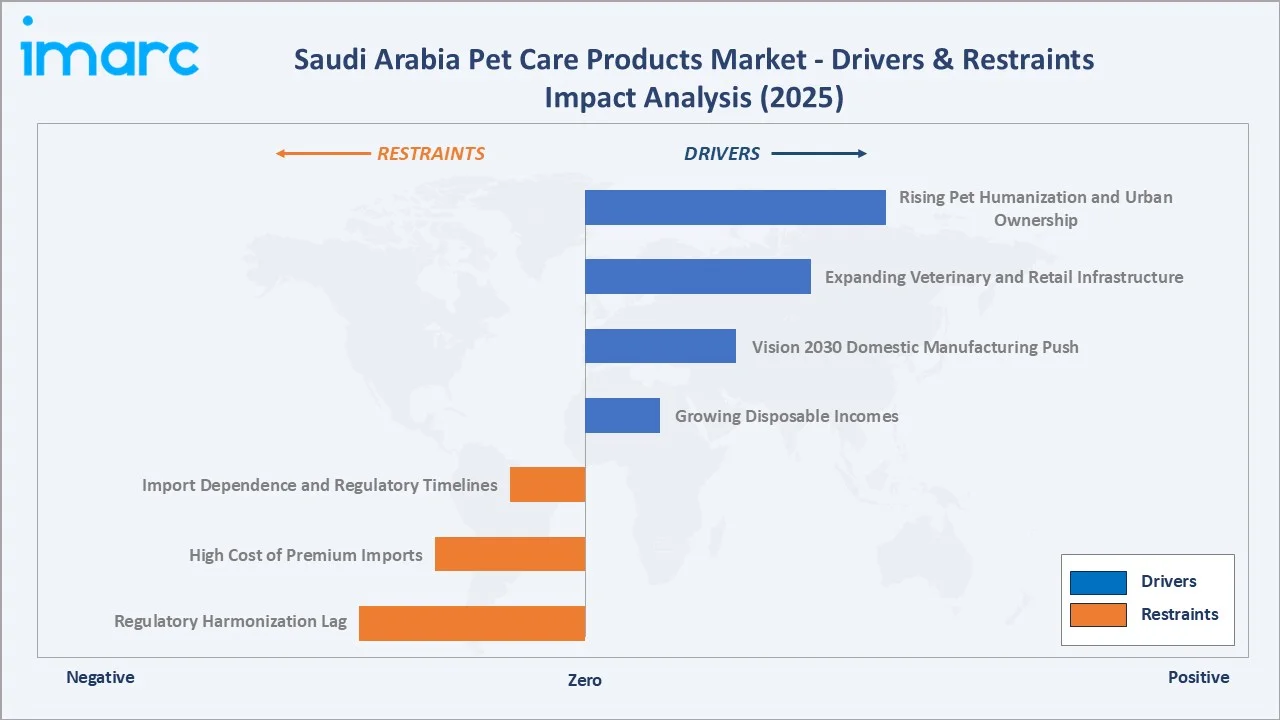
- Rising Pet Humanization and Urban Ownership: Saudi Arabia's pet population has more than tripled to approximately 2.4 million animals, as younger, urban households increasingly treat pets as family members rather than utilitarian animals.
- Expanding Veterinary and Retail Infrastructure: The number of licensed veterinary clinics grew 26% between 2020 and 2023, from 950 to 1,200 facilities according to MEWA data, improving access to preventive care and specialty treatments.
- Vision 2030 Domestic Manufacturing Push: In November 2024, Delicious Food Factory announced construction of a 55,000-square-meter pet food facility near Riyadh, targeting 60,000 tons of dry and 40,000 tons of wet pet food annually under its Horayra, Purevet, and Kulaib brands.
- Growing Disposable Incomes: Saudi per capita income rose to SAR 93,000 in 2023 from SAR 88,000 in 2021 per GASTAT data, enabling greater household spending on premium and organic pet nutrition.
Market Restraints
- Import Dependence and Regulatory Timelines: SFDA registration for new pet food formulations, particularly those carrying therapeutic claims, can take 6-12 months, delaying market entry for international brands.
- High Cost of Premium Imports: ZATCA tariffs average around 5-10% on imported pet products, raising retail prices and limiting affordability of specialized nutrition for middle-income households.
Market Opportunities
- Domestic Manufacturing Localization: Vision 2030 industrial incentives are attracting investment in local pet food production, positioning Saudi Arabia as a potential regional export base for GCC markets.
- Premium and Organic Product Lines: Rising demand for organic, grain-free, and therapeutic diets creates opportunities for brands offering scientifically formulated, traceable nutrition.
Market Challenges
- Regulatory Harmonization Lag: While SFDA aligns with Codex Alimentarius and AAFCO guidelines, inconsistent enforcement of labeling and certification requirements can delay new product registrations by several months.
- Low Pet Ownership Density Outside Urban Centers: Pet ownership remains concentrated in Riyadh, Jeddah, and Dammam, limiting volume growth potential across smaller cities and rural areas.
Emerging Market Trends
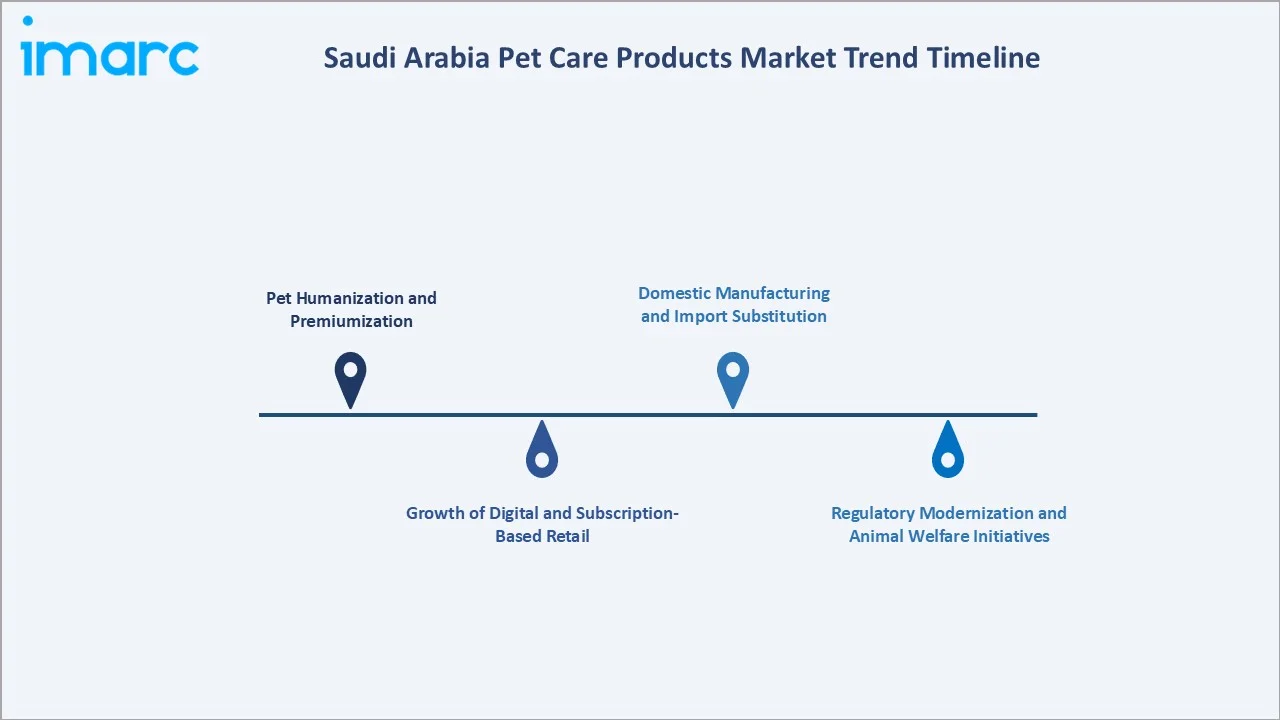
1. Pet Humanization and Premiumization
Saudi pet owners are increasingly treating animals as family members, driving demand for premium, grain-free, and protein-rich formulations. This shift mirrors human health and wellness trends, with owners paying a premium for recognizable, high-quality ingredients.
2. Growth of Digital and Subscription-Based Retail
E-commerce platforms such as Amazon.sa, PetZone, and MyPets are expanding subscription-based pet food delivery and virtual veterinary consultations, aligned with Vision 2030's National Transformation Program priorities for digital commerce and logistics modernization.
3. Domestic Manufacturing and Import Substitution
Delicious Food Factory's 55,000-square-meter facility near Riyadh, targeting 100,000 tons of annual production by late 2026, signals a structural shift toward local manufacturing under Vision 2030's food security goals.
4. Expansion of Pet Insurance and Wellness Services
Tree Digital Insurance Agency launched Saudi Arabia's first licensed pet insurance product in September 2024, covering veterinary care, surgeries, and medications, reflecting growing formalization of the Kingdom's pet care ecosystem.
5. Regulatory Modernization and Animal Welfare Initiatives
MEWA's 2024 animal welfare campaign, which inspects pet shops, clinics, and hospitality facilities, alongside Saudi Aramco's Olfa Animal Welfare launched in August 2024, is professionalizing the sector and strengthening consumer trust.
Industry Value Chain Analysis
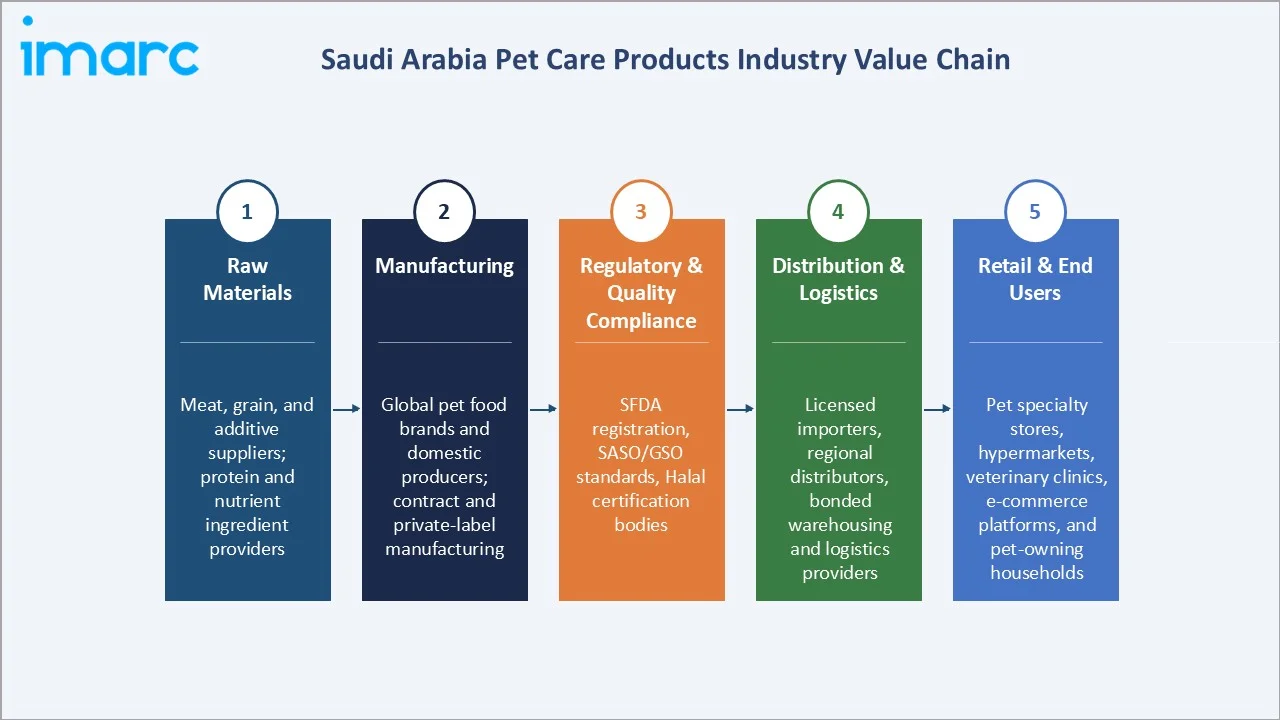
Saudi Arabia's pet care products value chain spans raw material and ingredient sourcing, manufacturing by global and domestic producers, SFDA regulatory compliance, multi-tier distribution, and retail across offline and online channels serving an estimated 2.4 million pet population.
|
Stage |
Key Participants |
|
Raw Materials |
Meat, grain, and additive suppliers; protein and nutrient ingredient providers |
|
Manufacturing |
Global pet food brands and domestic producers; contract and private-label manufacturing |
|
Regulatory & Quality Compliance |
SFDA registration, SASO/GSO standards, Halal certification bodies |
|
Distribution & Logistics |
Licensed importers, regional distributors, bonded warehousing and logistics providers |
|
Retail & End Users |
Pet specialty stores, hypermarkets, veterinary clinics, e-commerce platforms, and pet-owning households |
Distribution follows a multi-tier model in which global manufacturers supply licensed Saudi importers, who in turn service regional sub-distributors, veterinary clinics, and retail outlets. The rise of direct-to-consumer e-commerce platforms such as Amazon.sa and PetZone is compressing traditional importer margins, encouraging brands to pursue direct Saudi distribution agreements.
Technology Landscape in the Saudi Arabia Pet Care Products Industry
Nutrition Science and Functional Ingredients
Global and domestic manufacturers are investing in freeze-dried raw inclusions, hydrolyzed proteins, and functional additives targeting joint health, skin condition, and digestive wellness, mirroring the human nutraceutical trend gaining traction among Saudi pet owners.
Cold-Chain and Packaging Innovation
Frozen and fresh pet food formats require robust cold-chain logistics; Saudi Arabia's growing cold-storage and port infrastructure investment under Vision 2030 supports the entry of premium wet and raw-diet brands.
Digital and Smart Pet Technology
Wearable activity trackers, GPS collars, and app-based veterinary telehealth consultations are gaining traction among tech-savvy, younger Saudi pet owners, supported by high smartphone penetration nationwide.
Manufacturing Automation
Delicious Food Factory's new Riyadh-area facility incorporates automated extrusion and packaging lines, positioning domestic production to compete with imported brands on cost and consistency.
Market Segmentation Analysis
The report covers the following segments:
|
Segment Category |
Leading Segment |
Market Share |
Year |
|
Pet Type |
Cat |
38.4% |
2025 |
|
Type |
Food |
64.7% |
2025 |
|
Region |
Northern & Central Region |
46.8% |
2025 |

By Pet Type
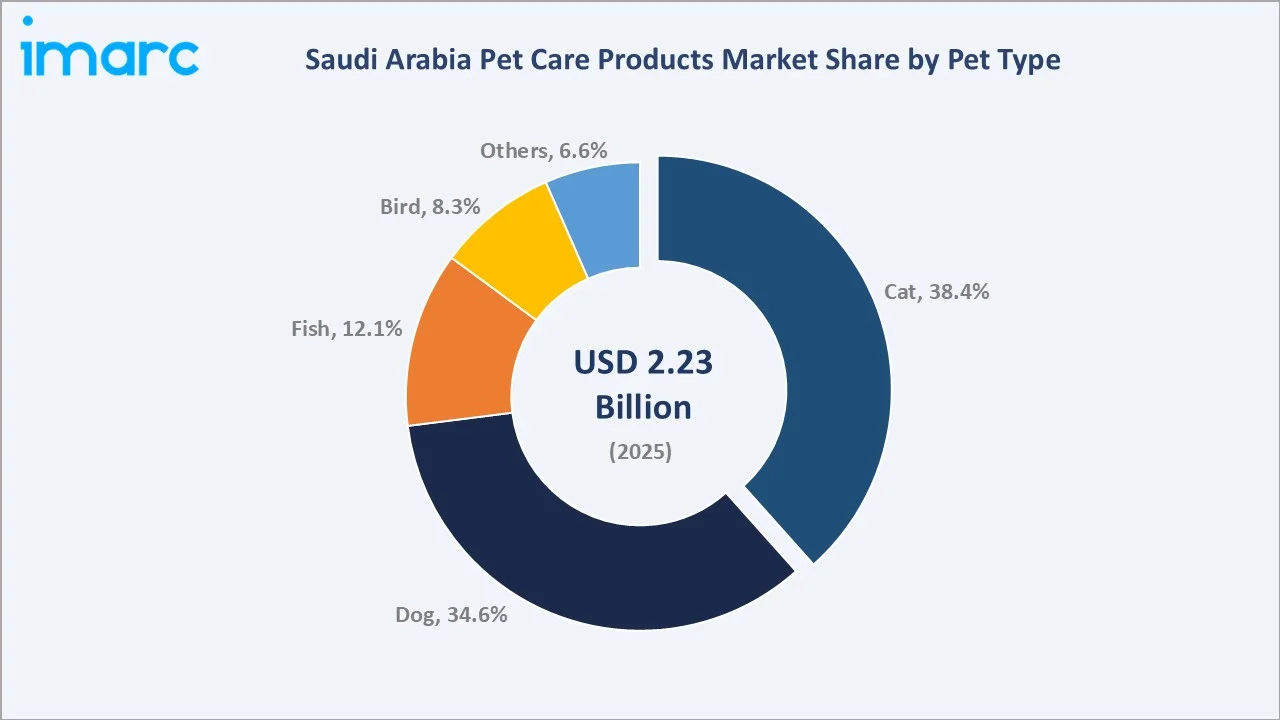
Cats lead pet-type segmentation at 38.4% share (2025), reflecting Saudi households' preference for low-maintenance companion animals suited to apartment and villa living alike. Cat-focused nutrition and litter products post an estimated 5.6% CAGR (2026-2034), the fastest among all pet-type categories, as premiumization accelerates.
To access detailed market analysis, Request Sample
Dogs follow at 34.6% share, driven by demand for guard and companion breeds among suburban households, with an estimated 5.3% CAGR through 2034. Fish, at 12.1% share, and birds, at 8.3% share, represent smaller but stable categories anchored by traditional home aquarium and aviary keeping, while other pets account for the remaining 6.6%.
By Type
Pet food commands 64.7% share (2025), reflecting the recurring nature of nutrition purchases relative to one-time accessory and grooming product spending. Food products are estimated to grow at a 5.4% CAGR (2026-2034), ahead of the 4.7% CAGR projected for non-food pet products.
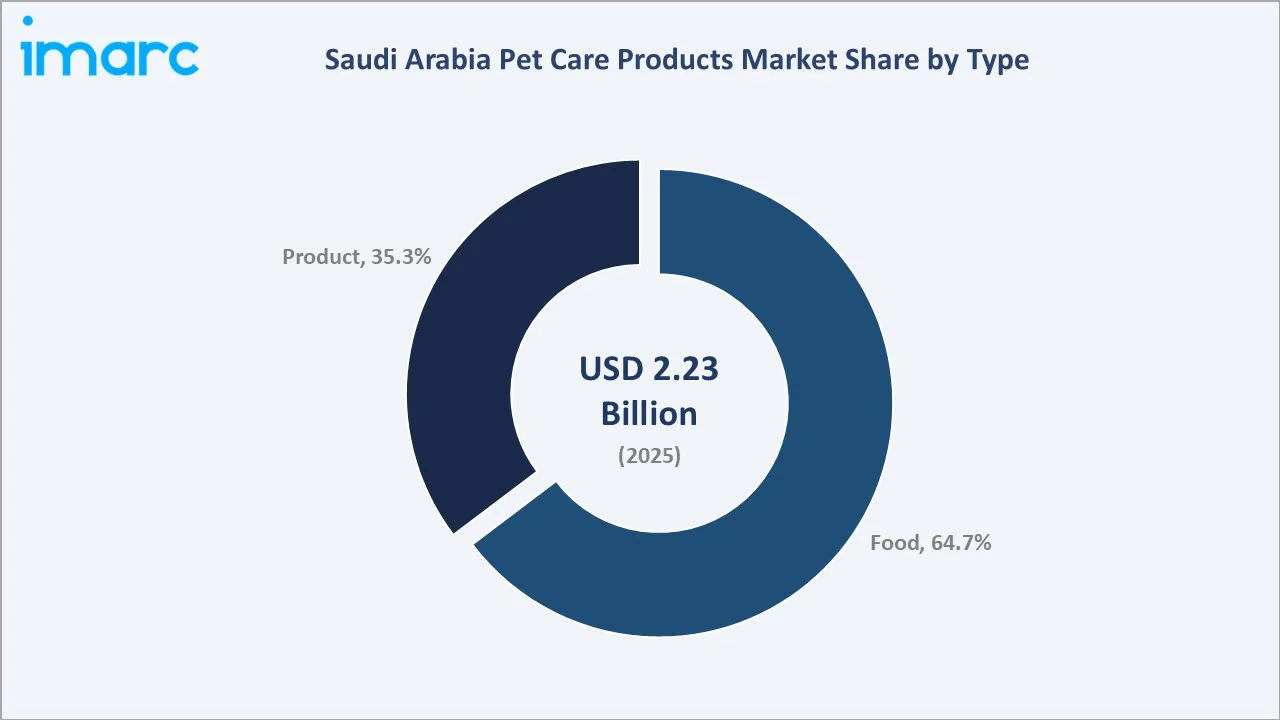
Non-food pet products, comprising grooming tools, accessories, bedding, and toys, hold 35.3% share (2025). Growth in this category is increasingly linked to premiumization, as Saudi pet owners invest in higher-quality collars, carriers, and wellness accessories alongside core nutrition spending.
Regional Market Insights
|
Region |
Share (2025) |
Key Growth Drivers & Characteristics |
|
Northern & Central Region |
46.8% |
Riyadh's concentration of affluent, pet-owning households; dense veterinary and retail infrastructure; largest e-commerce delivery network |
|
Western Region |
24.4% |
Jeddah's cosmopolitan, expatriate-heavy population; strong pet specialty retail presence; port access supporting import logistics |
|
Eastern Region |
17.7% |
Dammam and Khobar's expatriate professional communities; growing veterinary clinic density; industrial and residential expansion |
|
Southern Region |
11.1% |
Emerging urbanization and rising disposable incomes; gradual growth in pet ownership and veterinary access |
The Northern and Central Region's 46.8% dominance reflects Riyadh's status as Saudi Arabia's largest and wealthiest metropolitan area, home to the highest concentration of pet-owning households, licensed veterinary clinics, and e-commerce fulfillment infrastructure.
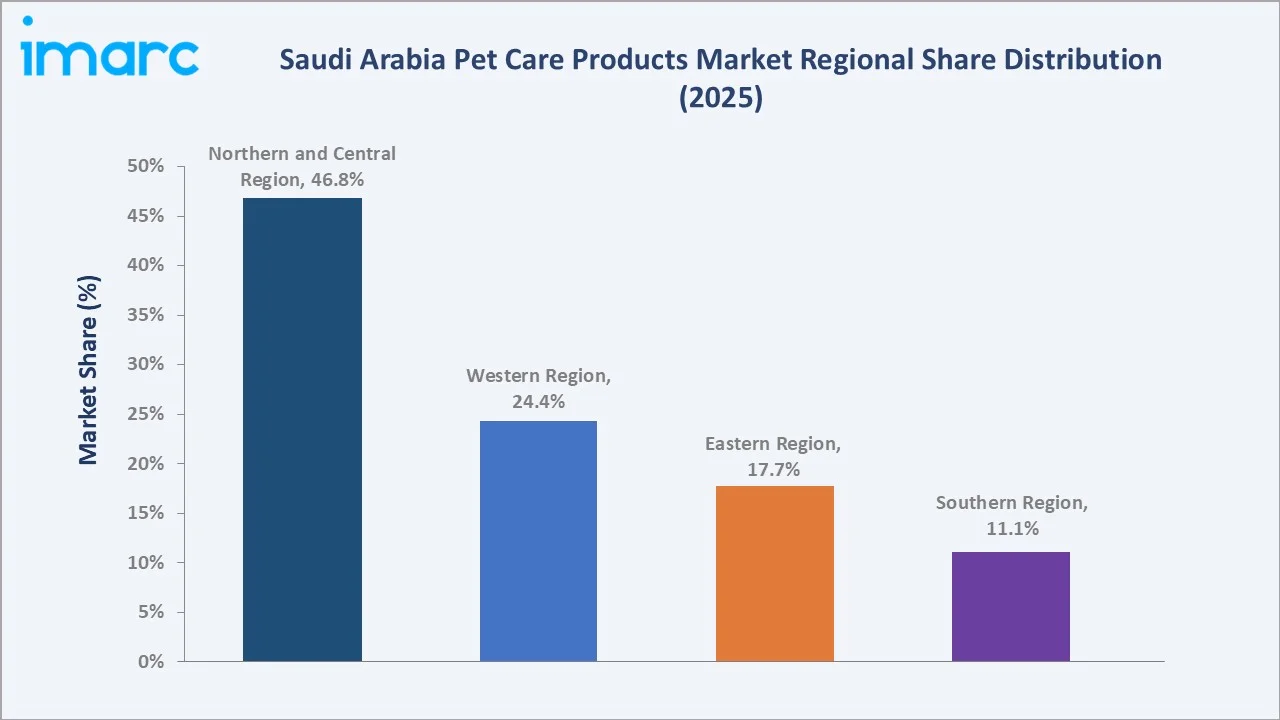
The Western Region's 24.4% share is anchored by Jeddah's large expatriate population and established pet specialty retail presence, while the Eastern Region's 17.7% share benefits from Dammam and Khobar's expatriate professional communities and expanding veterinary infrastructure.
Competitive Landscape
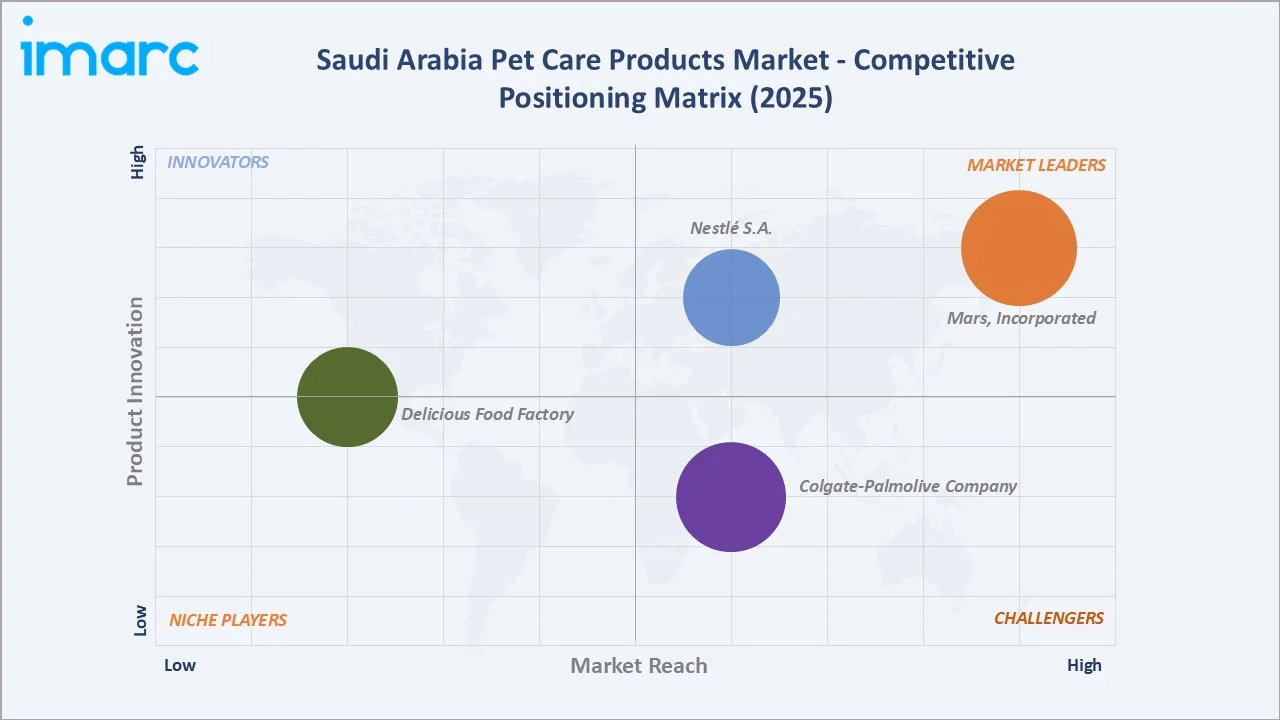
Saudi Arabia's pet care products market is moderately concentrated among global brand owners, with Mars Petcare and Nestlé Purina together estimated to hold 40-50% of value share across mainstream and premium pet food segments (2025), based on industry distribution data.
|
Company Name |
Brand / Product Line |
Market Position |
Core Strength |
|
Mars, Incorporated |
Pedigree, Whiskas, Royal Canin, Sheba |
Market Leader |
Integrating research insights from the WALTHAM Petcare Science Institute, utilizing localized operational hubs, such as its corporate presence and offices in Jeddah |
|
Nestlé S.A. |
Friskies, Purina ONE, and Purina Pro Plan |
Market Leader |
Science-backed nutrition, a robust portfolio of global brands tailored to health needs, and strict quality oversight tailored to the regional market through Purina Arabia |
|
Colgate-Palmolive Company |
Hill’s Science Diet, Hill’s Prescription Diet |
Strong Challenger |
Operates Hill’s Pet Nutrition, integration of proprietary prebiotic technologies (ActivBiome+) designed to rapidly nourish gut bacteria and support long-term digestive wellness |
|
Delicious Food Factory |
Horayra, Purevet, Kulaib |
Emerging Player |
Localized manufacturing scale, strategic alignment with national economic goals, and tailored nutritional science |
The competitive landscape is bifurcated: the mainstream and premium segment is dominated by Mars Petcare and Nestlé Purina through established distribution and veterinary endorsements, while a growing base of domestic producers and niche premium challengers compete on ingredient transparency, Halal certification, and local manufacturing credentials.
Key Company Profiles
Mars, Incorporated
Mars, Incorporated, which operates Mars Petcare, is a leading player in Saudi Arabia's pet care products market, distributing well-established brands including Pedigree, Whiskas, and Royal Canin through regional importers and veterinary channels.
- Product Portfolio: Pedigree, Whiskas, Royal Canin, Sheba, Greenies, and others.
- Strategic Focus: Premium brand positioning anchored by veterinary channel partnerships and nutrition science innovation.
Nestlé S.A.
Nestlé S.A., which operates Nestlé Purina Petcare, is one of the world's largest pet food companies and a leading competitor in Saudi Arabia, supplying Pro Plan, Friskies, and Gourmet through licensed distributors and modern retail.
- Product Portfolio: Friskies, Purina ONE, and Purina Pro Plan, and others.
- Strategic Focus: Scale-driven mainstream and premium nutrition offerings supported by global manufacturing and R&D investment.
Delicious Food Factory
Delicious Food Factory is a Saudi-based domestic manufacturer building the Middle East's largest pet food production facility near Riyadh, directly supporting Vision 2030's local manufacturing objectives.
- Product Portfolio: Horayra, Purevet, Kulaib dry and wet pet food lines.
- Strategic Focus: Import substitution through domestic manufacturing scale-up, targeting cost-competitive positioning against established international brands.
Market Concentration Analysis
Saudi Arabia's pet care products market exhibits moderate concentration at the branded, veterinary-endorsed level and greater fragmentation across mid-tier and value segments. Mars Petcare and Nestlé Purina collectively hold an estimated over 50-60% of value share (2025), with Hill's Pet Nutrition maintaining a strong presence in the veterinary diet and super-premium tier.
Below the premium tier, the market remains fragmented among regional distributors, private-label retailers, and emerging domestic manufacturers. Delicious Food Factory's large-scale production facility represents a notable consolidation vector, positioning domestic supply to compete directly with established import-led brands as capacity scales through 2026 and beyond.
Investment & Growth Opportunities
Fastest Growing Segments
Cat-focused nutrition (~5.6% CAGR), premium and organic pet food (~5.4% CAGR), and e-commerce-led pet retail represent Saudi Arabia's highest-growth investment vectors through 2034, as premiumization and digital adoption continue to reshape purchasing behavior.
Emerging Market Opportunities
Vision 2030's industrial localization financing creates a viable pathway for global and regional pet food manufacturers to establish Saudi-based production. A mid-scale facility serving Saudi Arabia and the broader GCC market would benefit from competitive energy costs and government procurement preference for locally manufactured goods.
Investment Themes
- Domestic manufacturing capacity expansion: Saudi Arabia's food security agenda and Delicious Food Factory's precedent create first-mover advantage for brands establishing local production ahead of 2026-2030 capacity scaling.
- Digital pet retail platform investment: Saudi Arabia's e-commerce growth creates a compelling opportunity for subscription-based pet food delivery and virtual veterinary consultation platforms.
- Pet wellness and insurance services: The September 2024 launch of Saudi Arabia's first pet insurance product signals emerging demand for veterinary financing and wellness subscription models.
Future Market Outlook (2026-2034)
The Saudi Arabia pet care products market is projected to grow from USD 2.23 Billion in 2025 to USD 3.50 Billion by 2034, at a 5.15% CAGR, reflecting steady, structurally supported growth as pet ownership formalizes across the Kingdom's major metropolitan areas.
Three structural forces anchor this growth trajectory through 2034: Vision 2030's sustained investment in veterinary and animal-welfare infrastructure; rising disposable incomes supporting premiumization across food and non-food categories; and the scale-up of domestic manufacturing capacity, led by facilities such as Delicious Food Factory's Riyadh-area plant, which is expected to reduce import dependence and support more competitive pricing across the market.
Research Methodology
Primary Research
Primary research comprised structured consultations with pet food distributors and importers, pet specialty retail managers from Riyadh and Jeddah, veterinary clinic operators, SFDA regulatory contacts, and e-commerce platform representatives.
Secondary Research
Secondary research encompassed SFDA pet food registration and labeling regulations, MEWA veterinary infrastructure and animal welfare data, General Authority for Statistics (GASTAT) income and demographic statistics, ZATCA import data, and company disclosures from major pet care brands operating in the Kingdom.
Forecasting Models
Market value forecasts were developed using segment-level growth modeling by pet type and product type, validated against historical 2020-2025 growth trends and cross-checked against Saudi Customs import data and GASTAT demographic and income projections.
Saudi Arabia Pet Care Products Market Report Coverage:
| Report Features | Details |
|---|---|
| Base Year of the Analysis | 2025 |
| Historical Period | 2020-2025 |
| Forecast Period | 2026-2034 |
| Units | Billion USD |
| Scope of the Report |
Exploration of Historical Trends and Market Outlook, Industry Catalysts and Challenges, Segment-Wise Historical and Future Market Assessment:
|
| Pet Types Covered | Dog, Cat, Fish, Bird, Others |
| Types Covered |
|
| Regions Covered | Northern and Central Region, Western Region, Eastern Region, Southern Region |
| Companies Covered | Mars, Incorporated, Nestlé S.A., Colgate-Palmolive Company, Delicious Food Factory, etc. |
| Customization Scope | 10% Free Customization |
| Post-Sale Analyst Support | 10-12 Weeks |
| Delivery Format | PDF and Excel through Email (We can also provide the editable version of the report in PPT/Word format on special request) |
Key Benefits for Stakeholders:
- IMARC’s industry report offers a comprehensive quantitative analysis of various market segments, historical and current market trends, market forecasts, and dynamics of the Saudi Arabia pet care products market from 2020-2034.
- The research report provides the latest information on the market drivers, challenges, and opportunities in the Saudi Arabia pet care products market.
- Porter's five forces analysis assist stakeholders in assessing the impact of new entrants, competitive rivalry, supplier power, buyer power, and the threat of substitution. It helps stakeholders to analyze the level of competition within the Saudi Arabia pet care products industry and its attractiveness.
- Competitive landscape allows stakeholders to understand their competitive environment and provides an insight into the current positions of key players in the market.
Frequently Asked Questions About the Saudi Arabia Pet Care Products Market Report
The Saudi Arabia pet care products market reached USD 2.23 Billion in 2025, driven by rising pet humanization, expanding veterinary infrastructure, and Vision 2030's domestic manufacturing push.
The market is projected to grow at a CAGR of 5.15% during 2026-2034, reaching USD 3.50 Billion by 2034, supported by premiumization and rising disposable incomes.
Cat lead at 38.4% share (2025), reflecting Saudi households' preference for low-maintenance companion animals suited to apartment and villa living.
Food commands the largest share at 64.7% (2025), anchored by recurring nutrition purchases across mainstream and premium brands.
The Northern and Central Region leads with 46.8% share (2025), anchored by Riyadh's dense, affluent pet-owning population and retail infrastructure.
Leading companies include Mars, Incorporated, Nestlé S.A., Colgate-Palmolive Company, and Delicious Food Factory, among others.
Vision 2030 supports veterinary infrastructure expansion, domestic pet food manufacturing, and digital commerce growth, collectively strengthening market fundamentals.
The Saudi Food and Drug Authority regulates pet food registration, labeling, ingredient disclosure, and Halal certification for imported and locally produced products.
The market is projected to reach approximately USD 2.86 Billion by 2030, supported by continued premiumization and veterinary infrastructure expansion.
Platforms such as Amazon.sa, PetZone, and MyPets are expanding subscription delivery and virtual veterinary consultations, aligned with Vision 2030's digital economy goals.
Need more help?
- Speak to our experienced analysts for insights on the current market scenarios.
- Include additional segments and countries to customize the report as per your requirement.
- Gain an unparalleled competitive advantage in your domain by understanding how to utilize the report and positively impacting your operations and revenue.
- For further assistance, please connect with our analysts.
 Request Customization
 Speak to an Analyst
 Request Brochure
 Inquire Before Buying
Benefits of Customization
- Personalize this research
- Triangulate with your data
- Get data as per your format and definition
- Gain a deeper dive into a specific application, geography, customer, or competitor
- Any level of personalization
Get in Touch With Us
UNITED STATES
Phone: +1-201-971-6302
INDIA
Phone: +91-120-433-0800
UNITED KINGDOM
Phone: +44-753-714-6104
Email: [email protected]
Client Testimonials




.webp)




.webp)













Related Reports

Choose your plan
*Please note that the prices mentioned below are starting prices for each bundle type. Kindly contact our team for further details.*
Single User License
- 1 User License, Access on 2 Devices
- PDF Report + Excel Dataset (Password Protected)
- Lifetime Access
- No Printing Rights
- 10% Free Report Customization
- 10–12 Weeks of Analyst Support
Five User License
- Access for 5 Users, 2 Devices per User
- PDF Report + Excel Dataset (Password Protected)
- Lifetime Access
- Dedicated Account Manager
- 12–14 Weeks of Analyst Support
- No Printing Rights
- 15% Free Report Customization
- 25% Discount on Your Next Purchase
Corporate User License
- Unlimited User Access (Within Your Organization)
- PDF Report + Excel Dataset
- Lifetime Access
- Dedicated Account Manager
- 14–20 Weeks of Analyst Support
- No Printing Rights
- 20% Free Report Customization
- 30% Discount on Your Next Purchase
Essential Insights
What's included:
3 reports
- Lifetime Access
- PDF Reports
- Excel Datasets
- 2 Weeks of Free Analyst Support
- 2 User Licenses
- Access on 2 Devices
- Printing Rights
- Complimentary PowerPoint (PPT) Version
- Complimentary License Upgrade
Professional Access
What's included:
5 reports
- Lifetime Access
- PDF Reports
- Excel Datasets
- 8 Weeks of Free Analyst Support
- 2 User Licenses
- Access on 2 Devices
- Printing Rights
- Complimentary PowerPoint (PPT) Version
- Complimentary License Upgrade
Business Advantage
What's included:
8 reports
- Lifetime Access
- PDF Reports
- Excel Datasets
- 14 Weeks of Free Analyst Support
- 2 User Licenses
- Access on 2 Devices
- Printing Rights
- Complimentary PowerPoint (PPT) Version
- Complimentary License Upgrade
Enterprise Intelligence
What's included:
10 reports
- Lifetime Access
- PDF Reports
- Excel Datasets
- 20 Weeks of Free Analyst Support
- 2 User Licenses
- Access on 2 Devices
- Printing Rights
- Complimentary PowerPoint (PPT) Version
- Complimentary License Upgrade